Article

Ultrafast Spin Dynamics of Pt/Gd19(Co0.8Fe0.2)81/Ta Heterostructure Investigated by Double-Pump Terahertz Emission Spectroscopy


1
Terahertz Technology Innovation Research Institute, Terahertz Spectrum and Imaging Technology Cooperative Innovation Center, Shanghai Key Laboratory of Modern Optical System, University of Shanghai for Science and Technology, Shanghai 200093, China
2
Shanghai Institute of Intelligent Science and Technology, Tongji University, Shanghai 200092, China
*
Authors to whom correspondence should be addressed.
These authors contributed equally to this work.
Nanomaterials 2026, 16(7), 390; https://doi.org/10.3390/nano16070390
Submission received: 5 March 2026 / Revised: 22 March 2026 / Accepted: 22 March 2026 / Published: 24 March 2026
(This article belongs to the Special Issue Ultrafast Terahertz Photonics in Nanoscale and Applications)

Abstract

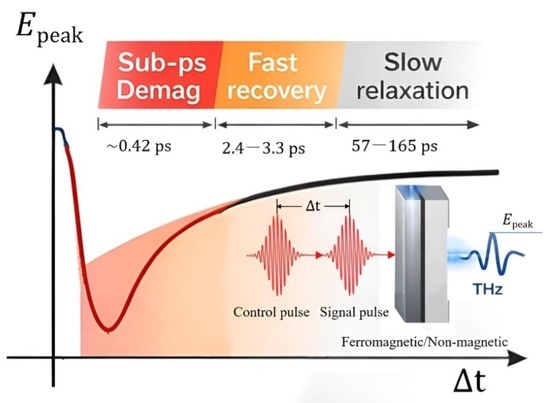
Ultrafast spin dynamics is a core research focus for advancing ultrafast spintronic devices, yet its accurate quantitative probing remains a challenge with conventional time-resolved techniques. Herein, we employ double-pump optical pump–terahertz emission spectroscopy (OPTE) to investigate the ultrafast spin dynamics of a Pt/Gd19(Co0.8Fe0.2)81/Ta ferrimagnetic rare-earth–transition-metal heterostructure. Experimental measurements resolve a single-step ultrafast demagnetization process with a characteristic time of ~0.42 ± 0.02 ps, followed by two-stage magnetic recovery involving a fast relaxation and a slow relaxation process. The fast and slow recovery time constants show a distinct positive dependence on the control pump fluence, increasing from 2.49 ± 0.11 ps to 3.28 ± 0.03 ps and 57.36 ± 11.28 ps to 164.96 ± 1.61 ps, respectively, as the pump fluence rises from 0.80 to 1.19 mJ/cm2. The ~0.42 ps demagnetization timescale is consistent with that of 3d transition metals, indicating the transient magnetic response of the low-Gd-concentration heterostructure is dominated by the CoFe sublattice. Our findings validate that OPTE is an effective approach for the quantitative characterization of electron–lattice–spin coupling processes in spin-based heterostructures and provide critical experimental insights for controllable manipulation of ultrafast spin dynamics, laying a foundation for the design of ultrafast terahertz spintronic devices.

Graphical Abstract

1. Introduction

Ultrafast demagnetization is the significant magnetization reduction in magnetic materials on sub-picosecond to several-picosecond timescales after femtosecond pulse excitation. First investigated in Ni thin films by Eric Beaurepaire et al. in 1996 [1], it has become a core topic in spintronics research [2,3,4,5,6]. Its ultrafast dynamics indicates an efficient angular momentum dissipation channel in ferromagnets [7,8]. By the Einstein–de Haas effect, spin angular momentum is ultimately transferred to the lattice [9,10]. The ultrashort laser–magnetic material interaction reveals nonequilibrium electron–lattice–spin coupling, and lays the experimental/theoretical foundation for ultrafast magnetic storage, terahertz (THz) spintronic devices, and optically controlled spin dynamics [11,12,13].
Regarding the underlying mechanisms, two primary scenarios explain laser-induced sub-picosecond demagnetization. The first is spin-flip scattering: nonequilibrium electrons excited by femtosecond pulses collide with phonons or impurities in the ferromagnet, triggering spin flips [14,15]. The second is super-diffusive spin transport [16,17]: the excited majority electrons have higher band velocities and longer lifetimes than the minority ones, depleting majority carriers and reducing magnetization in the excited region. Femtosecond laser-induced spin transport generates sub-picosecond spin-polarized currents, which convert to in-plane charge currents at ferromagnetic–nonmagnetic interfaces via spin–orbit coupling, ultimately producing THz radiation [18,19,20].
Experimentally, ultrafast demagnetization dynamics is characterized by various time-resolved techniques, such as the time-resolved magneto-optical Kerr effect (TR-MOKE) [21,22,23], time-resolved X-ray magnetic circular dichroism (TR-XMCD) [24,25], and optical second-harmonic generation (SHG) [26,27]. Though the TR-MOKE is a standard tool for studying ultrafast demagnetization and magnetization precession, quantifying its signals is non-trivial—its transient optical response does not directly reflect intrinsic magnetization evolution, but is modulated by the material’s wavelength-dependent optical and magneto-optical coefficients [28]. TR-XMCD and SHG are limited by radiation sources and optical penetration depth, respectively [29,30]. Thus, accurately probing ultrafast spin dynamics in materials and functional heterostructures under realistic device conditions remains a challenge.
With the rapid development of ultrafast THz spectroscopy, time-resolved optical pump–THz emission spectroscopy (OPTE) has emerged as a powerful platform for detecting and manipulating spin dynamics. Representative examples include recent studies on ultrafast spin dynamics in Fe thin films [31], antiferromagnetic–ferromagnetic phase transition in FeRh [32,33], and nonlinear magnetic responses in ferromagnetic heterostructures [34], demonstrating that OPTE offers a complementary and effective experimental approach for exploring ultrafast spin dynamics in ferromagnetic systems [35].
Pt/GdCoFe/Ta is a ferrimagnetic rare-earth and transition-metal heterostructure with great application potential. Its Gd–CoFe alloy layer has tunable ferromagnetism, and the antiparallel coupling between rare-earth Gd and transition metals Co/Fe endows it with rich magnon–lattice dynamical characteristics [36,37]. In this work, we use OPTE to study the ultrafast spin dynamics in a ferrimagnetic Pt/GdCoFe/Ta heterostructure. A single-step demagnetization process followed by two-stage magnetic recovery is observed. Our results provide insights into femtosecond-scale magnetic loss and recovery processes, and promote the advancement of ultrafast spintronics toward more controllable manipulation.

2. Materials and Methods

2.1. Sample Preparation

In this work, a Pt(3 nm)/Gd19(Co0.8Fe0.2)81(10 nm)/Ta(3 nm) heterostructure was deposited on the SiO2 substrate via a Kurt J. Lesker Company magnetron sputtering system (Jefferson Hills, PA, USA), with a base pressure of 3.0 × 10⁻⁸ torr. The 10 nm-thick Gd19(Co0.8Fe0.2)81 film was co-sputtered from Co0.8Fe0.2 and Gd targets, with precise Gd concentration control achieved by adjusting Gd target sputtering power while keeping the deposition time constant. A 3 nm-thick Ta buffer layer was first deposited on 0.5 mm-thick SiO2 substrates to enhance film adhesion and surface smoothness, followed by a 10 nm-thick Gd19(Co0.8Fe0.2)81 layer and a capping layer of Pt(3 nm-thick) to prevent oxidation. Due to the negative exchange coupling between Fe atoms’ 3d spin magnetic moment and Gd 4f orbitals’ magnetic moment, FeCo and Gd sublattices form a collinear antiferromagnetic coupling, such that the alloy film’s net magnetization is determined by Gd concentration.

2.2. Experimental Setup

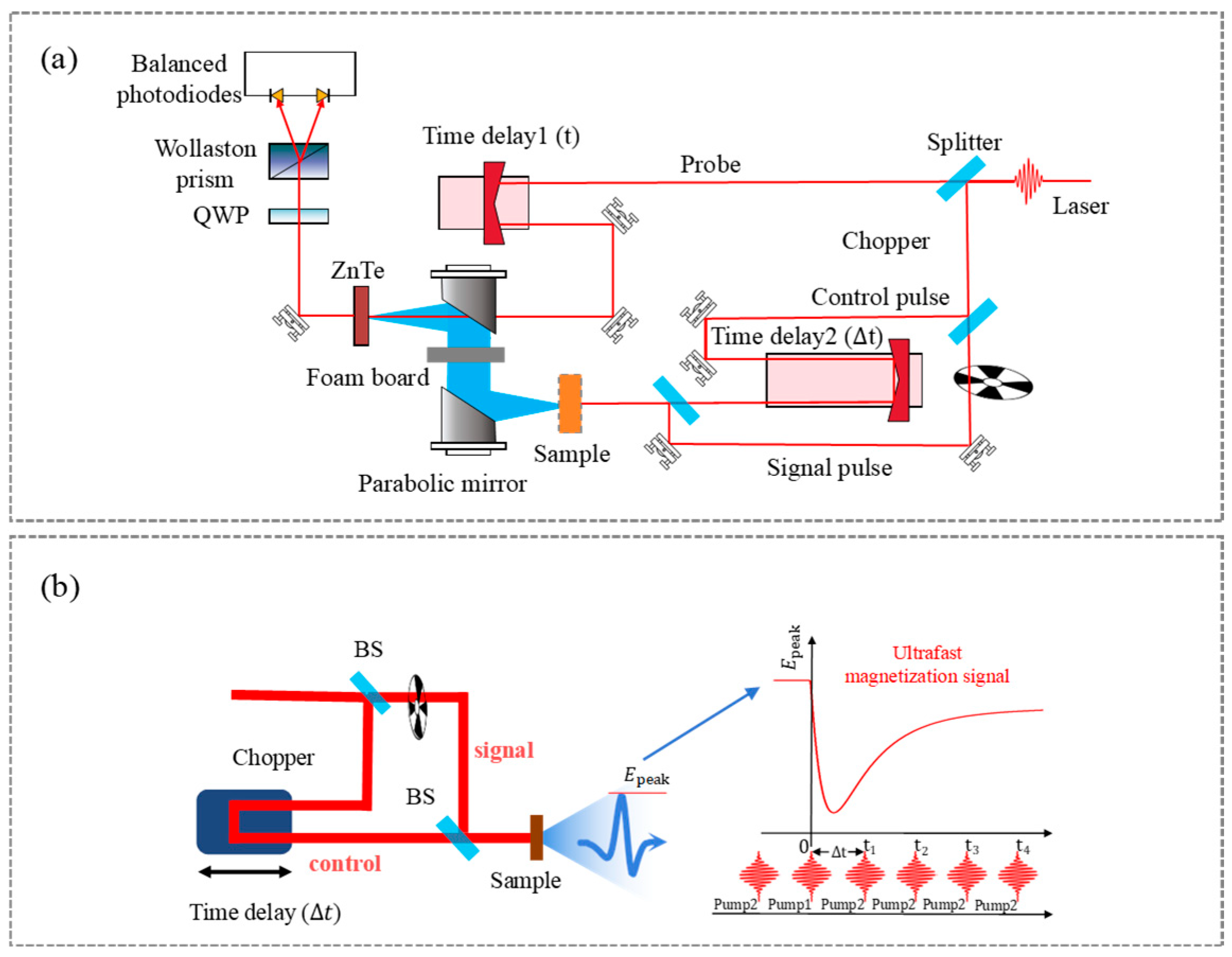
Figure 1a shows the configuration of the double-pump optical pump–THz emission (OPTE) setup. The system is driven by a 1 kHz repetition rate femtosecond laser (central wavelength: 800 nm and pulse duration: 35 fs) with linearly polarized output. The incident beam is split by a beam splitter into pump and probe branches: the pump beam excites the sample to emit THz radiation, which is collected by two off-axis parabolic mirrors into a (110)-oriented ZnTe electro-optic crystal (1 mm thick) for time-domain detection via electro-optic sampling. A precision delay stage (Time delay 1) in the probe beam path scans the pump–probe time delay t , enabling reconstruction of the complete THz temporal waveform. To realize a double-pump modulation scheme, the pump beam is further split by a second beam splitter into two independent excitation pulses: the signal pulse (Pump 1) and the control pulse (Pump 2). Pump 1 acts as the signal branch to generate THz radiation, while Pump 2 serves as the control pulse to induce transient modifications of the material’s magnetization state. The two pump beams are overlapped spatially and collinearly incident on the sample, with their relative timing precisely tuned via independent delay stages. A second delay line (Time delay 2) is introduced in the control-pulse beam’s path to adjust the temporal separation Δ t relative to the signal pulse. An in-plane magnetic field of ±160 mT was applied to keep the sample in the saturated magnetization state, by an electromagnet.
In the OPTE experiment, the chopper is placed in the signal pump’s path, such that only the signal pulse is modulated according to the lock-in amplification principle. When the signal pump pulse passes through the chopper, the THz emission signal E THz signal   &   control is generated by the combined action of the signal and control pump pulses. When the chopper blocks the signal pump pulse, only the unmodulated control pump pulse generates the THz emission signal E THz control . The measured signal is then obtained as the difference, E THz signal   &   control E THz control . We can measure the change in the peak value of E THz Signal , E peak Δ t , which is induced by ultrafast demagnetization using a control pump pulse.
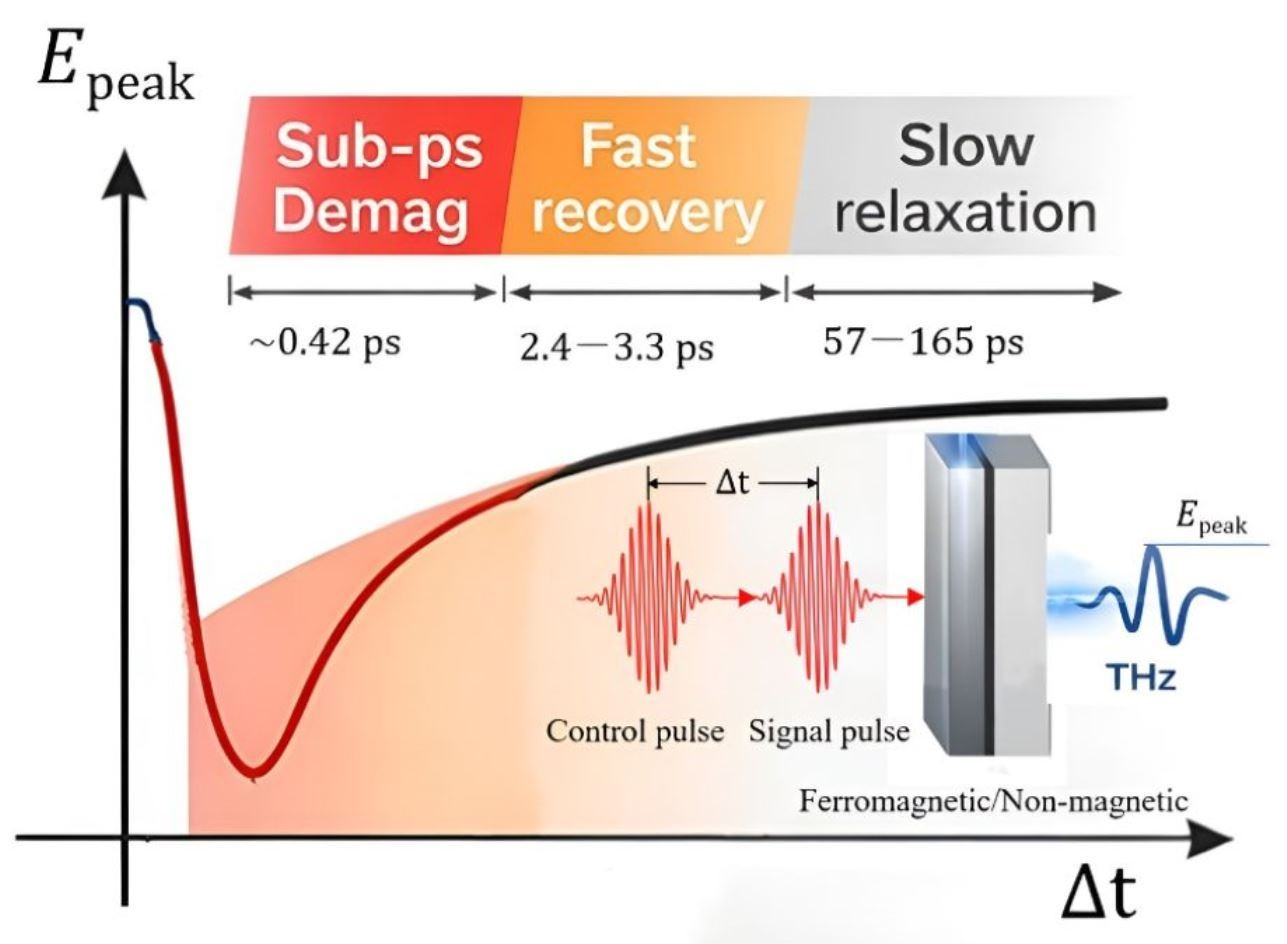
Figure 1b illustrates the principle of OPTE for probing ultrafast spin dynamics. In the double-pump modulation measurement, Time delay 1 is fixed at the peak position of the emitted THz field (denoted as E peak ), while Time delay 2 is scanned to adjust the temporal separation Δ t between Pump 1 and Pump 2 pulses. The peak amplitude of the THz emission generated by the signal beam (Pump 1) E peak is modulated by the sample’s transient magnetization change and subsequent recovery processes induced by the control beam (Pump 2). On this basis, the initial ultrafast demagnetization and the sub-picosecond to tens-of-picoseconds magnetic recovery dynamics can be experimentally resolved.

3. Results and Discussion

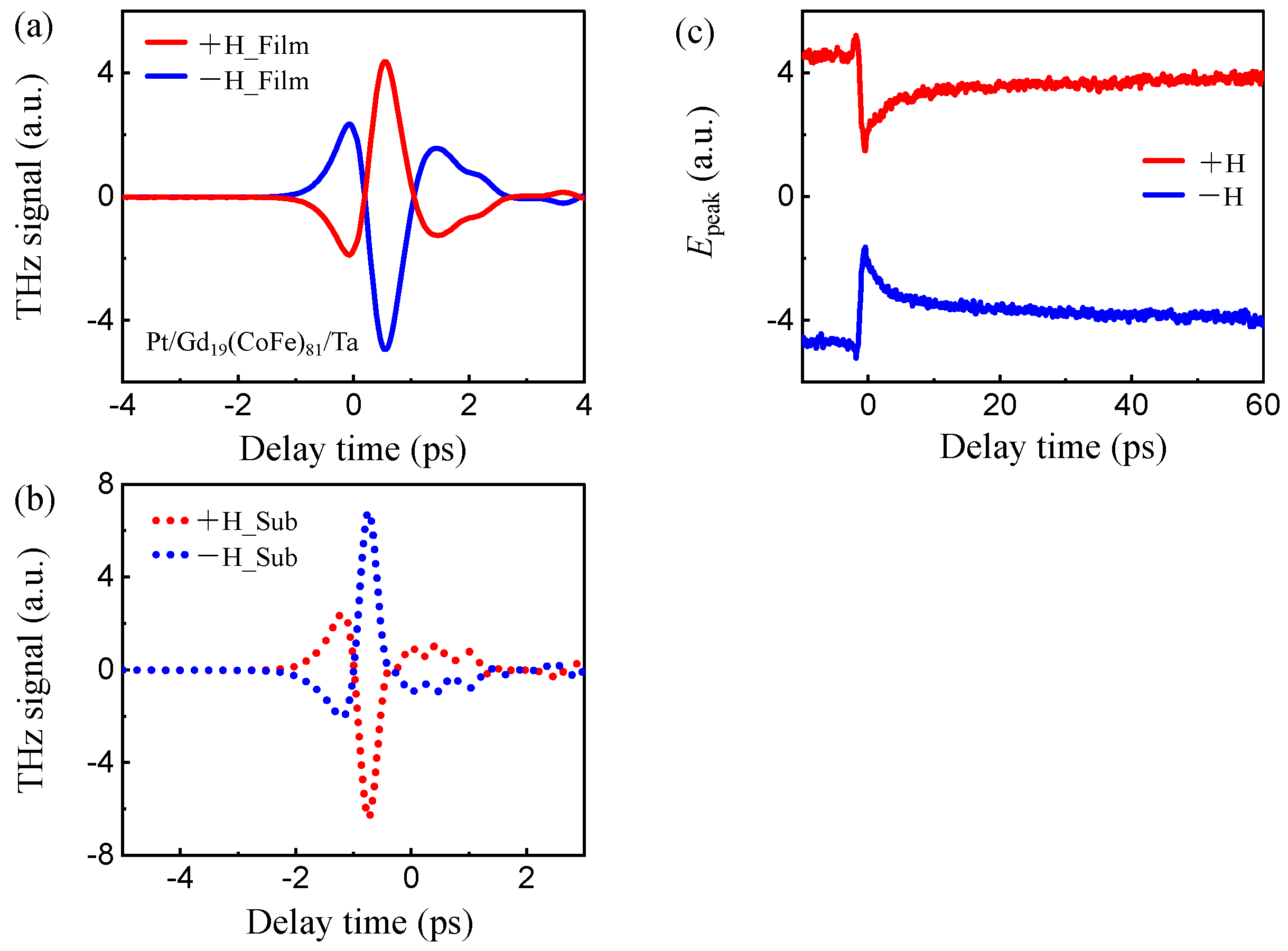
Figure 2a presents the THz time-domain signals emitted from the film-side-pumped Pt/Gd19(CoFe)81/Ta/SiO2 heterostructure under opposite external magnetic fields (+H and −H). A clear polarity reversal of the THz electric field waveform is observed upon reversing the magnetic field direction, and the signal amplitude remains nearly unchanged. This symmetry indicates that the THz radiation originates from magnetization-related transient currents rather than from nonmagnetic effects such as thermal radiation or optical rectification. Figure 2b presents the THz time-domain signals measured under substrate-side excitation under identical experimental conditions. When the external magnetic field is reversed from +H to −H, the THz waveform exhibits a clear polarity reversal. Compared with the film-side excitation, applied with the same magnetic field direction, the substrate-side incidence reverses the polarity of the emitted THz radiation. Such behavior is consistent with previous reports on the inverse spin Hall effect (ISHE) in ferromagnet/heavy-metal multilayers [38,39]. The femtosecond optical laser induces ultrafast spin current J S (t) in the ferromagnetic layer, which propagates toward the adjacent heavy-metal layer. Through the ISHE, J S (t) is converted into a transverse charge current J C (t), following J C t J S t × σ , where σ is the spin polarization, which is parallel to M . The time-dependent charge current J C t acts as a transient dipole source that radiates THz electromagnetic fields in the far field.
Figure 2c shows the OPTE signals E peak Δ t of the Pt/Gd19(CoFe)81/Ta heterostructure measured under positive and negative magnetic fields. Consistent with the emitted THz time-domain waveforms, the OPTE signal reverses its polarity upon magnetic field reversal. Note that the spin current generated by ultrafast demagnetization is proportional to M × d M / d t , even under magnetization reversal. However, the conversion of spin current into a charge current via the ISHE introduces an additional factor through the spin polarization σ . Therefore, the J C is odd with respect to magnetization reversal. This demonstrates that the OPTE signal reflects the evolution of magnetization, confirming the feasibility of this approach for investigating ultrafast spin dynamics. Three distinct dynamical processes can be identified: an initial sub-picosecond demagnetization characterized by a rapid signal decrease, followed by a fast magnetic recovery, and subsequently a slow relaxation process extending to nearly a hundred picoseconds.
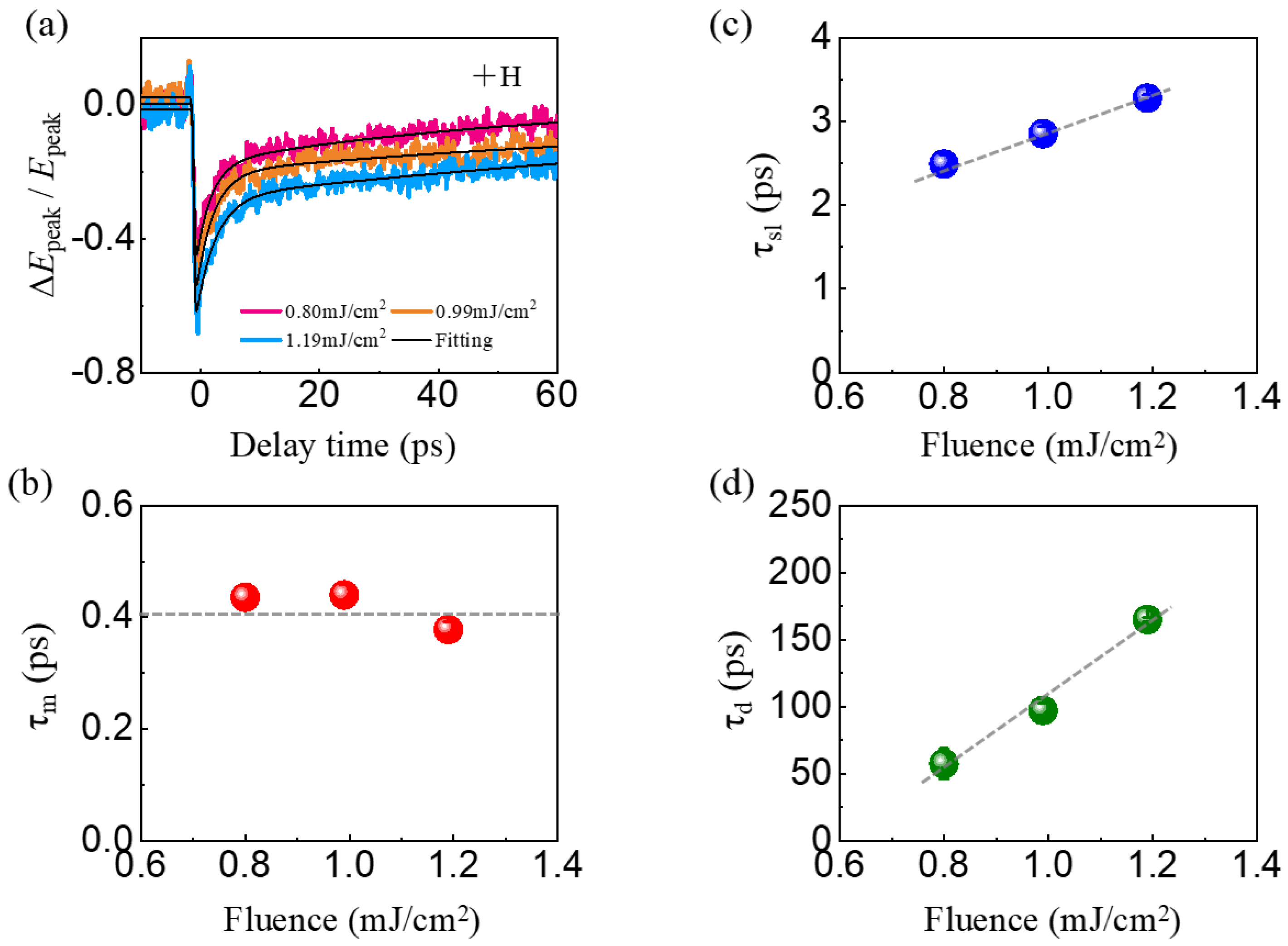
Figure 3a shows the control pulse fluence dependence of the normalized modulation signal Δ E peak Δ t / E peak for the Pt/Gd19(CoFe)81/Ta heterostructure under positive magnetic fields, where Δ E peak Δ t is obtained by subtracting the initial THz peak amplitude E peak from E peak Δ t . It can be found that the amplitude of Δ E peak Δ t / E peak Δ M Δ t increases monotonically with increasing pump fluence, rising from 50% at 0.8 mJ/cm2 to 68% at 1.19 mJ/cm2. This trend indicates that a stronger control pulse induces more pronounced demagnetization.
Analogous to conventional pump–probe spectroscopy, the temporal resolution of Δ E p e a k Δ t / E p e a k is determined by the optical pulse duration rather than the THz pulse duration, which investigates spin dynamics. In order to quantitatively analyze the ultrafast spin dynamics observed in Figure 3a, it is required to obtain the time constants of the spin dynamics, experimental data were fitted with a phenomenological bi-exponential model [31]:
Δ E peak Δ t E peak = 1 erf 2 ln 2 Δ t τ m × A B exp Δ t τ sl + B exp Δ t τ d + C
where parameters A and B show the demagnetization amplitudes before and after the fast recovery process, respectively. τ m is on the sub-picosecond timescale and characterizes the ultrafast demagnetization process. The time constants τ sl and τ d describe fast magnetic recovery and subsequent slow relaxation process, respectively. τ sl is associated with spin–lattice angular momentum transfer, while τ d relates to the thermal diffusion from the multilayer to the substrate and ambient environment [40,41,42].
The control-pulse-fluence-dependent experimental data Δ E peak Δ t / E peak can be well fitted using Equation (1), as plotted by the black curves in Figure 3a. Figure 3b presents the extracted values of the ultrafast demagnetization time constant τ m under a positive magnetic field as a function of the control pulse fluence. It can be found that τ m exhibits an independence on the pump fluence. The average demagnetization time is determined to be τ m ≈ 0.42 ± 0.02 ps. This value is consistent with the previously reported ultrafast demagnetization time of rare-earth and transition-metal ferrimagnetic alloys. For example, in the Fe74Gd26 system, TR-XMCD yielded an Fe sublattice demagnetization time of ~0.47 ps, while the Gd sublattice achieved a demagnetization time of 0.90 ± 0.10 ps [43]. This indicates that the spin dynamics in Pt/Gd19(CoFe)81/Ta is dominated by 3d transition-metal electrons.
Table 1 presents three sets of time constant τ m , spin–lattice relaxation τ sl and heat diffusion τ d values, obtained by various experimental techniques across different material systems. As shown in Table 1, τ m is consistent with previously reported values, such as ~250 ± 30 fs for Fe/W [44], ~300 fs for FeGe [45] and 215–400 fs for Fe60Al40 [46].
Notably, the Pt/Gd19(CoFe)81/Ta system studied here has a relatively low Gd concentration, so its transient magnetic response is dominated by the CoFe transition-metal sublattice. Consequently, only a single demagnetization process is observed, unlike the two-step demagnetization typically reported for high-Gd-content systems [47]. For 3d ferromagnetic metals, ultrafast magnetization dynamics are generally attributed to electron–magnon scattering [48,49,50].
Table 1. Summary of time constants of UDM ( τ m ), and spin–lattice relaxation ( τ sl ) and heat diffusion ( τ d ).
Material τ m (fs) τ s l (ps) τ d (ps)MethodsRefs.
3d ferromagnetic metalsCo~260//TR-MOKE[15]
Ni~160//TR-MOKE[15]
Fe373 ± 200.38 ± 0.02–0.42 ± 0.01/OPTE[31]
Co130–2000.4–0.6/OPTE[35]
Fe/MgO(100)50–750.8 ± 0.13>100TR-MOKE[50]
Fe/MgO~200//TR-MOKE[51]
Fe/MgO(001)   < 400//TR-MOKE[52]
Magnetic alloysFeGe(111)~300~4.8/TR-MOKE[45]
Fe60Al40215 ± 50–400 ± 50//TR-MOKE[46]
L10-FePt~2000.4–1.4~100–260TR-MOKE[53]
FeRh275–325 (Fe)
275–350 (Rh)
//TR-XUV-MOKE[54]
NiFe~160 ± 30/~3–4.5TR-MOKE[55]
Ferromagnetic heterostructuresTbCo/Pt120–2800.3–0.7/OPTE[35]
Co/Pt100–2900.3–0.8/OPTE[35]
Fe/W(110)250 ± 30~2–9/TR-MOKE[44]
Fe/W(110)~350–500~4–7/TR-SPES[45]
Co2FeAl0.5Si0.5/Pt~270~0.8~1300TR-MOKE[56]
Co2FeAl0.5Si0.5/Ta~280~1.5/TR-MOKE[56]
Fe/Pt280–300//Calculation[57]
Fe/Al280–300//Calculation[57]
Fe/Au350–400//Calculation[57]
Ta/Gd0.22(Co0.8Fe0.2)0.78/Al~500~1–3/TR-MOKE[47]
Ta/Gd0.24(Co0.8Fe0.2)0.76/Al τ m 1 : 1160
τ m 2 : 15,000
>30/TR-MOKE[47]
Pt/Gd19(CoFe)81/Ta420 ± 202.49 ± 0.11–3.28 ± 0.0357.36 ± 11.28–164.96 ± 1.61OPTEThis work
After demagnetization, the system enters the magnetic recovery process. Figure 3c,d show the pump fluence dependences of the fitted τ sl and τ d values, respectively. Under +H, the τ sl of the Pt/Gd19(CoFe)81/Ta heterostructure increases from approximately 2.49 ± 0.11 ps to 3.28 ± 0.03 ps over the fluence range, being longer than that for lots of single ferromagnets, while being similar to that for FM/NM heterostructures, such as τ sl = 2–9 ps for Fe/W(110) multilayers probed by TR-MOKE [44]. The τ sl is related to the magnetic anisotropy. As the pump fluence increases, spin agitation is enhanced, resulting in a greater reduction in the transient magnetic anisotropy energy. The reduction in transient magnetic anisotropy is mainly responsible for the slower spin–lattice relaxation observed at higher pump fluence.
Additionally, the slow recovery time constant, τ d , increases from approximately 57.36 ± 11.28 ps to 164.96 ± 1.61 ps as the control pump fluence increases from 0.80 to 1.19 mJ/cm2. For comparison, values reported in previous works are τ d > 100 ps for Fe/MgO(100) multilayers [50] and ~100–260 ps for L10-FePt [53]. This indicates that the pump fluence used in this work is high enough to raise the temperature of the heterostructure. Therefore, the thermal energy transfer between the sample and the substrate generally takes a longer time under higher laser pump fluence in our experiment.

4. Conclusions

This work investigates the ultrafast spin dynamics of Pt/Gd19(CoFe)81/Ta heterostructures grown on SiO2 substrate using double-pump optical pump–terahertz emission spectroscopy. The experimental results clearly resolve a single-step demagnetization process with a characteristic time of approximately 0.42 ps, followed by two distinct magnetic recovery components occurring on different timescales. The extracted demagnetization time is consistent with the typical timescale of 3d transition-metal sublattices, indicating that the transient magnetic response is dominated by the CoFe sublattice. Our results demonstrate that OPTE provides a complemental approach for characterizing multi-timescale coupling processes in ferrimagnetic heterostructures on the femtosecond timescale, offering experimental insights for ultrafast spin manipulation [58] and THz device engineering [59,60].

Author Contributions

Conceptualization, H.Z. and Z.J.; methodology, Z.J., Z.L. and H.X.; formal analysis, C.L., Z.L., B.L. and N.Y.; investigation, C.L., B.L., Z.L., H.X. and N.Y.; data curation, C.L., B.L., Z.L. and H.X.; data review, H.Z. and Z.J.; writing—original draft preparation, C.L., B.L. and Z.J.; writing—review, Z.J. and H.Z.; writing—editing, Z.J. and H.Z. All authors have read and agreed to the published version of the manuscript.

Funding

Project supported by the National Key Research and Development Program of China (Grant No. 2023YFF0719200), the National Natural Science Foundation of China (Grant Nos. 62322115, U24A20226, 62588201, 12274278 and 62435010), the Shanghai Educational Development Foundation (Grant No. 24SG46), the 111 Project (Grant No. D18014), and the Science and Technology Commission of Shanghai Municipality (Grant Nos. 22JC1400200 and 21S31907400).

Data Availability Statement

The original contributions presented in this study are included in the article. Further inquiries can be directed to the corresponding authors.

Conflicts of Interest

The authors declare no conflicts of interest.

References

  1. Beaurepaire, E.; Merle, J.-C.; Daunois, A.; Bigot, J.-Y. Ultrafast Spin Dynamics in Ferromagnetic Nickel. Phys. Rev. Lett. 1996, 76, 4250. [Google Scholar] [CrossRef]
  2. Chen, X.W.; Adam, R.; Bürgler, D.E.; Wang, F.Z.; Lu, Z.Y.; Pan, L.N.; Heidtfeld, S.; Greb, C.; Liu, M.H.; Liu, Q.F.; et al. Ultrafast demagnetization in ferromagnetic materials: Origins and progress. Phys. Rep. 2025, 1102, 1–63. [Google Scholar] [CrossRef]
  3. Malinowski, G.; Dalla Longa, F.; Rietjens, J.H.H.; Paluskar, P.V.; Huijink, R.; Swagten, H.J.M.; Koopmans, B. Control of Speed and Efficiency of Ultrafast Demagnetization by Direct Transfer of Spin Angular Momentum. Nat. Phys. 2008, 4, 855. [Google Scholar] [CrossRef]
  4. El-Ghazaly, A.; Gorchon, J.; Wilson, R.B.; Pattabi, A.; Bokor, J. Progress towards Ultrafast Spintronics Applications. J. Magn. Magn. Mater. 2020, 502, 166478. [Google Scholar] [CrossRef]
  5. Shim, J.-H.; Syed, A.A.; Kim, J.-I.; Piao, H.-G.; Lee, S.-H.; Park, S.-Y.; Choi, Y.S.; Lee, K.M.; Kim, H.-J.; Jeong, J.-R.; et al. Role of Non-Thermal Electrons in Ultrafast Spin Dynamics of Ferromagnetic Multilayer. Sci. Rep. 2020, 10, 6355. [Google Scholar] [CrossRef]
  6. De, A.; Lentfert, A.; Scheuer, L.; Stadtmüller, B.; Von Freymann, G.; Aeschlimann, M.; Pirro, P. Coherent and Incoherent Magnons Induced by Strong Ultrafast Demagnetization in Thin Permalloy Films. Phys. Rev. B 2014, 109, 024422. [Google Scholar] [CrossRef]
  7. Tauchert, S.R.; Volkov, M.; Ehberger, D.; Kazenwadel, D.; Evers, M.; Lange, H.; Donges, A.; Book, A.; Kreuzpaintner, W.; Nowak, U.; et al. Polarized Phonons Carry Angular Momentum in Ultrafast Demagnetization. Nature 2022, 602, 73. [Google Scholar] [CrossRef]
  8. Kang, K.; Omura, H.; Yesudas, D.; Lee, O.; Lee, K.-J.; Lee, H.-W.; Taniyama, T.; Choi, G.-M. Spin Current Driven by Ultrafast Magnetization of FeRh. Nat. Commun. 2023, 14, 3619. [Google Scholar] [CrossRef]
  9. Mentink, J.H.; Katsnelson, M.I.; Lemeshko, M. Quantum Many-Body Dynamics of the Einstein-de Haas Effect. Phys. Rev. B 2019, 99, 064428. [Google Scholar] [CrossRef]
  10. Dornes, C.; Acremann, Y.; Savoini, M.; Kubli, M.; Neugebauer, M.J.; Abreu, E.; Huber, L.; Lantz, G.; Vaz, C.A.F.; Lemke, H.; et al. The Ultrafast Einstein–de Haas Effect. Nature 2019, 565, 209. [Google Scholar] [CrossRef]
  11. Parchenko, S.; Hofhuis, K.; Larsson, A.Å.; Kapaklis, V.; Scagnoli, V.; Heyderman, L.J.; Kleibert, A. Plasmon-Enhanced Optical Control of Magnetism at the Nanoscale via the Inverse Faraday Effect. Adv. Photonics Res. 2025, 6, 2400083. [Google Scholar] [CrossRef]
  12. Hamamera, H.; Guimarães, F.S.M.; Dias, M.D.; Lounis, S. Polarisation-Dependent Single-Pulse Ultrafast Optical Switching of an Elementary Ferromagnet. Commun. Phys. 2022, 5, 16. [Google Scholar] [CrossRef]
  13. Xu, H.R.; Yang, Y.H.; Jin, Z.M.; Wang, P.; Feng, Z.; Wang, T.; Yue, W.S.; Chen, C.; Chen, F.; Zhu, Y.M.; et al. Generation and Manipulation of Light-Induced Orbital Transport in Co/Zr/Al2O3 Heterostructure Probed with Ultrafast Terahertz Emission. Commun. Phys. 2025, 8, 115. [Google Scholar] [CrossRef]
  14. Koopmans, B.; Malinowski, G.; Dalla Longa, F.; Steiauf, D.; Fähnle, M.; Roth, T.; Cinchetti, M.; Aeschlimann, M. Explaining the Paradoxical Diversity of Ultrafast Laser-Induced Demagnetization. Nat. Mater. 2010, 9, 259. [Google Scholar] [CrossRef]
  15. Carva, K.; Battiato, M.; Oppeneer, P.M. Ab Initio Investigation of Elliott-Yafet Electron-Phonon Mechanism in Laser-Induced Ultrafast Demagnetization. Phys. Rev. Lett. 2011, 107, 207201. [Google Scholar] [CrossRef]
  16. Eschenlohr, A.; Battiato, M.; Maldonado, P.; Pontius, N.; Kachel, T.; Holldack, K.; Mitzner, R.; Föhlisch, A.; Oppeneer, P.M.; Stamm, C. Ultrafast Spin Transport as Key to Femtosecond Demagnetization. Nat. Mater. 2013, 12, 332. [Google Scholar] [CrossRef]
  17. Battiato, M.; Carva, K.; Oppeneer, P.M. Super-Diffusive Spin-Transport as a Mechanism of Ultrafast Demagnetization. Phys. Rev. Lett. 2010, 105, 027203. [Google Scholar] [CrossRef]
  18. Seifert, T.; Jaiswal, S.; Martens, U.; Hannegan, J.; Braun, L.; Maldonado, P.; Freimuth, F.; Kronenberg, A.; Henrizi, J.; Radu, I.; et al. Efficient Metallic Spintronic Emitters of Ultrabroadband Terahertz Radiation. Nat. Photonics 2016, 10, 483. [Google Scholar] [CrossRef]
  19. Kefayati, A.; Ren, Y.; Jungfleisch, M.B.; Gundlach, L.; Xiao, J.Q.; Nikolić, B.K. Deciphering the Origin of Spin Current in Spintronic Terahertz Emitters and Its Imprint on Their Electromagnetic Radiation via Time-Dependent Density Functional Theory. Phys. Rev. B 2025, 111, L140415. [Google Scholar] [CrossRef]
  20. Guo, Y.Y.; Chen, Z.Q.; Cai, M.; Jin, Z.M.; Wang, X.F.; Zhang, C.; Balakin, A.V.; Shkurinov, A.P.; Peng, Y.; Zhu, Y.M.; et al. Ultrafast Photogalvanic Effect in Ferromagnet/Dirac Semimetal Heterostructures Diagnosed by Terahertz Emission Spectroscopy. ACS Photonics 2026, 13, 1330. [Google Scholar] [CrossRef]
  21. Takahashi, R.; Tani, Y.; Abe, H.; Yamasaki, M.; Suzuki, I.; Kan, D.; Shimakawa, Y.; Wadati, H. Ultrafast Demagnetization in NiCo2O4 Thin Films Probed by Time-Resolved Microscopy. Appl. Phys. Lett. 2021, 119, 102404. [Google Scholar] [CrossRef]
  22. Panda, S.N.; Rana, B.; Otani, Y.; Barman, A. Role of Spin–Orbit Coupling on Ultrafast Spin Dynamics in Nonmagnet/Ferromagnet Heterostructures. Adv. Quantum Technol. 2022, 5, 2200016. [Google Scholar] [CrossRef]
  23. Shibata, H.; Okano, M.; Watanabe, S. Ultrafast Control of Coherent Spin Precession in Ferromagnetic Thin Films via Thermal Spin Excitation Processes Induced by Two-Pulse Laser Excitation. Phys. Rev. B 2018, 97, 014438. [Google Scholar] [CrossRef]
  24. Yamamoto, K.; Kubota, Y.; Suzuki, M.; Hirata, Y.; Carva, K.; Berritta, M.; Takubo, K.; Uemura, Y.; Fukaya, R.; Tanaka, K.; et al. Ultrafast Demagnetization of Pt Magnetic Moment in L10-FePt Probed by Magnetic Circular Dichroism at a Hard X-Ray Free Electron Laser. New J. Phys. 2019, 21, 123010. [Google Scholar] [CrossRef]
  25. Takubo, K.; Yamamoto, K.; Hirata, Y.; Yokoyama, Y.; Kubota, Y.; Yamamoto, S.; Yamamoto, S.; Matsuda, I.; Shin, S.; Seki, T.; et al. Capturing Ultrafast Magnetic Dynamics by Time-Resolved Soft X-Ray Magnetic Circular Dichroism. Appl. Phys. Lett. 2017, 110, 162401. [Google Scholar] [CrossRef]
  26. Regensburger, H.; Vollmer, R.; Kirschner, J. Time-Resolved Magnetization-Induced Second-Harmonic Generation from the Ni(110) Surface. Phys. Rev. B 2000, 61, 14716. [Google Scholar] [CrossRef]
  27. Sultan, M.; Melnikov, A.; Bovensiepen, U. Ultrafast Magnetization Dynamics of Gd(0001): Bulk versus Surface. Phys. Status Solidi B 2011, 248, 2323. [Google Scholar] [CrossRef]
  28. Kampfrath, T.; Ulbrich, R.G.; Leuenberger, F.; Münzenberg, M.; Sass, B.; Felsch, W. Ultrafast Magneto-Optical Response of Iron Thin Films. Phys. Rev. B 2002, 65, 104429. [Google Scholar] [CrossRef]
  29. Campagnola, P. Second Harmonic Generation Imaging Microscopy: Applications to Diseases Diagnostics. Anal. Chem. 2011, 83, 3224. [Google Scholar] [CrossRef] [PubMed]
  30. Borchert, M.; Engel, D.; Von Korff Schmising, C.; Pfau, B.; Eisebitt, S.; Schick, D. X-Ray Magnetic Circular Dichroism Spectroscopy at the Fe L Edges with a Picosecond Laser-Driven Plasma Source. Optica 2023, 10, 450. [Google Scholar] [CrossRef]
  31. Huang, C.; Li, Z.; Lu, B.; Wang, Y.; Cai, M.; Xi, L.; Zhang, H.; Jin, Z. Optical Pump-Terahertz Emission Probe of Ultrafast Magnetization Dynamics. J. Chem. Phys. 2025, 163, 224202. [Google Scholar] [CrossRef]
  32. Awari, N.; Semisalova, A.; Deinert, J.-C.; Lenz, K.; Lindner, J.; Fullerton, E.; Uhlíř, V.; Li, J.; Clemens, B.; Carley, R.; et al. Monitoring Laser-Induced Magnetization in FeRh by Transient Terahertz Emission Spectroscopy. Appl. Phys. Lett. 2020, 117, 122407. [Google Scholar] [CrossRef]
  33. Li, G.; Medapalli, R.; Mentink, J.H.; Mikhaylovskiy, R.V.; Blank, T.G.H.; Patel, S.K.K.; Zvezdin, A.K.; Rasing, T.; Fullerton, E.E.; Kimel, A.V. Ultrafast Kinetics of the Antiferromagnetic-Ferromagnetic Phase Transition in FeRh. Nat Commun. 2022, 13, 2998. [Google Scholar] [CrossRef]
  34. Wang, B.; Shan, S.Y.; Wu, X.J.; Wang, C.; Pandey, C.; Nie, T.X.; Zhao, W.S.; Li, Y.T.; Miao, J.G.; Wang, L. Picosecond Nonlinear Spintronic Dynamics Investigated by Terahertz Emission Spectroscopy. Appl. Phys. Lett. 2019, 115, 121104. [Google Scholar] [CrossRef]
  35. Rotermund, F.; Yu, I.C.; Ko, S.; Kim, W.; Park, B.-G.; Ham, B.; Kim, K.-J.; Rotermund, F. Photon Energy-Dependent Ultrafast Magnetization Dynamics in Magnetic Heterostructures. Commun. Mater. 2025, 7, 15. [Google Scholar] [CrossRef]
  36. Bello, J.-L.; Lacour, D.; Migot, S.; Ghanbaja, J.; Mangin, S.; Hehn, M. Impact of Interfaces on Magnetic Properties of Gdx(Fe90Co10)1−x Alloys. Appl. Phys. Lett. 2022, 121, 212402. [Google Scholar] [CrossRef]
  37. Bello, J.-L.; Quessab, Y.; Xu, J.-W.; Vergès, M.; Damas, H.; Petit-Watelot, S.; Rojas Sánchez, J.-C.; Hehn, M.; Kent, A.D.; Mangin, S. Field-Free Current-Induced Magnetization Switching in GdFeCo: A Competition between Spin–Orbit Torques and Oersted Fields. J. Appl. Phys. 2022, 132, 083903. [Google Scholar] [CrossRef]
  38. Kampfrath, T.; Battiato, M.; Maldonado, P.; Eilers, G.; Nötzold, J.; Mährlein, S.; Zbarsky, V.; Freimuth, F.; Mokrousov, Y.; Blügel, S.; et al. Terahertz Spin Current Pulses Controlled by Magnetic Heterostructures. Nat. Nanotechnol. 2013, 8, 256. [Google Scholar] [CrossRef]
  39. Huang, L.; Zhou, Y.J.; Qiu, H.S.; Bai, H.; Chen, C.; Yu, W.C.; Liao, L.Y.; Guo, T.W.; Pan, F.; Jin, B.B.; et al. Antiferromagnetic Inverse Spin Hall Effect. Adv. Mater. 2022, 34, 2205988. [Google Scholar] [CrossRef]
  40. Ji, B.Y.; Jin, Z.M.; Wu, G.J.; Li, J.G.; Wan, C.H.; Han, X.F.; Zhang, Z.Z.; Ma, G.H.; Peng, Y.; Zhu, Y.M. Ultrafast Laser-Induced Magneto-Optical Response of CoFeB/MgO/CoFeB Magnetic Tunneling Junction. Appl. Phys. Lett. 2023, 122, 111104. [Google Scholar] [CrossRef]
  41. Kimling, J.; Kimling, J.; Wilson, R.B.; Hebler, B.; Albrecht, M.; Cahill, D.G. Ultrafast Demagnetization of FePt:Cu Thin Films and the Role of Magnetic Heat Capacity. Phys. Rev. B 2014, 90, 224408. [Google Scholar] [CrossRef]
  42. Fähnle, M.; Tsatsoulis, T.; Illg, C.; Haag, M.; Müller, B.Y.; Zhang, L. Ultrafast Demagnetization After Femtosecond Laser Pulses: Transfer of Angular Momentum from the Electronic System to Magnetoelastic Spin-Phonon Modes. J. Supercond. Nov. Magn. 2017, 30, 1381–1387. [Google Scholar] [CrossRef]
  43. Gupta, D.; Pankratova, M.; Riepp, M.; Pereiro, M.; Sanyal, B.; Ershadrad, S.; Hehn, M.; Pontius, N.; Schüßler-Langeheine, C.; Abrudan, R.; et al. Tuning Ultrafast Demagnetization with Ultrashort Spin Polarized Currents in Multi-Sublattice Ferrimagnets. Nat. Commun. 2025, 16, 3097. [Google Scholar] [CrossRef]
  44. Weber, A.; Pressacco, F.; Gunther, S.; Mancini, E.; Oppeneer, P.M.; Back, C.H. Ultrafast demagnetization dynamics of thin Fe/W(110) films: Comparison of time-and spin-resolved photoemission with time-resolved magneto-optic experiments. Phys. Rev. B 2011, 84, 132412. [Google Scholar] [CrossRef]
  45. Gong, Z.Z.; Zhang, W.; Liu, J.N.; Xie, Z.K.; Yang, X.; Tang, J.; Du, H.F.; Li, N.; Zhang, X.Q.; He, W.; et al. Ultrafast demagnetization dynamics in the epitaxial FeGe(111) film chiral magnet. Phys. Rev. B 2023, 107, 144429. [Google Scholar] [CrossRef]
  46. Arslan, M.; Bese, C.; Tabak, Z.; Bozdag, T.; Duman, E.; Yaglioglu, H.G. Experimental observation of transition from type I to type II ultrafast demagnetization dynamics in chemically disordered Fe60Al40 thin film, driven by laser fluence. J. Appl. Phys. 2022, 131, 093904. [Google Scholar] [CrossRef]
  47. Ren, Y.; Zhang, L.L.; Wang, T.; He, X.D.; Wu, G.J.; Gao, J.W.; Ran, P.; Zhang, R.H.; Yang, C.Y.; Mao, J.; et al. Analysis and Control of Ultrafast Demagnetization Dynamics in Ferrimagnetic Gdx(CoFe)1−x Alloys. J. Alloys Compd. 2021, 926, 166769. [Google Scholar]
  48. Zhang, W.T.; Maldonado, P.; Jin, Z.M.; Seifert, T.S.; Arabski, J.; Schmerber, G.; Beaurepaire, E.; Bonn, M.; Kampfrath, T.; Oppeneer, P.M.; et al. Ultrafast Terahertz Magnetometry. Nat. Commun. 2020, 11, 4247. [Google Scholar] [CrossRef]
  49. Weißenhofer, M.; Oppeneer, P.M. Ultrafast Demagnetization through Femtosecond Generation of Non-Thermal Magnons. Adv. Phys. Res. 2025, 4, 2300103. [Google Scholar] [CrossRef]
  50. Carpene, E.; Mancini, E.; Dallera, C.; Brenna, M.; Puppin, E.; De Silvestri, S. Dynamics of electron-magnon interaction and ultrafast demagnetization in thin iron films. Phys. Rev. B 2008, 78, 174422. [Google Scholar] [CrossRef]
  51. Razdolski, I.; Alekhin, A.; Martens, U.; Bürstel, D.; Diesing, D.; Münzenberg, M.; Bovensiepen, U.; Melnikov, A. Analysis of the time-resolved magneto-optical Kerr effect for ultrafast magnetization dynamics in ferromagnetic thin films. J. Phys. Condens. Matter 2017, 29, 174002. [Google Scholar] [CrossRef]
  52. Bühlmann, K.; Gort, R.; Salvatella, G.; Däster, S.; Fognini, A.; Bähler, T.; Dornes, C.; Vaz, C.A.F.; Vaterlaus, A.; Acremann, Y. Ultrafast demagnetization in iron: Separating effects by their nonlinearity. Struct. Dyn. 2018, 5, 044502. [Google Scholar] [CrossRef]
  53. Xie, Z.K.; Cai, Y.H.; Tang, M.; Zhou, J.L.; Liu, J.H.; Peng, J.; Jiang, T.R.; Shi, Z.; Chen, Z.F. Fluence and Temperature Dependences of Laser-Induced Ultrafast Demagnetization and Recovery Dynamics in L10-FePt Thin Film. Materials 2023, 16, 5086. [Google Scholar] [CrossRef]
  54. Günther, S.; Spezzani, C.; Ciprian, R.; Grazioli, C.; Ressel, B.; Coreno, M.; Poletto, L.; Miotti, P.; Sacchi, M.; Panaccione, G.; et al. Testing spin-flip scattering as a possible mechanism of ultrafast demagnetization in ordered magnetic alloys. Phys. Rev. B 2014, 90, 180407. [Google Scholar] [CrossRef]
  55. Chen, X.W.; Adam, R.; Wang, F.Z.; Song, Y.W.; Pan, L.N.; Song, C.K.; Heidtfeld, S.; Greb, C.; Li, Q.Y.; Yu, J.; et al. Magnetic domain-dependent ultrafast optical demagnetization in stripe domain films. J. Phys. D Appl. Phys. 2023, 56, 285001. [Google Scholar] [CrossRef]
  56. Vicario, C.; Ruchert, C.; Ardana-Lamas, F.; Derlet, P.M.; Tudu, B.; Luning, J.; Hauri, C.P. Off-resonant magnetization dynamics phase-locked to an intense phase-stable terahertz transient. Nat. Photonics 2013, 7, 720. [Google Scholar] [CrossRef]
  57. Lu, W.-T.; Zhao, Y.W.; Battiato, M.; Wu, Y.Z.; Yuan, Z. Interface reflectivity of a superdiffusive spin current in ultrafast demagnetization and terahertz emission. Phys. Rev. B 2020, 101, 014435. [Google Scholar] [CrossRef]
  58. Kirilyuk, A.; Kimel, A.V.; Rasing, T. Ultrafast Optical Manipulation of Magnetic Order. Rev. Mod. Phys. 2010, 82, 2731. [Google Scholar] [CrossRef]
  59. Wang, S.H.; Liu, B.W.; Wu, X.; Jin, Z.M.; Zhu, Y.M.; Zhang, L.J.; Peng, Y. Transfer Learning Empowered Multiple-Indicator Optimization Design for Terahertz Quasi-Bound State in the Continuum Biosensors. Adv. Sci. 2025, 12, 2504855. [Google Scholar] [CrossRef]
  60. Wu, K.; Rahman, M. Pulse Generation and Compression Techniques for Microwave Electronics and Ultrafast Systems. Electromagn. Sci. 2023, 1, 0010131. [Google Scholar] [CrossRef]
Figure 1. (a) Schematic of the double pump optical pump–THz emission (OPTE) optical setup. (b) Schematic illustration of the OPTE principle for probing ultrafast spin dynamics.
Nanomaterials 16 00390 g001
Figure 2. (a) THz time-domain signals measured from the Pt/Gd19(CoFe)81/Ta heterostructure with (a) film-side excitation and (b) substrate-side excitation under positive and negative magnetic fields. (c) Magnetic field-dependent, laser-induced modulation of the peak THz electric field E peak as a function of the double-pump delay Δ t under opposite magnetic fields. The pump fluences of signal- and control-pulse are 1.87 and 1.19 mJ/cm2, respectively.
Nanomaterials 16 00390 g002
Figure 3. (a) OPTE signals Δ E peak Δ t E pea k for the Pt/Gd19(CoFe)81/Ta/SiO2 heterostructure under positive magnetic field measured with different control pulse fluence 0.80–1.19 mJ/cm2, while the signal fluence is fixed at 1.87 mJ/cm2. (bd) Evolution of the ultrafast demagnetization time ( τ m ), fast recovery time ( τ sl ), and slow recovery time ( τ d ) as functions of the control pulse fluence. The dashed lines represent the corresponding linear fitting results. The error bars are calculated based on the standard deviation extracted from the fitting procedure.
Nanomaterials 16 00390 g003
Disclaimer/Publisher’s Note: The statements, opinions and data contained in all publications are solely those of the individual author(s) and contributor(s) and not of MDPI and/or the editor(s). MDPI and/or the editor(s) disclaim responsibility for any injury to people or property resulting from any ideas, methods, instructions or products referred to in the content.