Article

Tunable Optical Bistability in Asymmetric Dielectric Sandwich with Graphene

1
School of Physics and Information Engineering, Guangdong University of Education, Guangzhou 510303, China
2
School of Physics, South Normal University, Guangzhou 510006, China
3
School of Physics and Optoelectronics, South China University of Technology, Guangzhou 510640, China
*
Authors to whom correspondence should be addressed.
Nanomaterials 2026, 16(2), 116; https://doi.org/10.3390/nano16020116
Submission received: 11 December 2025 / Revised: 12 January 2026 / Accepted: 13 January 2026 / Published: 15 January 2026
(This article belongs to the Special Issue Nanophotonics, Nonlinear Optics and Optical Antennas)

Abstract

This study theoretically investigates the nonlinear optical response of asymmetric dielectric structures embedded with graphene and demonstrates tunable optical bistability in the terahertz frequency range. Our findings reveal that the bistable behavior can be effectively modulated by varying the incident angle, the working wavelength, and the thickness and permittivity of the dielectric layers. In symmetric dielectric configurations, transmittance is enhanced, whereas in asymmetric structures, it is reduced. The thresholds of optical bistability decrease with increasing wavelength of the incident light, while they increase with thicker dielectric layers or higher permittivity of the dielectric medium. Furthermore, widening the bistability range can be achieved by increasing the incident angle. The proposed asymmetric graphene–dielectric layered structure offers a promising platform for the development of advanced terahertz active photonic devices, including optical modulators, optical switches, and mid-infrared functional components.

1. Introduction

Optical bistability (OB) refers to the existence of two stable output light intensity states for a single input intensity, which can be switched between each other. The input-output characteristic typically exhibits an S-shaped hysteresis loop. Consequently, one input level corresponds to two possible stable output states, with the actual output value depending on the historical trend of the input variation [1]. This phenomenon originates from the nonlinear interaction between light and matter. Under strong incident electromagnetic fields, the induced electric dipole oscillations in dielectric atoms become nonlinear with respect to the external field, generating polarization fields and secondary radiation that lead to this specific nonlinear optical effect, often regarded as a feedback mechanism in nonlinear dielectric systems [2].
Regarding the bistability effect, the pursuit of higher photoswitching speeds and control efficiency drives the development of miniaturized device structures. Various novel configurations have been explored, including photonic crystal cavities [3], subwavelength metal gratings [4], metal gap waveguide nanocavities [5], nano-antenna arrays composed of nonlinear materials [6,7], and metamaterials [8]. However, achieving significant nonlinear effects in conventional Kerr materials (e.g., Si, GaAs) often requires substantial interaction lengths, which conflicts with the miniaturization demands for integrated optical devices. This limitation has motivated the search for alternative materials possessing strong inherent nonlinearities.
While traditional and emerging nonlinear materials (e.g., topological insulators, transition metal dichalcogenides) exhibit third-order nonlinearity, graphene stands out for its exceptionally high nonlinear susceptibility [9,10], ultrafast optical response, and gate-tunable conductivity [11,12]. Moreover, its atomic-scale thickness also makes it ideal for compact, tunable, and low-threshold optical devices without significant optical path length. Leveraging its excellent nonlinear optical characteristics, graphene has been successfully employed to realize optical modulators [13,14]. Furthermore, its high-speed optical signal processing capability enables applications in optical transistors [15], all-optical switches [16], and optical memories [17]. By exploiting its tunable conductivity, graphene has also been integrated into devices such as tuned optical sensors [18], metamaterials [19,20], terahertz absorbers [21], and terahertz radiation sources [22,23,24]. Additionally, the third-order nonlinearity of graphene facilitates the fabrication of mode-locked lasers [25] and optical limiters [26]. Recent research has demonstrated OB in graphene-Kerr nonlinear substrate configurations [27], experimentally verified ultrafast all-optical switching in graphene nanomaterials [28], observed OB for monolayer graphene in an air-enclosed cavity [29], and investigated bistable phenomena in symmetric double-layer dielectric structures incorporating nonlinear graphene sheets [30]. Furthermore, a mid-infrared hyperbolic microcavity with tunable resonance was realized based on a non-periodic graphene-dielectric stack, where its optical response and the topological transition between elliptic and hyperbolic dispersion were actively controlled via gate voltage [31]. In the terahertz regime, a reconfigurable logic device was demonstrated using a metamaterial composed of patterned graphene circular rings, where frequency-multiplexed logic gates (OR, XNOR, NAND) were implemented and tuned by electrically modulating the graphene’s Fermi level [32]. However, the optical bistable behavior of graphene in asymmetric multilayer dielectric structures, particularly the influence of structural asymmetry on the bistability threshold and tuning characteristics, still lacks systematic investigation.
In this work, we investigate the optical bistable phenomena in asymmetric multilayer dielectric structures that incorporate nonlinear graphene sheets. We systematically examine the influence of asymmetric conditions on OB, including variations in dielectric permittivity, layer thickness, incident angle, and the wavelength of the incident light. This study aims to provide insights beneficial for advancing the application of nonlinear optical elements in optical information processing.

2. Theoretical Models and Methods

We consider the transmission of light in a multilayer dielectric medium containing graphene sheets. The structure is shown in Figure 1a, together with the embedded graphene sheet shown in Figure 1b. It is a symmetric structure when n1 = n4 and n2 = n3, otherwise it is an asymmetric structure.
Without considering the effect of the external magnetic field, the conductivity of the graphene sheet in the dielectric medium can be described by the Kubo formula [9,27],
σ = σ 0 + σ = i e 2 k B T π 2 ( ω + τ 1 i ) [ E F k B T + 2 ln ( e E F k B T + 1 ) ] + i e 2 4 π ln 2 E F ( ω + τ 1 i ) 2 E F + ( ω + τ 1 i ) i 3 e 2 ( e v F ) 2 32 π 2 E F ω 3 ( 1 + α T )  
where σ 0 is the conductivity without the nonlinear effect of graphene sheet, as shown below,
σ 0 = i e 2 k B T π 2 ( ω + τ 1 i ) [ E F k B T + 2 ln ( e E F k B T + 1 ) ] + i e 2 4 π ln 2 E F ( ω + τ 1 i ) 2 E F + ( ω + τ 1 i )
and σ is the conductivity introduced when taking into account the nonlinear effect of the graphene sheet, as shown as below,
σ = i 3 e 2 ( e v F ) 2 32 π 2 E F ω 3 ( 1 + α T )
where α T is a two-photon absorption coefficient, ω is the angular frequency of the incident light, e is the electron charge, k B is the Boltzmann constant, T is the temperature, is the reduced Planck constant, τ is the relaxation time of phonon-electron interaction, E F is the Fermi level of graphene, and v F is the Fermi velocity of the electrons, v F = 10 6   m / s .
The coordinate system is selected as shown in Figure 1. We study the TE mode electromagnetic wave in dielectric medium, and the propagation equation in media layer 1 is expressed as
E 1 y = E i exp i [ k 1 z ( z + d 2 ) + k x x ] + E R exp i [ k 1 z ( z + d 2 ) k x x ] H 1 x = k 1 z μ o ω E i exp i [ k 1 z ( z + d 2 ) + k x x ] + k 1 z μ o ω E R exp i [ k 1 z ( z + d 2 ) k x x ] H 1 z = k x μ o ω E i exp i [ k 1 z ( z + d 2 ) + k x x ] + k x μ o ω E R exp i [ k 1 z ( z + d 2 ) k x x ]
For the electromagnetic wave through the layer 1 dielectric medium to the layer 2 dielectric medium, the propagation equation in the layer 2 is expressed as,
E 2 y = A exp [ i ( k 2 z z + k x x ) ] + B exp [ i ( k 2 z z k x x ) ] H 2 x = k 2 z μ o ω A exp [ i ( k 2 z z + k x x ) ] + k 2 z μ o ω B exp [ i ( k 2 z z k x x ) ] H 2 z = k x μ o ω A exp [ i ( k 2 z z + k x x ) ] + k x μ o ω B exp [ i ( k 2 z z k x x ) ]
The propagation equation in the layer 3 dielectric medium is given by,
E 3 y = C exp [ i ( k 3 z z + k x x ) ] + D exp [ i ( k 3 z z k x x ) ] H 3 x = k 3 z μ o ω A exp [ i ( k 3 z z + k x x ) ] + k 3 z μ o ω D exp [ i ( k 3 z z k x x ) ] H 3 z = k x μ o ω C exp [ i ( k 3 z z + k x x ) ] + k x μ o ω D exp [ i ( k 3 z z k x x ) ]
In layer 4,
E 4 y = E T exp i [ k 4 z ( z d 3 ) + k x x ] H 4 x = k 4 z μ o ω E T exp i [ k 4 z ( z d 3 ) + k x x ] H 4 z = k x μ o ω E T exp i [ k 4 z ( z d 3 ) + k x x ]
k x = k o ε 1 sin θ , k y z = k 0 2 ε j k x 2 , j = 1 , 2 , 3 , 4 , and θ is the angle of incidence. According to the boundary conditions of the electromagnetic field, Z = 0 , H 2 x = H 3 x = σ E 2 y , and we can get
Π = 1 8 ( 1 + k 2 z k 1 z ) [ ( 1 k 3 z k 2 z ) Γ + Ξ ] exp ( i k 2 z d 2 ) + [ ( 1 k 2 z k 1 z ) [ ( 1 + k 3 z k 2 z ) Γ Ξ ] exp ( i k 2 z d 2 )
and
Γ = ( 1 + k 4 z k 3 z ) exp ( i k 3 z d 3 ) + ( 1 k 4 z k 3 z ) exp ( i k 3 z d 3 )
Ξ = 2 k 3 z k 2 z ( 1 + k 4 z k 3 z ) exp ( i k 3 z d 3 ) μ 0 ω k 2 z ( σ 0 + 1 4 σ E T 2 Γ 2 ) Γ
So,
E i 2 = E T 2 Π 2
For convenience, we have added Table 1 below to summarize all material parameters used in the simulations. The table includes dielectric permittivities, layer thicknesses, graphene parameters, and incident conditions. It should be noted that in our model, the dielectric layers are treated as non-dispersive within the studied terahertz range, which is a common simplification for the theoretical analysis of bistability thresholds. However, graphene’s conductivity is frequency-dependent and is described by the Kubo formula (Equations (2) and (3)). This dispersion is essential for accurately capturing graphene’s nonlinear optical response.

3. Results and Discussions

The transfer matrix method (TMM) is employed to model wave propagation in the layered structure. All simulations are implemented in MATLAB software (Matlab.v7.1.R14.SP3) using a self-consistent iterative approach to handle graphene’s nonlinear conductivity. Perfectly matched layers are applied at both ends of the structure to mimic an infinite extent. It is noted that dielectric layers are assumed lossless and non-dispersive, while graphene is modeled as an infinitesimally thin sheet with surface conductivity; interfacial roughness and defects are neglected.
The third-order nonlinear effect of graphene influences the propagation of electromagnetic waves in dielectric media. Based on wave propagation theory, we simulate the transmission of electromagnetic waves through symmetric and asymmetric dielectric layers embedded with graphene sheets. The influence of graphene’s nonlinearity on wave propagation is analyzed, and tunable optical bistability is demonstrated. It is shown that such bistability can be controlled by adjusting the incident angle, as well as by varying the thickness and permittivity of the dielectric slabs.
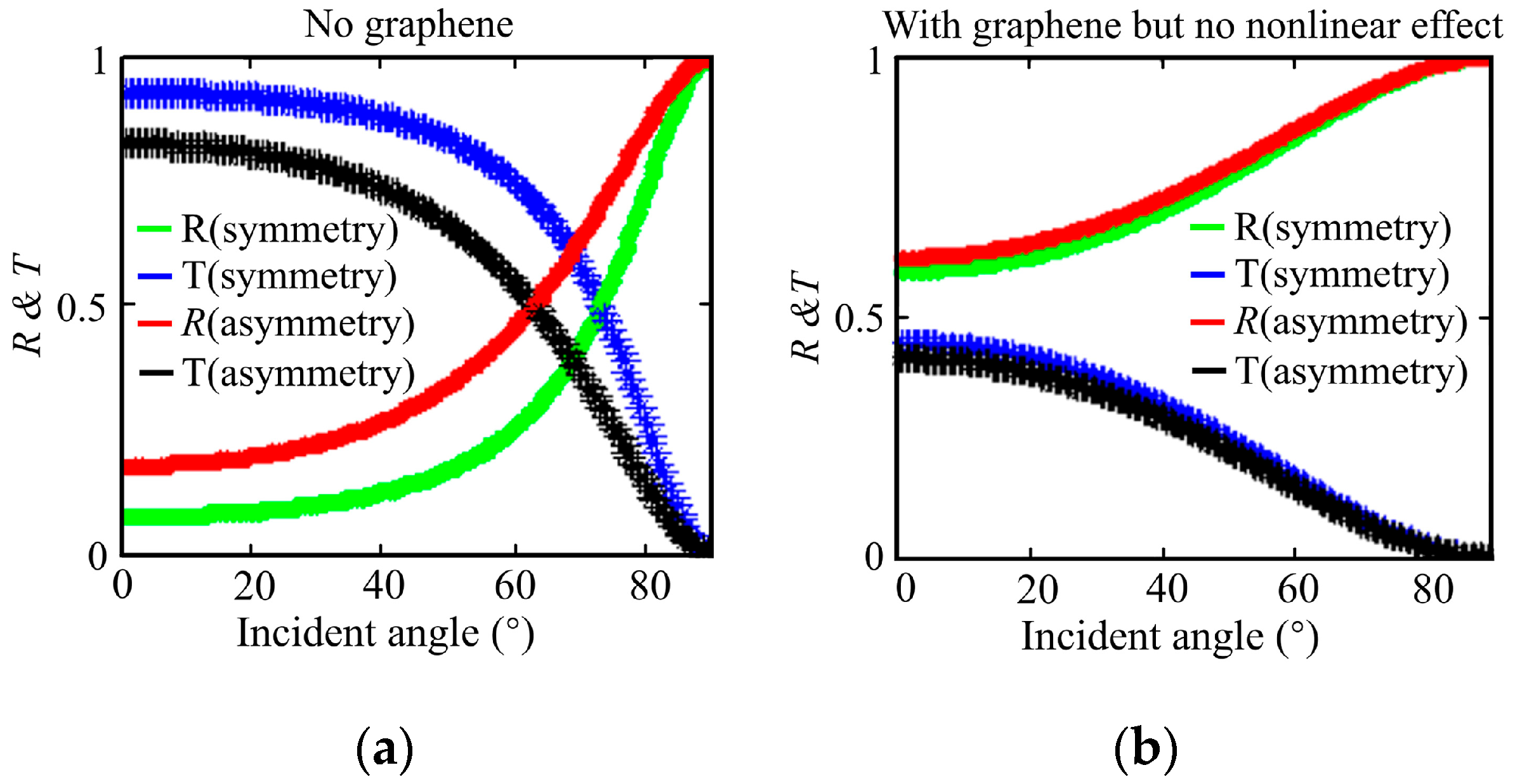
Prior to examining optical bistability, we first compare the transmission of electromagnetic waves in dielectric layers with and without graphene, disregarding its third-order nonlinear effect. Because graphene affects the interface behavior, a comparison between Figure 2a,b reveal that the presence of graphene enhances reflectivity and reduces transmittance. In Figure 2b, under the same incident angle, the asymmetric structure exhibits higher reflectivity than the symmetric one, facilitating the achievement of total internal reflection (TIR). Furthermore, when the third-order nonlinear effect is neglected, reflectivity increases with the incident angle. Additionally, adjusting the permittivity of the asymmetric dielectric layer can further enhance reflectivity.
Actually, the OB in our structure originates from the intensity-dependent third-order nonlinear conductivity of graphene. As the incident field intensity increases, the resulting nonlinear conductivity modifies the effective refractive index sensed by the propagating wave. This, in turn, shifts the resonant condition of the asymmetric Fabry–Perot-like cavity formed by the dielectric layers. Once the input intensity exceeds a critical threshold, the interaction between graphene’s nonlinear response and the cavity feedback leads to a switching behavior between distinct high- and low-transmission states, giving rise to the characteristic hysteresis.
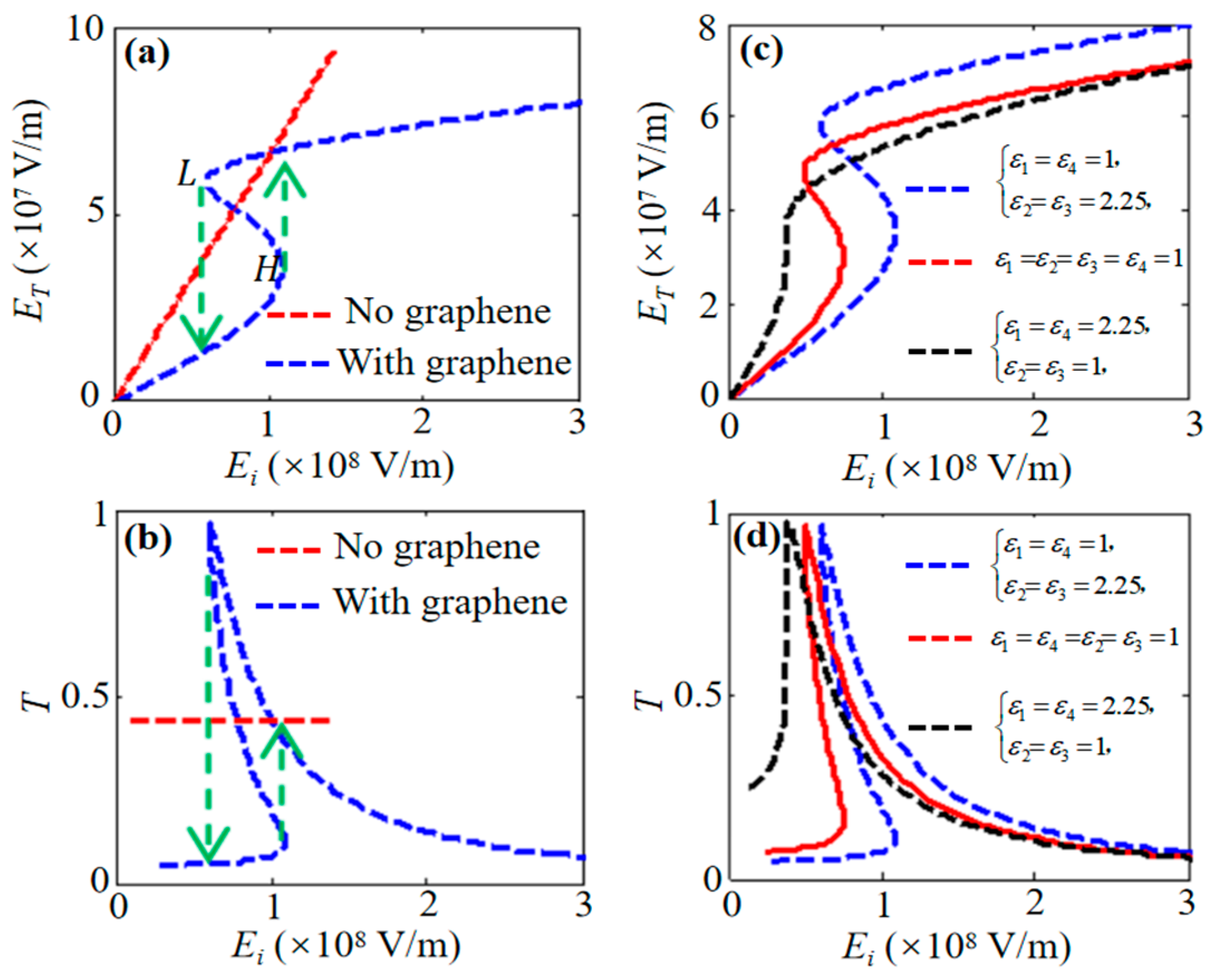
We then investigate optical bistability arising from the third-order nonlinear effect of graphene in a symmetric dielectric medium (Figure 1). In this structure, layers 1 and 4 and layers 2 and 3 are identical, forming a simple symmetric stack. Optical bistability is achieved via graphene’s nonlinearity, as shown in Figure 3a,b. In Figure 3a, the red line (without graphene nonlinearity) shows a proportional relationship between transmitted and incident intensities; consequently, the corresponding transmittance in Figure 3b is constant, exhibiting no bistability. When graphene nonlinearity is included, the blue line in Figure 3a exhibits a characteristic hysteresis “S” curve. Thus, optical bistability depends on graphene’s third-order nonlinear effect: transmissivity varies with incident intensity, where a single incident value can correspond to two possible transmission states, depending on the direction of intensity change. We further analyze the influence of layer permittivity on bistability in Figure 3c,d. A single graphene sheet in vacuum exhibits optical bistability (Figure 3c, red line). As incident intensity increases beyond a high threshold (H), the transmission jumps up. As intensity decreases below a low threshold (L), it jumps down, transitioning to a TIR mode. Figure 3c,d show that permittivity modification shifts these thresholds. Notably, if the outer layer permittivity significantly exceeds the inner layer’s, bistability can disappear.
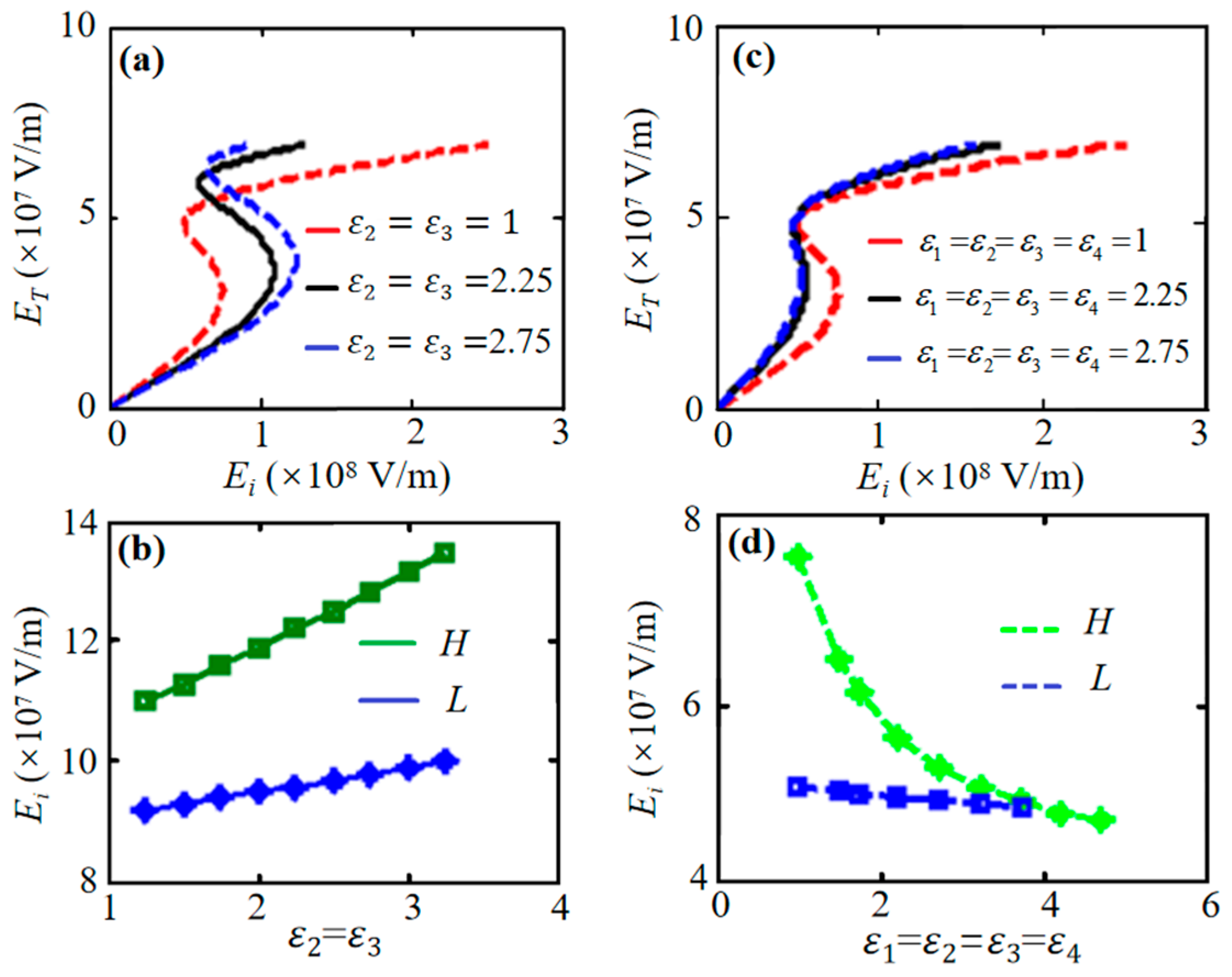
As shown in Figure 4a,b, for a structure with ε1 = ε4 = 1 (vacuum) and ε2 = ε3, simultaneously increasing ε2 and ε3 raises the bistability threshold. Conversely, when graphene is surrounded by identical dielectric (ε1 = ε2 = ε3 = ε4), increasing this common permittivity reduces the threshold, as shown in Figure 4c,d. Excessively high permittivity of the surrounding dielectric can eliminate bistability.
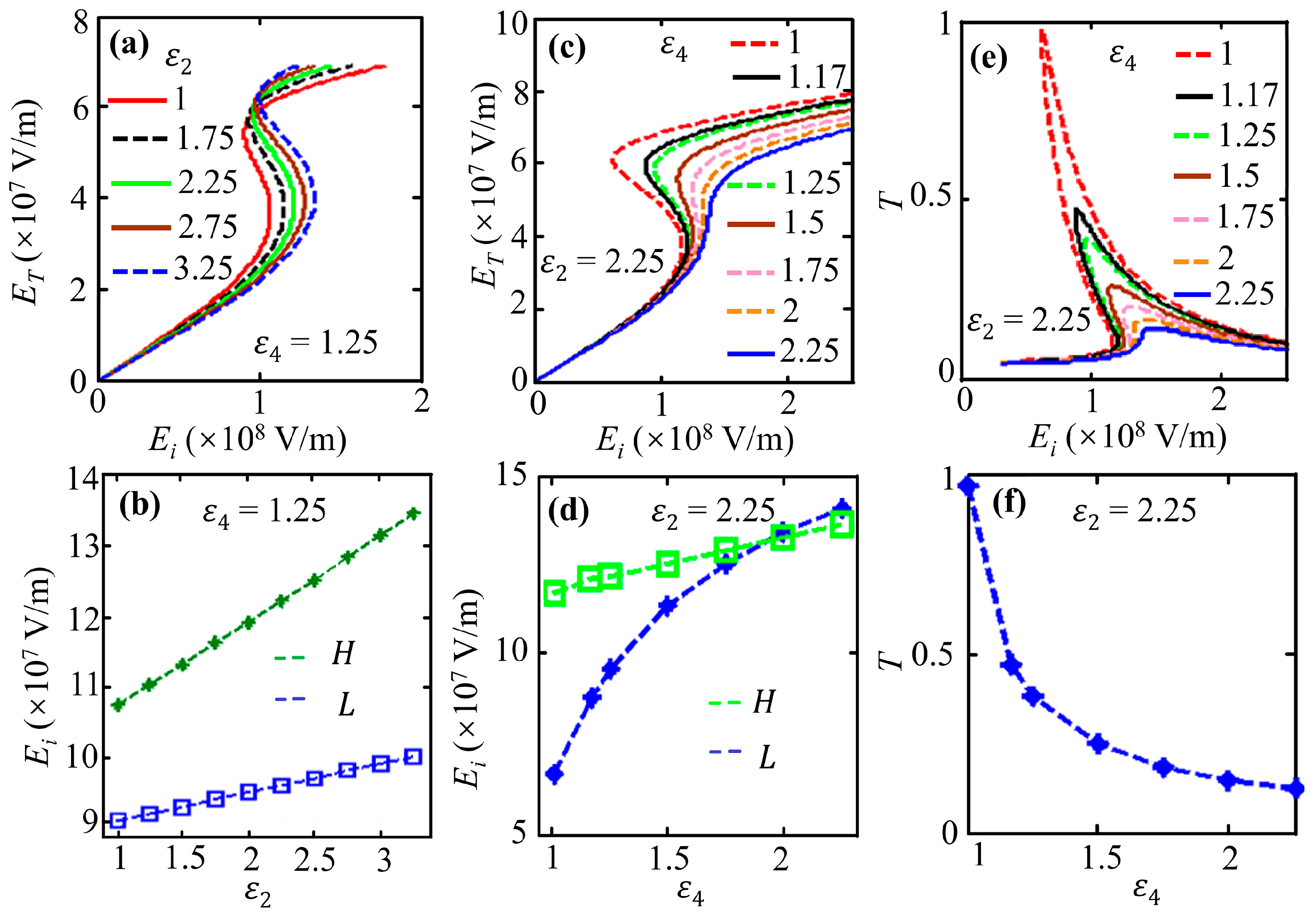
We further study the influence of permittivity on the bistability in an asymmetric system, as shown in Figure 5. Starting from a basic asymmetric structure (ε1 = 1, ε2 = 2.25, ε3 = 2.75, and ε4 = 1.25), increasing ε2 from 1 to 3.25 (with fixed ε4 = 1.25) raises the bistability threshold (see Figure 5a,b). Similarly, increasing ε4 from 1 to 2.25 (with fixed ε2 = 2.25) also increases the threshold (see Figure 5c,d), while reducing transmissivity (see Figure 5e,f).
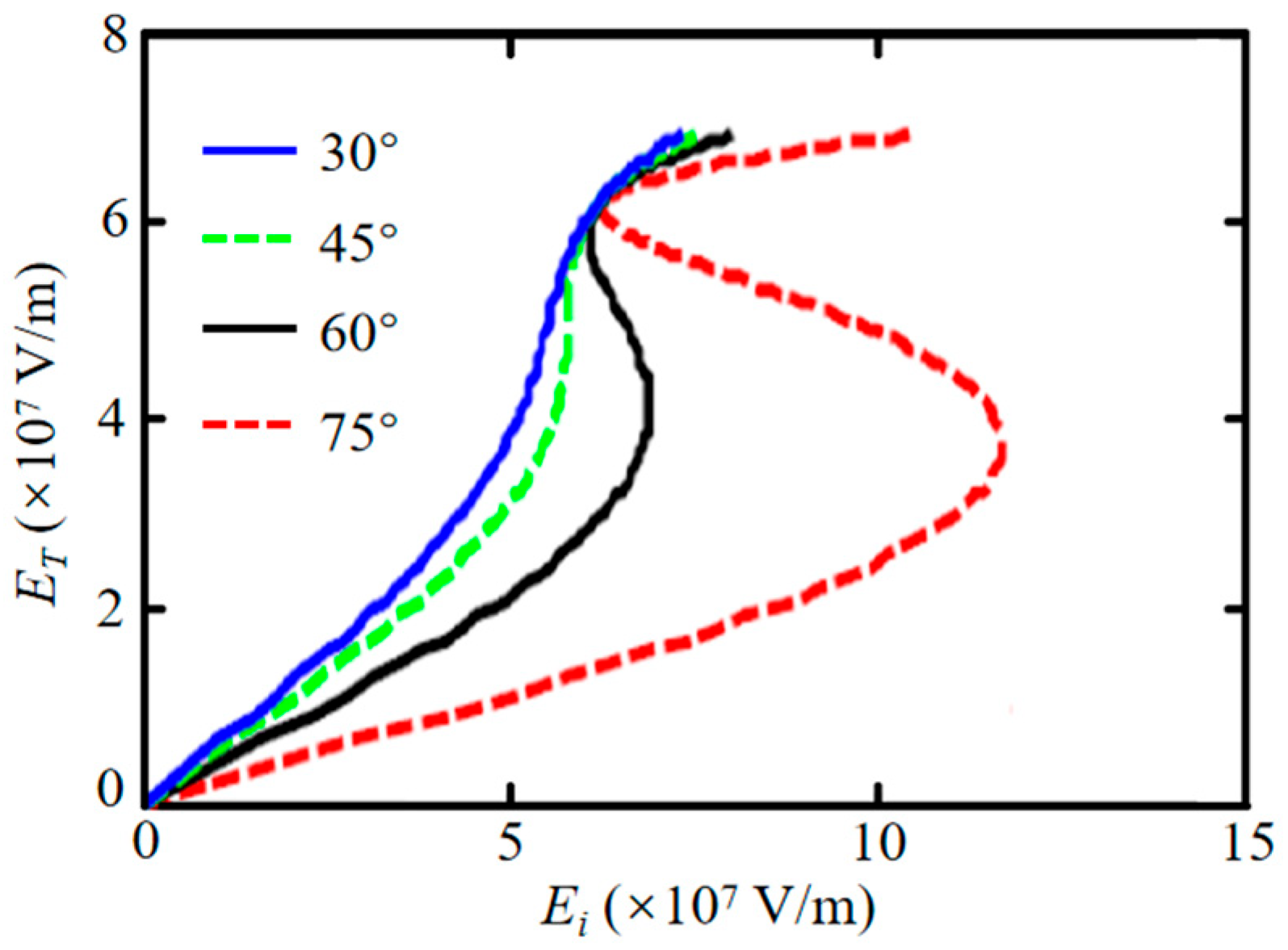
Next, we vary the incident angle to study its influence on optical bistability. As shown in Figure 6, for an asymmetric structure (ε1 = 1, ε2 = 2.25, ε3 = 2.75, and ε4 = 1), increasing the incident angle from 30° to 75° raises the high threshold value, while the low threshold remains relatively unchanged, thereby widening the bistability range. Bistability vanishes below a certain incident angle.
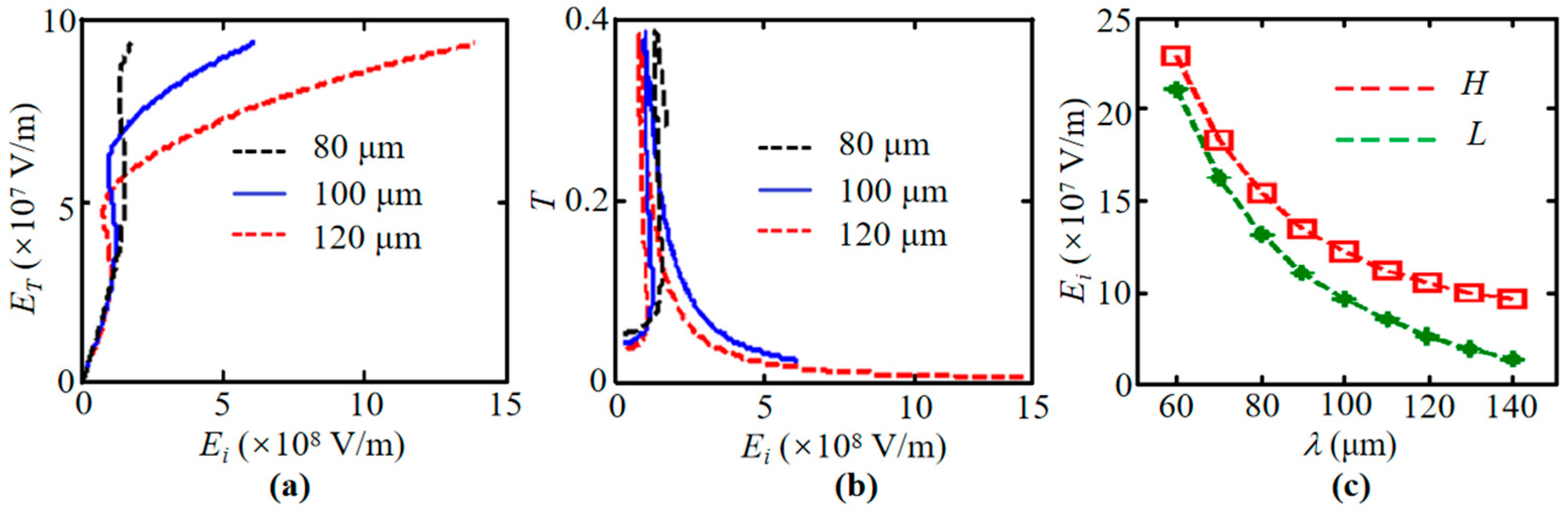
Now, we discuss the influence of the wavelength of the incident electromagnetic wave on optical bistability. In an asymmetric structure of ε1 = 1, ε2 = 2.25, ε3 = 2.75, and ε4 = 1.25, the transmitted intensity and transmittance for λ = 80, 100, and 120 μm are shown in Figure 7a,b, respectively. One can find that the thresholds of optical bistability (H and L) decrease with increasing wavelength, as shown in Figure 7c. It should be noticed that the transmittance curve has a slight leftwards shift with increasing wavelength of the incident electromagnetic wave.
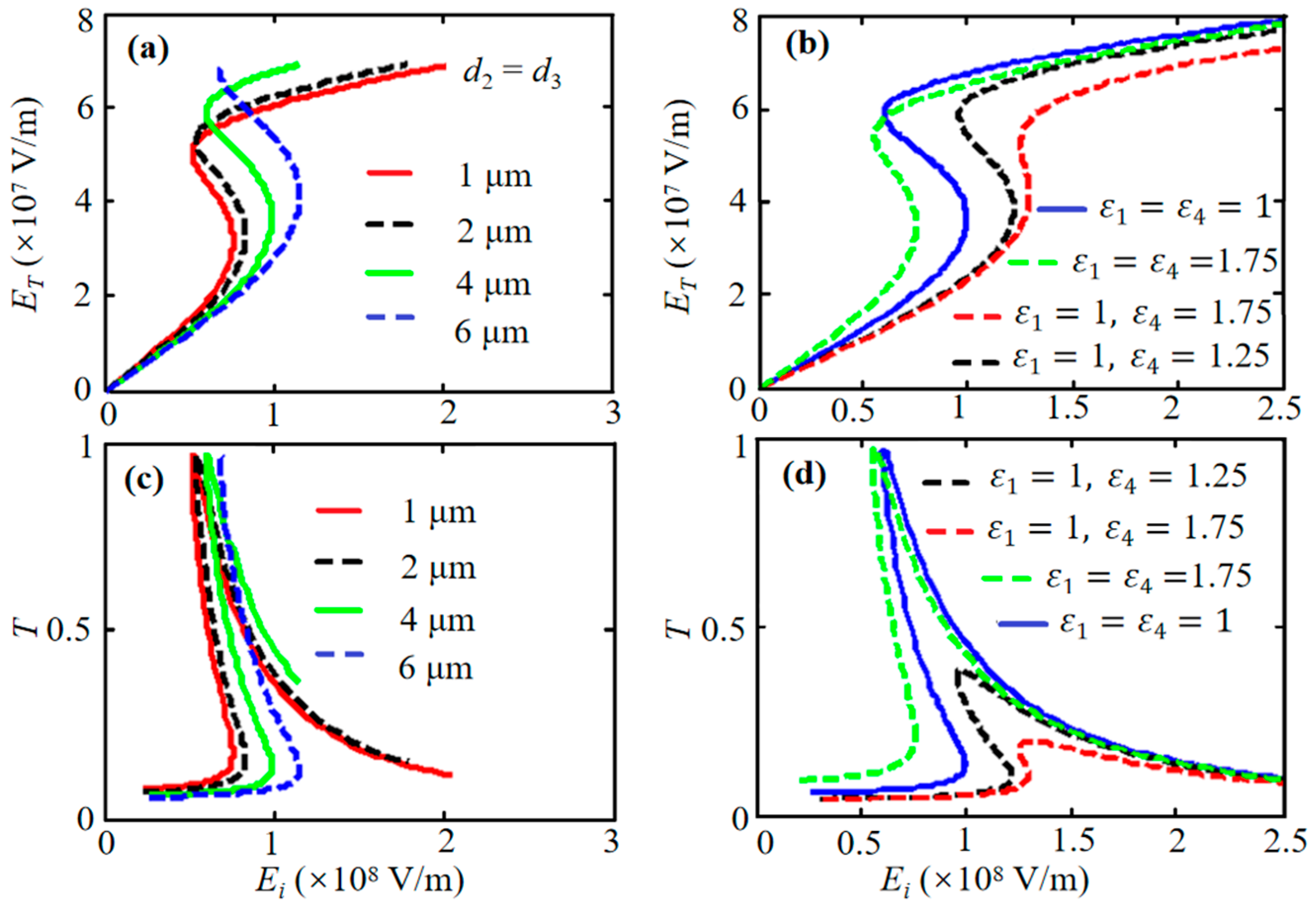
Finally, we study the effect of dielectric layer thickness on optical bistability in asymmetric structures. The calculation results indicate that simultaneously varying the thickness of d2 and d3 in an asymmetric structure (ε1 = 1, ε2 = 2.25, ε3 = 2.75, and ε4 = 1.25) affects bistability: a larger thickness yields a higher threshold (Figure 8a,c). Comparison between the cases of ε1 = ε4 and ε1ε4 (Figure 8b vs. Figure 8d) shows that matching the permittivity of the outer layers can significantly increase the bistability threshold and enhance transmittance.
Our work is distinguished from recent advances in graphene-based bistable systems—such as low-temperature superconducting multilayers [33], sandwich structures utilizing topological interface modes [34], and systems exploiting Anderson localization in random plasmonic gratings [35]. While these approaches achieve threshold modulation through external cryogenic conditions, intricate topological designs, or engineered disorder, we introduce a distinct paradigm based on intrinsic structural asymmetry in dielectric-graphene multilayers. We demonstrate that simple asymmetry in layer permittivity and thickness enables the broad tunability of bistability thresholds and hysteresis width without cryogenic conditions, complex patterning, or random gratings. This method provides a compelling alternative to realize the OB effect, thereby offering a more straightforward and potentially robust pathway to practical tunable terahertz bistable devices.

4. Conclusions

In summary, this study demonstrates that the third-order nonlinear optical response of graphene enables tunable optical bistability in dielectric-graphene multilayer structures. The key findings include: (1) Graphene enhances reflectivity and suppresses transmittance in linear regimes, facilitating conditions for total internal reflection. (2) Optical bistability emerges from graphene’s nonlinearity, exhibiting hysteresis dependence on incident intensity. (3) The bistability threshold can be effectively controlled by structural parameters: it increases with higher permittivity in adjacent dielectric layers (in symmetric configurations) or in specific asymmetric layer configurations, but vanishes if outer-layer permittivity becomes excessively large. (4) Increasing the incident angle widens the bistability range, while longer wavelengths lower the threshold. (5) Layer thickness and symmetry also provide control, with matched outer-layer permittivity significantly boosting transmittance. These results offer a theoretical and parametric foundation for designing graphene-based nonlinear photonic devices, such as optical switches, logic elements, and sensors.

Author Contributions

Conceptualization and writing—original draft preparation, Q.L.; supervision, W.L.; methodology, R.Z.; project administration, S.Y.; and investigation, S.L. All authors have read and agreed to the published version of the manuscript.

Funding

This research was funded by the National Natural Science Foundation of China (12474380); the Guangdong Basic and Applied Basic Research Foundation (2025A1515010714, 2023A1515010951, 2018A030313684); the National Key R&D Program of China (2023YFA1406900); the Scientific Research Fund of Guangdong Provincial Education Department (2017KTSCX134); the Scientific Research Capability Enhancement Project for Guangdong Provincial Key Disciplines (2024ZDJS052); the Scientific Key Research Fund of Guangdong Provincial Education Department (2025ZDZX1021); and the Guangdong Engineering Research Center for Silicon Carbide Smart Sensor Technology (202504221065).

Data Availability Statement

The data presented in this study are available on request from the corresponding author.

Conflicts of Interest

The authors declare no conflicts of interest.

References

  1. Gibbs, H.M. Optical Bistability: Controlling Light with Light; Academic Press: Cambridge, MA, USA, 1985. [Google Scholar]
  2. Abraham, E.; Smith, S.D. Optical bistability and related devices. Rep. Prog. Phys. 1982, 45, 815–885. [Google Scholar] [CrossRef]
  3. Wang, F.Y.; Li, G.X.; Tam, H.L.; Cheah, K.W.; Zhu, S.N. Optical bistability and multistability in one-dimensional periodic metal-dielectric photonic crystal. Appl. Phys. Lett. 2008, 92, 211109. [Google Scholar]
  4. Min, C.; Wang, P.; Chen, C.; Deng, Y.; Lu, Y.; Ming, H.; Ning, T.; Zhou, Y.; Yang, G. All optical switching in subwavelength metallic grating structure containing nonlinear optical materials. Opt. Lett. 2008, 33, 869–871. [Google Scholar] [CrossRef]
  5. Shen, Y.; Wang, G.P. Optical bistability in metal gap waveguide nanocavities. Opt. Express 2008, 16, 8421–8426. [Google Scholar] [CrossRef]
  6. Chen, P.Y.; Alu, A. Optical nanoantenna arrays loaded with nonlinear materials. Phys. Rev. B 2010, 82, 235405. [Google Scholar] [CrossRef]
  7. Zhou, F.; Liu, Y.; Li, Z.Y.; Xia, Y. Analytical model for optical bistability in nonlinear metal nano-antennae involving Kerr materials. Opt. Express 2010, 18, 13337–13344. [Google Scholar] [CrossRef] [PubMed]
  8. Chen, P.Y.; Farhat, M.; Alu, A. Bistable and self-tunable negative-index metamaterial at optical frequencies. Phys. Rev. Lett. 2011, 106, 105503. [Google Scholar] [PubMed]
  9. Hendry, E.; Hale, P.J.; Moger, J.; Savchenko, A.K.; Mikhailov, S.A. Coherent nonlinear optical response of graphene. Phys. Rev. Lett. 2010, 105, 097401. [Google Scholar] [CrossRef] [PubMed]
  10. Zhang, H.; Virally, S.; Bao, Q.; Ping, L.K.; Massar, S.; Godbout, N.; Kockaert, P. Z-scan measurement of the nonlinear refractive index of graphene. Opt. Lett. 2012, 37, 1856–1858. [Google Scholar] [CrossRef]
  11. Novoselov, K.S.; Geim, A.K.; Morozov, S.V.; Jiang, D.; Zhang, Y.; Dubonos, S.V.; Grigorieva, I.V.; Firsov, A.A. Electric field effect in atomically thin carbon films. Science 2004, 306, 666–669. [Google Scholar] [CrossRef]
  12. Castro Neto, A.H.; Guinea, F.; Peres, N.M.R.; Novoselov, K.S.; Geim, A.K. The electronic properties of graphene. Rev. Mod. Phys. 2009, 81, 109–162. [Google Scholar] [CrossRef]
  13. Liu, M.; Yin, X.; Ulin-Avila, E.; Geng, B.; Zentgraf, T.; Ju, L.; Wang, F.; Zhang, X. A graphene-based broadband optical modulator. Nature 2011, 474, 64–67. [Google Scholar] [CrossRef]
  14. Bonaccorso, F.; Sun, Z.; Hasan, T.; Ferrari, A.C. Graphene photonics and optoelectronics. Nat. Photonics 2010, 4, 611–622. [Google Scholar] [CrossRef]
  15. Assanto, G.; Wang, Z.; Hagan, D.J.; VanStryland, E.W. All-optical modulation via nonlinear cascading in type II second-harmonic generation. Appl. Phys. Lett. 1995, 67, 2120–2122. [Google Scholar] [CrossRef]
  16. Mazurenko, D.A.; Kerst, R.; Dijkhuis, J.I.; Akimov, A.V.; Golubev, V.G.; Kurdyukov, D.A.; Pevtsov, A.B.; Sel’kin, A.V. Ultrafast optical switching in three-dimensional photonic crystals. Phys. Rev. Lett. 2003, 91, 213903. [Google Scholar] [CrossRef] [PubMed]
  17. Nihei, H.; Okamoto, A. Photonic crystal systems for high-speed optical memory device on an atomic scale. Proc. SPIE 2001, 4416, 470–473. [Google Scholar]
  18. Simsek, E. Improving tuning range and sensitivity of localized SPR sensors with graphene. Photon. Technol. Lett. 2013, 25, 867–870. [Google Scholar] [CrossRef]
  19. Vasić, B.; Jakovljević, M.M.; Isić, G.; Gajić, R. Tunable metamaterials based on split ring resonators and doped graphene. Appl. Phys. Lett. 2013, 103, 011102. [Google Scholar] [CrossRef]
  20. Ju, L.; Geng, B.; Horng, J.; Girit, C.; Martin, M.; Hao, Z.; Bechtel, H.A.; Liang, X.; Zettl, A.; Shen, Y.R.; et al. Graphene plasmonics for tunable terahertz metamaterials. Nat. Nanotechnol. 2011, 6, 630–634. [Google Scholar] [CrossRef]
  21. Andryieuski, A.; Lavrinenko, A.V. Graphene metamaterials based tunable terahertz absorber: Effective surface conductivity approach. Opt. Express 2013, 21, 9144–9155. [Google Scholar] [CrossRef]
  22. Fan, Y.C.; Wei, Z.Y.; Li, H.Q.; Chen, H.; Soukoulis, C.M. Photonic band gap of a graphene-embedded quarter-wave stack. Phys. Rev. B 2013, 88, 241403. [Google Scholar] [CrossRef]
  23. Fan, Y.C.; Zhang, F.L.; Zhao, Q.; Wei, Z.Y.; Li, H.Q. Tunable terahertz coherent perfect absorption in a monolayer graphene. Opt. Lett. 2014, 39, 6269–6272. [Google Scholar] [CrossRef] [PubMed]
  24. Kaipa, C.S.R.; Yakovlev, A.B.; Hanson, G.W.; Padooru, Y.R.; Medina, F.; Mesa, F. Enhanced transmission with a graphene-dielectric microstructure at low-terahertz frequencies. Phys. Rev. B 2012, 85, 245407. [Google Scholar] [CrossRef]
  25. Bao, Q.; Zhang, H.; Wang, Y.; Ni, Z.; Yan, Y.; Shen, Z.; Loh, K.P.; Tang, D. Atomic-layer graphene as a saturable absorber for ultrafast pulsed lasers. Adv. Funct. Mater. 2009, 19, 3077–3083. [Google Scholar] [CrossRef]
  26. Lim, G.K.; Chen, Z.L.; Clark, J.; Goh, R.G.S.; Ng, W.H.; Tan, H.W.; Friend, R.H.; Ho, P.K.H.; Chua, L.L. Giant broadband nonlinear optical absorption response in dispersed graphene single sheets. Nat. Photonics 2011, 5, 554–560. [Google Scholar] [CrossRef]
  27. Mikhailov, S.A.; Ziegler, K. Nonlinear electromagnetic response of graphene: Frequency multiplication and the self-consistent-field effects. J. Phys. Condens. Matter 2008, 20, 384204. [Google Scholar] [CrossRef]
  28. Bao, Q.; Chen, J.; Xiang, Y.; Zhang, K.; Li, S.; Jiang, X.; Xu, Q.; Loh, K.P.; Venkatesan, T. Graphene nanobubbles: A new optical nonlinear material. Adv. Opt. Mater. 2015, 3, 744–749. [Google Scholar] [CrossRef]
  29. Peres, N.M.R.; Bludov, Y.V.; Santos, J.E.; Jauho, A.P.; Vasilevskiy, M.I. Optical bistability of graphene in the terahertz range. Phys. Rev. B 2014, 90, 125425. [Google Scholar] [CrossRef]
  30. Xiang, Y.; Dai, X.; Guo, J.; Wen, S.; Tang, D. Tunable optical bistability at the graphene-covered nonlinear interface. Appl. Phys. Lett. 2014, 104, 051108. [Google Scholar] [CrossRef]
  31. Dudek, M.; Kowerdziej, R.; Pianelli, A.; Parka, J. Graphene-based tunable hyperbolic microcavity. Sci. Rep. 2021, 11, 74. [Google Scholar] [CrossRef]
  32. Asgari, S.; Fabritius, T. Frequency-multiplexed tunable logic device based on terahertz graphene-integrated metamaterial composed of two circular ring resonator array. Sci. Rep. 2025, 15, 28920. [Google Scholar] [CrossRef] [PubMed]
  33. Ni, H.; Zhou, G.; Xu, S.; Liu, F.; Zhao, M.; Duan, S.; Zhao, D. Low-temperature optical bistability and multistability in superconducting photonic multilayers with graphene. Results Phys. 2023, 52, 106867. [Google Scholar] [CrossRef]
  34. Ardakani, A.G.; Ghasemi, Z. Optical bistability in Anderson localized states of a random plasmonic structure based on graphene layers. Eur. Phys. J. Plus 2022, 137, 998. [Google Scholar] [CrossRef]
  35. Li, F.; Xu, J.; Li, W.; Li, J.; Peng, Y.; He, M. Optical bistability modulation based on graphene sandwich structure with topological interface modes. Opt. Express 2023, 31, 40490–40497. [Google Scholar] [CrossRef] [PubMed]
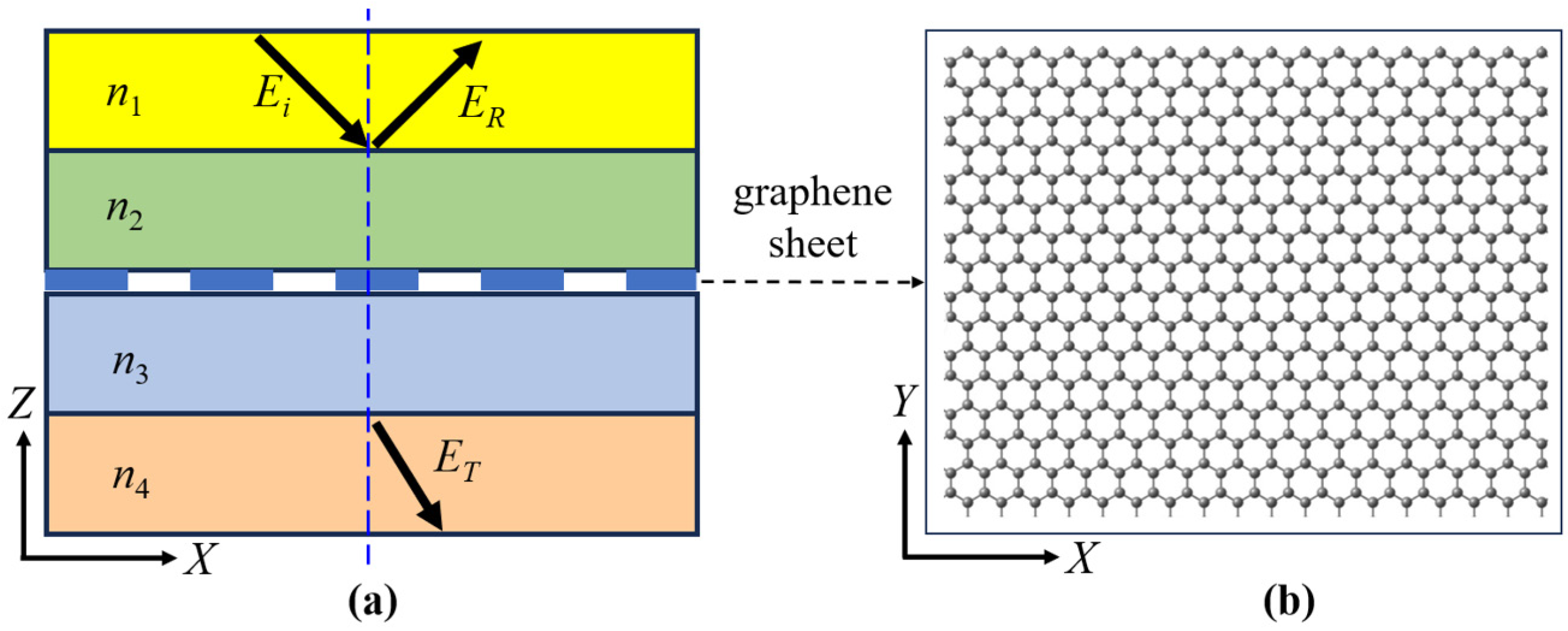
Figure 1. The structure of multilayer dielectric medium (a) containing graphene sheets (b). Ei, ER, and ET are the amplitudes of the incident, reflected and transmitted lights.
Nanomaterials 16 00116 g001
Figure 2. Transmittance and reflectivity versus incident angle for symmetric and asymmetric structures (a) without and (b) with graphene. Parameters for the asymmetric structure: ε1 = 1, ε2 = 2.75, ε3 = 2.25, and ε4 = 1.25. Symmetric structure: ε1 = 1, ε2 = 2.25, ε3 = 2.25, and ε4 = 1. Other parameters: wavelength λ = 100 μm, Fermi energy EF = 0.8 eV, T = 300 K, τ−1 = 0, d2 = d3 = 4 μm, and d1 = d4 are sufficiently large.
Nanomaterials 16 00116 g002
Figure 3. Transmitted intensity (a) and transmittance (b) versus incident intensity for symmetric structures without and with graphene nonlinearity. (c,d) Changing permittivity alters the bistability threshold. Parameters: Symmetric case (blue line): ε1 = ε4 = 1, ε2 = ε3 = 2.25. Vacuum case (red line): ε1 = ε2 = ε3 = ε4 = 1. Inverted case (black line): ε1 = ε4 = 2.25, ε2 = ε3 = 1. Incidence angle θ = 75°. Other parameters are as in Figure 2.
Nanomaterials 16 00116 g003
Figure 4. (a,c) Transmitted versus incident intensity for symmetric structures with graphene nonlinearity. (b) Threshold increases with increasing ε2 = ε3 (ε1 = ε4 = 1). (d) Threshold decreases when increasing a common permittivity of ε1 = ε2 = ε3 = ε4. Other parameters are the same as those in Figure 2.
Nanomaterials 16 00116 g004
Figure 5. Transmitted versus incident intensity for an asymmetric structure with graphene’s third-order nonlinearity. Varying ε2 (or ε4) alters the bistability threshold (af). Parameters: λ = 100 μm, EF = 0.8 eV, τ−1 = 0, T = 300 K, θ = 75°, and d2 = d3 = 4 μm.
Nanomaterials 16 00116 g005
Figure 6. Effect of incident angle on the bistability threshold for an asymmetric structure. Other parameters: λ = 100 μm, EF = 0.8 eV, τ−1 = 0, T = 300 K, θ = 75°, and d2 = d3 = 4 μm.
Nanomaterials 16 00116 g006
Figure 7. Transmitted intensity (a) and transmittance (b) versus incident intensity for the asymmetric bistable state with increasing wavelength λ = (80, 100, 120) μm. Other parameters are as in Figure 2. (c) The thresholds of optical bistability (H and L) versus λ.
Nanomaterials 16 00116 g007
Figure 8. The relation of transmittance intensity and incident intensity for asymmetric structures (ε1 = 1.25, ε2 = 2.25, ε3 = 2.75, and ε4 = 1.25) with the third-order nonlinear effect of the graphene sheet. (a,c) Effect of layer thickness (d2 = d3) on bistability threshold. (b,d) Comparison of bistability for cases of ε1 = ε4 and ε1ε4. Other parameters are the same as those in Figure 2.
Nanomaterials 16 00116 g008
Table 1. Parameters used in simulations.
ParametersSymbolValue/Range
Dielectric permittivityε1, ε2, ε3, ε41.0–3.0
Layer thicknessesd1, d2, d3, d42–10 μm
Graphene Fermi energyEF0.8 eV
TemperatureT300 K
Relaxation timeτ∞, (lossless)
Incident wavelengthλ80–120 μm
Incident angleθ0–90°
Disclaimer/Publisher’s Note: The statements, opinions and data contained in all publications are solely those of the individual author(s) and contributor(s) and not of MDPI and/or the editor(s). MDPI and/or the editor(s) disclaim responsibility for any injury to people or property resulting from any ideas, methods, instructions or products referred to in the content.