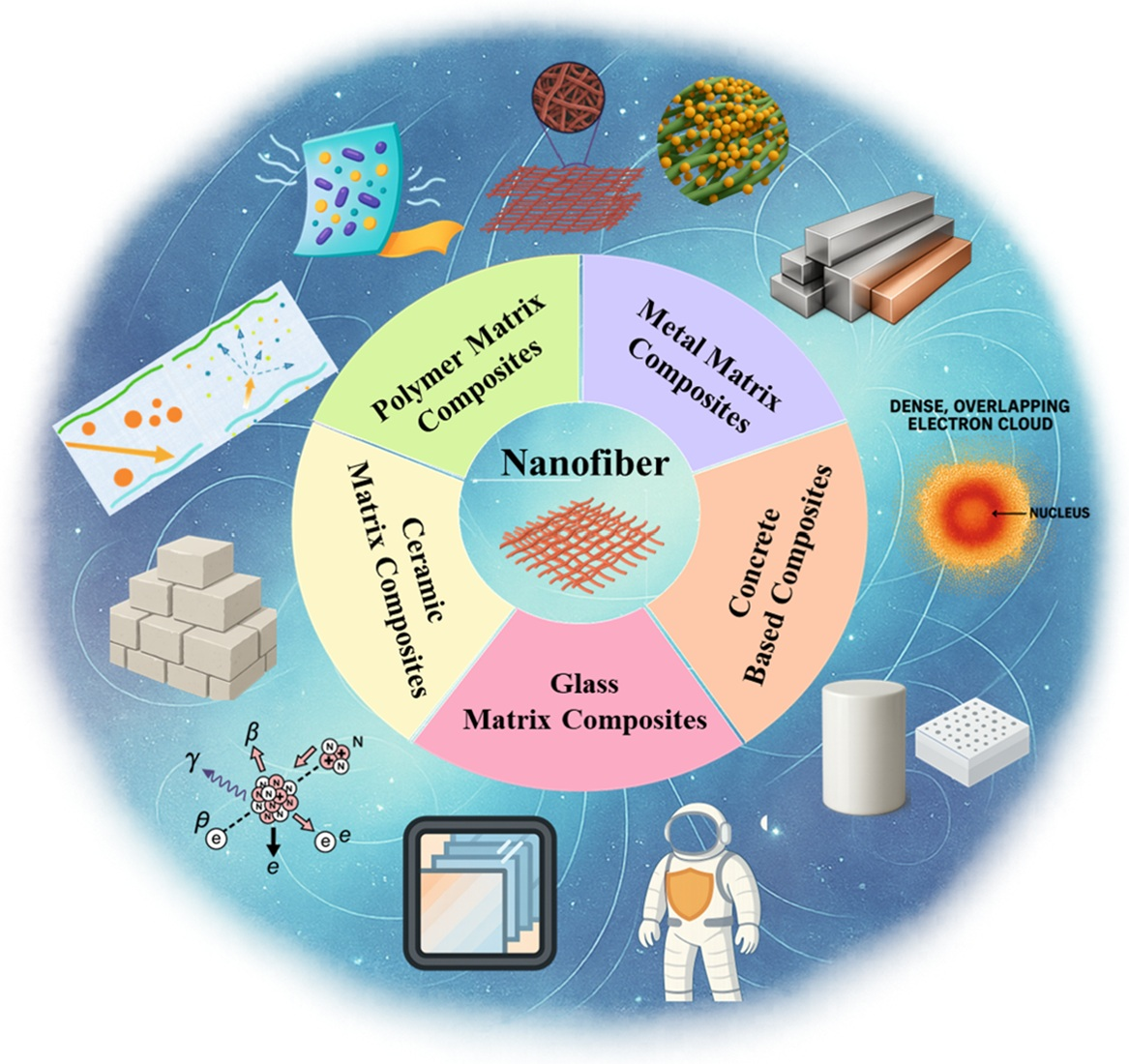
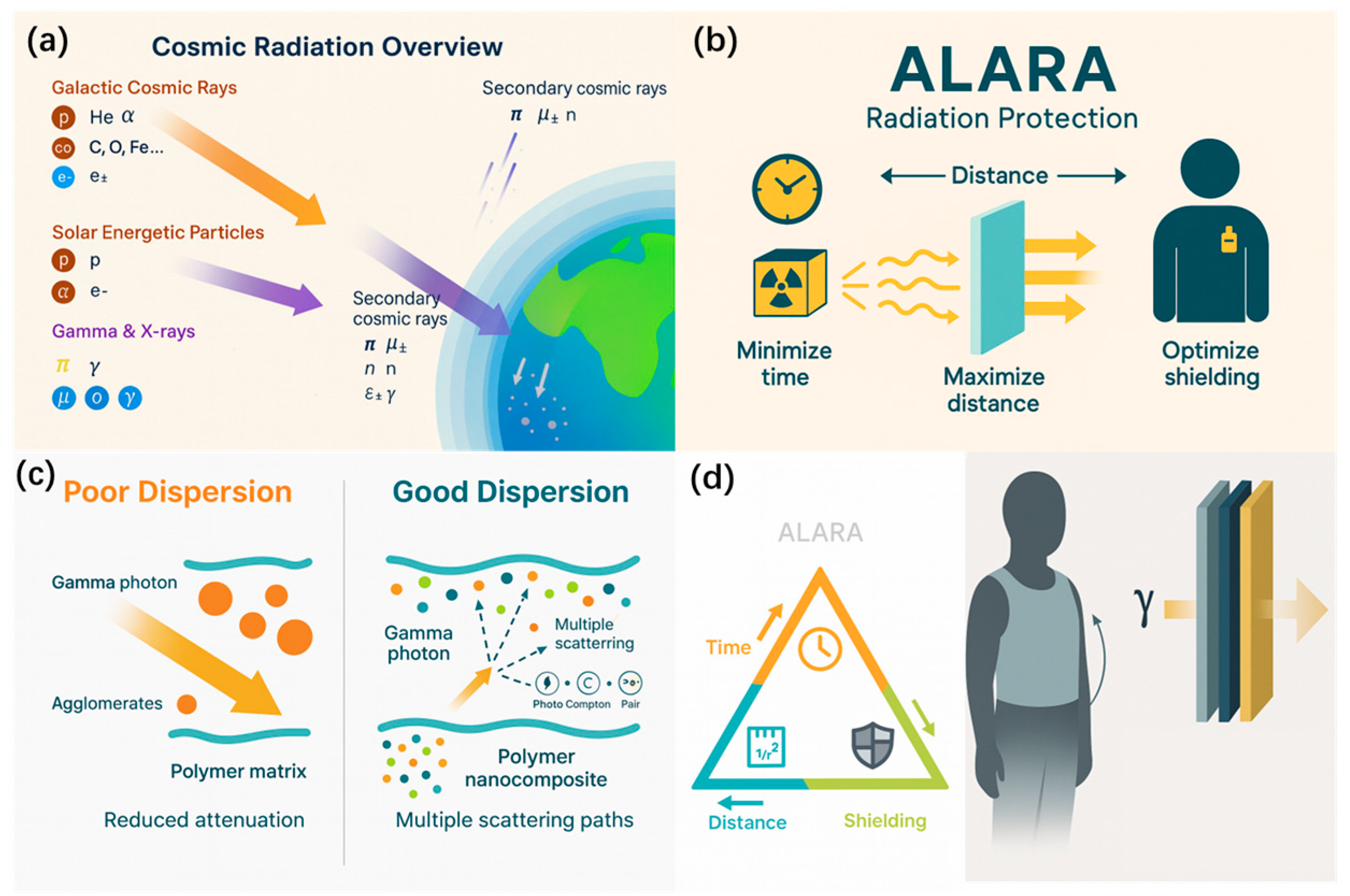
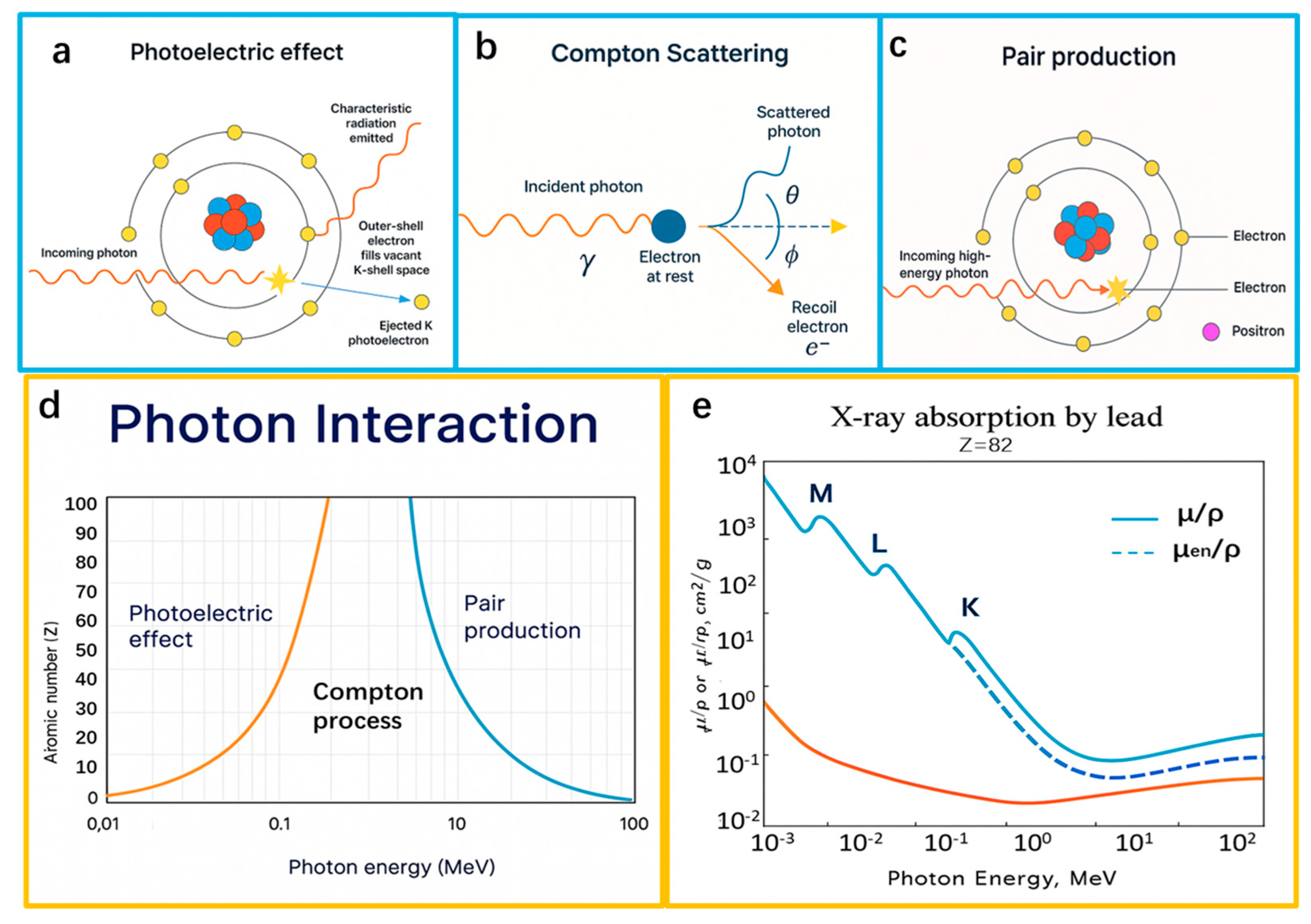
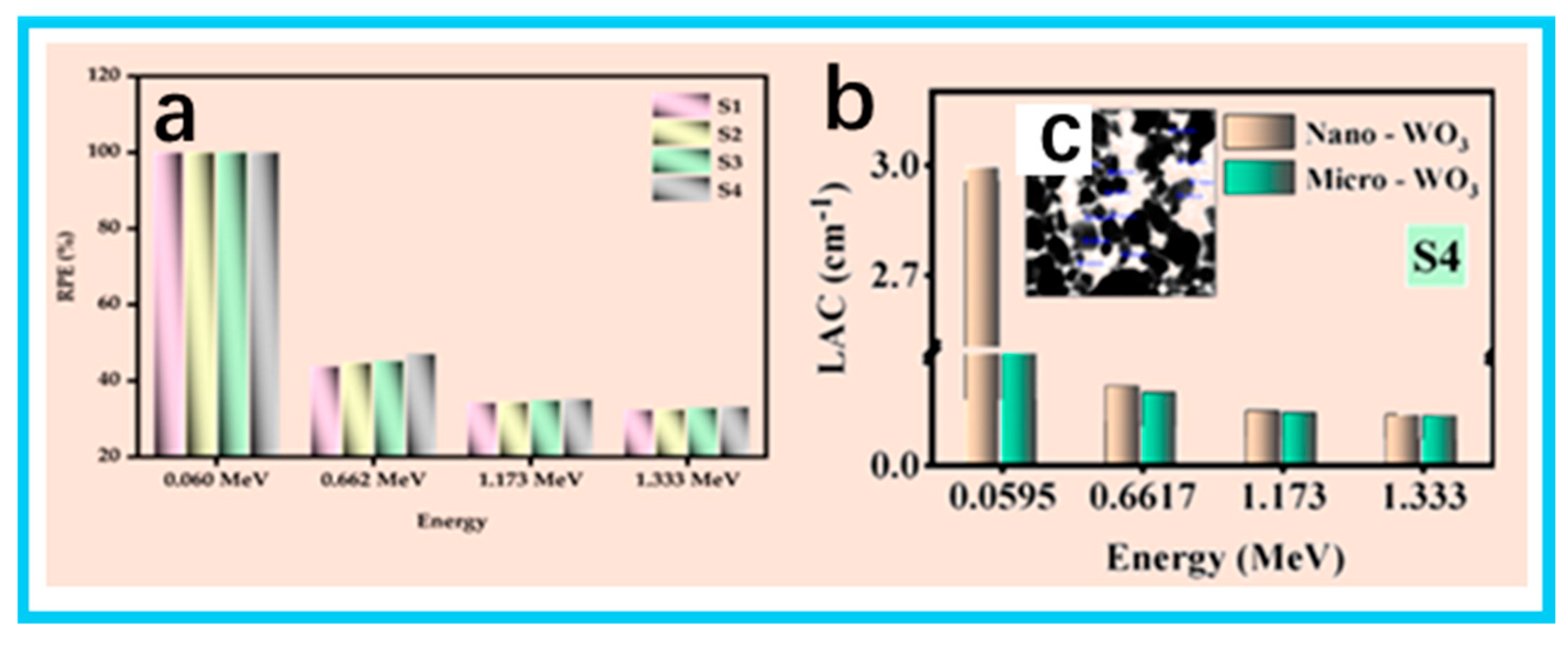
From Bench to Use: The Status of Gamma-Shielding Nanomaterials and the Prospects for Lead-Free Wearables



Abstract
1. Introduction
2. Interaction Between γ-Rays and Matter

3. γ-Ray Shielding Materials
4. Research Progress in Composite Materials
4.1. Polymer-Based Composites
4.1.1. Unsaturated Polyester-Based (UPR)


| Polymer Matrix | Filler Type | Filler Loading (wt.%) | γ-Ray Energy E (MeV) | Mass Attenuation Coefficient μ/ρ (cm2·g−1) | Linear Attenuation Coefficient μ (cm−1) | HVL (cm) | TVL (cm) | Radiation-Protection Efficiency, RPE (%) |
|---|---|---|---|---|---|---|---|---|
| Unsaturated polyester resin (UPR) [61] | Bi2O3 | 50 | 0.662 | 0.1038 | 3.16 | |||
| UPR [62] | Bi2(WO4)3 | 20 | 0.0844 | 5.610 | 18.768 | |||
| UPR [64] | CdTe | 20 | 0.0827 | |||||
| UP [65] | Micro PbO | 30 | 0.0844 | 0.133 | 5.21 | |||
| PR [66] | PbCO3 + WO3Nps | 5 + 25 | 0.21 | 4.55 | 43–46 | |||
| PR [67] | ZnO Micro + Nano | 30 + 30 | 0.0865 | 0.2034 | 3.41 | 11.34 | 33.42 | |
| UP [68] | Mo Nps | 50 | 0.0758 | 4.06 | ||||
| UP [69] | Sn Nps | 50 | 0.1516 | 4.5722 | ||||
| UPR [70] | GNPS | 1 | 0.08271 | 6.35 |
4.1.2. Epoxy Resin
4.1.3. Rubber
4.1.4. Polyolefins
4.1.5. Vinyl Polymers
4.1.6. Other High-Performance Polymer-Based
4.2. Metal-Based Composites
4.3. Concrete-Based Composites
4.4. Glass-Based Composites
4.5. Ceramic-Based Composites
5. Conclusions
6. Perspectives
- (1)
- Holistic design for multi-energy ranges and secondary-radiation suppression
- (2)
- Multiscale structures and multiphysics coupled properties
- (3)
- Flexible, wearable, and reconfigurable systems
- (4)
- Sustainable manufacturing, data-driven approaches, and standardized evaluation systems
- (5)
- Interdisciplinary collaboration and engineering demonstration
Funding
Data Availability Statement
Acknowledgments
Conflicts of Interest
Nomenclature
| ALARA | as low as reasonably achievable |
| IRPA | International Radiation-Protection Association |
| MCNPX | Monte Carlo N-Particle eXtended |
| HVL | half-value layer |
| SEM | scanning electron microscopy |
| EGSnrc | electron–gamma shower code (nrc) |
| EP | epoxy resin |
| Phy-X/PSD | Photon-Shielding Database |
| WinXCOM | XCOM photon cross-section database (Windows) |
| SEBS | styrene–ethylene–butylene–styrene |
| HPGe | high-purity germanium detector |
| LDPE | low-density polyethylene |
| HDPE | high-density polyethylene |
| LLDPE | linear low-density polyethylene |
| PVA | poly(vinyl alcohol) |
| UHDPE | ultra-high-density polyethylene |
| UPR | unsaturated polyester resin |
| ISO | isophthalic unsaturated polyester |
| MAC | mass attenuation coefficient |
| RPE | radiation-protection efficiency |
| CNT | carbon nanotube |
| NBR | nitrile-butadiene rubber |
| CR | chloroprene rubber |
| EDS | energy-dispersive X-ray spectroscopy |
| UHMWPE | ultra-high-molecular-weight polyethylene |
| BNNS | boron nitride nanosheets |
| EPM | ethylene–propylene rubber |
| TEM | transmission electron microscopy |
| PTA | phosphotungstic acid |
| MCNP5 | Monte Carlo N-Particle version 5 |
| BVO | bismuth vanadate |
| LAC | linear attenuation coefficient |
| PMMA | poly(methyl methacrylate) |
| EABF | energy absorption buildup factor |
| EBF | exposure buildup factor |
| CMT | calcium borate |
| PI | polyimide |
| HVCMC | high-volume-fraction composite |
| PPVE | poly(vinyl ester) |
| ABS | acrylonitrile–butadiene–styrene |
| GMASS | tungsten-based thermoplastic composite |
| PEEK | poly(ether ether ketone) |
| FDM | fused deposition modeling |
| OPC | ordinary Portland cement |
| NF | nanofiller |
| WOPC | white ordinary Portland cement |
| TVL | tenth-value layer |
| MFP | mean free path |
| NC | normal concrete |
| BC | barite concrete |
| SC | siderite concrete |
References
- Pan, Z.Q. Basic structures for strengthening radiation protection. Radiat. Prot. 1996, 16, 161–169. (In Chinese) [Google Scholar]
- Schaeffer, N.M. (Ed.) Reactor Shielding for Nuclear Engineers; Report TID-25951; U.S. Atomic Energy Commission, Office of Information Services: Washington, DC, USA, 1973; ISBN 0870790048.
- Chen, J.Y.; Zhao, Y.C. Research advances on risk models of radiogenic cancer and risk transfer models between populations. Int. J. Radiat. Med. Nucl. Med. 2014, 38, 341–346. (In Chinese) [Google Scholar] [CrossRef]
- Sun, Z.J.; Wang, J.X.; Xiang, J.; Zhao, Y.C.; Chen, J.Y.; Yang, Q.Q.; Fan, S.J. Estimation of radiation-induced gastric cancer risk coefficients in the Chinese population. Chin. J. Radiol. Med. Prot. 2015, 35, 282–286. (In Chinese) [Google Scholar] [CrossRef]
- Akman, F.; Sayyed, M.I.; Kaçal, M.R.; Tekin, H.O. Investigation of photon shielding performances of some selected alloys by exper imental data, theoretical and MCNPX code in the energy range of 81 keV–1333 keV. J. Alloys Compd. 2019, 772, 516–524. [Google Scholar] [CrossRef]
- Bhosale, R.R.; More, C.V.; Gaikwad, D.K.; Pawar, P.P.; Rode, M.N. Radiation shielding and gamma ray attenuation properties of some polymers. Nucl. Technol. Radiat. Prot. 2017, 32, 288–293. [Google Scholar] [CrossRef]
- Slaba, T.C.; Bahadori, A.A.; Reddell, B.D.; Singleterry, R.C.; Clowdsley, M.S.; Blattnig, S.R. Optimal shielding thickness forgalactic cosmic ray environments. Life Sci. Space Res. 2017, 12, 1–15. [Google Scholar] [CrossRef]
- More, C.V.; Alsayed, Z.; Badawi, M.S.; Thabet, A.A.; Pawar, P.P. Polymeric composite materials for radiation shielding: A review. Environ. Chem. Lett. 2021, 19, 2057–2090. [Google Scholar] [CrossRef]
- Wu, S.; Zhang, W.; Yang, Y. Progress in flexible and wearable lead-free polymer composites for radiation protection. Polymers 2024, 16, 3274. [Google Scholar] [CrossRef]
- Shahzad, K.; Kausar, A.; Manzoor, S.; Rakha, S.A.; Uzair, A.; Sajid, M.; Arif, A.; Khan, A.F.; Diallo, A.; Ahmad, I. Views on radiation shielding efficiency of polymeric nanocomposites for aerospace struc tural applications. Radiation 2022, 3, 1–20. [Google Scholar] [CrossRef]
- Wang, B.; Qiu, T.; Yuan, L.; Fang, Q.; Wang, X.; Guo, X.; Zhang, D.; Lai, C.; Wang, Q.; Liu, Y. A comparative study between pure bismuth/tungsten and the bismuth tungsten oxide for flexible shielding of gamma/X rays. Radiat. Phys. Chem. 2023, 208, 110906. [Google Scholar] [CrossRef]
- Asgari, M.; Afarideh, H.; Ghafoorifard, H.; Amirabadi, E.A. Comparison of nano/micro lead, bismuth and tungsten on the gamma shielding properties of the flexible composites against photon in wide energy range (40 keV–662 keV). Nucl. Eng. Technol. 2021, 53, 4142–4149. [Google Scholar] [CrossRef]
- Wu, H.X. Study on Nano-Lead Composite Materials for High-Energy Radiation Protection. Master’s Thesis, Shandong Normal University, Jinan, China, 2005. (In Chinese). [Google Scholar]
- Alsaab, A.H.; Zeghib, S. Study of prepared lead-free polymer nanocomposites for X- and gamma-ray shielding in healthcare applications. Polymers 2023, 15, 2142. [Google Scholar] [CrossRef]
- Hubbell, J.H. Review of photon interaction cross section data in the medical and biological context. Phys. Med. Biol. 1999, 44, R1–R22. [Google Scholar] [CrossRef]
- Wang, B.; Guo, X.; Yuan, L.; Fang, Q.; Wang, X.; Qiu, T.; Lai, C.; Wang, Q.; Liu, Y. Micro gadolinium oxide dispersed flexible composites developed for the shielding of thermal neutron/gamma rays. Nucl. Eng. Technol. 2023, 55, 1763–1774. [Google Scholar] [CrossRef]
- Almisned, G.; Tekin, H.O.; Kavaz, E.; Bilal, G.; Issa, S.A.; Zakaly, H.M.; Ene, A. Gamma, Fast Neutron, Proton, and Alpha Shielding Properties of Borate Glasses: A Closer Look on Lead (II) Oxide and Bismuth (III) Oxide Reinforcement. Appl. Sci. 2021, 11, 6837. [Google Scholar] [CrossRef]
- Jia, X.B. The Preparation of La/Ce-Doped Ba5Ta4O15 and its Gamma-Ray Shielding Properties of NR Composites. Master’s Thesis, Southwest University of Science and Technology, Mianyang, China, 2016. (In Chinese). [Google Scholar]
- Shen, X.H. Preparation of Polymer/Lead Radiation-Protection Materials and Their Radiation Shielding Properties. Master’s Thesis, Nanjing University of Aeronautics and Astronautics, Nanjing, China, 2008. (In Chinese). [Google Scholar]
- Li, H.F. Preparation and Performance Study of Lead-Containing Radiation-Protective Acrylic (PMMA) Plates. Master’s Thesis, Hubei University, Wuhan, China, 2009. (In Chinese). [Google Scholar]
- Kua, A.; Ogunseitan, O.; Saphores, J.D.; Shapiro, A.A.; Schoenung, J.M. Lead-Free Solders: Issues of Toxicity, Availability and Impacts of Extraction. In Proceedings of the 53rd Electronic Components and Technology Conference (ECTC) 2003, New Orleans, LA, USA, 27–30 May 2003; pp. 47–53. [Google Scholar] [CrossRef]
- He, D.Y. Life-Cycle Designed Hybrid Nanofibrous Membranes for X-Ray Protection and Photocatalysis. Ph.D. Thesis, Jilin University, Changchun, China, 2022. (In Chinese). [Google Scholar]
- Chandrika, B.; Ambika, M.; Seenappa, L.; Manjunatha, H.; Sridhar, K.; Lourduraj, A.C.; Kuttukaran, S.S. Gamma shielding ability of Bismuth–Tungsten oxide (Bi2O6W) nanoparticles. Radiat. Phys. Chem. 2024, 219, 111623. [Google Scholar] [CrossRef]
- Li, Y.; Wang, G.W.; Wu, Z.X.; Zhang, H.T.; Liu, G.Q. Study on Gamma Ray Shielding Properties of Bismuth Tungstate with Different Morphologies. J. Isot. 2023, 36, 9–14. [Google Scholar] [CrossRef]
- Li, R.; Gu, Y.; Wang, Y.; Yang, Z.; Li, M.; Zhang, Z. Effect of particle size on gamma radiation shielding property of gadolinium oxide dispersed epoxy resin matrix composite. Mater. Res. Express 2017, 4, 035035. [Google Scholar] [CrossRef]
- Yao, Y. Design and Evaluation of Γ-Ray Shielding Materials Doped with Bismuth Oxide. Master’s Thesis, University of South China, Hengyang, China, 2017. (In Chinese). [Google Scholar]
- Wang, J.; Wang, S.; Xu, Z.L.; Gao, Y.; You, Z.M.; Fan, J.K.; Du, X.; Zhang, Q. Silicone-Based Flexible Shielding Material for Gamma-Ray Shielding and Its Preparation Method. Chinese Patent CN 110828019 A, 21 February 2020. (In Chinese). [Google Scholar]
- Wang, J.; Wang, S.; Zhou, H.; Wu, Y.; Gao, Y.; Hu, Y.; Xu, Z.; Zhang, J.; Fan, J.; You, Z.; et al. Flexible Silicone-Based Material Doped with Nano Titanium Oxide for Gamma-Ray Shielding and Its Preparation Method. Chinese Patent CN 111312422 A, 19 June 2020. (In Chinese). [Google Scholar]
- Xu, F.; Xu, J.; Qiu, Q.; Zhou, Y. Gamma-Ray Shielding Fabric. Chinese Patent CN 205295621 U, 8 June 2016. (In Chinese). [Google Scholar]
- Wang, B.; Wu, S.; Liu, Y.; Huang, Q.; Qin, E.; Wei, S.; Pan, C.; Lu, H.; Shi, Y.; Ma, X.; et al. Preparation Method of Gamma-Ray Shielding Coating. Chinese Patent CN 116103603 A, 12 May 2023. (In Chinese). [Google Scholar]
- Azman, M.N.; Abualroos, N.J.; Yaacob, K.A.; Zainon, R. Feasibility of nanomaterial tungsten carbide as lead-free nanomaterial-based radiation shielding. Radiat. Phys. Chem. 2023, 202, 110492. [Google Scholar] [CrossRef]
- Gulbicim, H.; Aksu, M.; Turkan, N.; Babuz, C. Gamma ray shielding properties of synthesized lanthanide borides using EGSnrc code. Nucl. Instrum. Methods Phys. Res. Sect. B Beam Interact. Mater. At. 2023, 542, 259–269. [Google Scholar] [CrossRef]
- Wei, W.; Yang, H.; Yuan, Y.; Li, Y.; Cui, K.; Zhang, T.; Jia, X.; Qin, W.; Wu, X. Enhanced wide energy regions gamma ray shielding property for Bi2O3–Gd2O(CO3)2·H2O/EP composites with strong electron cloud overlap. J. Alloys Compd. 2023, 938, 168672. [Google Scholar] [CrossRef]
- Zhao, Y. Controllable Synthesis of Bismuth Tungstate Nanocrystal and Its γ-Ray Shielding Properties. Master’s Thesis, Southwest University of Science and Technology, Guangzhou, China, 2017. (In Chinese). [Google Scholar]
- Wang, G.W.; Zhang, H.T.; Mao, C.Y.; Wu, Z.X.; Liu, Y.; Yan, Q.; Liu, G.Q. Study on the shielding property of Er3+-doped Bi2WO6 against low-energy gamma rays. Nucl. Electron. Detect. Technol. 2023, 43, 778–783. (In Chinese) [Google Scholar]
- Li, J.S.; Dai, Y.D.; Zhang, Y.; Sun, H.; Chang, S.Q. Preparation process and properties of samarium polyacrylate/epoxy resin radiation-protection materials. At. Energy Sci. Technol. 2011, 45, 117–123. (In Chinese) [Google Scholar] [CrossRef]
- Wani, A.L.; Ara, A.; Usmani, J.A. Lead toxicity: A review. Interdiscip. Toxicol. 2015, 8, 55–64. [Google Scholar] [CrossRef]
- Bača, P.; Vanýsek, P. Issues concerning manufacture and recycling of lead. Energies 2023, 16, 4468. [Google Scholar] [CrossRef]
- May, G.J.; Davidson, A.; Monahov, B. Lead batteries for utility energy storage: A review. J. Energy Storage 2018, 15, 145–157. [Google Scholar] [CrossRef]
- Yanamandra, K.; Pinisetty, D.; Daoud, A.; Gupta, N. Recycling of Li-ion and lead acid batteries: A review. J. Indian Inst. Sci. 2022, 102, 281–295. [Google Scholar] [CrossRef]
- Mohan, R. Green bismuth. Nat. Chem. 2010, 2, 336. [Google Scholar] [CrossRef]
- Nassar, N.T.; Graedel, T.E.; Harper, E.M. By-product metals are technologically essential but have problematic supply. Sci. Adv. 2015, 1, e1400180. [Google Scholar] [CrossRef] [PubMed]
- Graedel, T.E.; Harper, E.M.; Nassar, N.T.; Nuss, P.; Reck, B.K.; Turner, B.L. Criticality of metals and metalloids. Proc. Natl. Acad. Sci. USA 2015, 112, 4257–4262. [Google Scholar] [CrossRef]
- Tang, L.; Wang, P.; Graedel, T.E.; Pauliuk, S.; Xiang, K.; Ren, Y.; Chen, W. Refining the understanding of China’s tungsten dominance with dynamic material cycle analysis. Resour. Conserv. Recycl. 2020, 158, 104829. [Google Scholar] [CrossRef]
- Jowitt, S.M. Introduction to a Resources Special Issue on criticality of the rare earth elements: Current and future sources and recycling. Resources 2018, 7, 35. [Google Scholar] [CrossRef]
- Alshahri, S.; Alsuhybani, M.; Alosime, E.; Almurayshid, M.; Alrwais, A.; Alotaibi, S. LDPE/Bismuth Oxide Nanocomposite: Preparation, Characterization and Application in X-ray Shielding. Polymers 2021, 13, 3081. [Google Scholar] [CrossRef] [PubMed]
- Marshall, S.K.; Boonpeng, K.; Buapud, N.; Chimhashat, S.; Chuaymuang, J.; Kwandee, P.; Songphum, N. Bismuth Oxide Nanoparticle-Enhanced Poly(methyl methacrylate) Composites for I-131 Radiation Shielding: A Combined Simulation and Experimental Investigation. Polymers 2025, 17, 590. [Google Scholar] [CrossRef] [PubMed]
- Hubbell, J.H. Review and history of photon cross section calculations. Phys. Med. Biol. 2006, 51, R245–R257. [Google Scholar] [CrossRef]
- Şakar, E.; Özpolat, Ö.F.; Alım, B.; Sayyed, M.I.; Kurudirek, M. Phy-X/PSD: Development of a user friendly online software for calculation of parameters relevant to radiation shielding and dosimetry. Radiat. Phys. Chem. 2020, 166, 108496. [Google Scholar] [CrossRef]
- Agostinelli, S.; Allison, J.; Amako, K.; Apostolakis, J.; Araujo, H.; Arce, P.; Asai, M.; Axen, D.; Banerjee, S.; Barrand, G.; et al. GEANT4—A simulation toolkit. Nucl. Instrum. Methods Phys. Res. Sect. A 2003, 506, 250–303. [Google Scholar] [CrossRef]
- Briesmeister, J.F. (Ed.) MCNP—A General Monte Carlo N-Particle Transport Code, Version 4C; Los Alamos National Laboratory Report LA-13709-M; Los Alamos National Laboratory: Los Alamos, NM, USA, 2000.
- Kaçal, M.R.; Akman, F.; Sayyed, M.I. Evaluation of gamma-ray and neutron attenuation properties of some polymers. Nucl. Eng. Technol. 2019, 51, 818–824. [Google Scholar] [CrossRef]
- Kilicoglu, O.; Kara, U.; Inanc, I. The impact of polymer additive for N95 masks on gamma-ray attenuation properties. Mater. Chem. Phys. 2021, 260, 124093. [Google Scholar] [CrossRef]
- Mann, H.S.; Brar, G.S.; Mudahar, G.S. Gamma-ray shielding effectiveness of novel light-weight clay-flyash bricks. Radiat. Phys. Chem. 2016, 127, 97–101. [Google Scholar] [CrossRef]
- Sharma, A.; Sayyed, M.I.; Agar, O.; Kaçal, M.R.; Polat, H.; Akman, F. Photon-shielding performance of bismuth oxychloride-filled polyester concretes. Mater. Chem. Phys. 2020, 241, 122330. [Google Scholar] [CrossRef]
- Biswas, R.; Sahadath, H.; Mollah, A.S.; Huq, M.F. Calculation of gamma-ray attenuation parameters for locally developed shielding material: Polyboron. J. Radiat. Res. Appl. Sci. 2016, 9, 26–34. [Google Scholar] [CrossRef]
- Harish, V.; Nagaiah, N.; Prabhu, T.N.; Varughese, K.T. Preparation and characterization of lead monoxide filled unsaturated polyester based polymer composites for gamma radiation shielding applications. J. Appl. Polym. Sci. 2009, 112, 1503–1508. [Google Scholar] [CrossRef]
- Yazdani-Darki, S.; Eslami-Kalantari, M.; Feizi, S.; Zare, H. Study of the structural and shielding properties of unsaturated polyester/lead oxide nanocomposites against gamma-rays. Radiat. Phys. Chem. 2023, 209, 110966. [Google Scholar] [CrossRef]
- Harish, V.; Nagaiah, N.; Kumar, H.G. Lead oxides filled isophthalic resin polymer composites for gamma radiation shielding applications. Indian J. Pure Appl. Phys. 2012, 50, 847–850. [Google Scholar]
- Mirji, R.; Lobo, B. Study of polycarbonate–bismuth nitrate composite for shielding against gamma radiation. J. Radioanal. Nucl. Chem. 2020, 324, 7–19. [Google Scholar] [CrossRef]
- Ghule, P.G.; Bholane, G.T.; Joshi, R.P.; Dahiwale, S.S.; Shelke, P.N.; Dhole, S.D. Gamma radiation shielding properties of unsaturated polyester/Bi2O3 composites: An experimental, theoretical and simulation approach. Radiat. Phys. Chem. 2024, 216, 111452. [Google Scholar] [CrossRef]
- Yılmaz, M.; Akman, F. Gamma radiation shielding properties for polymer composites reinforced with bismuth tungstate in different proportions. Appl. Radiat. Isot. 2023, 200, 110994. [Google Scholar] [CrossRef]
- Ambika, M.R.; Nagaiah, N.; Suman, S.K. Role of bismuth oxide as a reinforcer on gamma shielding ability of unsaturated polyester based polymer composites. J. Appl. Polym. Sci. 2017, 134, 44657. [Google Scholar] [CrossRef]
- Akman, F.; Ogul, H.; Kaçal, M.R.; Polat, H.; Dilsiz, K.; Agar, O. Gamma attenuation characteristics of CdTe-Doped polyester composites. Prog. Nucl. Energy 2021, 131, 103608. [Google Scholar] [CrossRef]
- Bagheri, K.; Razavi, S.M.; Ahmadi, S.J.; Kosari, M.; Abolghasemi, H. Thermal resistance, tensile properties, and gamma radiation shielding performance of unsaturated polyester/nanoclay/PbO composites. Radiat. Phys. Chem. 2018, 146, 5–10. [Google Scholar] [CrossRef]
- Hemily, H.M.; Saleh, I.H.; Ghataas, Z.F.; Abdel-Halim, A.A.; Hisam, R.; Shah, A.Z.; Sayyed, M.I.; Yasmin, S.; Elsafi, M. Radiation shielding enhancement of polyester adding artificial marble materials and WO3 nanoparticles. Sustainability 2022, 14, 13355. [Google Scholar] [CrossRef]
- Elsafi, M.; Sayyed, M.I.; Almuqrin, A.H. New polyester composites synthesized with additions of different sized ZnO to study their shielding efficiency. Nucl. Eng. Technol. 2024, 56, 2821–2827. [Google Scholar] [CrossRef]
- Oğul, H.; Agar, O.; Bulut, F.; Kaçal, M.R.; Dilsiz, K.; Polat, H.; Akman, F. A comparative neutron and gamma-ray radiation shielding investigation of molybdenum and boron filled polymer composites. Appl. Radiat. Isot. 2023, 194, 110731. [Google Scholar] [CrossRef] [PubMed]
- Oğul, H.; Polat, H.; Akman, F.; Kaçal, M.R.; Dilsiz, K.; Bulut, F.; Agar, O. Gamma and neutron shielding parameters of polyester-based composites reinforced with boron and tin nanopowders. Radiat. Phys. Chem. 2022, 201, 110474. [Google Scholar] [CrossRef]
- Başgöz, Ö.; Güler, S.H.; Güler, Ö.; Canbay, C.A.; Zakaly, H.M.; Issa, S.A.; Almisned, G.; Tekin, H. Synergistic effect of boron nitride and graphene nanosheets on behavioural attitudes of polyester matrix: Synthesis, experimental and Monte Carlo simulation studies. Diam. Relat. Mater. 2022, 126, 109095. [Google Scholar] [CrossRef]
- Elmahroug, Y.; Tellili, B.; Souga, C. Determination of shielding parameters for different types of resins. Ann. Nucl. Energy 2014, 63, 619–623. [Google Scholar] [CrossRef]
- Dong, M.G.; Xue, X.X.; Yang, H.; Li, Z.F. Shielding analysis and irradiation resistant effect of epoxy resin for gamma ray. At. Energy Sci. Technol. 2016, 50, 2101–2106. [Google Scholar] [CrossRef]
- Chang, L.; Zhang, Y.; Liu, Y.; Fang, J.; Luan, W.; Yang, X.; Zhang, W. Preparation and characterization of tungsten/epoxy composites for γ-rays radiation shielding. Nucl. Instrum. Methods Phys. Res. Sect. B Beam Interact. Mater. At. 2015, 356–357, 88–93. [Google Scholar] [CrossRef]
- Li, J.S.; Dai, Y.D.; Zhang, Y.; Sun, H.; Chang, S.Q. Preparation of Er2O3/epoxy resin composite material for radiation-protection and its property research. New Chem. Mater. 2010, 38, 48–52. (In Chinese) [Google Scholar]
- Erdogan, F.; Goddard, B.; Mohammadi, R.; Rojas, J.V. Gamma-ray and neutron attenuation of hafnium diboride-epoxy composites. Radiat. Phys. Chem. 2024, 222, 111884. [Google Scholar] [CrossRef]
- Al-Sarray, E.; Akkurt, I.; Gunoglu, K.; Evcin, A.; Bezir, N.C. Radiation shielding properties of some composite panel. Acta Phys. Pol. A 2017, 132, 490–492. [Google Scholar] [CrossRef]
- Aldhuhaibat, M.J.R.; Amana, M.S.; Jubier, N.J.; Salim, A.A. Improved gamma radiation shielding traits of epoxy composites: Evaluation of mass attenuation coefficient, effective atomic and electron number. Radiat. Phys. Chem. 2021, 179, 109183. [Google Scholar] [CrossRef]
- Sayyed, M.I.; Yasmin, S.; Almousa, N.; Elsafi, M. Shielding Properties of Epoxy Matrix Composites Reinforced with MgO Micro- and Nanoparticles. Materials 2022, 15, 6201. [Google Scholar] [CrossRef] [PubMed]
- Zhang, H.X. Preparation and Study on Functional Carbon Nanotubes/Epoxy Radiation Shielding Composite Materials. Master’s Thesis, Nanjing University of Aeronautics and Astronautics, Nanjing, China, 2014. (In Chinese). [Google Scholar]
- Dai, X.Z.; Xiao, D.T. Preparation of Y2O3/GeO2/epoxy resin-based multilayer radiation shielding material and its property research. J. Univ. South China (Sci. Technol.) 2016, 30, 40–43. (In Chinese) [Google Scholar]
- Alavian, H.; Samie, A.; Tavakoli-Anbaran, H. Experimental and Monte Carlo investigations of gamma ray transmission and buildup factors for inorganic nanoparticle/epoxy composites. Radiat. Phys. Chem. 2020, 174, 108960. [Google Scholar] [CrossRef]
- Vishnu, C.V.; Joseph, A.; Anju, K. Evaluation of the gamma radiation shielding characteristics of epoxy wall paint modified with micro sized Bi2O3 and WO3. Mater. Today Proc. 2023; in press. [Google Scholar] [CrossRef]
- Abualroos, N.J.; Yaacob, K.A.; Zainon, R. Radiation attenuation effectiveness of polymer-based radiation shielding materials for gamma radiation. Radiat. Phys. Chem. 2023, 212, 111070. [Google Scholar] [CrossRef]
- Dong, Y.; Dai, Y.D.; Chang, S.Q.; Kang, B.; Yang, X.Y. Preparation of WO3/CeO2/epoxy resin-based multilayer radiation shielding material and its property research. Mater. Rev. 2012, 26, 184–186. (In Chinese) [Google Scholar]
- Gwaily, S.E. Galena/(NR+SBR) rubber composites as gamma radiation shields. Polym. Test. 2002, 21, 883–887. [Google Scholar] [CrossRef]
- Vishnu, C.V.; Joseph, A. Gamma-ray shielding analysis on natural rubber composites fortified with barium tungstate (BaWO4). Radiat. Phys. Chem. 2024, 216, 111389. [Google Scholar] [CrossRef]
- Aziz, O.; Salama, E.; El-Nashar, D.E.; Bakry, A. Development of sustainable radiation-shielding blend using natural rubber/NBR, and bismuth filler. Sustainability 2023, 15, 9679. [Google Scholar] [CrossRef]
- Liang, F. Preparation of Bi3B5O12 and Its Synergistic Neutron–Gamma-Ray Shielding Performance. Ph.D. Thesis, Southwest University of Science and Technology, Mianyang, China, 2015. (In Chinese). [Google Scholar]
- Malekie, S.; Hajiloo, N. Comparative study of micro and nano size WO3/E44 epoxy composite as gamma radiation shielding using MCNP and experiment. Chin. Phys. Lett. 2017, 34, 108102. [Google Scholar] [CrossRef]
- Almuqrin, A.H.; Sayyed, M.I.; Elsafi, M.; Khandaker, M.U. Comparison of radiation shielding ability of Bi2O3 micro and nanoparticles for radiation shields. Radiat. Phys. Chem. 2022, 200, 110170. [Google Scholar] [CrossRef]
- Zali, V.S.; Jahanbakhsh, O.; Ahadzadeh, I. Preparation and evaluation of gamma shielding properties of silicon-based composites doped with WO3 micro- and nanoparticles. Radiat. Phys. Chem. 2022, 197, 110150. [Google Scholar] [CrossRef]
- Atashi, P.; Rahmani, S.; Ahadi, B.; Rahmati, A. Efficient, flexible and lead-free composite based on room temperature vulcanizing silicone rubber/W/Bi2O3 for gamma ray shielding application. J. Mater. Sci. Mater. Electron. 2018, 29, 12306–12322. [Google Scholar] [CrossRef]
- Mahmoud, M.E.; El-Khatib, A.M.; Badawi, M.S.; Rashad, A.R.; El-Sharkawy, R.M.; Thabet, A.A. Fabrication, characterization and gamma rays shielding properties of nano and micro lead oxide-dispersed-high density polyethylene composites. Radiat. Phys. Chem. 2018, 145, 160–173. [Google Scholar] [CrossRef]
- Mahmoud, M.E.; El-Khatib, A.M.; Badawi, M.S.; Rashad, A.R.; El-Sharkawy, R.M.; Thabet, A.A. Recycled high-density polyethylene plastics added with lead oxide nanoparticles as sustainable radiation shielding materials. J. Clean. Prod. 2018, 176, 276–287. [Google Scholar] [CrossRef]
- Harrison, C.; Burgett, E.; Hertel, N.; Grulke, E. Polyethylene/boron composites for radiation shielding applications. In AIP Conference Proceedings (Space Technology and Applications International Forum—STAIF-2008); American Institute of Physics: College Park, MD, UIA, 2008; Volume 969, pp. 484–491. [Google Scholar] [CrossRef]
- Abdalsalam, A.H.; Sayyed, M.I.; Hussein, T.A.; Şakar, E.; Mhareb, M.H.A.; Şakar, B.C.; Alim, B.; Kaky, K.M. A study of gamma attenuation property of UHMWPE/Bi2O3 nanocomposites. Chem. Phys. 2019, 523, 92–98. [Google Scholar] [CrossRef]
- Kaloshkin, S.D.; Tcherdyntsev, V.V.; Gorshenkov, M.V.; Gulbin, V.N.; Kuznetsov, S.A. Radiation-protective polymer-matrix nanostructured composites. J. Alloys Compd. 2012, 536, S522–S526. [Google Scholar] [CrossRef]
- Alsayed, Z.; Badawi, M.S.; Awad, R.; El-Khatib, A.M.; Thabet, A.A. Investigation of γ-ray attenuation coefficients, effective atomic number and electron density for ZnO/HDPE composite. Phys. Scr. 2020, 95, 085301. [Google Scholar] [CrossRef]
- Alsayed, Z.; Badawi, M.S.; Awad, R.; Thabet, A.A.; El-Khatib, A.M. Study of some γ-ray attenuation parameters for new shielding materials composed of nano ZnO blended with high density polyethylene. Nucl. Technol. Radiat. Prot. 2019, 34, 342–352. [Google Scholar] [CrossRef]
- Reda, A.M.; Alsawah, M.A.; Hosni, M.; Ahmed, R.M. Gamma-ray shielding effectiveness, thermal, and dielectric properties of filler-reinforced high-density polyethylene/boron carbide composites. Prog. Nucl. Energy 2024, 171, 105174. [Google Scholar] [CrossRef]
- Hosseini, M.A.; Malekie, S.; Keshavarzi, M. Analysis of radiation shielding characteristics of magnetite/high density polyethylene nanocomposite at diagnostic level using the MCNPX, XCOM, XMuDat and Auto-Zeff programs. Mosc. Univ. Phys. Bull. 2021, 76, S52–S61. [Google Scholar] [CrossRef]
- Kim, S.; Ahn, Y.; Song, S.H.; Lee, D. Tungsten nanoparticle anchoring on boron nitride nanosheet-based polymer nanocomposites for complex radiation shielding. Compos. Sci. Technol. 2022, 221, 109353. [Google Scholar] [CrossRef]
- Zhao, S.; Huo, Z.P.; Zhong, G.Q.; Zhang, H.; Hu, L.Q. Preparation of modified gadolinium/boron/polyethylene nanocomposites and their shielding properties for neutron and gamma rays. Chem. J. Chin. Univ. 2022, 43, 57–67. [Google Scholar] [CrossRef]
- Kim, J.; Seo, D.; Lee, B.C.; Seo, Y.S.; Miller, W.H. Nano-W dispersed gamma radiation shielding materials. Adv. Eng. Mater. 2014, 16, 1083–1089. [Google Scholar] [CrossRef]
- Olukotun, S.F.; Gbenu, S.T.; Oladejo, O.F.; Sayyed, M.I.; Tajudin, S.M.; Amosun, A.; Fadodun, O.; Fasasi, M. Investigation of gamma ray shielding capability of fabricated clay-polyethylene composites using EGS5, XCOM and Phy-X/PSD. Radiation Physics and Chemistry 2020, 177, 109079. [Google Scholar] [CrossRef]
- Belgin, E.E.; Aycik, G.A. Preparation and radiation attenuation performances of metal oxide filled polyethylene based composites for ionizing electromagnetic radiation shielding applications. J. Radioanal. Nucl. Chem. 2015, 306, 107–117. [Google Scholar] [CrossRef]
- El-Taher, A.; Zakaly, H.M.H.; Pyshkina, M.; Allam, E.A.; El-Sharkawy, R.M.; Mahmoud, M.E.; Abdel-Rahman, M.A.E. A comparative Study Between Fluka and Microshield Modeling Calculations to study the Radiation-Shielding of Nanoparticles and Plastic Waste composites. Z. Für Anorg. Und Allg. Chem. 2021, 647, 1083–1090. [Google Scholar] [CrossRef]
- El-Khatib, A.M.; Abbas, M.I.; Elzaher, M.A.; Badawi, M.S.; Alabsy, M.T.; Alharshan, G.A.; Aloraini, D.A. Gamma attenuation coefficients of nano cadmium oxide/high density polyethylene composites. Sci. Rep. 2019, 9, 16012. [Google Scholar] [CrossRef]
- El-Khatib, A.M.; Shalaby, T.I.; Antar, A.; Elsafi, M. Experimental study of polypropylene with additives of Bi2O3 nanoparticles as radiation-shielding materials. Polymers 2022, 14, 2253. [Google Scholar] [CrossRef]
- El-Khatib, A.M.; Shalaby, T.I.; Antar, A.; Elsafi, M. Improving Gamma Ray Shielding Behaviors of Polypropylene Using PbO Nanoparticles: An Experimental Study. Materials 2022, 15, 3908. [Google Scholar] [CrossRef]
- Zakaly, H.M.H.; Ashry, A.; El-Taher, A.; Abbady, A.G.E.; Allam, E.A.; El-Sharkawy, R.M.; Mahmoud, M.E. Role of novel ternary nanocomposites polypropylene in nuclear radiation attenuation properties: In-depth simulation study. Radiat. Phys. Chem. 2021, 188, 109667. [Google Scholar] [CrossRef]
- Kassem, S.M.; Abdel Maksoud, M.I.A.; El Sayed, A.M.; Ebraheem, S.; Helal, A.I.; Ebaid, Y.Y. Optical and radiation shielding properties of PVC/BiVO4 nanocomposite. Sci. Rep. 2023, 13, 10964. [Google Scholar] [CrossRef]
- Nasrabadi, M.; Tavakoli-Anbaran, H.; Ebrahimibasabi, E. Investigation of nano MgO loaded polyvinyl chloride polymer in protective clothing as a nonlead materials. Heliyon 2024, 10, e32711. [Google Scholar] [CrossRef]
- El-Sharkawy, R.M.; Abdou, F.S.; Gizawy, M.A.; Allam, E.A.; Mahmoud, M.E. Bismuth oxide nanoparticles (Bi2O3 NPs) embedded into recycled poly(vinyl chloride) plastic sheets as a promising shielding material for gamma radiation. Radiat. Phys. Chem. 2023, 208, 110838. [Google Scholar] [CrossRef]
- Muthamma, M.V.; Bubbly, S.G.; Gudennavar, S.B.; Narendranath, K.C.S. Poly(vinyl alcohol)–bismuth oxide composites for X-ray and γ-ray shielding applications. J. Appl. Polym. Sci. 2019, 136, 47949. [Google Scholar] [CrossRef]
- Issa, S.A.M.; Mostafa, A.M.A.; Hanafy, T.A.; Dong, M.; Xue, X. Comparison study of photon attenuation characteristics of poly vinyl alcohol (PVA) doped with Pb(NO3)2 by MCNP5 code, XCOM and experimental results. Prog. Nucl. Energy 2019, 111, 15–23. [Google Scholar] [CrossRef]
- Kazemi, F.; Malekie, S.; Hosseini, M.A. A Monte Carlo study on the shielding properties of a novel polyvinyl alcohol (PVA)/WO3 composite, against gamma rays, using the MCNPX code. J. Biomed. Phys. Eng. 2019, 9, 465–472. [Google Scholar] [CrossRef] [PubMed]
- Hosseini, M.A.; Malekie, S.; Kazemi, F. Experimental evaluation of gamma radiation shielding characteristics of polyvinyl alcohol/tungsten oxide composite: A comparison study of micro and nano sizes of the fillers. Nucl. Instrum. Methods Phys. Res. Sect. A Accel. Spectrometers Detect. Assoc. Equip. 2022, 1026, 166214. [Google Scholar] [CrossRef]
- Srinivasan, K.; Samuel, E.J.J. Evaluation of radiation shielding properties of the polyvinyl alcohol/iron oxide polymer composite. J. Med. Phys. 2017, 42, 273–278. [Google Scholar] [CrossRef] [PubMed]
- Issa, S.A.M.; Zakaly, H.M.H.; Pyshkina, M.; Mostafa, M.Y.A.; Rashad, M.; Soliman, T.S. Structure, optical, and radiation shielding properties of PVA–BaTiO3 nanocomposite films: An experimental investigation. Radiat. Phys. Chem. 2021, 180, 109281. [Google Scholar] [CrossRef]
- Manjunatha, H.C. A study of gamma attenuation parameters in poly methyl methacrylate and Kapton. Radiat. Phys. Chem. 2017, 137, 254–259. [Google Scholar] [CrossRef]
- Soni, G.; Gouttam, N.; Joshi, V. Synthesis and comparisons of optical and gamma radiation shielding properties for ZnO and SiO2 nanoparticles in PMMA nanocomposites thin films. Optik 2022, 259, 168884. [Google Scholar] [CrossRef]
- Bel, T.; Arslan, C.; Baydogan, N. Radiation shielding properties of poly(methyl methacrylate)/colemanite composite for the use in mixed irradiation fields of neutrons and gamma rays. Mater. Chem. Phys. 2019, 221, 58–67. [Google Scholar] [CrossRef]
- El-Khatib, A.M.; Alabsy, M.T.; El-Khatib, A.Y.; Dib, M.F.; Abbas, M.I. Superiority of micro/nano tungsten carbide reinforced poly-methyl methacrylate composites in shielding gamma radiation. Nucl. Eng. Technol. 2024, 56, 4103–4114. [Google Scholar] [CrossRef]
- Saberi Rise, M.; Hosseini Ranjbar, A.; Noori, H.; Saheb, V. Bi-PMMA composite materials and their shielding capability for low energy gamma rays. Radiat. Phys. Chem. 2023, 212, 111201. [Google Scholar] [CrossRef]
- Ismail, A.M.; Elmoulaa, N.B.G.; El Shazly, R.M.; Ashry, A. Impact of BaTiO3 on the structural, optical, and nuclear radiation shielding parameters of poly(methyl methacrylate) nanocomposites as transparent shielding material. Radiat. Phys. Chem. 2023, 212, 111100. [Google Scholar] [CrossRef]
- Pavlenko, V.I.; Cherkashina, N.I.; Yastrebinsky, R.N. Synthesis and radiation shielding properties of polyimide/Bi2O3 composites. Heliyon 2019, 5, e01703. [Google Scholar] [CrossRef]
- Baykara, O.; İrim, Ş.G.; Wis, A.A.; Keskin, M.A.; Ozkoc, G.; Avci, A.; Doğru, M. Polyimide nanocomposites in ternary structure: “A novel simultaneous neutron and gamma-ray shielding material”. Polym. Adv. Technol. 2020, 31, 2466–2479. [Google Scholar] [CrossRef]
- Abdali, K. Structural, morphological, and gamma ray shielding (GRS) characterization of HVCMC/PVP/PEG polymer blend encapsulated with silicon dioxide nanoparticles. Silicon 2022, 14, 9111–9116. [Google Scholar] [CrossRef]
- Cinan, Z.M.; Erol, B.; Baskan, T.; Mutlu, S.; Ortaç, B.; Yilmaz, S.S.; Yilmaz, A.H. Radiation shielding tests of crosslinked polystyrene-b-polyethyleneglycol block copolymers blended with nanostructured selenium dioxide and boron nitride particles. Nanomaterials 2022, 12, 297. [Google Scholar] [CrossRef]
- Turhan, M.F.; Akman, F.; Polat, H.; Kaçal, M.R.; Demirkol, İ. Gamma-ray attenuation behaviors of hematite doped polymer composites. Prog. Nucl. Energy 2020, 129, 103504. [Google Scholar] [CrossRef]
- El-Toony, M.M.; Eid, G.; Algarni, H.M.; Alhuwaymel, T.F.; Abel-hady, E.E. Synthesis and characterisation of smart poly vinyl ester/Pb2O3 nanocomposite for gamma radiation shielding. Radiat. Phys. Chem. 2020, 168, 108536. [Google Scholar] [CrossRef]
- Ceh, J.; Youd, T.; Mastrovich, Z.; Peterson, C.; Khan, S.; Sasser, T.A.; Sander, I.M.; Doney, J.; Turner, C.; Leevy, W.M. Bismuth infusion of ABS enables additive manufacturing of complex radiological phantoms and shielding equipment. Sensors 2017, 17, 459. [Google Scholar] [CrossRef]
- Wu, Y.; Cao, Y.; Wu, Y.; Li, D. Mechanical properties and gamma-ray shielding performance of 3D-printed poly-ether-ether-ketone/tungsten composites. Materials 2020, 13, 4475. [Google Scholar] [CrossRef] [PubMed]
- Sobczak, J.; Truszkiewicz, A.; Korczeniewski, E.D.; Cyganiuk, A.; Terzyk, A.P.; Kolanowska, A.; Jędrysiak, R.G.; Boncel, S.; Żyła, G. Shape-controlled iron–paraffin composites as γ- and X-ray shielding materials formable by warmth-of-hands-derived plasticity. ACS Appl. Eng. Mater. 2023, 1, 3237–3253. [Google Scholar] [CrossRef] [PubMed]
- Sobczak, J.; Truszkiewicz, A.; Cwynar, K.; Ruczka, S.; Kolanowska, A.; Jedrysiak, R.G.; Waśkiewicz, S.; Dzida, M.; Boncel, S.; Żyła, G. Soft, ternary, X- and gamma-ray shielding materials: Paraffin-based iron-encapsulated carbon nanotube nanocomposites. Mater. Adv. 2024, 5, 7327–7341. [Google Scholar] [CrossRef]
- Sobczak, J.; Truszkiewicz, A.; Ruczka, S.; Gancarz, P.; Cyganiuk, A.; Fal, J.; Korczeniewski, E.; Poręba, M.; Cwynar, K.; Marcos, M.A.; et al. High-efficient, manually-shapeable gamma- and X-ray shield—An introduction of paraffin-tungsten microcomposite along with its properties and recycling possibilities. Mater. Des. 2025, 257, 114449. [Google Scholar] [CrossRef]
- Sobczak, J.; Cioch, K.; Żyła, G. Paraffin-based composites containing high density particles: Lead and bismuth and its’ oxides as γ-ray shielding materials: An experimental study. Discov. Nano 2025, 20, 33. [Google Scholar] [CrossRef]
- Hager, M.D.; Greil, P.; Leyens, C.; van der Zwaag, S.; Schubert, U.S. Self-healing materials: Past, present and future. Adv. Mater. 2010, 22, 5424–5430. [Google Scholar] [CrossRef]
- Leng, J.; Lan, X.; Liu, Y.; Du, S. Shape-memory polymers and their composites: Stimulus methods and applications. Prog. Mater. Sci. 2011, 56, 1077–1135. [Google Scholar] [CrossRef]
- Akkas, A.; Tugrul, A.B.; Buyuk, B.; Addemir, A.O.; Marsoglu, M.; Agacan, B. Shielding effect of boron carbide aluminium metal matrix composite against gamma and neutron radiation. Acta Phys. Pol. A 2015, 128, B176–B179. [Google Scholar] [CrossRef]
- Singh, V.P.; Badiger, N.M. Gamma ray and neutron shielding properties of some alloy materials. Ann. Nucl. Energy 2014, 64, 301–310. [Google Scholar] [CrossRef]
- Agar, O.; Sayyed, M.I.; Akman, F.; Tekin, H.O.; Kaçal, M.R. An extensive investigation on gamma ray shielding features of Pd/Ag-based alloys. Nucl. Eng. Technol. 2019, 51, 853–859. [Google Scholar] [CrossRef]
- Majeed, E.I.; Najam, L.A.; Hamood, M.A.; Mahmoud, K.A. A comprehensive study on the γ-ray shielding performance of Al–Cu–PbO alloy: Experimental and simulation studies. Nucl. Eng. Technol. 2025, 57, 103124. [Google Scholar] [CrossRef]
- Ma, X.J. Experimental Study of γ-Ray and Neutron Shielding by Thermal-Sprayed Coatings. Master’s Thesis, University of South China, Hengyang, China, 2014. (In Chinese). [Google Scholar]
- Zhou, J.; Zeng, Q.; Xiong, Y.; Xu, J.; Zhang, F.; Wang, D.; Zheng, J. Research on the shielding performance and optimization of new type foam metal matrix composite shielding materials. Nucl. Instrum. Methods Phys. Res. Sect. B Beam Interact. Mater. At. 2022, 516, 31–37. [Google Scholar] [CrossRef]
- Zhang, P.; Xu, W.R.; Wang, W.X.; Li, J.; Jia, C.P.; Ma, Y.F. Preparation Method of Gadolinium Oxide/Tungsten/Aluminum Neutron and Gamma-Ray Core–Shell co-Shielding Material. Chinese Patent CN 111250697 A, 9 June 2020. (In Chinese). [Google Scholar]
- Demir, İ.; Gümüş, M.; Gökçe, H.S. Gamma ray and neutron shielding characteristics of polypropylene fiber-reinforced heavyweight concrete exposed to high temperatures. Constr. Build. Mater. 2020, 257, 119596. [Google Scholar] [CrossRef]
- Nikbin, I.M.; Mohebbi, R.; Dezhampanah, S.; Mehdipour, S.; Mohammadi, R.; Nejat, T. Gamma ray shielding properties of heavy-weight concrete containing nano-TiO2. Radiat. Phys. Chem. 2019, 162, 157–167. [Google Scholar] [CrossRef]
- Al-Tersawy, S.H.; El-Sadany, R.A.; Sallam, H.E.M. Long-term behavior of normal weight concrete containing hybrid nanoparticles subjected to gamma radiation. Arch. Civ. Mech. Eng. 2021, 21, 9. [Google Scholar] [CrossRef]
- Abo-El-Enein, S.A.; El-Hosiny, F.I.; El-Gamal, S.M.A.; Amin, M.S.; Ramadan, M. Gamma radiation shielding, fire resistance and physicochemical characteristics of Portland cement pastes modified with synthesized Fe2O3 and ZnO nanoparticles. Constr. Build. Mater. 2018, 173, 687–706. [Google Scholar] [CrossRef]
- Mokhtari, K.; Kheradmand Saadi, M.; Ahmadpanahi, H.; Jahanfarnia, G. Fabrication, characterization, simulation and experimental studies of the ordinary concrete reinforced with micro and nano lead oxide particles against gamma radiation. Nucl. Eng. Technol. 2021, 53, 3051–3057. [Google Scholar] [CrossRef]
- Dezhampanah, S.; Nikbin, I.M.; Mehdipour, S.; Mohebbi, R.; Moghadam, H. Fiber-reinforced concrete containing nano-TiO2 as a new gamma-ray radiation shielding materials. J. Build. Eng. 2021, 44, 102542. [Google Scholar] [CrossRef]
- Tekin, H.O.; Sayyed, M.I.; Issa, S.A.M. Gamma radiation shielding properties of the hematite–serpentine concrete blended with WO3 and Bi2O3 micro and nano particles using MCNPX code. Radiat. Phys. Chem. 2018, 150, 95–100. [Google Scholar] [CrossRef]
- Tekin, H.O.; Singh, V.P.; Manici, T. Effects of micro-sized and nano-sized WO3 on mass attenuation coefficients of concrete by using MCNPX code. Appl. Radiat. Isot. 2017, 121, 122–125. [Google Scholar] [CrossRef] [PubMed]
- El-Nahal, M.A.; Elsafi, M.; Sayyed, M.I.; Khandaker, M.U.; Osman, H.; Elesawy, B.H.; Saleh, I.H.; Abbas, M.I. Understanding the effect of introducing micro- and nanoparticle bismuth oxide (Bi2O3) on the gamma ray shielding performance of novel concrete. Materials 2021, 14, 6487. [Google Scholar] [CrossRef]
- Hassanzadeh, M.; Sadat Kiai, S.M. Calculation of photon attenuation coefficient and dose rate in concrete with the addition of SiO2 and MnFe2O4 nanoparticles using MCNPX code and comparison with experimental results. Nucl. Sci. Tech. 2018, 29, 152. [Google Scholar] [CrossRef]
- Florez, R.; Colorado, H.A.; Alajo, A.B.; Giraldo, C.H.C. The material characterization and gamma attenuation properties of Portland cement–Fe3O4 composites for potential dry cask applications. Prog. Nucl. Energy 2019, 111, 65–73. [Google Scholar] [CrossRef]
- Nikbin, I.M.; Shad, M.; Jafarzadeh, G.A.; Dezhampanah, S. An experimental investigation on combined effects of nano-WO3 and nano-Bi2O3 on the radiation shielding properties of magnetite concretes. Prog. Nucl. Energy 2019, 117, 103103. [Google Scholar] [CrossRef]
- Mesbahi, A.; Ghiasi, H. Shielding properties of the ordinary concrete loaded with micro- and nano-particles against neutron and gamma radiations. Appl. Radiat. Isot. 2018, 136, 27–31. [Google Scholar] [CrossRef]
- Özdemir, H.G.; Kaçal, M.R.; Akman, F.; Polat, H.; Agar, O. Investigation of gamma radiation shielding characteristics of bismuth reinforced ternary composites in wide photon energy region. Radiat. Phys. Chem. 2023, 208, 110924. [Google Scholar] [CrossRef]
- Chen, Z.F.; Xiao, L.F.; Tao, Q.W.; Xie, L.P. Research on the effect of lead–zinc tailings sand on the gamma-ray shielding performance of concrete. Ind. Constr. 2019, 49, 133–137. [Google Scholar] [CrossRef]
- Heerasingh, M.; Sankarappa, T.; Malge, A.; Devidas, A.; Raghavendra, B.; Pallavi, J.; Dyama, A. Dielectric, thermal and gamma shielding characteristics of PbO–TeO2–V2O5–CoO glasses. Mater. Chem. Phys. 2023, 307, 128200. [Google Scholar] [CrossRef]
- Marzuki, A.; Sasmi, T.; Fausta, D.E.; Harjana, H.; Suryanti, V.; Kabalci, I. The effect of Bi2O3/PbO substitution on physical, optical, structural, and gamma shielding properties of boro-tellurite glasses. Radiat. Phys. Chem. 2023, 205, 110722. [Google Scholar] [CrossRef]
- Ardiansyah, A.; Heryanto, H.; Armynah, B.; Salah, H.; Sulieman, A.; Bradley, D.A.; Tahir, D. Physical, mechanical, optical, and gamma radiation shielding properties of the BaO-based glass system prepared by the melt-quench technique: A review. Radiat. Phys. Chem. 2023, 210, 111059. [Google Scholar] [CrossRef]
- Sayyed, M.I.; Mhareb, M.; Şakar, B.C.; Mahmoud, K.; Şakar, E.; Thabit, H.A.; Kaky, K.M.; Baki, S. Experimental investigation of structural and radiation shielding features of Li2O-BaO-ZnO-B2O3-Bi2O3 glass systems. Radiat. Phys. Chem. 2024, 218, 111640. [Google Scholar] [CrossRef]
- Sayyed, M.I.; Alrashedi, M.F.; Almuqrin, A.H.; Elsafi, M. Recycling and optimizing waste lab glass with Bi2O3 nanoparticles to use as a transparent shield for photons. J. Mater. Res. Technol. 2022, 17, 2073–2083. [Google Scholar] [CrossRef]
- Cheewasukhanont, W.; Limkitjaroenporn, P.; Kothan, S.; Kedkaew, C.; Kaewkhao, J. The effect of particle size on radiation shielding properties for bismuth borosilicate glass. Radiat. Phys. Chem. 2020, 172, 108791. [Google Scholar] [CrossRef]
- Saleh, E.E.; Algradee, M.A.; El-Fiki, S.A.; Youssef, G.M. Fabrication of novel lithium lead bismuth borate glasses for nuclear radiation shielding. Radiat. Phys. Chem. 2022, 193, 109939. [Google Scholar] [CrossRef]
- Mhareb, M.H.A.; Ghrib, T.; Sayyed, M.; Hamad, M.K.; Sfina, N.; Ben Ali, A.; Almessiere, M. Structural, morphological, optical, and radiation shielding properties for BaO–TeO2 glass ceramic modified with different oxides: Bi2O3, MoO3, MnO2, and TiO2. Phys. B Condens. Matter 2024, 690, 416221. [Google Scholar] [CrossRef]
- Shah, A.Z.; Zaid, M.H.M.; Matori, K.A.; Yaakob, Y.; Sarmani, A.R.; Hisam, R. Comprehensive study on structural, elastic and radiation shielding abilities of novel quaternary Bi2O3–TeO2–Li2O–Al2O3 glasses. Prog. Nucl. Energy 2024, 171, 105191. [Google Scholar] [CrossRef]
- Mhareb, M.H.A.; Alajerami, Y.S.M.; Sayyed, M.I.; Mahmoud, K.A.; Ghrib, T.; Hamad, M.K.; Drmosh, Q.A.; Sfina, N.; Almessiere, M.A. Morphological, optical, structural, mechanical, and radiation-shielding properties of borosilicate glass–ceramic system. Ceram. Int. 2022, 48, 35227–35236. [Google Scholar] [CrossRef]
- Issa, S.A.M.; Kassab, L.R.P.; Susoy, G.; Nishimura, M.V.M.; da Silva Mattos, G.R.; Bordon, C.D.S.; Tekin, H.O. Fabrication, optical characteristic, and nuclear radiation shielding properties of newly synthesised PbO–GeO2 glasses. Appl. Phys. A 2020, 126, 748. [Google Scholar] [CrossRef]
- Prabhu, N.S.; Hegde, V.; Sayyed, M.I.; Agar, O.; Kamath, S.D. Investigations on structural and radiation shielding properties of Er3+ doped zinc bismuth borate glasses. Mater. Chem. Phys. 2019, 230, 267–276. [Google Scholar] [CrossRef]
- El-Sharkawy, R.M.; Shaaban, K.S.; Elsaman, R.; Allam, E.A.; El-Taher, A.; Mahmoud, M.E. Investigation of mechanical and radiation shielding characteristics of novel glass systems with the composition xNiO–20ZnO–60B2O3–(20–x)CdO based on nanometal oxides. J. Non-Cryst. 2020, 528, 119754. [Google Scholar] [CrossRef]
- Sadeq, M.; Bashter, I.; Salem, S.; Mansour, S.; Saudi, H.; Sayyed, M.; Mostafa, A. Enhancing the gamma-ray attenuation parameters of mixed bismuth/barium borosilicate glasses: Using an experimental method, Geant4 code and XCOM software. Prog. Nucl. Energy 2022, 145, 104124. [Google Scholar] [CrossRef]
- Rao, L.S.; Hila, F.C.; Reddy, M.S.; Hussain, S. Effect of zirconium oxide nanoparticles on thermal, optical, and radiation shielding properties of Bi2O3–B2O3–MnO2 glasses. Appl. Radiat. Isot. 2024, 205, 111183. [Google Scholar] [CrossRef]
- Selim, Y.; Sallam, O.I.; El-Alaily, N.A. Investigation of some optical, conducting and radiation shielding properties of Dy3+ ions doped boro-silicate glass systems. Ceram. Int. 2024, 50, 13336–13346. [Google Scholar] [CrossRef]
- Alzahrani, J.S.; Sharma, A.; Nazrin, S.N.; Alrowaili, Z.A.; Al-Buriahi, M.S. Optical and radiation shielding effectiveness of a newly fabricated WO3 doped TeO2–B2O3 glass system. Radiat. Phys. Chem. 2022, 193, 109968. [Google Scholar] [CrossRef]
- Kavgacı, M.; Yaykaşlı, H.; Eskalen, H.; Kavun, Y.; Yaşar, M.M. BaTiO3–B2O3–MgO–Na2O–CaO glass series: Radiation shielding, thermal, and mechanical properties. Nucl. Instrum. Methods Phys. Res. Sect. B Beam Interact. Mater. At. 2024, 554, 165462. [Google Scholar] [CrossRef]
- Çağlar, M.; Karabul, Y.; Kılıç, M.; Özdemir, Z.G.; İçelli, O. Na2Si3O7/Ag micro and nano-structured glassy composites: The experimental and MCNP simulation surveys of their radiation shielding performances. Prog. Nucl. Energy 2021, 139, 103855. [Google Scholar] [CrossRef]
- Elsafi, M.; El-Nahal, M.A.; Sayyed, M.I.; Saleh, I.H.; Abbas, M.I. Effect of bulk and nanoparticle Bi2O3 on attenuation capability of radiation shielding glass. Ceram. Int. 2021, 47, 19651–19658. [Google Scholar] [CrossRef]
- Elias, J.A.; Montes, E.; Torres-Castro, A.; Wiechers, C.; Gomez-Solis, C.; Vega-Carrillo, H.R.; Sosa, M.A.; Vallejo, M. Mn, Cu and Cr nanoparticles in Li2B4O7 glass: Radiation shielding and optical properties. Radiat. Phys. Chem. 2022, 194, 110037. [Google Scholar] [CrossRef]
- Mahmoud, M.E.; El-Khatib, A.M.; Halbas, A.M.; El-Sharkawy, R.M. Investigation of physical, mechanical and gamma-ray shielding properties using ceramic tiles incorporated with powdered lead oxide. Ceram. Int. 2020, 46, 15686–15694. [Google Scholar] [CrossRef]
- Mahmoud, M.E.; El-Khatib, A.M.; Halbas, A.M.; El-Sharkawy, R.M. Ceramic tiles doped with lead oxide nanoparticles: Their fabrication, physical, mechanical characteristics and γ-ray shielding performance. Radiat. Phys. Chem. 2021, 189, 109780. [Google Scholar] [CrossRef]
- Asal, S.; Erenturk, S.A.; Haciyakupoglu, S. Bentonite based ceramic materials from a perspective of gamma-ray shielding: Preparation, characterization and performance evaluation. Nucl. Eng. Technol. 2021, 53, 1634–1641. [Google Scholar] [CrossRef]


| Element | Density (g·cm−3) | K-Shell Absorption Edge (keV) |
|---|---|---|
| Fe | 7.87 | 7.13 |
| Ba | 3.51 | 37.44 |
| La | 6.70 | 38.93 |
| Ce | 6.77 | 40.45 |
| Ta | 16.65 | 67.4 |
| W | 19.35 | 69.53 |
| Pb | 11.35 | 88 |
| Bi | 9.35 | 90.35 |
| Polymer Matrix | γ-ray Energy E (MeV) | Mass Attenuation Coefficient μ/ρ (cm2·g−1) | Linear Attenuation Coefficient μ (cm−1) | HVL (cm) | TVL (cm) |
|---|---|---|---|---|---|
| PAN [6,52] | 0.662 | 0.078 | 0.1003 | 6.91 | 22.96 |
| Nylon 6, PA-6 [52] | 0.0976 | 7.10 | 23.60 | ||
| PANI [52] | 0.1135 | 6.11 | 20.29 | ||
| PEA [6] | 0.080 | ||||
| PET [6,52] | 0.078 | 0.1098 | 6.31 | 20.97 | |
| PTFE [52] | 0.1609 | 4.31 | 14.31 | ||
| POM [6] | 0.079 | ||||
| PPM [6] | 0.082 | ||||
| PPs [52] | 0.1061 | 6.53 | 21.71 | ||
| PPy [52] | 0.1235 | 5.61 | 18.65 | ||
| NR [6] | 0.084 | ||||
| LDPE [16] | 0.015 | 0.0169 |
| Polymer Matrix | Filler Type | Filler Loading (wt.%) | γ-Ray Energy E (MeV) | Mass Attenuation Coefficient μ/ρ (cm2·g−1) | Linear Attenuation Coefficient μ (cm−1) | HVL (cm) |
|---|---|---|---|---|---|---|
| Epoxy resin [80] | Y2O3 + GeO2 Nps | 9.55 + 8.42 | 0.6638 | 1.050 | 1.439 | 0.48 |
| Epoxy wall point [82] | Bi2O3 micro | 20 | 0.662 | 0.0864 | ||
| NR/SBR [85] | PbS | 500 phr | 29.5 | 0.023 | ||
| NR [86] | BaWO4 micro | 100 phr | 0.09 | 0.307 | 2.258 | |
| Silicone–rubber [90] | Bi2O3 Nps | 20 | 0.060 | 3.55 | 0.2 | |
| Silicone–rubber [91] | WO3 micro | 70 | 0.662 | 0.072 | 0.252 | 2.74 |
| RTV silicone–rubber [92] | W + Bi2O3 micro | 18.75 + 18.75 | 0.779 | 0.0059 | 0.117 |
| Polymer Matrix | Filler Type | Filler Loading (wt.%) | γ-Ray Energy E (MeV) | Mass Attenuation Coefficient μ/ρ (cm2·g−1) | Linear Attenuation Coefficient μ (cm−1) | HVL (cm) |
|---|---|---|---|---|---|---|
| HDPE [93] | PbO-NPs | 50 | 0.662 | 0.114 | 0.189 | 3.67 |
| HDPE [99] | ZnO-NPs | 40 | 0.099 | 0.121 | 5.728 | |
| HDPE [100] | B4C + Fe | 10 + 30 | 0.0823 | 0.113 | 0.12 | |
| HDPE [103] | Gd2O3-NPs + B4C | 10 + 20 | 0.07 | 0.088 | 7.9 | |
| r-HDPE [94] | PbO-NPs | 50 | 0.114 | 0.189 | 3.67 | |
| R-HDPE [107] | CuO-NPs + PTA | 40 | 0.099 | 0.124 | 5.594 | |
| LLDPE [102] | W–BNNS | 20 | 0.093 | 0.093 | 7.45 | |
| LLDPE [106] | PbO micro | 30 | 0.099 | 0.124 | 5.594 | |
| UHMWPE [96] | Bi2O3-NPs | 2 | 0.3839 | 0.117 | 0.124 | 5.59 |
| UHMWPE [97] | W-NPs | 60 | 0.122 | 3.43 | 0.2 | |
| PP [109] | Bi2O3-NPs | 50 | 0.06 | 5.59 | 0.124 | |
| PP [111] | CdO-NPs | 40 | 2.29188 | 3.29 | 0.211 |
| Glass System | Main High-Z Element(s) | γ-Ray Energy E (MeV) | Mass Attenuation Coefficient μ/ρ (cm2·g−1) | Linear Attenuation Coefficient μ (cm−1) | HVL (cm) |
|---|---|---|---|---|---|
| Li2O–PbO–Bi2O3–B2O3 [169] | Pb, Bi | 0.5 | 0.153 | 0.91 | 0.76 |
| BaO–TeO2–B2O3 glass-ceramic [170] | Bi, Ba, Te | 0.511 | 0.64 | 1.082 | |
| Bi2O3–TeO2–Li2O–Al2O3 [171] | Bi, Te | 0.662 | 0.08 | 0.38 | 1.58 |
| BaO-containing borosilicate glass-ceramic [172] | Ba | 0.059 | 9.497 | 0.073 | |
| Bi2O3/BaO-modified borosilicate glass [176] | Bi, Ba | 0.662 | 0.246–0.365 | 1.90 | |
| ZnO–B2O3–TeO2–WO3 [179] | W, Te, Zn | 0.511 | 0.486 | 2.07 | |
| BaTiO3–B2O3–MgO–Na2O–CaO [180] | Ba, Ti | 0.276 | 0.3475 | ||
| Na2Si3O7/Ag glassy composites [181] | Ag | 0.14 | 0.296 | ||
| Silicate glass with Bi2O3 micro- and nanoparticles [182] | Bi | 0.5953 | 1.19 |
Disclaimer/Publisher’s Note: The statements, opinions and data contained in all publications are solely those of the individual author(s) and contributor(s) and not of MDPI and/or the editor(s). MDPI and/or the editor(s) disclaim responsibility for any injury to people or property resulting from any ideas, methods, instructions or products referred to in the content. |
© 2025 by the authors. Licensee MDPI, Basel, Switzerland. This article is an open access article distributed under the terms and conditions of the Creative Commons Attribution (CC BY) license (https://creativecommons.org/licenses/by/4.0/).
Share and Cite
Qi, Q.; He, L.; Ye, H.; Wang, C.; Hu, P.; Liu, Y. From Bench to Use: The Status of Gamma-Shielding Nanomaterials and the Prospects for Lead-Free Wearables. Nanomaterials 2025, 15, 1799. https://doi.org/10.3390/nano15231799
Qi Q, He L, Ye H, Wang C, Hu P, Liu Y. From Bench to Use: The Status of Gamma-Shielding Nanomaterials and the Prospects for Lead-Free Wearables. Nanomaterials. 2025; 15(23):1799. https://doi.org/10.3390/nano15231799
Chicago/Turabian StyleQi, Qianhe, Liangyu He, Hao Ye, Ce Wang, Ping Hu, and Yong Liu. 2025. "From Bench to Use: The Status of Gamma-Shielding Nanomaterials and the Prospects for Lead-Free Wearables" Nanomaterials 15, no. 23: 1799. https://doi.org/10.3390/nano15231799
APA StyleQi, Q., He, L., Ye, H., Wang, C., Hu, P., & Liu, Y. (2025). From Bench to Use: The Status of Gamma-Shielding Nanomaterials and the Prospects for Lead-Free Wearables. Nanomaterials, 15(23), 1799. https://doi.org/10.3390/nano15231799