Higher than 60% Dielectric Tunability in Ba0.6Sr0.4TiO3 Films Using TiO2 Anatase Buffer Layers

 ,
, 
Abstract
1. Introduction
2. Materials and Methods
2.1. Material Fabrication
2.2. Characterization
3. Results and Discussion
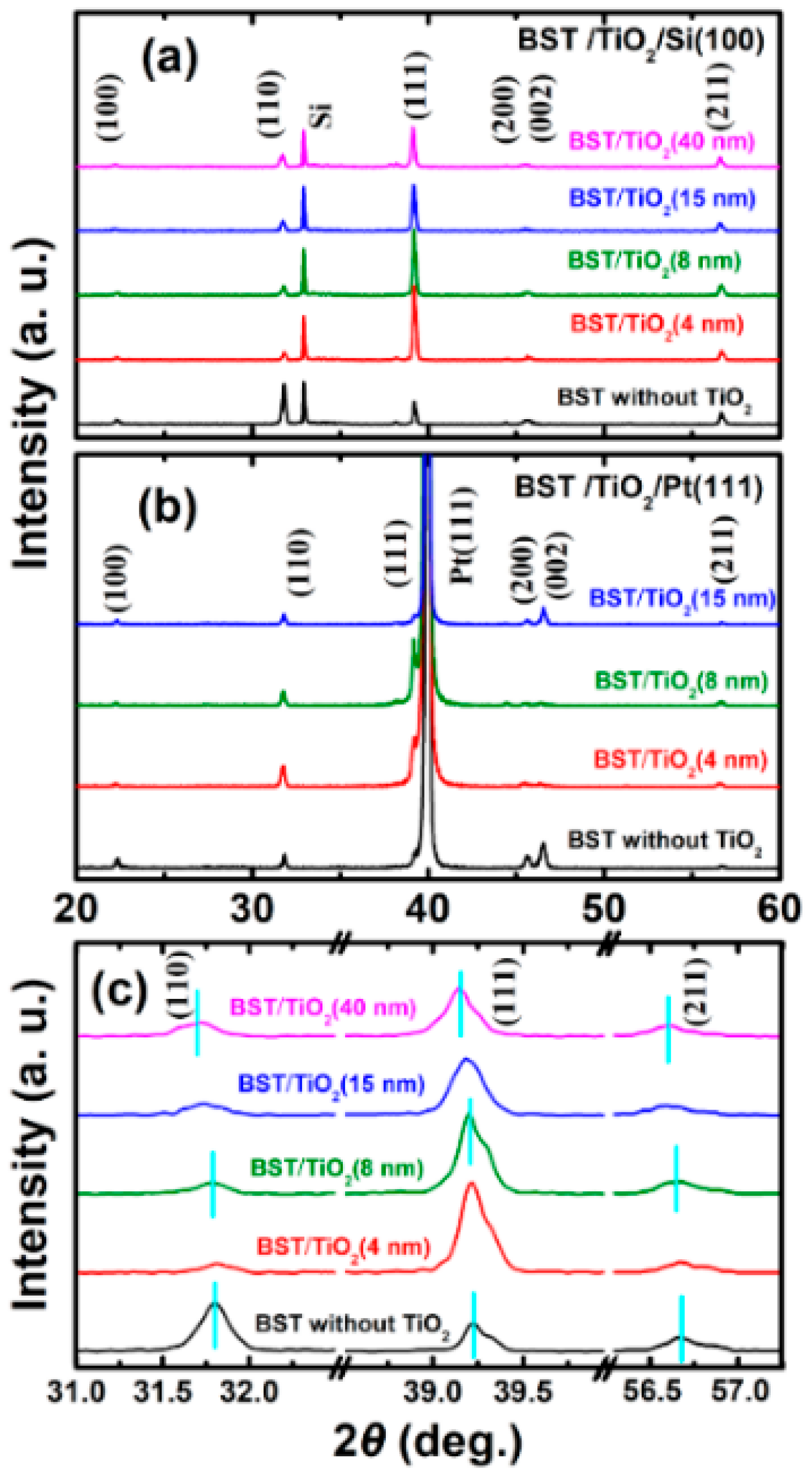
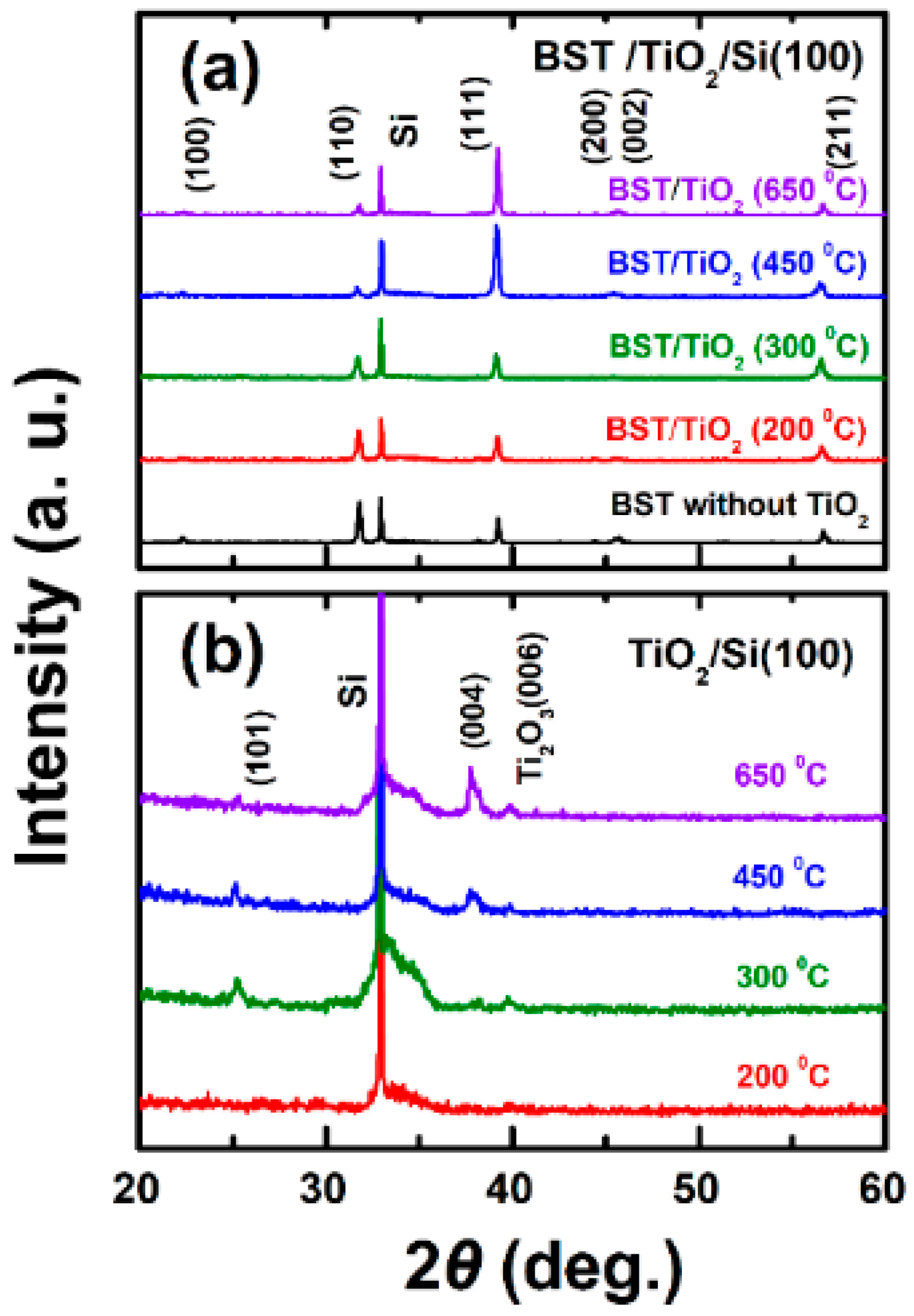
3.1. X-Ray Diffraction Spectrum (XRD)
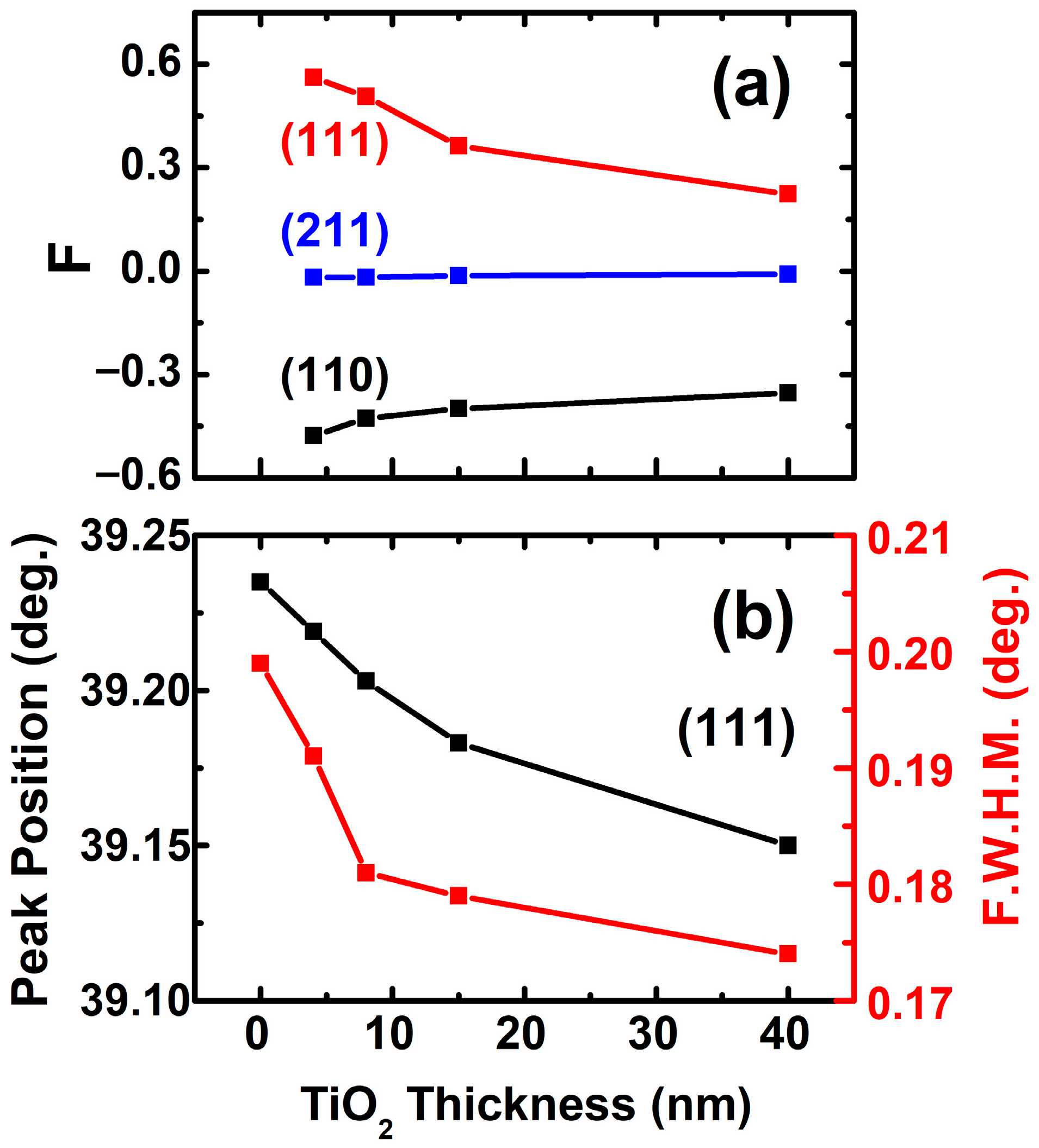
3.2. The Effect of the Lattice Structure of a TiO2 Buffer Layer on the Structure of BST Films
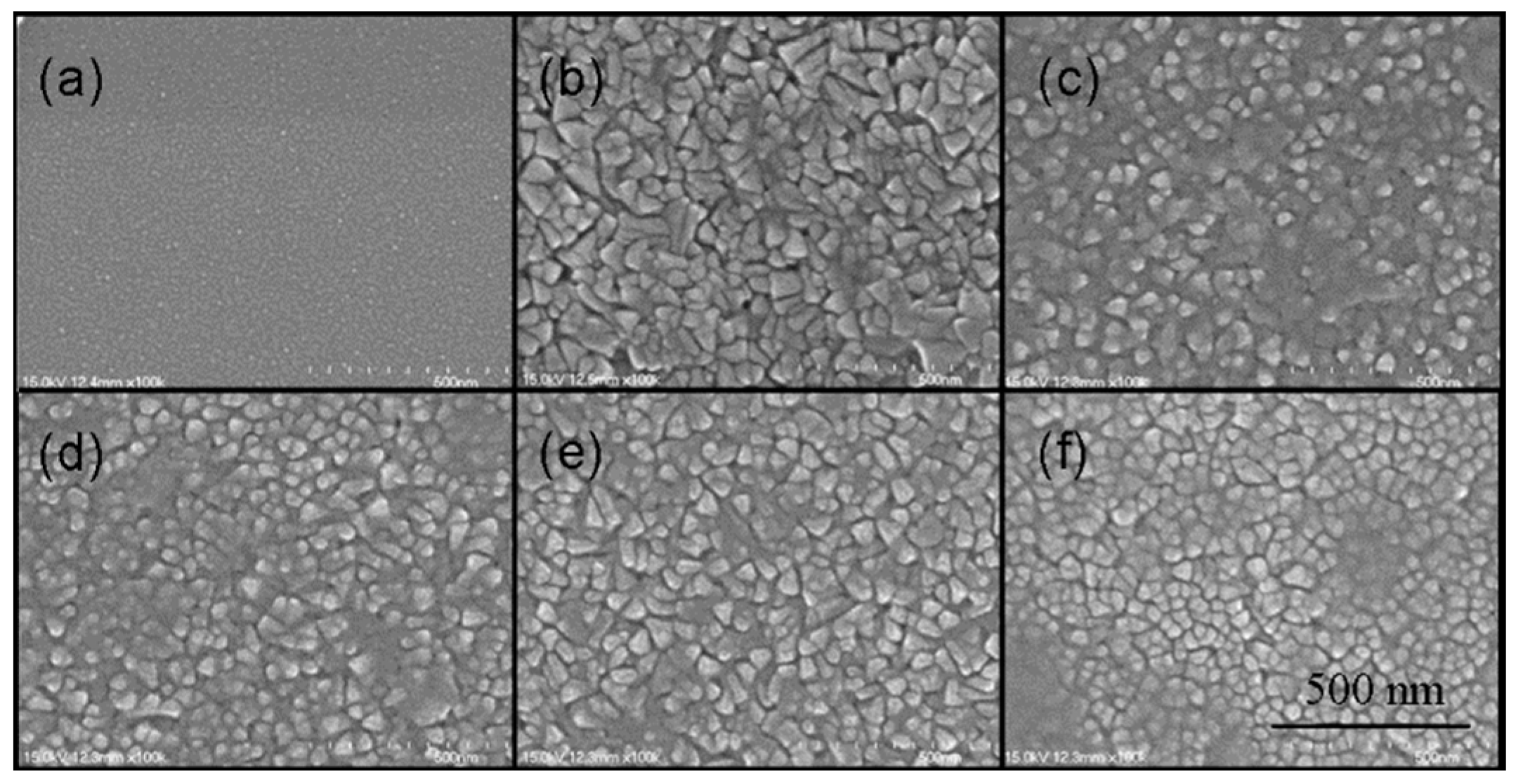
3.3. Surface Morphology and RMS Surface Roughness
3.4. The Effect of a TiO2 Buffer Layer on the Dielectric Characteristics
3.5. The Capacitance–Voltage (C-V) Characteristics and Dielectric Tunabilities
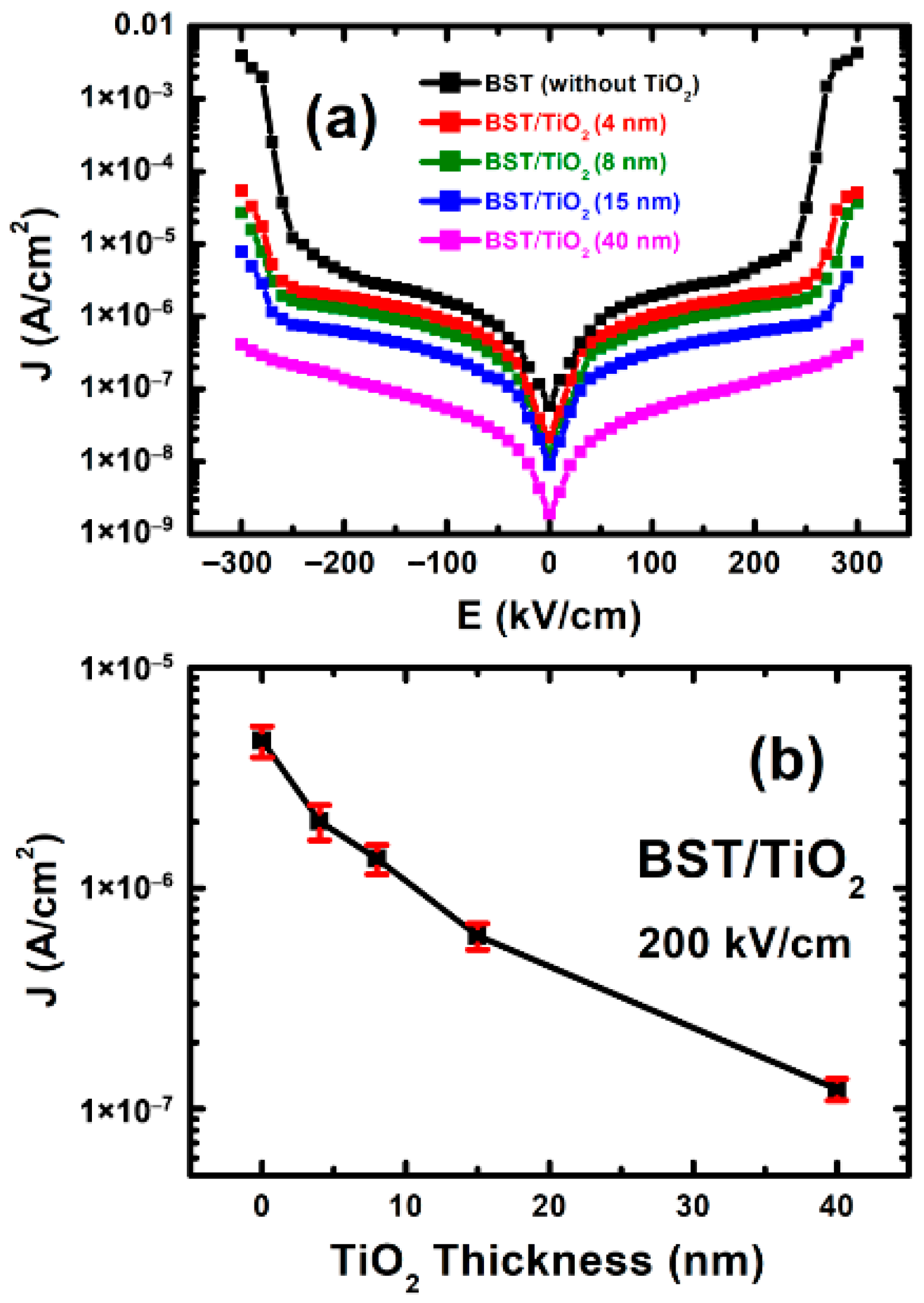
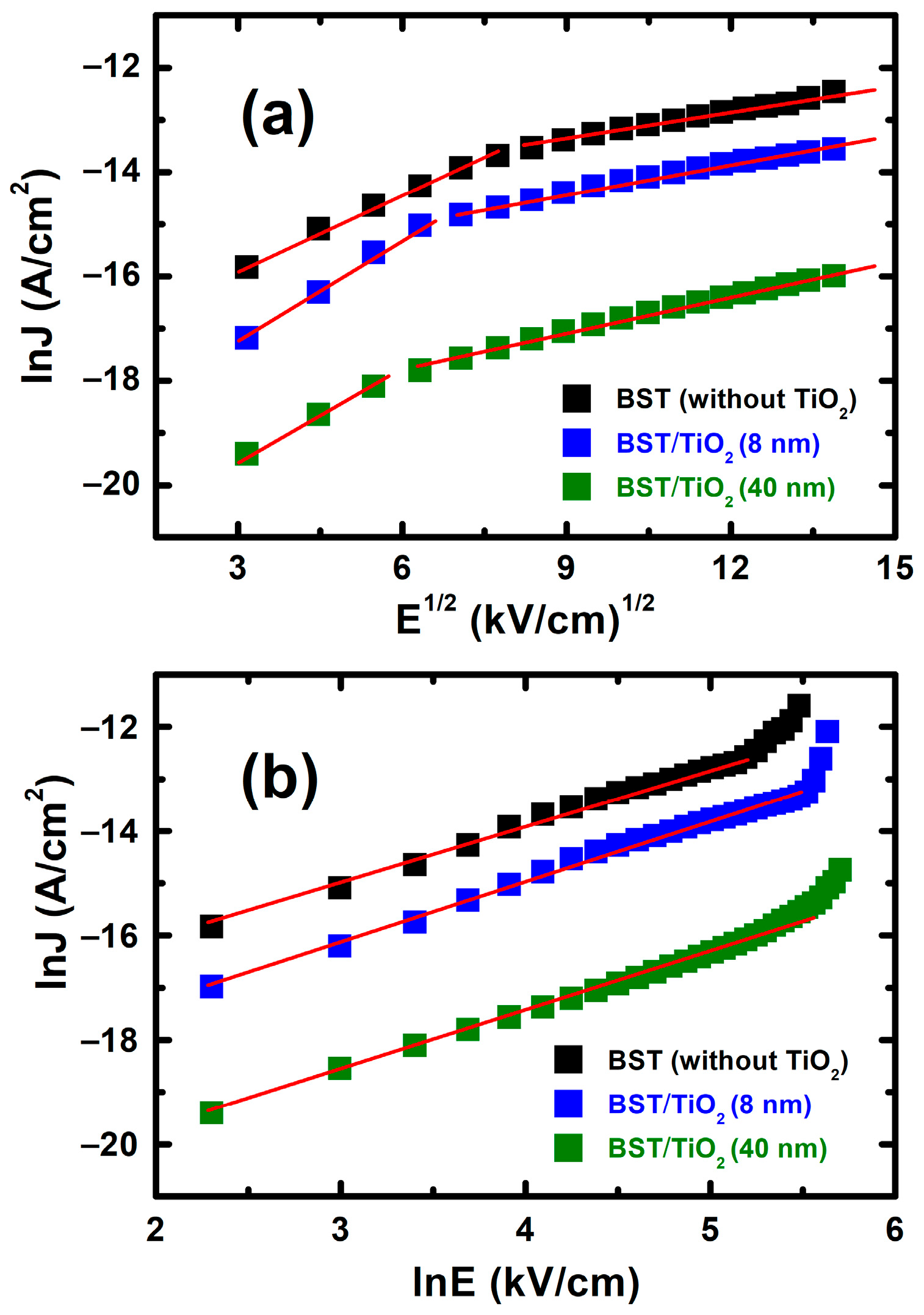
3.6. The I-V Characteristic Measurements
4. Conclusions
Author Contributions
Funding
Data Availability Statement
Conflicts of Interest
References
- Li, R.T.; Xu, D.M.; Du, C.; Ma, Q.Q.; Zhang, F.; Liang, X.; Wang, D.W.; Shi, Z.Q.; Liu, W.F.; Zhou, D. Giant dielectric tunability in ferroelectric ceramics with ultralow loss by ion substitution design. Nat. Commun. 2024, 15, 3754. [Google Scholar] [CrossRef] [PubMed]
- Huo, C.H.; Zhang, X.Y.; Li, C.; Xu, H.T.; Yu, P.; Cheng, L.; Zheng, C.L.; Gu, Z.Q. Robust tunability and newly emerged Q resonance of Ba0.8Sr0.2TiO3-based microwave capacitors under gamma irradiations. ACS Appl. Mater. Interfaces 2024, 16, 23517–23524. [Google Scholar] [CrossRef]
- Li, H.W.; Liu, C.; Ouyang, J. High dielectric tunability and figure of merit at low voltage in (001)-oriented epitaxial tetragonal Pb0.52Zr0.48TiO3 thin films. Nanomaterials 2025, 15, 695. [Google Scholar] [CrossRef]
- Johnson, K.M. Variation of dielectric constant with voltage in ferroelectrics and its application to parametric devices. J. Appl. Phys. 1962, 33, 2826–2831. [Google Scholar] [CrossRef]
- Mao, F.L.; Gui, J.S.; Hou, Y.Q.; Gao, S.Y.; Zeng, H.H.; Wang, W.B.; Xu, Z.B.; Zhu, Y.F.; Fan, L.; Zhang, H. Ultra-tunable dielectric capacitors enhanced by coupling ferroelectric field effect and semiconductor field effect. Appl. Phys. Lett. 2024, 125, 223502. [Google Scholar] [CrossRef]
- Sun, X.H.; Li, X.N.; Hou, S.; Huang, C.H.; Zou, J.; Li, M.Y.; Peng, T.Y.; Zhao, X.Z. The effect of Mg doping on the dielectric and tunable properties of Pb0.3Sr0.7TiO3 thin films prepared by sol–gel method. Appl. Phys. A 2014, 114, 777–783. [Google Scholar] [CrossRef][Green Version]
- Gao, L.B.; Guan, Z.P.; Huang, S.X.; Liang, K.X.; Chen, H.W.; Zhang, J.H. Enhanced dielectric properties of barium strontium titanate thin films by doping modification. J. Mater. Sci.-Mater. Electron. 2019, 30, 12821–12839. [Google Scholar] [CrossRef]
- Hussain, A.; Luo, S.B.; Zhao, C.; Liu, J.; Khan, A.M.; Yu, S.H. Ultrahigh dielectric tunability at low voltage in PVDF nanocomposite driven by nonlinear ZnO-ferroelectric core-shell architecture for microwave device application. Chem. Eng. J. 2025, 519, 165104. [Google Scholar] [CrossRef]
- Liu, S.H.; Xu, X.; Peng, M.Y.; Guo, Y.T.; Xu, J.; Gao, F. Fabrication and high dielectric properties of sandwich-structured Ba0.6Sr0.4TiO3/polyvinylidene fluoride layered composites with multiscale parallel interfaces. ACS Appl. Mater. Interfaces 2024, 16, 60948–60957. [Google Scholar] [CrossRef]
- Jiao, T.J.; You, C.Y.; Tian, N.; Ma, L.; Duan, Z.F.; Yan, F.X.; Ren, P.R.; Zhao, G.Y. High tunability and low loss via establishing an internal electric field in LiFe5O8/Ba0.6Sr0.4TiO3 composite films using chemical solution deposition method. Appl. Surf. Sci. 2022, 590, 153112. [Google Scholar] [CrossRef]
- Guo, Y.T.; Liu, S.H.; Wu, S.C.; Xu, J.; Pawlikowska, E.; Bulejak, W.; Szafran, M.; Rydosz, A.; Gao, F. Enhanced tunable dielectric properties of Ba0.6Sr0.4TiO3/PVDF composites through dual-gradient structural engineering. J. Alloys Compd. 2022, 920, 166034. [Google Scholar] [CrossRef]
- Peng, M.Y.; Liu, S.H.; Xu, X.; Feng, X.Y.; Zhang, J.; Xu, J.; Zhang, Y.T.; Gao, F. BST/PVDF-ABS composites with high dielectric tunability prepared via FDM additive manufacturing. J. Alloys Compd. 2025, 1020, 179347. [Google Scholar] [CrossRef]
- Zhang, X.G.; Fan, X.Y.; Ji, S.Y.; Cao, Y.L.; Song, J.M.; Li, G.; Liu, B.T.; Li, X.H.; Zhang, X.Y. A comparative study on the electrical properties of Ba0.6Sr0.4TiO3 film capacitors with different top electrodes. Curr. Appl. Phys. 2024, 68, 39–43. [Google Scholar] [CrossRef]
- Dong, H.L.; Zhang, H.; He, F.; Jia, Z.; Wei, K.L.; Tan, Q.L. Preparation and characterization of crystalline Ba0.5Sr0.5TiO3 thin films on FTO transparent electrodes. Ceram. Int. 2023, 49, 25199–25206. [Google Scholar] [CrossRef]
- Noguchi, Y.; Maki, H.; Kitanaka, Y.; Matsuo, H.; Miyayama, M. Control of misfit strain in ferroelectric BaTiO3 thin-film capacitors with SrRuO3-based electrodes on (Ba, Sr)TiO3-buffered SrTiO3 substrates. Appl. Phys. Lett. 2018, 113, 012903. [Google Scholar] [CrossRef]
- Zhao, J.Y.; Wang, Z.; Li, Y.; Zheng, K.; Zhang, J.; Meng, H.Y.; Zhang, N.; Zhao, Y.L.; Niu, G.; Wei, R. Dielectric nonlinearity analysis of BNT–ST–BT relaxor ferroelectric thin films with different film thicknesses. J. Appl. Phys. 2024, 136, 224103. [Google Scholar] [CrossRef]
- Takahashi, R.; Hamasaki, Y.; Sawai, S.; Novak, N.; Yasui, S.; Funakubo, H.; Ehara, Y.; Nishida, K. Dependence of the dielectric tunability in Ba(Zr0.2Ti0.8)O3 films deposited on (001) SrTiO3 substrates on film thickness and temperature. J. Ceram. Soc. Jpn. 2025, 133, 269–274. [Google Scholar] [CrossRef]
- Goud, J.P.; Kumar, A.; Alkathy, M.S.; Sandeep, K.; TS, A.R.; Sahoo, B.; Ryu, J.; Raju, K.C.J. Thickness dependence of microwave dielectric tunability in Ba0⋅5Sr0⋅5TiO3 thin films deposited by pulsed laser deposition. Ceram. Int. 2023, 49, 1188–1194. [Google Scholar] [CrossRef]
- Fardin, E.A.; Holland, A.S.; Ghorbani, K.; Akdogan, E.K.; Simon, W.K.; Safari, A.; Wang, J.Y. Polycrystalline Ba0.6Sr0.4TiO3 thin films on r-plane sapphire: Effect of film thickness on strain and dielectric properties. Appl. Phys. Lett. 2006, 89, 182907. [Google Scholar] [CrossRef]
- Chen, X.; Zhu, R.J.; Zhang, M.R.; Wang, Z.M. Composition gradient Ba1-xSrxTiO3 film with high dielectric tunability and temperature stability. Ceram. Int. 2025, 51, 29354–29360. [Google Scholar] [CrossRef]
- Aymen, S.; Mascot, M.; Jomni, F.; Carru, J.C. High tunability in lead-free Ba0.85Sr0.15TiO3 thick films for microwave tunable applications. Ceram. Int. 2019, 45, 23084–23088. [Google Scholar] [CrossRef]
- Gupta, R.; Gupta, V.; Tomar, M. Structural and dielectric properties of PLD grown BST thin films. Vacuum 2019, 159, 69–75. [Google Scholar] [CrossRef]
- Liu, T.X.; Zhang, X.Y.; Feng, Y.P.; Lin, Z.F.; Yuan, J.; Zhu, B.Y.; Hu, W.; Li, Q.; Ma, X.L.; Chen, Q.H.; et al. Improving the temperature stability of tunable devices by using composition-spread epitaxial ferroelectric BaxSr1−xTiO3 films. Phys. Rev. Mater. 2025, 9, 064410. [Google Scholar] [CrossRef]
- Dong, H.T.; Ke, L.; Hui, X.J.; Mao, J.J.; Du, H.Q.; Yuan, W.Q.; Ding, Q. Optimized Tunability of Barium Strontium Titanate Thin Films onto Different Plates with Proper Buffer Layers. Phys. Status Solidi B 2023, 260, 2200350. [Google Scholar] [CrossRef]
- Zhu, W.C.; Cheng, J.R.; Yu, S.W.; Gong, J.; Meng, Z.Y. Enhanced tunable properties of Ba0.6Sr0.4TiO3 thin films grown on Pt/Ti/SiO2/Si substrates using MgO buffer layers. Appl. Phys. Lett. 2007, 90, 032907. [Google Scholar] [CrossRef]
- Yia, W.C.; Kalkura, T.S.; Philofsky, E.; Kammerdiner, L. Structural and dielectric properties of Ba0.7Sr0.3TiO3 thin films grown on thin Bi layer-coated Pt(111)/Ti/SiO2/Si substrates. Thin Solid Film. 2002, 402, 307–310. [Google Scholar] [CrossRef]
- Lu, S.B.; Xu, Z.K. Internal residual stress studies and enhanced dielectric properties in La0.7Sr 0.3CoO3 buffered (Ba, Sr)TiO3 thin films. J. Appl. Phys. 2009, 106, 064107. [Google Scholar] [CrossRef]
- Yamada, T.; Muralt, P.; Sherman, V.O.; Sandu, C.S.; Setter, N. Epitaxial growth of Ba0.3Sr0.7TiO3 thin films on Al2O3(0001) using ultrathin TiN layer as a sacrificial template. Appl. Phys. Lett. 2007, 90, 142911. [Google Scholar] [CrossRef]
- Raman, T.S.A.; Arun, B.; Shivakumar, C.; Joseph, A.; Raju, K.C.J. Influence of oxygen pressure during deposition on the microwave dielectric tunability of Ba0.5Sr0.5TiO3 thin films in PLD process. Appl. Surf. Sci. 2024, 669, 160477. [Google Scholar] [CrossRef]
- Rabha, S.; Das, A.; Gone, S.; Dobbidi, P. Investigation of dielectric and electric behavior of MgTiO3 and Ba0.5Sr0.5TiO3 bilayer films by RF sputtering method. Appl. Surf. Sci. 2023, 608, 154972. [Google Scholar] [CrossRef]
- Wang, Y.; Liu, B.T.; Wei, F.; Yang, Z.M.; Du, J. Fabrication and electrical properties of (111) textured (Ba0.6Sr0.4)TiO3 film on platinized Si substrate. Appl. Phys. Lett. 2007, 90, 042905. [Google Scholar] [CrossRef]
- Kim, D.; Tuller, H.L.; Kim, H.S.; Park, J.S. High tunability (Ba, Sr)TiO3 thin films grown on atomic layer deposited TiO2 and Ta2O5 buffer layers. Appl. Phys. Lett. 2004, 85, 4705. [Google Scholar] [CrossRef]
- Kim, H.S.; Kim, H.G.; Kim, D.; Kim, K.-B.; Lee, J.C. High-tunability and low-microwave-loss Ba0.6Sr0.4TiO3 thin films grown on high-resistivity Si substrates using TiO2 buffer layers. Appl. Phys. Lett. 2005, 87, 212903. [Google Scholar] [CrossRef]
- Muralt, P.; Maeder, T.; Sagalowicz, L.; Hiboux, S.; Scalese, S.; Naumovic, D.; Agostino, R.; Xanthopoulos, G.N.; Mathieu, H.; Patthey, J.L.; et al. Texture control of PbTiO3 and Pb(Zr,Ti)O3 thin films with TiO2 seeding. J. Appl. Phys. 1998, 83, 3835–3841. [Google Scholar] [CrossRef]
- Bouregba, R.; Poullain, G.; Vilquin, B.; Murray, H. Orientation control of textured PZT thin films sputtered on silicon substrate with TiOx seeding. Mater. Res. Bull. 2000, 35, 1381–1390. [Google Scholar] [CrossRef]
- Muralt, P. Texture control and seeded nucleation of nanosize structures of ferroelectric thin films. J. Appl. Phys. 2006, 100, 051605. [Google Scholar] [CrossRef]
- Chen, L.L.; Shen, M.R.; Fang, L.; Xu, Y. Microstructure control of (Pb,Sr)TiO3 films on Pt/Ti/SiO2/Si substrates by a TiO2 buffer layer. Thin Solid Film. 2008, 516, 1285–1289. [Google Scholar] [CrossRef]
- Kato, K.; Suzuki, K.; Tanaka, K.; Fu, D.; Nishizawa, K.; Miki, T. Effect of amorphous TiO2 buffer layer on the phase formation of CaBi4Ti4O15 ferroelectric thin films. Appl. Phys. A 2004, 81, 861–864. [Google Scholar] [CrossRef]
- Higuchi, T.; Nakamura, M.; Hachisu, Y.; Saitoh, M.; Hattori, T.; Tsukamoto, T. Ferroelectric properties of Bi4Ti3O12 thin films prepared on TiO2 anatase layer. Jpn. J. Appl. Phys. 2004, 43, 6585–6589. [Google Scholar] [CrossRef]
- Lotgering, F.K. Topotactical reactions with ferrimagnetic oxides having hexagonal crystal structures. J. Inorg. Nucl. Chem. 1959, 9, 113. [Google Scholar] [CrossRef]
- Busani, T.; Devine, R.A.B. Dielectric and infrared properties of TiO2 films containing anatase and rutile. Semicond. Sci. Technol. 2005, 20, 870–875. [Google Scholar] [CrossRef]
- Zhang, F.; Wang, G.H.; Lin, N.; Zhou, J.J.; Zhong, S.L.; Yuan, M.X.; Li, B.; Zhou, W.Y. Synergistic promotion of inter-particle and intra-particle polarizations in BST@TiO2/PVDF nanocomposites towards elevated dielectric properties. Compos. Sci. Technol. 2024, 251, 110547. [Google Scholar] [CrossRef]
- Hussain, A.; Jie, L.; Zhao, C.; Yu, J.Y.; Khan, A.M.; Luo, S.B.; Yu, S.H. Low voltage tunability of PVDF-based nanocomposites by interface polarization induced by TiO2-coated BST core-shell nanoparticle. Compos. Commun. 2024, 49, 101984. [Google Scholar] [CrossRef]
- Jolivet, A.; Labbé, C.; Frilay, C.; Debieu, O.; Marie, P.; Horcholle, B.; Lemarié, F.; Portier, X.; Grygiel, C.; Duprey, S.; et al. Structural, optical, and electrical properties of TiO2 thin films deposited by ALD: Impact of the substrate, the deposited thickness and the deposition temperature. Appl. Surf. Sci. 2023, 608, 155214. [Google Scholar] [CrossRef]
- Aoki, K.; Fukuda, Y.; Numata, K.; Nishimura, A. Effects of titanium buffer layer on lead-zirconate-titanate crystallization processes in sol-gel deposition technique. Jpn. J. Appl. Phys. 1995, 34, 192–195. [Google Scholar] [CrossRef]
- Jeon, Y.A.; Shin, W.C.; Seo, T.S.; Yoon, S.G. Improvement in tunability and dielectric loss of (Ba0.5Sr0.5)TiO3 capacitors using seed layers on Pt/Ti/SiO2/Si substrates. J. Mater. Res. 2002, 17, 2831. [Google Scholar] [CrossRef]



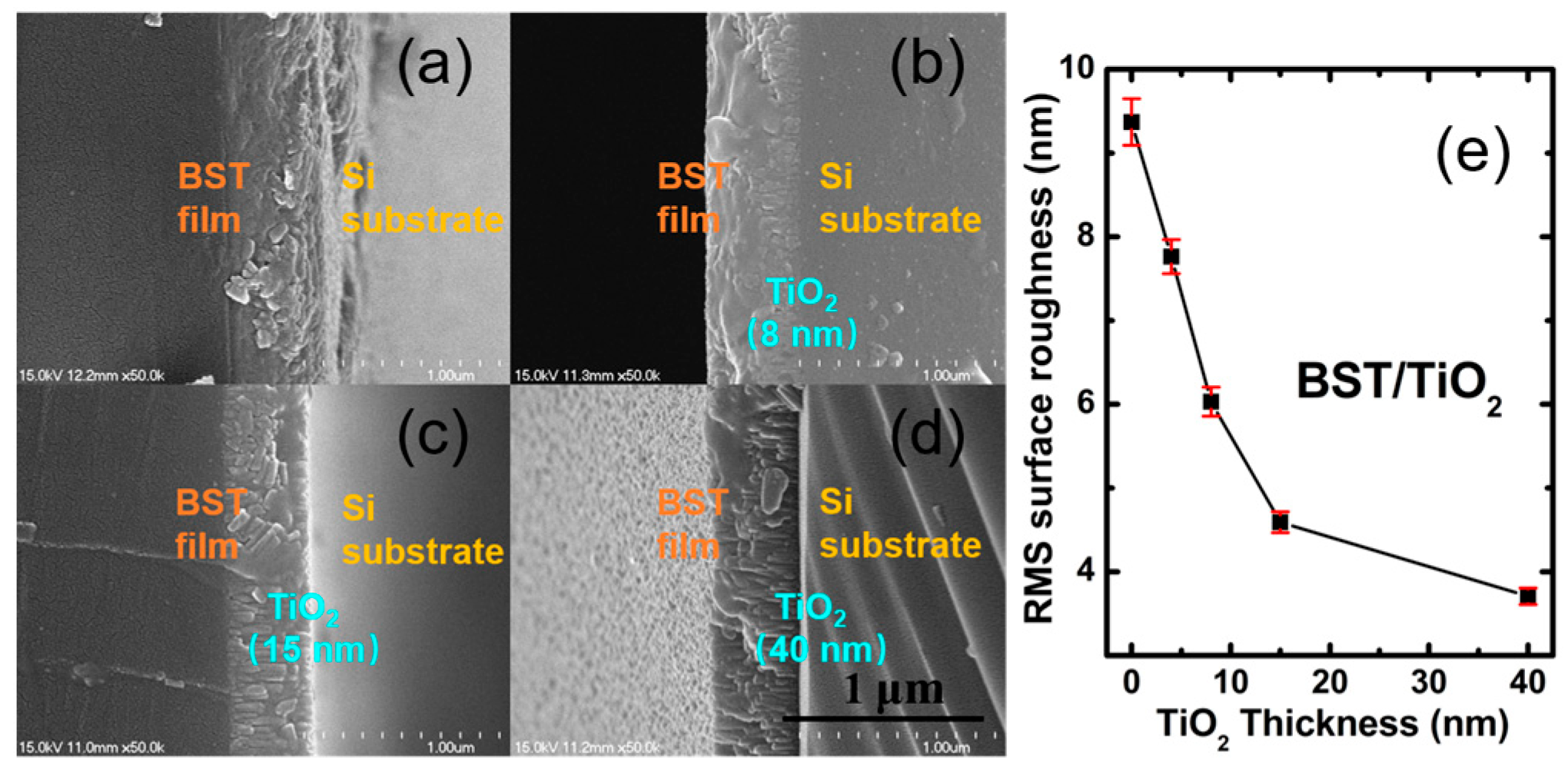
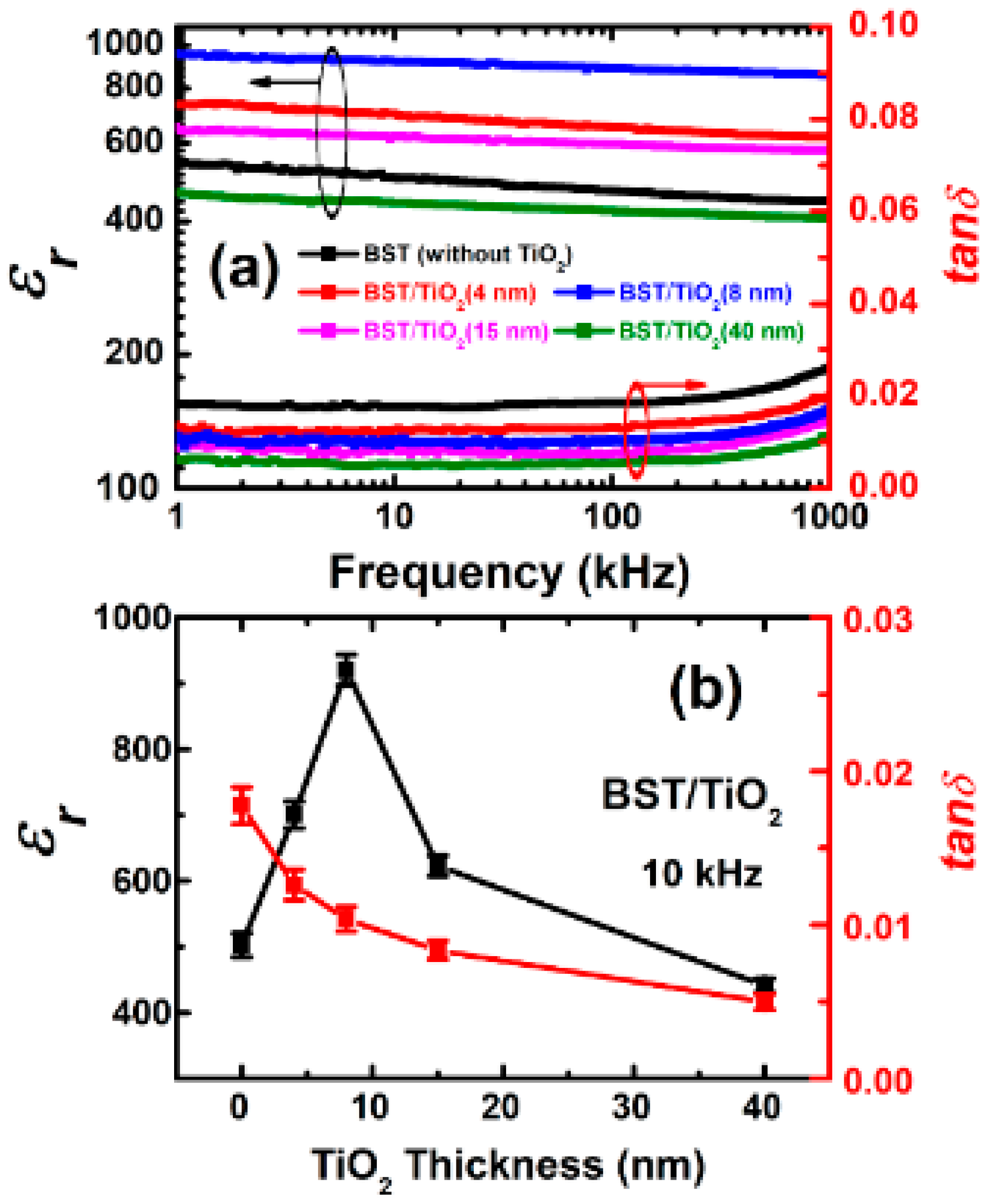
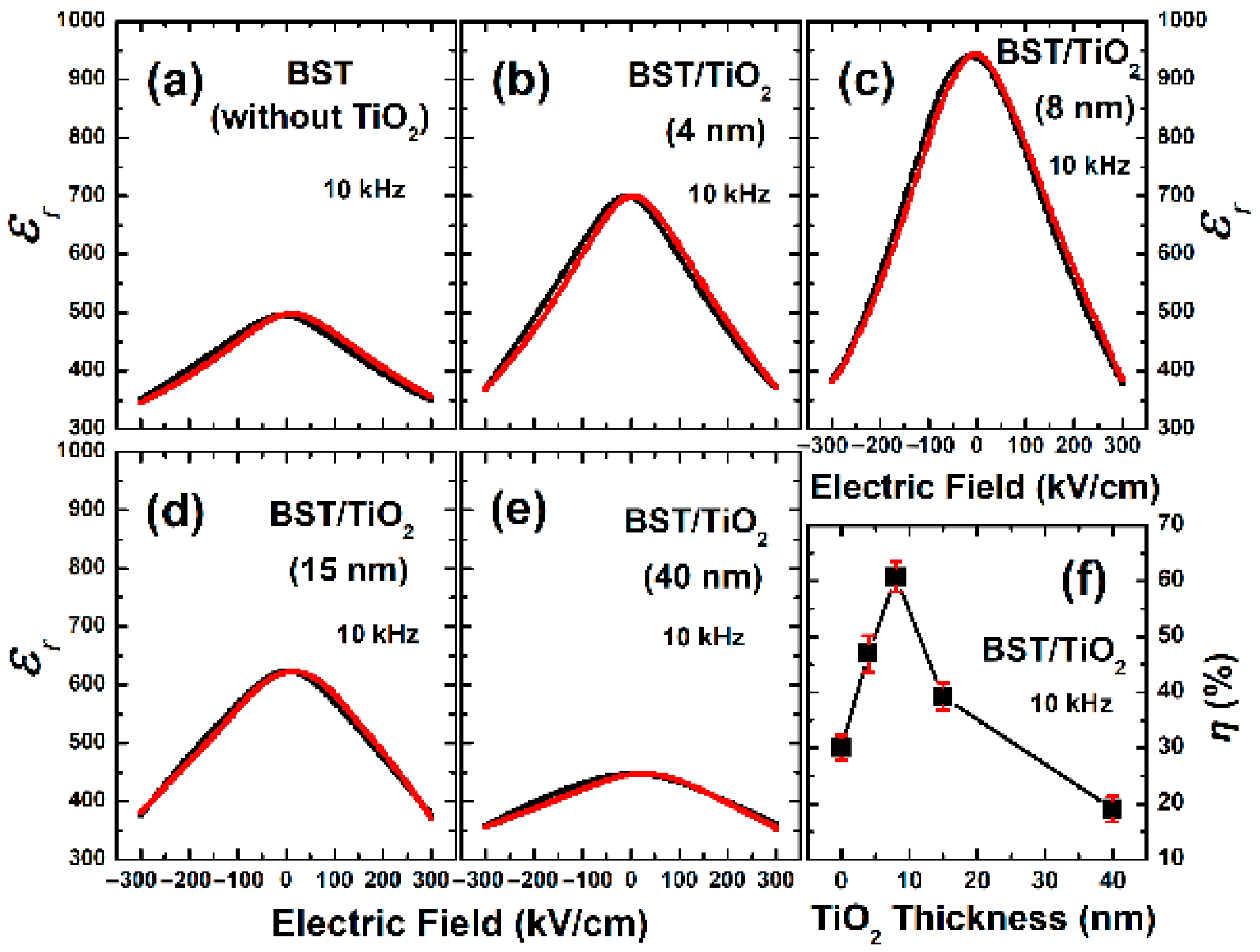
| Thin Film Type | TiO2 Thickness (nm) | Grain Size (nm) | Lattice Parameter (Å) | RMS Surface Roughness (nm) | εr | tanδ | J (A/cm2) | η (%) |
|---|---|---|---|---|---|---|---|---|
| BST | 0 | 42.25 | 3.9670 | 9.37 | 502.6 | 0.018 | 4.67 × 10⁻⁶ | 30.1 |
| BST/TiO2 | 4 | 44.27 | 3.9681 | 7.76 | 700.3 | 0.013 | 2.01 × 10⁻⁶ | 46.9 |
| BST/TiO2 | 8 | 46.69 | 3.9695 | 6.03 | 920.3 | 0.010 | 1.36 × 10⁻⁶ | 60.8 |
| BST/TiO2 | 15 | 47.08 | 3.9744 | 4.59 | 622.7 | 0.008 | 6.09 × 10⁻⁷ | 39.3 |
| BST/TiO2 | 40 | 48.46 | 3.9792 | 3.71 | 441.5 | 0.004 | 1.23 × 10⁻⁷ | 19.1 |
| Film Type | Peak Position (deg.) | F.W.H.M. (deg.) | F | Lattice Strain | ||||||
|---|---|---|---|---|---|---|---|---|---|---|
| (110) | (111) | (211) | (110) | (111) | (211) | (110) | (111) | (211) | ||
| BST | 31.821 | 39.235 | 56.690 | 0.201 | 0.199 | 0.230 | — | — | — | 0.0026 |
| BST/TiO2 (4 nm) | 31.809 | 39.219 | 56.687 | 0.204 | 0.191 | 0.232 | −0.477 | 0.562 | −0.019 | 0.0024 |
| BST/TiO2 (8 nm) | 31.798 | 39.203 | 56.677 | 0.207 | 0.181 | 0.233 | −0.428 | 0.507 | −0.018 | 0.0024 |
| BST/TiO2 (15 nm) | 31.744 | 39.183 | 56.614 | 0.212 | 0.179 | 0.238 | −0.399 | 0.363 | −0.013 | 0.0022 |
| BST/TiO2 (40 nm) | 31.712 | 39.150 | 56.613 | 0.216 | 0.174 | 0.242 | −0.354 | 0.224 | −0.009 | 0.0021 |
| Materials/Buffer | Methods | Buffer Thickness (nm) | Frequency (Hz) | E (kV/cm) | εr | tanδ | η (%) | Ref. |
|---|---|---|---|---|---|---|---|---|
| Ba0.6Sr0.4TiO3/MgO | PLD | 10 | 1 M | 300 | 275 | 0.009 | 30.0 | [25] |
| Ba0.7Sr0.3TiO3/Bi | EBE | 10 | 1 M | 500 | 290 | 0.048 | 55.2 | [26] |
| Ba0.6Sr0.4TiO3/LSCO | PLD | 100 | 1 M | 230 | 1170 | 0.01 | 75.0 | [27] |
| Ba0.3Sr0.7TiO3/TiN | PLD | 0.9 | 8 G | 200 | — | 0.03 | 35.5 | [28] |
| Ba0.6Sr0.4TiO3/TiO2 | PLD | 50 | 1 M | 200 | — | 0.03 | 72.9 | [32] |
| Ba0.6Sr0.4TiO3/Ta2O5 | PLD | 50 | 1 M | 200 | — | 0.04 | 53.1 | [32] |
| Ba0.6Sr0.4TiO3/TiO2 | ALD | 50 | 2 G | 40 | 230 | 0.079 | 33.2 | [33] |
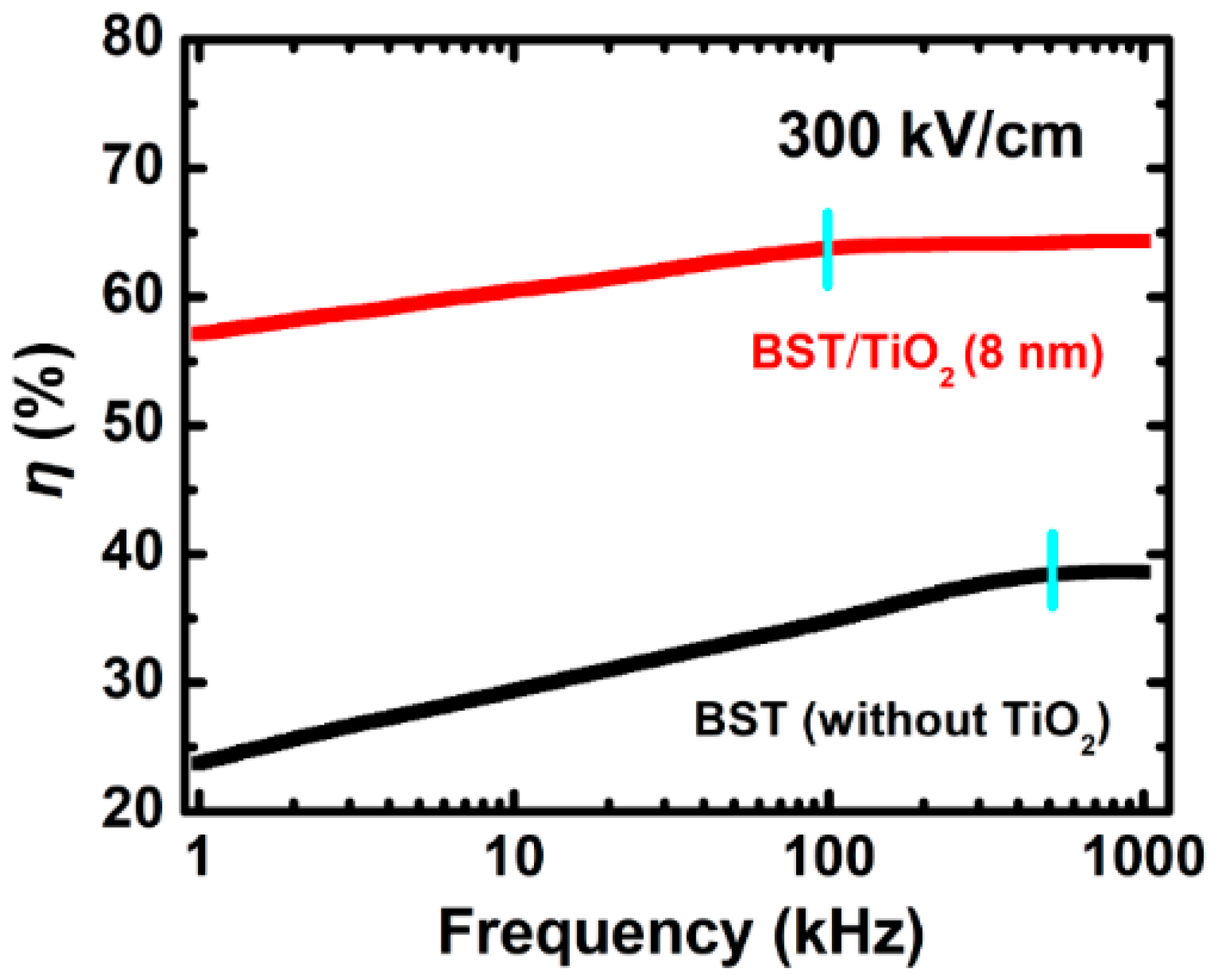
| Ba0.6Sr0.4TiO3/TiO2 | PLD | 8 | 1 M | 300 | 856.5 | 0.017 | 64.3 | this work |
Disclaimer/Publisher’s Note: The statements, opinions and data contained in all publications are solely those of the individual author(s) and contributor(s) and not of MDPI and/or the editor(s). MDPI and/or the editor(s) disclaim responsibility for any injury to people or property resulting from any ideas, methods, instructions or products referred to in the content. |
© 2025 by the authors. Licensee MDPI, Basel, Switzerland. This article is an open access article distributed under the terms and conditions of the Creative Commons Attribution (CC BY) license (https://creativecommons.org/licenses/by/4.0/).
Share and Cite
Zhang, P.; He, J.; Liu, X.; Zhang, L.; Zhang, L.; Wang, D.; Wu, K.; Wang, S. Higher than 60% Dielectric Tunability in Ba0.6Sr0.4TiO3 Films Using TiO2 Anatase Buffer Layers. Nanomaterials 2025, 15, 1797. https://doi.org/10.3390/nano15231797
Zhang P, He J, Liu X, Zhang L, Zhang L, Wang D, Wu K, Wang S. Higher than 60% Dielectric Tunability in Ba0.6Sr0.4TiO3 Films Using TiO2 Anatase Buffer Layers. Nanomaterials. 2025; 15(23):1797. https://doi.org/10.3390/nano15231797
Chicago/Turabian StyleZhang, Pengzhan, Jiaming He, Xinyu Liu, Leng Zhang, Ling Zhang, Danbei Wang, Kongpin Wu, and Sake Wang. 2025. "Higher than 60% Dielectric Tunability in Ba0.6Sr0.4TiO3 Films Using TiO2 Anatase Buffer Layers" Nanomaterials 15, no. 23: 1797. https://doi.org/10.3390/nano15231797
APA StyleZhang, P., He, J., Liu, X., Zhang, L., Zhang, L., Wang, D., Wu, K., & Wang, S. (2025). Higher than 60% Dielectric Tunability in Ba0.6Sr0.4TiO3 Films Using TiO2 Anatase Buffer Layers. Nanomaterials, 15(23), 1797. https://doi.org/10.3390/nano15231797