MoS2-Based Composites for Electrochemical Detection of Heavy Metal Ions: A Review



Abstract
1. Introduction
2. Overview of MoS2 Electrode Materials
2.1. Top-Down Approaches
- Mechanical exfoliation is a classical method for isolating monolayer or few-layer nanosheets from layered materials by applying physical force. This technique exploits the weak interlayer van der Waals forces characteristic of such materials. The standard procedure is as follows: First, a bulk MoS2 crystal is positioned onto the surface of a transparent adhesive tape with strong adhesion. Repeated peeling and pressing actions are then employed to mechanically disrupt the interlayer bonding. Subsequently, the tape bearing the exfoliated nanosheets is transferred onto a target substrate (e.g., SiO2/Si or gold-coated substrates). Following the slow removal of the tape, the exfoliated nanosheets remain adhered to the substrate surface. Finally, samples with the desired number of layers are identified and selected using optical microscopy or atomic force microscopy [22]. This method was initially demonstrated by Frindt [30] in 1966 for the exfoliation of MoS2, producing nanosheets ranging from several to dozens of layers thick. Despite its inherent scaling limitations, mechanical exfoliation remains the preferred method in laboratories for obtaining high-quality two-dimensional (2D) MoS2 nanosheets due to the exceptional structural integrity and electronic quality of the resulting samples.
- Chemical exfoliation is a versatile strategy for the efficient delamination of layered materials. This approach relies on the intercalation of selected chemical agents into the interlayer galleries of MoS2. The intercalants induce chemical reactions that expand the interlayer spacing and weaken the van der Waals bonding forces. Subsequent delamination is achieved through sonication or hydrolysis, yielding exfoliated nanosheets with high production yield and robust solution stability [31]. Zheng et al. [32] successfully synthesized monolayer MoS2 using sodium naphthalenide (Na+C10H8−) and related alkali metal naphthalenide complexes as intercalants via a two-step expansion and intercalation protocol. Their comparative study of lithium, sodium, and potassium-based intercalants revealed that sodium naphthalenide yielded MoS2 monolayers with lateral dimensions reaching 400 μm2, demonstrating its efficacy for producing high-quality, large-area monolayer MoS2. This method offers a straightforward procedure and utilizes reagents with relatively low toxicity. However, the introduced alkali metal ions pose challenges for complete elimination from the final material. Furthermore, certain essential intercalants are costly and present inherent safety hazards during handling.
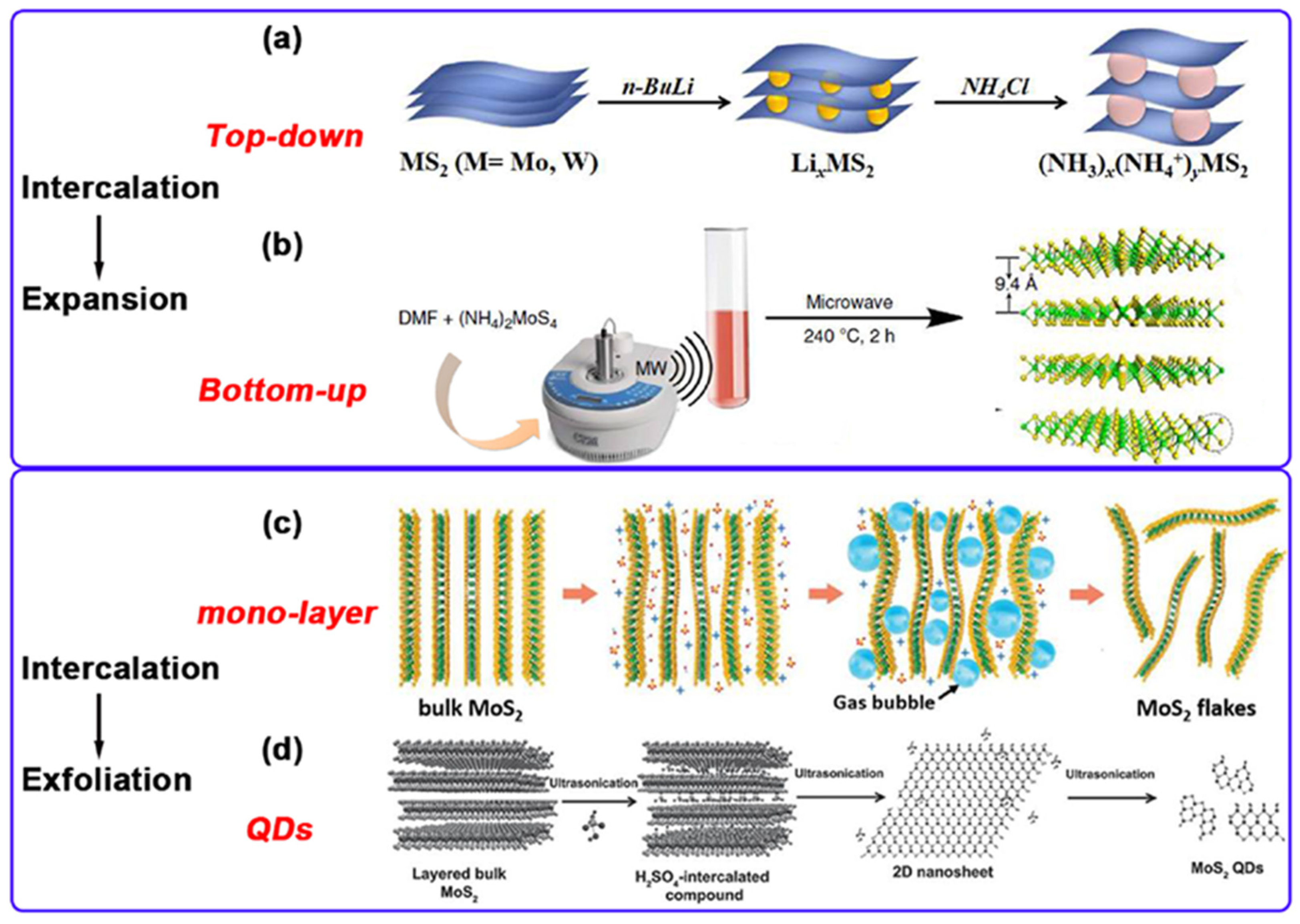
- Electrochemical exfoliation represents a method for preparing MoS2 nanosheets, as investigated by You et al. [33]. This technique exploits the co-intercalation of SO42− and OH− ions coupled with gas evolution-induced expansion to overcome interlayer van der Waals forces, thereby delaminating bulk MoS2 crystals into nanosheets. In their experimental setup, a natural MoS2 crystal served as the working electrode, a platinum wire as the counter electrode, and a 0.5 M H2SO4 aqueous solution as the electrolyte. Application of a bias voltage facilitated the exfoliation process. The resulting MoS2 nanosheets exhibited high crystallinity, large lateral dimensions (approximately 20 μm), and a Mo/S atomic ratio approximating 1:2. Liu et al. [34] employed electrochemical exfoliation to synthesize large-area, high-quality MoS2 nanosheets. In their procedure, a bulk MoS2 crystal served as the working electrode, a platinum wire as the counter electrode, and a 0.5 M sodium sulfate (Na2SO4) aqueous solution as the electrolyte. Following a +2 V pre-wetting step, a +10 V DC bias voltage was applied to drive the electrochemical exfoliation. This method facilitates the co-intercalation of hydroxyl radicals and sulfate ions, generated in situ via electrolysis, into the MoS2 interlayers. The mechanical force exerted by concomitant oxygen gas evolution further promotes interlayer dissociation. Consequently, monolayer and few-layer MoS2 nanosheets with lateral dimensions ranging from 5 to 50 μm were successfully obtained (Figure 3c). Material oxidation was effectively suppressed through optimization of the electrolysis parameters. Combining the scalability inherent to solution processing with the high material quality achieved, this approach offers a promising strategy for the controllable exfoliation of TMDs.
- Liquid-phase exfoliation involves dispersing MoS2 powder in water or an organic solvent, followed by ultrasonic treatment to exfoliate it into single or few-layer nanosheets. The method is influenced by factors such as ultrasonic power and solvent choice [35]. Dai et al. [36] were able to gradually exfoliate and cut bulk MoS2 into structures of different sizes, including single-layer MoS2 flakes, porous MoS2 flakes, and quantum dots, by controlling the ultrasonic time (Figure 3d). The experimental results show that the prepared MoS2 quantum dots exhibit uniform lateral dimensions of approximately 3.5 nm and a height ranging from 1 to 1.5 nm. They demonstrate excellent excitation-independent blue photoluminescence characteristics, with a quantum yield of 9.65% and a fluorescence lifetime of 4.66 nanoseconds. Furthermore, they exhibit good fluorescence stability within the pH range of 4 to 10. Liquid-phase exfoliation is low-cost and simple to operate, making it suitable for large-scale production. Nevertheless, it has drawbacks such as non-uniform thickness and size of the prepared materials, and difficulty in removing organic solvents.
2.2. Bottom-Up Approaches

3. Electrochemical Detection Based on MoS2 Electrode Materials
3.1. Voltammetry
3.2. Impedance Measurement Techniques
3.3. Potentiometry
3.4. Electrochemiluminescence Techniques
4. Electrochemical Sensing Applications of MoS2-Based Composites
4.1. MoS2/Metal Nanoparticle Composites
4.2. MoS2/Conductive Polymer Composites
4.3. MoS2/Carbon-Based Material Composites
4.4. MoS2/Metal Oxide Composites
4.5. MoS2/Chitosan Composites

| Materials | Technique | Real Sample | Metal Ion | LOD | Detection Range | Ref. |
|---|---|---|---|---|---|---|
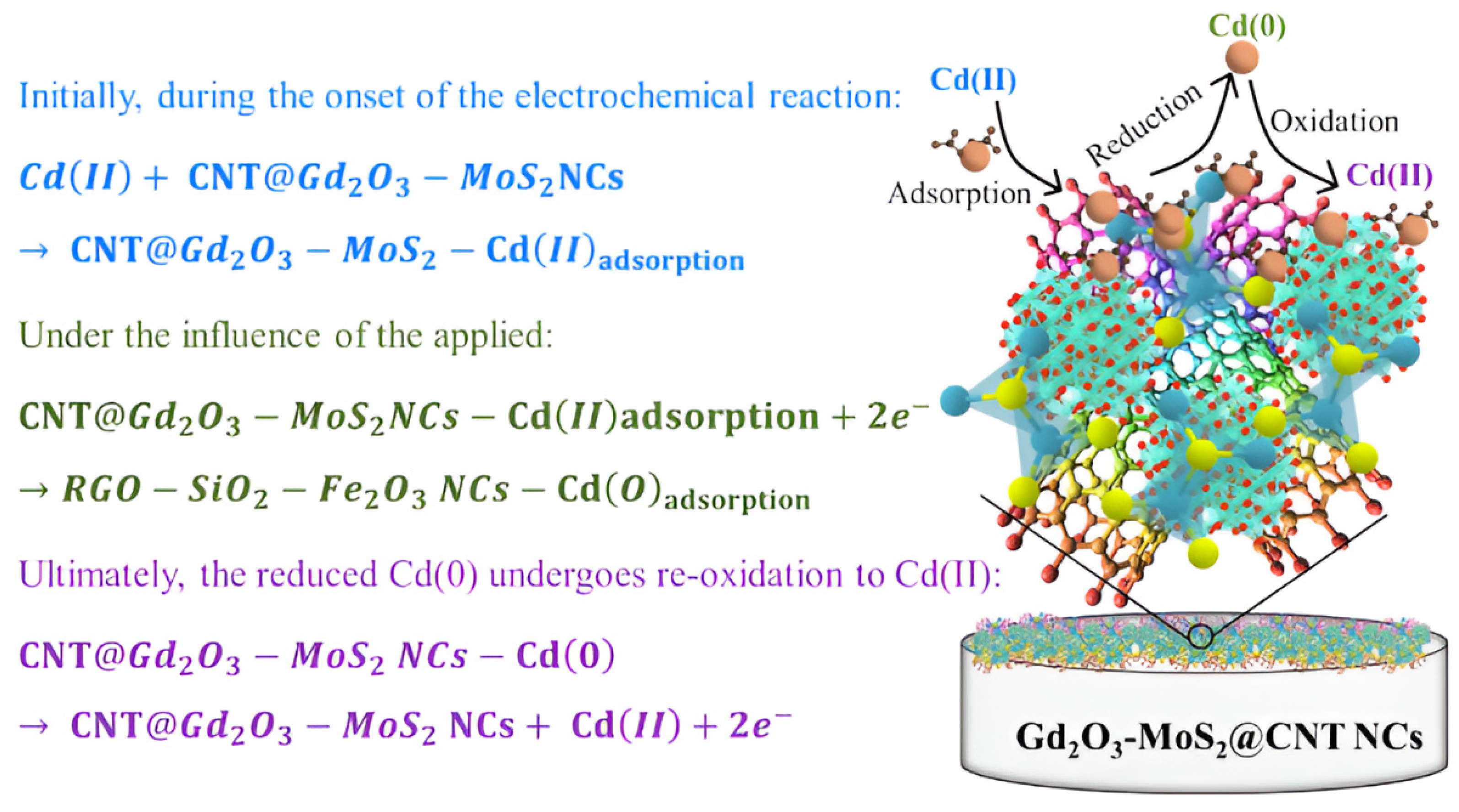
| Gd2O3-MoS2@CNT NCs | CV | Tap water | Cd2+ | 2.363 ppb | 5–110 ppb | [53] |
| MoS2/GCE | DPV | Tap water and sea water | Hg2+ | 0.2 ppq | 0.1 nM–0.2 mM | [55] |
| Mn-MoS2/MWCNTs/NA/GCE | DPASV | Tap water and lake water | Pb2+ | 0.08 μg/L | 0.2–100 μg/L | [58] |
| MoS2/NiS2 | SWASV | Not specified | Hg2+ | 0.0111 μM | 0–4 μM | [59] |
| MoS2/SPCE | CV, DPV | Not specified | Cu2+ | 5.43 μM | 5 μM–5 mM | [62] |
| MoS2/Au | DPV | Factory and environmental lab wastewater | Hg2+ | 0.0004 ppb | 0.0004 ppb–0.5 ppm | [81] |
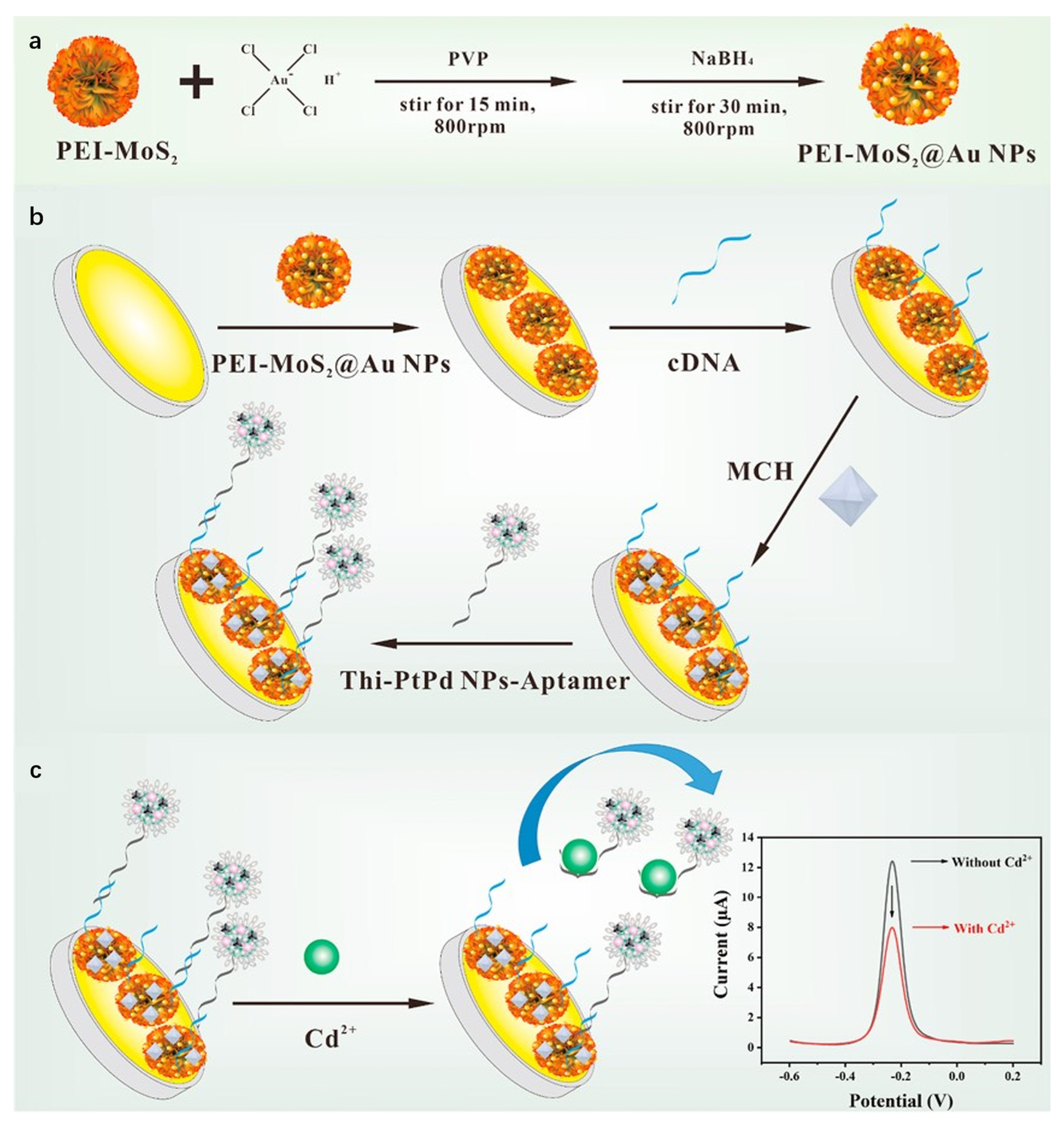
| PEI-MoS2@Au NPs | DPV | Tap water | Cd2+ | 2.34 × 10⁻⁴ nM | 1 × 10⁻³ nM–1 × 10² nM | [82] |
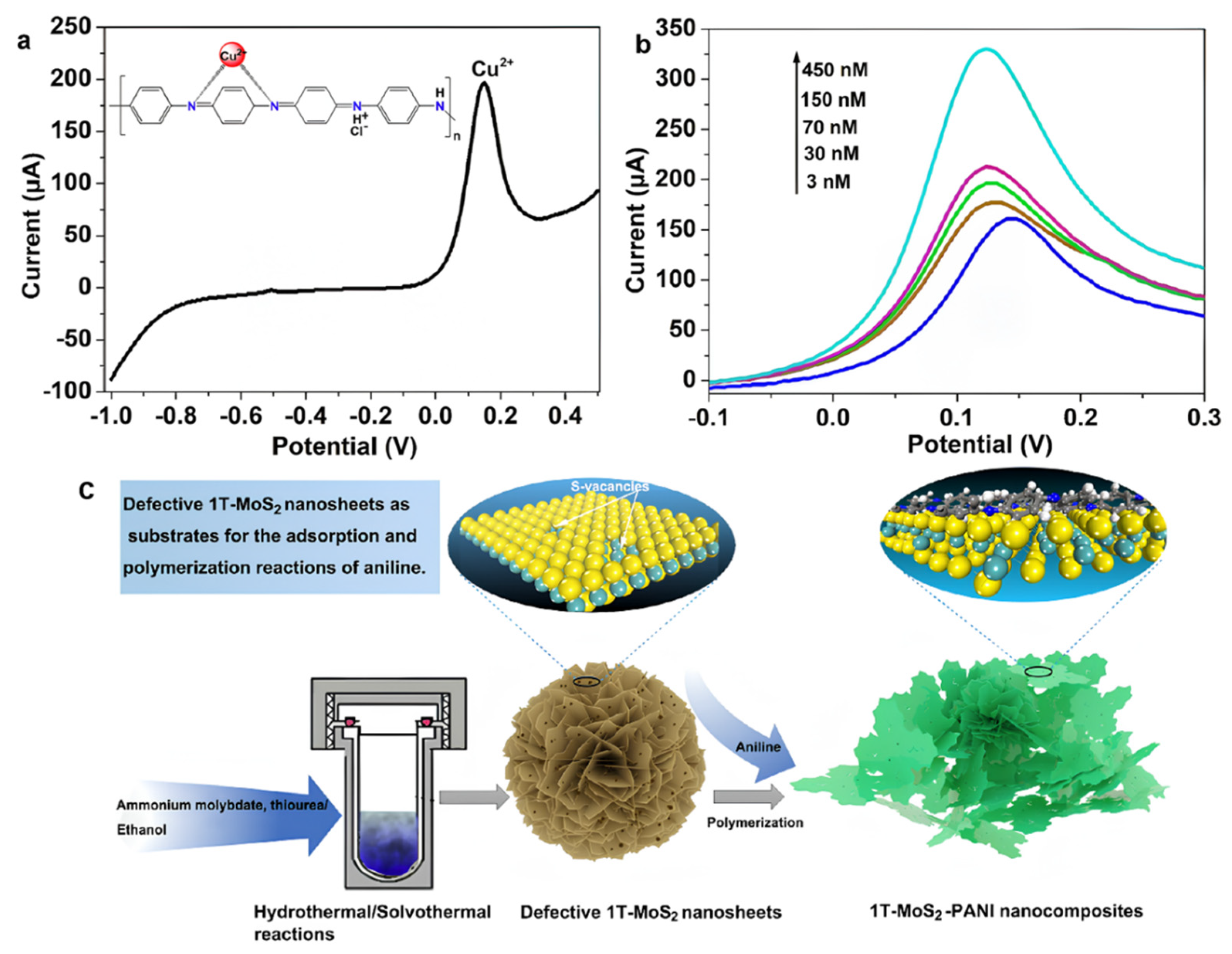
| 1T-MoS2/PANI/GCE | LSV | Tap water | Cu2+ | 0.33 nM | 3–450 nM | [88] |
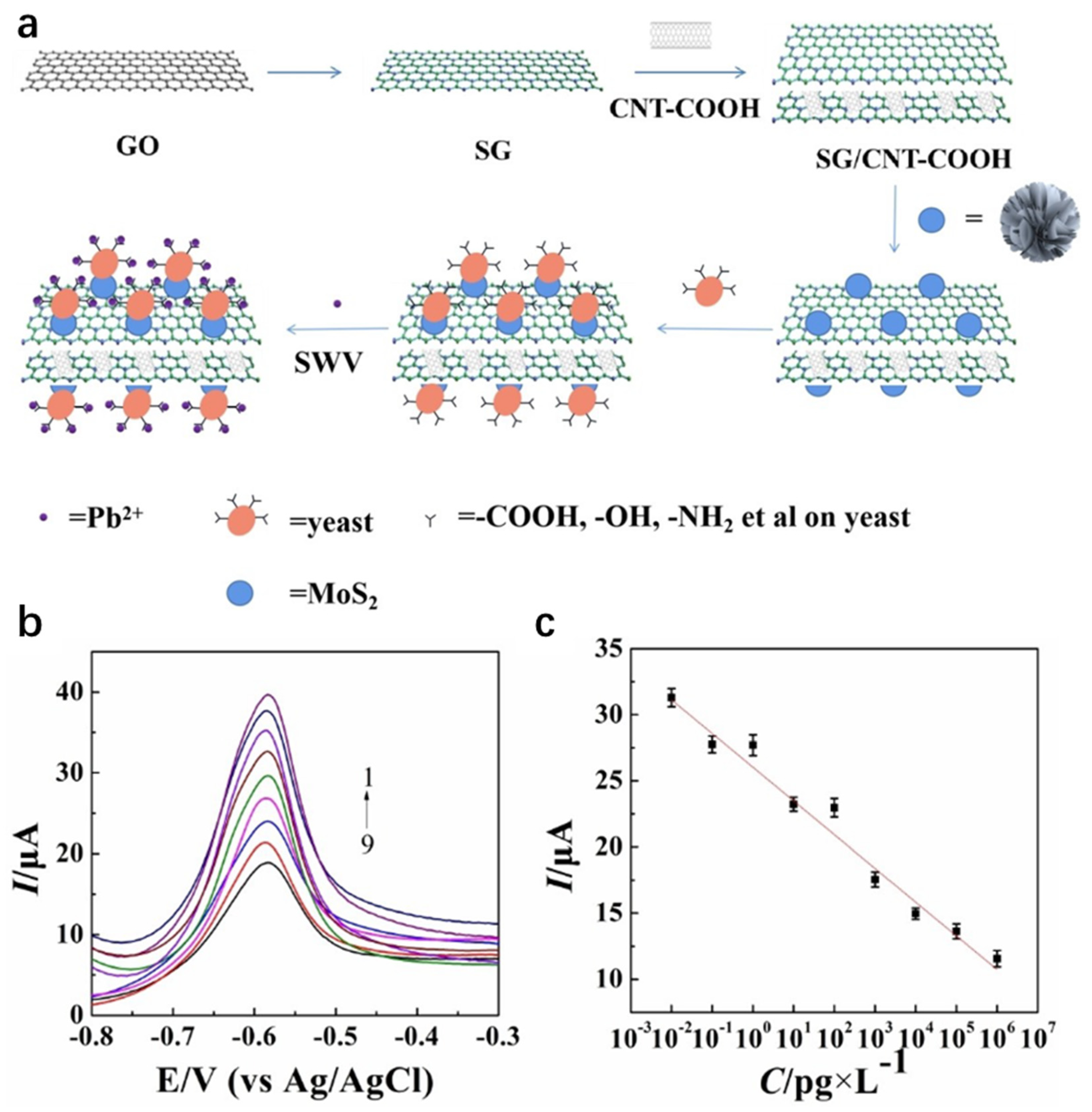
| SG/CNT-COOH/MoS2/Yeast/GCE | SWV | Human serum | Pb2+ | 2.61 × 10⁻¹⁵ g/L | 10−6–10−14 g/L | [94] |
| MSQD/PGE | ASDPV | Agriculture soil and ground water | Pb2+ | 1.96 × 10⁻⁹ M | 5.66 × 10⁻⁹ M–491.93 × 10⁻⁹ M | [95] |
| MoS2-rGO/CPE | DPASV | Tap water | Hg2+ | 1.6 µM | 1.0–10.0 µM | [96] |
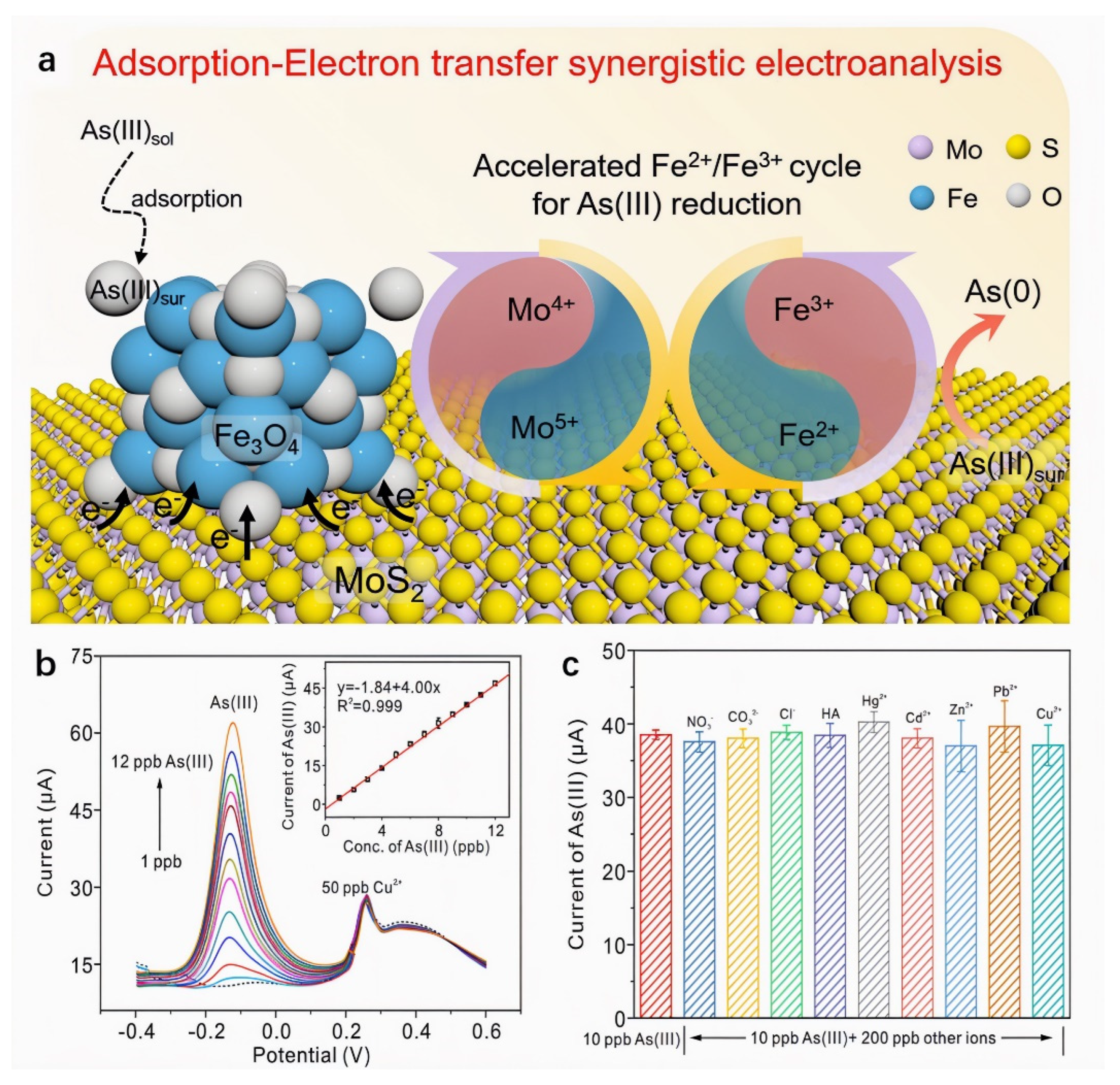
| Fe3O4/MoS2 | SWASV | Nanhu Lake and tap water | As(III) | 0.021 ppb | 1–10 ppb | [102] |
| Fe3O4/MoS2/Nafion/GCE | DPV | Seawater | Cd2+ | 0.053 μg/L | 5–300 μg/L | [103] |
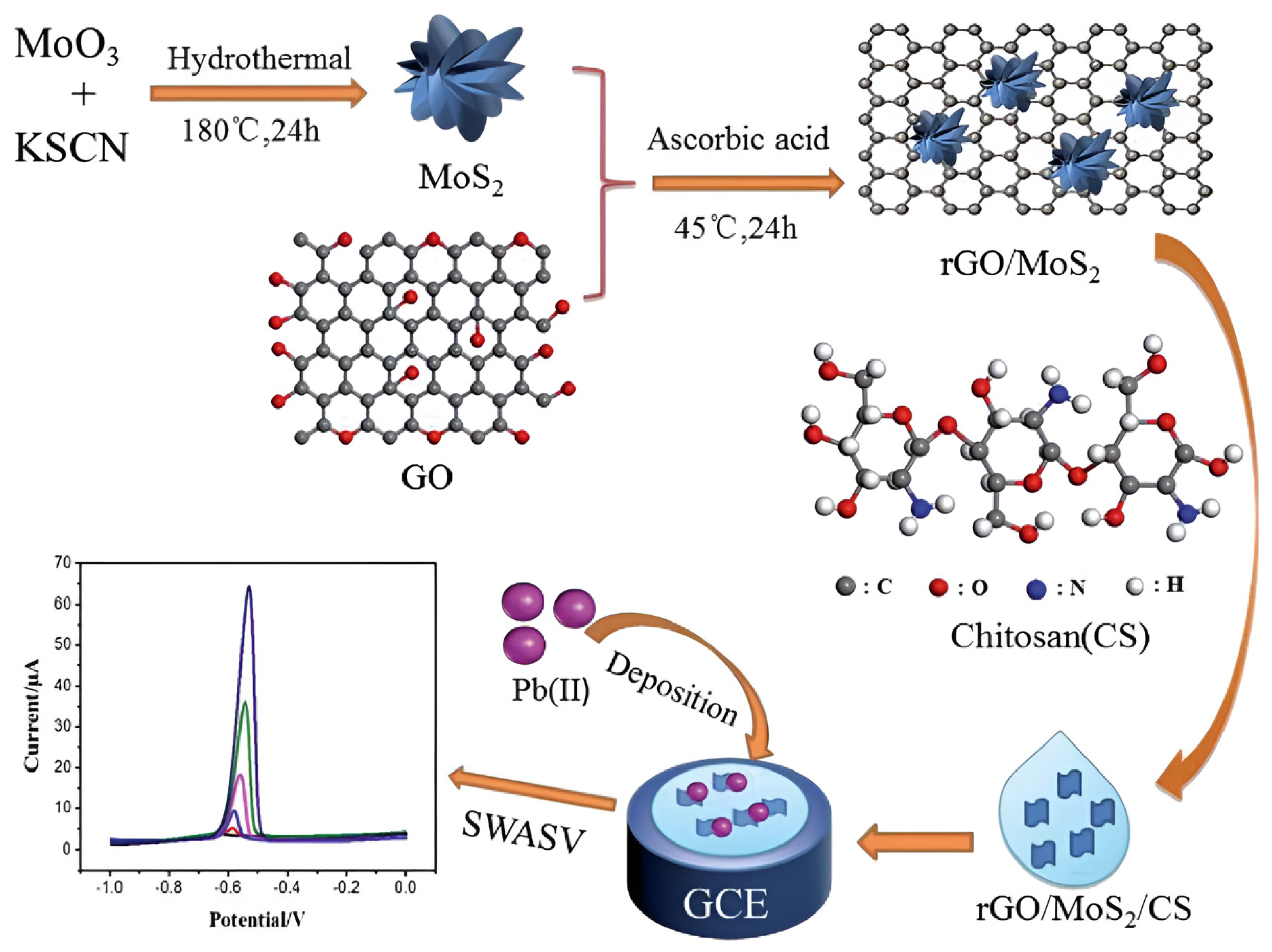
| rGO/MoS2/CS/GCE | SWASV | Tobacco leaves | Pb2+ | 0.0016 mM | 0.005–2.0 mM | [107] |
| CS/GO/MoS2/AuNPs | DPSV | Not specified | Hg2+ | 5.8 ng/L | 0.01–4 μg/L | [108] |
5. Challenges and Prospects
- Synthesis Limitations: The preparation methodology critically governs MoS2’s crystalline structure, specific surface area, and defect density—parameters dictating electron transfer efficiency, active site distribution, and ultimately sensing performance. Top-down strategies (e.g., mechanical/liquid-phase exfoliation) yield structurally intact few-layer MoS2 with minimal defects but suffer from low throughput and inconsistent layer uniformity, hindering scalability. Conversely, bottom-up approaches (hydrothermal synthesis, chemical vapor deposition) enable mass production yet require stringent parameter control; suboptimal conditions induce excessive sulfur vacancies and lattice defects that degrade conductivity and electrocatalytic activity. These processes also pose intrinsic safety hazards due to high-temperature/pressure requirements.
- Material Design Trade-offs: Engineering composite architecture necessitates balancing competing properties. Noble metal nanoparticles offer exceptional electroactivity but incur prohibitively high costs. Conducting polymers exhibit limited electrochemical stability. Carbon matrices require complex surface functionalization. Metal oxides suffer from inherent poor conductivity. Biomaterials demonstrate inadequate long-term stability. Systematic optimization of electroactivity, conductivity, durability, and biocompatibility remains imperative.
- Real-World Application Barriers: Complex matrices (e.g., hypersaline wastewater, biofluids) introduce interfering species that compromise selectivity and accuracy. Kinetically inefficient preconcentration of trace metal ions at electrode surfaces fundamentally restricts sensitivity and analysis speed. For flexible devices, achieving mechanical robustness and batch-to-batch reproducibility presents additional hurdles to reliability and scalability. Furthermore, the transition from lab-scale fabrication (e.g., manual drop-casting) to industrial-scale manufacturing remains a significant challenge, as it requires overcoming issues of poor reproducibility and low throughput to ensure consistent sensor performance.
6. Conclusions
Funding
Data Availability Statement
Conflicts of Interest
References
- Du, Y.; Tian, Z.; Zhao, Y.; Wang, X.; Ma, Z.; Yu, C. Exploring the Accumulation Capacity of Dominant Plants Based on Soil Heavy Metals Forms and Assessing Heavy Metals Contamination Characteristics near Gold Tailings Ponds. J. Environ. Manag. 2024, 351, 119838. [Google Scholar] [CrossRef] [PubMed]
- Wan, Y.; Liu, J.; Zhuang, Z.; Wang, Q.; Li, H. Heavy Metals in Agricultural Soils: Sources, Influencing Factors, and Remediation Strategies. Toxics 2024, 12, 63. [Google Scholar] [CrossRef]
- Li, R.; Wang, J.; Zhou, Y.; Zhang, W.; Feng, D.; Su, X. Heavy Metal Contamination in Shanghai Agricultural Soil. Heliyon 2023, 9, e22824. [Google Scholar] [CrossRef] [PubMed]
- Li, Y.-J.; Yuan, Y.; Tan, W.-B.; Xi, B.-D.; Wang, H.; Hui, K.-L.; Chen, J.-B.; Zhang, Y.-F.; Wang, L.-F.; Li, R.-F. Antibiotic Resistance Genes and Heavy Metals in Landfill: A Review. J. Hazard. Mater. 2024, 464, 132395. [Google Scholar] [CrossRef]
- Wang, X.; Lei, M.; Zhang, T.; Zhang, Q.; Zhang, R.; Yang, M. A Water-Stable Multi-Responsive Luminescent Zn-MOF Sensor for Detecting TNP, NZF and Cr2O72− in Aqueous Media. Dalton Trans. 2021, 50, 3816–3824. [Google Scholar] [CrossRef]
- Chen, M.-L.; Ma, L.-Y.; Chen, X.-W. New Procedures for Arsenic Speciation: A Review. Talanta 2014, 125, 78–86. [Google Scholar] [CrossRef] [PubMed]
- Mori, N.; Yasutake, A.; Marumoto, M.; Hirayama, K. Methylmercury Inhibits Electron Transport Chain Activity and Induces Cytochrome c Release in Cerebellum Mitochondria. J. Toxicol. Sci. 2011, 36, 253–259. [Google Scholar] [CrossRef]
- Jin, M.; Yuan, H.; Liu, B.; Peng, J.; Xu, L.; Yang, D. Review of the Distribution and Detection Methods of Heavy Metals in the Environment. Anal. Methods 2020, 12, 5747–5766. [Google Scholar] [CrossRef]
- Swartz, M. HPLC detectors: A brief review. J. Liq. Chromatogr. Relat. Technol. 2010, 33, 1130–1150. [Google Scholar] [CrossRef]
- Albals, D.; Al-Momani, I.F.; Issa, R.; Yehya, A. Multi-Element Determination of Essential and Toxic Metals in Green and Roasted Coffee Beans: A Comparative Study among Different Origins Using ICP-MS. Sci. Prog. 2021, 104, 00368504211026162. [Google Scholar] [CrossRef]
- Ferreira, C.P.; Techera Antunes, F.T.; Rebelo, I.N.; Da Silva, C.A.; Vilanova, F.N.; Corrêa, D.S.; De Souza, A.H. Application of the UV–Vis Spectrophotometry Method for the Determination of Glutamate in the Cerebrospinal Fluid of Rats. J. Pharm. Biomed. Anal. 2020, 186, 113290. [Google Scholar] [CrossRef]
- Altug, H.; Oh, S.-H.; Maier, S.A.; Homola, J. Advances and Applications of Nanophotonic Biosensors. Nat. Nanotechnol. 2022, 17, 5–16. [Google Scholar] [CrossRef]
- Liu, X.; Yao, Y.; Ying, Y.; Ping, J. Recent Advances in Nanomaterial-Enabled Screen-Printed Electrochemical Sensors for Heavy Metal Detection. TrAC Trends Anal. Chem. 2019, 115, 187–202. [Google Scholar] [CrossRef]
- Pujol, L.; Evrard, D.; Groenen-Serrano, K.; Freyssinier, M.; Ruffien-Cizsak, A.; Gros, P. Electrochemical Sensors and Devices for Heavy Metals Assay in Water: The French Groups’ Contribution. Front. Chem. 2014, 2, 19. [Google Scholar] [CrossRef]
- Meng, R.; Zhu, Q.; Long, T.; He, X.; Luo, Z.; Gu, R.; Wang, W.; Xiang, P. The Innovative and Accurate Detection of Heavy Metals in Foods: A Critical Review on Electrochemical Sensors. Food Control 2023, 150, 109743. [Google Scholar] [CrossRef]
- Liang, M.; Liu, Y.; Lu, S.; Wang, Y.; Gao, C.; Fan, K.; Liu, H. Two-Dimensional Conductive MOFs toward Electrochemical Sensors for Environmental Pollutants. TrAC Trends Anal. Chem. 2024, 177, 117800. [Google Scholar] [CrossRef]
- Balendhran, S.; Walia, S.; Nili, H.; Ou, J.Z.; Zhuiykov, S.; Kaner, R.B.; Sriram, S.; Bhaskaran, M.; Kalantar-zadeh, K. Two-Dimensional Molybdenum Trioxide and Dichalcogenides. Adv. Funct. Mater. 2013, 23, 3952–3970. [Google Scholar] [CrossRef]
- Sun, Y.; Gao, S.; Lei, F.; Xiao, C.; Xie, Y. Ultrathin Two-Dimensional Inorganic Materials: New Opportunities for Solid State Nanochemistry. Acc. Chem. Res. 2015, 48, 3–12. [Google Scholar] [CrossRef]
- Yuan, X.; Xu, J.; Zhao, Y.; Rui, S.; Wang, Q.; Meng, L.; Jia, Q.; Li, H.; Lu, S.; Zhang, Y. Plasma Treatment of Bismuth-Doped MoS2 with Excellent Supercapacitor Performance. J. Mater. Chem. C 2025, 13, 8179–8187. [Google Scholar] [CrossRef]
- Wypych, F.; Schöllhorn, R. 1T-MoS2, a New Metallic Modification of Molybdenum Disulfide. J. Chem. Soc. Chem. Commun. 1992, 1386–1388. [Google Scholar] [CrossRef]
- Xu, Z.; Lu, J.; Zheng, X.; Chen, B.; Luo, Y.; Tahir, M.N.; Huang, B.; Xia, X.; Pan, X. A Critical Review on the Applications and Potential Risks of Emerging MoS2 Nanomaterials. J. Hazard. Mater. 2020, 399, 123057. [Google Scholar] [CrossRef]
- Liu, Y.; Nan, H.; Wu, X.; Pan, W.; Wang, W.; Bai, J.; Zhao, W.; Sun, L.; Wang, X.; Ni, Z. Layer-by-Layer Thinning of MoS2 by Plasma. ACS Nano 2013, 7, 4202–4209. [Google Scholar] [CrossRef]
- Huang, Y.; Yu, K.; Li, H.; Xu, K.; Liang, Z.; Walker, D.; Ferreira, P.; Fischer, P.; Fan, D. Scalable Fabrication of Molybdenum Disulfide Nanostructures and Their Assembly. Adv. Mater. 2020, 32, 2003439. [Google Scholar] [CrossRef]
- Eda, G.; Fujita, T.; Yamaguchi, H.; Voiry, D.; Chen, M.; Chhowalla, M. Coherent Atomic and Electronic Heterostructures of Single-Layer MoS2. ACS Nano 2012, 6, 7311–7317. [Google Scholar] [CrossRef]
- Zhang, Y.; Xu, J.; Lu, S.; Li, H.; Yonar, T.; Hua, Q.; Liu, T.; Zhang, Y. Engineering Few-Layer MoS2 and rGO Heterostructure Composites for High-Performance Supercapacitors. Adv. Compos. Hybrid Mater. 2025, 8, 108. [Google Scholar] [CrossRef]
- Zhuang, X.; Mai, Y.; Wu, D.; Zhang, F.; Feng, X. Two-Dimensional Soft Nanomaterials: A Fascinating World of Materials. Adv. Mater. 2015, 27, 403–427. [Google Scholar] [CrossRef]
- Jia, Q.; Zhang, Y.; Xu, J.; Zhao, Y.; Wang, Q.; Rui, S.; Meng, L.; Li, H.; Lu, S.; Zhang, Y. Microstructure Regulation of 1T-MoS2 via Polyethylenepolypropylene Glycol and Ethanol Treatment for High-Stability Supercapacitor. J. Energy Storage 2025, 110, 115242. [Google Scholar] [CrossRef]
- Huang, Y.; Guo, J.; Kang, Y.; Ai, Y.; Li, C.M. Two Dimensional Atomically Thin MoS2 Nanosheets and Their Sensing Applications. Nanoscale 2015, 7, 19358–19376. [Google Scholar] [CrossRef]
- Shu, Y.; Yang, Y.; Gao, Q. Interlayer Engineering of Two-Dimensional Transition-Metal Disulfides for Electrochemical and Optical Sensing Applications. FlatChem 2021, 27, 100242. [Google Scholar] [CrossRef]
- Frindt, R.F. Single Crystals of MoS2 Several Molecular Layers Thick. J. Appl. Phys. 1966, 37, 1928–1929. [Google Scholar] [CrossRef]
- Wu, M.; Ma, D.; Hua, Q.; Lu, S. Interlayer Spacing Regulations on MoS2-Based Supercapacitors: Recent Advances and Challenges. Prog. Chem. 2025, 37, 1235–1260. [Google Scholar] [CrossRef]
- Zheng, J.; Zhang, H.; Dong, S.; Liu, Y.; Tai Nai, C.; Suk Shin, H.; Young Jeong, H.; Liu, B.; Ping Loh, K. High Yield Exfoliation of Two-Dimensional Chalcogenides Using Sodium Naphthalenide. Nat Commun 2014, 5, 2995. [Google Scholar] [CrossRef]
- You, X.; Liu, N.; Lee, C.J.; Pak, J.J. An Electrochemical Route to MoS2 Nanosheets for Device Applications. Mater. Lett. 2014, 121, 31–35. [Google Scholar] [CrossRef]
- Liu, N.; Kim, P.; Kim, J.H.; Ye, J.H.; Kim, S.; Lee, C.J. Large-Area Atomically Thin MoS2 Nanosheets Prepared Using Electrochemical Exfoliation. ACS Nano 2014, 8, 6902–6910. [Google Scholar] [CrossRef]
- Coleman, J.N.; Lotya, M.; O’Neill, A.; Bergin, S.D.; King, P.J.; Khan, U.; Young, K.; Gaucher, A.; De, S.; Smith, R.J.; et al. Two-Dimensional Nanosheets Produced by Liquid Exfoliation of Layered Materials. Science 2011, 331, 568–571. [Google Scholar] [CrossRef]
- Dai, W.; Dong, H.; Fugetsu, B.; Cao, Y.; Lu, H.; Ma, X.; Zhang, X. Tunable Fabrication of Molybdenum Disulfide Quantum Dots for Intracellular MicroRNA Detection and Multiphoton Bioimaging. Small 2015, 11, 4158–4164. [Google Scholar] [CrossRef]
- Xu, J.; Yuan, X.; Zhao, Y.; Rui, S.; Jia, Q.; Li, H.; Lu, S.; Li, B.; Zhang, Y.; Zhu, X. One-Step Hydrothermal Synthesis of Few-Layered Metallic Phase MoS2 for High-Performance Supercapacitors. Prog. Nat. Sci. Mater. Int. 2024, 34, 429–436. [Google Scholar] [CrossRef]
- Zhang, C.; Zhang, Y.; Zhang, Y.; Huang, X.; Li, Y.; Cao, J.; Zhou, C. One-Pot Synthesis of Ultrathin 1T-MoS2 Nanosheets as Efficient Catalyst for Reduction of 4-Nitrophenol. Mater. Lett. 2022, 314, 131794. [Google Scholar] [CrossRef]
- Zhai, N.; Luo, J.; Shu, P.; Mei, J.; Li, X.; Yan, W. 1D/2D CoTe2@MoS2 Composites Constructed by CoTe2 Nanorods and MoS2 Nanosheets for Efficient Electromagnetic Wave Absorption. Nano Res. 2023, 16, 10698–10706. [Google Scholar] [CrossRef]
- Tang, G.; Sun, J.; Wei, C.; Wu, K.; Ji, X.; Liu, S.; Tang, H.; Li, C. Synthesis and Characterization of Flowerlike MoS2 Nanostructures through CTAB-Assisted Hydrothermal Process. Mater. Lett. 2012, 86, 9–12. [Google Scholar] [CrossRef]
- Sun, H.; Yang, M.; Pu, S.; Gou, L.; Lv, C.; He, J.; Hou, X.; Xu, K. A Facile Photochemical Strategy for the Synthesis of High-Performance Amorphous MoS2 Nanoparticles. Nanoscale Adv. 2021, 3, 2830–2836. [Google Scholar] [CrossRef]
- Chen, Y.; Zhang, H.; Luo, Z.; Mao, W.; Pan, J.A.; Wang, S. Synthesis of Low-Symmetry 2D Transition Metal Dichalcogenides by Chemical Vapor Deposition. Prog. Chem. 2024, 36, 537–555. [Google Scholar] [CrossRef]
- Li, S.; Chen, X.; Liu, F.; Chen, Y.; Liu, B.; Deng, W.; An, B.; Chu, F.; Zhang, G.; Li, S.; et al. Enhanced Performance of a CVD MoS2 Photodetector by Chemical in Situ n-Type Doping. ACS Appl. Mater. Interfaces 2019, 11, 11636–11644. [Google Scholar] [CrossRef]
- Lee, Y.; Zhang, X.; Zhang, W.; Chang, M.; Lin, C.; Chang, K.; Yu, Y.; Wang, J.T.; Chang, C.; Li, L.; et al. Synthesis of Large-Area MoS2 Atomic Layers with Chemical Vapor Deposition. Adv. Mater. 2012, 24, 2320–2325. [Google Scholar] [CrossRef]
- Wu, Q.; Bi, H.-M.; Han, X.-J. Research Progress of Electrochemical Detection of Heavy Metal Ions. Chin. J. Anal. Chem. 2021, 49, 330–340. [Google Scholar] [CrossRef]
- Tian, Y.; Liu, J.; Qiao, J.; Ge, F.; Yang, Y.; Zhang, Q. Advancements in Electrochemical Sensing Technology for Heavy Metal Ions Detection. Food Chem. X 2025, 25, 102204. [Google Scholar] [CrossRef]
- Cheng, B.; Ren, B.; Lu, S. Smartphone-assisted Electrochemical Sensors for Environmental Monitoring. Instrumentation 2024, 11, 1–12. [Google Scholar] [CrossRef]
- Abd El-Raheem, H.; Helim, R.; Hassan, R.Y.A.; Youssef, A.F.A.; Korri-Youssoufi, H.; Kraiya, C. Electrochemical Methods for the Detection of Heavy Metal Ions: From Sensors to Biosensors. Microchem. J. 2024, 207, 112086. [Google Scholar] [CrossRef]
- Sun, Y.; Li, H.; Chen, Z.; Wang, D.; Wang, Z.; Xiao, F. The Application of MXene in Electrochemical Sensor. Prog. Chem. 2022, 34, 259–271. [Google Scholar] [CrossRef]
- Sawan, S.; Maalouf, R.; Errachid, A.; Jaffrezic-Renault, N. Metal and Metal Oxide Nanoparticles in the Voltammetric Detection of Heavy Metals: A Review. TrAC Trends Anal. Chem. 2020, 131, 116014. [Google Scholar] [CrossRef]
- Han, H.; Pan, D. Voltammetric Methods for Speciation Analysis of Trace Metals in Natural Waters. Trends Environ. Anal. Chem. 2021, 29, e00119. [Google Scholar] [CrossRef]
- Hu, L.; Zhang, L.; Zhou, Y.; Meng, G.; Yu, Y.; Yao, W.; Yan, Z. Chitosan-Stabilized Gold Nano Composite Modified Glassy Carbon Electrode for Electrochemical Sensing Trace Hg2+ in Practice. J. Electrochem. Soc. 2018, 165, B900–B905. [Google Scholar] [CrossRef]
- Mashkoor, F.; Shoeb, M.; Afzal Ahmad, S.; Ahmed, J.; Jeong, C. Development of Carbon Nanotube Decorated Gd2O3-MoS2 Nanocomposite for the Electrochemical Detection and Adsorption of Cadmium Metal Ions from Simulated Wastewater. Microchem. J. 2024, 207, 112082. [Google Scholar] [CrossRef]
- Simões, F.R.; Xavier, M.G. Electrochemical Sensors. In Nanoscience and its Applications; Elsevier: Amsterdam, The Netherlands, 2017; pp. 155–178. ISBN 978-0-323-49780-0. [Google Scholar]
- Aswathi, R.; Sandhya, K.Y. Ultrasensitive and Selective Electrochemical Sensing of Hg( ii ) Ions in Normal and Sea Water Using Solvent Exfoliated MoS2: Affinity Matters. J. Mater. Chem. A 2018, 6, 14602–14613. [Google Scholar] [CrossRef]
- Cunha-Silva, H.; Arcos-Martinez, M.J. Cathodic Stripping Voltammetric Determination of Iodide Using Disposable Sensors. Talanta 2019, 199, 262–269. [Google Scholar] [CrossRef]
- Bansod, B.; Kumar, T.; Thakur, R.; Rana, S.; Singh, I. A Review on Various Electrochemical Techniques for Heavy Metal Ions Detection with Different Sensing Platforms. Biosens. Bioelectron. 2017, 94, 443–455. [Google Scholar] [CrossRef]
- Zhang, C.; Lai, Z.; Liu, X.; Ye, M.; Zhang, L.; Zhang, L.; Chen, X. Voltammetric Determination of Pb2+ in Water Using Mn-doped MoS2/MWCNTs/Nafion Electrode Coupled with an Electrochemical Flow Analysis Device. Electroanalysis 2022, 34, 1638–1643. [Google Scholar] [CrossRef]
- Xu, H.; Li, H.-R.; Li, J.-Y.; Qu, J.-J.; Li, S.-S. Sensitive Detection of Hg(II) on MoS2/NiS2 Based on Interfacial Engineering to Accelerate the Ni2+/Ni3+ Cycle: Identification the Role of Atomic-Level Heterojunction-Induced Electron Transfer in Electroanalysis. Anal. Chim. Acta 2024, 1331, 343339. [Google Scholar] [CrossRef]
- Orazem, M.E.; Tribollet, B. Electrochemical Impedance Spectroscopy, 1st ed.; Wiley: Hoboken, NJ, USA, 2008; ISBN 978-0-470-04140-6. [Google Scholar]
- Avuthu, S.G.R.; Narakathu, B.B.; Eshkeiti, A.; Emamian, S.; Bazuin, B.J.; Joyce, M.; Atashbar, M.Z. Detection of Heavy Metals Using Fully Printed Three Electrode Electrochemical Sensor. In Proceedings of the IEEE SENSORS 2014, Valencia, Spain, 2–5 November 2014; IEEE: Piscataway, NJ, USA, 2014; pp. 669–672. [Google Scholar]
- Neethipathi, D.K.; Beniwal, A.; Bass, A.M.; Scott, M.; Dahiya, R. MoS2 Modified Screen Printed Carbon Electrode Based Flexible Electrochemical Sensor for Detection of Copper Ions in Water. IEEE Sens. J. 2023, 23, 8146–8153. [Google Scholar] [CrossRef]
- Lisak, G. Reliable Environmental Trace Heavy Metal Analysis with Potentiometric Ion Sensors—Reality or a Distant Dream. Environ. Pollut. 2021, 289, 117882. [Google Scholar] [CrossRef]
- Aragay, G.; Merkoçi, A. Nanomaterials Application in Electrochemical Detection of Heavy Metals. Electrochim. Acta 2012, 84, 49–61. [Google Scholar] [CrossRef]
- Huang, M.-R.; Ding, Y.-B.; Li, X.-G. Combinatorial Screening of Potentiometric Pb(II) Sensors from Polysulfoaminoanthraquinone Solid Ionophore. ACS Comb. Sci. 2014, 16, 128–138. [Google Scholar] [CrossRef]
- Li, L.; Chen, Y.; Zhu, J.-J. Recent Advances in Electrochemiluminescence Analysis. Anal. Chem. 2017, 89, 358–371. [Google Scholar] [CrossRef]
- Zhou, C.; Huang, J.; Wang, Q.; Tang, H.; Hu, Y.; Wang, W. MOFs-Based Photoelectrochemical Sensing Interface and Its Applications. Prog. Chem. 2024, 36, 893–903. [Google Scholar] [CrossRef]
- Qi, H.; Zhang, C. Electrogenerated Chemiluminescence Biosensing. Anal. Chem. 2020, 92, 524–534. [Google Scholar] [CrossRef]
- Harmesa, H.; Wahyudi, A.J.; Saefumillah, A.; Ivandini, T.A. Electrochemiluminescence Systems for Metal-Ion Detection: A Systematic Review. ChemistrySelect 2024, 9, e202401544. [Google Scholar] [CrossRef]
- Cui, J.; Xu, X.; Yang, C.; Wang, J.; Guo, Q.; Nie, G. A Difunctional Electrochemiluminescence Sensor Based on Ru-MOFs and Strand-Displacement-Amplification Reaction for Ultrasensitive Detection of Hg2+ and Ag+. Sens. Actuators B Chem. 2023, 378, 133141. [Google Scholar] [CrossRef]
- Han, B.; Li, W.; Shen, Y.; Li, R.; Wang, M.; Zhuang, Z.; Zhou, Y.; Jing, T. Improving the Sensitivity and Selectivity of Sulfonamides Electrochemical Detection with Double-System Imprinted Polymers. Sci. Total Environ. 2023, 864, 161173. [Google Scholar] [CrossRef]
- Zhang, H.; Li, L.; Wang, C.; Liu, Q.; Chen, W.-T.; Gao, S.; Hu, G. Recent Advances in Designable Nanomaterial-Based Electrochemical Sensors for Environmental Heavy-Metal Detection. Nanoscale 2025, 17, 2386–2407. [Google Scholar] [CrossRef]
- Zhou, J.; Chen, P. Modification of 2D Nanomaterials and Their Applications in Environment Pollution Treatment. Prog. Chem. 2021, 34, 1414–1430. [Google Scholar] [CrossRef]
- Zhong, Y.; Wang, Z.; Liu, H. Progress in Electrochemical Sensing of Ascorbic Acid. Prog. Chem. 2023, 35, 219–232. [Google Scholar] [CrossRef]
- Vilian, A.T.E.; Dinesh, B.; Kang, S.-M.; Krishnan, U.M.; Huh, Y.S.; Han, Y.-K. Recent Advances in Molybdenum Disulfide-Based Electrode Materials for Electroanalytical Applications. Microchim. Acta 2019, 186, 203. [Google Scholar] [CrossRef]
- Zhu, C.; Yang, G.; Li, H.; Du, D.; Lin, Y. Electrochemical Sensors and Biosensors Based on Nanomaterials and Nanostructures. Anal. Chem. 2015, 87, 230–249. [Google Scholar] [CrossRef]
- Li, H.; Xu, D. Silver Nanoparticles as Labels for Applications in Bioassays. TrAC Trends Anal. Chem. 2014, 61, 67–73. [Google Scholar] [CrossRef]
- Raril, C.; Manjunatha, J.G.; Ravishankar, D.K.; Fattepur, S.; Siddaraju, G.; Nanjundaswamy, L. Validated Electrochemical Method for Simultaneous Resolution of Tyrosine, Uric Acid, and Ascorbic Acid at Polymer Modified Nano-Composite Paste Electrode. Surf. Engin. Appl.Electrochem. 2020, 56, 415–426. [Google Scholar] [CrossRef]
- El-Raheem, H.A.; Hassan, R.Y.A.; Khaled, R.; Farghali, A.; El-Sherbiny, I.M. Polyurethane-Doped Platinum Nanoparticles Modified Carbon Paste Electrode for the Sensitive and Selective Voltammetric Determination of Free Copper Ions in Biological Samples. Microchem. J. 2020, 155, 104765. [Google Scholar] [CrossRef]
- Zhang, L.; Li, D.W.; Song, W.; Shi, L.; Li, Y.; Long, Y.T. High Sensitive On-Site Cadmium Sensor Based on AuNPs Amalgam Modified Screen-Printed Carbon Electrodes. IEEE Sens. J. 2010, 10, 1583–1588. [Google Scholar] [CrossRef]
- Liu, Y.; Zhao, J.; Zhao, K.; Zhang, S.; Tian, R.; Chang, M.; Wang, Y.; Li, X.; Ge, L.; Lisak, G. MoS2/Au Heterojunction Nanostructures for Electrochemical Detection of Trace Hg(II) in Wastewater Samples. J. Environ. Chem. Eng. 2023, 11, 111563. [Google Scholar] [CrossRef]
- Li, M.; He, B.; Yan, H.; Xie, L.; Cao, X.; Jin, H.; Wei, M.; Ren, W.; Suo, Z.; Xu, Y. An Aptasensor for Cadmium Ions Detection Based on PEI-MoS2@Au NPs 3D Flower-like Nanocomposites and Thi-PtPd NPs Core-Shell Sphere. Anal. Chim. Acta 2022, 1232, 340470. [Google Scholar] [CrossRef]
- Le, T.-H.; Kim, Y.; Yoon, H. Electrical and Electrochemical Properties of Conducting Polymers. Polymers 2017, 9, 150. [Google Scholar] [CrossRef]
- Naveen, M.H.; Gurudatt, N.G.; Shim, Y.-B. Applications of Conducting Polymer Composites to Electrochemical Sensors: A Review. Appl. Mater. Today 2017, 9, 419–433. [Google Scholar] [CrossRef]
- Lakard, S.; Lakard, B. Environmental Applications of Conducting Polymers and Their Composites: Adsorption and Detection of Heavy Metal Ions. J. Environ. Chem. Eng. 2025, 13, 116233. [Google Scholar] [CrossRef]
- Zhang, H.; Li, Y.; Zhang, Y.; Wu, J.; Li, S.; Li, L. A Disposable Electrochemical Sensor for Lead Ion Detection Based on In Situ Polymerization of Conductive Polypyrrole Coating. J. Electron. Mater. 2023, 52, 1819–1828. [Google Scholar] [CrossRef]
- Setiyanto, H.; Purwaningsih, D.R.; Saraswaty, V.; Mufti, N.; Zulfikar, M.A. Highly Selective Electrochemical Sensing Based on Electropolymerized Ion Imprinted Polyaniline (IIPANI) on a Bismuth Modified Carbon Paste Electrode (CPE-Bi) for Monitoring Nickel(ii) in River Water. RSC Adv. 2022, 12, 29554–29561. [Google Scholar] [CrossRef] [PubMed]
- Gan, X.; Zhang, J.; Liu, J.; Bai, Y.; Su, X.; Wang, W.; Cao, Z.; Zhao, H.; Ao, Y.; Wang, P. Polyaniline Functionalization of Defective 1T-MoS2 Nanosheets for Improved Electron and Mass Transfer: Implications for Electrochemical Sensors. ACS Appl. Nano Mater. 2023, 6, 11725–11736. [Google Scholar] [CrossRef]
- Yu, W.; Sisi, L.; Haiyan, Y.; Jie, L. Progress in the Functional Modification of Graphene/Graphene Oxide: A Review. RSC Adv. 2020, 10, 15328–15345. [Google Scholar] [CrossRef] [PubMed]
- Golestaneh, M. Applicability of a Graphene Oxide Nanocomposite for Fabrication of an Electrochemical Sensor for Simultaneous Detection of Sunset Yellow and Rhodamine B in Food Samples. Anal. Methods 2023, 15, 5500–5509. [Google Scholar] [CrossRef]
- Nguyen, T.D.; Nguyen, M.T.N.; Lee, J.S. Carbon-Based Materials and Their Applications in Sensing by Electrochemical Voltammetry. Inorganics 2023, 11, 81. [Google Scholar] [CrossRef]
- Simpson, A.; Pandey, R.R.; Chusuei, C.C.; Ghosh, K.; Patel, R.; Wanekaya, A.K. Fabrication Characterization and Potential Applications of Carbon Nanoparticles in the Detection of Heavy Metal Ions in Aqueous Media. Carbon 2018, 127, 122–130. [Google Scholar] [CrossRef]
- Li, X.; Zhou, H.; Fu, C.; Wang, F.; Ding, Y.; Kuang, Y. A Novel Design of Engineered Multi-Walled Carbon Nanotubes Material and Its Improved Performance in Simultaneous Detection of Cd(II) and Pb(II) by Square Wave Anodic Stripping Voltammetry. Sens. Actuators B Chem. 2016, 236, 144–152. [Google Scholar] [CrossRef]
- Yin, M.; Pu, H.; Zhang, Y.; Gao, P.; Sun, Q.; Yin, W.; Fa, H. Electrochemical Sensor Based on Biomass Yeast Integrated Sulfur-doped Graphene and Carboxylated Carbon Nanotubes/MoS2 for Highly-sensitive Detection of Pb2+. Electroanalysis 2023, 35, e202200163. [Google Scholar] [CrossRef]
- Kancharla, K.; Tadi, K.K. MoS2 Quantum Dots-Based Low-Cost and Disposable Electrochemical Sensor for the Detection of Lead (II) Ions. J. Electrochem. Soc. 2023, 170, 127509. [Google Scholar] [CrossRef]
- Rana, D.S.; Sharma, R.; Kumar, S.; Gupta, N.; Thakur, S.; Thakur, K.K.; Singh, D. Molybdenum Disulfide (MoS2) and Reduced Graphene Oxide (rGO) Nanocomposite Based Electrochemical Sensor for Detecting Mercury(II) Ions. Nano-Struct. Nano-Objects 2023, 36, 101041. [Google Scholar] [CrossRef]
- Mohammed, H.Y.; Farea, M.A.; Ingle, N.N.; Sayyad, P.W.; Al-Gahouari, T.; Mahadik, M.M.; Bodkhe, G.A.; Shirsat, S.M.; Shirsat, M.D. Review—Electrochemical Hydrazine Sensors Based on Graphene Supported Metal/Metal Oxide Nanomaterials. J. Electrochem. Soc. 2021, 168, 106509. [Google Scholar] [CrossRef]
- Han, X.; Wu, G.; Du, J.; Pi, J.; Yan, M.; Hong, X. Metal and Metal Oxide Amorphous Nanomaterials towards Electrochemical Applications. Chem. Commun. 2022, 58, 223–237. [Google Scholar] [CrossRef] [PubMed]
- Xu, H.; Wang, Q.-Y.; Jiang, M.; Li, S.-S. Application of Valence-Variable Transition-Metal-Oxide-Based Nanomaterials in Electrochemical Analysis: A Review. Anal. Chim. Acta 2024, 1295, 342270. [Google Scholar] [CrossRef]
- Lee, S.; Oh, J.; Kim, D.; Piao, Y. A Sensitive Electrochemical Sensor Using an Iron Oxide/Graphene Composite for the Simultaneous Detection of Heavy Metal Ions. Talanta 2016, 160, 528–536. [Google Scholar] [CrossRef] [PubMed]
- Zhang, M.; Guo, W. Simultaneous Electrochemical Detection of Multiple Heavy Metal Ions in Milk Based on Silica-Modified Magnetic Nanoparticles. Food Chem. 2023, 406, 135034. [Google Scholar] [CrossRef]
- Xia, X.; Cheng, X.-L.; Liu, Z.; Li, J.-J.; Li, S.-S. Sensitive Detection of As(III) on Fe3O4/MoS2 through Interfacial Engineering to Accelerate the Fe2+/Fe3+ Cycle: Identifying the Dominant Role of Electron Transfer Induced by Valence Change in Synergistic Electroanalysis. Sens. Actuators B Chem. 2022, 366, 132022. [Google Scholar] [CrossRef]
- Gao, J.; Qiu, C.; Qu, W.; Zhuang, Y.; Wang, P.; Yan, Y.; Wu, Y.; Zeng, Z.; Huang, G.; Deng, R.; et al. Detection of Cd2+ Based on Nano-Fe3O4/MoS2/Nafion/GCE Sensor. Anal. Sci. 2023, 39, 1445–1454. [Google Scholar] [CrossRef]
- Liu, X.; Zhao, X.; Liu, Y.; Zhang, T. Review on Preparation and Adsorption Properties of Chitosan and Chitosan Composites. Polym. Bull. 2022, 79, 2633–2665. [Google Scholar] [CrossRef]
- Saheed, I.O.; Yusof, E.N.M.; Oh, W.-D.; Hanafiah, M.A.K.M.; Suah, F.B.M. Fabrication of Chitosan@activated Carbon Composites in EmimAc for Cd(II) Adsorption from Aqueous Solution: Experimental, Optimization and DFT Study. Int. J. Biol. Macromol. 2023, 242, 124798. [Google Scholar] [CrossRef] [PubMed]
- Singh, V.K.; Kushwaha, C.S.; Shukla, S.K. Potentiometric Detection of Copper Ion Using Chitin Grafted Polyaniline Electrode. Int. J. Biol. Macromol. 2020, 147, 250–257. [Google Scholar] [CrossRef]
- Guo, C.; Wang, C.; Sun, H.; Dai, D.; Gao, H. A Simple Electrochemical Sensor Based on rGO/MoS2/CS Modified GCE for Highly Sensitive Detection of Pb( ii ) in Tobacco Leaves. RSC Adv. 2021, 11, 29590–29597. [Google Scholar] [CrossRef] [PubMed]
- Wang, R.; Xiong, C.; Xie, Y.; Han, M.; Xu, Y.; Bian, C.; Xia, S. Chitosan/Graphene Oxide/MoS2/AuNPs Modified Electrochemical Sensor for Trace Mercury Detection. In Proceedings of the 2021 IEEE 16th International Conference on Nano/Micro Engineered and Molecular Systems (NEMS), Xiamen, China, 25–29 April 2021; IEEE: New York, NY, USA, 2021; pp. 1303–1307. [Google Scholar]


| Synthetic Method | Advantages | Disadvantages | |
|---|---|---|---|
| Top-down approaches | Mechanical exfoliation | High quality, simple operation | Uncontrollable size, number of layers |
| Chemical exfoliation | High quality, high efficiency | Complex operation, impurities | |
| Electrochemical exfoliation | High quality, low cost | Complex operation, uncontrollable number of layers | |
| Liquid-phase exfoliation | High quality, easy to operate | Low single-layer yield, uncontrollable number of layers | |
| Bottom-up approaches | hydrothermal method | High quality, easy to operate | Long reaction time, higher reaction temperature |
| Chemical vapor deposition | High quality, large area | Toxic by-products, higher reaction temperature | |
Disclaimer/Publisher’s Note: The statements, opinions and data contained in all publications are solely those of the individual author(s) and contributor(s) and not of MDPI and/or the editor(s). MDPI and/or the editor(s) disclaim responsibility for any injury to people or property resulting from any ideas, methods, instructions or products referred to in the content. |
© 2025 by the authors. Licensee MDPI, Basel, Switzerland. This article is an open access article distributed under the terms and conditions of the Creative Commons Attribution (CC BY) license (https://creativecommons.org/licenses/by/4.0/).
Share and Cite
Cheng, B.; Wang, H.; Xiang, S.; Lu, S.; Ren, B. MoS2-Based Composites for Electrochemical Detection of Heavy Metal Ions: A Review. Nanomaterials 2025, 15, 1639. https://doi.org/10.3390/nano15211639
Cheng B, Wang H, Xiang S, Lu S, Ren B. MoS2-Based Composites for Electrochemical Detection of Heavy Metal Ions: A Review. Nanomaterials. 2025; 15(21):1639. https://doi.org/10.3390/nano15211639
Chicago/Turabian StyleCheng, Baizun, Hongdan Wang, Shouqin Xiang, Shun Lu, and Bingzhi Ren. 2025. "MoS2-Based Composites for Electrochemical Detection of Heavy Metal Ions: A Review" Nanomaterials 15, no. 21: 1639. https://doi.org/10.3390/nano15211639
APA StyleCheng, B., Wang, H., Xiang, S., Lu, S., & Ren, B. (2025). MoS2-Based Composites for Electrochemical Detection of Heavy Metal Ions: A Review. Nanomaterials, 15(21), 1639. https://doi.org/10.3390/nano15211639