
Biological Effects on S-PRG: An Integrative Review

 , ,
, ,
Abstract
1. Introduction
2. Materials and Methods
3. Results
3.1. Selected Studies
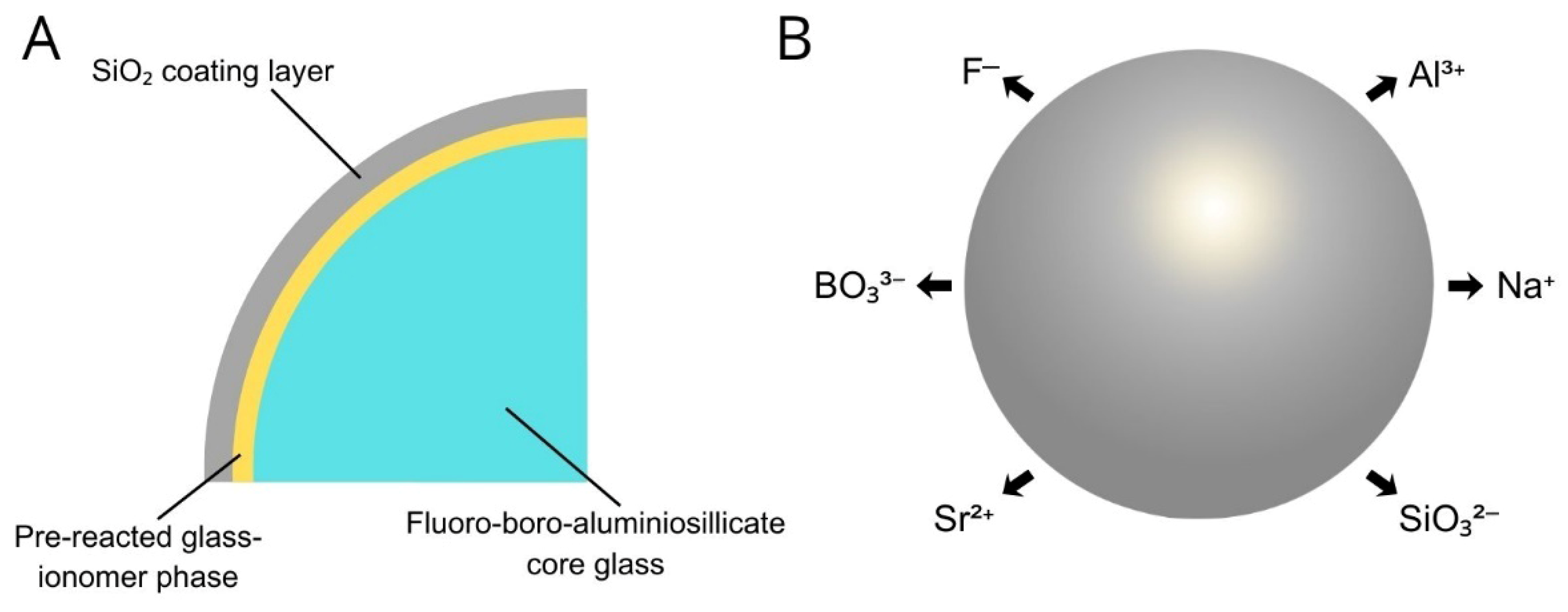
3.2. The S-PRG Particle
3.3. Dilution and Delivery Vehicle
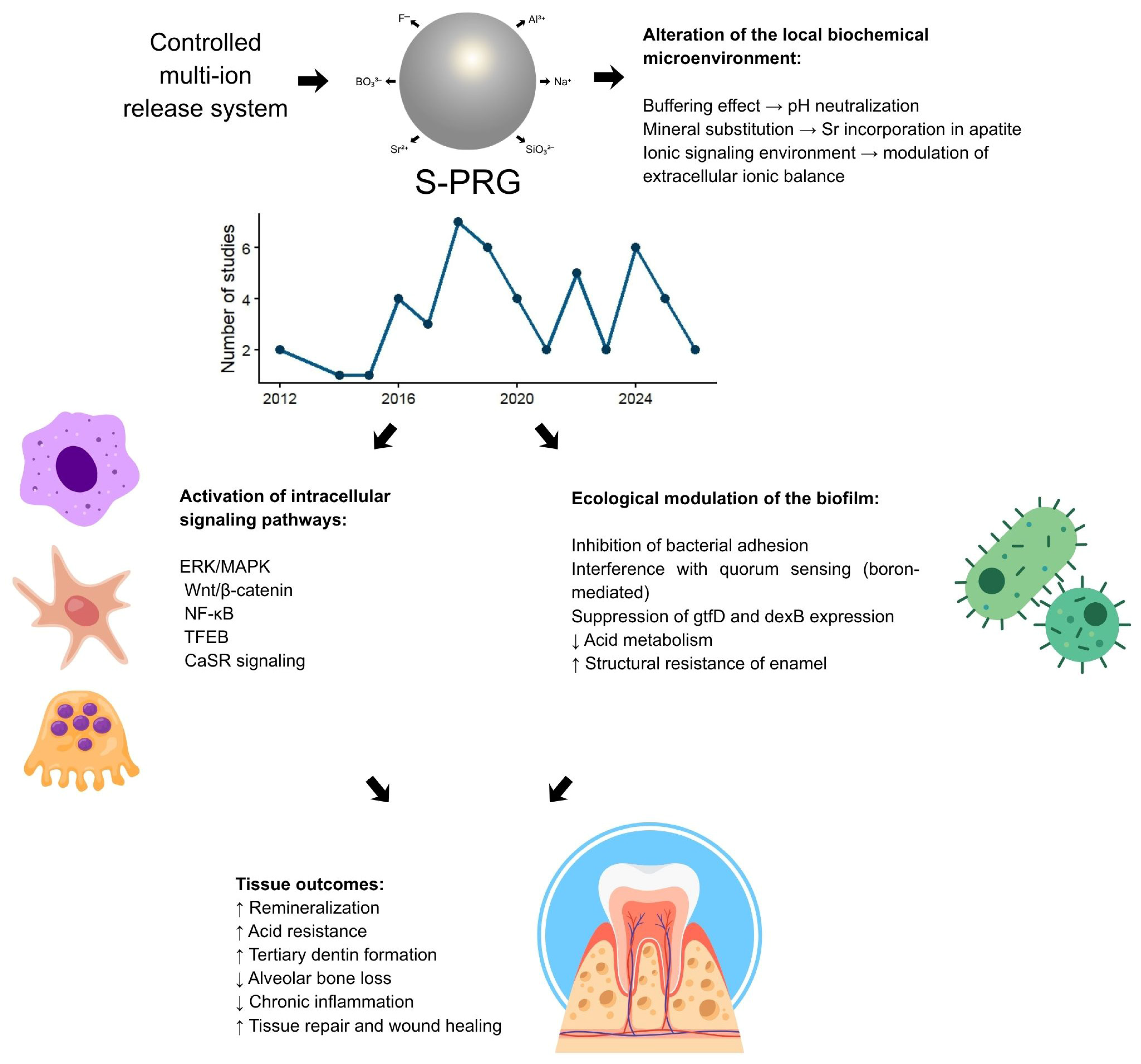
3.4. Biological Activities Associated with the S-PRG Particle
3.4.1. Ion-Mediated Mineralization and Enamel Protection
3.4.2. Antimicrobial and Antifungal Mechanisms
Biofilm Disruption and Bacterial Suppression
Oxidative Stress-Mediated Antifungal Activity
3.4.3. Cell Migration, Differentiation, and Regenerative Signaling
3.4.4. Modulation of Inflammatory and Matrix Remodeling Processes
3.4.5. Oral Epithelial Barrier Protection
3.5. Evidence Distribution According to Study Subclass
3.6. Comparison of S-PRG Materials with Other Bioactive and Conventional Dental Materials
4. Conclusions
Author Contributions
Funding
Institutional Review Board Statement
Informed Consent Statement
Data Availability Statement
Acknowledgments
Conflicts of Interest
Abbreviations
| hDPSCs | Human dental pulp-derived stem cells |
| HGF | Human gingival fibroblasts |
| ICP-AES | Inductively coupled plasma atomic emission spectroscopy |
| S-PRG | Surface pre-reacted glass ionomer |
| α-MEM | α-modified Eagle’s minimum essential medium |
References
- Schmalz, G.; Hickel, R.; Price, R.B.; Platt, J.A. Bioactivity of Dental Restorative Materials: FDI Policy Statement. Int. Dent. J. 2023, 73, 21–27. [Google Scholar] [CrossRef] [PubMed]
- Abozaid, D.; Azab, A.; Bahnsawy, M.A.; Eldebawy, M.; Ayad, A.; Soomro, R.; Elwakeel, E.; Mohamed, M.A. Bioactive restorative materials in dentistry: A comprehensive review of mechanisms, clinical applications, and future directions. Odontology 2025, 114, 349–377. [Google Scholar] [CrossRef]
- Wakamatsu, N.; Ogika, M.; Okano, T.; Murabayashi, C.; Kondo, T.; Iinuma, M. Effect of tooth surface coating material containing S-PRG filler on white spot lesions of young permanent teeth. Pediatr. Dent. J. 2018, 28, 40–45. [Google Scholar] [CrossRef]
- Inoue, H.; Lan, L.; Ke, Z.; Yang, Y.; Zheng, F.; Mao, D.; Goda, S. Effects of S-PRG filler eluate on MMP-1 and MMP-3 secretion by human gingival fibroblasts. Dent. Mater. J. 2022, 41, 159–166. [Google Scholar] [CrossRef]
- Thein, H.S.S.; Hashimoto, K.; Kawashima, N.; Noda, S.; Okiji, T. Evaluation of the anti-inflammatory effects of surface-reaction-type pre-reacted glass-ionomer filler containing root canal sealer in lipopolysaccharide-stimulated RAW264.7 macrophages. Dent. Mater. J. 2022, 41, 150–158. [Google Scholar] [CrossRef]
- Moroto, H.; Inoue, H.; Morikawa, Y.; Tanimoto, H.; Yoshikawa, K.; Goda, S.; Yamamoto, K. Effects of a co-stimulation with S-PRG filler eluate and muramyl dipeptide (MDP) on matrix metalloproteinase-1 production by human dental pulp fibroblast-like cells. Dent. Mater. J. 2023, 42, 375–382. [Google Scholar] [CrossRef]
- Nemoto, A.; Chosa, N.; Kyakumoto, S.; Yokota, S.; Kamo, M.; Noda, M.; Ishisaki, A. Water-soluble factors eluated from surface pre-reacted glass-ionomer filler promote osteoblastic differentiation of human mesenchymal stem cells. Mol. Med. Rep. 2018, 17, 3448–3454. [Google Scholar] [CrossRef] [PubMed]
- Imazato, S.; Ma, S.; Chen, J.-H.; Xu, H.H. Therapeutic polymers for dental adhesives: Loading resins with bio-active components. Dent. Mater. 2014, 30, 97–104. [Google Scholar] [CrossRef] [PubMed]
- Imazato, S. Bio-active restorative materials with antibacterial effects: New dimension of innovation in restorative dentistry. Dent. Mater. J. 2009, 28, 11–19. [Google Scholar] [CrossRef]
- Imazato, S.; Kitagawa, H.; Tsuboi, R.; Kitagawa, R.; Thongthai, P.; Sasaki, J.-I. Non-biodegradable polymer particles for drug delivery: A new technology for “bio-active” restorative materials. Dent. Mater. J. 2017, 36, 524–532. [Google Scholar] [CrossRef]
- Imazato, S.; Kitagawa, H. Dental Resin-Based Materials with Antibacterial Properties: Contact Inhibition and Controlled Release. In Oral Biofilms and Modern Dental Materials: Advances Toward Bioactivity; Ionescu, A.C., Hahnel, S., Eds.; Springer International Publishing: Cham, Switzerland, 2021; pp. 127–140. [Google Scholar]
- Imazato, S.; Kohno, T.; Tsuboi, R.; Thongthai, P.; Xu, H.H.; Kitagawa, H. Cutting-edge filler technologies to release bio-active components for restorative and preventive dentistry. Dent. Mater. J. 2020, 39, 69–79. [Google Scholar] [CrossRef]
- Imazato, S.; Nakatsuka, T.; Kitagawa, H.; Sasaki, J.-I.; Yamaguchi, S.; Ito, S.; Takeuchi, H.; Nomura, R.; Nakano, K. Multiple-Ion Releasing Bioactive Surface Pre-Reacted Glass-Ionomer (S-PRG) Filler: Innovative Technology for Dental Treatment and Care. J. Funct. Biomater. 2023, 14, 236. [Google Scholar] [CrossRef]
- Ishigure, H.; Kawaki, H.; Shintani, K.; Ueno, K.; Mizuno-Kamiya, M.; Takayama, E.; Hotta, M.; Kondoh, N.; Nikaido, T. Effects of multi-components released from S-PRG filler on the activities of human dental pulp-derived stem cells. Dent. Mater. J. 2021, 40, 1329–1337. [Google Scholar] [CrossRef] [PubMed]
- Ali, M.; Okamoto, M.; Komichi, S.; Watanabe, M.; Huang, H.; Takahashi, Y.; Hayashi, M. Lithium-containing surface pre-reacted glass fillers enhance hDPSC functions and induce reparative dentin formation in a rat pulp capping model through activation of Wnt/β-catenin signaling. Acta Biomater. 2019, 96, 594–604. [Google Scholar] [CrossRef]
- Okamoto, M.; Ali, M.; Komichi, S.; Watanabe, M.; Huang, H.; Ito, Y.; Miura, J.; Hirose, Y.; Mizuhira, M.; Takahashi, Y.; et al. Surface Pre-Reacted Glass Filler Contributes to Tertiary Dentin Formation through a Mechanism Different Than That of Hydraulic Calcium-Silicate Cement. J. Clin. Med. 2019, 8, 1440. [Google Scholar] [CrossRef] [PubMed]
- Yamaguchi-Ueda, K.; Akazawa, Y.; Kawarabayashi, K.; Sugimoto, A.; Nakagawa, H.; Miyazaki, A.; Kurogoushi, R.; Iwata, K.; Kitamura, T.; Yamada, A.; et al. Combination of ions promotes cell migration via extracellular signal-regulated kinase 1/2 signaling pathway in human gingival fibroblasts. Mol. Med. Rep. 2019, 19, 5039–5045. [Google Scholar] [CrossRef]
- Chandra, J.; Nakamura, S.; Shindo, S.; Leon, E.; Castellon, M.; Pastore, M.R.; Heidari, A.; Witek, L.; Coelho, P.G.; Nakatsuka, T.; et al. Surface Pre-Reacted Glass-Ionomer Eluate Suppresses Osteoclastogenesis through Downregulation of the MAPK Signaling Pathway. Biomedicines 2024, 12, 1835. [Google Scholar] [CrossRef]
- Iwamatsu-Kobayashi, Y.; Abe, S.; Fujieda, Y.; Orimoto, A.; Kanehira, M.; Handa, K.; Venkataiah, V.S.; Zou, W.; Ishikawa, M.; Saito, M. Metal ions from S-PRG filler have the potential to prevent periodontal disease. Clin. Exp. Dent. Res. 2017, 3, 126–133. [Google Scholar] [CrossRef]
- Miyaji, H.; Mayumi, K.; Miyata, S.; Nishida, E.; Shitomi, K.; Hamamoto, A.; Tanaka, S.; Akasaka, T. Comparative biological assessments of endodontic root canal sealer containing surface pre-reacted glass-ionomer (S-PRG) filler or silica filler. Dent. Mater. J. 2020, 39, 287–294. [Google Scholar] [CrossRef] [PubMed]
- Bhat, A.; Cvach, N.; Mizuno, C.; Ahn, C.; Zhu, Q.; Primus, C.; Komabayashi, T. Ion Release from Prototype Surface Pre-Reacted Glass Ionomer (S-PRG) Sealer and EndoSequence BC Sealer. Eur. Endod. J. 2021, 6, 122–127. [Google Scholar] [CrossRef]
- Takeuchi, H.; Kato, Y.; Sasaki, N.; Tanigaki, K.; Yamaga, S.; Mita, E.; Kuboniwa, M.; Matsusaki, M.; Amano, A. Surface pre-reacted glass-ionomer eluate protects gingival epithelium from penetration by lipopolysaccharides and peptidoglycans via transcription factor EB pathway. PLoS ONE 2022, 17, e0271192. [Google Scholar] [CrossRef]
- Miki, S.; Kitagawa, H.; Kitagawa, R.; Kiba, W.; Hayashi, M.; Imazato, S. Antibacterial activity of resin composites containing surface pre-reacted glass-ionomer (S-PRG) filler. Dent. Mater. 2016, 32, 1095–1102. [Google Scholar] [CrossRef] [PubMed]
- Lee, M.-J.; Kwon, J.-S.; Kim, J.-Y.; Ryu, J.-H.; Seo, J.-Y.; Jang, S.; Kim, K.-M.; Hwang, C.-J.; Choi, S.-H. Bioactive resin-based composite with surface pre-reacted glass-ionomer filler and zwitterionic material to prevent the formation of multi-species biofilm. Dent. Mater. 2019, 35, 1331–1341. [Google Scholar] [CrossRef] [PubMed]
- Garcia, M.T.; Namba, A.M.; Carmo, P.H.F.D.; Pedroso, L.L.C.; de Lima, P.M.N.; Gonçale, J.C.; Junqueira, J.C. Antimicrobial effects of surface pre-reacted glass-ionomer (S-PRG) eluate against oral microcosm biofilm. Biofouling 2024, 40, 390–401. [Google Scholar] [CrossRef]
- Rossoni, R.D.; De Barros, P.P.; das Chagas Lopes, L.A.; Ribeiro, F.C.; Nakatsuka, T.; Kasaba, H.; Junqueira, J.C. Effects of surface pre-reacted glass-ionomer (S-PRG) eluate on Candida spp.: Antifungal activity, anti-biofilm properties, and protective effects on Galleria mellonella against C. albicans infection. Biofouling 2019, 35, 997–1006. [Google Scholar] [CrossRef]
- Suzuki, N.; Yoneda, M.; Haruna, K.; Masuo, Y.; Nishihara, T.; Nakanishi, K.; Yamada, K.; Fujimoto, A.; Hirofuji, T. Effects of S-PRG eluate on oral biofilm and oral malodor. Arch. Oral Biol. 2014, 59, 407–413. [Google Scholar] [CrossRef]
- Shimazu, K.; Oguchi, R.; Takahashi, Y.; Konishi, K.; Karibe, H. Effects of surface reaction-type pre-reacted glass ionomer on oral biofilm formation of Streptococcus gordonii. Odontology 2016, 104, 310–317. [Google Scholar] [CrossRef]
- Nomura, R.; Morita, Y.; Matayoshi, S.; Nakano, K. Inhibitory effect of surface pre-reacted glass-ionomer (S-PRG) eluate against adhesion and colonization by Streptococcus mutans. Sci. Rep. 2018, 8, 5056. [Google Scholar] [CrossRef] [PubMed]
- Matayoshi, S.; Nomura, R.; Kitamura, T.; Okawa, R.; Nakano, K. Inhibitory effect of toothbrush monofilament containing surface pre-reacted glass-ionomer (S-PRG) filler on Streptococcus mutans. Sci. Rep. 2021, 11, 211. [Google Scholar] [CrossRef]
- de Lima, G.C.; de Cassia Orlando Sardi, J.; de Figueiredo, L.C.; Bueno-Silva, B.; Fonseca, M.A.; Dudu-Silva, G.; de Carvalho, F.P.P.; Rodrigues, J.A. Antibacterial activity of a bioactive composite resins containing surface pre-reacted glass in a complex multispecies subgingival biofilm. Odontology 2025. [Google Scholar] [CrossRef]
- Tamura, M.; Cueno, M.E.; Abe, K.; Kamio, N.; Ochiai, K.; Imai, K. Ions released from a S-PRG filler induces oxidative stress in Candida albicans inhibiting its growth and pathogenicity. Cell Stress Chaperones 2018, 23, 1337–1343. [Google Scholar] [CrossRef]
- Sunami, A.; Inokoshi, M.; Tamura, M.; Uo, M.; Wada, T.; Takahashi, R.; Hatano, K.; Onuma, H.; Kanazawa, M. Mechanical and antimicrobial properties of hard denture relining material with surface pre-reacted glass-ionomer filler. J. Prosthodont. Res. 2026. Epub ahead of printing. [Google Scholar]
- Kato, K.; Tamura, K.; Shimazaki, Y. Oral biofilm uptake of mineral ions released from experimental toothpaste containing surface pre-reacted glass-ionomer (S-PRG) filler. Arch. Oral Biol. 2020, 117, 104777. [Google Scholar] [CrossRef] [PubMed]
- Yoneda, M.; Suzuki, N.; Masuo, Y.; Fujimoto, A.; Iha, K.; Yamada, K.; Iwamoto, T.; Hirofuji, T. Effect of S-PRG Eluate on Biofilm Formation and Enzyme Activity of Oral Bacteria. Int. J. Dent. 2012, 2012, 814913. [Google Scholar] [CrossRef]
- Amaechi, B.T.; Key, M.C.; Balu, S.; Okoye, L.O.; Gakunga, P.T. Evaluation of the caries-preventive effect of toothpaste containing surface prereacted glass-ionomer filler. J. Investig. Clin. Dent. 2017, 8, e12249. [Google Scholar] [CrossRef] [PubMed]
- Spinola, M.d.S.; Moecke, S.E.; Rossi, N.R.; Nakatsuka, T.; Borges, A.B.; Gomes Torres, C.R. Efficacy of S-PRG filler containing varnishes on enamel demineralization prevention. Sci. Rep. 2020, 10, 18992. [Google Scholar] [CrossRef]
- Kato, K.; Kutsuna, R.; Kawamura, Y.; Shimazaki, Y. Bioactive caries-preventing effects of mineral ions released from surface pre-reacted glass-ionomer (S-PRG) filler on oral biofilm. Arch. Oral Biol. 2025, 179, 106392. [Google Scholar] [CrossRef]
- Nishimata, H.; Kamasaki, Y.; Satoh, K.; Kinoshita, R.; Omori, K.; Hoshino, T. Suppression of Streptococcus mutans Biofilm Formation and Gene Expression by PRG Barrier Coat: A Molecular and Microscopic Study for Preventing Dental Caries. Oral Health Prev. Dent. 2024, 22, 73–79. [Google Scholar]
- Suge, T.; Matsuo, T. Effects of toothpaste containing surface pre-reacted glass-ionomer (S-PRG) filler on crystallinity and acid resistance of hydroxyapatite. Am. J. Dent. 2020, 33, 183–186. [Google Scholar] [PubMed]
- Nakamura, K.; Hamba, H.; Nakashima, S.; Sadr, A.; Nikaido, T.; Oikawa, M.; Uo, M.; Tagami, J. Effects of experimental pastes containing surface pre-reacted glass ionomer fillers on inhibition of enamel demineralization. Dent. Mater. J. 2017, 36, 482–490. [Google Scholar] [CrossRef]
- Amaechi, B.T.; Kasundra, H.; Joshi, D.; Abdollahi, A.; Azees, P.A.A.; Okoye, L.O. Effectiveness of S-PRG Filler-Containing Toothpaste in Inhibiting Demineralization of Human Tooth Surface. Open Dent. J. 2018, 12, 811–819. [Google Scholar] [CrossRef]
- Ubolsa-ard, P.; Sanon, K.; Hiraishi, N.; Sayed, M.; Sakamaki, Y.; Yiu, C.K.Y.; Shimada, Y. Influence of surface pre-reacted glass-ionomer (S-PRG) filler eluate on collagen morphology, remineralization, and ultimate tensile strength of demineralized dentin. J. Mech. Behav. Biomed. Mater. 2024, 150, 106295. [Google Scholar] [CrossRef]
- Mendes Soares, I.P.; Anselmi, C.; Fernandes, L.d.O.; Peruchi, V.; de Lima, C.M.; Pires, M.L.B.A.; Ribeiro, R.A.d.O.; Costa, C.A.d.S.; Hebling, J. Transdentinal effects of S-PRG fillers on odontoblast-like cells. Dent. Mater. 2024, 40, 1259–1266. [Google Scholar] [CrossRef] [PubMed]
- Mosquim, V.; Zabeu, G.S.; Foratori-Junior, G.A.; Borges, A.B.; Rios, D.; Magalhães, A.C.; Wang, L. S-PRG-based toothpastes compared to NaF toothpaste and NaF varnish on dentin permeability in vitro. J. Appl. Oral Sci. 2022, 30, e20220082. [Google Scholar] [CrossRef]
- Ramos, F.; Briso, A.L.F.; Albertinazzi, L.; Marchetti, V.M.; Souza, M.T.; Fagundes, T.C. Efficacy of different in-office treatments for dentin hypersensitivity: Randomized and parallel clinical trial. Braz. Dent. J. 2024, 35, e245487. [Google Scholar] [CrossRef] [PubMed]
- Ribeiro, M.; Ferreira, B.A.J.; Ribeiro, A.C.F.; França, F.M.G.; Turssi, C.P.; Basting, R.T.; Vieira-Junior, W.F. Occlusion, acid resistance, and elemental characterization of dentin treated with desensitizing agents. Braz. Oral Res. 2025, 39, e016. [Google Scholar] [CrossRef]
- Ratanakupt, K.; Nakatsuka, T.; Kiatsirirote, K. The impact of surface pre-reacted glass-ionomer nanoparticles on ion dynamics and the physio-mechanical properties of denture base resin. J. Appl. Oral Sci. 2025, 33, e20250060. [Google Scholar] [CrossRef]
- Oliveira Neto, C.A.C.; Picolo, M.Z.D.; Amaral, F.L.B.D.; Torres, C.R.G.; Kantovitz, K.R.; Attin, T.; Basting, R.T. Resin composites containing S-PRG fillers: Effects on pH modulation of the surrounding medium, surface roughness, and gloss following erosive/abrasive challenge. J. Appl. Oral Sci. 2026, 33, e20250365. [Google Scholar] [CrossRef]
- ThanNaing, S.; Hiraishi, N.; Chen, X.; Foxton, R.; Shimada, Y. In vitro remineralization assessment of enamel subsurface lesions using different percentages of surface reaction-type pre-reacted glass-ionomer containing gum-based material. J. Dent. 2023, 135, 104602. [Google Scholar] [CrossRef]
- ThanNaing, S.; Abdou, A.; Sayed, M.; Sumi, Y.; Tagami, J.; Hiraishi, N. Dentin anti-demineralization potential of surface reaction-type pre-reacted glass-ionomer filler containing self-adhesive resin cement. Clin. Oral Investig. 2022, 26, 1333–1342. [Google Scholar] [CrossRef]
- Iijima, M.; Ishikawa, R.; Kawaguchi, K.; Ito, S.; Saito, T.; Mizoguchi, I. Effects of pastes containing ion-releasing particles on dentin remineralization. Dent. Mater. J. 2019, 38, 271–277. [Google Scholar] [CrossRef] [PubMed]
- Murayama, R.; Nagura, Y.; Yamauchi, K.; Moritake, N.; Iino, M.; Ishii, R.; Kurokawa, H.; Miyazaki, M.; Hosoya, Y. Effect of a coating material containing surface reaction-type pre-reacted glass-ionomer filler on prevention of primary enamel demineralization detected by optical coherence tomography. J. Oral Sci. 2018, 60, 367–373. [Google Scholar] [CrossRef] [PubMed]
- Iijima, M.; Kawaguchi, K.; Kawamura, N.; Ito, S.; Saito, T.; Mizoguchi, I. The effects of single application of pastes containing ion-releasing particles on enamel demineralization. Dent. Mater. J. 2017, 36, 461–468. [Google Scholar] [CrossRef]
- Kawashima, S.; Shinkai, K.; Suzuki, M. The effect of multi-ion releasing filler contents on the dentin bond strength of an adhesive resin developed for direct pulp-capping. Dent. Mater. J. 2015, 34, 841–846. [Google Scholar] [CrossRef]
- Kawashima, S.; Shinkai, K.; Suzuki, M. Effect of an experimental adhesive resin containing multi-ion releasing fillers on direct pulp-capping. Dent. Mater. J. 2016, 35, 479–489. [Google Scholar] [CrossRef]
- Itota, T.; Carrick, T.E.; Yoshiyama, M.; McCabe, J.F. Fluoride release and recharge in giomer, compomer and resin composite. Dent. Mater. 2004, 20, 789–795. [Google Scholar] [CrossRef]
- Ikemura, K.; Tay, F.R.; Endo, T.; Pashley, D.H. A Review of Chemical-approach and Ultramorphological Studies on the Development of Fluoride-releasing Dental Adhesives Comprising New Pre-Reacted Glass Ionomer (PRG) Fillers. Dent. Mater. J. 2008, 27, 315–339. [Google Scholar]
- Roberts, T.A.; Miyai, K.; Ikemura, K.; Fuchigami, K.; Kitamura, T. Fluoride Ion Sustained Release Preformed Glass Ionomer Filler and Dental Compositions Containing the Same. U.S. Patent US5883153A, 16 March 1999. [Google Scholar]
- Ito, S.; Iijima, M.; Hashimoto, M.; Tsukamoto, N.; Mizoguchi, I.; Saito, T. Effects of surface pre-reacted glass-ionomer fillers on mineral induction by phosphoprotein. J. Dent. 2011, 39, 72–79. [Google Scholar]
- Naoum, S.; Ellakwa, A.; Martin, F.; Swain, M. Fluoride Release, Recharge and Mechanical Property Stability of Various Fluoride-containing Resin Composites. Oper. Dent. 2011, 36, 422–432. [Google Scholar] [CrossRef] [PubMed]
- Han, L.; Okamoto, A.; Fukushima, M.; Okiji, T. Evaluation of a New Fluoride-releasing One-step Adhesive. Dent. Mater. J. 2006, 25, 509–515. [Google Scholar] [CrossRef] [PubMed][Green Version]
- Han, L.; Okiji, T. Evaluation of the ions release/incorporation of the prototype S-PRG filler-containing endodontic sealer. Dent. Mater. J. 2011, 30, 898–903. [Google Scholar] [CrossRef]
- Hirata-Tsuchiya, S.; Suzuki, S.; Nakamoto, T.; Kakimoto, N.; Yamada, S.; Shiba, H. Surgical Sealing of Laterally Localized Accessory Root Canal with Resin Containing S-PRG Filler in Combination with Non-Surgical Endodontic Treatment: A Case Report. Dent. J. 2020, 8, 131. [Google Scholar] [CrossRef]
- Fujimoto, Y.; Iwasa, M.; Murayama, R.; Miyazaki, M.; Nagafuji, A.; Nakatsuka, T. Detection of ions released from S-PRG fillers and their modulation effect. Dent. Mater. J. 2010, 29, 392–397. [Google Scholar] [CrossRef]
- Kashiwagi, K.; Inoue, H.; Komasa, R.; Hosoyama, Y.; Yamashita, K.; Morisaki, A.; Goda, S. Optimal dilutions of S-PRG filler eluate for experiments on human gingival fibroblasts in vitro. Dent. Mater. J. 2021, 40, 136–142. [Google Scholar] [CrossRef] [PubMed]
- Yassen, G.H.; Lippert, F.; Eckert, G.; Eder, J.; Zandoná, A.F. The effect of strontium and combinations of strontium and fluoride on the remineralization of artificial caries lesions in vitro. Quintessence Int. 2012, 43, e95–e103. [Google Scholar]
- Saku, S.; Kotake, H.; Scougall-Vilchis, R.J.; Ohashi, S.; Hotta, M.; Horiuchi, S.; Hamada, K.; Asaoka, K.; Tanaka, E.; Yamamoto, K. Antibacterial activity of composite resin with glass-ionomer filler particles. Dent. Mater. J. 2010, 29, 193–198. [Google Scholar] [CrossRef]
- Yoneda, M. Antibacterial Effect of Surface Pre-Reacted Glass Ionomer Filler and Eluate–Mini Review. Pharm. Anal. Acta 2015, 6, 349. [Google Scholar]
- Takakusaki, K.; Fueki, K.; Tsutsumi, C.; Tsutsumi, Y.; Iwasaki, N.; Hanawa, T.; Takahashi, H.; Takakuda, K.; Wakabayashi, N. Effect of incorporation of surface pre-reacted glass ionomer filler in tissue conditioner on the inhibition of Candida albicans adhesion. Dent. Mater. J. 2018, 37, 453–459. [Google Scholar] [CrossRef] [PubMed]
- Tonprasong, W.; Inokoshi, M.; Tamura, M.; Hatano, K.; Minakuchi, S. Impact of surface pre-reacted glass ionomer filler eluate on lipase gene expression in Candida albicans: An in vitro study. Dent. Mater. J. 2022, 42, 49–54. [Google Scholar] [CrossRef]
- Kawashima, N.; Hashimoto, K.; Kuramoto, M.; Bakhit, A.; Wakabayashi, Y.; Okiji, T. A Novel Bioactive Endodontic Sealer Containing Surface-Reaction-Type Prereacted Glass-Ionomer Filler Induces Osteoblast Differentiation. Materials 2020, 13, 4477. [Google Scholar] [CrossRef]
- Miyano, Y.; Mikami, M.; Katsuragi, H.; Shinkai, K. Effects of Sr2+, BO33−, and SiO32− on Differentiation of Human Dental Pulp Stem Cells into Odontoblast-Like Cells. Biol. Trace Elem. Res. 2023, 201, 5585–5600. [Google Scholar] [CrossRef]



| Main Activity | Experimental Model | Sample Size | Material/Vehicle | S-PRG Material Dilution | Key Findings | Reference | Study Subclass |
|---|---|---|---|---|---|---|---|
| Cell proliferation/cytocompatibility | hDPSCs | 3–6 wells per group | S-PRG eluate (DW/α-MEM) | 1:500, 1:100, 1:10, 1:2 | Cell responses were dilution-dependent; modulation of proliferation and ALP activity | Ishigure, Kawaki [14] | In vitro |
| Tertiary dentin formation (Wnt/β-catenin) | hDPSCs + Wistar rats | Cells: n = 3 Rats: 24 total | S-PRG + LiCl cement | 1.5:1.0 wt (S-PRG Powder/FGL liquid) | Increased migration, differentiation, mineralization; induced tertiary dentin via Wnt/β-catenin signaling | Ali, Okamoto [15] | In vivo |
| Tertiary dentin formation | hDPSCs + rats | Cells: n = 8 Rats: n = 3 | S-PRG cement | 1.5:1.0 wt (S-PRG Powder/liquid) | Induced dentin formation comparable to MTA; regulated osteo/dentinogenic genes | Okamoto, Ali [16] | In vivo |
| Osteogenic differentiation | hMSCs | n = 3, 6, or 8 | S-PRG eluate | 1:2–1:1000 | Upregulated ALP and mineralization (dose-dependent, no cytotoxicity) | Nemoto, Chosa [7] | In vitro |
| Tissue remodeling | Human pulp fibroblasts | n = 4 | S-PRG eluate ± MDP | 1:1, 0.01%, 0.1%, and 1% | Enhanced MMP-1 production via ERK; CaSR-dependent modulation | Moroto, Inoue [6] | In vitro |
| Wound healing/cell migration | HGF-1 cells | n = 4, 8, or 10 | S-PRG eluate (1:10,000) | 1:100, 1:1000 and 1:10,000 | Promoted migration via ERK1/2 activation | Yamaguchi-Ueda, Akazawa [17] | In vitro |
| Anti-osteoclastogenic/bone resorption inhibition | RAW264.7 cells (RANKL-induced osteoclastogenesis) | Not clear | S-PRG eluate (1:200–1:400) | 1:10–1:1200 | Suppressed OC formation and mineral dissolution; downregulated NFATc1, OCSTAMP, CATK; inhibited ERK/JNK/p38 signaling | Chandra, Nakamura [18] | In vitro |
| Inflammatory modulation | Human gingival fibroblasts | n = 4 | S-PRG eluate | 1:1, 0.01–1% | Regulated MMP-1/MMP-3 secretion and ERK/p38 signaling | Inoue, Lan [4] | In vitro |
| Anti-inflammatory (macrophages) | RAW264.7 cells | n = 3 or 4 | S-PRG sealer extract | 1:2, 1:4 | Downregulated IL-1α, IL-6, TNF-α and p-NF-κB | Thein, Hashimoto [5] | In vitro |
| Anti-inflammatory/periodontal protection (in vivo) | Mouse ligature-induced periodontal disease model | n = 3 | S-PRG eluate | 10 μL S-PRG eluate | Reduced alveolar bone loss; decreased neutrophil and macrophage infiltration; preserved collagen bundles; boron ion deposition detected | Iwamatsu-Kobayashi, Abe [19] | In vivo |
| Antibacterial + anti-inflammatory | Cells + Wistar rats | Cells: n = 5 Rats = 11 total | S-PRG sealer | - | Reduced E. faecalis growth and in vivo inflammatory response | Miyaji, Mayumi [20] | In vivo |
| Ion release/osteogenic potential | Extracted human teeth | n = 6 | Prototype S-PRG sealer | - | Released boron and strontium ions; potential antimicrobial and osteogenic effects | Bhat, Cvach [21] | In vitro |
| Epithelial barrier protection | 3D gingival epithelium | n = 2 | S-PRG eluate | 1:1, 0–25 μL per well | Upregulated CXADR via TFEB; reduced bacterial permeation | Takeuchi, Kato [22] | In vitro |
| Antibacterial (S. mutans) | S. mutans | n = 5 | Resin composite with S-PRG | 1:1, 50, 25, and 12.5 (vol.%) | Growth inhibition is concentration-dependent; BO33− and F− most active ions | Miki, Kitagawa [23] | In vitro |
| Antibacterial/anti-biofilm | Multispecies biofilm | n = 3 | SPRG-filled RBC + MPC | MPC (1.5–10% by weight). | Reduced protein adsorption and biofilm formation; improved acid neutralization | Lee, Kwon [24] | In vitro |
| Antibacterial/anti-biofilm (microcosm) | Human-derived oral microcosm biofilm (enamel specimens, 120 h) | S-PRG eluate | 100% | Reduced total microorganisms, streptococci and mutans streptococci; decreased lactic acid production; reduced biofilm structure (SEM) | Garcia, Namba [25] | In situ human model | |
| Antifungal | Candida spp. + G. mellonella | n = 3 | S-PRG eluate | 1:1, 50, 40, 30, 20, 10, and 5%, | Reduced biofilm and virulence; protective in vivo effect | Rossoni, de Barros [26] | In vivo |
| Oral biofilm modulation | Human saliva biofilm | n = 4 | S-PRG eluate | 1:1, 10, 20, 30, 40, 50, 60, 70, 80, 90, and 100% | Suppressed biofilm formation and VSC production | Suzuki, Yoneda [27] | In situ human model |
| Antimicrobial/coaggregation | Oral bacteria | n = 3 | S-PRG eluate | 1:1, 20% and 50% | Reduced bacterial growth and coaggregation | Shimazu, Oguchi [28] | In vitro |
| Antibacterial (gene expression) | S. mutans | n = 4 | S-PRG eluate | 1:1, 25%, 12.5% and 6.3% | Downregulated sugar metabolism operons; reduced cariogenicity | Nomura, Morita [29] | In vitro |
| Antibacterial toothbrush filament | S. mutans | Not clear | S-PRG-containing monofilament | Monofilaments containing S-PRG filler | Reduced biofilm; stronger effect in nylon | Matayoshi, Nomura [30] | In vitro |
| Antibacterial and anti-biofilm activity/coaggregation modulation | Oral bacteria (S. gordonii, S. mutans, S. oralis, L. acidophilus, C. albicans) | n = 3 | S-PRG eluate | 1:1, 0–50% | Reduced bacterial growth and biofilm formation; inhibited coaggregation of S. gordonii with S. oralis and F. nucleatum; increased autoaggregation of S. gordonii at specific concentrations | Shimazu, Oguchi [28] | In vitro |
| Antibacterial/subgingival multispecies biofilm | 39-species periodontitis-associated biofilm (7 days, 96-well plate) | n = 12 | S-PRG composite resins (Beautifil II, LS, Bulk) vs. conventional composite | - | Reduced total bacterial counts; decreased periodontopathogens and Yellow/Orange complexes; lower metabolic activity | de Lima, de Cassia Orlando Sardi [31] | In vitro |
| Antifungal (oxidative stress) | C. albicans | Not clear | S-PRG ion extraction liquid (ELIS) | 1:1, 1:8, 1:16, 1:32, 1:128 | Induced oxidative stress; reduced growth, biofilm and virulence factors | Tamura, Cueno [32] | In vitro |
| Antifungal/denture relining material | Hard denture liner with S-PRG (micro/nanofillers) | n = 4, 5 or 20 | S-PRG filler | 2.5–20 wt% | 10 wt% nanofiller reduced C. albicans adhesion while maintaining mechanical properties | Sunami, Inokoshi [33] | In vitro |
| Fluoride retention in biofilm | In situ oral biofilm | Not clear | S-PRG toothpaste | 1:3 | Enhanced fluoride retention via mineral ion uptake | Kato, Tamura [34] | In situ human model |
| Anti-caries (bacterial adherence) | S. mutans/P. gingivalis | n = 3 | S-PRG eluate | 10, 50 and 100% | Reduced adherence and proteolytic activity | Yoneda, Suzuki [35] | In vitro |
| Anti-caries (demineralization) | Human enamel blocks | n = 30 | S-PRG toothpaste | 0–20% | Reduced enamel demineralization | Amaechi, Key [36] | In vitro |
| Anti-caries varnish | Bovine enamel | n = 15 | S-PRG varnish | 10–40% | Dose-dependent protection against demineralization | Spinola, Moecke [37] | In vitro |
| Anti-caries/biofilm modulation (in situ) | In situ enamel slab device (human participants, 5 days) | n = 9 or 10 | S-PRG-containing prophylaxis paste filtrate | 1:3 | Reduced S. mutans/S. sanguinis ratio across biofilm layers; increased strontium and aluminum incorporation | Kato, Kutsuna [38] | In situ human model |
| Anti-caries/biofilm gene modulation | S. mutans biofilm on hydroxyapatite disks | n = 3 | PRG barrier coat | - | Reduced adhesion; suppressed caries-related gene expression (gtfD, dexB); altered biofilm structure | Nishimata, Kamasaki [39] | In vitro |
| Acid resistance/crystallinity | Hydroxyapatite pellets | Not clear | S-PRG toothpaste | 0–30 wt% | Increased crystallinity and acid resistance | Suge and Matsuo [40] | In vitro |
| Demineralization inhibition | Bovine enamel | Not clear | S-PRG paste | 0–30 wt% | S10 showed the greatest protective effect | Nakamura, Hamba [41] | In vitro |
| pH-cycling caries model | Tooth blocks | n = 7 | S-PRG toothpaste | 1–30% | Up to ~70% reduction in demineralization | Amaechi, Kasundra [42] | In vitro |
| Clinical remineralization (WSLs) | Children’s teeth | 7 children, 17 teeth | PRG Barrier Coat | - | Reduced white spot lesion area over 1 year | Wakamatsu, Ogika [3] | Clinical investigation |
| Dentin remineralization/collagen reinforcement | Demineralized bovine dentin (3-month SBF storage) | n = 8 | S-PRG filler eluate vs. NaF | 1:1 | Enhanced intrafibrillar mineralization; improved collagen morphology; increased phosphate/amide ratio and UTS | Ubolsa-ard, Sanon [43] | In vitro |
| Transdental odontogenic stimulation | MDPC-23 cells + artificial pulp chamber (dentin disk model) | n = 2, 8 or 10 | S-PRG filler eluate | 20 μL | Promoted odontogenic gene expression and enhanced mineralization (~40%) after prolonged exposure | Mendes Soares, Anselmi [44] | In vitro |
| Dentin permeability/hydraulic conductance | Human dentin disks from third molars | n = 8 | Toothpastes containing S-PRG fillers vs. NaF toothpaste and NaF varnish | 0–30% | Toothpastes containing 5–30% S-PRG reduced dentin hydraulic conductance similarly to NaF toothpaste; NaF varnish showed greater initial reduction but the effect decreased after erosive challenge | Mosquim, Zabeu [45] | In vitro |
| Dentin hypersensitivity reduction | Human teeth with non-cavitated root exposure (clinical evaluation using VAS and CoVAS) | Np-11, Nd = 48 | S-PRG barrier Coat vs. Duraphat, Biosilicate, and Single Bond Universal. | - | All desensitizers reduced dentin hypersensitivity over time; the S-PRG bioactive varnish showed a significant reduction between 15 and 30 days | Ramos, Briso [46] | Clinical investigation |
| Dentinal tubule occlusion/dentin hypersensitivity prevention | Human dentin disks evaluated by SEM and EDS after acid challenge | n = 10 | PRG Barrier Coat (S-PRG filler) vs. Gluma desensitizer and controls | - | PRG Barrier Coat promoted complete or partial dentinal tubule occlusion and maintained the effect after acid exposure | Ribeiro, Ferreira [47] | In vitro |
| Ion release and physicomechanical properties of denture base resin | PMMA resin specimens (disk and rectangular) | 72 disk specimens and 32 rectangular specimens | PMMA resin containing S-PRG nanoparticles | 5 wt% and 10 wt% S-PRG nanoparticles; 20 wt% S-PRG microparticles | Incorporation of S-PRG nanoparticles enabled the release of B, Si, Sr, Na, and F ions and maintained flexural strength within standards; 10 wt% showed the best balance between ion release and physicomechanical properties | Ratanakupt, Nakatsuka [48] | In vitro |
| pH buffering capacity and surface properties of S-PRG resin composites | Resin composite disks exposed to erosive/abrasive cycles | n = 5 for pH analysis n = 10 for erosion/abrasion test | Resin composites: Filtek Z350 XT (control), Beautifil II, Beautifil II Enamel, Beautifil II LS (S-PRG fillers) | - | S-PRG-containing composites increased the pH of the surrounding medium over time; erosive/abrasive challenge increased surface roughness but gloss values improved in S-PRG composites | Oliveira Neto, Picolo [49] | In vitro |
| Enamel remineralization of subsurface lesions | Bovine enamel specimens with artificial subsurface lesions | n = 50 | Gum-base material extracts containing S-PRG filler (GE0, GE5, GE10) | 0, 5, 10 wt% | 5% and 10% S-PRG groups showed significantly reduced lesion depth and enhanced remineralization; ion deposition confirmed by SEM/EDS | ThanNaing, Hiraishi [50] | In vitro |
| Anti-demineralization and dentin remineralization | Bovine dentin (crown cavities and root dentin blocks) under pH cycling | n = 32 teeth (crown dentin) + 64 root dentin blocks | Self-adhesive resin cements: S-PRG-based cement, Si-based cement, and RelyX cement | - | S-PRG-based cement showed lower demineralization depth, reduced mineral loss, and higher resistance to acidic challenge compared to other cements | ThanNaing, Abdou [51] | In vitro |
| Dentin remineralization and mechanical recovery | Demineralized human dentin blocks | n = 15 | Pastes containing S-PRG filler vs. nano-hydroxyapatite paste | 0, 5, 30% | S-PRG pastes promoted dentin remineralization, improved mechanical properties, and induced tubule occlusion after the remineralization period | Iijima, Ishikawa [52] | In vitro |
| Enamel anti-demineralization (protective coating) | Extracted human primary teeth evaluated by optical coherence tomography (OCT) | n = 18 (3 groups of 6) | Coating material containing S-PRG filler | - | S-PRG coating significantly increased integrated OCT values and prevented primary enamel demineralization over time | Murayama, Nagura [53] | In vitro |
| Enamel anti-demineralization and acid neutralization | Human enamel blocks exposed to a demineralizing solution | n = 38 | Pastes containing S-PRG filler vs. non-fluoride and hydroxyapatite pastes | 0, 5, 30% | S-PRG pastes showed dose-dependent acid-neutralizing effect, reduced enamel demineralization, and improved hardness, elastic modulus, and surface smoothness | Iijima, Kawaguchi [54] | In vitro |
| Microtensile bond strength of S-PRG adhesives | Flattened dentin surfaces of extracted human molars | n = 25 (5 groups of 5) | Experimental all-in-one adhesives containing S-PRG filler vs. Fluorobond Shakeone (control) | 0, 13, 27, 40 wt% | S-PRG incorporation did not significantly affect bond strength, except for a reduction at 13 wt% | Kawashima, Shinkai [55] | In vitro |
| Pulp healing and tertiary dentin formation | Exposed rat pulp (direct pulp capping, 14 and 28 days) | n = 6 | Experimental all-in-one adhesives containing S-PRG filler vs. control adhesive | 13 and 27 wt% | S-PRG adhesives showed no pulpal inflammation and promoted tertiary dentin formation; 13% and 27% formed dentin bridge comparable to the control after 28 days | Kawashima, Shinkai [56] | In vivo |
Disclaimer/Publisher’s Note: The statements, opinions and data contained in all publications are solely those of the individual author(s) and contributor(s) and not of MDPI and/or the editor(s). MDPI and/or the editor(s) disclaim responsibility for any injury to people or property resulting from any ideas, methods, instructions or products referred to in the content. |
© 2026 by the authors. Licensee MDPI, Basel, Switzerland. This article is an open access article distributed under the terms and conditions of the Creative Commons Attribution (CC BY) license.
Share and Cite
Balthazar Cavalcante de Oliveira, H.; Zablocki da Luz, J.; Eduardo de Lima, F.; de Castro Busatto Fernandes, C.; Barbosa Wetter, L.; Silva Schiebel, C.; Vieira Souza, A.; Smiderle, F.R.; Maria-Ferreira, D.; Machado-Souza, C. Biological Effects on S-PRG: An Integrative Review. J. Funct. Biomater. 2026, 17, 182. https://doi.org/10.3390/jfb17040182
Balthazar Cavalcante de Oliveira H, Zablocki da Luz J, Eduardo de Lima F, de Castro Busatto Fernandes C, Barbosa Wetter L, Silva Schiebel C, Vieira Souza A, Smiderle FR, Maria-Ferreira D, Machado-Souza C. Biological Effects on S-PRG: An Integrative Review. Journal of Functional Biomaterials. 2026; 17(4):182. https://doi.org/10.3390/jfb17040182
Chicago/Turabian StyleBalthazar Cavalcante de Oliveira, Hudson, Jessica Zablocki da Luz, Fabio Eduardo de Lima, Cauani de Castro Busatto Fernandes, Leticia Barbosa Wetter, Carolina Silva Schiebel, André Vieira Souza, Fhernanda Ribeiro Smiderle, Daniele Maria-Ferreira, and Cleber Machado-Souza. 2026. "Biological Effects on S-PRG: An Integrative Review" Journal of Functional Biomaterials 17, no. 4: 182. https://doi.org/10.3390/jfb17040182
APA StyleBalthazar Cavalcante de Oliveira, H., Zablocki da Luz, J., Eduardo de Lima, F., de Castro Busatto Fernandes, C., Barbosa Wetter, L., Silva Schiebel, C., Vieira Souza, A., Smiderle, F. R., Maria-Ferreira, D., & Machado-Souza, C. (2026). Biological Effects on S-PRG: An Integrative Review. Journal of Functional Biomaterials, 17(4), 182. https://doi.org/10.3390/jfb17040182