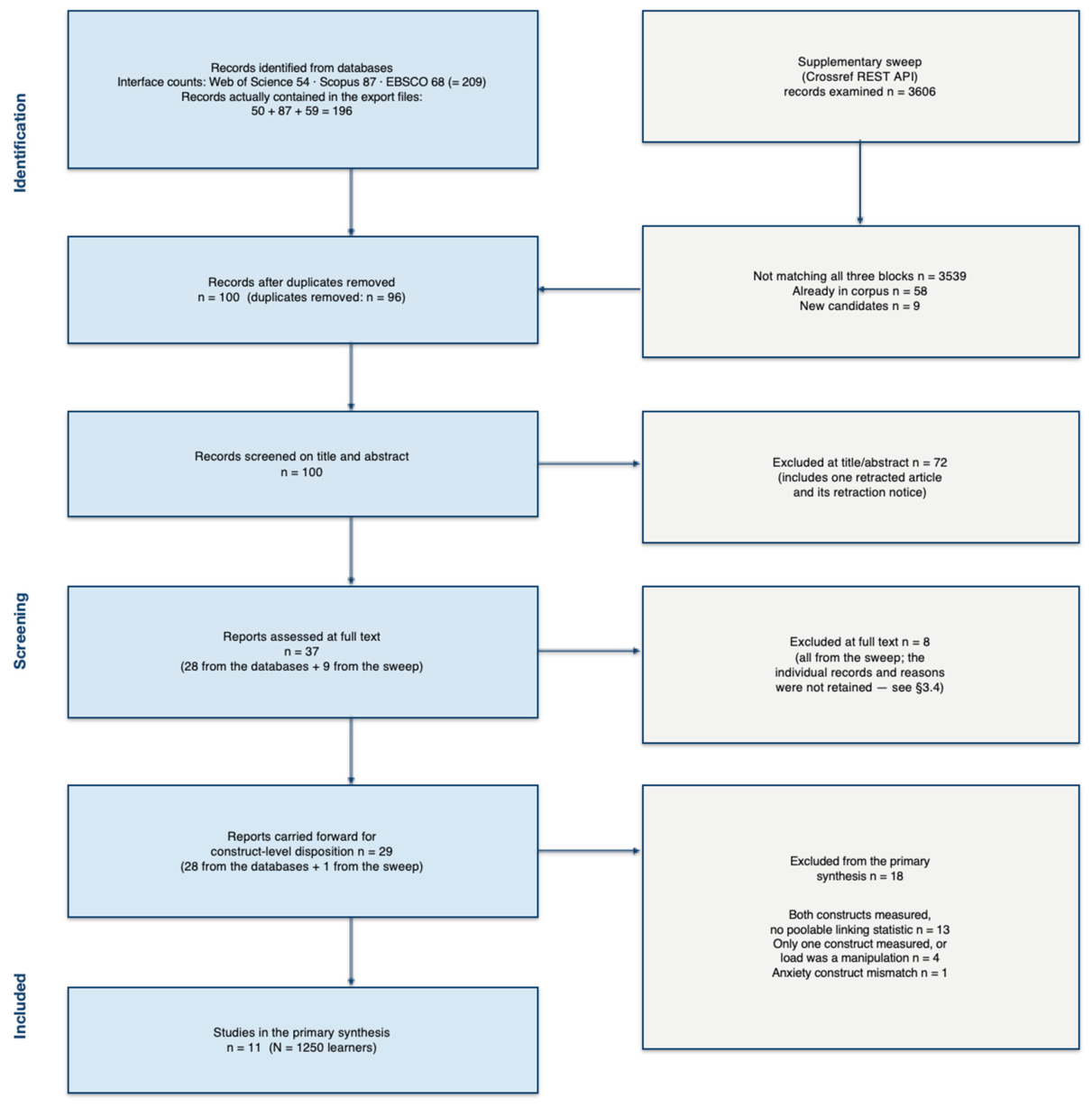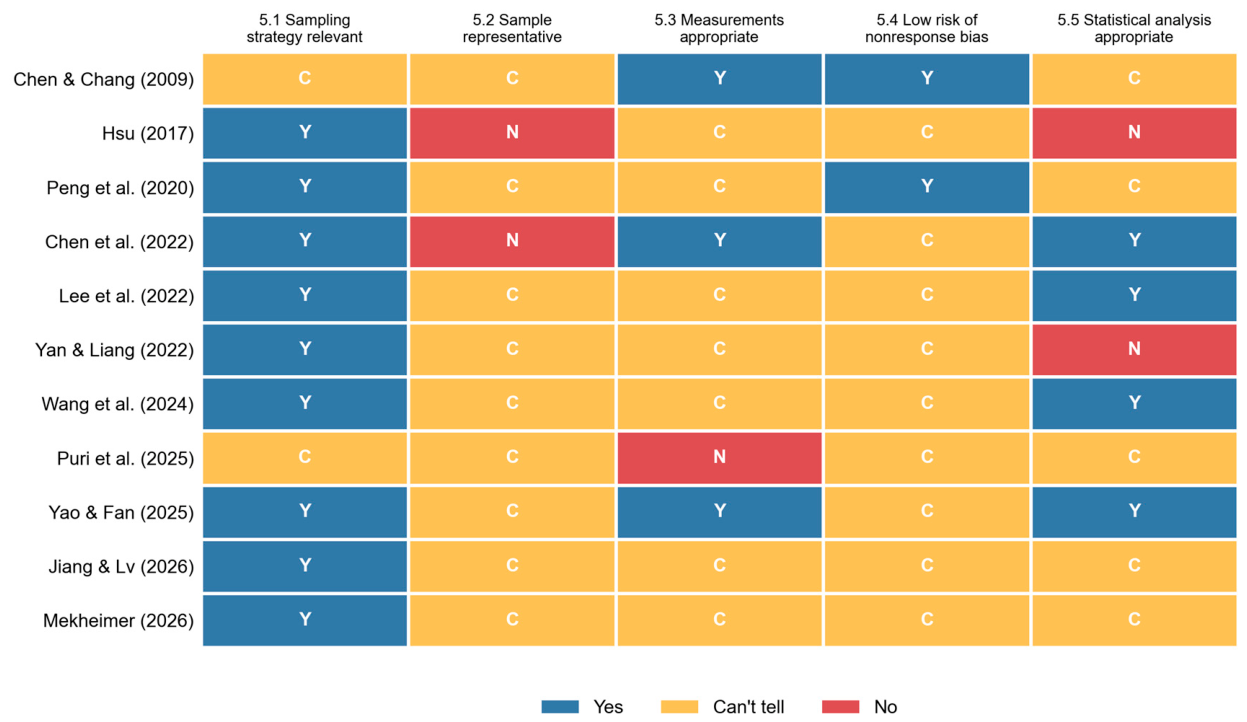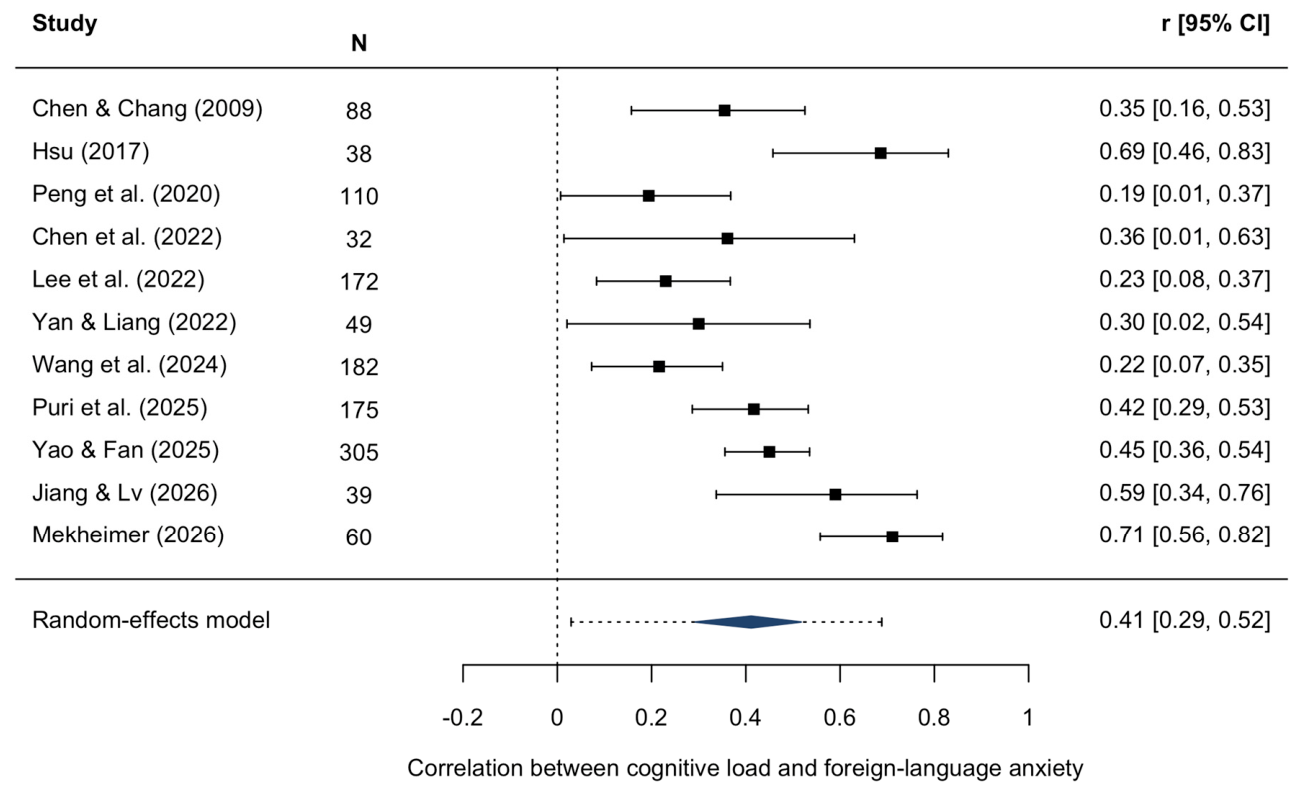
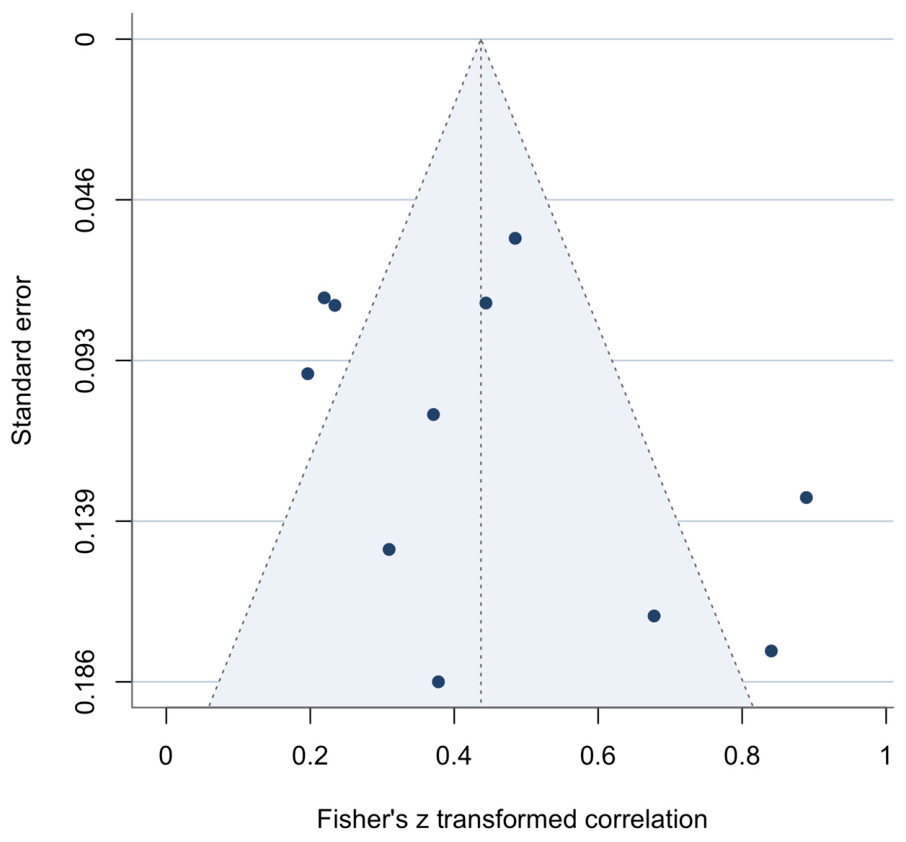
Cognitive Load and Foreign-Language Anxiety in Second-Language Learning: A Systematic Review and Meta-Analysis


Abstract
1. Introduction
2. Theoretical Background and Hypotheses
2.1. Cognitive Load in Second-Language Learning
2.2. Foreign-Language Anxiety
2.3. The Cognitive Load–Anxiety Nexus
2.4. Potential Moderators
2.5. The Present Study
3. Method
3.1. Protocol and Reporting
3.2. Eligibility Criteria
3.3. Information Sources and Search Strategy
3.4. Selection Process
3.5. Data Extraction and Coding
3.6. Effect-Size and Meta-Analytic Procedures
4. Results
4.1. Study Characteristics
4.2. Overall Association (Hypothesis 1)
4.3. Heterogeneity and the Exploratory Pacing Contrast
4.4. Small-Study Effects, Selective Non-Reporting, and Sensitivity Analyses
5. Discussion
5.1. Interpreting the Association (Hypothesis 1)
5.2. The Exploratory Pacing Contrast and the Modality Question
5.3. Relation to Prior Work
5.4. Theoretical and Practical Implications
5.5. A Reporting Gap in the Primary Literature
5.6. Limitations and Future Directions
6. Conclusions
Supplementary Materials
Author Contributions
Funding
Institutional Review Board Statement
Informed Consent Statement
Data Availability Statement
Conflicts of Interest
References
- Abramovitch, A., Abramowitz, J. S., Mittelman, A., Stark, A., Ramsey, K., & Geller, D. A. (2015). Research review: Neuropsychological test performance in pediatric obsessive–Compulsive disorder—A meta-analysis. Journal of Child Psychology and Psychiatry, 56(8), 837–847. [Google Scholar] [CrossRef] [Scilit] [PubMed]
- Baddeley, A. (2003). Working memory: Looking back and looking forward. Nature Reviews Neuroscience, 4(10), 829–839. [Google Scholar] [CrossRef] [Scilit] [PubMed]
- Borenstein, M., Hedges, L. V., Higgins, J. P. T., & Rothstein, H. R. (2009). Introduction to meta-analysis. Wiley. [Google Scholar] [CrossRef] [Scilit]
- Botes, E., Dewaele, J.-M., & Greiff, S. (2020). The foreign language classroom anxiety scale and academic achievement: An overview of the prevailing literature and a meta-analysis. Journal for the Psychology of Language Learning, 2(1), 26–56. [Google Scholar] [CrossRef] [Scilit]
- Card, N. A. (2012). Applied meta-analysis for social science research. Guilford Press. [Google Scholar]
- Chen, I.-J., & Chang, C.-C. (2009). Cognitive load theory: An empirical study of anxiety and task performance in language learning. Electronic Journal of Research in Educational Psychology, 7(2), 729–746. [Google Scholar] [CrossRef] [Scilit]
- Chen, Y., Zhang, L. Y., & Yin, H. (2022). A longitudinal study on students’ foreign language anxiety and cognitive load in gamified classes of higher education. Sustainability, 14(17), 10905. [Google Scholar] [CrossRef] [Scilit]
- Chen, Z., Guan, L., & Zhou, X. (2025). Is L2 learners’ metaphorical competence essentially cognitive, linguistic, or personal?—A meta-analysis. Journal of Intelligence, 13(9), 117. [Google Scholar] [CrossRef] [Scilit] [PubMed]
- Cho, M. (2018). Task complexity, modality, and working memory in L2 task performance. System, 72, 85–98. [Google Scholar] [CrossRef] [Scilit]
- Deeks, J. J., Higgins, J. P. T., & Altman, D. G. (2019). Analysing data and undertaking meta-analyses. In J. P. T. Higgins, J. Thomas, J. Chandler, M. Cumpston, T. Li, M. J. Page, & V. A. Welch (Eds.), Cochrane handbook for systematic reviews of interventions (pp. 241–284). Wiley. [Google Scholar] [CrossRef] [Scilit]
- Dewaele, J.-M., & MacIntyre, P. D. (2014). The two faces of Janus? Anxiety and enjoyment in the foreign language classroom. Studies in Second Language Learning and Teaching, 4(2), 237–274. [Google Scholar] [CrossRef] [Scilit]
- Dryden, S., Tankosić, A., & Dovchin, S. (2021). Foreign language anxiety and translanguaging as an emotional safe space: Migrant English as a foreign language learners in Australia. System, 101, 102593. [Google Scholar] [CrossRef] [Scilit]
- Duval, S., & Tweedie, R. (2000). Trim and fill: A simple funnel-plot-based method of testing and adjusting for publication bias in meta-analysis. Biometrics, 56(2), 455–463. [Google Scholar] [CrossRef] [Scilit] [PubMed]
- Egger, M., Davey Smith, G., Schneider, M., & Minder, C. (1997). Bias in meta-analysis detected by a simple, graphical test. BMJ, 315(7109), 629–634. [Google Scholar] [CrossRef] [Scilit] [PubMed]
- Eysenck, M. W., & Calvo, M. G. (1992). Anxiety and performance: The processing efficiency theory. Cognition and Emotion, 6(6), 409–434. [Google Scholar] [CrossRef] [Scilit]
- Eysenck, M. W., Derakshan, N., Santos, R., & Calvo, M. G. (2007). Anxiety and cognitive performance: Attentional control theory. Emotion, 7(2), 336–353. [Google Scholar] [CrossRef] [Scilit] [PubMed]
- Fulambarkar, N., Seo, B., Testerman, A., Rees, M., Bausback, K., & Bunge, E. (2022). Review: Meta-analysis on mindfulness-based interventions for adolescents’ stress, depression, and anxiety in school settings. Child and Adolescent Mental Health, 28(2), 307–317. [Google Scholar] [CrossRef] [Scilit] [PubMed]
- Gong, Z., Miao, K., Liu, X., Luo, M., Yu, Y., & Chen, Z. (2023). A positive association between working memory capacity and human creativity: A meta-analytic evidence. Journal of Intelligence, 11(1), 15. [Google Scholar] [CrossRef] [Scilit] [PubMed]
- Gullo, G., Gentile, A., Caci, B., & Alesi, M. (2025). Foreign language anxiety and cognition: A systematic review and meta-analysis. The Language Learning Journal. Advanced online publication. [Google Scholar] [CrossRef] [Scilit]
- Hedges, L. V., & Olkin, I. (1985). Statistical methods for meta-analysis. Academic Press. [Google Scholar]
- Higgins, J. P. T., Thompson, S. G., Deeks, J. J., & Altman, D. G. (2003). Measuring inconsistency in meta-analyses. BMJ, 327(7414), 557–560. [Google Scholar] [CrossRef] [Scilit] [PubMed]
- Hong, Q. N., Fàbregues, S., Bartlett, G., Boardman, F., Cargo, M., Dagenais, P., Gagnon, M.-P., Griffiths, F., Nicolau, B., O’Cathain, A., Rousseau, M.-C., & Pluye, P. (2018). The Mixed Methods Appraisal Tool (MMAT) version 2018 for information professionals and researchers. Education for Information, 34(4), 285–291. [Google Scholar] [CrossRef] [Scilit]
- Horwitz, E. K. (2001). Language anxiety and achievement. Annual Review of Applied Linguistics, 21, 112–126. [Google Scholar] [CrossRef] [Scilit]
- Horwitz, E. K., Horwitz, M. B., & Cope, J. (1986). Foreign language classroom anxiety. The Modern Language Journal, 70(2), 125–132. [Google Scholar] [CrossRef]
- Hsu, T.-C. (2017). Learning English with augmented reality: Do learning styles matter? Computers & Education, 106, 137–149. [Google Scholar] [CrossRef] [Scilit]
- Jackson, D., & Turner, R. (2017). Power analysis for random-effects meta-analysis. Research Synthesis Methods, 8(3), 290–302. [Google Scholar] [CrossRef] [Scilit] [PubMed]
- Jiang, Y., & Dewaele, J.-M. (2020). The predictive power of sociobiographical and language variables on foreign language anxiety of Chinese university students. System, 89, 102207. [Google Scholar] [CrossRef] [Scilit]
- Jiang, Z., & Lv, Q. (2026). The effects of task complexity and individual differences in novice interpreters’ consecutive interpreting performance. Acta Psychologica, 266, 106829. [Google Scholar] [CrossRef] [Scilit] [PubMed]
- Jung, J. (2018). Effects of task complexity and working memory capacity on L2 reading comprehension. System, 74, 21–37. [Google Scholar] [CrossRef] [Scilit]
- Lee, S.-P., Chang, S.-L., Su, H.-K., Cui, Z.-Y., & Lee, S.-D. (2022). Psychophysiological factors as predictors of second language writing achievement in a computer-based test. Frontiers in Psychology, 13, 958938. [Google Scholar] [CrossRef] [Scilit] [PubMed]
- Leppink, J., Paas, F., Van der Vleuten, C. P. M., Van Gog, T., & Van Merriënboer, J. J. G. (2013). Development of an instrument for measuring different types of cognitive load. Behavior Research Methods, 45(4), 1058–1072. [Google Scholar] [CrossRef] [Scilit] [PubMed]
- Lipsey, M. W., & Wilson, D. B. (2001). Practical meta-analysis. Sage. [Google Scholar]
- MacIntyre, P. D., & Gardner, R. C. (1991). Methods and results in the study of anxiety and language learning: A review of the literature. Language Learning, 41(1), 85–117. [Google Scholar] [CrossRef] [Scilit]
- MacIntyre, P. D., & Gardner, R. C. (1994). The subtle effects of language anxiety on cognitive processing in the second language. Language Learning, 44(2), 283–305. [Google Scholar] [CrossRef] [Scilit]
- Mayer, R. E. (2009). Multimedia learning (2nd ed.). Cambridge University Press. [Google Scholar] [CrossRef] [Scilit]
- Mekheimer, M. (2026). Discourse type effects on EFL listening comprehension: Cognitive load and metacognitive strategy shifts across scientific and literary texts. BMC Psychology, 14(1), 708. [Google Scholar] [CrossRef] [Scilit] [PubMed]
- Moreno, R., & Mayer, R. (2007). Interactive multimodal learning environments. Educational Psychology Review, 19(3), 309–326. [Google Scholar] [CrossRef] [Scilit]
- Paas, F., Tuovinen, J. E., Tabbers, H., & Van Gerven, P. W. M. (2003). Cognitive load measurement as a means to advance cognitive load theory. Educational Psychologist, 38(1), 63–71. [Google Scholar] [CrossRef] [Scilit] [PubMed]
- Paas, F. G. W. C. (1992). Training strategies for attaining transfer of problem-solving skill in statistics: A cognitive-load approach. Journal of Educational Psychology, 84(4), 429–434. [Google Scholar] [CrossRef]
- Page, M. J., McKenzie, J. E., Bossuyt, P. M., Boutron, I., Hoffmann, T. C., Mulrow, C. D., Shamseer, L., Tetzlaff, J. M., Akl, E. A., Brennan, S. E., Chou, R., Glanville, J., Grimshaw, J. M., Hróbjartsson, A., Lalu, M. M., Li, T., Loder, E. W., Mayo-Wilson, E., McDonald, S., … Moher, D. (2021). The PRISMA 2020 statement: An updated guideline for reporting systematic reviews. BMJ, 372, n71. [Google Scholar] [CrossRef] [Scilit] [PubMed]
- Pekrun, R. (2006). The control-value theory of achievement emotions: Assumptions, corollaries, and implications for educational research and practice. Educational Psychology Review, 18(4), 315–341. [Google Scholar] [CrossRef] [Scilit]
- Pekrun, R., Goetz, T., Frenzel, A. C., Barchfeld, P., & Perry, R. P. (2011). Measuring emotions in students’ learning and performance: The Achievement Emotions Questionnaire (AEQ). Contemporary Educational Psychology, 36(1), 36–48. [Google Scholar] [CrossRef] [Scilit]
- Peng, X., Chen, H., Wang, L., Tian, F., & Wang, H. (2020). Talking head-based L2 pronunciation training: Impact on achievement emotions, cognitive load, and their relationships with learning performance. International Journal of Human–Computer Interaction, 36(18), 1743–1759. [Google Scholar] [CrossRef] [Scilit]
- Plonsky, L. (2013). Study quality in SLA: An assessment of designs, analyses, and reporting practices in quantitative L2 research. Studies in Second Language Acquisition, 35(4), 655–687. [Google Scholar] [CrossRef] [Scilit]
- Plonsky, L., & Oswald, F. L. (2014). How big is “big”? Interpreting effect sizes in L2 research. Language Learning, 64(4), 878–912. [Google Scholar] [CrossRef] [Scilit]
- Puri, B., Mushtaque, I., Fang, S. H., Chenhe, G., & Younas, A. (2025). The impact of mobile-based language learning on speaking and learning anxiety, engagement and achievement in Chinese language learning: The mediating role of cognitive load. Acta Psychologica, 259, 105400. [Google Scholar] [CrossRef] [Scilit] [PubMed]
- Rassaei, E. (2015). Oral corrective feedback, foreign language anxiety and L2 development. System, 49, 98–109. [Google Scholar] [CrossRef] [Scilit]
- Robinson, P. (2001). Task complexity, task difficulty, and task production: Exploring interactions in a componential framework. Applied Linguistics, 22(1), 27–57. [Google Scholar] [CrossRef] [Scilit]
- Robinson, P., & Gilabert, R. (2007). Task complexity, the Cognition Hypothesis and second language learning and performance. IRAL—International Review of Applied Linguistics in Language Teaching, 45(3), 161–176. [Google Scholar] [CrossRef] [Scilit]
- Scovel, T. (1978). The effect of affect on foreign language learning: A review of the anxiety research. Language Learning, 28(1), 129–142. [Google Scholar] [CrossRef] [Scilit]
- Sweller, J. (1988). Cognitive load during problem solving: Effects on learning. Cognitive Science, 12(2), 257–285. [Google Scholar] [CrossRef] [PubMed]
- Sweller, J. (1994). Cognitive load theory, learning difficulty, and instructional design. Learning and Instruction, 4(4), 295–312. [Google Scholar] [CrossRef] [Scilit]
- Sweller, J. (2010). Element interactivity and intrinsic, extraneous, and germane cognitive load. Educational Psychology Review, 22(2), 123–138. [Google Scholar] [CrossRef] [Scilit]
- Sweller, J., Ayres, P., & Kalyuga, S. (2011). Cognitive load theory. Springer. [Google Scholar] [CrossRef] [Scilit]
- Teimouri, Y., Goetze, J., & Plonsky, L. (2019). Second language anxiety and achievement: A meta-analysis. Studies in Second Language Acquisition, 41(2), 363–387. [Google Scholar] [CrossRef] [Scilit]
- Te Nijenhuis, J., & Van den Hoek, M. (2016). Spearman’s hypothesis tested on Black adults: A meta-analysis. Journal of Intelligence, 4(2), 6. [Google Scholar] [CrossRef] [Scilit]
- Thompson, S. G., & Higgins, J. P. T. (2002). How should meta-regression analyses be undertaken and interpreted? Statistics in Medicine, 21(11), 1559–1573. [Google Scholar] [CrossRef] [Scilit] [PubMed]
- Valentine, J. C., Pigott, T. D., & Rothstein, H. R. (2010). How many studies do you need? A primer on statistical power for meta-analysis. Journal of Educational and Behavioral Statistics, 35(2), 215–247. [Google Scholar] [CrossRef] [Scilit]
- Viechtbauer, W. (2010). Conducting meta-analyses in R with the metafor package. Journal of Statistical Software, 36(3), 1–48. [Google Scholar] [CrossRef] [Scilit]
- Wang, H., Zhang, X., Jin, Y., & Ding, X. (2024). Examining the relationships between cognitive load, anxiety, and story continuation writing performance: A structural equation modeling approach. Humanities and Social Sciences Communications, 11, 1417. [Google Scholar] [CrossRef] [Scilit]
- Wang, Z., & Pang, H. (2026). Not a universal benefit: Examining the differential effects of emotional AI on L2 pre-service teachers’ language learning. British Journal of Educational Technology, 1–21. [Google Scholar] [CrossRef] [Scilit]
- Wojnarowski, C., Firth, N., Finegan, M., & Delgadillo, J. (2019). Predictors of depression relapse and recurrence after cognitive behavioural therapy: A systematic review and meta-analysis. Behavioural and Cognitive Psychotherapy, 47(5), 514–529. [Google Scholar] [CrossRef] [Scilit] [PubMed]
- Yan, J. X., & Liang, J. Y. (2022). Foreign language anxiety and dependency distance in English–Chinese interpretation classrooms. Frontiers in Psychology, 13, 952664. [Google Scholar] [CrossRef] [Scilit] [PubMed]
- Yao, G., & Fan, L. (2025). Cognitive load scale for AI-assisted L2 writing: Scale development and validation. Frontiers in Psychology, 16, 1666974. [Google Scholar] [CrossRef] [Scilit] [PubMed]
- Zhang, X. (2019). Foreign language anxiety and foreign language performance: A meta-analysis. The Modern Language Journal, 103(4), 763–781. [Google Scholar] [CrossRef] [Scilit]
- Zhang, Z., Liu, T., & Lee, C. (2021). Language learners’ enjoyment and emotion regulation in online collaborative learning. System, 98, 102478. [Google Scholar] [CrossRef] [Scilit]



| Study | Setting | N | Skill | Anxiety Instrument (Level) | Cognitive Load Index (Modality) | Pacing | Source Statistic | r |
|---|---|---|---|---|---|---|---|---|
| I.-J. Chen and Chang (2009) | Taiwan, China | 88 | Listening | FLCAS, 33 items (course) | CLSRS mental effort, 7-point (subj.) | Real-time | Zero-order Pearson r | 0.35 |
| Hsu (2017) | Taiwan, China | 38 | Vocabulary | FLCAS adapted, 8 items (course) | Mental-effort items, 3 of 8 CLQ items (subj.) | Self-paced | Two subgroup r, weighted Fisher z | 0.69 |
| Peng et al. (2020) | Mainland China | 110 | Speaking | AEQ anxiety, during learning (task) | Intrinsic load, single item (subj.) | Real-time | Zero-order Pearson r | 0.19 |
| Y. Chen et al. (2022) | Mainland China | 32 | General | FLCAS, 28 items (course) | Intrinsic load subscale (10-item CLS) (subj.) | Real-time | Spearman’s rho, final wave | 0.36 |
| Lee et al. (2022) | Taiwan, China | 172 | Writing | SLWAI, 22 items (course) | Content load, single item (subj.) | Self-paced | Zero-order Pearson r | 0.23 |
| Yan and Liang (2022) | Hong Kong, China | 49 | Interpreting | ICFLA, 15 items (course) | Mean dependency distance (obj.) | Real-time | Zero-order Pearson r | 0.30 |
| H. Wang et al. (2024) | Mainland China | 182 | Writing | Short L2 writing anxiety, 9 items (course) | Writing load subscale, 5 items (subj.) | Self-paced | Zero-order Pearson r | 0.22 |
| Puri et al. (2025) | Mainland China | 175 | Speaking | FLSAS, 13 items; LCLA, 4 items (course) | Leppink load total, 10 items (subj.) | Real-time | Two bivariate betas (=r), Fisher z | 0.42 |
| Yao and Fan (2025) | Mainland China | 305 | Writing | SLWAI, 22 items (course) | CL-AI-L2W total, 18 items (subj.) | Self-paced | Zero-order Pearson r | 0.45 |
| Z. Jiang and Lv (2026) | Mainland China | 39 | Interpreting | Interpreting Anxiety Scale, 20 items (course) | Perceived task difficulty, 1 item (subj.) | Real-time | Zero-order Pearson r | 0.59 |
| Mekheimer (2026) | Egypt | 60 | Listening | Listening anxiety, 2 items (course) | Perceived load, 3 items (subj.) | Real-time | Two within-participant r, Fisher z | 0.71 |
| Feature | Gullo et al. (2025) | Present Study |
|---|---|---|
| Focal cognitive construct | Omnibus “cognition” (load, working memory, attention, need for cognition) | Cognitive load only |
| Number of studies (k) | 13 | 11 |
| Anchoring of the relationship | Anxiety vs. cognitive performance/cost | Load–anxiety concurrent covariation |
| Pooled effect | θ = −0.28 | r = 0.41 (r = 0.37 excluding the most influential study) |
| Heterogeneity and dispersion | Not reported in comparable form | I2 = 80.1%; 95% prediction interval [0.03, 0.69] |
| Independent verification of screening and extraction | Not reported | Full-text stage repeated by two independent machine coders and verified against the sources by two of the authors (κ = 1.00 for inclusion) |
| Moderation by load modality/task pacing | Not possible (constructs merged) | Pacing contrast exploratory and confounded with skill (k = 7 vs. 4, ns); load modality not evaluable (k = 1 objective study) |
Disclaimer/Publisher’s Note: The statements, opinions and data contained in all publications are solely those of the individual author(s) and contributor(s) and not of MDPI and/or the editor(s). MDPI and/or the editor(s) disclaim responsibility for any injury to people or property resulting from any ideas, methods, instructions or products referred to in the content. |
© 2026 by the authors. Licensee MDPI, Basel, Switzerland. This article is an open access article distributed under the terms and conditions of the Creative Commons Attribution (CC BY) license.
Share and Cite
Yi, H.; Tang, W.; Chen, Q.; Wang, Z. Cognitive Load and Foreign-Language Anxiety in Second-Language Learning: A Systematic Review and Meta-Analysis. J. Intell. 2026, 14, 228. https://doi.org/10.3390/jintelligence14090228
Yi H, Tang W, Chen Q, Wang Z. Cognitive Load and Foreign-Language Anxiety in Second-Language Learning: A Systematic Review and Meta-Analysis. Journal of Intelligence. 2026; 14(9):228. https://doi.org/10.3390/jintelligence14090228
Chicago/Turabian StyleYi, Hong, Wenqian Tang, Qiang Chen, and Zhuo Wang. 2026. "Cognitive Load and Foreign-Language Anxiety in Second-Language Learning: A Systematic Review and Meta-Analysis" Journal of Intelligence 14, no. 9: 228. https://doi.org/10.3390/jintelligence14090228
APA StyleYi, H., Tang, W., Chen, Q., & Wang, Z. (2026). Cognitive Load and Foreign-Language Anxiety in Second-Language Learning: A Systematic Review and Meta-Analysis. Journal of Intelligence, 14(9), 228. https://doi.org/10.3390/jintelligence14090228