From Confidence to Commitment: Self-Perceived Competence and the Motivational Pathways to Intellectual Engagement with AI Learning Tools

 , , , ,
  , and
, and
Abstract
1. Introduction
2. Literature Review and Theoretical Background
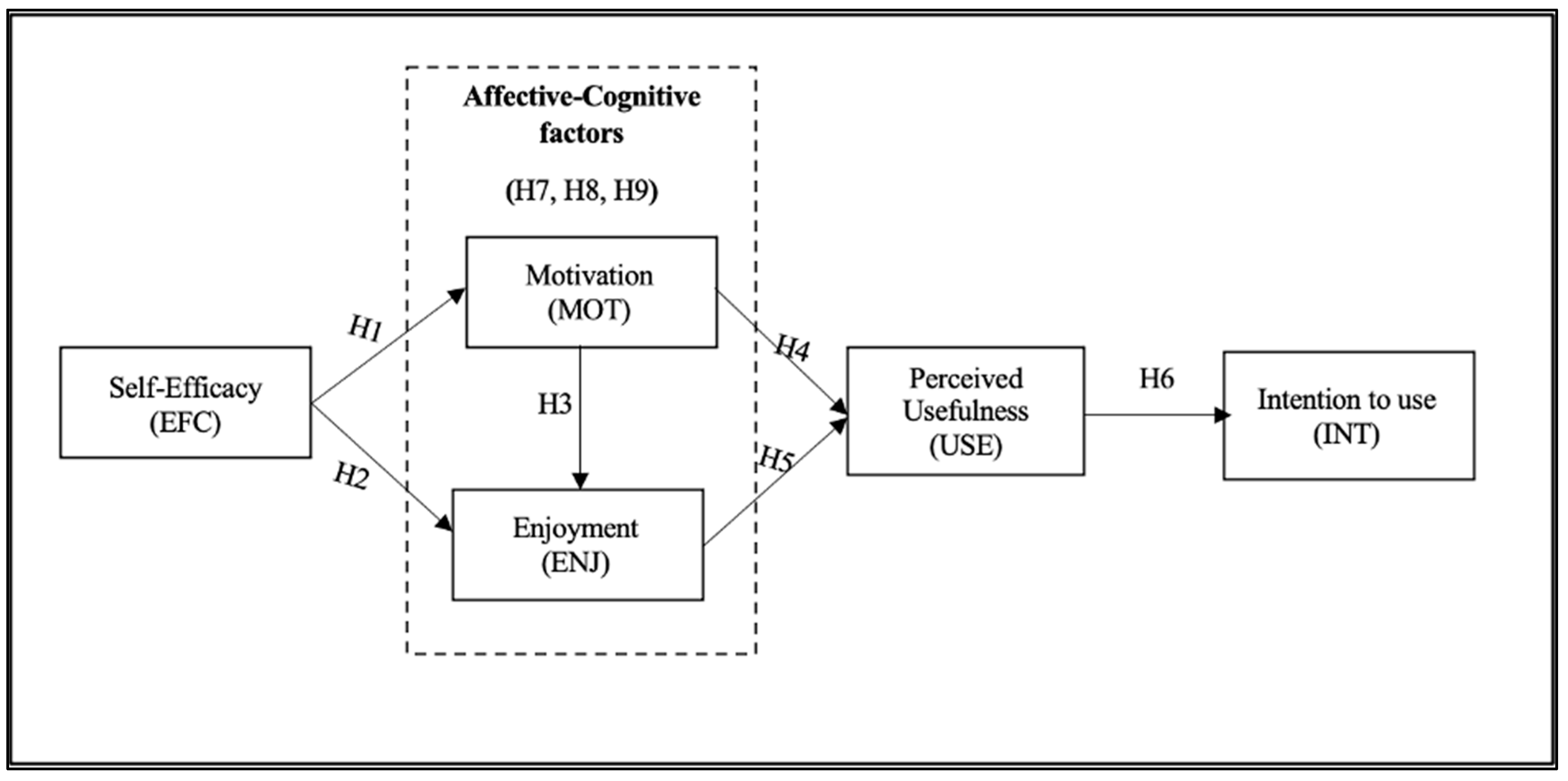
2.1. Conceptual Model and Research Hypotheses
2.1.1. Self-Efficacy in Technology Adoption
2.1.2. Motivation as a Determinant of Technology Acceptance
2.1.3. Enjoyment in Educational Technology Adoption
2.1.4. Perceived Usefulness of AI-Powered Learning Tools
2.1.5. Behavioral Intention Toward AI Use
2.1.6. The Mediating Role of Affective–Cognitive Factors: Integrating Motivation and Enjoyment
2.2. Situating the Model Within Research on Human Intelligence
3. Research Methodology
4. Results
4.1. Demographic Data
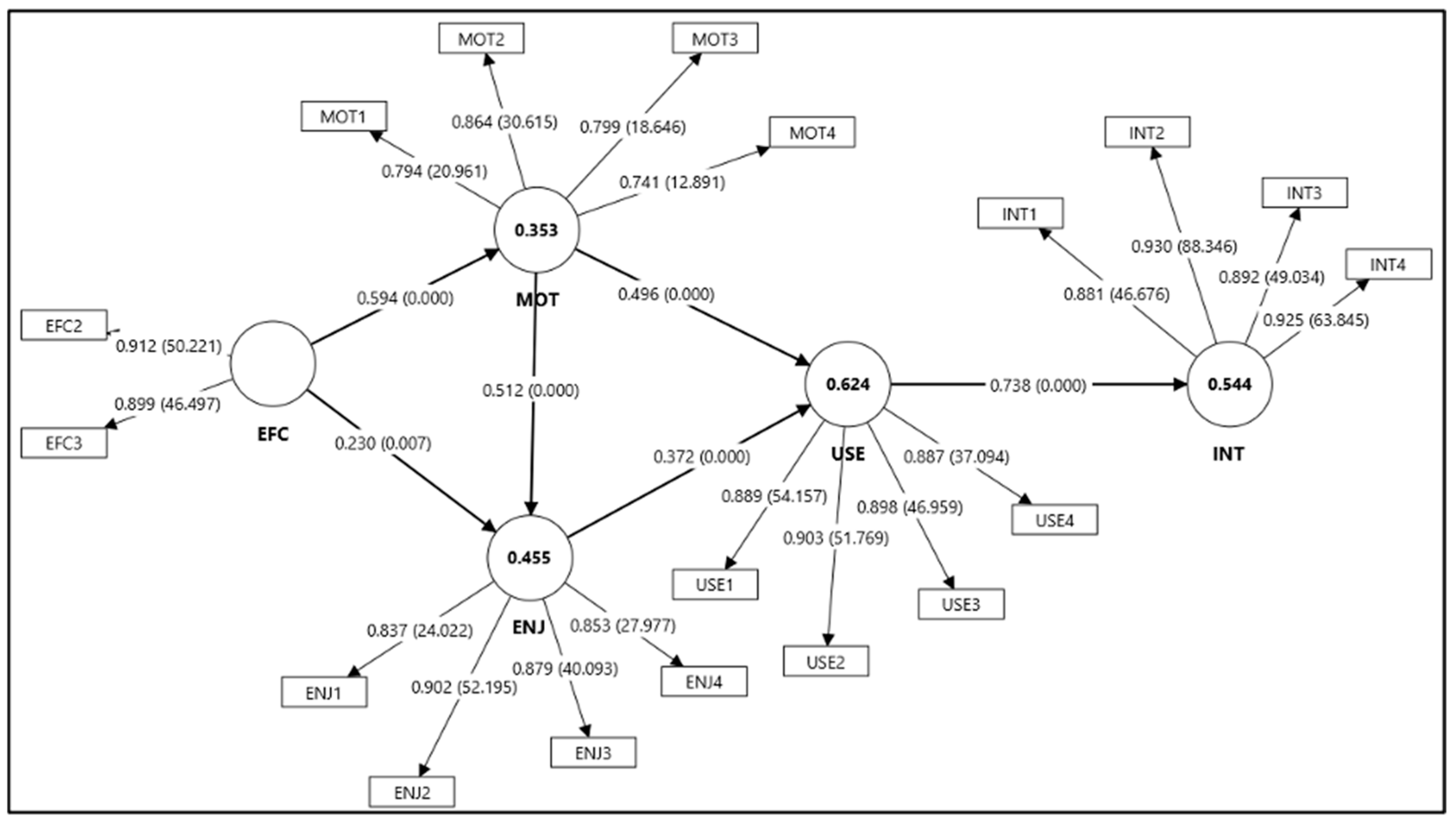
4.2. Measurement Model Assessment
4.3. Testing of the Structural Model and Hypotheses
5. Discussion
5.1. Findings in the Regional Context
5.2. The Mediating Role of Motivation Between Self-Efficacy and Perceived Usefulness
5.3. The Mediating Role of Enjoyment Between Self-Efficacy and Perceived Usefulness
5.4. Model Fit, Reliability, and Predictive Relevance
5.5. Implications for Research on Human Intelligence
6. Conclusions
6.1. Theoretical Implications
6.2. Practical Implications
6.3. Limitations and Future Research Directions
Author Contributions
Funding
Institutional Review Board Statement
Informed Consent Statement
Data Availability Statement
Acknowledgments
Conflicts of Interest
References
- Abdalla, R. A. M. (2024). Examining awareness, social influence, and perceived enjoyment in the TAM framework as determinants of ChatGPT. Personalization as a moderator. Journal of Open Innovation: Technology, Market, and Complexity, 10(3), 100327. [Google Scholar] [CrossRef] [Scilit]
- Abdullah, F., & Ward, R. (2016). Developing a general extended technology acceptance model for e-learning (GETAMEL) by analyzing commonly used external factors. Computers in Human Behavior, 56, 238–256. [Google Scholar] [CrossRef] [Scilit]
- Ackerman, P. L. (1996). A theory of adult intellectual development: Process, personality, interests, and knowledge. Intelligence, 22(2), 227–257. [Google Scholar] [CrossRef] [Scilit]
- Acosta-Enriquez, B. G., Vargas, C. G. A. P., Jordan, O. H., Ballesteros, M. A. A., & Morales, A. E. P. (2024). Exploring attitudes toward ChatGPT among college students: An empirical analysis of cognitive, affective, and behavioral components using path analysis. Computers and Education: Artificial Intelligence, 7, 100320. [Google Scholar] [CrossRef] [Scilit]
- Ahn, H. Y. (2024). AI-powered e-learning for lifelong learners: Impact on performance and knowledge application. Sustainability, 16(20), 9066. [Google Scholar] [CrossRef] [Scilit]
- Alharbi, J. M. (2025). Adoption of artificial intelligence tools for English language learning among Saudi EFL university students: The moderating role of faculty. Journal of Ecohumanism, 4(2), 804. [Google Scholar] [CrossRef] [Scilit]
- Al-khresheh, M. H., Demirkol Orak, S., Elyas, T., & Aboras, A. A. (2026). Modelling divergent thinking as a mediator between artificial intelligence cognitive stimulation and EFL learners’ cognitive creativity. Journal of Intelligence, 14(7), 139. [Google Scholar] [CrossRef] [Scilit] [PubMed]
- Almaiah, M. A., & Alismaiel, O. A. (2019). Examination of factors influencing the use of mobile learning system: An empirical study. Education and Information Technologies, 24(1), 885–909. [Google Scholar] [CrossRef] [Scilit]
- Al-Rahmi, W. M., Alias, N., Othman, M. S., Alzahrani, A. I., Alfarraj, O., Saged, A. A., & Abdul Rahman, N. S. (2018). Use of e-learning by university students in Malaysian higher educational institutions: A case in universiti teknologi malaysia. IEEE Access, 6, 14268–14276. [Google Scholar] [CrossRef] [Scilit]
- Alsubaie, M., Sarhan, M. Y., & Khojah, M. (2025). Assessing the factors affecting users’ behavioural intention to use MOOCs: An integration of self-determination theory and the technology acceptance model. Interactive Learning Environments, 33(6), 3758–3775. [Google Scholar] [CrossRef] [Scilit]
- Al-Zahrani, A. M., & Alasmari, T. M. (2024). Exploring the impact of artificial intelligence on higher education: The dynamics of ethical, social, and educational implications. Humanities and Social Sciences Communications, 11(1), 912. [Google Scholar] [CrossRef] [Scilit]
- Amjad, A. I., Malik, M. A., Aslam, S., & Habib, M. (2025). Bridging motivation and mastery: The role of self-efficacy in math education. TEM Journal, 14, 492–502. [Google Scholar] [CrossRef] [Scilit]
- Arvola, A., Vassallo, M., Dean, M., Lampila, P., Saba, A., Lähteenmäki, L., & Shepherd, R. (2008). Predicting intentions to purchase organic food: The role of affective and moral attitudes in the theory of planned behaviour. Appetite, 50(2–3), 443–454. [Google Scholar] [CrossRef] [Scilit] [PubMed]
- Bandura, A. (1997). Self-efficacy: The exercise of control. In SpringerReference. Springer. [Google Scholar] [CrossRef] [Scilit]
- Cano, J. R., & Nunez, N. A. (2024). Unlocking innovation: How enjoyment drives GenAI use in higher education. Frontiers in Education, 9, 1483853. [Google Scholar] [CrossRef] [Scilit]
- Cattell, R. B. (1963). Theory of fluid and crystallized intelligence: A critical experiment. Journal of Educational Psychology, 54(1), 1–22. [Google Scholar] [CrossRef] [Scilit]
- Chao, C.-M. (2019). Factors determining the behavioral intention to use mobile learning: An application and extension of the UTAUT model. Frontiers in Psychology, 10, 1652. [Google Scholar] [CrossRef] [Scilit] [PubMed]
- Chen, L., Chen, P., & Lin, Z. (2020). Artificial intelligence in education: A review. IEEE Access, 8, 75264–75278. [Google Scholar] [CrossRef] [Scilit]
- Cheng, K., & Tsai, C. (2020). Students’ motivational beliefs and strategies, perceived immersion and attitudes towards science learning with immersive virtual reality: A partial least squares analysis. British Journal of Educational Technology, 51(6), 2140–2159. [Google Scholar] [CrossRef] [Scilit]
- Cheng, M., & Yuen, A. H. K. (2018). Student continuance of learning management system use: A longitudinal exploration. Computers & Education, 120, 241–253. [Google Scholar] [CrossRef] [Scilit]
- Cheng, Y., & Huang, X. (2026). Beyond cognitive support: Social interaction and affective experience in AI-assisted creative thinking among university students. Journal of Intelligence, 14(7), 151. [Google Scholar] [CrossRef] [Scilit] [PubMed]
- Chin, W. W. (1998). The partial least squares approach to structural equation modeling. Modern Methods for Business Research, 295(2), 295–336. [Google Scholar]
- Chiu, T. K., Moorhouse, B. L., Chai, C. S., & Ismailov, M. (2024). Teacher support and student motivation to learn with artificial intelligence (AI) based chatbot. Interactive Learning Environments, 32(7), 3240–3256. [Google Scholar] [CrossRef] [Scilit]
- Cohen, J. (1988). Statistical power analysis for the behavioral sciences (2nd ed.). Routledge. [Google Scholar]
- Cui, Y. (2025). What influences college students using AI for academic writing?—A quantitative analysis based on HISAM and TRI theory. Computers and Education: Artificial Intelligence, 8, 100391. [Google Scholar] [CrossRef] [Scilit]
- Dahri, N. A., Yahaya, N., Al-Rahmi, W. M., Aldraiweesh, A., Alturki, U., Almutairy, S., Shutaleva, A., & Soomro, R. B. (2024). Extended TAM based acceptance of AI-powered ChatGPT for supporting metacognitive self-regulated learning in education: A mixed-methods study. Heliyon, 10(8), e29317. [Google Scholar] [CrossRef] [Scilit] [PubMed]
- Davis, F. D. (1989). Technology acceptance model: TAM. Information Seeking Behavior and Technology Adoption, 219(205), 5. [Google Scholar]
- Dehghani, H., & Mashhadi, A. (2024). Exploring Iranian English as a foreign language teachers’ acceptance of ChatGPT in English language teaching: Extending the technology acceptance model. Education and Information Technologies, 29(15), 19813–19834. [Google Scholar] [CrossRef] [Scilit]
- Duy, N. B. P., Phuong, T. N. M., Chau, V. N. M., Nhi, N. V. H., Khuyen, V. T. M., & Giang, N. T. P. (2024). AI-assisted learning: An empirical study on student application behavior. Multidisciplinary Science Journal, 7(6), 2025275. [Google Scholar] [CrossRef] [Scilit]
- Fan, Y., Tang, L., Le, H., Shen, K., Tan, S., Zhao, Y., Shen, Y., Li, X., & Gašević, D. (2025). Beware of metacognitive laziness: Effects of generative artificial intelligence on learning motivation, processes, and performance. British Journal of Educational Technology, 56(2), 489–530. [Google Scholar] [CrossRef] [Scilit]
- Flavell, J. H. (1979). Metacognition and cognitive monitoring: A new area of cognitive-developmental inquiry. American Psychologist, 34(10), 906–911. [Google Scholar] [CrossRef]
- Fornell, C., & Larcker, D. (1981). Evaluating structural equation models with unobservable variables and measurement error. Journal of Marketing Research, 18(1), 39–50. [Google Scholar] [CrossRef] [Scilit]
- Granić, A. (2022). Educational technology adoption: A systematic review. Education and Information Technologies, 27(7), 9725–9744. [Google Scholar] [CrossRef] [Scilit] [PubMed]
- Hair, J. F., Jr., Hult, G. T. M., Ringle, C. M., & Sarstedt, M. (2017). A primer on partial least squares structural equation modeling (PLS-SEM) (2nd ed.). Sage. [Google Scholar]
- Henseler, J. (2017). Partial least squares path modeling. In P. Leeflang, J. Wieringa, T. Bijmolt, & K. Pauwels (Eds.), Advanced methods for modeling markets (International Series in Quantitative Marketing). Springer. [Google Scholar] [CrossRef] [Scilit]
- Henseler, J., Hubona, G., & Ray, P. (2016). Using PLS path modeling in new technology research: Updated guidelines. Industrial Management & Data Systems, 116, 2–20. [Google Scholar] [CrossRef] [Scilit]
- Holden, H., & Rada, R. (2011). Understanding the influence of perceived usability and technology self-efficacy on teachers’ technology acceptance. Journal of Research on Technology in Education, 43(4), 343–367. [Google Scholar] [CrossRef] [Scilit]
- Huang, F., & Teo, T. (2020). Influence of teacher-perceived organisational culture and school policy on Chinese teachers’ intention to use technology: An extension of technology acceptance model. Educational Technology Research and Development, 68(3), 1547–1567. [Google Scholar] [CrossRef] [Scilit]
- Huang, F., Teo, T., & Zhou, M. (2021). Understanding factors influencing teachers’ intention to use technology: An integrated model approach. Educational Technology Research and Development, 69(4), 2247–2269. [Google Scholar]
- Hwang, G. J., & Xie, H. (2018). Review and trend analysis of knowledge management and e-learning research. Knowledge Management & E-Learning: An International Journal (KM&EL), 10(4), 371–374. [Google Scholar] [CrossRef] [Scilit]
- Ifinedo, P. (2017). Examining students’ intention to continue using blogs for learning: Perspectives from technology acceptance, motivational, and social-cognitive frameworks. Computers in Human Behavior, 72, 189–199. [Google Scholar] [CrossRef] [Scilit]
- Jeno, L. M., Grytnes, J.-A., & Vandvik, V. (2017). The effect of a mobile-application tool on biology students’ motivation and achievement in species identification: A self-determination theory perspective. Computers & Education, 107, 1–12. [Google Scholar] [CrossRef] [Scilit]
- Kim, Y. W., Cha, M. C., Yoon, S. H., & Lee, S. C. (2025). Not merely useful but also amusing: Impact of perceived usefulness and perceived enjoyment on the adoption of AI-powered coding assistant. International Journal of Human–Computer Interaction, 41(10), 6210–6222. [Google Scholar] [CrossRef] [Scilit]
- Kırcaburun, K. (2026). Generative AI use and critical thinking dispositions in higher education: A cross-sample study of the sequential role of metacognitive weakness and epistemic laziness. Journal of Intelligence, 14(7), 147. [Google Scholar] [CrossRef] [Scilit] [PubMed]
- Koteczki, R., & Balassa, B. E. (2025). Exploring generation Z’s acceptance of artificial intelligence in higher education: A TAM and UTAUT-based PLS-SEM and cluster analysis. Education Sciences, 15(8), 1044. [Google Scholar] [CrossRef] [Scilit]
- Lai, C. Y., Cheung, K. Y., & Chan, C. S. (2023). Exploring the role of intrinsic motivation in ChatGPT adoption to support active learning: An extension of the technology acceptance model. Computers and Education: Artificial Intelligence, 5, 100178. [Google Scholar] [CrossRef] [Scilit]
- Lavine, H., Thomsen, C. J., Zanna, M. P., & Borgida, E. (1998). On the primacy of affect in the determination of attitudes and behavior: The moderating role of affective-cognitive ambivalence. Journal of Experimental Social Psychology, 34(4), 398–421. [Google Scholar] [CrossRef] [Scilit]
- Ma, D., Akram, H., & Chen, I. H. (2024). Artificial intelligence in higher education: A cross-cultural examination of students’ behavioral intentions and attitudes. International Review of Research in Open and Distributed Learning, 25(3), 134–157. [Google Scholar] [CrossRef] [Scilit]
- Marasinghe, I. K., Weerasooriya, W. A., & Rathnabahu, N. (2024). Behavioral intention to use electronic resources by distance learners: An extension of the technology acceptance model. Journal of Librarianship and Information Science, 56(3), 594–606. [Google Scholar] [CrossRef] [Scilit]
- Marikyan, D., Papagiannidis, S., & Stewart, G. (2023). Technology acceptance research: Meta-analysis. Journal of Information Science, 52, 01655515231191177. [Google Scholar] [CrossRef] [Scilit]
- Mohamed Hashim, M. A., Tlemsani, I., & Matthews, R. (2022). Higher education strategy in digital transformation. Education and Information Technologies, 27(3), 3171–3195. [Google Scholar] [CrossRef] [Scilit] [PubMed]
- Naveed, Q. N., Choudhary, H., Ahmad, N., Alqahtani, J., & Qahmash, A. I. (2023). Mobile learning in higher education: A systematic literature review. Sustainability, 15(18), 13566. [Google Scholar] [CrossRef] [Scilit]
- Pan, X. (2020). Technology acceptance, technological self-efficacy, and attitude toward technology-based self-directed learning: Learning motivation as a mediator. Frontiers in Psychology, 11, 564294. [Google Scholar] [CrossRef] [Scilit] [PubMed]
- Park, Y., Son, H., & Kim, C. (2012). Investigating the determinants of construction professionals’ acceptance of web-based training: An extension of the technology acceptance model. Automation in Construction, 22, 377–386. [Google Scholar] [CrossRef] [Scilit]
- Qiu, G. (2025). On the relationship between students’ perceived support, students’ self-efficacy, and affect-emotions in AI-enhanced learning environments. European Journal of Education, 60(3), e70180. [Google Scholar] [CrossRef] [Scilit]
- Racero, F. J., Bueno, S., & Gallego, M. D. (2020). Predicting students’ behavioral intention to use open source software: A combined view of the technology acceptance model and self-determination theory. Applied Sciences, 10(8), 2711. [Google Scholar] [CrossRef] [Scilit]
- Rejali, S., Aghabayk, K., Esmaeli, S., & Shiwakoti, N. (2023). Comparison of technology acceptance model, theory of planned behavior, and unified theory of acceptance and use of technology to assess a priori acceptance of fully automated vehicles. Transportation Research Part A: Policy and Practice, 168, 103565. [Google Scholar] [CrossRef] [Scilit]
- Risko, E. F., & Gilbert, S. J. (2016). Cognitive offloading. Trends in Cognitive Sciences, 20(9), 676–688. [Google Scholar] [CrossRef] [Scilit] [PubMed]
- Rosli, M. S., & Saleh, N. S. (2023). Technology enhanced learning acceptance among university students during COVID-19: Integrating the full spectrum of self-determination theory and self-efficacy into the technology acceptance model. Current Psychology, 42(21), 18212–18231. [Google Scholar] [CrossRef] [Scilit] [PubMed]
- Ryan, R. M., & Deci, E. L. (2000). Intrinsic and extrinsic motivations: Classic definitions and new directions. Contemporary Educational Psychology, 25(1), 54–67. [Google Scholar] [CrossRef] [Scilit] [PubMed]
- Ryan, R. M., & Deci, E. L. (2020). Intrinsic and extrinsic motivation from a self-determination theory perspective: Definitions, theory, practices, and future directions. Contemporary Educational Psychology, 61, 101860. [Google Scholar] [CrossRef] [Scilit]
- Salloum, S. A., Alhamad, A. Q. M., Al-Emran, M., Monem, A. A., & Shaalan, K. (2019). Exploring students’ acceptance of e-learning through the development of a comprehensive technology acceptance model. IEEE Access, 7, 128445–128462. [Google Scholar] [CrossRef] [Scilit]
- Sarwar, U., Bhutto, J. A., Fazal, K., Sanhong, T., Mahmood, A., & Rehman, N. (2026). From hype to reality: The feasibility, dilemmas, and solutions of Gen AI in medical education from students’ perspectives. BMC Medical Education. in press. [Google Scholar] [CrossRef] [Scilit] [PubMed]
- Scherer, R., & Teo, T. (2019). Editorial to the special section, technology acceptance models: What we know and what we (still) do not know. British Journal of Educational Technology, 50(5), 2387–2393. [Google Scholar] [CrossRef] [Scilit]
- Sheldon, K. M., & Gunz, A. (2009). Psychological needs as basic motives, not just experiential requirements. Journal of Personality, 77(5), 1467–1492. [Google Scholar] [CrossRef] [Scilit] [PubMed]
- Shuaibu, H., Sule, I. M., Magashi, S. B., Otukoya, I., Shuaibu, S., Bako, A., & Mohammed, Y. (2024). AI-enhanced feedback systems and student’s learning outcomes in open, distance and e-learning. Nigerian Open, Distance and E-Learning Journal (NODeLJ), 2, 90–107. [Google Scholar]
- Soliman, M., Ali, R. A., Mahmud, I., & Noipom, T. (2025). Unlocking AI-powered tools adoption among university students: A fuzzy-set approach. Journal of Information and Communication Technology, 24(1), 1–28. [Google Scholar] [CrossRef] [Scilit]
- Suriano, R., & Plebe, A. (2026). The strategic prompting scale (SPS) for measuring metacognitive regulation in human–AI interaction. Journal of Intelligence, 14(7), 141. [Google Scholar] [CrossRef] [Scilit] [PubMed]
- Teng, M. F., & Wu, J. G. (2024). An investigation of learners’ perceived progress during online education: Do self-efficacy belief, language learning motivation, and metacognitive strategies matter? The Asia-Pacific Education Researcher, 33(2), 283–295. [Google Scholar] [CrossRef] [Scilit]
- Teo, T., & Zhou, M. (2017). The influence of teachers’ conceptions of teaching and learning on their technology acceptance. Computers & Education, 115, 188–200. [Google Scholar]
- Ursavaş, Ö. F. (2022). Unified theory of acceptance and use of technology model (UTAUT). In conducting technology acceptance research in education: Theory, models, implementation, and analysis (pp. 111–133). Springer International Publishing. [Google Scholar]
- Van der Heijden, H. (2004). User acceptance of hedonic information systems. MIS Quarterly, 695–704. [Google Scholar] [CrossRef] [Scilit]
- Van Harreveld, F., Nohlen, H. U., & Schneider, I. K. (2015). The ABC of ambivalence: Affective, behavioral, and cognitive consequences of attitudinal conflict. In Advances in experimental social psychology (Vol. 52, pp. 285–324). Academic Press. [Google Scholar]
- Vankatesh, V., & Davis, F. D. (1996). A model of the antecedents of perceived ease of use: Development and test. Decision Science, 27, 451–481. [Google Scholar] [CrossRef] [Scilit]
- Venkatesh, V., Morris, M. G., Davis, G. B., & Davis, F. D. (2003). User acceptance of information technology: Toward a unified view. MIS Quarterly, 27(3), 425. [Google Scholar] [CrossRef] [Scilit]
- von Stumm, S., & Ackerman, P. L. (2013). Investment and intelligence: A review and meta-analysis. Psychological Bulletin, 139, 841–869. [Google Scholar] [PubMed]
- Xu, J., & Liu, Q. (2025). Uncurtaining windows of motivation, enjoyment, critical thinking, and autonomy in AI-integrated education: Duolingo vs. ChatGPT. Learning and Motivation, 89, 102100. [Google Scholar] [CrossRef] [Scilit]
- Xu, W., Zhu, K., Zhou, D., Wang, C., & Wen, C. (2025). Examining the effects of habit and self-efficacy on users’ acceptance of a map-based online learning system via an extended TAM. Education Sciences, 15(7), 828. [Google Scholar] [CrossRef] [Scilit]
- Yao, H., Chen, S., & Liu, A. (2023). Exploring the relationship between academic challenge stress and self-rated creativity of graduate students: Mediating effects and heterogeneity analysis of academic self-efficacy and resilience. Journal of Intelligence, 11(9), 176. [Google Scholar] [CrossRef] [Scilit] [PubMed]
- Yuan, L., & Liu, X. (2025). The effect of artificial intelligence tools on EFL learners’ engagement, enjoyment, and motivation. Computers in Human Behavior, 162, 108474. [Google Scholar] [CrossRef] [Scilit]
- Zawacki-Richter, O., Marín, V. I., Bond, M., & Gouverneur, F. (2019). Systematic review of research on artificial intelligence applications in higher education—Where are the educators? International Journal of Educational Technology in Higher Education, 16(1), 39. [Google Scholar] [CrossRef] [Scilit]
- Zhai, X., Chu, X., Chai, C. S., Jong, M. S. Y., Istenic, A., Spector, M., Liu, J.-B., Yuan, J., & Li, Y. (2021). A review of artificial intelligence (AI) in education from 2010 to 2020. Complexity, 2021(1), 8812542. [Google Scholar] [CrossRef] [Scilit]
- Zhao, Y., Yue, Y., Sun, Z., Jiang, Q., & Li, G. (2025). Does generative artificial intelligence improve students’ higher-order thinking? A meta-analysis based on 29 experiments and quasi-experiments. Journal of Intelligence, 13(12), 160. [Google Scholar] [CrossRef] [Scilit] [PubMed]
- Zhou, J., Dovidio, J., & Wang, E. (2013). How affectively-based and cognitively-based attitudes drive intergroup behaviours: The moderating role of affective-cognitive consistency. PLoS ONE, 8(11), e82150. [Google Scholar] [CrossRef] [Scilit] [PubMed]
- Zhou, Z., & Zhang, Y. (2024). Intrinsic and extrinsic motivation in distance education: A self-determination perspective. American Journal of Distance Education, 38(1), 51–64. [Google Scholar] [CrossRef] [Scilit]



| Study | AI Tool/Context | Country | Framework | Key Finding |
|---|---|---|---|---|
| Alharbi (2025) | AI tools for EFL learning | Saudi Arabia | Extended TAM (knowledge, motivation) | Perceived knowledge, engagement, and motivation significantly predicted perceived usefulness (PU) and adoption intentions. |
| Al-Zahrani and Alasmari (2024) | General AI in HE | Saudi Arabia | Descriptive stakeholder survey | Strong positive attitudes toward AI; emphasis on ethics, personalization, and institutional readiness. |
| Cano and Nunez (2024) | Generative AI in innovation courses | Peru | TAM variant (enjoyment focus) | Perceived enjoyment strongly predicted intention to use GenAI; PU had no significant effect. |
| Dahri et al. (2024) | ChatGPT in pre-service teacher education | Malaysia | Extended TAM (incl. enjoyment, trust) | Enjoyment, trust, perceived AI usefulness, and personal competency significantly predicted acceptance. |
| Abdalla (2024) | ChatGPT adoption intentions | Global sample (incl. Gulf context) | TAM + personalization moderator | Personalization increased intention to use ChatGPT among students. |
| Koteczki and Balassa (2025) | AI tools adoption among Gen Z | Likely Poland/Europe | Extended TAM/UTAUT hybrid | Perceived usefulness remained the most critical predictor of AI adoption. |
| Variable | Items | Statement | Reference |
|---|---|---|---|
| Self-Efficacy | EFC1 | If I encounter problems while using AI tools, I can find solutions. | Ahn (2024). |
| EFC2 | I can quickly learn how to use new features of AI tools. | ||
| EFC3 | I am capable of independently navigating AI tools. | ||
| EFC4 | I feel competent using AI tools in my academic work. | ||
| Motivation | MOT1 | I believe I can use AI tools effectively. | Sheldon and Gunz (2009) |
| MOT2 | I am certain I can use AI tools to enhance my learning. | ||
| MOT3 | AI tools enable self-paced learning. | ||
| MOT4 | AI tools provide a sense of control over my learning. | ||
| Enjoyment | ENJ1 | Using AI tools puts me in a positive mood. | Cui (2025) |
| ENJ2 | I find using AI tools enjoyable. | ||
| ENJ3 | Using AI tools makes learning fun. | ||
| ENJ4 | I find learning with AI tools to be interesting. | ||
| Usefulness | USE1 | AI tools are beneficial for achieving my academic goals. | Davis (1989); Vankatesh and Davis (1996) |
| USE2 | I believe AI tools enhance my academic performance. | ||
| USE3 | AI tools help me to complete my work more efficiently. | ||
| USE4 | AI tools improve my productivity in academic tasks. | ||
| Intention to Use | INT1 | I believe AI tools will become an essential part of my learning process. | Davis (1989); Vankatesh and Davis (1996) |
| INT2 | If available, I will always choose to use AI tools. | ||
| INT3 | I will recommend AI tools to other students for their learning. | ||
| INT4 | I intend to continue using AI tools for my future learning. |
| Age | ||
|---|---|---|
| Male | Female | |
| Valid | 97 | 88 |
| Missing | 0 | 0 |
| Percentage | 52% | 48% |
| Mean Age | 21.165 | 20.886 |
| Std. Deviation | 1.412 | 1.377 |
| Minimum | 19.000 | 20.000 |
| Maximum | 28.000 | 29.000 |
| N = 185 | Characteristics | Frequencies | Percentages |
|---|---|---|---|
| Computer Skills | No Skills | 3 | 2% |
| Beginners | 73 | 39% | |
| Intermediate | 95 | 51% | |
| Advanced | 14 | 8% | |
| AI Skills | No Skills | 6 | 3% |
| Beginners | 95 | 51% | |
| Intermediate | 76 | 41% | |
| Advanced | 8 | 4% |
| Construct | Items | Factor Loadings > 0.7 | Cronbach’s Alpha (CA) > 0.7 | Composite Reliability (CR) > 0.7 | Average Variance Extracted (AVE) > 0.5 |
|---|---|---|---|---|---|
| Motivation | MOT1 | 0.794 | 0.812 | 0.877 | 0.641 |
| MOT2 | 0.864 | ||||
| MOT3 | 0.799 | ||||
| MOT4 | 0.741 | ||||
| Self-efficacy | EFC2 | 0.912 | 0.779 | 0.901 | 0.819 |
| EFC3 | 0.899 | ||||
| Enjoyment | ENJ1 | 0.837 | 0.891 | 0.924 | 0.754 |
| ENJ2 | 0.902 | ||||
| ENJ3 | 0.879 | ||||
| ENJ4 | 0.853 | ||||
| Perceived Usefulness | USE1 | 0.889 | 0.916 | 0.941 | 0.799 |
| USE2 | 0.903 | ||||
| USE3 | 0.898 | ||||
| USE4 | 0.887 | ||||
| Intention to use AI | INT1 | 0.881 | 0.928 | 0.949 | 0.823 |
| INT2 | 0.930 | ||||
| INT3 | 0.892 | ||||
| INT4 | 0.925 |
| EFC | ENJ | INT | MOT | USE | |
|---|---|---|---|---|---|
| EFC | 0.905 | ||||
| ENJ | 0.534 | 0.868 | |||
| INT | 0.405 | 0.673 | 0.907 | ||
| MOT | 0.594 | 0.648 | 0.643 | 0.801 | |
| USE | 0.574 | 0.694 | 0.738 | 0.737 | 0.894 |
| EFC | ENJ | INT | MOT | USE | |
|---|---|---|---|---|---|
| EFC | |||||
| ENJ | 0.636 | ||||
| INT | 0.480 | 0.741 | |||
| MOT | 0.746 | 0.755 | 0.741 | ||
| USE | 0.680 | 0.764 | 0.798 | 0.852 |
| Hypotheses | Direct Path | Beta Value (β) | t-Value | p Value | Effect Size (F2) | Hypothesis Validation |
|---|---|---|---|---|---|---|
| H1 | EFC -> MOT | 0.594 | 8.914 | 0.000 | 0.546 | Supported |
| H2 | EFC -> ENJ | 0.230 | 2.697 | 0.007 | 0.063 | Supported |
| H3 | MOT -> ENJ | 0.512 | 7.067 | 0.000 | 0.311 | Supported |
| H4 | MOT -> USE | 0.496 | 7.371 | 0.000 | 0.379 | Supported |
| H5 | ENJ -> USE | 0.372 | 5.376 | 0.000 | 0.214 | Supported |
| H6 | USE -> INT | 0.738 | 15.365 | 0.000 | 1.194 | Supported |
| Hypotheses | Indirect Path | Beta Value (β) | t-Value | p Value | 95% BCa CI | Hypothesis Validation |
|---|---|---|---|---|---|---|
| H7 | EFC -> MOT -> USE | 0.295 | 5.389 | 0.000 | [0.196, 0.414] | Supported |
| H8 | EFC -> ENJ -> USE | 0.086 | 2.235 | 0.025 | [0.027, 0.182] | Supported |
| H9 | EFC -> MOT -> ENJ -> USE | 0.113 | 3.700 | 0.000 | [0.066, 0.188] | Supported |
| Total Indirect Effect | 0.494 | - | - | - | ||
| R2 | Q2 | Standardized Root Mean Square Residual (SRMR) < 0.08 | |
|---|---|---|---|
| ENJ | 0.455 | 0.270 | 0.075 |
| INT | 0.544 | 0.151 | |
| MOT | 0.353 | 0.337 | |
| USE | 0.624 | 0.315 |
Disclaimer/Publisher’s Note: The statements, opinions and data contained in all publications are solely those of the individual author(s) and contributor(s) and not of MDPI and/or the editor(s). MDPI and/or the editor(s) disclaim responsibility for any injury to people or property resulting from any ideas, methods, instructions or products referred to in the content. |
© 2026 by the authors. Licensee MDPI, Basel, Switzerland. This article is an open access article distributed under the terms and conditions of the Creative Commons Attribution (CC BY) license.
Share and Cite
Alsudairi, F.; Asiri, A.M.; Khojah, M.; Al-Somali, S.A.; Bakry, D.; Alqarni, K.; Alsaigh, M. From Confidence to Commitment: Self-Perceived Competence and the Motivational Pathways to Intellectual Engagement with AI Learning Tools. J. Intell. 2026, 14, 220. https://doi.org/10.3390/jintelligence14090220
Alsudairi F, Asiri AM, Khojah M, Al-Somali SA, Bakry D, Alqarni K, Alsaigh M. From Confidence to Commitment: Self-Perceived Competence and the Motivational Pathways to Intellectual Engagement with AI Learning Tools. Journal of Intelligence. 2026; 14(9):220. https://doi.org/10.3390/jintelligence14090220
Chicago/Turabian StyleAlsudairi, Fahad, Arwa Mohammed Asiri, Mohammed Khojah, Sabah Abdullah Al-Somali, Dana Bakry, Khalid Alqarni, and Mohammed Alsaigh. 2026. "From Confidence to Commitment: Self-Perceived Competence and the Motivational Pathways to Intellectual Engagement with AI Learning Tools" Journal of Intelligence 14, no. 9: 220. https://doi.org/10.3390/jintelligence14090220
APA StyleAlsudairi, F., Asiri, A. M., Khojah, M., Al-Somali, S. A., Bakry, D., Alqarni, K., & Alsaigh, M. (2026). From Confidence to Commitment: Self-Perceived Competence and the Motivational Pathways to Intellectual Engagement with AI Learning Tools. Journal of Intelligence, 14(9), 220. https://doi.org/10.3390/jintelligence14090220