
Aha! Ratings as Metacognitive Judgments


Abstract
1. Introduction
1.1. Evidence for the Aha!-Insight Link
1.1.1. Insight Memory Advantage
1.1.2. Aha! Accuracy and Correctness Effects
1.1.3. Aha! Ratings and Discontinuity in Solution Processes
1.2. Disconnect Between Aha! Ratings and Other Insight Measures
1.3. Alternative Possible Bases for Aha! Experiences
1.4. Individual Differences in Predispositions to Report Aha! Experiences
1.5. Current Study
2. Materials and Methods
2.1. Participants and Design
2.2. Materials
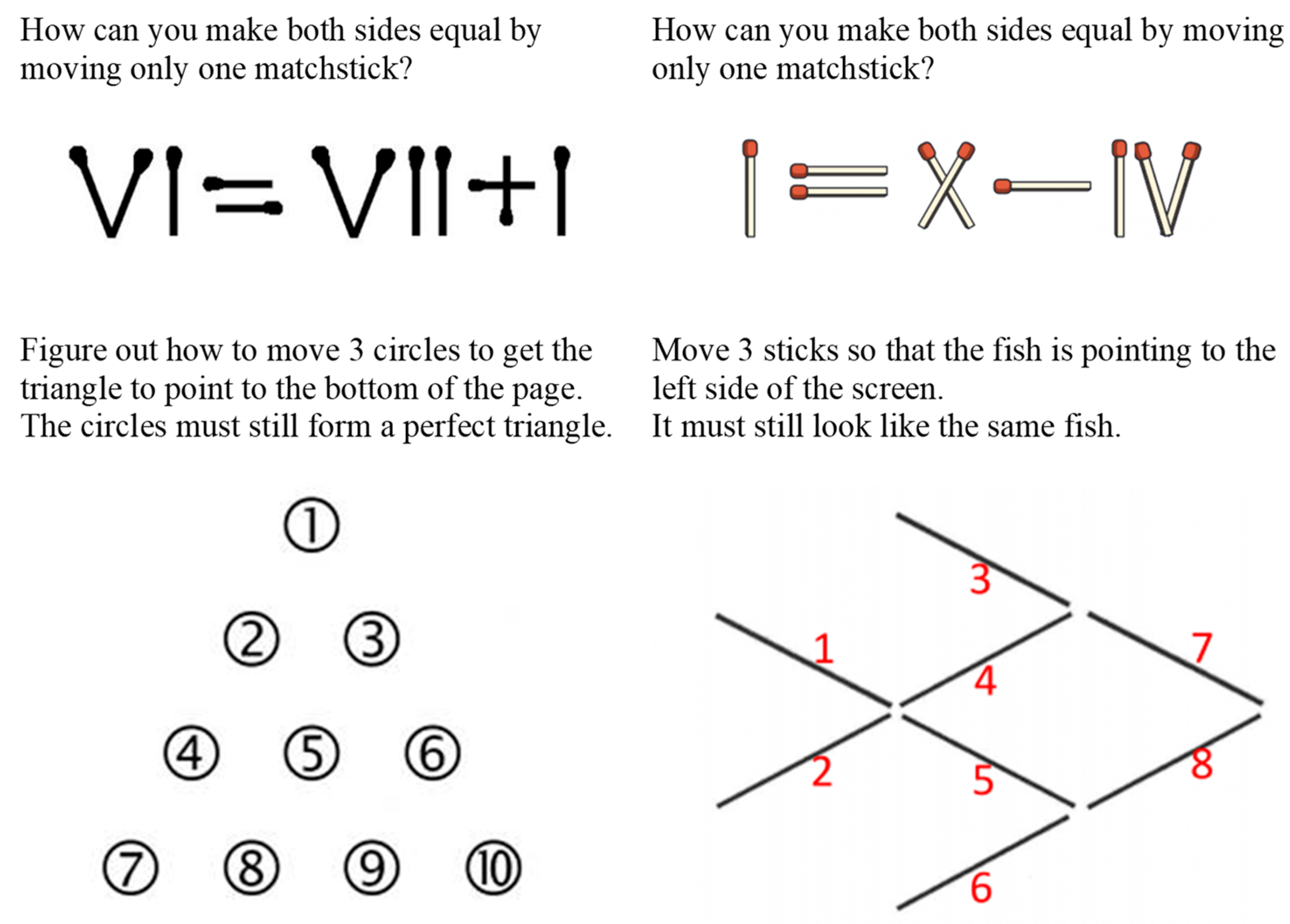
2.2.1. Insight Problems
2.2.2. Judgments of Aha! (JOAs)
2.2.3. Dweck Mindset Inventory
2.3. Procedure
“You will now be asked to respond to some problems. Please read the instructions for each problem carefully. Each problem will be presented for 3 min only and then the survey will automatically continue. After the survey has moved on you will be given the opportunity to input your answer to the problem. Click the arrow when you are ready to begin with the first problem.”
2.4. Data Analysis Plan
2.5. Open Science Availability
3. Results
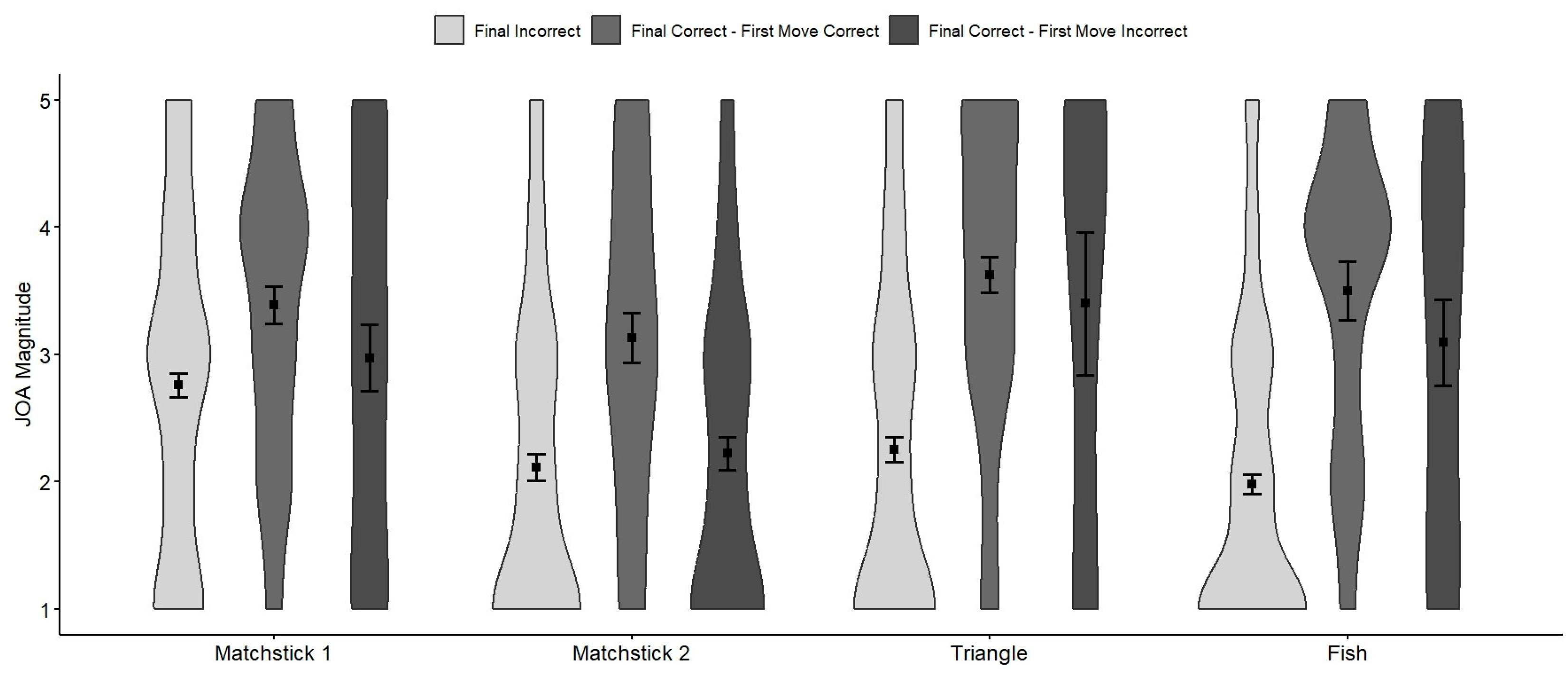
3.1. Testing for the Aha!-Correctness Effect
3.2. Testing for Associations Between Aha! Ratings and Restructuring
3.3. Effects of Growth Mindset on Problem-Solving Performance
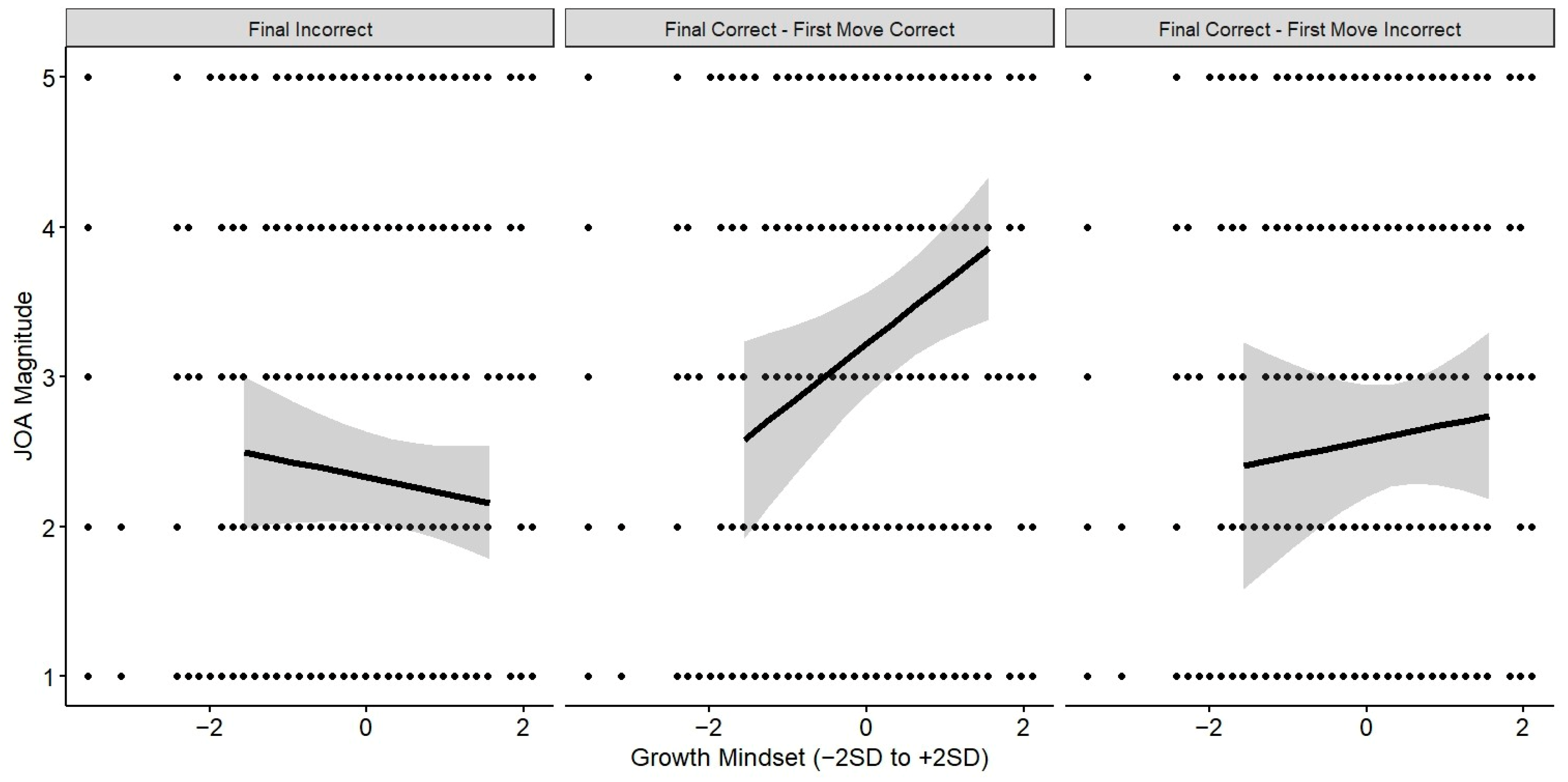
3.4. Effects of Growth Mindset on Aha! Ratings
4. Discussion
5. Conclusions
Author Contributions
Funding
Institutional Review Board Statement
Informed Consent Statement
Data Availability Statement
Acknowledgments
Conflicts of Interest
Abbreviations
| DMI | Dweck Mindset Inventory |
| FOK | Feeling of Knowing |
| FOW | Feeling of Warmth |
| JOA | Judgment of Aha! |
| JOL | Judgment of Learning |
| JOU | Judgment of Understanding |
References
- Ash, I. K., Jee, B. D., & Wiley, J. (2012). Investigating insight as sudden learning. Journal of Problem Solving, 4(2), 1–27. [Google Scholar] [CrossRef] [Scilit]
- Ash, I. K., & Wiley, J. (2008). Hindsight bias in insight and mathematical problem solving: Evidence of different reconstruction mechanisms for metacognitive versus situational judgments. Memory & Cognition, 36, 822–837. [Google Scholar] [CrossRef] [Scilit] [PubMed]
- Auble, P. M., & Franks, J. J. (1978). The effects of effort toward comprehension on recall. Memory & Cognition, 6, 20–25. [Google Scholar] [CrossRef] [Scilit][Green Version]
- Auble, P. M., Franks, J. J., & Soraci, S. A. (1979). Effort toward comprehension: Elaboration or “aha”? Memory & Cognition, 7, 426–434. [Google Scholar] [CrossRef] [Scilit]
- Barbouta, A., Barbouta, C., & Kotrotsiou, S. (2020). Growth mindset and grit: How do university students’ mindsets and grit affect their academic achievement? International Journal of Caring Sciences, 13(1), 654–664. [Google Scholar]
- Becker, M., Kühn, S., & Sommer, T. (2021). Verbal insight revisited—Dissociable neurocognitive processes underlying solutions accompanied by an Aha! experience with and without prior restructuring. Journal of Cognitive Psychology, 33, 659–684. [Google Scholar] [CrossRef] [Scilit]
- Bilalić, M., Graf, M., Vaci, N., & Danek, A. H. (2019). The temporal dynamics of insight problem solving—Restructuring might not always be sudden. Thinking & Reasoning, 27(1), 1–37. [Google Scholar] [CrossRef] [Scilit]
- Blackwell, L. S., Trzesniewski, K. H., & Dweck, C. S. (2007). Implicit theories of intelligence predict achievement across an adolescent transition: A longitudinal study and an intervention. Child Development, 78(1), 246–263. [Google Scholar] [CrossRef] [Scilit] [PubMed]
- Bowden, E. M., & Jung-Beeman, M. (2003). Aha! Insight experience correlates with solution activation in the right hemisphere. Psychonomic Bulletin & Review, 10(3), 730–737. [Google Scholar] [CrossRef] [Scilit] [PubMed]
- Burgoyne, A. P., Hambrick, D. Z., & Macnamara, B. N. (2020). How firm are the foundations of mind-set theory? The claims appear stronger than the evidence. Psychological Science, 31(3), 258–267. [Google Scholar] [CrossRef] [Scilit] [PubMed]
- Buyer, L. S., & Dominowski, R. L. (1989). Retention of solutions: It is better to give than to receive. The American Journal of Psychology, 102(3), 353–363. [Google Scholar] [CrossRef] [Scilit] [PubMed]
- Chesebrough, C., Chrysikou, E. G., Holyoak, K. J., Zhang, F., & Kounios, J. (2023). Conceptual change induced by analogical reasoning sparks Aha moments. Creativity Research Journal, 35(3), 499–521. [Google Scholar] [CrossRef] [Scilit]
- Cranford, E. A., & Moss, J. (2012). Is insight always the same? A protocol analysis of insight in compound remote associate problems. The Journal of Problem Solving, 4(2), 128–153. [Google Scholar] [CrossRef] [Scilit]
- Cushen, P. J., & Wiley, J. (2012). Cues to solution, restructuring patterns, and reports of insight in creative problem solving. Consciousness & Cognition, 21(3), 1166–1175. [Google Scholar] [CrossRef] [Scilit] [PubMed]
- Danek, A. H., Fraps, T., Von Müller, A., Grothe, B., & Öllinger, M. (2013). Aha! experiences leave a mark: Facilitated recall of insight solutions. Psychological Research, 77(5), 659–669. [Google Scholar] [CrossRef] [Scilit] [PubMed]
- Danek, A. H., Fraps, T., Von Müller, A., Grothe, B., & Öllinger, M. (2014). It’s a kind of magic—What self-reports can reveal about the phenomenology of insight problem solving. Frontiers in Psychology, 5, 1408. [Google Scholar] [CrossRef] [Scilit] [PubMed]
- Danek, A. H., & Salvi, C. (2020). Moment of truth: Why Aha! experiences are correct. Journal of Creative Behavior, 54, 484–486. [Google Scholar] [CrossRef] [Scilit] [PubMed]
- Danek, A. H., & Wiley, J. (2017). What about false insights? Deconstructing the Aha! experience along its multiple dimensions for correct and incorrect solutions separately. Frontiers in Psychology, 7, 2077. [Google Scholar] [CrossRef] [Scilit] [PubMed]
- Danek, A. H., & Wiley, J. (2020). What causes the insight memory advantage? Cognition, 205, 104411. [Google Scholar] [CrossRef] [Scilit] [PubMed]
- Danek, A. H., Wiley, J., & Öllinger, M. (2016). Solving classical insight problems without Aha! experience: 9 dot, 8 coin, and matchstick arithmetic problems. Journal of Problem Solving, 9(1), 4. [Google Scholar] [CrossRef] [Scilit]
- Danek, A. H., Williams, J., & Wiley, J. (2020). Closing the gap: Connecting sudden representational change to the subjective Aha! experience in insightful problem solving. Psychological Research, 84(1), 111–119. [Google Scholar] [CrossRef] [Scilit] [PubMed]
- DiStefano, P. V., Patterson, J. D., & Beaty, R. E. (2025). Evaluating overinclusive thinking: Development and validation of the Categorical Overinclusive Thinking Task (COverTT). Thinking Skills and Creativity, 56, 101726. [Google Scholar] [CrossRef] [Scilit]
- Dominowski, R. L., & Buyer, L. S. (2000). Retention of problem solutions: The re-solution effect. The American Journal of Psychology, 113(2), 249–274. [Google Scholar] [CrossRef] [Scilit] [PubMed]
- Duncker, K. (1945). On problem-solving (L. S. Lees, Trans.). Psychological Monographs, 58(5), i–113. [Google Scholar] [CrossRef] [Scilit]
- Durso, F. T., Rea, C. B., & Dayton, T. (1994). Graph-theoretic confirmation of restructuring during insight. Psychological Science, 5(2), 94–98. [Google Scholar] [CrossRef] [Scilit]
- Dweck, C. S. (1999). Self-theories: Their role in motivation, personality, and development. Psychology Press. [Google Scholar]
- Dweck, C. S. (2006). Mindset: The new psychology of success. Random House. [Google Scholar]
- Dygert, S. K. C., & Jarosz, A. F. (2026). Navigating the garden path: Evidence for restructuring as a shared process. Journal of Intelligence, 14(7), 128. [Google Scholar] [CrossRef] [Scilit] [PubMed]
- Ellis, D. M., Robison, M. K., & Brewer, G. A. (2021). The cognitive underpinnings of multiply-constrained problem solving. Journal of Intelligence, 9(1), 7. [Google Scholar] [CrossRef] [Scilit] [PubMed]
- Fedor, A., Szathmáry, E., & Öllinger, M. (2015). Problem solving stages in the five square problem. Frontiers in Psychology, 6, 1050. [Google Scholar] [CrossRef] [Scilit] [PubMed]
- Flavell, J. H. (1979). Metacognition and cognitive monitoring: A new area of cognitive–developmental inquiry. American Psychologist, 34(10), 906–911. [Google Scholar] [CrossRef]
- Fleck, J. I., & Weisberg, R. W. (2004). The use of verbal protocols as data: An analysis of insight in the candle problem. Memory & Cognition, 32, 990–1006. [Google Scholar] [CrossRef] [Scilit] [PubMed]
- Fleck, J. I., & Weisberg, R. W. (2013). Insight versus analysis: Evidence for diverse methods in problem solving. Journal of Cognitive Psychology, 25(4), 436–463. [Google Scholar] [CrossRef] [Scilit]
- Gallucci, M. (2025). GAMLj3: GAMLj Suite for linear models [jamovi module]. Available online: https://gamlj.github.io/ (accessed on 20 July 2026).
- Gick, M. L., & Lockhart, R. S. (1995). Cognitive and affective components of insight. In R. J. Sternberg, & J. E. Davidson (Eds.), The nature of insight (pp. 197–228). MIT Press. [Google Scholar]
- Grimmer, H., Laukkonen, R., Tangen, J., & von Hippel, W. (2022). Eliciting false insights with semantic priming. Psychonomic Bulletin & Review, 29, 954–970. [Google Scholar] [CrossRef] [Scilit] [PubMed]
- Gruber, H. E. (1995). Insight and affect in the history of science. In R. J. Sternberg, & J. E. Davidson (Eds.), The nature of insight (pp. 397–431). MIT Press. [Google Scholar]
- Hedne, M. R., Norman, E., & Metcalfe, J. (2016). Intuitive feelings of warmth and confidence in insight and noninsight problem solving of magic tricks. Frontiers in Psychology, 7, 1314. [Google Scholar] [CrossRef] [Scilit] [PubMed]
- Kaplan, C. A., & Simon, H. A. (1990). In search of insight. Cognitive Psychology, 22(3), 374–419. [Google Scholar] [CrossRef] [Scilit]
- Katona, G. (1940). Organizing and memorizing: Studies in the psychology of learning and teaching. Columbia University Press. [Google Scholar]
- Kaufman, S. B., Quilty, L. C., Grazioplene, R. G., Hirsh, J. B., Gray, J. R., Peterson, J. B., & DeYoung, C. G. (2016). Openness to experience and intellect differentially predict creative achievement in the arts and sciences. Journal of Personality, 84(2), 248–258. [Google Scholar] [CrossRef] [Scilit] [PubMed]
- King, L. A., Walker, L. M. K., & Broyles, S. J. (1996). Creativity and the five-factor model. Journal of Research in Personality, 30(2), 189–203. [Google Scholar] [CrossRef] [Scilit]
- Kizilirmak, J. M., Gallisch, N., Schott, B. H., & Folta-Schoofs, K. (2021). Insight is not always the same: Differences between true, false, and induced insights in the matchstick arithmetic task. Journal of Cognitive Psychology, 33(6–7), 700–717. [Google Scholar] [CrossRef] [Scilit]
- Kizilirmak, J. M., Galvao Gomes da Silva, J., Imamoglu, F., & Richardson-Klavehn, A. (2016). Generation and the subjective feeling of “Aha!” are independently related to learning from insight. Psychological Research, 80, 1059–1074. [Google Scholar] [CrossRef] [Scilit] [PubMed]
- Knoblich, G., Ohlsson, S., Haider, H., & Rhenius, D. (1999). Constraint relaxation and chunk decomposition in insight problem solving. Journal of Experimental Psychology: Learning, Memory, and Cognition, 25(6), 1534–1555. [Google Scholar] [CrossRef]
- Knoblich, G., Ohlsson, S., & Raney, G. E. (2001). An eye movement study of insight problem solving. Memory & Cognition, 29(7), 1000–1009. [Google Scholar] [CrossRef] [Scilit] [PubMed]
- Kohler, W. (1969). The task of Gestalt psychology. Princeton University Press. [Google Scholar]
- Koriat, A. (1997). Monitoring one’s own knowledge during study: A cue-utilization approach to judgments of learning. Journal of Experimental Psychology: General, 126(4), 349–370. [Google Scholar] [CrossRef]
- Laukkonen, R. E., Ingledew, D. J., Grimmer, H. J., Schooler, J. W., & Tangen, J. M. (2021). Getting a grip on insight: Real-time and embodied Aha experiences predict correct solutions. Cognition and Emotion, 35(5), 918–935. [Google Scholar] [CrossRef] [Scilit] [PubMed]
- Laukkonen, R. E., Kaveladze, B. T., Tangen, J. M., & Schooler, J. W. (2020). The dark side of Eureka: Artificially induced Aha moments make facts feel true. Cognition, 196, 104122. [Google Scholar] [CrossRef] [Scilit] [PubMed]
- Laukkonen, R. E., & Tangen, J. M. (2017). Can observing a Necker cube make you more insightful? Consciousness and Cognition, 48, 198–211. [Google Scholar] [CrossRef] [Scilit] [PubMed]
- Liljedahl, P. G. (2005). Mathematical discovery and affect: The effect of Aha! experiences on undergraduate mathematics students. International Journal of Mathematical Education in Science and Technology, 36(2–3), 219–234. [Google Scholar] [CrossRef] [Scilit]
- Macnamara, B. N., & Burgoyne, A. P. (2023). Do growth mindset interventions impact students’ academic achievement? A systematic review and meta-analysis with recommendations for best practices. Psychological Bulletin, 149(3–4), 133–173. [Google Scholar] [CrossRef] [Scilit] [PubMed]
- Maier, N. R. F. (1931). Reasoning in humans. II. The solution of a problem and its appearance in consciousness. Journal of Comparative Psychology, 12(2), 181–194. [Google Scholar] [CrossRef] [Scilit]
- McCrae, R. R. (1987). Creativity, divergent thinking, and openness to experience. Journal of Personality and Social Psychology, 52(6), 1258–1265. [Google Scholar] [CrossRef]
- Mednick, S. A. (1962). The associative basis of the creative process. Psychological Review, 69(3), 220–232. [Google Scholar] [CrossRef] [Scilit] [PubMed]
- Metcalfe, J. (1986a). Feeling of knowing in memory and problem solving. Journal of Experimental Psychology: Learning, Memory, and Cognition, 12(2), 288–294. [Google Scholar] [CrossRef][Green Version]
- Metcalfe, J. (1986b). Premonitions of insight predict impending error. Journal of Experimental Psychology: Learning, Memory, & Cognition, 12(4), 623–634. [Google Scholar] [CrossRef]
- Metcalfe, J., & Wiebe, D. (1987). Intuition in insight and noninsight problem solving. Memory & Cognition, 15(3), 238–246. [Google Scholar] [CrossRef] [Scilit] [PubMed]
- Nelson, T. O., & Narens, L. (1990). Metamemory: A theoretical framework and new findings. Psychology of Learning and Motivation, 26, 125–173. [Google Scholar] [CrossRef] [Scilit]
- Norman, G. (2010). Likert scales, levels of measurement and the “laws” of statistics. Advances in Health Sciences Education, 15, 625–632. [Google Scholar] [CrossRef] [Scilit] [PubMed]
- Ohlsson, S. (1992). Information-processing explanations of insight and related phenomena. In M. T. Keane, & K. J. Gilhooly (Eds.), Advances in the psychology of thinking (pp. 1–44). Harvester Wheatsheaf. [Google Scholar]
- Ormerod, T. C., MacGregor, J. N., & Chronicle, E. P. (2002). Dynamics and constraints in insight problem solving. Journal of Experimental Psychology: Learning, Memory, and Cognition, 28(4), 791–799. [Google Scholar] [CrossRef] [PubMed]
- Ovington, L. A., Saliba, A. J., Moran, C. C., Goldring, J., & MacDonald, J. B. (2018). Do people really have insights in the shower? The when, where and who of the Aha! moment. The Journal of Creative Behavior, 52(1), 21–34. [Google Scholar] [CrossRef] [Scilit]
- Öllinger, M., Jones, G., Faber, A. H., & Knoblich, G. (2013). Cognitive mechanisms of insight: The role of heuristics and representational change in solving the eight-coin problem. Journal of Experimental Psychology: Learning, Memory, and Cognition, 39(3), 931–939. [Google Scholar] [CrossRef] [Scilit] [PubMed]
- Öllinger, M., Jones, G., & Knoblich, G. (2014). Insight and search in Katona’s five-square problem. Experimental Psychology, 61(4), 263–272. [Google Scholar] [CrossRef] [Scilit] [PubMed]
- Ross, W., & Vallée-Tourangeau, F. (2022). Insight with stumpers: Normative solution data for 25 stumpers and a fresh perspective on the accuracy effect. Thinking Skills and Creativity, 46, 101114. [Google Scholar] [CrossRef] [Scilit]
- Salvi, C., Bricolo, E., Kounios, J., Bowden, E., & Bowman, M. (2016). Insight solutions are correct more often than analytic solutions. Thinking & Reasoning, 22(4), 443–460. [Google Scholar] [CrossRef] [Scilit] [PubMed]
- Schooler, J. W., Fallshore, M., & Fiore, S. M. (1995). Epilogue: Putting insight into perspective. In R. J. Sternberg, & J. E. Davidson (Eds.), The nature of insight (pp. 559–587). MIT Press. [Google Scholar]
- Seifert, C. M., Meyer, D. E., Davidson, N., Patalano, A. L., & Yaniv, I. (1995). Demystification of cognitive insight: Opportunistic assimilation and the prepared-mind perspective. In R. J. Sternberg, & J. E. Davidson (Eds.), The nature of insight (pp. 65–124). MIT Press. [Google Scholar]
- Seol, H. (2025). Seolmatrix: A module for calculating correlations and agreement in jamovi (Version 4.0.1) [jamovi module]. Available online: https://github.com/hyunsooseol/seolmatrix (accessed on 20 July 2026).
- Shen, W., Tong, Y., & Yuan, Y. (2018). Feeling the insight: Uncovering somatic markers of the “aha” experience. Applied Psychophysiology and Biofeedback, 43(1), 13–21. [Google Scholar] [CrossRef] [Scilit] [PubMed]
- Sisk, V. F., Burgoyne, A. P., Sun, J., Butler, J. L., & Macnamara, B. N. (2018). To what extent and under which circumstances are growth mind-sets important to academic achievement? Two meta-analyses. Psychological Science, 29(4), 549–571. [Google Scholar] [CrossRef] [Scilit] [PubMed]
- Smith, S. M., Chandolia, V. J., Kidd, M. A., & Paladino, M. S. (2026). Generative insight: Aha! Moments in category generation and divergent thinking. Journal of Experimental Psychology: General, 155(2), 555–563. [Google Scholar] [CrossRef] [Scilit] [PubMed]
- Smith, S. M., Kidd, M. A., Chandolia, V. J., & Hermoso, J. M. (2025). Verbal insight problems and Aha! moments. Creativity Research Journal. Advance online publication. [Google Scholar] [CrossRef] [Scilit]
- Soper, D. S. (2026). R-square confidence interval calculator [Software]. Available online: https://www.danielsoper.com/statcalc (accessed on 20 July 2026).
- Strickland, T., Wiley, J., & Ohlsson, S. (2022). Hints and the aha-accuracy effect in insight problem solving. In Proceedings of the annual meeting of the cognitive science society (Vol. 44). Available online: https://escholarship.org/uc/item/638489j1 (accessed on 20 July 2026).
- Stuyck, H., Aben, B., Cleeremans, A., & Van den Bussche, V. (2021). The Aha! moment: Is insight a different form of problem solving? Consciousness and Cognition, 90, 103055. [Google Scholar] [CrossRef] [Scilit] [PubMed]
- Su, L. C., Wei, J. H., & Chuang, H. H. (2026). Fostering divergent thinking through a growth creative mindset: The mediating roles of multicultural attitudes and openness to experience. Thinking Skills and Creativity, 60, 102129. [Google Scholar] [CrossRef] [Scilit]
- The Jamovi Project. (2025). Jamovi (Version 2.6.44) [Computer Software]. Available online: https://www.jamovi.org (accessed on 20 July 2026).
- Threadgold, E., Marsh, J. E., & Ball, L. J. (2018). Normative data for 84 UK English rebus puzzles. Frontiers in Psychology, 9, 2513. [Google Scholar] [CrossRef] [Scilit] [PubMed]
- Topolinski, S., & Reber, R. (2010). Gaining insight into the “Aha” experience. Current Directions in Psychological Science, 19(6), 402–405. [Google Scholar] [CrossRef] [Scilit]
- VanLehn, K. (1988). Toward a theory of impasse-driven learning. In H. Mandl, & A. M. Lesgold (Eds.), Learning issues for intelligent tutoring systems (pp. 19–41). Springer. [Google Scholar] [CrossRef] [Scilit]
- Webb, M. E., Cropper, S. J., & Little, D. R. (2019). “Aha!” is stronger when preceded by a “huh?”: Presentation of a solution affects ratings of aha experience conditional on accuracy. Thinking & Reasoning, 25(3), 324–364. [Google Scholar] [CrossRef] [Scilit]
- Webb, M. E., Little, D. R., & Cropper, S. J. (2016). Insight is not in the problem: Investigating insight in problem solving across tasktypes. Frontiers in Psychology, 7, 1424. [Google Scholar] [CrossRef] [Scilit] [PubMed]
- Webb, M. E., Little, D. R., & Cropper, S. J. (2018). Once more with feeling: Normative data for the Aha experience in insight and noninsight problems. Behavior Research Methods, 50(5), 2035–2056. [Google Scholar] [CrossRef] [Scilit] [PubMed]
- Webb, M. E., Little, D. R., & Cropper, S. J. (2021). Unusual uses and experiences are good for feeling insightful, but not for problem solving: Contributions of schizotypy, divergent thinking, and fluid reasoning, to insight moments. Journal of Cognitive Psychology, 33(6–7), 770–792. [Google Scholar] [CrossRef] [Scilit]
- Wertheimer, M. (2020). Productive thinking. Harper. (Original work published 1959). [Google Scholar] [CrossRef] [Scilit]
- Wickham, H. (2016). ggplot2: Elegant graphics for data analysis. Springer. Available online: https://ggplot2.tidyverse.org (accessed on 20 July 2026).
- Wiley, J., & Danek, A. H. (2024). Restructuring processes and Aha! experiences in insight problem solving. Nature Reviews Psychology, 3(1), 42–55. [Google Scholar] [CrossRef] [Scilit]
- Wiley, J., Thiede, K. W., & Griffin, T. D. (2016). Improving metacomprehension with the situation-model approach. In K. Mokhtari (Ed.), Improving reading comprehension through metacognitive reading instruction for first and second language readers (pp. 93–110). Rowman & Littlefield. [Google Scholar]
- Zedelius, C. M., & Schooler, J. W. (2015). Mind wandering “Ahas” versus mindful reasoning: Alternative routes to creative solutions. Frontiers in Psychology, 6, 834. [Google Scholar] [CrossRef] [Scilit] [PubMed]



| Problem | Correct Solutions | Average JOA for All Solutions | Average JOA for Correct Solutions | Average JOA for Incorrect Solutions | Correct First Move Solutions | Wrong First Move Solutions |
|---|---|---|---|---|---|---|
| Matchstick 1 | 33% | 2.92 | 3.24 | 2.76 | 21% (66) | 12% (37) |
| Matchstick 2 | 48% | 2.31 | 2.52 | 2.11 | 16% (45) | 33% (95) |
| Triangle | 34% | 2.71 | 3.60 | 2.25 | 29% (78) | 05% (12) |
| Fish | 17% | 2.21 | 3.33 | 1.98 | 10% (29) | 07% (20) |
Disclaimer/Publisher’s Note: The statements, opinions and data contained in all publications are solely those of the individual author(s) and contributor(s) and not of MDPI and/or the editor(s). MDPI and/or the editor(s) disclaim responsibility for any injury to people or property resulting from any ideas, methods, instructions or products referred to in the content. |
© 2026 by the authors. Licensee MDPI, Basel, Switzerland. This article is an open access article distributed under the terms and conditions of the Creative Commons Attribution (CC BY) license.
Share and Cite
Wiley, J.; Miller, T.S. Aha! Ratings as Metacognitive Judgments. J. Intell. 2026, 14, 198. https://doi.org/10.3390/jintelligence14090198
Wiley J, Miller TS. Aha! Ratings as Metacognitive Judgments. Journal of Intelligence. 2026; 14(9):198. https://doi.org/10.3390/jintelligence14090198
Chicago/Turabian StyleWiley, Jennifer, and Taylor Strickland Miller. 2026. "Aha! Ratings as Metacognitive Judgments" Journal of Intelligence 14, no. 9: 198. https://doi.org/10.3390/jintelligence14090198
APA StyleWiley, J., & Miller, T. S. (2026). Aha! Ratings as Metacognitive Judgments. Journal of Intelligence, 14(9), 198. https://doi.org/10.3390/jintelligence14090198