Cognitive–Mathematics Relations: A Meta-Analysis of Norm-Referenced Standardized Test Batteries

 , ,
, ,  ,
,  ,
, 
Abstract
1. Introduction
1.1. Theoretical Anchors
1.2. Development of Mathematics Cognition
1.3. Cattell-Horn-Carroll Theory on the Structure of Human Cognitive Abilities
1.4. Cognitive–Mathematics Relations in Previous Research
1.5. Meta-Analyses of Cognitive–Mathematics Relations
1.6. Current Study
- What are the average correlations between CHC broad abilities (e.g., comprehension-knowledge, fluid reasoning) and narrow mathematics skills (e.g., calculation, math problem solving)?
- Using the average correlations, what are the cognitive–mathematics relations in a meta-analytic structural equation model?
2. Methods
2.1. Correlation Matrices from Test Manuals
2.2. Constructs Included in the Meta-Analysis
2.3. Inclusion Criteria
2.4. Data Extraction and Coding of Subtests
2.5. Stage 1: Estimating Meta-Analytic Correlations
2.6. Stage 2: Using Meta-Analytic Correlations to Examine Cognitive–Mathematics Relations
3. Results
3.1. Descriptive Statistics
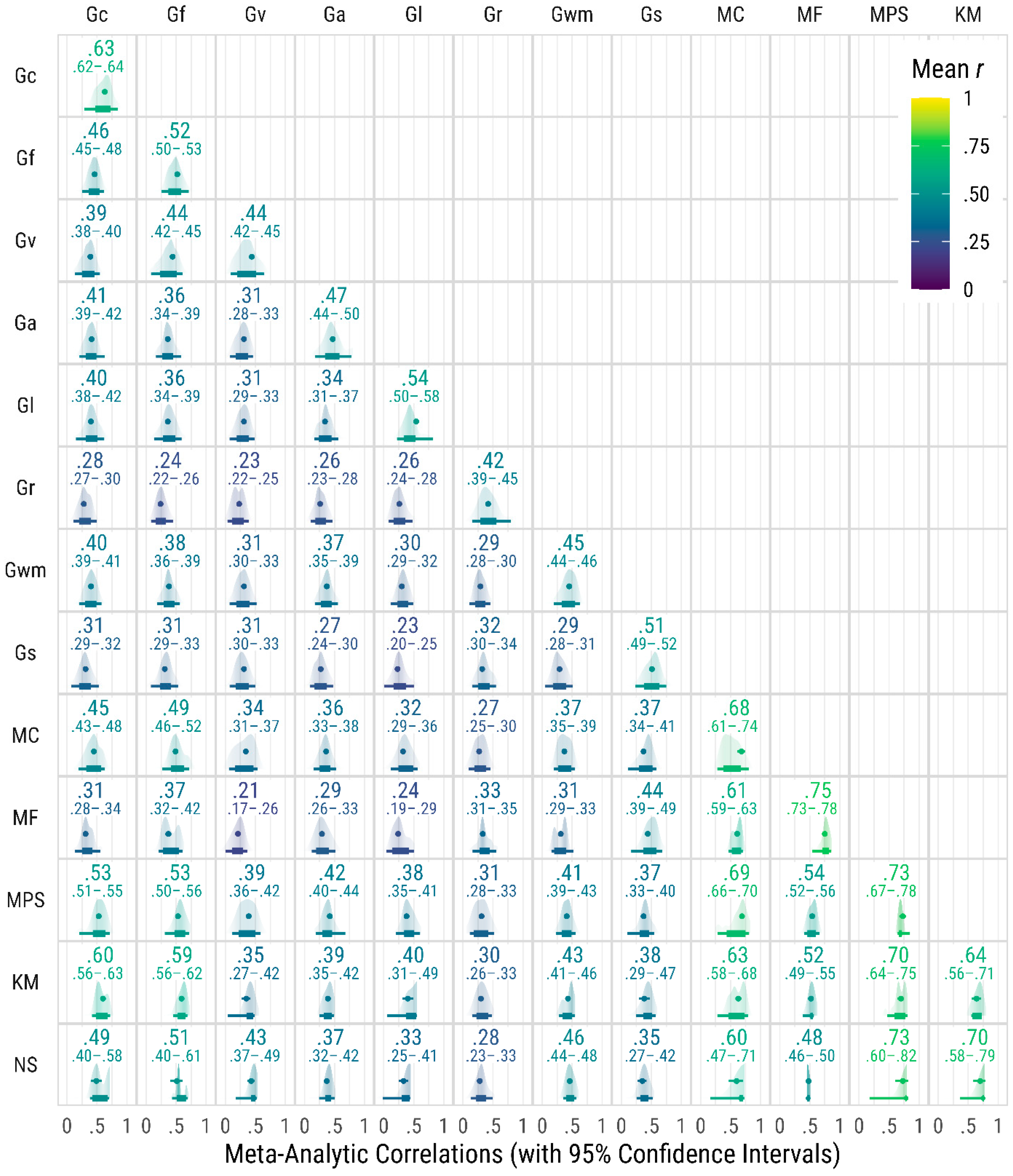
3.2. Meta-Analytic Correlations
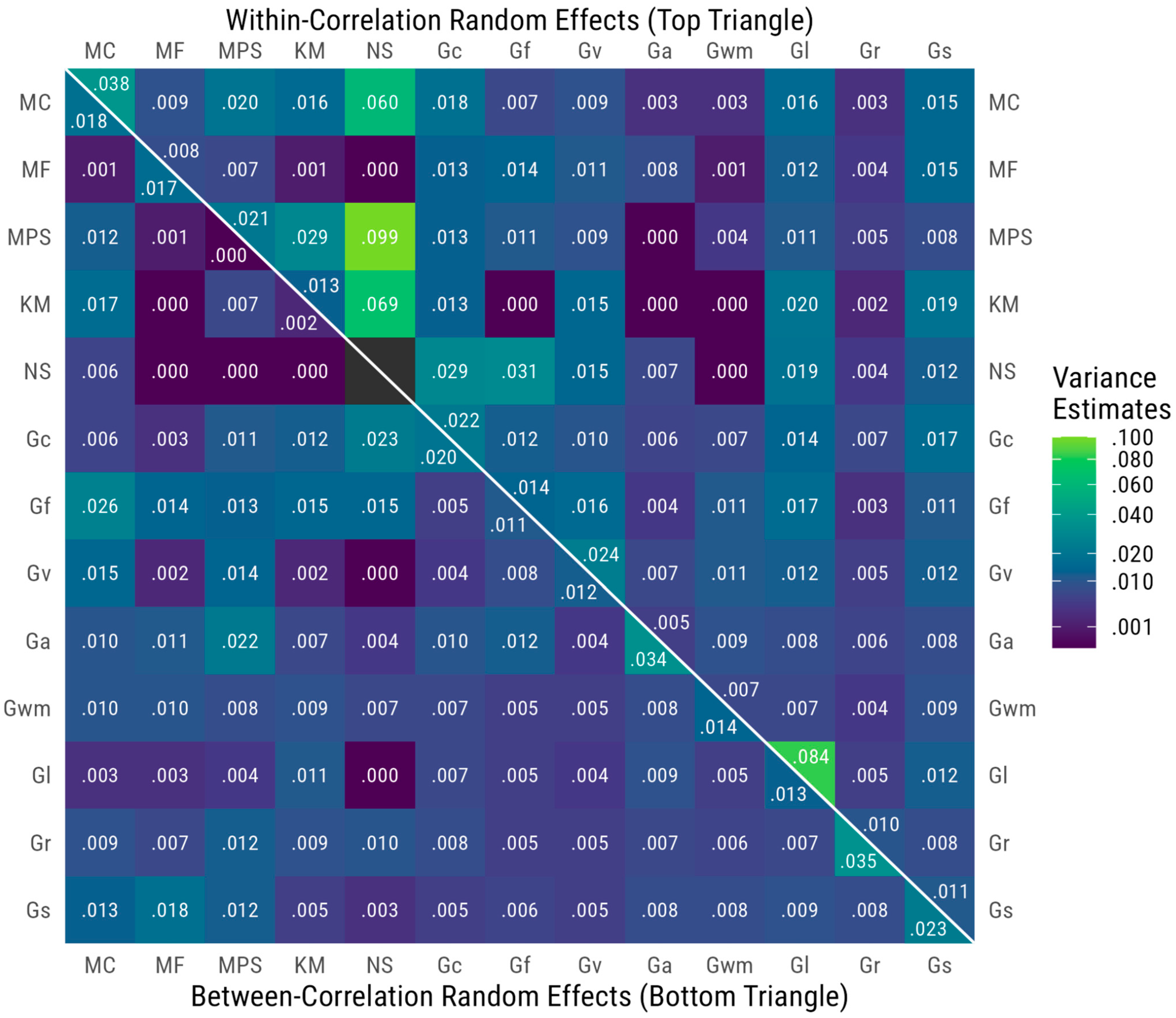
3.3. Heterogeneity of Meta-Analytic Correlations
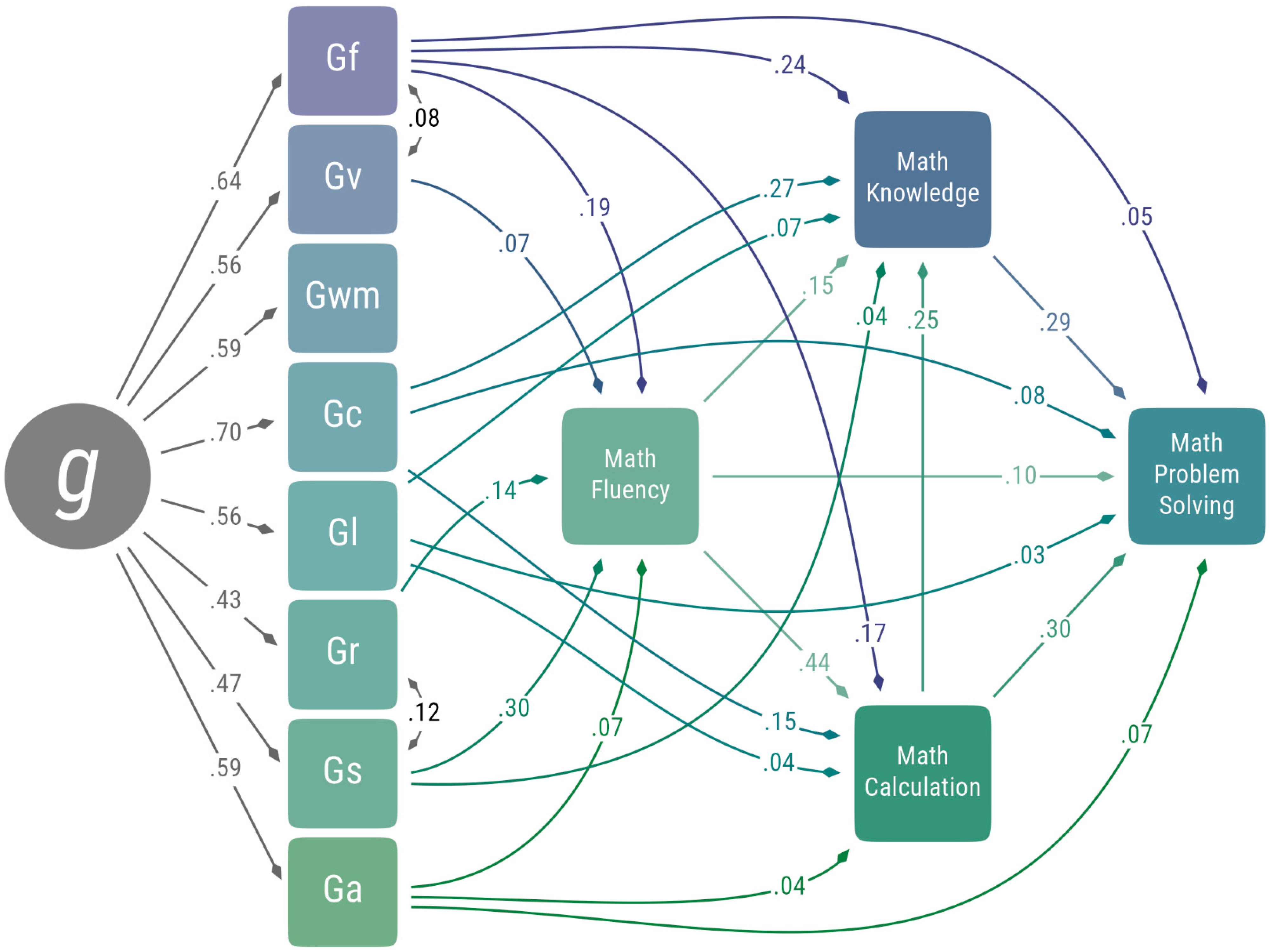
3.4. SEM Using the Meta-Analytic Correlation Matrix
3.5. Follow-Up Analysis with Narrow CHC Cognitive Abilities
4. Discussion
4.1. Integrating Results with Previous Research and Theory
4.2. Practical Implications for School-Based Evaluations
4.3. Limitations and Future Directions
4.4. Conclusions
Supplementary Materials
Author Contributions
Funding
Institutional Review Board Statement
Informed Consent Statement
Data Availability Statement
Acknowledgments
Conflicts of Interest
References
- Amland, T., Grande, G., Scherer, R., Lervåg, A., & Melby-Lervåg, M. (2025). Cognitive factors underlying mathematical skills: A systematic review and meta-analysis. Psychological Bulletin, 151(1), 88–129. [Google Scholar] [CrossRef] [Scilit]
- Atit, K., Power, J. R., Pigott, T., Lee, J., Geer, E. A., Uttal, D. H., Ganley, C. M., & Sorby, S. A. (2022). Examining the relations between spatial skills and mathematical performance: A meta-analysis. Psychonomic Bulletin & Review, 29(3), 699–720. [Google Scholar] [CrossRef] [Scilit] [PubMed]
- Benson, N. F., Kranzler, J. H., & Floyd, R. G. (2016). Examining the integrity of measurement of cognitive abilities in the prediction of achievement: Comparisons and contrasts across variables from higher-order and bifactor models. Journal of School Psychology, 58, 1–19. [Google Scholar] [CrossRef] [Scilit] [PubMed]
- Berkowitz, M., & Stern, E. (2018). Which cognitive abilities make the difference? Predicting academic achievements in advanced STEM studies. Journal of Intelligence, 6(4), 48. [Google Scholar] [CrossRef] [Scilit] [PubMed]
- Blankson, A. N., & Blair, C. (2016). Cognition and classroom quality as predictors of math achievement in the kindergarten year. Learning and Instruction, 41, 32–40. [Google Scholar] [CrossRef] [Scilit]
- Bull, R., Espy, K. A., & Wiebe, S. A. (2008). Short-term memory, working memory, and executive functioning in preschoolers: Longitudinal predictors of mathematical achievement at age 7 years. Developmental Neuropsychology, 33(3), 205–228. [Google Scholar] [CrossRef] [Scilit] [PubMed]
- Burns, M. K. (2005). Using incremental rehearsal to increase fluency of single-digit multiplication facts with children identified as learning disabled in mathematics computation. Education & Treatment of Children, 28(3), 237–249. Available online: https://www.jstor.org/stable/42899847 (accessed on 20 June 2026).
- Caemmerer, J. M., Keith, T. Z., & Reynolds, M. R. (2020). Beyond individual intelligence tests: Application of Cattell-Horn-Carroll Theory. Intelligence, 79, 101433–11. [Google Scholar] [CrossRef] [Scilit]
- Caemmerer, J. M., Maddocks, D. L. S., Keith, T. Z., & Reynolds, M. R. (2018). Effects of cognitive abilities on child and youth academic achievement: Evidence from the WISC-V and WIAT-III. Intelligence, 68, 6–20. [Google Scholar] [CrossRef] [Scilit]
- Caemmerer, J. M., Reynolds, M. R., & Keith, T. Z. (2023). Beyond individual tests: Youth’s cognitive abilities on their math and writing skills. Learning and Individual Differences, 102, 102271. [Google Scholar] [CrossRef] [Scilit]
- Calderón-Tena, C. O., & Caterino, L. C. (2016). Mathematics learning development: The role of long-term retrieval. International Journal of Science and Mathematics Education, 14(7), 1377–1385. [Google Scholar] [CrossRef] [Scilit]
- Cheung, M. W. L. (2015). Meta-analysis: A structural equation modeling approach. John Wiley & Sons. [Google Scholar]
- Coolen, I. E. J. I., & Castronovo, J. (2023). How memory counts in mathematical development. Journal of Cognition, 6(1), 1. [Google Scholar] [CrossRef] [Scilit] [PubMed]
- Dehaene, S. (1997). The number sense: How the mind creates mathematics. Oxford University Press. [Google Scholar]
- Dehaene, S. (2011). The number sense: How the mind creates mathematics (Revised ed.). Oxford University Press. [Google Scholar]
- Dehaene, S., Piazza, M., Pinel, P., & Cohen, L. (2005). Three parietal circuits for number processing. In J. I. D. Campbell (Ed.), Handbook of mathematical cognition (pp. 433–453). Psychology Press. [Google Scholar]
- Ebner, S., MacDonald, M. K., Grekov, P., & Aspiranti, K. B. (2025). A meta-analytic review of the concrete-representational-abstract math approach. Learning Disabilities Research and Practice, 40(1), 31–42. [Google Scholar] [CrossRef] [Scilit]
- Flanagan, D. P., Alfonso, V. C., & Reynolds, M. R. (2013). Broad and narrow CHC abilities measured and not measured by the wechsler scales: Moving beyond within-battery factor analysis. Journal of Psychoeducational Assessment, 31(2), 202–223. [Google Scholar] [CrossRef] [Scilit]
- Flanagan, D. P., Sotelo-Dynega, M., & Alfonso, V. C. (2025). Overview of the Woodcock-Johnson V tests of cognitive abilities and virtual test library. Journal of Psychoeducational Assessment, 43(8), 802–844. [Google Scholar] [CrossRef] [Scilit]
- Floyd, R. G., Shaver, R. B., & McGrew, K. S. (2003). Interpretation of the Woodcock-Johnson III tests of cognitive abilities: Acting on evidence. In F. A. Schrank, & D. P. Flanagan (Eds.), WJ III clinical use and interpretation: Scientist-practitioner perspectives (pp. 1–46). Academic Press. [Google Scholar] [CrossRef] [Scilit]
- Geary, D. C. (2011). Cognitive predictors of achievement growth in mathematics: A 5-year longitudinal study. Developmental Psychology, 47(6), 1539–1552. [Google Scholar] [CrossRef] [Scilit] [PubMed]
- Georgiou, G. K., Guo, K., Naveenkumar, N., Vieira, A. P. A., & Das, J. P. (2020). PASS theory of intelligence and academic achievement: A meta-analytic review. Intelligence, 79, 101431. [Google Scholar] [CrossRef] [Scilit]
- Gough, P. B., & Tunmer, W. E. (1986). Decoding, reading, and reading disability. Remedial and Special Education, 7(1), 6–10. [Google Scholar] [CrossRef] [Scilit]
- Green, C. T., Bunge, S. A., Briones Chiongbian, V., Barrow, M., & Ferrer, E. (2017). Fluid reasoning predicts future mathematical performance among children and adolescents. Journal of Experimental Child Psychology, 157, 125–143. [Google Scholar] [CrossRef] [Scilit] [PubMed]
- Hajovsky, D. B., Niileksela, C. R., Flanagan, D. P., Alfonso, V. C., Schneider, W. J., & Robbins, J. (2025). Toward a consensus model of cognitive–reading achievement relations using meta-structural equation modeling. Journal of Intelligence, 13(8), 104. [Google Scholar] [CrossRef] [Scilit] [PubMed]
- Jarvis, H. L., & Gathercole, S. E. (2003). Verbal and non-verbal working memory and achievements on national curriculum tests at 11 and 14 years of age. Educational and Child Psychology, 20(3), 123–140. [Google Scholar] [CrossRef] [Scilit]
- Ji, Z., & Guo, K. (2023). The association between working memory and mathematical problem solving: A three-level meta-analysis. Frontiers in Psychology, 14, 1091126. [Google Scholar] [CrossRef] [Scilit] [PubMed]
- Keith, T. Z. (2019). Multiple regression and beyond: An introduction to multiple regression and structural equation modeling. Routledge. [Google Scholar]
- Kovacs, K., & Conway, A. R. A. (2016). Process overlap theory: A unified account of the general factor of intelligence. Psychological Inquiry, 27(3), 151–177. [Google Scholar] [CrossRef] [Scilit]
- Kranzler, J. H., & Keith, T. Z. (1999). Independent confirmatory factor analysis of the Cognitive Assessment System (CAS): What does the CAS measure? School Psychology Review, 28(1), 117–144. [Google Scholar] [CrossRef] [Scilit]
- Kranzler, J. H., Keith, T. Z., & Flanagan, D. P. (2000). Independent examination of the factor structure of the Cognitive Assessment System (CAS): Further evidence challenging the construct validity of the CAS. Journal of Psychoeducational Assessment, 18(2), 143–159. [Google Scholar] [CrossRef] [Scilit]
- LaForte, E. M., Dailey, D., & McGrew, K. S. (2025). Technical manual: Woodcock–Johnson V. Riverside Assessments. [Google Scholar]
- LeFevre, J., Fast, L. A., Skwarchuk, S.-L., Smith-Chant, B. L., Bisanz, J., Kamawar, D., & Penner-Wilger, M. (2010). Pathways to mathematics: Longitudinal predictors of performance. Child Development, 81(6), 1753–1767. [Google Scholar] [CrossRef] [Scilit] [PubMed]
- Liu, J., Peng, P., Zhao, B., & Luo, L. (2022). Socioeconomic status and academic achievement in primary and secondary education: A meta-analytic review. Educational Psychology Review, 34(4), 2867–2896. [Google Scholar] [CrossRef] [Scilit]
- Liu, Y., Peng, P., & Yan, X. (2025). Early numeracy and mathematics development: A longitudinal meta-analysis on the predictive nature of early numeracy. Journal of Educational Psychology, 117(6), 863–883. [Google Scholar] [CrossRef] [Scilit]
- Lubinski, D., Benbow, C. P., & Kell, H. J. (2014). Life paths and accomplishments of mathematically precocious males and females four decades later. Psychological Science, 25(12), 2217–2232. [Google Scholar] [CrossRef] [Scilit] [PubMed]
- Maxwell, S. E., & Cole, D. A. (2007). Bias in cross-sectional analyses of longitudinal mediation. Psychological Methods, 12(1), 23–44. [Google Scholar] [CrossRef] [Scilit] [PubMed]
- McGrew, K. S., Mather, N., LaForte, E. M., & Wendling, B. J. (2025). Woodcock-Johnson V. Riverside Assessments, LLC. [Google Scholar]
- McGrew, K. S., & Wendling, B. J. (2010). Cattell–Horn–Carroll cognitive-achievement relations: What we have learned from the past 20 years of research. Psychology in the Schools, 47, 651–675. [Google Scholar] [CrossRef] [Scilit]
- Miller Singley, A. T., & Bunge, S. A. (2018). Eye gaze patterns reveal how we reason about fractions. Thinking & Reasoning, 24(4), 449–474. [Google Scholar] [CrossRef] [Scilit]
- Montague, M., Warger, C., & Morgan, T. H. (2000). Solve It! Strategy instruction to improve mathematical problem solving. Learning Disabilities Research & Practice, 15(2), 110–116. [Google Scholar] [CrossRef] [Scilit] [PubMed]
- Muthén, L. K., & Muthén, B. O. (1998–2015). Mplus user’s guide (7th ed.). Muthén & Muthén. [Google Scholar]
- Naglieri, J. A., & Johnson, D. (2000). Effectiveness of a cognitive strategy intervention in improving arithmetic computation based on the PASS theory. Journal of Learning Disabilities, 33(6), 591–597. [Google Scholar] [CrossRef] [Scilit] [PubMed]
- National Council of Teachers of Mathematics. (2023). Procedural fluency in mathematics: A position of the national council of teachers of mathematics. Available online: https://www.nctm.org/Standards-and-Positions/Position-Statements/Procedural-Fluency-in-Mathematics/ (accessed on 20 June 2026).
- Niileksela, C. R., Hajovsky, D. B., He, Z., & Villeneuve, E. F. (2025). Cognitive–achievement relations with the Woodcock–Johnson V. Journal of Psychoeducational Assessment, 43(8), 880–896. [Google Scholar] [CrossRef] [Scilit]
- Niileksela, C. R., Reynolds, M. R., Keith, T. Z., & McGrew, K. S. (2016). A special validity study of the WJ IV: Acting on evidence for specific abilities. In D. P. Flanagan, & V. C. Alfonso (Eds.), WJ IV clinical use and interpretation: Scientist-Practitioner perspectives. Academic Press. [Google Scholar] [CrossRef] [Scilit]
- Pearl, J. (2000). Causality: Models, reasoning, and inference. Cambridge University Press. [Google Scholar]
- Peng, P., & Kievit, R. A. (2020). The development of academic achievement and cognitive abilities: A bidirectional perspective. Child Development Perspectives, 14(1), 15–20. [Google Scholar] [CrossRef] [Scilit] [PubMed]
- Peng, P., Namkung, J., Barnes, M., & Sun, C. (2016). A meta-analysis of mathematics and working memory: Moderating effects of working memory domain, type of mathematics skill, and sample characteristics. Journal of Educational Psychology, 108(4), 455–473. [Google Scholar] [CrossRef] [Scilit]
- Peng, P., Wang, T., Wang, C., & Lin, X. (2019). A meta-analysis on the relation between fluid intelligence and reading/mathematics: Effects of tasks, age, and social economics status. Psychological Bulletin, 145(2), 189–236. [Google Scholar] [CrossRef] [Scilit] [PubMed]
- Schneider, W. J., & McGrew, K. S. (2018). The Cattell–Horn–Carroll theory of intelligence. In D. P. Flanagan, & E. M. McDonough (Eds.), Contemporary intellectual assessment (pp. 73–130). Guilford. [Google Scholar]
- Schrank, F. A., & Wendling, B. J. (2018). The Woodcock–Johnson IV. In D. P. Flanagan, & E. M. McDonough (Eds.), Contemporary intellectual assessment: Theories, tests, and issues (4th ed., pp. 383–451). The Guilford Press. [Google Scholar]
- Sirin, S. R. (2005). Socioeconomic status and academic achievement: A meta-analytic review of research. Review of Educational Research, 75(3), 417–453. [Google Scholar] [CrossRef] [Scilit]
- Starr, A., Libertus, M. E., & Brannon, E. M. (2013). Number sense in infancy predicts mathematical abilities in childhood. Proceedings of the National Academy of Sciences, 110(45), 18116–18120. [Google Scholar] [CrossRef] [Scilit] [PubMed]
- Taub, G. E., Keith, T. Z., Floyd, R. G., & McGrew, K. S. (2008). Effects of general and broad cognitive abilities on mathematics achievement. School Psychology Quarterly, 23(2), 187–198. [Google Scholar] [CrossRef] [Scilit]
- Van de Weijer-Bergsma, E., Kroesbergen, E. H., & Van Luit, J. E. H. (2015). Verbal and visual-spatial working memory and mathematical ability in different domains throughout primary school. Memory and Cognition, 43, 367–378. [Google Scholar] [CrossRef] [Scilit] [PubMed]
- Viechtbauer, W. (2010). Conducting meta-analyses in R with the metafor package. Journal of Statistical Software, 36(3), 1–48. [Google Scholar] [CrossRef] [Scilit]
- Villeneuve, E. F., Hajovsky, D. B., Mason, B. A., & Lewno, B. M. (2019). Cognitive ability and math computation developmental relations with math problem solving: An integrated, multigroup approach. School Psychology, 34(1), 96–108. [Google Scholar] [CrossRef] [Scilit] [PubMed]
- Viswesvaran, C., & Ones, D. S. (1995). Theory testing: Combining psychometric meta-analysis and structural equations modeling. Personnel Psychology, 48(4), 865–885. [Google Scholar] [CrossRef] [Scilit]
- Warne, R. T. (2016). Five reasons to put the g back into giftedness: An argument for applying the Cattell–Horn–Carroll theory of intelligence to gifted education research and practice. Gifted Child Quarterly, 60(1), 3–15. [Google Scholar] [CrossRef] [Scilit]
- White, K. R. (1982). The relation between socioeconomic status and academic achievement. Psychological Bulletin, 91(3), 461–481. [Google Scholar] [CrossRef]
- Xenidou-Dervou, I., Molenaar, D., Ansari, D., van der Schoot, M., & van Lieshout, E. C. D. M. (2017). Nonsymbolic and symbolic magnitude comparison skills as longitudinal predictors of mathematical achievement. Learning and Instruction, 50, 1–13. [Google Scholar] [CrossRef] [Scilit]
- Xu, C., Di Lonardo Burr, S., & LeFevre, J.-A. (2023). The hierarchical relations among mathematical competencies: From fundamental numeracy to complex mathematical skills. Canadian Journal of Experimental Psychology/Revue canadienne de psychologie expérimentale, 77(4), 284–295. [Google Scholar] [CrossRef] [Scilit] [PubMed]
- Zaboski, B., Kranzler, J. H., & Gage, N. A. (2018). Meta-analysis of the relationship between academic achievement and broad abilities of the Cattell–Horn–Carroll theory. Journal of School Psychology, 72, 1–13. [Google Scholar] [CrossRef] [Scilit] [PubMed]
- Ziegler, J. C., & Goswami, U. (2005). Reading acquisition, developmental dyslexia, and skilled reading across languages: A psycholinguistic grain size theory. Psychological Bulletin, 131(1), 3–29. [Google Scholar] [CrossRef] [Scilit] [PubMed]



| Gc | Gf | Gv | Ga | Gl | Gr | Gwm | Gs | MC | MF | MPS | KM | NS | |
|---|---|---|---|---|---|---|---|---|---|---|---|---|---|
| Gc | 3197 | ||||||||||||
| Gf | 1831 | 400 | |||||||||||
| Gv | 3170 | 1219 | 1125 | ||||||||||
| Ga | 852 | 386 | 400 | 190 | |||||||||
| Gl | 1257 | 679 | 1791 | 384 | 495 | ||||||||
| Gr | 1057 | 519 | 541 | 381 | 496 | 331 | |||||||
| Gwm | 3778 | 1582 | 2756 | 566 | 1350 | 817 | 1619 | ||||||
| Gs | 2215 | 824 | 1427 | 342 | 556 | 503 | 1929 | 501 | |||||
| MC | 472 | 138 | 168 | 130 | 132 | 166 | 204 | 122 | 111 | ||||
| MF | 391 | 98 | 94 | 104 | 91 | 177 | 157 | 108 | 118 | 52 | |||
| MPS | 442 | 132 | 152 | 139 | 128 | 162 | 205 | 122 | 185 | 109 | 13 | ||
| KM | 130 | 28 | 34 | 25 | 23 | 53 | 48 | 25 | 133 | 17 | 52 | 26 | |
| NS | 68 | 26 | 25 | 28 | 29 | 54 | 47 | 27 | 16 | 5 | 12 | 12 | 0 |
| Gc | Gf | Gv | Ga | Gl | Gr | Gwm | Gs | MC | MF | MPS | KM | NS | |
|---|---|---|---|---|---|---|---|---|---|---|---|---|---|
| Gc | 384 | ||||||||||||
| Gf | 216 | 150 | |||||||||||
| Gv | 273 | 222 | 263 | ||||||||||
| Ga | 82 | 49 | 55 | 34 | |||||||||
| Gl | 123 | 111 | 160 | 48 | 126 | ||||||||
| Gr | 112 | 89 | 107 | 65 | 70 | 76 | |||||||
| Gwm | 252 | 199 | 278 | 63 | 142 | 106 | 220 | ||||||
| Gc | 179 | 154 | 198 | 44 | 70 | 85 | 182 | 133 | |||||
| MC | 135 | 53 | 56 | 57 | 43 | 57 | 59 | 46 | 14 | ||||
| MF | 59 | 21 | 21 | 39 | 19 | 47 | 25 | 21 | 55 | 20 | |||
| MPS | 110 | 51 | 55 | 62 | 46 | 59 | 57 | 47 | 95 | 55 | 10 | ||
| KM | 28 | 7 | 9 | 9 | 9 | 10 | 10 | 7 | 13 | 6 | 12 | 4 | |
| NS | 10 | 7 | 10 | 10 | 10 | 11 | 10 | 7 | 7 | 5 | 7 | 7 | 0 |
| Number Sense Direct Effect (Indirect, Total Effect) | Math Fluency Direct Effect (Indirect, Total Effect) | Math Calculation Direct Effect (Indirect, Total Effect) | Math Knowledge Direct Effect (Indirect, Total Effect) | Math Problem Solving Direct Effect (Indirect, Total Effect) | |
|---|---|---|---|---|---|
| Comprehension-Knowledge | .191 (--, --) | −.006 (.058, .052) | .105 (.070, .175) | .226 (.096, .322) | .072 (.162, .234) |
| Fluid Reasoning | .225 (--, --) | .118 (.068, .186) | .124 (.129, .253) | .192 (.134, .326) | .042 (.204, .246) |
| Visual Processing | .136 (--, --) | −.109 (.041, −.068) | .022 (.011, .033) | −.084 (.043, −.041) | .011 (.044, .055) |
| Auditory Processing | .056 (--, --) | .055 (.017, .072) | .035 (.042, .077) | .002 (.038, .040) | .063 (.050, .113) |
| Long-Term Storage | .025 (--, --) | .013 (.008, .021) | .037 (.014, .051) | .065 (.018, .083) | .039 (.035, .074) |
| Retrieval Fluency | .036 (--, --) | .132 (.011, .143) | −.016 (.062, .047) | −.002 (.035, .033) | .018 (.040, .058) |
| Short-Term Working Memory | .195 (--, --) | .018 (.059, .077) | .009 (.081, .090) | .019 (.087, .107) | −.016 (.112, .096) |
| Processing Speed | .086 (--, --) | .271 (.026, .297) | .023 (.133, .156) | .039 (.085, .124) | −.005 (.110, .105) |
| Number Sense | -- | .302 (--, --) | .269 (.112, .381) | .336 (.090, .426) | .350 (.180, .530) |
| Math Fluency | -- | -- | .369 (--, --) | .108 (.056, .164) | .082 (.113, .195) |
| Math Calculation | -- | -- | -- | .152 (--, --) | .240 (.023, .263) |
| Math Knowledge | -- | -- | -- | -- | .151 (--, --) |
| Indirect Effect of g | .571 | .418 | .523 | .617 | .591 |
| R2 | .426 | .353 | .534 | .655 | .674 |
| Math Fluency Direct Effect (Indirect, Total Effect) | Math Calculation Direct Effect (Indirect, Total Effect) | Math Knowledge Direct Effect (Indirect, Total Effect) | Math Problem Solving Direct Effect (Indirect, Total Effect) | |
|---|---|---|---|---|
| Comprehension-Knowledge | .052 (--, --) | .153 (.022, .175) | .271 (.051, .322) | .080 (.154, .234) |
| Fluid Reasoning | .186 (--, --) | .172 (.081, .253) | .236 (.090, .326) | .054 (.192, .246) |
| Visual Processing | −.068 (--, --) | .063 (−.030, .033) | −.039 (−.002, −.041) | .064 (−.009, .055) |
| Auditory Processing | .072 (--, --) | .045 (.032, .077) | .011 (.030, .040) | .071 (.043, .114) |
| Long-Term Storage | .021 (--, --) | .042 (.009, .051) | .068 (.016, .083) | .032 (.042, .074) |
| Retrieval Fluency | .143 (--, --) | −.015 (.062, .047) | .000 (.033, .033) | .020 (.039, .058) |
| Short-Term Working Memory | .077 (--, --) | .056 (.034, .090) | .073 (.034, .107) | .030 (.067, .096) |
| Processing Speed | .297 (--, --) | .026 (.130, .156) | .041 (.083, .124) | −.009 (.114, .105) |
| Math Fluency | -- | .436 (--, --) | .150 (.107, .257) | .104 (.208, .312) |
| Math Calculation | -- | -- | .247 (--, --) | .303 (.073, .376) |
| Math Knowledge | -- | -- | -- | .295 (--, --) |
| Indirect Effect of g | .418 | .523 | .617 | .591 |
| R2 | .301 | .496 | .600 | .622 |
| Comprehension-Knowledge Narrow Abilities | Fluid Reasoning Narrow Abilities | Short-Term Working Memory Narrow Abilities | Visual Processing Narrow Abilities | Mathematics Skills | |||||||||||||
|---|---|---|---|---|---|---|---|---|---|---|---|---|---|---|---|---|---|
| LS | CM | VL | K0 | I | RG | RQ | Wa | Wc | Wv | Vz | MV | MC | MF | MPS | KM | NS | |
| LS | 1.00 | ||||||||||||||||
| CM | .56 | 1.00 | |||||||||||||||
| VL | .59 | .63 | 1.00 | ||||||||||||||
| K0 | .51 | .31 | .70 | 1.00 | |||||||||||||
| I | .44 | .32 | .47 | .46 | 1.00 | ||||||||||||
| RG | .44 | .34 | .46 | .47 | .51 | 1.00 | |||||||||||
| RQ | .42 | .41 | .50 | .45 | .52 | .48 | 1.00 | ||||||||||
| Wa | .42 | .45 | .39 | .39 | .33 | .31 | .31 | 1.00 | |||||||||
| Wc | .39 | .35 | .41 | .41 | .41 | .41 | .47 | .43 | 1.00 | ||||||||
| Wv | .27 | .23 | .36 | .32 | .39 | .32 | .46 | .33 | .40 | 1.00 | |||||||
| Vz | .35 | .25 | .43 | .44 | .48 | .46 | .47 | .28 | .37 | .35 | 1.00 | ||||||
| MV | .31 | .22 | .32 | .28 | .36 | .32 | .30 | .22 | .28 | .37 | .33 | 1.00 | |||||
| MC | .40 | .34 | .45 | .52 | .43 | .47 | .63 | .32 | .42 | .40 | .39 | .26 | 1.00 | ||||
| MF | .29 | .23 | .31 | .35 | .31 | .34 | .52 | .24 | .40 | .26 | .24 | .19 | .61 | 1.00 | |||
| MPS | .50 | .41 | .56 | .57 | .51 | .52 | .63 | .38 | .45 | .36 | .45 | .28 | .69 | .54 | 1.00 | ||
| KM | .51 | .36 | .62 | .56 | .58 | .51 | .66 | .41 | .49 | .43 | .39 | .23 | .63 | .52 | .70 | 1.00 | |
| NS | .41 | .07 | .55 | .57 | .47 | .52 | .68 | .44 | .52 | .44 | .48 | .12 | .60 | .48 | .73 | .70 | 1.00 |
| Math Fluency β | Math Calculation β | Math Knowledge β | Math Problem Solving β | |
|---|---|---|---|---|
| Narrow Abilities | ||||
| Comprehension-Knowledge Narrow | ||||
| Listening Ability | .032 | .022 | .139 | .101 |
| Communication Ability | .012 | .085 | −.170 | .059 |
| Lexical Knowledge | −.038 | −.065 | .341 | .064 |
| General Knowledge | .174 | .299 | .057 | .223 |
| Fluid Reasoning Narrow | ||||
| Induction | .066 | .073 | .249 | .129 |
| General Sequential Reasoning | .135 | .191 | .136 | .167 |
| Short-Term Working Memory Narrow | ||||
| Auditory Memory Span | .049 | .039 | .122 | .065 |
| Working Memory | .221 | .083 | .129 | .079 |
| Visual Memory Span | −.010 | .112 | .070 | .004 |
| Visual Processing Narrow | ||||
| Visualization | −.037 | .052 | −.045 | .086 |
| Visual Memory | .031 | .009 | −.092 | .003 |
| Indirect Effects of Broad Abilities and g | ||||
| Comprehension-Knowledge | .136 | .258 | .316 | .347 |
| Fluid Reasoning | .140 | .183 | .271 | .207 |
| Short-Term Working Memory | .177 | .147 | .203 | .096 |
| Visual Processing | −.009 | .039 | −.074 | .059 |
| g | .393 | .553 | .627 | .620 |
Disclaimer/Publisher’s Note: The statements, opinions and data contained in all publications are solely those of the individual author(s) and contributor(s) and not of MDPI and/or the editor(s). MDPI and/or the editor(s) disclaim responsibility for any injury to people or property resulting from any ideas, methods, instructions or products referred to in the content. |
© 2026 by the authors. Licensee MDPI, Basel, Switzerland. This article is an open access article distributed under the terms and conditions of the Creative Commons Attribution (CC BY) license.
Share and Cite
Niileksela, C.R.; Hajovsky, D.B.; Cocar-Montenegro, F.P.; Schneider, W.J.; Flanagan, D.P.; Alfonso, V.C. Cognitive–Mathematics Relations: A Meta-Analysis of Norm-Referenced Standardized Test Batteries. J. Intell. 2026, 14, 142. https://doi.org/10.3390/jintelligence14070142
Niileksela CR, Hajovsky DB, Cocar-Montenegro FP, Schneider WJ, Flanagan DP, Alfonso VC. Cognitive–Mathematics Relations: A Meta-Analysis of Norm-Referenced Standardized Test Batteries. Journal of Intelligence. 2026; 14(7):142. https://doi.org/10.3390/jintelligence14070142
Chicago/Turabian StyleNiileksela, Christopher R., Daniel B. Hajovsky, Francisco Philippe Cocar-Montenegro, William Joel Schneider, Dawn P. Flanagan, and Vincent C. Alfonso. 2026. "Cognitive–Mathematics Relations: A Meta-Analysis of Norm-Referenced Standardized Test Batteries" Journal of Intelligence 14, no. 7: 142. https://doi.org/10.3390/jintelligence14070142
APA StyleNiileksela, C. R., Hajovsky, D. B., Cocar-Montenegro, F. P., Schneider, W. J., Flanagan, D. P., & Alfonso, V. C. (2026). Cognitive–Mathematics Relations: A Meta-Analysis of Norm-Referenced Standardized Test Batteries. Journal of Intelligence, 14(7), 142. https://doi.org/10.3390/jintelligence14070142