Chinese STEM College Students’ AI-Mediated Informal Digital Learning of English: A Hybrid SEM-PNA Approach to the Hedonic-Motivation System Adoption Model



Abstract
1. Introduction
2. Literature Review
2.1. Informal Digital Learning of English Mediated by AI
2.2. Influencing Factors of AI-Mediated IDLE
2.3. Hedonic-Motivation System Adoption Model as the Basis
2.4. The Present Study: Combining PLS-SEM and PNA
- RQ1.
- How are the HMSAM constructs associated with AI-IDLE among Chinese STEM college students?
- RQ2.
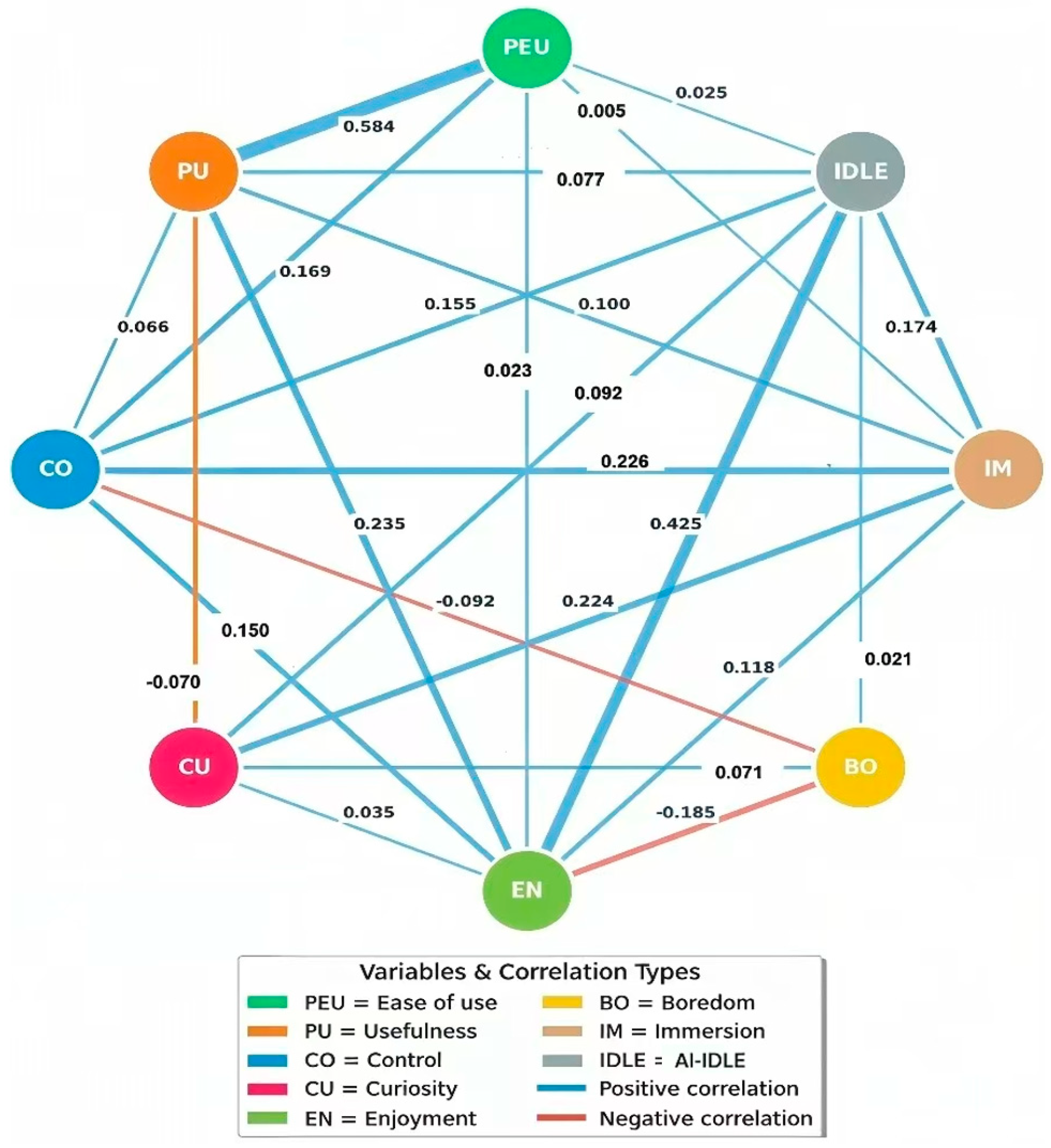
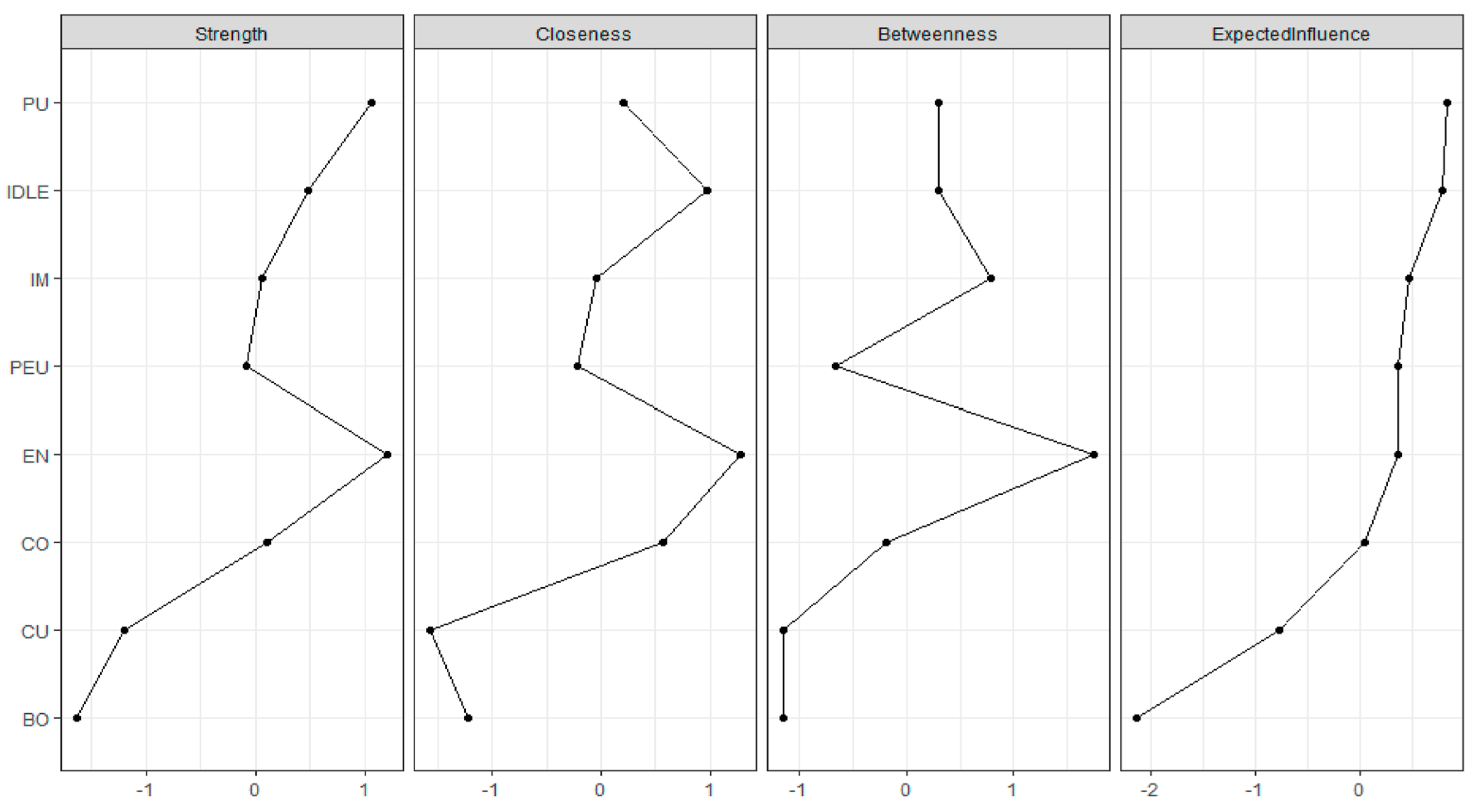
- Which constructs demonstrate the highest influence within the psychological network comprising the HMSAM constructs and AI-IDLE?
3. Methodology
3.1. Participants
3.2. Instruments
3.2.1. Perceived Ease of Use and Perceived Usefulness
3.2.2. Enjoyment and Boredom
3.2.3. Curiosity, Control and Focused Immersion
3.2.4. English Proficiency
3.3. Data Analysis
4. Results
4.1. PLS-SEM Findings
4.2. PNA Findings
5. Discussion
6. Implications and Limitations
7. Conclusions
Supplementary Materials
Author Contributions
Funding
Institutional Review Board Statement
Informed Consent Statement
Data Availability Statement
Conflicts of Interest
Abbreviations
| AI | Artificial intelligence |
| IDLE | Informal digital learning of English |
| HMSAM | Hedonic-Motivation System Adoption Model |
| PLS-SEM | Partial least squares structural equation modeling |
| PNA | Psychological network analysis |
References
- Aladini, A., Ismail, S. M., Ahmad Saleem Khasawneh, M., & Shakibaei, G. (2025). Self-directed writing development across computer/AI-based tasks: Unraveling the traces on L2 writing outcomes, growth mindfulness, and grammatical knowledge. Computers in Human Behavior Reports, 17, 100566. [Google Scholar] [CrossRef]
- Borsboom, D., Deserno, M. K., Rhemtulla, M., Epskamp, S., Fried, E. I., McNally, R. J., Robinaugh, D. J., Perugini, M., Dalege, J., Costantini, G., Isvoranu, A.-M., Wysocki, A. C., van Borkulo, C. D., van Bork, R., & Waldorp, L. J. (2021). Network analysis of multivariate data in psychological science. Nature Reviews Methods Primers, 1(1), 58. [Google Scholar] [CrossRef]
- Chen, Y., Ke, N., Huang, L., & Luo, R. (2025). The role of GenAI in EFL speaking: Effects on oral proficiency, anxiety and risk-taking. RELC Journal, 00336882251341072. [Google Scholar] [CrossRef]
- Davis, F. (1989). Perceived usefulness, perceived ease of use, and user acceptance of information technology. MIS Quarterly, 13, 319. [Google Scholar] [CrossRef] [PubMed]
- Deng, X., & Yu, Z. (2023). An extended hedonic motivation adoption model of TikTok in higher education. Education and Information Technologies, 28(10), 13595–13617. [Google Scholar] [CrossRef] [PubMed]
- Epskamp, S., Borsboom, D., & Fried, E. I. (2018). Estimating psychological networks and their accuracy: A tutorial paper. Behavior Research Methods, 50(1), 195–212. [Google Scholar] [CrossRef] [PubMed]
- Epskamp, S., & Fried, E. I. (2018). A tutorial on regularized partial correlation networks. Psychological Methods, 23(4), 617–634. [Google Scholar] [CrossRef] [PubMed]
- Fornell, C., & Larcker, D. F. (1981). Evaluating structural equation models withunobservable variables and measurement error. Journal of Marketing Research, 18(1), 39–50. [Google Scholar] [CrossRef]
- Hair, J. F., Howard, M. C., & Nitzl, C. (2020). Assessing measurement model quality in PLS-SEM using confirmatory composite analysis. Journal of Business Research, 109, 101–110. [Google Scholar] [CrossRef]
- Hevey, D. (2018). Network analysis: A brief overview and tutorial. Health Psychology and Behavioral Medicine, 6(1), 301–328. [Google Scholar] [CrossRef] [PubMed]
- Lee, J. (2019). Informal digital learning of English and second language vocabulary outcomes: Can quantity conquer quality? British Journal of Educational Technology, 50(2), 767–778. [Google Scholar] [CrossRef]
- Liu, G., Ghorbandordınejad, F., Zhao, X., & Esirgapov, M. (2026). Social support, resilience, and (AI-Mediated) informal digital learning of English among multilingual learners in Uzbekistan. International Journal of Applied Linguistics. [Google Scholar] [CrossRef]
- Liu, G., & Hossain, M. K. (2026). What predicts (AI-mediated) informal digital learning of English in the global south? The case of rural Bangladeshi students. Journal of Computer Assisted Learning, 42(2), e70196. [Google Scholar] [CrossRef]
- Liu, G., & Ma, C. (2023). Measuring EFL learners’ use of ChatGPT in informal digital learning of English based on the technology acceptance model. Innovation in Language Learning and Teaching, 18(2), 125–138. [Google Scholar] [CrossRef]
- Liu, G., Yue, Z., & Zhang, R. (2023). Examining the relationships among motivation, informal digital learning of English, and foreign language enjoyment: An explanatory mixed-method study. ReCALL, 36(1), 72–88. [Google Scholar] [CrossRef]
- Liu, G., & Zhao, X. (2025a). A scoping review of AI-mediated informal language learning: Mapping out the terrain and identifying future directions. ReCALL, 38, 111–130. [Google Scholar] [CrossRef]
- Liu, G., & Zhao, X. (2025b). The predictive effects of sociobiographical variables, English learning confidence, and digital competence on AI-mediated informal digital learning of English (AI-IDLE). International Journal of Applied Linguistics, 36(2), 1641–1652. [Google Scholar] [CrossRef]
- Liu, G., Zou, M., Soyoof, A., & Chiu, M. (2024). Untangling the relationship between AI-mediated informal digital learning of english (AI-IDLE), foreign language enjoyment and the ideal L2 self: Evidence from Chinese university EFL students. European Journal of Education, 60(1), e12846. [Google Scholar] [CrossRef]
- Liu, G. L., Lee, J. S., & Zhao, X. (2025). Critical digital literacies, agentic practices, and AI-mediated informal digital learning of English. System, 134, 103797. [Google Scholar] [CrossRef]
- Liu, G. L., & Soyoof, A. (2026). Does informal digital language learning really contribute to second language achievement? Evidence from a multilevel meta-analysis. System, 139, 104036. [Google Scholar] [CrossRef]
- Livingstone, D. W. (2001). Adults’ informal learning: Definitions, findings, gaps and future research. Centre for the Study of Education and Work. [Google Scholar]
- Lowry, P., Gaskin, J., Twyman, N., Hammer, B., & Roberts, T. (2013). Taking “fun and games” seriously: Proposing the hedonic-motivation system adoption model (HMSAM). Journal of the Association for Information Systems, 14, 617–671. [Google Scholar] [CrossRef]
- Montgomery, S. L. (2013). Does science need a global language? English and the future of research. University of Chicago Press. [Google Scholar]
- Paradowski, M. B., & Jelińska, M. (2024). The predictors of L2 grit and their complex interactions in online foreign language learning: Motivation, self-directed learning, autonomy, curiosity, and language mindsets. Computer Assisted Language Learning, 37(8), 2320–2358. [Google Scholar] [CrossRef]
- Pekrun, R. (2006). The control-value theory of achievement emotions: Assumptions, corollaries, and implications for educational research and practice. Educational Psychology Review, 18, 315–341. [Google Scholar] [CrossRef]
- Peltokorpi, V. (2023). The “language” of career success: The effects of English language competence on local employees’ career outcomes in foreign subsidiaries. Journal of International Business Studies, 54, 258–284. [Google Scholar] [CrossRef]
- Prasetya, R. (2023). Assessing the impact of English language skills and TOEIC performance on career development. Scripta: English Department Journal, 10, 281–294. [Google Scholar] [CrossRef]
- Qu, K., & Wu, X. (2024). ChatGPT as a CALL tool in language education: A study of hedonic motivation adoption models in English learning environments. Education and Information Technologies, 29(15), 19471–19503. [Google Scholar] [CrossRef]
- Rana, M., & Shaikh, R. (2024). The role of English speaking- skills in career progression: A case study among sudanese undergraduate EFL students. World Journal of English Language, 14, 349. [Google Scholar] [CrossRef]
- Reinders, H., & Benson, P. (2017). Research agenda: Language learning beyond the classroom. Language Teaching, 50(4), 561–578. [Google Scholar] [CrossRef]
- Reinhardt, J. (2019). Social media in second and foreign language teaching and learning: Blogs, wikis, and social networking. Language Teaching, 52(1), 1–39. [Google Scholar] [CrossRef]
- Soyoof, A., Azari Noughabi, M., Ghasemi, A., Solhi, M., & Leon Liu, G. (2025). Exploring the mediating role of savoring beliefs on EFL learners’ informal digital learning of English and willingness to communicate: A cross-cultural perspective. Innovation in Language Learning and Teaching, 1–22. [Google Scholar] [CrossRef]
- Soyoof, A., Lee, J., & Liu, G. (2026). Informal digital learning of English (IDLE) as an innovative pedagogy: A catalyst for holistic language development and sustainable global impact. Journal of Computer Assisted Learning, 42, e70237. [Google Scholar] [CrossRef]
- Soyoof, A., & Reynolds, B. (2026). Exploring the role of informal digital English learning in EFL students’ communication behaviour in Iran and Macau: A cross-cultural mixed-methods study. Journal of Computer Assisted Learning, 42(2), e70220. [Google Scholar] [CrossRef]
- Sundqvist, P., & Sylvén, L. K. (2016). Global and extramural English: Classroom challenges. In P. Sundqvist, & L. K. Sylvén (Eds.), Extramural English in teaching and learning: From theory and research to practice (pp. 19–41). Palgrave Macmillan UK. [Google Scholar] [CrossRef] [PubMed]
- Venkatesh, V., Morris, M., Davis, G., & Davis, F. (2003). User acceptance of information technology: Toward a unified view. MIS Quarterly, 27, 425–478. [Google Scholar] [CrossRef]
- Wang, M., & Zhang, L. J. (2026). Can grit be perceived and regulated? A mixed-methods exploration of English learners’ metacognitive awareness of grit and its impact on achievement and self-efficacy. Language Teaching Research, 13621688251405049. [Google Scholar] [CrossRef]
- Wang, X., Gao, Y., Reynolds, B., & Wang, Q. (2025). Exploring Chinese EFL learners’ beliefs about AI-mediated informal digital learning of English: Insights from Q methodology. Porta Linguarum Revista Interuniversitaria de Didáctica de las Lenguas Extranjeras, 131–146. [Google Scholar] [CrossRef]
- Wang, X., Gao, Y., & Reynolds, B. L. (2026). L2 self-guides, achievement emotions, and engagement in AI-mediated informal digital learning of English: Insights from structural equation modeling and psychological network analysis. The Asia-Pacific Education Researcher, 1–12. [Google Scholar] [CrossRef]
- Wu, H., Lalli, G., & Zeng, Y. (2026). Beyond the digital divide: Exploring literacy, perspectives, and barriers to GenAI among K12 EFL teachers in China’s under-resourced regions. International Journal of Applied Linguistics. [Google Scholar] [CrossRef]
- Wu, H., & Liu, W. (2025). Exploring mechanisms of effective informal GenAI-supported second language speaking practice: A cognitive-motivational model of achievement emotions. Discover Computing, 28(1), 119. [Google Scholar] [CrossRef]
- Wu, H., & Pan, Z. (2025). What deserve studying the most? A Q methodology approach to explore stakeholders’ perspectives on research priorities in GenAI-supported second language education. European Journal of Education, 60(1), e12898. [Google Scholar] [CrossRef]
- Wu, H., & Wang, Y. (2025). Disclosing Chinese college students’ flow experience in GenAI-assisted informal digital learning of english: A self-determination theory perspective. Learning and Motivation, 90, 102134. [Google Scholar] [CrossRef]
- Wu, H., Wang, Y., & Wang, Y. (2024). “To use or not to use?”: A mixed-methods study on the determinants of EFL college learners’ behavioral intention to use AI in the distributed learning context. The International Review of Research in Open and Distributed Learning, 25(3), 158–178. [Google Scholar] [CrossRef]
- Xie, Q. (2019). Analyzing professional English learning needs and situations of science and language majors in a Chinese university. Higher Education Studies, 9, 141. [Google Scholar] [CrossRef]
- Ye, Y. (2020). EAP for undergraduate science and engineering students in an EFL context: What should we teach? Ampersand, 7, 100065. [Google Scholar] [CrossRef]
- Zhang, R., Zou, D., & Cheng, G. (2025). ChatGPT affordance for logic learning strategies and its usefulness for developing knowledge and quality of logic in English argumentative writing. System, 128, 103561. [Google Scholar] [CrossRef]
- Zhao, X., & Danping, W. (2024). Domain-specific L2 grit, anxiety, boredom, and enjoyment in online Chinese learning. The Asia-Pacific Education Researcher, 33, 783–794. [Google Scholar] [CrossRef]
- Zhao, X., Hossain, K., & Sun, P. (2026). The facilitating role of enjoyment and anxiety in shaping (AI-mediated) informal language learning and confidence: An explanatory sequential mixed-methods investigation. Journal of Computer Assisted Learning, 42(1), e70181. [Google Scholar] [CrossRef]
- Zhao, X., & Wang, D. (2026). The impact of ChatGPT’s feedback on L2 Chinese learners’ writing outcome, confidence, and emotions: A mixed-method quasi-experimental study. Assessing Writing, 68, 101027. [Google Scholar] [CrossRef]
- Zou, B., Liviero, S., Ma, Q., Zhang, W., Du, Y., & Xing, P. (2024). Exploring EFL learners’ perceived promise and limitations of using an artificial intelligence speech evaluation system for speaking practice. System, 126, 103497. [Google Scholar] [CrossRef]




| Variables | Count | Percentage |
|---|---|---|
| Gender | ||
| Male | 212 | 51.3% |
| Female | 201 | 48.7% |
| Age | ||
| 18–20 | 300 | 72.6% |
| 21–25 | 79 | 19.1% |
| 26–30 | 30 | 7.3% |
| >30 | 4 | 1% |
| Grade | ||
| Undergraduate | 303 | 73.4% |
| Graduate | 68 | 16.5% |
| PhD candidate | 42 | 10.2% |
| Construct | Item | Loading | AVE | CR | Cronbach’s α |
|---|---|---|---|---|---|
| Boredom | Bo1~Bo4 | 0.846~0.912 | 0.764 | 0.928 | 0.898 |
| Control | CO1~Co4 | 0.887~0.904 | 0.797 | 0.922 | 0.873 |
| Curiosity | CY1~CY3 | 0.842~0.942 | 0.810 | 0.945 | 0.923 |
| Enjoyment | En1~En4 | 0.785~0.866 | 0.697 | 0.902 | 0.855 |
| AI-IDLE | GI1~GI8 | 0.816~0.879 | 0.685 | 0.945 | 0.934 |
| Focused immersion | IM1~IM4 | 0.766~0.858 | 0.672 | 0.891 | 0.839 |
| Perceived ease of use | PE1~PE4 | 0.809~0.896 | 0.724 | 0.913 | 0.872 |
| Perceived usefulness | PU1~PU5 | 0.776~0.932 | 0.703 | 0.922 | 0.894 |
| Construct | 1 | 2 | 3 | 4 | 5 | 6 | 7 | 8 |
|---|---|---|---|---|---|---|---|---|
| 1. Boredom | 0.874 | |||||||
| 2. Control | −0.276 | 0.893 | ||||||
| 3. Curiosity | 0.045 | 0.146 | 0.900 | |||||
| 4. Enjoyment | −0.327 | 0.627 | 0.206 | 0.835 | ||||
| 5. Focused immersion | −0.142 | 0.558 | 0.317 | 0.541 | 0.820 | |||
| 6. AI-IDLE | −0.176 | 0.591 | 0.265 | 0.717 | 0.570 | 0.828 | ||
| 7. Perceived ease of use | −0.166 | 0.553 | 0.110 | 0.558 | 0.427 | 0.507 | 0.851 | |
| 8. Perceived usefulness | −0.190 | 0.564 | 0.072 | 0.645 | 0.481 | 0.571 | 0.765 | 0.838 |
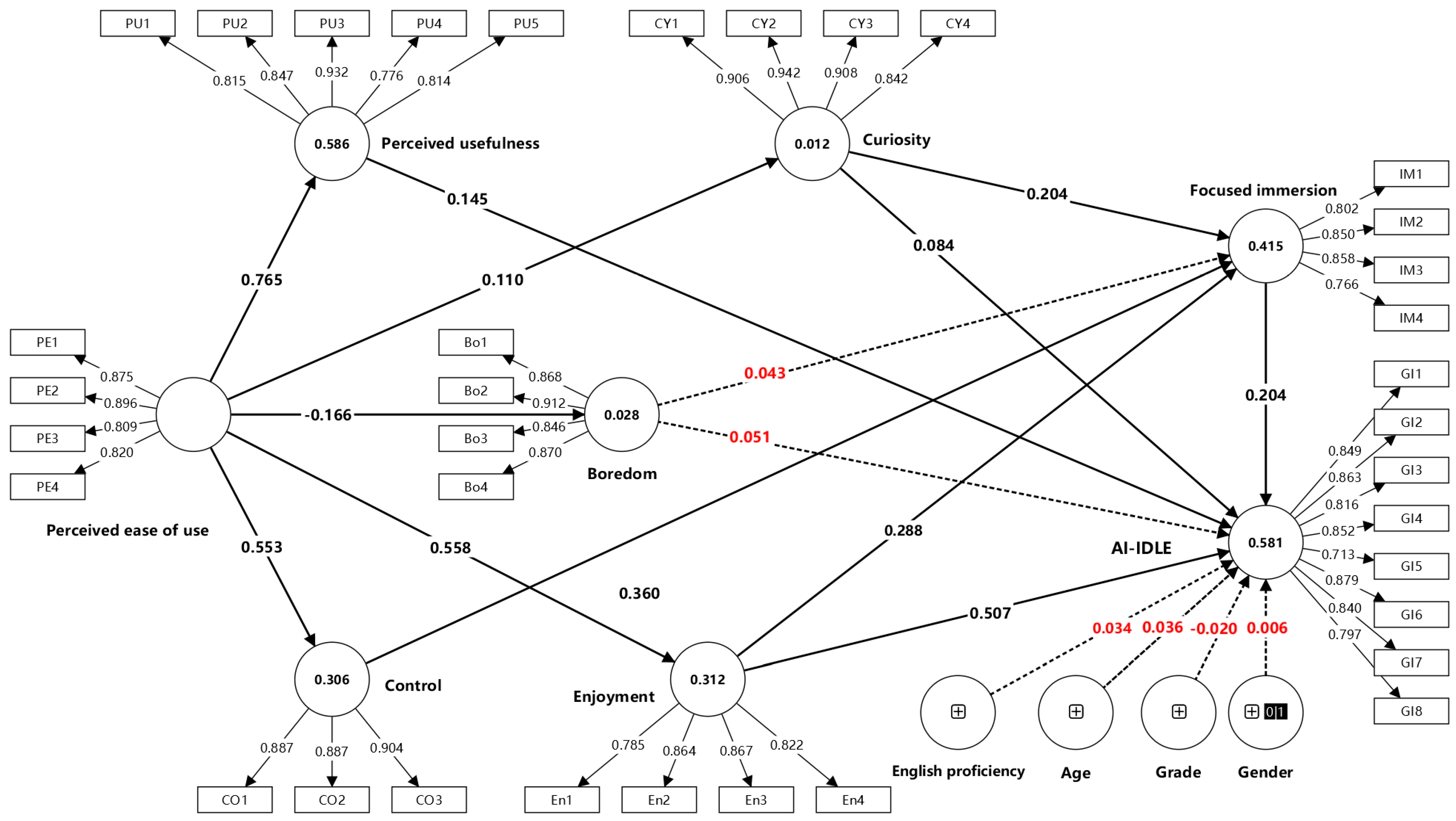
| Pathway | β | SD | t | p |
|---|---|---|---|---|
| Control variables | ||||
| Age → AI-IDLE | 0.036 | 0.071 | 0.510 | 0.610 |
| Gender → AI-IDLE | 0.006 | 0.064 | 0.095 | 0.924 |
| Grade → AI-IDLE | −0.020 | 0.072 | 0.280 | 0.780 |
| Key constructs | ||||
| Boredom → Focused immersion | 0.043 | 0.042 | 1.024 | 0.306 |
| Boredom → AI-IDLE | 0.051 | 0.040 | 1.286 | 0.199 |
| Control → Focused immersion | 0.360 | 0.056 | 6.459 | 0.000 |
| Curiosity → Focused immersion | 0.204 | 0.046 | 4.453 | 0.000 |
| Curiosity → AI-IDLE | 0.084 | 0.036 | 2.366 | 0.018 |
| English proficiency → AI-IDLE | 0.034 | 0.033 | 1.044 | 0.297 |
| Enjoyment → Focused immersion | 0.288 | 0.055 | 5.264 | 0.000 |
| Enjoyment → AI-IDLE | 0.507 | 0.057 | 8.847 | 0.000 |
| Focused immersion → AI-IDLE | 0.204 | 0.048 | 4.233 | 0.000 |
| Perceived ease of use → Boredom | −0.166 | 0.056 | 2.967 | 0.003 |
| Perceived ease of use → Control | 0.553 | 0.044 | 12.490 | 0.000 |
| Perceived ease of use → Curiosity | 0.110 | 0.051 | 2.164 | 0.031 |
| Perceived ease of use → Enjoyment | 0.558 | 0.045 | 12.425 | 0.000 |
| Perceived ease of use → Perceived usefulness | 0.765 | 0.025 | 30.515 | 0.000 |
| Perceived usefulness → AI-IDLE | 0.145 | 0.063 | 2.304 | 0.021 |
| Pathway | β | SD | t | Lower | Upper |
|---|---|---|---|---|---|
| Perceived ease of use → Perceived usefulness → AI-IDLE | 0.110 | 0.049 | 2.259 | 0.017 | 0.207 |
| Perceived ease of use → Boredom → Focused immersion → AI-IDLE | −0.002 | 0.002 | 0.911 | −0.005 | 0.001 |
| Perceived ease of use → Control → Focused immersion → AI-IDLE | 0.041 | 0.012 | 3.353 | 0.019 | 0.066 |
| Perceived ease of use → Enjoyment → AI-IDLE | 0.284 | 0.038 | 7.421 | 0.210 | 0.357 |
| Perceived ease of use → Curiosity → AI-IDLE | 0.009 | 0.006 | 1.525 | 0.000 | 0.024 |
| Perceived ease of use → Boredom → AI-IDLE | −0.007 | 0.007 | 0.967 | −0.024 | 0.006 |
| Perceived ease of use → Curiosity → Focused immersion → AI-IDLE | 0.005 | 0.003 | 1.596 | 0.000 | 0.011 |
| Perceived ease of use → Enjoyment → Focused immersion → AI-IDLE | 0.033 | 0.010 | 3.248 | 0.015 | 0.055 |
Disclaimer/Publisher’s Note: The statements, opinions and data contained in all publications are solely those of the individual author(s) and contributor(s) and not of MDPI and/or the editor(s). MDPI and/or the editor(s) disclaim responsibility for any injury to people or property resulting from any ideas, methods, instructions or products referred to in the content. |
© 2026 by the authors. Licensee MDPI, Basel, Switzerland. This article is an open access article distributed under the terms and conditions of the Creative Commons Attribution (CC BY) license.
Share and Cite
Xu, Y.; Wu, H. Chinese STEM College Students’ AI-Mediated Informal Digital Learning of English: A Hybrid SEM-PNA Approach to the Hedonic-Motivation System Adoption Model. J. Intell. 2026, 14, 120. https://doi.org/10.3390/jintelligence14070120
Xu Y, Wu H. Chinese STEM College Students’ AI-Mediated Informal Digital Learning of English: A Hybrid SEM-PNA Approach to the Hedonic-Motivation System Adoption Model. Journal of Intelligence. 2026; 14(7):120. https://doi.org/10.3390/jintelligence14070120
Chicago/Turabian StyleXu, Yixuan, and Hanwei Wu. 2026. "Chinese STEM College Students’ AI-Mediated Informal Digital Learning of English: A Hybrid SEM-PNA Approach to the Hedonic-Motivation System Adoption Model" Journal of Intelligence 14, no. 7: 120. https://doi.org/10.3390/jintelligence14070120
APA StyleXu, Y., & Wu, H. (2026). Chinese STEM College Students’ AI-Mediated Informal Digital Learning of English: A Hybrid SEM-PNA Approach to the Hedonic-Motivation System Adoption Model. Journal of Intelligence, 14(7), 120. https://doi.org/10.3390/jintelligence14070120