

Emotional Intelligence, Self-Regulation, and Children’s Well-Being in Fourth-Grade Students: Cross-Sectional Associations from Türkiye



Abstract
1. Introduction
1.1. Theoretical Background: Children’s Well-Being, Emotional Intelligence, and Self-Regulation
1.2. Aim of the Study
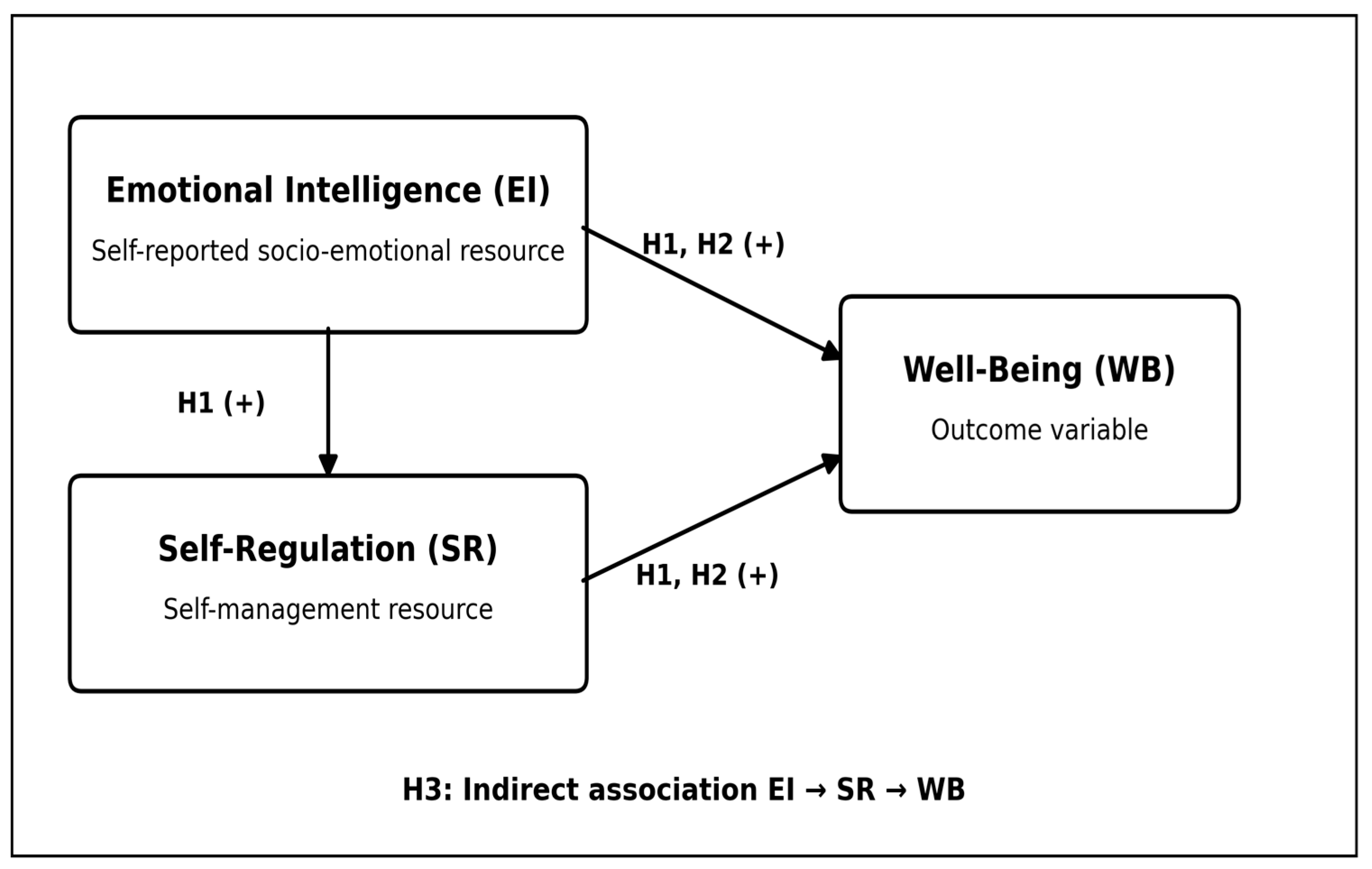
1.3. Objectives and Hypotheses
- RQ1. What are fourth-grade elementary school students’ levels of emotional intelligence, self-regulation, and well-being?
- RQ2. What are the relationships among emotional intelligence, self-regulation, and well-being?
- RQ3. How much variance in children’s well-being is accounted for by emotional intelligence and self-regulation when they are examined separately and jointly?
- RQ4. Does the association between emotional intelligence and children’s well-being include an indirect association through self-regulation?
Hypotheses
2. Materials and Methods
2.1. Participants
2.2. Measures
2.2.1. Emotional Intelligence
2.2.2. Self-Regulation
2.2.3. Children’s Well-Being
2.3. Procedure
2.4. Validity Evidence and Internal Consistency Reliability
2.5. Data Analysis
3. Results
3.1. Descriptive Statistics for the Variables
3.2. Relationships Among the Variables
3.3. Regression-Based Associations with Well-Being
3.4. Indirect Association Through Self-Regulation
3.5. Covariate-Adjusted Robustness Analyses
4. Discussion
Limitations and Future Research Directions
5. Conclusions
Author Contributions
Funding
Institutional Review Board Statement
Informed Consent Statement
Data Availability Statement
Acknowledgments
Conflicts of Interest
Abbreviations
| EI | Emotional intelligence |
| SR | Self-regulation |
| WB | Well-being |
Appendix A
Appendix A.1. Demographic Characteristics of Participants

| Variable | Category | n | % |
|---|---|---|---|
| Gender | Girl | 330 | 52.6 |
| Boy | 297 | 47.4 | |
| Nationality | Turkish citizen | 545 | 87.1 |
| Other | 81 | 12.9 | |
| Number of siblings | Only child | 64 | 10.3 |
| 1 sibling | 246 | 39.4 | |
| 2 siblings | 179 | 28.7 | |
| 3 or more siblings | 135 | 21.6 | |
| Family size | 2 members | 11 | 1.8 |
| 3 members | 54 | 8.8 | |
| 4 members | 237 | 38.4 | |
| 5 or more members | 315 | 51.1 | |
| Mother’s education level | Primary school | 407 | 64.9 |
| Middle school | 41 | 6.5 | |
| High school | 54 | 8.6 | |
| University or above | 125 | 19.9 | |
| Father’s education level | Primary school | 417 | 66.5 |
| Middle school | 27 | 4.3 | |
| High school | 56 | 8.9 | |
| University or above | 127 | 20.3 | |
| Mother’s occupation | Homemaker | 378 | 63.3 |
| Public sector | 118 | 19.8 | |
| Private sector | 68 | 11.4 | |
| Self-employed | 33 | 5.5 | |
| Father’s occupation | Unemployed | 9 | 1.6 |
| Public sector | 136 | 23.9 | |
| Private sector | 246 | 43.3 | |
| Self-employed | 177 | 31.2 | |
| Parental marital status | Married | 550 | 88.3 |
| Divorced | 61 | 9.8 | |
| Deceased | 12 | 1.9 |
Appendix A.2. Assumption, Diagnostic, and Robustness Checks
| Control | Value/Result | Interpretation |
|---|---|---|
| Emotional intelligence skewness | −0.325 | Acceptable |
| Emotional intelligence kurtosis | −0.160 | Acceptable |
| Self-regulation skewness | −0.536 | Acceptable |
| Self-regulation kurtosis | 0.457 | Acceptable |
| Well-being skewness | −0.675 | Acceptable |
| Well-being kurtosis | 0.499 | Acceptable |
| Tolerance | 0.835 | No multicollinearity problem |
| VIF | 1.198 | No multicollinearity problem |
| Condition Index | 18.919 | Acceptable |
| Durbin–Watson | 1.949 | Acceptable |
| Maximum Cook’s Distance | 0.042 | No influential observation |
| Variable | B | Conventional SE | HC3 SE | p | 95% Bootstrap CI |
|---|---|---|---|---|---|
| Constant | 0.816 | 0.192 | 0.195 | <.001 | [0.437, 1.199] |
| Emotional intelligence | 0.851 | 0.058 | 0.065 | <.001 | [0.721, 0.976] |
| Self-regulation | 0.159 | 0.074 | 0.074 | .032 | [0.017, 0.305] |
References
- Akın, A., Yılmaz, S., Özen, Y., Raba, S., & Özhan, Y. (2016). Stirling Çocuklar İçin Duygusal ve Psikolojik İyi Oluş Ölçeği’nin Türkçe formunun geçerlik ve güvenirliği [Validity and reliability of the Turkish form of the stirling children’s emotional and psychological well-being scale]. In V. sakarya’da eğitim araştirmalari kongresi [5th educational research congress in Sakarya] (pp. 74–79). Sakarya Üniversitesi Eğitim Bilimleri Enstitüsü Yayınları. Available online: https://toad.halileksi.net/olcek/stirling-cocuklar-icin-duygusal-ve-psikolojik-iyi-olus-olcegi/ (accessed on 13 April 2026).
- Alpay, M. R. (2021). Farkındalık Temelli Beden Eğitimi Derslerinin İlkokul 3. ve 4. Sınıf Öğrencilerinin Bilinçli Farkındalık ile Duygusal ve Psikolojik İyi Oluş Düzeyleri Üzerine Etkisi [The effect of mindfulness-based physical education lessons on the mindfulness and emotional and psychological well-being levels of third- and fourth-grade primary school students] [Master’s thesis, Ankara University]. Thesis No. 656275. Available online: https://tez.yok.gov.tr/UlusalTezMerkezi/ (accessed on 13 April 2026).
- Aydın, F. (2018). Okul Öncesi Dönem Çocuklarının Öz Düzenleme Becerilerinin ve Duygusal Zekâlarının İncelenmesi [An examination of preschool children’s self-regulation skills and emotional intelligence] [Master’s thesis, Gazi University]. Thesis No. 485964. Available online: https://tez.yok.gov.tr/UlusalTezMerkezi/ (accessed on 13 April 2026).
- Boekaerts, M., Pintrich, P. R., & Zeidner, M. (Eds.). (2000). Handbook of self-regulation. Academic Press. [Google Scholar]
- Bru-Luna, L. M., Martí-Vilar, M., Merino-Soto, C., & Cervera-Santiago, J. L. (2021). Emotional intelligence measures: A systematic review. Healthcare, 9(12), 1696. [Google Scholar] [CrossRef] [PubMed]
- Chu, L., Li, P.-H., & Yu, M.-N. (2020). The longitudinal effect of children’s self-regulated learning on reading habits and well-being. International Journal of Educational Research, 104, 101673. [Google Scholar] [CrossRef]
- Cipriano, C., Strambler, M. J., Naples, L. H., Ha, C., Kirk, M., Wood, M., Sehgal, K., Zieher, A. K., Eveleigh, A., McCarthy, M. F., Funaro, M., Ponnock, A., Chow, J. C., & Durlak, J. A. (2023). The state of evidence for social and emotional learning: A contemporary meta-analysis of universal school-based SEL interventions. Child Development, 94(5), 1181–1204. [Google Scholar] [CrossRef]
- Cohen, L., Manion, L., & Morrison, K. (2018). Research methods in education (8th ed.). Routledge. [Google Scholar] [CrossRef]
- Creswell, J. W., & Creswell, J. D. (2018). Research design: Qualitative, quantitative, and mixed methods approaches (5th ed.). SAGE. [Google Scholar]
- Çakar, U., & Arbak, Y. (2004). Modern yaklaşımlar ışığında değişen duygu zekâ ilişkisi ve duygusal zekâ [The changing emotion-intelligence relationship and emotional intelligence in light of modern approaches]. Dokuz Eylül Üniversitesi Sosyal Bilimler Enstitüsü Dergisi, 6(3), 23–48. Available online: https://avesis.deu.edu.tr/yayin/0ef6aa39-fcc2-47bd-894d-93e8da89c18b/modern-yaklasimlar-isiginda-degisen-duygu-zeka-iliskisi-ve-duygusal-zeka (accessed on 13 April 2026).
- Çelik, Ş. (2008). Lise Öğrencilerinin Öznel İyi Oluşlarının Duygusal Zeka Açısından İncelenmesi [The investigation of the subjective well-being of high school students in terms of emotional intelligence] [Master’s thesis, Selçuk University]. Thesis No. 218747. Available online: https://tez.yok.gov.tr/UlusalTezMerkezi/ (accessed on 13 April 2026).
- Diener, E. (1984). Subjective well-being. Psychological Bulletin, 95(3), 542–575. Available online: https://papers.ssrn.com/sol3/papers.cfm?abstract_id=2162125 (accessed on 13 April 2026). [CrossRef] [PubMed]
- Diener, E., Suh, E. M., Lucas, R. E., & Smith, H. L. (1999). Subjective well-being: Three decades of progress. Psychological Bulletin, 125(2), 276–302. Available online: https://psycnet.apa.org/record/1999-10106-007 (accessed on 13 April 2026). [CrossRef]
- Dignath, C., Büttner, G., & Langfeldt, H. P. (2008). How can primary school students learn self-regulated learning strategies most effectively? A meta-analysis on self-regulation training programmes. Educational Research Review, 3(2), 101–129. [Google Scholar] [CrossRef]
- Dülgergil, S. (2024). İlkokul Öğrencilerinin İyi Oluşları ile Bağıntılı Değişkenlerin İncelenmesi: Bir Karma Yöntemler Araştırması [The investigation of the variables related to the well-being of primary school students: A mixed methods research] [Ph.D. thesis, Hacettepe University]. Thesis No. 848172. Available online: https://tez.yok.gov.tr/UlusalTezMerkezi/ (accessed on 13 April 2026).
- Dülgergil, S., & Çelik, S. (2023). İlkokul öğrencilerinin iyi oluşunu kavramsallaştırmak: Sistematik bir inceleme [Conceptualizing the well-being of elementary school students: A systematic review]. Dokuz Eylül Üniversitesi Buca Eğitim Fakültesi Dergisi, 57, 1149–1176. [Google Scholar] [CrossRef]
- Eccles, J. S. (1999). The development of children ages 6 to 14. The Future of Children, 9(2), 30–44. [Google Scholar] [CrossRef]
- Erol, M. (2022). İlkokul 3. Sınıf Öğrencilerinin Arkadaşlığa Yükledikleri Anlamlar Doğrultusunda Geliştirilen Eğitim Programının Arkadaşlık, Akran İlişkileri ve Psikolojik İyi Oluşa Etkisi [The effect of an educational program developed based on the meanings attributed to friendship by third-grade primary school students on friendship, peer relationships, and psychological well-being] [Ph.D. thesis, Gazi University]. Thesis No. 738952. Available online: https://tez.yok.gov.tr/UlusalTezMerkezi/ (accessed on 13 April 2026).
- European Commission. (2024). Well-being at school. European education area. Available online: https://education.ec.europa.eu/education-levels/school-education/well-being-at-school (accessed on 9 May 2026).
- European School Education Platform. (2025, December 16). From children to children: Guidelines on mental health and wellbeing at school. Available online: https://school-education.ec.europa.eu/en/discover/news/children-children-guidelines-mental-health-and-wellbeing-school (accessed on 9 May 2026).
- Fomina, T., Burmistrova-Savenkova, A., & Morosanova, V. (2020). Self-regulation and psychological well-being in early adolescence: A two-wave longitudinal study. Behavioral Sciences, 10(3), 67. [Google Scholar] [CrossRef]
- Gajda, M., Jasińska-Maciążek, A., Grygiel, P., Opozda-Suder, S., & Dolata, R. (2025). Self-regulation as a mediator and moderator between school stress and school well-being: A multilevel study. European Journal of Investigation in Health, Psychology and Education, 15(12), 259. [Google Scholar] [CrossRef]
- Gao, T., Li, B., Liang, S., Zhou, W., Zhu, X., Bai, L., & Li, G. (2024). How parenting styles affect primary school students’ subjective well-being? The mediating role of self-concept and emotional intelligence. Frontiers in Psychology, 15, 1425777. [Google Scholar] [CrossRef]
- Goleman, D. (1995). Emotional intelligence: Why it can matter more than IQ. Bantam Books. [Google Scholar]
- Guerra-Bustamante, J., León-del-Barco, B., Yuste-Tosina, R., López-Ramos, V. M., & Mendo-Lázaro, S. (2019). Emotional intelligence and psychological well-being in adolescents. International Journal of Environmental Research and Public Health, 16(10), 1720. [Google Scholar] [CrossRef]
- Güngör, A. (2023). 60–72 aylık çocukların duygusal zekâ ve psikolojik iyi oluş düzeyleri arasındaki ilişkinin incelenmesi [An examination of the relationship between emotional intelligence and psychological well-being levels of 60–72-month-old children] [Master’s thesis, Pamukkale University]. Thesis No. 814392. Available online: https://tez.yok.gov.tr/UlusalTezMerkezi/ (accessed on 13 April 2026).
- Hascher, T. (2008). Quantitative and qualitative research approaches to assess student well-being. International Journal of Educational Research, 47(2), 84–96. [Google Scholar] [CrossRef]
- Hayes, A. F. (2022). Introduction to mediation, moderation, and conditional process analysis: A regression-based approach (3rd ed.). The Guilford Press. [Google Scholar]
- Herut, A. H., Muleta, H. D., & Lebeta, M. F. (2024). Emotional intelligence as a predictor for academic achievement of children: Evidence from primary schools of Southern Ethiopia. Social Sciences & Humanities Open, 9, 100779. [Google Scholar] [CrossRef]
- IBM Corp. (2020). IBM SPSS statistics for windows (version 27.0) [Computer software]. IBM Corp. [Google Scholar]
- Karaduman Şermet, C. (2024). Ebeveynlerin Birlikte Ebeveynlikleri ile Çocuklarının Duygusal ve Psikolojik İyi Oluşları Arasındaki İlişkinin İncelenmesi [Examining the relationship between parents’ coparenting and their children’s emotional and psychological well-being] [Master’s thesis, Bursa Uludağ University]. Thesis No. 894399. Available online: https://tez.yok.gov.tr/UlusalTezMerkezi/ (accessed on 13 April 2026).
- Kaya Memiş, A. (2018). Okul Nezaket Algısının İlkokul Öğrencilerinin Psikolojik ve Duygusal İyi Oluşları ile İlişkisinin İncelenmesi [Investigation of the relationship between school kindness perception and psychological and emotional well-being among primary school students] [Master’s thesis, Uludağ University]. Thesis No. 529401. Available online: https://tez.yok.gov.tr/UlusalTezMerkezi/ (accessed on 13 April 2026).
- Keyes, C. L. M., Shmotkin, D., & Ryff, C. D. (2002). Optimizing well-being: The empirical encounter of two traditions. Journal of Personality and Social Psychology, 82(6), 1007–1022. [Google Scholar] [CrossRef]
- Kılıç, C., Yüksel Doğan, R., & Metin, E. N. (2024). Exploring the relationship between Turkish mothers’ parenting and psychological well-being in early childhood: The role of child emotion regulation and dysregulation. Behavioral Sciences, 14(6), 426. [Google Scholar] [CrossRef]
- Konu, A., & Rimpelä, M. (2002). Well-being in schools: A conceptual model. Health Promotion International, 17(1), 79–87. [Google Scholar] [CrossRef] [PubMed]
- Küçükkaragöz, H., & Kocabaş, A. (2012, March 24–26). Çocuklar için duygusal zekâ ölçeğinin ilköğretim 5. sınıf öğrencilerinde geçerlik ve güvenirliği [Validity and reliability of the emotional intelligence scale for children among 5th grade primary school students]. 11. Ulusal Sınıf Öğretmenliği Eğitimi Sempozyumu [11th National Classroom Teacher Education Symposium], Rize, Türkiye. [Google Scholar]
- Liddle, I., & Carter, G. F. A. (2015). Emotional and psychological well-being in children: The development and validation of the Stirling Children’s Well-being Scale. Educational Psychology in Practice, 31(2), 174–185. [Google Scholar] [CrossRef]
- Llamas-Díaz, D., Cabello, R., Megías-Robles, A., & Fernández-Berrocal, P. (2022). Systematic review and meta-analysis: The association between emotional intelligence and subjective well-being in adolescents. Journal of Adolescence, 94(7), 925–938. [Google Scholar] [CrossRef]
- Maes, S., & Gebhardt, W. (2000). Self-regulation and health behavior: The health behavior goal model. In M. Boekaerts, P. R. Pintrich, & M. Zeidner (Eds.), Handbook of self-regulation (pp. 343–368). Academic Press. [Google Scholar]
- Maxwell, S. E., & Cole, D. A. (2007). Bias in cross-sectional analyses of longitudinal mediation. Psychological Methods, 12(1), 23–44. [Google Scholar] [CrossRef]
- Mayer, J. D., & Salovey, P. (1997). What is emotional intelligence? In P. Salovey, & D. Sluyter (Eds.), Emotional development and emotional intelligence: Implications for educators (pp. 3–31). Basic Books. [Google Scholar]
- Molero, D., Sánchez-Narváez, G., Jiménez-delaTorre, R., & Gavín-Chocano, Ó. (2025). Development of emotional intelligence through an intervention program in primary school students. European Journal of Investigation in Health, Psychology and Education, 15(12), 247. [Google Scholar] [CrossRef]
- Nieto-Carracedo, A., Gómez-Iñiguez, C., Tamayo, L. A., & Igartua, J.-J. (2024). Emotional intelligence and academic achievement relationship: Emotional well-being, motivation, and learning strategies as mediating factors. Psicología Educativa, 30(2), 67–74. [Google Scholar] [CrossRef]
- OECD. (2021). Measuring what matters for child well-being and policies. OECD Publishing. [Google Scholar] [CrossRef]
- OECD. (2024). Social and emotional skills for better lives. OECD Publishing. [Google Scholar] [CrossRef]
- Olgun, D., & Bulut Serin, N. (2024). The relationship between emotion regulation both emotional and psychological well-being levels in disadvantaged primary school students. International Online Journal of Primary Education, 13(4), 238–250. [Google Scholar] [CrossRef]
- Özal, Z., Ambrosini, F., Nese, A., Mancini, G., & Chirumbolo, A. (2024). Exploring emotional intelligence in children using the trait emotional intelligence questionnaire: A systematic review. BMC Psychology, 12, 652. [Google Scholar] [CrossRef] [PubMed]
- Özbey, S., Erata, F., & Yavuz, K. (2022). Okul öncesi dönem çocuklarında iyi oluş ve psikolojik sağlamlık: Değer davranışlarının ve özdüzenleme becerilerinin yordayıcı etkisi [Well-being and psychological resilience in preschool children: The predictive effect of value behaviors and self-regulation skills]. Değerler Eğitimi Dergisi, 20(44), 351–383. [Google Scholar] [CrossRef]
- Paris, S. G., & Paris, A. H. (2001). Classroom applications of research on self-regulated learning. Educational Psychologist, 36(2), 89–101. [Google Scholar] [CrossRef]
- Pauletto, M., Grassi, M., Passolunghi, M. C., & Penolazzi, B. (2021). Psychological well-being in childhood: The role of trait emotional intelligence, regulatory emotional self-efficacy, coping and general intelligence. Clinical Child Psychology and Psychiatry, 26(4), 1284–1297. [Google Scholar] [CrossRef]
- Petrides, K. V., & Furnham, A. (2001). Trait emotional intelligence: Psychometric investigation with reference to established trait taxonomies. European Journal of Personality, 15(6), 425–448. [Google Scholar] [CrossRef]
- Petrides, K. V., Pita, R., & Kokkinaki, F. (2007). The location of trait emotional intelligence in personality factor space. British Journal of Psychology, 98(2), 273–289. [Google Scholar] [CrossRef] [PubMed]
- Pérez, J. C., Petrides, K. V., & Furnham, A. (2005). Measuring trait emotional intelligence. In R. Schulze, & R. D. Roberts (Eds.), Emotional intelligence: An international handbook (pp. 181–201). Hogrefe & Huber Publishers. [Google Scholar]
- Rodríguez, S., González-Suárez, R., Vieites, T., Piñeiro, I., & Díaz-Freire, F. M. (2022). Self-regulation and students’ well-being: A systematic review 2010–2020. Sustainability, 14(4), 2346. [Google Scholar] [CrossRef]
- Ryan, R. M., & Deci, E. L. (2001). On happiness and human potentials: A review of research on hedonic and eudaimonic well-being. Annual Review of Psychology, 52, 141–166. [Google Scholar] [CrossRef]
- Ryff, C. D. (1989). Happiness is everything, or is it? Explorations on the meaning of psychological well-being. Journal of Personality and Social Psychology, 57(6), 1069–1081. [Google Scholar] [CrossRef]
- Ryff, C. D., & Singer, B. H. (2008). Know thyself and become what you are: A eudaimonic approach to psychological well-being. Journal of Happiness Studies, 9(1), 13–39. [Google Scholar] [CrossRef]
- Salovey, P., & Mayer, J. D. (1990). Emotional intelligence. Imagination, Cognition and Personality, 9(3), 185–211. [Google Scholar] [CrossRef]
- Sarı, A., & Akınoğlu, O. (2013). Öz-düzenlemeli öğrenme: Modeller ve uygulamalar [Self-regulated learning: Models and practices]. Marmara Üniversitesi Atatürk Eğitim Fakültesi Eğitim Bilimleri Dergisi, 29(29), 139–154. Available online: https://dergipark.org.tr/tr/pub/maruaebd/article/2126 (accessed on 13 April 2026).
- Sarıkan, S. (2023). Üniversite öğrencilerinin duygusal zekâ, bilişsel esneklik ve psikolojik iyi oluş düzeyleri arasındaki ilişkinin incelenmesi [An examination of the relationship among university students’ emotional intelligence, cognitive flexibility, and psychological well-being levels] [Master’s thesis, Necmettin Erbakan University]. Thesis No. 377644. Available online: https://tez.yok.gov.tr/UlusalTezMerkezi/ (accessed on 13 April 2026).
- Schlesier, J., Roden, I., & Moschner, B. (2019). Emotion regulation in primary school children: A systematic review. Children and Youth Services Review, 100, 239–257. [Google Scholar] [CrossRef]
- Seligman, M. E. P., Ernst, R. M., Gillham, J., Reivich, K., & Linkins, M. (2009). Positive education: Positive psychology and classroom interventions. Oxford Review of Education, 35(3), 293–311. [Google Scholar] [CrossRef]
- UNDP. (2015a). Goal 3: Good health and well-being. United Nations Development Programme Sustainable Development Goals. Available online: https://www.undp.org/sustainable-development-goals/good-health (accessed on 9 May 2026).
- UNDP. (2015b). Goal 4: Quality education. United Nations Development Programme Sustainable Development Goals. Available online: https://www.undp.org/sustainable-development-goals/quality-education (accessed on 9 May 2026).
- UNESCO. (2021). Reimagining our futures together: A new social contract for education. UNESCO Publishing. Available online: https://www.unesco.org/en/articles/reimagining-our-futures-together-new-social-contract-education (accessed on 9 May 2026).
- Waterman, A. S. (1993). Two conceptions of happiness: Contrasts of personal expressiveness, eudaimonia, and hedonic enjoyment. Journal of Personality and Social Psychology, 64(4), 678–691. [Google Scholar] [CrossRef]
- Yalçın, Ş. B. (2023). Ortaöğretim Öğrencilerinin Duygusal Zekâ ve Okula Uyumlarının Öz Düzenleme Becerilerine Etkisi [The effect of secondary school students’ emotional intelligence and school adjustment on their self-regulation skills] [Master’s thesis, Zonguldak Bülent Ecevit University]. Thesis No. 780400. Available online: https://tez.yok.gov.tr/UlusalTezMerkezi/ (accessed on 13 April 2026).
- Yılmaz, R. Ş. (2020). İlkokul 4. sınıf öğrencilerinin sahip oldukları öz-düzenleme becerileri ile sosyal bilgiler dersi akademik başarıları arasındaki ilişkinin incelenmesi [An examination of the relationship between self-regulation skills and social studies academic achievement among fourth-grade primary school students] [Master’s thesis, Erzincan Binali Yıldırım University]. Thesis No. 633820. Available online: https://tez.yok.gov.tr/UlusalTezMerkezi/tezDetay.jsp?id=TRJ9BZzZFQr3zUkQ-sRpgA&no=ZwBlrCeU5uFkx0CCofqyGQ (accessed on 13 April 2026).
- Zimmerman, B. (2002). Becoming a self-regulated learner: An overview. Theory into Practice, 41(2), 64–70. [Google Scholar] [CrossRef]
- Zimmerman, B. J. (2000). Attaining self-regulation: A social cognitive perspective. In M. Boekaerts, P. R. Pintrich, & M. Zeidner (Eds.), Handbook of self-regulation (pp. 13–39). Academic Press. [Google Scholar]
| Variable | n | M | SD | Min | Max |
|---|---|---|---|---|---|
| Emotional intelligence | 627 | 3.06 | 0.41 | 1.56 | 4.00 |
| Self-regulation | 627 | 2.33 | 0.32 | 1.00 | 3.00 |
| Well-being | 626 | 3.80 | 0.65 | 1.42 | 5.00 |
| Variables | Emotional İntelligence | Well-Being | Self-Regulation |
|---|---|---|---|
| Emotional intelligence | 1 | ||
| Well-being | 0.560 ** | 1 | |
| Self-regulation | 0.407 ** | 0.293 ** | 1 |
| Model | Predictor Variable | B | SE | β | t | p | R2 | F |
|---|---|---|---|---|---|---|---|---|
| Model 1 | Constant | 1.031 | 0.165 | 6.245 | <.001 | 0.314 | 285.597 | |
| Emotional intelligence | 0.902 | 0.053 | 0.560 | 16.900 | <.001 | |||
| Model 2 | Constant | 2.403 | 0.184 | 13.078 | <.001 | 0.086 | 58.577 | |
| Self-regulation | 0.597 | 0.078 | 0.293 | 7.654 | <.001 | |||
| Model 3 | Constant | 0.816 | 0.192 | 4.245 | <.001 | 0.319 | 145.957 | |
| Self-regulation | 0.159 | 0.074 | 0.078 | 2.156 | .031 | |||
| Emotional intelligence | 0.851 | 0.058 | 0.529 | 14.608 | <.001 |
| Path/Effect Type | Relationship in the Model | B | SE | β | t | p | 95% CI Lower | 95% CI Upper |
|---|---|---|---|---|---|---|---|---|
| a path | Emotional intelligence → Self-regulation | 0.321 | 0.029 | 0.407 | 11.161 | <.001 | 0.265 | 0.378 |
| b path | Self-regulation → Well-being | 0.159 | 0.074 | 0.078 | 2.150 | .031 | 0.014 | 0.304 |
| Total association, c | Emotional intelligence → Well-being | 0.902 | 0.057 | 0.560 | 15.784 | <.001 | 0.790 | 1.015 |
| Direct association, c′ | Emotional intelligence → Well-being | 0.851 | 0.065 | 0.529 | 13.099 | <.001 | 0.724 | 0.979 |
| Indirect association, a × b | Emotional intelligence → Self-regulation → Well-being | 0.051 | 0.024 | — | — | — | 0.005 | 0.102 |
| Variable | B | SE | β | t | p | 95% CI Lower | 95% CI Upper |
|---|---|---|---|---|---|---|---|
| Emotional intelligence | 0.791 | 0.059 | 0.501 | 13.382 | <.001 | 0.675 | 0.907 |
| Self-regulation | 0.195 | 0.073 | 0.097 | 2.650 | .008 | 0.050 | 0.339 |
| Gender | 0.072 | 0.043 | 0.057 | 1.669 | .096 | −0.013 | 0.157 |
| Nationality | −0.262 | 0.068 | −0.133 | −3.873 | <.001 | −0.396 | −0.129 |
| Number of siblings | −0.016 | 0.040 | −0.023 | −0.392 | .696 | −0.095 | 0.063 |
| Family size | 0.032 | 0.051 | 0.036 | 0.625 | .532 | −0.068 | 0.131 |
| Maternal education level | 0.012 | 0.025 | 0.023 | 0.460 | .645 | −0.038 | 0.061 |
| Paternal education level | 0.001 | 0.024 | 0.002 | 0.050 | .961 | −0.047 | 0.049 |
| Path/Effect Type | Relationship in the Model | B | SE/Boot SE | t | p | 95% CI Lower | 95% CI Upper |
|---|---|---|---|---|---|---|---|
| a path | Emotional intelligence → Self-regulation | 0.321 | 0.030 | 10.694 | <.001 | — | — |
| b path | Self-regulation → Well-being | 0.195 | 0.073 | 2.650 | .008 | — | — |
| Total association, c | Emotional intelligence → Well-being | 0.854 | 0.055 | 15.661 | <.001 | — | — |
| Direct association, c′ | Emotional intelligence → Well-being | 0.791 | 0.059 | 13.382 | <.001 | — | — |
| Indirect association, a × b | Emotional intelligence → Self-regulation → Well-being | 0.062 | 0.025 | — | — | 0.017 | 0.114 |
Disclaimer/Publisher’s Note: The statements, opinions and data contained in all publications are solely those of the individual author(s) and contributor(s) and not of MDPI and/or the editor(s). MDPI and/or the editor(s) disclaim responsibility for any injury to people or property resulting from any ideas, methods, instructions or products referred to in the content. |
© 2026 by the authors. Licensee MDPI, Basel, Switzerland. This article is an open access article distributed under the terms and conditions of the Creative Commons Attribution (CC BY) license.
Share and Cite
İzgi Onbaşılı, Ü.; Tekir, A.; Ercan Yalman, F. Emotional Intelligence, Self-Regulation, and Children’s Well-Being in Fourth-Grade Students: Cross-Sectional Associations from Türkiye. J. Intell. 2026, 14, 107. https://doi.org/10.3390/jintelligence14060107
İzgi Onbaşılı Ü, Tekir A, Ercan Yalman F. Emotional Intelligence, Self-Regulation, and Children’s Well-Being in Fourth-Grade Students: Cross-Sectional Associations from Türkiye. Journal of Intelligence. 2026; 14(6):107. https://doi.org/10.3390/jintelligence14060107
Chicago/Turabian Styleİzgi Onbaşılı, Ümit, Aliye Tekir, and Feride Ercan Yalman. 2026. "Emotional Intelligence, Self-Regulation, and Children’s Well-Being in Fourth-Grade Students: Cross-Sectional Associations from Türkiye" Journal of Intelligence 14, no. 6: 107. https://doi.org/10.3390/jintelligence14060107
APA Styleİzgi Onbaşılı, Ü., Tekir, A., & Ercan Yalman, F. (2026). Emotional Intelligence, Self-Regulation, and Children’s Well-Being in Fourth-Grade Students: Cross-Sectional Associations from Türkiye. Journal of Intelligence, 14(6), 107. https://doi.org/10.3390/jintelligence14060107

