1. Introduction
Predator–prey interactions are a central theme in ecology and mathematical biology due to their role in regulating population dynamics and shaping ecosystem structure [
1]. Although their mathematical formulation appears simple, these systems can exhibit complex behaviors, including stable coexistence, oscillations, and extinction, driven by nonlinear interactions. Over the past decades, predator–prey models have been extensively studied using differential equations, which remain a primary tool for analyzing species interactions and food web dynamics [
2,
3].
A key component in modeling predator–prey systems is the functional response, which describes how predation depends on prey density. Several forms have been proposed, including Holling types I and II, ratio-dependent, and Hassell–Varley responses [
4,
5,
6,
7,
8]. These formulations capture different ecological mechanisms and lead to qualitatively distinct dynamical behaviors.
In ecological applications, two mechanisms are frequently introduced to control population dynamics: harvesting and supplementary feeding. Harvesting removes individuals from a population and is widely used in resource management and population control [
9,
10,
11]. Supplementary feeding provides predators with an additional food source and has been explored as a strategy to enhance biological control, especially when natural prey is scarce [
12,
13]. Theoretical studies suggest that additional food can increase predator density while reducing predation pressure on the target prey, a phenomenon often referred to as apparent competition [
12,
13]. However, empirical observations show mixed outcomes, indicating that the effectiveness of supplementary feeding depends on factors such as food quality and availability [
14,
15].
More recent studies emphasize that the quantity and quality of additional food are critical parameters influencing system stability and long-term dynamics [
16,
17,
18,
19]. In particular, high-quality supplementary food can enhance predator performance and improve pest suppression, while low-quality resources may reduce predator efficiency [
15]. Experimental studies also support these findings, showing that providing alternative food sources can significantly increase predator populations and improve biological control outcomes [
20,
21].
In parallel, predator–prey models incorporating harvesting have been widely studied, typically involving two main classes: constant-yield harvesting, where a fixed biomass is removed, and constant-effort harvesting, where removal is proportional to population density [
9,
17,
22]. Although harvesting in real ecological systems often exhibits saturation due to limited harvesting capacity, search time, or handling constraints, linear harvesting remains a useful approximation when the semi-saturation constants associated with harvesting are sufficiently large relative to the population densities. In this regime, a saturated harvesting response can be approximated by its first-order linear form. This approximation preserves biological relevance while allowing analytical investigation of the underlying dynamical mechanisms. These studies highlight the importance of identifying thresholds that balance ecological sustainability and resource exploitation.
Despite the extensive literature on harvesting and supplementary feeding, their combined effects remain less understood. Existing models indicate that integrating these mechanisms can produce rich dynamical behaviors, including bifurcations and changes in stability regions [
23,
24,
25]. However, explicit conditions linking harvesting intensity, stability transitions, and pest eradication thresholds are still limited.
A number of recent studies have examined the interaction between harvesting and additional food in predator–prey systems, reaching different conclusions depending on the biological structure considered [
26,
27,
28,
29,
30]. For example, predator cannibalism can enhance the positive effect of supplementary food, but inappropriate harvesting may still trigger pest outbreaks. In systems with prey refuge, continuous harvesting can destabilize coexistence, while pulsed harvesting may restore stability. Stochastic harvesting strategies have also been shown to induce pest resurgence. Age-structured prey populations indicate that the timing of harvesting is as important as its magnitude. In food chain models, the identity of the harvested species strongly influences the overall dynamics. Despite these insights, most studies rely on additional biological complexities such as refuges, cannibalism, or age structure, which makes it difficult to isolate the fundamental interaction between harvesting and supplementary food. Moreover, explicit threshold conditions ensuring reliable pest control without destabilizing predator populations remain limited.
In [
31], Basheer et al. studied a Holling–Tanner predator–prey model with supplementary food for the predator. They showed that additional resources can stabilize predator dynamics and improve pest control. Their analysis provided conditions for the existence and stability of equilibria, as well as thresholds for pest extinction and predator persistence. They also demonstrated that changes in the quantity and quality of supplementary food can induce bifurcations, leading to transitions between stable and oscillatory dynamics. Although these results provide useful insights into biological control, prey behavioral responses were not considered, despite their potential to significantly alter predator–prey interactions. The present study extends this framework by incorporating prey behavioral responses together with harvesting, thereby deriving more complete threshold conditions for pest control.
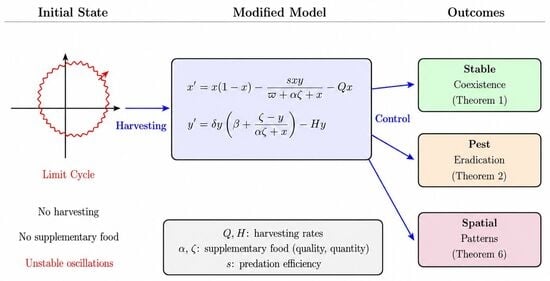
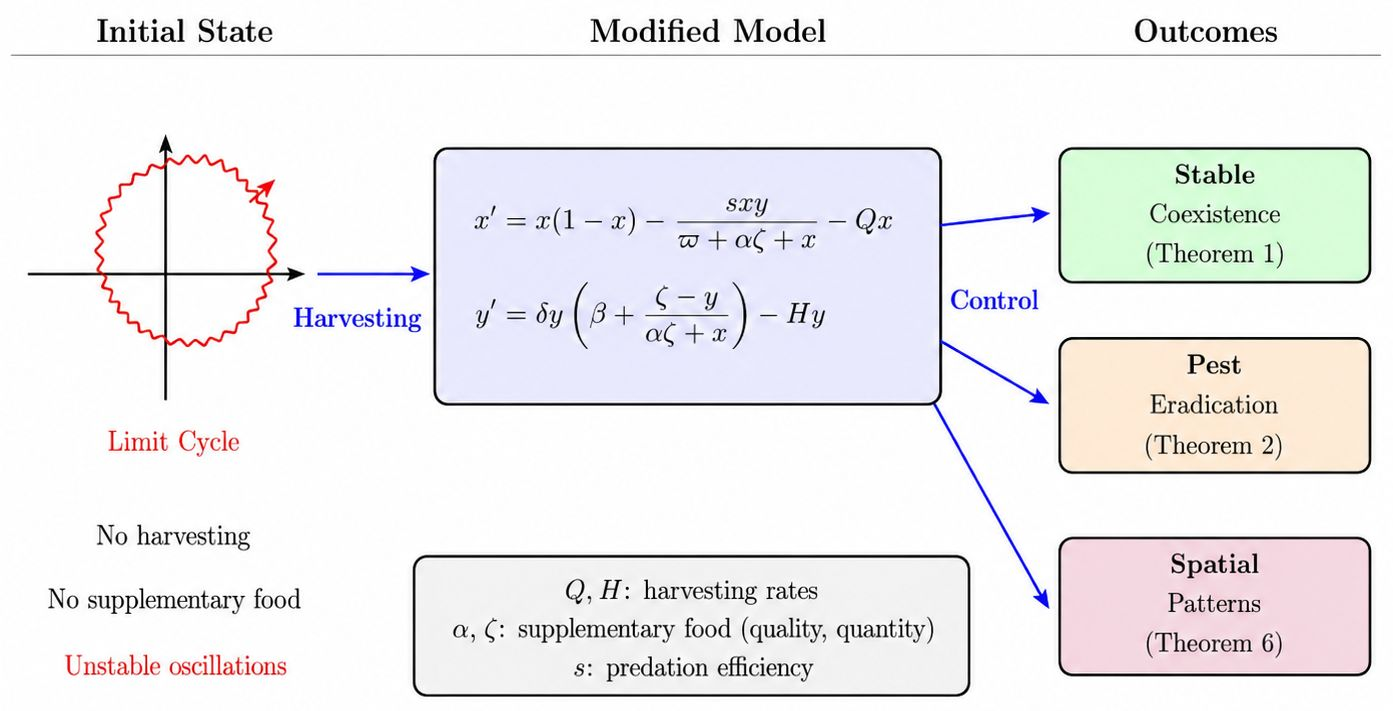
In this work, we analyze a modified Holling–Tanner predator–prey model that incorporates linear harvesting in both populations and supplementary food for the predator. The objective is to determine how harvesting alters the qualitative dynamics of the system and to identify parameter regions corresponding to coexistence, oscillatory behavior, and prey extinction.
We derive explicit conditions for the existence and stability of equilibria and show that harvesting parameters directly affect the discriminant of the equilibrium equation as well as the associated stability criteria. A key result is the identification of a critical predation threshold separating stable coexistence from oscillatory dynamics. This demonstrates that harvesting acts as a control parameter capable of suppressing limit cycles and stabilizing the system.
We further establish sufficient conditions for pest eradication by linking harvesting intensity, predation rate, and the nonexistence of coexistence equilibria. In particular, we show that when no interior equilibrium exists and predation exceeds a critical level, the system converges globally to a prey-free state for all positive initial conditions.
To characterize transitions between dynamical regimes, we analyze local bifurcations. Hopf bifurcation analysis identifies conditions under which periodic oscillations emerge, while saddle–node bifurcation analysis determines when coexistence equilibria disappear. These bifurcations define boundaries between qualitatively distinct dynamical regimes.
Finally, we extend the model to include spatial diffusion and investigate Turing instability. We derive conditions under which diffusion destabilizes a spatially homogeneous equilibrium and induces pattern formation. The results show that harvesting modifies the equilibrium structure and therefore influences the onset of diffusion-driven instability.
The paper is organized as follows.
Section 2 introduces the model and analyzes equilibria and stability.
Section 3 presents bifurcation analysis.
Section 4 studies Turing instability.
Section 5 discusses the implications of the results.
2. Dynamical Aspects of the Model
Building on our earlier framework in [
31], we extend the predator–prey system by incorporating linear harvesting in both prey and predator populations. The model is based on standard ecological assumptions used in predator–prey dynamics. We assume that the prey population grows logistically in the absence of predation, reflecting density dependence caused by limited environmental resources and intraspecific competition. Predator consumption is described by a Holling type II functional response, which captures the saturation of feeding rates at high prey densities due to handling and search limitations.
In addition to predation, both populations are subject to linear harvesting, where individuals are removed at rates proportional to their population densities. This represents external control mechanisms such as harvesting, culling, or resource exploitation. The combined effects of harvesting and predation generate competing ecological forces. Prey harvesting reduces prey abundance and indirectly limits predator growth, while predator harvesting weakens top–down control and may facilitate prey recovery. The balance between these mechanisms determines whether the system approaches coexistence, oscillatory dynamics, or prey eradication.
We further assume that predators have continuous access to supplementary food and distribute their foraging effort between the focal prey and alternative food sources. These food sources interact through a shared handling and assimilation mechanism. As a result, supplementary food modifies the effective semi-saturation level of the functional response, leading to the coupled term
in the denominator. Here,
x denotes prey density, while
represents the effective contribution of supplementary food through its quantity
and quality parameter
. This formulation reflects the ecological assumption that supplementary food alters predator feeding behavior and saturation rather than acting as an independent additive intake. The resulting model is given by
System (
1) is written in non-dimensional form. Time is scaled by the intrinsic growth rate of the prey, and prey density is normalized by its carrying capacity. The parameter
represents a baseline survival contribution supported by supplementary feeding. This term accounts for predator maintenance under external ecological support, rather than autonomous reproduction in the absence of prey. To ensure biological consistency, we assume
so that the effective predator mortality remains positive. This assumption is appropriate in managed biological control systems, where supplementary food may enhance predator survival but does not fully compensate for natural mortality or harvesting losses. All parameters are dimensionless. In particular,
Q and
H denote proportional harvesting rates, while
and
characterize the quality and quantity of supplementary food, respectively.
For analytical convenience, we define the effective predator mortality parameter
which combines direct predator removal through harvesting with survival support induced by supplementary food. The parameter
h is not sign-restricted. Positive values correspond to net predator loss in the absence of prey, while negative values correspond to regimes in which supplementary food support exceeds removal effects, allowing predator persistence even when prey are absent.
Substituting
into System (
1), the term involving
cancels from the predator equation and the system becomes
Although System (
3) is algebraically equivalent to System (
1), we retain the original parameters
H and
in most of the analysis and numerical simulations. This preserves the biological interpretation of harvesting and supplementary-food support as distinct mechanisms and allows direct interpretation of stability thresholds and bifurcation results. The reduced parameter
h is introduced to clarify the net balance between predator removal and external survival support.
For a detailed derivation of the baseline model without harvesting, see [
31].
Table 1 summarizes the biological meaning of the variables and parameters.
Remark 1
(Relation to the source model).
The present model is adapted from Equation (14) of [31]. In the original formulation, the predation term contains the denominator , where the term represents predator interference that increases with predator density. In the present formulation, this term is replaced by the constant ϖ, interpreted as a baseline saturation effect independent of predator density. This modification preserves the core ecological structure of prey growth, predator consumption, supplementary food effects, and conversion efficiency, while enabling analytical tractability. In particular, it allows explicit derivation of threshold conditions for harvesting-induced stabilization, eradication, and diffusion-driven instability. For the original density-dependent interference formulation, see [31].
2.1. Equilibria and Local Stability
Equation (
1) defines a system that exhibits four equilibrium points, indicating the conditions under which the system remains in a steady state.
: extinction of both species; : the predator population faces extinction while the prey population reaches and remains at its maximum sustainable size or carrying capacity; : prey extinction occurs while predators reach their carrying capacity; : a non-trivial equilibrium.
For the interior equilibrium
, we need to solve the following equations:
And from Equation (
4) we have
From Equation (
5) we have
Substituting Equation (
7) into Equation (
6) yields
where
Thus, we have two different cases:
The Jacobian matrix
J for our system is
At an interior equilibrium
, the equilibrium conditions
and
hold, and the Jacobian evaluated at this point simplifies to
Theorem 1.
Assume that the equilibria of System (1) are biologically feasible. Then the local stability properties of the equilibria are as follows: - 1.
The trivial equilibrium is locally asymptotically stable if - 2.
The boundary equilibrium which exists when is locally asymptotically stable if - 3.
which exists when is locally asymptotically stable if - 4.
Let be an interior equilibrium, whose existence conditions are specified in the preceding analysis. Define Then is locally asymptotically stable if and only if
The condition defines a critical predation threshold. Below this threshold, the interior equilibrium remains stable, while exceeding it leads to instability and the emergence of oscillatory dynamics. This identifies predation intensity as a key control parameter governing system behavior.
Proof. Assume that the equilibrium points of System (
1) are biologically feasible. Their local stability is determined by evaluating the Jacobian matrix at each equilibrium point.
At the trivial equilibrium point
, the Jacobian matrix is
Therefore,
is locally asymptotically stable if and only if
At the boundary equilibrium point
, the Jacobian matrix is
Since
, the equilibrium
is locally asymptotically stable if and only if
At the boundary equilibrium point
the Jacobian matrix is
Since
, the equilibrium
is locally asymptotically stable if and only if
At the non-trivial equilibrium point
, the Jacobian matrix of System (
1) is
where
Using the equilibrium conditions
and
, these entries simplify to
The trace condition
gives
The determinant condition
simplifies to
Substituting
gives
Since
, the determinant condition becomes
Multiplying through by
and rearranging for
s yields
Substitute
:
Therefore, the inequality simplifies dramatically to
Under the positivity condition
, then
, and the inequality yields an upper bound on
s:
□
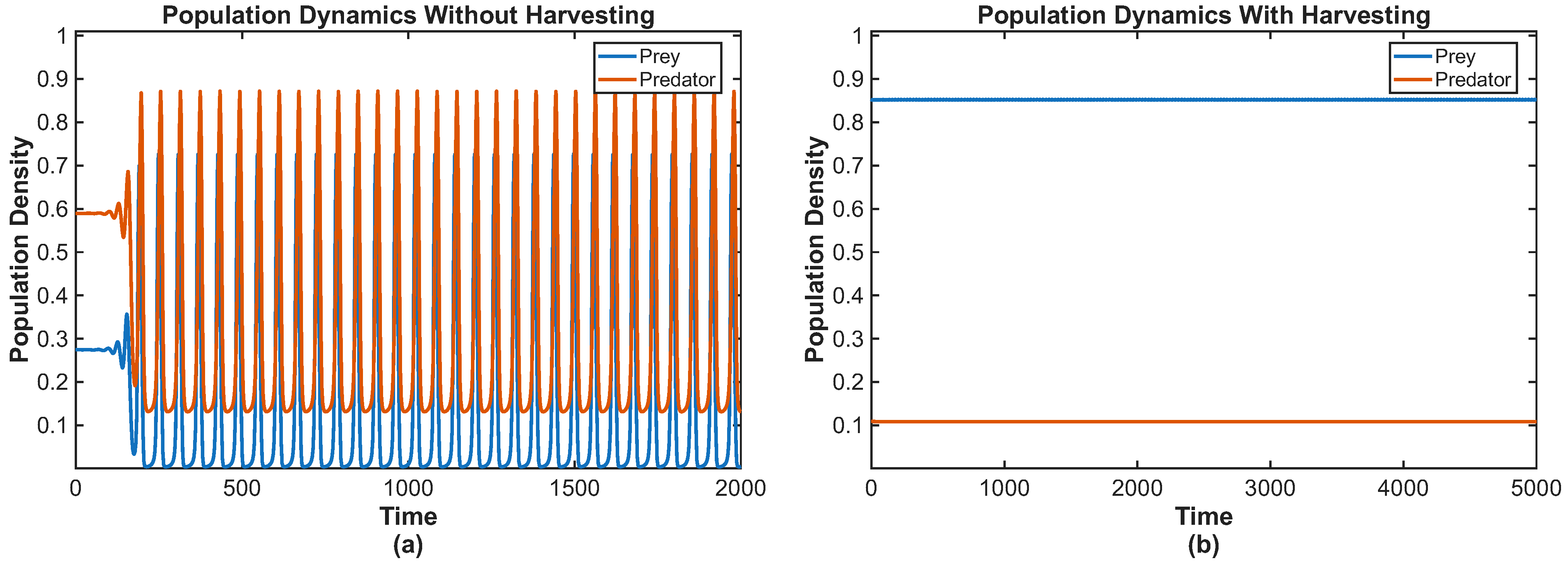
Adding linear harvesting transforms an unstable predator-prey system into a stable one by balancing predation dynamics. Specifically, the harvesting rate can shift the dynamics from chaotic cycles to a stable equilibrium (see
Figure 1).
2.2. Cyclical Dynamics
In this section, we investigate the impact of harvesting on the dynamics of the predator–prey system described by (
1). Our goal is to demonstrate that, for any initial condition in the first quadrant
, the system’s trajectories remain confined within a bounded region. This property ensures that the populations neither grow without bound nor collapse to negative values, reflecting biologically realistic behavior.
To formalize this observation, we first state the following proposition.
Lemma 1
([
32])
. If , , and for with , thenIf , , and for with , then Proposition 1.
Assume that the parameters satisfyFor any positive initial conditions, the solutions , of System (
1)
remain positive for all and are uniformly ultimately bounded. Moreover, the following estimates hold: Proof. Positivity follows from the invariance of the coordinate axes, since and .
From the first equation of (
1), we have the differential inequality
Using Lemma 1 and the assumption
, we obtain
Hence, for any , there exists such that for all .
For the second equation, we rewrite it as
For
, using
and the monotonicity of
, we obtain
Because
is arbitrary, taking
gives the desired bound
Therefore, and are uniformly ultimately bounded, completing the proof. □
Proposition 2.
Consider System (
1)
, and let denote an interior equilibrium point with strictly positive coordinates. Assume that the system parameters satisfyUnder these conditions, System (
1)
has at least one closed orbit lying entirely within the first quadrant of the plane. Proof. If the conditions above lead to
, the interior positive equilibrium
is unstable (either an unstable node or focus). By Proposition 1 together with the Poincaré–Bendixson theorem [
33], trajectories starting sufficiently close to the equilibrium must form a periodic orbit around it. □
This result implies that the system exhibits sustained oscillatory behavior around the interior equilibrium, and the trajectory does not intersect the axes, remaining strictly positive for both variables. Such behavior is typical in predator–prey and ecological models where populations coexist and undergo persistent cycles.
2.3. Global Stability and Pest Eradication
Prey harvesting directly reduces prey density, thereby limiting resource availability for predators, whereas predator harvesting diminishes top–down regulation of the prey population. These opposing effects generate competing mechanisms: prey removal suppresses population growth, while predator removal alleviates predation pressure. The interplay between these processes determines whether the system approaches a stable equilibrium, exhibits sustained oscillations, or undergoes collapse.
In contrast, when harvesting is coupled with the provision of alternative food sources for predators, the system dynamics are fundamentally altered. In particular, the predator population can persist independently of the prey, leading to the emergence of a boundary equilibrium . The following theorem formalizes the conditions under which this equilibrium is globally stable.
Theorem 2
(Pest Eradication)
. Consider the predator–prey system in (1). Suppose that:- 1.
The prey-free equilibrium is biologically feasible: - 2.
The predation rate is sufficiently large: - 3.
The quadratic equation, Equation (8), satisfies ensuring that no interior equilibrium exists in the positive quadrant. Then the prey-free equilibrium
is globally asymptotically stable for every initial condition with , . Proof. We begin with local stability. From Theorem 1, the equilibrium
is locally asymptotically stable if and only if
which is equivalent to the condition (2). Hence
is locally asymptotically stable.
Next, Proposition 1 ensures that all solutions with and remain positive and bounded for all . In particular, every trajectory admits a nonempty, compact, and invariant omega-limit set.
We now examine the boundary equilibria. At the origin
, the eigenvalues are
Assumption (1) of Theorem 2 guarantees that . Moreover, since , it follows that , and hence . Therefore, is an unstable node and cannot attract trajectories starting in the interior of the first quadrant.
At the axial equilibrium
, the eigenvalues are
Under assumption (2) of Theorem 2, one verifies that , so that is a saddle point. Its stable manifold lies entirely on the x-axis, and therefore trajectories with cannot converge to .
By the assumption (3), there is no equilibrium in the interior , . Suppose a periodic orbit existed in . By the index theorem, must enclose at least one equilibrium. The only equilibria are , , and , all of which lie on the boundary or . However, a closed curve contained entirely in , cannot enclose a point on the axes without intersecting them, contradicting the invariance of the axes. Hence, no periodic orbit exists.
By the Poincaré–Bendixson theorem, the omega-limit set of any trajectory in the positive quadrant must therefore reduce to an equilibrium. Since
and
cannot attract interior trajectories, the only remaining possibility is
. It follows that
for all initial conditions with
,
. This proves that
is globally asymptotically stable. □
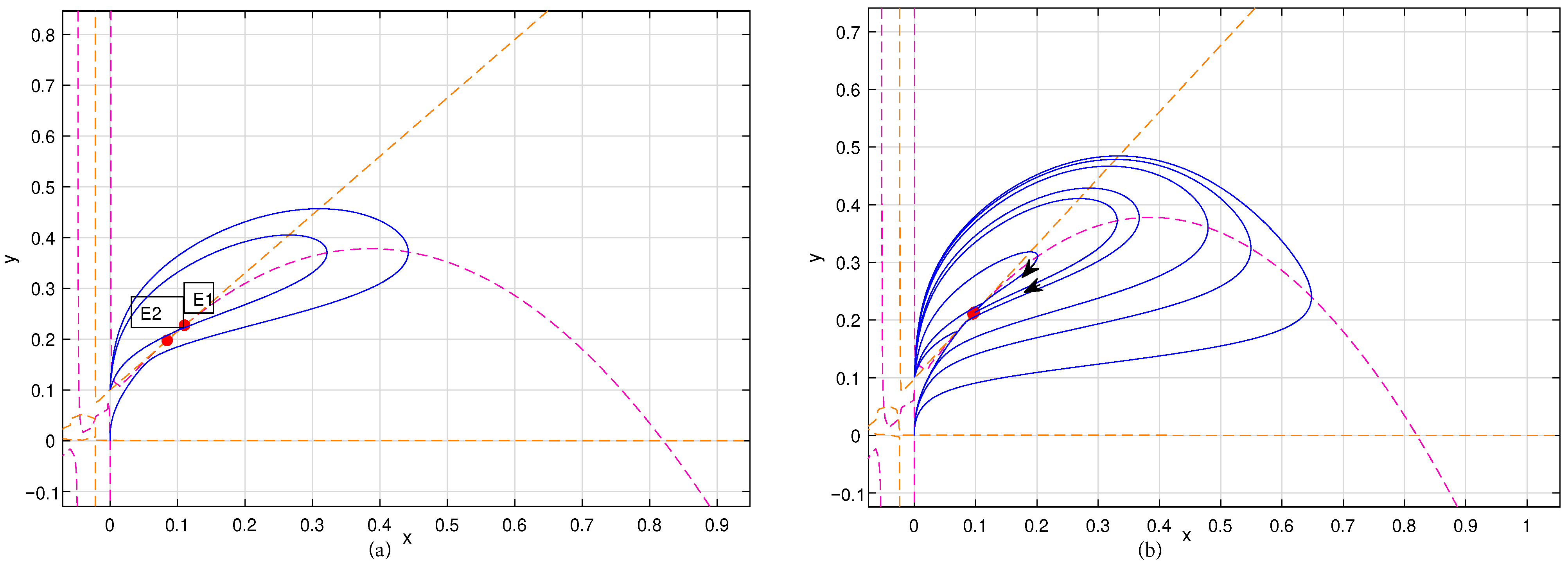
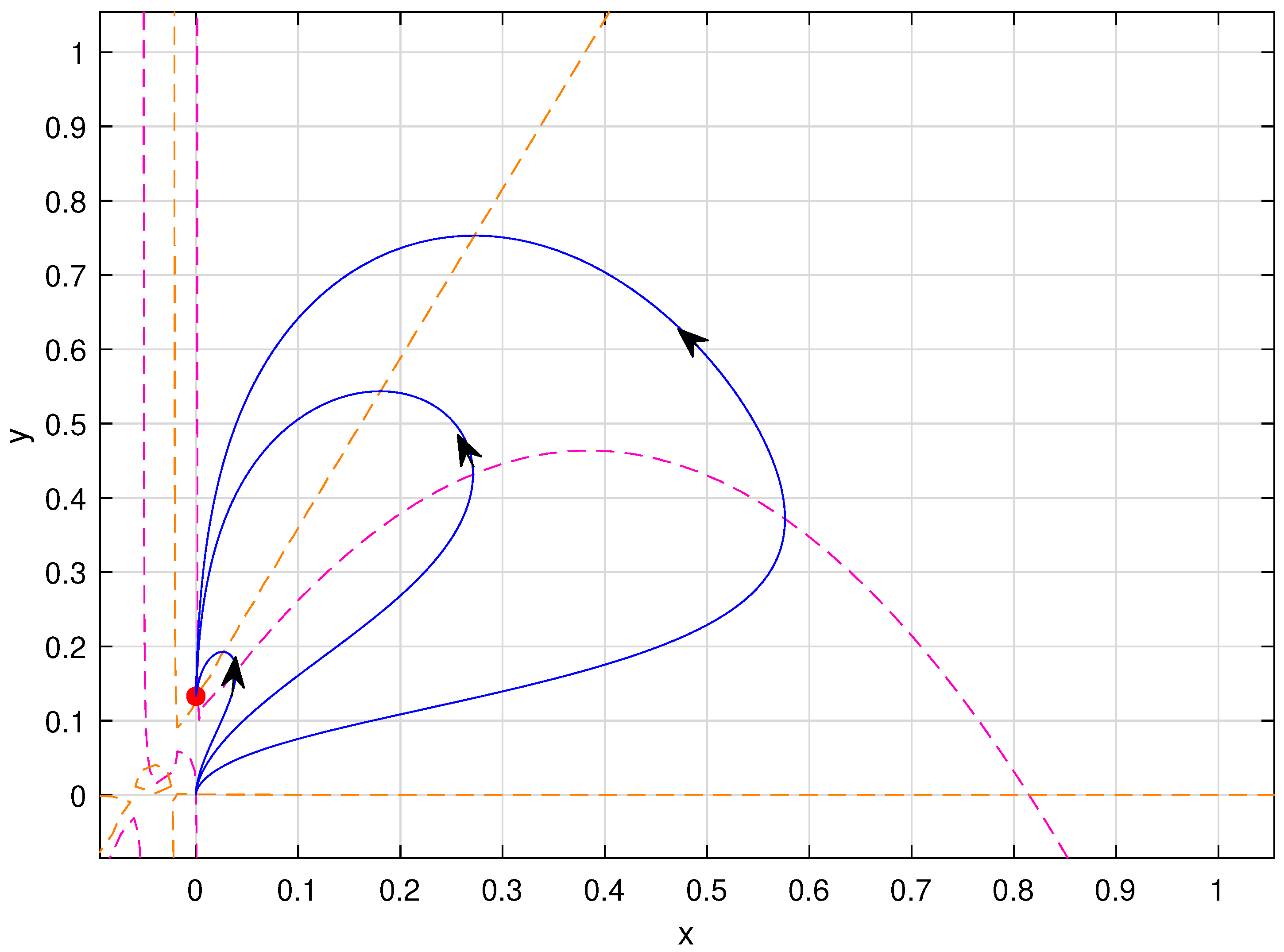
This result shows that prey eradication arises from the combined effect of sufficiently strong predation and harvesting (see
Figure 2). Harvesting alone does not guarantee eradication but shifts the parameter region in which predator dominance becomes possible.
Proposition 3.
Assume that and For any fixed value of the additional food quality , there exists a sufficiently large such that Hence, if the system admits no interior equilibrium in the region , , then the prey population is eradicated for all positive initial conditions.
Proof. From Theorem 2, pest eradication occurs provided that
Substituting
into the inequality yields
Because the left-hand side of the assumption is strictly less than this limit, there exists a sufficiently large
satisfying the condition. □
4. Turing Instability
In ecological systems, a homogeneous equilibrium that is stable in a non-spatial model may become unstable once spatial processes, such as diffusion, are introduced. This phenomenon is known as Turing instability, or diffusion-driven instability [
36,
37].
We incorporate spatial structure by allowing both populations to move across space, modeling random movement as isotropic diffusion:
The system is defined over a bounded spatial domain with Neumann boundary conditions for with .
Remark 3.
Turing instability does not occur for arbitrary parameter choices. Only within a specific range, often called the Turing space, does diffusion destabilize a previously stable equilibrium.
Our goal is to identify the conditions under which Turing patterns can emerge in System (
35), particularly considering whether harvesting alone can induce instability.
To do this, we linearize the system around its homogeneous steady state , which corresponds to the equilibrium under harvesting. Small spatial and temporal perturbations are introduced to evaluate stability.
Following [
36], Turing instability occurs if the following conditions on the Jacobian matrix of the reaction terms and diffusion coefficients are satisfied.
Theorem 5
(Turing Instability Condition)
. Let be a spatially homogeneous equilibrium with Jacobian matrix and diffusion coefficients . Ifthen the equilibrium is stable without diffusion but unstable in its presence. A necessary structural requirement is summarized in the following proposition.
Proposition 4
(Necessary Condition). If is stable in the absence of diffusion but unstable when diffusion is included, then either of the following are true, where is the Jacobian matrix of the reaction terms:
- 1.
and ;
- 2.
and .
For System (
35), the Jacobian matrix evaluated at
is
Observe that
Hence, the second part of Proposition 4 can hold. Consequently, a necessary condition for diffusion-driven instability is
Biologically, this requires the prey population to exhibit local positive feedback near equilibrium (e.g., due to harvesting effects reducing effective self-regulation). While this condition is necessary, it is not sufficient for pattern formation; additional constraints involving diffusion rates and cross-interactions are required.
Theorem 6.
Let be the positive spatially homogeneous interior equilibrium of System (
35)
, with and diffusion coefficients . Defineand diffusion coefficients . Ifthen is locally asymptotically stable for the reaction system (without diffusion) but becomes unstable when diffusion is introduced, leading to the emergence of spatial patterns via Turing instability. Proof. Let
denote the spatially homogeneous equilibrium of System (
35). We first analyze the stability of this equilibrium for the corresponding kinetic system obtained by neglecting the diffusion terms.
The Jacobian matrix evaluated at
is
According to Theorem 1, the equilibrium of the reaction system is locally asymptotically stable provided that
From Theorem 1, the trace condition
is satisfied whenever
Similarly, the determinant condition
holds provided that
with the requirement that
.
In addition, Proposition 4 shows that a necessary requirement for diffusion-driven instability is
(since
). From the explicit expression of
, the condition
is satisfied whenever
Consequently, if
then the equilibrium
is locally asymptotically stable for the reaction system in the absence of diffusion, with
and
.
Now let
be the diffusion matrix. Introducing normal mode perturbations of the form
where
k denotes the spatial wave number, substitution into System (
35) yields
Thus the characteristic equation becomes
where
and
To identify the dominant unstable mode, we differentiate
with respect to
. This gives the critical wave number
The wave number corresponds to the fastest-growing unstable mode and determines the dominant spatial wavelength of the emerging pattern.
By Theorem 5, diffusion destabilizes the equilibrium whenever
Substituting the entries of the Jacobian matrix into condition (40) yields
and substituting the entries of the Jacobian matrix into condition (40) yields
The determinant
is given by
Therefore, under the assumptions of the theorem, the equilibrium
remains stable for the reaction system (since
) but loses stability once diffusion is introduced, as the Turing conditions (
40) and (
41) are satisfied.
Hence diffusion induces instability of the homogeneous state, and the system admits diffusion-driven (Turing) instability, leading to the emergence of spatial patterns. □
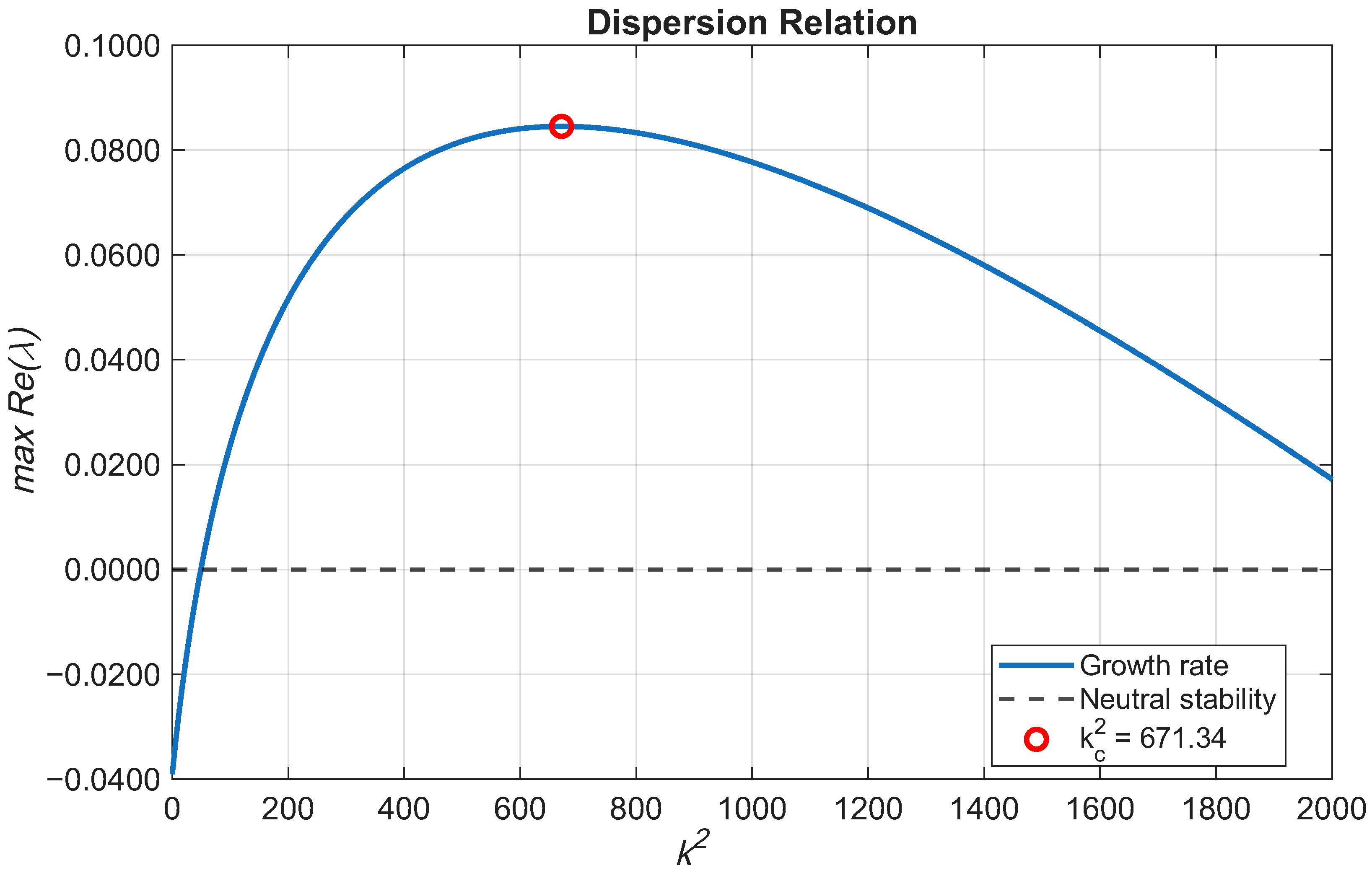
For the parameters used in
Figure 6, the numerical evaluation of
is shown in
Figure 7. The curve satisfies
, confirming that the homogeneous equilibrium is stable in the absence of diffusion. However,
for an interval of wavenumbers
, confirming diffusion-driven instability. The peak occurs at
, which identifies the dominant unstable mode responsible for the pattern wavelength observed in the nonlinear simulation.
These results indicate that harvesting influences the Turing instability region indirectly through its impact on the equilibrium values
. In particular, increasing harvesting shifts the stability boundary and, depending on parameter interactions, may either promote or suppress the onset of spatial pattern formation. The dispersion analysis in
Figure 6 confirms the existence of unstable spatial modes predicted by Theorem 6.
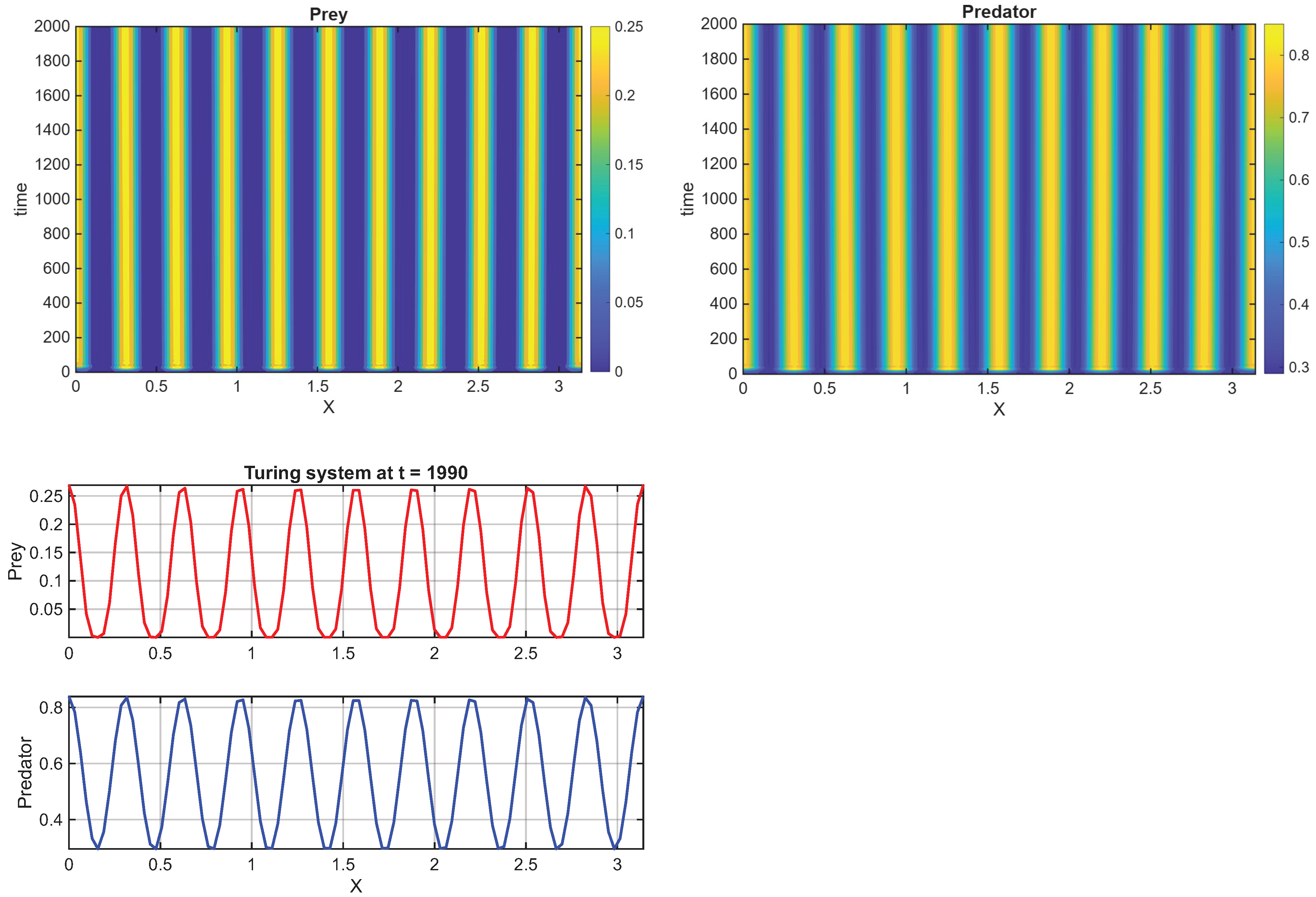
Figure 7 then illustrates the resulting nonlinear spatial patterns. When predator diffusion exceeds that of the prey, diffusion-driven instability generates heterogeneous regions of high and low density, leading to the emergence of characteristic spatial patterns.
The spatial distributions shown in
Figure 7 reveal that diffusion can destabilize an otherwise homogeneous coexistence state and generate persistent heterogeneous population structures. Ecologically, these Turing patterns correspond to the spontaneous formation of prey-rich and prey-poor patches across the habitat, even when environmental conditions are spatially uniform. Regions with high prey density may represent localized pest refuges where prey temporarily escape intense predation, whereas regions with low prey density indicate effective predator suppression.
The corresponding predator distribution follows these prey aggregations, creating alternating zones of predator concentration and prey abundance. Such spatial self-organization has been reported in many ecological systems, including agricultural pest–natural enemy interactions, insect population dynamics, and fragmented landscapes, where predator mobility often exceeds that of prey.
Our analysis shows that this spatial heterogeneity emerges when predator diffusion exceeds prey diffusion (), allowing predators to rapidly track local prey concentrations. In addition, harvesting indirectly influences the emergence of these patterns by modifying the equilibrium densities and consequently shifting the system into or out of the Turing instability region. Moderate harvesting may therefore promote spatial pattern formation by enhancing local prey growth feedback, whereas excessive harvesting can suppress pattern formation by reducing population densities below the threshold required for diffusion-driven instability.
These findings suggest that harvesting affects not only population abundance but also the spatial organization of ecological communities, with direct implications for biological control and landscape-level pest management.
5. Discussion and Conclusions
In this study, we explored how linear harvesting, together with supplementary food for predators, shapes the dynamics of a modified Holling–Tanner predator–prey system. Unlike our previous work [
31], where we looked at additional food alone but left out harvesting, here we brought harvesting into the picture—and we found it is a real game-changer. Our main finding is that harvesting does a lot more than just shrink population sizes; it can fundamentally change whether the system stabilizes, drives a pest to extinction, or even forms spatial patterns when movement is taken into account.
Before diving into the ecological implications, a quick word of caution. Our mathematical analysis covers the entire parameter space of System (
1), but not every mathematically valid combination makes ecological sense. Extremely high harvesting rates or very low population densities can produce equilibrium values that are hard to realize in real-world settings. So, whenever we interpret our results ecologically, we focus on biologically feasible regions where both prey and predator populations stay positive and meaningful.
Our results differ from closely related work in several important respects. Ref. [
27] concluded that linear harvesting invariably destabilizes predator–prey systems, inducing chaos. In contrast, we show (Theorem 1) that linear harvesting can be stabilizing when additional food quality is sufficiently high—a novel finding that challenges the generality of their claim. Unlike [
26], who focused on cannibalism-driven outbreaks, our model excludes cannibalism to isolate the pure harvesting–additional food interaction, allowing us to prove explicit eradication thresholds (Theorem 2) that do not appear in their work. While [
28] warned that arbitrary control choices lead to unpredictable outcomes, we provide biologically interpretable conditions (Proposition 3) that guarantee pest suppression. Finally, compared to stage-structured [
29] and food-chain [
30] models, our simpler two-species framework with prey behavioral responses yields closed-form Turing conditions (Theorem 6) that are directly applicable to spatial biological control. Collectively, these distinctions clarify the specific novelty of the present contribution regarding harvesting as a control parameter and its interaction with additional food.
We now discuss the non-spatial system. Without any harvesting, the model tends to produce sustained oscillations—you can see this in the left panel of
Figure 1. By working through the equilibrium analysis in
Section 2, we found that the system can have up to two interior equilibrium points, depending on whether the discriminant
is positive, zero, or negative. Theorem 1 then gives us precise conditions for when each equilibrium is locally stable. In particular, if the predation efficiency
s stays below
, the interior equilibrium
is locally asymptotically stable. What is really interesting is that introducing a moderate amount of harvesting can actually help satisfy that inequality. As a result, it dampens those boom–bust oscillations and pushes the system toward a stable equilibrium—see the right panel of
Figure 1. Biologically, this means that if we pick harvest rates carefully, we can prevent those wild population swings that often plague fisheries or pest outbreaks, making populations far more predictable and easier to manage.
Pest eradication is addressed in
Section 2, which derives the conditions under which the prey-free equilibrium
is globally stable. Theorem 2 tells us that when predation is strong enough—specifically, when
—and no interior equilibrium exists (that is,
), the prey-free state attracts all trajectories starting from positive initial conditions. That is, for any positive initial condition, the prey eventually goes extinct while the predator hangs on, thanks to alternative food and harvesting.
Figure 2 shows this numerically. From a practical standpoint, if your predators are efficient and you give them enough supplementary food, you can wipe out a pest without losing the predator population. That is a pretty clear strategy for biological control: maintain a predator-only state that keeps any future pest invasion in check. This result goes beyond our earlier work [
31]—there, we did not consider harvesting at all, so we could not show how harvesting can be tuned to eliminate the coexistence equilibrium entirely.
In the case where the supplementary food is of lower quality, Proposition 3 establishes sufficient conditions under which pest eradication remains achievable. It shows that for any fixed food quality (), as long as is smaller than , you can simply increase the amount of additional food enough to satisfy the eradication condition. In other words, even modest-quality food can tip the balance in favour of the predator if you provide enough of it. This is advantageous for field applications where high-quality food might be too expensive or hard to come by.
We also came across two key bifurcations, which we analysed in detail in
Section 3. Theorem 3 shows that a Hopf bifurcation occurs when
s crosses the critical value
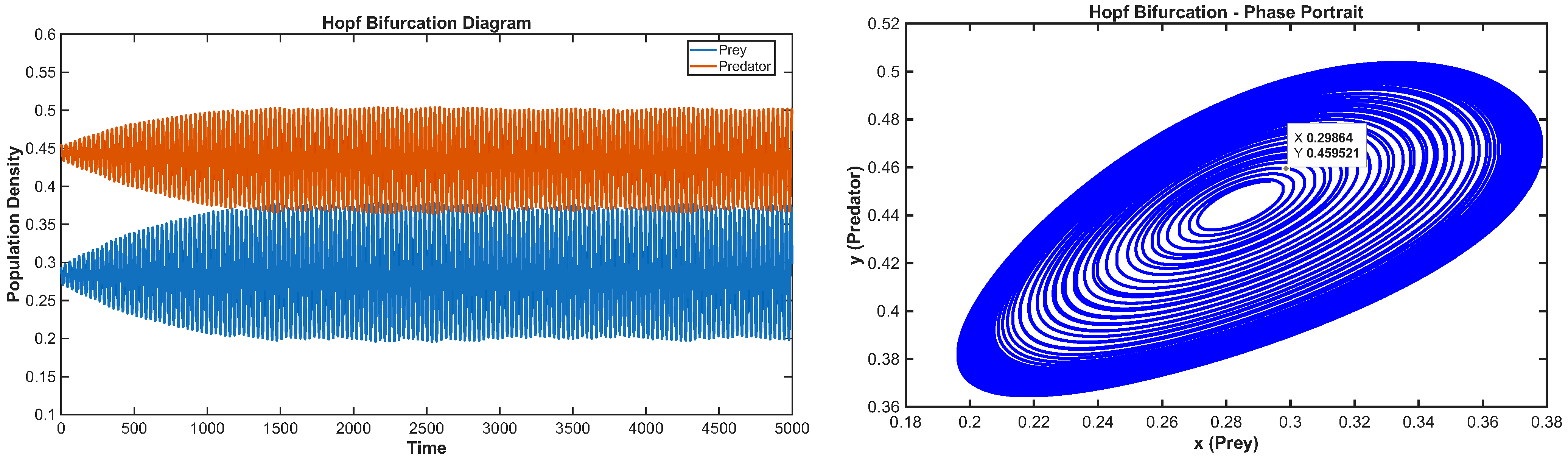
At this critical value the system switches from a stable equilibrium to a limit cycle—see
Figure 3. We also checked the transversality condition
, so we know the bifurcation is genuine. Biologically, this marks the transition from predictable coexistence to cyclic booms and crashes, exactly the kind of regime managers usually want to avoid. Then there is the saddle–node bifurcation (Theorem 4), which happens when
reaches
such that the discriminant
. Here, two interior equilibria—one stable, one unstable—merge and vanish (
Figure 4). Using Sotomayor’s theorem, we verified that
and
, so the bifurcation is generic. Beyond this point, predator and prey can no longer coexist, and the system collapses to a boundary state where either the prey or the predator goes extinct. This is essentially an ecological tipping point: even a gradual environmental change, like a slight decline in baseline predator reproduction
, can trigger a sudden regime shift. This underscores the importance of staying within safe parameter ranges.
When spatial movement is incorporated, the system exhibits an additional layer of complexity through diffusion-driven instability. In
Section 4, we derived explicit conditions under which a spatially homogeneous equilibrium loses stability after diffusion is introduced. The necessary condition is
, which defines a threshold for prey self-activation near equilibrium. Combining this with the local stability conditions of Theorem 1 yields a Turing window,
Within this parameter region, differences in predator and prey dispersal rates can destabilize the uniform coexistence state and generate stationary spatial patterns. Numerically, when predator diffusion exceeds prey diffusion, the populations self-organize into alternating regions of high and low density, producing persistent spatial patchiness (
Figure 7).
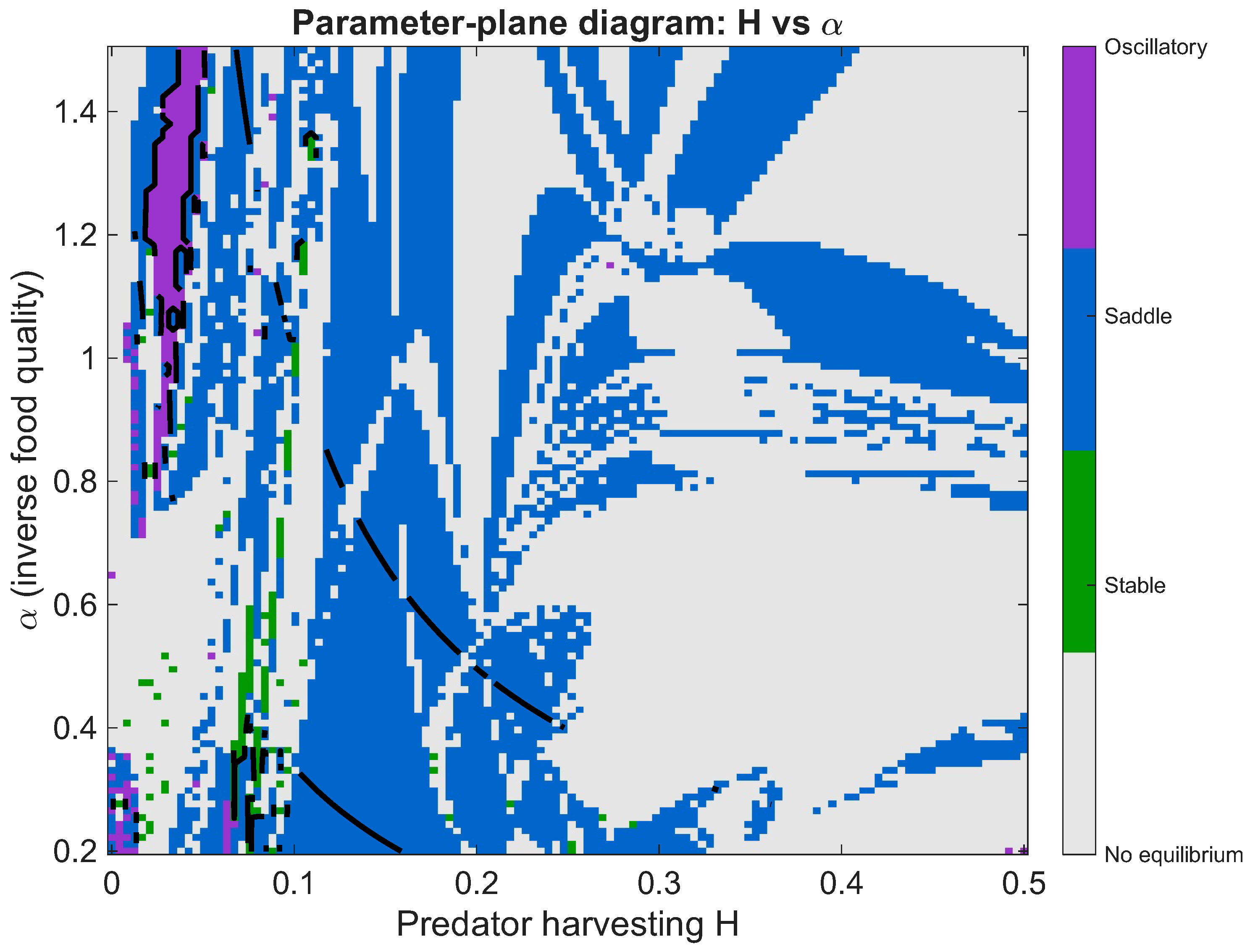
Overall, linear harvesting is a double-edged sword. Used carefully, it can stabilize otherwise chaotic dynamics (Theorem 1), help eradicate pests (Theorem 2 and Proposition 3), and even promote spatial patterning (Theorem 6). But cross those critical thresholds—Hopf or saddle–node bifurcations—and you risk sudden collapses or unwanted oscillations (Theorems 3 and 4). Our results provide clear mathematical conditions, summarised in
Table 2, that ecologists and resource managers can use to choose harvesting rates and supplementary food levels that keep the system in a desirable, stable regime. By connecting theoretical ecology to practical management, we hope this work contributes to more effective and resilient strategies for agriculture, conservation, and natural resource management.
From an ecological perspective, these patterns may represent localized pest outbreaks, prey refuges, or predator aggregation zones, phenomena commonly observed in agricultural systems and fragmented habitats. Such spatial heterogeneity can emerge even in environmentally uniform landscapes purely through local species interactions and differential movement.
An important ecological finding of this study is that harvesting can shift the system into or out of this Turing region by altering the equilibrium population densities and local interaction strengths. Consequently, harvesting acts not only as a population control mechanism, but also as a regulator of spatial ecological organization. This suggests that harvesting strategies may influence where pest outbreaks occur across a landscape, not only how large populations become.
5.1. Advantages of the Modeling Framework
The model presented here offers several advantages for understanding harvesting-induced regime shifts in predator–prey systems with supplementary food. First, the simplified functional response (Remark 1) renders the equilibrium and stability analysis fully explicit, yielding interpretable threshold conditions (Theorem 1) that directly link harvesting efforts Q and H to stability outcomes. Second, the analytical derivation of the Hopf bifurcation threshold (Theorem 3) identifies predation intensity as a key bifurcation parameter, providing a clear mechanistic explanation for the onset of oscillatory dynamics. Third, all stability conditions are expressed in terms of ecologically meaningful parameter combinations, facilitating comparative studies across different systems without requiring extensive numerical exploration.
Our analysis reveals several notable results. The trivial equilibrium loses stability when prey harvesting is low () or predator harvesting is low (), consistent with the ecological expectation that harvesting pressure can drive extinction. More intriguingly, the interior equilibrium loses stability through a Hopf bifurcation when the predation rate s exceeds . The threshold reflects a balance between prey growth and predation pressure at equilibrium, while encodes the effect of supplementary food on predator self-limitation. The condition , required for to be defined, identifies a parameter regime where predator self-regulation is sufficiently strong to permit stable coexistence.
5.2. Limitations, Disadvantages, and Future Directions
Despite the analytical and numerical results obtained in this study, several limitations remain, and they naturally suggest directions for further work.
The model relies on a simplified representation of predator interference by replacing the density-dependent term with a constant (see Remark 1). This reduction removes an important feedback mechanism. In systems where interference increases strongly with predator density, the current formulation may distort the predicted stability region of the interior equilibrium, either inflating or shrinking it relative to more realistic dynamics.
The assumption of supplementary food as uniformly beneficial is also restrictive. The model does not account for cases where additional food is of poor quality or toxic, which can reduce predator efficiency or alter functional responses. This limits direct application to ecological settings where food quality varies.
The spatial analysis remains incomplete. Although
Figure 7 shows spatial pattern formation consistent with Turing instability, the analysis does not yet include the full dispersion relation
across wavenumbers, nor the explicit derivation of the critical wavenumber
or parameter conditions for Turing instability. Without these components, the distinction between true diffusion-driven instability and alternative pattern-forming mechanisms is not fully rigorous. A complete linear stability analysis in Fourier space would strengthen the spatial conclusions and provide clearer parameter thresholds.
The study also focuses primarily on the local stability of equilibria. Global dynamics, including basin structures, coexistence regions, and the stability of periodic orbits, are not analyzed and may significantly affect long-term behavior.
Future work should address these limitations directly. Extending the model to include the original density-dependent interference term would allow a more realistic assessment of predator interactions and their effect on bifurcation structure, particularly the Hopf threshold. In addition, incorporating stochastic perturbations, whether demographic or environmental, would test the robustness of the deterministic predictions and clarify how finite-size effects modify stability and pattern formation outcomes.
5.3. Conclusions
In summary, the model shows that harvesting and supplementary feeding jointly determine the qualitative dynamics of predator–prey systems. Harvesting modifies stability thresholds, while supplementary food alters predator efficiency and shifts bifurcation boundaries.
The system exhibits three main regimes: stable coexistence, oscillatory dynamics through Hopf bifurcation, and collapse through saddle–node bifurcation. Diffusion introduces spatial instability leading to Turing pattern formation under parameter mismatch in dispersal rates.
Harvesting acts as a control parameter with dual effects. It can stabilize population oscillations under moderate levels, but it can also drive extinction or instability when excessive. The interaction with supplementary food determines whether the system remains in a stable regime or transitions to oscillatory or extinct states.
All analytical results are valid within biologically meaningful parameter ranges where population densities remain positive and predator growth does not exceed harvesting losses. Within this regime, the model provides explicit thresholds for ecological control and clarifies how harvesting and food supplementation can be tuned to achieve stability or eradication outcomes.
From an ecological management perspective, the results reveal three important implications. First, increasing prey harvesting can reduce pest abundance, but excessive harvesting may destabilize coexistence dynamics. Second, high-quality supplementary food can enhance predator persistence and improve biological control efficiency. Third, poor nutritional supplementation may weaken predator performance and delay pest suppression, emphasizing that both food quantity and food quality must be considered in integrated pest management strategies.