1. Introduction
Corporate taxation represents a fundamental pillar of national fiscal systems, providing governments with critical revenues to finance public infrastructure, social programs, and long-term economic development. However, corporate tax avoidance—defined as the use of legal strategies to minimize tax liabilities—has become an increasingly debated issue in both academic research and policy discussions. Although such practices may comply with existing regulations, aggressive tax planning can erode public revenues, increase fiscal inequality, and raise concerns regarding corporate transparency and accountability [
1,
2]. In this context, tax avoidance reflects not only efficient financial management but also potential managerial opportunism, highlighting the importance of effective CG mechanisms.
A substantial body of research emphasizes the role of governance structures in constraining opportunistic financial behavior. From an agency theory perspective, managers may engage in aggressive tax planning to enhance short-term performance or meet shareholder expectations, even when such strategies increase regulatory and reputational risks [
3]. Effective governance mechanisms—particularly active and independent boards—are therefore expected to mitigate managerial opportunism and promote more responsible financial decision-making [
4]. However, empirical findings remain mixed. While some studies document a disciplining role of governance in reducing tax avoidance, others report weak or context-dependent effects, suggesting that governance structures alone may be insufficient to constrain complex financial strategies [
5,
6,
7]. These inconsistencies suggest that governance effectiveness depends not only on board structure but also on the informational environment and complementary organizational capabilities available to firms.
Within the CG literature, BGD has received increasing attention as a mechanism that may enhance monitoring quality and financial discipline. Gender-diverse boards are often associated with broader perspectives in decision-making, more rigorous deliberation processes, and greater sensitivity to ethical and reputational considerations. Several studies report that firms with higher female board representation exhibit more conservative financial behavior and lower levels of tax aggressiveness [
8,
9]. However, other studies find weaker or insignificant relationships, particularly in environments characterized by institutional constraints or limited access to high-quality information [
5,
7]. This mixed evidence suggests that the effectiveness of gender diversity is not universal, but rather conditional on the informational and institutional context within which boards operate.
At the same time, rapid technological development is reshaping corporate governance practices. AI and digital transformation technologies are increasingly embedded in firms’ decision-making systems, financial analytics, and internal control processes. By enabling the processing of large volumes of data and facilitating real-time anomaly detection, AI can strengthen monitoring, enhance transparency, and improve regulatory compliance [
10,
11]. Empirical evidence further suggests that digital transformation reduces corporate tax avoidance by improving internal control systems, lowering information asymmetries, and increasing external scrutiny [
12,
13,
14]. From this perspective, AI functions as a governance-enabling capability that enhances the informational environment within which boards operate.
However, the governance implications of AI are not unambiguously positive. Advanced analytical tools may also enable more sophisticated tax planning strategies by facilitating complex financial modeling and the management of intangible assets [
15,
16]. Accordingly, the impact of AI on corporate tax behavior is inherently conditional. When governance mechanisms are strong, AI may enhance monitoring effectiveness and transparency; when governance is weak, it may facilitate opportunistic financial behavior. This dual role highlights the importance of examining the interaction between technological capability and governance structures.
Despite the growing literature on CG and digital transformation, limited empirical research examines how technological capabilities interact with board characteristics—particularly BGD—to influence corporate tax avoidance. This gap is especially relevant in developing economies, where governance institutions and regulatory enforcement are relatively weaker, and internal governance mechanisms play a critical role in shaping corporate behavior.
Against this background, the present study investigates whether AI capability moderates the relationship between BGD and corporate tax avoidance. Using a panel dataset of 1586 non-financial firms from developing economies over the period 2009–2023, the study examines whether digital technological capability strengthens the governance role of gender-diverse boards in constraining opportunistic tax behavior. AI capability is measured using a disclosure-based AI adoption index that captures firms’ engagement with intelligent technologies. To ensure robust inference, the empirical analysis combines firm FE models, dynamic two-step System GMM estimation, and an instrumental variable (2SLS) approach to address unobserved heterogeneity, dynamic endogeneity, and potential reverse causality.
The findings indicate that firms with greater BGD exhibit lower levels of tax avoidance. More importantly, AI capability significantly strengthens this relationship, suggesting that technological capacity enhances the monitoring effectiveness of gender-diverse boards. These results contribute to the literature in three important ways. First, they provide new evidence on the role of BGD in improving tax compliance in developing economies. Second, they identify AI capability as a governance-enabling resource that enhances transparency and monitoring effectiveness. Third, they demonstrate that governance structures and technological capabilities operate as complementary mechanisms in shaping corporate financial behavior.
Overall, this study highlights the importance of integrating governance structures with digital capabilities to strengthen corporate accountability and fiscal discipline. The findings provide important implications for policymakers, regulators, and corporate stakeholders seeking to improve governance quality and tax compliance in developing economies.
2. Literature Review
2.1. Corporate Tax Avoidance as a Governance Outcome
Corporate tax avoidance is increasingly conceptualized as a governance-related outcome rather than merely a technical financial strategy. While tax planning can enhance firms’ after-tax cash flows, aggressive tax avoidance may expose firms to regulatory scrutiny and reputational risks [
2]. Accordingly, corporate tax behavior reflects not only managerial efficiency but also the effectiveness of internal monitoring and accountability mechanisms within organizations [
4].
From an agency theory perspective, tax avoidance may arise when information asymmetries enable managers to pursue strategies that enhance financial performance while reducing transparency. Desai and Dharmapala [
1] argue that tax sheltering can be associated with managerial opportunism in the presence of weak governance, whereas Hanlon and Heitzman [
2] emphasize that tax outcomes depend critically on monitoring quality and managerial incentives. This perspective highlights the central role of governance mechanisms in shaping firms’ tax strategies.
Empirical research provides substantial evidence on the relationship between governance and corporate tax behavior, although findings remain inconclusive. Several studies report that stronger governance mechanisms—such as board independence and effective audit oversight—reduce aggressive tax planning [
5,
6,
17]. In contrast, other studies document weaker or context-dependent effects, suggesting that governance effectiveness varies across institutional environments and depends on monitoring quality and enforcement conditions [
7,
18]. These mixed findings indicate that governance structures alone may be insufficient to fully constrain complex financial decisions such as tax avoidance.
Beyond governance structures, recent research highlights the importance of strategic and managerial factors in shaping tax behavior. Firms facing significant investment or innovation expenditures may engage in tax planning to preserve internal financing capacity. For example, Xiang et al. [
19] show that innovation-related expenditures can increase book–tax differences when fiscal incentives are insufficient, while executive characteristics and top management dynamics have also been shown to influence firms’ tax strategies [
20,
21]. These findings suggest that corporate tax behavior reflects broader strategic considerations rather than purely governance-related factors.
Overall, the literature indicates that corporate tax avoidance is a multidimensional outcome shaped by governance mechanisms, managerial incentives, and firms’ strategic conditions [
22,
23]. Importantly, the persistence of mixed empirical evidence suggests that traditional governance mechanisms may not be sufficient in isolation. Instead, their effectiveness may depend on complementary organizational capabilities that enhance information processing, transparency, and monitoring quality. In this regard, emerging research highlights the role of technological capabilities—particularly digital transformation and artificial intelligence—in strengthening governance effectiveness and influencing corporate tax behavior [
13,
14].
2.2. Board Gender Diversity and Financial Discipline
Within the CG literature, BGD has attracted increasing attention as a determinant of monitoring quality and financial discipline [
24]. Gender-diverse boards are generally associated with broader perspectives in decision-making, more rigorous deliberation processes, and greater sensitivity to ethical and reputational considerations [
25]. Female directors are often characterized as more stakeholder-oriented and risk-averse, which can enhance oversight of complex financial decisions and reduce managerial discretion in opportunistic strategies [
9,
26]. From a governance perspective, greater gender diversity may therefore strengthen board independence and improve monitoring effectiveness.
Empirical evidence on the relationship between BGD and corporate tax behavior has expanded considerably, although findings remain mixed. Several studies document a disciplining role of gender-diverse boards, showing that firms with higher female representation tend to exhibit lower levels of tax aggressiveness and narrower book–tax differences. For example, Mai et al. [
9] find that female leadership is associated with more conservative financial reporting and reduced tax avoidance, while Gaio et al. [
8] show that gender-diverse boards mitigate aggressive tax strategies, particularly under conditions of economic uncertainty. Similarly, Fourati et al. [
27] provide evidence that BGD strengthens governance mechanisms that discourage opportunistic tax planning.
In contrast, other studies report weaker or context-dependent relationships. Hossain et al. [
7] show that the impact of gender diversity on tax behavior varies across institutional environments, suggesting that board composition alone may not be sufficient to constrain complex financial strategies. Likewise, Khlifi et al. [
28] demonstrate that governance characteristics interact with broader sustainability and disclosure practices in shaping tax outcomes. These findings indicate that the effectiveness of gender diversity depends on contextual factors, including institutional quality, governance structures, and the broader informational environment. Collectively, this mixed evidence suggests that governance effectiveness is conditional rather than universal, depending on firms’ internal capabilities and external environments [
24].
Importantly, recent research emphasizes that effective board monitoring depends not only on board composition but also on the availability and quality of information. Corporate tax planning involves complex accounting structures and regulatory considerations that may limit directors’ ability to fully evaluate managerial decisions [
2,
20]. As a result, even gender-diverse boards may face monitoring constraints when information-processing capacity is limited. This limitation highlights a key boundary condition in the governance literature, suggesting that board effectiveness is contingent upon complementary organizational capabilities that enhance information transparency and analytical capacity.
Taken together, the literature suggests that while BGD can strengthen financial discipline, its effectiveness is not universal and depends on the interaction between board characteristics and the firm’s informational and organizational environment. This limitation provides a strong rationale for incorporating technological capability into governance analysis. In particular, technologies that enhance data processing, transparency, and monitoring—such as artificial intelligence—may improve the effectiveness of board-level governance in complex financial domains such as corporate taxation.
2.3. Artificial Intelligence and Digital Governance
Alongside developments in CG, firms are increasingly undergoing digital transformation that reshapes internal governance systems and information-processing capabilities. Within this transformation, AI has emerged as a distinct technological capability embedded in corporate analytics, risk management systems, and internal control infrastructures [
29]. Unlike broader digitalization measures, AI captures intelligent technologies—such as machine learning, automation, and advanced analytics—that enhance firms’ ability to process complex information and support data-driven decision-making. By enabling the analysis of large volumes of financial and operational data and facilitating real-time anomaly detection, AI can improve monitoring precision and organizational transparency [
10,
11]. In doing so, it reduces information asymmetries between managers, boards, and external stakeholders, which represents a central concern in agency theory [
1].
Recent research suggests that AI adoption enhances governance effectiveness by improving monitoring quality and internal control systems. For instance, Saeed [
10] shows that AI-based governance technologies strengthen board oversight and audit committee effectiveness, thereby reducing opportunistic financial behavior such as earnings management. Similarly, Huang and Gao [
11] demonstrate that AI-driven technological capability supports stronger governance structures by improving internal control systems and facilitating real-time data integration. These findings position AI as a governance-enabling infrastructure that enhances transparency and strengthens the monitoring capacity of corporate decision-makers.
Evidence from the broader digital transformation literature further supports the governance role of technological capability. Studies indicate that digital technologies reduce information asymmetries and improve monitoring by strengthening internal control systems and increasing transparency in financial reporting [
13,
14]. Chen and Meng [
15] further argue that digital transformation reshapes financial decision-making by improving access to information and enhancing managerial accountability. In this context, technological capabilities complement traditional governance mechanisms by providing boards with more timely, accurate, and comprehensive information.
From a regulatory perspective, AI also plays an important role in strengthening compliance and monitoring systems. AI-based analytical tools enable firms and regulators to detect irregular financial patterns more efficiently, thereby improving tax enforcement and regulatory oversight. Empirical evidence shows that advanced analytics and integrated digital platforms reduce information asymmetries between firms and regulatory authorities, strengthening compliance incentives and governance transparency [
30].
However, the governance implications of AI are not unambiguously positive. While many studies emphasize its monitoring benefits, emerging research suggests that advanced analytical capabilities may also enable firms to design more sophisticated financial and tax optimization strategies. For example, Qu and Jing [
16] find that AI adoption can increase corporate tax avoidance when firms use advanced analytics to implement complex tax planning strategies or offset rising technological investment costs. Similarly, Chen and Meng [
15] argue that digital transformation may enhance firms’ ability to exploit regulatory complexity and manage intangible assets in ways that facilitate tax minimization.
Taken together, the literature indicates that the impact of AI on corporate financial behavior is inherently conditional. On the one hand, AI can strengthen governance by improving monitoring accuracy, transparency, and information-processing capacity. On the other hand, it may enhance firms’ ability to engage in sophisticated financial strategies, including aggressive tax planning. These contrasting perspectives suggest that the governance implications of AI depend on the strength of internal monitoring mechanisms. In particular, AI is more likely to enhance governance effectiveness when complemented by strong board structures. This complementarity highlights the importance of examining how AI interacts with governance characteristics—such as BGD—in shaping corporate tax behavior.
2.4. The Governance Complementarity Perspective
Integrating insights from agency theory and the resource-based view (RBV), AI can be conceptualized as a governance-enabling capability that complements traditional monitoring mechanisms within firms. Agency theory emphasizes the role of corporate boards in mitigating managerial opportunism arising from information asymmetries between managers and shareholders [
2], while the RBV highlights that firm-specific capabilities—such as advanced technological resources—enhance information-processing capacity and decision-making effectiveness [
10,
11].
From this perspective, AI extends the informational and analytical capabilities available to corporate boards by improving data integration, real-time monitoring, and analytical precision. These capabilities are particularly important in complex financial domains, such as corporate tax planning, where decision-making involves significant informational complexity and regulatory ambiguity. By enhancing transparency and reducing information asymmetries, AI can strengthen boards’ ability to evaluate managerial actions and detect opportunistic behavior.
However, the effectiveness of AI-driven monitoring is not automatic. The benefits of technological capability depend on the strength of internal governance structures that utilize such information. Without effective oversight, enhanced analytical capacity may not translate into improved monitoring outcomes and may even facilitate more sophisticated financial strategies. This implies that technological capability and governance mechanisms operate as complementary rather than substitutive forces in shaping corporate behavior [
13,
14].
Accordingly, the governance impact of AI is conditional on the quality of board-level monitoring. In firms with stronger governance structures—such as gender-diverse boards—AI can enhance monitoring effectiveness by providing more accurate, timely, and relevant information for decision-making. In contrast, in firms with weaker governance, the same technological capabilities may be underutilized or potentially exploited for opportunistic purposes.
Building on this complementarity perspective, the present study proposes that AI capability strengthens the governance role of BGD in constraining corporate tax avoidance. Specifically, AI enhances the informational environment within which gender-diverse boards operate, thereby improving their ability to monitor managerial behavior and promote greater financial discipline.
3. Theoretical Framework and Hypotheses Development
3.1. Board Gender Diversity and Corporate Tax Avoidance
Agency theory suggests that information asymmetry between managers and shareholders may encourage opportunistic managerial behavior, including aggressive tax planning [
1]. When managerial actions are insufficiently monitored, tax strategies may be used not only to improve firm performance but also to obscure managerial opportunism. Effective governance mechanisms, particularly active and independent boards of directors, therefore play an important role in constraining managerial discretion and ensuring that financial decisions align with long-term stakeholder interests.
BGD has increasingly been examined as a governance mechanism that may strengthen board monitoring and financial discipline [
31]. Gender-diverse boards tend to exhibit broader perspectives in decision-making, stronger deliberative processes, and greater sensitivity to ethical and reputational risks [
9,
26]. Female directors are often associated with greater diligence, stronger stakeholder orientation, and lower tolerance for opportunistic financial behavior, which may enhance oversight of complex financial decisions such as corporate tax planning [
8].
Empirical evidence increasingly supports the monitoring role of gender-diverse boards in shaping firms’ financial behavior. For example, Mai et al. [
9] find that female leadership is associated with lower levels of earnings manipulation and tax aggressiveness. Similarly, Gaio et al. [
8] show that gender-diverse boards mitigate aggressive tax strategies under conditions of economic uncertainty, while Fourati et al. [
27] document that BGD strengthens governance mechanisms that discourage opportunistic tax planning. Although some studies report context-dependent effects depending on institutional environments and governance quality [
7], the overall evidence suggests that gender diversity can enhance monitoring effectiveness and improve corporate financial discipline.
Accordingly, stronger board monitoring associated with gender diversity is expected to promote greater tax compliance and discourage opportunistic tax strategies.
H1. BGD is positively associated with effective tax rates (i.e., negatively associated with corporate tax avoidance).
3.2. Artificial Intelligence as a Digital Governance Amplifier
The effectiveness of board monitoring depends not only on governance structures but also on the informational environment available to directors. Advances in AI have significantly enhanced corporate information systems by enabling real-time analysis of large financial datasets, anomaly detection, and predictive decision-making [
10,
11]. By strengthening firms’ information-processing capacity, AI technologies can reduce information asymmetries between managers, boards, and external stakeholders [
29].
From a governance complementarity perspective, technological capabilities may reinforce the effectiveness of traditional governance mechanisms. Digital transformation research indicates that advanced technological systems can improve monitoring accuracy, strengthen internal control processes, and increase transparency in financial reporting [
13,
14]. These capabilities may enable boards to better evaluate complex managerial decisions and detect potentially opportunistic financial practices.
However, the governance implications of digital technologies are not necessarily uniform. While many studies emphasize the monitoring benefits of AI and digital transformation, others suggest that advanced analytical tools may allow firms to design more sophisticated financial strategies, including complex tax planning arrangements [
15,
16]. Consequently, the influence of AI on corporate financial behavior may depend on the strength of internal governance structures within firms.
When strong governance mechanisms—such as gender-diverse boards—are present, AI capabilities may enhance monitoring effectiveness by improving information availability and analytical precision. In contrast, when governance oversight is weak, technological capabilities may facilitate more sophisticated financial strategies, including tax optimization. From this perspective, AI may function as a digital governance amplifier that strengthens the monitoring role of board structures in constraining opportunistic financial behavior.
H2. AI capability positively moderates the relationship between BGD and effective tax rates.
3.3. Conceptual Framework
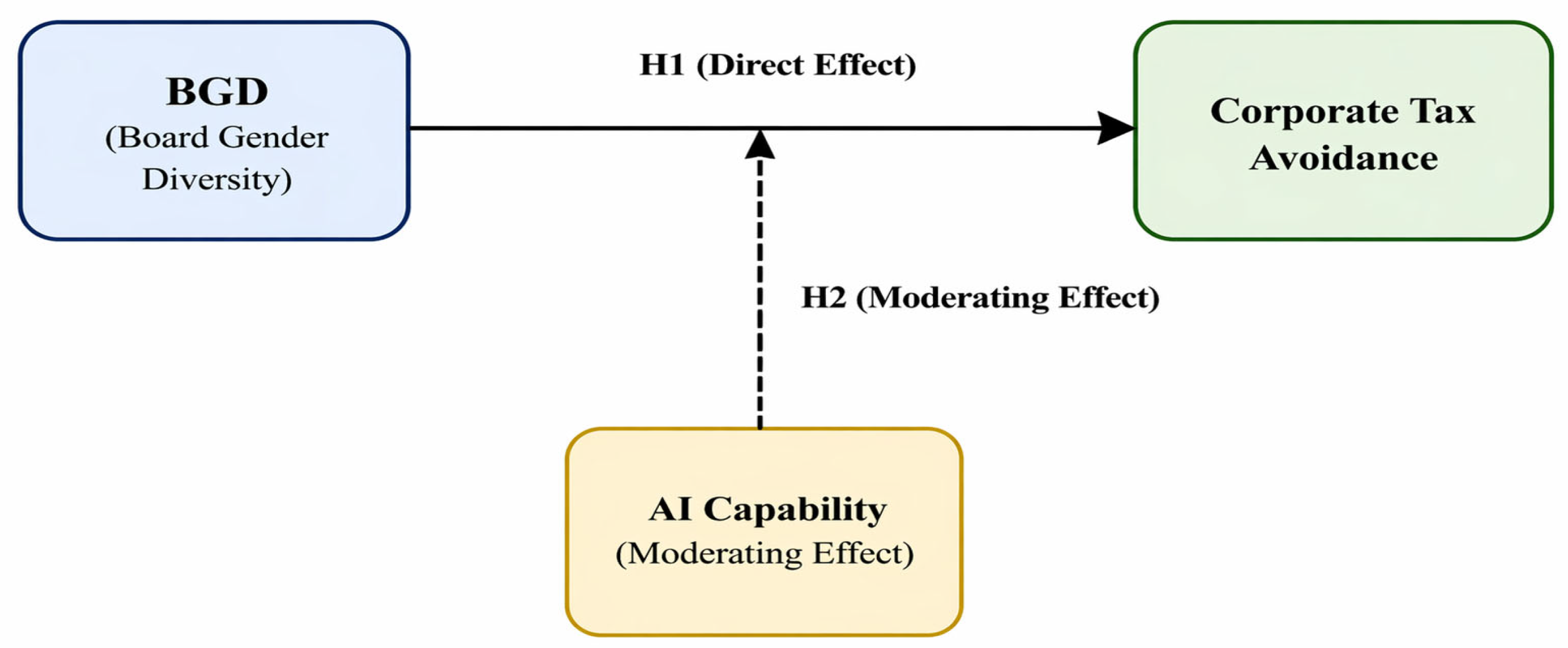
Building on agency theory, the RBV, and emerging digital governance perspectives, this study develops a conceptual framework linking BGD, AI capability, and corporate tax avoidance, as illustrated in
Figure 1. Agency theory emphasizes the monitoring role of corporate boards in mitigating managerial opportunism arising from information asymmetries between managers and shareholders [
1,
2]. Within this framework, gender-diverse boards are expected to strengthen board oversight by improving deliberation quality, increasing ethical sensitivity, and enhancing scrutiny of complex financial decisions such as corporate tax planning [
8,
9].
At the same time, the effectiveness of board monitoring depends on the informational environment available to directors. Advances in AI enhance firms’ information-processing capabilities by enabling real-time data analysis, anomaly detection, and stronger internal control systems [
10,
11]. By improving data integration and reducing information asymmetries between managers and boards, AI technologies may strengthen governance effectiveness and support more informed oversight of complex financial activities.
From a governance complementarity perspective, technological capabilities and governance structures operate jointly in shaping corporate financial behavior. While BGD strengthens monitoring incentives and ethical oversight, AI capability enhances the analytical capacity required to evaluate complex managerial decisions. Consequently, AI may amplify the monitoring effectiveness of gender-diverse boards by improving information transparency and analytical precision. In this framework, BGD is expected to influence corporate tax avoidance, while AI capability moderates this relationship by strengthening the governance role of gender-diverse boards.
4. Methodology
4.1. Sample Selection
This study examines the relationship between BGD and corporate tax avoidance, as well as the moderating role of AI capability, using a panel dataset of publicly listed firms from developing economies over the period 2009–2023. Focusing on developing economies is particularly relevant because corporate tax revenues represent a major source of government income, while governance institutions and monitoring systems may be relatively weaker than in developed markets [
3]. In such environments, internal governance mechanisms—particularly board composition—may play a more important role in shaping corporate financial behavior and monitoring managerial decisions [
17,
18]. At the time of data collection, 2023 was the most recent year for which consistent firm-level governance, AI disclosure, and tax reporting data were available across the databases used in this study.
Consistent with prior studies on CG and tax avoidance, financial institutions are excluded due to their unique regulatory structures, capital requirements, and tax reporting frameworks, which limit comparability with non-financial firms [
6,
32]. Excluding financial firms is a common practice in empirical tax research to ensure more consistent measurement of financial and tax variables across industries.
To construct the final dataset, several screening procedures are applied. First, firm-year observations with missing values for key variables—including the Cash Effective Tax Rate (Cash ETR), BGD, AI capability, and control variables—are removed to ensure data completeness and consistency. Second, observations with negative pre-tax income are excluded because effective tax rate measures are not meaningful when firms report losses, which may distort the interpretation of tax avoidance behavior [
2,
33,
34,
35]. Third, following standard practice in corporate finance and governance research, all continuous variables are winsorized at the 1st and 99th percentiles to mitigate the influence of extreme observations and reduce the impact of outliers on regression estimates [
17].
After applying these screening procedures, the final sample consists of 1586 non-financial firms, yielding 23,790 firm-year observations over the period 2009–2023. This panel structure allows the analysis to capture both cross-sectional variation across firms and temporal dynamics in governance structures and technological capabilities. The resulting dataset therefore provides an appropriate empirical setting to examine how BGD and AI capability jointly influence corporate tax behavior in developing economies.
4.2. Data Sources and Variable Measurement
Firm-level financial, governance, and tax data are obtained from the Refinitiv Eikon/DataStream database, which provides standardized financial statements, governance indicators, and ESG-related metrics for publicly listed firms across countries [
2,
33,
36]. Board composition variables—including BGD and board characteristics—are extracted from Refinitiv governance datasets.
To enhance data accuracy, this study also utilizes firms’ annual reports and corporate disclosures, which provide additional information on board structure and AI-related activities. This complementary approach improves measurement reliability, particularly for capturing firm-level technological capability [
37,
38,
39].
4.2.1. Dependent Variable
Corporate tax avoidance (TA) is primarily measured using the Cash effective tax rate (Cash ETR), calculated as cash taxes paid divided by pre-tax income. Lower values of Cash ETR indicate higher levels of tax avoidance, as firms pay a smaller proportion of their taxable income in taxes. This measure is widely used in empirical research because it captures firms’ realized tax burden and actual cash tax payments [
8,
22]. However, Cash ETR captures short-term tax outcomes and may reflect statutory tax differences, loss carryforwards, and enforcement variation rather than pure tax avoidance behavior, particularly in cross-country settings.
Consistent with prior literature, this study also employs book–tax differences (BTD) as an alternative proxy to enhance robustness [
2,
5,
17,
34]. The use of multiple measures is important because corporate tax avoidance is a multidimensional construct, and different proxies capture different aspects of tax behavior [
2]. Specifically, while Cash ETR reflects realized tax payments, it may not fully capture persistent tax avoidance behavior [
33]. In contrast, BTD captures discrepancies between accounting income and taxable income and is often interpreted as an indicator of more aggressive tax strategies, although it may also reflect earnings management and accounting discretion [
1].
Accordingly, combining Cash ETR and BTD provides a more comprehensive assessment of corporate tax avoidance by capturing both cash-based and accrual-based dimensions of firms’ tax behavior.
4.2.2. Independent Variable
BGD is measured as the proportion of female directors on the board, calculated as the number of female directors divided by total board size. This measure reflects the extent of female participation in board decision-making and is commonly used in CG research examining the influence of gender diversity on monitoring effectiveness and corporate financial behavior [
10,
13].
4.2.3. Moderating Variable
AI capability is employed as the moderating variable capturing the extent to which firms integrate intelligent technologies into their governance, reporting, and operational processes. In contrast to broader digitalization measures, AI specifically reflects advanced analytical technologies—such as machine learning, automation, and data-driven systems—that enhance firms’ information-processing capacity, monitoring mechanisms, and decision-making precision. Through these capabilities, AI strengthens internal control systems and improves transparency in managerial decision-making. Prior studies show that AI improves internal control quality and information transparency, thereby enhancing monitoring effectiveness [
11,
13].
Consistent with the digital transformation literature, AI capability is measured using an AI Adoption Index derived from firms’ disclosures in annual and sustainability reports [
16,
34]. The index is constructed using a dictionary-based text analysis approach to identify AI-related content, including keywords such as “artificial intelligence,” “machine learning,” “deep learning,” “automation,” “data analytics,” and “intelligent systems.” The text analysis was conducted in Python 3.10, using pandas 1.5.3, NumPy 1.23.5, and NLTK 3.8.1 to systematically extract, clean, and process firm disclosures and quantify AI-related terminology.
This ratio captures the intensity of AI-related technological disclosure while controlling for differences in document length across firms. The resulting measure is aggregated and standardized using z-score normalization to enhance comparability and reduce scale heterogeneity across observations. While disclosure-based measures may reflect both actual technological adoption and reporting incentives, they provide a systematic and comparable proxy for firms’ engagement with AI technologies across countries and over time.
Importantly, by normalizing keyword frequency and focusing on AI-specific analytical and automation technologies, the index captures firms’ AI-enabled information-processing infrastructure rather than general disclosure intensity or firm size. The keyword dictionary is constructed based on prior studies on AI and digital transformation [
16,
34], ensuring that the measure reflects genuine AI capability rather than broader digitalization or reporting behavior. This distinction is particularly important given the increasing complexity of corporate disclosures and the growing role of AI in enhancing information processing and governance oversight [
10]. This approach is consistent with recent studies employing textual analysis to capture intangible technological capabilities and helps mitigate concerns that the measure reflects general disclosure intensity rather than AI-specific adoption.
Consistent with moderation analysis procedures, both BGD and AI capability are mean-centered prior to constructing the interaction term to mitigate multicollinearity and facilitate interpretation. The interaction term (BGD × AI) captures whether the effect of BGD on corporate tax avoidance varies with the level of AI capability embedded within firms’ governance and technological systems.
4.2.4. Control Variables
Following prior research on CG and tax avoidance, several firm-level, board-related, and country-level control variables are included [
7,
14,
26]. These include firm size, leverage, profitability, firm age, capital intensity, growth opportunities, board size, and board independence, as well as annual real GDP growth rate and CPI inflation rate to capture macroeconomic conditions. Firm size captures resource availability and regulatory scrutiny, leverage reflects tax shield effects from debt financing, and profitability accounts for differences in taxable income. Firm age and growth opportunities capture organizational maturity and strategic dynamics, while capital intensity reflects tax incentives associated with fixed asset investments. Board size and board independence are included to account for governance structures that influence monitoring quality and managerial oversight. At the country level, the annual real GDP growth rate reflects overall economic performance and business cycle conditions, while the annual CPI inflation rate captures macroeconomic stability and price-level dynamics that may influence corporate tax behavior [
3]. Detailed definitions of all variables are presented in
Table 1.
4.3. Empirical Model Specification
To test the proposed hypotheses, this study employs panel data regression techniques that account for unobserved heterogeneity across firms and time [
40]. Panel estimation is particularly appropriate for CG research because it allows the analysis to control for time-invariant firm characteristics that may influence both governance structures and tax behavior [
41,
42,
43,
44].
Following prior studies on CG and corporate tax avoidance, firm FE models are estimated to control for unobserved firm-specific factors that remain constant over time, such as managerial culture, organizational structure, or long-standing governance practices [
7,
24]. In addition, year fixed effects are included to control for macroeconomic shocks, regulatory changes, and global economic conditions that may simultaneously influence firms’ tax planning behavior.
To further account for cross-country differences, country fixed effects are incorporated to capture time-invariant institutional characteristics such as legal systems, tax regimes, and governance environments.
Baseline Model; to test Hypothesis 1, which predicts that BGD influences corporate tax avoidance, the following baseline specification is estimated:
Moderation Model: to test Hypothesis 2, which predicts that AI capability strengthens the governance effect of BGD on tax compliance, the following interaction model is estimated:
where
TAit represents corporate tax avoidance for firm i in year t measured using the Cash ETR.
BGDit represents board gender diversity, measured as the proportion of female directors on the board.
AIit−1 represents artificial intelligence capability measured using a one-period lag of the AI Adoption Index.
BGDit × AIit−1 captures the moderating effect of prior AI capability on the relationship between BGD and corporate tax avoidance.
Controls it denotes the vector of control variables, including firm size, leverage, profitability, firm age, capital intensity, growth opportunities, board size, and board independence, as well as annual real GDP growth rate and CPI inflation rate as country-level controls.
μi denotes firm fixed effects
λt denotes year fixed effects, controlling for macroeconomic and regulatory shocks.
δc denotes country fixed effects.
εit denotes the idiosyncratic error term
The baseline specification includes firm, year, and country fixed effects. Country–year fixed effects are not included in the baseline models but are introduced in supplementary analyses (
Section 5.7) to provide a more stringent control for time-varying institutional heterogeneity. Standard errors are clustered at the firm level to account for heteroskedasticity and serial correlation [
45].
4.4. Estimation Strategy and Endogeneity
The empirical analysis employs firm fixed-effects (FE) models to control for time-invariant firm characteristics that may simultaneously influence governance structures and corporate tax behavior. FE estimation is widely used in CG research as it accounts for unobservable firm-specific factors—such as managerial culture, organizational structure, and persistent governance practices—that remain constant over time [
17,
28].
To address dynamic endogeneity and potential reverse causality, the study further employs the two-step System GMM estimator developed by Arellano and Bover [
46] and Blundell and Bond [
47]. System GMM is particularly suitable for panel data settings with large cross-sectional dimensions and shorter time periods, as it allows the inclusion of lagged dependent variables while controlling for simultaneity bias, omitted variable bias, and the dynamic persistence of corporate behavior. This approach has been widely applied in recent governance and tax avoidance studies [
9,
45].
To further strengthen causal identification, an instrumental variable approach based on two-stage least squares (2SLS) is implemented. Industry-year leave-one-out averages are used as instruments to capture exogenous variation in governance and AI adoption while excluding firm-specific effects. This strategy helps mitigate concerns related to reverse causality and time-varying endogeneity by isolating variation driven by peer effects rather than firm-level decision-making. The validity of the instrument relies on the assumption that industry-level AI adoption influences firm-level AI through peer effects but does not directly affect firm-specific tax avoidance decisions, thereby satisfying the exclusion restriction. Similar approaches have been applied in recent governance and digital transformation studies to improve identification and strengthen causal inference [
3,
14,
15].
In addition, several robustness checks are conducted to ensure the stability of the results. PSM is used to construct a matched sample of firms with similar observable characteristics, thereby reducing bias arising from non-random board composition [
6]. The Heckman two-step selection model is also employed to address potential self-selection in governance and board structure decisions. Furthermore, alternative measures of tax avoidance and alternative specifications of BGD are used to ensure that the findings are not sensitive to variable definitions or measurement choices [
34].
Overall, this multi-method framework enhances the reliability and credibility of the empirical findings by addressing endogeneity, model specification, and sample selection concerns.
5. Empirical Findings
5.1. Descriptive Statistics
Table 2 presents the descriptive statistics for all variables used in the empirical analysis. The mean value of TA is 0.214, indicating that firms pay, on average, approximately 21.4% of their pre-tax income as cash taxes, with moderate variation across the sample. The distribution of TA (skewness = 0.87; kurtosis = 3.42) suggests no extreme departures after winsorization.
BGD averages 0.176, indicating that women occupy about 17.6% of board seats, with a positively skewed distribution (1.12), reflecting generally low female representation. AI shows a mean value of 5.430 with moderate dispersion, reflecting heterogeneous levels of digital capability across firms. The near-zero skewness indicates a relatively symmetric distribution of AI adoption intensity. For descriptive purposes, the raw AI index values are reported, while standardized (z-score) values are used in the regression analysis.
Among control variables, SIZE indicates a sample of predominantly medium-to-large firms, while LEV (mean = 0.482) reflects substantial reliance on debt financing. ROA, AGE, and CAPINT show moderate variation, whereas MTB displays higher dispersion and positive skewness, suggesting variability in growth opportunities. Board characteristics show an average size of 8.412 members and independence level of 0.471.
At the country level, GDP growth averages 3.85% (ranging from −6.20% to 10.80%), while inflation averages 5.92% with greater dispersion, indicating variation in macroeconomic conditions across countries.
Overall, the data exhibit sufficient variation across governance, technological, firm-level, and macroeconomic factors, supporting the empirical analysis of the moderating role of AI in the relationship between BGD and tax avoidance.
5.2. Correlation Matrix and Multicollinearity Diagnostics
Table 3 reports the Pearson correlation matrix for the main variables. Consistent with the descriptive statistics, BGD is positively correlated with TA (r = 0.084,
p < 0.01), suggesting that firms with greater female board representation tend to exhibit higher effective tax rates, indicating lower levels of tax avoidance.
AI also shows a positive correlation with TA (r = 0.112, p < 0.01), indicating that firms with stronger digital capability tend to display higher tax compliance. The correlation between BGD and AI is moderate (r = 0.217), suggesting that gender-diverse boards are somewhat more prevalent in technologically advanced firms, without raising multicollinearity concerns.
Among the control variables, SIZE is positively associated with AI (r = 0.436), consistent with prior evidence that larger firms possess greater technological and organizational resources. LEV shows a negative correlation with TA, while ROA is positively associated with TA, in line with prior findings.
At the country level, GDP growth is positively associated with TA, while inflation exhibits a weaker and mixed relationship, indicating that macroeconomic conditions may influence corporate tax behavior.
Overall, all pairwise correlations remain well below the conventional threshold of 0.70, indicating that multicollinearity is unlikely to be a concern [
37].
To further assess multicollinearity,
Table 4 reports the Variance Inflation Factors (VIFs). All VIF values remain below 3.5, with a mean VIF of 2.12, well below conventional thresholds. The interaction term (BGD × AI), constructed using mean-centered variables, also exhibits acceptable VIF levels. These results confirm that multicollinearity does not affect the reliability of the regression estimates [
38].
5.3. Regression Results and Moderation Effects
Corporate tax avoidance is measured using TA, where higher values indicate lower levels of tax avoidance. Accordingly, governance mechanisms that constrain aggressive tax planning are expected to exhibit positive coefficients on TA, consistent with prior literature [
2,
33].
Table 5 reports the FE regression results. Model diagnostics confirm the appropriateness of the FE specification, with within R-squared values ranging from 0.218 to 0.242 and significant F-tests.
Column (1) shows that BGD is positively and significantly associated with TA (coefficient = 0.032,
p < 0.05), indicating that firms with greater female board representation exhibit lower tax avoidance. In economic terms, a one standard deviation increase in BGD is associated with an increase in TA of approximately 0.45 percentage points, suggesting economically meaningful improvements in tax compliance. This finding is consistent with Almaharmeh et al. [
32], Li et al. [
37], Mai et al. [
9], and Gaio et al. [
8], who show that gender-diverse boards enhance monitoring and ethical oversight.
This result can be explained by the stronger monitoring and compliance orientation associated with female directors, which reduces managerial incentives for aggressive tax planning. However, the finding contrasts with Hasan et al. [
5], Koay and Sapiei [
17], Shamil et al. [
6], and Hossain et al. [
7], who report weak or context-dependent effects. This difference likely reflects variations in institutional quality and governance effectiveness across settings.
Column (2) introduces lagged AI (AI
t−1) to mitigate endogeneity concerns. The coefficient is positive and significant (coefficient = 0.023,
p < 0.01), indicating that digital capability improves tax compliance. Economically, a one standard deviation increase in AI capability is associated with an increase in TA of approximately 2.90 percentage points, indicating that digital transformation has a substantial impact on reducing tax avoidance. This result aligns with Azenzoul et al. [
37], Huang and Gao [
11], and Saeed [
10], who show that AI enhances transparency and internal controls.
From a theoretical perspective, the results support agency theory [
1], the RBV [
39], and the governance complementarity perspective [
4]. This effect can be attributed to improved information processing and monitoring, which reduce information asymmetry and limit opportunistic behavior. However, it contrasts with Qu and Jing [
16] and Xiang et al. [
19], who find that AI may facilitate tax avoidance through advanced planning strategies. This suggests that AI’s effect depends on whether it is used for governance or tax optimization.
Column (3) presents the interaction between BGD and AI. The coefficient is positive and significant (coefficient = 0.011, p < 0.05), indicating that AI strengthens the governance role of gender-diverse boards. In economic terms, the interaction effect implies that the positive impact of BGD on tax compliance becomes stronger by approximately 1.39 percentage points for firms with higher AI capability, highlighting a meaningful complementarity between governance structures and digital technologies.
This can be explained by the complementarity between governance and technology: while gender-diverse boards improve oversight, AI enhances information quality and analytical capability, thereby amplifying monitoring effectiveness. These findings are consistent with Fourati et al. [
27], Metwally et al. [
23], and Trinh et al. [
48], but differ from Hasan et al. [
5] and Shamil et al. [
6], who report limited governance effects in isolation. This suggests that governance effectiveness depends on supporting capabilities.
Control variables show expected signs. Firm size and profitability are positively associated with TA, while leverage is negative. GDP growth is positive and inflation is negative, indicating macroeconomic effects.
Overall, the findings indicate that governance mechanisms alone are insufficient to fully constrain tax avoidance; their effectiveness is significantly enhanced by complementary technological capabilities. BGD and AI therefore operate jointly to improve corporate tax compliance.
5.4. Moderation Analysis: Interaction Effects
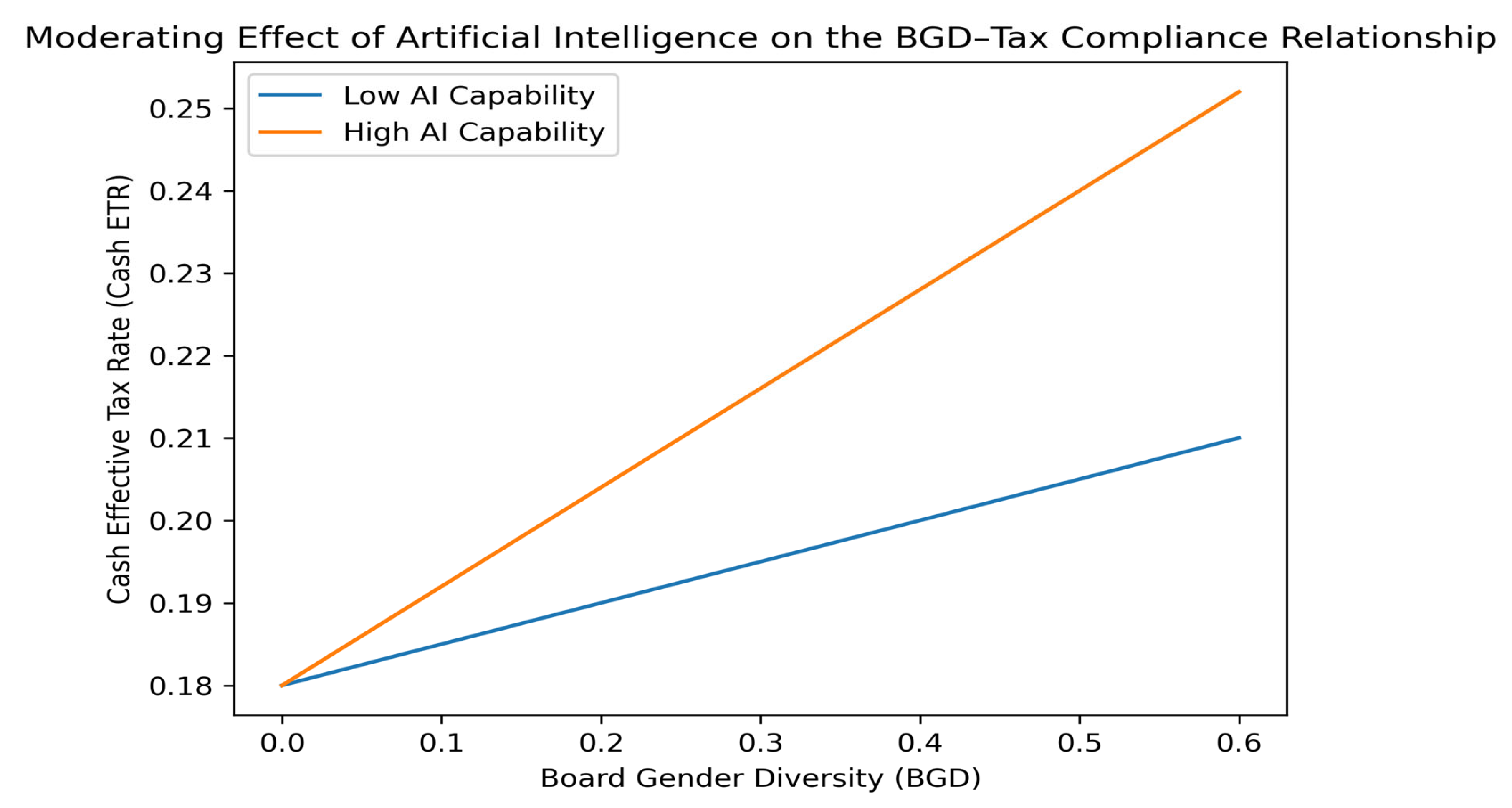
To further examine the moderating role of AI, a graphical analysis of the interaction effects was conducted. Following standard moderation procedures, conditional marginal effects were plotted to illustrate how the relationship between BGD and TA varies across different levels of AI [
40]. The moderating variable was evaluated at low and high levels of AI (±1 standard deviation from the mean).
Figure 2 presents the interaction between BGD and AI on TA. The slopes are clearly non-parallel, indicating a moderating effect. Consistent with the regression results reported in
Table 5, the positive relationship between BGD and TA becomes stronger when AI is higher. In contrast, when AI is relatively low, the association between BGD and TA remains positive but is noticeably weaker.
These findings suggest that AI enhances the monitoring effectiveness of gender-diverse boards by improving the informational environment in which governance decisions occur. By strengthening firms’ information-processing capacity and internal monitoring systems, AI enables boards to better detect aggressive tax planning behavior and enhance tax compliance. Overall, the graphical evidence supports H2, confirming that AI strengthens the governance effect of BGD in constraining corporate tax avoidance.
5.5. Alternative Specification Test: Book–Tax Differences (BTD)
To address potential limitations of the TA measure and ensure that the baseline findings are not sensitive to the choice of tax avoidance proxy, the models are re-estimated using BTD as an alternative measure. While TA reflects realized tax payments, BTD captures the gap between accounting and taxable income and is widely used to detect aggressive tax planning [
1,
2].
Unlike TA, higher BTD values indicate greater tax aggressiveness.
Table 6 reports the results.
Column (1) shows that BGD is negatively and significantly associated with BTD (coefficient = −0.018, p < 0.05), indicating that firms with greater female board representation exhibit lower tax aggressiveness. This result confirms the baseline findings and suggests that gender-diverse boards strengthen monitoring and reduce opportunistic financial reporting.
Column (2) shows that lagged AI (AIt−1) is negatively and significantly related to BTD (coefficient = −0.013, p < 0.01), indicating that digital capability improves tax compliance. This can be explained by the role of AI in enhancing transparency, reducing information asymmetry, and strengthening internal control systems.
Column (3) shows that the interaction between BGD and AI is negative and significant (coefficient = −0.006, p < 0.05), indicating that AI strengthens the governance role of gender-diverse boards in constraining tax aggressiveness. This suggests a complementary relationship, where AI enhances the ability of boards to monitor financial reporting and detect aggressive tax practices.
Overall, the BTD results are consistent with the baseline TA findings, confirming that the main conclusions are robust to alternative tax avoidance measures.
5.6. Alternative Measure of BGD (Binary Specification)
To further verify the robustness of the results and address potential measurement sensitivity in the proportional BGD variable, an alternative binary specification is employed. Specifically, BGD is defined as a dummy variable equal to 1 if the board includes at least one female director and 0 otherwise. This specification captures the threshold effect of female board participation. The binary specification of BGD is consistent with prior studies that capture the threshold effect of female board presence [
32,
49]. It also aligns with research emphasizing the use of alternative governance measures, including dummy variables, to test robustness [
23,
41].
Table 7 reports the results. In Column (1), the binary BGD variable is positively and significantly associated with TA (coefficient = 0.031,
p < 0.05), indicating that firms with at least one female director exhibit lower levels of tax avoidance. This finding is consistent with the baseline results and suggests that even minimal female representation strengthens governance monitoring.
Column (2) shows that lagged AI (AIt−1) remains positively and significantly associated with TA (coefficient = 0.023, p < 0.01), confirming that digital capability improves tax compliance.
In Column (3), the interaction term between BGD and AI is positive and statistically significant (coefficient = 0.011, p < 0.05), indicating that AI strengthens the governance role of gender-diverse boards. Economically, this suggests that the effect of female board participation on tax compliance becomes stronger as firms adopt higher levels of AI capability, reinforcing the complementary relationship between governance and technology.
Overall, the results remain consistent with the baseline findings, confirming that the governance effects of female board participation are robust to alternative measurement and are not sensitive to the specific specification of BGD.
5.7. Supplementary Analysis: Country–Year Fixed Effects
To further control for time-varying cross-country heterogeneity, the models are re-estimated using country–year fixed effects, which absorb changes in tax policy, enforcement intensity, and macroeconomic conditions.
Table 8 reports the results. In Model (1), BGD remains positively and significantly associated with TA (coefficient = 0.020,
p < 0.01), while AI
t–1 also shows a positive and significant effect (coefficient = 0.014,
p < 0.05), indicating stronger tax compliance in firms with higher governance quality and digital capability.
In Model (2), the interaction term between BGD and AIt−1 is positive and statistically significant (coefficient = 0.011, p < 0.01), confirming that AI strengthens the governance role of gender-diverse boards.
Overall, the results remain consistent with the baseline findings, demonstrating that the positive effect of BGD and the reinforcing role of AI are robust to more stringent controls for time-varying country-level factors.
6. Robustness Analyses
6.1. Endogeneity-Robust Analysis: System GMM
Although firm FE estimation controls for time-invariant heterogeneity, endogeneity concerns may still arise due to reverse causality, omitted variables, and the dynamic nature of corporate tax behavior [
50]. For instance, firms with stronger governance structures or lower tax aggressiveness may be more likely to appoint female directors or adopt advanced digital technologies, creating potential simultaneity between governance mechanisms, AI capability, and tax outcomes.
To address these concerns, the study employs the two-step System GMM estimator developed by Arellano and Bover [
46] and extended by Blundell and Bond [
47]. This approach is widely used in CG and financial research to mitigate endogeneity and dynamic panel bias [
24,
33,
35,
36]. AI is introduced as a one-period lag (AI
t−1) to further reduce reverse causality concerns. In addition, macroeconomic controls, including GDP growth and inflation, are incorporated to capture time-varying country-level conditions.
Table 9 reports the results. The coefficient on the lagged dependent variable is positive and statistically significant across all models, indicating persistence in corporate tax behavior. Consistent with the baseline results, BGD remains positively and significantly associated with Cash ETR, suggesting that gender-diverse boards are linked to lower tax avoidance. AI
t−1 also exhibits a positive and significant relationship with Cash ETR, indicating that firms with stronger digital capabilities demonstrate higher tax compliance. Importantly, the interaction term (BGD × AI
t−1) remains positive and statistically significant, confirming that AI strengthens the governance role of gender-diverse boards.
Diagnostic tests support the validity of the model. The AR(2) test indicates no evidence of second-order serial correlation, while the Hansen test fails to reject the null hypothesis of instrument validity, confirming the appropriateness of the instrument set. Country fixed effects are not included in the System GMM specification, as they are time-invariant and absorbed through the transformation of the data.
Overall, the results remain consistent with the baseline findings, reinforcing the robustness of the study’s conclusions and supporting the complementary role of governance and digital capability in constraining corporate tax avoidance.
6.2. Heterogeneity Analysis: High vs. Low AI Firms
To further examine the moderating role of AI capability, the sample is divided into high-AI and low-AI firms based on the median level of AI adoption. This approach allows us to assess whether the governance effect of BGD varies across different levels of digital capability, consistent with prior CG research exploring contextual heterogeneity [
24,
33,
37].
Table 10 reports the results. In the low-AI subsample, BGD shows a modest positive association with Cash ETR (coefficient = 0.010,
p < 0.10), indicating a relatively weaker governance effect. In contrast, in the high-AI subsample, the coefficient on BGD is larger and highly significant (coefficient = 0.027,
p < 0.01), suggesting that gender-diverse boards exert a stronger influence in reducing corporate tax avoidance in digitally advanced firms.
These findings indicate that AI capability enhances the monitoring effectiveness of gender-diverse boards by improving the information environment and decision-making processes. Overall, the heterogeneity analysis supports the earlier moderation results, confirming that digital capability strengthens the governance role of board diversity in constraining corporate tax avoidance.
7. Additional Robustness Checks
To further validate the baseline findings and address potential econometric concerns, three additional techniques are employed: the Heckman two-stage selection model, PSM, and 2SLS. These approaches are widely used in CG and corporate finance research to mitigate biases arising from sample selection, reverse causality, and observable firm heterogeneity [
24,
33,
37].
In this study, firms with stronger governance structures or lower tax aggressiveness may be more likely to appoint female directors or adopt AI technologies, creating potential reverse causality. The application of these techniques helps ensure that the estimated relationships between BGD, AI capability, and corporate tax behavior are not driven by selection bias or endogeneity concerns.
7.1. Addressing Selection Bias: Heckman Two-Stage Model
To address potential self-selection in AI adoption, the study employs a Heckman two-stage selection model [
24]. In the first stage, a probit model estimates the likelihood of AI adoption based on firm characteristics and governance factors. The resulting Inverse Mills Ratio (IMR) is then included in the second-stage regression to correct for potential selection bias.
Table 11 reports the results. The coefficient on the IMR is positive and statistically significant, indicating the presence of selection bias and confirming the relevance of the Heckman correction. Importantly, the main findings remain consistent with the baseline results. BGD continues to exhibit a positive and significant association with Cash ETR, suggesting that gender-diverse boards are associated with lower tax avoidance. Similarly, lagged AI (AI
t−1) remains positively related to tax compliance, and the interaction term (BGD × AI
t−1) remains positive and statistically significant.
Overall, these results indicate that the moderating effect of AI capability is not driven by self-selection or reverse causality in AI adoption, reinforcing the robustness of the study’s conclusions.
7.2. PSM Analysis
Another potential concern is that firms with higher levels of AI capability may systematically differ from those with lower digital adoption in observable characteristics such as firm size, governance structures, and financial performance. If unaddressed, these differences may bias the estimated relationship between AI capability, BGD, and corporate tax avoidance.
To mitigate this concern, PSM is employed following Rosenbaum and Rubin. This approach constructs a matched sample of firms with similar observable characteristics, thereby reducing selection bias. Firms with higher AI capability (treatment group) are matched with firms exhibiting lower AI adoption (control group) based on key financial and governance variables.
Table 12 reports the matched-sample results. Consistent with the baseline findings, lagged AI (AI
t−1) remains positively and significantly associated with Cash ETR, indicating that firms with stronger digital capability exhibit higher tax compliance. Similarly, BGD remains positively related to tax compliance, and the interaction term (BGD × AI
t−1) remains positive and statistically significant, confirming that AI strengthens the monitoring effectiveness of gender-diverse boards.
Overall, the PSM results reinforce the robustness of the main findings and suggest that the observed governance–technology complementarity is not driven by observable firm characteristics.
7.3. Instrumental Variable Estimation
To further address potential endogeneity and reverse causality concerns, the study employs a 2SLS approach [
48]. This method accounts for the possibility that BGD and AI capability may be jointly determined with corporate tax behavior. Instrumental variables are used to isolate the exogenous variation in BGD and AI
t−1.
Table 13 reports the results. The first-stage estimates indicate that the instruments are highly relevant, as evidenced by strong and statistically significant coefficients and F-statistics well above conventional thresholds. In the second stage, the results remain consistent with the baseline findings. BGD continues to exhibit a positive and significant association with Cash ETR, indicating that gender-diverse boards are linked to lower tax avoidance. Similarly, AI
t−1 remains positively associated with tax compliance, while the interaction term (BGD × AI
t−1) remains positive and statistically significant, confirming the complementary role of governance and digital capability.
For the alternative specification using BTD, the coefficients display the expected opposite signs, further reinforcing the robustness of the findings across different tax avoidance measures. Diagnostic tests support the validity of the instruments: the endogeneity tests confirm the presence of endogeneity, while the overidentification tests fail to reject the null hypothesis of instrument validity.
Overall, the 2SLS results confirm that the observed relationships are not driven by reverse causality or omitted variable bias, providing strong evidence for the causal interpretation of the governance–technology interaction in shaping corporate tax behavior.
8. Discussion
This study examines whether BGD influences corporate tax avoidance and whether AI capability strengthens the governance effectiveness of gender-diverse boards. The findings provide strong and consistent support for the proposed hypotheses across multiple model specifications.
Consistent with Hypothesis 1, the results show that BGD is positively associated with the effective tax rate, indicating lower levels of corporate tax avoidance. This finding supports the argument that gender-diverse boards enhance monitoring quality, ethical oversight, and transparency in corporate decision-making, in line with prior evidence. Specifically, prior studies document that female board representation reduces tax aggressiveness and promotes more conservative financial behavior across different institutional settings [
8,
9,
28], with similar evidence observed at the executive level [
26].
From an agency theory perspective, the results suggest that female directors contribute to more effective monitoring and reduce managerial opportunism in tax-related decisions. However, these findings contrast with studies reporting weak or insignificant governance effects in certain contexts [
6,
17], as well as broader evidence highlighting mixed results across countries [
43].
Consistent with Hypothesis 2, the results further indicate that AI capability positively moderates the relationship between BGD and corporate tax compliance. This supports the governance complementarity perspective, whereby governance structures and technological capabilities jointly shape corporate behavior. While BGD strengthens monitoring incentives, AI enhances the informational environment, improves data processing, and reduces information asymmetry, thereby enabling more effective oversight. This finding aligns with prior research demonstrating that advanced technologies strengthen governance effectiveness, improve internal control systems, and enhance transparency [
10,
11]. It is also consistent with evidence that digitalization improves tax compliance and regulatory efficiency [
30].
The robustness analyses reinforce these conclusions. The results remain consistent across alternative model specifications and estimation techniques, including System GMM, Heckman, PSM, and 2SLS, suggesting that the findings are not driven by reverse causality, selection bias, or observable firm heterogeneity. Overall, the study highlights the increasing importance of digital governance, emphasizing that the effectiveness of traditional governance mechanisms depends not only on board structure but also on firms’ ability to leverage technological capabilities.
From a practical and policy perspective, the findings suggest that regulators and policymakers aiming to enhance corporate transparency and fiscal accountability should promote both board diversity and digital transformation. Encouraging female representation on corporate boards, alongside investments in AI and digital infrastructure, may strengthen governance systems and reduce opportunistic financial behavior, particularly in developing economies.
Notwithstanding these contributions, several limitations should be acknowledged. First, the use of short-term tax measures, such as Cash ETR, primarily captures realized tax outcomes and may be influenced by country-specific tax regimes, enforcement differences, and temporary accounting effects, rather than fully reflecting long-term tax avoidance behavior. Second, although advanced econometric techniques are employed, residual endogeneity related to unobserved and time-varying firm characteristics cannot be entirely ruled out. Third, the AI measure, while based on disclosure-driven text analysis, may partly reflect firms’ reporting incentives in addition to actual technological adoption. Finally, the multi-country setting introduces institutional heterogeneity that may affect the generalizability of the findings across different regulatory and governance environments.
Future research may address these limitations by employing long-run tax avoidance measures, utilizing quasi-experimental or natural experiment designs to strengthen causal inference, and incorporating more direct indicators of AI adoption. In addition, further studies could explore other dimensions of digital transformation and governance structures to better understand how technological and institutional factors jointly shape corporate financial behavior.
9. Conclusions
This study examines the relationship between BGD, AI capability, and corporate tax avoidance in firms from developing economies over the period 2009–2023.
The findings show that BGD is associated with higher effective tax rates, indicating lower levels of tax avoidance, while AI capability enhances tax compliance. Importantly, the interaction results confirm that digital capability strengthens the governance effectiveness of gender-diverse boards, supporting the view that governance and technological capabilities operate as complementary mechanisms.
This study contributes to the literature by providing new evidence on the governance role of BGD, identifying AI as a governance-enabling resource, and demonstrating the joint effect of governance structures and digital technologies in shaping corporate financial behavior. From a policy perspective, the results highlight the importance of promoting board diversity alongside digital transformation to enhance corporate transparency and accountability.
Despite these contributions, the findings should be interpreted in light of certain limitations related to tax avoidance measurement, potential endogeneity, and the use of disclosure-based proxies for AI capability. Future research may address these issues by employing long-run tax measures, more direct indicators of technological adoption, and quasi-experimental designs, as well as exploring the role of institutional environments in shaping governance–technology interactions.
Overall, the study underscores the importance of integrating governance structures with digital capabilities to strengthen corporate accountability in the digital era.
Author Contributions
Conceptualization, M.M. and A.M.; methodology, M.M. and M.A.Z.; software, M.A.Z.; validation, M.M., A.M. and L.D.; formal analysis, M.M.; investigation, M.M. and N.I.K.; resources, A.M. and L.D.; data curation, M.A.Z. and N.I.K.; writing—original draft preparation, M.M.; writing—review and editing, A.M., L.D. and N.I.K.; visualization, M.A.Z.; supervision, M.M.; project administration, M.M.; funding acquisition, A.M. All authors have read and agreed to the published version of the manuscript.
Funding
The authors gratefully acknowledge the Middle East University, Amman, Jordan, for providing financial support to cover the publication fee of this article.
Data Availability Statement
The raw data supporting the conclusions of this article will be made available by the authors on request.
Acknowledgments
The authors would like to acknowledge the academic and institutional support provided by their affiliated universities, which facilitated the completion of this research. The authors also thank their institutions for providing access to research resources and databases that contributed to the development of this study.
Conflicts of Interest
The authors declare no conflicts of interest.
Abbreviations
The following abbreviations are used in this manuscript:
| AI | Artificial Intelligence |
| BGD | Board Gender Diversity |
| CG | Corporate Governance |
| TA | Corporate Tax Avoidance |
| Cash ETR | Cash Effective Tax Rate |
| BTD | Book–Tax Differences |
| RBV | Resource-Based View |
| FE | Fixed Effects |
| RE | Random Effects |
| GMM | Generalized Method of Moments |
| PSM | Propensity Score Matching |
| IMR | Inverse Mills Ratio |
| VIF | Variance Inflation Factor |
| 2SLS | Two-stage least squares |
References
- Desai, M.A.; Dharmapala, D. Corporate tax avoidance and high-powered incentives. J. Financ. Econ. 2006, 79, 145–179. [Google Scholar] [CrossRef]
- Hanlon, M.; Heitzman, S. A review of tax research. J. Account. Econ. 2010, 50, 127–178. [Google Scholar] [CrossRef]
- Mansour, M.; Alomair, M. Institutional quality, ESG performance, and aggressive tax planning in developing countries. Sustainability 2026, 18, 1126. [Google Scholar] [CrossRef]
- Kovermann, J.; Velte, P. The impact of corporate governance on corporate tax avoidance—A literature review. J. Int. Account. Audit. Tax. 2019, 36, 100270. [Google Scholar] [CrossRef]
- Hasan, A.; Anwar, W.; Zahir-Ul-Hassan, M.K.; Ahmed, A. Corporate governance and tax avoidance: Evidence from an emerging market. Appl. Econ. 2024, 56, 2688–2704. [Google Scholar] [CrossRef]
- Shamil, M.M.; Gooneratne, D.W.; Gunathilaka, D.; Shaikh, J.M. The effect of board characteristics on tax aggressiveness: The case of listed entities in Sri Lanka. J. Account. Emerg. Econ. 2024, 14, 747–770. [Google Scholar] [CrossRef]
- Hossain, M.S.; Islam, M.Z.; Ali, M.S.; Safiuddin, M.; Ling, C.C.; Fung, C.Y. The nexus of tax avoidance and firms characteristics—Does board gender diversity have a role? Evidence from an emerging economy. Asia-Pac. J. Bus. Adm. 2025, 17, 401–427. [Google Scholar] [CrossRef]
- Gaio, L.E.; Lucas, A.C.; Stefanelli, N.O.; Bonacim, C.A.G. Board gender diversity: Impact on corporate tax avoidance in response to economic policy uncertainty. J. Sustain. Financ. Invest. 2026, 16, 1–21. [Google Scholar] [CrossRef]
- Mai, B.D.; Pham, D.K.; Pho, T.V.; Phan, G.Q.; Nguyen, T.T.H. Exploring gender and corporate governance in an emerging market: Bridging female leadership, earnings management and tax avoidance. J. Risk Financ. Manag. 2025, 18, 342. [Google Scholar] [CrossRef]
- Saeed, U. Can artificial intelligence and blockchain condition governance mechanisms to restrict earnings management? SN Bus. Econ. 2025, 5, 206. [Google Scholar] [CrossRef]
- Huang, Q.; Gao, L. Technological empowerment: The pathways of artificial intelligence influencing corporate ESG performance. Financ. Res. Lett. 2025, 86, 108855. [Google Scholar] [CrossRef]
- Chen, S.; Jiawei, G.; Jebran, K. CFO status in TMT informal hierarchy and corporate tax aggressiveness. Rev. Quant. Financ. Account. 2025, 1–43. [Google Scholar] [CrossRef]
- Xie, K.; Huang, W. The impact of digital transformation on corporate tax avoidance: Evidence from China. Discret. Dyn. Nat. Soc. 2023, 2023, 8597326. [Google Scholar] [CrossRef]
- Zhang, Q.; She, J. Digital transformation and corporate tax avoidance: An analysis based on multiple perspectives and mechanisms. PLoS ONE 2024, 19, e0310241. [Google Scholar] [CrossRef] [PubMed]
- Chen, W.; Meng, F. Is corporate digital transformation a tax haven? Int. J. Manag. Financ. 2024, 20, 304–333. [Google Scholar] [CrossRef]
- Qu, G.; Jing, H. Is new technology always good? Artificial intelligence and corporate tax avoidance: Evidence from China. Int. Rev. Econ. Financ. 2025, 98, 103949. [Google Scholar] [CrossRef]
- Koay, G.Y.; Sapiei, N.S. The role of corporate governance on corporate tax avoidance: A developing country perspective. J. Account. Emerg. Econ. 2025, 15, 84–105. [Google Scholar] [CrossRef]
- Menchaoui, I.; Hssouna, C. Impact of internal governance mechanisms on tax aggressiveness: Evidence from French firms listed on the CAC 40. EuroMed J. Bus. 2024, 19, 503–517. [Google Scholar] [CrossRef]
- Xiang, J.; Shao, Q.; Fan, Y. Innovation incentives and corporate tax avoidance: Evidence from China. Econ. Anal. Policy 2025, 85, 1216–1237. [Google Scholar] [CrossRef]
- Jiang, H.; Kim, E. Which Top Management Team Characteristics Drive a Firm’s Tax Aggressiveness? Emerg. Mark. Financ. Trade 2024, 60, 2428–2446. [Google Scholar] [CrossRef]
- Sobhan, R.; Jewel, M.A.K.; Sultana, T. The CEO’s last name matters: Family control, independent oversight and tax avoidance. Asian J. Econ. Bank. 2025. [Google Scholar] [CrossRef]
- Almulhim, A.; Metwally, A.B.M. The impact of tax avoidance on earnings management: The moderating role of board governance characteristics. Int. J. Financ. Stud. 2025, 13, 225. [Google Scholar] [CrossRef]
- Metwally, A.B.M.; Montash, A.A.; Ali, S.A.; Yassin, M. Board characteristics and tax avoidance: The moderating effect of ESG disclosure. Cogent Bus. Manag. 2025, 12, 2588063. [Google Scholar] [CrossRef]
- Mansour, M.; Al Zobi, M.; E’leimat, D.A.; Abu Alim, S.; Tabash, M.I. Female leadership, gender boards and environmental innovation: Comprehensive evidence from the global energy sector. Innov. Green Dev. 2025, 4, 100275. [Google Scholar] [CrossRef]
- Alodat, A.Y.; Hao, Y.; Nobanee, H.; Ali, H.; Mansour, M.; Al Amosh, H. Board characteristics and cybersecurity disclosure: Evidence from the UK. Electron. Commer. Res. 2025, 25, 4717–4735. [Google Scholar] [CrossRef]
- Kersten, L.F.; Qari, S. The association between gender diversity of companies’ executives and corporate tax avoidance. Corp. Gov. 2025. [Google Scholar] [CrossRef]
- Fourati, Y.M.; ElAyeb, M.; Drira, M. Integrated reporting quality and corporate tax avoidance: The moderating role of board gender diversity. Int. J. Discl. Gov. 2026, 23, 183–196. [Google Scholar] [CrossRef]
- Khlifi, S.; Chouaibi, Y.; Chouaibi, S. Do ESG practices mediate the relationship between board characteristics and tax avoidance in G20 countries? Corp. Gov. 2025, 25, 288–310. [Google Scholar] [CrossRef]
- Mansour, M.; Zobi, M.A.; Alomair, M. Artificial Intelligence, ESG Governance, and Green Innovation Efficiency in Emerging Economies. Economies 2026, 14, 11. [Google Scholar] [CrossRef]
- Belahouaoui, R.; Attak, E.H. Digital taxation, artificial intelligence and tax administration 3.0: Improving tax compliance behavior. Account. Res. J. 2024, 37, 172–191. [Google Scholar] [CrossRef]
- Al Sa’Ed, T.; Saleh, M. The role of gender diversity in the board of directors in enhancing social sustainability: The moderating role of financial performance in Palestine. Palest. Tech. Univ. Res. J. 2024, 12, 143–155. [Google Scholar] [CrossRef]
- Almaharmeh, M.I.; Shehadeh, A.; Alkayed, H.; Aladwan, M.; Iskandrani, M. Family ownership, corporate governance quality and tax avoidance: Evidence from an emerging market—The case of Jordan. J. Risk Financ. Manag. 2024, 17, 86. [Google Scholar] [CrossRef]
- Dyreng, S.D.; Hanlon, M.; Maydew, E.L. Long-run corporate tax avoidance. Account. Rev. 2008, 83, 61–82. [Google Scholar] [CrossRef]
- Chen, M.; Zhao, K.; Jin, W. Corporate digital transformation and tax avoidance: Evidence from China. Pac.-Basin Financ. J. 2024, 85, 102400. [Google Scholar] [CrossRef]
- Lesmy, D.; Muchnik, L.; Mugerman, Y. Lost in the fog: Growing complexity in financial reporting—A comparative study. Humanit. Soc. Sci. Commun. 2025, 12, 1813. [Google Scholar] [CrossRef]
- Kamarudin, K.A.; Wan Ismail, W.A.; Harymawan, I.; Mohamad Ariff, A. Audit firm tenure and corporate tax avoidance: Evidence spanning COVID-19 pandemic. J. Financ. Crime 2025, 32, 98–116. [Google Scholar] [CrossRef]
- Mansour, M.; Al Zobi, M.; Alnohoud, I.; Abu-Allan, A.; Khassawneh, A.; Saad, M. Does engaging in ESG practices improve banks’ performance in Jordan? Banks Bank Syst. 2025, 20, 62–73. [Google Scholar] [CrossRef]
- Eleyan, D.; Saleh, M.W.A.; Assaf, N.A.; Salisu Maigoshi, Z. Corona Virus (COVID-19) Pandemic: Economic and Educational Responses and Aftermath Effects in Developing and Developed Countries. In Artificial Intelligence and COVID Effect on Accounting. Accounting, Finance, Sustainability, Governance & Fraud: Theory and Application; Alareeni, B., Hamdan, A., Eds.; Springer: Singapore, 2022. [Google Scholar] [CrossRef]
- Li, Q.; Maydew, E.L.; Willis, R.H.; Xu, L. Taxes and director independence: Evidence from board reforms worldwide. Rev. Account. Stud. 2023, 28, 910–957. [Google Scholar] [CrossRef]
- Azenzoul, A.; Mahouat, N.; Mokhlis, K.; Moussaid, A. Digital transformation and corporate tax avoidance: Evidence from Moroccan listed firms. J. Risk Financ. Manag. 2025, 18, 575. [Google Scholar] [CrossRef]
- Alomair, M.; Metwally, A.B.M. Does ESG disclosure matter for the tax avoidance—Firm value relationship? Evidence from an emerging market. Sustainability 2025, 17, 3836. [Google Scholar] [CrossRef]
- Aiken, L.S.; West, S.G.; Reno, R.R. Multiple Regression: Testing and Interpreting Interactions; SAGE Publications: Newbury Park, CA, USA, 1991. [Google Scholar]
- Yahaya, M.B.; Oon, E.Y.N.; Jusoh, R. Board structure, executive attributes and corporate tax avoidance: A systematic literature review. Asian Rev. Account. 2025, 34, 1–29. [Google Scholar] [CrossRef]
- Bani Atta, A.A. Adoption of fintech products through environmental regulations in Jordanian commercial banks. J. Financ. Report. Account. 2025, 23, 536–549. [Google Scholar] [CrossRef]
- Hossain, M.S.; Ali, M.S.; Islam, M.Z.; Safiuddin, M.; Ling, C.C.; Fung, C.Y. The nexus of firms characteristics and tax avoidance—Do independent directors have a role? Evidence from Bangladesh. J. Account. Emerg. Econ. 2025, 15, 623–644. [Google Scholar] [CrossRef]
- Arellano, M.; Bond, S. Some tests of specification for panel data: Monte Carlo evidence and an application to employment equations. Rev. Econ. Stud. 1991, 58, 277–297. [Google Scholar] [CrossRef]
- Blundell, R.; Bond, S. Initial conditions and moment restrictions in dynamic panel data models. J. Econom. 1998, 87, 115–143. [Google Scholar] [CrossRef]
- Trinh, V.Q.; Li, T.; Ha, O.; Liu, J. Board busyness and financial leverage: The impact of corporate tax avoidance. Financ. Rev. 2025, 60, 951–1002. [Google Scholar] [CrossRef]
- Boussaidi, A.; Hamed-Sidhom, M. Board’s characteristics, ownership’s nature and corporate tax aggressiveness: New evidence from the Tunisian context. EuroMed J. Bus. 2021, 16, 487–511. [Google Scholar] [CrossRef]
- Saleh, M.W.; Mansour, M. Is audit committee busyness associated with earnings management? The moderating role of foreign ownership. Account. Res. J. 2024, 37, 80–97. [Google Scholar] [CrossRef]
| Disclaimer/Publisher’s Note: The statements, opinions and data contained in all publications are solely those of the individual author(s) and contributor(s) and not of MDPI and/or the editor(s). MDPI and/or the editor(s) disclaim responsibility for any injury to people or property resulting from any ideas, methods, instructions or products referred to in the content. |