
This is an early access version, the complete PDF, HTML, and XML versions will be available soon.
Article

SARIMA vs. Prophet: Comparative Efficacy in Forecasting Traffic Accidents Across Ecuadorian Provinces


by
Wilson Chango
1,2,*,
Ana Salguero
2,
Tatiana Landivar
2,
Roberto Vásconez
2,
Geovanny Silva
2,
Pedro Peñafiel-Arcos
2,
Lucía Núñez
2 and
Homero Velasteguí-Izurieta
1,*
1
Department of Systems and Computation, Pontifical Catholic University of Ecuador, Esmeraldas Campus PUCESE, Esmeraldas 080101, Ecuador
2
Faculty of Informatics and Electronics, Escuela Superior Politécnica de Chimborazo (ESPOCH), Riobamba 060155, Ecuador
*
Authors to whom correspondence should be addressed.
Computation 2026, 14(1), 5; https://doi.org/10.3390/computation14010005

Submission received: 14 November 2025 / Revised: 9 December 2025 / Accepted: 16 December 2025 / Published: 31 December 2025

Abstract

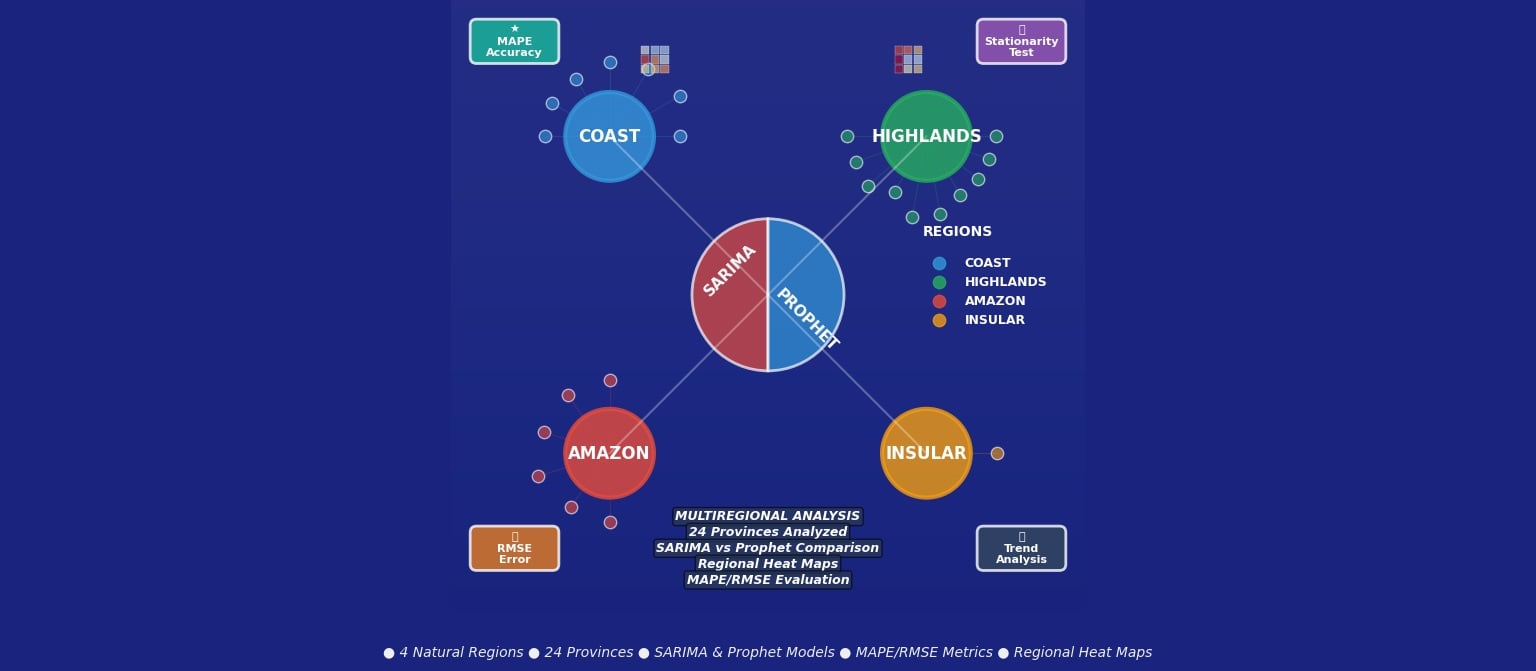
This study aimed to evaluate the comparative predictive efficacy of the SARIMA statistical model and the Prophet machine learning model for forecasting monthly traffic accidents across the 24 provinces of Ecuador, addressing a critical research gap in model selection for geographically and socioeconomically heterogeneous regions. By integrating classical time series modeling with algorithmic decomposition techniques, the research sought to determine whether a universally superior model exists or if predictive performance is inherently context-dependent. Monthly accident data from January 2013 to June 2025 were analyzed using a rolling-window evaluation framework. Model accuracy was assessed through Mean Absolute Percentage Error (MAPE) and Root Mean Square Error (RMSE) metrics to ensure consistency and comparability across provinces. The results revealed a global tie, with 12 provinces favoring SARIMA and 12 favoring Prophet, indicating the absence of a single dominant model. However, regional patterns of superiority emerged: Prophet achieved exceptional precision in coastal and urban provinces with stationary and high-volume time series—such as Guayas, which recorded the lowest MAPE (4.91%)—while SARIMA outperformed Prophet in the Andean highlands, particularly in non-stationary, medium-to-high-volume provinces such as Tungurahua (MAPE 6.07%) and Pichincha (MAPE 13.38%). Computational instability in MAPE was noted for provinces with extremely low accident counts (e.g., Galápagos, Carchi), though RMSE values remained low, indicating a metric rather than model limitation. Overall, the findings invalidate the notion of a universally optimal model and underscore the necessity of adopting adaptive, region-specific modeling frameworks that account for local geographic, demographic, and structural factors in predictive road safety analytics.
Keywords: SARIMA; Prophet; traffic accident prediction; time series forecasting; model selection; Ecuador SARIMA; Prophet; traffic accident prediction; time series forecasting; model selection; Ecuador
Graphical Abstract