1. Introduction
In this paper, a fast distributed algorithm is proposed for solving the unit allocation and uniform price determination for a uniform price auction. Uniform price auction is a multiunit auction [
1,
2], in which
k identical items (equivalently,
k units) are auctioned off to
m bidders, each bidding for multiple units with a per-unit bidding price If each bidder can only bid for one unit; the winner determination problem is identical to the classical
kWTA problem [
3,
4].
1.1. Uniform Price Auction (UPA)
In convention, a uniform price auction is conducted in a centralized manner. Each bidder submits his/her bid, which includes the number of units to bid and the per-unit bidding price, in sealed to an auctioneer. Then, the auctioneer allocates the units to the bidders in accordance with the descending order of the per-unit bidding prices. Once the unit allocation has been performed, all winners pay for each unit the least winning per-unit bidding price. While the conventional method for solving a uniform price auction is efficient as the auctioneer is in charge of the unit allocation and price determination, bidding information (including the number of units to bid and the per-unit bidding price) privacy is not protected, and thus it is not applicable to the situation when some bidders do not want to disclose their bidding information. In this regard, a new distributed algorithm has to be developed to solve these problems with bidding information privacy protection. However, algorithms developed along this direction are scarce. To the best of our knowledge, all these algorithms are developed for sealed-bid auctions in which each bidder can only bid for one unit of items.
1.2. Distributed/Decentralized Algorithms
For the first price auctions, a few distributed or decentralized algorithms have been developed in recent years to deal with sealed-bid auctions with bidding price protection and auctioneer ripping off. Some algorithms are developed based on encryption technique [
5,
6] for the bidding information together with a specialized algorithm for the auctioneer to rank the encrypted bidding prices. For
multiunit auctions, where each bidder can only bid for one unit,
kWTA-based algorithms have been developed to ensure partial bidding prices protection [
7,
8] and support full bidding prices protection [
9].
It should be stressed that
decentralization has long been investigated in auction implementations [
10,
11,
12]. Some decentralized implementations focused on the algorithm for winner determination auctioneer rips them out only [
10] Bidding prices protection is not considered. If the bidding information is not protected, auctioneer could learn from the bidding information collected from the historical auctions so as to maximize the revenue of the future auctions [
13,
14,
15,
16]. On the other hand, many distributed
kWTA algorithms introduced in recent years [
17,
18,
19,
20] can be applied in solving the winner determination problem in an uniform price auction if each bidder can only bid for one unit and if the bidding price is set to be the input. However, these algorithms are unable to determine the uniform price.
1.3. Multiunit UPA with Bidding Price Protection
On top of the above issues on winner determination and uniform price determination, some decentralized algorithms have been developed and implemented with consideration on the issue on bidding prices protection [
11,
12]. Inspired by a recent developed fast distributed
kWTA algorithm for uniform price auctions in which each bidder can bid for one unit [
9], we propose in this paper a fast distributed algorithm for the multiunit uniform price auctions in which each bidder can bid for more than one unit. An exemplar market of this kind is the electricity auction market [
21]. Our proposed algorithm is able to complete the units allocation and uniform price determination in a very few number of steps. Moreover, this algorithm is able to protect the bidding information, including the units to bid and the per-unit bidding price. The idea behind the algorithm development is simply based on the
bisection method which has been applied in a fast distributed algorithm as presented in [
9].
1.4. Organization of the Paper
In the next section, the uniform price auction to be solved in this paper is formally defined. Existing solutions for solving the problems (unit allocation and uniform price determination) in a uniform price auction are presented. Then, the proposed fast distributed algorithm is presented in
Section 3. Convergence analysis, stopping criteria and sufficient steps for convergence are analyzed in the section. Benefits of our fast distributed algorithm are re-iterated in
Section 4. Simulation results with comparisons to the existing methods are presented in
Section 5. Discussions on the applicability of the proposed algorithm in other auction settings are commented onin
Section 6. Finally, the conclusion of the paper is presented in
Section 7.
2. Uniform Price Auction (UPA)
Depending on the settings of (a) a bidder’s bidding price vector; (b) the allocation rules; and (c) the payment determination rules, various mechanisms have been introduced for uniform price auction [
2].
In this paper, we consider a sealed-bid auction with k identical units to be auction-off. There are m () bidders who are willing to bid. Each bidder might bid for multiple units. Let be the bid vector of the bidder. Here, is the number of units to bid and be the per-unit bidding price. As a convention, we let . To proceed, we need to make the following assumptions.
Assumption 1.
(a) The total bidding quantities is larger than the number of units to be auctioned off. That is to say, . (b) All per-unit bidding prices are distinct positive integers. That is to say, if . Moreover, , where M is the maximum per-unit bidding price. (c) The maximum number of units to be bid by a bidder is limited to Q, i.e., for . (d) Bidders do not want to disclose their bidding prices. □
It should be noted that
per-unit price,
per-unit bidding price and
bidding price are used interchangeably in this paper. Moreover, other settings like those for sealed-bid combinatorial multiunit auctions are not treated in this paper. For a combinatorial multiunit auction, the
bidder bids for all
units by
. A winner must be allocated with all the units being bid. This units allocation problem is equivalent to a knapsack problem which is a
hard problem [
22]. One should not confuse that our proposed algorithm is applicable to this combinatorial auction problem.
2.1. Unit Allocation and Price Determination
To allocate the units, it starts from the highest per-unit bidding price, . Allocate the bidder with the highest per-unit bidding price the units being bid. If there are units remaining, allocate the bidder with the second highest per-unit bidding price, i.e., , for the units being bid. The process repeats until all the units are allocated. For the payment, it is determined by the least winning per-unit bidding price, i.e., the uniform price. All winning bidders pay for this uniform price.
2.2. Illustrative Examples
For illustration,
Table 1 shows two examples. The bidders’ bids are
,
,
,
and
. The difference between these two examples is in the total number of units for bid, (1)
and (2)
.
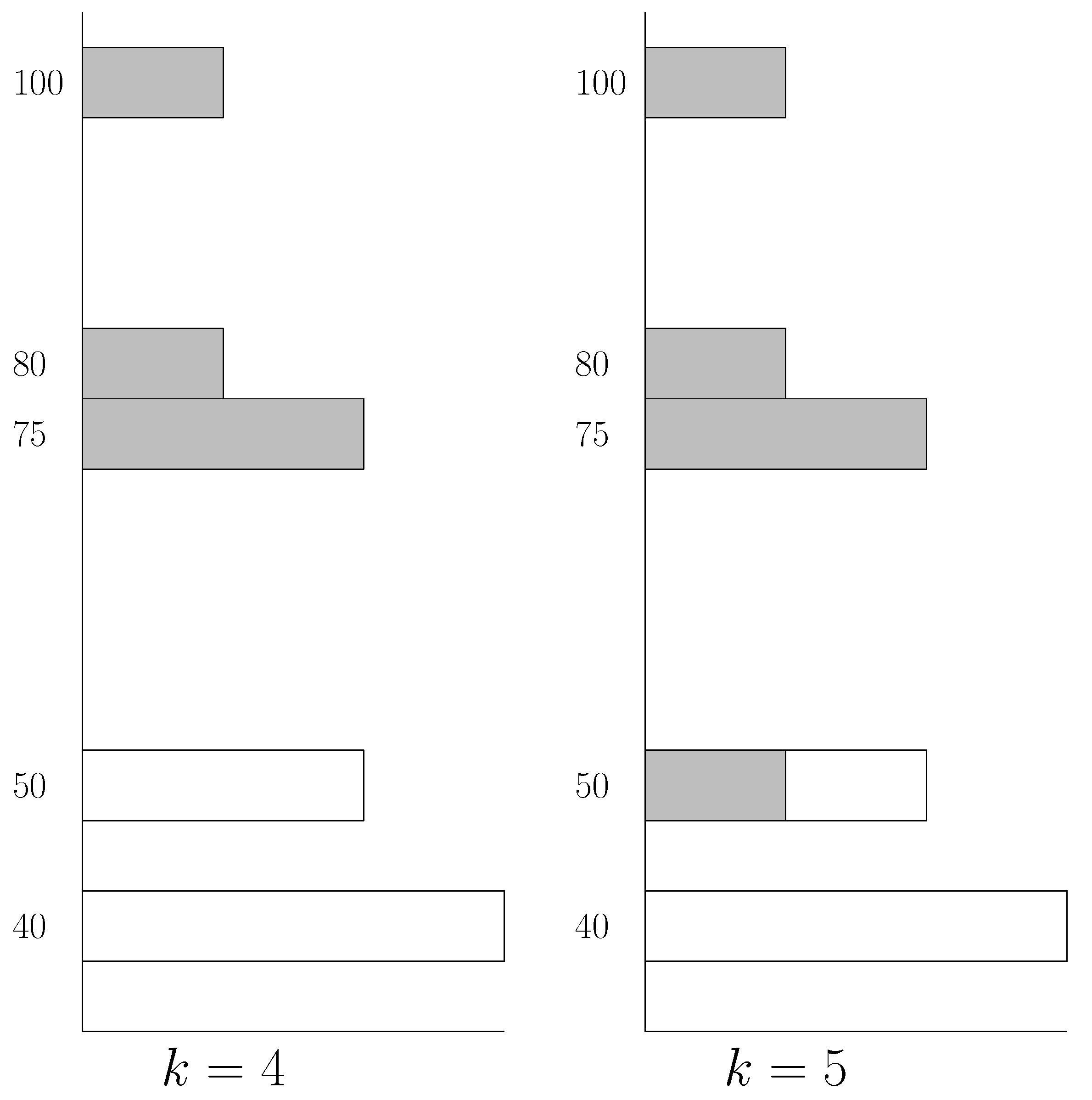
Figure 1 shows the idea behind unit allocation and uniform price determination. For
, the units are allocated to the bidders
with one unit,
with two units and
with one unit. The uniform price is 75. For
, the units are allocated to the bidders
with one unit,
with one unit,
with two units and
with one unit. The uniform price is 50.
2.3. Solutions for UPA and Their Limitations
Here, we introduce two solutions for solving the unit allocation and uniform price determination for a uniform price auction. The first one is based on the conventional sealed-bid auction mechanism [
1]. All bidders submit their bids to an auctioneer and let the auctioneer allocate the units and determine the uniform price. The second one is inspired by the Wang
kWTA neural network [
23,
24].
2.3.1. Centralized Algorithm
To solve the unit allocation and uniform price determination problems in a uniform price auction, the classical solution is based on a
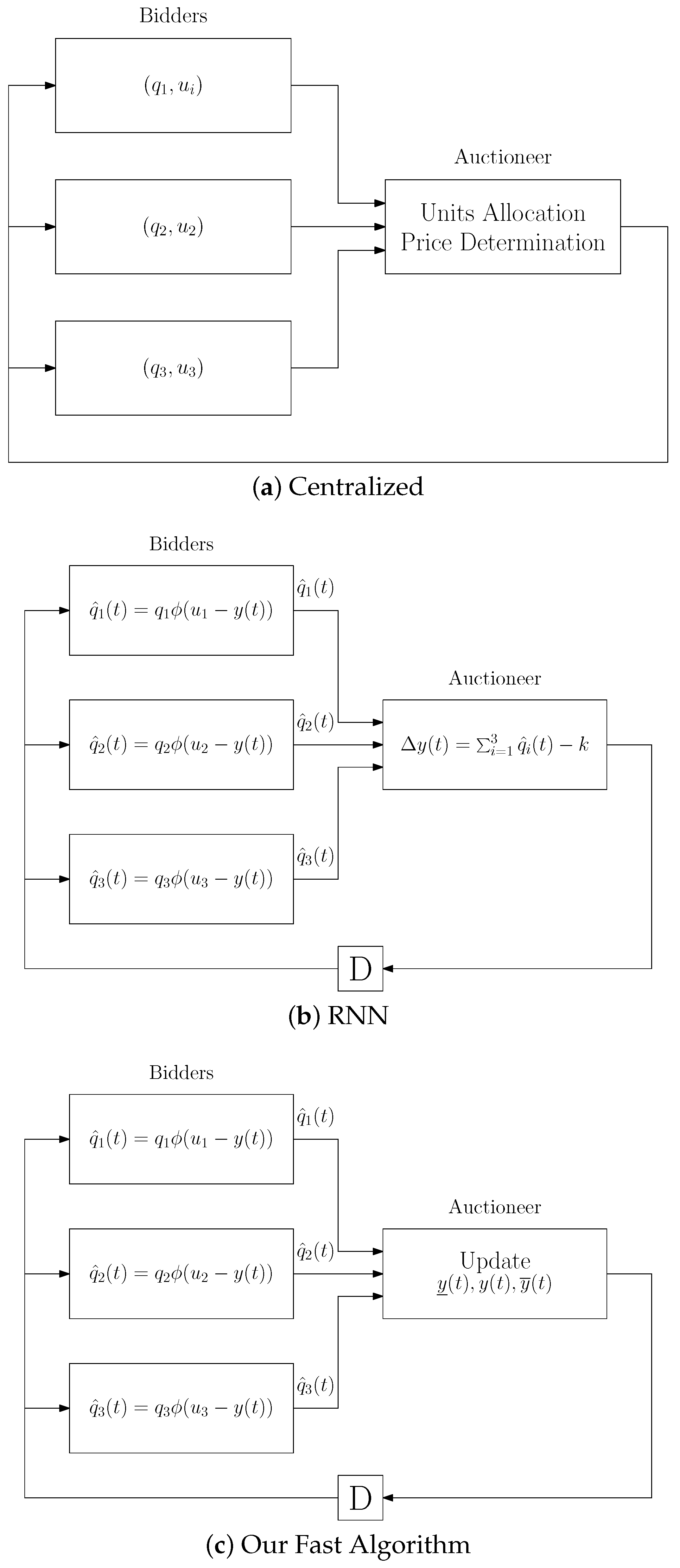
centralized method in which an auctioneer is needed. All bidders submit their bidding information to the auctioneer, as shown in
Figure 2a. The auctioneer will then perform the unit allocation and determine the uniform price.
First, the per-unit bidding prices are sorted in ascending order, i.e., . Starting from , is allocated to the bidder. If , allocate to the bidder. Repeat the allocation process until all k units have been allocated. The uniform price is defined as the least winning per-unit price. Once the results have been obtained, the auctioneer broadcasts the results to the bidders. Algorithm 1 lists the detailed steps for this centralized algorithm.
Clearly, this centralized method is very efficient, as the time span (equivalently, the number of steps) for unit allocation and uniform price determination is just one. However, the bidding price privacy is definitely not protected.
| Algorithm 1 Centralized Algorithm |
Bidders: Set and . Send to the auctioneer. Auctioneer: (Unit Allocation) Rank s in ascending order, i.e., . Set and (remaining units). while {} do Allocate to bidder. Set and . . end while for , do . end for Auctioneer: (Bidding Results Broadcast) for , do Send to the bidder. end for
|
2.3.2. Recurrent Neural Network-Based Distributed Algorithm
Another solution is based on a
distributed method as presented in
Appendix A and shown in
Figure 2b. Note that this recurrent neural network-based distributed algorithm has not been presented in the literature for solving the unit allocation and uniform price determination problems in a uniform price auction. Bidders do not need to be sent to the auctioneer agent any bidding information.
Setting
. In each round
t, the bidders simply send their
to the auctioneer.
is a piecewise linear function defined as follows:
where
. Then, the auctioneer updates
upon the receiving of
for
.
where
is the step size. Finally, the updated
is broadcasted to all the bidders for their updating of
.
However, this distributed method suffers from two problems. First, this method can only protect the losing bidding price. All bidders and the auctioneer are able to recover the winners’ bidding prices. Second, the time span for unit allocation and uniform price determination can be long, as the number of steps for completing the task is in the order of to . If the communication delay in each iteration is in the order of , the time span will be in the order of 10 to . This time span will be scaled up if either the number of bidders or the number of units to be auctioned off scales up.
In the sequel, it is needed to develop an efficient distributed algorithm that is able to protect the bidding price privacy.
3. Fast Distributed Algorithm
In view of the limitations of the algorithms presented in the last section regarding the bidding price privacy and the long completion time, a fast distributed algorithm is developed to simultaneously allocate the units to the bidders and determine the uniform price in a small number of steps. Moreover, the fast distributed algorithm is able to protect the bidding price privacy.
The key for the algorithm development is based on the property of
, where
As is a non-increasing function, we can then state without proof the following theorem regarding the property of :
Theorem 1.
as stated in Equation (3) is a non-increasing function of y, i.e., if , with and . In addition, there exists such that . □ If the uniform price is set to be the least winning price, . As is a non-increasing function of a single variable y, a distributed algorithm can easily be developed by the method of bisection.
3.1. Bisection Method-Based Distributed Algorithm
The distributed algorithm is depicted in Algorithm 2 and its implementation is shown in
Figure 2c. By the fact that
is a single variable function and
is a non-increasing function, as stated in Theorem 1,
method of bisection can be applied. We define three variables, namely
,
and
.
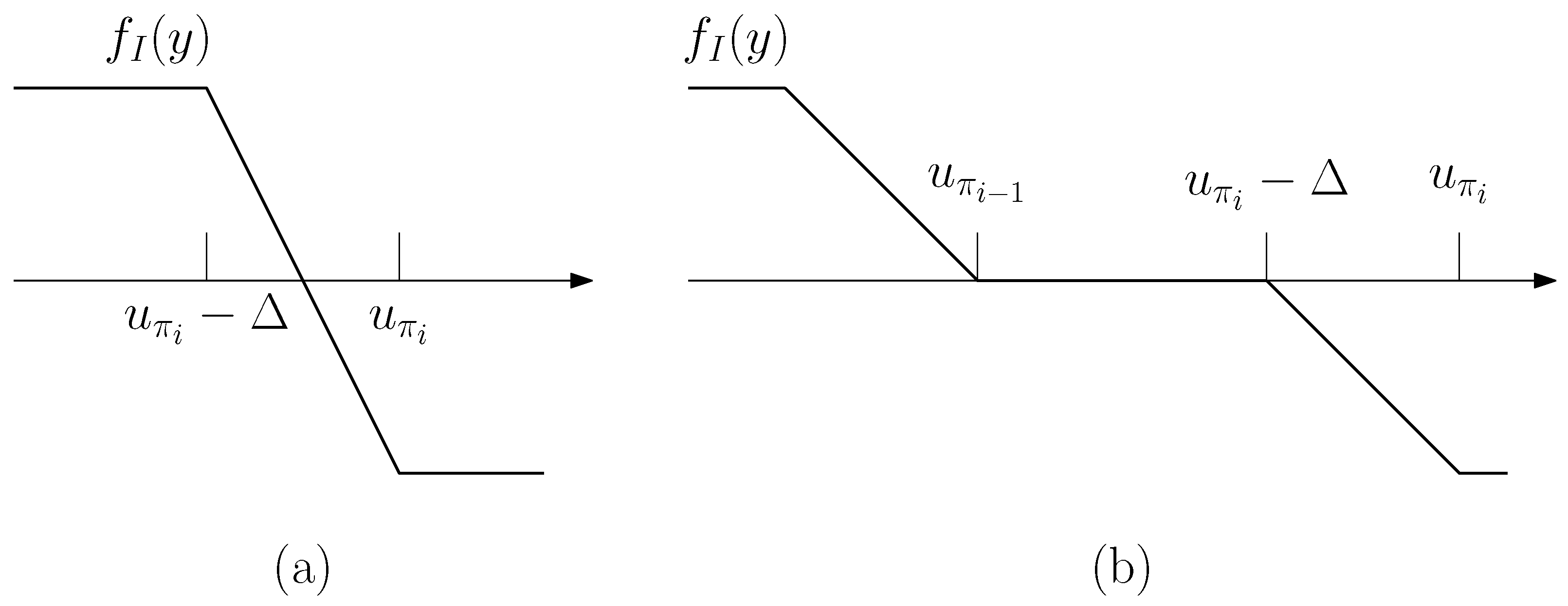
Let be the index of the winner with the least winning price . We also let be the convergent value of and be the units allocated to the bidder. Either one of the following two cases will happen:
- (a)
and hence
.
- (b)
and hence
.
Figure 3 shows the shapes of
for these cases.
For , the auctioneer sets that , and . Then, is broadcast to all bidders. Once the bidders have received , they calculate their and then send their to the auctioneer. After that, the auctioneer calculates , and based on the values s received. Again, is broadcasted to all bidders.
For
, all bidders calculate their
based on the
received and then send them to the auctioneer. The auctioneer then updates
,
and
by the following Equation (
4).
where
.
| Algorithm 2 Bisection Method-Based Distributed Algorithm |
Initialization: Set M, Q, and . Bidders: for
do in parallel Set and . end for Auctioneer: Set k, , , . Broadcast y to all bidders. while {} do Bidders: for do in parallel Calculate Send to the auctioneer. end for Auctioneer: Calculate . if then and . else and . end if Broadcast y to all bidders. end while Units allocated are . Uniform price is .
|
3.2. Convergence Analysis
Let the be the last winner, be the units being allocated and be the convergent of . It can be shown that .
Theorem 2. By setting and , we can obtain (i) for all and (ii) . Moreover, .
3.3. Stopping Criteria
To ensure that
, the following stopping criteria must hold:
As
, the above condition holds if the following condition holds:
To ensure , we need the condition that . As , . To ensure , we need another condition that . As a result, we can state without proof the following stopping criteria.
Theorem 3. The sufficient conditions to ensure that and are given as follows:where Q is given. 3.4. Number of Steps
Similarly to the case of distinct bid prices, we can state the following theorem on the number of steps
for the convergence of
such that
Theorem 4. A sufficient condition on the number of steps for the algorithm, as stated in Equation (4), to allocate the units and determine the uniform price is given by Proof. By Equations (
5)–(
7),
. On the other hand, the initial condition
implies that
. To ensure that
,
. Equivalently,
The proof is completed. □
3.5. Optimal Setting
From Equation (
8), it is clear that the smallest number of steps occurs when
is maximum. By Equation (
7), we get
We let
. It can be shown that
for
.
is maximum at
. That is to say,
. Equivalently,
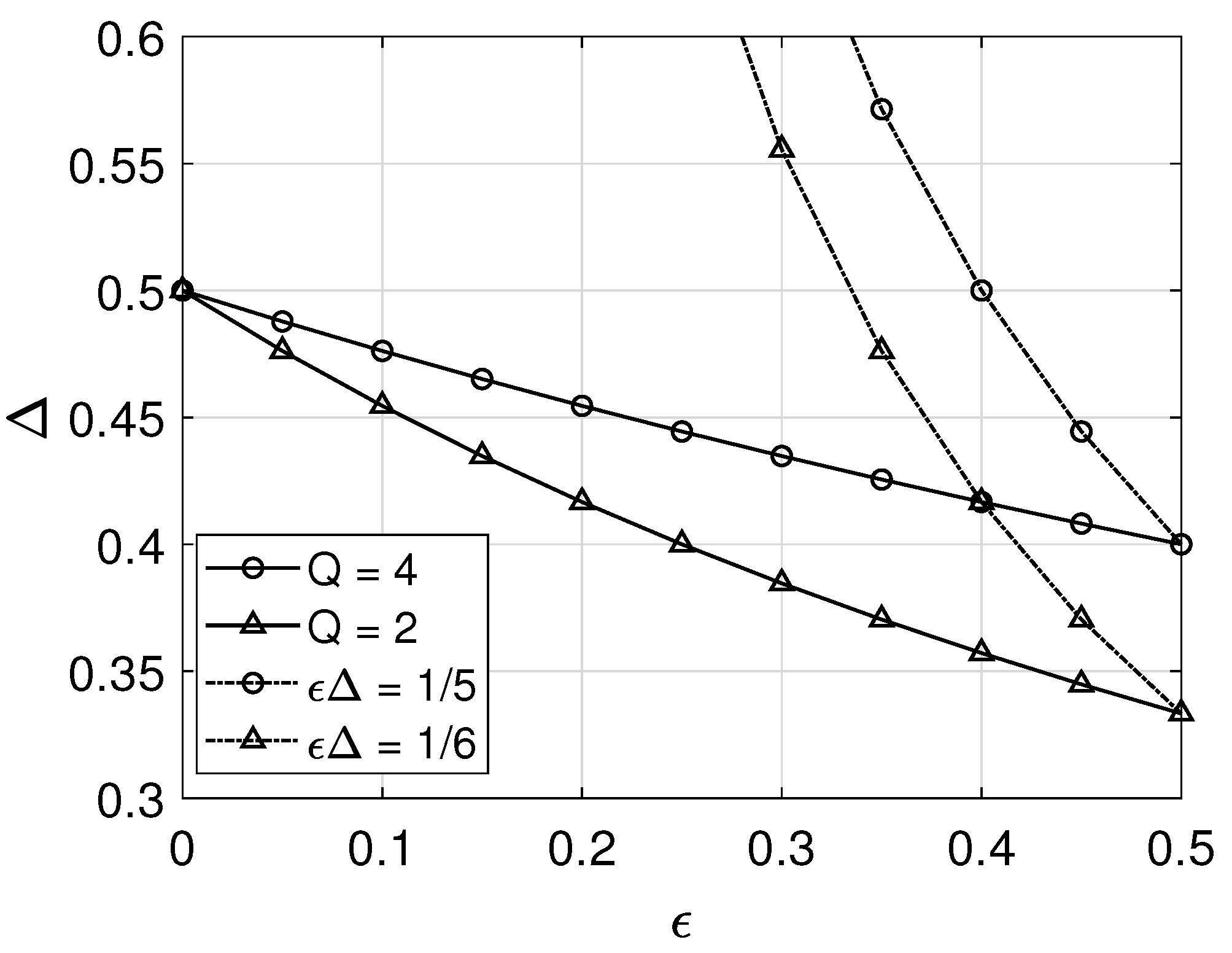
For illustration, the curves for
and
are shown in
Figure 4.
We can now state without proof the following theorem for the setting of
,
and
for the algorithm as stated in Equation (
4).
Theorem 5. Given M and Q, ϵ, Δ and the stopping criteria are, respectively, set as follows: The number of steps for unit allocation and uniform price determination is given by It should be noted that the number of steps
, as stated in Equation (
11) is independent of
m once
M and
Q are fixed. Therefore, the time span for completing the unit allocation and uniform price determination depends on the total communication delay in the data exchange in a step times the total number of steps
. It will be discussed in the next section; this time span is still short as compared with the recurrent neural network solution.
4. Benefits of the Fast Algorithm
In summary, the proposed fast distributed algorithm as stated in this section has many advantages as compared with the algorithms presented in
Section 2.3. A comparison among the algorithms presented is depicted in
Table 2.
4.1. Bidding Information Privacy Protection
In each implementation, the bidding prices (s or s) and bidding quantities (s) are not communicated during the process. Therefore, the above implementations are able to protect both winners’ and losers’ bidding information privacy. A centralized algorithm does not protect any bidding information. The RNN-based algorithm only partially protects some bidding information.
4.2. Low Communication Delay
In this implementation, sending data
and
in between bidders and the auctioneer is accomplished by a wireless communication protocol [Chapter 2] [
25]. Equivalently, broadcasting
y to all bidder agents is accomplished by the same wireless communication protocol. Suppose that there are
m bidders. The time span for unit allocation and uniform price determination is
, where
is the communication delay of sending a message from one device to another.
It should be noted that the number is based on the fact that m bidders need to send their s to the auctioneer and the auctioneer needs to broadcast the , and to all the bidders. For WiFi connection, the medium access control (MAC) is based on the protocol carrier sense medium access with collision avoidance (CSMA/CA). For m bidders successfully send their data to the auctioneer, the time complexity is in the order of . Practically, the time span is hardly more than . Owing not to distract the readers on the elegant of our algorithm, we simply state that the time span is . For a more realistic bound, we simply have to change 10 (resp. 1) seconds to 100 (resp. 10) seconds for Bluetooth (resp. WiFi).
By Equation (
11), we can get that the time span is equal to
. If (i) we set the total number of bidders
and
; and (ii) consider Bluetooth communication protocol (i.e.,
second), the time span is around 10 s. For WiFi communication, the communication delay is
s. The time span is around one second.
In our algorithm, M has to be pre-set and it has to be larger than . Clearly, we can only guess an upper bound for this value. As the time span is proportional to , the time span is still short even if we guess the from M to . This time span scales as the number of bidders increases. So, our algorithm is not suitable to be applied in those auctions requiring real-time decision.
5. Simulations
Simulation results are shown in this section with a focus on (i) the small number of steps required for convergence and (ii) the number of steps for convergence as compared with the RNN-based solution.
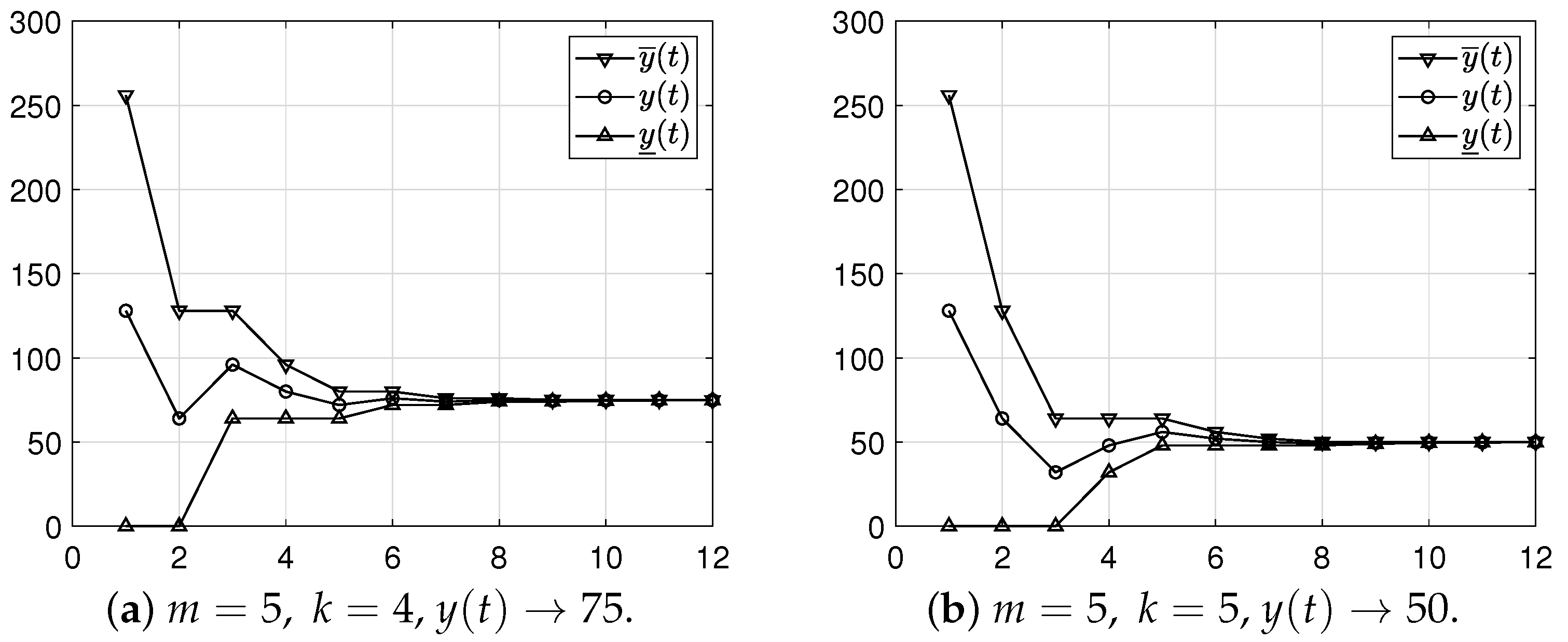
5.1. Finite-Time Convergence
With reference to the bidding information depicted in
Table 1, we set that
and
. Thus, we can obtain
and
. By that, two simulations are conducted. One is for
and the other is for
. Their results on
,
and
are shown in
Figure 5.
For the case of
in
Table 1, the uniform price is given by
(as shown in
Figure 5a) and the units being allocated are given by
. For the case of
in
Table 1, the uniform price is given by
(as shown in
Figure 5b) and the units being allocated are given by
.
5.2. Fast Convergence
To compare the fast convergence of the proposed Equation (
4) as compared with the RNN-based algorithm, extensive simulations are conducted for that
For all simulations,
,
and
.
5.2.1. Our Algorithm
For our proposed algorithm, the stopping criteria is given by
which is from Theorem 5. Hence, the number of steps required for our Equation (
4) to determine the unit allocation and the uniform price is given by
This number is independent of
m,
k, the per-unit bidding prices
and the number of units to bid
.
5.2.2. RNN-Based
For the RNN-based algorithm, the number of steps to determine the uniform price and the unit allocation depends on the per-unit bidding prices and the number of units to bid. To have a fair comparison, a set of 1000 samples are generated for each
M and
. In each sample, a set of five per-unit bidding prices are randomly generated in between 0 and
M. In addition, a set of five bidding units are randomly generated in the range from 1 to 4. Then, the number of steps for an RNN-based algorithm to determine the uniform price and the unit allocation for this sample is counted. The average number of steps over 1000 samples for a specific
M is recorded. The step size and the stopping criteria are set as follows:
5.2.3. Comparison Results for Different M
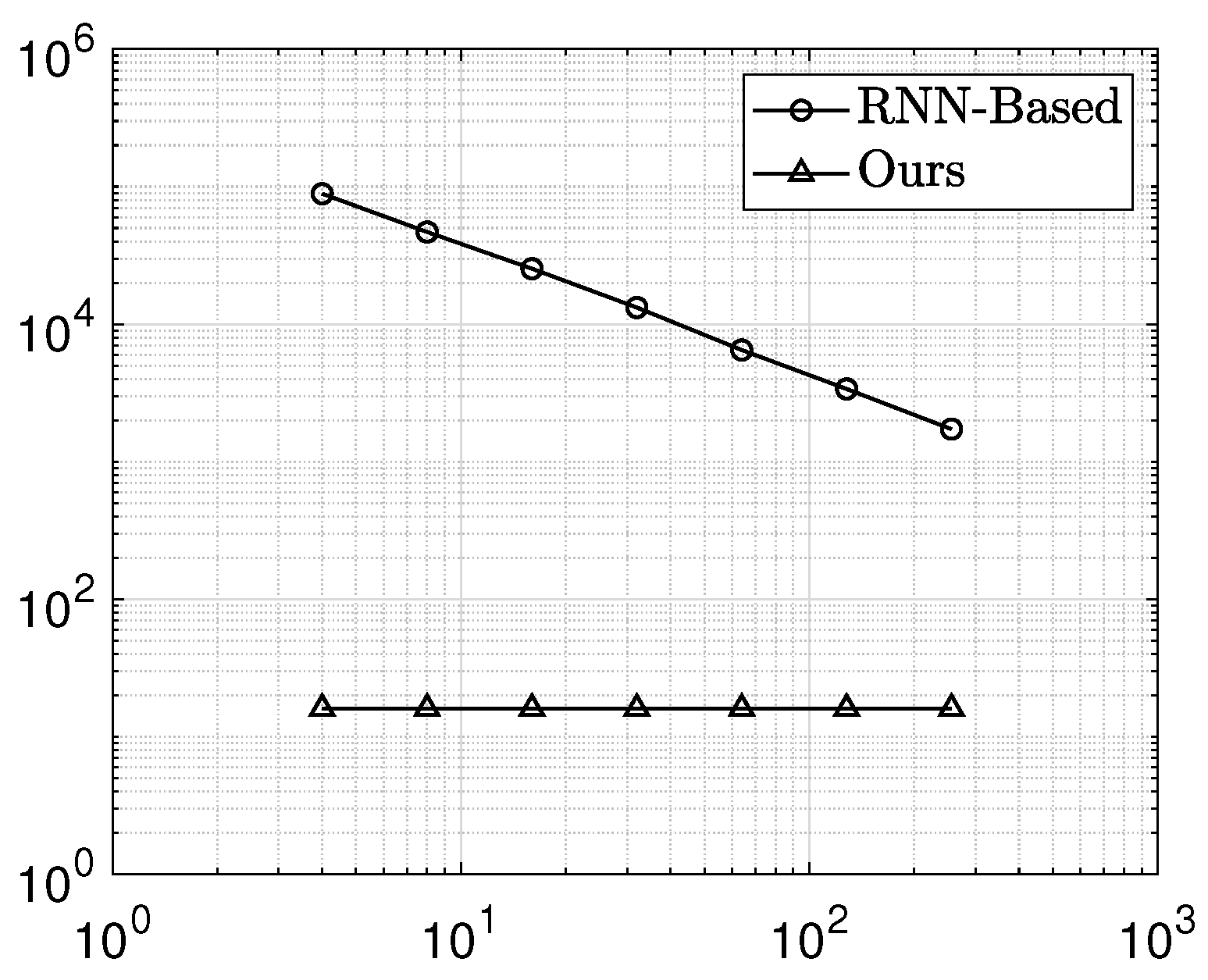
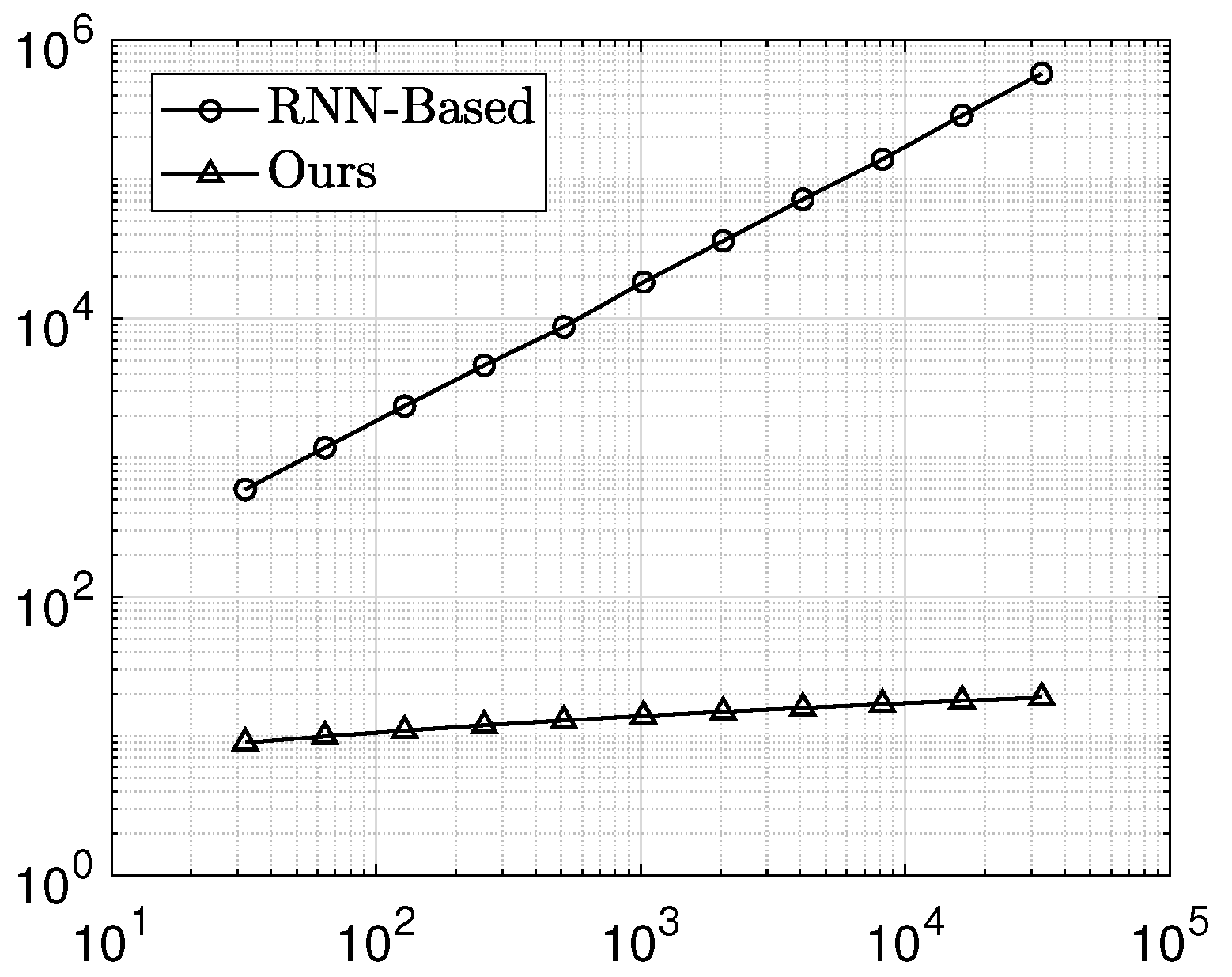
The comparison results are shown in
Figure 6 and
Figure 7. Here, the line with circles is the result from the RNN-based algorithm. The line with triangles is the result from our proposed algorithm. Let
be the average number of steps for the RNN-based algorithm, with price range
, to determine the unit allocation and uniform price. It is clear from
Figure 6 that
for the RNN-based algorithm. Equivalently,
The number of steps obtained by the RNN-based algorithm is much larger than our proposed algorithm, especially when M is large.
5.2.4. Comparison Results for Different m
For
, the results for different numbers of bidders are shown in
Figure 7. Let
be the average number of steps for the RNN-based algorithm with
and
. Again, the average number of steps obtained by the RNN-based algorithm is much larger than our proposed algorithm, especially when
m is small. It is clear from
Figure 7 that
For a small number of m, the difference is in the order of magnitude . For practical consideration, our algorithm is applied to a small number of bidders. Therefore, our proposed algorithm is preferred for solving the unit allocation and uniform price determination problems.
5.3. On Bidding Price Privacy
For Case (1) in
Table 1, the proposed Equation (
4) is applied with
and
. During the process of unit allocation and uniform price determination, the auctioneer can obtain information
from the bidders as well as
,
and
. All this information is depicted in
Table 3 for illustration.
From the above results, the auctioneer is able to determine from the number of units to be allocated and the uniform price for the payment of the units. For other bidding information, the auctioneer can best guess that , and . The auctioneer is unable to guess and . For the per-unit bidding prices, except , the auctioneer can only know the ranges for , , and . The exact values of , , and are unknown. Per-unit bidding prices are protected.
6. Discussions
In this section, two important issues are discussed. The first one is on the identical per-unit price bidding problem. The other is on the case that the uniform price is defined as the highest losing bidding price. The third one is on the per-unit bidding price protection.
6.1. Identical Per-Unit Bidding Price
It should be noted that our proposed algorithm is not applicable to the situation that multiple bidders have identical per-unit bidding price. To deal with this problem, one solution is to add a time-dependent markup on a bid. The earlier bidder will be allocated with units first.
Let
T be the period for the bidders to set their bid. Let us say the bid setting starts from 1:00 p.m. and ends at 1:15 p.m. So, the bidding period
T is 900 s. Further, let
be the time when the
bidder has just completed his/her setting. Then, the input
is replaced by
as follows:
For the settings of and , we need to solve the condition that . For this, we need to consider two conditions: (i) and (ii) and .
For Case (i), we can get
. To ensure that
, we have to set
For Case (ii), we can get
and
. Thus,
and
. To ensure that
,
If we assume that
is larger than
, the settings of
and
are given by
and
. The value
is set to assume that no two or more bids are submitted within
time. By that, the additional number of iterations is simply
(resp.
). The total number of steps
is given by
The modified algorithm for solving the winner determination and price determination is depicted in Algorithm 3.
| Algorithm 3 Modified Bisection Method-Based Distributed Algorithm |
Initialization: Set M, Q, , , , and . Bidders: for
do in parallel Set and . Set . end for Auctioneer: Set k, , , . Broadcast y to all bidders. while {} do Bidders: for do in parallel Calculate Send to the auctioneer. end for Auctioneer: Calculate . if then and . else and . end if Broadcast y to all bidders. end while Units allocated are . Uniform price is .
|
6.2. Highest Losing Bidding Price as the Uniform Price
If the uniform price is set to be
the highest losing per-unit bidding price, our proposed distributed algorithm as stated in Equation (
4) can be modified by changing the condition in Equation (
4) as follows:
The benefits as presented in
Section 4 carry over to this algorithm.
Moreover, it can readily be shown that Theorem 5 holds true for this case.
and
. If the stopping criteria is set to be that
, the number of steps for this algorithm to determine the unit allocation and the uniform price (highest losing price) is identical to the number of steps for Algorithm 2. That is to say,
if
and hence
.
6.3. Bidding Information Privacy
For the per-unit bidding price (resp. bidding unit) privacy, we can only demonstrate and present in
Section 5.3 for Case (1) in
Table 1 that the auctioneer is unable to determine the per-unit bidding prices and the units being bid from the data obtained during the process of unit allocation and uniform price determination by our proposed distributed algorithm as stated in Equation (
4). Once the unit allocation and uniform price have been determined, the auctioneer can obtain from
Table 1 the following results.
| Bidder | 1 | 2 | 3 | 4 | 5 |
| | | 75 | | |
| 0 | 1 | 2 | 0 | 1 |
Except the lowest winning per-unit price, the auctioneer cannot know other per-unit bidding prices. For the bidding units, the auctioneer can know that , and . The bidding quantities of other bidders are unknown.
Therefore, our algorithm could protect the per-unit bidding prices and partially protect the bidding units. Theoretical analysis on bidding price privacy protection has yet to be accomplished. We leave it as a work for future investigation, if it is possible. We can only
conjecture that our proposed Equation (
4) is able to protect the per-unit bidding prices
for
.
6.4. Limitations on Encryption-Based Privacy Protection
Protecting bidding price has recently attracted cryptologists developing techniques to tackle such problem [
6,
11,
12,
26,
27,
28,
29,
30]. Consider a sealed-bid first price auction. One approach is to develop an encryption method for the bidding price together with a comparison algorithm for ranking two encrypted bidding prices [
5]. By repeatedly applying the comparison algorithm among the
n encrypted bidding prices, the centralized agent is able to determine the encrypted bidding price corresponding to the highest bid (resp. the winner) and announce the result to all the bidders. Finally, the winner announces his/her bidding price to the bidders.
These methods can protect the bidding prices. However, it is not suitable for a uniform price auction in which each bidder can bid for multiple units with a single per-unit price. While the auctioneer is able to obtain the ranking order of the per-unit bidding prices, the auctioneer needs to know the bidding quantities from the bidders to complete the unit allocation. Bidding information privacy is not all protected.
6.5. Other Multi-Unit Auction Mechanisms
It is clear that our proposed algorithm is limited to uniform price auction. For auctioning off multi-unit, other mechanisms like discriminatory price auction and combinatorial auction [
31] can be applied. It is very true. However, extended modification is needed if our algorithm is applied in a discriminatory price auction to protect the losing bidding information. For combinatorial auctions, our algorithm is not able to apply, as solving the winner determination problem itself requires all bidding information. Privacy cannot be protected.
6.5.1. Discriminatory Price Auction
For a discriminatory auction, each bidder has a not-to-disclose bid . The auctioneer allocates the units to the bidders starting from the bidder with the highest per-unit bidding price until the units have all been allocated. Then, each winning bidder pays for each unit based on his/her per-unit bidding price.
For this auction mechanism, our fast algorithm can be applied. The lowest per-unit winning price can be immediately obtained. Let
be the bid of the
winner with the lowest per-unit bidding price. After the winner determination process has been completed, the auctioneer is able to know that
Moreover, the auctioneer knows the per-unit bidding price . After that, the auctioneer can set and then re-run the winner determination process to obtain the second lowest per-unit bidding price. This process repeats until all per-unit winning prices have been obtained.
Therefore, our fast algorithm can be extended and applied in discriminatory price auctions with losing per-unit prices protection. The complexity of this extended algorithm is just in the order of . Losing bid information is protected.
6.5.2. Combinatorial Auction
For a combinatorial auction, each bidder has a not-to-disclose bid
. Here,
is the amount to be paid for all
units if the bidder has successfully won the bid. As mentioned earlier in the paper, the winner determination problem of auctioning off multi-units via a combinatorial auction mechanism is identical to a knapsack problem, which is a well-known
-hard problem [
22]. Just for solving the winner determination problem, the auctioneer needs to know all the bidding information. It is unable to protect any bidding information.
7. Conclusions
In this paper, a fast distributed algorithm has been presented for solving the unit allocation and uniform price determination problems for a uniform price auction, in which the bidders can bid for multiple units with a per-unit bidding price. The key idea is based on applying the idea of the bisection method. In the sequel, the proposed distributed algorithm is able to allocate the units to the bidders and determine the uniform price in a very small number of steps as compared with the recurrent neural network-based algorithm. Furthermore, the distributed algorithm is able to protect the bidding information, including the bidders’ per-unit bidding price and their units to bid. Theoretical analyses on the properties of the proposed algorithm, including its convergence property and the stopping criteria, are presented. Finally, the advantages of the proposed algorithm are elucidated and demonstrated by simulations. To the best of our knowledge, applying the method of bisection for solving the unit allocation and uniform price determination problems in a distributed manner with bidding price protection has not been presented in the literature.
Author Contributions
Conceptualization, J.S. and C.-S.L.; Methodology, J.S.; Software, J.C.C.C.; Validation, J.C.C.C.; Formal analysis, J.S.; Investigation, C.-S.L.; Writing—original draft, J.S.; Writing—review and editing, C.-S.L.; Project administration, J.C.C.C. All authors have read and agreed to the published version of the manuscript.
Funding
The work presented in this paper is supported in part by research grants from the National Science and Technology Council (NSTC) of Taiwan numbering 110-2221-E-005-053, 111-2221-E-005-084, 112-2221-E-005-076 and 113-2221-E-005-072.
Data Availability Statement
The original contributions presented in this study are included in the article. Further inquiries can be directed to the corresponding authors.
Acknowledgments
Th authors would like to thanks for the reviewers for their valuable comments and the assistant editor for handling our inquiries during the review process.
Conflicts of Interest
The authors declare no conflicts of interest.
Appendix A. Recurrent Neural Network Solution
In this section, a recurrent neural network solution for solving the unit allocation and price determination problems in a uniform price auction is introduced. Its limitations on bidding price privacy protection and communication delay are presented.
Appendix A.1. Algorithm
For the case that each bidder bids for multiple units, the allocation and the uniform price can be solved by the following recurrent neural network solution which is in essence a modification of Wang
kWTA [
23] which consists of a single recurrent state.
where
,
is the step size.
Once Equations (
A1) and (
A2) converge, the units allocated are
and the uniform price is
. Here,
is the rounding operator Here, we assume that the algorithm terminates in finite steps, i.e.,
. For
, the rounding operator can be removed. This property can be confirmed by the following theorem.
Theorem A1. Given that , the algorithm as stated in Equations (A1) and (A2) is able to converge and determine the units to be allocated to the bidders and the uniform price. Proof. Consider the following scalar function of
y.
Differentiating
with respect to
y, we can get
, and hence Equation (
A1) is a gradient descent system. Equivalently,
. Therefore,
exists and
. As
and
is a non-increasing function,
decreases from
M to the rightmost value of
y in
.
is the least winning per-unit price. The uniform price is determined.
Let
be this value and
be the corresponding winner. As
, it is clear that
. In addition, we can get
for
,
for
and
. As a result, the algorithm as stated in Equations (
A1) and (
A2) is able to determine the units to be allocated to the bidders. The proof is completed. □
Appendix A.2. Winners’ Bidding Price Not Protected
While the algorithm as stated in Equations (
A1) and (
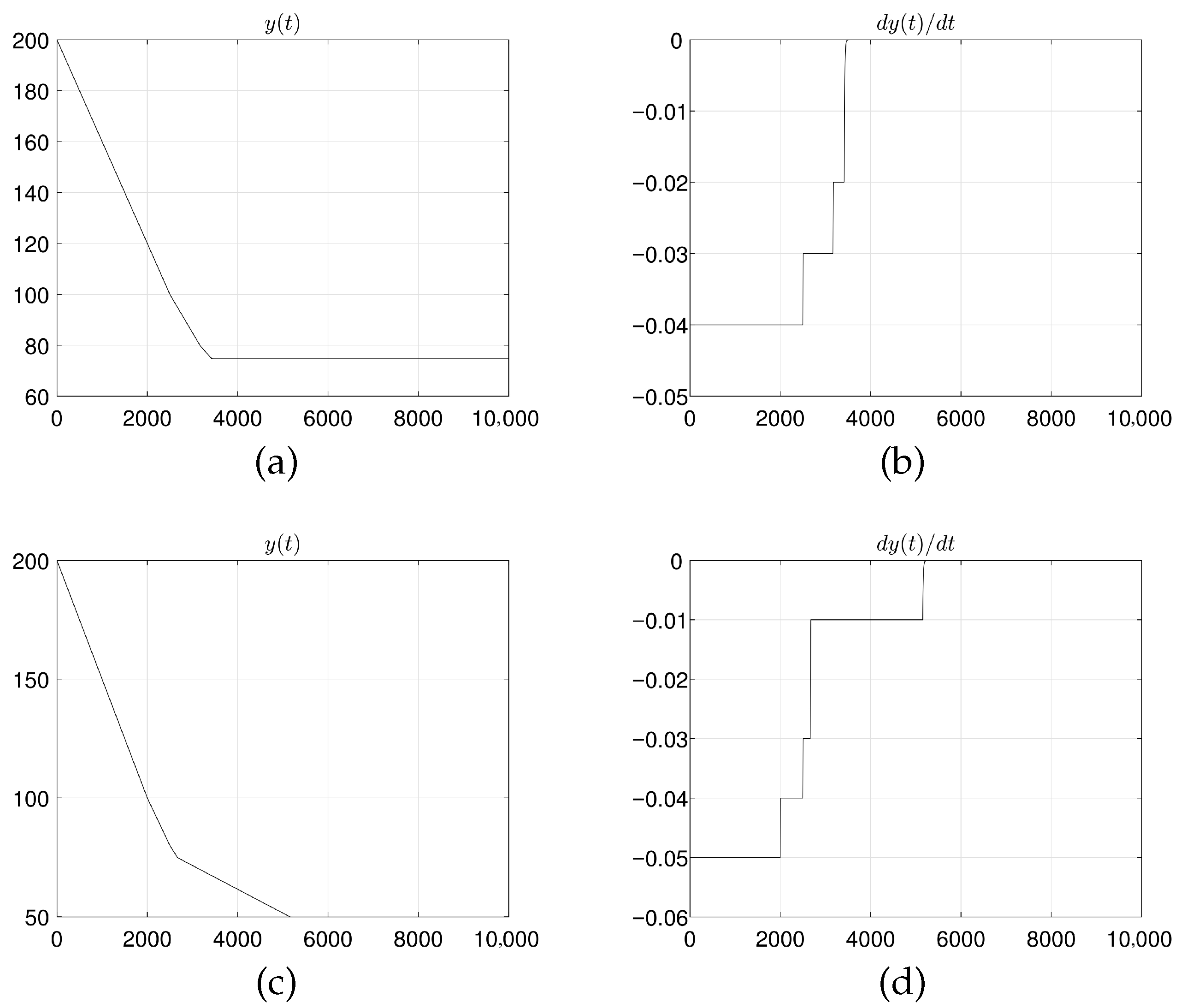
A2) is able to solve the problems in a uniform price auction, the algorithm is unable to protect the winning per-unit bidding price information. For the examples as presented in
Table 1,
Figure A1 shows the changes in
and
obtained. From the change in
, i.e.,
Figure A1b,d, the bidders and the auctioneer are able to reveal the winning per-unit bidding prices.
Let
and so on be the time instances when
jumps abruptly. The winning per-unit bidding prices are
and so on. When does
change abruptly, as shown in
Figure A1b,d? The auctioneer is able to reveal the winning per-unit prices. The winners’ per-unit bidding prices are not protected.
Appendix A.3. Communication Delay
From
Figure A1, one can see that the number of steps for the unit allocation and uniform price determination is in the order of
. Consider that the bidders and the auctioneer are agents. The algorithm as stated in Equations (
A1) and (
A2) is implemented in a distributed manner. Sending
, for
, from the bidder agents to the auctioneer agent will cause communication delay. Similarly, sending
from the auctioneer agent to the bidder agents will cause another communication delay. Therefore, a large number of steps will definitely hamper the application of Equations (
A1) and (
A2) for a uniform price auction.
Figure A1.
Simulation results for the illustrative examples as presented in
Table 1. Here,
and
. (
a,
c): Change in
against
t. (
b,
d): Change in
against
t. By observing when
changes abruptly, as shown in (
b,
d), the auctioneer and the bidders are able to reveal the winners’ bidding prices. From (
a,
c), one can see that the number of steps for the RNN-based algorithm to determine the unit allocation and the uniform price is in the order of
.
Figure A1.
Simulation results for the illustrative examples as presented in
Table 1. Here,
and
. (
a,
c): Change in
against
t. (
b,
d): Change in
against
t. By observing when
changes abruptly, as shown in (
b,
d), the auctioneer and the bidders are able to reveal the winners’ bidding prices. From (
a,
c), one can see that the number of steps for the RNN-based algorithm to determine the unit allocation and the uniform price is in the order of
.
Appendix B. Proof of Theorem 2
Let be the index of the winner with the least winning price . We also let be the convergent value of and be the units allocated to the bidder. To prove that converges to , two cases are considered.
- (a)
First, and hence .
- (b)
Second, and hence .
The proof is thus based on mathematical induction for the argument that for all .
Appendix B.1. Case (a)
For the case that , it is clear that . From that, we can get for all and for all .
For , it is clear that . It is assumed that the argument is true for , i.e., . For , we can get .
If
, we can obtain by Equation (
4) that
,
. As
,
. As a result,
.
If
, we can obtain by Equation (
4) that
,
. As
,
. As a result,
.
Therefore, the argument is true for .
Appendix B.2. Case (b)
For the case that and hence , we can get for all and for all .
If
, we can obtain by Equation (
4) that
,
. As
,
. As a result,
.
If
, we can obtain by Equation (
4) that
,
. As
,
. As a result,
.
Therefore, the argument is true for .
Based on the analysis in Case (a) and Case (b); and by the principle of mathematical induction, we can conclude that for .
Appendix B.3. Convergence
Note that , . Together with the fact that for all , we conclude that . As and , . The proof is completed.
References
- Krishna, V. Auction Theory; Academic Press: Amsterdam, The Netherlands, 2009. [Google Scholar]
- Khezr, P.; Cumpston, A. A review of multiunit auctions with homogeneous goods. J. Econ. Surv. 2022, 36, 1225–1247. [Google Scholar] [CrossRef]
- Lazzaro, J.; Ryckebusch, S.; Mahowald, M.; Mead, C. Winner-Take-All networks of (N) complexity. In Proceedings of the Advances in Neural Information Processing Systems, Cambridge, MA, USA, 1 January 1988; Morgan Kaufmann: Burlington, MA, USA, 1989; pp. 703–711. [Google Scholar]
- Majani, E.; Erlanson, R.; Abu-Mostafa, Y.S. On the K-Winners-Take-All Network. In Proceedings of the Advances in Neural Information Processing Systems 1, Denver, CO, USA, 28 November–1 December 1988; Touretzky, D.S., Ed.; Morgan-Kaufmann: Burlington, MA, USA, 1988; pp. 634–642. [Google Scholar]
- Guo, Z.; Fu, Y.; Cao, C. Secure first-price sealed-bid auction scheme. Eurasp J. Inf. Secur. 2017, 2017, 16. [Google Scholar] [CrossRef]
- Chen, B.; Li, X.; Xiang, T.; Wang, P. SBRAC: Blockchain-Based sealed-bid auction with bidding price privacy and public verifiability. J. Inf. Secur. Appl. 2022, 65, 103082. [Google Scholar] [CrossRef]
- Sum, G.; Sum, J.; Chi-Sing Leung, A.; Chang, J.C.C. A Distributed kWTA for Decentralized Auctions. In Proceedings of the Neural Information Processing: ICONIP 2023, Changsha, China, 20–23 November 2023; Luo, B., Cheng, L., Wu, Z.G., Li, H., Li, C., Eds.; Springer: Singapore, 2023. [Google Scholar]
- Sum, J.; Leung, C.S.; Chang, J. Analysis and design of a distributed kWTA with application in sealed-bid auctions with bidding price privacy protection. IEEE Trans. Neural Netw. Learn. Syst. 2025, 36, 16264–16278. [Google Scholar] [CrossRef] [PubMed]
- Sum, J.; Leung, C.S.; Chang, J. A Fast Wang kWTA with Application in Sealed-Bid Uniform Price Auction. IEEE Trans. Neural Netw. Learn. Syst. 2025, in press. [Google Scholar] [CrossRef]
- Fontoura, M.; Ionescu, M.; Minsky, N. Decentralized peer-to-peer auctions. Electron. Commer. Res. 2005, 5, 7–24. [Google Scholar] [CrossRef]
- Omar, I.A.; Hasan, H.R.; Jayaraman, R.; Salah, K.; Omar, M. Implementing decentralized auctions using blockchain smart contracts. Technol. Forecast. Soc. Change 2021, 168, 120786. [Google Scholar] [CrossRef]
- Chiquito, E.; Bodin, U.; Schelén, O. Survey on decentralized auctioning systems. IEEE Access 2023, 11, 51672–51688. [Google Scholar] [CrossRef]
- Feng, Z.; Narasimhan, H.; Parkes, D.C. Deep learning for revenue-optimal auctions with budgets. In Proceedings of the 17th International Conference on Autonomous Agents and Multiagent Systems, Stockholm, Sweden, 10–15 July 2018; pp. 354–362. [Google Scholar]
- Nedelec, T.; Calauzènes, C.; El Karoui, N.; Perchet, V. Learning in repeated auctions. In Foundations and Trends in Machine Learning; Mark de Jongh: Dordrecht, The Netherlands, 2022; Volume 15, pp. 176–334. [Google Scholar]
- Brânzei, S.; Derakhshan, M.; Golrezaei, N.; Han, Y. Online Learning in Multi-Unit Auctions. arXiv 2023, arXiv:2305.17402. [Google Scholar]
- Galgana, R.; Golrezaei, N. Learning in Repeated Multi-Unit Pay-As-Bid Auctions. arXiv 2023, arXiv:2307.15193. [Google Scholar] [CrossRef]
- Li, S.; Zhou, M.; Luo, X.; You, Z.H. Distributed Winner-Take-All in dynamic networks. IEEE Trans. Autom. Control 2017, 62, 577–589. [Google Scholar] [CrossRef]
- Zhang, Y.; Li, S.; Xu, B.; Yang, Y. Analysis and design of a distributed k-Winners-Take-All model. Automatica 2020, 115, 108868. [Google Scholar] [CrossRef]
- Zhang, Y.; Li, S.; Weng, J. Distributed k-winners-take-all network: An optimization perspective. IEEE Trans. Cybern. 2022, 53, 5069–5081. [Google Scholar] [CrossRef] [PubMed]
- Zhang, Y.; Li, S.; Zhou, X.; Weng, J.; Geng, G. Single-state distributed k-winners-take-all neural network model. Inf. Sci. 2023, 647, 119528. [Google Scholar] [CrossRef]
- Foti, M.; Vavalis, M. Blockchain based uniform price double auctions for energy markets. Appl. Energy 2019, 254, 113604. [Google Scholar] [CrossRef]
- Garey, M.R.; Johnson, D.S. Computers and Intractability: A Guide to the Theory of NP-Completeness; W.H. Freeman: New York, NY, USA, 1979. [Google Scholar]
- Wang, J. Analysis and design of k-Winners-Take-All model with a single state variable and the Heaviside step activation function. IEEE Trans. Neural Netw. 2010, 21, 1496–1506. [Google Scholar] [CrossRef]
- Liu, Q.; Dang, C.; Cao, J. A novel recurrent neural network with one neuron and finite-time convergence for k-winners-take-all operation. IEEE Trans. Neural Netw. 2010, 21, 1140–1148. [Google Scholar]
- Peterson, L.; Davie, B. Computer Networks: A System Approach, 5th ed.; Morgan Kaufmann: Burlington, MA, USA, 2012. [Google Scholar]
- Chen, Y.H.; Chen, S.H.; Lin, I.C. Blockchain based smart contract for bidding system. In Proceedings of the 2018 IEEE International Conference on Applied System Invention (ICASI), Chiba, Japan, 13–17 April 2018; IEEE: New York, NY, USA, 2018; pp. 208–211. [Google Scholar]
- Chen, Y.; Tian, X.; Wang, Q.; Jiang, J.; Li, M.; Zhang, Q. SAFE: A general secure and fair auction framework for wireless markets with privacy preservation. IEEE Trans. Dependable Secur. Comput. 2020, 19, 2038–2053. [Google Scholar] [CrossRef]
- Sharma, G.; Verstraeten, D.; Saraswat, V.; Dricot, J.M.; Markowitch, O. Anonymous fair auction on blockchain. In Proceedings of the 2021 11th IFIP International Conference on New Technologies, Mobility and Security (NTMS), Paris, France, 19–21 April 2021; IEEE: New York, NY, USA, 2021; pp. 1–5. [Google Scholar]
- Shi, Z.; de Laat, C.; Grosso, P.; Zhao, Z. Integration of blockchain and auction models: A survey, some applications, and challenges. IEEE Commun. Surv. Tutor. 2023, 25, 497–537. [Google Scholar] [CrossRef]
- Zhang, Z.; Lu, X.; Li, M.; An, J.; Yu, Y.; Yin, H.; Zhu, L.; Liu, Y.; Liu, J.; Khoussainov, B. A Blockchain-based Privacy-Preserving Scheme for Sealed-bid Auction. IEEE Trans. Dependable Secur. Comput. 2024, 21, 4668–4683. [Google Scholar] [CrossRef]
- Pekeč, A.; Rothkopf, M.H. Combinatorial auction design. Manag. Sci. 2003, 49, 1485–1503. [Google Scholar] [CrossRef]
| Disclaimer/Publisher’s Note: The statements, opinions and data contained in all publications are solely those of the individual author(s) and contributor(s) and not of MDPI and/or the editor(s). MDPI and/or the editor(s) disclaim responsibility for any injury to people or property resulting from any ideas, methods, instructions or products referred to in the content. |
© 2025 by the authors. Licensee MDPI, Basel, Switzerland. This article is an open access article distributed under the terms and conditions of the Creative Commons Attribution (CC BY) license (https://creativecommons.org/licenses/by/4.0/).