New Circuits for Simultaneously Initiating Two Different Quantum Superpositions



Abstract
1. Introduction
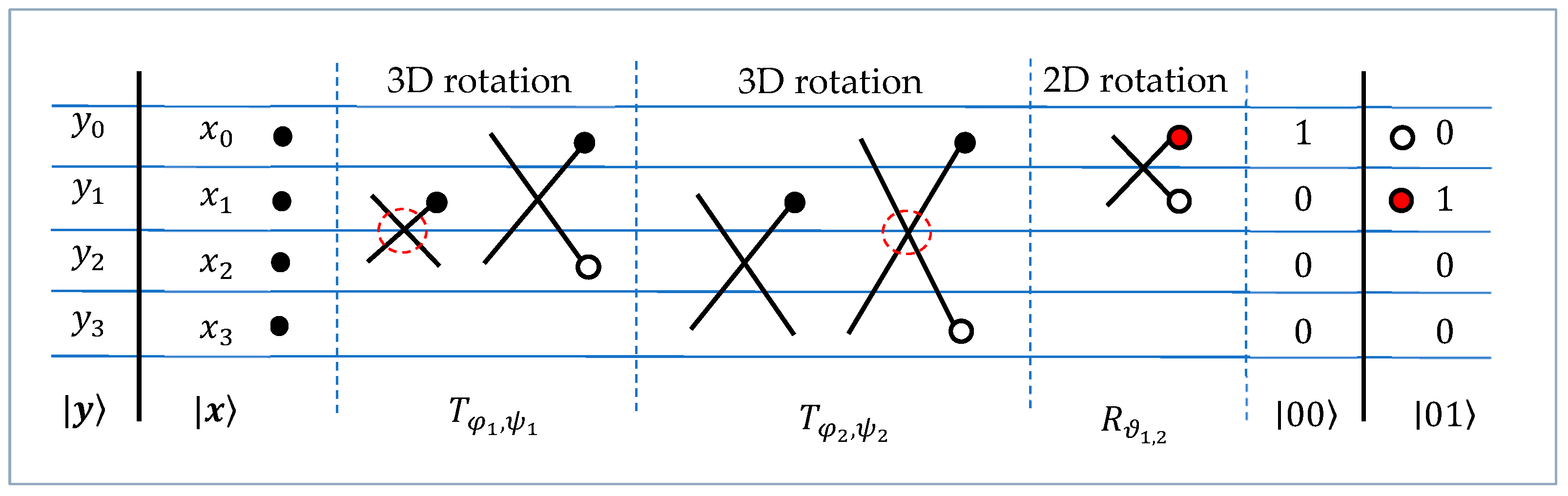
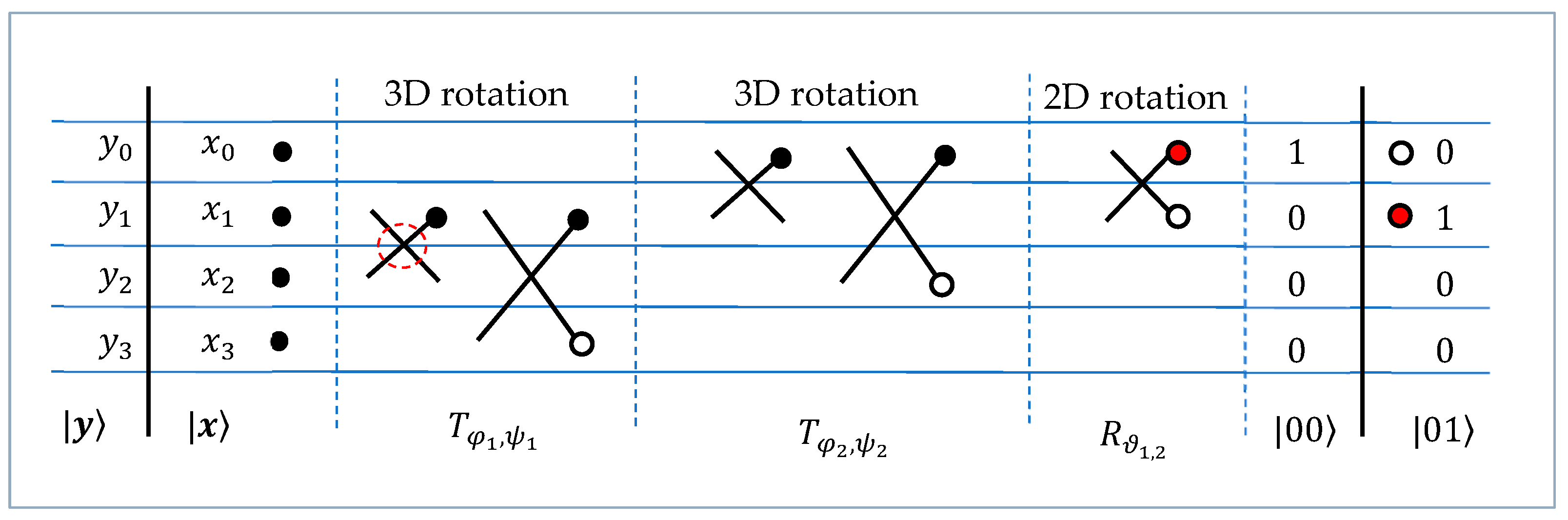
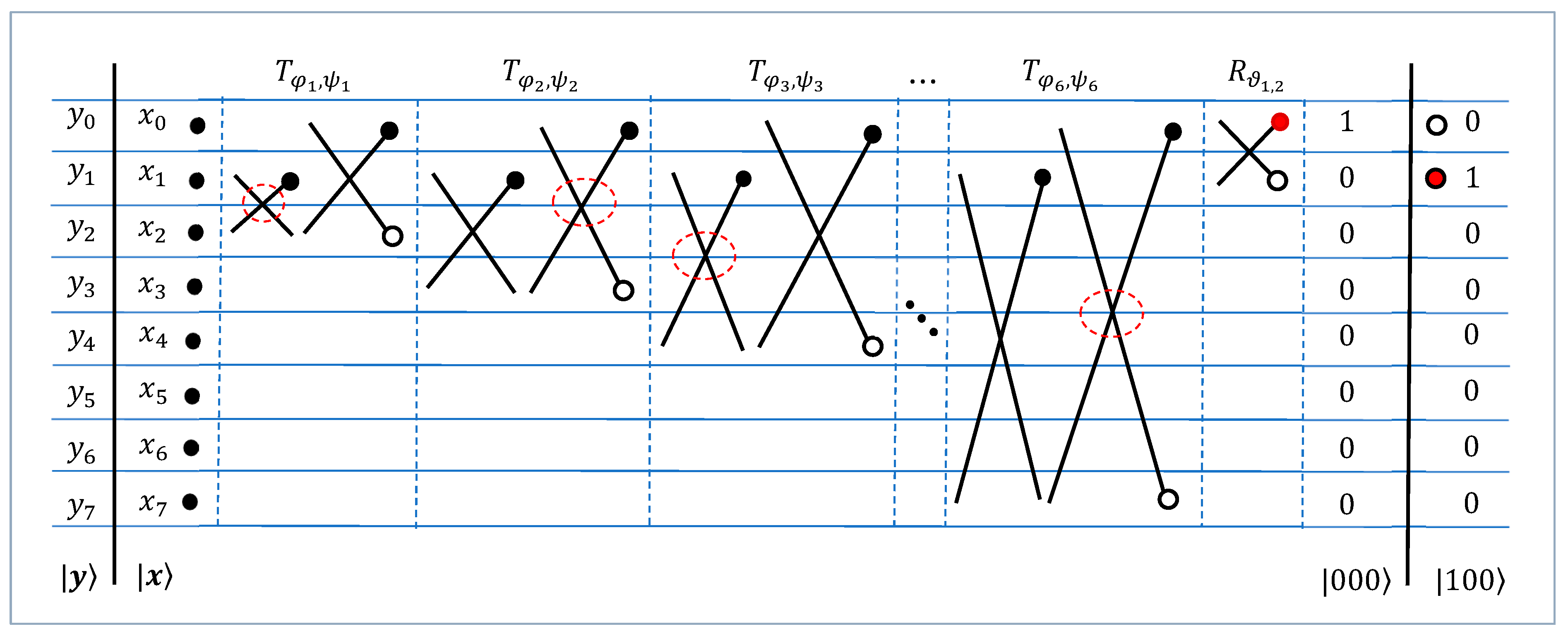
- We develop a unitary transformation generated by two vectors, or two quantum superpositions, by using 3D rotations.
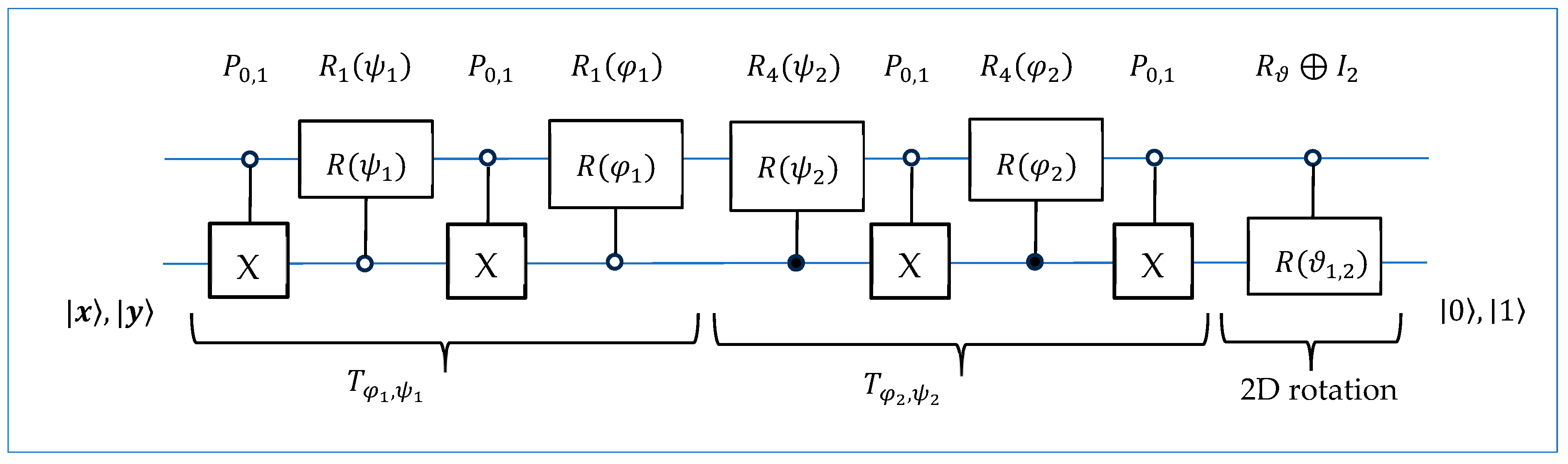
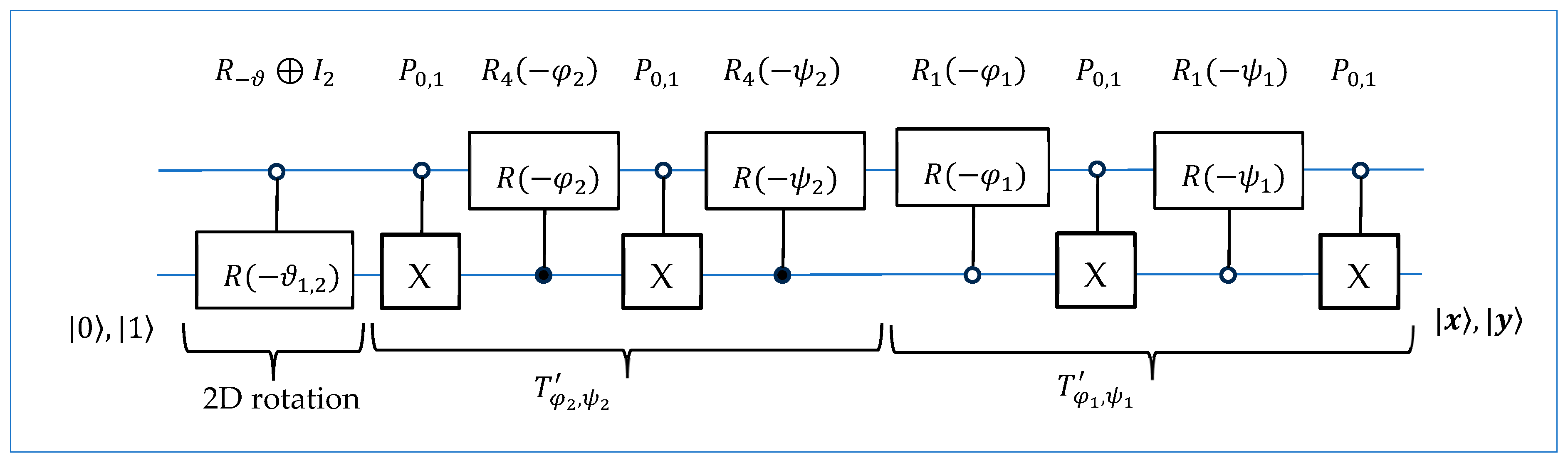
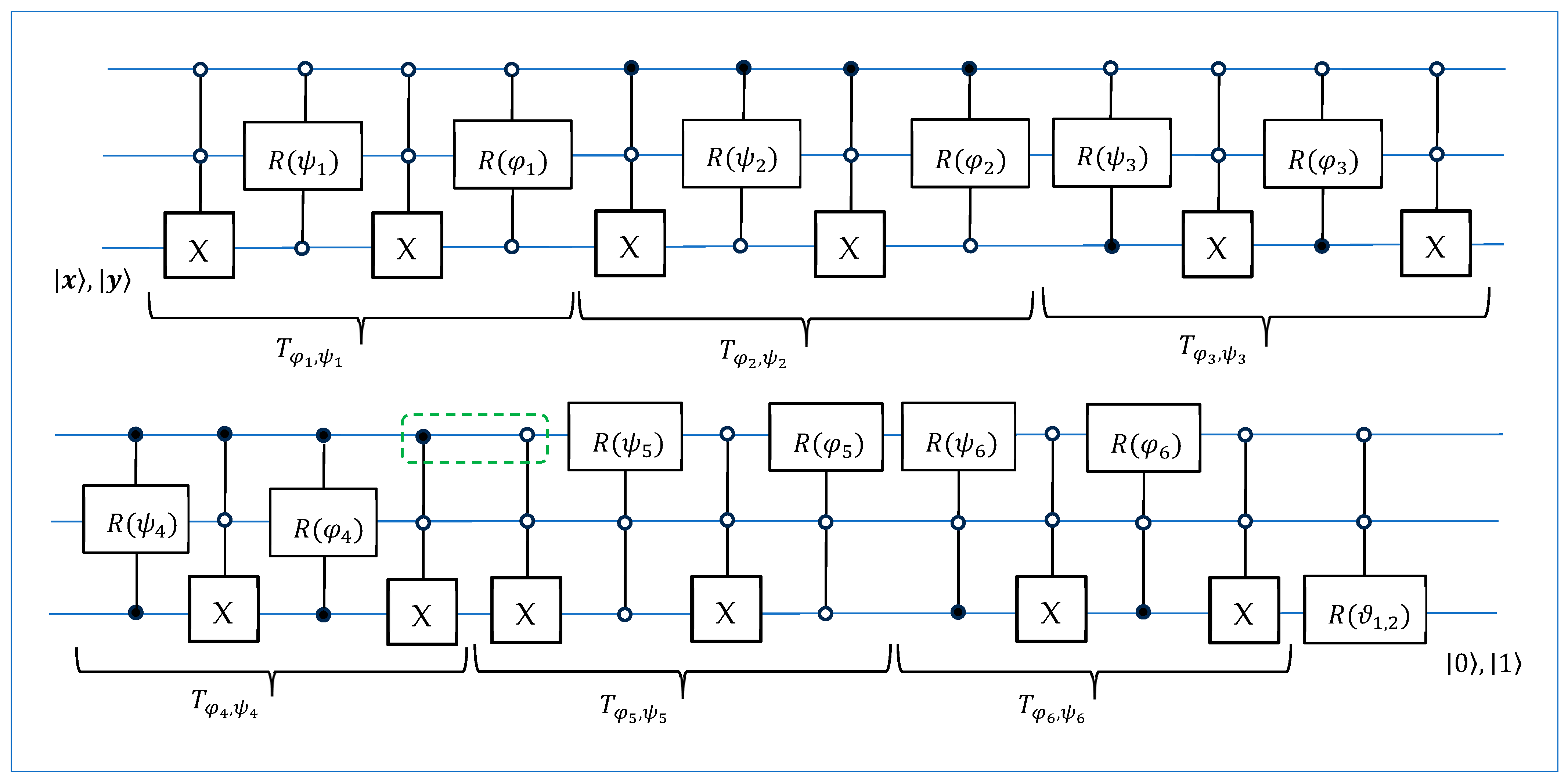
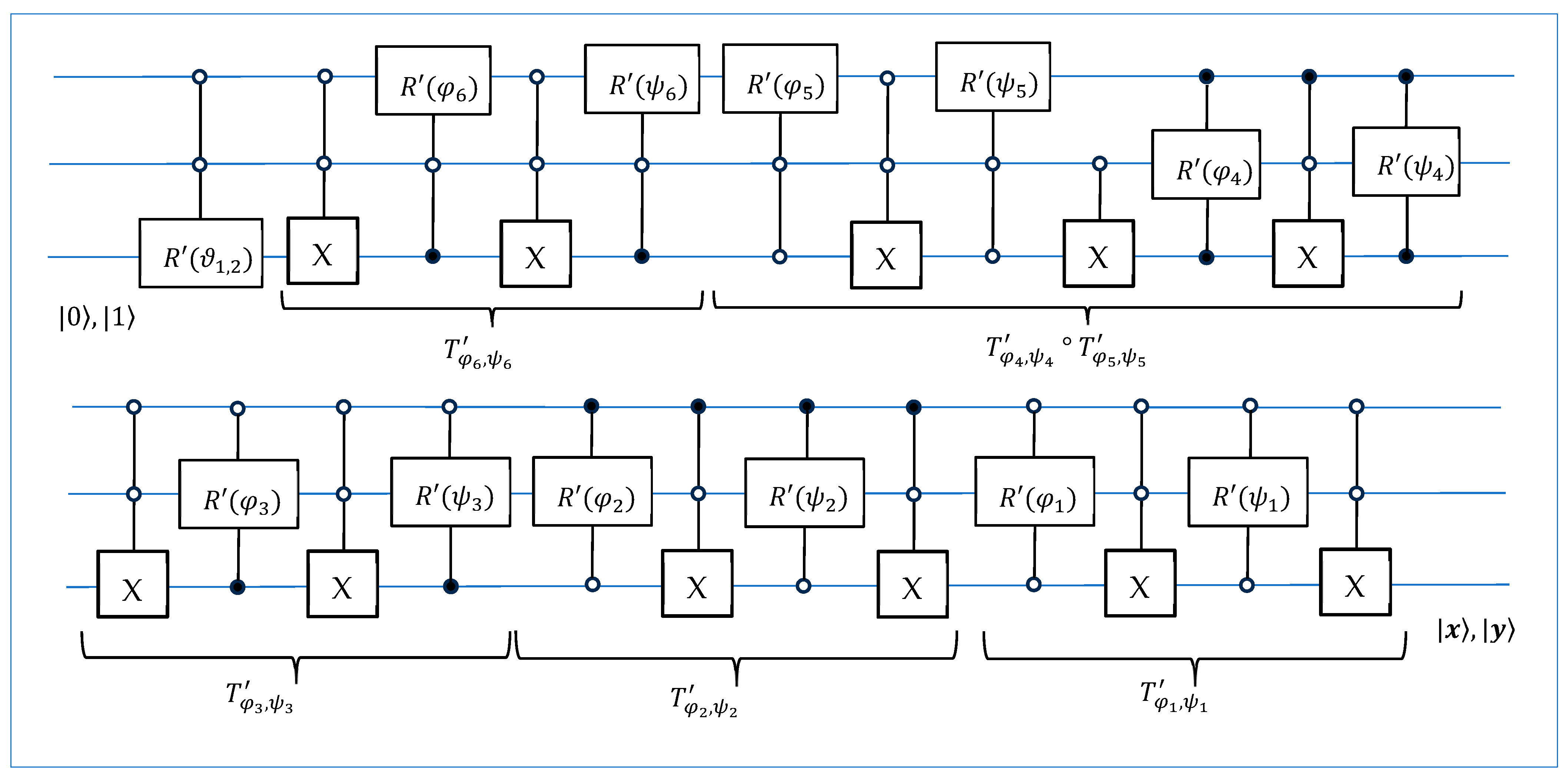
- We propose quantum circuits, each of which allows us to calculate two different multi-qubit superpositions.
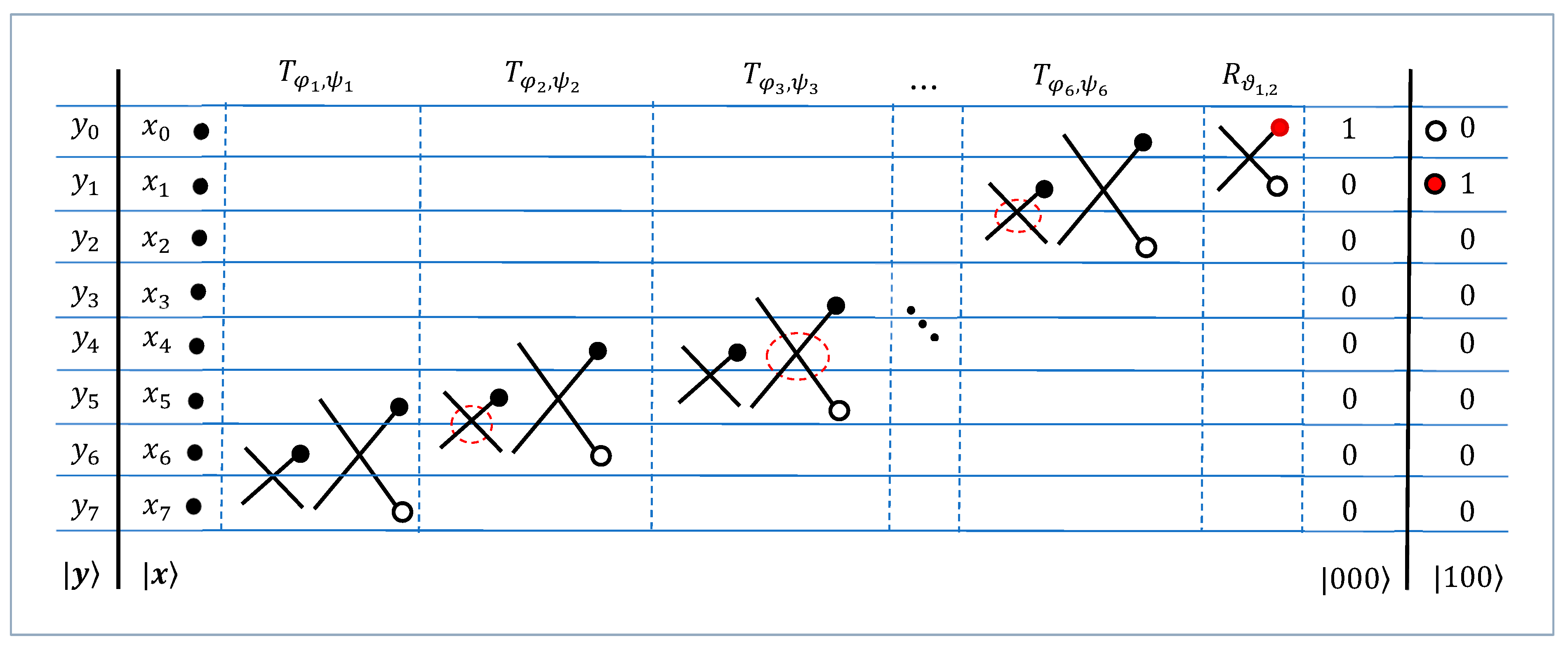
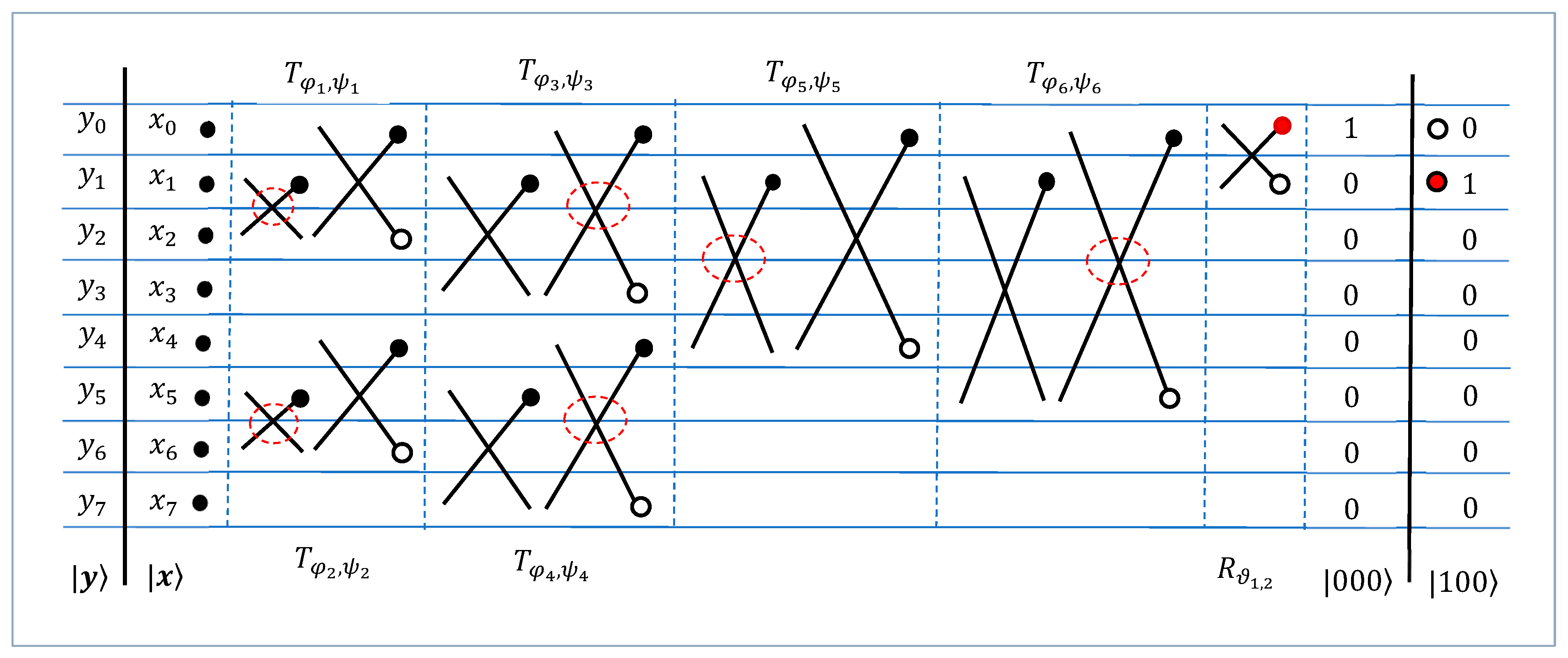
- We present examples with different paths for initiating two 2- and 3-qubit superpositions. These circuits are constructed, tested, and validated using the Qiskit framework.
2. The DsiHT with One Generator
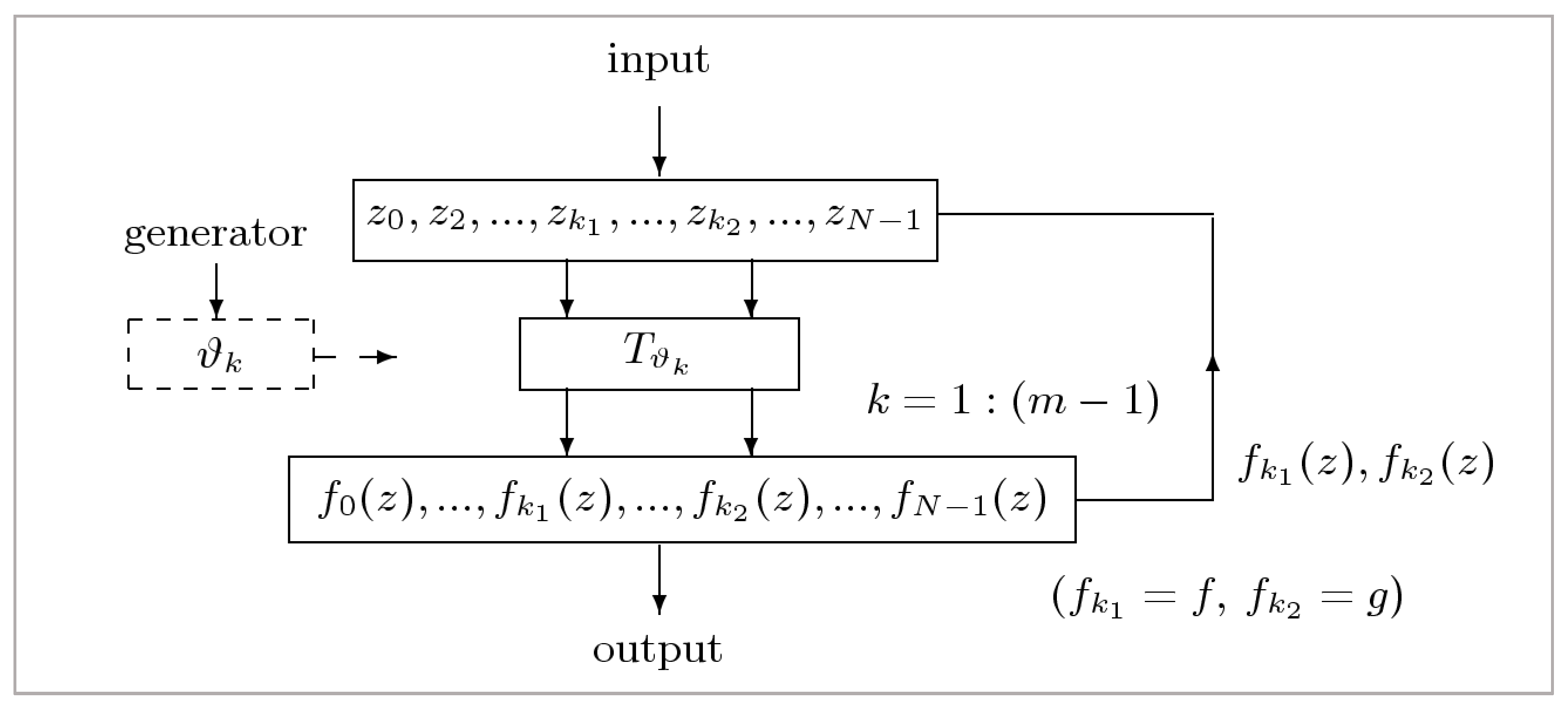
3. Decision Equations with Two Vector-Generators
Rotations in 3D Space
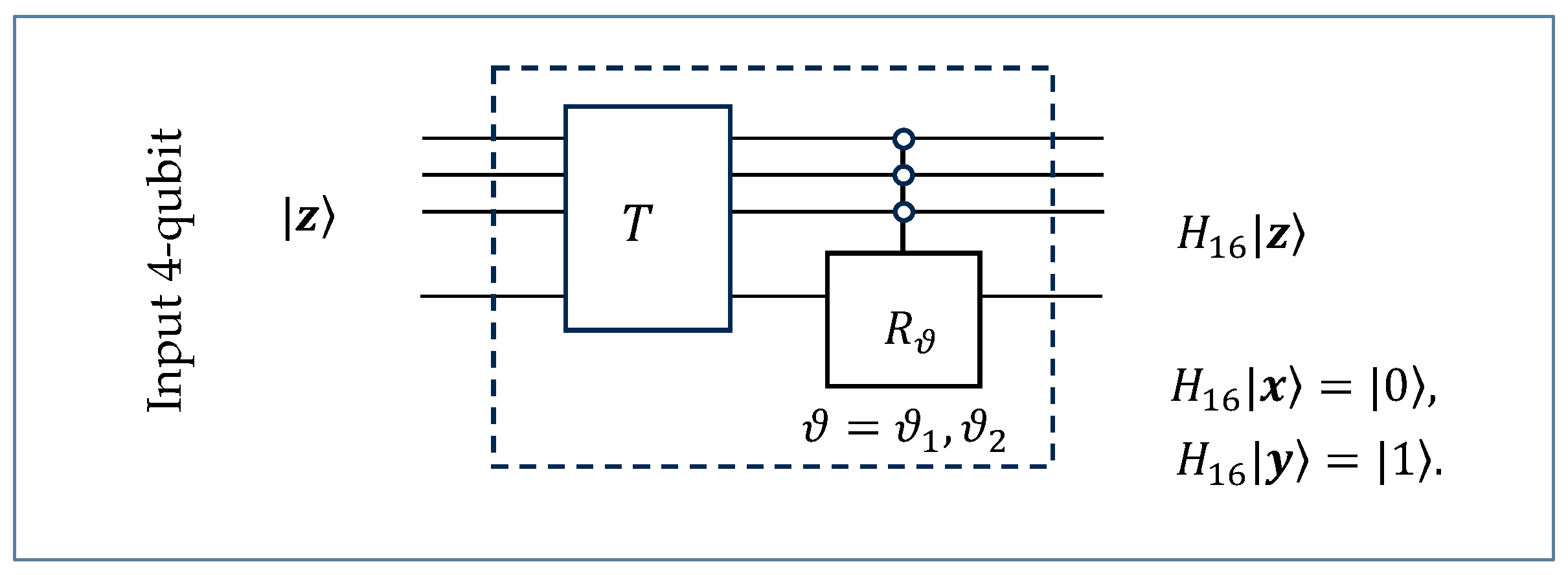
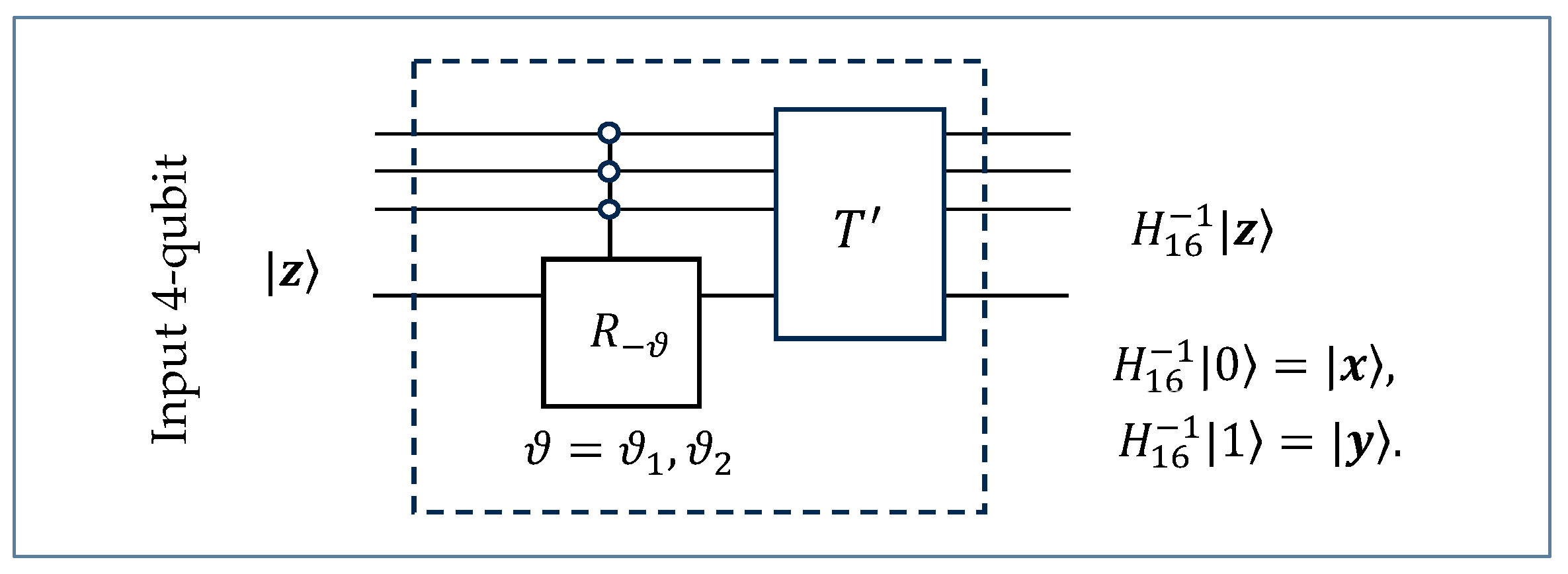
4. The 3-Qubit Q2siHT
5. Circuit Simulation and Analysis Using IBM’s Qiskit Framework
6. Conclusions
Author Contributions
Funding
Institutional Review Board Statement
Informed Consent Statement
Data Availability Statement
Conflicts of Interest
Abbreviations
| DsiHT | Discrete signal-induced heap transform |
| D2siHT | Discrete two signal-induced heap transform |
| Q2siHT | Quantum two signal-induced heap transform |
| BP | Bit plane |
References
- Deutsch, D. Quantum computational networks. Proc. R. Soc. Lond. A Math. Phys. Sci. 1989, 425, 73–90. [Google Scholar]
- Deutsch, D.; Barenco, A.; Ekert, A. Universality in quantum computation. Proc. R. Soc. Lond. A Math. Phys. Sci. 1995, 449, 669–677. [Google Scholar]
- Barenco, A.; Bennett, C.H.; Cleve, R.; DiVincenzo, D.P.; Margolus, N.; Shor, P.; Sleator, T.; Smolin, J.A.; Weinfurter, H. Elementary gates for quantum computation. Phys. Rev. A 1995, 52, 3457. [Google Scholar] [CrossRef] [PubMed]
- Knill, E. Approximation by Quantum Circuits; LANL Rep. LAUR-95-2225; Los Alamos National Laboratory: Los Alamos, NM, USA, 1995. [Google Scholar]
- Long, G.-L.; Sun, Y. Efficient scheme for initializing a quantum register with an arbitrary superposed state. Phys. Rev. A 2001, 64, 014303. [Google Scholar] [CrossRef]
- Shende, V.V.; Markov, I.L. Quantum circuits for incompletely specified two-qubit operators. Quantum Inf. Comput. 2005, 5, 49–58. [Google Scholar] [CrossRef]
- Bärtschi, A.; Eidenbenz, S. Deterministic preparation of Dicke states. In International Symposium on Fundamentals of Computation Theory; Springer: Cham, Switzerland, 2019. [Google Scholar]
- Plesch, M.; Brukner, C. Quantum state preparation with universal gate decompositions. arXiv 2010, arXiv:1003.5760v2. [Google Scholar] [CrossRef]
- Gleinig, N.; Hoefler, T. An efficient algorithm for sparse quantum state preparation. In Proceedings of the 58th ACM/IEEE Design Automation Conference, San Francisco, CA, USA, 5–9 December 2021; IEEE: New York, NY, USA, 2021. [Google Scholar]
- de Veras, T.M.; da Silva, L.D.; da Silva, A.J. Double sparse quantum state preparation. Quantum Inf. Process. 2002, 21, 204. [Google Scholar] [CrossRef]
- Volya, D.; Mishra, P. State preparation on quantum computers via quantum steering. arXiv 2023, arXiv:2302.13518v3. [Google Scholar] [CrossRef]
- Householder, A.S. Unitary Triangulation of a Nonsymmetric Matrix. J. ACM 1958, 5, 339–342. [Google Scholar] [CrossRef]
- Rutishause, H. Simultaneous Iteration Method for Symmetric Matrices. In Linear Algebra. Handbook for Automatic Computation; Bauer, F.L., Ed.; Springer: Berlin/Heidelberg, Germany, 2017. [Google Scholar]
- Golub, G.H.; Van Loan, C.F. Matrix Computations, 3rd ed.; Johns Hopkins Press: Baltimore, ML, USA, 1996. [Google Scholar]
- Bindel, D.; Demmel, J.; Kahan, W.; Marques, O. On Computing Givens Rotations Reliably and Efficiently; LAPACK Working Note 148; UT-CS-00-449; University of Tennessee: Knoxville, TN, USA, 2001. [Google Scholar]
- Demmel, J.; Grigori, L.; Hoemmen, M.; Langou, J. Communication-optimal parallel and sequential QR and LU factorizations. SIAM J. Sci. Comp. 2012, 34, 206–239. [Google Scholar] [CrossRef]
- Wang, H.; Bochen, T.D.; Cong, J. Quantum state preparation circuit optimization exploiting don’t cares. arXiv 2024, arXiv:2409.01418. [Google Scholar]
- Pinto, D.F.; Friedrich, L.; Maziero, J. Preparing general mixed quantum states on quantum computers. arXiv 2024, arXiv:2402.04212. [Google Scholar] [CrossRef]
- Zhang, X.M.; Li, T.; Yuan, X. Quantum state preparation with optimal circuit depth: Implementations and applications. Phys. Rev. Lett. 2022, 129, 230504. [Google Scholar] [CrossRef] [PubMed]
- Vartiainen, J.J.; Möttönen, M.; Salomaa, M.M. Efficient decomposition of quantum gates. Phys. Rev. Lett. 2004, 92, 177902. [Google Scholar] [CrossRef] [PubMed]
- Möttönen, M.; Vartiainen, J.J.; Bergholm, V.; Salomaa, M.M. Quantum circuits for general multiqubit gates. Phys. Rev. Lett. 2004, 93, 130502. [Google Scholar] [CrossRef]
- Bergholm, V.; Vartiainen, J.J.; Möttönen, M.; Salomaa, M.M. Quantum circuits with uniformly controlled one-qubit gates. arXiv 2004, arXiv:quant-ph/0410066v2. [Google Scholar] [CrossRef]
- Shende, V.V.; Bullock, S.S.; Markov, I.L. Synthesis of quantum-logic circuits. IEEE Trans. Comput.-Aided Des. Integr. Circuits Syst. 2006, 25, 1000–1010. [Google Scholar] [CrossRef]
- Grigoryan, A.M.; Gomez, A.; Agaian, S.S. A Novel approach to state-to-state transformation in quantum computing. Information 2025, 16, 689. [Google Scholar] [CrossRef]
- Grigoryan, A.M. New permutation-free quantum circuits for implementing 3- and 4-qubit unitary operations. Information 2025, 16, 621. [Google Scholar] [CrossRef]
- Grigoryan, A.M.; Grigoryan, M.M. Brief Notes in Advanced DSP: Fourier Analysis with MATLAB; CRC Press: Boca Raton, FL, USA; Taylor, and Francis Group: Abingdon, UK, 2009. [Google Scholar]
- Nielsen, M.A.; Chuang, I.L. Quantum Computation and Quantum Information; Cambridge University Press: Cambridge, UK, 2000. [Google Scholar]
- Rieffel, E.G.; Polak, W.H. Quantum Computing: A Gentle Introduction; The MIT Press: Cambridge, MA, USA, 2011. [Google Scholar]
- Qiskit Development Team. Qiskit: An Open-Source Framework for Quantum Computing, Version 1.3.2. Computer Software. IBM Quantum: Poughkeepsie, NY, USA, 2019.
- Mykhailova, M. Quantum Programming in Depth Solving problems with Q# and Qiskit; Manning: Shelt Island, NY, USA, 2025. [Google Scholar]
- IBM Quantum. Exact and Noisy Simulation with Qiskit Aer Primitives. IBM Quantum Documentation—Guides, 2024–2025. Available online: https://quantum.cloud.ibm.com/docs/guides/simulate-with-qiskit-aer (accessed on 1 November 2025).
- Grigoryan, A.M. Effective methods of QR-decompositions of square complex matrices by fast discrete signal-induced heaptransforms. Adv. Linear Algebra Matrix Theory (ALAMT) 2023, 12, 87–110. [Google Scholar] [CrossRef]
- Haroche, S.; Raimond, J.-M. Exploring the Quantum: Atoms, Cavities, and Photons; Oxford University Press: Oxford, UK, 2006; ISBN 0-19-850914-6. [Google Scholar]
- Häffner, H.; Roos, C.F.; Blatt, R. Quantum Computing with Trapped Ions. Phys. Rep. 2008, 469, 155–203. [Google Scholar] [CrossRef]



| −36.53 | ||||||
| Basis States | Probabilities of | ||||
|---|---|---|---|---|---|
| Theoretical | 500 Shots | 1000 Shots | 10,000 Shots | 100,000 Shots | |
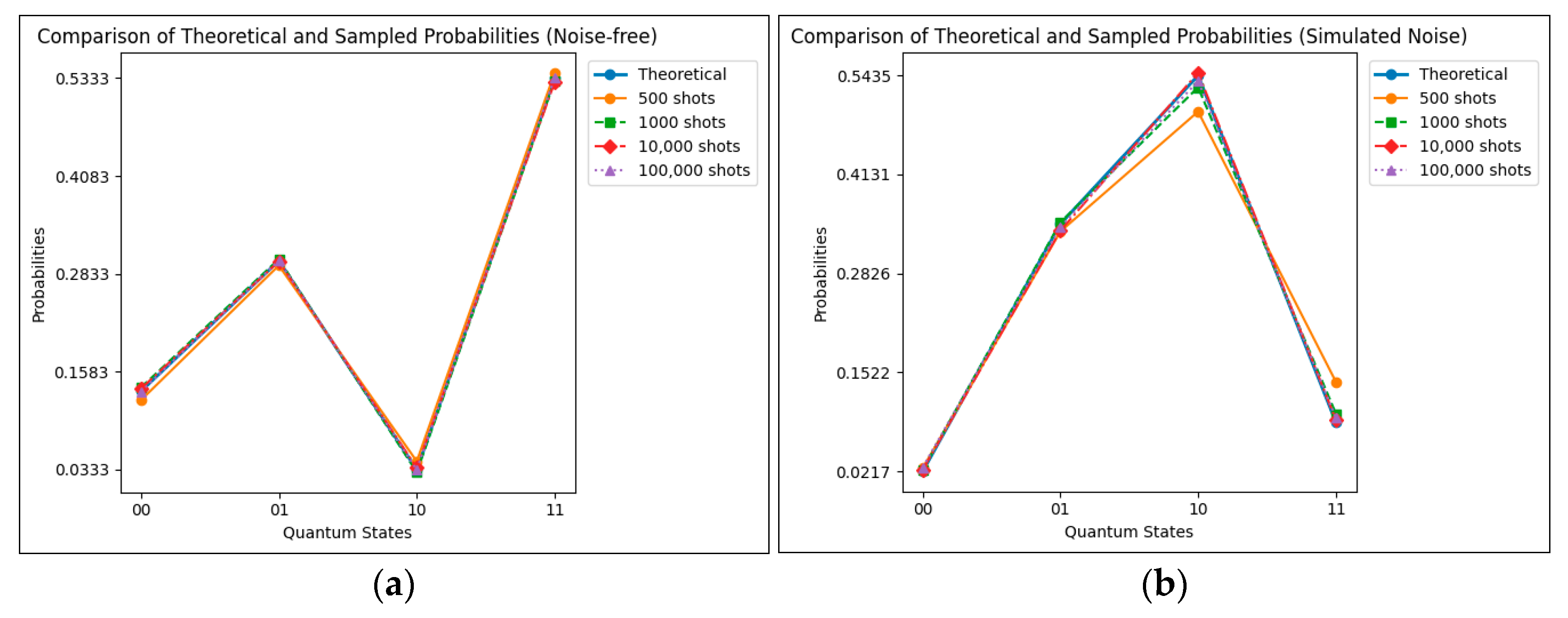
| 0.1333 | 0.1160 | 0.1430 | 0.1369 | 0.1320 | |
| 0.3000 | 0.3040 | 0.2980 | 0.3008 | 0.3007 | |
| 0.0333 | 0.0320 | 0.0400 | 0.0326 | 0.0327 | |
| 11 | 0.5333 | 0.5480 | 0.5190 | 0.5297 | 0.5346 |
| RMSE | |||||
| Basis States | Probabilities of | ||||
| Theoretical | 500 Shots | 1000 Shots | 10,000 Shots | 100,000 Shots | |
| 0.0217 | 0.0240 | 0.02400 | 0.0220 | 0.0221 | |
| 0.3478 | 0.3340 | 0.3570 | 0.3430 | 0.3462 | |
| 0.5435 | 0.5700 | 0.5300 | 0.5478 | 0.5459 | |
| 11 | 0.0869 | 0.0720 | 0.0890 | 0.0872 | 0.0858 |
| RMSE | |||||
| Basis States | Probabilities of | ||||
|---|---|---|---|---|---|
| Theoretical | 500 Shots | 1000 Shots | 10,000 Shots | 100,000 Shots | |
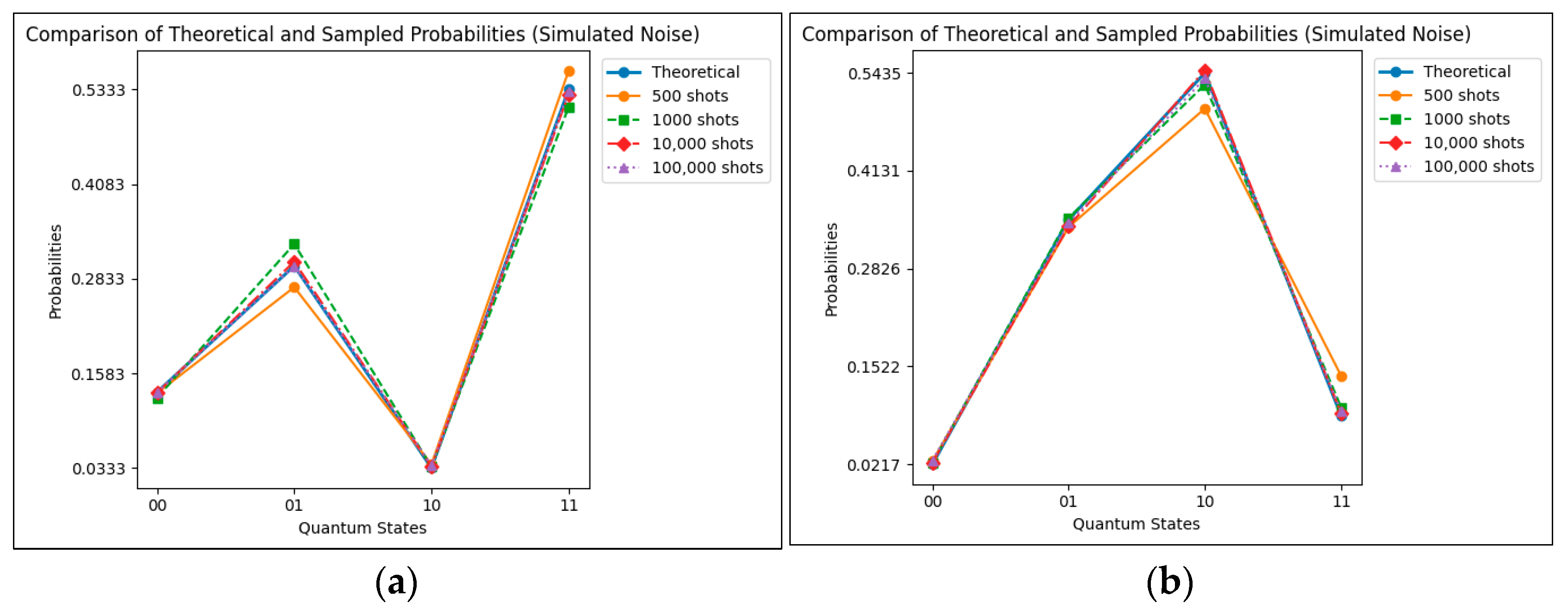
| 0.1333 | 0.1540 | 0.1380 | 0.1356 | 0.1349 | |
| 0.3000 | 0.2680 | 0.3000 | 0.3057 | 0.2998 | |
| 0.0333 | 0.0340 | 0.0450 | 0.0380 | 0.0382 | |
| 11 | 0.5333 | 0.5440 | 0.5170 | 0.5207 | 0.5271 |
| RMSE | |||||
| Basis States | Probabilities of | ||||
| Theoretical | 500 Shots | 1000 Shots | 10,000 Shots | 100,000 Shots | |
| 0.0217 | 0.0300 | 0.0230 | 0.0210 | 0.0227 | |
| 0.3478 | 0.3140 | 0.3370 | 0.3379 | 0.3478 | |
| 0.5435 | 0.5740 | 0.5460 | 0.5494 | 0.5429 | |
| 11 | 0.0869 | 0.0820 | 0.0940 | 0.0917 | 0.0866 |
| RMSE | |||||
| Basis States | Probabilities of | ||||
|---|---|---|---|---|---|
| Theoretical | 1000 Shots | 10,000 Shots | 100,000 Shots | 1,000,000 Shots | |
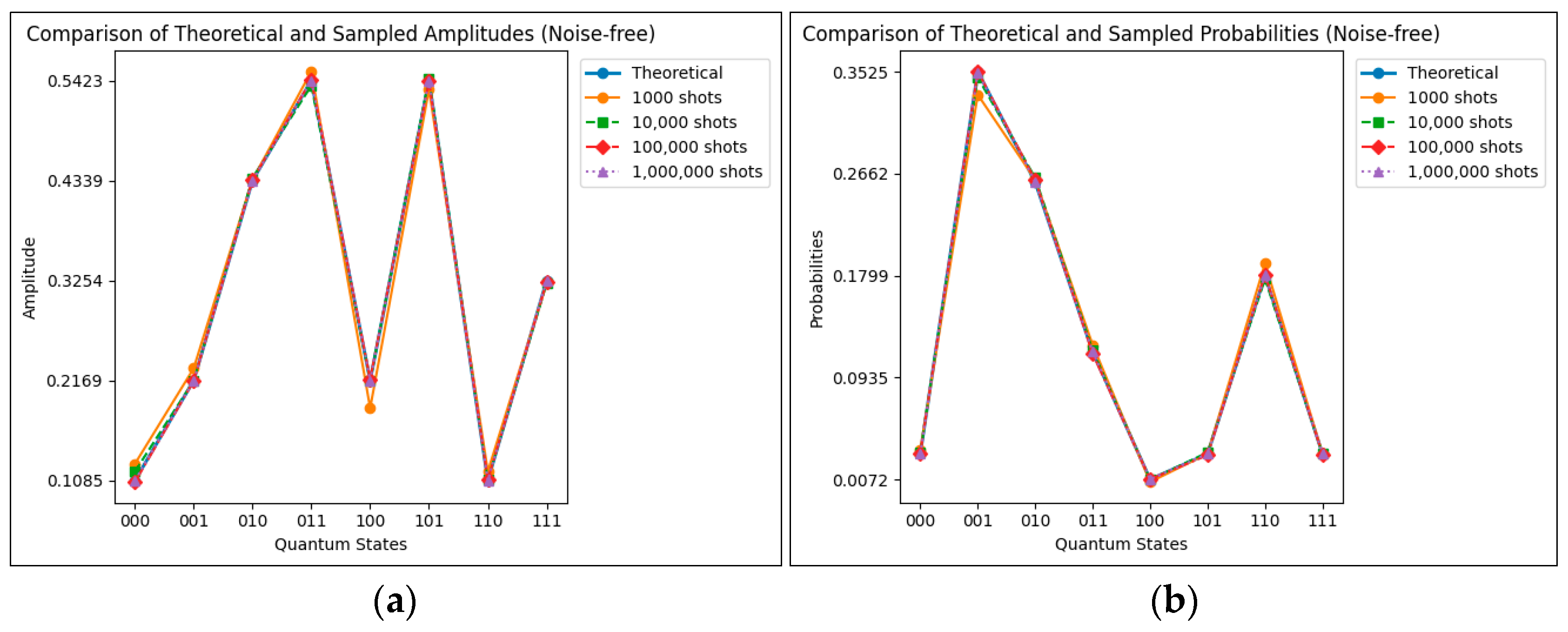
| 0.0118 | 0.0070 | 0.0088 | 0.0118 | 0.0117 | |
| 0.0471 | 0.0420 | 0.0464 | 0.0466 | 0.0472 | |
| 0.0118 | 0.0110 | 0.0105 | 0.0115 | 0.0119 | |
| 111 | 0.1059 | 0.0910 | 0.1032 | 0.1070 | 0.106 |
| RMSE | |||||
| Basis States | Probabilities of | ||||
| Theoretical | 1000 Shots | 10,000 Shots | 100,000 Shots | 1,000,000 Shots | |
| 0.0288 | 0.0320 | 0.0303 | 0.0290 | 0.0287 | |
| 0.3525 | 0.3330 | 0.3477 | 0.3527 | 0.3516 | |
| 0.1799 | 0.1900 | 0.1771 | 0.1805 | 0.1800 | |
| 111 | 0.0288 | 0.0290 | 0.0288 | 0.0284 | 0.0291 |
| RMSE | |||||
| Basis States | Probabilities of | ||||
|---|---|---|---|---|---|
| Theoretical | 1000 Shots | 10,000 Shots | 100,000 Shots | 1,000,000 Shots | |
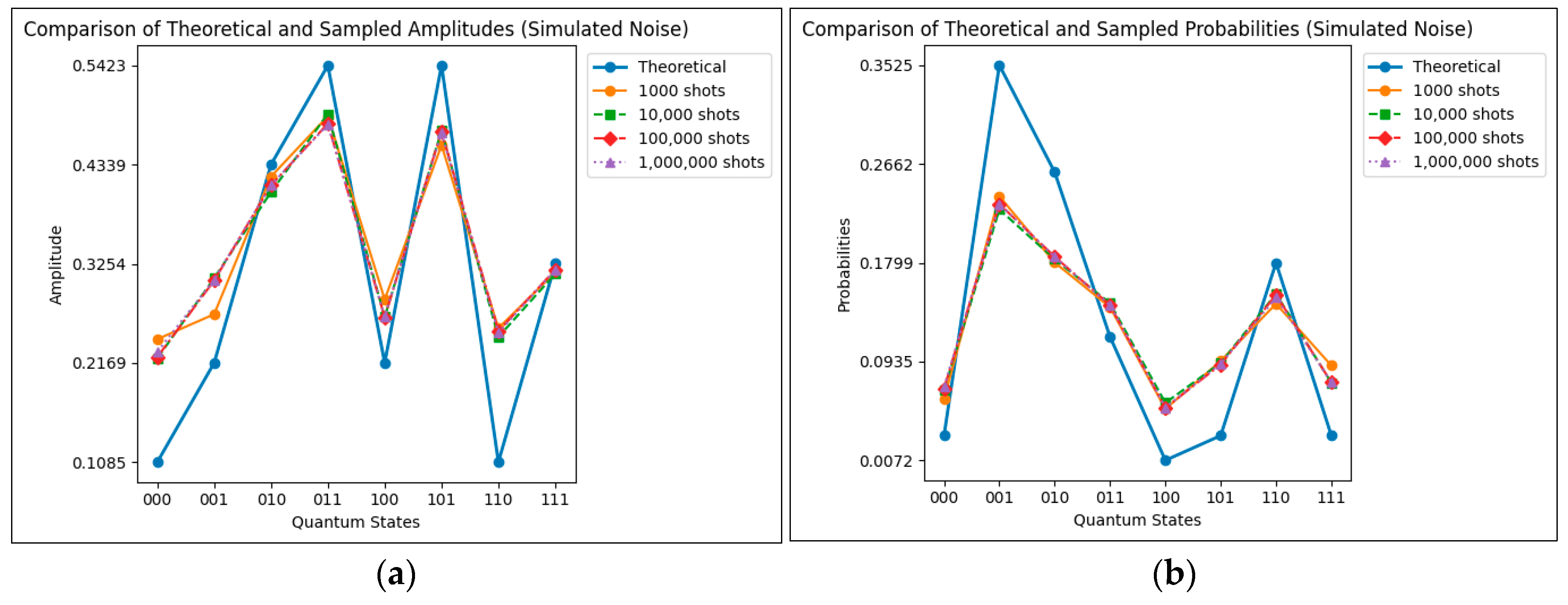
| 0.0118 | 0.066 | 0.0616 | 0.0623 | 0.0613 | |
| 0.0471 | 0.101 | 0.0968 | 0.0985 | 0.0986 | |
| 0.0118 | 0.068 | 0.0659 | 0.0673 | 0.0664 | |
| 111 | 0.1059 | 0.1 | 0.1054 | 0.109 | 0.1091 |
| RMSE | |||||
| Basis States | Probabilities of | ||||
| Theoretical | 1000 Shots | 10,000 Shots | 100,000 Shots | 1,000,000 Shots | |
| 0.0288 | 0.0610 | 0.0688 | 0.0699 | 0.0716 | |
| 0.3525 | 0.2380 | 0.2264 | 0.2311 | 0.2313 | |
| 0.1799 | 0.1440 | 0.1527 | 0.1518 | 0.1494 | |
| 111 | 0.0288 | 0.0900 | 0.0750 | 0.0752 | 0.0752 |
| RMSE | |||||
Disclaimer/Publisher’s Note: The statements, opinions and data contained in all publications are solely those of the individual author(s) and contributor(s) and not of MDPI and/or the editor(s). MDPI and/or the editor(s) disclaim responsibility for any injury to people or property resulting from any ideas, methods, instructions or products referred to in the content. |
© 2025 by the authors. Licensee MDPI, Basel, Switzerland. This article is an open access article distributed under the terms and conditions of the Creative Commons Attribution (CC BY) license (https://creativecommons.org/licenses/by/4.0/).
Share and Cite
Grigoryan, A.M.; Gomez, A.A. New Circuits for Simultaneously Initiating Two Different Quantum Superpositions. Information 2025, 16, 1043. https://doi.org/10.3390/info16121043
Grigoryan AM, Gomez AA. New Circuits for Simultaneously Initiating Two Different Quantum Superpositions. Information. 2025; 16(12):1043. https://doi.org/10.3390/info16121043
Chicago/Turabian StyleGrigoryan, Artyom M., and Alexis A. Gomez. 2025. "New Circuits for Simultaneously Initiating Two Different Quantum Superpositions" Information 16, no. 12: 1043. https://doi.org/10.3390/info16121043
APA StyleGrigoryan, A. M., & Gomez, A. A. (2025). New Circuits for Simultaneously Initiating Two Different Quantum Superpositions. Information, 16(12), 1043. https://doi.org/10.3390/info16121043