You are currently viewing a new version of our website. To view the old version click .
Information
  • Article
  • Open Access

21 December 2022

A Closer Look at Machine Learning Effectiveness in Android Malware Detection

,
and
Department of Information and Communication Engineering, University of the Aegean, 83200 Karlovasi, Samos, Greece
*
Author to whom correspondence should be addressed.
These authors contributed equally to this work.
This article belongs to the Special Issue Advances in Computing, Communication & Security

Abstract

Nowadays, with the increasing usage of Android devices in daily life activities, malware has been increasing rapidly, putting peoples’ security and privacy at risk. To mitigate this threat, several researchers have proposed different methods to detect Android malware. Recently, machine learning based models have been explored by a significant mass of researchers checking for Android malware. However, selecting the most appropriate model is not straightforward, since there are several aspects that must be considered. Contributing to this domain, the current paper explores Android malware detection from diverse perspectives; this is achieved by optimizing and evaluating various machine learning algorithms. Specifically, we conducted an experiment for training, optimizing, and evaluating 27 machine learning algorithms, and a Deep Neural Network (DNN). During the optimization phase, we performed hyperparameter analysis using the Optuna framework. The evaluation phase includes the measurement of different performance metrics against a contemporary, rich dataset, to conclude with the most accurate model. The best model was further interpreted by conducting feature analysis, using the Shapley Additive Explanations (SHAP) framework. Our experiment results showed that the best model is the DNN consisting of four layers (two hidden), using the Adamax optimizer, as well as the Binary Cross-Entropy (loss), and the Softsign activation functions. The model succeeded with 86% prediction accuracy, while the balanced accuracy, the F1-score, and the ROC-AUC metrics were at 82%.

1. Introduction

With the growing development of Android applications and the plethora of services offered by mobile devices, security threats are on the rise. This trend is further exacerbated in the context of ongoing crises, including the coronavirus one, which brought along a sudden need for businesses and their employees to start or increase working from home. Indeed, as an example, a recent report from McAfee [1] states that cyber criminals have been exploiting the global interest in the COVID-19 pandemic and vaccines by creating fake applications masquerading as official health department mobile applications.
In the mobile arena, malware is becoming the most prominent and dangerous threat that causes various security incidents, and result in a range of financial damage. Especially for devices based on the Android platform, each year, new and more sophisticated malware is being detected [1]. In this respect, contemporary malware detection techniques, including heuristic detection and signature-based detection, are not considered sufficient anymore to detect new malicious applications [2].
In an effort to detect and confront Android malware, various approaches have been proposed so far. In general, Android malware detection can be categorized into signature-based and anomaly-based. The latter usually employs Machine Learning (ML) to distinguish anomalies, i.e., deviations from the trained model, which are regarded as malicious behavior.
Furthermore, malware detection schemes can be classified into two main categories: static analysis and dynamic analysis. Static analysis uses syntactic features that can be extracted from each Android Package Kit (APK) file, without executing the application. This is considered a much safer and quicker process that also reduces the overall computational overhead. On the other hand, dynamic analysis requires the application to be executed on either a real device or a simulated environment, e.g., a Virtual Machine (VM). This is an important factor which makes research on this field lean towards static analysis [3].
In this context, in order to handle the detection of sophisticated, modern mobile malware, as well as the demand for more accurate predictions, diverse techniques such as ML algorithms are brought to the foreground [3,4]. Specifically, ML is a sub-set of Artificial Intelligence (AI) that gains applicability in various domains, while different mobile applications were developed. Especially in security targeting mobile devices, legacy ML algorithms such as Support Vector Machine (SVM), Logistic Regression (LR), and Decision Tree (DT) have been extensively assessed, showing promising results in classifying Android malware. Overall, ML models can be used to overcome the limitations of traditional detection methods and provide superior prediction scores [5].
More recently, several researchers have started to employ different Neural Networks (NN) for anomaly-based malware detection. Specifically, Deep Neural Networks (DNN), Convolutional Neural Networks (CNN), Recurrent Neural Networks (RNN), and Feed-Forward networks (FFN) have been applied to various detection schemes with promising results.
However, applying ML techniques for predicting malware applications is generally a cumbersome process, due to various factors that influence their training and prediction accuracy, and therefore such methods call for careful and thorough exploration. The first major consideration is the quality and the quantity of the input data used for training the ML algorithms. Furthermore, it is also crucial to inspect the various ML algorithms for comparing their detection performance, which in turn will assist in finding the more suitable one for a given problem. Finally, ML hyperparameter tuning is also key to the prediction performance and may include the enabling of techniques, including early stopping classifiers, the use of different topologies and activation functions, as well as the selection of different batches and epochs [6].
Altogether, the current work intends to investigate in a more comprehensive manner the use of ML algorithms for mobile malware detection, by applying different optimization techniques. Specifically, we explored and validated the performance of 28 different supervised and semi-supervised ML algorithms, including a DNN model, regarding their capacity in identifying Android malware. We conducted a comparative analysis in terms of prediction accuracy, and other relevant key metrics. We proceeded with a hyperparameter tuning of the selected DNN model, by using the Optuna framework, for exploring further its prediction accuracy. Last but not least, due to the existence of different input data, a side goal of the current study is to shed light on these input features that significantly affect the performance of malware prediction. Precisely, we enabled the SHAP framework for scrutinizing the ML algorithms and revealed key classification features that affect prediction performance.
To summarize, the work at hand contributes to the following goals:
  • A large dataset of contemporary malware is collected to extract features using static analysis;
  • Twenty seven different ML models were trained, using the aforementioned dataset in an effort to find the best performer;
  • A DNN model is tuned and optimized after conducting hyperparameters importance analysis, by using the Optuna framework on our benchmark dataset.
  • Feature importance analysis is performed using the SHAP framework on the best performing ML model to reveal the most significant classification features.
The outline of the rest of the paper is as follows: The next section focuses on the existing work on the field. Section 3 details the methodology used to conduct this study, including the utilized dataset, the testbed, and the relevant performance metrics. Section 4 focuses on the evaluation of 27 shallow ML models, while Section 5 concentrates on DNN model evaluation. Section 6 elaborates on feature importance. The final section concludes and provides future directions.

3. Methodology

3.1. Dataset

For the needs of the current work, 1000 malware samples were collected from the most contemporary benchmark dataset, namely AndroZoo [22], dated from 2017 to 2020. AndroZoo is a well-known and widely used collection of Android applications gathered from various sources, including the official Google Play application market [35]. It includes new and more sophisticated malware samples in comparison to older datasets, e.g., Drebin [8]. Each of the chosen applications was cross-examined by several antivirus products. The (balanced) dataset also contained 1000 benign applications, collected from Google Play. The latter applications were also dated from 2017 to 2020. The list of malicious and benign samples (applications) used in the experiments can be found in a publicly accessible GitHub repository, as given in the “Data Availability Statement” section.

3.2. Data Analysis

Static analysis was performed on all the samples using the open-source tool Androtomist [36], which is able to extract various features from an Android application by decompiling its APK file. This work relies on two feature categories, namely permissions and intents. This is carried out because the aforementioned feature categories are the commonest in the relevant research [3], and therefore it allows for easy comparison with previous or future studies. Precisely, the tool extracted the aforementioned features from each application’s Manifest.xml file to create a feature vector, i.e., a binary representation of each distinct feature.

3.3. Research Design and Testbed

In the conducted experiment detailed further down in Section 4, Android malware detection is shaped as a binary classification problem, for which either an ML or a DNN model can be utilized. However, choosing the most accurate ML model for predicting whether or not an Android application is indeed malware is considered a cumbersome procedure. This is due to the existence of various parameters and biases that influence the final prediction. These include the different possible ML/DNN models, the input data, the existence of various activation and loss functions, as well as the many hyperparameters that the different ML/DNN models enable. All the above issues compose a complex setting that needs to be carefully explored before recommending the most suitable and accurate model.
In this context, the experiments carried out in the context of the present work were split into two distinct phases. The main purpose of the first phase is to test and evaluate a variety of ML algorithms, including a DNN model, for identifying the most suitable and accurate one. In the second phase, the model that achieved the best score in terms of prediction was re-trained and re-evaluated using other quality metrics. In this way, one can draw more accurate conclusions about its prediction performance. During the above-mentioned phases, GPU support was also enabled for accelerating both the training and evaluating processes of the ML/DNN models.
The selection of the ML algorithms was based on two criteria. First, its prevalence in similar works, and second, the implementation of each selected algorithm to be readily available in well-known ML libraries. Thus, shallow classification on the dataset was conducted against 27 ML models as shown in the first column of Table 2. DNN classification on the other hand was based on different structures, as well as on specific optimizers, activation, and loss functions. Specifically, for implementing and evaluating both shallow and DNN models, we relied on the NumPy v.1.19.5, scikit-learn v.0.23.1, SHAP v.0.40.0, TensorFlow v.2.4.0, Keras v.2.4.0, and Optuna v.2.10.0 in Python v3.7.0. Moreover, the training process was offloaded to a GPU using the NVIDIA GPU v.526.86, CUDA API v.12.0, and CuDNN SDK 7.6. The implementation of the above mentioned models, as well as the conducted experiments, were carried out on an MS Windows 10 Pro machine, incorporating an Intel Core i7-7700HQ processor, 16 GB DDR4-2400 RAM, and an NVIDIA GeForce GTX 1050 Mobile with 4 GB RAM GPU.
Table 2. Evaluation results per shallow ML algorithm. The classifiers are ordered based on the accuracy metric.

3.4. Performance Metrics

In the literature, various performance metrics exist for evaluating the accuracy of an ML model. For the purposes of the current research, the following metrics were considered: Prediction Accuracy, Balanced Accuracy, F1 score, and Area Under the Curve-Receiver Operating Characteristics (AUC-ROC). The latter two metrics are key for assessing the preciseness and robustness of the model to produce superior predictions. If the dataset is balanced (as in our case), then accuracy is a valid metric [36]. Otherwise, F1 should be the prominent metric.
Specifically, the prediction accuracy of the model is calculated by Equation (1), which denotes the accuracy of the model to make correct predictions:
P r e d i c t i o n A c c u r a c y = Number of correct predictions Total number of predictions × 100
The F1 score metric is the harmonic mean of precision and recall metrics, which are discussed in detail below in this subsection. This metric is computed by Equation (2). The maximum result value for this metric is 1, meaning that both the precision and recall are perfect, while the minimum is 0:
F 1 = 2 1 p r e c i s i o n + 1 r e c a l l = 2 p r e c i s i o n r e c a l l p r e c i s i o n + r e c a l l
The accuracy of the model is also measured by the AUC-ROC curve. This metric shows how capable the model is of making correct predictions between the distinct classes. Precisely, the ROC is the probability curve, while the AUC represents the degree of separability. The higher the AUC, the better the model predicts the classes correctly. For computing the AUC-ROC metric, apart from the necessity to calculate the recall metric, one also needs to compute both the so-called Specificity (shown in Equation (3)), as well as the False Positive Rate (FPR), given in Equation (4). Last but not least, for observing any data imbalance between the two classes (malware or not), meaning that one class of the two appears more often than the other in the dataset, we also calculated the Balanced Accuracy:
Specificity = T N T N + F P
FPR = 1 Specificity = F P T N + F P

4. Shallow Classifiers

4.1. Initial Analysis

The current section includes a large-scale evaluation of 27 different shallow ML algorithms against the dataset. At first, all the classifiers were trained and evaluated by keeping unchanged their default hyperparameter settings. For each algorithm, we extracted the relevant performance metrics as discussed previously in Section 3.4.
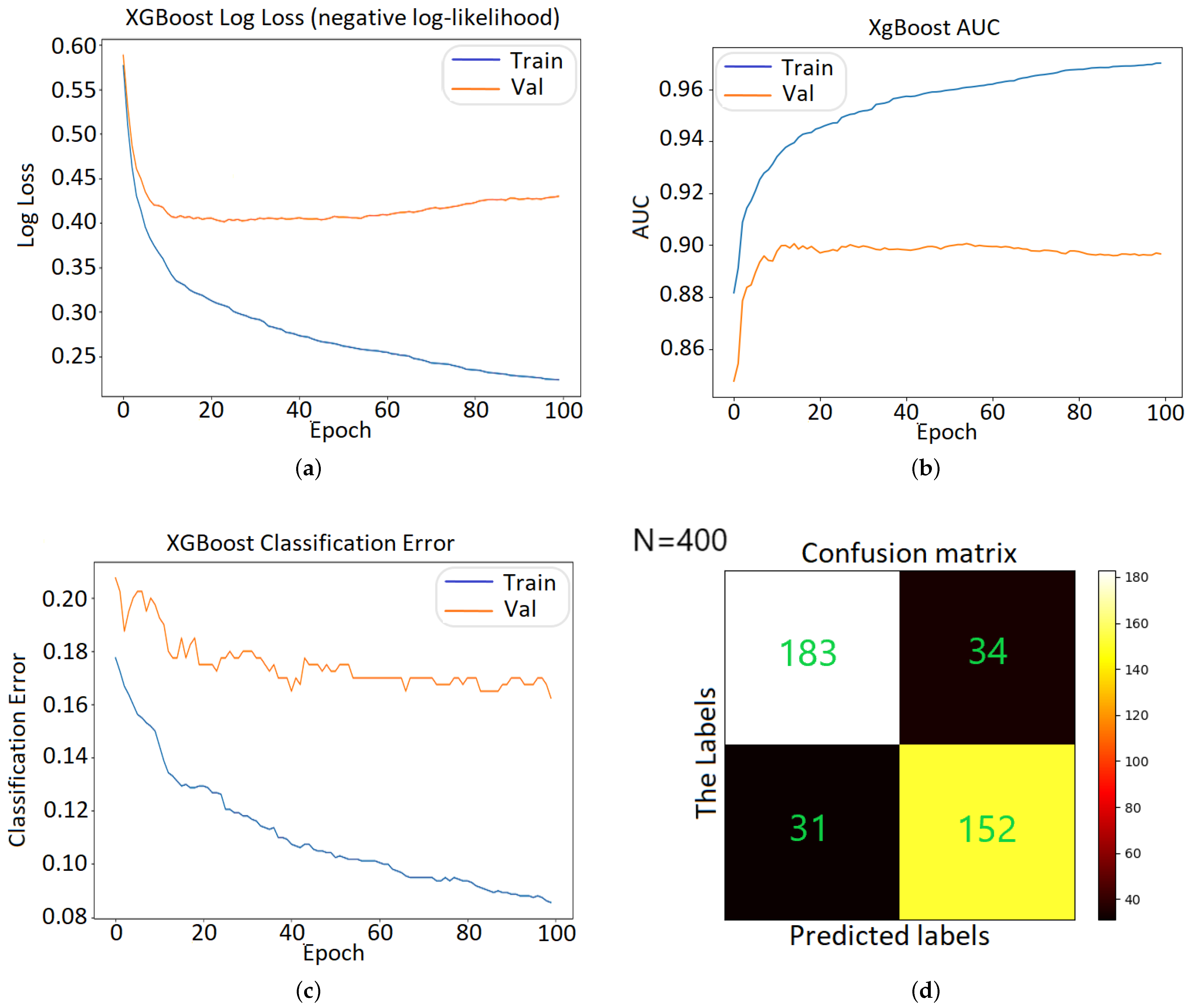
As shown in Table 2, the XGBoost classifier succeeded the best prediction results. Specifically, its prediction accuracy, balanced accuracy, F1-score, and ROC-AUC metrics were found to be 82%. Furthermore, for the same classifier, we calculated the log loss (negative log-likelihood), the classification error, and the confusion matrix. The latter is a 2D table that visualizes the performance of the model by illustrating the actual label values in columns, and the predicted labels in rows. These values indicate the True Negative (TN), True Positive (TP), False Positive (FP), and False Negative (FN) predictions of the model.
In more detail, the TP index shows the number of the correct predictions of the model, meaning that these applications are correctly identified as being malware by the model, whereas the FP indicates the applications that are falsely identified as being malware. In the same way, the TN value corresponds to the number of applications that are correctly predicted as goodware, whereas the FN shows the incorrect predictions of the applications as not being malware.
Figure 1 depicts the log loss (negative log-likelihood) and the classification error during the training and testing phase, as well as the ROC-AUC and the confusion matrix of the XGBoost classifier.
Figure 1. Performance curves of the XGBoost classifier: (a) log loss (negative log-likelihood); (b) AUC; (c) classification error; (d) confusion matrix.
Finally, other related metrics to the confusion matrix were also calculated for assessing the recall and the precision of the XGBoost model. Both of the latter metrics are useful for measuring the relevance of the model to make accurate predictions. The recall metric, which is also known as TP rate or sensitivity, is calculated by Equation (5). This was found to be 83% for the XGBoost classifier and depicts the proportion of the actual Android malware (positives values) that were correctly predicted by the model. In other words, this is the fraction that quantifies the number of malware (positive class) predictions made out over all Android malware (positive examples) contained in the dataset.
On the other hand, the precision metric designates the portion of the predicted Android malware (positive classes) that were actually identified correctly by the model (Equation (6)). This metric actually quantifies the number of positive classes that correctly belong to the correct prediction class, and in our case was found to be 82%:
R e c a l l = T P T P + F N
P r e c i s i o n = T P T P + F P

4.2. ML Optimization

In the previous section, the considered ML algorithms were trained and evaluated by keeping their hyperparameter settings unchanged. However, the authors in [37,38,39] argue about the importance of fine-tuning the ML hyperparameters for improving the prediction accuracy of an ML algorithm. Among others, this may be achieved by using diverse methods and techniques, such as applying statistical methods, or using different quantifying measures for applying forward selection for the most important hyperparameters on different datasets.
Under this mindset, the XGboost algorithm, succeeded in obtaining the best accuracy results according to Table 2, was further scrutinized by fine-tuning its hyperparameters in an effort to optimize and improve further its prediction performance. For this purpose, the “Optuna” open-source framework [40] was used.
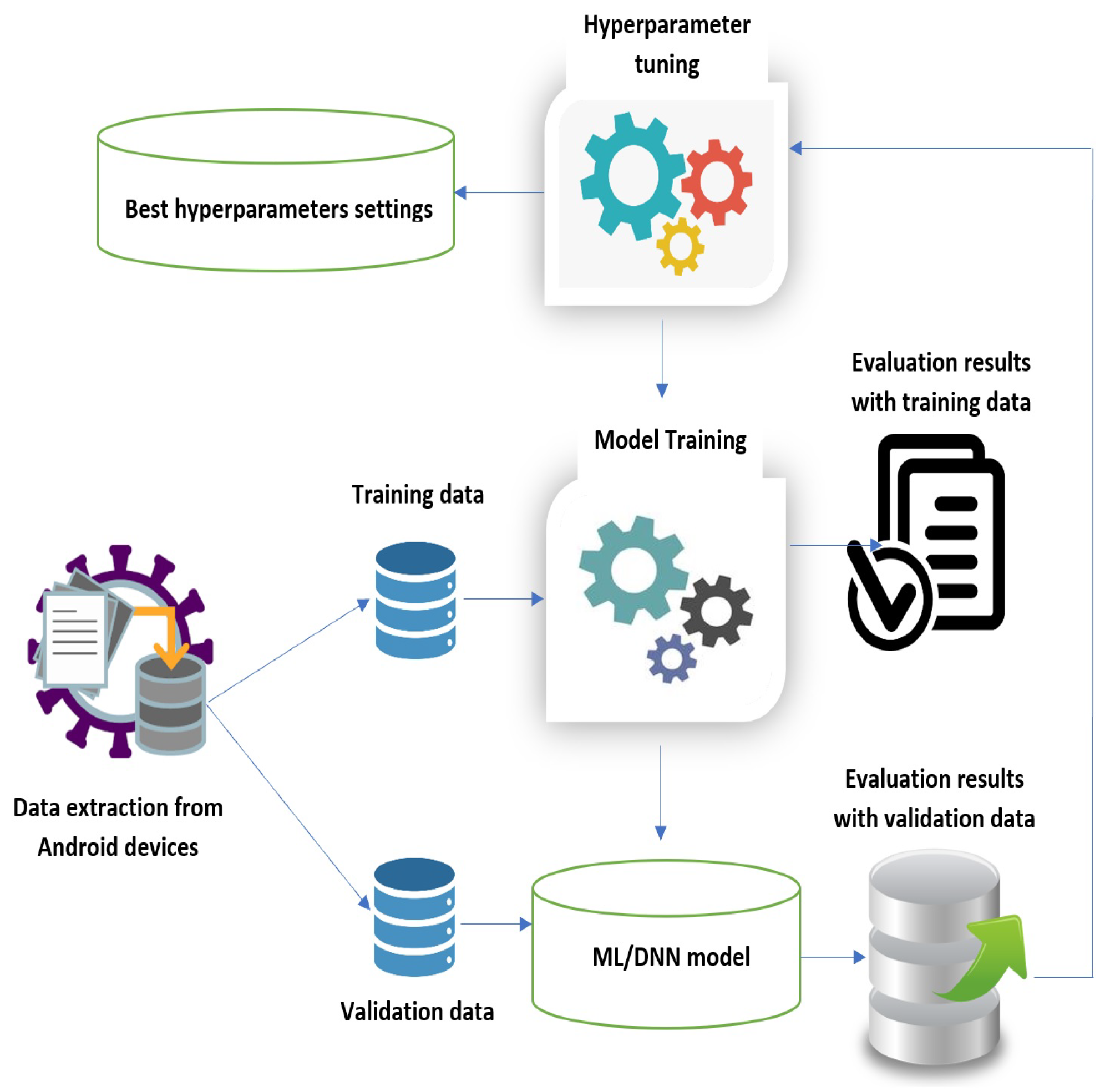
By observing the abstract view of the process in Figure 2, the data extracted from the Android sample were split into the training and validation sets. First off, the model was trained with the training dataset and produced the training evaluation results. Next, the model was validated with the validating dataset and the relevant performance results were extracted. Then, a hyperparameter tuning phase started for altering the parameters accordingly, and the model was re-trained. The new prediction results were compared to the previous ones, and if the model succeeded in obtaining better results, the new hyperparameter settings were kept. The final output of this iterating process is the best hyperparameter settings of the model that yielded the most accurate prediction results.
Figure 2. Abstract view of the training process and hyperparameter tuning of an ML model.
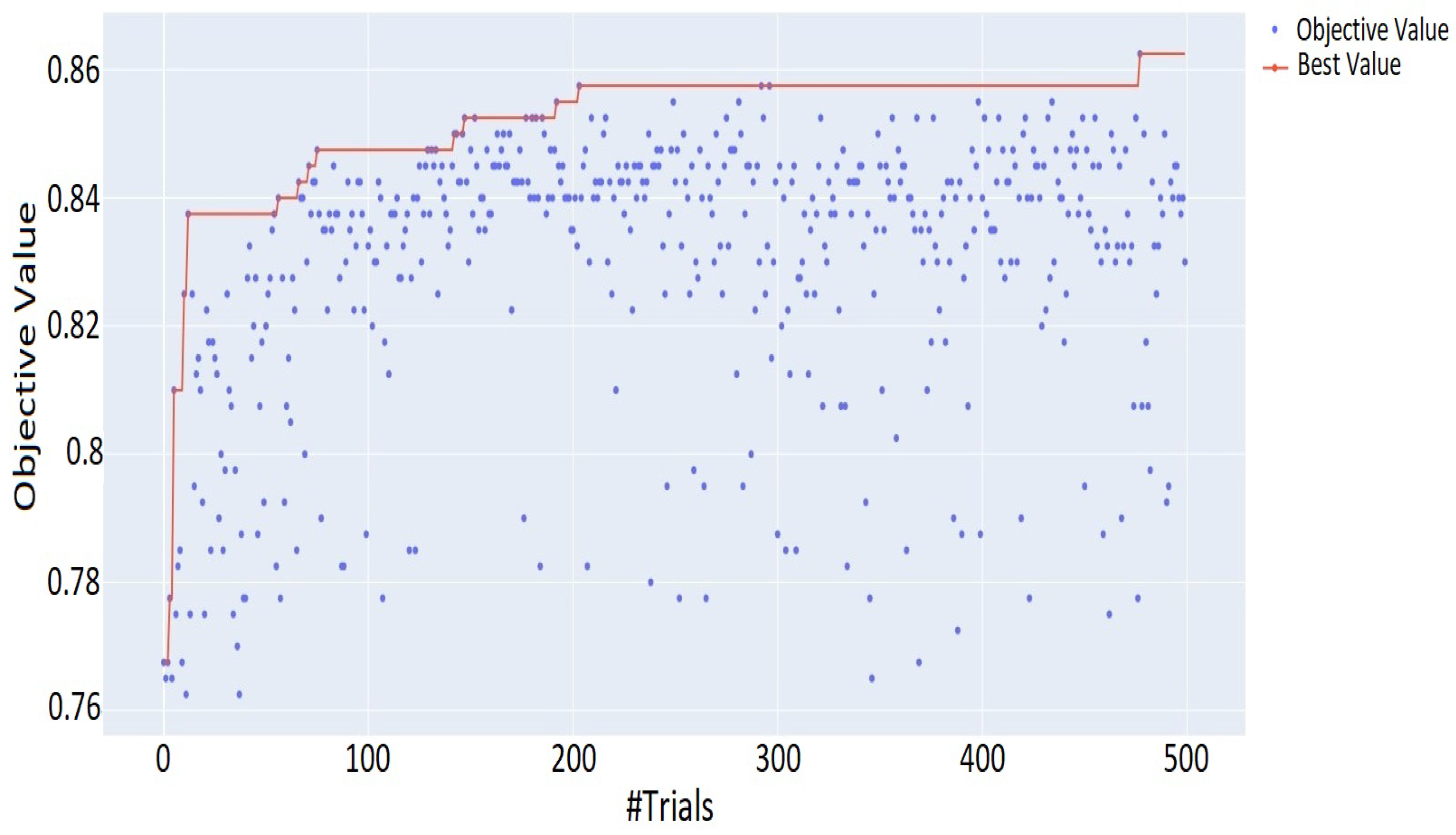
As shown in Table 3, after fine-tuning the XGBoost classifier, we extracted the optimized values for its hyperparameters. Based on these values, the classifier was re-configured and both the training and evaluation phases were repeated. As observed from Table 3, the classifier improved its prediction accuracy by 2% and reached 86%. Furthermore, the F1-score and the ROC-AUC metrics were further improved and measured at 86.5% and 86.7%, respectively. The optimization history of the XGBoost classifier across the epochs is shown in Figure 3. In the figure, the blue dots denote the objective values across the different epochs, while the red line represents the best ones.
Table 3. XGboost’s hyperparameters and its default and optimized values.
Figure 3. Optimization history of the XGboost classifier.
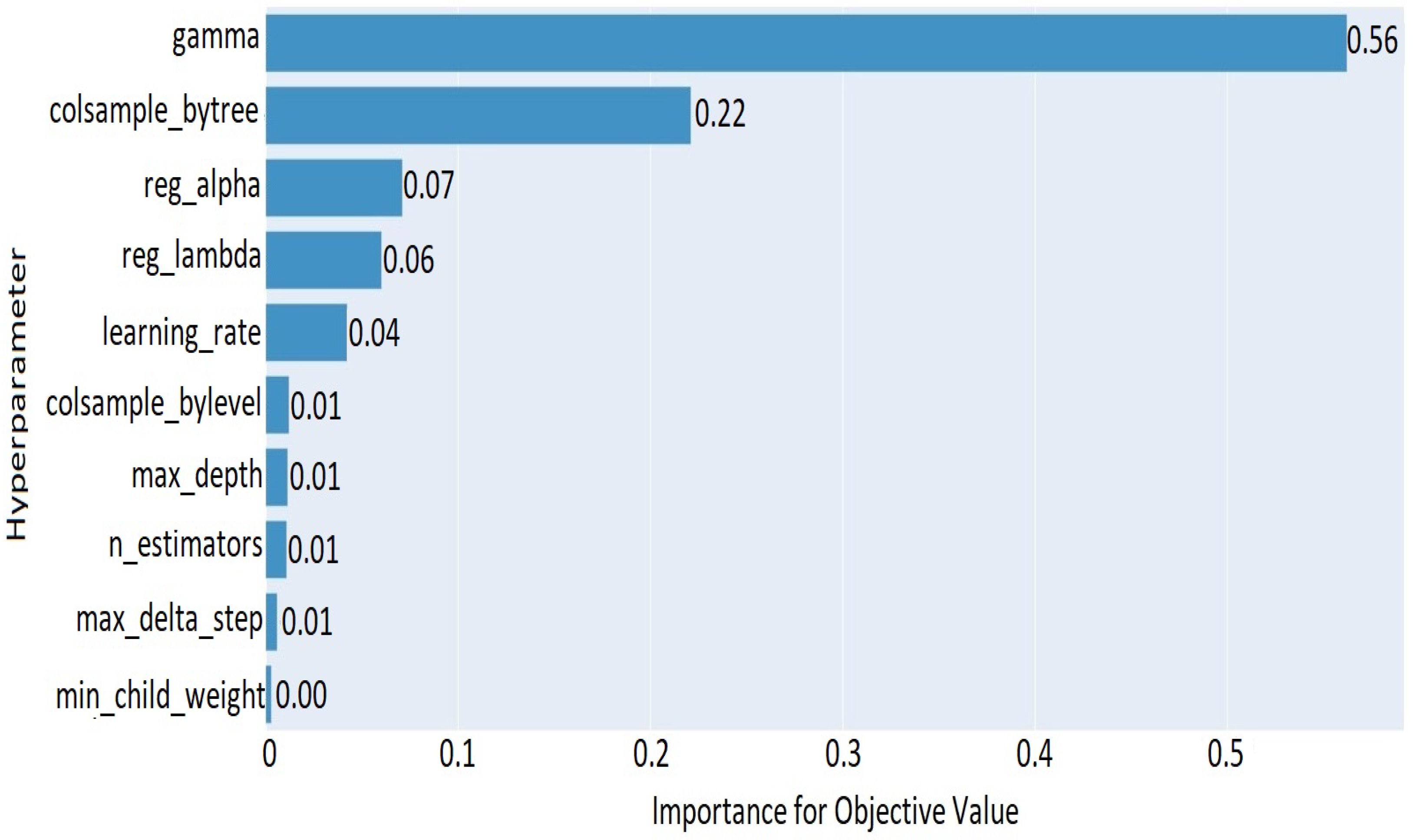
Additionally, Figure 4 depicts the percentage that each hyperparameter affects the objective value (prediction accuracy) of the XGboost classifier. Specifically, the default value of the “gamma” hyperparameter contributes to the optimal prediction accuracy of the model by 56%. In the same way, the default value of the colsample_bytree hyperparameter, after being altered to 0.91, contributes to the optimal prediction by 22%. No less important, the values of the hyperparameters reg_alpha, reg_lambda, and learning_rate improve the prediction accuracy of the classifier by 7%, 6%, and 6%, respectively, after changing correspondingly their default values to 2, 4, and 0.37. The rest of the hyperparameters contribute to the prediction results of the XGboost classifier less than 1%.
Figure 4. Hyperparameters’ importance for the XGboost classifier.
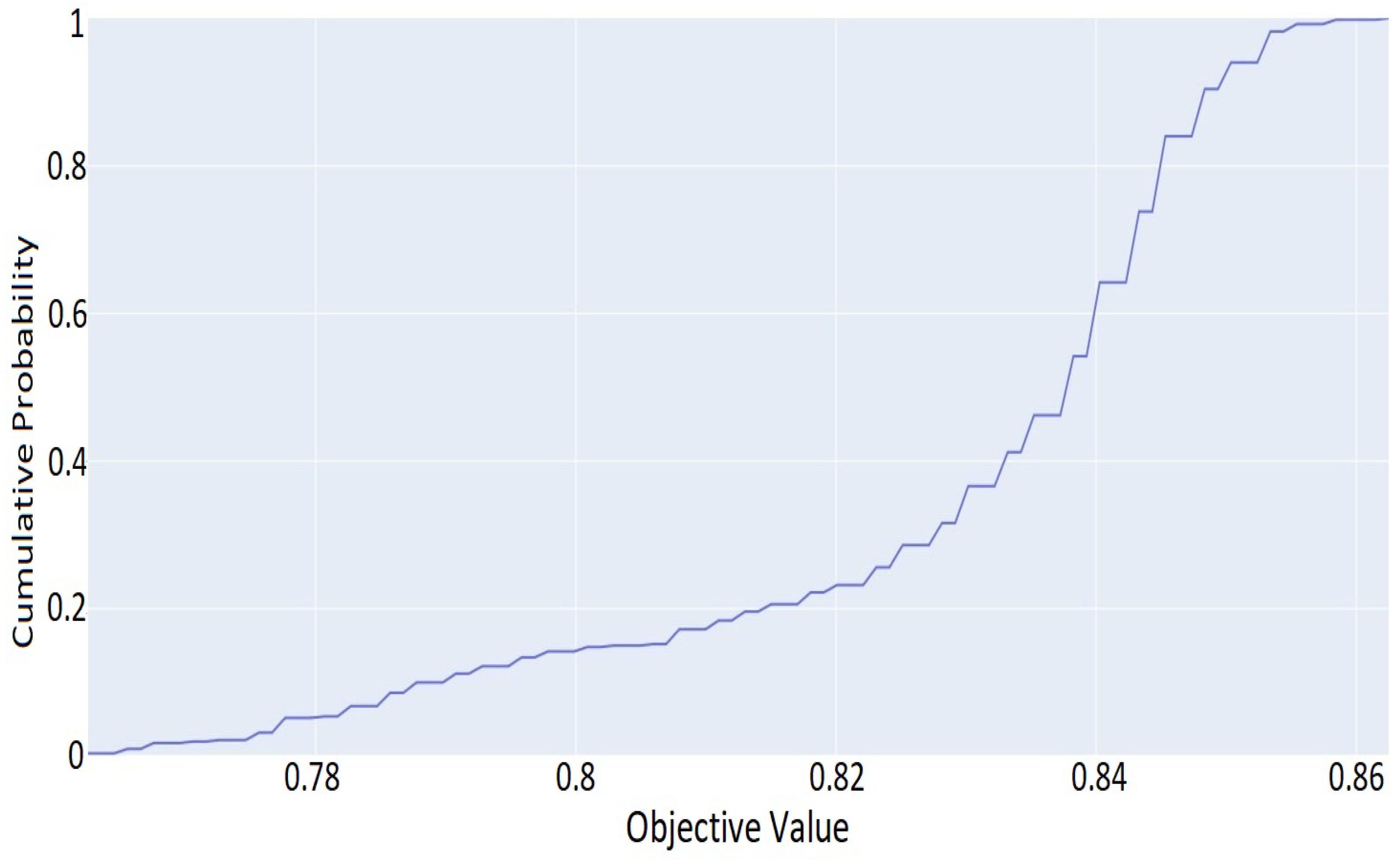
The empirical distribution function (also known as the Empirical Cumulative Distribution Function) of the XGboost classifier is depicted in Figure 5. Specifically, it shows the cumulative probability across the objective and best value. Recall that generally the empirical distribution function describes a sample of observations of a given variable.
Figure 5. Cumulative probability distribution of the XGboost classifier.
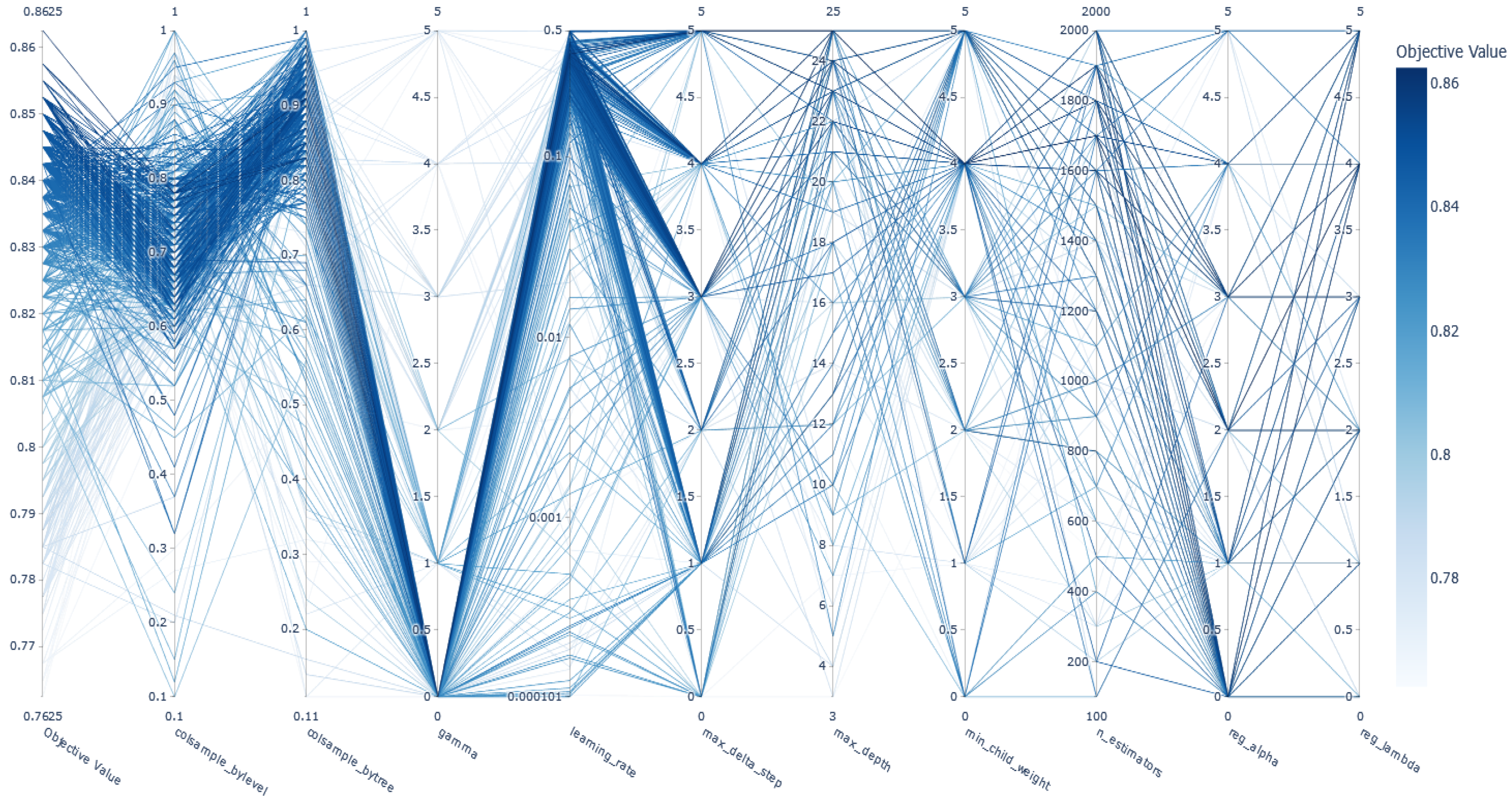
Last but not least, Figure 6 illustrates the relation between the multiple values of the hyperparameters in relation to the best value. Actually, this figure shows clearly the association of each hyperparameter value with the best score of the XGboost classifier.
Figure 6. Hyperparameters’ parallel coordination view for the XGboost classifier.

5. DNN Analysis

5.1. Preliminaries

There are several differences when comparing a ML model with a DNN. Precisely, some of them concern the training process of the DNN model and how it learns the way the weights of each input feature are assigned and automatically changed for improving the performance of the model, and so on. Furthermore, by comparing their structures, the DNN architecture is deeper and may comprise a number of hidden layers, in which various algorithms can be enabled for aiding surpassing some of the shortcomings of ML techniques. For example, a common problem for ML algorithms is the performance saturation, where the learning accuracy of the model reaches the maximum, meaning that it can not be improved further, even if one feeds the model with new input data.
Generally speaking, a DNN architecture that consists of L hidden layers uses Equation (7) to calculate the output for each layer. This is denoted by the h ( L ) (x) and indicates the output of layer L with arguments x:
f ( x ) = f ( [ a ( L + 1 ) ( h ( L ) ( a ( L ) ( ( h ( 2 ) ( a ( 2 ) ( h ( 1 ) ( a ( x ) ) ) ) ) ) ) ) ] )
Furthermore, during the learning phase, the final output is calculated by Equation (8). The a(x) input is a vector of arguments, and the result of the Equation (9) is also a vector. For example, a ( 2 ) denotes the argument of layer 2:
f k ( x ) = f k ( a k ( x ) )
a ( x ) = W h ( x ) + b
As already pointed out, in the current research, Android malware detection is modeled as a binary classification problem. To find the most accurate DNN model, one should evaluate diverse architectures that include various numbers of layers and neurons and choose the most appropriate optimizer, activation, and loss function. Nevertheless, this is a laborious process due to the large number of combinations that need to be examined and taken into account during the learning phase. In the literature, several researchers choose to evaluate their models through a specific DNN structure and by enabling specific optimizers, activation, and loss functions. Therefore, this option may fail to conclude the most optimal and accurate model. Therefore, for making a conclusion about the best DNN model, we also applied the “Optuna” framework.

5.2. DNN Hyperparameter Optimization and Evaluation Results

The DNN hyperparameter tuning is considered an important, but not a straightforward task. This process is useful for making a conclusion about the most appropriate selection of an activation and optimization function, as well as for the best structure of the model. Additionally, one needs to enable an early stopping functionality, configure the batches-epochs, activate diagnostic procedures such as overfitting-underfitting during the learning process, etc.
The underfitting phenomenon appears in the NNs when either these have not been trained for enough time, or the training data are not significant enough to determine a meaningful relationship between the input and output variables. This phenomenon forces the prediction results of the neural networks to be poor. On the other hand, overfitting is a modeling error that occurs when the enabled function is too closely aligned to a limited set of data points. This means that the model is considered useful only to its initial dataset, and not to any other ones. Therefore, to avoid the overfitting problem, the dropout regularization [41] is applied to the NN, in order to skip some neurons’ connections randomly, while the model is trained.
For this purpose, as pointed out previously, the Optuna open-source framework [40] was used again for optimizing the performance of the DNN model towards making more accurate Android malware predictions. Optuna created different structures of DNN models and evaluated their performance prediction by altering their hyperparameters, as shown in Table 4. Additionally, we proceeded to further configurations of the model. That is, the DNN was tuned to use the dataset for 2000 times (epochs), and its internal parameters were set to be updated after a sample of 25 records (batches). Finally, Optuna was configured to run the optimization and evaluation process of the DNN model 50 times.
Table 4. DNN’s hyperparameter configuration thresholds.
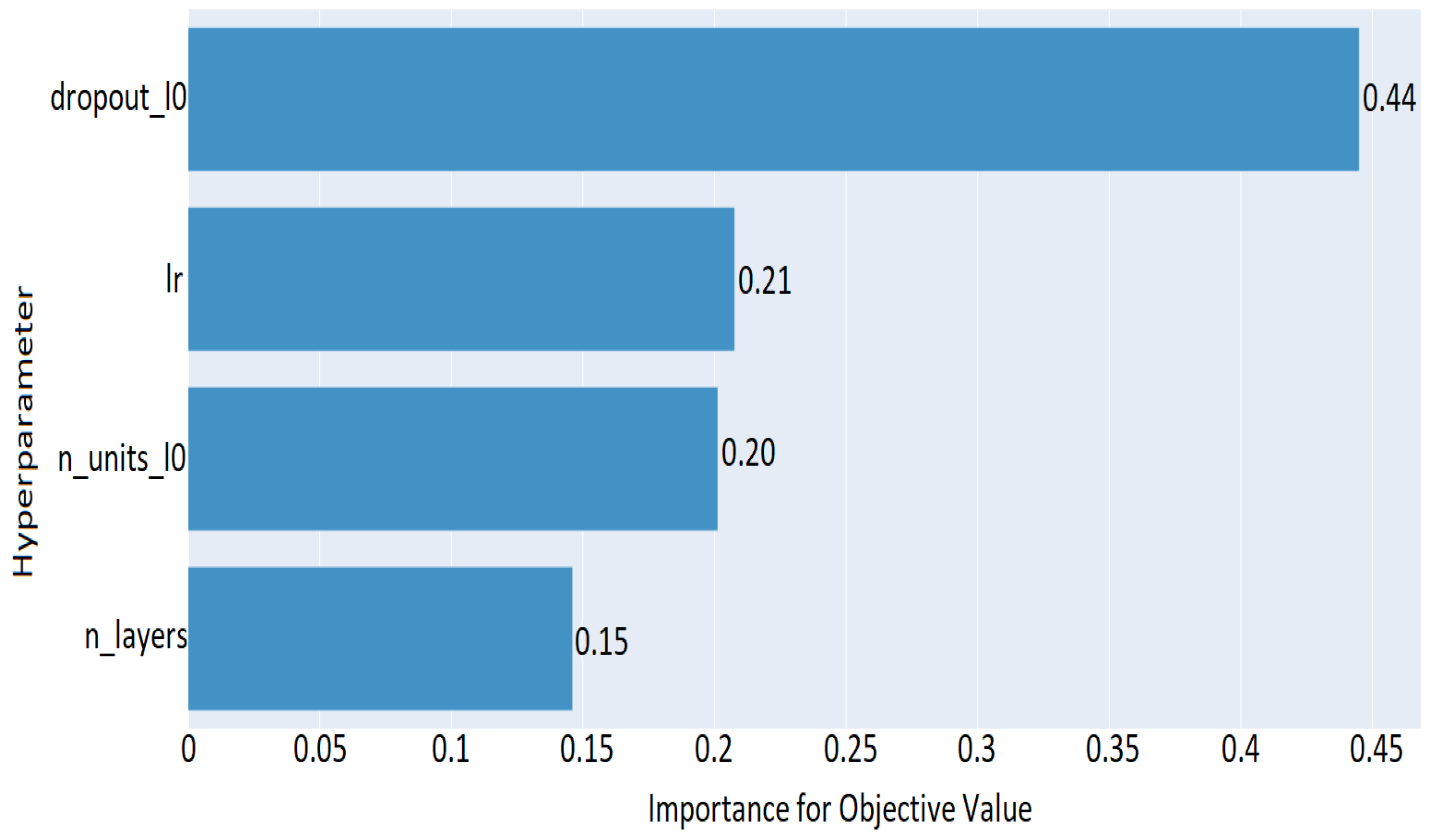
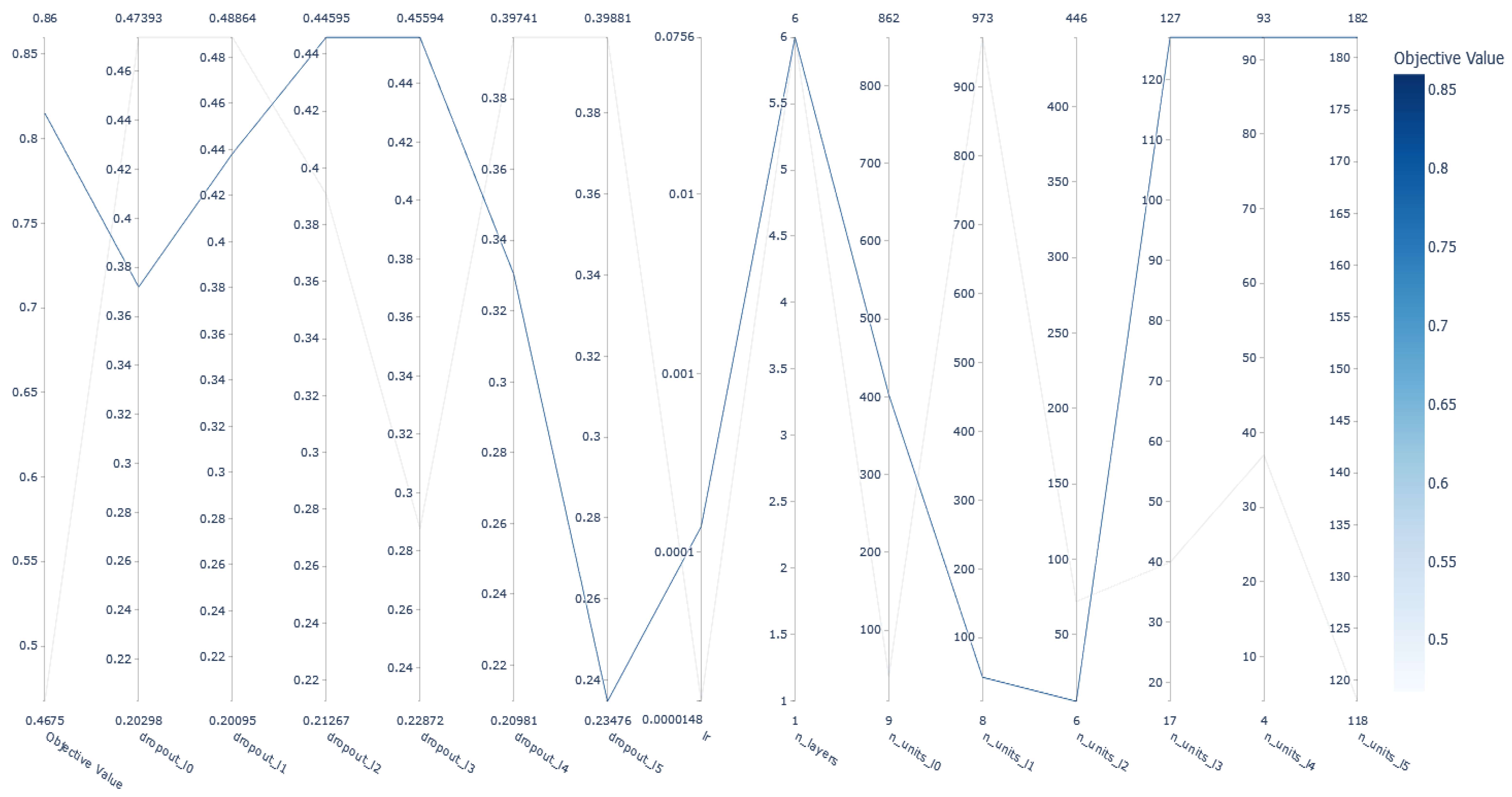
Figure 7 illustrates the way each hyperparameter affects the objective value (prediction accuracy) of the DNN model. As observed, the Dropout parameter at the input layer affects the optimal prediction accuracy (best value) of the model by 44%. Moreover, the learning rate (lr) parameter impacts the optimal prediction of the model by 21%. The number of units at the input layers and the number of layers contribute to the best value of the model by 20% and 15%, respectively. Another useful plot is also shown in Figure 8; it visualizes the relation between the multiple values of the hyperparameters and the best prediction value. Actually, this figure clarifies the association of the value for each hyperparameter towards the best value of the DNN model.
Figure 7. Hyperparameters’ importance for the DNN model.
Figure 8. Hyperparameters’ parallel coordination schema of the DNN model.
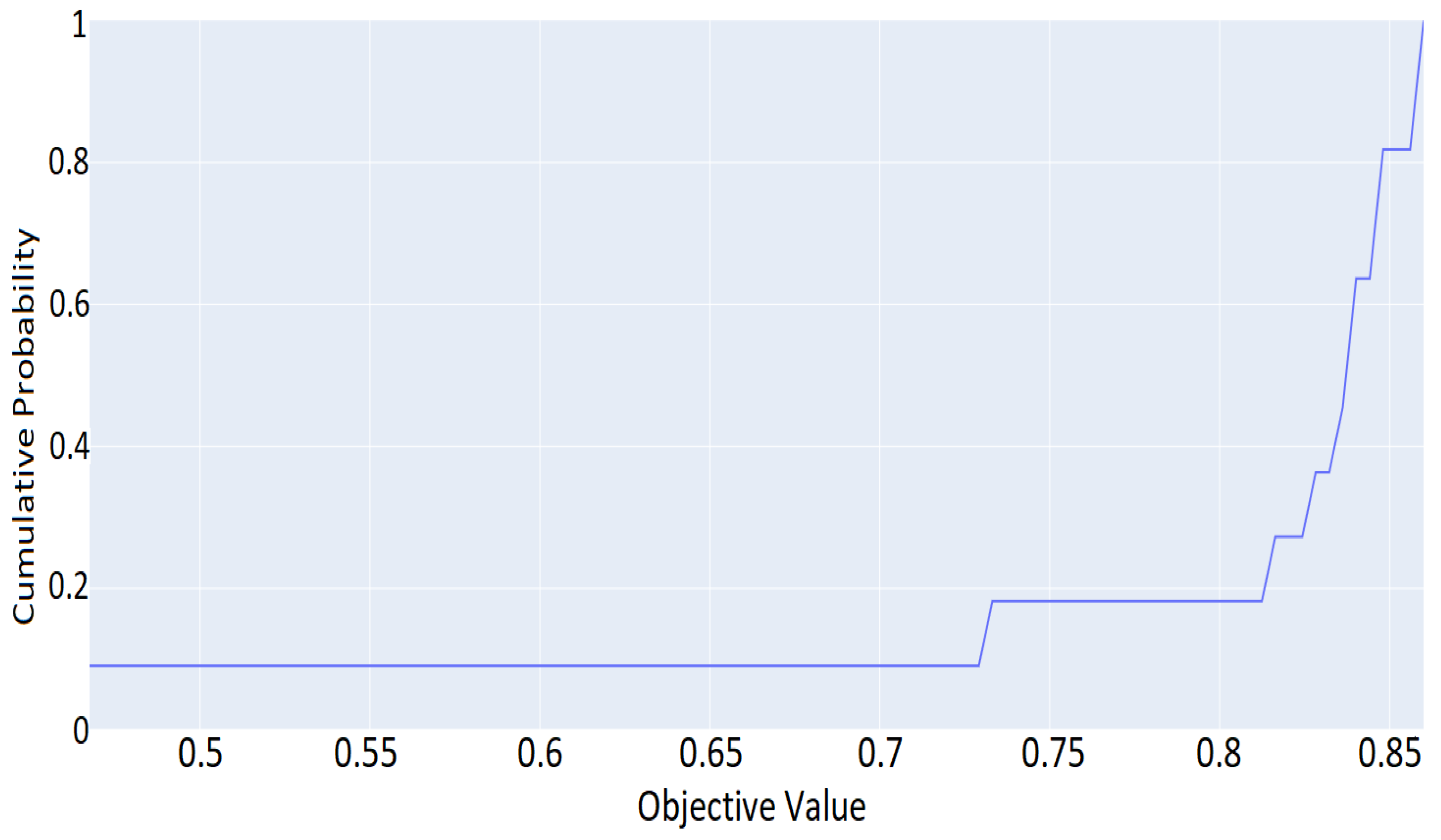
The empirical distribution function of the DNN model is shown in Figure 9. The aforementioned performance analysis suggests that the DNN model succeeded with higher performance results in predicting Android malware, compared to the shallow classifiers evaluated in Section 4.2.
Figure 9. Cumulative probability distribution of the DNN model.
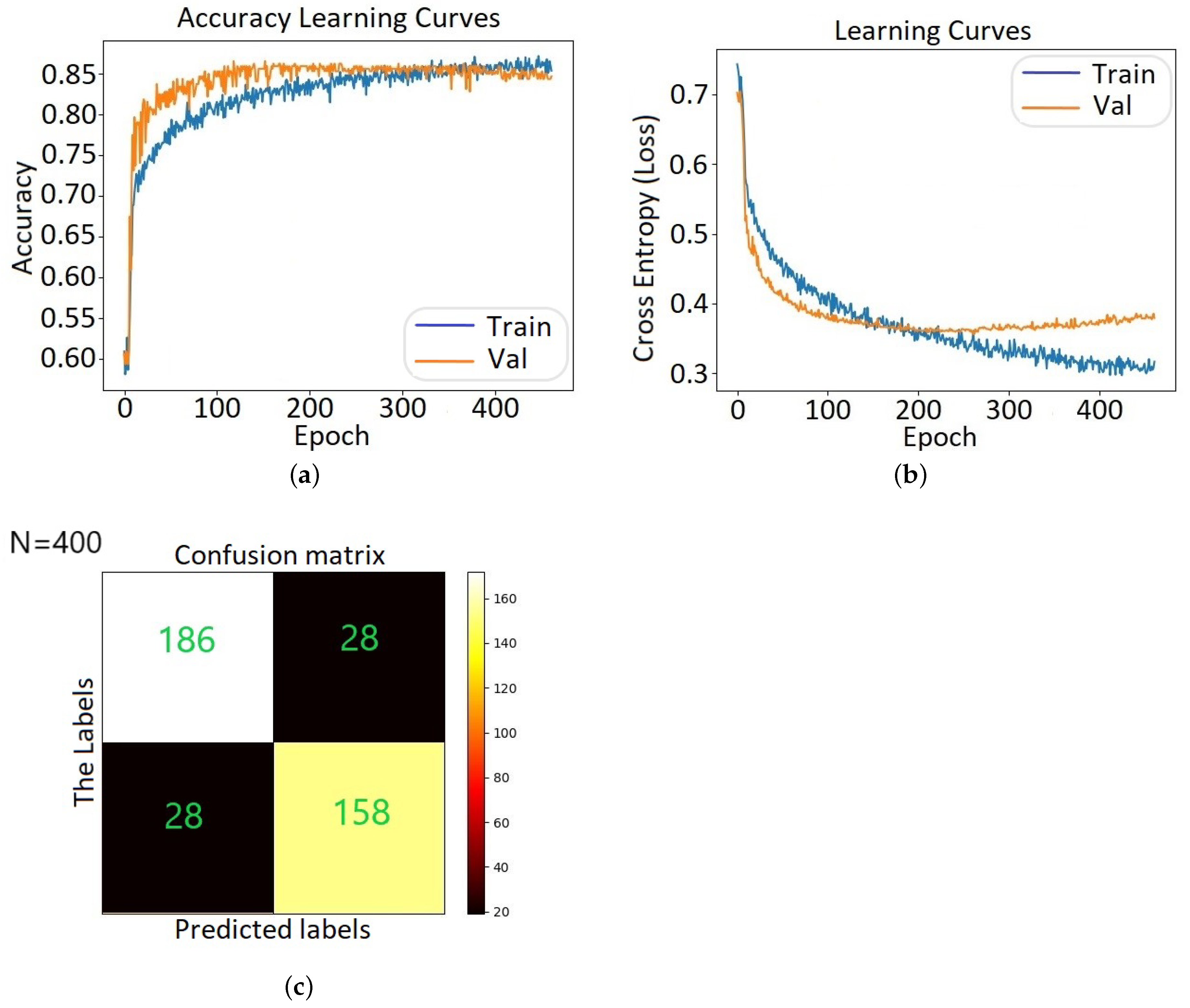
The rest of the performance metrics for the DNN model are illustrated in Figure 10. Specifically, the accuracy curves for the learning and prediction phase across the different epochs are shown in Figure 10a, while the cross-entropy (loss) is depicted in Figure 10b. Last but not least, the confusion matrix of the model is given in Figure 10c.
Figure 10. Performance curves of the DNN model: (a) accuracy; (b) cross entropy (loss); (c) confusion matrix.
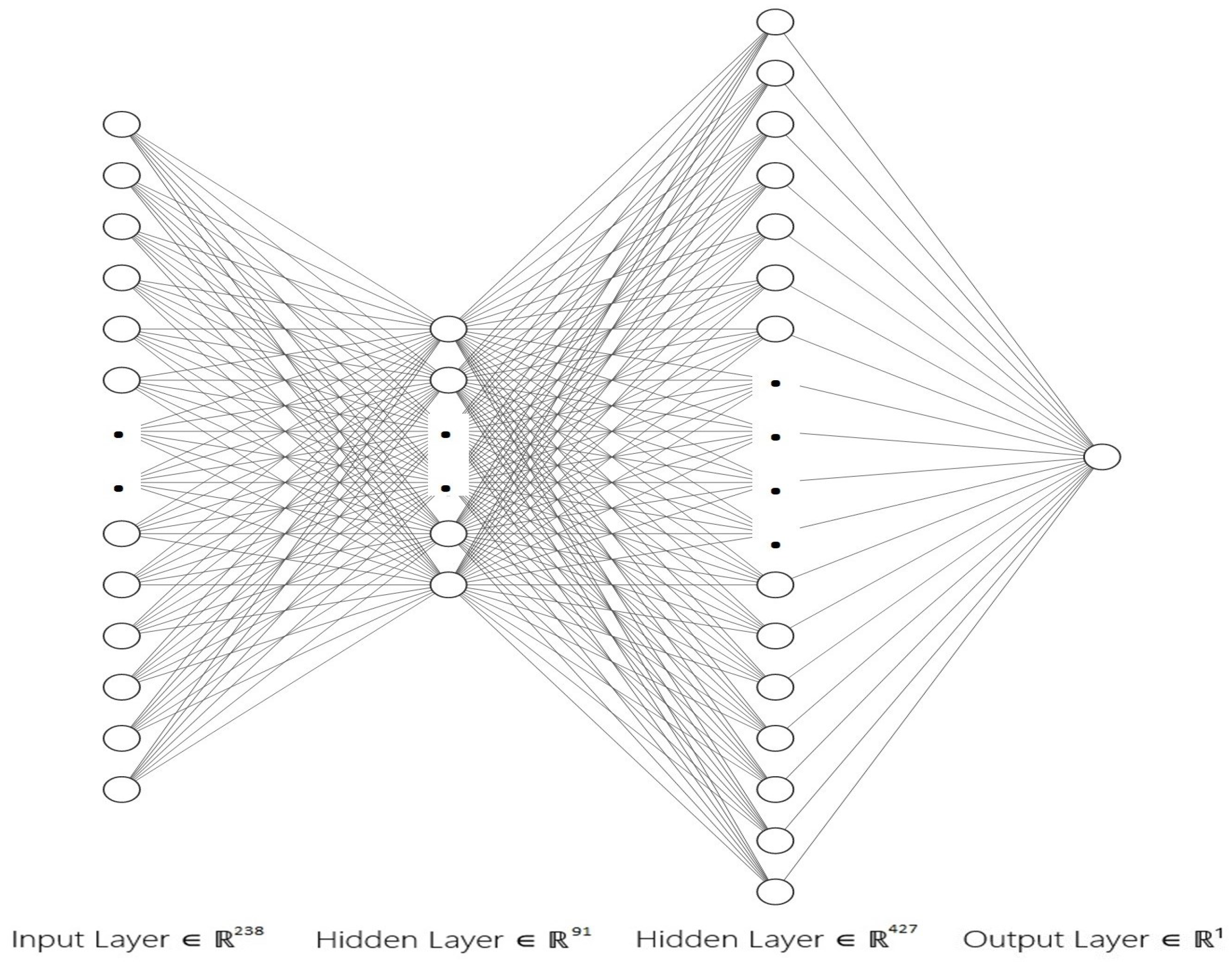
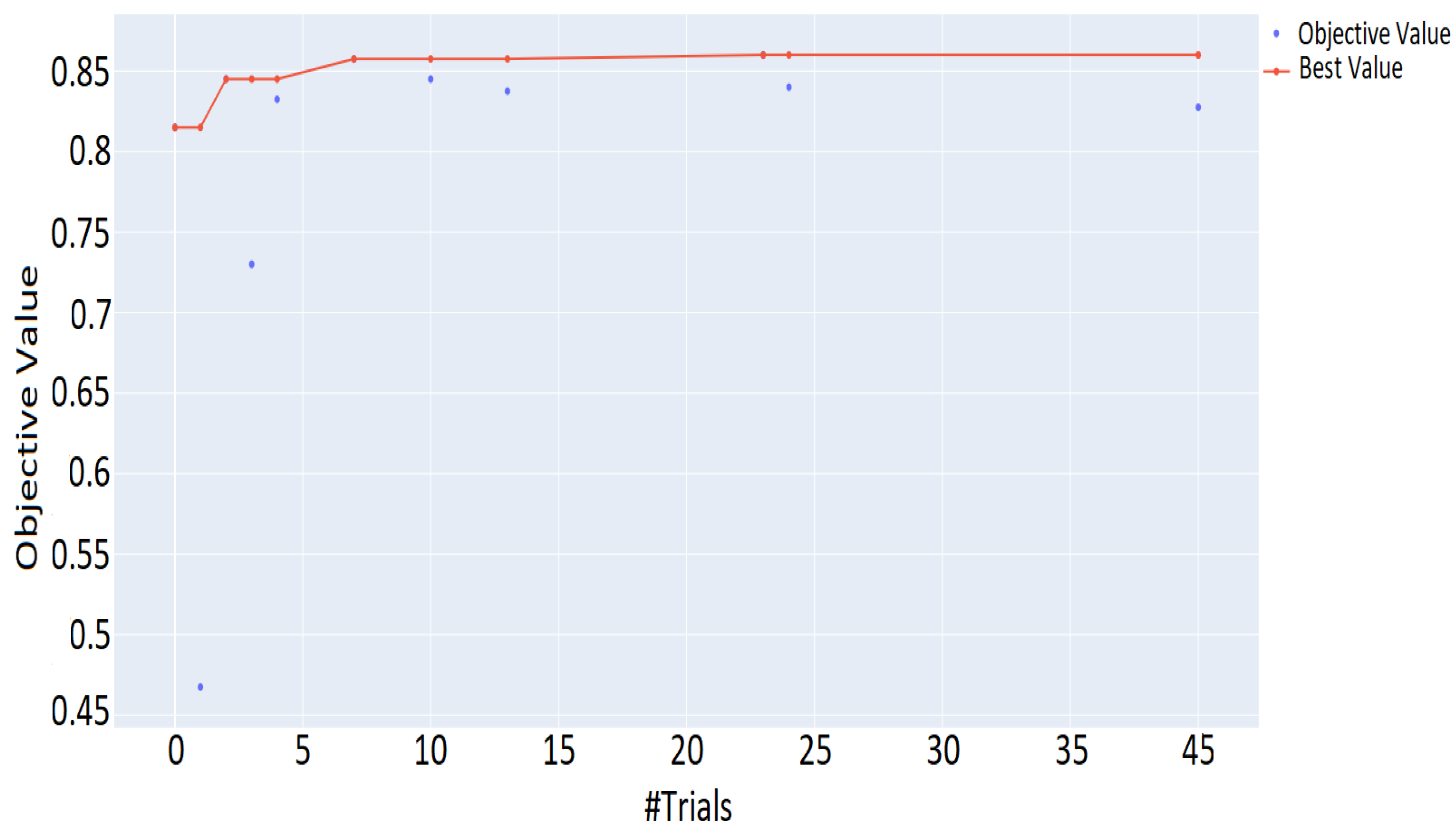
By observing the aforementioned evaluation results, the architecture of the DNN model with the highest accuracy prediction results consists of four layers, with two hidden ones. The abstract architecture view of the model is illustrated in Figure 11, whereas the parameters of each layer are recapitulated in Table 5. The optimized model enables the Adamax optimizer, as well as the Binary Cross-Entropy (loss) and the Softsign activation functions. The optimization history of the classifier across the epochs is shown in Figure 12. Specifically, the optimized prediction accuracy of the model reached 86%, which is better by 2% compared to the XGboost one.
Figure 11. DNN architecture of the best performing model. It comprises four layers with 238 (input), 91 (hidden), 427 (hidden), and 1 (output) nodes, respectively.
Table 5. Total parameters of the DNN: 300,413. All the parameters are considered trainable.
Figure 12. Optimization history of the DNN model.

6. SHAP Analysis and Features Importance Assessment

Feature importance is generally considered a very useful step when evaluating ML models. During this process, the model is further evaluated and interpreted for deducing which input feature has a positive or negative impact on the model’s prediction. For assisting this process, i.e., for interpreting further the DNN model, we relied on the SHAP unified framework [42].
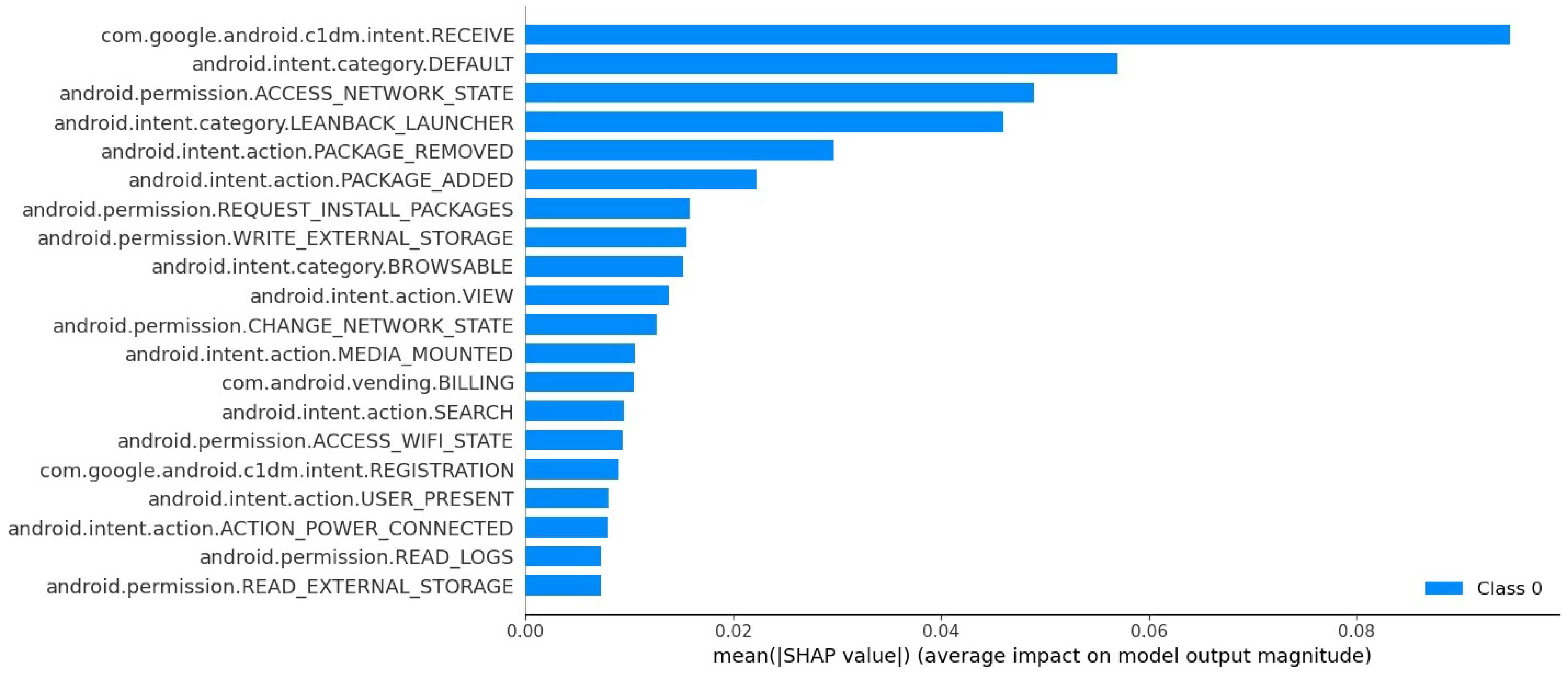
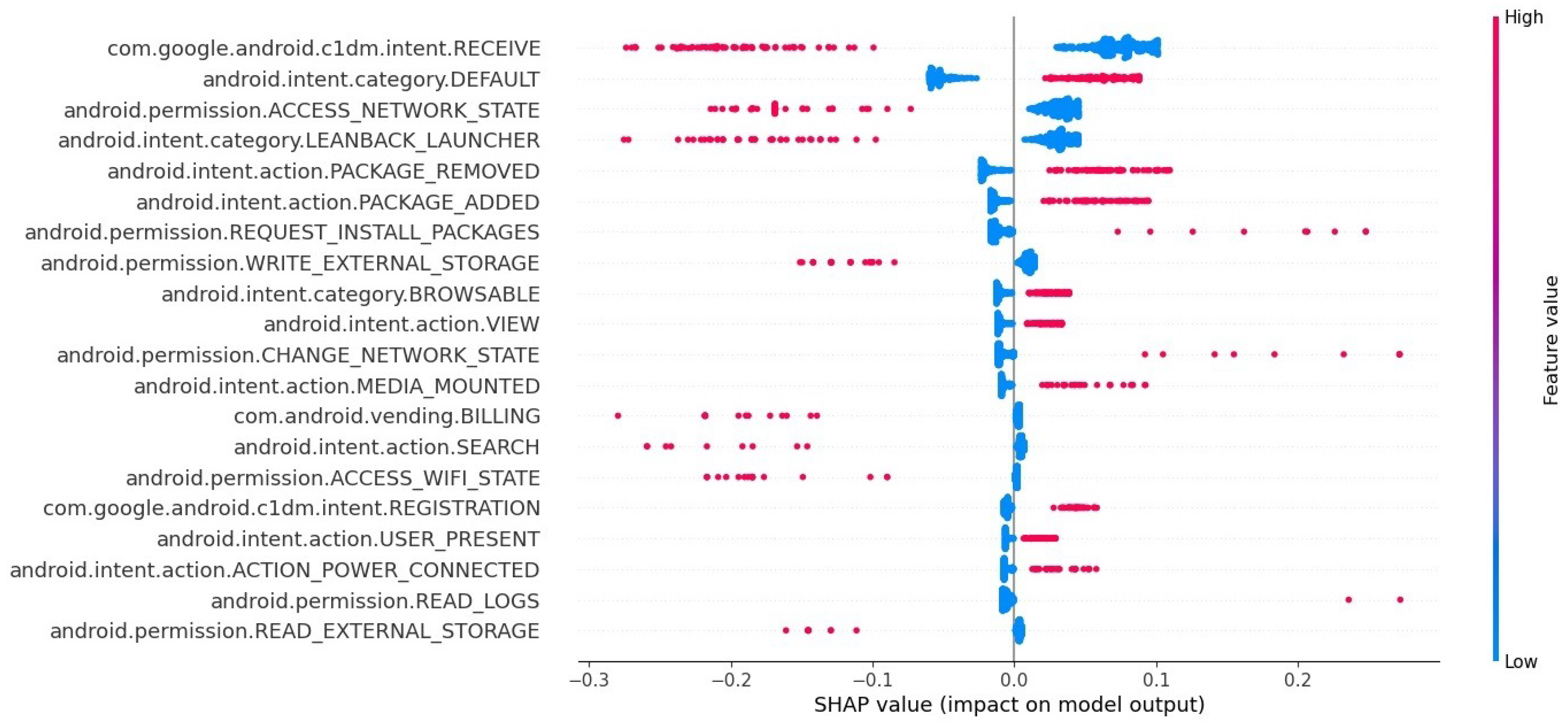
Figure 13 and Figure 14 depict the average impact of the most important input features (mean Shapley values), as well as their contribution (heatmap) to the model’s classification output. Precisely, Figure 14 illustrates in descending order the most influencing features in determining the outcome. The high and low values of each input feature are shown in red and blue font, respectively. For example, in the same figure, it is perceived that the com.google.android.c1dm.intent.RECEIVE is the most influencing feature in determining the outcome. Putting it another way, the high values for this feature decrease the possibility for a given application to be malware, while low values augment it.
Figure 13. Features importance for the DNN model.
Figure 14. Heatmap of the input features for the DNN model.
Figure 13 depicts in descending order for each input feature the assessment of the average magnitude impact on the model’s output. Note that both the aforementioned figures show only the features that contribute to the model’s prediction, discarding the rest of them. For instance, by observing both Figure 13 and Figure 14, it is obvious that the Intent.RECEIVE feature has a major impact, over 0.08 (SHAP value), to the output of the model. Additionally, low values of this feature positively affect the output of the model, meaning that the model makes more accurate predictions at about 0.1 (SHAP value). Similarly, high values of the same feature negatively affect the output, meaning that the model makes wrong predictions at almost –0.3 (SHAP value). On the other hand, the category.DEFAULT feature impacts the model output at about 0.06. The low values of this feature contribute negatively to the mode’s output, whereas high values have a positive impact, at about 0.1. Finally, it is noteworthy that only 7 out of 20 features are Android permissions, while the rest are Intents.

7. Conclusions

The current paper sheds more light on the capability of using both shallow and deep ML techniques for predicting malware in the Android platform. This was achieved by exploring, optimizing, and evaluating the performance of 28 different ML algorithms, including a DNN model.
The optimization process considered hyperparameter analysis by means of the Optuna framework. The most accurate model was found to be the DNN one, succeeding a prediction accuracy of 86%. The evaluation process also included the calculation of diverse performance metrics, such as the balanced accuracy, the F1-score, and the ROC-AUC, which were found to be 82% for the (superior vis-à-vis shallow classifiers) DNN model. Overall, the proposed structure of the DNN model consists of four layers (two hidden), using the Adamax optimizer, as well as the Binary Cross-Entropy (loss), and the Softsign activation functions.
Furthermore, the DNN model was also interpreted for extracting the most important input features that contribute positively or negatively to the final prediction of the model. This was achieved by means of the SHAP unified framework. However, more input data are needed in order to safely argue about the performance of the DNN model. Finally, as part of future work, we intend to integrate the DNN model into a malware detection application for Android users.

Author Contributions

Conceptualization, F.G. and V.K.; Data curation, F.G., V.K. and G.K.; Formal analysis, F.G., V.K. and G.K.; Investigation, F.G. and V.K.; Methodology, F.G., V.K. and G.K.; Resources, V.K. and G.K.; Software, F.G. and V.K.; Supervision, F.G., V.K. and G.K.; Validation, F.G., V.K. and G.K.; Visualization, F.G., V.K. and G.K.; Writing—original draft, F.G., V.K. and G.K.; Writing—review and editing, F.G., V.K. and G.K. All authors have read and agreed to the published version of the manuscript.

Funding

This research received no external funding.

Institutional Review Board Statement

Not applicable.

Data Availability Statement

The Python scripts as well as the list of malicious and benign samples (applications) used in the experiments can be found in a publicly accessible GitHub repository at https://github.com/billkoul/AndroidMalwareDL (accessed on 17 December 2022).

Conflicts of Interest

The authors declare no conflict of interest.

Abbreviations

The following abbreviations are used in this manuscript:
AIArtificial Intelligent
AMDAndroid Malware Dataset
APKAndroid Package Kit
AUC-ROCArea Under The Curve-Receiver Operating Characteristics
CNNConvolutional Neural Networks
DNNDeep Neural Network
DTDecision Tree
FFNFeed-Forward network
FNFalse Negative
FPRFalse Positive Rate
FPFalse Positive
LRLogistic Regression
LSTMLong Short-Term Memory
MLMachine Learning
NNNeural Networks
RNNRecurrent Neural Network
SHAPShapley Additive Explanations
SVMSupport Vector Machine
TNTrue Negative
TPTrue Positive
VMVirtual Machine

References

  1. McAfee. Mobile Threat Report 2021. Available online: https://www.mcafee.com/content/dam/global/infographics/McAfeeMobileThreatReport2021.pdf (accessed on 10 February 2022).
  2. Kalash, M.; Rochan, M.; Mohammed, N.; Bruce, N.D.B.; Wang, Y.; Iqbal, F. Malware classification with deep convolutional neural networks. In Proceedings of the 2018 9th IFIP International Conference on New Technologies, Mobility and Security (NTMS), Paris, France, 26–28 February 2018; IEEE: Piscataway, NJ, USA, 2018; pp. 1–5. [Google Scholar]
  3. Kouliaridis, V.; Kambourakis, G. A Comprehensive Survey on Machine Learning Techniques for Android Malware Detection. Information 2021, 12, 185. [Google Scholar] [CrossRef]
  4. Qiu, J.; Zhang, J.; Luo, W.; Pan, L.; Nepal, S.; Xiang, Y. A survey of android malware detection with deep neural models. ACM Comput. Surv. 2020, 53, 1–36. [Google Scholar] [CrossRef]
  5. Gavriluţ, D.; Cimpoeşu, M.; Anton, D.; Ciortuz, L. Malware detection using machine learning. In Proceedings of the 2009 International Multiconference on Computer Science and Information Technology, Mragowo, Poland, 12–14 October 2009; pp. 735–741. [Google Scholar]
  6. Giannakas, F.; Troussas, C.; Voyiatzis, I.; Sgouropoulou, C. A deep learning classification framework for early prediction of team-based academic performance. Appl. Soft Comput. 2021, 106, 107355. [Google Scholar] [CrossRef]
  7. Li, D.; Wang, Z.; Xue, Y. Fine-grained Android Malware Detection based on Deep Learning. In Proceedings of the 2018 IEEE Conference on Communications and Network Security (CNS), Beijing, China, 30 May–1 June 2018; pp. 1–2. [Google Scholar] [CrossRef]
  8. Arp, D.; Spreitzenbarth, M.; Huebner, M.; Gascon, H.; Rieck, K. Drebin: Efficient and Explainable Detection of Android Malware in Your Pocket. In Proceedings of the 21th Annual Network and Distributed System Security Symposium (NDSS), San Diego, CA, USA, 23–26 February 2014; Volume 12, p. 1128. [Google Scholar]
  9. Karbab, E.B.; Debbabi, M.; Derhab, A.; Mouheb, D. MalDozer: Automatic framework for android malware detection using deep learning. Digit. Investig. 2018, 24, S48–S59. [Google Scholar] [CrossRef]
  10. Zhou, Y.; Jiang, X. Dissecting Android Malware: Characterization and Evolution. In Proceedings of the 2012 IEEE Symposium on Security and Privacy, San Francisco, CA, USA, 20–23 May 2012; pp. 95–109. [Google Scholar] [CrossRef]
  11. Li, W.; Wang, Z.; Cai, J.; Cheng, S. An Android Malware Detection Approach Using Weight-Adjusted Deep Learning. In Proceedings of the 2018 International Conference on Computing, Networking and Communications (ICNC), Maui, HI, USA, 5–8 March 2018; pp. 437–441. [Google Scholar] [CrossRef]
  12. Xu, K.; Li, Y.; Deng, R.H.; Chen, K. DeepRefiner: Multi-layer Android Malware Detection System Applying Deep Neural Networks. In Proceedings of the 2018 IEEE European Symposium on Security and Privacy (EuroS P), London, UK, 24–26 April 2018; pp. 473–487. [Google Scholar] [CrossRef]
  13. Virus Share. Available online: https://virusshare.com (accessed on 30 June 2022).
  14. Zegzhda, P.; Zegzhda, D.; Pavlenko, E.; Ignatev, G. Applying Deep Learning Techniques for Android Malware Detection. In Proceedings of the 11th International Conference on Security of Information and Networks, SIN ’18, Amalfi, Italy, 5–7 September 2018. [Google Scholar] [CrossRef]
  15. VirusTotal. Available online: https://www.virustotal.com (accessed on 30 June 2022).
  16. Android Malware Dataset (Argus Lab). 2018. Available online: https://www.impactcybertrust.org/dataset_view?idDataset=1275 (accessed on 12 December 2022).
  17. Xu, Z.; Ren, K.; Qin, S.; Craciun, F. CDGDroid: Android Malware Detection Based on Deep Learning Using CFG and DFG. In International Conference on Formal Engineering Methods; Springer: Berlin/Heidelberg, Germany, 2018; pp. 177–193. [Google Scholar]
  18. Lindorfer, M.; Neugschwandtner, M.; Platzer, C. MARVIN: Efficient and Comprehensive Mobile App Classification through Static and Dynamic Analysis. In Proceedings of the 2015 IEEE 39th Annual Computer Software and Applications Conference, Taichung, Taiwan, 1–5 July 2015; Volume 2, pp. 422–433. [Google Scholar] [CrossRef]
  19. Kim, T.; Kang, B.; Rho, M.; Sezer, S.; Im, E.G. A Multimodal Deep Learning Method for Android Malware Detection Using Various Features. IEEE Trans. Inf. Forensics Secur. 2019, 14, 773–788. [Google Scholar] [CrossRef]
  20. Masum, M.; Shahriar, H. Droid-NNet: Deep Learning Neural Network for Android Malware Detection. In Proceedings of the 2019 IEEE International Conference on Big Data (Big Data), Los Angeles, CA, USA, 9–12 December 2019; pp. 5789–5793. [Google Scholar] [CrossRef]
  21. Niu, W.; Cao, R.; Zhang, X.; Ding, K.; Zhang, K.; Li, T. OpCode-Level Function Call Graph Based Android Malware Classification Using Deep Learning. Sensors 2020, 20, 3645. [Google Scholar] [CrossRef] [PubMed]
  22. Allix, K.; Bissyandé, T.F.; Klein, J.; Traon, Y.L. AndroZoo: Collecting Millions of Android Apps for the Research Community. In Proceedings of the 13th International Conference on Mining Software Repositories, MSR ’16, Austin, TX, USA, 14–15 May 2016; pp. 468–471. [Google Scholar]
  23. Pektas, A.; Acarman, T. Deep learning for effective Android malware detection using API call graph embeddings. Soft Comput. 2020, 24, 1027–1043. [Google Scholar] [CrossRef]
  24. Zou, K.; Luo, X.; Liu, P.; Wang, W.; Wang, H. ByteDroid: Android Malware Detection Using Deep Learning on Bytecode Sequences; Springer: Berlin/Heidelberg, Germany, 2020; pp. 159–176. [Google Scholar] [CrossRef]
  25. Fan, M.; Liu, J.; Luo, X.; Chen, K.; Chen, T.; Tian, Z.; Zhang, X.; Zheng, Q.; Liu, T. Frequent Subgraph Based Familial Classification of Android Malware. In Proceedings of the 2016 IEEE 27th International Symposium on Software Reliability Engineering (ISSRE), Ottawa, ON, Canada, 23–27 October 2016; pp. 24–35. [Google Scholar] [CrossRef]
  26. Maiorca, D.; Ariu, D.; Corona, I.; Aresu, M.; Giacinto, G. Stealth Attacks: An Extended Insight into the Obfuscation Effects on Android Malware. Comput. Secur. 2015, 51, 16–31. [Google Scholar] [CrossRef]
  27. Kang, H.; Wook Jang, J.; Mohaisen, A.; Kim, H.K. Detecting and Classifying Android Malware Using Static Analysis along with Creator Information. Int. J. Distrib. Sens. Netw. 2015, 11, 479174. [Google Scholar] [CrossRef]
  28. Karbab, E.; Debbabi, M. PetaDroid: Adaptive Android Malware Detection Using Deep Learning. In International Conference on Detection of Intrusions and Malware, and Vulnerability Assessment; Springer: Berlin/Heidelberg, Germany, 2021; pp. 319–340. [Google Scholar] [CrossRef]
  29. Millar, S.; McLaughlin, N.; Martinez del Rincon, J.; Miller, P. Multi-view deep learning for zero-day Android malware detection. J. Inf. Secur. Appl. 2021, 58, 102718. [Google Scholar] [CrossRef]
  30. Vu, L.N.; Jung, S. AdMat: A CNN-on-Matrix Approach to Android Malware Detection and Classification. IEEE Access 2021, 9, 39680–39694. [Google Scholar] [CrossRef]
  31. Zhang, N.; Tan, Y.A.; Yang, C.; Li, Y. Deep learning feature exploration for Android malware detection. Appl. Soft Comput. 2021, 102, 107069. [Google Scholar] [CrossRef]
  32. Yumlembam, R.; Issac, B.; Jacob, S.M.; Yang, L. IoT-based Android Malware Detection Using Graph Neural Network with Adversarial Defense. IEEE Internet Things J. 2022. [Google Scholar] [CrossRef]
  33. CICMalDroid. Available online: https://www.unb.ca/cic/datasets/maldroid-2020.html (accessed on 10 February 2022).
  34. Musikawan, P.; Kongsorot, Y.; You, I.; So-In, C. An Enhanced Deep Learning Neural Network for the Detection and Identification of Android Malware. IEEE Internet Things J. 2022, 1. [Google Scholar] [CrossRef]
  35. Google Play. Available online: https://play.google.com/ (accessed on 10 February 2022).
  36. Kouliaridis, V.; Kambourakis, G.; Geneiatakis, D.; Potha, N. Two Anatomists Are Better than One-Dual-Level Android Malware Detection. Symmetry 2020, 12, 1128. [Google Scholar] [CrossRef]
  37. Bergstra, J.; Bengio, Y. Random search for hyper-parameter optimization. J. Mach. Learn. Res. 2012, 13, 281–305. [Google Scholar]
  38. Probst, P.; Boulesteix, A.L.; Bischl, B. Tunability: Importance of hyperparameters of machine learning algorithms. J. Mach. Learn. Res. 2019, 20, 1934–1965. [Google Scholar]
  39. Weerts, H.J.; Mueller, A.C.; Vanschoren, J. Importance of tuning hyperparameters of machine learning algorithms. arXiv 2020, arXiv:2007.07588. [Google Scholar]
  40. Akiba, T.; Sano, S.; Yanase, T.; Ohta, T.; Koyama, M. Optuna: A Next-Generation Hyperparameter Optimization Framework; Association for Computing Machinery: New York, NY, USA, 2019. [Google Scholar] [CrossRef]
  41. Srivastava, N.; Hinton, G.; Krizhevsky, A.; Sutskever, I.; Salakhutdinov, R. Dropout: A simple way to prevent neural networks from overfitting. J. Mach. Learn. Res. 2014, 15, 1929–1958. [Google Scholar]
  42. Lundberg, S.M.; Lee, S.I. A unified approach to interpreting model predictions. In Proceedings of the Advances in Neural Information Processing Systems, Long Beach, CA, USA, 4–9 December 2017; pp. 4765–4774. [Google Scholar]
Disclaimer/Publisher’s Note: The statements, opinions and data contained in all publications are solely those of the individual author(s) and contributor(s) and not of MDPI and/or the editor(s). MDPI and/or the editor(s) disclaim responsibility for any injury to people or property resulting from any ideas, methods, instructions or products referred to in the content.

Article Metrics

Citations

Article Access Statistics

Multiple requests from the same IP address are counted as one view.