The Apian Universe in Eastern Christian Hymnography

Abstract
1. Introduction
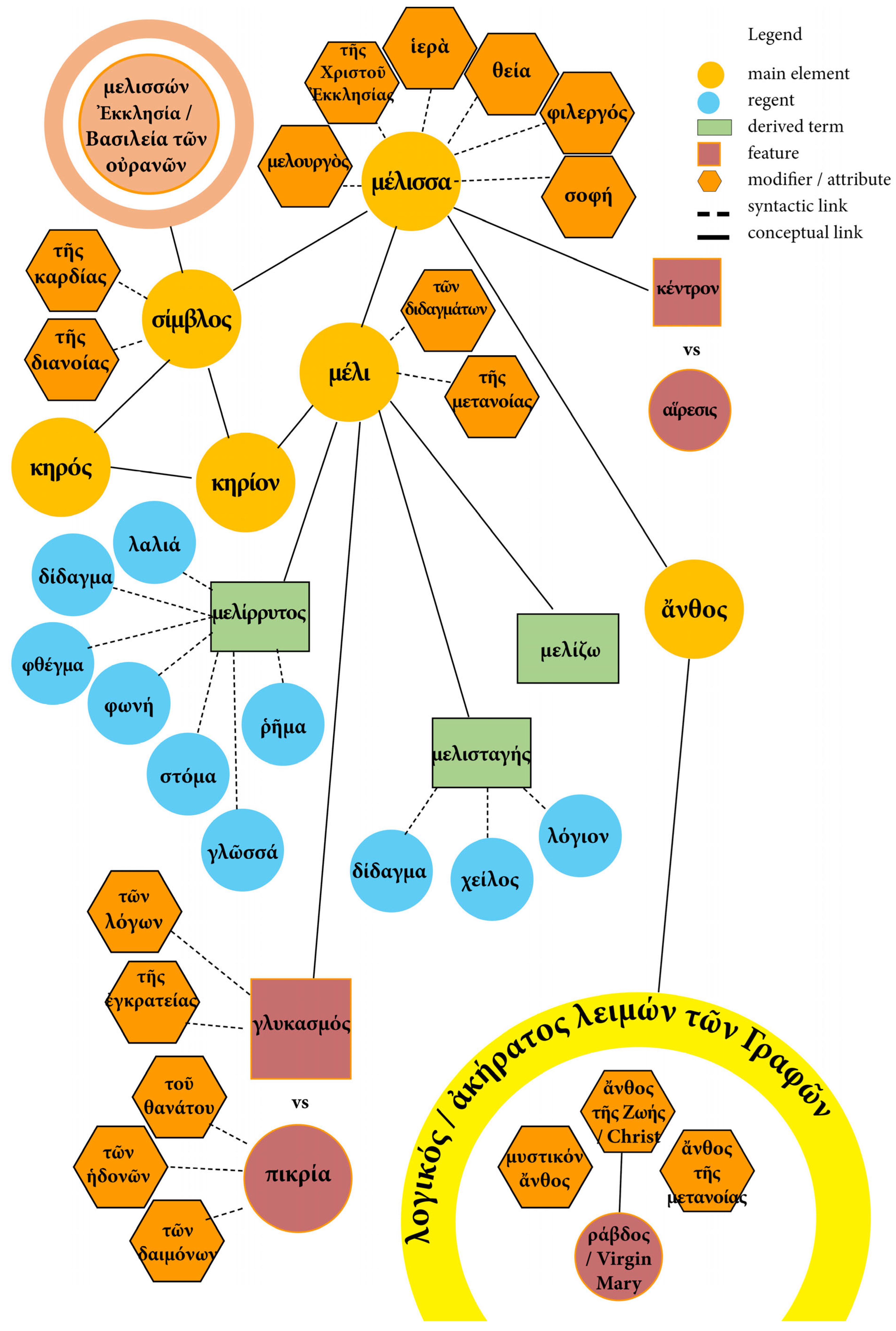
- Bee (μέλισσα).
- Honey (μέλι).
- Honeycomb (κηρίον).
- Beehive (σίμβλος).
2. The Biblical Origins of the Apian Imagery in Hymnographic Works
- Of diligence and extraordinary strength relative to its small size (Sirach 11:3 “The bee is small among flying creatures, but what it produces is the origin of sweet things.”);
- An example of cooperation and coordination (LXX Ps 117:12: “They have surrounded me like bees”).
3. Apian Terminology in Byzantine Hymnbooks—A Repertoire
3.1. Honey
Unto Thee O Christ, Who didst work the wondrous miracle in the wilderness, did the ungrateful children of Israel, who had suckled honey from the rocks (ἐκ πέτρας τὸ μέλι θηλάσαντες), offer gall, and in exchange for Thy deeds of goodness they offered Thee vinegar instead of manna.(Tone Five, Sunday Morning, Ode III)3
A lifeless corpse affixed to the Cross, Thy side pierced by the spear; and given gall to drink, O longsuffering Master, who by the hand of Moses didst make sweet the waters of Marah; I entreat Thee and pray Thee: do Thou cast the bitter passions away from my understanding, and sweeten my mind with the honey of repentance (τῆς μετανοίας τῷ μέλιτι γλυκάνας), and grant me to worship Thy precious Passion.(Tuesday in the Fourth Week, at Vespers, Sticheron)
Suckled on the sweetness of abstinence, thou didst cast away the bitterness of sensuality; and so, father, thou hast granted us a pleasure sweeter than honey and the honeycomb (ὅθεν ὑπὲρ μέλι καὶ κηρίον, ἡδύνεις Πάτερ τὰς αἰσθήσεις ἡμῶν).(Fourth Sunday in Lent, Matins, Ode 4)
‘Thy kiss is deceitful and thine embrace bitter. To whom, O deceiver, dost thou say, Rejoice, Master?’ saith Christ to Judas. ‘Friend, why art thou come here? For if thou hast come to kiss Me, why then hast thou brought a sword anointed with honey?’.(Holy and Great Thursday Evening, Small Compline, Ode 9)4
The one who disobeyed your counsels, O Lazarus, is hurled down into Hades, dashed against precipitous rocks; and instead of honeyed sweetness (γλυκασμοῦ μελιτώδους), the wretched man reaps the bitterness of a most miserable death [οἰκτροτάτου θανάτου πικρίαν].(7 November, Matins, Ode 4)
Suckled on the sweetness of abstinence, thou hast cast away the bitterness of sensual indulgence (τὴν πικρίαν τῶν ἡδονῶν); and so, father, thou givest us a pleasure sweeter than honey and the honeycomb (τὸν γλυκασμόν […] ὑπὲρ μέλι καὶ κηρίον).(Fourth Sunday in Lent, Matins, Ode 4)
Kyros, who partook of the sweetness of Your flesh (μελίζων σάρκα), O my Christ, having laid aside his mortal flesh, now stands before Your throne.(8 January, Matins, Stichoi)
3.2. Honeycomb
Christ tasted gall, healing the ancient tasting of the fruit, and now, with the honeycomb (νυνί δέ σύν κηρίω μέλιτος), He granteth enlightenment to our ancestor and the sweet partaking of Himself.(Thomas Sunday, Ode 4)
From earth she took flight to heaven’s hives (ἀπέπτη πρὸς μελισσῶνας πόλου), Isidora, the bee of virtuous deeds [μέλισσα χρηστῶν πράξεων].(1 May, Stichoi)
Rejoice, O beehive of the Fathers (Πατέρων ὁ μελισσών), who wore down your own bodies in asceticism, and mortified the passions of the flesh; who by divine love took wing in mind [τὸν νοῦν θείῳ ἔρωτι ἐπτερώσατε] and soared unto the Heavens, and who rejoice with the Angels and enjoy eternal good things.(Sunday of all Saints, Vespers, Litia)
3.3. Bee
4. A Bridge Across Time—The Case of Romanian Akathists
5. Conclusions
Funding
Institutional Review Board Statement
Informed Consent Statement
Data Availability Statement
Acknowledgments
Conflicts of Interest
| 1 | The Greek editions used for this investigation are: Menaia (1905), Triodion (1960), Pentecostarion (1959) and Paraklētikē, ētoi Oktōēchos hē Megalē (1976). |
| 2 | It should be noted that in early manuscripts dating from before the eleventh century, and even in Slavonic manuscripts from the twelfth and thirteenth centuries, the two liturgical books, the Triodion and the Pentecostarion, constituted a single volume (Pistrui 1970). |
| 3 | Unless indicated as my own translations the liturgical texts are rendered from Menaia (2000) in the translation of Isaac E. Lambertsen, available online https://www.ponomar.net/english.html (accessed on 20 May 2026). |
| 4 | According to Mother Mary and then Archimandrite Kallistos Ware, the Small Compline is found in the Slavonic books, but not in the modern editions of the Greek Triodion; it is printed, however, in the Greek Triodion published at Rome in 1738, but the text differs somewhat from the Slavonic. The Lenten Triodion (2002, p. 560, note 31). However, the mentioned edition does not reproduce the Small Compline of the Holy Thursday Vigil, present only in the Slavonic and Romanian editions. |
| 5 | A troparion in the religious music of Eastern Orthodox Christianity is a short hymn of one stanza, or organized in more complex forms as a series of stanzas. Types: Apolytikion/Theotokion/Stavrotheotokion—if a Theotokion makes reference to the Crucifixion of Jesus. |
| 6 | A sticheron is a hymn of a particular genre sung during the daily evening (Hesperinos/Vespers) and morning (Orthros/Matins) offices. |
| 7 | A canon is a structured hymn used in the Eastern Orthodox services. It consists of nine odes, based on the Biblical canticles. Each ode contains an irmos and several troparia. The earliest form of canon dates from the 7th century and was further developed in the 8th and 9th centuries. |
| 8 | A kontakion is a form of hymn in the Byzantine liturgical tradition, originated in Syriac hymnograph, that gained prominence in Byzantium during the 6th century. Kontakia have 24 strophes (oikoi or ikoi) and begin with a prologue (the prooimoion or koukoulion) (Krivko 2015). |
| 9 | Akathist or is a hymn which consists of 24 or 25 stanzas divided into kontakia (short hymns) and ikoi (longer stanzas) and seems similar to ancient kontakia. |
| 10 | It should be noted, however, that no uniformity exists with regard to the textual content of these Akathists, since each translation introduces thematic variations, often emphasizing particular aspects in accordance with local liturgical and devotional traditions. |
References
- Acatistier. 2016. Bucureşti: Editura Institutului Biblic și de Misiune Ortodoxă al Bisericii Ortodoxe Române.
- Acatistierul Sfinţilor Români. 2020. Bucureşti: Editura Institutului Biblic și de Misiune Ortodoxă al Bisericii Ortodoxe Române.
- Boicu, Dragoş. 2024. Textul hagiografic și valențele lui multiple: Două perspective asupra vieții sf. Ioan cel Nou de la Suceava. Candela III: 85–106. [Google Scholar]
- Boicu, Dragoş. 2026. The Symbolic Value of a “Romanian” Saint: The Life of Saint John the New from Suceava and Its Multiple Nuances. Religions 17: 13. [Google Scholar] [CrossRef] [Scilit]
- Catehism Creştin Orthodox. 1990. Bucureşti: Editura Institutului Biblic și de Misiune Ortodoxă al Bisericii Ortodoxe Române.
- Catehism Ortodox. 2000. Alba Iulia: Reîntregirea.
- Frøyshov, Stig Simeon R. 2013. Greek hymnody. In The Canterbury Dictionary of Hymnology. Edited by J. R. Watson and Emma Hornby. London: Canterbury Press. Available online: http://www.hymnology.co.uk/g/greek-hymnody (accessed on 22 June 2026).
- Frøyshov, Stig Simeon R., Aleksandra Nikiforova, and Natalia Smelova. 2023. Byzantine Influence before Byzantinisation: The Tropologion Sinai Greek NE MG 56+ 5 Compared with the Georgian and Syriac Melkite Versions. Religions 14: 1363. [Google Scholar] [CrossRef] [Scilit]
- Grosdidier de Matons, José. 1981. Liturgie et hymnographie. Kontakion et Canon. Dumbarton Oaks Papers 34–35: 31–43. [Google Scholar] [CrossRef] [Scilit]
- Hawaweeny, Raphael. 2017. The True Significance of Sacred Tradition and Its Great Worth: A Nineteenth-Century Orthodox Response to Roman Catholic and Protestant Missionaries in the East. DeKalb: Cornell University Press. First published 1886. [Google Scholar]
- Kövecses, Zoltán. 2020. Extended Conceptual Metaphor Theory. Cambridge and New York: Cambridge University Press. [Google Scholar]
- Krivko, Roman. 2011. A Typology of Byzantine Office Menaia of the Ninth-Fourteenth Centuries. Scrinium 7: 1–68. [Google Scholar] [CrossRef] [Scilit]
- Krivko, Roman. 2015. “Kondak” [“Kontakion”]. In Pravoslavnaya Entsiklopediya. Moscow: Tserkovno-Nauchnyy Tsentr, vol. 36, pp. 586–91. Available online: http://www.pravenc.ru/text/1841894.html (accessed on 9 September 2026).
- Lakoff, George, and Mark Johnsen. 1980. Metaphors We Live By. Chicago: University of Chicago Press. [Google Scholar]
- Menaia. 1905. Edited by Iōannes Nikolaidon. Athens: Iōannes Nikolaidon.
- Menaia. 2000. Translated by Isaac Lambertsen. Available online: https://www.ponomar.net/english.html (accessed on 20 June 2026).
- Nikiforova, Alexandra. 2005. The Historical Development of Liturgical Menaion in the 9–12th cc. The Structure, Calendar and Content of Menaia from St. Catherine’s Monastery on Sinai. Ph.D. thesis, A. M. Gorky Institute of World Literature of the Russian Academy of Sciences (IMLI RAS), Moscow, Russia. [Google Scholar]
- Paraklētikē, ētoi Oktōēchos hē Megalē. 1976. Athens: Apostoliki Diakonia.
- Pentecostarion. 1959. Athens: Apostoliki Diakonia.
- Pistrui, Chiril. 1970. Unul din cele mai vechi manuscrise slave din ţara noastră. Studii Teologice 22: 212–29. [Google Scholar]
- Pociechina, Helena, and Alexander Kravetsky. 2013. Menaia: An Example of Hymnographyc Literature and a Tool to Shape the Orthodox Worldview. Olsztyn: Centrum Badań Europy Wschodniej. [Google Scholar]
- Streza, Ciprian. 2020. Traducerea mineielor în limba vorbită a poporului-etape ale unei deveniri culturale şi spirituale româneşti. Revista Transilvania 7: 86–97. [Google Scholar]
- The Lenten Triodion. 2002. Translated by Mother Mary and Archimandrite Kallistos Ware. Available online: https://www.ponomar.net/data/lenten_triodion.pdf (accessed on 23 June 2026).
- Triodion. 1960. Athens: Apostoliki Diakonia.
- Trisaghion. 2013. Sibiu: Andreiana.
- Velkovska, Elena Velkova. 2018. The liturgical books of the Byzantine Rite: History and culture. In Liturgische Bücher in der Kulturgeschichte Europas. Edited by Hanns Peter Neuheuser. Wiesbaden: Harrassowitz Verlag, pp. 137–54. [Google Scholar]


| Celebration Day | Saint’s Name | Troparion/Sticheron |
|---|---|---|
| 29 September | Cyriacus the Anchorite | Thy most faithful favorite delighted himself with the teaching of divinely inspired laws and words more than with honey (ὑπὲρ μέλι) (Matins, Ode 7). |
| 6 December | Nicholas of Myra | Having acquired in thy heart tablets inscribed with many virtues by the immortal and all-pure finger of Christ God, O Nicholas, sweetness greater than that of honey or the honeycomb (ὑπὲρ κηρίον καὶ μέλι γλυκύ) poureth forth from thy lips (Matins, Ode 3). Having mystically approached the cup of wisdom, O father Nicholas, from thy lips thou didst let fall raindrops sweeter than honey or the honeycomb (ὑπὲρ μέλι καὶ κηρίον), commanding the people to cry aloud: O God of our fathers, blessed art Thou! (Matins, Ode 7). |
| 13 January | Hermylus & Stratonicus | Having made your dwelling in the desert in the piety of God and having laid waste to the passions through perfect self-restraint, you blossomed like the palm tree, O God-bearing ones, bringing to mankind clusters that nourish the soul—the fruits of the virtues—sweeter than honey (γλυκασμὸν ὑπὲρ μέλι). Therefore, with faith, we magnify your memory (Matins, Sessional hymn); my translation. |
| 25 January | Gregory of Nazianz | Denouncing the error of the impious and opening the Scriptures in a manner worthy of God, you proclaimed doctrines sweeter than honey (ὑπὲρ μέλι ἡδύνοντα), gladdening the hearts of the faithful and teaching them clearly, O all-glorious one, to worship the Trinity in the unity of the Godhead. Therefore, you established that the image of the Savior is to be venerated in the holy icon, in respect of His human nature. O Gregory the Theologian, intercede with Christ our God that He may grant forgiveness of transgressions to those who celebrate with love your holy memory (Matins, Sessional hymn); my translation. |
| 2 April | Titus | Drawing in the sweetness of abstinence, thou didst spew forth the bitterness of the passions; wherefore, thou delightest our souls more than honey and the honeycomb (ὑπὲρ μέλι καὶ κηρίον), O father (Matins, Ode 1). |
| 13 May | Glykeria | To Glykeria, the bitter bite of the beast proved sweeter than honey; indeed, it was as honey (ὑπὲρ γλυκάζον ὡς ἀληθῶς ἦν μέλι) (Matins, Stichoi). |
| Celebration Day | Saint’s Name | Occurrence |
|---|---|---|
| 11 October | Apostle Philip | honey-flowing utterances/μελιρρύτοις λαλιαῖς |
| 13 November/27 January | John Chrysostom | rivers of mellifluous doctrines/ποταμοὺς διδαγμάτων μελιρρύτων |
| 4 December | John of Damascus | your honey-flowing words/μελιρρύτοις σοῖς φθέγμασι mellifluous voice/φωνὴν τὴν μελίρρυτον |
| 26 December | Euthymius, Bishop of Sardis | mouth flowing with honey/στόμα μελίρρυτον |
| 2 January | Sylvester, Pope of Rome | the sound of thy mellifluous words/Ῥημάτων σου μελιρρύτων ὁ φθόγγος |
| 10 January | Gregory of Nyssa | the sound of thy mellifluous words/ῥημάτων σου μελιρρύτων ὁ φθόγγος |
| 21 January/12 August | Maximus the Confessor | torrent of teachings sweet as honey/τῶν διδαγμάτων χειμάρρους τῶν μελιρρύτων |
| 30 January | Three Hierarchs | from your honey-flowing and sweet tongue/ἐκ τῆς μελιρρύτου καὶ ἡδείας σου […] γλώττης |
| 11 March | Sophronius of Jerusalem | the honey-flowing rivers of wisdom/τοὺς μελιρρύτους ποταμοὺς τῆς σοφίας |
| 7/8 July | Procopius | your honey-flowing tongue/μελίρρυτος γλῶσσά σου |
| Celebration Day | Saint’s Name | Occurrence |
|---|---|---|
| 27 January | John Chrysostom | the mellifluous Chrysostom/μελισταγοῦς Χρυσοστόμου |
| 7/8 July | Procopius | teachings dripping with honey/διδάγματα μελισταγῆ |
| 12 July | Proclus | the flow of thy honeyed discourse/τῶν σῶν μελισταγῶν λογίων |
| 26 July | Paraskevi | from honey-flowing lips/μελισταγῶν ἐκ χειλέων |
| Celebration Day | Saint’s Name | Troparion/Sticheron |
|---|---|---|
| 10 January | Gregory of Nyssa | Setting thy godly life aright, O divinely manifest Gregory, thou didst illumine thine activity with divine vision; for, loving wisdom with godly desire, thou wast enriched by grace from the mouth of the Spirit; and causing the sweetness of thy discourse to drip forth like honey from the honeycomb (καὶ ὡς κηρίον μέλιτος, τὸν γλυκασμόν σου τῶν λόγων ἀποστάξας), thou dost ever gladden the Church of God with divine understanding. Wherefore, dwelling in the heavens as a holy hierarch, pray thou unceasingly for us who celebrate thy memory (Vespers, Aposticha). |
| 11 March | Sophronius of Jerusalem | The utterance proceeding from your divine lips, inspired by God, sweetens through grace the minds of the faithful, dripping like a honeycomb with the beauty of its thoughts (ὥς περ κηρίον στάζουσα, τῶν νοημάτων τὴν εὐπρέπειαν) (Matins, Ode 3). |
| Celebration Day | Saint’s Name | Occurrence |
|---|---|---|
| 18 September | Eumenios of Gortina | Like a bee thou didst diligently make the rounds of the noetic flowers, O hierarch, gathering sweet honey and laying it up in the honeycombs/beehives of thy heart (τὸ γλυκὺ μέλι θηρώμενος, καὶ καρδίας τοῖς σίμβλοις ἐντιθέμενος) (Matins, Ode 3). |
| 2 May | Athanasius the Great | Having made your heart as a honeycomb/beehive (ὡς σίμβλον τὴν καρδίαν) of good works, you pour forth for us the sweetness of Orthodoxy (ἀναβλύζεις γλυκασμὸν ὀρθοδοξίας ἡμῖν), and as we partake of it, we cry aloud: “Blessed are You, O God of our fathers” (Matins, Ode 7). |
| 28 August | Moses the Black | Storing up the sweetness of the flowers of the virtues in the honeycomb/beehive of thy mind (τῷ σίμβλῳ τῆς διανοίας σου), like an industrious bee (ὡς μέλισσα φιλεργός), O father, thou didst pour forth the sweetness of immortality which dispelleth the bitterness of the demons (ἀνέβλυσας γλυκασμὸν ἀθάνατον, τὴν πικρίαν τῶν δαιμόνων ἀπελαύνοντα) (Matins, Ode 6). |
| Celebration Day | Saint’s Name | Troparion/Sticheron |
|---|---|---|
| 18 September | Eumenios of Gortina | Like the bee (καθὼς ἡ μέλιττα) thou didst diligently make the rounds of the noetic flowers (λειμῶνας τοὺς λογικοὺς), O hierarch, gathering sweet honey and laying it up in the honeycombs/beehives of thy heart (Matins, Ode 3). |
| 29 September | Cyriacus the Anchorite | Taught by the knowledge of wise men through the new laws and the old covenant, O wise one, acquiring the aspect of every virtue, emulating the behavior of a wise bee (σοφῆς μελίσσης τὸν τρόπον ζηλῶν), and becoming a chosen vessel, thou didst cry out: Glory to Thy power, O Thou Who lovest mankind! (Matins, Ode 4). |
| 1 January | Basil the Great | O most blessed Basil, thou divine and sacred bee of the Church of Christ (θεία καὶ ἱερὰ τῆς Χριστοῦ Ἐκκλησίας μέλισσα)! Having armed thyself with the sting of divine desire (τοῦ θείου πόθου τῷ κέντρῳ, σεαυτὸν καθοπλίσας), thou didst wound the blasphemies of abominable heresies, and didst store up the sweetness of piety for the souls of the faithful. And now, passing over the incorrupt pastures of the divine garden of paradise, be thou mindful of us as thou standest before the consubstantial Trinity (Vespers, Aposticha). With the industrious labor of the bee (τῷ τῆς μελίσσης, Βασίλειε φιλοπόνῳ) thou didst gather honey from the flowers of all the virtues (ἀρετῆς ἁπάσης τὸ ἄνθος), O Basil, and as a wise man thou art blessed therein (Matins, Ode 6). |
| 30 January | Three Hierarchs | Hovering like bees over the meadow of the Scriptures (ἐν λειμῶνι τῶν Γραφῶν, καθάπερ μέλισσαι), O wise ones, ye gathered well the most excellent pollen of their flowers, and together ye have produced for all the faithful the honey of your teachings (τὸ μέλι πᾶσι τοῖς πιστοῖς τῶν διδαγμάτων ὑμῶν) unto their utter delight. Wherefore, each of us, delighting therein, crieth out with gladness: Even after death be ye advocates for us who praise you, O blessed ones (Matins, Sessional hymn). |
| 5 July | Athanasius of Athos | Overcome by the desire for wisdom, thou didst travel to the noble City of Constantine, O divinely wise one, and like a wise bee crafting honey (ὡς μέλιττα σοφή καὶ μελουργὸς), and having industriously joined pure deeds to thy words, thou didst forsake those things which are unprofitable (Matins, Ode 3). |
| 28 August | Moses the Black | Storing up the sweetness of the flowers of the virtues in the honeycomb/beehive of thy mind (τῷ σίμβλῳ τῆς διανοίας σου), like an industrious bee (ὡς μέλισσα φιλεργός), O father, thou didst pour forth the sweetness of immortality which dispelleth the bitterness of the demons (ἀνέβλυσας γλυκασμὸν ἀθάνατον, τὴν πικρίαν τῶν δαιμόνων ἀπελαύνοντα) (Matins, Ode 6). |
| Source Domain | Target Domain |
|---|---|
| meadows (λειμών) | Scripture, dogmatic teachings, pragmatic knowledge. |
| flower (ἄνθος) | the very concept of virtue, compunction. |
| pollen/dew collection | struggle to achieve the virtues and practice them. |
| bee (μέλισσα) | saint: martyr/bishop/ascetic. |
| honey (μέλι) | the result of practicing virtue. |
| sweetness (γλυκασμός) | the imprint of grace. |
| honeycomb (κηρίον/σίμβλος) | deposit of the saints’ virtue which overflows its benefits toward the faithful. |
| apiary (μελισσών) | Church/Kingdom of Heaven. |
Disclaimer/Publisher’s Note: The statements, opinions and data contained in all publications are solely those of the individual author(s) and contributor(s) and not of MDPI and/or the editor(s). MDPI and/or the editor(s) disclaim responsibility for any injury to people or property resulting from any ideas, methods, instructions or products referred to in the content. |
© 2026 by the author. Licensee MDPI, Basel, Switzerland. This article is an open access article distributed under the terms and conditions of the Creative Commons Attribution (CC BY) license.
Share and Cite
Boicu, D. The Apian Universe in Eastern Christian Hymnography. Religions 2026, 17, 1093. https://doi.org/10.3390/rel17091093
Boicu D. The Apian Universe in Eastern Christian Hymnography. Religions. 2026; 17(9):1093. https://doi.org/10.3390/rel17091093
Chicago/Turabian StyleBoicu, Dragoş. 2026. "The Apian Universe in Eastern Christian Hymnography" Religions 17, no. 9: 1093. https://doi.org/10.3390/rel17091093
APA StyleBoicu, D. (2026). The Apian Universe in Eastern Christian Hymnography. Religions, 17(9), 1093. https://doi.org/10.3390/rel17091093