1. Tianzhu Jiangsheng Chuxiang Jingjie (Explanations on the Incarnation of God) and the Inculturation of Catholic Spiritual Practice in 17th-Century China
Reverentially called the “Confucius from the West” (西来孔子) during his lifetime, Giulio Aleni, S. J. (1582–1649) stands out as a uniquely formative figure in the introduction of Jesuit spirituality to China (
Hosle and Dai 2024, p. 1). Born in Brescia, Aleni was trained in the rigorous Aristotelian-Scholastic and Neoplatonic curriculum of the Roman College, a philosophical foundation deeply informed by the
Cursus Conimbricensis (
de Carvalho 2020, p. xiii), before arriving in Macao in late 1610 or early 1611, eventually entering mainland China in 1613 (
Hosle and Dai 2024, p. 2). Establishing his remarkably successful mission base in Fujian from 1625 onward, Aleni employed a highly adaptive evangelization strategy that balanced the rigorous translation of Western scholastic metaphysics with culturally contextualized visual and narrative literature.
Among Aleni’s many works on Jesuit spirituality, his
Tianzhu Jiangsheng Chuxiang Jingjie (天主降生出像经解; translated as
Explanations on the Incarnation of God; hereafter
Jingjie) stands out as a uniquely influential text.
1 Among late Ming and early Qing Catholic writings in Chinese,
Jingjie holds special significance for Catholic Christians. As
Patrick (
2024, p. 56) highlights, Aleni’s
Jingjie stands as “the most significant of such works” in the late Ming Dynasty for contextually engaging Christian-themed art. Not only is it the first illustrated work in the Chinese-speaking world to recount the life of Jesus; it is also a practical guide that interweaves Chinese and Catholic forms of spiritual cultivation—a mode of engagement that recent scholarship has theorized through the Sinicized frameworks of
jingjie (境界, existential horizon),
xiuyang (修养, spiritual cultivation), and
gongfu (工夫, practical effort) (
You 2022;
Ji 2023). Using the medium of Chinese-style illustrated woodblock prints, drawing on discourses of spiritual cultivation in Confucianism and Daoism, Aleni presents Catholic-Jesuit spirituality as the preeminent means of shaping the ideal person.
Rather than offering a merely descriptive account of Chinese reader reception or psychologizing the missionary’s personal intentions, the primary object of this study is the Jingjie itself. We focus on the text’s active image-text construction and its underlying theological design, demonstrating how it served as a dynamic textual site where European scholastic and Neoplatonic training converged with Chinese intellectual horizons to initiate a profound intercultural dialogue. We explore the Jingjie through one central question: How did Aleni integrate Chinese and Catholic spiritual traditions to shape the heart–mind of Chinese Catholics? To answer this question, we clarify the agency and context of this synthesis, centering on the Jingjie as a textual space that embodies Aleni’s curatorial agency and theological design. Rather than offering a merely descriptive historical account of Jesuit accommodation, we present a systematic theological and philosophical reconstruction of the text’s synthesis, showing how the text-image architecture of the Jingjie facilitated a tense yet creative exchange that transcended a simple binary of accommodation or resistance, creating a shared hybrid space of Christian–Confucian identity in late Ming Fujian.
Specifically, this paper offers new insights across three key areas. Its first contribution pertains to an ontological-moral reframing of Christology. Unlike existing scholarship that views accommodation as a mere tactical translation of terminology, this paper argues that Aleni constructed an ontological foundation for inculturation by presenting Christ as the cosmic sage-king and “person of ren” (仁人). This theological integration redefined Christology not merely as an alien historical narrative, but as an active moral archetype that unites Christian faith with Chinese heart–mind cultivation.
This paper’s second contribution centers on the philosophical justification of visual praxis. Although previous studies often treat Jingjie’s woodblock prints as descriptive pedagogical tools, this paper uncovers how Aleni utilized the Yijing’s Dao-Vessel dialectic in providing a profound philosophical justification for image contemplation, suggesting that the physical image (the Vessel) serves as a necessary and active medium for human consciousness to ascend to the transcendent divine (the Dao).
Third and finally, the paper focuses on the aesthetic transformation of spiritual union, identifying Aleni’s novel conceptual convergence of the Daoist concept of “wandering with creation” (与造物游) with the disciplined Ignatian method of spiritual union. This concept of “wandering with the creation,” originating from the Daoist classic Zhuangzi, represents a cosmological extension of the ultimate ideal of Daoism. This paper demonstrates how Aleni skillfully transformed the concept of “wandering” in Zhuangzi from an absolute, carefree aesthetic state of spiritual freedom into an active, contemplative path for the soul to transcend creation in union with the Creator.
To make these contributions, this paper will first survey the current state of research on the Jingjie, then analyze the interaction of text and image within the introductory poem and opening image, and finally explore the theoretical and conceptual implications of Aleni’s inter-cultural interweaving for the inculturation of Catholicism in China today. In making these concrete contributions, this paper challenges modern theological overdependence on conceptual analysis, instead advancing an “embodied hermeneutics” that approaches the gospel stories not as a historical object of investigation, but as an internal encounter and conversion to be experienced. Thus it redefines Christology not as a static historical dogma but as an active moral imperative realized through personal cultivation, rebuilding Christian spirituality as a culturally situated journey in which the physical senses actively participate in divine contemplation. To ground this theoretical framework in its proper context, we begin by exploring the historical origins of the Jingjie.
2. The Origin and Research History of the Jingjie
Giulio Aleni created
Jingjie to complement the special method of spiritual cultivation in the Jesuit tradition—
Exercitia Spiritualia, otherwise known simply as the
Exercises.
2 Formulated by Ignatius of Loyola, the
Exercises instructed believers to command their senses and intellect by using their imagination to place themselves within the historical scenes of Jesus’ life. Although Ignatius requested his fellow Jeronimo Nadal (1507–1580) to create an illustrated album to accompany the
Exercises, titled
Evangelicae Historiae Imagines, this work remained incomplete at Nadal’s death. Not until 1593 did Nadal’s assistant Diego Jiménez (Jacobus Ximenez, 1530–1596) finally compile the images of several engravers and, with the approval of Pope Clement VIII, incorporate them into
Annotations and Meditations on the Gospels, a written commentary that provided explanations and annotations of the images from
Evangelicae Historiae Imagines. Depicting the life of Jesus in engravings, the
Imagines were intended to help Jesuits contemplate and meditate on the images, reaching the spiritual realm Ignatius envisioned, encountering Jesus through the imagination, senses, and reason.
The
Imagines spread rapidly, their method of “using images to aid cultivation” becoming a fundamental means of introducing the Jesuit tradition to others. Closely linked to the strategy of “accommodation or adaptation,” this cross-cultural propagation of Ignatian spirituality rendered
Exercitia Spiritualia accessible by integrating its spirituality with indigenous culture (
Hosne 2013, p. 5). According to Nicolas Standaert, the album was introduced to China between 1591 and 1609 (
Standaert 2009, pp. 169–70). In 1605, Matteo Ricci specifically referenced
Imagines as an aid to the
Exercises, noting: “It is even more useful than the Bible” (
Standaert 2009, p. 171;
Tacchi Venturi 1913). Not long afterwards (1637), Aleni published his
Jingjie, using selected images from
Imagines rendered in traditional Chinese woodblock style, also writing Chinese explanations.
3 In accordance with the
Exercises,
Jingjie’s central images guide the practitioner through the tripartite spiritual journey of
via purgativa (purgative way),
via illuminativa (illuminative way), and
via unitiva (unitive way). In Ignatian spirituality,
via purgativa focuses on cleansing the soul of sin and disordered attachments;
via illuminativa inspires the active, moral imitation of Christ’s virtues; and
via unitiva fosters an intimate mystical union with God’s love in all things. Aleni’s
Jingjie purposefully curates and adapts Jerome Nadal’s templates to align with this progressive itinerary, transforming the passive act of viewing woodblock prints into an active, step-by-step spiritual ascent.
Importantly, Jingjie is a companion and visual adaptation of Aleni’s earlier, more detailed narrative work, the Tianzhu Jiangsheng Yanxing Jilüe (天主降生言行纪略; The Brief Record of the Words and Deeds of the Incarnation of the Lord of Heaven, published in 1635). While Jilüe provided a comprehensive textual account of the Gospels, Jingjie constituted a pedagogical and spiritual evolution, utilizing a specialized “Chuxiang” (出像) format—in which illustrations appear at the top of the page and Chinese explanations at the bottom—to make the Christian narrative more immediate and digestible for Chinese audiences. While Jilüe prioritizes a comprehensive, text-heavy narrative of Gospel events, Jingjie deliberately condenses linguistic complexity to prioritize visual and meditative praxis, shifting the pedagogical focus from cognitive acquisition to affective Ignatian contemplation. This formal transformation was deeply embedded in the thriving commercial publishing culture of the late Ming dynasty. By adopting the popular “Chuxiang” layout, which was highly reminiscent of contemporary illustrated vernacular novels, dramas, and Buddhist sutras, Aleni strategically aligned Catholic spirituality with the visual habits and domestic printing conventions of Chinese readers, allowing the Gospel narrative to compete effectively in a saturated material print market.
To date, scholarly research on
Jingjie has focused primarily on its aesthetic and communicative dimensions. Paul Rheinbay has examined Aleni’s iconographic reinterpretation of the
Imagines, maintaining that
Jingjie represents an important phase of Jesuit “inculturation” characterized by a sophisticated dialectic between doctrinal fidelity and cultural adaptation (
Rheinbay 1997). Nicolas Standaert has described
Jingjie as “another translation of the method of
Exercitia Spiritualia,” noting that its pictorial composition follows
Exercitia’s principle of “Composition of Place” (定像), thereby facilitating an internal “pilgrimage of the heart” (
Standaert 2009, p. 171). And Junhyoung Michael Shin has demonstrated that
Jingjie’s structural layout was specifically engineered to foster active spiritual contemplation, arguing that by maintaining a strict iconographic fidelity to the template of
the Imagines while employing a deliberate temporal dislocation, Aleni successfully constructed a timeless devotional present (which, as we will later argue, necessitated a specialized hermeneutical approach by which the Chinese reader “silently meditated” and “wandered with creation” to bridge the visual image and transcendent meaning (
Shin 2011)). Shin therefore argues that
Jingjie was influenced by Chinese Buddhist imagery in its depiction of visions and images, noting the deep exchange and integration between Catholicism and Buddhism through visual representation (
Shin 2023).
Although this scholarship offers valuable aesthetic and communicative insights, Aleni’s text-image design requires a more rigorous theoretical framework that goes beyond unidirectional models of “cultural transmission” or “passive reception.” As
Song (
2019, pp. 18, 24) persuasively argues, the late Ming Jesuit-Confucian encounter is best conceptualized through “dialogic hybridization.” Rather than a simple assimilation, Aleni’s works initiated a dynamic, two-way process of negotiation and hybridization in which both the Jesuit “self” and the Chinese “other” actively redefined their boundaries to construct a hybrid socio-religious identity (
Song 2019, p. 24). Investigating the
Jingjie under this hybrid paradigm allows us to explore how Aleni’s scholastic theology and the spiritual horizons of the Confucian literati actively reshaped one another. Through deep immersion in Chinese culture,
Jingjie integrated Catholic spiritual traditions into a Chinese social and cultural context, offering a method of “images and scriptures” (像与经) for the heart–mind cultivation of Chinese Christians from Confucian backgrounds. We therefore undertake a deeper exploration of this method to enhance our understanding of the historical process of Catholic inculturation and to provide valuable theoretical support and practical guidance for ongoing efforts to advance Catholic inculturation in China and to contribute to Jesuit-Confucian dialogue. Adopting an inter-disciplinary approach that integrates iconology and comparative theology, we show how Aleni adroitly drew on Confucian and Daoist themes and concepts to construct an enculturated theological foundation for Catholic spirituality.
3. The Confucian Interpretation of the Cosmic Christ: The Christological Foundation of the Poem
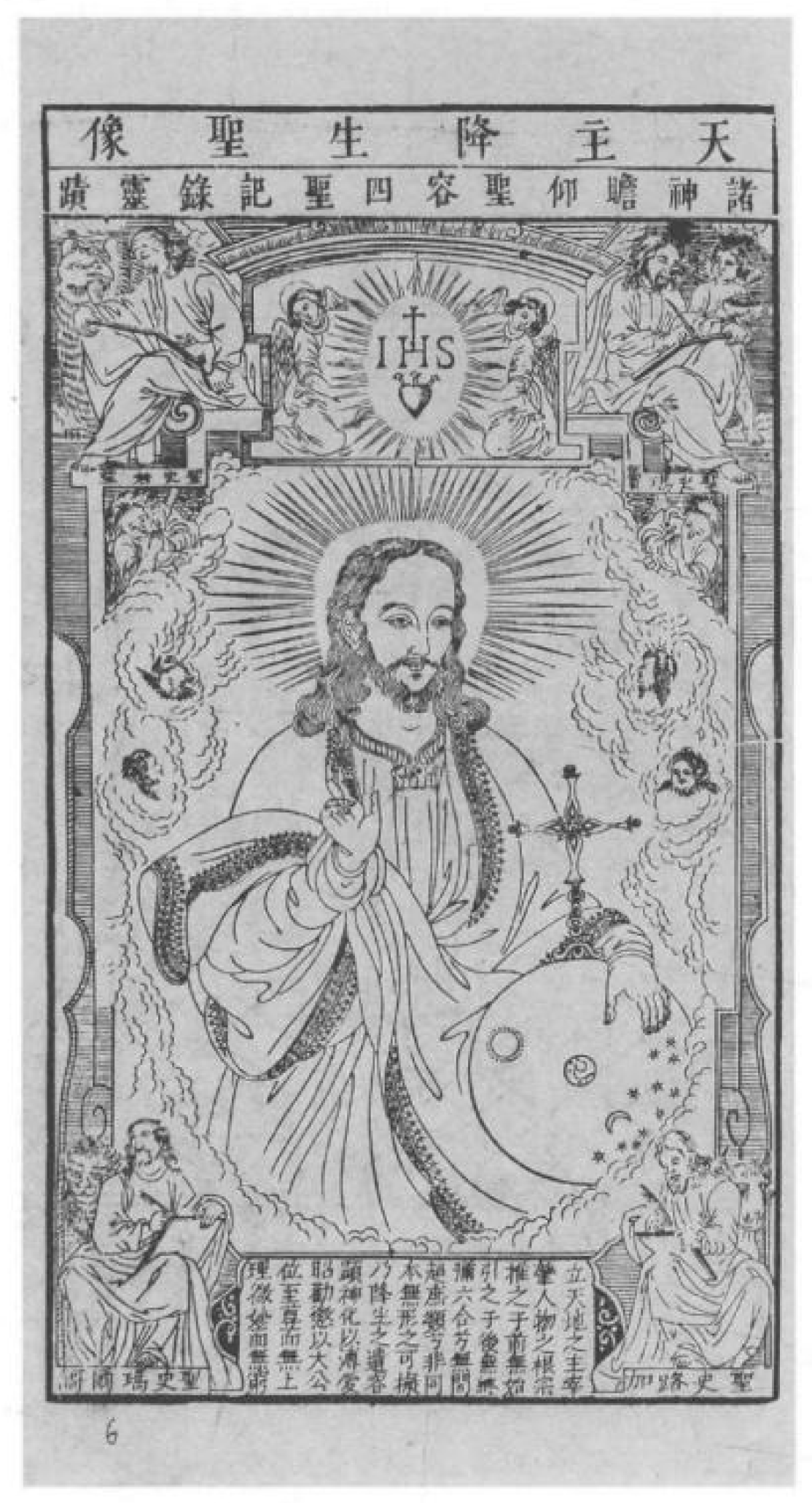
Jingjie’s interweaving of Catholic thought and Chinese philosophy is evident in its very second image (following a detailed map of Jerusalem in the time of Christ), the “Icon of the Nativity of God” (天主降生圣像; see
Figure 1), which serves as a programmatic summary for the entire book, representing a Christologically grounded approach to spiritual cultivation.
Beneath this image appears the following poem of praise:
| 立天地之主宰, | He is the Ruler who established heaven and earth, |
| 造人物之根宗。 | He is the root and ancestor who created humankind and all things. |
| 推之于前无始, | Before all ages, He is without beginning, |
| 引之于后无终。 | Beyond ages’ end, He is without end. |
| 弥六合兮无间, | Pervading the Six Coordinates,4 He is unbounded and undivided, |
| 造庶类兮靡同。 | He created various kinds, each distinct from the other. |
| 本无形之可拟, | He is originally formless to frame, |
| 乃降生之遗 [wèi5] 容。 | However He was born to bestow His image. |
| 宣仁爱以博化, | He proclaims ren [benevolence] for the universal edification, |
| 理微妙而难穷。 | His li [principle] is subtle and is hard to exhaust. |
Originally titled “
Tianzhu xiangzan” (《天主像赞》), the poem was composed in the classical meter of
fu (赋) by the prominent late Ming official and convert Xu Leshan (许乐善, 1548–1627), a close associate of Xu Guangqi (徐光启) (
Song 2019, p. 281). By prefixing this Confucianized eulogy of Xu to the visual framework of Nadal, Aleni effectively canonized the Christian gospel within the linguistic prestige of the Chinese literati tradition, thereby engaging in a strategy of “reciprocal adaptation” (
Song 2019, p. 281). Although these poetic verses might first read like a classical Chinese hymn of praise that seamlessly weaves together traditional cosmological vocabulary to laud a transcendent subject, in combining them with Nadal’s images, Aleni drew on Chinese thought to articulate the theme of the “Cosmic Christ” and integrate the Jesuit practice of
Exercitia Spiritualia.
The iconographic theme is that of the
Salvator Mundi, a theme with deep religious and cultural resonance.
6 The orb surmounted by a cross, which is held in Christ’s left hand, is known as the
globus cruciger, symbolizing dominion over the created order. The profound theological significance of this icon lies in its twofold nature: on the one hand, the human figure of Jesus; on the other, the orb as a symbol of the cosmos, representing Cosmic Christ. Art historian Felicity Harley-McGowan has traced this conception back to Gregory of Nyssa, who wrote that Christ “holds the circle of the earth (κατἐχει τον γύρον της γης) … enclosing within himself all creation that can be known” (
Migne 1863, p. 524;
Harley-McGowan 2019).
7 This theological idea, that the whole universe is encompassed within Christ, gave rise to spiritual practices grounded in perceiving God through all created things. But the unique significance of
Jingjie is that it gives the universal Logos a “Chinese form,” guiding the viewer to contemplate the Cosmic Christ from a Chinese standpoint (
Ding 1999). To do so, the poem utilizes a cross-philosophical methodology wherein Confucian and Daoist categories do not merely serve as auxiliary illustrations for established Catholic dogmas; rather, they actively reshape and reformulate the interpretation of Christian theological content. By projecting Christ’s divinity onto the immanent-transcendent dialectic of the Daoist “formless” (无形) and the “Six Coordinates” (六合), Aleni recast Christ’s omnipresence not as an external, abstract deity, but as an immanent cosmological reality. Likewise, by framing Christ’s redemptive mission through the Confucian lens of
ren (仁) and
li (理), Aleni reinterpreted the Incarnation not merely as a historical, juridical act of salvation, but as the ultimate cosmic and ethical realization of the organic harmony between Heaven (天), Earth (地), and humanity (人). Consequently, these indigenous Chinese categories actively constituted a localized Christology, redefining the Christian mystery as the ontological fulfillment of the Chinese moral and cosmological order.
Composed in classical Chinese verse, the poem first declares that Christ is the “root and ancestor” (根宗) of humankind and all creation, combining “humankind” (人) and “all things” (物) to refer to the entire created order. On the level of linguistic-cultural hermeneutics, the Chinese binomial “root and ancestor” (根宗) semantically resonates with the conceptual archetype of the Chinese lineage system (宗法制). While this resonance does not necessarily prove that Aleni consciously adopted this sociological model as a direct source of his theology, it nevertheless establishes a powerful hermeneutical horizon for his target readers. The first character “根” (root), originally meaning “tree root,” signifies “beginning” or “source”; the second character “宗,” deriving from the traditional ancestral temple system, designates the ancestor or progenitor of a clan or lineage (which the first comprehensive Chinese dictionary, Shuowen Jiezi [说文解字] explains as “a revered ancestral temple,” noting its composition from the radicals “宀” [roof] and “示” [altar]). This etymological grounding, anchored firmly in the primary textual tradition, allows us to interpret Aleni’s terminology not as an arbitrary loanword, but as a deliberate linguistic choice that inherently activates the Chinese cultural schema of familial continuity. The combination of these two radicals depicts a sacred space for ancestral worship, meaning “ancestor.” The phrase “root and ancestor” (根宗) therefore skillfully transposes the relationship between Creator and creation from a European substantialist framework into a familial Chinese ontology. Rather than conceiving God through the Catholic scholastic model of a transcendent, external causa prima, who crafts the universe ex nihilo, the poem’s use of “root and ancestor” (根宗) depicts Christ as the immanent, generative root or patriarch of a cosmic family. This conceptual shift introduces a deep philosophical negotiation, bridging the ontological division between Creator and creature by utilizing the Chinese lineage model of continuity and generation, thereby redefining Christ’s lordship not as external domination, but as an immanent, ancestral kinship with the entire cosmos.
The poem goes on to state that Christ “creates various kinds” (造庶类), each different from the other. This phrase—“various kinds” (庶类)—invokes the
Mao Shi Zhuanjian (《毛诗传笺》), an influential Han Dynasty commentary on the
Book of Poetry (《诗经》): “When the various kinds multiply and flourish, and hunting is carried out in season, if the ruler is benevolent like the mythical beast Zouyu, then the Way of kingship is fulfilled” (庶类蕃殖,搜田以时,仁如驺虞,则王道成也) (
Kong 2018, p. 32). The fecundity of “various kinds” was often used to symbolize a king’s benevolence or good and just governance. By appropriating this terminology in Xu’s poem, Aleni presented Christ as the creator of “various kinds,” thereby underscoring his capacity to govern the cosmos—a Sinicized interpretation of Christ as “King of the Universe.” Through this curated text, Aleni thereby effectively transformed the Christological “King of the Universe” into a Sinicized paradigm of political-cosmic moral order.
The poem also employs Chinese cosmological terms such as the “Six Coordinates” (六合) to convey the Incarnation and the dual nature of Christ. The term “六合” refers to the entire cosmos, as the legendary Tang Dynasty commentary on the classic Daoist scripture
Zhuangzi explains (
Commentaries on Nanhua Zhenjing, 南华真经注疏): “The Six Coordinates are the four directions plus up and down” (六合者,谓天地四方也。) (
Ziporyn 2020, p. 118). As John S. Major points out in
Heaven and Earth in Early Han Thought, the “Six Coordinates” are not only geographical directions but also cosmological boundaries (
Major 1993, pp. 144–45). By utilizing this traditional Chinese concept in this poem, Aleni situated the mystery of Christ in this Chinese traditional cosmological framework, thereby achieving an ontological inculturation of the Incarnation, transposing the universality of the Logos into the expansive boundaries of the Chinese cosmic order.
The poem also reveals the core mystery of the Incarnation with the stanza: “He is originally formless to frame, However He was born to bestow His image” (本无形之可拟,乃降生之遗容). The phrase “originally formless” (本无形) first affirms the transcendent nature of Christ’s divinity, which aligns with the Chinese philosophical understanding of the ultimate reality as formless: “Greatest Image is formless” (大象无形). The sentence “However He was born to bestow His image” (乃降生之遗容) then connotes that the “metaphysical” (形而上) Dao has entered the world of the “physical” (形而下) Vessel (器), grounding the spiritual practice of “contemplating the image” (观像). This dialectic between the formless and the manifested image functions as a theological key point of
Jingjie, establishing a framework in which the radical alterity of the divine becomes accessible to human consciousness precisely through the mediation of the visible Vessel (for more on “Dao” and “Vessel,” see
Section 4).
This dialectic between formless and manifested image reflects Aleni’s deep grounding in Neoplatonic metaphysics. As
de Carvalho (
2020) demonstrates, Aleni’s philosophical framework in China was profoundly shaped by his earlier encounter with the
Cursus Conimbricensis, a set of commentaries on Aristotle that infused Aristotelian scholasticism with a Neoplatonic hierarchy of being, entering early modern Jesuit theology via Patristic and Medieval mystical traditions. As
Hosle and Dai (
2024, p. 29n8) argue, Aleni’s theological design was heavily influenced by the Neoplatonic concept of
reditus in unum (the return of all creation to the One), a concept translated in earlier Jesuit works like Ricci’s
Tianzhu Shiyi (《天主实义》) as 归元 (returning to the source). In this metaphysical scheme, the cosmos is conceived as a structured descent from the formless One (here, the divine “Dao”) into the material many (here, the physical “Vessel”). This design allows the Chinese reader’s finite intellect to proceed from the physical “traces” of the images to ascend to the transcendent “spirit” of the Creator, completing the mystical journey of
reditus in unum through localized visual contemplation.
Thus by placing the Icon of Nativity of God at the beginning of his work and accompanying it with a poem of praise, Aleni established a Christological foundation for his enculturated Catholic theory of spiritual cultivation, providing a theoretical basis for moving from “contemplating the image” (观像) to “spiritual communion” (神交). Much like ultimate reality in Chinese philosophy, Christ’s divinity is without beginning or end, pervading the entire cosmos, “originally formless to frame.” Yet, this ultimate reality became incarnate, enabling believers to imitate his actions on earth. In this process, the image functions as medium: by means of the senses and imagination, the practitioner can be led from the “physical traces” (形下之迹) to the “metaphysical spirit” (形上之神), achieving through contemplation a spiritual communion with the historical figure of Jesus Christ. This Christological image, elaborately “carved” with Confucian and Daoist discourse, lays a solid foundation for the spiritual practices presented in the rest of Jingjie.
4. The Moral Reconstruction of Christology: Christ as the Cosmic Sage-King and Person of Ren
Comparative spiritual cultivation (修养论) explores how individuals cultivate moral character across different cultural contexts. By fostering a dialogue between the Catholic and Confucian traditions on their paths of self-transformation, this approach of “comparative cultivation” powerfully advances the “embodied hermeneutics” advocated in our introduction. Such a hermeneutics has deep contemporary significance for modern spiritual life, demonstrating how spiritual shaping can transcend the limitations of abstract, conceptual dogmatism, transforming into a vibrant journey of moral and spiritual growth for contemporary seekers, as rooted in specific cultural contexts.
In Chinese, spiritual cultivation is called “修养,” literally meaning “cultivate and nurture.” This term denotes not a rule-based deontological ethics, but rather a virtue-oriented moral ontology. The term “cultivate” (修) signifies the active and prudent self-discipline exercised within ethical practice, whereas “nurture” (养) refers to the holistic, mind–body integrated process of transformation undergone by the subject’s habits.
According to the
Great Learning (
Daxue 大学), one of the “Four Books” of Confucianism, “From the Son of Heaven down to the common people, all must regard cultivation of the personal life as the root or foundation” (自天子以至于庶人,一是皆以修身为本) (
Chan 1963, p. 87). The Song-Dynasty Neo-Confucian philosopher Zhu Xi’s (朱熹) commentary on the
Daxue elaborates: “From the ‘rectification of the mind’ upward, all the following actions are ‘cultivation of the personal life.’ From the ‘regulation of the family’ downward, these actions naturally follow from it” (正心’以上,皆所以修身也。‘齐家’以下,则举此而错之耳。) (
Zhu 2004, p. 6).
8 Rooted in principles such as “rectifying the heart” (正心), “being sincere in thoughts” (诚意), “the investigation of things” (格物), and “extension of knowledge” (致知), self-cultivation forms the foundation for governing one’s family, state, and ultimately the world. Influenced by Zhu Xi and his “Cheng-Zhu School of Neo-Confucianism” (程朱理学), many scholars and officials in late Ming China adopted these methods of moral and spiritual cultivation. In an effort to adapt Catholic practices to the local cultural environment, Giulio Aleni therefore established a precise epistemological correspondence between the Confucian practice of self-cultivation and Ignatian spiritual exercises. Within this framework, the visual contemplation of sacred images is recontextualized: it is no longer merely an aesthetic experience, but rather an active moral-epistemological practice—one accorded a status equivalent to the Confucian practices of “the investigation of things” (格物) and “extension of knowledge” (致知).
Indeed,
Jingjie is a quintessential product of the intellectual dialogue between Cheng-Zhu Neo-Confucianism and Catholic theology about spiritual cultivation during the late Ming period. This is clear from the very opening poem, especially the stanzas: “He proclaims
ren for the universal edification; His
li is subtle and is hard to exhaust” (宣仁爱以博化,理微妙而难穷。). Here, via the voice of the poem, the earthly mission of Jesus is called the proclamation of benevolence (
ren 仁), the chief Confucian virtue, which Confucius himself characterized as “loving others” and Jesuits translated as “charity and piety” (
caritas et pietas) (
Meynard 2015, p. 64). Similarly, the Gospel narratives described in
Jingjie identify love and compassion for the suffering of humankind as the primary motive for Jesus Christ’s actions.
Ren also has a cosmological dimension, which the Ming-Dynasty Neo-Confucian philosopher Wang Yangming (王阳明) defined in his
Instructions for Practical Living (
Chuanxilu 传习录) as follows: “Ren is to see heaven, earth, and all things as one body” (仁者,以天地万物为一体。) (
L. Chen 2014, p. 18). By identifying Christ as the concrete embodiment of this ontological unity, the
Jingjie reconstructs Christology through an organic cosmology that emphasizes the universal interconnectedness of all things. Consequently, the visual meditations found in the text of
Jingjie aim to guide the practitioner toward an existential praxis of
ren which is termed “practice” (工夫). This is not merely a passive contemplation of external doctrines, but rather a visceral engagement—encompassing body, mind, and also spirit—with Christ’s cosmic love, thereby transforming the practitioner’s own mind into the mind of heaven, earth and all things.
By stating that Christ “proclaims [宣]
ren for the universal edification [教化],” the opening poem also deploys the archetype of the Chinese sage-king for Jesus Christ, equating the “Cosmic Christ” with a figure easily understood and piously revered by Chinese literati. In Chinese, the character “宣” (to proclaim) is closely related to imperial authority. Its original meaning was “great hall,” referring to the “audience hall of the Son of Heaven” (天子宣室), where the emperor met with ministers and issued decrees. The use of “宣” therefore underscores Christ’s kingly identity, especially since universal edification (教化) is the mission of a Confucian ruler, who by his own virtue, culture, and rituals, is to “guide common people with virtue, and keep them in line by means of ritual” (道之以德,齐之以礼) (
Slingerland 2003, p. 8). Moreover, as Confucius’s
Analects (论语) indicate, although “universal edification” (博化) is rooted in
ren (仁), it also transcends
ren, reaching the realm of the “sage” (圣人):
Zigong (子贡) asked, “If there were one able to broadly extend his benevolence to the common people and bring succor to the multitudes, what would you make of him? Could such a person be called Good [ren]?” The Master said, “Why stop at Good [ren]? Such a person should surely be called a sage! Even someone like Yao or Shun would find such a task daunting.”
子贡曰:“如有博施于民而能济众,何如?可谓仁乎?何事于仁,必也圣乎!尧、舜其犹病诸!”
Elsewhere in the
Analects, Confucius characterized the sage who performs universal edification as follows: “Desiring to take his stand, one who is Good helps others to take their stand; wanting to realize himself, he helps others to realize themselves” (己欲立而立人,己欲达而达人) (
Slingerland 2003, p. 63). Moreover, Song-Dynasty Confucian philosophers such as Cheng Yi believed that the ancient sage-kings Yao and Shun had reached the pinnacle of virtue, “attaining the correctness of heavenly
li [principle] and achieving the perfection of human relations” (得天理之正,极人伦之至) (
Cheng and Cheng 2000). Aleni, however, suggested that these sage-kings fell short of the sage’s realm of “extensively conferring benefits on the people.” By endorsing the declaration that Christ proclaims “universal edification” (博化), Aleni implied that Christ surpasses the sage-kings Yao and Shun, achieving a level they could not reach, realizing a unique form of politico-theological transcendence. By drawing upon the established definition of the sage-king, Aleni positioned the cosmic Christ as the eschatological fulfillment of the Confucian political ideal, thereby transforming an immanent historical ideal into a transcendent theological reality.
However, we cannot ignore that this political–theological elevation of Christ above Yao and Shun carried a latent and subversive risk. In the context of political theology, the Chinese Emperor is regarded as the sole intermediary linking the cosmic order with human society, thereby possessing an absolute and inherent moral and political authority. By positioning the transcendent Christ as the truly supreme sage-king, one who even transcends those revered kings in the ancient era, Aleni’s Christology subtly relativized the absolute authority of the Emperor. To some degree, this conceptual tension laid a groundwork for the subsequent conflict between Catholicism and Chinese imperial authority during the Qing dynasty.
The poem also uses the term “
li” (理) from the Cheng-Zhu school of Neo-Confucianism (程朱理学) for the “principle” embodied in the sage-king Jesus Christ’s character of benevolence or goodness (
ren). According to the Cheng-Zhu school,
li is the supreme reality and principle, the origin of and pattern-principle within all the beings of the universe. As Zhu Xi (朱熹) states, “Principle [
li] refers to the Way [
dao], which exists before physical form, and is the root from which all things are produced” (理也者,形而上之道也,生物之本也) (
Zhu 2000, p. 2798;
Chan 1963, p. 636). And as his predecessor, the Song-Dynasty Neo-Confucian philosopher Cheng Yi (程颐) said, “All things under heaven can be understood in the light of their principle [
li]. As there are things, there must be their specific principles. One thing necessarily has one principle [
li]” (天下物,皆可以理照。有物必有则,一物须有一理) (
Cheng and Cheng 2000, p. 242;
Chan 1963, p. 563). The Cheng-Zhu school emphasized the investigation of things to exhaust the principles (格物穷理), a practice (工夫) through which principle was discerned within things to reach a state of “sudden enlightenment” (豁然贯通). By viewing Christ as the ultimate embodiment of
li, Aleni built a crucial bridge between Christian Logos and the order of Neo-Confucianism. By adopting the assertion that Christ’s
li is “subtle and is hard to exhaust” (微妙而难穷), Aleni introduced an apophatic theological turn to this paradigm. Ultimately, this conceptual revision imposed a transcendental limitation on the epistemology of the Cheng-Zhu school of Neo-Confucianism; although human reason can explore inner principles, the supreme
li of Logos, the incarnate Word, possesses an infinite depth of apophatic theology, forever transcending absolute cognitive understanding.
In portraying Jesus as a moral sage-king who proclaims benevolence or good (ren) for universal edification, with a li that is subtle and hard to exhaust, Aleni connected the core of Catholic spirituality—imitatio Christi—to the Confucian tradition of “follow the example of the sages and worthies” (希圣希贤), indicating that this “Cosmic Christ” surpasses the sage-kings with respect to his universal edification and inexhaustible li. Viewers of the Jingjie’s images were called to meditate on Christ’s salvific ren and inexhaustible li, transforming these theological concepts into concrete practices in their own lives: emulating the benevolent charity of Jesus Christ in their daily lives.
This call to emulate Christ’s benevolent charity, however, is not merely an external moral imitation; rather, it is anchored in a deeper, localized Christological model where Christ is established as the archetypal “person of
ren” (仁人). Because the Confucian quest to “follow the sages” (希圣希贤) ultimately culminates in embodying the character of a “person of
ren,” the
Jingjie engages in a profound dialogic hybridization (
Song 2019, p. 24), positioning Christ as the absolute manifestation of this ethical ideal. Within the Confucian classics, the “person of
ren” (仁人) represents the pinnacle of moral nobility and the ultimate spirit of self-sacrifice—one who would not hesitate to lay down their life for the sake of righteousness. Likewise, Mencius famously declared, “A benevolent person (i.e., the ‘person of
ren’) has no enemies in the world” (仁人无敌于天下) (
Van Norden 2008, p. 184). Aleni projected these classical paradigms onto Christ, offering a reinterpretation of the central mystery of the Crucifixion: Christ’s sacrificial death on the cross is no longer presented as a transactional and culturally incongruous Western doctrine of atonement, but is instead viewed as the supreme historical embodiment of the ideal of sacrificing one’s life to fulfill
ren; furthermore, the universal reconciliation Christ achieved for all humanity is regarded as the ultimate realization of the state wherein “the person of
ren has no enemies” (仁人无敌).
For Chinese believers today, this Christology of the “person of ren” has profound practical significance for modern spiritual formation. In the contemporary context, this historical synthesis offers a vital resource for shaping modern spirituality, rescuing spiritual life from the dual traps of “abstract intellectualism” and “cultural alienation.” Given that the contemporary Chinese church is far from homogeneous, comprising distinct social groups whose spiritual needs are deeply conditioned by their socio-economic backgrounds, Aleni’s historical synthesis is able to provide a versatile, culturally organic “embodied practice” that speaks directly to the varied socio-cultural realities of contemporary Chinese seekers, transforming Christian discipleship into a culturally situated moral imperative of everyday life. For instance, urban intellectuals may resonate with the Confucian cultivation discourse as a framework for ethical self-discipline, while rural believers—often embedded in communal and oral cultures—might find the visual and narrative dimensions of the Jingjie more immediately accessible within their liturgical practices. For both, this approach delineates a path of “embodied practice”—a spiritual journey in which the realization of faith is no longer manifested merely as passive adherence to doctrinal formulas, but rather embodied as the active, daily, and sustained cultivation of ren within one’s own specific social context.
5. The Dao-Vessel Dialectic in Image Contemplation in Aleni’s Intercultural Interpretation
In reconstructing Christ as the personal embodiment of ren, Aleni addressed the ontological-moral dimension of inculturation. Pedagogically and spiritually, Aleni also defended the visual medium used to contemplate this Cosmic Christ.
Although
Jingjie is relatively limited in terms of its inculturation of artistic technique, especially in comparison to the
Song Nianzhu Guicheng (诵念珠规程),
it makes extensive use of Chinese intellectual traditions to convey Jesuit spiritual cultivation. In this sense,
Jingjie can be regarded as one of the earliest systematic attempts to localize Catholic spiritual cultivation in China. This is clear from the very introduction to
Jingjie, in which Aleni articulated a Catholic method of spiritual cultivation that combines “contemplating the image” (观像) with “reading scripture” (读经):
The learner, beginning from the physical traces, explores the metaphysical spirit; via what the eyes can see, he comes to unite with what they cannot see, preserving and contemplating this silently in mind. Thus he can wander continually with creation, without needing always to turn the pages of a book; it is divinely marvelous and illuminates, yet its meaning depends upon the person’s own realization.
学者繇形下之迹,以探乎形上之神;繇目睹所已及,并会乎目睹所未及,默默存想。当有不待披卷而恒与造物游者,神而明之,是则存乎其人已。
Here, we have not only an interweaving of Confucian philosophy and Catholic theology but also an embryonic expression of a localized theory of Catholic spiritual cultivation.
9To establish a method for spiritual cultivation through “reading images and contemplating images” (读图观像) that would lead readers to the ultimate ideal of “the unity of heaven and humanity” (天人合一),
Jingjie’s first task was to answer the fundamental philosophical question: How can human beings ascend from the visible, material “image” (像) to the invisible, spiritual “Dao”? To answer this question, the text does not rely solely on Catholic doctrine, namely that God reveals himself in visible things. Instead, it enacts a dialogic hybridization by interweaving this theological concept into the framework of Chinese philosophy, drawing on traditional binaries such as, on the one hand, “prior to physical” (形而上) and “Dao” (道) and, on the other, “subsequent to physical” (形而下) and “concrete objects” (or “Vessel,” 器皿), especially as found in the
Yijing (易经): “Therefore what is prior to physical form pertains to the Dao, and what is subsequent to physical form pertains to concrete objects [the Vessel]” (形而上者谓之道,形而下者谓之器) (
Lynn 1994, p. 67).
This synthesis served, more widely, as a cross-cultural defense of sacred art during the early-modern, Western iconoclastic crisis, a time during which Protestant reformers like John Calvin rejected representational images as idolatrous. In response, the Catholic Counter-Reformation—exemplified by the Council of Trent (1545–1563) and theorists like Gabriele Paleotti—defended images by linking them to their divine prototypes. Aleni’s use of the Yijing’s Dao-Vessel dialectic represents an analogous conceptual translation of this Tridentine defense. By framing the physical image (像) as the material “Vessel” (器) and the transcendent divine as the “Dao” (道), Aleni circumvented both Western iconoclastic objections and Chinese literati suspicions of idolatry, arguing that the material Vessel does not compete with the divine Dao. Rather, since the metaphysical Dao manifests through the physical Vessel, the image serves as a necessary medium for the soul to ascend to the transcendent archetype, enacting Paleotti’s theology of sacred art.
On the one hand, the Dao is mysterious, subtle, profound, and abstruse; on the other, the Vessel includes everything in the world that is formed and can be perceived. The Dao, however, is never separate from the Vessel, as the Vessel is what receives the Dao. The two are mutually inclusive and inseparable, such that, in the words of Cheng Yi, “concrete things [the Vessel] are the Way [Dao] and the Way [Dao] is concrete things [the Vessel]” (器亦道,道亦器) (
Cheng and Cheng 2000, p. 55;
Chan 1963, p. 527). Aleni affirmed the status of the visual medium as a vehicle for divine revelation, noting that the invisible God can be approached precisely via the mediation of His visible, material manifestations.
For Aleni, the fundamental nature of God, like the Dao, is “metaphysical” (形而上)—mysterious, surpassing human understanding. Yet, God, again like the “Dao,” which is manifested in the “Vessel,” continually reveals himself through his physical and visible creation. The supreme and ultimate “Vessel” of God’s self-revelation is the incarnate Jesus Christ, whose life activities had “physical” characteristics—eating, drinking, dwelling, clothing, joys, and sorrows, all of which were perceptible to human beings. These activities were narratively recorded in the Gospels and visually represented in sacred images (出像). Crucially, however, the humanity and the divinity of this “physical” Jesus were inseparable, much like the Neo-Confucian relationship between
li (理) and
qi (气), which are inseparable yet unmixed, constituting the fundamental dualism of the universe, as immaterial “principle” and “material force” (in the translation of
Chan (
1963, p. 634)). According to Neo-Confucian philosopher Zhu Xi, “Principle has never been separated from material force,” for without
li there would be no ground for existence, and without
qi li would have nothing to which to adhere (
Chan 1963, p. 634). Aleni skillfully employed this cosmological paradigm to translate the complex Chalcedonian Christological formula—which defines Christ’s divinity and humanity as a unity that is “unconfused, unchanging, undivided, and unseparated”—into language that Chinese scholars could understand.
The spiritual practitioner could therefore come to know God through the path of “establishing images to exhaust meaning” (立象尽意), with Aleni establishing a philosophical foundation for spiritual cultivation via “contemplating images” in terms of a relationship between “physical traces” (形下之迹) and “metaphysical spirit” (形上之神), describing this process as “extending from what the eyes can see to what the eyes cannot see” (繇目睹所已及并会乎目睹所未及). On the one hand, “what the eyes can see” referred to the images or “physical traces” of the
Jingjie; on the other, “what the eyes cannot see” pointed to the “image beyond the images, the scene beyond the scenes” (象外之象, 景外之景). The second “image” in the phrase “image beyond the image” encompassed all the carved figures produced by the woodcut artist that depicted traditional Ming clothing, furniture, and domestic settings. Through these, the viewer could perceive the figure of Jesus Christ situated in a Chinese cultural environment.
10 The first “image,” however, referred to the historical world of Jesus of Nazareth in the first-century Mediterranean, which existed outside, before, and beyond the woodcut image. Via imagination, the viewer entered this historical world in both body and spirit, seeing “what the eyes cannot see” by means of “what the eyes can see.”
11 As Steffen Zierholz demonstrates, this spiritual ascent found its counterpart in the Jesuit (and classical philosophical) ideal of
enargeia, with Jesuit visual culture designed to create an “enargetic space” where the material image is interiorized into actual presence, dissolving the boundary between viewer and mystery and achieving a state of “vivid presence” (
Zierholz 2016, pp. 432, 443).
In Catholic spiritual tradition, physically “seeing” an image with the eyes leads to inner contemplation. Through this ability, the meditator not only observes the presented historical scene, but also actively projects a coherent spatiotemporal vision, filling it with the vivid presence of divine figures. Within the meditative space of
Jingjie, practitioners envision a complete setting of time and space, arranging the described persons, events, and objects into a vivid scene, then situating themselves within it.
12 Practitioners are not limited to merely
imagining the “image beyond the image” but are invited to enter it wholly, with both body and soul. Thus this practice constitutes a kind of religious psychology in which imagination is interiorized into direct experience—a method widely employed by those seeking mystical encounters. Within this imagined space, the practitioner not only contemplates the images described in
Jingjie but also experiences a form of synaesthesia, awakening and co-experiencing all their senses and thereby participating in the life of Jesus. What is perceived is no longer the printed image before the eyes but the living world of Christ himself.
This visual practice therefore provides a profound philosophical basis for image contemplation, with its significance far exceeding the simple descriptive or didactic function that people usually attribute to
Jingjie’s woodcut works. By utilizing the
Yijing’s “Dao-Vessel” (道器) dialectic, the text of
Jingjie elevated the material image from a mere illustrative tool to a necessary and active “Vessel” (器) through which human consciousness could ascend to the transcendent “Dao” (道). Historically, this visual praxis represents a transcultural manifestation of
visio divina (sacred seeing), a traditional Catholic practice in which encountering, viewing, and meditating on sacred images serves to elevate the mind to the reality of the living God (
Crabtree 2020, pp. 78–79). Although Protestant reformers rejected representational images as conducive to idolatry, Aleni’s woodblocks served as a physical medium bridging the eye and spirit, demonstrating that the printed page itself can integrate
visio divina with
lectio divina as essential elements of spiritual formation (
Crabtree 2020, p. 79). Ultimately, this synthesis demonstrated that printmaking as a material medium was not a negative obstacle to divinity; on the contrary, it served as a sacred field in which the invisible Logos is revealed to the practitioner, becoming tangible and visible.
6. Wandering with Creation: The Aesthetic Transformation of Spiritual Union
Although Aleni’s Dao-Vessel dialectic established the philosophical legitimacy of contemplating sacred images, this visual praxis ultimately served as a pathway toward a higher stage of spiritual union, one characterized by “not needing to turn the pages” (不待披卷) to achieve communion with the Creator. As the second sentence from Aleni’s introduction to the Jingjie (above) reads:
Thus he can wander continually with creation, without needing always to turn the pages of a book; it is divinely marvelous and illuminates, yet its meaning depends upon the person’s own realization.
Here, the phrase “wander with creation” (与造物游) reflects an aesthetic current popular in the late Ming dynasty rooted in the classical Daoist Zhuangzi’s (庄子) philosophy of “let yourself be carried along by things so that the mind wanders freely” (且夫乘物以游心) (
G. Chen 2007, p. 146;
Ziporyn 2020, p. 39). The goal of this aesthetic was to follow the natural flow of creation and achieve a state of ease and self-contentment, nourishing the vital spirit within, and, while remaining rooted in a finite body and material world, to pursue the infinite extension of life and the free repose of the aesthetic spirit (
Guo and Yao 2023, p. 162).
13As scholars have noted, while classical “wandering” entails a complete involvement with the world rather than an escape from it (
Ziporyn 2012, p. 164), Aleni adapted this concept to arouse the viewer’s poetic imagination (
Li 2017;
Dekoninck 2016, p. 86). Consequently, the practitioner is no longer an aimless wanderer but rather purposefully “carried along by” the visible traces of Christ’s life to achieve a state of spiritual perfection. Here, the text orchestrates a profound dialogic hybridization by adroitly observing this indigenous Chinese aesthetic paradigm and creatively transforming it from a form of carefree and self-contented literati elegance into an inculturated Catholic method of contemplation. In this reinterpreted framework, “riding upon creation” is no longer a general submission to nature but a means of approaching God through everything depicted in the meditative images, and “wandering with the mind” is no longer an aimless wandering but a clear theological and supernatural dimension: the practitioner is invited to employ imagination to extend and “graft” their own life experience onto the vivid scenes of Jesus Christ. The aimless wandering of the Daoist sage was thereby recast into a structured supernatural dimension.
Such a creative grafting of Daoist aesthetics onto Ignatian spirituality however exposed significant theological tensions. A fundamental discord—one that is difficult to reconcile—exists between the contemplative, non-dualistic state of detachment embodied in the Daoist ideal of “riding upon things so that the mind wanders” and the active, volitionally driven moral transformation demanded by Christian discipleship. In transforming a literati aesthetic characterized by unconstrained ease and a reverence for nature into a highly structured, Christ-centered spiritual discipline, Aleni risked downplaying the fundamental incompatibility between Daoist ontological passivity and Catholic moral activity. This conceptual friction highlights a key limitation of Aleni’s strategy, namely, the risk that the alterity of the Christian spiritual theology might be diluted into a generalized, aestheticized cosmology.
This tension is particularly visible when considering Aleni’s personal stance on Chinese religions. As
Patrick (
2024, p. 69) has shown, Aleni viewed sectarian Daoism as “sacrilegious,” Buddhism as “heterodoxy.” Aleni’s appropriation of the Daoist concept of “wandering with creation” was therefore no theological compromise but a rhetorical and philosophical strategy of “plundering the spoils of Egypt.” Originating from the biblical narrative in Exodus (Exod. 3:22)
14, where God instructs the Israelites to take valuables from the Egyptians, the concept of “plundering” was famously allegorized by Augustine in his
De doctrina Christiana to justify the Christian appropriation of secular wisdom and pagan philosophy (
Augustine 1997, pp. 64–65). This framework provided profound theological legitimacy for later Jesuit missionaries to actively adopt and “baptize” indigenous cultural resources. By isolating the classical vocabulary of the
Zhuangzi from its religious associations, the text actively “baptized” the concept of
you (游, wandering), transforming an absolute, carefree, aesthetic state of spiritual passivity into a highly structured, Christ-centered, Ignatian pilgrimage of the soul returning to its transcendent Creator.
In developing this account of Catholic spiritual practice, Aleni’s
Jingjie looked to the
Yijing (易经) phrase “it is divinely marvelous and illuminates; yet its meaning depends upon the person’s own realization” (神而明之,是则存乎其人已) (
Liu and Lin 2006, pp. 295–96) to suggest that the practitioner must exercise personal agency in drawing on life circumstances and cultural context to realize divine mystery. Jesuit spirituality not only allowed for but also encouraged such subjectivity. As Ignatius of Loyola, the founder of the Jesuit order, once explained:
reasoning about it for oneself, can thus discover something that will bring better understanding or a more personalized concept of the history—either through one’s own reasoning or to the extent that the understanding is enlightened by God’s grace. This brings more spiritual relish and spiritual fruit than if the one giving the Exercises had lengthily explained and amplified the meaning of the history.
This Ignatian focus on experiential realization was rooted in the Western tradition of mystical contemplation, particularly “the application of the senses” (
applicatio sensuum) and “the contemplation to attain love” (
contemplatio ad obtineam amorem) in the
Spiritual Exercises, together which seek to find God in all things (
buscar a Dios en todas las cosas) (
Patrick 2024, p. 37). Rather than passive withdrawal, Ignatian contemplation envisioned God actively dwelling and laboring through the created order (
Ganss 1991, pp. 176–77). By aligning this contemplation with the Daoist ideal of “wandering with creation” (与造物游), Aleni positioned the natural world as a shared theater of divine presence in which sensory contemplation of his illustrations became a participatory encounter with God’s cosmic labor.
Given that personal experience is necessarily shaped by cultural context, the significance of Jingjie lies in its use of enculturated and localized images to assist practitioners situated within a Chinese social and cultural milieu. On the basis of visual contemplation, each practitioner is free to select from all of creation to construct a meditative landscape, thereby generating direct or indirect experiences with both individual and national characteristics. Practitioners are therefore enabled to practice spiritual cultivation within the Chinese social and cultural context, make their own moral discernments in ethical life, and practice contextualized virtues.