Article

Development and Validation of the Christian Perception and Experience of Suffering Scale

by
Sung-Won Kim
Contract-Based Department, Chongshin University, 143 Sadang-ro, Dongjak-gu, Seoul 06988, Republic of Korea
Religions 2026, 17(8), 922; https://doi.org/10.3390/rel17080922
Submission received: 21 April 2026 / Revised: 9 July 2026 / Accepted: 24 July 2026 / Published: 4 August 2026
(This article belongs to the Section Religions and Health/Psychology/Social Sciences)

Abstract

The objective of this study was to develop and validate the Christian Perception and Experience of Suffering Scale (CPESS), an instrument designed to measure how Christians perceive and encounter suffering. In the first stage of the research process, a comprehensive literature review was conducted to identify key constructs and generate 62 preliminary items. After undergoing content validation by eight experts, the initial items were refined into a set of 47. Subsequently, a pilot study involving 26 Christians was conducted to further revise the items. For the main study, 702 Christians were surveyed, resulting in 687 valid responses retained for analysis after the exclusion of unusable data. Factor analyses were conducted using JAMOVI 2.3, SPSS 22, and AMOS 22. The total sample was split into two subsamples: 299 cases were allocated for exploratory factor analysis, and 388 cases for confirmatory factor analysis. Following validity and reliability assessment, the final scale consisted of 30 items across six factors: Spiritual Maturity through Suffering (10 items), Providential Trust in Suffering (6 items), Perceived Divine Intervention in Suffering (3 items), Support for the Suffering (3 items), Attitude toward Suffering (4 items), and Spiritual Discipline in Suffering (4 items). This theologically grounded, valid, and reliable scale will provide a valuable resource for advancing scholarly understanding of Christian suffering.

1. Introduction

While the past decade has been a period of significant advancement in science, medicine, and technology, it has also been a time of steadily increasing global challenges. Particularly between 2020 and 2022, the COVID-19 pandemic, rising poverty, multiple wars, the resulting migration issues, and the widening gap between the rich and the poor were intensified. Between 2022 and 2025, the Ukraine War, the Israel–Hamas conflict, worsening humanitarian crises, an energy crisis, and hyperinflation prevailed (Filipenco 2025). The U.S.–Israeli strikes on 28 February 2026, killing Iran’s Supreme Leader, provoked immediate Iranian military retaliation and the closure of the Strait of Hormuz (Council on Foreign Relations 2026). According to the 2025 Global Risks Report, which gathered insights from more than 900 experts worldwide, key risk themes are identified as declining optimism, deepening geopolitical and geoeconomic tensions, a growing sense of societal fragmentation, environmental risks, and technological risks (World Economic Forum 2025).
Although suffering is a pervasive human experience shared by Christians and non-Christians alike, believers interpret and endure it through a distinct theological lens: in a fallen world, suffering is not merely a common occurrence but a natural and inevitable path for those seeking to follow Christ (Bickel and Jantz 2017, p. 154; Carson 1990, p. 90; Senkbeil 2013, pp. 112–13). Although the nature, intensity, and duration of suffering may vary, suffering is a natural experience for Christians after the Fall. Scripture as well as various scholars (Chung 2023; Hamm 2013; Keller 2013, pp. 126–52; Klass [1993] 2006; Yim 2014) also describe the sufferings of biblical figures such as Job, Joseph, Moses, Jonah, Jeremiah, Daniel and his friends, Jesus Christ, and Paul. Augustine argues that “no nature at all is evil,” since evil is merely “the want of good.” Like the fire that purifies gold but consumes chaff, “the same violence of affliction proves, purges, clarifies the good, but damns, ruins, exterminates the wicked” (Augustine 1950, pp. 11, 365). Similarly, C. S. Lewis describes pain as “God’s megaphone,” explaining its function in this way: “But it gives the only opportunity the bad man can have for amendment. It removes the veil; it plants the flag of truth within the fortress of a rebel soul.” (Lewis 2001, pp. 93–94).
Alcorn (2010) strongly asserts that a faith left unprepared for suffering is a deceptive faith, and that true faith is revealed and tested through suffering (p. 5). Suffering is the very means by which Christ redeemed humanity, having taken on human flesh Himself. Though painful, it is both beneficial and purposeful, as it is the only way through which believers can truly experience the Lord’s redemptive work (Keller 2013, pp. 163–64). The spiritual benefits of suffering encompass providing hope by orienting believers toward God’s purposes (Hall et al. 2021) and fostering a deeper understanding of and trust in God (K.-B. Kim 2022; Y.-S. Park 2012, pp. 362–63). Suffering also facilitates the restoration of one’s relationship with God (Hall et al. 2021; M.-H. Park 2015; Tripp 2018, pp. 34–35) and promotes conformity to the image of Christ through sanctification (Hall and Hill 2019; Hall et al. 2021; M.-H. Park 2015). Beyond these benefits, suffering serves to illuminate the authentic thoughts and desires embedded in the human heart such as addressing life’s ultimate purpose, meaning, and hope (Tripp 2018, pp. 27–31). However, in moments of suffering, several factors can deepen the pain of the challenges we face, including poor theology, doubt of God, unrealistic expectations of life and others, pride, materialism, and selfism (Tripp 2018, pp. 32–40).
Given its profound significance, previous scholars have emphasized the need for empirical research on suffering (Hale-Smith et al. 2012; Hall et al. 2022; VanderWeele 2019). They noted that studies on suffering from a religious or specifically Christian perspective have been relatively infrequent, and they emphasized the need for further research, particularly empirical studies. According to Hale-Smith et al. (2012), the evaluation of religious doctrines remains underdeveloped, particularly regarding the causes of suffering. VanderWeele (2019) argues that while suffering is a fundamental human experience, empirical research and validated measures are still emerging and remain disproportionately limited. Recently, Hall et al. (2022) underscored the imperative for evidence-based research, noting that the conventional wisdom—which posits that suffering invariably entails theodical struggles regarding divine attributes—remains empirically unsubstantiated. Based on the need for quantitative research on Christian suffering identified by previous researchers, the limitations of existing scales, and the growing frequency of suffering across the world, this study aims to develop and validate a scale of Christian suffering. In line with the aforementioned research needs and objectives, the research questions of this study are as follows:
  • What is the underlying factor structure of the Christian Perception and Experience of Suffering Scale?
  • To what extent does the Christian Perception and Experience of Suffering Scale demonstrate validity and reliability?

2. Literature Review

Empirical studies on the relationship between faith and suffering have been conducted by previous researchers. Extant research on the relationship between attachment to God and spiritual self-awareness indicates that individuals with higher levels of attachment anxiety or attachment avoidance toward God are less likely to perceive suffering as a means of spiritual growth or connection with God. Mediation analysis further reveals that a higher level of avoidant attachment to God is associated with lower spiritual self-awareness, which in turn is related to a reduced ability to appraise suffering as transformational (Bock et al. 2023). The previous study entitled “The patient’s story of overcoming a medical challenge” demonstrates that patients with deep spirituality and a steadfast faith in God were found to derive meaning from their suffering. In particular, spirituality and faith were shown to help patients endure pain, experience physical and emotional healing, find meaning in their experiences, and sustain resilience (Díaz-Gilbert 2014). In a study conducted among adolescents, religiosity and spirituality were found to be predictors of narrative identity or characteristic adaptations that constitute patience (Schnitker et al. 2017). A recent study reported that spiritual surrender moderated the negative relationship between the severity of adverse life events and life satisfaction, though it failed to moderate the influence of such events on positive or negative feelings (Shannonhouse et al. 2024).
This continuous emphasis on Christian suffering prompts the question: What is the current state of scales for assessing suffering among Christians? The subfactors, items, and characteristics of previously developed suffering scales are presented below. Pargament et al. (2000) developed the Religious Coping Scale (RCOPE) and validated it with 540 college students who had experienced a serious negative life event and 551 hospitalized middle-aged and older adults suffering from medical illnesses. This scale consists of 105 items representing 21 factors, which are as follows: Benevolent Religious Reappraisal, Punishing God Reappraisal, Demonic Reappraisal, Reappraisal of God’s Powers, Collaborative Religious Coping, Active Religious Surrender, Passive Religious Deferral, Pleading for Direct Intercession, Self-Directing Religious Coping, Seeking Spiritual Support, Religious Focus, Religious Purification, Spiritual Connection, Spiritual Discontent, Marking Religious Boundaries, Seeking Support from Clergy or Members, Religious Helping, Interpersonal Religious Discontent, Seeking Religious Direction, Religious Conversion, and Religious Forgiving. This scale includes items such as “Saw my situation as part of God’s plan” (Benevolent Religious Reappraisal), “Believed the devil was responsible for my situation” (Demonic Reappraisal), “Did my best and then turned the situation over to God” (Active Religious Surrender), and “Wondered whether God had abandoned me” (Spiritual Discontent). The large number of factors and items limits its utility and has prevented widespread use (Pargament et al. 2011). A further limitation of this study is its reliance on etic perspectives, which focus on universal religious attributions while failing to capture the unique, Christian-specific nuances of suffering (McMartin and Hall 2022). A notable limitation of this study lies in its sampling strategy. The scale was not developed for the general Christian population, but rather for a specific age group experiencing severe adversity, which may restrict the generalizability of the findings.
Pargament et al. (2011) developed the Brief Religious Coping Scale (Brief RCOPE) as a condensed and cross-culturally validated version of the original RCOPE to overcome the inefficiencies associated with its excessive number of items and subfactors. The scale consists of two subscales, Positive and Negative, each comprising seven items. This scale includes items such as “Looked for a stronger connection with God” and “Sought God’s love and care” (Positive), as well as “Wondered whether God had abandoned me” and “Felt punished by God for my lack of devotion” (Negative) (Pargament et al. 2011).
The psychologists and physicians Hale-Smith et al. (2012) developed the Views of Suffering Scale (VOSS), a suffering perception scale consisting of 30 items across ten factors: Unorthodox, Random, Retribution, Limited knowledge, Suffering God, Overcoming, Providence, Soul-building, Encounter, and Divine responsibility. Sample items include: “God could prevent evil and/or suffering from happening, but God chooses not to because God is not entirely good” (Unorthodox), “Suffering just happens without purpose or underlying reason” (Random), “Individuals suffer because of their deeds in the past” (Retribution), and “We know God is good in the midst of pain because God suffers with us” (Suffering God) (Hall et al. 2022). Researchers emphasized the significance of the VOSS by noting that it offers a reliable means of assessing people’s beliefs about suffering, allowing for exploration of the factors that lead to various suffering-related views and their impact on coping with stressful life events. Despite these contributions, the VOSS consists of only seven factors aligned with Christian perspectives, while the remaining factors encompass unorthodox theistic, atheistic/agnostic, and Buddhist/Hindu views (Hall et al. 2022). This heterogeneity renders the scale potentially inadequate for research focused exclusively on the Christian faith.
Hall et al. (2021) developed the Christian Sanctification of Suffering Scale. This scale is a unidimensional measure comprising 11 items, such as “My suffering is a reflection of God’s will,” “God is glorified through my suffering,” “My suffering makes me more Christlike,” and “My suffering unites me with the sufferings of Jesus Christ.” A limitation of this scale is that it represents only one broad, positive Christian appraisal of suffering rather than a comprehensive theological spectrum. Consequently, it fails to capture the distinct and varied perspectives on suffering that may exist among different groups within the Christian community (McMartin and Hall 2022).
Hall et al. (2022) conducted a study on the development of Suffering with Christ: Emic Christian Coping. This scale consists of two factors—Power and Intimacy and Christ as Example—comprising 11 items. These include “My suffering has made me more aware of God’s power” and “My suffering leads me to pour out my heart to Christ” (Power and Intimacy), as well as “It is a privilege to suffer because Jesus suffered” and “My suffering is a way of taking up Jesus’ cross” (Christ as Example).
Shannonhouse et al. (2024) developed the Christian Spiritual Surrender Scale (CSSS). This scale is a unidimensional measure comprising 10 items, such as “I actively chose to turn my suffering over to God because I knew God loved me,” “When I had no control, I surrendered my suffering to God, because I trusted in God,” “I wanted what God wanted for me more than what I wanted for myself, which helped me put my troubles in God’s hands,” and “When circumstances were hard, I asked God to help me accept God’s plan for my life.” Similar to the scales developed by Hall et al. (2021) and Hall et al. (2022), a limited number of items or a single factor may be insufficient to fully capture the profound and intricate nature of suffering.
Chang et al. (2026) developed the Christian Views of Suffering Scale (CVSS), a psychometric instrument designed to assess diverse perspectives on suffering within a Christian theological framework. The scale was developed through a series of four studies (Study 1–4) conducted with Christian participants residing in the United States. Data were collected from individuals belonging to non-mainstream Christian denominations, encompassing Roman Catholic, Mormon, and Jehovah’s Witness traditions. The CVSS consists of 40 items across 10 factors: Identify with Christ, Depend on God, Opportunity for Growth, Opportunity to Comfort Others, Opportunity to Testify, Test of Faith, Overcoming Spiritual Opposition, Meaningless, Inconsequential, and Completing Christ’s Suffering. Sample items are as follows: “God is using my suffering to develop my character” (Opportunity for Growth), “Some suffering is beyond redemption” (Meaningless), “As long as the soul is fine, suffering is irrelevant” (Inconsequential), and “Christ’s suffering is completed through my suffering” (Completing Christ’s Suffering). While convergent validity was examined through correlations with pre-existing measures, this study did not report internal evidence such as Factor Loadings, Average Variance Extracted (AVE), and Construct Reliability (CR) within the Confirmatory Factor Analysis (CFA) framework. The absence of these indices may be considered a limitation in demonstrating the scale’s internal convergent validity more robustly. The basic information regarding the faith-related suffering scale introduced above is summarized in Table 1.
Although it is not a validated scale for measuring suffering, there were suggestions that could help in understanding suffering or developing scales. McMartin and Hall (2022) proposed the Christian perspectives on suffering based on qualitative research findings and theological review as follows: “Suffering allows us to comfort or help others,” “Suffering is an opportunity for growth,” “Suffering is a test of faith,” “Suffering provides an opportunity to testify,” “Suffering is overcoming spiritual opposition,” “Suffering allows us to identify with Christ,” “Suffering is meaningless,” and “Suffering is inconsequential.”
VanderWeele (2019) proposed a series of questions titled Personal Suffering Assessment to capture the essential characteristics of suffering. Seven questions were generated based on common philosophical and theological themes on suffering presented at the conference on The Enigma of Suffering held in Rome, 2017. The items are as follows: “To what extent are you suffering?”, “The intensity of what I have been experiencing feels intolerable,” “The length of time I have been suffering, or expect to suffer, feels intolerable,” “I feel powerless to stop my current experience of suffering,” “The suffering I have been experiencing affects all aspects of my life,” “Certain purposes of my life have been badly disrupted because of what I have been experiencing,” and “What I have been experiencing threatens who I am as a person.” This study is limited in that it did not present any empirical survey results and included only seven questions measuring the intensity of suffering and the extent of suffering-related experiences.
In summary, while existing instruments provide valuable insights into the phenomenon of suffering, they possess limitations in capturing its distinct Christian dimensions. To address these gaps, the subsequent sections shift focus to the empirical phase of this research, delineating the methodological framework and the resulting empirical findings.

3. Methods

3.1. Research Participants

The participants of this study consisted of Protestant Christian adults attending church. A total of 687 questionnaires were utilized for the analysis, following the exclusion of incomplete or careless responses from the 702 initially collected. To ensure a balanced distribution of churches and regions, the sample was divided: 299 copies were allocated for Exploratory Factor Analysis (EFA) and 388 copies for Confirmatory Factor Analysis (CFA). The EFA group included 100 males and 199 females, while the CFA group consisted of 150 males and 238 females. Detailed demographic characteristics of the participants are presented in Table 2.

3.2. Research Procedures

The procedure for developing the scale for Christian suffering involves extracting constructs and developing preliminary items based on an analysis of previous studies, verifying content validity, conducting a pilot study and a main survey, and testing the validity through EFA and CFA as well as testing its reliability. The detailed process for each stage is as follows.

3.2.1. Extraction of Constructs and Development of Preliminary Items

As the first step in developing a Christian suffering scale, previous studies related to Christian theology, the psychology of spiritual coping, and existing scales (Hale-Smith et al. 2012; Hall et al. 2021, 2022; S.-W. Kim 2025; McMartin and Hall 2022; Pargament et al. 2000; Pargament et al. 2011; Shannonhouse et al. 2024; VanderWeele 2019) were reviewed in order to determine the constructs and to develop corresponding preliminary items. Following a comprehensive review of previous studies, the definition of Christian suffering was formulated as follows. From a psychological perspective, suffering can be viewed as the personal experience of losing what one regards as good, resulting in “the undesired experience, of considerable intensity or duration, of a negative physical or affective state” (VanderWeele 2019, p. 58). K.-B. Kim (2022) defined Christian suffering as a rhetorical expression used when emphasizing it as an instrument that urges faith-based endurance and growth under the relationship with God for the diverse pains experienced by saints in a reality fallen into sin. In this study, Christian suffering is defined as “Christians’ enduring and interpreting the pain they inevitably experience while living as children of God in a sinful world, based on their relationship with God.” Drawing upon an integrative analysis of previous studies, the constructs of Christian suffering were identified as: suffering beliefs, attitudes, experiences, consequences, and gospel suffering. The preliminary scale comprised 62 items across five constructs, consisting of 15 items for suffering beliefs, 14 for suffering attitudes, 18 for suffering experiences, nine for suffering consequences, and six for gospel suffering.

3.2.2. Content Validity Assessment

Content validity assessment was conducted to verify the conceptual relevance and clarity of the item. A panel of eight experts, specializing in systematic theology, Christian philosophy, and Christian education, participated in the content validity assessment. The evaluation was carried out via email between 11 August and 18 August 2025. The interpretation of the Content Validity Index (CVI) for this study followed the criteria established by Polit and Beck (2006). Fifteen items were removed and two items were revised in this process, as detailed in the corresponding note.1

3.2.3. Pilot Study and Main Survey

A pilot study was conducted between 22 and 28 August 2025, with a sample of 26 participants, using items based on experts’ evaluation. Drawing upon the pilot study results, two items were revised after identifying ambiguities in meaning or difficulties in the rating process: “I obey as the Lord leads during suffering” to “I experience God’s guidance in the midst of suffering” and “I do good in the midst of suffering” to “I practice kindness and service in the midst of suffering.”
The main survey was administered between 31 August and 30 November 2025, targeting a sample of church-attending Christians. Participants rated each item on a 5-point Likert scale (1 = Strongly Disagree, 2 = Disagree, 3 = Neutral, 4 = Agree, 5 = Strongly Agree). A total of 687 responses were used for the analyses, with 299 cases used for the EFA and 388 cases used for the CFA.

3.3. Data Analysis

The collected data were analyzed using JAMOVI 2.3, SPSS 25.0, and AMOS 25.0. The analytical procedures were as follows: First, to determine the optimal number of factors, parallel analysis was conducted. Analysis using the JAMOVI 2.3 software confirmed the appropriateness of a six-factor model with eigenvalues greater than 1. For EFA, principal axis factoring was employed for factor extraction, and direct oblimin was selected as the rotation method to identify the underlying factor structure. CFA was conducted to assess the goodness-of-fit of the hypothesized factor structure. Convergent validity was assessed via standardized factor loadings, Average Variance Extracted (AVE), and Construct Reliability (CR). Subsequently, discriminant validity was also evaluated by comparing AVE values with the squared correlations between the constructs. Lastly, the reliability of the scale and factors was verified by examining internal consistency using Cronbach’s α.

4. Results

4.1. Scale Constructs

In this study, an initial pool of 62 preliminary items across five constructs was developed based on a literature review and the researcher’s insights. These items underwent content validity verification by a panel of eight experts, resulting in the selection of 47 items and the revision of two items. Following the verifications of validity and reliability, the final scale was structured into the following factors and items: Spiritual Maturity through Suffering (10 items), Providential Trust in Suffering (6 items), Perceived Divine Intervention in Suffering (3 items), Support for the Suffering (3 items), Attitude toward Suffering (4 items), and Spiritual Discipline in Suffering (4 items).

4.2. Exploratory Factor Analysis

EFA was conducted on 47 items to identify the underlying factor structure and to provide evidence of construct validity. Initially, the factorability of the items was assessed using the Kaiser–Meyer–Olkin (KMO) measure of sampling adequacy and Bartlett’s test of sphericity. Suitability for factor analysis requires a KMO value of 0.50 or higher, with Bartlett’s test of sphericity being statistically significant at p < 0.05 (Noh 2019, p. 145). The KMO value of 0.94 and a significant Bartlett’s test result, χ2(435) = 7120.75, p < 0.001, confirmed the suitability of the data for factor analysis. Items with factor loadings below 0.40 or substantial cross-loadings on multiple factors were removed from the analysis. Through this refinement process, 17 items were excluded, resulting in a final set of 30 items. The deleted items are presented in the note below.2
The first factor, Spiritual Maturity through Suffering, consisted of 10 items, explaining 45.04% of the variance. The second factor, Providential Trust in Suffering, consisted of 6 items, explaining 6.88% of the variance. The third factor, Perceived Divine Intervention in Suffering, comprised 3 items, explaining 3.82% of the variance. The fourth factor, Support for the Suffering, comprised 3 items, explaining 3.27% of the variance. The fifth factor, Attitude toward Suffering, included 4 items, explaining 2.88% of the variance. The sixth factor, Spiritual Discipline in Suffering, included 4 items, explaining 2.16% of the variance. The results of the EFA are presented in Table 3.

4.3. Confirmatory Factor Analysis

4.3.1. Model Fit

CFA was conducted to evaluate the six-factor model comprising 30 items identified in the exploratory factor analysis. The initial model did not demonstrate an adequate fit to the data: χ2(390) = 1325.29, p < 0.001; SRMR = 0.04; GFI = 0.80; CFI = 0.89; TLI = 0.88; and RMSEA = 0.08 (90% CI [0.07, 0.08]). Examination of the modification indices revealed several large error covariances. Specifically, high modification indices were observed between e10–e9 (MI = 61.00), e12–e11 (MI = 55.09), and e8–e6 (MI = 43.16). Based on the modification indices and the identification of theoretically justifiable item pairs, three pairs of error terms were allowed to correlate. According to Byrne (2016, p. 110), error covariances can be specified when there is evidence of item redundancy or content overlap.
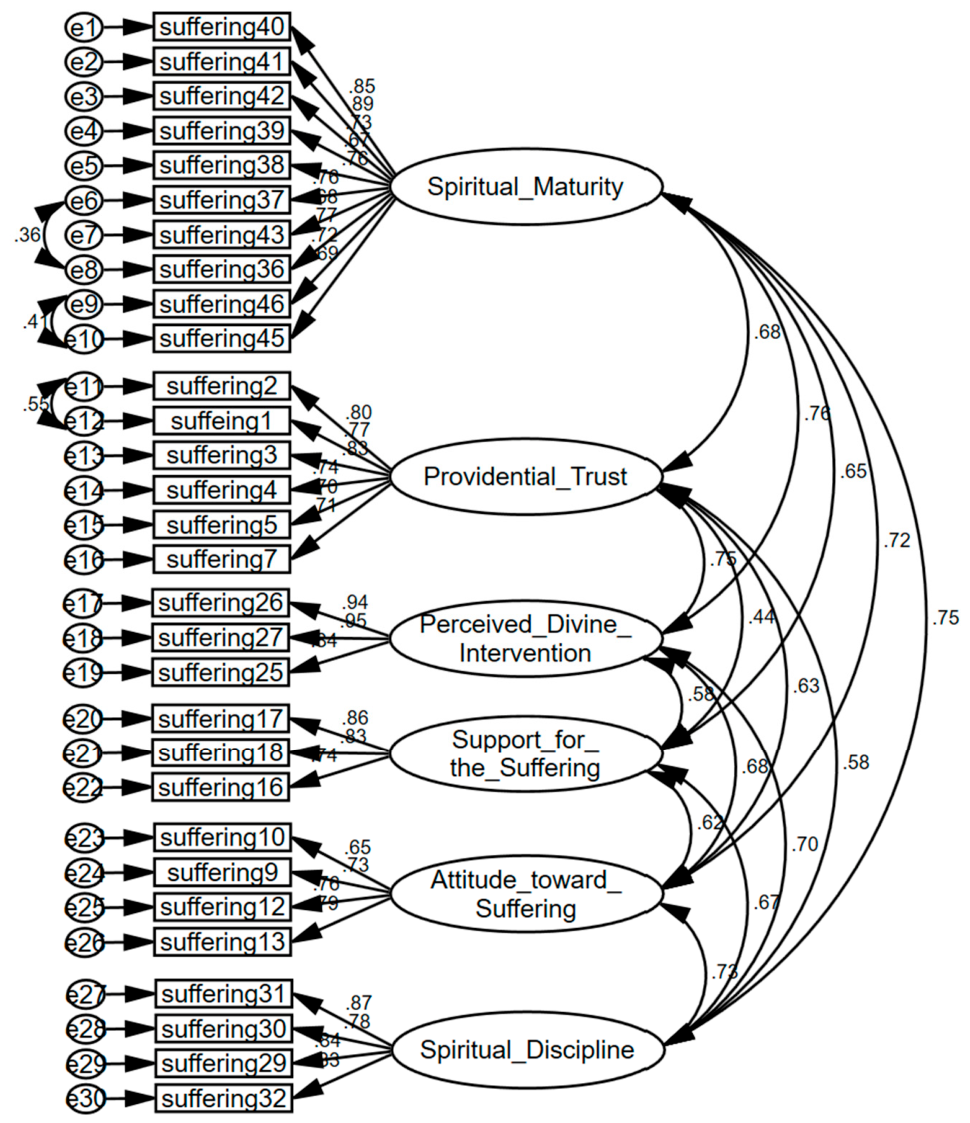
The modified model demonstrated improved fit to the data: χ2(387) = 1129.60, p < 0.001; SRMR = 0.04; GFI = 0.83; CFI = 0.92; TLI = 0.92; and RMSEA = 0.07 (90% CI [0.07, 0.08]). In this model, standardized factor loadings ranged from 0.54 to 0.85 across the six factors. The model fit indices are presented in Table 4, and the CFA model is illustrated in Figure 1.

4.3.2. Validity Test

CFA was performed to establish construct validity, which encompasses convergent and discriminant validity (Yu 2022, p. 159). With respect to convergent validity, all factor loadings should be statistically significant and at least 0.50, while AVE and construct reliability (CR) values should exceed the recommended thresholds of 0.50 and 0.70, respectively (Song 2024, pp. 460–61; Yu 2022, pp. 163–64). The results in Table 5 confirm the criteria for convergent validity.
For discriminant validity, the squared inter-construct correlations (r2) should be lower than the AVE for each construct (Song 2024, pp. 477–78; Yu 2022, pp. 168–69). The results in Table 6 satisfy the discriminant validity.

4.4. Reliability Test

Cronbach’s α alpha coefficients were calculated to assess the internal consistency reliability of the six factors comprising 30 items. The alpha coefficients were 0.93 for Factor 1, 0.89 for Factor 2, 0.93 for Factor 3, 0.84 for Factors 4, 0.82 for Factors 5, 0.90 for Factor 6. The overall scale demonstrated excellent reliability, with a Cronbach’s α of 0.96, as shown in Table 7.

4.5. Final Version

The scale developed in this study was designed to assess Christians’ perspectives on suffering and their lived experiences of it and was named the Christian Perception and Experience of Suffering Scale (CPESS). In this study, Christian suffering was defined as ‘Christians’ enduring and interpreting the pain they inevitably experience while living as children of God in a sinful world, based on their relationship with God.’ The final scale consists of six factors and 30 items, as presented in Table 8.

5. Discussion

In this study, the Christian Perception and Experience of Suffering Scale (CPESS) was developed to measure how Christians perceive and encounter suffering. The scale is comprised of 30 across six factors: Spiritual Maturity through Suffering, Providential Trust in Suffering, Perceived Divine Intervention in Suffering, Support for the Suffering, Attitude toward Suffering, and Spiritual Discipline in Suffering. These findings corroborate and extend the insights of previous research.

5.1. Scale Development

To provide a more granular discussion of the first research question, the factor structure and its constituent items are discussed below. The first factor of the suffering scale, ‘Spiritual Maturity through Suffering,’ consists of ten items such as “My heart and soul become holy through suffering,” “I become more like Jesus through suffering,” and “I learn perseverance through suffering,” and emerged as the primary component, accounting for 45.04% of the total variance. The identification of this factor aligns with the ‘Christian functional views of suffering’ proposed by McMartin and Hall (2022), which conceptualizes suffering as both a catalyst for growth and a refinement of faith. Furthermore, the inclusion of this factor is corroborated by the Christian Views of Suffering Scale (Chang et al. 2026), which similarly identifies Opportunity for Growth as a factor.
The factor Providential Trust in Suffering comprised six items including “I believe suffering is part of God’s plan,” “I believe that suffering is under God’s sovereign control,” and “I believe in God’s goodness even when the outcomes of suffering differ from my desires.” The inclusion of this factor is consistent with findings from the Christian Views of Suffering Scale (Chang et al. 2026), in which Depend on God was identified as a factor. These results further align with MacArthur’s (MacArthur [2002] 2003) conceptual framework, which defines a constructive attitude toward suffering as seeking its purpose and discerning the divine will to cultivate deeper trust (p. 146). Furthermore, research by Hall et al. (2021) reinforces the significance of trust in divine providence by highlighting how the sanctification of suffering fosters meaning and satisfaction. This relational dynamic with God effectively bridges human distress with a higher spiritual purpose.
The factor Perceived Divine Intervention in Suffering comprises three items such as “I experience God’s power through suffering,” “I experience God’s guidance in the midst of suffering,” and “I experience God’s comfort in the midst of suffering.” Parallel to these results, several theologians emphasize God’s divine empathy, noting that He, having endured the loss of His Son, provides paternal comfort and companionship to those undergoing suffering (Y.-B. Park 2012; Keller 2013, pp. 153–76; Klass [1993] 2006). Perceived divine intervention examined in this study is contextually consistent with the Pleading for Direct Intercession factor of the RCOPE scale, which reflects a coping strategy of petitioning for miracles and divine involvement during suffering (Pargament et al. 2000).
The factor Support for the Suffering comprised three items, including “I prayerfully intercede for those who are suffering,” “I seek to comfort those who are suffering,” and “I attempt to help those who are suffering.” This aligns with the perspective of McMartin and Hall (2022), who identified Suffering Allows us to Comfort/Help Others as a primary function of suffering. In a qualitative study on the experience of suffering for the gospel, participants perceived suffering as serving a communal function, which accords with the findings of the present study. Specifically, they regarded their own experiences of suffering as a means to deepen their empathy for others and to provide support for those enduring similar hardships (S.-W. Kim 2026).
The factor Attitude toward Suffering encompasses dimensions of composure, gratitude, benevolence/service, and perseverance. It is measured by specific items such as “I am grateful even in the midst of suffering,” “I can maintain composure even in the midst of suffering,” and “I endure suffering with the hope of future glory.” These results are corroborated by McMartin and Hall’s perspective that suffering may serve as an opportunity for growth by cultivating obedience, empathy, compassion, perseverance, and hope (McMartin and Hall 2022). This result partly echoes previous findings (S.-W. Kim 2025, 2026), which indicated that gratitude is a common response among Christians facing various forms of suffering, such as family illness or suffering for the gospel. In particular, Christians who endured suffering for the gospel expressed joy and contentment, identifying ‘waiting on God’s timing’ as a key way to endure suffering (S.-W. Kim 2026).
The final factor of the scale, Spiritual Discipline in Suffering, comprised four items, including “I am drawn near to God’s Word in the midst of suffering,” “I devote myself to prayer in the midst of pain,” and “I sing praises to God in the midst of suffering.” These results resonate with Graham’s perspective, which posits that the suffering experience leads Christians to spiritual insights into the Scriptures, an intensified life of prayer, and the development of steadfast endurance (Graham [1991] 2010, pp. 119–26). Furthermore, these results parallel those of S.-W. Kim (2025), which indicated that Christians with family members suffering from illness experience spiritual growth by focusing on worship, engaging in Bible reading, devoting themselves to prayer, and practicing obedience.

5.2. Scale Validation

Regarding the second research question concerning the validity and reliability of the scale, the EFA revealed that the scale explained more than 64% of the total variance. Considering the threshold that the explanatory power of the total variance should exceed 60% (Noh 2019, p. 159), these results suggest that the factors and items in this study effectively account for the perceptions and experiences of suffering among Christians. The results of the CFA indicated that most model fit indices met the recommended thresholds, confirming the fitness of the measurement model. Convergent validity was established through the evaluation of factor loadings, statistical significance, CR, and AVE. Furthermore, discriminant validity was demonstrated by comparing the correlation coefficients between latent variables with the AVE values. Reliability was established through the high internal consistency reliability, as evidenced by the Cronbach’s α values. Therefore, it can be concluded that the developed scale has demonstrated both psychometric validity and reliability.

6. Conclusions

Given the global prevalence of suffering and the subsequent need for expanded quantitative research, this study developed a scale to assess Christians’ perception and experience of suffering. The significance of this study lies in its comprehensive approach to quantifying the diverse dimensions of Christian suffering. While previous scales were limited by theological inconsistencies, a restricted number of items, or a narrow focus on only specific aspects of suffering, the constructs and preliminary items of this study attempt to measure the holistic dimensions of Christian suffering, including perceptions, attitudes, experiences, consequences, and suffering for the Gospel. The 30-item, six-factor model derived from this research provides a robust framework for evaluating the multifaceted nature of Christian suffering, integrating cognitive perceptions, affective attitudes, and lived experiences. A key strength of this study lies in its methodological rigor, as it strictly adhered to scale development protocols and ensured psychometric validity through EFA and CFA using independent datasets. The CPESS provides a theological framework for understanding Christians’ experiences of suffering by assessing spiritual maturity, trust in God, and responses to suffering. Unlike general suffering or coping scales, the CPESS uniquely measures suffering through a Christian theological framework, making it a valuable tool for Christian counseling, pastoral care, and spirituality research. Despite these strengths, a key characteristic and limitation of this study is that the sample reflects the specific demographic profile of Korean Protestants, resulting in a high proportion of participants holding church offices—such as deacons, kwonsas (senior deaconesses), elders, and ordained ministers—as well as a majority of long-term or lifelong believers. Therefore, future research should utilize the preliminary items developed in this study to further validate the scale among a broader population, extending beyond Korean Protestants to include Christians from other countries and ordinary laypersons. Future validation studies across diverse cultural and denominational contexts will strengthen the applicability of the CPESS. Initially developed and validated in this study, the CPESS provides a theologically grounded and empirically validated framework for comprehensively assessing Christians’ perceptions and experiences of suffering, thereby advancing research on Christian suffering and spiritual formation.

Funding

This work was supported by the Ministry of Education of the Republic of Korea and the National Research Foundation of Korea (NRF-2024S1A5A2A01027961).

Data Availability Statement

The original data presented in the study are openly available in Zenodo at https://doi.org/10.5281/zenodo.21680789.

Conflicts of Interest

The author declares no conflict of interest.

Notes

1
The following seven items were excluded for failing to meet the I-CVI threshold of 0.78: “I believe that suffering is a means of confirming the assurance of salvation,” “I glorify God through my suffering,” “My suffering is a conduit through which I experience the cross of Jesus,” “I am grateful for Jesus’s salvation of the world through His suffering on the cross,” “I am neither surprised nor afraid when suffering approaches,” “I strive to avoid committing sins that may induce suffering,” and “I am aware of the biblical principles regarding suffering”. The following eight items were also excluded due to low total scores from the expert panel: “I believe that suffering is opportunities to display God’s majesty and glory,” “I meditate on relevant Bible verses in the midst of suffering,” “I wrestle with seeking to understand the meaning of suffering,” “I provide practical assistance that meets the actual needs of those experiencing suffering,” “Through suffering, I am able to empathize with those who are suffering,” “I help God’s servants (e.g., missionaries, retired pastors, etc.) who are undergoing suffering,” “Caring for those in suffering is one of my top priorities,” and “Through suffering, my focus shifts from myself toward God and others”. The revised items are as follows: “I complete my daily responsibilities in the midst of suffering” to “I fulfill my daily responsibilities even in the midst of suffering,” and “I pray for those who are persecuted for their faith and for nations facing religious persecution” to “I pray for those who are persecuted for the gospel.”
2
Following 17 items were excluded during the EFA. The item numbers represent the numbering used in the questionnaire: (6) “I believe that faith strengthens through suffering,” (8) “I find comfort in knowing that Jesus empathizes with my suffering,” (11) “I fulfill my daily responsibilities even in the midst of suffering,” (14) “I do not judge others’ suffering lightly,” (15) “I do not give rash advice to those who are suffering,” (19) “I receive comfort and support from the faith community in the midst of suffering,” (20) I examine myself in the midst of suffering,” (21) “I repent of sin in the midst of suffering,” (22) “I strive to understand the spiritual meaning embedded in suffering,” (23) “I am inspired by the sufferings of biblical figures and faithful witnesses,” (24) Knowing that Jesus endured suffering brings me comfort,” (28) “I learn obedience through suffering,” (33) “I make decisions based on biblical values in the midst of suffering,” (34) “I stand firm on God’s promises in the midst of suffering,” (35) “Though I may not fully understand the purpose of suffering, I endure it by faith,” (44) “I endure discomfort, disadvantages, and suffering to secure my faith,” and (47) “I pray for those who are persecuted for the gospel.”

References

  1. Alcorn, Randy. 2010. The Goodness of God: Assurance of Purpose in the Midst of Suffering. Colorado Springs: Multnomah Books. [Google Scholar]
  2. Augustine. 1950. The City of God. Translated by Marcus Dods. New York: Modern Library. [Google Scholar]
  3. Bickel, Bruce, and Stan Jantz. 2017. Answering the Toughest Questions About Suffering and Evil. Ada: Bethany House Publisher. [Google Scholar]
  4. Bock, Naomi A., M. Hall, David C. Wang, and Todd W. Hall. 2023. Spiritual self-awareness as a moderator between attachment to god and evangelical Christians’ appraisals of suffering. Spirituality in Clinical Practice 10: 131–49. [Google Scholar] [CrossRef] [Scilit]
  5. Byrne, Barbara M. 2016. Structural Equation Modeling with AMOS: Basic Concepts, Applications, and Programming, 3rd ed. New York: Routledge. [Google Scholar]
  6. Carson, Donald Arthur. 1990. How Long o Lord?: Reflections on Suffering and Evil. Lisle: Inter-Varsity Press. [Google Scholar]
  7. Chang, Nicole F., M. Elizabeth Lewis Hall, Jason McMartin, and Eu Gene Chin. 2026. The development of the Christian views of suffering scale. Psychology of Religion and Spirituality. Advance online publication. [Google Scholar] [CrossRef] [Scilit]
  8. Chung, Hye-Yeon. 2023. A reinterpretation of the suffering faced by Christians: Focusing on Joseph’s life. Theology and Praxis 86: 331–57. [Google Scholar] [CrossRef] [Scilit]
  9. Council on Foreign Relations. 2026. U.S. Relations with Iran. March 2. Available online: https://www.cfr.org/articles/us-relations-iran (accessed on 10 April 2026).
  10. Díaz-Gilbert, Miriam. 2014. Spirituality, suffering, meaning, resiliency, and healing: Research findings and a patient’s story of overcoming a medical challenge. International Journal for Human Caring 18: 45–51. [Google Scholar] [CrossRef] [Scilit]
  11. Filipenco, Daniil. 2025. Top 10 World Problems and Their Solutions. DevelopmentAid. April 2. Available online: https://www.developmentaid.org/news-stream/post/147458/top-10-world-problems-and-their-solutions (accessed on 19 January 2026).
  12. Graham, Billy. 2010. Hope for the Troubled Heart. Translated by Gyu-Chae Jeong. Seoul: Hongsungsa. First published 1991. [Google Scholar]
  13. Hale-Smith, Amy, Crystal L. Park, and Donald Edmondson. 2012. Measuring beliefs about suffering: Development of the views of suffering scale. Psychological Assessment 24: 855–66. [Google Scholar] [CrossRef] [Scilit] [PubMed]
  14. Hall, M. Elizabeth Lewis, and Peter Hill. 2019. Meaning-making, suffering, and religion: A worldview conception. Mental Health, Religion & Culture 22: 467–79. [Google Scholar] [CrossRef] [Scilit]
  15. Hall, M. Elizabeth Lewis, Jason McMartin, Crystal L. Park, Shane J. Sacco, Dahee Kim, Kelly Kapic, Eric Silverman, Laura R Shannonhouse, Jamie D. Aten, Lindsay Snow, and et al. 2022. Suffering with Christ: Emic Christian coping and relation to well-being. SSM Mental Health 2: 100158. [Google Scholar] [CrossRef] [Scilit]
  16. Hall, M. Elizabeth Lewis, Jason McMartin, David Wang, Laura Shannonhouse, Jamie D. Aten, Eric J. Silverman, and Lauren A. Decker. 2021. The Christian sanctification of suffering scale: Measure development and relationship to well-being. Mental Health, Religion & Culture 24: 796–813. [Google Scholar] [CrossRef] [Scilit]
  17. Hamm, M. Dennis. 2013. The sharing of His sufferings: The social cost of following Jesus. In Suffering and the Christian Life. Edited by Richard W. Miller. Maryknoll: Orbis Books, pp. 19–47. [Google Scholar]
  18. Keller, Timothy. 2013. Walking with God Through Pain and Suffering. New York: Penguin Books. [Google Scholar]
  19. Kim, Kyu-Bo. 2022. A biblical review of modern discourse on pain. The Gospel and Counseling 30: 5–34. [Google Scholar] [CrossRef]
  20. Kim, Sung-Won. 2025. A qualitative study of a Christian’s suffering with a family member’s illness. Journal of Christian Education & Information Technology 85: 201–41. [Google Scholar] [CrossRef] [Scilit]
  21. Kim, Sung-Won. 2026. A qualitative study on the experience and meaning of suffering for the gospel. A Journal of Christian Education in Korea 85: 145–69. [Google Scholar]
  22. Klass, Dennis. 2006. Spirituality, protestantism, and death. In Death and Spirituality. Edited by Kenneth J. Doka and John D. Morgan. Translated by Jae-Young Kim. Goyang: Humanlove, pp. 105–44. First published 1993. [Google Scholar]
  23. Lewis, Clive Staples. 2001. The Problem of Pain. New York: HarperCollins Publishers. [Google Scholar]
  24. MacArthur, John F., Jr. 2003. The Power of Suffering: Strengthening Your Faith in the Refiner’s Fire. Translated by Eun-Sil Kim. Seoul: Quiet Waters Communications. First published 2002. [Google Scholar]
  25. McMartin, Jason, and M. Elizabeth Lewis Hall. 2022. Christian functional views of suffering: A review and theoretical overview. Mental Health, Religion & Culture 25: 247–62. [Google Scholar] [CrossRef] [Scilit]
  26. Noh, Kyung-Sup. 2019. Statistical Analysis for Thesis Writing. Seoul: Hanbit Academy. [Google Scholar]
  27. Pargament, Kenneth, Margaret Feuille, and Donna Burdzy. 2011. The Brief RCOPE: Current Psychometric Status of a Short Measure of Religious Coping. Religions 2: 51–76. [Google Scholar] [CrossRef] [Scilit]
  28. Pargament, Kenneth I., Harold G. Koenig, and Lisa M. Perez. 2000. The many methods of religious coping: Development and initial validation of the RCOPE. Journal of Clinical Psychology 56: 519–43. [Google Scholar] [CrossRef]
  29. Park, Myeong-Ho. 2015. A Comparison between posttraumatic growth in the positive psychology and benefit of hardship in Christianity. Hanyoung Journal 19: 89–106. [Google Scholar]
  30. Park, Young-Bum. 2012. The theodicy and the suffering of God: The concept of the suffering of God as the answer for a theodicy. Korean Journal of Systematic Theology 33: 243–79. [Google Scholar] [CrossRef] [Scilit]
  31. Park, Young-Sam. 2012. Suffering and God’s Omnipotence: Theodicy’s Questions and Theological Answers. Seoul: Dongyeon. [Google Scholar]
  32. Polit, Denise F., and Cheryl Tatano Beck. 2006. The content validity index: Are you sure you know what’s being reported? Critique and recommendations. Research in Nursing & Health 29: 489–97. [Google Scholar] [CrossRef] [Scilit] [PubMed]
  33. Schnitker, Sarah A., Benjamin Houltberg, William Dyrness, and Nanyamka Redmond. 2017. The virtue of patience, spirituality, and suffering: Integrating lessons from positive psychology, psychology of religion and Christian theology. Psychology of Religion and Spirituality 9: 264–75. [Google Scholar] [CrossRef] [Scilit]
  34. Senkbeil, Harold L. 2013. Where in the World Is God?: Finding Hope in the Midst of Suffering. Bellingham: Lexham Press. [Google Scholar]
  35. Shannonhouse, Laura, Jason McMartin, Shane J. Sacco, M. Hall, Crystal L. Park, Dahee Kim, Eric Silverman, Kelly Kapic, and Jamie Aten. 2024. Spiritual surrender: Measurement of an emic Christian religious coping strategy. Spirituality in Clinical Practice 11: 173–85. [Google Scholar] [CrossRef] [Scilit]
  36. Song, Ji-Jun. 2024. Professor Song Ji-Jun’s Understanding and Application of Dissertation Statistics. Paju: 21segi-sa. [Google Scholar]
  37. Tripp, Paul David. 2018. Suffering: Gospel Hope When Life Doesn’t Make Sense. Wheaton: Crossway. [Google Scholar]
  38. VanderWeele, Tyler J. 2019. Suffering and response: Directions in empirical research. Social Science & Medicine 224: 58–66. [Google Scholar] [CrossRef] [Scilit] [PubMed]
  39. World Economic Forum. 2025. The Global Risks Report 2025, 20th ed. Available online: https://reports.weforum.org/docs/WEF_Global_Risks_Report_2025.pdf (accessed on 19 January 2026).
  40. Yim, Byung-Jin. 2014. A study on the adversity management for successful life. Logos Management Review 12: 135–52. [Google Scholar]
  41. Yu, Jong-Pil. 2022. Concepts and Understanding of Structural Equation Modeling. Seoul: Hannarae Academy. [Google Scholar]
Figure 1. Path Diagram of the Confirmatory Factor Analysis. Note. The values on the single-headed arrows indicate standardized factor loadings of the observed variables on their respective latent factors. The values on the curved double-headed arrows indicate standardized correlations among the latent factors.
Religions 17 00922 g001
Table 1. Religious Suffering Scale.
Developer (Year)
Scale Name
No. of Factors & Item
Factor Name
Sample ItemCharacteristics
Pargament et al. (2000)
Religious Coping Scale
-
21 factors, 105 items
-
Benevolent Religious Reappraisal
-
Punishing God Reappraisal
-
Demonic Reappraisal
-
Reappraisal of God’s Powers
-
Collaborative Religious Coping
-
Active Religious Surrender
-
Passive Religious Deferral
-
Pleading for Direct Intercession, etc.
-
Wondered what I did for God to punish me.
-
Questioned the power of God.
-
Tried to put my plans into action together with God.
-
Didn’t do much, just expected God to solve my problems for me.
-
Pleaded with God to make things turn out okay.
-
subject: college students with major life stressors & hospitalized adults
-
Positive vs. Negative Religious Coping
-
doubts about the appropriateness of factors such as Demonic Reappraisal and Interpersonal Religious Discontent
-
limited utility due to excessive factors and items
Hale-Smith et al. (2012)
Views of Suffering Scale
-
10 factors, 30 items
-
Unorthodox
-
Random
-
Retribution
-
Limited Knowledge
-
Suffering God
-
Overcoming
-
Providence
-
Soul-building
-
Encounter
-
Divine Responsibility
-
We know God is good in the midst of pain because God suffers with us.
-
God could prevent evil and/or suffering from happening, but God chooses not to because God is not entirely good.
-
Individuals suffer because of their deeds in the past.
-
God is all-powerful and can change situations to alleviate suffering.
-
use of two large samples
-
grounded in a
-
solid theological base
-
use of convenience samples of undergraduate students
-
limited ethnic and religious diversity
Hall et al. (2021)
Christian Sanctification of Suffering Scale
-
11 items without factor
-
My suffering is a reflection of God’s will.
-
God is glorified through my suffering.
-
God uses the Bible to communicate to me in my suffering.
-
My suffering makes me more Christlike.
-
My suffering unites me with the sufferings of Jesus Christ.
-
measuring Christian concepts
-
absence of sub-factors
-
limited number of items
Hall et al. (2022)
Suffering with Christ: Emic Christian Coping
-
2 factors, 11 items
-
Power and Intimacy
-
Christ as Example
-
My suffering has made me more aware of God’s power.
-
My suffering has shown me how dependent upon God I am.
-
My suffering is a way of taking up Jesus’ cross.
-
I follow Jesus’ example in facing my suffering.
-
measuring Christian concepts
-
limited number of items
Shannonhouse et al. (2024)
Christian Spiritual Surrender Scale
-
11 items without factor
-
I actively chose to turn my suffering over to God because I knew God loved me.
-
When I had no control, I surrendered my suffering to God, because I trusted in God.
-
I wanted what God wanted for me more than what I wanted for myself, which helped me put my troubles in God’s hands.
-
When circumstances were hard, I asked God to help me accept God’s plan for my life.
-
measuring Christian concepts
-
absence of sub-factors
-
limited number of items
-
double-barreled (compound) questions
Chang et al. (2026)
Christian Views of Suffering Scale
-
10 factors, 40 items
-
Identify with Christ
-
Depend on God
-
Opportunity for Growth
-
Opportunity to Comfort Others
-
Opportunity to Testify
-
Test of Faith
-
Overcoming Spiritual Opposition
-
Meaningless
-
Inconsequential
-
Completing Christ’s Suffering
-
My suffering shows me my need for God.
-
My suffering contributes to God’s redemptive work in the world.
-
Some suffering is beyond redemption.
-
Suffering doesn’t matter because there will be no suffering in heaven.
-
development of the CVSS via Studies 1 through 4
-
emic Christian measure
-
including Non-mainstream Christian sample
-
lack of CFA-based internal metrics (AVE, CR) for convergent validity
Table 2. Demographic Information (N = 299, 388).
Exploratory Factor AnalysisConfirmatory Factor Analysis
CategoryN%CategoryN%
DerMale10033.4GenderMale15038.7
Female19966.6Female23861.3
Age20s3010.0Age20s318.0
30s227.430s379.5
40s6923.140s9524.5
50s7926.450s12532.2
60s4515.160s5814.9
70s or more5418.170s or more4210.8
Years of faith10 years or less93.0Years of faith10 years or less143.6
11–20 years217.011–20 years4110.6
21–30 years4715.721–30 years5915.2
31 years or more11137.131 years or more14036.1
Lifelong Christian11137.1Lifelong Christian13434.5
Church
duty
None5317.7Church
duty
None6416.5
Deacon13143.8Deacon17444.8
Senior
deaconess
8628.8Senior
deaconess
9624.7
Elder206.7Elder266.7
Pastor93.0Pastor287.2
Total299100.0Total388100.0
Table 3. Exploratory Factor Analysis (N = 299).
ItemFactorCommu-
nality
123456
Factor 1 Spiritual Maturity through Suffering
40. I gain a faith refined like pure gold through suffering.0.86−0.02−0.06−0.020.090.070.79
41. I walk the path of a disciple and a servant through suffering.0.86−0.05−0.06−0.050.00−0.060.76
42. I learn perseverance through suffering.0.76−0.03−0.020.03−0.02−0.050.67
39. I gain a deeper understanding and broader empathy for others through suffering.0.740.08−0.020.19−0.100.100.64
38. I become more like Jesus through suffering.0.63−0.01−0.070.120.04−0.050.62
37. My heart and soul become holy through trials and suffering.0.54−0.01−0.110.050.15−0.150.66
43. Because biblical and worldly values clash, I view Christian suffering as something usual.0.520.160.03−0.110.01−0.290.55
36. I mature into a more complete and strengthened Christian through suffering.0.510.03−0.260.040.02−0.170.68
46. I trust that suffering for the gospel prepares me for the coming glory.0.480.160.100.090.25−0.090.62
45. Through suffering for the gospel, I am sharing in the sufferings of Jesus.0.440.080.180.100.31−0.190.68
Factor 2 Trust in God’s Providence
2. I believe that suffering is under God’s sovereign control.0.010.85−0.110.09−0.120.050.78
1. I believe suffering is part of God’s plan.0.020.840.080.06−0.050.020.65
3. I believe that God will give me the strength to endure suffering.−0.090.80−0.040.08−0.06−0.120.69
4. I believe that suffering is a channel through which God’s will is fulfilled.−0.040.780.03−0.080.12−0.130.65
5. I believe in God’s goodness even when the result of suffering differs from my desire.0.070.65−0.13−0.100.160.020.62
7. I hold the hope that present suffering will ultimately be turned into future good.0.270.44−0.120.030.160.180.54
Factor 3 Perceived Divine Intervention in Suffering
26. I experience God’s guidance in the midst of suffering.−0.000.05−0.880.03−0.00−0.050.85
27. I experience God’s comfort in the midst of suffering.0.030.00−0.870.020.02−0.040.82
25. I experience God’s power through suffering.0.090.13−0.60−0.000.220.010.71
Factor 4 Support for the Suffering
17. I seek to comfort those who are suffering.0.010.06−0.020.85−0.02−0.050.81
18. I attempt to help those who are suffering.0.040.010.030.800.120.030.73
16. I prayerfully intercede for those who are suffering.0.09−0.00−0.100.460.07−0.210.53
Factor 5 Attitude toward Suffering
10. I can maintain composure even in the midst of suffering.−0.05−0.030.030.090.880.030.68
9. I am grateful even in the midst of suffering.0.090.10−0.13−0.030.620.000.58
12. I practice kindness and service in the midst of suffering.0.04−0.05−0.130.110.57−0.150.66
13. I endure suffering with the hope of future glory.0.060.03−0.150.050.56−0.120.62
Factor 6 Spiritual Discipline in Suffering
31. I devote myself to prayer in the midst of pain.0.110.07−0.050.100.08−0.620.67
30. I apply to myself what God’s Word teaches about suffering.0.060.08−0.160.160.05−0.560.67
29. I am drawn near to God’s Word in the midst of suffering.0.100.11−0.090.080.14−0.540.64
32. I sing praises to God in the midst of suffering.0.120.02−0.220.200.01−0.460.64
Eigenvalue16.552.811.701.491.311.07
% of Variance45.046.883.823.272.882.16
Total variance45.0451.9355.7559.0161.8964.05
Table 4. Model Fit (N = 388).
Modelχ2dfRMRGFITLICFIRMSEA
Original1325.293900.040.800.880.890.08
Modified1129.603870.040.830.920.920.07
Cut-off <0.05>0.900.60–0.80
Table 5. Convergent Validity (N = 388).
FactorItemEstimateS.E.C.R.AVEConstruct
Reliability
Bβ
Spiritual
Maturity
through
Suffering
Suffering 4510.69 0.570.93
Suffering 460.990.720.0617.49 ***
Suffering 361.000.770.0714.25 ***
Suffering 430.850.680.0712.73 ***
Suffering 371.090.760.0814.11 ***
Suffering 381.080.760.0814.06 ***
Suffering 390.810.670.0712.50 ***
Suffering 420.810.730.0613.61 ***
Suffering 411.170.890.0716.30 ***
Suffering 401.140.850.0715.60 ***
Providential Trust
in Suffering
Suffering 710.71 0.580.89
Suffering 50.860.700.0712.95 ***
Suffering 41.190.740.0913.72 ***
Suffering 31.080.830.0715.28 ***
Suffering 11.170.770.0814.14 ***
Suffering 21.120.800.0814.76 ***
Perceived Divine Intervention
in Suffering
Suffering 2510.84 0.830.94
Suffering 271.000.950.0425.56 ***
Suffering 261.050.940.0425.41 ***
Support for
the Suffering
Suffering 1610.74 0.660.85
Suffering 180.960.830.0615.62 ***
Suffering 171.060.860.0716.02 ***
Attitude
toward
Suffering
Suffering 1310.79 0.540.83
Suffering 120.940.760.0615.01 ***
Suffering 90.900.730.0614.51 ***
Suffering 100.950.650.0812.71 ***
Spiritual
Discipline
in Suffering
Suffering 3210.83 0.690.87
Suffering 291.010.840.0519.96 ***
Suffering 300.910.780.0517.65 ***
Suffering 311.020.870.0520.89 ***
*** p < 0.001.
Table 6. Discriminant Validity (N = 388).
Factor 1Factor 2Factor 3Factor 4Factor 5Factor 6
Factor 1[0.57]
Factor 20.63 **[0.58]
Factor 30.74 **0.70 **[0.83]
Factor 40.61 **0.41 **0.55 **[0.66]
Factor 50.64 **0.52 **0.59 **0.52 **[0.54]
Factor 60.70 **0.51 **0.66 **0.60 **0.62 **[0.69]
** p < 0.01, [ ] AVE.
Table 7. Reliability (N = 687).
FactorItem *Cronbach’s α
Factor 11–100.93
Factor 211–160.89
Factor 317–190.93
Factor 420–220.84
Factor 523–260.82
Factor 627–300.90
Total1–300.96
* Item numbers refer to the final numbering of the scale.
Table 8. Final Factors and Items.
FactorItem *
Spiritual Maturity
Through Suffering
1. I gain a faith refined like pure gold through suffering.
2. I walk the path of a disciple and a servant through suffering.
3. I learn perseverance through suffering.
4. I gain a deeper understanding and broader empathy for others through suffering.
5. I become more like Jesus through suffering.
6. My heart and soul become holy through trials and suffering.
7. Because biblical and worldly values clash, I view Christian suffering as something usual.
8. I mature into a more complete and strengthened Christian through suffering.
9. I trust that suffering for the gospel prepares me for the coming glory.
10. Through suffering for the gospel, I am sharing in the sufferings of Jesus.
Providential Trust
in Suffering
11. I believe that suffering is under God’s sovereign control.
12. I believe suffering is part of God’s plan.
13. I believe that God will give me the strength to endure suffering.
14. I believe that suffering is a channel through which God’s will is fulfilled.
15. I believe in God’s goodness even when the result of suffering differs from my desire.
16. I hold the hope that present suffering will ultimately be turned into future good.
Perceived Divine
Intervention
in Suffering
17. I experience God’s guidance in the midst of suffering.
18. I experience God’s comfort in the midst of suffering.
19. I experience God’s power through suffering.
Support for
the Suffering
20. I seek to comfort those who are suffering.
21. I attempt to help those who are suffering.
22. I prayerfully intercede for those who are suffering.
Attitude toward
Suffering
23. I can maintain composure even in the midst of suffering.
24. I am grateful even in the midst of suffering.
25. I practice kindness and service in the midst of suffering.
26. I endure suffering with the hope of future glory.
Spiritual Discipline
in Suffering
27. I devote myself to prayer in the midst of pain.
28. I apply to myself what God’s Word teaches about suffering.
29. I am drawn near to God’s Word in the midst of suffering.
30. I sing praises to God in the midst of suffering.
* Item numbers refer to the final numbering of the scale.
Disclaimer/Publisher’s Note: The statements, opinions and data contained in all publications are solely those of the individual author(s) and contributor(s) and not of MDPI and/or the editor(s). MDPI and/or the editor(s) disclaim responsibility for any injury to people or property resulting from any ideas, methods, instructions or products referred to in the content.