1. Introduction
At some point, when discussing mysticism, two errors of perspective are commonly made. On the one hand, it is assumed that the phenomenon emerged in the sixteenth century through the work of Saint Teresa of Ávila and Saint John of the Cross. On the other, mysticism appears to be regarded as exclusive to Castile during the Siglo de Oro. In truth, these two great Doctors of the Church were the consolidators of the movement, since they were the first to theorise and systematically describe the stages of a spiritual journey culminating in the union of the soul with its Creator, doing so based on their own experience. For this reason, their works came to overshadow those of other mystical authors, not only because of the formulation of the doctrine itself, but also owing to the distinctive style of their writings and their overflowing personalities, particularly in the case of the Founding Mother.
As is well known, social and cultural phenomena do not arise suddenly. They are the result of processes of greater or lesser duration, whose embryonic material gradually expands and develops into complex structures, absorbing, filtering, and reformulating ideas and ways of thinking, being, and existing. One might compare this process to a kaleidoscope which, with each historical turn, creates new forms from the same constituent pieces.
Mysticism can be traced back to Pseudo-Dionysius in the Early Middle Ages, and throughout its evolutionary trajectory it absorbed numerous influences until it attained the coherence and significance conferred upon it by Saint Teresa and Saint John of the Cross. It incorporated, for example, the Platonic theory of the soul, love, and supreme beauty; the Augustinian conception centred upon knowledge of God through self-knowledge; as well as the Thomistic idea that mysticism is ultimately a work of reason. Along its path, mysticism also assimilated elements of Franciscans, grounded in love and in vigilance over oneself, focused upon the care of the heart, according to Osuna. Through the course of history, it continued to absorb, integrate, and reformulate the ideas of Duns Scotus, Saint Thomas Aquinas, Eckhart, and Gerson, to mention only some of the most significant figures who acted as precursors and instigators, until the moment when the two Doctors of the Church consolidated Christian mysticism.
However, mysticism did not end with them and continues, even today, to evolve, nourishing itself with new and varied influences that find expression in contemporary mystics such as Edith Stein. Nor was it a phenomenon exclusive to sixteenth-century Castile, for it emerged throughout Europe in its various forms and nuances, as well as in the American continent, where it found expression in the works of religious women such as Josefa del Castillo and Úrsula Suárez.
In Portugal, centres of mystical expression also emerged, although they have not yet been the subject of a systematic and comprehensive study. Within this context, Sóror Isabel do Menino Jesus (Sister Elizabeth of the Child Jesus) assumes a prominent role, since her writings provide essential material for analysing the development of mysticism in Portuguese lands, both in general terms and in relation to specifically female manifestations. An examination of the biographical aspects and ascetic writings of this Franciscan nun will demonstrate her role as a continuator of the phenomenon, assessing the extent to which her work approaches, or diverges from, Teresian mysticism within a possible Iberian framework. It will also make it possible to identify the various strands and nuances of the mystical expression of this Portuguese religious woman, who lived during the seventeenth and eighteenth centuries in a country subtly marked by the Orientalising ambience of the Hebrew and Muslim culture of the conversos and, at the same time, receptive to the abundance of influences stemming from Atlantic culture and Portuguese lyricism.
2. A Portuguese Mystic: Biographical Profile
Marvão is a Portuguese town located in the district of Portalegre, in the Alto Alentejo region, at the summit of the Serra do Sapoio. It is dominated by a medieval castle and surrounded by defensive walls. It was here that Sóror Isabel do Menino Jesus was born on 3 February 1673, “between seven and eight o’clock in the morning on a Friday, and because it was wintertime the whole land was covered in snow”.
1 Nine days later, she was baptised with the name Isabel Fernandes, daughter of João Morato and Domingas Rodrigues, who already had two daughters: Maria Rodrigues Morata, born in 1669, and Catarina Sanches, born in 1671.
The family lived on Rua do Espírito, in a house that formed part of a larger group of urban and rural properties. They enjoyed a comfortable standard of living, supported by several servants and employees, and maintained good relations with the local nobility. Their economic standing also enabled them to grant loans at interest.
Isabel’s parents were “Christians and greatly God-fearing, of the purest blood” (2). João Morato was a soldier and held several important offices within the town. He was humble and charitable, and deeply devoted to the Blessed Virgin Mary, in whose honour “he fasted every Saturday until the age of eighty-five” (2). Isabel’s mother, in turn, was beautiful, honest, prudent, and intelligent, with a profound devotion to the Five Wounds of Christ and to Our Lady of the Rosary. Both she and her husband would eventually join the Third Order of Saint Francis. The couple remained united for sixty years and “were always married in peace and tranquillity, united in will as though they were one” (3).
Although Isabel herself never married, she devoted considerable care to her nieces and nephews: four children of her sister Maria and seven of Catarina. All of them would eventually embrace the religious life, professing within the Franciscan Order. Isabel possessed a lively and cheerful disposition; she was trusting, spirited, highly determined, and diligent. “The only advantage I possessed was not being beautiful and having a stern and serious countenance.” (5) Physically, she was of delicate constitution and somewhat frail in health.
Her father was disappointed at her birth, having always wished for a son, a circumstance that Isabel interpreted as a foreshadowing of her future life: “with such abasement and disdain did the world receive me, and from that moment it rose up against me” (3).
Despite this, and to the surprise and scandal of the family, João Morato decided to provide Isabel with some academic instruction, albeit under restrictions and for a limited period. This circumstance was entirely extraordinary within the social context of Marvão, where women were generally illiterate. The tutor employed for this purpose received additional remuneration if he succeeded in completing the task within the stipulated time, which transformed the learning process into an intensive undertaking, such that he “pressed her so greatly that there was not a single day of rest for a young girl” (4). The lessons became even more demanding because of the ease with which Isabel assimilated the material.
Sóror Isabel do Menino Jesus was not of noble birth and was raised and educated as a Christian; nevertheless, Duque Fernandes points to a possible
converso origin, supporting this hypothesis with three significant aspects: the numerous references to the Old Testament throughout the nun’s writings; the appearance of the surname Morato in various inquisitorial proceedings; and the occupations of the witnesses present at the family’s marriages and baptisms, namely tailors, locksmiths, carpenters, and similar tradesmen (
Fernandes 2016, pp. 78, 95).
As previously noted, Isabel appears to have completed her brief studies successfully, developing during this period a taste for reading and writing. This, however, became a cause of concern for her parents, who, “by the time she was thirteen years of age”, (5) forbade her from speaking with people, especially intellectuals, because “having been endowed with good understanding and natural rhetoric […] I was always kept under watch for silence” (5).
One day, when Isabel was returning home after having gone to church to confess, she decided to visit one of her married sisters. Her brother-in-law, “knowing that I was inclined towards books, offered me a very curious book because it was written in parable form” (6). At first, she thought it might be a Flos Sanctorum, “which suited my temperament”, (6) which strongly suggests that she had likely already read hagiographical works. However, as she gradually discovered its contents, “the sun appeared with rays of light, because God infused me with a superior light that immediately dispelled the darkness of my ignorance” (6).
The nun provides no indication in her writings regarding the title or author of this mysterious book, which marked a decisive stage in her spiritual and ascetic development. We can only speculate and suggest that it was a work of a formative and pedagogical nature, offering guidance on how to learn to pray and to direct the soul along appropriate spiritual paths. At that time, Isabel did not know “that there was any Father who governed souls”, (6) nor was she aware of the existence of mental prayer, “because these spiritual goods were in those times very hidden” (6). From that moment onwards, “I immediately took the book as my master […] and in these terms I allowed myself to be governed by the book which taught me to turn my back on the world through the denial of my own will” (6).
Thus, considering that the book was “written in parable form” and most likely contained a strong allegorical dimension, it may have been an ascetical work in the tradition of the mystical theology of Pseudo-Dionysius and his continuators, closely related to the soul’s ascending journey towards divine love and total union with God. Another possibility would be a treatise on prayer or The Imitation of Christ by Thomas à Kempis, which, after the Bible, was one of the most widely read books of the period.
For now, we shall limit ourselves to suggesting a number of possible works by Portuguese authors already published at the time when Isabel received the book, and which would, in principle, have been more accessible to readers in a town such as Marvão: Doutrina Espiritual, by Francisco de Sousa Tavares (Lisbon 1564); Voz do Amado, by D. Hilarião Brandão (Lisbon 1579), which includes a treatise on prayer; Fugida do mundo para Deus pela escada da penitência, by Father Diogo Monteiro (Lisbon 1619); Tratado da vida contemplativa, by Friar Filipe da Luz (Lisbon 1623); Arte do orar, by Diogo Monteiro (Lisbon 1630); and Arte espiritual, by Paulo Vasconcelos (Lisbon 1649), which explains what is necessary for meditation and contemplation.
Indeed, this mysterious volume marked a before and an after in the life of Sóror Isabel do Menino Jesus, who, in adopting the book as her master, already revealed a desire for a more transcendent life, marked by worldly detachment, though she still needed to discover how to achieve it. From an early age she nurtured the idea of the conventual life; however, its realisation would be delayed due to a succession of family circumstances.
During this period, she began practising penances and fasting and sleeping on a rough bed. She still did not know what interior recollection was, nor the correct manner of praying, and thus limited herself to reciting the Litany of Our Lady. Four months later she encountered a Franciscan confessor—whose names is never revealed—who told her, “That without prayer she could neither diminish her faults nor persevere in virtue”, (6) and Isabel asked him “whether he would take me under his care” (6). The following months were difficult, as she attempted to adapt progressively to her new life.
As domestic and family duties occupied her throughout the day, she prayed at midnight, “because I did not want anyone to know of the change in my life” (6). The struggle was considerable and not without relapses, and “it was necessary for the Lord to call me a second time […] with silent voices” (6).
As already mentioned, Isabel did not yet know what interior recollection was and therefore began to seek God through the purgative way, initiating a general confession and daily examination of conscience. She intensified fasting and penances, also mortifying the senses, particularly sight, remaining for five years without looking into a mirror. This rigorous denial of the will was, according to the nun, “the greatest exercise I had in order to acquire the virtues” (7).
Thus, the mystical resolution of the young woman began to take shape, as she sought to renounce the worldly in favour of a life dedicated to meditation and personal purification. Before entering religious life, the future Franciscan experienced a first supernatural episode during one of her moments of prayer, in which God “told me if I wanted to be His spouse; I said yes, and He immediately gave me a ring of His Love, which was placed on the finger of the heart, and in His Divine Presence I made a vow of chastity; here Love took wings to fly, for where love enters, the cross has its beginning” (7).
At this stage, beginning to perceive the first results of her efforts, she increased her time of nocturnal prayer, proportionally reducing her hours of sleep. She obeyed everyone with naturalness and dedication and worked tirelessly, despite her delicate constitution and limited strength, “so that I never ordered any service without teaching through action the active way”, (7) facing everything with great patience and resignation. We shall now examine her conventual life.
3. Life in the Cloister
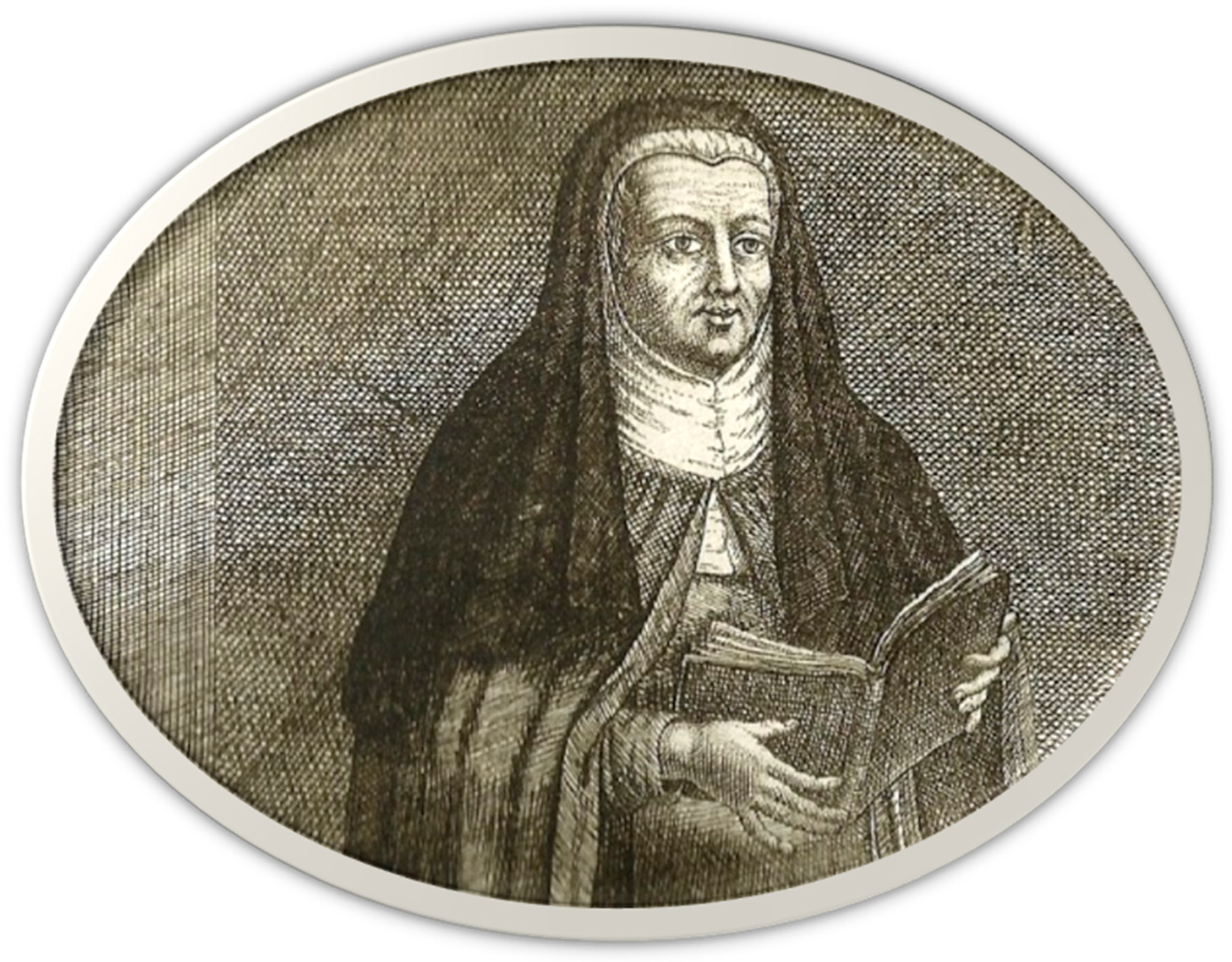
Sóror Isabel do Menino Jesus (
Figure 1) lived a worldly life until the age of twenty-five years and six months, as she herself states, occupied with numerous domestic tasks and family responsibilities, as already noted. At that time, in 1698, she began, as we have seen, to practise the ascetic life, although not without difficulties and with periods of relapse.
In 1704, during the surrender of Marvão to Castilian troops, within the context of the War of the Spanish Succession (1702–1714), the family moved to Portalegre, “with considerable discomforts, the greater part of which fell upon me” (8). They remained in that city for three years.
It was then that Isabel’s mother changed her opinion regarding her youngest daughter’s religious vocation. Consequently, on 27 February 1707, when she was already thirty-four years old, Isabel was voted into the Convent of Estrela in Portalegre, of the Order of Saint Clare, with almost unanimous approval, in the presence of the guardian of the Convent of Saint Francis of Portalegre, Friar Francisco de Santa Bárbara.
Her parents “arranged my situation with great sorrow of heart, and once accounts were settled, I entered religious life” (8). On 2 April of the same year, the Franciscan entered the novitiate, professing one year later, on 14 April 1708, with all votes in her favour. “I received the holy habit with great joy, as one who comes to heaven not to rest but to suffer all the austerity of religion” (8).
The convent followed the Rule of Saint Clare, approved by Pope Urban IV on 18 October 1263; however, there was considerable laxity in its observance, as was likewise evident in the Constitutions, according to the records of the visitation acts. Absences from prayer were frequent, silence during the Divine Office was not maintained, and unjustified dispensations were requested in order not to sing in the choir. Secular clothing was worn, with low necklines, false hairpieces, jewellery and high-heeled shoes, even by the lay sisters, to the point that they staged interludes dressed as men when the role required it.
Sóror Isabel do Menino Jesus, who by then had already acquired solid theoretical and practical knowledge of prayer, realised that her fellow religious knew nothing about it, and even less about mental prayer. Her attempts to remedy this situation were not well received by the community, not even when she served as novice teacher, which made her the target of attacks, insults and defamations—something she endured with great patience. “The community was extremely backward in mental prayer, and as I had been formed in it for ten years I would not retreat, for I was certain that if virtue did not go forward, it would go backwards; great defamation arose against me, with absences and severe persecutions […] there was no person in the entire community from whom I did not receive offences” (8).
From 9 August 1712 onwards, one of the most dramatic periods in Isabel’s life began, when she was accused and severely punished for a seemingly serious fault which she had not committed. In her first vision of the wound of Christ, it was revealed to her that she would be imprisoned, as in fact occurred: in stocks, in chains, isolated, and unable to write. She remained incarcerated for six months, between 26 October 1712 and April 1713, stripped of habit and veil. She was removed from the position of novice teacher and deprived of legitimate acts, rendered ineligible for the position of abbess or any other position, and denied an active vote in elections or in the admission of novices.
It is worth noting the brevity of the author’s references to these events, diminishing their importance and viewing the situation with charity and mercy, from a higher perspective than the merely worldly one: “even if they offended me, whenever I had the opportunity to serve those who wished something from me, I was always ready” (8).
Everything began with the visit of a delegate of the Order, to whom one of the religious sisters “spoke of what she felt about me” (13). The sixty nuns who lived in the convent at that time agreed with the punishment, claiming that “what I deserved for my faults was to be imprisoned, and that if I did not amend myself, it would happen a second time” (13).
What were these faults? Very likely, as
Fernandes (
2016, pp. 154–1158) suggests, the punishment was related to the frequent male visits Sóror Isabel received, especially from secular men, to whom she offered gifts and money to gain their trust and later speak to their consciences. She herself was astonished by such an unusual practice: “A reckless challenge, for a woman of little judgement to consider herself trusted in giving money to men and catechising them with favours and attention; it seems more a disgrace to virtue than gilded virtue” (21). Indeed, this situation was highly unusual, especially considering that the religious sister had duly professed the vow of poverty. How ever, it must be noted that Isabel was responsible for the managing family assets and caring for her nephews, which allowed her to handle certain financial resources outside conventional channels.
She did this exclusively out of love and by divine command, in a mission that always occupied a central place in her life, whose purpose was to “fish for souls”, because “I learned to shed the blood of my veins and the money from my purse for the redemption of souls” (20). She spent her own financial resources, relying on her parents’ support or resorting to loans: “for I clearly saw that I had nothing with which to repay the money I borrowed in order to give to these souls, and I lacked even what was necessary for my own needs, such as clothing, for I could not go naked since I was a nun” (22). Ultimately, the money was not spent for their own benefit, as we have just seen, but rather invested in the salvations of souls.
This behaviour must have caused scandal within the community, given the unusual nature of her actions, and it is entirely possible that one of the sisters took advantage of the visitor’s presence to report the situation. For Sóror Isabel, however, this was not easy, because “I was not ignorant of the dangers involved, and I wished to escape these encounters and complained to the Lord” (2)1. After her imprisonment, the Franciscan remained eight years without “buying souls”.
Later, the informant was discovered. When she fell gravely ill, it was Isabel who cared for her with charity.
The Franciscan nun usually prayed between 8 p.m. and 11 p.m., after which she would write. From 1736 onwards, she prayed almost continuously, sometimes throughout the entire night. As a result of sleep deprivation and prolonged fasting, she became increasingly weakened until she fell ill. She took upon herself the faults of the other nuns and interceded tirelessly for sinners to save their souls, so much so that secular visitors also came to the convent seeking her help.
She likewise devoted herself to the suffrage of the souls of the departed, as well as to the conversion of the living, especially priests, as previously noted. Illnesses were frequent and often simultaneous, such as severe colic or attacks of gout. The latter caused such swelling in her feet that she was forced to walk barefoot on wooden clogs, even in winter.
Regarding the positions she held, in addition to being Novice teacher, Sóror Isabel do Menino Jesus also served as portress, during which time she experienced the vision of the keys, which we will address later. She also became abbess, although only very late in life, after four unsuccessful attempts in which she received only a single vote
2.
Finally, on 5 June 1744, she was elected abbess with 34 votes, at the age of 71, succeeding Sóror Josefa Luísa da Anunciada (1742–1744). She governed for only one triennium (1744–1747), with one of her nieces, Sóror Isabel de São José, serving as her vicaress
3.
It was a difficult mandate, not without concerns, complications, and defamations; nevertheless, the Franciscan succeeded in improving the condition of the convent, particularly in the regularity of daily life and in the practice of mental prayer. She successfully introduced several reforms, maintained verbal chastity, and positively influenced the other nuns. Duque Fernandes names some of Isabel’s disciples: her nieces Isabel de São José and Brites Maria dos Serafins; Isabel, Catarina Sanches, Maria da Conceição, Ana de São Agostinho, and Ana de São Francisco (
Fernandes 2016, p. 289).
Sóror Isabel do Menino Jesus died on 5 October 1752, at the age of 79, with 44 years of profession, while serving as Mistress of the Order. During the last six months of her bedridden condition, she experienced two particularly intense ecstasies, one of which involved levitation.
4. Supernatural Experiences
In 1713, “the Lord began to grant me favours”, (9) following the dramatic experience of imprisonment. She began to experience locutions and visions of Christ, of Our Lady, of the Apostles Saint Peter and Saint Paul, as well as of Saint Francis, Saint Dominic, and Saint Rose of Viterbo. These visions were intellectual in nature, because “I did not see them with the eyes of the body, but I felt their presence” (9).
This type of experience implied an understanding, on the part of the mystic, of the meaning of what was seen. Such interpretation was to a certain extent conditioned by her spiritual state and by the personal and earthly circumstances surrounding her at that moment. At the end of this brief chapter, Sóror Isabel do Menino Jesus reveals a clear awareness of what her spiritual path would be: “since the path by which God led me was not to stop at the love of servants, but to seek the end of love, which is God Himself, the same Lord disposed me through continual prayer, which were the effects left by these visits, until the soul came to rest in its centre” (9).
It should be noted that the Franciscan frequently writes Soul with a capital letter and without the definite article, thereby giving it the character of a proper name rather than a common noun, and thus personifying the soul in an allegorical sense, as was customary among mystics.
It was also during this period that she experienced her first ecstasy, “while on one occasion in prayer” (10), at which time she heard words saying: “Bride, open the doors of your heart to me” (10). As was typical in such experiences, Isabel fell outside herself, losing awareness of reality and bodily sensation, with great rigidity akin to catalepsy. This was the so-called alienatio mentis, which included strong emotional agitation, followed by the raptus, in which the ecstatic self gives way to God.
The experience appears to have been prolonged, because “for a long time I knew nothing of myself, and regaining some awareness I understood that my soul was being transformed in God, hearing these words: I wish you to rest with me in Heaven, and placing me at His table He gave me to eat the bread of the Sacrament” (10).
On another occasion, while praying during the night, as was her custom, “such divine love grew in my soul that it caused me to be suspended; it is known that suspension is the inability to use the senses and faculties” (12). The Franciscan nun saw a choir of virgins, in which there was “a supreme tribunal of great majesty”, (12) presided over by the Virgin Mary.
Then Saint Clare appeared, binding her with a chain; afterwards Saint Teresa of Jesus appeared, who also bound her with another chain. Finally, the Virgin bound her with a third chain, “telling me that with these three chains you will overcome the three enemies of the soul” (12). After the ecstasy, Isabel remained for a long time with her eyes raised to heaven, in a clearly revelatory experience, in which she became convinced of the manner in which she was to combat these three adversaries: “the world with patience, the devil with humility, and the flesh with penance” (12). She further adds, regarding this last point, that “from this there now arises some progress in my life”, (12) a highly significant observation. Symbolically, this vision functioned as a favourable sign, a gesture of maternal approval on the part of the Virgin, and fraternal approval from the two saints, serving as an encouragement to continue the ascetic path and a confirmation of its authenticity.
In one of her intellectual visions, the Lord was represented to her “on the seashore fishing for souls” (15), in the sea of the world. The first to be caught were those of priests, many of whom were unworthy of divine love. At that moment, the Franciscan’s spirit was again seized in ecstasy, “and a naked sword was shown to me”, (15) which represented divine justice, with which priests were struck and condemned to hell. Only she, Isabel, could put an end to these executions through penance and prayer.
Accordingly, the Franciscan immediately sought to follow the divine instructions and “I seized the sword, because it bore a cross, and it remained sheathed within my heart” (15). At this point, Isabel becomes aware of, and laments, her smallness in undertaking such a mission, “with the little my spirit was capable of […] because I was not endowed with virtues” (15).
Despite everything, she never lost determination. The concern for fallen clerics and priests is recurrent throughout Isabel’s biographical writings, in which she refers to the salvation of their souls as “fishing”. According to
Fernandes (
2016, p. 289), the Franciscan’s work, at least in its published form, appears to be particularly oriented towards the condemnation of the sins of priests and religious figures, though also of laypeople, as well as towards the salvation of all their souls.
In this sense, Isabel’s confessors, whose names are never revealed, appear to have guided her writings and selectively chosen certain passages, placing them within the context of the mystic’s life and experiences in Marvão, in order to use them as exemplary models while simultaneously legitimising her mission through the mystical qualities of a Franciscan nun who thus acts as an intermediary and mediator with divine power.
The supernatural experiences of Sóror Isabel do Menino Jesus were numerous throughout her life in cloistered reclusion. Since the aim of this work is not to provide an exhaustive analysis of each and every one of them, we have chosen to refer only to the most symbolic and representative, especially those containing material capable of contributing to the assessment of the degree and intensity of mystical expression in the writings of this Portuguese religious woman.
In this sense, her visit to Hell and its description deserve particular attention, once again being associated with priests in a state of sin. The nun entered Hell “passing through great fears and jolts”, in what she called the “infernal dungeon” (16). In the deepest place were the priests, surrounded by great furnaces of active fire, where “the demons were roasting much flesh in pieces”. At that moment it was revealed to her that these were “the priests who in the world had burned themselves in the vice of lust” (16).
In another ecstasy, Isabel was again taken to Hell. This time, the demons opened graves to bury those sinful priests. Only penance would close the tombs, to which the Franciscan responded “that the “Ecclesiastical Fellows” might live eternally and I would remain buried in Hell […] and the Lord accepted […] saying that only the thought would remain buried while I lived in this world, and that at death I would be released from such a place” (17).
In paragraph 38 we find a more detailed description of Hell, where she acknowledges the difficulty of attempting to describe such a sinister and repugnant place, for which there is no comparison. The walls “are made of feet or like black mountains covered in filth”, with steep cliffs, an extremely dark place, with nests of rats and other aberrant creatures lodged in holes. There are enormous spider webs, locks impossible to open, and chimneys with constant smoke—“a perpetual and dreadful prison”.
Beyond the terror these images provoked, Isabel felt a profound “compassion for the souls who were there”. The demonic figures were diverse, all deformed: some dragged themselves, broken, others had human form—“ugly, scabbed, twisted, and black men”. After these hideous visions, the Franciscan decided to intensify her prayer even further, making it almost constant, as well as her acts of humility, “which for them was the greatest punishment she could give, stripping them of their weapons and striking them on the head with them”.
Finally, we shall refer to the vision of the keys, which occurred in 1736, when Sóror Isabel do Menino Jesus was performing the duties of portress. The event unfolded in episodes over three consecutive nights.
On the first night, the nun went to bed earlier than usual, around ten o’clock, because she “was very full of ailments” (34). The Lord rebuked her, compelling her to remain in prayer until midnight, “so that you may have the merit of being at midnight in prayer, giving glory to the Father, the Son, and the Holy Spirit” (34). The Lord further asked her, should she fail to remain in prayer, “to whom shall I entrust the keys of my love?” (34).
On the second night, the Franciscan again went to bed early, “for I could not endure more due to the great weakness in which I found myself”, (35) after which she once again heard the voice of the Lord lamenting that He still had no one to whom He could entrust the keys of His love. At that moment, Isabel clearly perceived “with spiritual and bodily understanding, as if He were almost represented to me in His Most Holy humanity, because the veil became so thin that He could almost be known”; at that instant, she “could not doubt what was taking place between God and me, and I held an ever-lower opinion of myself” (35).
Finally, on the third night, the Lord delivered the keys to her, “and, placing them upon my neck, He said: upon your neck I place My keys so that no form of vanity may rise to your head” (36). After these three nights, Isabel prayed with even greater intensity, if that were possible, as she had been warned that “just as a fish dies immediately out of water, so you too, if you are not in prayer, prepare yourself to die” (36).
Despite everything, the Franciscan managed to reconcile all her duties as best she could, although “the weight of the cross was so great, due to the many cares and labours” (36). To this were added the constant attacks of the devil, “who seemed to have placed his artillery everywhere I went” (36). After this outline of the most important moments in the life of Sóror Isabel do Menino Jesus, as well as some of the mystical experiences she underwent during her religious life in the Convent of Estrela in Portalegre, we shall proceed to apply the comparative method in order to identify the parallels between this Portuguese nun and Saint Teresa of Ávila.
5. Teresian Parallels
Teresa de Cepeda y Ahumada was born in 1515 in the walled city of Ávila, in arid Castile. Her paternal family was of recognised converso origin: her grandfather, Juan Sánchez, was a well-known merchant from Toledo who was reconciled with the Holy Office in an auto-da-fé in 1485, after which he moved to Ávila, where he continued to prosper and raise his eight children. The eldest son, Alonso Sánchez de Cepeda, was the father of Teresa.
At that time, Ávila had a significant Mudéjar presence and was the repository of a medieval tradition imbued with Kabbalistic and Sufi influences, with concealed Semitic spiritualities (
Villanueva 2014, pp. 35–36). It was in this environment that Teresa grew up, within a socially and economically well-established family that possessed enslaved servants, probably unbaptised, according to the same author. This contrasts with the account provided by the saint herself in the first chapter of her
Libro de la Vida, where she praises her father’s virtues: “It was never possible to persuade him to keep slaves, because he had great compassion for them.”
The future Doctor of the Church, daughter of Don Alonso’s second marriage, grew up in a large family of “three sisters and nine brothers”, and spent her time avidly reading books of chivalry and building hermitages with her brother Rodrigo. As a woman, she did not receive formal academic education; as is well known, her entire intellectual formation was acquired in a self-taught manner.
This biographical background provides an essential point of comparison with the life of Sóror Isabel do Menino Jesus, particularly regarding their shared experience of lay spiritual formation, limited formal instruction, and early immersion in devotional reading practices that would later shape their mystical trajectories.
Isabel Fernandes was born 158 years later, in a similarly walled village on the border with Castile, crowned by a medieval castle: Marvão, approximately 58 leagues from Ávila (351 km). As previously noted, there are indications of a possible
converso origin, although without sufficient consistency to confirm or rule it out definitively. Regarding the presence of the Jewish population in this Portuguese region, it was mainly concentrated in Castelo de Vide and Portalegre, where a Jewish quarter emerged in the first half of the fifteenth century, composed of 38 families, mostly originating from Castile (
Tavares 1982, p. 17).
Isabel also grew up in a well-to-do family, with servants to perform domestic tasks, as well as various employees to manage the family’s properties. She had only two sisters, both older, and unlike Teresa, she received some formal education, albeit for a short period. Here lies the first divergence from the Saint of Ávila.
Teresa, by contrast, always had fragile health, and illness was a constant feature of her life, so that she would sometimes spend long periods in convalescence. During one such period of recovery, her uncle, Don Pedro Sánchez de Cepeda, gave her the book that would mark a before and after in the spiritual and religious life of the Foundress: The Tercer Abecedario by Francisco de Osuna (1492 or 1477–1540).
Sóror Isabel do Menino Jesus also received a decisive and illuminating book, although she never specifies in her writings which work it was. We only know that it “was written in parable form”. Both the Carmelite and the Franciscan, who consistently cultivated a taste for reading, adopted these providentially received works as their masters. Both mystics embarked upon the ascetic path with a difficult and uncertain beginning, marked by hesitation and alternating progress and regression, in a constant struggle against worldly temptations in search of spiritual transcendence. Both also experienced considerable difficulty in learning the correct mode of prayer.
Teresa lamented not finding anyone to teach her, to the extent that she took refuge in books, “which were like company or a shield”, and she never began prayer without them. “And many times, upon opening the book, nothing more was needed” (
Vida, 9) (
Teresa de Jesús 1986). She suffered from not finding learned men capable of understanding her experiences and clarifying her doubts, lamenting the presence of “half-learned” individuals, lacking sufficient knowledge and competence to provide her with spiritual guidance.
In turn, Isabel struggled with the correct form of prayer, initially unaware of what interior recollection was, until she encountered a Franciscan priest who provided her with proper guidance. Unfortunately, is has not yet been possible to ascertain the identity of this religious figure. From that moment onwards, she began to pray with greater frequency and regularity, although not without difficulties of adaptation. Unlike Teresa, Isabel also had to care for her nieces and nephews, which left her only the night hours for prayer—a habit she would maintain throughout her life.
Both mystics experienced a calling to religious life relatively early; however, the realisation of the cloistered life and the consolidation of their ascetic paths occurred only later, especially in the case of the Portuguese nun. Both also experienced disappointment in their first contact with convent life, due to the chaotic and undisciplined environment of the respective convents they entered, marked by frequent failures in the observance of the Rule. For the Carmelite, this became a catalyst that initiated her reforming and founding mission. For her part, the Franciscan limited herself to introducing successive improvements in the Convent of Estrela, where she professed, which culminated during the triennium of her abbacy.
Beyond temporal and geographical distance, there is also a considerable difference in temperament and character between these two women, which, while not entirely antagonistic, reveals significant disparities, partly due to the span of more than a century and a half separating them, with the consequent and inevitable historical, socio-cultural, and religious changes which, nevertheless, altered very little the status of women in society.
On the one hand, we have Teresa, a Castilian woman raised in the interior of the Iberian Peninsula, in a walled city that at the time exhibited a strong Orientalising atmosphere, influenced by Arab and Jewish traditions interwoven—albeit discreetly—with Christian heritage. On the other hand, Isabel, a Portuguese woman from the interior, who nevertheless also absorbed influences from the Atlantic culture of the Lusitanian spirit, Messianism, and Sebastianism. Consequently, a clear difference in habitat is observed here, which cannot be disregarded (
Silva 1983, p. 57).
Humanly speaking, the Castilian nun possessed a dynamic, optimistic, cheerful, spontaneous, and at times somewhat ingenuous personality. An indefatigable “wanderer”, she reformed the Carmelite Order, travelled tirelessly to found convents despite her constant ailments, and still found time to write, bringing her work to the summit of Spanish literature of the Siglo de Oro. A restless personality, she finds a fitting counterpart in the biblical Martha. Her writing reflects this character perfectly: it is agile, spontaneous, rich in comparisons and allegories, not without a sense of humour and marked by subtle irony.
She writes for her fellow religious women to guide and encourage them in the practice of virtue, which she also does through personal example. She writes as if speaking, in a markedly colloquial tone, at times approaching the sermon—a genre she greatly appreciated—with expressions such as “¡Hermanas!” and “¡Mirad, hijas!”, to cite only a few examples. It is common for her to repeat a concept in various forms, using successive comparisons to ensure clarity both for herself and for the reader. Sóror Isabel do Menino Jesus also employs this same technique. In the Carmelite’s texts there is a strong exhortative component, especially when advising or addressing key themes such as prayer, humility, and self-knowledge. Teresa is also a mystagogue, because she teaches through example, based on her own experience (
Álvarez 2006, pp. 16, 27).
In turn, Sóror Isabel do Menino Jesus displays a more sober and serious personality, with a “grave and solemn manner”, as she herself describes it, and an early maturity acquired through the force of circumstances when she had to care for her nieces and nephews, which also contributed to developing the maternal and protective sense she exercised throughout her life, both in the family and conventual contexts. Although responsible and measured, she also had a cheerful and lively spirit, was diligent, and always ready to help those in need.
It is, however, in her writing that she differs most significantly from the Teresian style, with a discourse that reflects the restraint. It is clear and concise, well organised into coherent sequences, revealing prior reflection on the subject addressed, as we shall see later. Humour and irony are scarce and very subtle, as is allegory, with a preference for the use of comparison, often employed consecutively to reinforce and clarify the intended message.
She has a clear awareness of the intended readers of her writings; thus, she is clear and succinct, but also cautious, limiting herself to transmitting only what is requested of her, focusing on essential points because, like Teresa, she wrote under obedience to her superiors. Depending on the subject, she sometimes adopts a style close to a report, especially in autobiographical passages or when narrating some of her supernatural experiences.
In contrast, in texts dealing with her spiritual progress, her style reveals a strong pedagogical dimension, grounded in the empirical nature of what is narrated, because, like Teresa, everything she sets out arises from lived experience. Within the religious and spiritual context, Isabel’s attitude corresponds to that of the biblical Mary, more centred on interior life, recollection, and inward care, where her principal work was the “fishing” of souls, especially those of priests.
For both mystics, prayer was the central axis of their ascetic journey, as were the various mechanisms aimed at the annihilation of the will, namely penances and disciplines, which were considerably more rigorous in the case of the Franciscan nun. Both she and the Carmelite experienced numerous supernatural events, whose culminating points were transverberation in the case of the former, and various ecstasies involving levitation in the case of the latter.
Beyond biographical and strictly ascetic–mystical aspects, both Sóror Isabel do Menino Jesus and the Saint of Ávila also shared indignation towards the irregular and inappropriate behaviour of members of the clergy, more specifically the “Ecclesiastical Fellows”. The Founding Mother also criticised poorly educated scholars, but always did so from a certain distance, indirectly, using irony and humour as a mitigating element. In this she differs from the Franciscan nun, who criticises them more directly and almost relentlessly, albeit also with subtle irony and a discreet sense of humour.
In paragraphs 123 to 127, she addresses the “learned Doctors” apologising for her lack of formal learning and for the involuntary errors that her ignorance may have caused, concluding with the following words: “In recompense for granting me absolution [for these possible errors], I place in their hands two more sheets of paper, which, being flowered paper, may smell pleasantly to the Lord Priests.” She then proceeds, addressing a Lord Priest as representative of many others, to enumerate a succession of flowers and plants, relating the properties of each to the virtues and good practices she considers essential for the proper exercise of the priesthood.
Always with an exhortative character, at times in a reproving and critical tone and at others with a maternal attitude of counsel, the Franciscan begins with the sunflower, which follows the sun wherever it goes, just as the “Ecclesiastical Fellows” must follow the light of God. This is followed by the daisy, as a symbol of pure and untainted love; the lily flower, symbolising penance, without which chastity cannot be preserved. She continues with the angélica, a flower with narrow leaves whose scent becomes stronger “the more the Lord Priest restrains his senses through mortification”; the espadana, (bulrush) with sword-like leaves and a white root, symbolising purity of affections; a wild plant, the carqueja, so curled that it does not admit cutting, just as chastity “cannot be cut through so many entanglements unless one has divine love, capable of cutting through so many thoughts, words, and deeds”. She also refers to the cypress, which draws its strength from its roots and thus remains almost immovable during storms.
This succession of comparisons establishes a parallel here with one of the most well-known sermons of Father António Vieira (1608–1697), the Sermon of Saint Anthony to the Fish [O Sermão de Santo António aos Peixes], in which the Jesuit employs a similar device, comparing various social stereotypes of the time with the positive and negative characteristics of different fish. Considering that the first edition was published in 1682, it is highly likely that Isabel had read it.
Finally, the Franciscan concludes these paragraphs with various counsels and warnings regarding human weakness, which makes man his own greatest enemy. She continues by persistently criticising priest incapable of maintaining the vow of chastity: “now I ask the Lord Priest to strive greatly in this virtue and to recognise that those who are obliged to preserve chastity are precisely those who must guard their eyes most carefully.”
As we can see, the parallels between these two mystics are significant, despite the differences in their milieu and the temporal and geographical distance that separates them. In what follows, we shall examine to what extent, if any, these convergences are reflected in the mystical expression of Sóror Isabel do Menino Jesus. Was she a continuator of Teresian mysticism? For our analysis, we shall use only the biographical texts (paragraphs 1–51) as reference, and those revealing ascetic–mystical content (paragraphs 87–127), as they present the greatest number of comparable indicators.
6. The Printed Work
The writings of Sóror Isabel do Menino Jesus were composed in obedience to three of her spiritual directors, among whom was Friar Martinho de São José, the organiser of the texts and one of the promoters of the volume published in 1757. As previously noted, the Franciscan nun wrote at midnight, after her hours of prayer, as she herself reveals in paragraph 33: “If it was necessary to attend to certain occupations, such as writing, I would write at midnight as though it were midday; thus, after eleven consecutive years devoted to this practice, sleep was so disrupted that I did not sleep for even two hours.” If she indeed maintained this routine for eleven years, her written production must have been far greater than that which was ultimately published. What, then, became of the remainder? Several hypotheses may be advanced. On the one hand, the religious may have destroyed part of her writings, either on her own initiative or at the instruction of her superiors. On the other hand, and more plausibly, the writings were subjected to a process of evaluation and selection by her superiors with a view to future publication, as in fact occurred. This process required Isabel to prepare fair copies of the selected texts to adapt the result to the standards of reading and scrutiny to which they would later be subjected. At the same time, before public circulation could be authorised, it was necessary to discern whether the experiences described were of divine or demonic origin. An interpersonal relationship was thus established between the writer and her superiors, one that was not devoid of subjective purposes and motivations of various kinds. Although the guidance of the prelates did not constitute an argument from authority, nor obedience a renunciation of free will, it should not be forgotten that the writer’s subordination to her superior corresponded simultaneously to the superior’s own obedience to the inquisitor (
Jacquinet 2013, pp. 75–76). At a certain point, Isabel was forbidden to write, to prevent her texts from circulating within the convent, or even beyond it, without prior examination of their content. This fact also indicates the interest and curiosity shown by the nuns of the convent in reading the writings of their fellow religious. For this reason, the Franciscan kept her papers in a locked box, the key to which she always wore around her neck.
Isabel was one of fourteen Portuguese Franciscan nuns in the Early Modern Age, whose biography was published. The project was realised through the efforts of Friar Martinho, but also through those of the writer’s niece, Sóror Isabel de São José, during her abbacy, a position she assumed after her aunt’s death. The autograph manuscript was organised into a single volume, with consecutive numbering of the paragraphs, and in close collaboration with the writer herself, who prepared a fair copy in the form in which it is known today. The final text was sent to press without further alterations, accompanied by an endorsement by Friar Jerónimo de Belém (1692–?), a distinguished Franciscan writer and chronicler of the Province. It was printed posthumously in Lisbon, in quarto format, in the printing house of José da Costa Coimbra, with all the requisite licences, under the title
Vida da Serva de Deos Sóror Isabel do Menino Jesus Abadessa, que foi do Mosteiro de Santa Clara de Portalegre. Escripta pela mesma venerável religiosa, de mandado de seus Padres espirituais, com outros Tratados Mysticos: prática para o interior das Religiosas do mesmo Mosteiro, em que se encontraõ as muitas mercês, que Deus lhe fez, em ordem á salvaçaõ das almas, com algumas cartas espirituaes. Disposta pelo M. R. Padre Fr. Martinho de S. Joze, pregador jubilado, e provincial da mesma Provincia dos Algarves que também foi confessor e dada a luz pelo padre João Evangelista da Cruz, e Costa, Bacharel formado nos Sagrados Cânones. The writings were published in the following order according to their content: autobiographical writings (paragraphs 1–51),
Letter to the Abbess and the Nuns (52–85),
Supplication to the Provincial Minister (86), ascetic-mystical writings (87–127), twenty letters to a religious man, and fifteen letters to a religious woman
4. According to
Fernandes (
2016, pp. 289–92), this organisation of the texts is not chronological, but rather follows other criteria. If one considers the period in which they were written, the chronological order would be as follows: twenty letters to a religious man, fifteen letters to a religious woman, texts of ascetic-mystical content (which the researcher subtitles “mystical treatise”), the
Supplication to the Provincial Minister, autobiographical texts (which Duque Fernandes subtitles “Life”), and the
Letter to the Abbess and the Nuns.
In what follows, we shall analyse the writings of ascetic-mystical content, identifying all those elements that configure the mystical expression of Sóror Isabel do Menino Jesus. We shall determine the degree of proximity they establish, or fail to establish, with Teresian mysticism, and we shall examine the extent to which the specific characteristics of Lusitanian culture are manifested in the mystical experience and discourse of this Franciscan nun.
7. Mystical Expression
The writings of ascetic-mystical content by Sóror Isabel do Menino Jesus fall within the category of the compendium, insofar as they synthesise, in forty paragraphs (87–127), the essential aspects that determine “the paths through which the soul may attain union with God” (87). The text is expository and descriptive in nature, constructed upon an empirical foundation derived from the religious woman’s personal experience, and intended “to say what I know, not as one who teaches, but as one who learns” (87). The sequence of the discourse follows the three stages of the spiritual life—purgative, illuminative, and unitive—as proposed, among others, by Saint Thomas Aquinas, whose antecedents date back to the fifth and sixth centuries and were formulated in embryonic form by Pseudo-Dionysius the Areopagite. These constitute the origins of Christian mysticism, whose subsequent development gave rise to various transformations over time, eventually culminating in distinctive individual variants, such as the seven Mansions [Moradas] of Saint Teresa of Ávila or the ten degrees of the Ladder of Divine Love [Escala Amorosa] by Saint John of the Cross.
The Franciscan nun writes to learn; in this sense, as she describes the ascetic journey, she is simultaneously confirming that learning for herself while also teaching through what has been learned. Her writings thus acquire a pedagogical character which, beyond their descriptive and report-like tone, includes admonitions—at times approaching the sermonic style—as well as the gradual recognition of her own progress along the spiritual path. She provides information regarding the benefits obtained through various ascetic practices, such as prayer and penitential exercises, while also warning of the potential dangers encountered along the journey and explaining how to combat them to avoid the risk of relapse. To render her exposition and descriptions clearer, Isabel employs certain allegories, numerous comparisons, and many illustrative examples drawn either from her own experience, from the teachings of learned authorities, or from her readings. In the latter case, these readings appear to have followed a progressive order, corresponding to the religious woman’s own advancement along the path of the three ascetic stages. References to Sacred Scripture are abundant throughout the compendium, with a particular preference for the Old Testament. Other authors, such as Thomas Kempis, Francisco de Osuna, and Saint John of the Cross, are likewise evident throughout the Franciscan’s writings. However, the most notable influence is that of Saint Teresa of Ávila, which becomes palpable from the outset and without great effort. Self-knowledge, the practice of virtue, prayer, humility, good works, and love of one’s enemy constitute the essential elements of Teresian pedagogy, which Isabel filters through her own experience, thereby confirming, even in the late eighteenth century, the validity and efficacy of the Teresian model in achieving the ultimate goal of the ascetic journey: the complete union of the soul with its Creator.
Although she composed her work during the first half of the eighteenth century, Isabel continued to employ the feminine rhetorical conventions characteristic of earlier centuries, downplaying her abilities and knowledge in the firm conviction that the successful exposition of the subjects addressed was due not to her own talent, but rather to divine intervention. Nevertheless, the invocation of intellectual incapacity and the fragility of her feminine condition is neither expressed with the same intensity and irony found in Saint Teresa of Ávila, nor with the same reivindicative tone present in Teresa de Cartagena, to cite only a few examples. “Because I lack learning” and “My lack of letters leaves me in doubt, yet I shall proceed with my purpose” are among the observations made by the Franciscan throughout the text. Considering her austere and discreet character, as well as the fact that she had received a certain degree of academic instruction during her youth, the use of such expressions is not always merely a rhetorical device, but rather an honest acknowledgement of the difficulty involved in writing coherently and substantively about a subject that is apparently intangible and largely supernatural in nature. The problem, therefore, lies not so much in a “lack of letters” as in the challenge of attempting to explain the inexplicable. Moreover, it must also be taken into account that Isabel had the opportunity to prepare fair copies of her writings before they were published, a circumstance that contributed to the homogeneous and well-structured sequence of exposition, with thematic resumptions in some cases and more synthetic recapitulations in others, all in the interest of clarity and rigour in the explanation of concepts.
Paragraph 87 has an introductory character and concludes with the following statement: “The understanding of the love of God is an art which not all possess, and if, with the permission of the learned mystical Doctors, they allow me to say what I understand, I shall begin with the three ways.” From the outset of the paragraphs devoted to the purgative way, the Franciscan already introduces the essential elements of her mystical expression, namely repentance, penitence of the senses, and perseverance in the cultivation of virtues to establish solid foundations. Among these virtues, chastity occupies a primordial place because it “deserves to be venerated for its strength, which is strong as lightning […] a powerful weapon against vice” (92). Humility, patience, obedience, and silence are likewise regarded as virtues of great importance in Sister Isabel’s mystical expression. Regarding the latter, the religious woman draws attention to the danger represented by excessive speech, “for if the tongue speaks more than is necessary, it brings much harm upon itself” (98). According to the Franciscan’s theory, the tongue possesses two properties: “it speaks either good or evil, and if it is accustomed to speaking little, it will come always to speak well” (106). Other important aspects include examinations of conscience and the fear of God, “because now [in the purgative way] one begins to observe the law of God” (89). Above all, however, “the greatest virtue that man must possess is to love God” (98). In this sense, each person must “build a wall of virtues and withdraw within the interior self, for there God awaits in order to speak to the heart” (98).
It should be noted that Sister Isabel never addresses her fellow nuns directly, as the Founding Mother had done. Her counsels and guidance are directed instead towards man, towards the human being in general. In this way, she transcends the strict limits of conventual enclosure, conferring upon her mystical experience a timeless and universal character that surpasses any form of restrictive limitation.
The two principal pillars upon which the mystical expression of this Franciscan religious rests are the Socratic principle of self-knowledge and the continuous practice of prayer. In the first case, “to establish virtue upon self-knowledge is the surest path, because therein man sees himself as he truly is” (96). The best means of attaining such self-knowledge is through humility, since its strength lies precisely in “creating the roots” of that self-knowledge (95) and eradicating vanity. Just as there can be no heart without love, there can likewise be no love without the cross. In this purgative way, the cross is made of bronze and “weighs one arroba [approximately fifteen kilograms], which is the burden that one who begins the path of virtue is capable of bearing” (96). Throughout Isabel’s writings, there is frequent use of terminology relating to weights, measures, and calculations, reminiscences of the knowledge she likely acquired during her youth, when assisting her parents in household management, or during the period of her brief academic instruction. Through this terminology applied to the cross, it acquires the status of a measure or indicator of the degree of effort required at each stage of the journey, which the Franciscan explains in the following simple yet eloquent terms: “The cross of this first way is both light and heavy: heavy for one unaccustomed to bearing any burden of mortification, and light because it does not yet carry great weight, for little suffers he who loves but little” (89).
She then proceeds to the illuminative way, in which the cross continues to weigh one arroba, although the bronze has now been transformed into silver. At this stage, the heart remains a stone and therefore requires two hours of daily prayer, without exception, so that such hardness may be reduced to dust. Prayer is the path through which the presence of God is encountered, since “the Lord always allows Himself to be found by those who seek Him” (98). One must meditate and persevere in mental prayer; otherwise, the soul will stray along other paths and remain lost, unable to encounter the friend who awaits it. Here, the Franciscan converges with the pedagogy of prayer-as-friendship so central to Teresian spirituality, which entails a progressive education of seeing, listening, and inwardly speaking with Christ. In the practice of recollection, the capacity for empathy with Christ’s sufferings is expanded and, simultaneously, the capacity for self-expression, because, ultimately, more important than the experience of prayer itself is the experience of Love. It is in this illuminative way that the roots must be uprooted “with strength of arm”, so that the soil may be thoroughly cleansed, “for, being so poorly cultivated, it bore neither flowers nor fruit” (97). The fruits gathered from the virtues at this stage are still bittersweet, because they are not yet generated through the love of God, but rather arise from self-interest. At this point along the path, the soul remains ill and must be purged through “spiritual medicine”. Good works are likewise indispensable for the growth of virtues, functioning as a form of fertiliser for the spiritual garden.
In a more practical dimension, beginning with paragraph 100, Isabel proposes the exercise of the three faculties of the soul. First, through meditation, it is necessary to erase from the memory all that is useless or superficial. Next, one must care for the understanding, because “it must be the pilot governing this ship, for it is to guide the other faculties”. Third comes the will, which must learn to delight in what is just. “It will be necessary to perform many acts until they become habitual, but human nature is so fragile that, when man believes he has emptied the faculties, he finds them once more filled with all that is useless; yet even so, he must not lose courage” (103). Another constant throughout the Franciscan’s ascetic writings is the use of encouraging and motivating language, for she is fully aware of the difficulties inherent in a journey of such magnitude, having herself experienced them and knowing well that the effort will be abundantly rewarded once the goal has been attained. From this point onwards, it is necessary “to take great care to continue advancing” (107), because the greatest difficulties have already been overcome and the path now becomes easier.
One thus arrives at the unitive way, where the cross is made of marble and weighs four
arrobas of gold. At this stage of the journey, the soul no longer walks, but flies. At this point, Isabel establishes a beautiful analogy between the sufferings endured in order to attain union with God and the feathers that gradually form the wings necessary for flight:
5 “love was born to suffer, and since in love all is suffering, these sufferings formed wings, and thus it shall be seen that they flew to the greatest height, which is union and transformation with God.” It remains of the utmost importance to persevere in prayer and humility, especially during the absences of the Beloved, because through them God wills “that the soul exercise itself in the spiritual penitence of the dark night” (110). According to the Franciscan’s experience, it is here that the first dark night begins, in which the sun is covered by clouds, although a ray of light may still be glimpsed, “bringing with it some love” (110). At this stage, the soul acquires more virtues. In the second night, it enters a very narrow path “through which neither skin nor bone may pass” (113), and undergoes a great purgation, yet acquires virtues upon virtues. “It possesses the virtue of giving light by which the soul may recognise its faults and immersed in humility, proceeds beneath faith in search of God” (113). This is a moment of hope in which one perceives that God has not withdrawn, but merely remains hidden, thereby evoking the concept of the hidden God in Isaiah (45:15). At this point, retreat is no longer possible, and the only option is to continue forward, in a struggle where everything is either gained or lost. “It enters the furnace in order to be refined, surrendering itself to be fashioned by the hands of the artisan” (114).
In the third night, the darkest of all, “God places the soul upon a path that inspires fear […] because it has lost sight of the sole object that it loved” (114). At this stage, the soul has already gathered many fruits, accumulated virtues upon virtues and prayer upon prayer, because it now knows that the love of God lies hidden within the heart “and will come in due time to ransom the captive who finds himself in captivity” (116). After these three nights of darkness, the soul enters a prayer of profound sleep, and “there enters within the soul so great a possession of the love of God that the soul becomes as though delirious” (117). This is the consummation of love through union in the substance of the soul, rendering separation impossible. The heart is inflamed in a fire of living flame, without smoke, and all vanity disappears, giving way to a permanent state of humility through self-knowledge. “I speak from experience, and if there are higher degrees, I do not know how to explain them” (117).
The proximity between Isabel’s mystical experience and the mystical expression found in Saint John of the Cross is truly remarkable, particularly in relation to the Ladder of Divine Love, according to which it is first necessary to obscure the faculties of the soul—memory, understanding, and will—emptying them in faith, hope, and love. In the dark night, only the transformed loving will remain, because it is annihilated within the divine will and, in this way, the soul ceases to belong to itself through an act of love. “Se hace un espíritu con él por un trocamiento de voluntades” (“It becomes one spirit with Him through an exchange of wills”), according to Francisco de Osuna. In this manner, Sister Isabel was capable of “engolfarse” (immersing herself) in the most secret and exalted splendours according to a ladder of love in which she appears to synthesise the ten degrees proposed by St. John into only three. Within the Franciscan’s scheme, the first four degrees would be traversed during the illuminative way, in which the soul becomes sick and seeks God without rest. It begins to perform works out of love for God and to suffer for the Beloved, patiently enduring all the trials and difficulties encountered along the path. The fifth, sixth, and seventh degrees are traversed during the unitive way, where the soul has already acquired wings with which to fly, although it may at times still fall again. The fervour becomes so intense and the longing so overwhelming that it produces raptures and ecstasies. Finally, the third dark night experienced by the Franciscan would correspond to the eighth, ninth, and tenth degrees of Saint John of the Cross’s ladder, in which the soul burns gently and culminates in total assimilation.
After this grand and sublime experience, Isabel quite aptly asks what this soul is to do from this point onwards. “Even having attained this state, it is necessary to remain ever vigilant, for there will always be unprofitable thoughts, spiritless words, and works devoid of merit” (123). For this reason, she does not hesitate to exhort a return to the three ways and to avoid any sense of security, since harmful roots may remain, and new temptations may arise at any moment. “The servants of God can never consider themselves secure while they live in the flesh” (118). In this state of union, the soul can no longer live without the guidance of divine love and begins to experience an intensified love for one’s neighbour, which is manifested in the practice of charity and compassion. Now, “this soul is enclosed within the castle where the love of God dwells” (122), and it possesses various qualities which Isabel enumerates, namely the ability to recognise the cunning of the devil, who remains in perpetual warfare against the soul. For this reason, it is necessary to remain ever ready, with hand raised and armed against him. It must remain almost continually in prayer; it comes to know many of God’s secrets; “to love one’s enemies by virtue of the privilege of divine love” (122); and, although now bearing a cross of great weight, it does not fall into as many faults as before. It remains in constant humility, “for these privileges and singularities are granted only to souls of humble heart.”
8. Conclusions
The Portuguese Franciscan Sóror Isabel do Menino Jesus was, in effect, a mystic. She chose the ascetic path in her youth, while still living in her family home. With some initial difficulties and full of doubts regarding the correct way to proceed, she managed to begin her path of prayer with the help of several books and the guidance received from her first confessor and spiritual director. Her ascetic progress began to gain consistency when she entered the Convent of Estrela in Portalegre; however, during the early years her life in the cloister was not easy, due, among other factors, to the envy and constant defamation to which she was subjected by her fellow religious, which culminated in a severe punishment and imprisonment for a fault she had not committed. Prayer was a constant in her life, almost equivalent to the act of breathing, and her primary mission was to “fish for souls”, especially those of priests and clerics, using money and certain material favours as bait to win over their consciences.
Unusually, during her youth she received a brief but intensive academic education, which fostered her taste for books, reading, and writing. At a certain point, her confessors urged her to set down her biography and spiritual experiences in writing, which she did in obedience. A few years after her death, a selection of these writings was published in a single volume, after having been examined by her confessors. It was a lengthy process in which the Franciscan even had time to produce fair copies of the texts. The publication of this work, which has endured through time, allows us today to know the life and work of this Portuguese mystic, long kept in obscurity.
Her biography and ascetic journey reveal numerous parallels with the life and doctrine of Saint Teresa of Ávila. A possible converso origin, a childhood spent in a walled city, a love of books, initial doubts, advances and setbacks in the early stages of their ascetic lives, and the hostilities they had to face during their first years in the cloister are some of the common points shared by these two religious women, despite the temporal and spatial distance separating them. Doctrinally, they also share essential elements, namely perseverance in prayer, the paramount importance of self-knowledge, the mission of saving souls, and above all the supernatural experiences they both underwent, such as visions, raptures, and ecstasies.
It was not the aim of this study to analyse intertextualities in the Franciscan’s work, nor to compile a list of the authors and works she may have read beyond the Sacred Scriptures. Nevertheless, it was possible to observe, almost at first glance and without great effort, the influence of the Carmelite tradition, particularly the Mansions, as well as the work of Saint John of the Cross and his Ladder of Divine Love.
The mystical expression of Sóror Isabel is condensed in her mystical compendium, which displays a markedly pedagogical, theoretical, and practical dimension. These texts make it possible to verify the assimilation she achieved of Carmelite mysticism, fusing it with her own lived experience and thereby giving it a personal stamp, more compact and entirely focused on the supreme goal of the journey: the total union of the soul with its Creator. Here lies the key distinction between the Franciscan and her predecessors.
Whereas the Saint of Ávila proposed a path of seven mansions and the St. John’s ladder of ten rungs, Sister Isabel condenses the ascent into three stages, corresponding to three successive and gradual dark nights, in which in the first it is still possible to glimpse a very faint ray of light, while the final night is one of total darkness. In the Franciscan’s conceptualisation, the always-ascending journey that begins with the initial calling and culminates in union is not a compartmentalised or strictly segmented process. It is indeed an ascending movement, but one marked by nuances that at times occur simultaneously and at other times in sequence, since it takes place within the immaterial, the ethereal, and the intangible. Only the first step and the final union are fixed and stable points. The ascent itself is chromatic, asymmetrical, and intercurrent, a kind of “degradé” that rises from the deepest chiaroscuro to total light, as though it were an effusion. This is the central axis of the mystical expression of Sóror Isabel do Menino Jesus, which grants her a distinct personality within the universe of mystics and renders her highly significant, both in the Portuguese and Iberian context.