Article

When Does Anti-Zionism Become Antisemitism? Evidence from Self-Identified American Christians

1
Metropolitan College, Boston University, Boston, MA 02115, USA
2
Department of Philosophy and Religion, University of North Carolina at Pembroke, Pembroke, MA 28372, USA
*
Author to whom correspondence should be addressed.
Religions 2026, 17(7), 829; https://doi.org/10.3390/rel17070829
Submission received: 29 May 2026 / Revised: 29 June 2026 / Accepted: 6 July 2026 / Published: 10 July 2026

Abstract

This article examines how anti-Zionist sentiment and antisemitism relate among self-identified American Christians, drawing on an original 2024 survey of roughly 2000 respondents. The survey included multiple antisemitic tropes and Israel-related statements measuring severe anti-Israel and anti-Zionist sentiment. Using generalized ordered logistic regression, we find a strong and escalating association between anti-Zionist sentiment and antisemitic trope endorsement across multiple levels of antisemitic intensity. Respondents who express stronger opposition to Israel are significantly more likely to affirm classical antisemitic stereotypes involving Jewish power, dual loyalty, or financial control. Supersessionist beliefs are likewise associated with greater antisemitic sentiment, with the relationship becoming especially pronounced at higher levels of antisemitism. In contrast, the traditional deicide belief does not emerge as a statistically significant correlate once broader theological and political attitudes are taken into account. Younger Christians, urban residents, and Southerners exhibit higher antisemitism, while education, age, and female gender are associated with lower levels. Taken together, the findings show that anti-Zionism and antisemitism are often empirically intertwined within contemporary American Christianity, particularly at more extreme levels. Because the data are cross-sectional, the results should be interpreted as associations rather than causal effects.

1. When Does Anti-Zionism Become Antisemitism? Evidence from Self-Identified American Christians

Is anti-Zionism a form of antisemitism? This question has divided scholars, policymakers, and religious leaders for decades (Rosenfeld 2019; Harrison 2020; Nelson 2019; Jacobs 2024). Scholars who describe hostility toward Israel as a form of “new antisemitism,” most prominently Robert Wistrich (2020), argue that opposition to Zionism often denies Jews the collective rights routinely afforded to other peoples. This concern is reflected in the International Holocaust Remembrance Alliance (IHRA) definition, which includes as antisemitic the act of “denying the Jewish people their right to self-determination, e.g., by claiming that the existence of a State of Israel is a racist endeavor” (IHRA 2016). From this perspective, rejecting Zionism can amount to denying Jews the same political rights afforded to other nations—a discriminatory stance rooted in anti-Jewish animus rather than principle. Critics, however, warn against treating anti-Zionism and antisemitism as synonymous (Jerusalem Declaration on Antisemitism 2021). Judith Butler, for example, rejects “the claim that any and all criticism of the State of Israel is effectively anti-Semitic” (Butler 2012, p. 1; see also Ury and Miron 2023). Opposition to Zionism, critics argue, can reflect broader objections to nationalism, colonialism, or specific Israeli government actions rather than hostility toward Jews as a people. Indeed, some Jewish groups identify as anti-Zionist, underscoring that the position can arise from moral or theological commitments rather than prejudice (JVP n.d.).
This study does not seek to engage in or resolve the definitional debates outlined above. We do not assume that criticism of Israel is inherently antisemitic, nor do we treat anti-Zionism, anti-Israel sentiment, and criticism of Israeli policy as identical categories. Rather, we examine whether severe negative attitudes toward Israel—including claims that move beyond discrete policy disagreement toward broader moral condemnation, delegitimization, or rejection of Israeli sovereignty—are empirically associated with endorsement of antisemitic tropes among self-identified American Christians.1
The question is particularly important for Christian communities, where both philosemitic and anti-Jewish theological currents have deep historical roots. Among self-identified American Christians, attitudes toward Jews and Israel often intertwine with doctrines about covenantal succession, biblical prophecy, and eschatology, as well as with partisan politics and contemporary social movements. These currents can generate admiration, attachment, indifference, criticism, or hostility, sometimes within the same religious communities (Hummel 2019; Ariel 2013). Understanding whether, and to what extent, anti-Zionist sentiment among Christians overlaps with antisemitic attitudes is therefore essential for assessing the theological, ideological, and demographic correlates of prejudice in this population.
In this article, we seek to empirically clarify how anti-Zionist sentiment and antisemitism relate to one another among self-identified American Christians, drawing on an original 2024 survey of roughly 2000 self-identified Christians. We define anti-Zionist sentiment as a severe delegitimizing orientation toward Israel, rather than a narrow philosophical rejection of Jewish self-determination. Our primary goal is to statistically assess the relative strength of multiple correlates and predictors associated with the endorsement of antisemitic views. Within this broader analysis, we pay particular attention to the relationship between anti-Zionism and antisemitism—examining how closely these attitudes align, where they diverge, and whether their association becomes stronger as respondents move from isolated stereotype endorsement to more intense antisemitic belief.
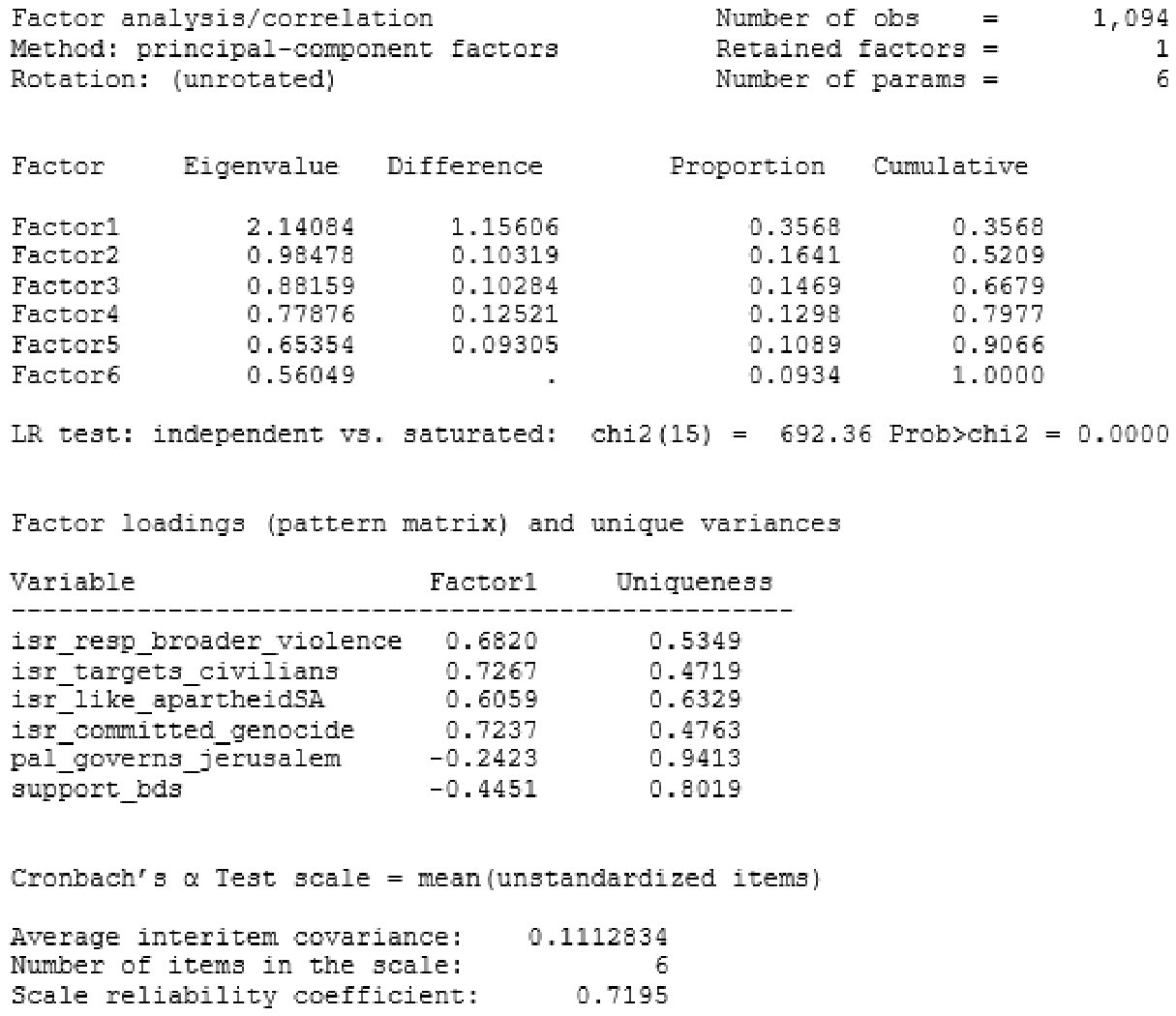
We conceptualize anti-Zionism in attitudinal terms, while recognizing that the boundary between anti-Zionism, anti-Israel sentiment, and legitimate criticism of Israeli policy is contested. Respondents were not asked whether they identified as anti-Zionist. Instead, they were presented with a set of statements concerning Israel’s moral standing, sovereignty claims, wartime conduct, and support for BDS. Some of these items—such as support for exclusive Palestinian sovereignty over Jerusalem or support for BDS—more directly capture delegitimizing or anti-Zionist attitudes. Others—such as claims that Israel deliberately targets Palestinian civilians or committed genocide in Gaza—may also reflect severe moral condemnation of Israeli conduct. Our claim is therefore not that endorsement of any single item necessarily proves principled rejection of Israel’s right to exist. Rather, factor analysis (reported in the Appendix B) indicates that these items cohere around a common latent dimension that can reasonably be understood as severe anti-Israel/anti-Zionist sentiment. We use the term anti-Zionist sentiment in this broader empirical sense: not as ordinary criticism of Israeli policy, but as a cluster of attitudes involving severe moral condemnation, delegitimization, and opposition to Israel’s sovereignty or legitimacy.
The article’s contribution is therefore not simply to ask whether anti-Zionism and antisemitism are correlated. Prior studies have examined that relationship in other populations and contexts (Hirsh 2018; Feldman 2018; Ury and Miron 2023). Our contribution is to examine how this relationship operates among self-identified American Christians, a population in which pro-Israel, philosemitic, supersessionist, anti-Jewish, and politically polarized currents may coexist. We ask whether severe anti-Israel/anti-Zionist sentiment remains associated with antisemitic trope endorsement after accounting for denomination, religiosity, supersessionism, deicide belief, political ideology, intergroup contact, region, age, education, race, ethnicity, gender, income, and concern about economic inequality. We also examine whether this association is constant across the antisemitism scale or becomes stronger as respondents move from isolated stereotype endorsement to more intense antisemitic beliefs.
Because our study focuses on Christian perspectives, we assess whether denominational identity—Catholic, evangelical, or mainline Protestant—affects these attitudes. We also examine how distinct theological beliefs historically associated with Christian anti-Judaism, particularly the Deicide Charge (the belief that Jews are collectively responsible for the death of Jesus) and Supersessionism (the belief that Christianity has replaced the Jewish people as God’s chosen people), shape antisemitic views (Inbari and Bumin 2024, pp. 71–112; Clouse 1977). We do not treat supersessionism as automatically antisemitic in every contemporary Christian context. Christian traditions understand covenantal succession in different ways, and some believers may hold residual supersessionist assumptions while nonetheless identifying as Christian Zionists, often without explicit animus toward Jews. In our analysis, supersessionism is therefore modeled as a theological correlate that may facilitate, intensify, or accompany antisemitic attitudes, rather than as an antisemitic attitude in itself. Our study also includes an index measure of respondents’ exposure to Jewish people and customs, capturing how familiarity may influence attitudes toward Jews. Finally, we consider a range of demographic and socioeconomic factors—such as race, age, region, income, and respondents’ anxiety about income inequality in the United States—to identify the most important predictors of antisemitism among American Christians today.
The findings reveal a strong and consistent association between anti-Zionism and antisemitism among American Christians. Higher anti-Zionism scores substantially increase the odds of endorsing antisemitic stereotypes, and this relationship grows stronger at more extreme levels of antisemitism. Supersessionist beliefs likewise predict greater antisemitic sentiment, particularly among the most prejudiced respondents. In contrast, the traditional “deicide” belief that Jews were responsible for the death of Jesus no longer exerts a meaningful influence. Younger Christians are notably more likely to hold antisemitic views, while women and highly educated respondents are less so. Urban residence and living in the U.S. South also emerge as significant contextual predictors of higher antisemitism. Taken together, the results suggest that anti-Zionism in contemporary American Christianity often functions less as a purely political stance and more as a correlate—or, at higher intensities, a possible expression—of underlying antisemitic worldview.

2. The Survey

Between 8 and 14 March 2024, we conducted a national survey examining American Christians’ attitudes toward Jews and Judaism, as well as their views on the Israeli–Palestinian conflict and the ongoing war between Israel and Hamas in Gaza. According to the latest Pew Research Center study (Smith et al. 2025), 62% of Americans identify as Christian, making Christianity by far the largest religious affiliation in the United States. This means that the attitudes and beliefs of self-identifying Christians carry substantial social and political weight, shaping national conversations on moral values, public policy, and intergroup relations. By examining the views of American Christians, our survey thus captures perspectives from a group that not only represents a majority of the U.S. population but also exerts an outsized influence on the nation’s cultural and political landscape.
The survey included 2027 Christian adults and carries a margin of error of just under ±2.2%. Lucid Holdings, Inc., New Orleans, LA, USA (now a part of Cint Group) provided the nationally representative sample, which was weighted to Pew Research Center benchmarks for gender, age, race, education, and U.S. Census region, ensuring both data reliability and comparability with prior studies. The instrument was fielded by SurveyUSA and included self-identified evangelical and born-again Protestants, Catholics, and mainline Protestants. Within the survey, respondents were presented with a series of items measuring antisemitic and anti-Zionist/anti-Israel attitudes. These data allow us to test hypotheses concerning the social, political, and religious factors associated with antisemitism in the United States.
Throughout this article, “American Christians” refers to self-identified Christian adults in the United States, not to American Christianity as a unified theological tradition or institutional system. This is an intentionally broad population category of self-identification. It includes practicing Christians, nominal or cultural Christians, Catholics, evangelicals, mainline Protestants, and respondents whose Christian identity may be more social than doctrinal. For this reason, we do not assume that Christian self-identification carries a single theological meaning. Instead, we use denomination, frequency of church attendance, deicide belief, supersessionism, Jewish exposure, ideology, and demographic variables to examine variation within this broad category of self-identified Christians.
“Anti-Zionism” and “antisemitism” can mean different things to different people. We measure antisemitism by relying on a battery of statements developed by the Anti-Defamation League (ADL).2 We use this battery because it is a widely recognized and historically comparable survey instrument, not because we treat the ADL as an interpretive authority or adopt its institutional positions on antisemitism, anti-Zionism, or Israel. These statements reflect common antisemitic tropes—such as Jewish control of business, media, or global affairs—and are used to gauge the prevalence of antisemitic attitudes in different populations. However, while the core themes remain consistent, ADL’s wording of individual items has varied over time, and there are also some differences between the U.S.-based surveys and the ADL’s Global 100 Index (ADL 2025). The precise statements that were used in the survey appear below. We asked the respondents to respond to each of these antisemitic tropes and indicate whether they think these are “probably true” or “probably false.” We also provided “I don’t know” response option.
  • Jews are more loyal to Israel than to this country.
  • Jews have too much power in the business world.
  • Jews have too much power in the international financial markets.
  • Jews still talk too much about what happened to them in the Holocaust.
  • Jews don’t care what happens to anyone but their own kind.
  • Jews have too much control over global affairs.
  • Jews have too much control over the United States government.
  • Jews think they are better than other people.
  • Jews have too much control over the global media.
  • Jews are responsible for most of the world’s wars.
  • People hate Jews because of the way Jews behave.
These items do not all capture the same form of antisemitism. They include several related but analytically distinguishable families of anti-Jewish belief: dual loyalty, Holocaust resentment, economic and financial conspiracy claims, political and media-control narratives, social closure, characterological stereotypes, and generalized blame. We use the additive index as a measure of the breadth and intensity of antisemitic trope endorsement, not because these tropes are identical but because endorsement of multiple tropes indicates a broader antisemitic worldview. The reliability and dimensionality checks reported in the methodological appendix support the use of the index as an overall measure, while also recognizing that individual items vary in intensity, historical content, and social meaning.
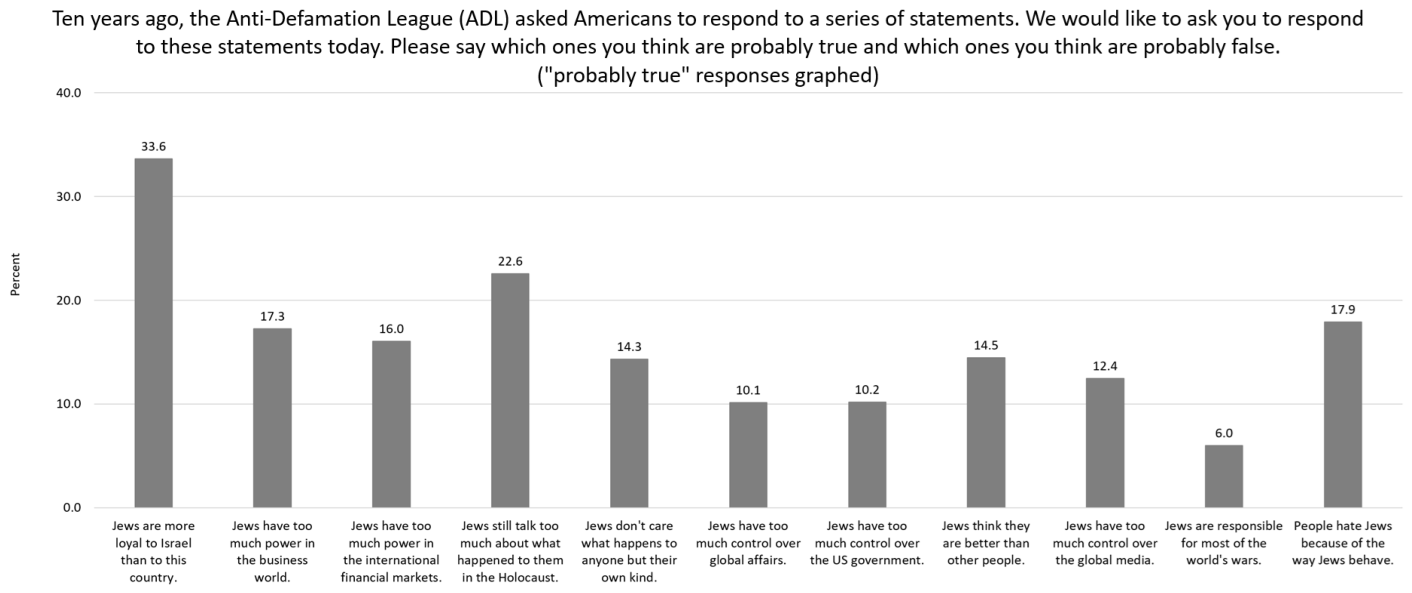
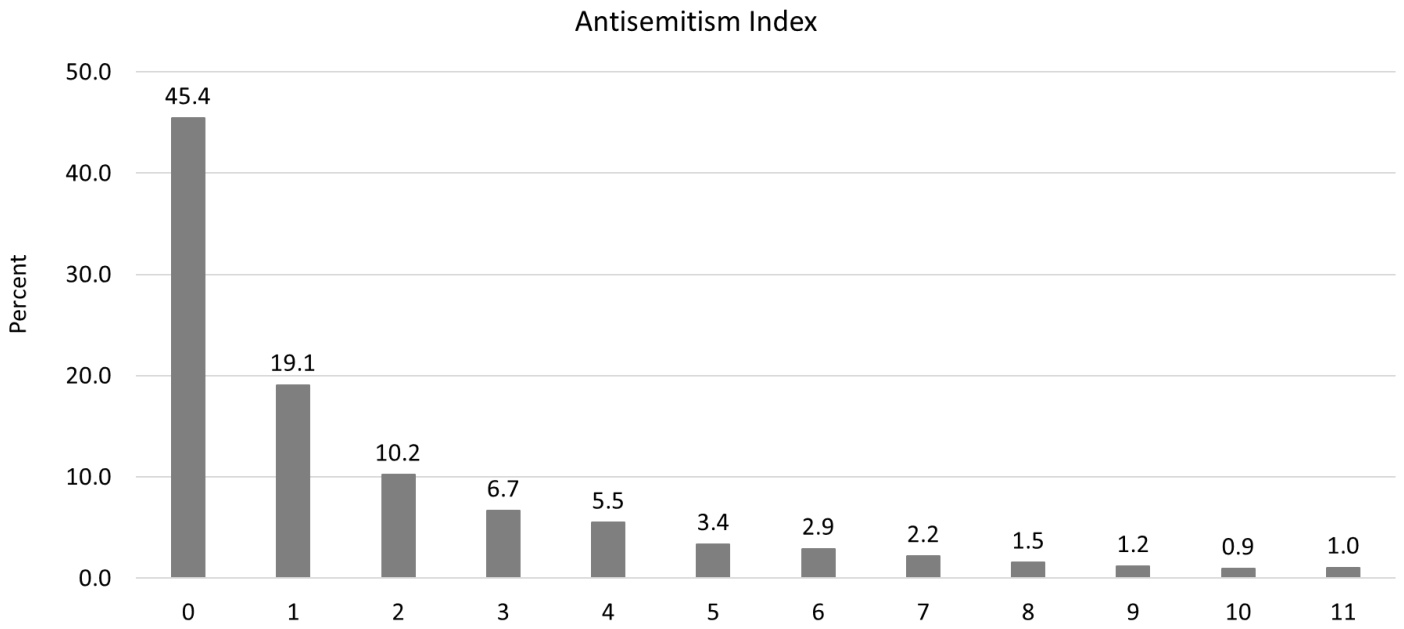
Figure 1 below indicates the percentage of respondents who agreed with each antisemitic statement (“probably true” responses). On the basis of these responses, we created a simple additive index, ranging from zero (no antisemitism) to 11 (affirmative responses to every one of the statements above) to measure the respondents’ proclivity to endorse antisemitic tropes. Figure 2 shows the distribution of responses.
The data presented in Figure 1 reveal that antisemitic beliefs persist among American Christians at significant, though varying, rates. The most commonly endorsed statement was “Jews are more loyal to Israel than to this country,” with 33.6% of respondents agreeing. This is a strikingly high figure, echoing a classic antisemitic canard suggesting Jewish dual loyalty—a charge frequently documented and condemned in studies of antisemitism.
A considerable portion of respondents also believed that “Jews still talk too much about what happened to them in the Holocaust” (22.6%), and that “Jews have too much power in the business world” (17.3%). The notion that Jews excessively control aspects of global or national life is a persistent antisemitic theme, historically used to other and scapegoat Jewish communities (Berger 1986).
Other statements, such as “Jews have too much power in international financial markets” (16.0%), “Jews don’t care what happens to anyone but their own kind” (14.3%), and “Jews think they are better than other people” (14.5%), similarly mimic old conspiracy theories that have fueled antisemitism for generations. Given that more than one in ten Christian respondents endorse each of these ideas highlights the persistence of negative stereotypes among self-identified American Christians.
Statements relating to Jewish influence over media, government, and global affairs were agreed to by 10–12% of respondents, indicating that traditional conspiracy theories about Jewish control—though less prevalent than beliefs in dual loyalty or Holocaust “talk”—are still held by a notable minority. The least endorsed was the claim that “Jews are responsible for most of the world’s wars,” at 6.0%. While this is a lower percentage, it still represents a significant belief held by a portion of this population. Comparing these results to the ADL’s longitudinal data, we see echoes of patterns that have remained stubbornly persistent over decades: certain antisemitic beliefs, especially around dual loyalty, power, and the Holocaust, continue to be accepted by alarming numbers of Americans—including communities where strong traditions of ethical teaching and social justice might suggest otherwise.
Our survey also explored severe anti-Israel and anti-Zionist views. Specifically, we asked respondents to evaluate several Israel-related statements, using the same response options—“probably true,” “probably false,” and “I don’t know”—as in the antisemitism battery.
  • Israel is responsible for the violence in the broader Middle East region.
  • Israel deliberately targets Palestinian civilians.
  • Israel is just like apartheid South Africa.
  • Israel has committed genocide in the recent fighting in Gaza.
We also added two additional measures of anti-Israel sentiment, based on the affirmative responses to the following statements.
  • Jerusalem, in its entirety, should be the capital of Palestine, and its governance should not be shared with Israel.
  • I have heard of the Boycott, Divestment, and Sanctions (BDS) Movement and support it moderately/completely.3
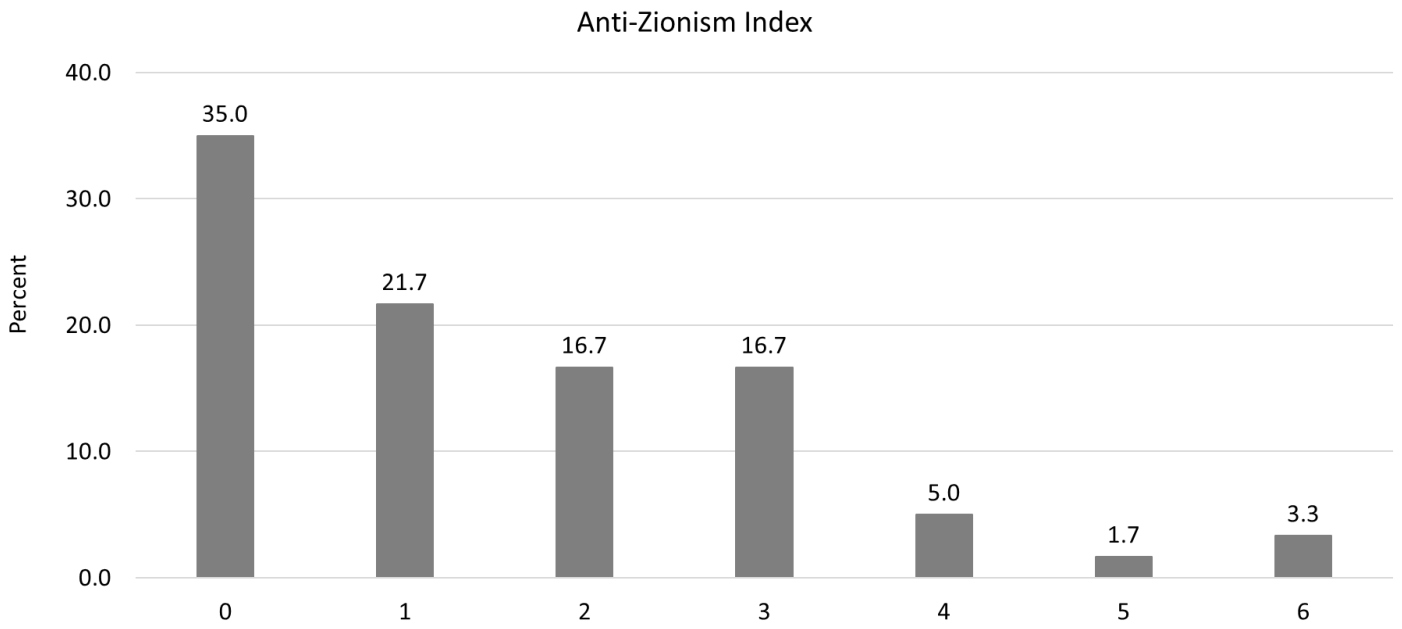
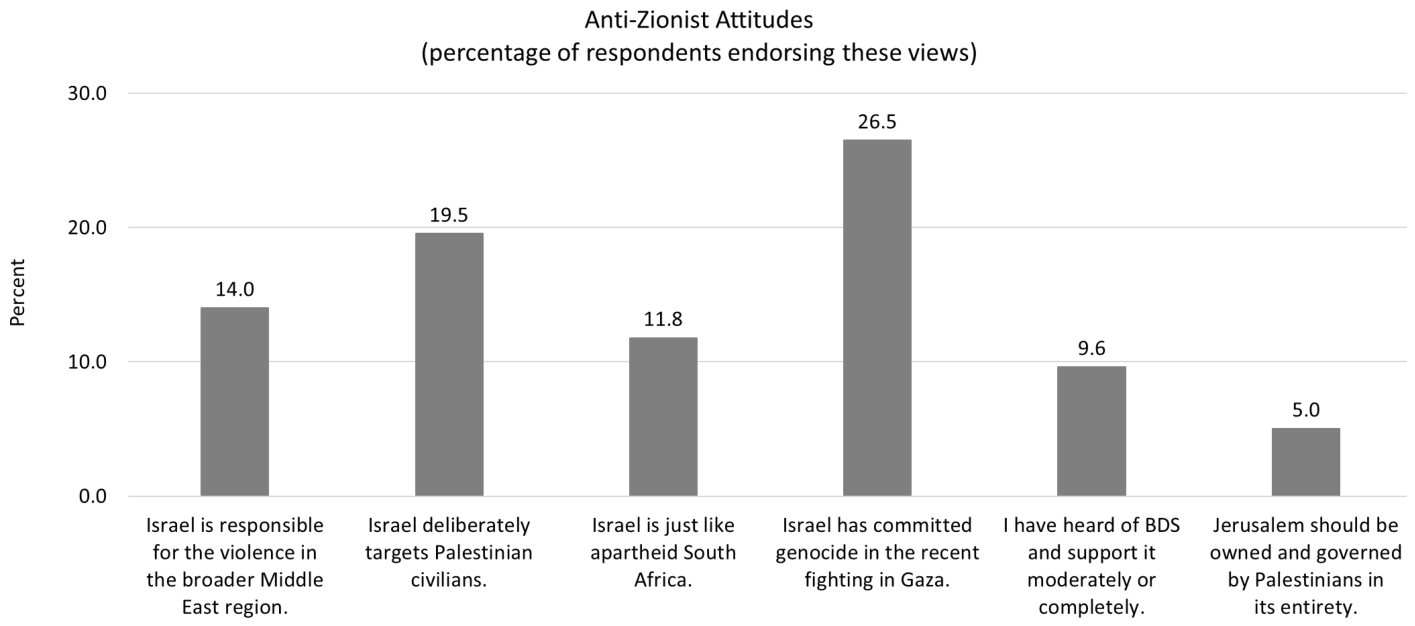
Figure 3 illustrates the degree of support for these anti-Israel/anti-Zionist positions in our sample. Similar to the antisemitism scale, we created a basic additive index that ranges from zero (no agreement with any of the statements mentioned above) to 6 (agreement with every statement). Figure 4 illustrates the distribution of the anti-Zionism scores among respondents.
These two indices play a central role in this analysis. The antisemitism index serves as the dependent variable, while the anti-Zionism index is considered as a potential correlate/predictor of antisemitism. Some empirical studies confirm the anti-Zionism-antisemitism connection (Kaplan and Small 2006) and we similarly hypothesize that stronger anti-Israel attitudes will correlate with higher antisemitic sentiment. At the same time, our theoretical objective is broader than just this relationship: to identify the range of correlates and predictors associated with antisemitism in this population.
Beyond anti-Zionism, we consider several additional factors that potentially contribute to antisemitic sentiment among American Christians. First, we explore the role of religious belief and practice, positing that the endorsement of the Deicide Charge (the belief that Jews are collectively responsible for the death of Jesus) is a powerful predictor of antisemitism, reflecting its historic role as a root of anti-Jewish prejudice (J. Cohen 2007; Nirenberg 2013). Similarly, the view that Christianity has superseded Jewish people as God’s chosen people (supersessionism) is hypothesized to increase antisemitic attitudes (Soulen 1996; Bilewicz et al. 2013).
We also hypothesize that religiosity (measured by frequency of church attendance) may be linked to antisemitism. It is important to assess whether frequent religious attendance has a completely independent association with antisemitism (theoretically, it is unclear whether this should contribute to or reduce antisemitism) or whether its influence can only be assessed contextually, in reference to the specific religious beliefs. If the role of religious commitment matters only to amplify the impact of certain beliefs—as we suspect to be the case—frequency of church attendance should not be statistically related to antisemitism by itself and its influence could only be gauged as an intervening/mediating factor that buttresses or undermines certain theological beliefs about Jews. When religious messaging includes philosemitic themes (such as Christian Zionism, Abrahamic lineage, pro-Israel eschatology), frequent attendance may reduce antisemitism or increase positive attitudes toward Jews. Conversely, if the theology emphasizes replacement theology, Jewish rejection of Christ, or End Times punishment, frequent religious attendance may reinforce antisemitic narratives.
Denominational differences should also play a role. Research suggests that Catholic identity may be associated with higher antisemitism, though post-Vatican II reforms have weakened this legacy (Bilewicz et al. 2013; Lipstadt 2019; Kertzer 2001; Bumin et al. 2023). On the one hand, belonging to mainline Protestant churches should reduce or mitigate antisemitism through the mainline emphasis on interfaith engagement and greater inclusivity. On the other hand, however, mainline churches have adopted an increasingly anti-Israel rhetoric and several BDS resolutions in recent decades, so it remains unclear whether mainline churches should be protective against antisemitism or provide fertile ground for it (Olson 2018; Rynhold 2015, pp. 116–38). Evangelical affiliation may similarly be linked to both higher and lower antisemitism, given the presence of both supersessionist and literalist, philosemitic currents within the evangelical theology (Kaplan and Small 2006; Soulen 1996). We thus remain open to directionality of influence and utilize simple dummy variables for Catholic and evangelical Protestant identity—thus treating mainline denomination as the baseline—to measure these effects.
Christian attention to Jews and Israel does not lead only to hostility. In many contemporary Christian contexts, Jews and Israel are viewed through philosemitic, covenantal, biblical, or eschatological frameworks that generate admiration, theological attachment, Christian Zionism, or strong identification with the modern State of Israel (see, e.g., Inbari and Bumin 2024). Other Christians may be largely indifferent to Zionism or to Israel, while still holding residual theological assumptions about Judaism. Antisemitism within American Christianity must therefore be understood as part of a broader and internally complex field of attitudes in which admiration, attachment, indifference, criticism, and hostility can coexist.
Self-assessed knowledge of the Israeli–Palestinian conflict is hypothesized to have a complex relationship with antisemitism. While greater knowledge may reduce prejudice, some evidence suggests that politicized “knowledge” may instead reinforce negative attitudes (Pettigrew and Tropp 2006). Since we rely on self-reported and self-assessed levels of familiarity with the conflict, our measure more likely reflects socialization and group conformity effects than actual knowledge. We utilize a two-tailed test of statistical significance and relax our expectations about causality in order to capture any potential effects on antisemitism associated with feeling knowledgeable about the conflict.
Intergroup contact theory suggests that greater exposure to Jewish individuals as neighbors or coworkers, as well as more frequent exposure to Jewish religious customs, should reduce antisemitism by mitigating stereotypes and fostering empathy (Pettigrew and Tropp 2006). We therefore hypothesize that greater contact with Jews and their customs reduces the likelihood of endorsing antisemitic tropes.
Political ideology also matters, although there is some uncertainty about how it matters. In the Western democratic context, alignment with far-right ideologies have historically been associated with higher antisemitism (Weiss 2019; Mudde 2019), whereas the far-left/progressive view is generally seen as protective against antisemitism. However, especially recently, debates persist over rising and increasingly visible anti-Zionism and antisemitism among the progressive left in the U.S. and other Western countries (Hersh and Royden 2022; Lipstadt 2019). Thus, it is important to consider the possibility of nonlinearity.
The “classic” ideology–antisemitism hypothesis expects that higher levels of political conservatism are associated with increased antisemitic attitudes; that is, individuals identifying as conservative or very conservative will exhibit higher antisemitism scores than those identifying as liberal or very liberal. This assumes a linear or monotonic effect—antisemitism increases as respondents move to the right on the ideological spectrum. The nonlinear hypothesis, on the other hand, postulates that individuals at both ideological extremes (extremely liberal and extremely conservative) will exhibit higher levels of antisemitic attitudes than those with centrist or moderate ideological views. We test these hypotheses in two ways. The linear relationship is assessed with ordinal measure of ideology (ranging from “extremely liberal” to “extremely conservative”), while the curvilinear relationship is assessed by re-estimating the model with two dummy variables reflecting self-reported stance as either “extremely liberal” or “extremely conservative.”
Beyond ideology, socialization, and theological beliefs, demographic factors are also considered. Recent research suggests that higher rates of antisemitism exist among young people, Black and Latino identifiers, and non-college educated Americans, as well as those who live in close proximity to Jewish populations (Smith and Schapiro 2019; J. E. Cohen 2018; Feinberg 2020). Thus, higher education is expected to decrease antisemitism (Golebiowska 1995; Borgonovi 2012; Staetsky 2017). Men are hypothesized to exhibit higher levels of antisemitism than women (Staetsky 2017; Bergmann 2008). Urban residence is similarly expected to be associated with greater antisemitism, reflecting higher exposure to Jewish people and to radical or politicized discourse that is more common in urban settings than rural ones (Feinberg 2020).
Race and ethnicity should also have influence on antisemitic views. In the more recent past, it has become common to frame Israeli Jews as elitist Whites engaged in colonialism and exploitation of the Palestinian people. This suggests that African Americans and other racial minorities, like Hispanics, may not harbor positive affinity toward the Jewish people and see them more as oppressors than brethren. Recent empirical scholarship has generally noted high rates of antisemitic views among racial minority groups, especially African Americans (Smith and Schapiro 2019). However, there are also significant parallels between African American and Jewish experiences and ample examples of their joint activism during the Civil Rights era and beyond (Krause 2016). We therefore do not make strong theoretical predictions about directionality of effects and utilize statistical modeling techniques that allow us to analyze all potential directions of influence. We use two dichotomous variables, based on self-reported racial/ethnic belonging to either African American or Hispanic group.
A similar lack of clarity about directionality of influence characterizes age. The “classic” hypothesis about age-antisemitism connection posits that the older generations will be more antisemitic than younger generations (Shenhav-Goldberg and Kopstein 2020; ADL 2023b). Older Americans have been socialized during periods when antisemitic stereotypes were more culturally accepted and less challenged (e.g., pre-Civil Rights era, pre-Holocaust). Furthermore, some older cohorts were raised with explicit Christian teachings about Jewish culpability in the crucifixion of Jesus Christ before interfaith revisions in theology—such as Nostra Aetate in Catholicism—became more common. Surveys like those from ADL, Pew, and the General Social Survey (GSS) have often found that antisemitic beliefs indeed decline among younger cohorts. For example, Johnathan Greenblatt, the CEO and National Director of the Anti-Defamation League, wrote that “Since 1964, ADL has regularly conducted a comprehensive study of antisemitic attitudes. And time after time, we reliably found that antisemitism was stronger among older Americans and weaker among younger. This made intuitive sense as younger people would generally be more accepting, and as they aged, antisemitism would fade” (Greenblatt 2024).
However, contrary to older research on social tolerance, younger individuals may now show higher antisemitic attitudes, potentially due to online influences and shifting norms (Marcus 2007; Federico and Sidanius 2002). Among some younger individuals, criticism of Israel or Zionism can blur into antisemitism, especially when it involves collective blame of Jews or denial of Jewish peoplehood. Furthermore, some studies (e.g., Claims Conference 2020; ADL 2023a) show that many younger Americans lack basic knowledge of the Holocaust, which has historically served as a moral barrier against antisemitism. In some progressive youth spaces, Jews may also be perceived as White, powerful, or privileged, which can foster resentment or exclusion within social justice discourses. This view, which is increasingly embraced by activist students in elite universities like Columbia, MIT, or Harvard, ignores the diversity and vulnerability of Jewish communities, and frames Jews as legitimate targets of disdain and punitive action (Task Force 2025). Lastly, contemporary generation of young people are particularly disillusioned with mainstream institutions and may therefore be vulnerable to appeals to conspiratorial worldviews, many of which have longstanding antisemitic roots (e.g., financial elites, media control, “globalist” rhetoric). We utilize our cohort-based measure of age to test these different possibilities about the age-antisemitism association.
We also explore economic conditions as potential predictors of antisemitism. Some theories suggest that lower income may foster scapegoating and thus greater antisemitism (Bonikowski 2017). However, income is an objective indicator, but antisemitism is often driven by subjective grievances—especially perceptions of unfairness, injustice, or resentment (Zawadzki 1948; Glick 2002). People with similar incomes may feel very differently about their position, depending on their reference group or perceived upward mobility. Historical and contemporary studies show that antisemitism often thrives in contexts where Jews are blamed for systemic inequality (e.g., myths about Jewish control of banks, media, or politics). Measuring the concern about income and wealth inequality therefore captures this potential scapegoating dynamic more directly than income (Pessin 2023). We thus hypothesize that greater concern about economic inequality and injustice in the U.S.—in a general sense, not in specific reference to the Jewish people—will be associated with higher likelihood of endorsing antisemitic tropes.
We also include two dummy regional variables—Northeast and South. Northeast tends to be more religiously diverse and has larger Jewish population than other regions, which could reduce antisemitism through contact theory or increase it via group threat mechanisms (we will consider both directions of influence). The South is often associated with longer or more visible histories of racial and ethnic prejudice. But the South also has a high concentration of evangelical Protestants, some of whom subscribe to philosemitic theological messages. The South is also historically associated with right-wing populism, resistance to federal civil rights enforcement, and suspicion of “globalist” elites (a trope that often carries antisemitic overtones), so, like the Northeast, residence in the South can both enhance and reduce inclination to endorse antisemitism. Thus, it is important to assess whether there are any independent effects associated with these regions of residence, and the directionality of these effects if they do exist.

3. Methodology and Statistical Findings

To account for the ordinal nature of the dependent variable—antisemitism is measured on a 0–11 scale—we employed a generalized ordered logit model using Stata’s 18.0 Standard Edition gologit2 command. Unlike the standard ordered logit, which assumes that the relationship between predictors and the outcome is constant across all response thresholds (the proportional odds assumption), the generalized model relaxes this constraint. This approach is appropriate when the proportional odds assumption is violated, allowing the effects of some predictors to vary across outcome categories while retaining proportionality for others when justified (Williams 2006). This is the case in our data. We utilize the autofit option, which automatically tests the proportional odds assumption for each variable and constrains those meeting the assumption while freeing those that do not, resulting in a parsimonious and correctly specified partial proportional odds model. The following variables did not satisfy the parallel lines assumption fully and their impact changed, depending on which outcome threshold was considered: supersessionism, anti-Zionism, frequency of church attendance, concern about economic injustice in the U.S., ideology, South, Black respondent, and Hispanic respondent.
Additionally, because of the very low number of observations at the high end of the antisemitism scale (less than 7% of respondents endorsed seven or more out of eleven antisemitic tropes), we collapsed the top portion of the index into nine categories (0–8) in order to achieve convergence. Without doing so, the estimation procedure cannot reliably estimate the thresholds and coefficients for sparsely populated outcome levels, and thus struggles to find reliable estimates for the odds of being in or beyond those rare categories. This modification does not distort our substantive interpretation.
Our study includes two appendices. The first presents summary statistics and variable coding procedures. A separate methodological appendix (see Methodological Appendix B) documents measurement and modeling decisions; explains the construction of the antisemitism and anti-Zionism indices; and provides alternative specifications, assumption tests, and robustness checks. It is intended as a transparent and citable reference for analyzing skewed, zero-heavy, and intensity-graded attitudinal outcomes.
Before we delve into the results, it is worth noting that the full survey included 2027 Christian adults, while the fully specified regression model includes 1145 complete cases. This reduction reflects listwise deletion after “don’t know” responses, and other missing values were treated as missing across the dependent variable and the full set of covariates (more than 20). The reduction is therefore cumulative rather than attributable to nonresponse on a single item. Because “don’t know” responses may reflect several different processes—lack of information, uncertainty, disengagement, question sensitivity, or reluctance to answer—we do not code them as substantive midpoint responses. As discussed in the Methodological Appendix B, additional checks using reduced covariate specifications produce substantively similar results, suggesting that the core association between anti-Zionist sentiment and antisemitic trope endorsement is not driven by listwise deletion.
Table 1 provides the regression results. Because some variables have a differential impact on different outcome categories of the antisemitism index, we report separate regression analyses for each outcome category (antisemitism index score; 0–7).4 The odds ratios (ORs) in the column labeled “No antisemitism” reflect the odds of endorsing any antisemitic trope (i.e., being in category 1, 2, …, 7) versus endorsing none (category 0/“no antisemitism”).
First and most importantly, anti-Zionist sentiment is one of the strongest statistical correlates of antisemitism in our model. Higher anti-Zionism scores are strongly and consistently associated with increased odds of being in a higher antisemitism category. At every threshold—whether someone is just embracing a few antisemitic attitudes or is in the highest, most openly antisemitic group—higher anti-Zionism scores correspond to substantially greater odds of falling into a higher antisemitism category. While anti-Zionism emerges as a significant predictor of antisemitic attitudes, it is important to emphasize that we interpret this link as a correlation rather than a confirmed causal effect, given the cross-sectional nature of our data. In other words, anti-Zionist sentiment is best seen as a strong attitudinal correlate—or even an expressive facet—of antisemitism in this population, rather than a proven causal trigger.
Notably, the odds ratios get larger at higher thresholds, peaking at threshold 6 (OR = 2.79). This means that the more antisemitic the threshold, the stronger the relationship with anti-Zionism. For every one-unit increase in anti-Zionism, the odds of being in a more antisemitic group versus all less antisemitic groups combined nearly double or more at every level. At the lowest threshold (from “no antisemitism” to the endorsement of one antisemitic trope), a one-point rise in the anti-Zionism scale increases the odds of expressing any antisemitic views by about 73% (OR = 1.725). As we look at those with more severe antisemitic attitudes, the impact of anti-Zionism grows even stronger. If we focus on crossing into the most severe antisemitism levels (threshold 6), a one-point increase in anti-Zionism nearly triples the odds (OR ≈ 2.8). What does this mean in substance and in plain language? This means that anti-Zionism is not just linked to mild bias among American Christians—it is most strongly associated with membership in the most openly or intensely antisemitic categories. In fact, for each step someone moves up the anti-Zionism scale, their odds of being among the most antisemitic respondents are nearly three times as high.
While we are particularly interested in the anti-Zionism–antisemitism relationship, the results for the additional variables included in our model are also not merely confirmatory but substantively novel. They help clarify the mechanisms through which antisemitic attitudes are more likely to appear and identify the conditions under which particular factors become more or less consequential. This broader analysis thus strengthens, rather than distracts from, the central puzzle by placing the anti-Zionism–antisemitism relationship within a more comprehensive explanatory framework. For that reason, the inclusion and discussion of the variables that follows are not ancillary but essential for properly specifying the model, reducing the risk of omitted variable bias, and situating the anti-Zionism effect in context.
Those who believe that the Christian Church has replaced Jews and Israel in God’s plan also exhibit consistently higher odds of endorsing antisemitic tropes. Similar to anti-Zionism, supersessionist views sharply increase the odds of being in a higher antisemitism category. The relationship dramatically intensifies at the very high end, especially for the most extreme levels of antisemitism (from OR = 1.58 at threshold 1 to OR = 8.03 at threshold 5), suggesting supersessionist beliefs are especially concentrated among those with the most entrenched antisemitism.
Belief in Jewish responsibility for the crucifixion of Jesus (Deicide Belief), while historically linked to Christian antisemitism, is not a statistically significant predictor in our model. The odds ratio is approximately 1.32 (suggesting a positive relationship between deicide belief and antisemitic views), but the confidence interval is very wide and includes zero, meaning that the deicide belief has—at best—an inconsistent relationship with antisemitism in our sample. We also ruled out the possibility of multicollinearity, which could potentially explain this nonsignificance. Thus, this finding likely reflects this belief’s declining salience in contemporary discourse and the stronger explanatory power of other religious constructs, such as supersessionism, which is doing the explanatory “heavy lifting” in our model. The theological and political content of antisemitism today appears to be shaped more by perceptions of Jewish power, national identity, and religious replacement than by legacy doctrinal claims such as the Deicide Charge.
In this model, frequency of church attendance is not statistically significant correlate of antisemitism in any of the outcome categories but one—threshold 4, which reflects endorsement of four antisemitic statements. At that outcome level, more frequent church attendance reduces the odds of being strongly antisemitic by 20% (OR = 0.797) for each step-level change in the church attendance variable (6 steps; 0–6). This is a curious finding and one that immediately led us to ask questions about this threshold. What does threshold 4 mean in our model?
Threshold 4 corresponds to this contrast: P(Y > 4) vs. P(Y ≤ 4). That is, threshold 4 reflects the odds of being in category 5, 6, or 7 (i.e., endorsing 5–7 or more antisemitic tropes) versus being in category 0–4. So, threshold 4 essentially distinguishes high antisemitism from none, low, or moderate antisemitism. This potentially makes threshold 4 the first point where we can start to identify people as being “very antisemitic.”
Do other variables also behave differently at this threshold? Yes, a few important variables sharply increase in magnitude or become statistically significant at this threshold. Supersessionism explodes in size and significance at threshold 4 (from OR = 2.16 at threshold 3 to OR = 6.96 at threshold 4). Similarly, the effect of urban residence on antisemitism strengthens substantially and peaks at threshold 4.5 The jump from OR = 2.15 in threshold 3 to OR = 3.36 in threshold 4 means that urban residents are over three times as likely as suburban and rural residents to fall into the highest antisemitism group (5+ tropes) rather than any lower category, even after controlling for all other covariates. Educational attainment also does not attain statistical significance until threshold 3 and peaks at threshold 4, reducing the odds of endorsing antisemitism by 23% per every increase in educational attainment, from “some high school” to “graduate degree” (5-level change). All of this suggests that threshold 4 is indeed a meaningful tipping point.
To return our readers’ attention to the frequency of church attendance for a moment—we also hypothesized that the impact of frequent church attendance on antisemitism is likely to be mediated by the specific theological messages that frequent attendance would reinforce. So, does the impact of religious intensity depend on what is believed, not just how often one attends church? We tested the potential interaction between supersessionism and frequency of church attendance, hypothesizing that the impact of supersessionism would be more pronounced among frequent churchgoers than among Christians who seldom attend religious services. However, insignificant statistical result with the interaction term included suggests that the effect of supersessionist belief does not vary significantly by level of religiosity. Thus, more frequent church attendance does not have a robust association with antisemitism directly, nor does it amplify or weaken the relationship between supersessionist beliefs and antisemitism in a statistically meaningful way. When we repeat this exercise for the deicide belief—to assess whether antisemitism related to this theological belief is amplified by greater church attendance—we similarly find a non-significant result.
Our results for ideology (coded into 7 categories, from “extremely liberal” to “extremely conservative”) are also fascinating. More conservative ideology raises the odds (by 17% for each step-level change) of being above the “no antisemitism” category (i.e., agreeing with any antisemitic tropes), but is not significant at higher thresholds. This suggests that ideology matters mainly for distinguishing those with no antisemitism from those with any but does not further distinguish among higher levels. Once a Christian respondent in our sample already holds some antisemitic beliefs, conservatism does not predict holding more.
We then replace an ordinal ideology variable with two dummy variables, denoting “extremely conservative” and “extremely liberal” ideological orientations. Across all thresholds/categories and cutoff points, “extremely conservative” orientation is not a statistically significant predictor of antisemitism in our model. We caution our readers from overinterpreting this substantively; we simply conclude that there is no evidence (in these data and model) that far-right identification is associated with higher or lower odds of being in a higher antisemitism category.
Across all measured thresholds where “extremely liberal” is statistically significant (0–4), these respondents are consistently and substantially less likely to exhibit more antisemitic attitudes, with odds ratios between 0.17 and 0.37 (63–83% reduction in odds of high antisemitism). This effect is both statistically significant and sizeable, indicating that “extremely liberal” identification is strongly protective against antisemitism. Notably, at the critical juncture denoted by threshold 4—which potentially represents a shift to more extreme expressions of antisemitism—this negative association remains robust (OR = 0.18) and grows larger vis-à-vis threshold 3, suggesting that far left orientation serves as a partial barrier to advancement into the highest antisemitism categories (5, 6, 7), where the effects lose statistical significance. This means that Christians who identify as “extremely liberal” are most strongly insulated against entering any antisemitic category at all and also have robustly lower odds for moderate degrees of antisemitism (until threshold 4).
What do these somewhat disparate results then imply about the relationship between ideology and antisemitism? These results hint at the possibility that ideology’s primary role is in predicting whether someone rejects antisemitism altogether, rather than how intensely someone may hold such views. In other words, ideological orientation seems to acts as a gateway: it strongly shapes the likelihood of harboring any antisemitic beliefs but has limited influence on the gradations of antisemitism among those already predisposed. We obviously do not want to overstate these findings—just one survey sample is insufficient to form broad, generalizing claims. Replication with broader samples will be needed to confirm these patterns.6
We also considered whether self-reported income and degree of concern about economic inequality in income and wealth in the contemporary U.S. are related to antisemitism. Regarding income, we find that higher income is protective against most extreme antisemitism: at the two highest thresholds (6 and 7), each increase in income level reduces the odds of being in those categories by 39% and 55%, respectively. Regarding concerns about economic inequality, we find that such concerns matter only at three thresholds: 2, 3 and 6. At moderate levels of antisemitism (thresholds 2 and 3), the effect is statistically significant, but relatively modest—8.6% increase in odds of antisemitic views at threshold 2 and 13.2% increase at level 3. At very high levels of antisemitism (threshold 6), the same increase in economic injustice concern is associated with 50% higher odds of being in the most antisemitic category, compared to all lower categories (OR = 1.498). This effect is both larger and more statistically robust than at lower thresholds. How to interpret this pattern?
Economic injustice concerns are not, by themselves, inherently antisemitic. However, our data seems to suggest that American Christians who have a tendency to see the world primarily through the lens of economic injustice are more likely to also hold antisemitic attitudes, especially at the most extreme end of the spectrum. The fact that the odds ratio rises from 1.13 at moderate antisemitism to 1.50 at the highest indicates that among those with the most entrenched antisemitic attitudes, concerns about economic stratification are often a more central part of their worldview. In other words, while modest economic inequality concerns are common and not inherently problematic, for a subset of people in our sample, this worldview may blend with or become a vehicle for more conspiratorial or severe antisemitic beliefs.
This pattern aligns with Roger Petersen’s (2001) framework in Understanding Ethnic Violence, which links perceptions of group-based deprivation and status reversal to feelings of resentment toward out-groups. In this context, economic inequality concerns may serve as expressions of ethnic resentment—reflecting a perceived loss of economic dominance vis-à-vis Jews, who are often stereotyped as economically powerful or privileged. For some individuals, perceptions of unfair economic hierarchies may thus become ethnically coded, transforming general economic grievances into group-based blame.
While Jewish exposure might be expected to lower antisemitic attitudes, we find no significant effect once other covariates are included. By contrast, urban residence remains a robust and statistically significant predictor at thresholds 2, 3, 4, and 6, with its peak influence at threshold 4. This suggests that urban contexts may foster distinct ideological or political climates—perhaps through exposure to anti-Zionist discourses, activism, or media environments—that influence antisemitic attitudes independently of interpersonal contact with Jews.
We also checked for a possibility of interaction between Jewish exposure and urban residence—after all, Christian contact with Jews should be more prevalent and frequent in urban, rather than rural or suburban settings. When we allow the effect of urban residence to vary depending on Jewish exposure (and vice versa), there is no clear evidence that either factor alone or their combination have a statistically detectable impact. So, how do we reconcile this insignificance with the original finding that urbanicity is a statistically significant predictor of support? We tend to think that the significant urban effect without interaction might be a simplified “average” effect—on average, living in an urban area is associated with increased antisemitism odds, regardless of Jewish exposure. Adding the interaction decomposes this average into conditional effects that turn out to be weaker or noisier, and therefore fail to achieve meaningful levels of statistical significance in the model with the interaction term.
As we hypothesized, women are less likely to endorse antisemitic views than men. Women have 54% lower odds of being in higher antisemitism categories versus men. This is a very strong and consistent protective effect across all thresholds.
We find that older respondents have about 18% lower odds per each generational “step” of being in higher antisemitism categories, and this effect is consistent and significant throughout the entire antisemitism continuum. This means that younger Christians are consistently more likely to endorse antisemitic tropes, even at higher levels of antisemitism. The finding that younger individuals are more likely to express antisemitic attitudes runs counter to some research on generational tolerance. Some studies, particularly in racial prejudice and attitudes toward LGBTQ+ people, find that younger cohorts are more tolerant and egalitarian (Marcus 2007; Federico and Sidanius 2002). However, this generational liberalism does not seem to necessarily extend to all outgroups, especially Jews. Younger people are disproportionately exposed to online ecosystems where antisemitism circulates, often masked within anti-globalist, conspiracist, or anti-Zionist content and where meme culture can trivialize or normalize antisemitic ideas (Heslep and Berge 2021; Von Mering 2022; Zannettou et al. 2020). Some studies have shown that younger internet users are more likely to encounter or share antisemitic content, especially via TikTok, Instagram, and Discord. With the Holocaust and postwar antisemitism receding from public memory, younger people also lack the same level of personal or educational exposure to Jewish history and antisemitism as the older generations and may be more receptive to revisionist or denialist narratives spreading online.
Black racial identity attains statistical significance only at threshold 6, suggesting that the Black Christians are very unlikely to fall in the highest antisemitism category (OR = 0.03; a 97% decrease relative to other racial and ethnic groups). The fact that this effect is only statistically significant at that top threshold suggests that African Americans may be similar to other racial groups at lower levels of antisemitism (thresholds 1–6), but that they are far less likely to be among the most extreme antisemites (threshold 7).
Hispanic respondents, on the other hand, are more than twice as likely as other races/ethnicities to be in the highest antisemitism categories, versus lower categories, but this effect is only statistically significant at threshold 4. At that level (which, as we discussed above, could differentiate “very antisemitic” respondents), the odds ratio for Hispanic ethnicity is 2.31. To be clear, not all Hispanic respondents are more antisemitic. In fact, for the majority of the distribution (mild to moderate antisemitism), there is no statistically significant difference between Hispanic and non-Hispanic respondents; the difference emerges only at the extreme. The finding thus suggests that among those who are at the “high antisemitism” extreme, Hispanics are over-represented, while at the lower levels, rates are comparable to non-Hispanics.
Who are these highly antisemitic Hispanics in our sample? The minority of Hispanics who hold extremely antisemitic attitudes tend to come from particular sociodemographic and religious backgrounds: they are more likely to be lower-/middle-income, modestly educated (72% have less than a bachelor’s degree), Catholic, religiously active, and to hold supersessionist and anti-Zionist views. The rate of crucifixion blame is also much higher rate than the general sample rate—19% explicitly blame Jews for crucifying Jesus. The fact that supersessionism and crucifixion-blame doctrines are so strongly represented among this subsample—despite official Catholic Church positions, especially post-Nostra Aetate—suggests traditional prejudice that continues to persist unofficially.
Lastly, in comparison to someone from another region, living in the South increases the odds of being in the most severe antisemitism categories nearly triple for threshold 6 and over six times the odds for threshold 7. The remaining variables—Catholic and evangelical dummy variables, self-reported level of knowledge about the Israeli–Palestinian conflict, married status, and Northeast regional dummy—are not statistically significant across any thresholds of the dependent variable.
Despite our expectations, neither Catholic nor evangelical affiliation emerged as statistically significant predictors of antisemitism in the models. This may seem surprising at first, but it highlights the fact that religious affiliation alone is a poor proxy for theological content or ideological intensity. In other words, simply identifying as Catholic or evangelical does not, in itself, tell us much about a person’s actual beliefs regarding Jews, Israel, or salvation history. Instead, specific doctrinal beliefs and political attitudes—such as supersessionism and anti-Zionism—are much stronger predictors of antisemitism than denominational labels. This suggests that antisemitic sentiment is not uniformly distributed within denominations but may be concentrated among subsets of believers who hold particular theological or ideological views, regardless of their broader religious identity. For example, a Catholic who affirms the Church’s post-Vatican II stance on Judaism may hold very different views of the Jewish people than one shaped by more traditionalist, pre-Vatican II narratives that are infused with punitive supersessionism. Similarly, evangelicals vary widely in their views on Jews and Israel, with some embracing strong philosemitic, pro-Israel attitudes and others rejecting both Jewish chosenness and Zionism.
The lack of denominational significance could also reflect broader convergence in contemporary American Christianity, where political and cultural identities override religious ones. In this context, for example, an evangelical, a mainline Protestant, and a Catholic who share nationalist, anti-globalist, or anti-elite sentiments may all exhibit similar levels of antisemitism—despite differences in their denominational heritage.

4. Conclusions

This article offers a comprehensive empirical investigation of the correlates of antisemitism among American Christians, with a specific focus on how anti-Israel attitudes intersect with traditional theological, political, and demographic predictors. The findings reveal a consistent and powerful association between anti-Zionism and antisemitic sentiment: those who express stronger anti-Israel views are significantly more likely to endorse antisemitic tropes, with this relationship intensifying at higher levels of antisemitism. Supersessionist theological beliefs—that Christianity has replaced Judaism in God’s plan—similarly predict greater antisemitism, particularly among those at the extreme end of the spectrum. Interestingly, the historically potent deicide belief does not have a statistically significant impact, potentially suggesting its declining relevance in contemporary Christian antisemitism relative to other political and theological constructs. These findings suggest that contemporary Christian antisemitism may be undergoing an important transformation: rather than being driven primarily by older doctrinal accusations such as explicit deicide theology, it increasingly appears to emerge through attitudes involving Israel, covenantal legitimacy, and religious supersession. In this sense, anti-Jewish prejudice among contemporary Christians may be evolving rather than disappearing, taking forms that are more politically mediated than historically classical, yet still structurally connected to longstanding theological narratives about Jewish legitimacy and collective identity.
The model also uncovers meaningful distinctions in how other variables operate across levels of antisemitism. For example, more frequent church attendance is not uniformly associated with antisemitism but becomes a protective factor (reducing proclivity toward antisemitism) at threshold 4—where respondents move from moderate to high antisemitism. This same threshold marks a turning point for several other variables, including education (which begins to show a significant protective effect), urban residence (which becomes a strong predictor of higher antisemitism), and Hispanic ethnicity (which becomes a statistically significant risk factor). These patterns suggest that threshold 4 may represent a critical tipping point where antisemitic views shift from casual or unreflective prejudice into a more ideologically rooted and severe form.
Some variables—such as anti-Zionism, supersessionism, urban residence, and residence in the South region—demonstrate particularly strong predictive power at higher thresholds of antisemitism. These variables appear to be especially relevant for identifying individuals with entrenched or ideologically rooted antisemitism, rather than those who may simply hold one or two prejudicial views without deep conviction. In contrast, variables such as being female or older consistently reduce the likelihood of expressing antisemitism across all levels, acting as stable protective factors rather than varying in strength depending on severity. This divergence suggests that the correlates of mild antisemitic attitudes may differ—both in kind and degree—from those associated with more extreme expressions. For instance, mild antisemitism might stem from unreflective stereotypes or socialized prejudices, whereas high levels of antisemitism may appear more closely associated with ideological systems that include theological replacement narratives or deep-seated hostility toward Israel. These results point to the importance of disaggregating antisemitism not just by presence or absence but by intensity and configuration, as the underlying associations and potential interventions may differ across this spectrum.
Demographic variables produce some surprising results. Younger Christians are significantly more likely to endorse antisemitic attitudes across the entire spectrum, challenging conventional assumptions about higher tolerance among younger cohorts. This could reflect the influence of social media, online conspiracies, or anti-Zionist activism in digital spaces that occasionally bleeds into antisemitic expression.
Racial identity also interacts with antisemitism in complex ways: Black respondents are dramatically less likely to be in the most antisemitic category (but do not otherwise differ from other American Christians in their antisemitic tendencies), while a small subset of highly antisemitic Hispanic respondents tend to be religious, working-class, and influenced by residual traditionalist or “folk” Catholic theology. These informal, often syncretic religious beliefs and practices that exist alongside or beneath official Church doctrine. These beliefs are typically passed down through families or local communities rather than formal theological instruction and may reflect pre-Vatican II traditions (Matovina 2012). In some contexts, they preserve older theological ideas—such as Jewish responsibility for the crucifixion or supersessionist views of Judaism—that have been formally repudiated by the Holy See but remain influential at the grassroots level.
Living in the U.S. South significantly increases the odds of falling into the most extreme antisemitism categories, with odds more than doubling at the second-highest level and exceeding six times at the highest level. This suggests that South’s regional culture remains a powerful contextual factor in predicting severe antisemitic attitudes.
To conclude, it is important to once again reiterate that because our data are cross-sectional, our analysis focuses on estimating conditional associations between anti-Zionism and antisemitism rather than identifying causal effects. We cannot determine whether anti-Zionist sentiment produces antisemitic trope endorsement, whether antisemitic attitudes shape views of Israel, or whether both are produced by broader ideological, theological, informational, or social environments. What the analysis does show, however, is that severe anti-Israel/anti-Zionist sentiment and antisemitic trope endorsement are strongly and consistently intertwined among self-identified American Christians and that this relationship becomes especially pronounced at higher levels of antisemitic intensity. The distinction between criticism of Israel and antisemitism remains analytically important, but our findings indicate that, in this population, the most severe forms of Israel-directed hostility often coexist with broader antisemitic worldviews.
Taken together, these results indicate that, in practice, anti-Zionism often appears alongside—and may serve as a reinforcing frame for—antisemitic worldviews, particularly at the more extreme end of the attitudinal spectrum. While it remains conceptually possible to separate criticism of Israeli policy from antisemitism, our findings suggest that such distinctions are, empirically, often blurred. As a result, claims that anti-Zionism and antisemitism are cleanly separable should be treated with caution, as overlooking their substantial overlap risks understating an important channel through which antisemitic attitudes are expressed in contemporary discourse.
These findings also enrich our understanding of how specific religiously rooted beliefs and political attitudes can intertwine to shape prejudice. They underscore the importance for scholars of religion and society to consider the nuanced ways that theological worldviews and contemporary political stances (like anti-Zionism) may jointly influence intergroup relations and perceptions of out-groups. In highlighting this intersection, our study offers a valuable data-driven perspective to ongoing discussions in the religion-and-prejudice literature.

Author Contributions

Conceptualization, K.B. and M.I.; Methodology, K.B.; Software, K.B.; Validation, K.B. and M.I.; Formal analysis, K.B. and M.I.; Investigation, K.B. and M.I.; Data curation, K.B.; Writing—original draft preparation, K.B. and M.I.; Writing—review and editing, K.B. and M.I.; Visualization, K.B.; Project administration, K.B. and M.I.; Funding acquisition, K.B. and M.I. All authors have read and agreed to the published version of the manuscript.

Funding

This study was funded by a grant from Chosen People Ministries. The financial sponsors played no role in the design, execution, analysis, interpretation of data, or writing of the study.

Data Availability Statement

The raw survey data analyzed in this article are not publicly available and will not be distributed by the authors. Certain replication materials and additional details about the analyses are available from the corresponding author upon reasonable request. Variable coding information is provided in Appendix A.

Conflicts of Interest

The authors declare no conflicts of interest.

Appendix A. Summary Statistics and Variable Coding Procedures

Appendix A.1. Summary Statistics

Obs.MeanStd. dev.MinMax
Antisemitism index (dependent variable)20271.7452.472011
Anti-Zionism index20270.7181.13004
Catholic denomination20270.3910.48801
Evangelical denomination20270.3810.48601
Frequency of church attendance20272.7391.87806
Exposure to Jewish friends, customs20271.5231.29906
Deicide belief (Jews punished for crucifying Jesus)18400.0840.27801
Supersessionism12580.4240.49401
Concerned about economic inequality in the U.S.20276.2482.46309
Self-reported knowledge about Israeli-Palestinian dispute20272.1861.21204
Ideology20273.3541.55606
Far right (extremely conservative) ideological identification20270.0830.27701
Far left (extremely liberal) ideological identification20270.0460.21001
Income19332.4821.85206
Educational attainment20272.6631.42905
Gender (female)20160.5480.49801
Marital status (married)20270.4290.49501
African American respondent20270.1310.33801
Hispanic/Latino respondent20270.1230.32801
Age cohorts20271.5080.99303
South (region of residence)20270.4060.49101
Northeast (region of residence)20270.1860.39001
Urban residence20270.2600.43901
Eschatology x frequency of church attendance
    Amillennial beliefs reinforced through church attendance20271.0691.74705
    Postmillennial beliefs reinforced through church attendance20270.5611.36805
    Premillennial beliefs reinforced through church attendance20270.7811.62505

Appendix A.2. Variable Descriptions and Coding Procedures

  • Antisemitism Index (dependent variable)—Additive index based on “probably true” responses to 11 antisemitic statements developed by the Anti-Defamation League (ADL); ranges from zero to 11.
  • Anti-Zionism Index—Additive index based on “probably true” responses to 4 statements that are critical of Israel; ranges from zero to 4. Statements include: “Israel is responsible for the violence in the broader Middle East region.”, “Israel deliberately targets Palestinian civilians.”, “Israel is just like apartheid South Africa.”, and “Israel has committed genocide in the recent fighting in Gaza.”
  • Catholic Denomination—self-identification as Catholic or Roman Catholic; coded 1 and zero otherwise.
  • Evangelical Denomination—self-identification as evangelical and/or born-again Protestant; coded 1 and zero otherwise.
  • Frequency of Church Attendance (Religiosity)—“Aside from weddings and funerals, on average, how often did you attend church or religious services?” Coded 1 for “Never”; 2 for “Seldom”; 3 for “A few times a year”; 4 for “Once a month”; 5 for “Two or three times a month”; 6 for “At least once a week”; 7 “Daily”.
  • Exposure to Jewish People and Customs—additive index that ranges from zero to 6, based on affirmative responses the following statements: “I have socialized with Jewish friends or neighbors.”; “I have worked alongside Jews.”; “I have been present at a Jewish religious service in a synagogue (e.g., a bar mitzvah or sabbath service).”; “I have been present at a Jewish religious service/event in a home (e.g., a Passover seder).”; “I am or used to be Jewish.”; “I have been part of an interfaith family that includes Judaism.”
  • Deicide Charge—Based on selecting “The Jews” response option to the “Who bears the blame for the crucifixion of Jesus?” Coded as dichotomous variable.
  • Supersessionism—Based on answers to the “Which of the following best expresses your beliefs or feelings about the Jewish people?” Those respondents who selected either “Jews are cursed by God because they crucified Jesus.” or “God’s covenant with Jews has not been entirely replaced but rather fulfilled in Christ.” were coded as 1; other responses coded as zero.
  • Economic Inequality Concerns—Ordinal measure based on “On a scale of 1 to 10, with 1 being not concerned at all and 10 being extremely concerned, how concerned are you about the income gap and economic disparities between rich and poor in American society today?”
  • Self-Reported Knowledge of the Israeli–Palestinian Conflict—Perceived knowledge of the conflict based on the following question: “How knowledgeable are you about the Israeli-Palestinian conflict?” The following response options were provided: “I have very limited knowledge about the conflict.” (0); “I have a little knowledge about the conflict.” (1); “I have a moderate level of knowledge about the conflict.” (2); “I am very knowledgeable about the conflict.” (3); “I do not know anything about the conflict.” (4). “Don’t know” responses are then recoded as missing values and dropped from the analysis.
  • Ideology—Based on responses to the following question: “In general, would you describe your political views as…” Coded zero for “Extremely liberal”; 1 for “Liberal”; 2 for “Slightly liberal”; 3 for “Moderate, middle of the road”; 4 for “Slightly conservative”; 5 for “Conservative”; 6 for “Extremely conservative”. Coded 7 for “Do not know” and then recoded as missing value to drop from analysis.
  • Far right (extremely conservative) political orientation—Coded on the basis of the preceding ideology question. Respondents who selected “extremely conservative” political orientation are coded 1 and zero otherwise.
  • Far left (extremely liberal) political orientation—Coded on the basis of the preceding ideology question. Respondents who selected “extremely liberal” political orientation are coded 1 and zero otherwise.
  • Income—“What was your total household income before taxes during the past 12 months?” Coded 0 for “Less than $25,000”; 1 for “$25,000 to $34,999”; 2 for “$35,000 to $49,999”; 3 for “$50,000 to $74,999”; 4 for “$75,000 to $99,999”; 5 for “$100,000 to $149,999”; 6 for “$150,000 or more”. Coded 7 for “Prefer not to answer” and then recoded as missing value to drop from analysis.
  • Educational Attainment—“What is the highest level of education you have completed?” Coded 0 for “some high school”; 1 for “high school graduate”; 2 for “some college”; 3 for “trade/technical/vocational training”; 4 for “bachelor’s degree”; 5 for “post graduate degree”; and 6 for “do not wish to respond.” The latter was dropped from analysis.
  • Gender (female)—Question asked “Are you …” Response options included “male,” “female,” “prefer not to answer,” and “gender not listed above.” Recoded zero for “Male” and 1 for “Female.” Other categories recoded as missing values and dropped from the analysis.
  • Marital Status (married)—“What is your current marital status?” Coded 1 for “Single/Never married”; 2 for “Separated”; 3 for “Divorced”; 4 for “Widowed”; 5 for “Married”. Coded 6 for “Do not wish to respond” and then recoded as missing value to drop from analysis. We then recoded the variable 1 for “married” and zero otherwise.
  • Race/ethnicity—“How do you identify yourself?” Coded 1 for “American Indian or Alaskan Native”; 2 for “Asian”; 3 for “Black or African American”; 4 for “Hispanic or Latino”; 5 for “Multiracial/multiethnic”; 6 for “Native Hawaiian or Other Pacific Islander”; 7 for “White, non-Hispanic”; and 8 for “Other race not listed above”. Additionally, dummy variables for each of the value categories were created, where 1 represented a particular race/ethnicity and zero otherwise.
  • Age—“What is your age?” Open-end format that allows the respondent to enter their actual age as a whole number. Due to our interest in cohort effects, we then recoded the variable 0 for “18–29 years old”; 1 for “30–49 years old”; 2 for “50–64 years old”; 3 for “65 years and older”.
  • Region of Residence—“Which U.S. state do you reside in?” Respondents were presented the name of the specific states to aid in their selection and responses were then recoded “Midwest” for IA, IL, IN, KS, MI, MN, MO, ND, NE, OH, SD, WI; coded “Northeast” for CT, DC, DE, MA, MD, ME, NH, NJ, NY, PA, RI, VT; Coded “Southeast” for AL, AR, FL, GA, KY, LA, MS, NC, SC, TN, VA, WV 4 for “Southwest”—AZ, NM, OK, TX; 5 for “West”—AK, CA, CO, HI, ID, MT, NV, OR, UT, WA, WY. On the basis of this coding, we generated dichotomous variables for each region.
  • Area of residence (rural, suburban, urban)—“Which of the following best describes the area you live in?” Coded 1 for “Urban”; 2 for “Suburban”; 3 for “Rural”. We then recoded this variable 1 for “urban” and zero otherwise.

Appendix B. Methodological Appendix: Measurement, Modeling, and Robustness Checks

This appendix serves an important purpose. It documents in a transparent and citable manner the measurement decisions, modeling choices, and robustness checks underpinning the analysis in the main article. While not required for substantive interpretation of the results reported in the article, this appendix is designed to be used, cited, and replicated. Although motivated by a specific empirical application, the framework articulated here is deliberately portable and intended for reuse across studies of religious prejudice, ideological extremism, and intensity-graded attitudinal outcomes.
The appendix demonstrates that the substantive relationships identified in the main manuscript—especially, a strong and statistically significant association between anti-Zionism and antisemitism among American Christians—remain stable across a wide range of alternative specifications, including additive and latent-variable measures, ordinary least squares regression, ordered logistic regression, generalized ordered logistic regression, hurdle models, and zero-inflated negative binomial models. Throughout this appendix, as is also the case throughout the main article, the analysis is intentionally associational rather than causal. Because our survey data on antisemitism are cross-sectional, the models estimate conditional relationships among variables rather than definitive causal pathways.

Appendix B.1. Measurement Construction and Validation

Appendix B.1.1. Construction of the Antisemitism Index

Conceptual Foundation
The antisemitism index utilized in this study is based on the Anti-Defamation League’s (ADL) long-standing battery of antisemitic stereotype items. These measures have been employed extensively in prior research and permit meaningful comparability with existing scholarship on antisemitic attitudes. The index consists of eleven statements referencing classic antisemitic stereotypes, conspiracy narratives, dual-loyalty accusations, and negative characterological claims regarding Jews. Respondents were asked whether each statement was “probably true” or “probably false.” Consistent with standard ADL coding procedures, responses were coded dichotomously: 1 = “probably true”; 0 = “probably false.” “Don’t know” responses were recoded as missing values and excluded from scale construction.
Additive Index Construction
The antisemitism measure was constructed as an additive index summing the number of antisemitic statements endorsed by respondents. The additive specification was retained for three primary reasons. First, additive index maximizes interpretability. A higher score straightforwardly indicates endorsement of a broader range of antisemitic beliefs. Second, additive measures preserve comparability with existing ADL-based scholarship. Third, alternative latent-variable approaches produce substantively similar conclusions while introducing additional assumptions regarding latent dimensionality, communalities, and item structure. Accordingly, the additive index offers the strongest balance between interpretability, transparency, and comparability.
To minimize potential response bias arising from all eleven items pointing in the same direction, we randomized the order of the “probably true,” “probably false,” and “don’t know” response options across items. In addition, the eleven antisemitism items themselves were presented in randomized order to respondents.
Item-Level Endorsement Rates, Measurement Error, and the Interpretation of Low-Intensity Antisemitism
As Figure 1 in the main paper indicates, the endorsement rates for individual antisemitism statements are modest. Some scholars may argue that these low item-level endorsement rates largely reflect social desirability bias, with respondents conditioned to avoid explicitly endorsing antisemitic statements even when such beliefs may be present. From this perspective, modest “probably true” responses should be interpreted as evidence of suppression rather than genuine absence of antisemitic sentiment, making the additive scale’s skewed distribution unsurprising and not substantively informative about underlying attitudes.
We agree that any self-report measure of prejudicial attitudes is subject to inherent measurement error, including potential social desirability bias or respondents’ reluctance to endorse socially stigmatized beliefs. This limitation is common to all survey-based measures of antisemitism or other socially sensitive attitudes. While it is impossible to fully eliminate these concerns, the use of an online survey format—rather than phone or in-person interviewing—likely reduces at least some pressure toward socially desirable responding, since respondents complete the survey privately and without direct interaction with an interviewer. Furthermore, our use of multiple antisemitism indicators and robustness checks vis-à-vis factor analysis-based index helps mitigate random response error and captures underlying patterns more reliably than any single item alone. Lastly, we also want to underscore that while self-reported measures of socially sensitive attitudes are always subject to measurement error, these low scores also reflect substantive realities: U.S. Christians are generally more philosemitic than the general U.S. population, and the broader U.S. context is already strongly pro-Israel and pro-Jewish in comparison to other countries. Thus, the observed distributions likely reflect both genuine attitudes and the usual limitations of self-reports.
Index Reliability and Dimensionality
To evaluate whether the eleven items used for the additive index form a coherent latent construct, we conducted exploratory factor analysis using principal-components factor estimation. The results strongly support unidimensionality. Factor 1 eigenvalue is 5.63 and Factor 1 solution explains 51.2% of the variance. No additional factor exceeded an eigenvalue of 1.00. All items loaded positively and substantially on the first factor, with loadings ranging from 0.51 to 0.79. The additive index also demonstrates strong internal consistency, with Cronbach’s alpha of 0.88. This level of reliability exceeds standard thresholds for attitudinal scales in survey research and supports the interpretation of the index as measuring a coherent underlying construct.
Table 1 scores would produce different results than an additive index, we carried out a linear regression analysis (OLS) because, with 146 unique values, this factor-based index is no longer appropriate for the generalized ordinal logistic regression. The results are largely the same as those obtained via gologit2 for the additive index, but static, lacking the threshold-specific nuance that gologit2 provides. There is no evidence that factor analysis score produces qualitatively different conclusions from the additive index.
Theological Variables as Explanatory Mechanisms, Not Antisemitism Index Items
Some scholars suggest incorporating supersessionism and deicide beliefs into the antisemitism scale itself. We do not adopt this approach because these theological constructs function analytically as explanatory mechanisms rather than indicators of antisemitism per se. Supersessionism and deicide beliefs represent theological frameworks that may justify, intensify, or facilitate antisemitic attitudes. Incorporating them directly into the dependent variable would collapse explanatory mechanisms into the outcome being explained. Modeling these variables separately therefore preserves conceptual clarity and allows direct estimation of their independent relationships with antisemitic attitudes.
Reliability analysis also indicates that supersessionism and crucifixion-blame (deicide belief) do not form a coherent scale with the broader antisemitism index (Cronbach’s α = 0.11). This suggests that these variables capture related but analytically distinct dimensions rather than manifestations of a single underlying construct.

Appendix B.1.2. Construction of the Anti-Zionism Index

Conceptual Definition
The anti-Zionism index was designed to measure attitudinal opposition to the legitimacy, sovereignty, or moral standing of the State of Israel while intentionally avoiding explicit references to Jews or Judaism. This distinction is important because many existing measures of anti-Zionism incorporate items that directly reference Jews, Jewish power, or Jewish identity, thereby making it difficult to disentangle attitudes toward Israel from explicit antisemitic prejudice. The present index was intentionally constructed to isolate attitudes toward Israel from direct expressions of anti-Jewish animus.
Measurement Logic
The six-item index includes statements concerning:
  • “Israel is responsible for the violence in the broader Middle East region.”
  • “Israel deliberately targets Palestinian civilians.”
  • “Israel is just like apartheid South Africa.”
  • “Israel has committed genocide in the recent fighting in Gaza.”
  • “Jerusalem, in its entirety, should be the capital of Palestine, and its governance should not be shared with Israel.”
  • Combined “I have heard of BDS and support it moderately” and “I have heard of BDS and support it completely” (BDS = Boycott, Divest, and Sanction Movement)
The inclusion of these items reflects a conceptual distinction between ordinary policy disagreement and broader ideological opposition to Israeli sovereignty and legitimacy. The index does not treat all criticism of Israeli policy as anti-Zionist. Rather, the included items were selected because they move beyond discrete policy disagreement toward broader narratives of delegitimization.
The index is additive. Following the ADL’s method of coding the antisemitism index, we offered respondents three responses to each statement: “probably true,” “probably false,” or “don’t know.” “Don’t know” responses were then recoded as missing values and excluded from scale construction; the remaining responses were coded dichotomously.
Control of Jerusalem and Genocide in Gaza Index Items
Some may contend that opposition to recognizing Jerusalem as Israel’s capital may reflect ordinary foreign-policy disagreement rather than anti-Zionism. However, the wording of the survey item extends beyond debate over embassy placement or divided sovereignty. Respondents were asked whether: “Jerusalem, in its entirety, should be the capital of Palestine, and its governance should not be shared with Israel.” This position entails rejection of Israeli sovereignty claims altogether. Factor analysis further demonstrates that endorsement of this item covaries strongly with broader anti-Zionist attitudes.
A similar concern could be levied in relation to the statement that Israel has committed genocide in recent fighting in Gaza. Theoretically, allegations of genocide could reflect judgments regarding wartime conduct rather than anti-Zionism per se. Nevertheless, in the present data, as the factor analysis shows, endorsement of genocide claims clusters systematically with broader anti-Zionist narratives. In fact, the “Israel committed genocide” item has the second-strongest loading on Factor 1 (0.724). Consequently, these items function empirically not as isolated policy disagreements but as components of a broader ideological orientation.
Reliability and Dimensionality
To assess construct validity of the additive index and address potential concerns that the six items we used do not reflect a single latent construct of anti-Israel/anti-Zionist sentiment, we carried out factor analysis and reliability testing. Principal-components factor analysis indicates a dominant single dimension (Factor 1 eigenvalue = 2.14). This demonstrates that, for our respondents, these six items function as empirical proxies for a broader anti-Zionist worldview, rather than isolated foreign policy disagreements.
To address potential concerns regarding construct validity, we assessed the internal consistency of the Anti-Zionism Index. Although several items display lower loadings than those observed in the antisemitism index, the results nonetheless support a coherent underlying dimension. The six-item scale demonstrates acceptable reliability (Cronbach’s α = 0.72), exceeding the conventional 0.70 threshold used in the social sciences.
In order to assess whether an anti-Zionism measure based on Factor 1 scores would produce different results than an additive index, we carried out a regression analysis with a factor-analytic solution. Regression results are consistent with those obtained using the additive index: the direction, significance, and substantive interpretation of the effect of anti-Zionism on antisemitism remain unchanged. Thus, the additive index provides a more transparent and interpretable summary without materially affecting our conclusions.
To further ensure robustness, we also re-estimated all primary models using an additive anti-Zionism index which excludes the control of Jerusalem and genocide items (thereby making it 0–4). The substantive relationship between anti-Zionism and antisemitism remains highly statistically significant (at p < 0.001 level) and substantively unchanged across all specifications. These results indicate that the observed association is not driven solely by any single contested item.
It is also important to note that the major factor analytic models—Principal Component Analysis (PCA), Principal Factor Analysis (PCF), Exploratory Factor Analysis (EFA), and Confirmatory Factor Analysis (CFA)—all differ in their objectives, in how they handle data variance, how they treat the “communalities” (the proportion of a variable’s variance explained by the factors), and the underlying assumptions regarding latent constructs. So, like any measurement strategy, including additive indices, reliance on factor-analytic approaches also involves modeling assumptions and trade-offs.
Figure A1. Factor analysis results for Anti-Zionism index.
Religions 17 00829 g0a1

Appendix B.2. Model Specification and Empirical Strategy

Appendix B.2.1. Dependent Variable Specifications and Modeling Choice

  • With so many categories, is the dependent variable even ordinal?
Our outcome is an additive index of agreement with 11 items (collapsed to 0–8 for statistical estimation). Conceptually, this index is not merely a count—it represents a graded, latent disposition of antisemitic sentiment, expressed across multiple indicators. Responses to these 11 antisemitic statements are not independent and interchangeable events; they are correlated indicators of an underlying attitude. A score of 4 vs. 2 is not just “twice as many events”—it reflects greater intensity and breadth of antisemitic endorsement. Thus, treating our additive index as ordinal is fully defensible. We are modeling thresholds of latent antisemitism, not event frequency. Therefore, using ordinal modeling is substantively appropriate and aligns with best practices for latent attitudinal data.
  • Antisemitism scale which serves as the dependent variable is described as a 0–11 scale. Why not use the original scale and instead collapse it into a 9-category variable?
The decision to collapse the 12-point scale (0 to 11) into 9 categories (0 to 8)7 is briefly discussed in the main paper, but it is worth a mention here as well. It was a deliberate step to ensure model stability and avoid the “empty cell” problem in higher-intensity categories (e.g., scores of 8–11), where observations are sparse. This transformation ensures that each category has sufficient frequency to generate reliable standard errors without sacrificing the nuanced “intensity” of the original scale. It is an unfortunate, but necessary trade-off with these types of data. And—most importantly—it does not distort substantive interpretation.
  • Given that the antisemitism index is additive, aren’t count models more appropriate? Moreover, given that 45.4% of the respondents did not endorse any antisemitic statements, should antisemitism score be interpreted as a zero-inflated count index? If so, a zero-inflated Poisson, zero-inflated Negative Binomial, or a two-step hurdle statistical modeling approach is more intuitive and methodologically appropriate than generalized ordinal logistic model.
Indeed, the distribution of the antisemitism index—particularly the substantial proportion of respondents scoring zero—warrants careful consideration of alternative specifications. However, even when we estimate models that make this distinction, the overall conclusions remain the same.
We assess this in two ways. First, we recode the antisemitism index as a dichotomous variable, where zero represents “probably false” responses to all 11 questions and 1 represents endorsement of any number of antisemitic tropes. This binary model is useful because it captures “entry” into antisemitism, thereby allowing us to distinguish between zero versus non-zero responses. The results are qualitatively the same as the generalized ordinal logistic regression results for the transition to any antisemitism (outcome 0), but this specification cannot distinguish moderate vs. extreme respondents or model heterogeneous effects across different thresholds of antisemitism.
We then re-estimate the model using a more sophisticated zero-inflated negative binomial (ZINB) model. The ZINB approach directly addresses the issue of zero-inflation concern because it explicitly accounts for the fact that a substantial number of respondents express no antisemitic beliefs at all (“structural zeros”), while modeling the intensity of antisemitism among those who do.
In the count portion of the model, higher anti-Zionism, endorsement of supersessionist theology, and economic inequality concerns are all associated with greater levels of antisemitism among those who could be antisemitic. Younger respondents and those living in urban areas also report higher antisemitism, while women report slightly lower levels. These findings closely mirror the generalized ordinal logit (gologit2) results.
The inflation portion of the ZINB model identifies respondents who are effectively “never antisemitic”—“structural zeros.” We struggled to specify the inflation portion—a key requirement in Stata—because there is no variable in our analysis that can be clearly labeled as “never antisemitic,” which is what the model implicitly assumes. This challenge underscores a conceptual limitation of the ZINB and similar approaches in this context. The notion that some respondents are structurally incapable of expressing antisemitism at all is such a strong—and likely unrealistic—assumption.
Despite the challenge of identifying true “structural zeros,” we settled on using female respondent marker and educational attainment, thus assuming that women and more educated respondents are more likely to belong to this zero-inflated group. Education does not reach statistical significance, but ZINB confirms that women are much more likely than men to belong to the “never antisemitic” group. By separating out this group, our ZINB model directly addresses potential concerns about zero-inflation, but the difficulty in defining true “structural zeros” remains a key limitation of this approach—who can be meaningfully classified as belonging to a group that would have a zero probability of ever expressing antisemitic attitudes?
There are additional reasons why count models are less well suited than the generalized ordinal logistic framework to the study of antisemitic attitudes. Poisson/ZINB assumes a count-generating process in which events arise from a single underlying rate and are conditionally independent given that rate. But our 11 antisemitic statements are clearly correlated, reflecting overlapping constructs (e.g., conspiracy, dual loyalty, etc.). Thus, a person agreeing with one item is more likely to agree with others. This violates the core assumption of count models.
The antisemitism index aggregates agreement with a set of correlated items designed to capture a latent antisemitic disposition; as such, increases in the index reflect greater breadth or intensity of antisemitic endorsement rather than the accumulation of independent events. This makes an ordinal specification substantively appropriate, and the use of a generalized ordinal logistic model allows us to relax the parallel lines assumption where it is violated (unlike the standard ordered logistic model, which imposes a rigid proportional odds/parallel lines assumption).
Tests of the parallel lines assumption, as we indicated in the main paper, show that several statistically significant variables violate this constraint, meaning their effects vary across cutpoints. For example,
  • supersessionism: weaker at low thresholds, explodes at higher ones
  • economic inequality concerns: become pronounced only in the medium portion of the scale
  • urban: negligible at lower levels but pronounced at higher thresholds
  • anti-Zionism: consistently strong, with increasing magnitude at higher thresholds
  • ideology: only matters at the “any antisemitism” threshold
This is precisely what the generalized ordered logit model is designed to capture: predictors may operate differently at lower versus higher levels of the outcome. A count model does not capture such threshold-specific variation, as it assumes and models a single conditional mean (or rate) for the count outcome and does not distinguish between predictors of initial antisemitic endorsement and predictors of more extreme positions. This highlights a key limitation of modeling the outcome with a single count equation, which is not well aligned with the underlying structure of our data.
In summary, to confirm that our results are not sensitive to the mass at zero, we estimated additional models using a hurdle specification and ZINB (logit for zero vs. non-zero and a truncated count model for positive values). The results are consistent with those from the generalized ordinal logit models: the direction, statistical significance, and relative magnitude of key predictors remain essentially unchanged. This confirms that our findings are not driven by the choice of statistical modeling approach.
Furthermore, while count models offer certain advantages for true event-count outcomes, we believe the generalized ordinal logistic framework is better aligned with the latent attitudinal structure of our antisemitism index. Generalized ordinal logit results are also interpretable as likelihood of exceeding substantively meaningful thresholds of antisemitism, while zero-inflated models require interpreting two separate processes that are based on unrealistic assumptions, are difficult to justify theoretically in the context of our study, and are inconsistent with the observed threshold-specific variation in predictor effects.
Notably, the results remain robust across multiple models. We have conducted exhaustive robustness checks, and all of our primary findings—and, specifically, the robust relationship between anti-Zionism and antisemitism—remain consistent and highly significant across:
  • Ordinary Least Squares regression (OLS), treating the 11-point scale as linear.
  • Ordered Logistic regression, treating the 11- or 9-point index as a series of ordered discrete categories, under the assumption of constant effect across outcome thresholds.
  • Generalized Ordinal Logistic model (gologit2), treating the 9-point index as an ordered categorical outcome while allowing the effects of predictors to vary across outcome thresholds.
  • Hurdle models (Logit and Truncated Poisson), which separately model the “gateway” and “intensity” of antisemitic belief.
  • Zero-Inflated Negative Binomial (ZINB) models, which specifically account for the high frequency of zero-scores.
The stability of the coefficients across these varied specifications demonstrates that neither the category collapse nor the choice of gologit2 as the primary model artificially inflates our results. Instead, gologit2 provides the most granular look at the threshold-specific dynamics of these attitudes.
When modeling anti-Zionism as an explanatory variable and antisemitism as the dependent variable, aren’t the authors implicitly assuming that anti-Zionism causes antisemitism, and shouldn’t the paper devote more attention to clarifying the direction of causality between the two constructs?
We agree that the relationship between anti-Zionism and antisemitism may be endogenous. However, the data used in this study are cross-sectional, with both attitudes measured at the same point in time. As a result, there is no temporal ordering that would allow us to distinguish whether anti-Zionism is associated with antisemitism, antisemitism leads to anti-Zionism, or whether both are shaped by common underlying factors. While it is possible to specify models in which either variable is treated as the dependent variable, such specifications do not resolve this identification problem and should not be interpreted as establishing causal direction.
Addressing endogeneity using approaches such as 2SLS or other instrumental variable or simultaneous equation models is a methodologically sophisticated possibility, but it hinges on something much harder: there needs to be a credible instrument for anti-Zionism that affects antisemitism only through anti-Zionism (i.e., satisfies the exclusion restriction). That’s extremely difficult to identify. Most plausible “instruments” (media exposure, ideology, education, political identity, etc.) almost certainly have direct relationships with antisemitism, thereby violating this assumption. And weak or invalid instruments would also yield estimates that are more biased and less reliable than those produced by our current specification.
Accordingly, our analysis focuses on estimating conditional associations rather than causal effects. For this reason, we present results primarily as odds ratios, which provide a straightforward and widely used way to summarize relationships without implying a causal interpretation. The results consistently show a strong relationship, but we interpret this as evidence of a robust association rather than a definitive causal pathway.

Appendix B.2.2. Missingness, Misattribution, Multicollinearity, Predicted Probabilities

  • Missingness and Treatment of “Don’t Know” Responses
Some readers may argue that the treatment of missing data substantially reduces the analytic sample and may introduce concerns about representativeness or selection bias. Specifically, such concerns would note that although the original survey included more than 2000 respondents, the multivariate models reported in Table 1 rely on only 1145 complete cases because respondents with missing values—Including “don’t know” responses—were excluded through listwise deletion. As a result, roughly 45% of the original sample is omitted from the regression analyses, raising questions about whether the remaining analytic sample differs systematically from excluded respondents and whether the findings may therefore be sensitive to the handling of missing data.
Our decision to treat “don’t know” and similar responses as missing values rather than substantive responses across all variables included in the model reflects both conceptual and methodological considerations. Because our analysis includes more than 20 explanatory variables—many of which offer a “don’t know” option—the reduction in sample size reflects the cumulative effect of listwise deletion across variables, rather than missingness concentrated in any single measure. In other words, the ~45% reduction does not indicate that nearly half the respondents failed to answer one key question; rather, it reflects smaller amounts of missing data distributed across multiple variables that, when combined, reduce the usable sample for multivariate analysis.
We examined patterns of missingness and found no evidence that they are systematically related to the key relationship of interest between anti-Zionism and antisemitism (i.e., missingness does not appear to bias the estimated association). As an additional check, we estimated models using fewer covariates (thereby increasing the effective sample size), which yielded the same results. This increases confidence that the findings are not driven by listwise deletion. We also note that this pattern of sample reduction is common in survey analyses with multiple attitudinal items that include “don’t know” options, and reflects a trade-off between model completeness and sample retention.
Furthermore, coding “don’t know” and similar responses as substantive responses introduces not only measurement error but also researcher bias. For example, coding “don’t know” responses as a midpoint between agreement and disagreement would impose a substantive assumption that uncertainty represents a moderate or ambivalent position. In practice, however, “don’t know” responses may reflect several distinct processes, including political disengagement, lack of information, unwillingness to answer socially sensitive questions, confusion regarding question wording, or genuine uncertainty. Because these underlying meanings are heterogeneous and theoretically ambiguous, treating “don’t know” responses as ordered attitudinal categories risks introducing substantial measurement error.
At the same time, we acknowledge some existing arguments in the literature suggesting that politically disengaged respondents may exhibit distinctive patterns of prejudice. J. E. Cohen (2024), for example, argues that respondents selecting “don’t know” options to partisanship question may differ systematically from highly engaged respondents with strong party ID. While this concern is theoretically plausible, our supplemental analyses indicate that, in our data, the exclusion of “don’t know” responses does not materially alter the observed relationship between anti-Zionism and antisemitism, or between any other independent variables and antisemitism.
The analysis places heavy emphasis on odds ratios across 9 categories of the dependent variable, resulting in dense tables that are difficult to interpret substantively. If the goal is to demonstrate meaningful effects, graphical presentations of predicted probabilities would be far more informative than long lists of odds ratios.
On the surface, using graphical presentations of predicted probabilities sounds like a great solution to aid presentation and interpretability of evidence. However, we have found that for the specific requirements of the gologit2 framework, the presentation of odds ratios remains the most statistically transparent and substantively intelligible approach.
Because our model relaxes the proportional odds assumption, our primary predictors (such as anti-Zionism and supersessionism) exhibit differential impacts across different outcome categories. Calculating predicted probabilities for such variables results in a series of non-parallel, intersecting curves that are often completely unintelligible. They obscure, rather than clarify, the specific “inflection points” where these correlates are activated. We believe that the odds ratios at each threshold provide a more precise and readable “map” of how these ideological triggers function as the intensity of antisemitism increases.
Also, as we have noted regarding the cross-sectional nature of our data, our findings represent conditional associations rather than causal effects. Predicted probabilities—while visually appealing in some applications—often employ a predictive language that can be more easily misinterpreted by readers as establishing a causal “impact” or “forecast.” By adhering to odds ratios, we maintain a more disciplined and accurate focus on the strength of association between our predictors and the outcome, avoiding the risk of implying a temporal or causal ordering that our research design does not support.
  • Multicollinearity Between Income and Education
Some may argue that income should be removed from the statistical models because it is highly correlated with education. Critics may also note that income does not achieve statistical significance in most specifications. Under these circumstances, one might ask whether retaining income in the analysis is analytically justified.
We examined the potential multicollinearity between education and income directly. The pairwise correlation between the two variables is moderate (r = 0.41), well below commonly used thresholds that would indicate problematic collinearity. In addition, variance inflation factors are low for both variables (VIF = 1.34 for education; 1.49 for income), with a mean VIF of 1.26 across the model and a maximum of 1.98, indicating no evidence of multicollinearity. Accordingly, these diagnostics provide consistent evidence that education and income capture related but distinct dimensions and can be included simultaneously without distorting model estimates. We also estimated models excluding income; the substantive results remain unchanged.
Also, it is important to remember that the inclusion of income is not merely for the sake of controls. We explore objective measures (income) and subjective interpretations (concern about income and wealth inequality) of economic conditions as potential predictors of antisemitism. Some theories suggest that lower income may foster scapegoating and thus greater antisemitism (e.g., Bonikowski 2017). Thus, we believe it is important to retain income in the model specification to preserve theoretical completeness and to avoid omitted variable bias, especially given the diagnostic results.
  • Distinguishing Anti-Zionism from Broader Foreign Policy Attitudes
Some readers may question whether our “anti-Zionism” measure may not be capturing a distinct ideological orientation, but rather broader foreign policy attitudes toward Israel and the United States, including opposition to Israeli policy, general pro-Palestinian sentiment, dovish foreign policy preferences, or anti-U.S. foreign policy alignment.
To determine whether our anti-Zionism index is simply a mask for a broader foreign policy disagreement, we utilize variables based on the following questions asked in our survey:
  • In relation to the Israeli–Palestinian dispute, where do you place your support?
  • In the Middle East conflict, generally speaking, do you think the United States should take Israel’s side, the Palestinians’ side, or not take either side?
  • In the 2024 presidential election, who do plan to vote for?
  • Has your support for Israel changed in light of the recent events of 7 October 2023, and the subsequent war between Israel and Hamas in Gaza?
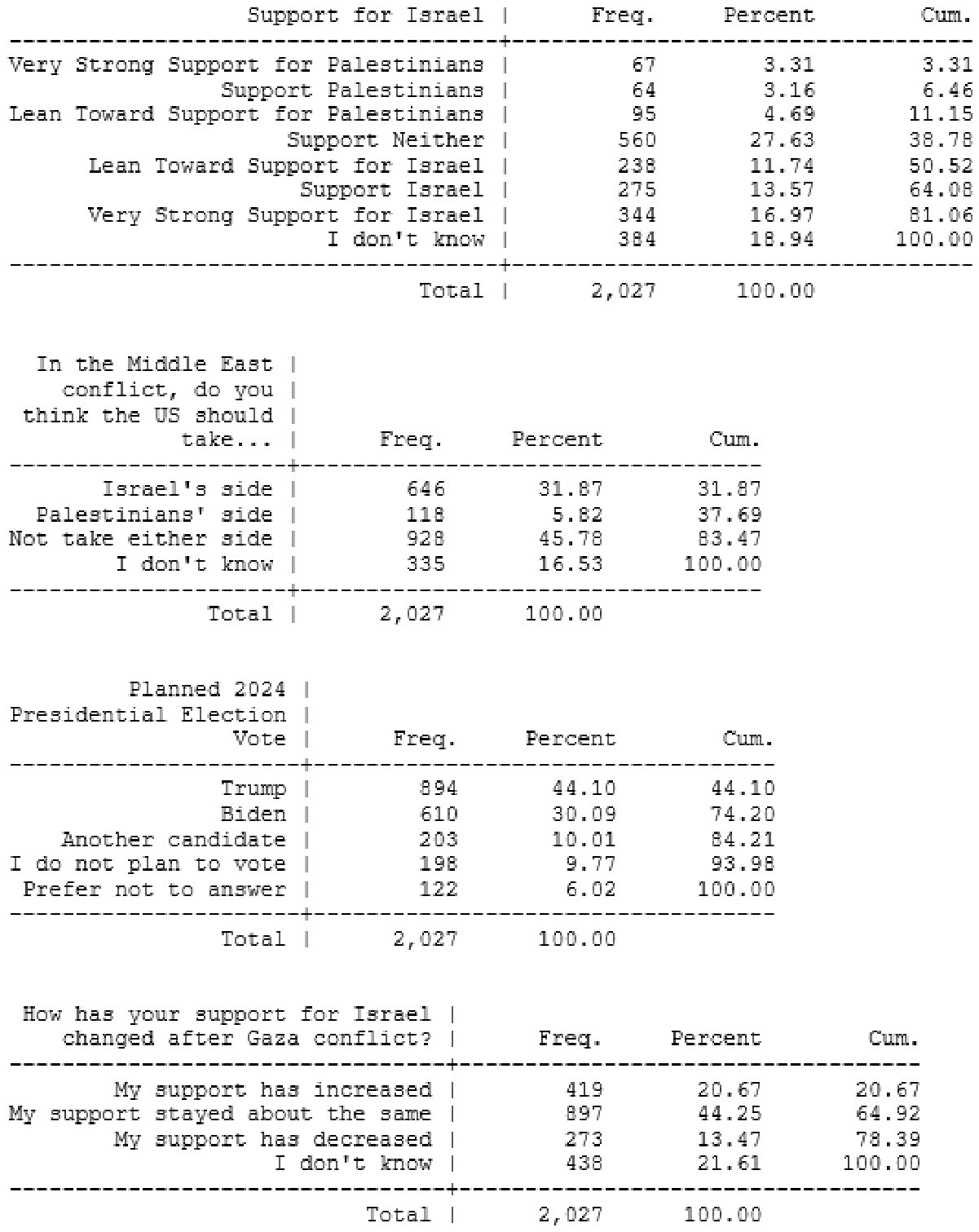
We provide basic tabulations of the responses to show these variables’ structure:
Figure A2. Coding structure and distributions for additional variables.
Religions 17 00829 g0a2
We include these three variables alongside the original model’s variables and estimate five statistical models: OLS linear regression, ordinal logistic regression with full proportional odds, generalized ordinal logistic model with partial proportional odds (gologit2), zero-inflated negative binomial (ZINB) model, and manually specified Hurdle model (we run a logistic regression for the “hurdle”—i.e., crossing into any antisemitism—and a Truncated Poisson for the “intensity” of antisemitic sentiment). The latter two help us to ensure that our findings are not sensitive to the distributional assumptions of our models.
What is most notable is how robust our results to every model specification and every modeling assumption that we subject this data to—the relationship between anti-Zionism and antisemitism is not spurious or the result of misattribution. In every specification, the relationship between anti-Zionism and antisemitism remained stable and statistically significant (p < 0.001), even when controlling for partisan alignment, Middle East policy preferences, and changes in support for Israel following the 7 October war—plus, all of the other variables included in the original model. Moreover, practically every other statistically significant variable from the original model retains its significance in all of the alternative model specifications. The only exception to this is the sensitivity of “Northeast” regional dummy and “concern about economic inequality” variable to model specifications (former becomes significant, latter becomes insignificant in some models).
Lastly, variables capturing specific policy disagreements regarding the current war are generally not statistically significant, suggesting that the relationships we observe are rooted in stable frameworks rather than transient policy stances. We recognize that our conceptualization of “foreign policy disagreement” (side-taking, prospective 2024 presidential vote choice, and changing support for Israel due to the war) may differ from some readers’ conception, but the variables that we tried as proxies show that this is effectively white noise in our model. We can thus confidently confirm that people in our sample who are mad at Israel’s war policies are no more likely to believe antisemitic tropes than anyone else in our sample. Anti-Zionism is associated with antisemitism beyond general political and foreign-policy attitudes toward Israel and the United States.
Table A1. Zero-inflated negative binomial model predicting antisemitism index.
VariableCount Equation: Coefficient (Robust SE)Inflation Equation: Coefficient (Robust SE)
Support for Israel−0.07(0.039)
Preferred US policy on Israeli-Palestinian conflict
    Israel’s side(baseline)
    Palestinians’ side0.04(0.162)
    Not take either side0.08(0.115)
    I don’t know−0.49(0.175)**
Presidential vote in 2024
    Trump(baseline)
    Biden0.00(0.124)
    Another candidate−0.21(0.176)
    I do not plan to vote0.48(0.174)**
    Prefer not to answer0.00(0.223)
Change in support for Israel after Gaza invasion
    My support has increased(baseline)
    My support stayed about the same0.07(0.112)
    My support has decreased−0.16(0.149)
    I don’t know−0.10(0.209)
Catholic0.12(0.137)
Evangelical−0.02(0.124)
Religiosity (frequency of church attendance)0.01(0.025)
Exposure to Jewish friends and religious customs−0.01(0.035)
Crucifixion blame0.03(0.131)
Supersessionism0.36(0.085)***
Anti-Zionism index0.33(0.042)***
Perceived economic injustice0.04(0.019)*
Knowledge about Israeli-Palestinian dispute0.00(0.041)
Ideology (conservative)0.07(0.034)*
Household income−0.01(0.025)
Educational attainment−0.01(0.034) 0.24(0.123)*
Gender (female)−0.12(0.102) 1.50(0.653)*
Marital status (married)−0.03(0.095)
African American respondent0.00(0.133)
Hispanic/Latino respondent−0.14(0.154)
Age cohorts−0.15(0.051)**
Southeast (region of residence)0.14(0.096)
Northeast (region of residence)0.31(0.134)*
Urban residence0.21(0.100)*
Constant0.06(0.338) −3.26(0.885)***
Ancillary/dispersion parameter
    /lnalpha−0.83(0.246)***95% CI: [−1.315, −0.352]
    alpha0.434(0.107) 95% CI: [0.268, 0.703]
Model statistics
    N (observations)1026
    Non-zero observations603
    Zero observations423
    Wald X2400.52
    Prob > X20.000
    Log pseudolikelihood−1720.291
Note: The count equation models the expected count of endorsed antisemitic tropes. The inflation equation is a logit model predicting membership in the always-zero process; positive coefficients indicate greater odds of structural zero membership. Robust standard errors are in parentheses; * p < 0.05; ** p < 0.01; *** p < 0.001.
Table A2. Two-part hurdle specification: logistic model for any endorsement and truncated Poisson model among endorsers.
VariableLogit: Odds Ratio
(Robust SE)
Truncated Poisson: Coefficient
(Robust SE)
Support for Israel1.076 (0.099) −0.072 (0.035)*
Preferred US policy on Israeli-Palestinian conflict
    Israel’s side(baseline)
    Palestinians’ side0.820 (0.348) 0.044 (0.133)
    Not take either side1.365 (0.333) 0.079 (0.106)
    I don’t know0.891 (0.332) −0.461 (0.200)*
Presidential vote in 2024
    Trump(baseline)
    Biden0.724 (0.177) 0.079 (0.106)
    Another candidate0.518 (0.159)*−0.078 (0.146)
    I do not plan to vote1.649 (0.576) 0.270 (0.152)
    Prefer not to answer1.072 (0.532) −0.126 (0.241)
Change in support for Israel after Gaza invasion
    My support has increased(baseline)
    My support stayed about the same1.131 (0.248) 0.042 (0.110)
    My support has decreased0.813 (0.278) −0.071 (0.121)
    I don’t know0.379 (0.149)*0.228 (0.167)
Catholic0.888 (0.208) 0.173 (0.133)
Evangelical1.065 (0.231) 0.016 (0.130)
Religiosity (frequency of church attendance)1.084 (0.051) −0.015 (0.023)
Exposure to Jewish friends and religious customs0.921 (0.056) 0.009 (0.033)
Crucifixion blame1.383 (0.459) −0.010 (0.120)
Supersessionism1.205 (0.210) 0.367 (0.082)***
Anti-Zionism index1.842 (0.196)***0.221 (0.038)***
Perceived economic injustice1.041 (0.037) 0.025 (0.018)
Knowledge about Israeli-Palestinian dispute0.835 (0.077)*0.038 (0.036)
Ideology (conservative)1.105 (0.079) 0.042 (0.029)
Household income0.957 (0.051) −0.008 (0.024)
Educational attainment0.909 (0.058) −0.007 (0.029)
Gender (female)0.502 (0.087)***−0.145 (0.085)
Marital status (married)1.274 (0.240) −0.122 (0.088)
African American respondent1.520 (0.484) −0.161 (0.112)
Hispanic/Latino respondent1.184 (0.344) −0.200 (0.135)
Age cohorts0.817 (0.084)*−0.112 (0.042)**
Southeast (region of residence)1.057 (0.200) 0.177 (0.087)*
Northeast (region of residence)1.589 (0.416) 0.177 (0.110)
Urban residence1.149 (0.239) 0.180 (0.084)*
Constant1.106 (0.766) 0.524 (0.300)
Model statistics
    Observations1026 603
    Wald X2107.11 371.99 (31)
    Prob > X20.000 0.000
    Log pseudolikelihood−598.186 −1123.933
    Pseudo R20.119
Note: The logistic model predicts whether a respondent endorsed at least one antisemitic trope; entries are odds ratios. The truncated Poisson model predicts the count of endorsed tropes among respondents with at least one endorsement (lower truncation limit = 0); entries are log-count coefficients. Robust standard errors are in parentheses. * p < 0.05, ** p < 0.01, *** p < 0.001.

Notes

1
This debate also unfolds within a broader scholarly discussion about the relationship between academic research on antisemitism and the categories advanced by Jewish communal organizations, advocacy institutions, and policy bodies. Scholars have cautioned that definitions of antisemitism are not merely descriptive instruments but also carry political, institutional, and normative implications (Judaken 2024). Others have emphasized the need to distinguish anti-Jewish prejudice from anti-Zionism, anti-Israel politics, postcolonial critique, and competing understandings of Jewish collective identity (Klug 2013; Loeffler 2026). At the same time, scholarship on philosemitism and Christian-Jewish relations reminds us that positive attention to Jews and Israel can also reflect ambivalent or instrumental theological assumptions rather than simple tolerance (Karp and Sutcliffe 2011). We therefore approach the anti-Zionism/antisemitism relationship as an empirical question rather than as a definitional presumption.
2
We use this battery because it is a widely recognized and historically comparable survey instrument, not because we treat the ADL as an interpretive authority or adopt its institutional positions on antisemitism, anti-Zionism, or Israel. The authors have no financial, institutional, or research relationship with the ADL.
3
The question asks: “Have you heard of the Boycott, Divestment, and Sanctions (BDS) Movement? Do you support it?” Respondents were given the following options: “I have heard of BDS and support it completely,” “I have heard of BDS and support it moderately,” “I have heard of BDS and oppose it moderately,” “I have heard of BDS and oppose it completely,” and “I have not heard of the BDS movement.” Those who said that they support BDS moderately or completely were coded into the anti-Zionism index. As noted above and discussed further in the appendix, we do not treat endorsement of any single Israel-related item—including the Jerusalem or BDS items—as inherently antisemitic or as conclusive evidence of anti-Zionism; our claim concerns the broader empirical pattern produced by the full index.
4
In the generalized ordinal logistic regression (gologit2) output, category 8 serves as the implicit baseline for the partial proportional odds model. Consequently, odds ratios for categories 0–7 are interpreted relative to the top category (8), not the bottom. This is standard in ordinal regression when the top category is used as the reference, and it does not affect substantive conclusions: lower categories’ odds ratios indicate the odds of being in that category versus the highest one.
5
It is statistically insignificant at levels 5 and 7, and statistically significant, but slightly reduced in its impact at level 6, in comparison to level 4.
6
To preempt potential concerns that a measure of partisanship would perform better than ideology, we re-estimated the models using party identification dummy variables (Democrat, Republican, Independent) in place of ideology. The results of the model are substantively unchanged, except that party identification is not statistically significant in the fully specified models (with the minor exception of Independents at the highest threshold), and the estimated effects of anti-Zionism and other key predictors remain stable. We therefore retain ideology as our preferred specification, both because it better captures the underlying construct of interest and because it facilitates cross-national comparability in our broader research, where party identification is not consistently measured across contexts.
7
In the gologit2 output, category 8 serves as the implicit baseline for the partial proportional odds model. Consequently, odds ratios for categories 0–7 are interpreted relative to the top category (8), not the bottom. This is standard in ordinal regression when the top category is used as the reference, and it does not affect substantive conclusions: lower categories’ ORs indicate the odds of being in that category versus the highest one.

References

  1. ADL. 2023a. A Closer Look at the Relationship Between Holocaust Knowledge, Education and Antisemitism. ADL, April 14. Available online: https://www.adl.org/resources/article/closer-look-relationship-between-holocaust-knowledge-education-and-antisemitism (accessed on 14 May 2026).
  2. ADL. 2023b. Antisemitic Attitudes in America: Topline Findings. ADL, January 12. Available online: https://www.adl.org/resources/report/antisemitic-attitudes-america-topline-findings (accessed on 14 May 2026).
  3. ADL. 2025. The ADL Global 100: Index of Antisemitism. Available online: https://www.adl.org/adl-global-100-index-antisemitism (accessed on 14 May 2026).
  4. Ariel, Yaakov. 2013. An Unusual Relationship: Evangelical Christians and Jews. New York: NYU Press. [Google Scholar]
  5. Berger, David, ed. 1986. History and Hate: Dimensions of Anti-Semitism. Philadelphia: The Jewish Publication Society. [Google Scholar]
  6. Bergmann, Werner. 2008. Anti-Semitic Attitudes in Europe: A Comparative Perspective. Journal of Social Issues 64: 343–62. [Google Scholar] [CrossRef]
  7. Bilewicz, Michal, Mikołaj Winiewski, Mirosław Kofta, and Adrian Wójcik. 2013. Harmful Ideas, The Structure and Consequences of Anti-Semitic Beliefs in Poland. Political Psychology 34: 821–39. [Google Scholar] [CrossRef]
  8. Bonikowski, Bart. 2017. Ethno-Nationalist Populism and the Mobilization of Collective Resentment. British Journal of Sociology 68: 181–213. [Google Scholar] [CrossRef]
  9. Borgonovi, Francesca. 2012. The Relationship between Education and Levels of Trust and Tolerance in Europe. British Journal of Sociology 63: 146–67. [Google Scholar] [CrossRef] [PubMed]
  10. Bumin, Kirill, Philip A. Cunningham, Adam Gregerman, and Motti Inbari. 2023. American Catholic Attitudes toward Jews, Judaism, and the Israeli-Palestinian Conflict. Studies in Christian-Jewish Relations 18: 1–22. [Google Scholar] [CrossRef]
  11. Butler, Judith. 2012. Parting Ways: Jewishness and the Critique of Zionism. New York: Columbia University Press. [Google Scholar]
  12. Claims Conference. 2020. First-Ever 50-State Survey on Holocaust Knowledge of American Millennials and Gen Z Reveals Shocking Results. Claims Conference; Available online: https://www.claimscon.org/millennial-study/?utm_campaign=shareaholic&utm_medium=email_this&utm_source=email (accessed on 14 May 2026).
  13. Clouse, Robert. 1977. The Meaning of the Millennium: Four Views. Downers Grove: InterVarsity Press. [Google Scholar]
  14. Cohen, Jeffrey E. 2018. From Antisemitism to Philosemitism? Trends in American Attitudes Toward Jews from 1964–2016. Religions 9: 107–28. [Google Scholar] [CrossRef]
  15. Cohen, Jeffrey E. 2024. Ideology and attitudes toward Jews in US public opinion: A reconsideration. Religions 15: 59. [Google Scholar] [CrossRef]
  16. Cohen, Jeremy. 2007. Christ Killers: The Jews and the Passion from the Bible to the Big Screen. New York: Oxford University Press. [Google Scholar]
  17. Federico, Christopher M., and Jim Sidanius. 2002. Racism, Ideology, and Affirmative Action Revisited: The Antecedents and Consequences of “Principled Objections” to Affirmative Action. Journal of Personality and Social Psychology 82: 488–502. [Google Scholar] [CrossRef] [PubMed]
  18. Feinberg, Ayal. 2020. Explaining Ethnoreligious Minority Targeting: Variation in U.S. Anti-Semitic Incidents. Perspectives on Politics 18: 770–87. [Google Scholar] [CrossRef]
  19. Feldman, Jonathan. 2018. Toward a History of the Term ‘Anti-Semitism’. The American Historical Review 123: 1139–50. [Google Scholar] [CrossRef]
  20. Glick, Peter. 2002. Sacrificial Lambs Dressed in Wolves’ Clothing: Envious Prejudice, Ideology, and the Scapegoating of Jews. In Understanding Genocide: The Social Psychology of the Holocaust. Edited by Leonard S. Newman and Ralph Erber. New York: Oxford University Press, pp. 113–42. [Google Scholar]
  21. Golebiowska, Ewa A. 1995. Individual Value Priorities, Education, and Political Tolerance. Political Behavior 17: 23–48. [Google Scholar] [CrossRef]
  22. Greenblatt, Johnathan. 2024. The growing antisemitism among young Americans. Time, March 21. Available online: https://time.com/6958957/growing-antisemitism-young-americans/ (accessed on 14 May 2026).
  23. Harrison, Bernard. 2020. Blaming the Jews. Bloomington: Indiana University Press. [Google Scholar]
  24. Hersh, Eitan, and Laura Royden. 2022. Antisemitic Attitudes Across the Ideological Spectrum. Political Research Quarterly 76: 697–711. [Google Scholar] [CrossRef]
  25. Heslep, Daniel G., and Persephone S. Berge. 2021. Mapping Discord’s Darkside: Distributed Hate Networks on Disboard. Paper presented at AoIR 2021: The 22nd Annual Conference of the Association of Internet Researchers, Virtual Event, October 13–16; Available online: http://spir.aoir.org (accessed on 5 July 2026).
  26. Hirsh, David. 2018. Contemporary Left Antisemitism. London: Routledge. [Google Scholar]
  27. Hummel, Daniel. 2019. Covenant Brothers: Evangelicals, Jews, and U.S-Israel Relations. Philadelphia: University of Pennsylvania Press. [Google Scholar]
  28. IHRA (International Holocaust Remembrance Alliance). 2016. Working Definition of Antisemitism. Available online: https://holocaustremembrance.com/resources/working-definition-antisemitism (accessed on 14 May 2026).
  29. Inbari, Motti, and Kirill Bumin. 2024. Christian Zionism in the Twenty-Frist Century: American Evangelical Public Opinion on Israel. New York: Oxford University Press. [Google Scholar]
  30. Jacobs, Jill. 2024. Criticism of Israel and Antisemitism: How to Tell Where One Ends and the Other Begins. New York: T’ruah—The Rabbinic Call for Human Rights. Available online: https://truah.org/resources/criticism-of-israel-and-antisemitism-how-to-tell-where-one-ends-and-the-other-begins/ (accessed on 14 May 2026).
  31. Jerusalem Declaration on Antisemitism. 2021. Available online: https://jerusalemdeclaration.org/ (accessed on 24 June 2026).
  32. Judaken, Jonathan. 2024. Critical Theories of Anti-Semitism. New York: Columbia University Press. [Google Scholar]
  33. JVP (Jewish Voice for Peace). n.d.FAQ: About JVP. Available online: https://www.jewishvoiceforpeace.org/faq/ (accessed on 14 May 2026).
  34. Kaplan, Edward H., and Charles A. Small. 2006. Anti-Israel Sentiment Predicts Anti-Semitism in Europe. Journal of Conflict Resolution 50: 548–61. [Google Scholar] [CrossRef]
  35. Karp, Jonathan, and Adam Sutcliffe. 2011. Philosemitism in History. New York: Cambridge University Press. [Google Scholar]
  36. Kertzer, David I. 2001. The Popes Against the Jews: The Vatican’s Role in the Rise of Modern Anti-Semitism. New York: Knopf. [Google Scholar]
  37. Klug, Brian. 2013. Interrogating ‘New Anti-Semitism’. Ethnic & Racial Studies 36: 468–82. [Google Scholar] [CrossRef]
  38. Krause, Phillip Allen. 2016. To Stand Aside or Stand Alone: Southern Reform Rabbis and the Civil Rights Movement. Tuscaloosa: The University of Alabama Press. [Google Scholar]
  39. Lipstadt, Deborah. 2019. Antisemitism: Here and Now. New York: Penguin Random House. [Google Scholar]
  40. Loeffler, James. 2026. Exceptional Hatred: Antisemitism and the Fight over Free Speech in Modern America. New York: Macmillan Publishers. [Google Scholar]
  41. Marcus, Kenneth L. 2007. Anti-Zionism as Racism: Campus Anti-Semitism and the Civil Rights Act of 1964. William & Mary Bill of Rights Journal 15: 837–91. [Google Scholar]
  42. Matovina, Timothy. 2012. Latino Catholicism: Transformation in America’s Largest Church. Princeton: Princeton University Press. [Google Scholar]
  43. Mudde, Cas. 2019. The Far Right Today. Medford: Polity Press. [Google Scholar]
  44. Nelson, Cary. 2019. Israel Denial: Anti-Zionism, Antisemitism and the Faculty Campaign against the Jewish State. Bloomington: Indiana University Press. [Google Scholar]
  45. Nirenberg, David. 2013. Anti-Judaism: The Western Tradition. New York: W. W. Norton & Company. [Google Scholar]
  46. Olson, Jason. 2018. America’s Road to Jerusalem: The Impact of the Six-Day War on Protestant Politics. Lanham: Lexington Books. [Google Scholar]
  47. Pessin, Andrew. 2023. Epistemic Antisemitism, or ‘Good People Gone Wild:’ How Decent People Can Be Antisemites and Not Even Know It. In Poisoning the Wells Antisemitism in Contemporary America. Edited by Corinne E. Blackmer and Andrew Pessin. Newton: Academic Studies Press. [Google Scholar]
  48. Petersen, Roger D. 2001. Understanding Ethnic Violence: Fear, Hatred, and Resentment in Twentieth-Century Eastern Europe. Cambridge: Cambridge University Press. [Google Scholar]
  49. Pettigrew, Thomas F., and Linda R. Tropp. 2006. A Meta-Analytic Test of Intergroup Contact Theory. Journal of Personality and Social Psychology 90: 751–83. [Google Scholar] [CrossRef] [PubMed]
  50. Rosenfeld, Alvin H., ed. 2019. Anti-Zionism and Antisemitism: The Dynamics of Delegitimization. Bloomington: Indiana University Press. [Google Scholar]
  51. Rynhold, Jonathan. 2015. The Arab-Israeli Conflict in American Political Culture. New York: Cambridge University Press. [Google Scholar]
  52. Shenhav-Goldberg, Rachel, and Jeffrey S. Kopstein. 2020. Antisemitism on a California Campus: Perceptions and Views among Students. Contemporary Jewry 40: 237–58. [Google Scholar] [CrossRef]
  53. Smith, Gregory, Alan Cooperman, Becka Alper, Besheer Mohamed, Chip Rotolo, Patricia Tevington, Justin Nortey, Asta Kallo, Jeff Diamant, and Dalia Fahmy. 2025. Decline of Christianity in the U.S. Has Slowed, May Have Leveled Off. Pew Research Center, February 26. Available online: https://www.pewresearch.org/religion/2025/02/26/decline-of-christianity-in-the-us-has-slowed-may-have-leveled-off/ (accessed on 14 May 2026).
  54. Smith, Tom W., and Benjamin Schapiro. 2019. Antisemitism in Contemporary America. In American Jewish Yearbook 2018. Edited by Dashefsky Arnold and Ira M. Sheskin. Storrs: Center for Judaic Studies and Contemporary Jewish Life, University of Connecticut, pp. 113–62. [Google Scholar]
  55. Soulen, Richard K. 1996. The God of Israel and Christian Theology. Minneapolis: Fortress Publishing. [Google Scholar]
  56. Staetsky, Daniel L. 2017. Antisemitism in Contemporary Great Britain. A Study of Attitudes Towards Jews and Israel. London: Institute for Jewish Policy Research. [Google Scholar]
  57. Task Force. 2025. Presidential Task Force on Combating Antisemitism and Anti-Israeli Bias. Cambridge: Harvard University. [Google Scholar]
  58. Ury, Scott, and Guy Miron. 2023. Antisemitism and the Politics of History. Waltham: Brandeis University Press. [Google Scholar]
  59. Von Mering, Sabine. 2022. The Dark Side of Social Media: How It Fuels Antisemitism. Waltham: Brandeis University. Available online: https://www.brandeis.edu/jewish-experience/social-justice/2022/may/antisemitism-social-media.html (accessed on 14 May 2026).
  60. Weiss, Bari. 2019. How to Fight Anti-Semitism. New York: Crown. [Google Scholar]
  61. Williams, Richard. 2006. Generalized Ordered Logit/Partial Proportional Odds Models for Ordinal Dependent Variables. The Stata Journal 6: 58–82. [Google Scholar] [CrossRef]
  62. Wistrich, Robert S. 2020. A Lethal Obsession: Anti-Semitism from Antiquity to the Global Jihad. New York: Random House. [Google Scholar]
  63. Zannettou, Savvas, Joel Finkelstein, Barry Bradlyn, and Jeremy Blackburn. 2020. A Quantitative Approach to Understanding Online Antisemitism. In Proceedings of the Fourteenth International AAAI Conference on Web and Social Media. ICWSM 2020. Palo Alto: Association for the Advancement of Artificial Intelligence. Available online: https://cdn.aaai.org/ojs/7343/7343-28-10573-1-10-20200601.pdf (accessed on 4 August 2025).
  64. Zawadzki, Bohdan. 1948. Limitations of the Scapegoat Theory of Prejudice. Journal of Abnormal and Social Psychology 43: 127–41. [Google Scholar] [CrossRef]
Figure 1. Anti-Jewish Tropes Endorsed by American Christians.
Religions 17 00829 g001
Figure 2. Antisemitism Index.
Religions 17 00829 g002
Figure 3. Anti-Zionist Attitudes.
Religions 17 00829 g003
Figure 4. Distribution of Anti-Zionism Scores Among Respondents.
Religions 17 00829 g004
Table 1. Predictors of Antisemitism: Generalized Ordinal Logistic Regression Results.
No AntisemitismEndorsed 1 TropeEndorsed 2 TropesEndorsed 3 TropesEndorsed 4 TropesEndorsed 5 TropesEndorsed 6 TropesEndorsed 7+ Tropes
VariableOdds RatiosOdds RatiosOdds RatiosOdds RatiosOdds RatiosOdds RatiosOdds RatiosOdds Ratios
Catholic1.254(0.230) 1.254(0.230) 1.254(0.230) 1.254(0.230) 1.254(0.230) 1.254(0.230) 1.254(0.230) 1.254(0.230)
Evangelical1.260(0.236) 1.088(0.207) 0.964(0.207) 0.629(0.153) 1.036(0.304) 1.027(0.328) 1.046(0.514) 0.347(0.267)
Frequency of church attendance1.079(0.047) 1.051(0.049) 1.033(0.050) 1.056(0.057) 0.797(0.058)**0.915(0.089) 0.834(0.095) 1.028(0.156)
Exposure to Jewish people and customs0.935(0.056) 0.959(0.064) 0.958(0.070) 0.954(0.075) 1.016(0.083) 0.911(0.096) 1.234(0.190) 0.766(0.155)
Belief that Jews crucified Jesus (deicide)1.323(0.293) 1.323(0.293) 1.323(0.293) 1.323(0.293) 1.323(0.293) 1.323(0.293) 1.323(0.293) 1.323(0.293)
Supersessionism1.095(0.175) 1.578(0.260)**1.729(0.317)**2.160(0.459)***6.959(2.054)***8.026(2.686)***0.930(0.414) 0.761(0.600)
Anti-Zionism index1.725(0.148)***1.863(0.157)***2.120(0.173)***2.017(0.176)***2.089(0.215)***1.920(0.215)***2.794(0.427)***2.712(0.585)***
Concern about economic injustice in the US1.044(0.037) 1.076(0.043) 1.086(0.045)*1.132(0.049)**1.024(0.051) 0.981(0.056) 1.498(0.152)***0.879(0.158)
Self-reported knowledge of Israeli-Palestinian conflict0.915(0.064) 0.915(0.064) 0.915(0.064) 0.915(0.064) 0.915(0.064) 0.915(0.064) 0.915(0.064) 0.915(0.064)
Ideology1.174(0.069)**1.082(0.067) 1.119(0.070) 1.131(0.084) 1.107(0.085) 1.022(0.098) 0.762(0.093) 1.037(0.170)
Income0.942(0.045) 0.955(0.048) 0.938(0.049) 1.005(0.060) 1.081(0.073) 1.125(0.099) 0.450(0.087)***0.607(0.129)*
Education0.948(0.058) 0.935(0.059) 0.886(0.064) 0.773(0.066)**0.771(0.069)**0.847(0.089) 1.138(0.150) 1.022(0.173)
Female respondent0.461(0.064)***0.461(0.064)***0.461(0.064)***0.461(0.064)***0.461(0.064)***0.461(0.064)***0.461(0.064)***0.461(0.064)***
Married respondent1.185(0.174) 1.185(0.174) 1.185(0.174) 1.185(0.174) 1.185(0.174) 1.185(0.174) 1.185(0.174) 1.185(0.174)
Black respondent1.278(0.338) 1.641(0.433) 1.629(0.422) 1.323(0.376) 1.058(0.336) 1.221(0.534) 0.027(0.024)***0.284(0.301)
Hispanic respondent1.044(0.285) 0.887(0.257) 0.942(0.295) 0.717(0.274) 2.310(0.938)*0.570(0.268) 1.588(1.047) 3.502(2.755)
Age groups0.816(0.062)**0.816(0.062)**0.816(0.062)**0.816(0.062)**0.816(0.062)**0.816(0.062)**0.816(0.062)**0.816(0.062)**
South1.094(0.192) 1.034(0.182) 1.106(0.215) 1.376(0.295) 1.572(0.389) 0.908(0.270) 2.888(1.228)*6.130(3.886)**
Northeast1.250(0.270) 1.250(0.270) 1.250(0.270) 1.250(0.270) 1.250(0.270) 1.250(0.270) 1.250(0.270) 1.250(0.270)
Urban resident1.035(0.203) 1.156(0.221) 1.616(0.319)*2.152(0.463)***3.365(0.834)***1.518(0.485) 3.224(1.456)*0.855(0.663)
Constant0.798(0.368) 0.283(0.147)*0.121(0.066)***0.062(0.040)***0.032(0.021)***0.039(0.028)***0.030(0.030)***0.241(0.480)
N (observations)1145
Log pseudolikelihood−1652.34
Wald X2453.77
Prob > X20.000
McKelvey and Zavoina’s R20.240
Pseudo R20.177
Difference of BIC’ parameters2740.112
Note: Robust standard errors are reported in parentheses; all significance tests are two-tailed; reported difference of BIC’ parameters indicates that fully-specified model (one that includes all of the variables above) is more likely to have generated the data than the null model (with only demographic variables); McKelvey and Zavoina’s R2 provides the closest approximation of Adjusted R2 statistic found in OLS; * p < 0.05; ** p < 0.01; *** p < 0.001.
Disclaimer/Publisher’s Note: The statements, opinions and data contained in all publications are solely those of the individual author(s) and contributor(s) and not of MDPI and/or the editor(s). MDPI and/or the editor(s) disclaim responsibility for any injury to people or property resulting from any ideas, methods, instructions or products referred to in the content.