When Does Anti-Zionism Become Antisemitism? Evidence from Self-Identified American Christians


Abstract
1. When Does Anti-Zionism Become Antisemitism? Evidence from Self-Identified American Christians
2. The Survey
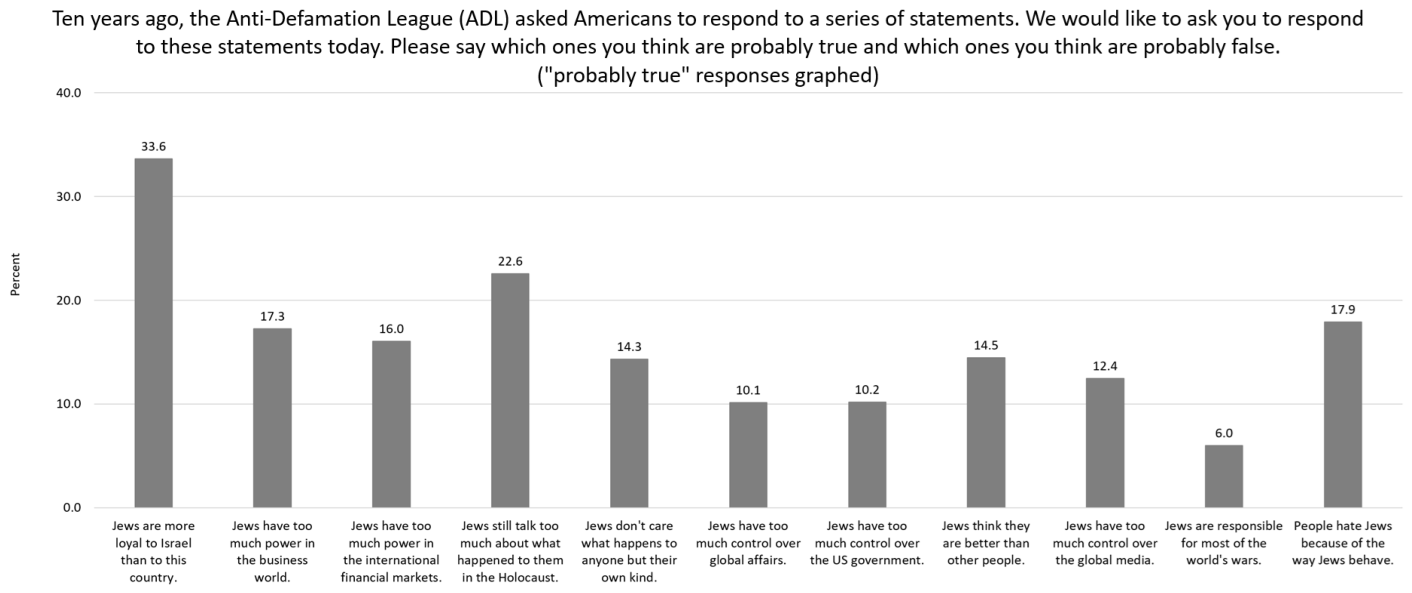
- Jews are more loyal to Israel than to this country.
- Jews have too much power in the business world.
- Jews have too much power in the international financial markets.
- Jews still talk too much about what happened to them in the Holocaust.
- Jews don’t care what happens to anyone but their own kind.
- Jews have too much control over global affairs.
- Jews have too much control over the United States government.
- Jews think they are better than other people.
- Jews have too much control over the global media.
- Jews are responsible for most of the world’s wars.
- People hate Jews because of the way Jews behave.
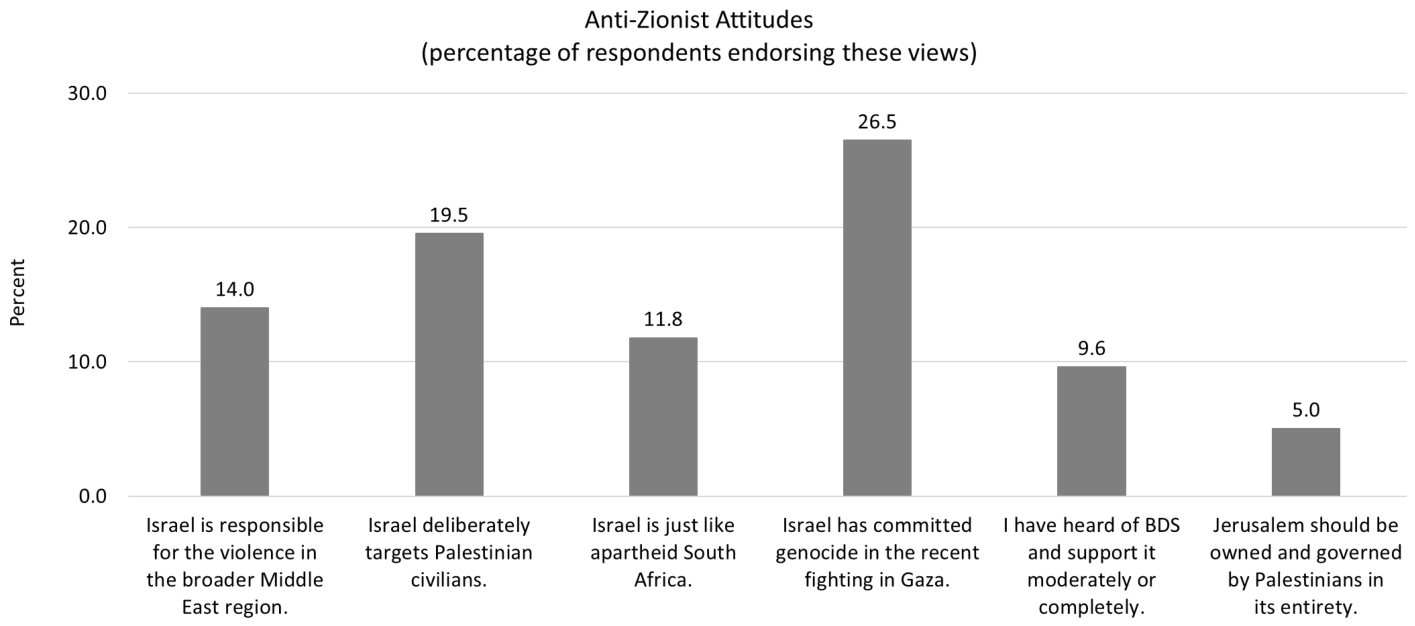
- Israel is responsible for the violence in the broader Middle East region.
- Israel deliberately targets Palestinian civilians.
- Israel is just like apartheid South Africa.
- Israel has committed genocide in the recent fighting in Gaza.
- Jerusalem, in its entirety, should be the capital of Palestine, and its governance should not be shared with Israel.
- I have heard of the Boycott, Divestment, and Sanctions (BDS) Movement and support it moderately/completely.3
3. Methodology and Statistical Findings
4. Conclusions
Author Contributions
Funding
Data Availability Statement
Conflicts of Interest
Appendix A. Summary Statistics and Variable Coding Procedures
Appendix A.1. Summary Statistics
| Obs. | Mean | Std. dev. | Min | Max | |
| Antisemitism index (dependent variable) | 2027 | 1.745 | 2.472 | 0 | 11 |
| Anti-Zionism index | 2027 | 0.718 | 1.130 | 0 | 4 |
| Catholic denomination | 2027 | 0.391 | 0.488 | 0 | 1 |
| Evangelical denomination | 2027 | 0.381 | 0.486 | 0 | 1 |
| Frequency of church attendance | 2027 | 2.739 | 1.878 | 0 | 6 |
| Exposure to Jewish friends, customs | 2027 | 1.523 | 1.299 | 0 | 6 |
| Deicide belief (Jews punished for crucifying Jesus) | 1840 | 0.084 | 0.278 | 0 | 1 |
| Supersessionism | 1258 | 0.424 | 0.494 | 0 | 1 |
| Concerned about economic inequality in the U.S. | 2027 | 6.248 | 2.463 | 0 | 9 |
| Self-reported knowledge about Israeli-Palestinian dispute | 2027 | 2.186 | 1.212 | 0 | 4 |
| Ideology | 2027 | 3.354 | 1.556 | 0 | 6 |
| Far right (extremely conservative) ideological identification | 2027 | 0.083 | 0.277 | 0 | 1 |
| Far left (extremely liberal) ideological identification | 2027 | 0.046 | 0.210 | 0 | 1 |
| Income | 1933 | 2.482 | 1.852 | 0 | 6 |
| Educational attainment | 2027 | 2.663 | 1.429 | 0 | 5 |
| Gender (female) | 2016 | 0.548 | 0.498 | 0 | 1 |
| Marital status (married) | 2027 | 0.429 | 0.495 | 0 | 1 |
| African American respondent | 2027 | 0.131 | 0.338 | 0 | 1 |
| Hispanic/Latino respondent | 2027 | 0.123 | 0.328 | 0 | 1 |
| Age cohorts | 2027 | 1.508 | 0.993 | 0 | 3 |
| South (region of residence) | 2027 | 0.406 | 0.491 | 0 | 1 |
| Northeast (region of residence) | 2027 | 0.186 | 0.390 | 0 | 1 |
| Urban residence | 2027 | 0.260 | 0.439 | 0 | 1 |
| Eschatology x frequency of church attendance | |||||
| Amillennial beliefs reinforced through church attendance | 2027 | 1.069 | 1.747 | 0 | 5 |
| Postmillennial beliefs reinforced through church attendance | 2027 | 0.561 | 1.368 | 0 | 5 |
| Premillennial beliefs reinforced through church attendance | 2027 | 0.781 | 1.625 | 0 | 5 |
Appendix A.2. Variable Descriptions and Coding Procedures
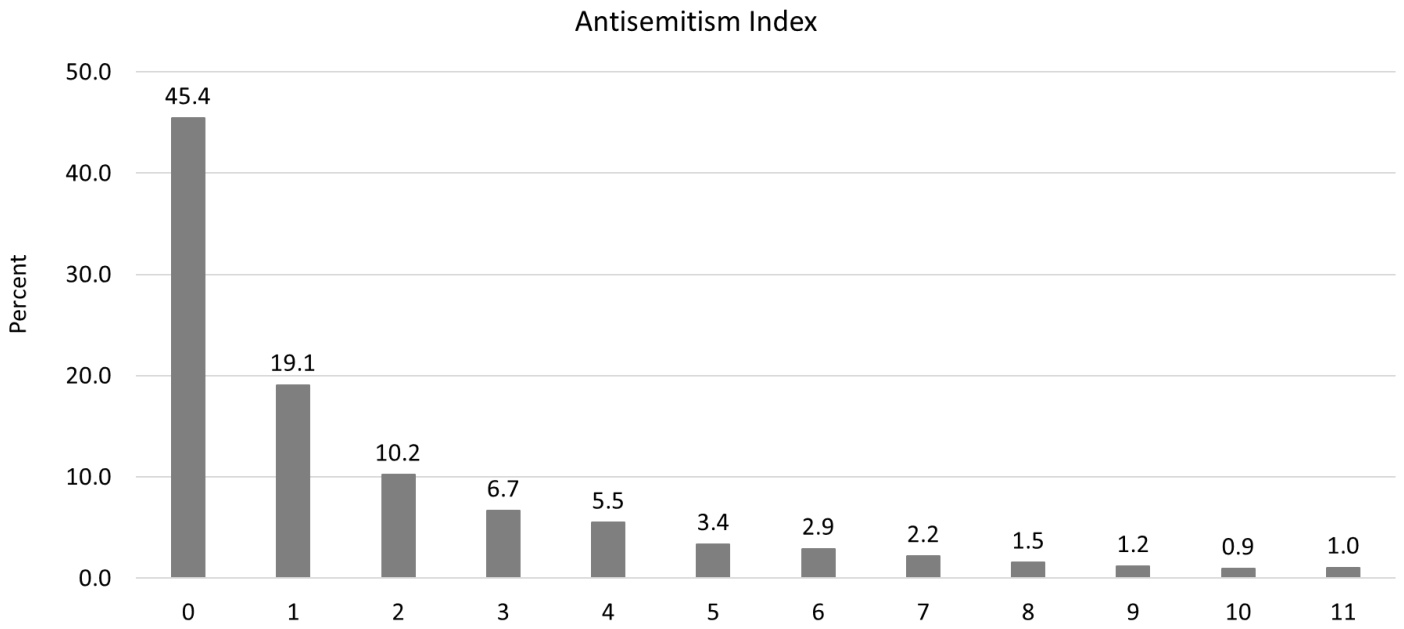
- Antisemitism Index (dependent variable)—Additive index based on “probably true” responses to 11 antisemitic statements developed by the Anti-Defamation League (ADL); ranges from zero to 11.
- Anti-Zionism Index—Additive index based on “probably true” responses to 4 statements that are critical of Israel; ranges from zero to 4. Statements include: “Israel is responsible for the violence in the broader Middle East region.”, “Israel deliberately targets Palestinian civilians.”, “Israel is just like apartheid South Africa.”, and “Israel has committed genocide in the recent fighting in Gaza.”
- Catholic Denomination—self-identification as Catholic or Roman Catholic; coded 1 and zero otherwise.
- Evangelical Denomination—self-identification as evangelical and/or born-again Protestant; coded 1 and zero otherwise.
- Frequency of Church Attendance (Religiosity)—“Aside from weddings and funerals, on average, how often did you attend church or religious services?” Coded 1 for “Never”; 2 for “Seldom”; 3 for “A few times a year”; 4 for “Once a month”; 5 for “Two or three times a month”; 6 for “At least once a week”; 7 “Daily”.
- Exposure to Jewish People and Customs—additive index that ranges from zero to 6, based on affirmative responses the following statements: “I have socialized with Jewish friends or neighbors.”; “I have worked alongside Jews.”; “I have been present at a Jewish religious service in a synagogue (e.g., a bar mitzvah or sabbath service).”; “I have been present at a Jewish religious service/event in a home (e.g., a Passover seder).”; “I am or used to be Jewish.”; “I have been part of an interfaith family that includes Judaism.”
- Deicide Charge—Based on selecting “The Jews” response option to the “Who bears the blame for the crucifixion of Jesus?” Coded as dichotomous variable.
- Supersessionism—Based on answers to the “Which of the following best expresses your beliefs or feelings about the Jewish people?” Those respondents who selected either “Jews are cursed by God because they crucified Jesus.” or “God’s covenant with Jews has not been entirely replaced but rather fulfilled in Christ.” were coded as 1; other responses coded as zero.
- Economic Inequality Concerns—Ordinal measure based on “On a scale of 1 to 10, with 1 being not concerned at all and 10 being extremely concerned, how concerned are you about the income gap and economic disparities between rich and poor in American society today?”
- Self-Reported Knowledge of the Israeli–Palestinian Conflict—Perceived knowledge of the conflict based on the following question: “How knowledgeable are you about the Israeli-Palestinian conflict?” The following response options were provided: “I have very limited knowledge about the conflict.” (0); “I have a little knowledge about the conflict.” (1); “I have a moderate level of knowledge about the conflict.” (2); “I am very knowledgeable about the conflict.” (3); “I do not know anything about the conflict.” (4). “Don’t know” responses are then recoded as missing values and dropped from the analysis.
- Ideology—Based on responses to the following question: “In general, would you describe your political views as…” Coded zero for “Extremely liberal”; 1 for “Liberal”; 2 for “Slightly liberal”; 3 for “Moderate, middle of the road”; 4 for “Slightly conservative”; 5 for “Conservative”; 6 for “Extremely conservative”. Coded 7 for “Do not know” and then recoded as missing value to drop from analysis.
- Far right (extremely conservative) political orientation—Coded on the basis of the preceding ideology question. Respondents who selected “extremely conservative” political orientation are coded 1 and zero otherwise.
- Far left (extremely liberal) political orientation—Coded on the basis of the preceding ideology question. Respondents who selected “extremely liberal” political orientation are coded 1 and zero otherwise.
- Income—“What was your total household income before taxes during the past 12 months?” Coded 0 for “Less than $25,000”; 1 for “$25,000 to $34,999”; 2 for “$35,000 to $49,999”; 3 for “$50,000 to $74,999”; 4 for “$75,000 to $99,999”; 5 for “$100,000 to $149,999”; 6 for “$150,000 or more”. Coded 7 for “Prefer not to answer” and then recoded as missing value to drop from analysis.
- Educational Attainment—“What is the highest level of education you have completed?” Coded 0 for “some high school”; 1 for “high school graduate”; 2 for “some college”; 3 for “trade/technical/vocational training”; 4 for “bachelor’s degree”; 5 for “post graduate degree”; and 6 for “do not wish to respond.” The latter was dropped from analysis.
- Gender (female)—Question asked “Are you …” Response options included “male,” “female,” “prefer not to answer,” and “gender not listed above.” Recoded zero for “Male” and 1 for “Female.” Other categories recoded as missing values and dropped from the analysis.
- Marital Status (married)—“What is your current marital status?” Coded 1 for “Single/Never married”; 2 for “Separated”; 3 for “Divorced”; 4 for “Widowed”; 5 for “Married”. Coded 6 for “Do not wish to respond” and then recoded as missing value to drop from analysis. We then recoded the variable 1 for “married” and zero otherwise.
- Race/ethnicity—“How do you identify yourself?” Coded 1 for “American Indian or Alaskan Native”; 2 for “Asian”; 3 for “Black or African American”; 4 for “Hispanic or Latino”; 5 for “Multiracial/multiethnic”; 6 for “Native Hawaiian or Other Pacific Islander”; 7 for “White, non-Hispanic”; and 8 for “Other race not listed above”. Additionally, dummy variables for each of the value categories were created, where 1 represented a particular race/ethnicity and zero otherwise.
- Age—“What is your age?” Open-end format that allows the respondent to enter their actual age as a whole number. Due to our interest in cohort effects, we then recoded the variable 0 for “18–29 years old”; 1 for “30–49 years old”; 2 for “50–64 years old”; 3 for “65 years and older”.
- Region of Residence—“Which U.S. state do you reside in?” Respondents were presented the name of the specific states to aid in their selection and responses were then recoded “Midwest” for IA, IL, IN, KS, MI, MN, MO, ND, NE, OH, SD, WI; coded “Northeast” for CT, DC, DE, MA, MD, ME, NH, NJ, NY, PA, RI, VT; Coded “Southeast” for AL, AR, FL, GA, KY, LA, MS, NC, SC, TN, VA, WV 4 for “Southwest”—AZ, NM, OK, TX; 5 for “West”—AK, CA, CO, HI, ID, MT, NV, OR, UT, WA, WY. On the basis of this coding, we generated dichotomous variables for each region.
- Area of residence (rural, suburban, urban)—“Which of the following best describes the area you live in?” Coded 1 for “Urban”; 2 for “Suburban”; 3 for “Rural”. We then recoded this variable 1 for “urban” and zero otherwise.
Appendix B. Methodological Appendix: Measurement, Modeling, and Robustness Checks
Appendix B.1. Measurement Construction and Validation
Appendix B.1.1. Construction of the Antisemitism Index
Conceptual Foundation
Additive Index Construction
Item-Level Endorsement Rates, Measurement Error, and the Interpretation of Low-Intensity Antisemitism
Index Reliability and Dimensionality
Theological Variables as Explanatory Mechanisms, Not Antisemitism Index Items
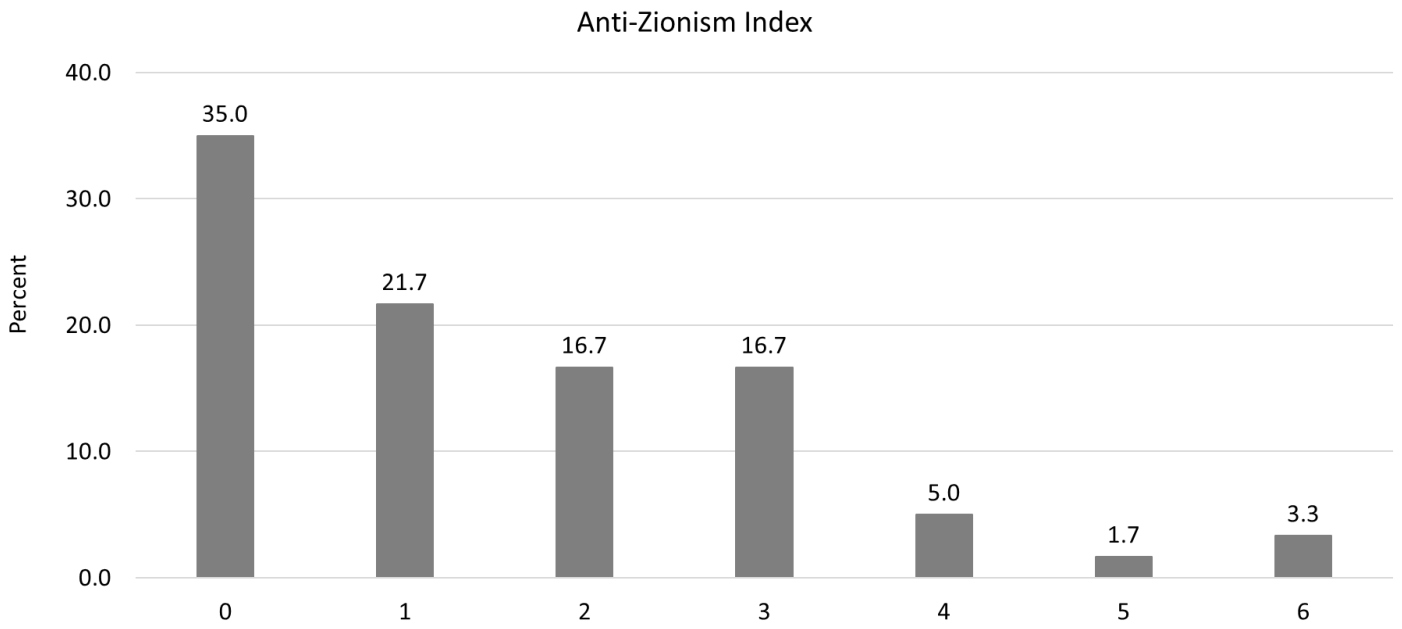
Appendix B.1.2. Construction of the Anti-Zionism Index
Conceptual Definition
Measurement Logic
- “Israel is responsible for the violence in the broader Middle East region.”
- “Israel deliberately targets Palestinian civilians.”
- “Israel is just like apartheid South Africa.”
- “Israel has committed genocide in the recent fighting in Gaza.”
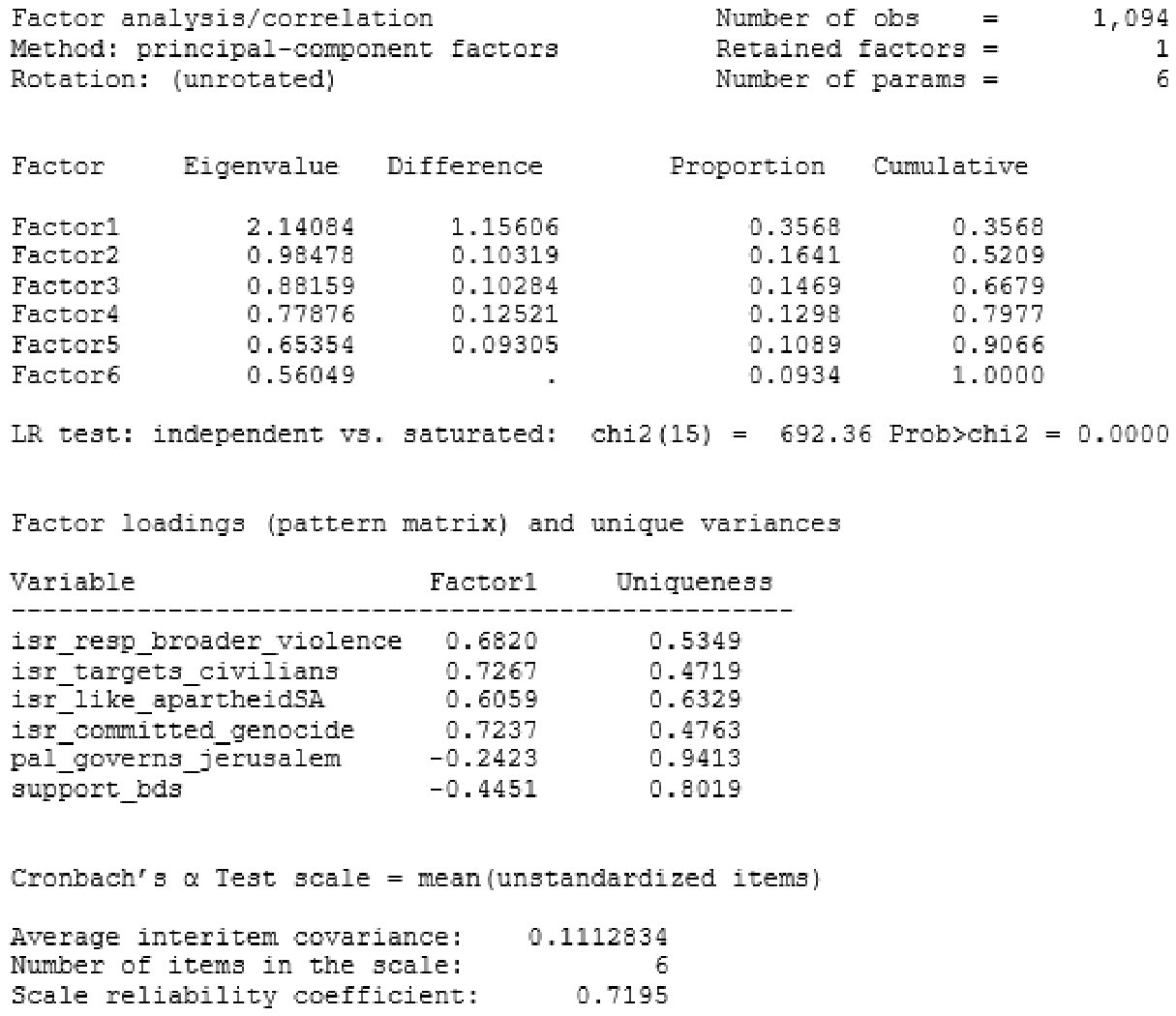
- “Jerusalem, in its entirety, should be the capital of Palestine, and its governance should not be shared with Israel.”
- Combined “I have heard of BDS and support it moderately” and “I have heard of BDS and support it completely” (BDS = Boycott, Divest, and Sanction Movement)
Control of Jerusalem and Genocide in Gaza Index Items
Reliability and Dimensionality

Appendix B.2. Model Specification and Empirical Strategy
Appendix B.2.1. Dependent Variable Specifications and Modeling Choice
- With so many categories, is the dependent variable even ordinal?
- Antisemitism scale which serves as the dependent variable is described as a 0–11 scale. Why not use the original scale and instead collapse it into a 9-category variable?
- Given that the antisemitism index is additive, aren’t count models more appropriate? Moreover, given that 45.4% of the respondents did not endorse any antisemitic statements, should antisemitism score be interpreted as a zero-inflated count index? If so, a zero-inflated Poisson, zero-inflated Negative Binomial, or a two-step hurdle statistical modeling approach is more intuitive and methodologically appropriate than generalized ordinal logistic model.
- supersessionism: weaker at low thresholds, explodes at higher ones
- economic inequality concerns: become pronounced only in the medium portion of the scale
- urban: negligible at lower levels but pronounced at higher thresholds
- anti-Zionism: consistently strong, with increasing magnitude at higher thresholds
- ideology: only matters at the “any antisemitism” threshold
- Ordinary Least Squares regression (OLS), treating the 11-point scale as linear.
- Ordered Logistic regression, treating the 11- or 9-point index as a series of ordered discrete categories, under the assumption of constant effect across outcome thresholds.
- Generalized Ordinal Logistic model (gologit2), treating the 9-point index as an ordered categorical outcome while allowing the effects of predictors to vary across outcome thresholds.
- Hurdle models (Logit and Truncated Poisson), which separately model the “gateway” and “intensity” of antisemitic belief.
- Zero-Inflated Negative Binomial (ZINB) models, which specifically account for the high frequency of zero-scores.
Appendix B.2.2. Missingness, Misattribution, Multicollinearity, Predicted Probabilities
- Missingness and Treatment of “Don’t Know” Responses
- Multicollinearity Between Income and Education
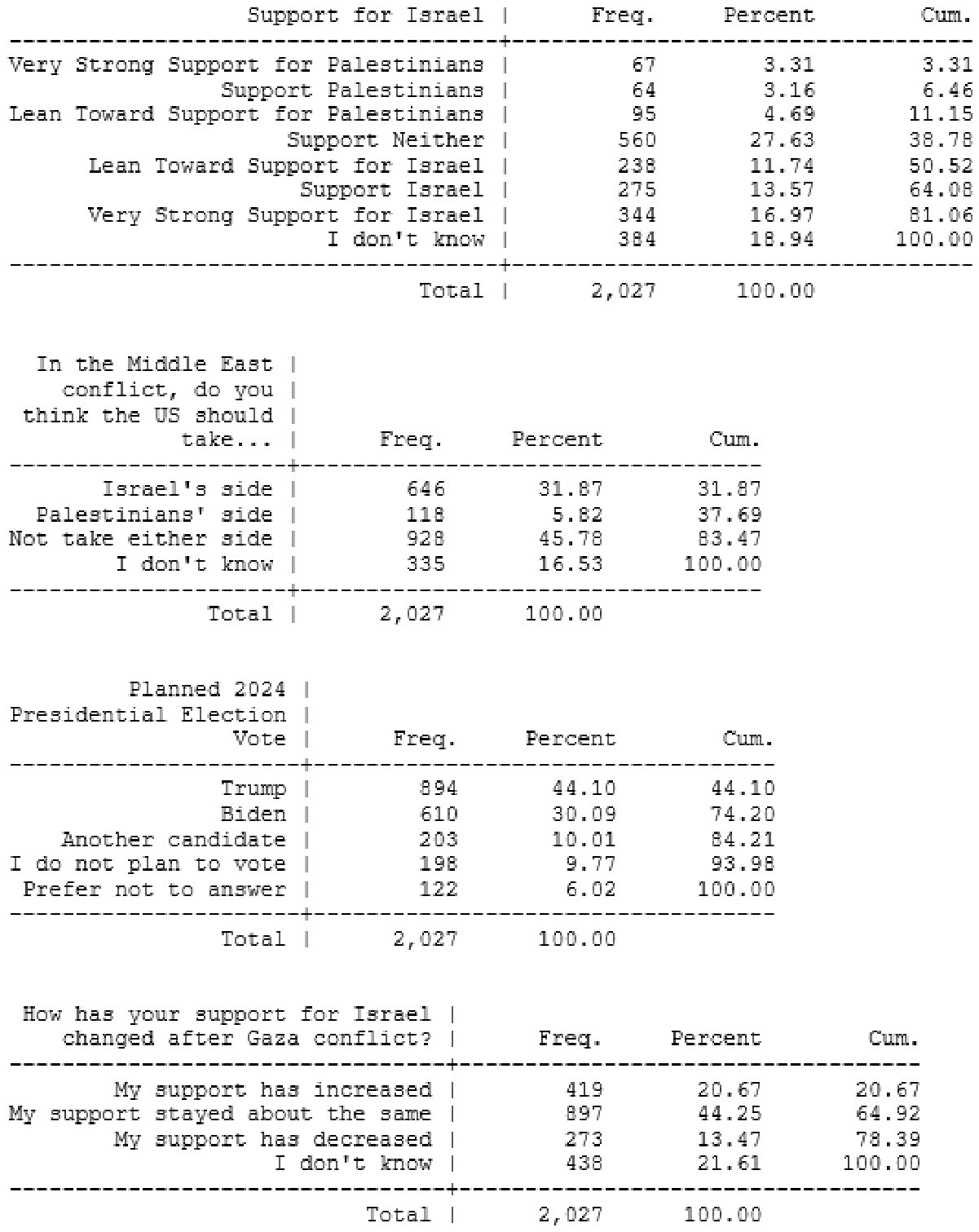
- Distinguishing Anti-Zionism from Broader Foreign Policy Attitudes
- In relation to the Israeli–Palestinian dispute, where do you place your support?
- In the Middle East conflict, generally speaking, do you think the United States should take Israel’s side, the Palestinians’ side, or not take either side?
- In the 2024 presidential election, who do plan to vote for?
- Has your support for Israel changed in light of the recent events of 7 October 2023, and the subsequent war between Israel and Hamas in Gaza?

| Variable | Count Equation: Coefficient (Robust SE) | Inflation Equation: Coefficient (Robust SE) | ||||
|---|---|---|---|---|---|---|
| Support for Israel | −0.07 | (0.039) | ||||
| Preferred US policy on Israeli-Palestinian conflict | ||||||
| Israel’s side | (baseline) | |||||
| Palestinians’ side | 0.04 | (0.162) | ||||
| Not take either side | 0.08 | (0.115) | ||||
| I don’t know | −0.49 | (0.175) | ** | |||
| Presidential vote in 2024 | ||||||
| Trump | (baseline) | |||||
| Biden | 0.00 | (0.124) | ||||
| Another candidate | −0.21 | (0.176) | ||||
| I do not plan to vote | 0.48 | (0.174) | ** | |||
| Prefer not to answer | 0.00 | (0.223) | ||||
| Change in support for Israel after Gaza invasion | ||||||
| My support has increased | (baseline) | |||||
| My support stayed about the same | 0.07 | (0.112) | ||||
| My support has decreased | −0.16 | (0.149) | ||||
| I don’t know | −0.10 | (0.209) | ||||
| Catholic | 0.12 | (0.137) | ||||
| Evangelical | −0.02 | (0.124) | ||||
| Religiosity (frequency of church attendance) | 0.01 | (0.025) | ||||
| Exposure to Jewish friends and religious customs | −0.01 | (0.035) | ||||
| Crucifixion blame | 0.03 | (0.131) | ||||
| Supersessionism | 0.36 | (0.085) | *** | |||
| Anti-Zionism index | 0.33 | (0.042) | *** | |||
| Perceived economic injustice | 0.04 | (0.019) | * | |||
| Knowledge about Israeli-Palestinian dispute | 0.00 | (0.041) | ||||
| Ideology (conservative) | 0.07 | (0.034) | * | |||
| Household income | −0.01 | (0.025) | ||||
| Educational attainment | −0.01 | (0.034) | 0.24 | (0.123) | * | |
| Gender (female) | −0.12 | (0.102) | 1.50 | (0.653) | * | |
| Marital status (married) | −0.03 | (0.095) | ||||
| African American respondent | 0.00 | (0.133) | ||||
| Hispanic/Latino respondent | −0.14 | (0.154) | ||||
| Age cohorts | −0.15 | (0.051) | ** | |||
| Southeast (region of residence) | 0.14 | (0.096) | ||||
| Northeast (region of residence) | 0.31 | (0.134) | * | |||
| Urban residence | 0.21 | (0.100) | * | |||
| Constant | 0.06 | (0.338) | −3.26 | (0.885) | *** | |
| Ancillary/dispersion parameter | ||||||
| /lnalpha | −0.83 | (0.246) | *** | 95% CI: [−1.315, −0.352] | ||
| alpha | 0.434 | (0.107) | 95% CI: [0.268, 0.703] | |||
| Model statistics | ||||||
| N (observations) | 1026 | |||||
| Non-zero observations | 603 | |||||
| Zero observations | 423 | |||||
| Wald X2 | 400.52 | |||||
| Prob > X2 | 0.000 | |||||
| Log pseudolikelihood | −1720.291 | |||||
| Variable | Logit: Odds Ratio (Robust SE) | Truncated Poisson: Coefficient (Robust SE) | ||
|---|---|---|---|---|
| Support for Israel | 1.076 (0.099) | −0.072 (0.035) | * | |
| Preferred US policy on Israeli-Palestinian conflict | ||||
| Israel’s side | (baseline) | |||
| Palestinians’ side | 0.820 (0.348) | 0.044 (0.133) | ||
| Not take either side | 1.365 (0.333) | 0.079 (0.106) | ||
| I don’t know | 0.891 (0.332) | −0.461 (0.200) | * | |
| Presidential vote in 2024 | ||||
| Trump | (baseline) | |||
| Biden | 0.724 (0.177) | 0.079 (0.106) | ||
| Another candidate | 0.518 (0.159) | * | −0.078 (0.146) | |
| I do not plan to vote | 1.649 (0.576) | 0.270 (0.152) | ||
| Prefer not to answer | 1.072 (0.532) | −0.126 (0.241) | ||
| Change in support for Israel after Gaza invasion | ||||
| My support has increased | (baseline) | |||
| My support stayed about the same | 1.131 (0.248) | 0.042 (0.110) | ||
| My support has decreased | 0.813 (0.278) | −0.071 (0.121) | ||
| I don’t know | 0.379 (0.149) | * | 0.228 (0.167) | |
| Catholic | 0.888 (0.208) | 0.173 (0.133) | ||
| Evangelical | 1.065 (0.231) | 0.016 (0.130) | ||
| Religiosity (frequency of church attendance) | 1.084 (0.051) | −0.015 (0.023) | ||
| Exposure to Jewish friends and religious customs | 0.921 (0.056) | 0.009 (0.033) | ||
| Crucifixion blame | 1.383 (0.459) | −0.010 (0.120) | ||
| Supersessionism | 1.205 (0.210) | 0.367 (0.082) | *** | |
| Anti-Zionism index | 1.842 (0.196) | *** | 0.221 (0.038) | *** |
| Perceived economic injustice | 1.041 (0.037) | 0.025 (0.018) | ||
| Knowledge about Israeli-Palestinian dispute | 0.835 (0.077) | * | 0.038 (0.036) | |
| Ideology (conservative) | 1.105 (0.079) | 0.042 (0.029) | ||
| Household income | 0.957 (0.051) | −0.008 (0.024) | ||
| Educational attainment | 0.909 (0.058) | −0.007 (0.029) | ||
| Gender (female) | 0.502 (0.087) | *** | −0.145 (0.085) | |
| Marital status (married) | 1.274 (0.240) | −0.122 (0.088) | ||
| African American respondent | 1.520 (0.484) | −0.161 (0.112) | ||
| Hispanic/Latino respondent | 1.184 (0.344) | −0.200 (0.135) | ||
| Age cohorts | 0.817 (0.084) | * | −0.112 (0.042) | ** |
| Southeast (region of residence) | 1.057 (0.200) | 0.177 (0.087) | * | |
| Northeast (region of residence) | 1.589 (0.416) | 0.177 (0.110) | ||
| Urban residence | 1.149 (0.239) | 0.180 (0.084) | * | |
| Constant | 1.106 (0.766) | 0.524 (0.300) | ||
| Model statistics | ||||
| Observations | 1026 | 603 | ||
| Wald X2 | 107.11 | 371.99 (31) | ||
| Prob > X2 | 0.000 | 0.000 | ||
| Log pseudolikelihood | −598.186 | −1123.933 | ||
| Pseudo R2 | 0.119 | |||
| 1 | This debate also unfolds within a broader scholarly discussion about the relationship between academic research on antisemitism and the categories advanced by Jewish communal organizations, advocacy institutions, and policy bodies. Scholars have cautioned that definitions of antisemitism are not merely descriptive instruments but also carry political, institutional, and normative implications (Judaken 2024). Others have emphasized the need to distinguish anti-Jewish prejudice from anti-Zionism, anti-Israel politics, postcolonial critique, and competing understandings of Jewish collective identity (Klug 2013; Loeffler 2026). At the same time, scholarship on philosemitism and Christian-Jewish relations reminds us that positive attention to Jews and Israel can also reflect ambivalent or instrumental theological assumptions rather than simple tolerance (Karp and Sutcliffe 2011). We therefore approach the anti-Zionism/antisemitism relationship as an empirical question rather than as a definitional presumption. |
| 2 | We use this battery because it is a widely recognized and historically comparable survey instrument, not because we treat the ADL as an interpretive authority or adopt its institutional positions on antisemitism, anti-Zionism, or Israel. The authors have no financial, institutional, or research relationship with the ADL. |
| 3 | The question asks: “Have you heard of the Boycott, Divestment, and Sanctions (BDS) Movement? Do you support it?” Respondents were given the following options: “I have heard of BDS and support it completely,” “I have heard of BDS and support it moderately,” “I have heard of BDS and oppose it moderately,” “I have heard of BDS and oppose it completely,” and “I have not heard of the BDS movement.” Those who said that they support BDS moderately or completely were coded into the anti-Zionism index. As noted above and discussed further in the appendix, we do not treat endorsement of any single Israel-related item—including the Jerusalem or BDS items—as inherently antisemitic or as conclusive evidence of anti-Zionism; our claim concerns the broader empirical pattern produced by the full index. |
| 4 | In the generalized ordinal logistic regression (gologit2) output, category 8 serves as the implicit baseline for the partial proportional odds model. Consequently, odds ratios for categories 0–7 are interpreted relative to the top category (8), not the bottom. This is standard in ordinal regression when the top category is used as the reference, and it does not affect substantive conclusions: lower categories’ odds ratios indicate the odds of being in that category versus the highest one. |
| 5 | It is statistically insignificant at levels 5 and 7, and statistically significant, but slightly reduced in its impact at level 6, in comparison to level 4. |
| 6 | To preempt potential concerns that a measure of partisanship would perform better than ideology, we re-estimated the models using party identification dummy variables (Democrat, Republican, Independent) in place of ideology. The results of the model are substantively unchanged, except that party identification is not statistically significant in the fully specified models (with the minor exception of Independents at the highest threshold), and the estimated effects of anti-Zionism and other key predictors remain stable. We therefore retain ideology as our preferred specification, both because it better captures the underlying construct of interest and because it facilitates cross-national comparability in our broader research, where party identification is not consistently measured across contexts. |
| 7 | In the gologit2 output, category 8 serves as the implicit baseline for the partial proportional odds model. Consequently, odds ratios for categories 0–7 are interpreted relative to the top category (8), not the bottom. This is standard in ordinal regression when the top category is used as the reference, and it does not affect substantive conclusions: lower categories’ ORs indicate the odds of being in that category versus the highest one. |
References
- ADL. 2023a. A Closer Look at the Relationship Between Holocaust Knowledge, Education and Antisemitism. ADL, April 14. Available online: https://www.adl.org/resources/article/closer-look-relationship-between-holocaust-knowledge-education-and-antisemitism (accessed on 14 May 2026).
- ADL. 2023b. Antisemitic Attitudes in America: Topline Findings. ADL, January 12. Available online: https://www.adl.org/resources/report/antisemitic-attitudes-america-topline-findings (accessed on 14 May 2026).
- ADL. 2025. The ADL Global 100: Index of Antisemitism. Available online: https://www.adl.org/adl-global-100-index-antisemitism (accessed on 14 May 2026).
- Ariel, Yaakov. 2013. An Unusual Relationship: Evangelical Christians and Jews. New York: NYU Press. [Google Scholar]
- Berger, David, ed. 1986. History and Hate: Dimensions of Anti-Semitism. Philadelphia: The Jewish Publication Society. [Google Scholar]
- Bergmann, Werner. 2008. Anti-Semitic Attitudes in Europe: A Comparative Perspective. Journal of Social Issues 64: 343–62. [Google Scholar] [CrossRef]
- Bilewicz, Michal, Mikołaj Winiewski, Mirosław Kofta, and Adrian Wójcik. 2013. Harmful Ideas, The Structure and Consequences of Anti-Semitic Beliefs in Poland. Political Psychology 34: 821–39. [Google Scholar] [CrossRef]
- Bonikowski, Bart. 2017. Ethno-Nationalist Populism and the Mobilization of Collective Resentment. British Journal of Sociology 68: 181–213. [Google Scholar] [CrossRef]
- Borgonovi, Francesca. 2012. The Relationship between Education and Levels of Trust and Tolerance in Europe. British Journal of Sociology 63: 146–67. [Google Scholar] [CrossRef] [PubMed]
- Bumin, Kirill, Philip A. Cunningham, Adam Gregerman, and Motti Inbari. 2023. American Catholic Attitudes toward Jews, Judaism, and the Israeli-Palestinian Conflict. Studies in Christian-Jewish Relations 18: 1–22. [Google Scholar] [CrossRef]
- Butler, Judith. 2012. Parting Ways: Jewishness and the Critique of Zionism. New York: Columbia University Press. [Google Scholar]
- Claims Conference. 2020. First-Ever 50-State Survey on Holocaust Knowledge of American Millennials and Gen Z Reveals Shocking Results. Claims Conference; Available online: https://www.claimscon.org/millennial-study/?utm_campaign=shareaholic&utm_medium=email_this&utm_source=email (accessed on 14 May 2026).
- Clouse, Robert. 1977. The Meaning of the Millennium: Four Views. Downers Grove: InterVarsity Press. [Google Scholar]
- Cohen, Jeffrey E. 2018. From Antisemitism to Philosemitism? Trends in American Attitudes Toward Jews from 1964–2016. Religions 9: 107–28. [Google Scholar] [CrossRef]
- Cohen, Jeffrey E. 2024. Ideology and attitudes toward Jews in US public opinion: A reconsideration. Religions 15: 59. [Google Scholar] [CrossRef]
- Cohen, Jeremy. 2007. Christ Killers: The Jews and the Passion from the Bible to the Big Screen. New York: Oxford University Press. [Google Scholar]
- Federico, Christopher M., and Jim Sidanius. 2002. Racism, Ideology, and Affirmative Action Revisited: The Antecedents and Consequences of “Principled Objections” to Affirmative Action. Journal of Personality and Social Psychology 82: 488–502. [Google Scholar] [CrossRef] [PubMed]
- Feinberg, Ayal. 2020. Explaining Ethnoreligious Minority Targeting: Variation in U.S. Anti-Semitic Incidents. Perspectives on Politics 18: 770–87. [Google Scholar] [CrossRef]
- Feldman, Jonathan. 2018. Toward a History of the Term ‘Anti-Semitism’. The American Historical Review 123: 1139–50. [Google Scholar] [CrossRef]
- Glick, Peter. 2002. Sacrificial Lambs Dressed in Wolves’ Clothing: Envious Prejudice, Ideology, and the Scapegoating of Jews. In Understanding Genocide: The Social Psychology of the Holocaust. Edited by Leonard S. Newman and Ralph Erber. New York: Oxford University Press, pp. 113–42. [Google Scholar]
- Golebiowska, Ewa A. 1995. Individual Value Priorities, Education, and Political Tolerance. Political Behavior 17: 23–48. [Google Scholar] [CrossRef]
- Greenblatt, Johnathan. 2024. The growing antisemitism among young Americans. Time, March 21. Available online: https://time.com/6958957/growing-antisemitism-young-americans/ (accessed on 14 May 2026).
- Harrison, Bernard. 2020. Blaming the Jews. Bloomington: Indiana University Press. [Google Scholar]
- Hersh, Eitan, and Laura Royden. 2022. Antisemitic Attitudes Across the Ideological Spectrum. Political Research Quarterly 76: 697–711. [Google Scholar] [CrossRef]
- Heslep, Daniel G., and Persephone S. Berge. 2021. Mapping Discord’s Darkside: Distributed Hate Networks on Disboard. Paper presented at AoIR 2021: The 22nd Annual Conference of the Association of Internet Researchers, Virtual Event, October 13–16; Available online: http://spir.aoir.org (accessed on 5 July 2026).
- Hirsh, David. 2018. Contemporary Left Antisemitism. London: Routledge. [Google Scholar]
- Hummel, Daniel. 2019. Covenant Brothers: Evangelicals, Jews, and U.S-Israel Relations. Philadelphia: University of Pennsylvania Press. [Google Scholar]
- IHRA (International Holocaust Remembrance Alliance). 2016. Working Definition of Antisemitism. Available online: https://holocaustremembrance.com/resources/working-definition-antisemitism (accessed on 14 May 2026).
- Inbari, Motti, and Kirill Bumin. 2024. Christian Zionism in the Twenty-Frist Century: American Evangelical Public Opinion on Israel. New York: Oxford University Press. [Google Scholar]
- Jacobs, Jill. 2024. Criticism of Israel and Antisemitism: How to Tell Where One Ends and the Other Begins. New York: T’ruah—The Rabbinic Call for Human Rights. Available online: https://truah.org/resources/criticism-of-israel-and-antisemitism-how-to-tell-where-one-ends-and-the-other-begins/ (accessed on 14 May 2026).
- Jerusalem Declaration on Antisemitism. 2021. Available online: https://jerusalemdeclaration.org/ (accessed on 24 June 2026).
- Judaken, Jonathan. 2024. Critical Theories of Anti-Semitism. New York: Columbia University Press. [Google Scholar]
- JVP (Jewish Voice for Peace). n.d.FAQ: About JVP. Available online: https://www.jewishvoiceforpeace.org/faq/ (accessed on 14 May 2026).
- Kaplan, Edward H., and Charles A. Small. 2006. Anti-Israel Sentiment Predicts Anti-Semitism in Europe. Journal of Conflict Resolution 50: 548–61. [Google Scholar] [CrossRef]
- Karp, Jonathan, and Adam Sutcliffe. 2011. Philosemitism in History. New York: Cambridge University Press. [Google Scholar]
- Kertzer, David I. 2001. The Popes Against the Jews: The Vatican’s Role in the Rise of Modern Anti-Semitism. New York: Knopf. [Google Scholar]
- Klug, Brian. 2013. Interrogating ‘New Anti-Semitism’. Ethnic & Racial Studies 36: 468–82. [Google Scholar] [CrossRef]
- Krause, Phillip Allen. 2016. To Stand Aside or Stand Alone: Southern Reform Rabbis and the Civil Rights Movement. Tuscaloosa: The University of Alabama Press. [Google Scholar]
- Lipstadt, Deborah. 2019. Antisemitism: Here and Now. New York: Penguin Random House. [Google Scholar]
- Loeffler, James. 2026. Exceptional Hatred: Antisemitism and the Fight over Free Speech in Modern America. New York: Macmillan Publishers. [Google Scholar]
- Marcus, Kenneth L. 2007. Anti-Zionism as Racism: Campus Anti-Semitism and the Civil Rights Act of 1964. William & Mary Bill of Rights Journal 15: 837–91. [Google Scholar]
- Matovina, Timothy. 2012. Latino Catholicism: Transformation in America’s Largest Church. Princeton: Princeton University Press. [Google Scholar]
- Mudde, Cas. 2019. The Far Right Today. Medford: Polity Press. [Google Scholar]
- Nelson, Cary. 2019. Israel Denial: Anti-Zionism, Antisemitism and the Faculty Campaign against the Jewish State. Bloomington: Indiana University Press. [Google Scholar]
- Nirenberg, David. 2013. Anti-Judaism: The Western Tradition. New York: W. W. Norton & Company. [Google Scholar]
- Olson, Jason. 2018. America’s Road to Jerusalem: The Impact of the Six-Day War on Protestant Politics. Lanham: Lexington Books. [Google Scholar]
- Pessin, Andrew. 2023. Epistemic Antisemitism, or ‘Good People Gone Wild:’ How Decent People Can Be Antisemites and Not Even Know It. In Poisoning the Wells Antisemitism in Contemporary America. Edited by Corinne E. Blackmer and Andrew Pessin. Newton: Academic Studies Press. [Google Scholar]
- Petersen, Roger D. 2001. Understanding Ethnic Violence: Fear, Hatred, and Resentment in Twentieth-Century Eastern Europe. Cambridge: Cambridge University Press. [Google Scholar]
- Pettigrew, Thomas F., and Linda R. Tropp. 2006. A Meta-Analytic Test of Intergroup Contact Theory. Journal of Personality and Social Psychology 90: 751–83. [Google Scholar] [CrossRef] [PubMed]
- Rosenfeld, Alvin H., ed. 2019. Anti-Zionism and Antisemitism: The Dynamics of Delegitimization. Bloomington: Indiana University Press. [Google Scholar]
- Rynhold, Jonathan. 2015. The Arab-Israeli Conflict in American Political Culture. New York: Cambridge University Press. [Google Scholar]
- Shenhav-Goldberg, Rachel, and Jeffrey S. Kopstein. 2020. Antisemitism on a California Campus: Perceptions and Views among Students. Contemporary Jewry 40: 237–58. [Google Scholar] [CrossRef]
- Smith, Gregory, Alan Cooperman, Becka Alper, Besheer Mohamed, Chip Rotolo, Patricia Tevington, Justin Nortey, Asta Kallo, Jeff Diamant, and Dalia Fahmy. 2025. Decline of Christianity in the U.S. Has Slowed, May Have Leveled Off. Pew Research Center, February 26. Available online: https://www.pewresearch.org/religion/2025/02/26/decline-of-christianity-in-the-us-has-slowed-may-have-leveled-off/ (accessed on 14 May 2026).
- Smith, Tom W., and Benjamin Schapiro. 2019. Antisemitism in Contemporary America. In American Jewish Yearbook 2018. Edited by Dashefsky Arnold and Ira M. Sheskin. Storrs: Center for Judaic Studies and Contemporary Jewish Life, University of Connecticut, pp. 113–62. [Google Scholar]
- Soulen, Richard K. 1996. The God of Israel and Christian Theology. Minneapolis: Fortress Publishing. [Google Scholar]
- Staetsky, Daniel L. 2017. Antisemitism in Contemporary Great Britain. A Study of Attitudes Towards Jews and Israel. London: Institute for Jewish Policy Research. [Google Scholar]
- Task Force. 2025. Presidential Task Force on Combating Antisemitism and Anti-Israeli Bias. Cambridge: Harvard University. [Google Scholar]
- Ury, Scott, and Guy Miron. 2023. Antisemitism and the Politics of History. Waltham: Brandeis University Press. [Google Scholar]
- Von Mering, Sabine. 2022. The Dark Side of Social Media: How It Fuels Antisemitism. Waltham: Brandeis University. Available online: https://www.brandeis.edu/jewish-experience/social-justice/2022/may/antisemitism-social-media.html (accessed on 14 May 2026).
- Weiss, Bari. 2019. How to Fight Anti-Semitism. New York: Crown. [Google Scholar]
- Williams, Richard. 2006. Generalized Ordered Logit/Partial Proportional Odds Models for Ordinal Dependent Variables. The Stata Journal 6: 58–82. [Google Scholar] [CrossRef]
- Wistrich, Robert S. 2020. A Lethal Obsession: Anti-Semitism from Antiquity to the Global Jihad. New York: Random House. [Google Scholar]
- Zannettou, Savvas, Joel Finkelstein, Barry Bradlyn, and Jeremy Blackburn. 2020. A Quantitative Approach to Understanding Online Antisemitism. In Proceedings of the Fourteenth International AAAI Conference on Web and Social Media. ICWSM 2020. Palo Alto: Association for the Advancement of Artificial Intelligence. Available online: https://cdn.aaai.org/ojs/7343/7343-28-10573-1-10-20200601.pdf (accessed on 4 August 2025).
- Zawadzki, Bohdan. 1948. Limitations of the Scapegoat Theory of Prejudice. Journal of Abnormal and Social Psychology 43: 127–41. [Google Scholar] [CrossRef]


| No Antisemitism | Endorsed 1 Trope | Endorsed 2 Tropes | Endorsed 3 Tropes | Endorsed 4 Tropes | Endorsed 5 Tropes | Endorsed 6 Tropes | Endorsed 7+ Tropes | |||||||||||||||||
|---|---|---|---|---|---|---|---|---|---|---|---|---|---|---|---|---|---|---|---|---|---|---|---|---|
| Variable | Odds Ratios | Odds Ratios | Odds Ratios | Odds Ratios | Odds Ratios | Odds Ratios | Odds Ratios | Odds Ratios | ||||||||||||||||
| Catholic | 1.254 | (0.230) | 1.254 | (0.230) | 1.254 | (0.230) | 1.254 | (0.230) | 1.254 | (0.230) | 1.254 | (0.230) | 1.254 | (0.230) | 1.254 | (0.230) | ||||||||
| Evangelical | 1.260 | (0.236) | 1.088 | (0.207) | 0.964 | (0.207) | 0.629 | (0.153) | 1.036 | (0.304) | 1.027 | (0.328) | 1.046 | (0.514) | 0.347 | (0.267) | ||||||||
| Frequency of church attendance | 1.079 | (0.047) | 1.051 | (0.049) | 1.033 | (0.050) | 1.056 | (0.057) | 0.797 | (0.058) | ** | 0.915 | (0.089) | 0.834 | (0.095) | 1.028 | (0.156) | |||||||
| Exposure to Jewish people and customs | 0.935 | (0.056) | 0.959 | (0.064) | 0.958 | (0.070) | 0.954 | (0.075) | 1.016 | (0.083) | 0.911 | (0.096) | 1.234 | (0.190) | 0.766 | (0.155) | ||||||||
| Belief that Jews crucified Jesus (deicide) | 1.323 | (0.293) | 1.323 | (0.293) | 1.323 | (0.293) | 1.323 | (0.293) | 1.323 | (0.293) | 1.323 | (0.293) | 1.323 | (0.293) | 1.323 | (0.293) | ||||||||
| Supersessionism | 1.095 | (0.175) | 1.578 | (0.260) | ** | 1.729 | (0.317) | ** | 2.160 | (0.459) | *** | 6.959 | (2.054) | *** | 8.026 | (2.686) | *** | 0.930 | (0.414) | 0.761 | (0.600) | |||
| Anti-Zionism index | 1.725 | (0.148) | *** | 1.863 | (0.157) | *** | 2.120 | (0.173) | *** | 2.017 | (0.176) | *** | 2.089 | (0.215) | *** | 1.920 | (0.215) | *** | 2.794 | (0.427) | *** | 2.712 | (0.585) | *** |
| Concern about economic injustice in the US | 1.044 | (0.037) | 1.076 | (0.043) | 1.086 | (0.045) | * | 1.132 | (0.049) | ** | 1.024 | (0.051) | 0.981 | (0.056) | 1.498 | (0.152) | *** | 0.879 | (0.158) | |||||
| Self-reported knowledge of Israeli-Palestinian conflict | 0.915 | (0.064) | 0.915 | (0.064) | 0.915 | (0.064) | 0.915 | (0.064) | 0.915 | (0.064) | 0.915 | (0.064) | 0.915 | (0.064) | 0.915 | (0.064) | ||||||||
| Ideology | 1.174 | (0.069) | ** | 1.082 | (0.067) | 1.119 | (0.070) | 1.131 | (0.084) | 1.107 | (0.085) | 1.022 | (0.098) | 0.762 | (0.093) | 1.037 | (0.170) | |||||||
| Income | 0.942 | (0.045) | 0.955 | (0.048) | 0.938 | (0.049) | 1.005 | (0.060) | 1.081 | (0.073) | 1.125 | (0.099) | 0.450 | (0.087) | *** | 0.607 | (0.129) | * | ||||||
| Education | 0.948 | (0.058) | 0.935 | (0.059) | 0.886 | (0.064) | 0.773 | (0.066) | ** | 0.771 | (0.069) | ** | 0.847 | (0.089) | 1.138 | (0.150) | 1.022 | (0.173) | ||||||
| Female respondent | 0.461 | (0.064) | *** | 0.461 | (0.064) | *** | 0.461 | (0.064) | *** | 0.461 | (0.064) | *** | 0.461 | (0.064) | *** | 0.461 | (0.064) | *** | 0.461 | (0.064) | *** | 0.461 | (0.064) | *** |
| Married respondent | 1.185 | (0.174) | 1.185 | (0.174) | 1.185 | (0.174) | 1.185 | (0.174) | 1.185 | (0.174) | 1.185 | (0.174) | 1.185 | (0.174) | 1.185 | (0.174) | ||||||||
| Black respondent | 1.278 | (0.338) | 1.641 | (0.433) | 1.629 | (0.422) | 1.323 | (0.376) | 1.058 | (0.336) | 1.221 | (0.534) | 0.027 | (0.024) | *** | 0.284 | (0.301) | |||||||
| Hispanic respondent | 1.044 | (0.285) | 0.887 | (0.257) | 0.942 | (0.295) | 0.717 | (0.274) | 2.310 | (0.938) | * | 0.570 | (0.268) | 1.588 | (1.047) | 3.502 | (2.755) | |||||||
| Age groups | 0.816 | (0.062) | ** | 0.816 | (0.062) | ** | 0.816 | (0.062) | ** | 0.816 | (0.062) | ** | 0.816 | (0.062) | ** | 0.816 | (0.062) | ** | 0.816 | (0.062) | ** | 0.816 | (0.062) | ** |
| South | 1.094 | (0.192) | 1.034 | (0.182) | 1.106 | (0.215) | 1.376 | (0.295) | 1.572 | (0.389) | 0.908 | (0.270) | 2.888 | (1.228) | * | 6.130 | (3.886) | ** | ||||||
| Northeast | 1.250 | (0.270) | 1.250 | (0.270) | 1.250 | (0.270) | 1.250 | (0.270) | 1.250 | (0.270) | 1.250 | (0.270) | 1.250 | (0.270) | 1.250 | (0.270) | ||||||||
| Urban resident | 1.035 | (0.203) | 1.156 | (0.221) | 1.616 | (0.319) | * | 2.152 | (0.463) | *** | 3.365 | (0.834) | *** | 1.518 | (0.485) | 3.224 | (1.456) | * | 0.855 | (0.663) | ||||
| Constant | 0.798 | (0.368) | 0.283 | (0.147) | * | 0.121 | (0.066) | *** | 0.062 | (0.040) | *** | 0.032 | (0.021) | *** | 0.039 | (0.028) | *** | 0.030 | (0.030) | *** | 0.241 | (0.480) | ||
| N (observations) | 1145 | |||||||||||||||||||||||
| Log pseudolikelihood | −1652.34 | |||||||||||||||||||||||
| Wald X2 | 453.77 | |||||||||||||||||||||||
| Prob > X2 | 0.000 | |||||||||||||||||||||||
| McKelvey and Zavoina’s R2 | 0.240 | |||||||||||||||||||||||
| Pseudo R2 | 0.177 | |||||||||||||||||||||||
| Difference of BIC’ parameters | 2740.112 | |||||||||||||||||||||||
Disclaimer/Publisher’s Note: The statements, opinions and data contained in all publications are solely those of the individual author(s) and contributor(s) and not of MDPI and/or the editor(s). MDPI and/or the editor(s) disclaim responsibility for any injury to people or property resulting from any ideas, methods, instructions or products referred to in the content. |
© 2026 by the authors. Licensee MDPI, Basel, Switzerland. This article is an open access article distributed under the terms and conditions of the Creative Commons Attribution (CC BY) license.
Share and Cite
Bumin, K.; Inbari, M. When Does Anti-Zionism Become Antisemitism? Evidence from Self-Identified American Christians. Religions 2026, 17, 829. https://doi.org/10.3390/rel17070829
Bumin K, Inbari M. When Does Anti-Zionism Become Antisemitism? Evidence from Self-Identified American Christians. Religions. 2026; 17(7):829. https://doi.org/10.3390/rel17070829
Chicago/Turabian StyleBumin, Kirill, and Motti Inbari. 2026. "When Does Anti-Zionism Become Antisemitism? Evidence from Self-Identified American Christians" Religions 17, no. 7: 829. https://doi.org/10.3390/rel17070829
APA StyleBumin, K., & Inbari, M. (2026). When Does Anti-Zionism Become Antisemitism? Evidence from Self-Identified American Christians. Religions, 17(7), 829. https://doi.org/10.3390/rel17070829