Religiosity and Life Satisfaction Across Latin America

Abstract
1. Introduction
2. Literature Review
2.1. Religiosity and Life Satisfaction in Cross-National Perspective
2.2. Social Religiosity Versus Individual Religiosity
2.3. Religiosity and Life Satisfaction in Latin America
2.4. Religiosity and Life Satisfaction Across Religious Groups
3. Data and Methods
3.1. Dependent Variable
3.2. Focal Predictors
3.2.1. Two Dimensions of Religiosity
3.2.2. Controls
4. Results

| Model 1 Beta | Model 2 Beta | Model 3 Beta | Model 4 Beta | Model 5 Beta | |
|---|---|---|---|---|---|
| Attendance | 0.04 *** | 0.02 *** | 0.02 *** | 0.03 *** | 0.03 *** |
| Religious importance | 0.04 *** | 0.04 *** | 0.06 *** | 0.06 *** | |
| Religious identity | −0.01 ** | −0.01 ** | −0.02 ** | ||
| Age | −0.34 *** | −0.34 *** | |||
| age2 | 0.29 *** | 0.29 *** | |||
| Female | −0.00 | −0.00 | |||
| Education | 0.04 *** | 0.04 *** | |||
| White | 0.01 ** | 0.01 ** | |||
| Married | 0.03 *** | 0.03 *** | |||
| Wealth | 0.10 *** | 0.10 *** | |||
| Conservative | 0.03 *** | 0.03 *** | |||
| Urban | −0.02 *** | −0.02 *** | |||
| Employed | 0.03 *** | 0.03 *** | |||
| Catholic | 0.00 | ||||
| _cons | −0.03 | −0.02 | −0.02 | −0.00 | −0.00 |
| Country dummies | Yes | Yes | Yes | Yes | Yes |
| Year dummies | Yes | Yes | Yes | Yes | Yes |
| N | 102,045 | 101,295 | 99,216 | 81,153 | 81,153 |
| Country | Social Religiosity (Religious Service Attendance) | Individual Religiosity (Importance of Religion) | Individual Religiosity (Religious Identity) |
|---|---|---|---|
| Mexico (n = 3853) | −0.02 | 0.09 *** | 0.00 |
| Guatemala (n = 3475) | −0.00 | 0.13 *** | 0.01 |
| El Salvador (n = 4020) | 0.05 * | 0.03 | −0.01 |
| Honduras (n = 3726) | 0.01 | 0.14 *** | −0.02 |
| Nicaragua (n = 3864) | 0.06 ** | 0.04 | −0.02 |
| Costa Rica (n = 3058) | 0.01 | 0.06 ** | 0.02 |
| Panama (n = 3862) | −0.03 * | 0.03 * | 0.04 |
| Colombia (n = 4891) | 0.01 | 0.04 ** | 0.00 |
| Ecuador (n = 4302) | 0.06 ** | 0.08 ** | −0.06 * |
| Bolivia (n = 5850) | 0.04 | 0.07 *** | −0.02 |
| Peru (n = 4761) | 0.04 * | 0.06 ** | −0.01 |
| Paraguay (n = 3062) | 0.04 | 0.06 ** | −0.07 * |
| Chile (n = 3836) | 0.06 ** | 0.05 ** | 0.00 |
| Uruguay (n = 3935) | 0.07 *** | −0.01 | −0.04 * |
| Brazil (n = 4185) | 0.04 | 0.04 | 0.01 |
| Venezuela (n = 3804) | 0.00 | 0.07 ** | −0.00 |
| Argentina (n = 3353) | −0.03 | 0.07 ** | −0.04 |
| Dom. Republic (n = 3637) | 0.05 ** | 0.04 | −0.01 |
| Haiti (n = 4285) | 0.06 | 0.10 *** | −0.02 |
| Jamaica (n = 3352) | 0.07 ** | 0.04 | −0.04 * |
| Guyana (n = 2042) | 0.01 | 0.06 | 0.07 |
| Variables | Model 1 | Model 2 |
|---|---|---|
| Religious denomination (Ref = Catholic) | ||
| Protestant | 0.00138 | −0.00391 |
| (0.00975) | (0.0107) | |
| Non-Christian Eastern religion | 0.139 *** | 0.136 *** |
| (0.0232) | (0.0259) | |
| None, but believes in a supreme being | −0.0394 *** | −0.0431 *** |
| (0.00881) | (0.00951) | |
| Evangelical | 0.0115 | 0.0213 ** |
| (0.00699) | (0.00762) | |
| Mormon | 0.0408 | 0.00296 |
| (0.0283) | (0.0313) | |
| Traditional or native religion | −0.0846 ** | −0.0956 ** |
| (0.0296) | (0.0304) | |
| Spiritism—Kardecist | 0.0219 | −0.0363 |
| (0.0831) | (0.0910) | |
| Jewish | 0.0210 | 0.0133 |
| (0.0667) | (0.0687) | |
| Agnostic or atheists | −0.0343 + | −0.0729 *** |
| (0.0194) | (0.0193) | |
| Jehovah’s Witness | −0.0360 | −0.0466 + |
| (0.0242) | (0.0281) | |
| Other | 0.00632 | −0.00398 |
| (0.0274) | (0.0285) | |
| Constant | 3.220 *** | 3.496 *** |
| (0.0143) | (0.0243) | |
| Observations | 133,416 | 107,974 |
| R-squared | 0.085 | 0.110 |
| Controls | No | Yes |
| Year and country dummies | Yes | Yes |
5. Discussion
Author Contributions
Funding
Institutional Review Board Statement
Informed Consent Statement
Data Availability Statement
Conflicts of Interest
Appendix A
| Country | Sample Size |
| Mexico | 6220 |
| Guatemala | 6065 |
| El Salvador | 6110 |
| Honduras | 6445 |
| Nicaragua | 6332 |
| Costa Rica | 6049 |
| Panama | 6185 |
| Colombia | 6077 |
| Ecuador | 7534 |
| Bolivia | 10,804 |
| Peru | 7147 |
| Paraguay | 6043 |
| Chile | 6732 |
| Uruguay | 6038 |
| Brazil | 7014 |
| Venezuela | 6058 |
| Argentina | 5962 |
| Dominican Republic | 6050 |
| Haiti | 7321 |
| Jamaica | 6022 |
| Guyana | 6202 |
| TOTAL | 138,410 |
Appendix B
| Variable | Survey Question |
| Life Satisfaction | To begin, in general how satisfied are you with your life? Would you say that you are (1) very satisfied, (2) Somewhat satisfied, (3) Somewhat dissatisfied, (4) very dissatisfied |
| Social Religiosity | |
| Attend religious services | How often do you attend religious services? (1) More than once a week, (2) Once per week (3) Once a month (4) Once or twice a year (5) Never or almost never |
| Individual Religiosity | |
| Religion is important in life | Please, could you tell me how important is religion in your life? Very important, rather important, not very important, not at all important. |
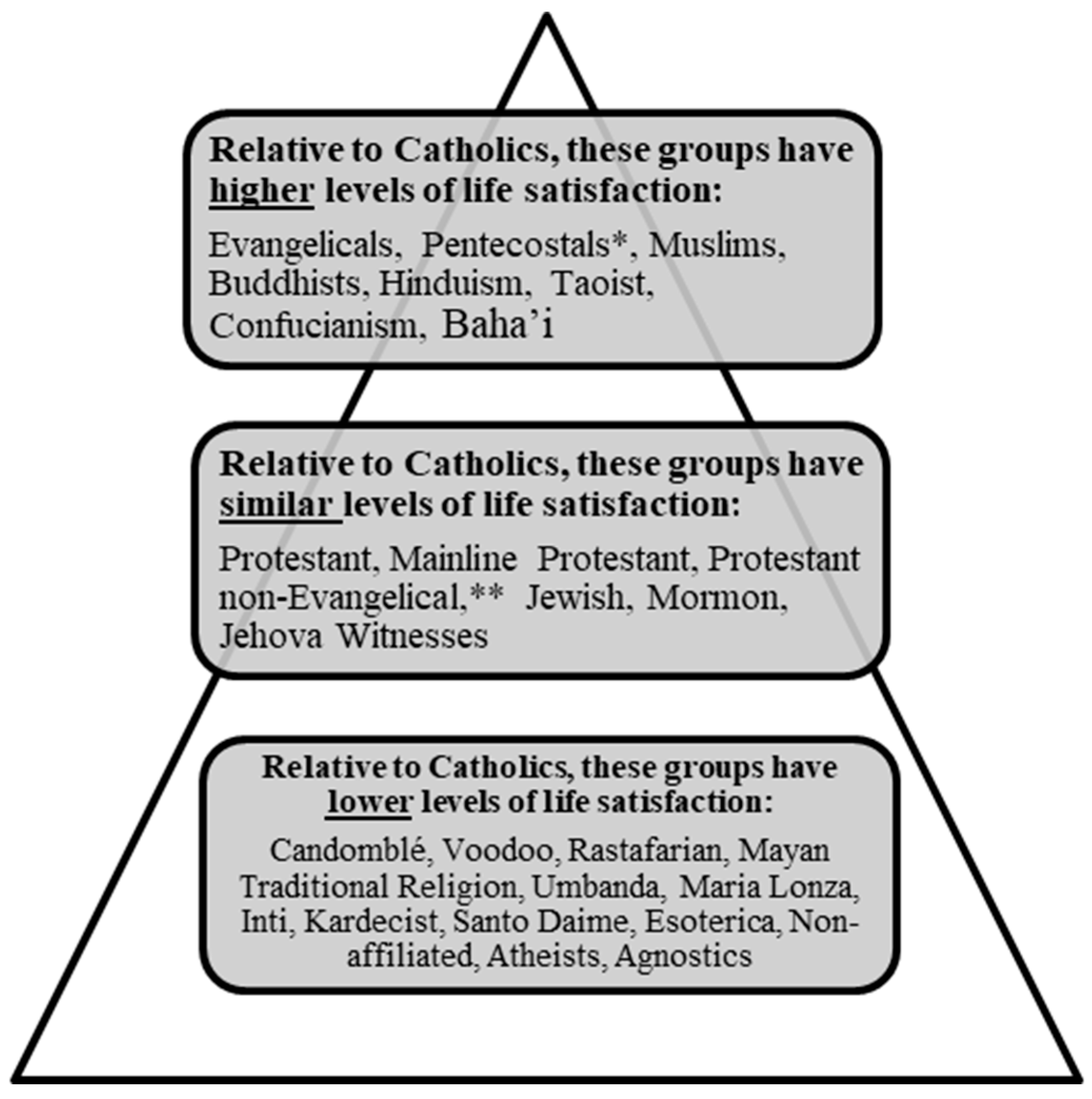
| Religious identity | What is your religion, if any? (1) Catholic. (2) Protestant, Mainline Protestant or Protestant non-Evangelical (Christian; Calvinist; Lutheran; Methodist; Presbyterian; Disciple of Christ; Anglican; Episcopalian; Moravian). (3) Non-Christian Eastern Religions (Islam; Buddhist; Hinduism; Taoist; Confucianism; Baha’i). (4) None (Believes in a Supreme Entity but does not belong to any religion) (5) Evangelical and Pentecostal (Evangelical; Pentecostals; Church of God; Assemblies of God; Universal Church of the Kingdom of God; International Church of the Foursquare Gospel; Christ Pentecostal Church; Christian Congregation; Mennonite; Brethren; Christian Reformed Church; Charismatic non-Catholic; Light of World; Baptist; Nazarene; Salvation Army; Adventist; Seventh-Day Adventist; Sara Nossa Terra). (6) LDS (Mormon). (7) Traditional Religions or Native Religions (Candomblé, Voodoo, Rastafarian, Mayan Traditional Religion; Umbanda; Maria Lonza; Inti; Kardecista, Santo Daime, Esoterica). (10) Jewish (Orthodox; Conservative; Reform). (11) Agnostic, atheist (Does not believe in God). (12) Jehovah’s Witness. (77) Other. Recoded as: (11) and (4) = 0 (no religious identity), else = 1 (has religious identity) |
| All variables were recoded so that higher value means more or, in the case of dummy variables, one means “yes” and zero means “no”. | |
Appendix C
| Variable | Definition |
| Age | Age of respondent [recorded in years completed] |
| Age2 | Age squared (age2) |
| Female | 1 (female); 0 (otherwise) |
| Education | Highest year of education: 0 (low) to 18 (high) |
| White | Do you consider yourself white, mestizo, indigenous, black, mulatto, or of another race? 1 (white); 0 (otherwise) |
| Marital status | 1 (married, living together or civil union); 0 (otherwise) |
| Wealth | Wealth Index in Quintiles: using PCA first component (created using Household Asset Indicators: TV, fridge, telephone, cellphone, car, washer, microwave, motorcycle, indoor plumbing, indoor bath, and computer) |
| Catholic | 1 (catholic); 0 (otherwise) |
| Conservative | Thinking about the political left and political right, where do you place yourself in this scale 1 (left) to 10 (right). recode (6, 7, 8, 9, 10 = 1; else = 0) |
| Urban | 1 (urban); 0 (rural) |
| Employed | Are you currently: working? Not working, but have a job? (yes = 1; else = 0) |
| All variables were recoded so that higher value means more or, in the case of dummy variables, one means “yes” and zero means “no”. | |
Appendix D
Descriptive Statistics
| Variable | Obs | Mean | Std. Dev. | Min | Max |
| Happy | 136,720 | 3.237142 | 0.8078754 | 1 | 4 |
| Attend | 103,393 | 3.017816 | 1.408502 | 1 | 5 |
| Rel Important | 136,797 | 3.429754 | 0.8646705 | 1 | 4 |
| Rel Identity | 135,092 | 0.9007787 | 0.29896 | 0 | 1 |
| Age | 137,971 | 39.77499 | 16.01323 | 16 | 99 |
| Age2 | 137,971 | 1838.471 | 1459.229 | 256 | 9801 |
| Female | 138,408 | 0.5089229 | 0.4999222 | 0 | 1 |
| Education | 137,063 | 9.510276 | 4.339511 | 0 | 19 |
| White | 138,410 | 0.237808 | 0.4257425 | 0 | 1 |
| Married | 138,410 | 0.560198 | 0.4963648 | 0 | 1 |
| Wealth | 137,324 | 1.44 × 10⁻¹⁰ | 0.8749607 | −5.987335 | 5.50567 |
| Conservative | 113,974 | 0.4316072 | 0.4953025 | 0 | 1 |
| Urban | 138,410 | 0.6779857 | 0.4672501 | 0 | 1 |
| Employed | 137,790 | 0.5303215 | 0.4990816 | 0 | 1 |
| Catholic | 135,092 | 0.5927072 | 0.491332 | 0 | 1 |
| 1 | Although happiness and life satisfaction tap into different dimensions of subjective well-being, we use the terms interchangeably. Most studies use the term “happiness” interchangeably with the terms “subjective well-being,” and “life satisfaction.” For a detailed review of these definitions, see Easterlin (2003). |
| 2 | It is important to underscore that the religious landscape of the continent is undergoing very rapid transformation (Pew Research Center 2014; Lesage et al. 2026). For example, a 2026 Pew Research Center study reports that Catholics remain the largest religious group in many Latin American countries, but the last several decades have witnessed a significant decline in the proportion of Catholics in Argentina by 13%, Brazil by 15%, Chile by 18%, and Colombia by 19%, to name a few. At the same time, the share of the religiously unaffiliated has nearly doubled in those same countries (Lesage et al. 2026). Also, as one anonymous reviewer observed, the dynamics of religious adherence are quite different among these groups; in Brazil, while non-practicing “evangélicos” exist, they are a tiny minority; in the Catholic fold, only about half of those self-identifying as Catholics effectively attend church. |
| 3 | The religious categories used in our research are drawn directly from the denomination categories set by LAPOP in their survey questionnaires. It is important to highlight that religious categories such as “mainline Protestant” make sense in the US and Europe, but not in Latin America. The categories Protestant and Evangelical, for example, are used inconsistently in Latin America—most Protestants are Evangelicals, and most Evangelicals are Pentecostal or Charismatic. The distinction between Protestant, Evangelical and Pentecostal, which makes sense in a US context, does not translate as easily to Latin America. We thank two anonymous reviewers for this point. |
| 4 | We acknowledge that how respondents understand the question related to individual religiosity can be subjective. We view denominational affiliation as an individual form of religiosity that likely does not yield as much life satisfaction as actual participation in religious services. |
| 5 | Age-squared (age2) is controlled for in happiness research to mathematically model and capture the U-shaped curve of well-being across the lifespan. Including both age and age2 allows us to identify the “pure” effect of aging, which typically dips to a low-point in mid-life before rising again in older age. |
| 6 | White refers to respondents who self-identified as being “White.” Most Latin Americans are “mestizo”—a mixture of Indigenous, Black, and White. Hence, those who self-identify as “White” are probably respondents who display Caucasian phenotypical characteristics (e.g., light skin color). For more information on this phenomenon, see Smith and Valente (2026). |
| 7 | By default, OLS chooses the largest category as “reference” (Catholic), but it is important to underscore that the category “Catholic” in Latin America is a very broad, encompassing everything from non-practicing cultural Catholics to Charismatic Catholics, whose beliefs and worship patterns mirror those of Pentecostals. Thus, we are aware that comparing “Catholics” with other specific religious groups can be problematic. |
| 8 | There might be, of course, other reasons why people are unhappy. For example, as one reviewer observed, Santo Daime has indigenous roots, although it is a syncretic religion in its own right. Hence, their lower life satisfaction might not have to do with their religious belonging or identity, but with the discrimination they suffer. |
| 9 | Since “Catholic” is still the cultural default mode in most Latin American countries, people who identify as Catholic (individual religiosity), despite not practicing or attaching importance to religion, will fill the category that produces a negative association between religious identity and well-being. People who have opted out of the cultural default mode religion, Catholicism—e.g., Evangelicals—will, on average, be much more likely to practice and attach more importance to religion. Thus, the difference in well-being could be between those who practice and attach importance to religion and those who do not, regardless of whether the latter are atheists/agnostics or cultural Catholics. This is relevant to Hypotheses 2c, 3a and 3b. We thank an anonymous reviewer for suggesting this point. |
References
- Abu-Rayya, Hisham M., Shayma Almoty, Fiona A. White, and Maram H. Abu-Rayya. 2016. The interconnection between Islamic religiosity and deviancy among Australian Muslim youth: A partial mediation role of life satisfaction. The International Journal for the Psychology of Religion 26: 337–47. [Google Scholar] [CrossRef]
- Adeyemo, David A., and Adediran Temitope Adeleye. 2008. Emotional intelligence, religiosity and self-efficacy as predictors of psychological well-being among secondary school adolescents in Ogbomoso, Nigeria. Europe’s Journal of Psychology 4: 1–13. [Google Scholar] [CrossRef]
- Barro, Robert J., and Rachel M. McCleary. 2003. Religion and economic growth across countries. American Sociological Review 68: 760–81. [Google Scholar] [CrossRef]
- Blanchflower, David G., and Andrew J. Oswald. 2011. International happiness: A new view on the measure of performance. Academy of Management Perspectives 25: 6–22. [Google Scholar] [CrossRef]
- Carranza Esteban, Renzo F., Josue Edison Turpo-Chaparro, Oscar Mamani-Benito, Jesus Hanco Torres, and Fiorella Sarria Arenaza. 2021. Spirituality and religiousness as predictors of life satisfaction among Peruvian citizens during the COVID-19 pandemic. Heliyon 7: e06939. [Google Scholar] [CrossRef] [PubMed]
- Chaves, Mark. 2011. American Religion: Contemporary Trends. Princeton: Princeton University Press. [Google Scholar]
- Chesser, Svetlana, Sally Swanson, Evans Garey, and Ralph W. Hood, Jr. 2018. Religious and non-religious predictors of life satisfaction in a sample of American college students. Mental Health, Religion & Culture 21: 418–28. [Google Scholar] [CrossRef]
- Childs, Ellen. 2010. Religious Attendance and Happiness: Examining Gaps in the Current Literature—A Research Note. Journal for the Scientific Study of Religion 49: 550–60. [Google Scholar] [CrossRef]
- Choirina, Vera Nur, Yulia Ayriza, and Yoga Setyo Wibowo. 2021. Religiosity and life satisfaction in Indonesia: Evidence from a community survey. Journal of Educational, Health and Community Psychology 10: 38. [Google Scholar] [CrossRef]
- Clark, Andrew, and Orsolya Lelkes. 2009. Let Us Pray: Religious Interactions in Life Satisfaction. PSE Working Papers Haslshs-00566120. Bengaluru: HAL. [Google Scholar]
- De la Torre, Renée, and Eloísa Martín. 2016. Religious Studies in Latin America. Annual Review of Sociology 42: 473–92. [Google Scholar] [CrossRef]
- Desmond, Scott A., Rachel Kraus, and Brendan J. L. Dugan. 2018. “Let the heavens be glad, and the earth rejoice”: Religion and life satisfaction among emerging adults in the United States. Mental Health, Religion & Culture 21: 304–18. [Google Scholar] [CrossRef]
- Dilmaghani, Maryam. 2018. Religiosity and subjective wellbeing in Canada. Journal of Happiness Studies: An Interdisciplinary Forum on Subjective Well-Being 19: 629–47. [Google Scholar]
- Dolan, Paul, Laura Kudrna, and Arthur Stone. 2017. The Measure Matters: An Investigation of Evaluative and Experience-Based Measures of Wellbeing in Time Use Data. Social Indicators Research 134: 57–73. [Google Scholar] [PubMed]
- Dorahy, Martin J., John F. Schumaker, B. Krishnamurthy, and Pramod Kumar. 1997. Religious ritual and dissociation in India and Australia. The Journal of Psychology 131: 471–76. [Google Scholar] [CrossRef] [PubMed]
- Easterlin, Richard A. 2003. Explaining happiness. Proceedings of the National Academy of Sciences 100: 11176–83. [Google Scholar] [CrossRef]
- Ellison, Christopher G. 1991. Religious involvement and subjective well-being. Journal of Health and Social Behavior 32: 80–99. [Google Scholar] [CrossRef] [PubMed]
- Ellison, Christopher G., and David Gay. 1990. Region, religious commitment, and life satisfaction among black Americans. The Sociological Quarterly 31: 123–47. [Google Scholar] [CrossRef]
- Ellison, Christopher G., David A. Gay, and Thomas A. Glass. 1989. Does Religious Commitment Contribute to Individual Life Satisfaction? Social Forces 68: 100–23. [Google Scholar] [CrossRef]
- Ferrer-i-Carbonell, Ada, and Paul Frijters. 2004. How important is methodology for the estimates of the Determinants of happiness? Economic Journal 114: 641–59. [Google Scholar] [CrossRef]
- Ferris, Abbott L. 2002. Religion and the quality of life. Journal of Happiness Studies 3: 199–215. [Google Scholar] [CrossRef]
- Greeley, Andrew, and Michael Hout. 2006. The Truth About Conservative Christians: What They Think and What They Believe. Chicago: University of Chicago Press. [Google Scholar]
- Green, Morgan, and Marta Elliott. 2010. Religion, health, and psychological well-being. Journal of Religious Health 49: 149–63. [Google Scholar]
- Greene, Kenneth, and Bong Joon Yoon. 2004. Religiosity, Economics, and Life Satisfaction. Review of Social Economy 62: 245–61. [Google Scholar] [CrossRef]
- Greenfield, Emily A., and Nadine F. Marks. 2007. Religious social identity as an explanatory factor for associations between more frequent formal religious participation and psychological well-being. International Journal of Psychology of Religion 17: 245–59. [Google Scholar] [CrossRef]
- Hackett, Conrad, Marcin Stonawski, Yunping Tong, Stephanie Kramer, Anne Shi, and Dalia Fahmy. 2025. How the Global Religious Landscape Changed From 2010 to 2020. Washington, DC: Pew Research Center. [Google Scholar]
- Hadaway, Christopher. 1978. Life Satisfaction and Religion: A Reanalysis. Social Forces 57: 636–43. [Google Scholar] [CrossRef]
- Headey, Bruce, Juergen Schupp, Ingrid Tucci, and Gert G. Wagner. 2010. Authentic happiness theory supported by impact of religion on life satisfaction: A longitudinal analysis with data for Germany. The Journal of Positive Psychology 5: 73–82. [Google Scholar] [CrossRef]
- Iannaccone, Laurence R. 1998. Introduction to the economics of religion. Journal of Economic Literature 36: 1465–95. [Google Scholar]
- Inglehart, Ronald F. 2009. Cultural Change, Religion, Subjective Well-Being, and Democracy in Latin America. In Religious Pluralism, Democracy, and the Catholic Church in Latin America. Edited by Frances Hagopian. Notre Dame: University of Notre Dame Press, pp. 67–95. [Google Scholar]
- Inglehart, Ronald F. 2010. Faith and freedom: Traditional and modern ways to happiness. In International Differences in Well-Being. Edited by John Helliwell Diener and Daniel Kahneman. Oxford: Oxford University Press, pp. 351–97. [Google Scholar]
- Kim-Prieto, Chu, and Ed Diener. 2009. Religion as a source of variation in the experience of positive and negative emotions. The Journal of Positive Psychology 4: 447–60. [Google Scholar] [CrossRef]
- Koenig, Harold, Michael E. McCullough, and David B. Larson. 2001. Handbook of Religion and Health. Oxford: Oxford University Press. [Google Scholar]
- Krause, Neal. 2003. Religious Meaning and Subjective well-being in late life. The Journal of Gerontology Series B Psychological Sciences and Social Sciences 58: 160–70. [Google Scholar] [CrossRef]
- LAPOP. 2025. America Barometer Technical Report. Available online: https://www.vanderbilt.edu/lapop/AmericasBarometer-Weights-and-Design-Effects-2025.pdf (accessed on 3 May 2026).
- LAPOP Lab. 2010–2016/2017. AmericasBarometer. Nashville: Center for Global Democracy. Available online: www.vanderbilt.edu/lapop (accessed on 1 July 2025).
- Laurencelle, Rhonda M., Steven C. Abell, and David J. Schawartz. 2002. The Relation Between Intrinsic Religious Faith and Psychological Well-Being. The International Journal of the Psychology of Religion 12: 109–23. [Google Scholar] [CrossRef]
- Lesage, Kirsten, Jonathan Evans, Manolo Corichi, and Skylar Thomas. 2026. Catholicism Has Declined in Latin America Over the Past Decade. Washington, DC: Pew Research Center. [Google Scholar]
- Lever, Joaquina P., and Amparo Estrada. 2016. Psychological and Social Determinants of Subjective Well-Being in Mexico: Poverty, Class Identification and Social Mobility. In Handbook of Happiness Research in Latin America—International Handbooks of Quality of Life. Edited by Mariano Rojas. Cham: Springer, pp. 389–403. [Google Scholar]
- Lim, Chaeyoon, and Robert D. Putnam. 2010. Religion, social networks, and life satisfaction. American Sociological Review 75: 914–33. [Google Scholar] [CrossRef]
- McCullough, Michael E., Robert A. Emmons, and Jo-Ann Tsang. 2002. The grateful disposition: A conceptual and empirical topography. Journal of Personality and Social Psychology 82: 112–27. [Google Scholar] [CrossRef] [PubMed]
- Metzl, Einat S. 2009. The role of creative thinking in resilience after hurricane Katrina. Psychology of Aesthetics, Creativity, and the Arts 3: 112–23. [Google Scholar] [CrossRef]
- Ng, Yew-Kwang. 1996. Happiness surveys: Some comparability issues and an exploratory survey based on just perceivable increments. Social Indicators Research 38: 1–27. [Google Scholar] [CrossRef]
- Ng, Yew-Kwang. 1997. A case for happiness, cardinalism, and interpersonal comparability. Economic Journal 107: 1848–58. [Google Scholar] [CrossRef]
- Ng, Yew-Kwang. 2011. Happiness Is Absolute, Universal, Ultimate, Unidimensional, Cardinally Measurable and Interpersonally Comparable: A Basis for the Environmentally Responsible Happy Nation Index. Technical Report. Melbourne: Monash University, Department of Economics. [Google Scholar]
- Ngamaba, Kayonda, and Debbie Soni. 2018. Are Happiness and Life Satisfaction Different Across Religious Groups? Exploring Determinants of Happiness and Life Satisfaction. Journal of Religion Health 57: 2118–39. [Google Scholar] [PubMed]
- Norris, Pippa, and Ronald Inglehart. 2004. Sacred and Secular: Religion and Politics Worldwide. Cambridge: Cambridge University Press. [Google Scholar]
- Okulicz-Kozaryn, Adam. 2010. Religiosity and life satisfaction across nations. Mental Health, Religion & Culture 13: 155–69. [Google Scholar] [CrossRef]
- Paez, Dario, Gonzalo Martinez-Zelaya, Marian Bilbao, Felipe E. Garcia, Javier Torres-Vallejos, Salvador Vargas, Edgardo Sierralta, and Silvia da Costa. 2017. Religiosity, Psychosocial Factors, and Well-Being: An Examination Among a National Sample of Chileans. Psychology of Religion and Spirituality 10: 138–45. [Google Scholar]
- Pargament, Kenneth. 2002. Is Religion Nothing but…? Explaining Religion versus Explaining Religion Away. Psychological Inquiry 13: 239–44. [Google Scholar] [CrossRef]
- Pew Research Center. 2014. Religion in Latin America: Widespread Change in a Historically Catholic Region. Washington, DC: Pew Research Center, November 13. [Google Scholar]
- Rozer, Jesper, and Gerbert Kraaykamp. 2013. Income inequality and subjective well-being: A cross-national study on the conditional effects of individual and national characteristics. Social Indicators Research 113: 1009–23. [Google Scholar]
- Saintila, Jacksaint, David Javier-Aliaga, Anna Valle-Chafloque, Christian Casas-Galvez, Luz Antonia Barreto-Espinoza, and Yaquelin E. Calizaya-Milla. 2024. Sociodemographic aspects, beliefs about lifestyles, and religiosity as predictors of life satisfaction in Peruvian university students: A cross-sectional study. Front Public Health 12: 1476544. [Google Scholar] [CrossRef] [PubMed]
- Schwadel, Philip. 2011. The effects of education on Americans’ religious practices, beliefs, and affiliations. Review of Religious Research 53: 37–57. [Google Scholar] [CrossRef]
- Shen, Jing, and Irena Kogan. 2019. Does the religious context matter? The causal effect of religious diversity on individual life satisfaction in the UK. Journal of Ethnic and Migration Studies 46: 3722–43. [Google Scholar] [CrossRef]
- Smith, Ryan A., and Rubia Valente. 2026. How Prevalent are Colortocracies in Latin America? An Examination of Cross-National Heterogeneity in the Effects of Skin Tone and Self-Identified Race on Occupational Status and Wealth. Du Bois Review 23: 1–29. [Google Scholar] [CrossRef]
- Stavrova, Olga, Detlef Fetchenhauer, and Thomas Schlosser. 2013. Why are religious people happy? The effect of the social norm of religiosity across countries. Social Science Research 42: 90–105. [Google Scholar] [CrossRef] [PubMed]
- Ten Kate, Josje, Willem de Koster, and Jeroen van der Waal. 2017. The effect of religiosity on life satisfaction in a secularized context: Assessing the relevance of believing and belonging. Review of Religious Research 59: 135–55. [Google Scholar] [CrossRef] [PubMed]
- Watkins, Philip, Michael Frederick, and Don E. Davis. 2022. Gratitude to God Predicts Religious Well-Being over Time. Religions 13: 675. [Google Scholar] [CrossRef]
- Welch, Michael, David Sikkink, and Matthew Loveland. 2007. The radius of trust: Religion, social embeddedness and trust in strangers. Social Forces 86: 23–46. [Google Scholar] [CrossRef]
- You, Sukkyung, Ji Eun Yoo, and Koh Yunsung. 2019. Religious practices and mental health outcomes among Korean adults. Personality and Individual Differences 142: 7–12. [Google Scholar] [CrossRef]

| Attend | Religion Important | Religious Identity | Life Satisfaction | |
|---|---|---|---|---|
| Attend | 1.00 | . | . | . |
| Religion Important | 0.4991 *** | 1.00 | . | . |
| Religious Identity | 0.3697 *** | 0.4511 *** | 1.00 | . |
| Life Satisfaction | 0.0192 *** | 0.0475 *** | 0.0116 *** | 1.00 |
Disclaimer/Publisher’s Note: The statements, opinions and data contained in all publications are solely those of the individual author(s) and contributor(s) and not of MDPI and/or the editor(s). MDPI and/or the editor(s) disclaim responsibility for any injury to people or property resulting from any ideas, methods, instructions or products referred to in the content. |
© 2026 by the authors. Licensee MDPI, Basel, Switzerland. This article is an open access article distributed under the terms and conditions of the Creative Commons Attribution (CC BY) license.
Share and Cite
Valente, R.R.; Smith, R.A. Religiosity and Life Satisfaction Across Latin America. Religions 2026, 17, 820. https://doi.org/10.3390/rel17070820
Valente RR, Smith RA. Religiosity and Life Satisfaction Across Latin America. Religions. 2026; 17(7):820. https://doi.org/10.3390/rel17070820
Chicago/Turabian StyleValente, Rubia R., and Ryan A. Smith. 2026. "Religiosity and Life Satisfaction Across Latin America" Religions 17, no. 7: 820. https://doi.org/10.3390/rel17070820
APA StyleValente, R. R., & Smith, R. A. (2026). Religiosity and Life Satisfaction Across Latin America. Religions, 17(7), 820. https://doi.org/10.3390/rel17070820