Developing Emotionally Intelligent AI: A Yogācāra-Informed Buddhist Framework for Affective Computing

Abstract
1. Introduction
2. Major Theories of Emotion Underlying Affective Computing
2.1. The Basic Emotions Theory: A Categorical Approach
2.2. The Valence–Arousal Model: A Dimensional Approach
3. Yogācāra: Extending the Existing Theories of Emotion
3.1. A Holistic View: The Interconnectedness of Mental Experience
3.2. A Processual View: How an Affective Experience Unfolds
- The Unconscious Foundation: Experience does not arise from a blank slate. It is constantly influenced by two deep, unconscious layers of the mind. The first is the storehouse consciousness (ālayavijñāna 阿賴耶識, 8), which serves as a reservoir for all past imprints and karmic seeds. It is the continuous stream that provides the raw material for our conscious moments. The second is the self-grasping consciousness (manas 末那識, 7), an afflicted mentality that perpetually grasps at the storehouse consciousness and conceives of it as a permanent “I” or “self”. This underlying self-grasping constantly colors our perception and provides a basis for afflictive emotions to arise as we try to protect and enrich this constructed identity. At this foundational level, the affective dimension is already latently present: the karmic seeds stored in the storehouse consciousness include the habitual tendencies toward specific feeling-tones (vedanā 受, 11), i.e., the accumulated dispositions to find certain objects pleasant, others unpleasant, and still others neutral. These dispositional feeling tendencies are not yet conscious emotions, but they pre-configure the affective texture of any experience that will arise.4
- The Arising of Conscious Experience: A conscious experience emerges through an interaction known as “contact” (sparśa 觸, 10). This is the simultaneous coming together of three elements: a sense faculty (e.g., the eye), a sense object (e.g., a shape), and the corresponding sensory consciousness (e.g., visual consciousness). The moment these three connect, a conscious event occurs. Crucially for affective experience, this contact immediately gives rise to vedanā (the feeling-tone of pleasant, unpleasant, or neutral), which forms the affective core of the arising moment. Vedanā does not arise in isolation. It is simultaneously accompanied by the other four ever-present Mental Factors, each of which modulates the affective tone. Attention determines whether the feeling-tone is amplified or diffused; conception frames the feeling-tone within a meaningful narrative; and volition channels it into a behavioral tendency. Additionally, the event may be colored by other caitta from Table 1, such as “Faith” (19) or “Anger” (31), which further enrich or intensify the affective quality of the experience. As the Buddhist scholar Xuanzang described it, consciousness sketches the outline of a mental image, while the various Mental Factors add the colors (cf. Li 2022, p. 161). Vedanā supplies the affective hue, while the cognitive, attentional, and volitional factors determine its saturation, direction, and depth.
- Reinforcing the Cycle: An affective experience does not simply vanish. As it passes, the feeling-tone it carried, together with the cognitive frames, attentional habits, and volitional tendencies that accompany it, leave new imprints in the storehouse consciousness. This reinforces existing affective habits and behavioral predispositions, increasing the likelihood that similar feeling-tones and the patterns that modulate them will arise again in the future.
4. A Practical Case: A Yogācāra Framework for Sentiment Analysis
4.1. The Limits of Current Affective Lexicons
- 〈num〉APA00032〈/num〉
- 〈lex〉惊喜〈/lex〉
- 〈ccat〉a〈/ccat〉
- 〈eng〉pleasantly surprised〈/eng〉
- 〈emotion〉PA〈/emotion〉
- 〈intensity〉7,0,0,0,0,0,0,0,0,0,0,0,0,0,0,0,0,0,0,5〈/intensity〉
- 〈polarity〉1〈/polarity〉
- 〈syn〉〈/syn〉
- 〈emotion_class〉A〈/emotion_class〉
- 〈standard〉0〈/standard〉
4.2. A New Annotation Framework with Yogācāra Insights
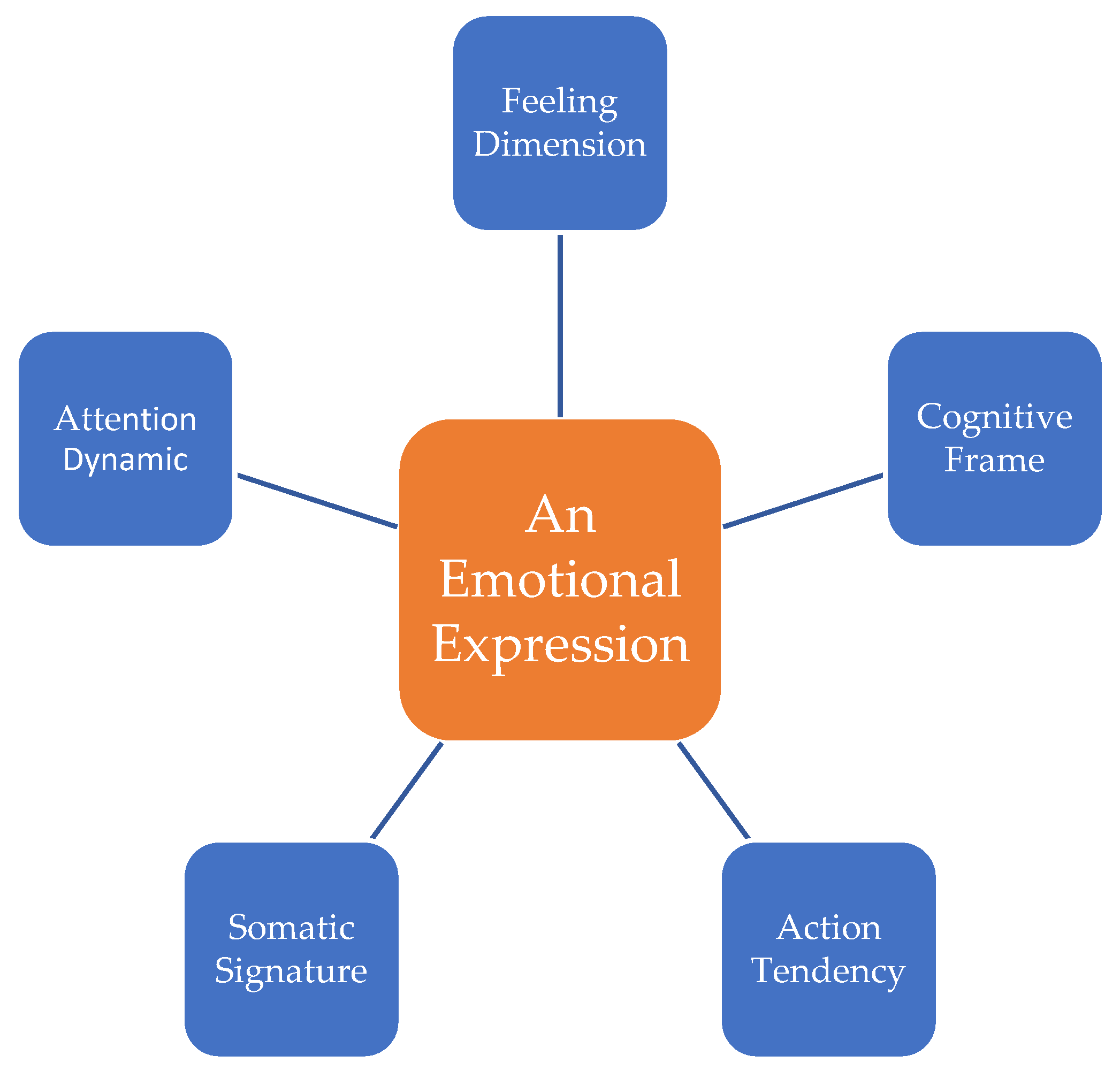
- Somatic Signature (from “contact”-sparśa 觸): In Yogācāra, “contact” is the meeting of sense, object, and consciousness. This resonates with recent research in psychology emphasizing that cognition is grounded in the somatic domain (Hartley 2004; Varela et al. 1991). This aspect captures the bodily sensations associated with an emotion. Instead of a vague label, we can annotate qualities like “Warmth”, “Heaviness”, and “Agitation”, addressing the physical feelings commonly associated with an emotion.
- Attention Dynamic (from “attention”-manaskāra 作意): “Attention” is the function of directing consciousness toward an object. During an emotional experience, our attention changes. This aspect captures whether attention becomes fixed or diluted, and whether its orientation is primarily internal (focused on self) or external (focused on the outer world).
- Feeling Dimensions (from “feeling”-vedanā 受): This aspect corresponds directly to the Mental Factor of “feeling” and can incorporate the existing Valence–Arousal model. It captures the core affective tone of valence polarity (positive/negative/neutral) and arousal intensity (low to high). This allows the framework to retain the useful components of current dimensional models.
- Cognitive Frame (from conception-saṃjñā 想): “Conception” is the Mental Factor that grasps an object’s features and forms concepts. This aspect of the framework identifies the underlying cognitive meaning associated with an emotion. We can include different cognitive frames such as Gain, Loss, Threat, Injustice, Connection, or Growth. This provides crucial context that is lost in simple emotion labels.
- Action Urge (from volition-cetanā 思): “Volition” is the Mental Factor that directs the mind toward an activity. This aspect annotates the potential behavioral impulse associated with an emotion. Common tendencies can include Approach, Avoid, Attack, or Freeze. This captures the dynamic and motivational nature of an affective state.
- Somatic Signature: Warmth: 7; Heaviness: 0; Agitation: 7.
- Attention Dynamic: Focus Level: 7; Orientation: External.
- Feeling Dimension: Valence/Polarity: Positive; Arousal/Intensity: 8.
- Cognitive Frame: Gain (implying an unexpected positive outcome).
- Action Urge: Approach (a tendency to engage).
4.3. “Wholesome” Application: Emotion Navigation Support for Personal Chatbots
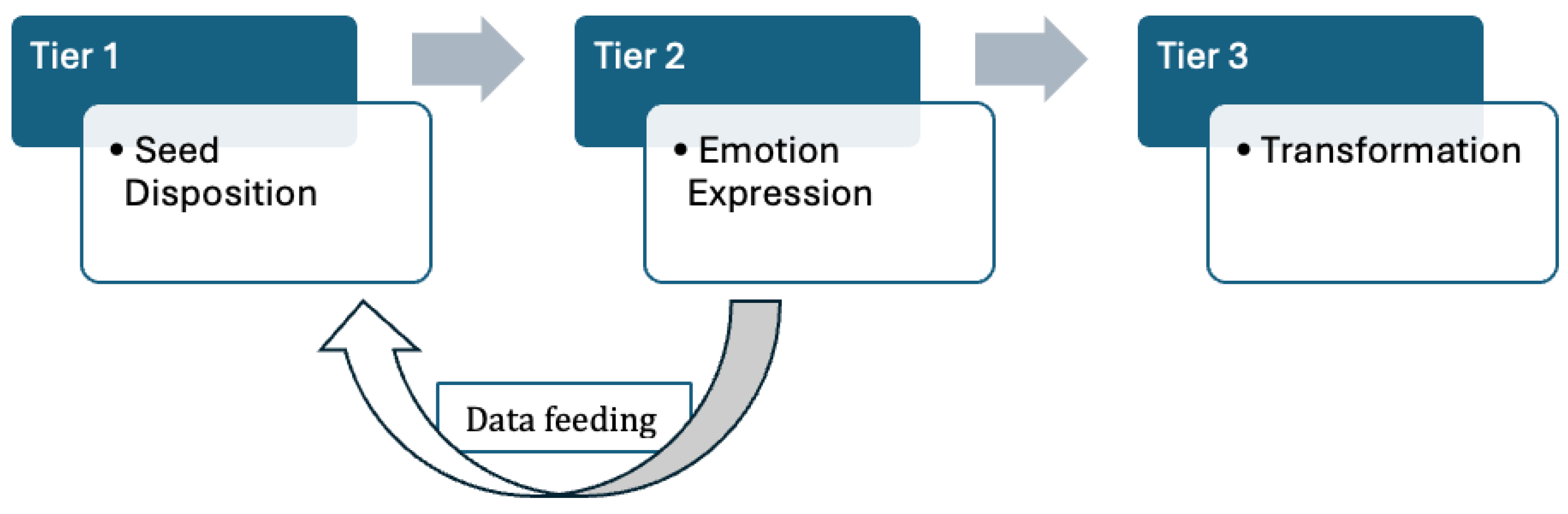
- Tier 1: Seed Disposition (Understanding the Past)
- Tier 2: Emotion Expression (Analyzing the Present)
- Tier 3: Transformation (Guiding the Future)
5. Conclusions: The Ethics of Affective Computing and the Need for Theoretical Diversity
Funding
Institutional Review Board Statement
Informed Consent Statement
Data Availability Statement
Conflicts of Interest
| 1 | The tenet of Yogācāra is often understood to be “representation-only”, indicating that we do not have direct access to external objects and can only access them as “representations”. However, there are philosophical implications and debates over how to understand this “representation” in Yogācāra, as well as whether this term is accurate, both of which are beyond the scope of this paper. For further discussions of the “representation-only” aspect of Yogācāra, see Waldron (2023, pp. 184–95) and Wayman (1979). |
| 2 | |
| 3 | For a recent description and discussion of this process in detail, see Waldron (2023, pp. 197–232). The discussion of Yogācāra doctrines in this section also draws from texts such as the Treatise on the Establishment of Consciousness-only (成唯識論, CBETA 2026.R1, T31, no. 1585) and Stages of Yogic Practice (Yogācārabhūmi 瑜伽師地論, CBETA 2025.R3, T30, no. 1579). For an English translation of the Treatise on the Establishment of Consciousness-only, an authoritative Yogācāra text in East Asia, see Cook (1999); for its historical contextualization, see Lusthaus (2003, pp. 351–425). |
| 4 |
References
Primary Sources
Dacheng baifa mingmen lun 大乘百法明門論 [Mahāyāna Treatise on the Hundred Dharmas Illuminating the Gate]. Translated by Xuanzang (玄奘, 602–664 CE). CBETA Online. 2025.R1, T31, no. 1614.Cheng weishi lun 成唯識論 [Treatise on the Establishment of Consciousness-only], 10 juans. Compiled by Kuiji (窺基, 632–682 CE). CBETA Online. 2025. T31, no. 1585.Yujia Shidi lun 瑜伽師地論 (Skt. Yogācārabhūmi-śāstra; Eng. Stages of Yogic Practice). 100 juans. Translated by Xuanzang Xuanzang (玄奘, 602–664 CE). CBETA Online. 2025.R3, T30, no. 1579.Secondary Sources
- Bagozzi, Richard P. 1992. The Self-Regulation of Attitudes, Intentions, and Behavior. Social Psychology Quarterly (US) 55: 178–204. [Google Scholar] [CrossRef]
- Barrett, Lisa Feldman. 2006. Are Emotions Natural Kinds? Perspectives on Psychological Science 1: 28–58. [Google Scholar] [CrossRef] [PubMed]
- Brody, Justin. 2020. Enaction, Convolution and Conceptualism: An AI-Based Exploration of Dharmakīrti’s Perception and Conception. Hualin International Journal of Buddhist Studies 3: 1–26. [Google Scholar] [CrossRef]
- Brosch, Tobias, Klaus Scherer, Didier Grandjean, and David Sander. 2013. The Impact of Emotion on Perception, Attention, Memory, and Decision-Making. Swiss Medical Weekly 143: w13786. [Google Scholar] [CrossRef] [PubMed]
- Chatterjee, Ashok Kumar. 1987. The Yogācāra Idealism. New Delhi: Motilal Banarsidass. [Google Scholar]
- Chien, Ju-En. 2023. The Mind and Mental Factors According to the Cheng Weishi Lun (成唯識論): An Approach to Buddhist Therapeutic Soteriology. Ph.D. dissertation, Ludwig-Maximilians-Universität München, Munich, Germany. [Google Scholar]
- Cook, Francis, trans. 1999. Three Texts on Consciousness Only. Berkeley: Numata Center for Buddhist Translation and Research. [Google Scholar]
- Cowie, Roddy. 2015. Ethical Issues in Affective Computing. In The Oxford Handbook of Affective Computing. Edited by Rafael A. Calvo, Sidney D’Mello, Jonathan Gratch and Arvid Kappas. Oxford: Oxford University Press. [Google Scholar]
- Devillers, Laurence, and Roddy Cowie. 2023. Ethical Considerations on Affective Computing: An Overview. Proceedings of the IEEE 111: 1445–58. [Google Scholar] [CrossRef]
- Ekman, Paul. 1992. An Argument for Basic Emotions. Cognition and Emotion 6: 169–200. [Google Scholar] [CrossRef]
- Gunes, Hatice, and Maja Pantic. 2010. Automatic, Dimensional and Continuous Emotion Recognition. International Journal of Synthetic Emotions 1: 68–99. [Google Scholar] [CrossRef]
- Gunes, Hatice, Björn Schuller, Maja Pantic, and Roddy Cowie. 2011. Emotion Representation, Analysis and Synthesis in Continuous Space: A Survey. Paper presented at 2011 IEEE International Conference on Automatic Face & Gesture Recognition (FG), Santa Barbara, CA, USA, March 21–25; pp. 827–34. [Google Scholar] [CrossRef]
- Hartley, Linda. 2004. Somatic Psychology: Body, Mind and Meaning. Hoboken: Wiley. [Google Scholar]
- Hershock, Peter D. 2020. The Intelligence Revolution and the New Great Game: A Buddhist Reflection on the Personal and Societal Predicaments of Big Data and Artificial Intelligence. Hualin International Journal of Buddhist Studies 3: 62–77. [Google Scholar] [CrossRef]
- Hershock, Peter D. 2021. Buddhism and Intelligent Technology: Toward a More Humane Future. London: Bloomsbury Academic. [Google Scholar]
- Hershock, Peter D. 2025. AI, Consciousness, and the Evolutionary Frontier: A Buddhist Reflection on Science and Human Futures. Religions 16: 562. [Google Scholar] [CrossRef]
- Hilgard, Ernest R. 1980. The Trilogy of Mind: Cognition, Affection, and Conation. Journal of the History of the Behavioral Sciences 16: 107–17. [Google Scholar] [CrossRef]
- Ismailov, Mariam. 2025. Rethinking AI Subjectivity Through Yogācāra Philosophy. Master’s thesis, Leiden University, Leiden, The Netherlands. Available online: https://studenttheses.universiteitleiden.nl/access/item%3A4280935/view (accessed on 25 May 2026).
- ISO. 2022. ISO/IEC 30150-1:2022 Information Technology—Affective Computing User Interface (AUI), Part 1: Model. ICS: 35.240.20. Geneva: ISO. Available online: https://www.iso.org/standard/78031.html (accessed on 5 June 2025).
- ISO. 2024. ISO/IEC TR 30150-2:2024 Information Technology—Affective Computing User Interface (AUI), Part 2: Affective Characteristics. ICS: 35.240.20. Geneva: ISO. Available online: https://www.iso.org/standard/82501.html (accessed on 5 June 2025).
- Izard, Carroll E. 2009. Emotion Theory and Research: Highlights, Unanswered Questions, and Emerging Issues. Annual Review of Psychology 60: 1–25. [Google Scholar] [CrossRef] [PubMed]
- Li, Jingjing. 2022. Comparing Husserl’s Phenomenology and Chinese Yogācāra in a Multicultural World: A Journey Beyond Orientalism. London: Bloomsbury Academic. [Google Scholar]
- Li, Jingjing. 2023. Joy as Contextualized Feeling: Two Contrasting Pictures of Joy in East Asian Yogācāra. Journal of the American Academy of Religion 91: 698–713. [Google Scholar] [CrossRef]
- Long, Ho Thi Ngu, Phramaha Somphong Guṇākaro, and Sanu Mahatthanadull. 2023. The Buddhist Emotional Intelligence Management: An Integration of Daniel Goleman’s Theory and Theravāda Perspective. Journal of International Buddhist Studies 13: 2. [Google Scholar]
- Lou, Eric. 2017. A Novel Computer Simulation of the Mind Using Buddhist Theories. SSRN Scholarly Paper No. 3026291. Rochester: Social Science Research Network. [Google Scholar] [CrossRef]
- Lusthaus, Dan. 2003. Buddhist Phenomenology: A Philosophical Investigation of Yogacara Buddhism and the Ch’eng Wei-Shih Lun. Abingdon: Routledge. [Google Scholar]
- Mayer, John D., Heather Frasier Chabot, and Kevin M. Carlsmith. 1997. Conation, Affect, and Cognition in Personality. In Advances in Psychology. Amsterdam: North-Holland, vol. 124. [Google Scholar] [CrossRef]
- Pei, Guanxiong, Haiying Li, Yandi Lu, Yanlei Wang, Shizhen Hua, and Taihao Li. 2024. Affective Computing: Recent Advances, Challenges, and Future Trends. Intelligent Computing 3: 0076. [Google Scholar] [CrossRef]
- Picard, Rosalind W. 1997. Affective Computing. Cambridge: The MIT Press. [Google Scholar]
- Plamper, Jan. 2017. The History of Emotions: An Introduction. Translated by Keith Tribe. Oxford: Oxford University Press. [Google Scholar]
- Russell, James A. 1980. A Circumplex Model of Affect. Journal of Personality and Social Psychology 39: 1161–78. [Google Scholar] [CrossRef]
- Sharf, Robert H. 2016. Is Yogācāra Phenomenology? Some Evidence from the Cheng Weishi Lun. Journal of Indian Philosophy 44: 777–807. [Google Scholar] [CrossRef]
- Varela, Francisco J., Eleanor Rosch, and Evan Thompson. 1991. The Embodied Mind: Cognitive Science and Human Experience. Cambridge: The MIT Press. [Google Scholar]
- Waldron, William S. 2003. The Buddhist Unconscious: The Ālaya–Vijñāna in the Context of Indian Buddhist Thought. Abingdon: RoutledgeCurzon. [Google Scholar]
- Waldron, William S. 2023. Making Sense of Mind Only: Why Yogacara Buddhism Matters. Somerville: Wisdom Publications. [Google Scholar]
- Wayman, Alex. 1979. Yogācāra and the Buddhist Logicians. Journal of the International Association of Buddhist Studies 2: 65–78. [Google Scholar]
- Xu, Lihong, Hongfei Lin, Yu Pan, Hui Ren, and Jianmei Chen. 2008. Qinggan Cihui Benti de Gouzao 情感词汇本体的构造 [Constructing the Affective Lexicon Ontology]. Journal of the China Society for Scientific and Technical Information 情报学报 27: 180–85. [Google Scholar]
- Zhang, Lei 張磊. 2018. Dacheng Baifa Mingmen Lun de Fanyi Yu Neirong Laiyuan Xinkao Dacheng 大乘百法明門論的翻譯與內容來源新考 [A New Investigation on the Origin of the Translation and Content of the Mahāyāna Treatise on the Hundred Dharmas Illuminating the Gate]. Zongjiaoxue Yanjiu 宗教學研究 3: 109–15. [Google Scholar]



| I. Mind Dharmas (citta 心法) | 1. Visual consciousness (cakṣur-vijñāna 眼識) 2. Auditory consciousness (śrotra-vijñāna 耳識) 3. Olfactory consciousness (ghrāṇa-vijñāna 鼻識) 4. Gustatory consciousness (jihvā-vijñāna 舌識) 5. Tactile/kinetic consciousness (kāya-vijñāna 身識) | 6. Empiric consciousness (mano-vijñāna 意識) 7. Self-grasping consciousness (manas 末那識) 8. Storehouse consciousness (ālaya-vijñāna 阿賴耶識) | |
| II. Mental Factors (caitta 心所有法) | Ever-present (sarvatraga 遍行) | 9. Attention (manaskāra 作意) 10. Sensory contact (sparśa 觸) 11. Feeling (vedanā 受) | 12. Conception/associative thinking (saṃjñā 想) 13. Volition (cetanā 思) |
| Specific (viniyata 別境) | 14. Desire (chanda 欲) 15. Confident resolve (adhimokṣa 勝解) 16. Memory/mindfulness (smṛti 念) | 17. Meditative concentration (samādhi 定) 18. Wisdom/discernment (prajñā 慧) | |
| Wholesome (kuśala 善) | 19. Faith/trust (śraddhā 信) 20. Vigor/diligence (vīrya 精進) 21. [Inner] shame (hrī 慚) 22. Embarrassment (apatrāpya 愧) 23. Lack of greed (alobha 無貪) 24. Lack of hatred (adveṣa 無瞋) | 25. Lack of delusion (amoha 無癡) 26. Serenity (praśrabdhi 輕安) 27. Carefulness (apramāda 不放逸) 28. Equanimity (upekṣā 行捨) 29. Non-harming (ahiṃsā 不害) | |
| Root afflictions (kleśa 煩惱) | 30. Greed (rāga 貪) 31. Aversion (pratigha 瞋) 32. Arrogance (māna 慢) | 33. Ignorance (mūḍhi 無明) 34. Doubt (vicikitsā 疑) 35. Wrong view (dṛṣṭi 不正見) | |
| Secondary afflictions (upakleśa 隨煩惱) | 36. Anger (krodha 忿) 37. Enmity (upanāha 恨) 38. [Verbal] maliciousness (pradāśa 惱) 39. Resist recognizing own faults (mrakṣa 覆) 40. Deceit (māyā 誑) 41. Guile (śāṭhya 諂) 42. Conceit (mada 憍) 43. Harmfulness (vihiṃsā 害) 44. Envy (īrṣyā 嫉) 45. Selfishness (mātsarya 慳) | 46. Shamelessness (āhrīkya 無慚) 47. Non-embarrassment (anapatrāpya 無愧) 48. Lack of faith (āśraddhya 不信) 49. Lethargic negligence (kausīdya 懈怠) 50. Carelessness/heedlessness (pramāda 放逸) 51. Mental fogginess (styāna 惛沈) 52. Restlessness (auddhatya 掉擧) 53. Forgetfulness (muṣitasmṛtitā 失念) 54. Lack of [self-]awareness (asaṃprajanya 不正知) 55. Distraction (vikṣepa 散亂) | |
| Indeterminate (aniyata 不定) | 56. Torpor (middha 睡眠) 57. Remorse (kaukṛtya 惡作) | 58. Initial mental application (vitarka 尋) 59. [Subsequent] discursive thought (vicāra 伺) | |
| III. Form (rūpa 色法) | 60. Eye (cakṣus 眼) 61. Ear (śrotra 耳) 62. Nose (ghrāṇa 鼻) 63. Tongue (jihvā 舌) | 64. Body (kaya 身) 65. [Visible] form (rūpa 色) 66. Sound (śabda 聲) 67. Smell (gandha 香) | 68. Taste (rasa 味) 69. Touch (spraṣṭavya 觸) 70. ‘Formal’ thought-objects (dharmāyatana-paryāpanna-rūpa 法處所攝色) |
| IV. Embodied-conditioning not directly [perceived] by Citta (citta-viprayukta-saṃskāra-dharma 心不相應行法) | 71. [Karmic] accrual (prāpti 得) 72. Life-force (jīvitendriya 命根) 73. Commonalities by species (nikāya-sabhāgatā 衆同分) 74. Differentiation of species (visabhāga 異生性) 75. Attainment of thoughtlessness (asaṃjñi-samāpatti 無想定) 76. Attainment of cessation (nirodha-samāpatti 滅盡定) 77. [Realm of] thoughtless [beings] (āsaṃjñika 無想報) 78. ‘Name’ body (nāma-kāya 名身) 79. ‘Predicate’ body (pada-kāya 句身) 80. ‘Utterance’ body (vyañjana-kāya 文身) 81. Birth/arising (jāti 生) 82. Aging/decaying (jarā 老) | 83. Continuity/abiding (sthiti 住) 84. Impermanence (anityatā 無常) 85. Systematic operation (pravṛtti 流轉) 86. Determinant [karmic] differences (pratiniyama 定異) 87. Unifying (yoga 相應) 88. Speed (java 勢速) 89. Seriality (anukrama 次第) 90. Area (deśa 方) 91. Time (kāla 時) 92. Number/calculation (saṃkhyā 數) 93. Synthesis (sāmagrī 和合性) 94. Otherwiseness (anyathātva 不和合性) | |
| V. Unconditioned dharmas (asaṃskṛta-dharmas 無爲法) | 95. Spatiality (ākāśa 虛空無為) 96. Cessation through understanding (pratisaṃkhyā-nirodha 擇滅無爲) 97. Cessation without understanding (apratisaṃkhyā-nirodha 非擇滅無爲) 98. ‘Motionless’ cessation (āniñjya 不動滅無爲) 99. Cessation of associative thinking and pleasure/Pain (saṃjñā-vedayita-nirodha 想受滅無爲) 100. Suchness/ipseity (tathata 眞如無為) | ||
| Basic Emotion Category | Subcategory | Sample Chinese Words |
|---|---|---|
| 乐 (Joy) | 1. 快乐 (Happiness) | 喜悦、欢喜、笑咪咪、欢天喜地 |
| 2. 安心(Peace) | 踏实、宽心、定心丸、问心无愧 | |
| 好 (Like) | 3. 尊敬(Respect) | 恭敬、敬爱、毕恭毕敬、肃然起敬 |
| 4. 赞扬 (Praise) | 英俊、优秀、通情达理、实事求是 | |
| 5. 相信 (Trust) | 信任、信赖、可靠、毋庸置疑 | |
| 6. 喜爱 (Fondness) | 倾慕、宝贝、一见钟情、爱不释手 | |
| 怒 (Anger) | 7. 愤怒(Rage) | 气愤、恼火、大发雷霆、七窍生烟 |
| 哀 (Sadness) | 8. 悲伤 (Grief) | 忧伤、悲苦、心如刀割,悲痛欲绝 |
| 9. 失望 (Disappointment) | 憾事、绝望、灰心丧气、心灰意冷 | |
| 10. 疚(Guilt) | 内疚、忏悔、过意不去、问心有愧 | |
| 11. 思 (Longing) | 相思、思念、牵肠挂肚、朝思暮想 | |
| 惧 (Fear) | 12. 慌 (Panic) | 慌张、心慌、不知所措、手忙脚乱 |
| 13. 恐惧 (Fear) | 胆怯、害怕、担惊受怕、胆颤心惊 | |
| 14. 羞 (Shame/Shy) | 害羞、害臊、面红耳赤、无地自容 | |
| 恶 (Disgust) | 15. 烦闷 (Upset) | 憋闷、烦躁、心烦意乱、自寻烦恼 |
| 16. 憎恶 (Loathing) | 反感、可耻、恨之入骨、深恶痛绝 | |
| 17. 贬责 (Condemnation) | 呆板、虚荣、杂乱无章、心狠手辣 | |
| 18. 妒忌 (Jealousy) | 眼红、吃醋、醋坛子、嫉贤妒能 | |
| 19. 怀疑 (Doubt) | 多心、生疑、将信将疑、疑神疑鬼 | |
| 惊 (Surprise) | 20. 惊奇 (Surprise) | 奇怪、奇迹、大吃一惊、瞠目结舌 |
| Aspects of Emotion | Proposed Annotating Options | Examples |
|---|---|---|
| Somatic Signature (Embodied experience) | Warmth: Scaled Value (e.g., 0–9 from cold to heated) Heaviness: Scaled Value (0–9 from light to heavy) Agitation: Scaled Value (−9–0–9 from numbed to relaxed to agitated) | “Sadness” → Warmth: 2; Heaviness: 8; Agitation: −2 “Thrilled” → Warmth: 7; Heaviness: 0; Agitation: 9 |
| Attention Dynamic (Focus and orientation) | Focus Level: Scaled Value (0–9 from diffused to concentrated) Orientation: Internal/External | “Obsessed” → Focus level: 9; Orientation: External “Selfish” → Focus level: 8; Orientation: Internal |
| Feeling Dimensions (Valence–arousal) | Valence/Polarity: Positive/Negative/Neutral Arousal/Intensity: Scaled Value (0–9 from low to high) | “Happiness” → Valence/polarity: Positive; Arousal/intensity: 8 |
| Cognitive Frame (Meaning assignment) | Loss/Gain/Threat/Injustice/Connection/Growth | “Betrayal” → Injustice “Opportunity” → Gain |
| Action Urge (Behavioral impulse) | Approach/Avoid/Attack/Freeze | “Embrace” → Approach “Hide” → Avoid |
Disclaimer/Publisher’s Note: The statements, opinions and data contained in all publications are solely those of the individual author(s) and contributor(s) and not of MDPI and/or the editor(s). MDPI and/or the editor(s) disclaim responsibility for any injury to people or property resulting from any ideas, methods, instructions or products referred to in the content. |
© 2026 by the author. Licensee MDPI, Basel, Switzerland. This article is an open access article distributed under the terms and conditions of the Creative Commons Attribution (CC BY) license.
Share and Cite
He, Y. Developing Emotionally Intelligent AI: A Yogācāra-Informed Buddhist Framework for Affective Computing. Religions 2026, 17, 762. https://doi.org/10.3390/rel17070762
He Y. Developing Emotionally Intelligent AI: A Yogācāra-Informed Buddhist Framework for Affective Computing. Religions. 2026; 17(7):762. https://doi.org/10.3390/rel17070762
Chicago/Turabian StyleHe, Yongshan. 2026. "Developing Emotionally Intelligent AI: A Yogācāra-Informed Buddhist Framework for Affective Computing" Religions 17, no. 7: 762. https://doi.org/10.3390/rel17070762
APA StyleHe, Y. (2026). Developing Emotionally Intelligent AI: A Yogācāra-Informed Buddhist Framework for Affective Computing. Religions, 17(7), 762. https://doi.org/10.3390/rel17070762