1. Introduction
In Lutheran church music, the chorale is not only a musical form but one of the most enduring legacies of the Reformation. Martin Luther regarded music as a
donum Dei (a gift of God) and made the chorale a fundamental means of strengthening the congregation’s faith, teaching doctrine, and consolidating collective identity. In the post-Reformation Lutheran tradition, the chorale assumed both liturgical and pedagogical functions, becoming a living sound that carried the congregation’s shared memory and theological continuity. Within this tradition, the practice of new composers placing existing chorale melodies as
cantus firmus at the center of new compositions is widespread. However, the gesture of such placement itself has generally been treated as a technical choice or theological reference (see, e.g.,
Dürr 2005;
Chafe 2000); its cultural-strategic dimensions have received comparatively little systematic attention.
Johann Sebastian Bach’s cantata
Wachet auf, ruft uns die Stimme, BWV 140, offers one of the most striking examples of this practice. Composed in 1731 in Leipzig for the 27th Sunday after Trinity, the work is based on Philipp Nicolai’s 1599 chorale. Bach makes the chorale text and melody the structural backbone of the cantata: in the opening chorale fantasia it appears as
cantus firmus in soprano and horn, in the fourth movement it is used in the tenor voice as
cantus firmus, and the work closes with a simple four-part chorale setting. In musicological literature, this use is generally discussed within the contexts of the formal technique of the chorale cantata genre, liturgical appropriateness, or tonal-allegorical symbolism (
Dürr 2005;
Chafe 2000). Although these approaches illuminate Bach’s mastery of the chorale and his theological depth, they tend not to theorize the cultural and power-related dimensions of the gesture itself—the act of strategically placing an old melody at the center of a new composition.
This limitation in the existing literature constitutes the central problematic of the article. Bach’s elevation of Nicolai’s chorale as
cantus firmus may be understood as more than a technical choice or theological reminder. This gesture can be read as a musical concretization of the practice of deriving authority for the new from the old.
Bell’s (
1992) concept of traditionalization, situated within her broader framework of ritualization, offers a productive theoretical tool for examining this practice. Furthermore, the polyphonic
1 texture woven around the
cantus firmus in Bach’s chorale fantasia can be read as an auditory extension of Bell’s concept of the ritualized body—that is, as a
ritualized auditory body. This reading treats chorale usage not as an object but as an act, and seeks to render visible the dimensions of authority and legitimation within compositional strategies in Lutheran liturgical music.
In light of this problematic, the study pursues three interrelated objectives, each corresponding to a guiding research question. First, at the level of method, it asks: can the analytical vocabulary of ritual theory—specifically Bell’s concept of ritualization—be productively applied to the internal compositional structure of a musical work? Second, at the level of interpretation, it asks: how does a ritual-theoretical reading of the opening chorale fantasia of BWV 140 reframe the function of Bach’s cantus firmus technique beyond its established formal, liturgical, and allegorical interpretations? Third, at the level of theory-building, it asks: can Bell’s concept of the ritualized body be extended into the auditory domain to yield a new analytical concept—the ritualized auditory body—suitable for the study of sacred music? The article does not treat these objectives as mutually exclusive; rather, it pursues them together, using BWV 140 as a single, focused case through which a methodological proposal is developed and tested.
The article proceeds along the following roadmap.
Section 2 presents Bell’s concepts of ritualization, traditionalization, and ritualized body, and sets out the analytical procedure through which these concepts are linked to musical evidence.
Section 3 traces the historical background of Nicolai’s chorale from its emergence in 1599 to Bach’s performance in 1731.
Section 4 conducts a two-layered musical analysis of the opening chorale fantasia of BWV 140 through the concepts of traditionalization and ritualized auditory body.
Section 5 discusses the findings, evaluates the applicability of the framework to other Bach cantatas (such as BWV 80 and BWV 4), and reflects on the broader implications of the study for the analysis of sacred music.
2. Theoretical Framework: Bell’s Concept of Ritualization
Catherine Bell’s Ritual Theory, Ritual Practice (1992) is widely regarded as a significant conceptual repositioning within the field of ritual studies. Bell objects to the tendency of traditional ritual studies to treat ritual as a fixed category or as an action opposed to thought; instead, she proposes to reconceptualize ritual as a strategic act situated within everyday practices. The concept of ritualization she develops for this purpose emphasizes that ritual is not a pre-existing category but an act produced through certain practices being strategically distinguished from the everyday. Bell’s approach, drawing on a post-structuralist framework nourished by Bourdieu’s concept of habitus and Foucault’s analysis of power, makes it possible to examine how ritual practices produce social power relations, hierarchies, and processes of legitimation.
The operational center of Bell’s conceptual repositioning is the concept of ritualization. Bell defines the concept as follows: “ritualization is a way of acting that is designed and orchestrated to distinguish and privilege what is being done in comparison to other, usually more quotidian, activities” (
Bell 1992, p. 74). The key terms of the definition point to intentionality: the words “designed” and “orchestrated” indicate that ritualization is not a coincidental or spontaneous process but a practice strategically constructed. More critical are the concepts of “distinguish” and “privilege” at the heart of the definition; these two acts lie at the core of ritualization and point to the process through which the distinction between the sacred and the ordinary is itself produced. For Bell, this distinction is not a pre-existing reality but an active output of the ritualization process.
This definition points to the most critical dimension of Bell’s theoretical move: the deconstruction of the category of ritual in favor of the act of ritualization. Bell rejects the classical approach that views ritual as an analytical object—a fixed category to be examined, classified, and compared—and instead repositions ritualization as a strategic, practical, and situational form of action (
Bell 1992, p. 74). This distinction is not only terminological but ontological: ritual is not a
thing, but a
way of doing. Bell’s formulation, rather than questioning whether ritual practice conforms to a pre-existing category, makes it possible to examine through which strategies a particular action is distinguished from other actions and rendered privileged. This conceptual move carries particular significance for musicological analysis. Reading the chorale fantasia of BWV 140 through Bell’s framework allows the composition to be positioned not as a musical object situated within ritual but as
itself a ritualization act. This is the central analytical positioning of the article.
Within Bell’s framework, two specific concepts are central to this study: traditionalization and the ritualized body. Traditionalization is one of the strategic instruments of ritualization, expressing the practice of deriving authority for the new from the old. According to Bell, certain actions gain legitimacy by being bound to past forms, structures, or objects; this binding is not only an indicator of continuity but a strategic act that brings authority into the present. In the Lutheran music tradition, the reuse of sixteenth-century chorale melodies as
cantus firmus by later composers constitutes a paradigmatic example of how the traditionalization strategy may operate at the compositional level. The ritualized body, on the other hand, represents the embodied dimension of
Bell’s (
1992) theory: it is a process in which ritualization is internalized not only mentally or symbolically but at the bodily level, in a
silent interaction between the body and the ritually structured environment. A terminological clarification is in order here: in both Bell’s
ritualized body and the
ritualized auditory body proposed below, “body” denotes the actual, lived, perceiving body rather than a metaphor, so that “embodied participation” is meant literally; what is described as the body being “shaped” or “reshaped,” however, refers to the formation of perceptual and behavioural dispositions through ritual practice, not to any physical modification of the body itself.
Analytical Procedure: Linking Bell’s Concepts to Musical Evidence
Because this study applies a framework developed for social and anthropological analysis to a musical score, it is necessary to make explicit the procedure through which Bell’s concepts are connected to specific musical features. Without such a procedure, there is a risk that the analysis collapses into unconstrained interpretation, leaving the reader unable to distinguish observations grounded in the musical text from conclusions derived from theoretical preference. This subsection therefore sets out the analytical criteria used in the sections that follow.
The guiding principle is that a musical feature is treated as evidence of ritualization only where it can be shown to
distinguish and privilege a musical element relative to its surrounding texture—the operation Bell places at the core of the concept. A compositional device counts as a candidate ritualizing mechanism, rather than a mere stylistic convention, when it satisfies at least one of the following criteria: (a) it sets one musical layer apart from others through a marked and sustained contrast (for example, in rhythmic motion, register, or timbre); (b) it binds the present composition to a recognizably older musical object whose authority precedes the work itself (the criterion most relevant to traditionalization); or (c) it structures the listener’s perceptual field in a way that foregrounds one element as a fixed point of orientation. The following table summarizes how the two operationalized concepts are mapped onto observable musical indicators.
| Bell’s Concept | Observable Musical Indicator in BWV 140 | Criterion for Treating It as Ritualizing (Not Only Conventional) |
| Traditionalization | Placement of the 132-year-old Nicolai melody as cantus firmus; rhythmic augmentation; soprano horn reinforcement | The device binds the 1731 composition to a recognizably older, canonical melody whose authority precedes the work (criterion b) |
| Privileged differentiation | Sustained contrast between the slow cantus firmus and the rapid imitative lower voices; French overture ceremoniality of the ritornello | A marked and sustained textural contrast sets one layer apart from the others (criterion a) |
| Ritualized (auditory) body | The familiar melody positioned as a perceptual fixed point around which the polyphony is organized | The structure foregrounds one element as a fixed point of perceptual orientation for the listener (criterion c) |
Two qualifications follow from this procedure. First, the criteria identify a device as a
candidate ritualizing mechanism; the claim that it functions ritually is always relative to the specific liturgical and historical context reconstructed in
Section 3, not a property of the notes in isolation. Second, the procedure distinguishes between what can be established from the score (texture, register, augmentation, instrumentation) and what can only be inferred about reception (how congregants may have heard and responded). The analysis treats the former as demonstrable and the latter as interpretive, and adopts correspondingly cautious language in
Section 4.2.
This study extends Bell’s bodily emphasis into the auditory domain by developing an analytical proposal designated as the
ritualized auditory body. Before applying it, its status should be stated precisely, since the concept intersects with neighbouring ideas in the study of embodied and phenomenological listening. The ritualized auditory body is intended here as a mid-level analytical model rather than a literal claim about physiology or a freestanding metaphor. In terms of its theoretical status, it is best understood not as a freestanding theory but, primarily, as a theoretical extension of Bell’s framework into the auditory domain—one that, in extending it, also synthesizes her concept of the ritualized body with Varwig’s distributed listening—and that is operationalized here as a new, mid-level analytical model for the study of sacred music. On this model the auditory body is not the individual listener’s physiology but the collectively constituted auditory experience of the listening congregation, brought into being for the duration of the ritual act; within it the chorale melody serves as the structural spine and perceptual point of orientation—registrally uppermost, yet experienced as the fixed centre around which the surrounding polyphony is organized. It builds upon, but is distinct from, two adjacent concepts. It extends Bell’s
ritualized body—which concerns how bodies are shaped through silent interaction with a ritually structured environment—by specifying the auditory channel as the medium of that shaping. It also differs from
Varwig’s (
2020) concept of
distributed listening, which describes, phenomenologically, how early modern congregants attended to music across a dispersed sonic field: where distributed listening characterizes a mode of perceptual activity, the ritualized auditory body names the structuring mechanism by which a composition may organize that activity into a privileged, collectively oriented experience. In short, distributed listening describes how listeners attend; the ritualized auditory body proposes how the music strategically structures what they attend to. Defined this way, the concept is in principle transferable to other works in which a familiar, authoritative melody is embedded within unfamiliar polyphony, as the conclusion notes.
This proposal should be situated within a broader scholarly turn. Over the past two decades, the study of religion has increasingly attended to sound and hearing, redressing what has been termed a
disciplinary deafness that long privileged the visual and the textual over the sonic (
Hackett 2012). Hackett observes that domains such as liturgy, performance, embodiment, and spatiality lend themselves to acoustic and auditory analysis, even though music and extramusical sound have received comparatively little theoretical attention within the field (
Hackett 2012). Within this turn, scholars have begun to theorize how sonic experience is registered in the body. Woods, for example, develops the concept of an
embodied hierophany to describe how spiritual experience can become manifest through sound as an affective, bodily phenomenon, with the listening body serving as the site at which a sense of the sacred emerges (
Woods 2018). The notion of the ritualized auditory body proposed here is consonant with this line of inquiry but differs from it in two respects. Whereas Woods examines a largely self-directed spirituality arising outside formal religious frameworks, the present analysis concerns a strategically structured ritualization within an established liturgical tradition; and whereas the embodied hierophany describes the manifestation of the sacred in the individual body, the ritualized auditory body is proposed as a mechanism through which a composition may organize collective auditory attention around an inherited, authoritative melody. The concept thus extends the embodied and sonic emphases of recent religious sound studies into the specific domain of Lutheran chorale practice, while retaining the strategic dimension supplied by Bell’s framework. The analytical reading developed in the following sections applies these concepts—traditionalization and the ritualized auditory body—to the opening chorale fantasia of BWV 140.
4. A Two-Layered Analysis of the Opening Chorale Fantasia of BWV 140
The theoretical framework and historical background presented in the previous sections are the necessary preconditions for this section, which constitutes the analytical heart of the article. When the two concepts operationalized within
Bell’s (
1992) framework of ritualization—traditionalization and the ritualized auditory body—are applied, following the analytical procedure set out in Section Analytical Procedure: Linking Bell’s Concepts to Musical Evidence, to the opening chorale fantasia of BWV 140, Bach’s compositional gesture can be read not only as a technical choice but as a cultural-strategic act. This section develops the two-layered reading in two separate sub-sections: the first analyzes the hierarchical positioning of the
cantus firmus as a traditionalization strategy; the second reconceptualizes the chorale’s embedding in the auditory field of the congregational listener as a musical extension of Bell’s concept of the ritualized body.
4.1. Traditionalization: Musical Expansion and the Cantus Firmus Strategy
Bach composed the opening chorale fantasia of his cantata BWV 140 in E-flat major and in 3/4 m (
Mukasa 2025). The orchestral ritornello of the work is characterized by dotted rhythms reminiscent of the French overture style
2; this structure adds a regal, ceremonial character to Nicolai’s call to awakening text (
Lima 2023). The ceremonial character of the opening section creates an auditory environment marked off from an ordinary church-music texture—an instance of what
Bell (
1992, p. 74) terms privileged differentiation, in the sense established by criterion (a) of the analytical procedure above.
Upon this compositional ground, Bach’s manner of treating Nicolai’s chorale allows the traditionalization strategy to be observed at three distinct levels. The first level is the placement of the
cantus firmus at the top of the auditory hierarchy through instrumentation. Nicolai’s melody is presented in the soprano voice—the highest voice—accompanied by a strengthening horn (
corno) (
Lima 2023). This instrumental choice may be read not as a coincidental preference but as a strategic gesture that establishes a position of auditory prominence by raising the melody above the orchestral texture. It should be acknowledged that reinforcing the soprano chorale line with a wind instrument was a common feature of Bach’s Leipzig practice, shaped in part by the performing forces at hand, rather than a unique invention; consistent with the analytical procedure of Section Analytical Procedure: Linking Bell’s Concepts to Musical Evidence, however, the claim advanced here concerns not the novelty of the device but its effect—whatever its practical motivation, doubling the soprano with the corno sets the inherited melody in relief above the surrounding voices, and it is this privileging function, not the choice of instrument as such, that the traditionalization reading isolates. The horn, in the Lutheran music tradition, carries associations of awakening and announcement and evokes the voice of the watchman figure in Nicolai’s chorale text. Thus the
cantus firmus is positioned not only as an old melody but as the auditory representative of inherited authority.
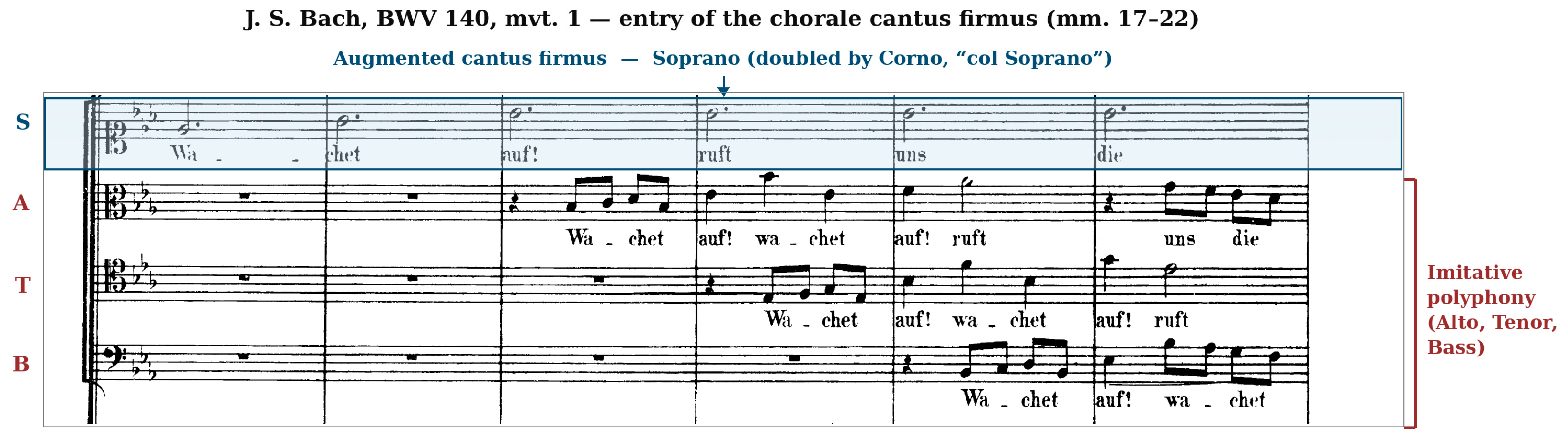
The second level is the contrast structure formed by the polyphonic texture around the
cantus firmus. In contrast to the slowly progressing
cantus firmus in the soprano, the alto, tenor, and bass parts exhibit a highly active and imitative polyphonic texture (
Spencer 2015; see
Figure 1). As
Figure 1 makes visible (mm. 17–22), the inherited melody is privileged on three fronts at once: it is placed registrally uppermost in the soprano, is reinforced in unison by the corno (col Soprano), and unfolds in augmented, long note-values while the alto, tenor, and bass move beneath it in rapid imitative figuration on the same text. This structural opposition—the contrast between the fixed, monumental chorale melody and the active, urgent lower voices—offers a musical counterpart to the operation of strategic distinguishing in Bell’s definition of ritualization. While the urgency and preparation generated by the awakening are musically depicted in the imitative figures of the lower voices, the chorale melody in the soprano serves as a stable traditional anchor. This contrast structure produces a two-level schema in which the
cantus firmus may be heard as the ancient and the polyphonic texture as the present.
The third level is Bach’s strategic augmentation technique
3. Bach radically slows down Nicolai’s melody, which the congregation knew well from their hymnals. Each note of the melody is presented across far longer note values, spread over the urgent figures of the orchestra and the lower voices (
van Geest 2024;
Zazulia 2021). This temporal expansion monumentalizes a familiar melody, lending its ancient and unchanging character a ritual dimension. The augmentation technique here can be read as more than a technical compositional device: Nicolai’s 132-year-old melody is temporally set apart from the surrounding motion and given the quality of a fixed, time-transcending reference. What Bach does may thus be understood not as the mere addition of an old melody to a new composition but as the strategic transposition of the authority of the old melody into the present, where it serves as the ground of legitimacy for his own new composition.
Taken together, these three levels allow Bach’s chorale fantasia to be read as a paradigmatic musical concretization of the traditionalization strategy. For
Bell (
1992), traditionalization is the practice of deriving authority for the new from the old; Bach’s gesture can be read in precisely these terms. The new composition (Bach’s 1731 polyphony) leans on the authority of the old melody (Nicolai’s 1599 chorale); through the
cantus firmus position, polyphonic contrast, and augmentation, this leaning is performed at the musical level. Bach does not conceal his innovation but legitimizes it by routing it through the authority of the old.
4.2. Ritualized Auditory Body: The Participation of the Leipzig Congregation and the Ritual of Recognition
The analysis in the previous sub-section has identified the function of traditionalization at the compositional level, drawing on features that can be established from the score. The present sub-section turns to the experiential dimension; here, because the article does not draw upon listener accounts, diaries, letters, or contemporary descriptions of reception, the claims are necessarily more inferential, and the language is adjusted accordingly. Within
Bell’s (
1992) framework, ritualization processes operate not only structurally but also at the bodily level. Bell’s concept of the ritualized body describes the process through which ritual practice is internalized in the body: the body is reshaped according to particular schemas of opposition, hierarchy, and privileging through a silent interaction with the ritually structured environment. The concept of the ritualized auditory body proposed by this study seeks to conceptualize the experiential dimension of musical ritualization by extending Bell’s bodily emphasis into the auditory domain, in the precise sense defined in Section Analytical Procedure: Linking Bell’s Concepts to Musical Evidence.
For the Leipzig congregation in 1731, the chorale Wachet auf was, by all available indications, one of the most familiar elements of collective memory. Bach’s listeners during his Leipzig period possessed deep prior knowledge of the chorale texts and melodies (
Varwig 2020). Nicolai’s chorale was firmly established in Lutheran hymnody as a symbol of Lutheran identity and the expectation of parousia (
Lima 2023;
Spencer 2015). This familiarity is the precondition that may have transformed the auditory experience of the chorale fantasia from an ordinary act of music listening into a ritual act of recognition. With the opening measures of the chorale fantasia, the congregational listener would have heard, in a new context, a melody known for years; this moment of recognition can be interpreted as the point at which the traditionalization strategy was enacted at the embodied-experiential level.
Varwig’s (
2020) concept of distributed listening offers a critical theoretical resource for conceptualizing this experiential dimension. According to Varwig’s formulation, the eighteenth-century church listener, unlike the modern concert-hall listener, engaged in a practice of distributed listening (
Varwig 2020). The congregation, throughout the cantata, is best understood not as passive auditors but as participants who likely followed the chorale melody they knew by filtering it through the complex polyphonic texture. This practice of distributed listening contrasts with the passive, silent listener figure presumed by the modern listening paradigm. On this view, the Leipzig congregation may be characterized not as a passive consumer but as a collective body potentially engaged in the auditory ritualization process of the chorale fantasia.
At this point, the analytical extension proposed by the article becomes visible. Whereas Varwig’s concept of distributed listening describes the listener’s auditory activity phenomenologically, Bell’s framework of ritualization makes it possible to analyze how that activity may be strategically structured. Bringing the two concepts together yields the analytical force of the ritualized auditory body: the chorale fantasia can be understood as a mechanism that may have structured the listener’s auditory perception and bodily participation and oriented them toward a privileged collective experience. The cantus firmus functions, on this reading, as the perceptual spine of an auditory body, while the surrounding polyphonic layers operate as the textural fabric enveloping that spine. The listener may thus have perceived the familiar old melody as a fixed point of orientation while being surrounded by the new compositional material.
This enveloping process can be understood at three levels. At the first level, hearing the familiar Nicolai melody within the polyphonic structure of the opening may have helped to align the congregation around a single perceptual focus (
Varwig 2020). Individual listeners, through this melody, could be drawn toward the community’s shared historical and theological memory. The perception of the familiar chorale melody as a fixed point potentially encouraged a shift from individual to collective orientation.
This dynamic of collective formation through shared musical sound has been theorized directly in the study of congregational music.
Brower (
2018) analyzes how contemporary worship music gives rise to distinct
modes of congregating, arguing that a congregation is not a pre-given entity but is actively constituted through communal musical practice. Although Brower’s ethnographic context is modern evangelical worship rather than eighteenth-century Lutheran liturgy, her account of how shared musical participation brings a congregation into being as a collective offers a suggestive parallel for the way Nicolai’s familiar melody may have gathered the Leipzig congregation into a single body of recognition. A comparable emphasis appears in
Shelley’s (
2020) account of the Black gospel tradition, in which the experience of the holy through sound is confirmed by religious feeling that is, in his words, at once individual and collective. While these contexts are historically and theologically distinct from BWV 140, together they lend support to the present claim that shared musical sound can function to bind individual listeners into a collective body—the dynamic the ritualized auditory body seeks to name in the specific case of the chorale fantasia.
At the second level, this ritual of recognition can be interpreted as combining Bach’s artistic gesture with the shared faith of the congregation, in a way that frames the work not only as a musical composition but as a collective ritual act (
Varwig 2020). On this reading, the congregational listener does not only listen to the music; by auditorily confirming the familiar position of the melody, the listener may participate in the ritualization of Lutheran identity. In this context the chorale can be understood to function not only as a musical form but as a model that gives concrete shape to theological expectation (
van Geest 2024).
At the third level, the concept of the ritualized auditory body operates as the complementary dimension of the traditionalization strategy. The authoritative position of the
cantus firmus at the compositional level (4.1) might be able to reach its full ritualizing potential only when it is taken up through recognition and participation in the congregation’s auditory experience. That is, Bach’s gesture can be read not only as a compositional strategy but as a potential embodied ritualization process that binds the auditory experience of the Leipzig congregation to the authority of the traditional. Through this auditory adaptation,
Bell’s (
1992) concept of the ritualized body becomes a productive instrument for analyzing not only the structural but also the experiential dimensions of musical practice.
In sum, the opening chorale fantasia of BWV 140 can be read as a two-layered act of ritualization in which the concepts of traditionalization and the ritualized auditory body work together. Bach’s chorale usage can be understood as more than a compositional technique or theological reminder: it may be read as a strategic cultural act that legitimizes the new by routing it through the authority of the old, and that potentially renders the congregation’s auditory experience an active participant in this legitimation process.
5. Discussion and Conclusions
This study has analyzed Johann Sebastian Bach’s gesture of using Philipp Nicolai’s 1599 chorale as
cantus firmus in the opening chorale fantasia of his cantata
Wachet auf, ruft uns die Stimme (BWV 140, 1731) through two specific concepts from within
Bell’s (
1992) theory of ritualization: traditionalization and the ritualized auditory body. The two-layered reading has suggested that Bach’s compositional gesture can be understood not only as a formal technique or theological reminder but as a cultural-strategic act of ritualization. The traditionalization analysis (
Section 4.1) identified three score-based levels—the placement of Nicolai’s melody at the top of the auditory hierarchy through soprano and horn instrumentation, its structural opposition to the imitative lower voices, and its temporal expansion through augmentation—through which Bach may be seen to transpose the authority of a 132-year-old melody into his own composition. The ritualized auditory body analysis (
Section 4.2), advanced more cautiously as an interpretive reading, proposed that this compositional structure could have shaped the experience of the Leipzig congregation, drawing on
Varwig’s (
2020) concept of distributed listening to characterize how a familiar melody embedded in unfamiliar polyphony may orient collective attention.
Reading the two layers together clarifies the article’s central argument: Bach’s chorale usage may be understood as not only structural but potentially experiential, not only an act of deriving authority but a process that could foster embodied participation. The two layers are mutually reinforcing rather than independent. The compositional privileging of the cantus firmus establishes the conditions under which a ritualized auditory experience becomes possible, while that experience, in turn, is what would complete the traditionalizing gesture in the perception of the congregation.
Rather than restating these findings, the remainder of the conclusion considers their broader implications. The principal methodological contribution of the study is the demonstration that the analytical vocabulary of ritual theory can be brought into close contact with the internal detail of a musical score, provided that an explicit procedure (Section Analytical Procedure: Linking Bell’s Concepts to Musical Evidence) governs the move from notation to interpretation and that claims about reception are held to a more cautious evidentiary standard than claims about structure. If this procedure is sound, it suggests a wider program: the systematic study of how compositional techniques—not only cantus firmus treatment but also textural hierarchy, quotation, and rhythmic augmentation—may function as ritualizing mechanisms across sacred repertoires.
Two features make BWV 140 an especially suitable case for this framework: its cantus firmus is a chorale of exceptional canonical authority and deep congregational familiarity by 1731, and that melody is set in sharp registral, rhythmic, and textural relief against the surrounding polyphony. These same two features define the conditions under which the model can be extended to other works: it applies most directly where a melody carrying independent, pre-existing authority is embedded as a recognizable fixed point within less familiar polyphonic material, and has least purchase where the borrowed material is neither independently authoritative nor perceptually foregrounded. Three lines of further inquiry follow directly. First, the framework invites comparative application within Bach’s own output. Other chorale cantatas built upon melodies of comparable canonical authority—BWV 80, Ein feste Burg ist unser Gott, drawing on the central chorale of the Reformation, or BWV 4, Christ lag in Todes Banden, drawing on the canonical Easter chorale—would allow the two-layered model to be tested against contrasting theological and melodic material, and would show whether the readings proposed here generalize beyond a single case. Second, the concept of the ritualized auditory body, defined in Section Analytical Procedure: Linking Bell’s Concepts to Musical Evidence as a mid-level analytical model, may be extended to other traditions in which a familiar, authoritative melody is embedded within less familiar musical surroundings: the treatment of plainchant in Catholic polyphony (in Palestrina’s Missa Ecce sacerdos magnus, for instance, the chant is laid out in sustained long note-values that migrate from voice to voice while the surrounding parts sing the Mass Ordinary in faster polyphony), the role of fixed melodic formulae in Orthodox chant, or congregational hymnody in other Protestant traditions.
Comparative work of this kind would connect the present study to broader conversations in religious sound studies and the analysis of liturgical participation, and could draw productively on the growing phenomenological literature on liturgical experience.
Gschwandtner (
2022), for instance, shows how phenomenological analysis can illuminate the ways in which communal worship organizes time, space, body, and affect, and how liturgy may shape a shared communal identity. Bringing such phenomenological description into dialogue with the strategic, ritual-theoretical reading developed here could deepen the comparative study of how diverse liturgical traditions structure the auditory experience of their congregations.
Third, the experiential claims advanced cautiously here could be pursued more rigorously through engagement with surviving historical evidence of reception—orders of service, theological writing on church music, and contemporary accounts of worship—so that the inferential reading offered in
Section 4.2 might be tested against the documentary record.
The study is, finally, bounded in three respects that its conclusions should not obscure. Its analysis is confined to the opening chorale fantasia, leaving the remaining movements—especially the fourth-movement chorale setting and the soprano–bass duets—for separate treatment; it operationalizes only two concepts from Bell’s framework rather than the fuller typology she elaborates in later work (
Bell 1997); and, as a single-case study, it can propose but not establish the generalizability of its model. These limitations are also an agenda. Read through Bell’s framework, Bach’s use of Nicolai’s chorale in BWV 140 ceases to be a purely technical matter and becomes a case through which the cultural-strategic and embodied dimensions of sacred compositional practice can be examined—an example of how music may function not only as an object situated within ritual but as a mode of ritualization in its own right.