Article

Light, Time, and Sacrament: A Theological Reading of Impressionist Form

by
Dominic A. Aquila
Art History, University of St. Thomas, Houston, TX 77006, USA
Religions 2026, 17(6), 718; https://doi.org/10.3390/rel17060718
Submission received: 20 April 2026 / Revised: 12 June 2026 / Accepted: 15 June 2026 / Published: 16 June 2026

Abstract

This essay advances a theological reappraisal of Impressionist painting as a modern mode of sacramental perception capable of renewing the contemplative imagination within a disenchanted West. While recent scholarship has interpreted Impressionism as a limit case of aesthetic immanence, reducing vision to light, temporality, and surface, this study argues that such immanence is not closed. Drawing on Aidan Nichols’s distinction between art made for the liturgy and art tutored by it and informed by David Fagerberg’s account of liturgy as the right ordering of reality itself, the argument proposes that Impressionist form can be evaluated according to precise theological criteria. Sustained ekphrastic analysis of Monet’s Portal of Rouen Cathedral in Morning Light (1894), Cézanne’s Mont Sainte-Victoire (c. 1902–1904), and Messiaen’s Louange à l’Immortalité de Jésus (1941) is brought into conversation with Jean-Luc Marion’s phenomenology of givenness, Pavel Florensky’s theology of perspective, and Augustine’s account of distentio animi. Read in this light, Impressionism emerges not as indifference to the sacred, but as a discipline of attention that disposes artist and perceiver toward participation in a liturgical reality already given in creation: a modern praeparatio evangelica whose formal achievements, though historically bounded, remain theologically available. The argument does not presume that Impressionist form is theological in intention, but that, when attended to with sufficient formal discipline, it may be recognized as consonant with theological accounts of perception.

1. Introduction

This essay advances a theological reappraisal of Impressionist painting by arguing that its formal achievements, above all its disciplined attention to light, duration, and chromatic structure, may be recognized as consonant with theological accounts of sacramental perception. The argument does not presume that Impressionist painters intended theological significance. It claims, rather, that when the formal logic of these works is followed with sufficient patience, it exceeds the limits of the immanentist historiographic tradition within which Impressionism is typically read and discloses a depth that theological aesthetics is uniquely equipped to name.
The essay proceeds in seven stages. Section 2 diagnoses the cultural and perceptual crisis to which Impressionism responds, with particular attention to Weber’s disenchantment thesis and Rosa’s account of resonance. Section 3 surveys the dominant art-historical accounts of Impressionism and identifies the immanentist assumptions that they share in common, before proposing ekphrasis as a methodological corrective. Section 4 provides the theological frame: Marion’s phenomenology of givenness, Eliade’s account of displaced sacrality, and the concept of praeparatio evangelica. Section 5 establishes the chromatic-theological argument through the contrast between Byzantine iconography and the Impressionist inheritance. Section 6 develops the Augustinian account of time as the temporal framework for the ekphrastic analyses. Section 7 offers sustained ekphrastic readings of three works: Monet’s Portal of Rouen Cathedral in Morning Light (1894), Cézanne’s Mont Sainte-Victoire (c. 1902–1904), and Messiaen’s Louange à l’Immortalité de Jésus (1941). Section 8 draws the theological conclusions and addresses the contemporary stakes of the argument.

2. Beauty, Disenchantment, and the Sociocultural Stakes

Beauty remains evident in the ordinary experience of life: in the play of light across a landscape at a particular hour, in a musical work especially well performed, in the quiet satisfaction of things well made, in the beauty of a life well lived. As Thomas Aquinas observes in his reply on the relation of the beautiful to the good, pulchra enim dicuntur quae visa placent: “things are called beautiful because they are pleasing to look at” (Aquinas n.d., I.5.4 ad 1, trans. Freddoso). The beautiful, Aquinas continues, “consists in due proportion, since the sensory power delights in things that are duly proportioned, because they are similar to it” (Aquinas n.d., I.5.4 ad 1, trans. Freddoso). Beauty, in this sense, is not the preserve of the rare or the esoteric. It is woven into the fabric of ordinary experience and perception. And yet beauty’s status has shifted. What was once trusted to disclose something significant beneath the surface of things now appears, more often than not, as decorative or ornamental, an event that subjectively satisfies but no longer seems revelatory. C. S. Lewis recognized the stakes of this shift with particular clarity. In The Abolition of Man, he argues that the reduction in beauty and value to mere expressions of feeling, rather than perceptions of something real, would gradually erode the conditions of moral and cultural formation, leading ultimately to “the destruction of the society which accepts it” (C. S. Lewis 1944, p. 27). Writing from within the secular academy a half century later, Elaine Scarry confirms the diagnosis from the inside. Beautiful things themselves have not been banished from the humanities, she observes; what has been banished is “conversation about the beauty of these things,” so that scholars who live daily among beautiful poems, paintings, and arguments now “speak about their beauty only in whispers” (Scarry 1999, p. 57). What is at stake is not simply aesthetic judgment, but the integrity of perception itself, whether the act of seeing still participates in reality or has been reduced to registering private sensation.
Yet any rehabilitation of beauty as a genuine cognitive and spiritual category must reckon with the challenge that the twentieth century posed to it. The catastrophes of two world wars, and in particular the uses to which aesthetic refinement was put in the context of mass atrocity, led theologians, artists, and philosophers alike to wonder whether beauty could retain any claim to moral seriousness. Nicholas Wolterstorff’s critique of the aesthetic tradition in Art in Action and Elaine Scarry’s exploration of the relationship between beauty and justice in On Beauty and Being Just mark the seriousness of this challenge (Wolterstorff 1980; Scarry 1999). The present essay does not evade it. The Thomistic account of beauty to which it appeals is not a claim that beauty is untroubled or that its cultural history is naïve. It is, rather, a claim that beauty’s transcendental status, its ontological rootedness in proportion, integrity, and radiance, persists even through its historical disfigurements and instrumentalizations. Beauty, to adapt the image of kintsugi pottery, does not become more beautiful by denying its fractures; it discloses its depth precisely through them. The argument developed below is not for beauty as consolation or escape, but for beauty as a mode of contact with reality that is, if anything, more urgently needed in the aftermath of modernity’s self-damage than before it.
Hans Urs von Balthasar diagnosed this cultural condition with characteristic precision. For Balthasar, beauty’s modern fate is bound up with a decisive rupture in the unity of the transcendentals: truth, goodness, and beauty. When beauty is severed from truth and goodness, it does not disappear; it persists in altered form: aestheticized, privatized, and rendered incapable of disclosing the depth of reality (von Balthasar 1982, pp. 18–20). Aidan Nichols succinctly captures the implications of this severance, noting that it helps explain “the perceived reduction in the moral order to a self-centered relativism, and the retrenchment of the metaphysical order to a materialism placed at the service of either technology or psychology or both. The final upshot of all this, [Balthasar] predicts will be the incapacity for either faith or love” (Nichols 2008, p. 12). What is lost is not beauty as such, but its capacity to mediate reality and to draw the perceiver beyond surface appearance into participation in what is.
Max Weber’s account of modernity offers, from a sociological perspective, a parallel diagnosis. The fate of the age is “characterized by rationalization and intellectualization and, above all, by the ‘disenchantment of the world.’” Yet the consequence is not eradication but retreat: “the ultimate and most sublime values have retreated from public life either into the transcendental realm of mystic life or into the brotherliness of direct and personal human relations” (Weber 1946, p. 155). Weber continues, drawing on art as a particular example:
It is not accidental that our greatest art is intimate and not monumental, nor is it accidental that today only within the smallest and intimate circles, in personal human situations, in pianissimo, that something is pulsating that corresponds to the prophetic pneuma, which in former times swept through the great communities like a firebrand, welding them together.
(Weber 1946, p. 155)
What Weber discloses is not merely a sociological observation but a structural diagnosis of modern culture: the collapse of a shared public space in which beauty and meaning could be held in common. The pneuma, the spirit that once animated collective life and was communicated across whole civilizations, has been compressed into the private and the pianissimo. The intimate circle survives; the common world is impoverished. The problem is not that beauty has vanished, but that it has lost its communicability: its capacity to address and transform the perceiver in ways that can be shared beyond the private sphere. A recent clarification of Weber’s account is pertinent here. Marotta (2023) argues that Weberian disenchantment concerns not the disappearance of the sacred or the death of transcendence, but a transformation in the naïve human disposition toward the world: a loss of the intuition that the world is “imbued with magical properties” (Marotta 2023, p. 239). Far from being a process of detranscendentalization, disenchantment “actually participates in a process of transcendentalization” (Marotta 2023, p. 239), in which the world and its events “are no longer framed in a magical worldview but are instead naïvely understood as mere objects to be subsumed under transcendent criteria,” so that “the world in itself ends up having no meaning to offer” (Marotta 2023, p. 238). What is at stake, in other words, is not an objective withdrawal of meaning from reality, but a shift in the human capacity to perceive and receive it. This distinction is consonant with the argument developed below: the problem of disenchantment is ultimately perceptual, and its address must therefore be sought at the level of perception itself.
What Weber describes at the level of cultural form finds a more phenomenologically precise articulation in the work of Hartmut Rosa, who recasts disenchantment as a loss of resonance. He reminds his readers of the etymological root in Latin: “re-sonare” refers to an acoustical phenomenon, “to re-sound” (Rosa 2019, p. 165). For Rosa, disenchantment is not simply the removal of supernatural belief; it is a transformation in the quality of our relationship to the world itself. “Disenchantment means that the world literally stops singing” (Rosa 2019, p. 326). In place of a world that addresses, calls, and draws the subject into responsive relation, modernity produces a world that is merely available: predictable, calculable, and controllable, but constitutively mute. Resonance, for Rosa, is not a feeling but a mode of relation … a specific way of being-related-to-the-world, one in which “both subject and world” must be “sufficiently ‘closed’ or self-consistent so as to each speak in their own voice, while also remaining open enough to be affected or reached by each other” (Rosa 2019, pp. 168–69, 174). Its loss is not merely the loss of pleasure or affect but the loss of a world capable of speaking, of making genuine claims upon the perceiver that exceed what the perceiver brings to the encounter. Taken together, Weber’s cultural diagnosis and Rosa’s phenomenological recasting describe not simply a loss of belief but a deformation of perception, a world no longer experienced as meaningful, but as mute.
If the world has, as Rosa suggests, ceased to “speak,” a regenerative question follows: how might the conditions of a world that can once again be heard in common be restored, and by whom? Such a loss of communicability and its restoration to a common world is what commends Arnold J. Toynbee’s concept of the “creative minority.” In A Study of History, Toynbee identifies “creative minorities” as those exceptional communities that, when a civilization confronts the failure of its established order, devise responses adequate to the challenge and draw others after them, not by compulsion, but by the compelling force of example. His term for this force is mimesis, or inspired imitation (Toynbee 1947, pp. 49, 211–15). Joseph Ratzinger, reflecting on this dynamic, observed that “the destiny of a society always depends on its creative minorities” (Ratzinger 2007, p. 34).
Such minorities do not fulfill their cultural task by acquiescing to the privatization Weber describes. If the highest values have retreated into the intimate circle and the pianissimo, the task of a creative minority is not to preserve that retreat but to reverse its direction. Toynbee’s own account of how such minorities act in history traces a pattern he calls “withdrawal-and-return”: the creative minority withdraws from the common life long enough to develop a new response to the civilization’s crisis, then returns to transmit that response to the wider society through the contagion of example, not by compulsion (Toynbee 1947, pp. 230–40). The significance of creative minorities lies, then, not in sequestration but in diffusion: in the transformation of what is first cultivated in concentrated, even private form into something once again shareable in common. The very site of retreat becomes the locus of renewal, from which the pneuma may once again emerge, not merely as a private consolation, but as a force capable of reconstituting a public world.
A further question is continuous with the preceding one: whether such a reformation of perception remains possible under the conditions of a disenchanted and visually immanentized modernity, and, if so, where it might be sought, and by what agents it might be advanced. If renewal is to arise from within modernity rather than in reaction against it, it must be pursued precisely at the point where modernity appears most fully to have realized its own logic, where vision is most often confined to immanence and where, as Weber observed, the highest values have retreated into the intimate and the pianissimo.
It is here that the arts assume a particular significance. One could turn to philosophy, to theology, or to the beauty of the natural world, and thinkers have turned to all three. But art has a specific advantage: it is of human make, a poiema, in which a particular quality of attention has been given durable, communicable form. Artists must first receive before they can give form; in the act of making at its most serious, knowing and making become indistinguishable, the work emerging from a sustained, disciplined encounter with what is given. The made work then externalizes and stabilizes that prior act of reception, transmitting it to others, inviting them into the same quality of attentiveness that produced it. The work of art uniquely objectifies a mode of perception, giving it a stable, repeatable, and public form that neither natural beauty nor philosophical argument can fully achieve. Natural beauty is given without human agency shaping the conditions of its reception; philosophy can describe a mode of attention but cannot produce it. Only the made work draws another person into a reformed perception, not by persuading but by requiring it to be undergone.
The thinkers who have diagnosed modernity’s perceptual crisis most searchingly have turned, almost without exception, to art, whether visual, literary, or musical, as the site where that crisis is most legible and its reformation most conceivable. Weber turns to art to illustrate and give heft to his disenchantment thesis. As already indicated by the musical association of the term “resonance,” Rosa asserts that “the experience of music suspends the division between self and world, transforming it in a way into a pure relationship” that negates or at least mitigates the alienation associated with living in a disenchanted world (Rosa 2019, p. 94). Hans Georg Gadamer opens Truth and Method not with a philosophical proposition but with the encounter with a work of art, “The question of truth in the experience of art,” because it is there, he argues, that truth-disclosure has survived modernity’s reduction in knowing to method (Gadamer 1985, p. 3). Martin Heidegger turns to the work of art because it remains one of the few sites where being can still emerge into “unconcealment” (aletheia) in a world that reduces everything to mere availability (Heidegger 1971, p. 36). That four thinkers as different as these converge on art is not incidental. It reflects the structural recognition that the crisis of modernity is located at the level of perception, and that it is within the arts that perception is most deliberately disciplined, externalized in a made object, and rendered communicable. The question is therefore not whether art is relevant to this crisis but which art, at which moment of modernity’s self-realization, presses perception to its furthest limit, and whether, pressed that far, something breaks through.
A further warrant for turning to the arts, and to Impressionism in particular, emerges in the work of the Dominican theologian Aidan Nichols, whose The Art of God Incarnate provides one of the earliest and most theologically precise accounts of how the crisis of modern perception was registered and partly resolved in painting. Nichols identifies the shift from Impressionism to Post-Impressionism as “the Impressionist crisis in the epistemology of painting,” and reads the seminal figures who followed Monet as having brought “once again within our imaginative reach an approach to the painterly image as a healing and transforming disclosure of a world which is already a sacrament of presence” (Nichols 1980, p. 9). The formulation is telling. Writing in 1980, well before the phenomenological theology of Jean-Luc Marion and the theology-and-visual-art literature of the last two decades (e.g., Hart 2003; Quash 2013; Anderson and Dyrness 2016; Anderson 2025),1 Nichols had already identified in modern painting a resource for answering the very condition this essay has been tracing: a world perceived as mute, made again perceptible as addressing, as giving, as sacramental. The present argument stands in this lineage and extends it. Where Nichols locates the sacramental recovery primarily in the Post-Impressionist break, the present essay will argue that the sacramental disclosure is already operative, in latent and formally specific ways, within Impressionism itself. The crisis Nichols names is real; its resolution, it will be shown, begins earlier and within the very practice he treats as its occasion.
If art is the privileged site for the reformation of perception, and if only the made work can objectify and transmit a quality of attention that would otherwise remain private and incommunicable, then the most rigorous test of that claim is not art that announces its transcendent content (overtly religious art) but art that appears to have foreclosed it. Impressionism is that test: a practice whose dominant historiography has construed it as the disciplined confinement of vision to the surface of appearances, and which for that reason presses the question to its limit. This essay therefore proceeds by granting, rather than contesting, the dominant art-historical interpretation of Impressionism as an immanentist practice of perception, not in order to refute it from without, but to inhabit it from within long enough to test whether its limits are as final as they appear. The question is whether, even here, beauty retains the resources for renewed communicability; whether what now pulses only in the pianissimo of private perception can be brought once more into a form shareable in common; and whether, in that sharing, something of what has been lost might be recoverable. The claim advanced here is not that theology is imposed upon Impressionism from without, but that the formal achievements of Impressionist painting, when sustained in attention, may disclose a depth that theological aesthetics is uniquely equipped to name. In this way, Impressionism becomes a privileged case for examining how the sacred persists within the spatio-temporal conditions of modern artistic practice, even when no longer explicitly named as such.

3. The Art-Historical Account and Its Limits

The historiography of Impressionism over the past half-century reveals a succession of interpretive frameworks that progressively narrows the horizon within which beauty can appear. What emerges across these phases is not simply a series of competing readings, but a convergence toward a shared assumption, namely that perception, however refined, remains confined to the field of immanence and its historical mediation.
Already in its earliest theoretical formulations, Impressionism was construed in immanentist terms. Venturi’s (1941) essay, “The Aesthetic Idea of Impressionism,” published in the inaugural issue of the Journal of Aesthetics and Art Criticism, exemplifies this tendency with philosophical clarity. Venturi defines Impressionism as concerned not with reality but with “the appearance of reality,” explicitly connecting its aesthetic to Kant’s account of pleasure as referring “not to the object, but only to the subject” (Venturi 1941, p. 37). He grounds the movement in sensation rather than knowledge, appearance rather than form. Jules-Antoine Castagnary had already discerned this orientation at the movement’s founding moment, writing in Le Siècle on 29 April 1874 that the Impressionists “render not the landscape but the sensation produced by the landscape” and in so doing “leave reality behind and enter into full idealism” (Castagnary 1874). This early framing is instructive precisely because it was not a distortion imposed from outside; it was the movement’s own self-understanding as its first sympathetic critics received and systematized it. The immanentization of Impressionism is not a late interpretive imposition; it is present from the beginning.
A decisive turning point in subsequent historiography came with the work of Robert L. Herbert, whose Impressionism: Art, Leisure, and Parisian Society reframed the movement as a response to the social transformations of modern Paris. Writing of Degas’s racetrack images, Herbert argues that they “stand for a society undergoing profound and rapid transformations” (Herbert 1988, p. 169). The social-historical frame this methodology establishes treats Impressionist form as symptomatic of its conditions. The canvas is read as a record of nineteenth-century Paris rather than as a disclosure that exceeds those conditions. T. J. Clark, in Farewell to an Idea, provides the most searching materialist account. For Clark, the defining condition of modernity is contingency, a social order that has turned away from inherited meaning toward “a projected future of goods, pleasures, freedoms, forms of control over nature, or infinities of information” (Clark 1999, p. 7). Within this framework, modernism appears as the art of a civilization that has lost its capacity to signify with confidence. What is most striking, however, is the candor with which Clark acknowledges the cost of this refusal. Writing of Impressionism specifically, he observes that even Monet’s art is driven “not so much by a version of positivism as by a cult of art as immolation, with more of the flavor of Nerval and Géricault to it than of Zola and Claude Bernard” (Clark 1999, p. 12). This formulation concedes far more to the non-positivist dimensions of Impressionist practice than the dominant social-historical framework can easily absorb. It is precisely this excess, the immolatory, inexhaustible quality that Clark names but cannot account for, that the present essay proposes to examine from a different angle.
The risk of subordinating the work of art to the conditions of its interpretation has not been resolved but intensified by the so-called global turn in Impressionist studies, exemplified by recent edited volumes such as Globalizing Impressionism (Clark and Fowle 2020) and Mapping Impressionist Painting in Transnational Contexts (Burns and Price 2021). This turn reconceives Impressionism less as a historically bounded movement than as a mobile node within a network of cultural exchange. The gains of this approach are real. It exposes the contingency of the canon, brings neglected artists and audiences into view, and corrects provincial assumptions. Yet these gains come at a methodological cost. As the object of study expands geographically, it becomes increasingly diffuse. The individual work of art is subtly displaced. No longer the primary site of inquiry, it becomes illustrative, evidence marshaled in support of a broader historical argument. The canvas does not disappear, but it recedes behind its conditions.
This essay resists such recession, not by retreating to a naïve formalism, but by insisting that sustained attention to what a work formally achieves is the irreplaceable ground of any interpretation worthy of the name. In this respect, Clark’s work is instructive. Whatever his theoretical commitments, which are unambiguously materialist, his method proceeds through sustained ekphrasis before it arrives at social argument. Ekphrasis, in its classical sense, denotes the verbal articulation of a visual work. It is the disciplined effort to render in language what a work of art formally achieves, its organization of light, color, space, and surface, in order to hold it long enough for interpretation to become answerable to what is actually there. When Clark writes of Jean-Baptiste-Camille Corot, that his gray pastorals “grapple head on (not even defiantly) with the disenchantment of the world” and “aim to include the disenchantment in themselves, and thus make it bearable,” the social argument arrives only because the formal observation has been held long enough to yield it (Clark 1999, p. 12).
The present essay follows that order of priority, insisting that interpretation begin where the work itself begins, not in its conditions, but in its form. The difficulty is that the most influential theoretical account of nineteenth-century vision makes this insistence increasingly hard to sustain. Jonathan Crary has argued that vision itself undergoes a profound transformation in the nineteenth century, a “break with classical models of vision” that was “inseparable from a massive reorganization of knowledge and social practices” (Crary 1990, p. 9). The operative term throughout is observer rather than spectator: the observer is “one who sees within a prescribed set of possibilities, one who is embedded in a system of conventions and limitations” (Crary 1990, p. 6). On this account, vision is always “inseparable from the possibilities of an observing subject who is both the historical product and the site of certain practices, techniques, institutions, and procedures of subjectification” (Crary 1990, p. 5). What is less often remarked is that Crary’s account of perception also governs art history’s methods: the historiography of Impressionism increasingly mirrors the epistemological assumptions it attributes to the nineteenth century, approaching the work of art through the social and discursive conditions that construct its visibility.
What this methodological framework obscures is a path not taken. The disclosive register, which Crary’s framework rules out—the work of art as an event of formal disclosure rather than as a historical effect—was, in the early nineteenth century, available as a live possibility for artists and scientists alike. Jacques Barzun noted that at the opening of the nineteenth century, “specialization had not gone so far that a man could not combine an interest in science with every other liberal pursuit” (Barzun 1961, p. 65). Artists and scientists shared a common orientation toward the real, committed to admitting “the widest possible range of experience as real” (Barzun 1961, p. 64).
The vocation shared in common by artists and scientists (vocation meaning here not merely a profession but an answering to what calls for attention, a disposition of inquiry ordered toward a reality that gives itself to be known) admitted of two possibilities. Observation could remain ordered toward the disclosure of a reality that precedes and exceeds it, or it could become increasingly reflexive, turning back upon the conditions under which observation itself occurs. Paul Klee’s celebrated formulation names the first possibility with precision: art does not reproduce the visible; rather, it makes visible, macht sichtbar (Klee 1968, p. 182). Nichols, commenting on the theological reach of this dictum, finds in it the very “guiding thread for the future” of painting: an art whose task is not to mirror surface appearance but to bring the invisible into the register of the visible (Nichols 1980, p. 12). Martin D’Arcy identified the casualty of the second possibility: under positivist pressure, inquiry withdraws from an independent reality and reconstitutes itself as the management of its own procedures (D’Arcy 2017, p. 3). The vocation Barzun identified has not been abandoned. It has been quietly redirected: the painter no longer asks what the visible world gives to be seen, but what the eye itself contributes to seeing; the physicist no longer asks what nature is, but what an instrument can measure.
Rosalind Krauss brings this historiographic trajectory to its philosophical limit. In The Optical Unconscious, she characterizes the arc of modernism, with Impressionism as its origin, as “the history of an ever more abstract and abstracting opticality”: a field of visual experience systematically severed from embodiment, tactility, and any referential depth beyond the retinal surface; vision understood as self-sufficient, answerable only to its own conditions: a closed immanence in which vision has been detached from the question of what, if anything, it discloses (Krauss 1993, pp. 7–8, 13). Krauss here has identified the theoretical endpoint that Venturi’s Kantian subject-centeredness, Herbert’s social embeddedness, and Crary’s constructed observer all approach but do not fully name. Krauss’s account marks the limit case this essay inhabits and presses against.
The historiographic trajectory just sketched is inseparable from the sociocultural crisis within which Impressionism emerged. The Third Republic in France brought the dissolution of aristocratic and ecclesiastical patronage, the secularization of public culture under the Ferry laws, and the replacement of the Salon system by commercial galleries (Nord 1995, p. 136; White and White 1993, chaps. xi–xvii). Peter Berger makes clear that disenchantment is not only a condition of individual consciousness but of the social structures within which art is produced and received, the “plausibility structures” that sustain or erode the capacity of shared meaning to take hold (Berger 1967, p. 45). The collapse of the Academic-Salon system and the rise in the dealer-critic network were not merely institutional rearrangements but transformations in the very conditions under which painting could be made, seen, and valued.
No figure embodies this transformation more consequentially than Paul Durand-Ruel (1831–1922), the Parisian dealer whose gallery became the principal commercial and critical infrastructure through which Impressionism reached its public. Against a market that had rejected Monet, Pissarro, Renoir, and Sisley, Durand-Ruel bought their work in bulk, paid them monthly stipends, mounted solo exhibitions when such shows were nearly unknown, and twice risked bankruptcy to sustain them; Renoir later remarked that without him the Impressionists would have starved (Bailey 2015). Yet the figure who underwrote this most formally radical movement in nineteenth-century painting was himself a devout Catholic and ardent monarchist, a daily communicant who had aspired in youth to a missionary vocation, and who was arrested in 1880, at the age of fifty, for protesting the Third Republic’s suppression of the male religious congregations (Bailey 2015). He understood his dealership not as commerce but as vocation: “We are on this earth,” he wrote, “not for our amusement and to think only of ourselves and our loved ones, but to do good all around us, within the limits of our power” (Durand-Ruel [1939] 2014, p. 17). That such a man should have staked his livelihood on painters who neither shared his faith nor painted religious subjects is itself a datum requiring interpretation. The theological interpretation offered here is Balthasarian rather than Durand-Ruel’s own: that genuine beauty discloses truth exceeding the intentions of its makers, and that the sacred may be served through those who do not name it.
Durand-Ruel’s wager points toward a structural question: whether the sacred can persist, unannounced and unacknowledged, within the very practices of a secularizing culture. The question pursued here is whether the paintings he championed demonstrate it in formal terms: whether Impressionism itself, in the rigorous immanence of its attention to light and time, enacts a version of what Durand-Ruel enacted commercially, the service of something it does not name. As Mircea Eliade argues in The Sacred and the Profane, “such a profane existence is never found in the pure state”: however thoroughly modern man has desacralized his world, he “never succeeds in completely doing away with religious behavior,” because “sacrality is in a sense camouflaged in the immediate, in the ‘natural’ and the everyday” (Eliade 1959, p. 23). Impressionism, this essay argues, is one site where camouflage is operative: a modern practice of perception that, in confining itself to the immanent surfaces of light and time, paradoxically discloses within them the sacred persisting not in explicit religious form but latent within the very structures of modern vision.
It is at this juncture, where historiography and pictorial practice converge in their privileging of appearance, that a theological aesthetic perspective becomes not an imposition from without but a necessary enlargement from within. Han Urs von Balthasar opens his magnum opus, The Glory of the Lord. by insisting that beauty is “the last thing which the thinking intellect dares to approach, since only it dances as an uncontained splendour around the double constellation of the true and the good and their inseparable relation to one another” (von Balthasar 1982, p. 18). On this account, beauty is not exhausted by its appearing, nor reducible to the conditions of its perception. What is disclosed in any genuine encounter with the beautiful is simultaneously “the figure and that which shines forth from the figure, making it into a worthy, a love-worthy thing”: form and splendor inseparably conjoined, neither collapsible into the other (von Balthasar 1982, p. 19). The task, then, is not to overturn the foregoing historiographical tradition but to reopen within it the question it has too quickly settled. That is, whether the beauty that appears in these works is merely immanent, or whether, in and through its very appearing, it participates in a reality that exceeds it.
This essay argues for the latter, and it does so by a method appropriate to the claim: sustained, ekphrastic attention to what three works formally achieve, pressed far enough that what the immanentist framework excludes at the conceptual level begins to reassert itself at the level of formal experience. The argument does not proceed by importing theological categories from without and applying them to works that resist them; it proceeds by following the formal logic of the works themselves until that logic exceeds what the dominant historiographic framework can contain. Monet painted the Rouen Cathedral façade more than thirty times and never captured it. That failure is not operationalist; it is the formal record of an encounter with excess, an excess that resists reduction to the perceptual operation itself. It is here, in this excess that breaks through the conditions of immanent perception and cannot be accounted for by them, that a Balthasarian analysis finds what positivism cannot name: the luminous surplus of the real, the claritas of created form shining through its material conditions.

Methodological Note: Theology, Liturgy, and Ekphrasis

This essay proceeds through theological aesthetics in disciplined dialog with art history, not by imposition of the former upon the latter. As Gadamer argues in Truth and Method, the encounter with a genuine work of art is an event of truth-disclosure: the work’s Anspruch (claim) upon the viewer opens onto a “fusion of horizons,” which acknowledges the pastness of a historical text or artifact as one horizon and the present as another. Their integration discloses truth that exceeds any single historical appropriation (Gadamer 1985, p. 273). The claim is not that Monet or his contemporaries intended theological significance, but that their paintings disclose it, that their formal properties may be recognized as capable of being read as satisfying criteria for sacramental beauty that theological aesthetics brings into view. The ekphrastic method followed here performs this fusion in the writing itself: sustained, durational attention to the visible and audible discloses depth that instantaneous inspection, so often taken as definitive of Impressionist perception, cannot reach.
Yet ekphrasis presupposes a practice of disciplined perception that it cannot itself generate. It depends upon habits of attention formed not in solitary virtuosity but within communities of seeing and hearing, transmitted across generations. To name that prior formation, and to render visible the shared discipline without which sustained beholding cannot disclose a common world, is to arrive at the second methodological commitment of this essay. The problem is not only how to describe what is seen or heard, but how a mode of seeing or hearing capable of being shared in common is formed at all.
To be sure, modern societies possess communal practices that gather attention: civic ritual, the classroom, the museum, the concert hall. Each cultivates, in its own way, a public mode of seeing and offers a partial resistance to the privatization Weber describes. Yet each remains bounded by the horizon within which it operates. Civic ritual tends toward instrumentality, ordered to cohesion rather than to the disclosure of reality as given. Education refines perception but often abstracts from the embodied and durational conditions under which attention is formed. The arts preserve practices of beholding, yet typically within elective or specialized communities rather than across a genuinely common world. What these practices achieve is real; what they lack is a stable ordering to what exceeds them, a shared orientation to reality as something to be received rather than produced.
Within the Christian tradition, this fuller formation of perception has a name: liturgy. What distinguishes liturgy from these other communal practices is not simply that it gathers participants or focuses attention, but that it is ordered to the reception of reality as given, not constructed: a shared participation in what is held to precede and exceed the community itself, and therefore capable of sustaining a genuinely common world. Read in light of Weber’s account of retreat into the intimate and the pianissimo, liturgy emerges as the site in which what has withdrawn is gathered again into shared form. Before one can ask what an Impressionist painting achieves, one must first have in view the theological account of perception by which any such achievement can be recognized.
Aidan Nichols’s distinction proves methodologically decisive here: between art made for the liturgy and art that is “tutored by the beauty of the Liturgy,” instantiating to some degree “memory, symbol, and meaning” (Nichols 1999, pp. 104, 108). Byzantine iconography belongs to the first category. Impressionism belongs to the second: it cultivates perceptual and affective dispositions ordered toward reception, forming habits of attention that prepare the soul to receive what liturgy offers. For Nichols, foremost for an art informed by liturgy is a recognition of the sacrality of creation (Nichols 1999, p. 108). Nichols’s earlier The Art of God Incarnate supplies the theological premise on which this recognition rests. Reading the passage from Impressionism to Post-Impressionism as the moment in which painting recovered the painterly image as “a healing and transforming disclosure of a world which is already a sacrament of presence,” Nichols thereby establishes, on independent theological grounds, that modern painting can be read as a site where the world’s sacramentality becomes once again perceptible (Nichols 1980, p. 9). The present essay extends this premise by locating the recovery earlier: Impressionist form itself, attended to durationally (for the eye, no less than the ear, must be given time to receive what is given), already cultivates the perceptual disposition that Nichols identifies. Maurice Denis, whose career moves directly from Nabi Post-Impressionism to the theory and practice of sacred art, makes this recognition explicit: the “certain order” that a painting instantiates is nothing other than the ordered disclosure of beauty as a transcendental property of being (Denis 1968, p. 94). The interpretive tradition surveyed above minimizes this first principle of an art that aspires to liturgy.
In this essay, liturgy does not refer exclusively to formal ecclesiastical ritual. It names, more broadly, a right ordering of perception through which the world is received as given rather than managed as available. What Aidan Nichols identifies as the formal and affective condition of art “tutored” by liturgy receives its most searching theological articulation in the work of Alexander Schmemann. For Schmemann, worship is not a ceremony within the world but the act by which the world’s true nature becomes manifest. The primordial intuition of worship is “that the world … is an epiphany of God, a means of His revelation, presence and power” (Schmemann 1973, p. 2). Liturgy, in this sense, does not import sacredness into a neutral reality; it discloses the sacramental character that belongs to creation as such. The secular attitude is therefore not simply disbelief but “the negation of worship”: the refusal of the world’s capacity to serve as epiphany, the denial “of the sacramentality of man and the world” (Schmemann 1973, pp. 1, 4).
This account clarifies, at a theological level, the cultural diagnosis with which this essay began. Where Max Weber observed the retreat of the highest values from public life into the intimate and the pianissimo, Schmemann identifies the deeper loss: not the disappearance of meaning, but the eclipse of a world capable of being received in common as meaningful. Secularism, on this account, disperses what was once held publicly into private experience. Liturgy reverses that dispersion by reestablishing the world as a shared epiphany: a site where meaning, given rather than constructed, can once again be received together. David Fagerberg makes the point with particular clarity: liturgy does not create reality but “celebrates” what is always already the case, bringing to ritual expression what is “steadfastly and pervasively true” (Fagerberg 2004, p. 143). It does not insert transcendence into an otherwise empty immanence; it renders perceptible, in common, a reality that precedes the act of celebration itself (Fagerberg 2004, p. 144).
Romano Guardini develops this claim at the level of the perceiving body. Liturgy discloses “matters of deepest import” within the ordinary materials and gestures of human life (light, time, space, movement, bread, wine), not by adding meaning to them, but by training perception to recognize what they already bear (Guardini 1979, p. 10). The liturgical act is thus not an overlay but a discipline: a retraining of attention through which the given world becomes legible again as meaningful. What is formed in this way is not a private sensibility but a shared capacity for reception, one that restores, in common, the conditions under which meaning can appear.
Understood in this light, liturgy names the very condition that the preceding analysis has shown to be in crisis: a form of perception capable of receiving the world as more than surface, and of doing so in a way that can be held in common rather than dissipated into private sensation. It is precisely this condition that Impressionist practice, without naming it, begins to recover.
Accordingly, liturgically formed persons do not encounter a disenchanted world from which God is absent and into which transcendence must somehow be imported. They encounter a world already consecrated, already ordered, in its deepest structures, to the divine, and liturgy is what trains the perception to receive what is given. This educating of perception is precisely what the Impressionist practice partially enacts without naming. The painter who attends to the shimmer of complementary colors across a cathedral façade until its surface opens onto an inexhaustible depth is performing a kind of liturgical perception prior to any explicit liturgical act: a perceptual reorientation toward the sacrality of the given that liturgy, at its deepest level, cultivates and completes. And, crucially, the painter does this in a form that can be shared in common. The canvas externalizes an act of reception and makes it available to another perceiver, dragging the pianissimo back into the possibility of a common world. This structural movement, from a private act of reception to a publicly transmissible form, is what Elaine Scarry, from a wholly different philosophical starting point, identifies as beauty’s inherent momentum toward replication: “Beauty brings copies of itself into being” (Scarry 1999, p. 3). Her claim that beauty incites drawing, description, and transmission constitutively resists the privatization Weber diagnoses (Scarry 1999, pp. 3–7). Scarry’s replication thesis and the communicability argument advanced here are making the same structural observation about beauty and the common world; the theological account differs in naming the ground of that momentum: not beauty’s own formal energy alone, but the givenness of a reality that exceeds what any single perception constitutes and therefore perpetually calls for renewed reception and transmission.
This essay does not claim that the sacred survives in the Impressionists’ unconscious desires or primitivist intuitions. It claims that Impressionist form, the specific formal properties of light handling, temporal solicitation, chromatic structure, and compositional unity, may be understood as satisfying rigorously theological criteria for sacramental perception. The sacred is not hidden in the painters’ psychology; it is disclosed through the formal properties of the work itself. The formal properties in question, that is, are trained upon a world whose depth exceeds what perception constitutes: a world received, in the term this essay will develop, as inexhaustible.
In Schmemann’s terms, that world’s sacramentality is “the revelation of its meaning, the restoration of its essence, the fulfillment of its destiny” (Schmemann 1973, p. 3). The ekphrastic readings that follow, therefore, are not illustrations of a pre-given theological point. They are the essay’s central test: whether Impressionist form, attended to with sufficient discipline, in fact performs the perceptual restoration the preceding pages have described.


4. Theological Frame: Givenness, Sacrality, and Praeparatio Evangelica

If perception, when disciplined, discloses the visible and audible world as inexhaustible, the question is how such disclosure is to be understood. Jean-Luc Marion’s phenomenology of givenness offers a vocabulary capable of clarifying what is at stake. Marion’s central claim is that phenomena are not first constituted by the subject but are given according to their own measure: givenness “does not come from a subjective initiative, but from the thing itself, which shows itself from itself and gives itself from itself” (Marion 2002, p. 197). What appears does so not simply because it is perceived, but because it gives itself, in excess of what the subject constructs.
Mircea Eliade’s distinction between the sacred and the profane provides a complementary frame: the sacred does not disappear under disenchantment but is displaced, persisting in latent and fragmentary modes within practices that no longer name it. Impressionism, read in this light, may be one such site of displaced sacrality, a modern practice whose disciplined attention to light, temporality, and the ordinary renders transcendence implicit yet still operative in the structure of perception it cultivates.2
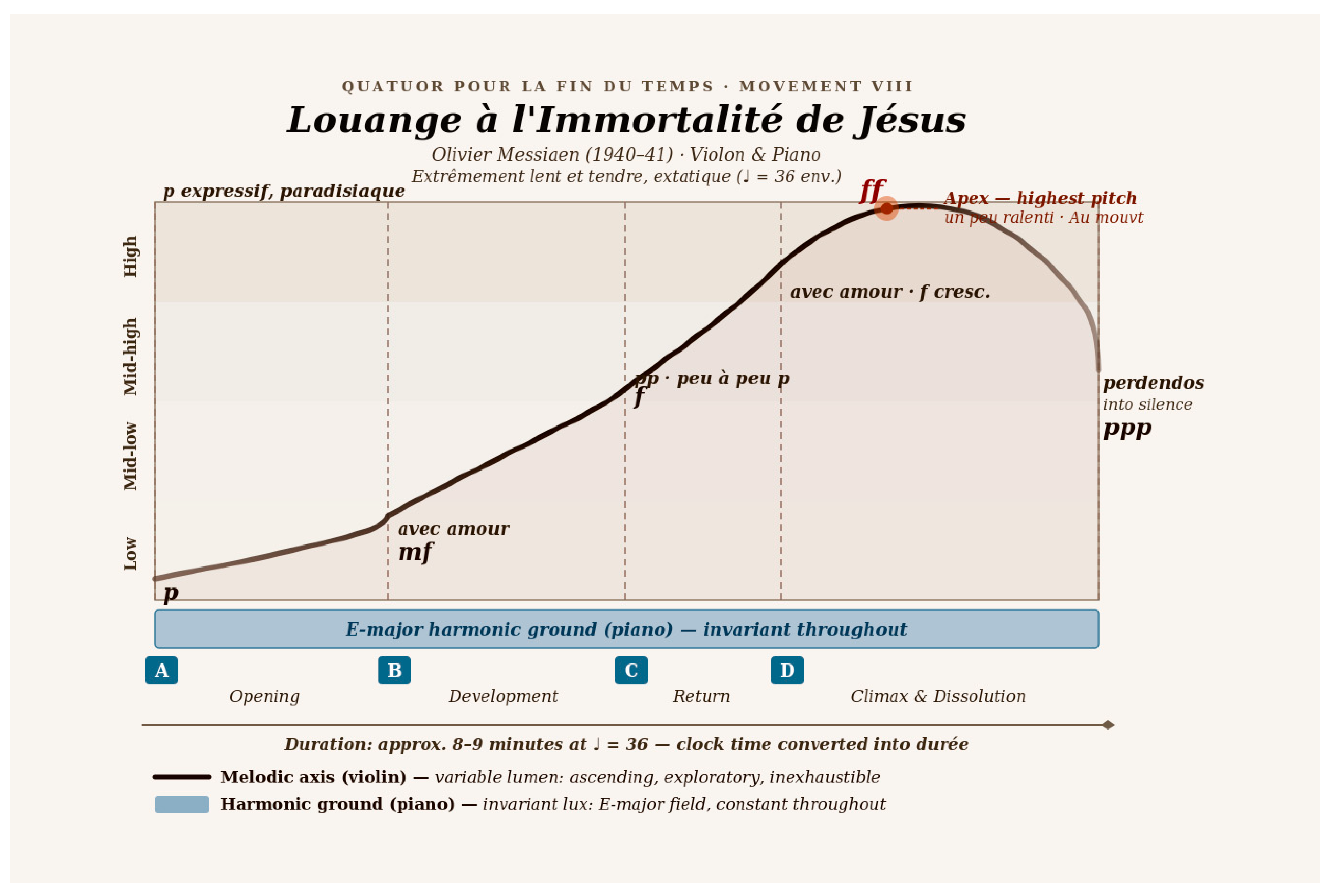
Marion’s givenness and Eliade’s displaced sacrality are convergent: both name a mode of presence that exceeds what modern frameworks of consciousness can accommodate. Aidan Nichols furnishes the theological premise that underwrites this convergence. Writing of the late-nineteenth-century break with what he calls “the Pan-Scientism of the age,” Nichols argues that for Cézanne, Gauguin, and Van Gogh, art “must possess the character of a sign. Artworks must be revelatory after their own fashion, vehicles of presence” (Nichols 1980, p. 11). The Christian tradition, in speaking of praeparatio evangelica, names precisely such a condition: a formation of perception that prepares one to receive what is given as more than it first appears. The ekphrastic analyses that follow test this claim through three specific formal operations. In the Monet analyses (Section 7.1), the theological concept of lux and lumen (the distinction between uncreated radiance and created, variable light that mediates it) provides the precise vocabulary for what Monet’s serial practice enacts: an invariant structure disclosed through, and never exhausted by, endlessly variable material instances. This same lux/lumen grammar, realized architecturally in Matisse’s chapel (Section 5.2), reappears in purely musical terms in Messiaen’s Louange (Section 7.3), where an invariant E-major harmonic ground serves as the lux through which the slow ascending melody, as lumen, ascends. Marion’s account of givenness, understood in this way, supplies the philosophical grammar that ties together the three analyses: what each work gives, in excess of what any single viewing or hearing constitutes, is the formal enactment of praeparatio evangelica: a discipline of perception that prepares one to receive, with sufficient attention, what is always already given as inexhaustible.

5. Chromatic Theology: The Icon and the Impressionist Inheritance

5.1. Byzantine Iconography and Impressionism: Opposite Means, Common Structure

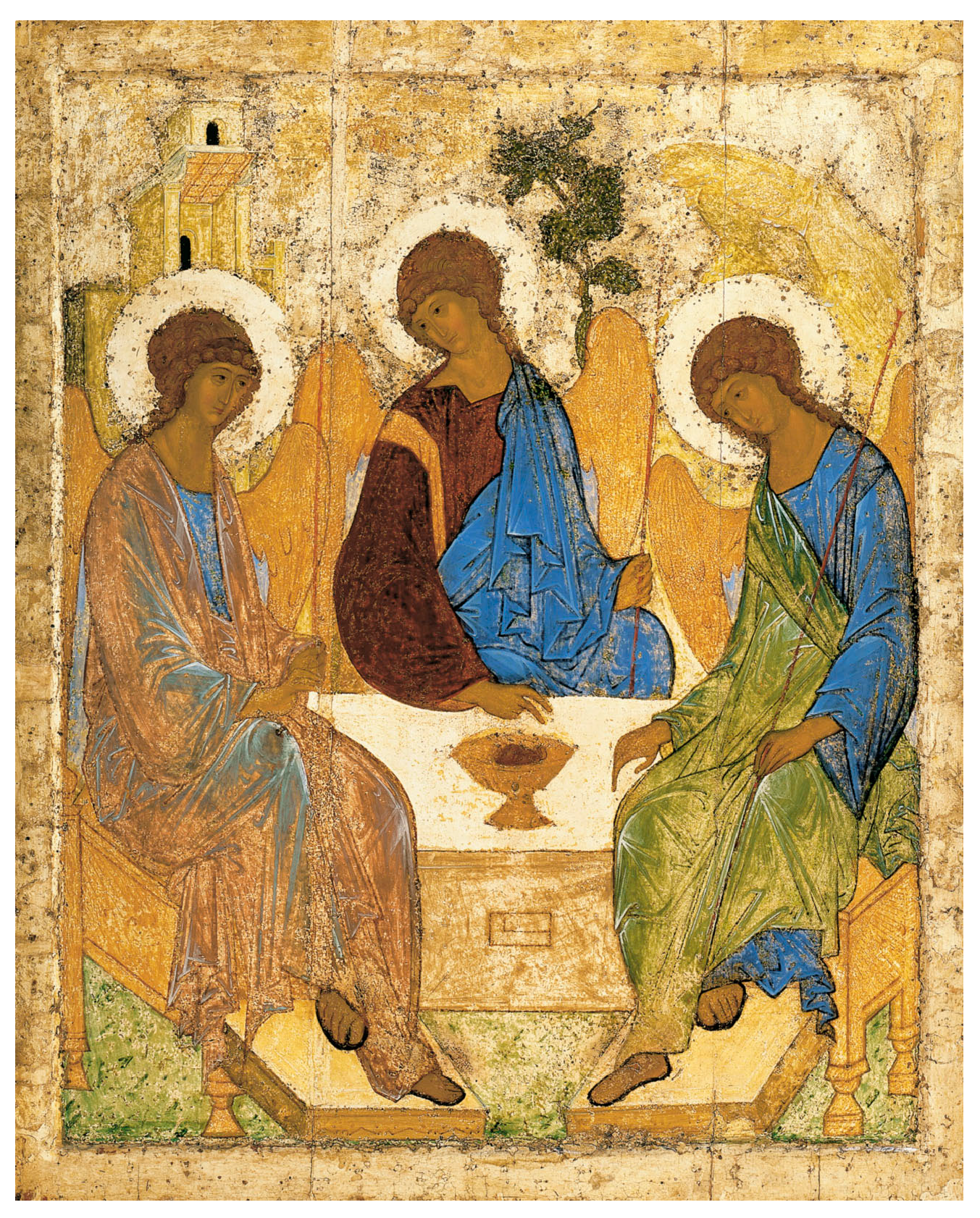
The Byzantine icon provides, within the Christian tradition, the paradigm case of art that leads not merely toward but into liturgy, and Andrei Rublev’s Trinity (c. 1411–1425) (Figure 1), painted for the Trinity Lavra of St. Sergius, is its most luminous instance. Paul Evdokimov treats it as the supreme realization of the iconographic tradition’s trinitarian vocation, the visible image in which the divine communion of three persons becomes, for the earthly church, “a community of mutual love, a unity in multiplicity” (Evdokimov 1990, p. 243). Florensky, for his part, treats the same icon as exemplary, and his account of reverse perspective offers the most penetrating philosophical analysis of its theological function. In a conventional perspective, the viewer’s eye is the vanishing point: all lines converge on the position of the beholder. In the icon, the perspective is reversed: lines diverge toward the viewer, making the icon a source of light rather than a scene to be observed. The Rublev makes this reversal palpable: footstools and thrones splay outward, the chalice is given simultaneously from above and from the side, and the three figures incline to form a circle that opens precisely toward the viewer at the empty fourth place. The composition is constituted as an opening rather than as a closed scene.
For Florensky, this reversal is not a technical failing but a theological intervention: the icon does not represent reality from the viewer’s vantage but radiates reality toward the viewer. The sacred is not an object of our gaze but a presence that gazes upon us (Florensky 1996, p. 79). The icon thus establishes, in its own register, the principle that organizes what follows: form itself can train perception toward a presence it does not contain. The Impressionist canvases to which we turn later in this essay pursue that principle by entirely different means: without dogmatic content, without a tradition of liturgical use, without the gold ground that signifies uncreated light, but with a formal seriousness that warrants theological attention.
Impressionism achieves something structurally analogous through formally opposite means, and this is the dialectical heart of the argument. Where the icon uses stasis, Impressionism uses flux; where the icon negates spatial depth, Impressionism immerses the viewer in atmospheric space. Yet both traditions are contemplative in structure, disposing the viewer toward a mode of reception that is the opposite of analytical distance. Both solicit what might be called (extending Florensky’s term theologically) a reverse perspective of reception: the recognition that what we behold is not simply an object of our gaze but a reality that addresses us, that has a claim upon our attention prior to any act of will.

5.2. Maurice Denis, Henri Matisse, and the Explicit Theological Turn

Certain Catholic artists in the Impressionist tradition made the theological disclosure latent in Impressionist form explicit. Maurice Denis’s famous dictum of 1890, “It is well to remember that a picture, before being a battle horse, a nude woman, or some anecdote, is essentially a plane surface covered with colors assembled in a certain order” (Denis 1968, p. 94), is invariably read as the founding manifesto of aesthetic formalism. It was nothing of the kind. Denis was a devout Catholic who later founded the Ateliers d’Art Sacré, and the same body of theoretical writing makes the underlying theological claim unmistakable. Rejecting the Impressionist reduction in painting to retinal sensation, Denis writes in “Subjective and Objective Deformation” (1909): “Art is no longer only a visual sensation which we record…. No, it is a creation of our spirit of which nature is only the occasion” (Denis 1968, p. 106). The “certain order” of the 1890 formula is thus not an aestheticist closure but an ontological one: the order of intelligible form disclosed to a perception that has been liturgically trained.
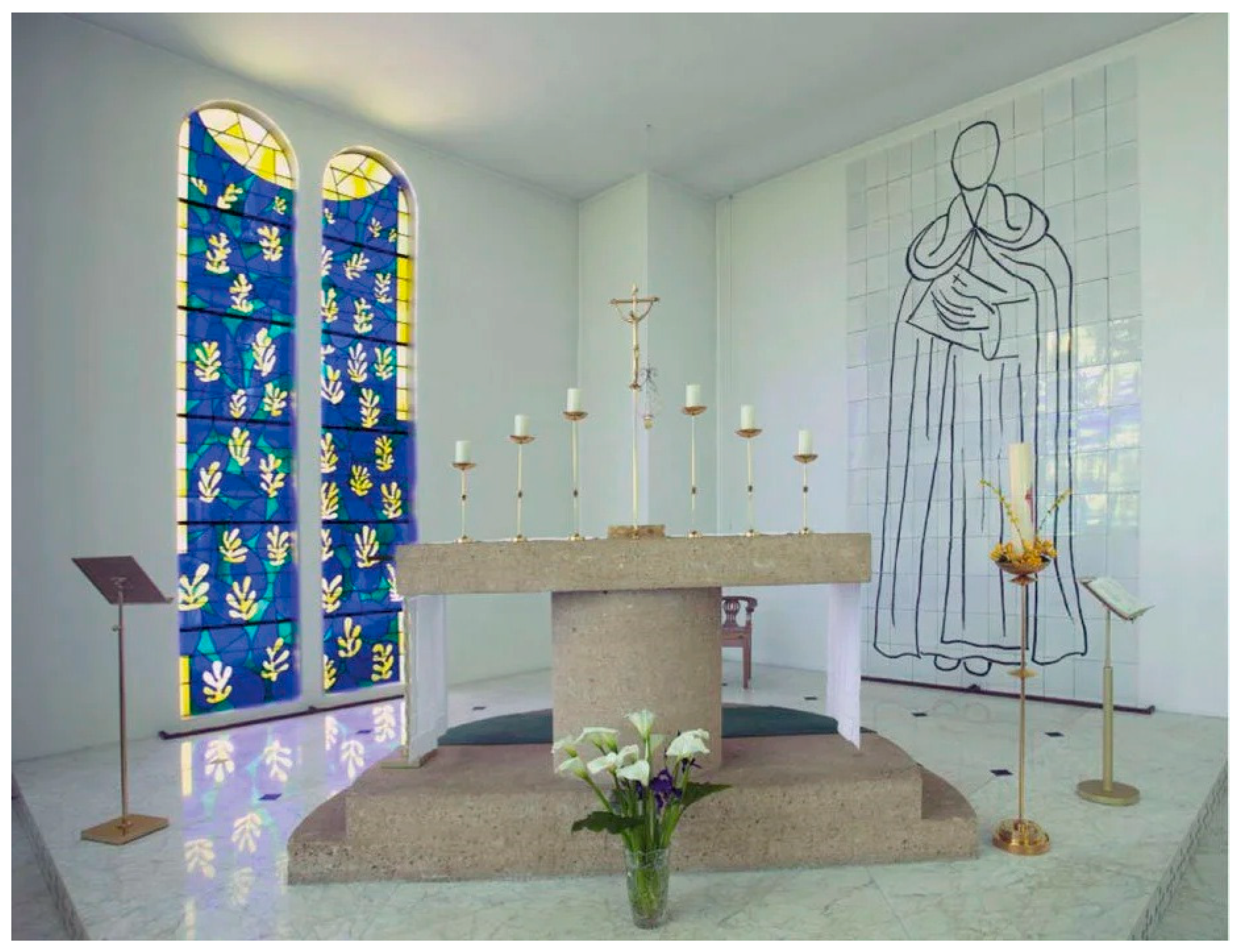
Matisse’s Chapelle du Rosaire at Vence (1948–1951) (Figure 2) is the most architecturally complete realization of this theological appropriation. The stained-glass windows cast fields of colored light onto the chapel’s white ceramic walls, creating an interior in which lumen, the physical colored light filtering through glass, is arranged to mediate lux, the divine illumination the liturgy makes present. It is fitting that Matisse should stand at this point of convergence: Elaine Scarry’s philosophical account of beauty returns repeatedly to his paintings of palms at Nice as exemplary occasions of beauty’s “lifesaving” power (Scarry 1999, pp. 16–23). What her secular analysis finds latent in the easel paintings, the chapel makes liturgically explicit. What the chapel realizes architecturally, the formal mediation of lux through lumen, will reappear, in a different medium, when this essay turns below to the Louange à l’Immortalité de Jésus from Olivier Messiaen’s Quatuor pour la fin du temps.

6. Duration and the Beholding Eye: Augustine, Bergson, and Contemplative Attention

6.1. The Problem of Clock Time

Henri Bergson’s diagnosis of modernity’s temporal pathology is the philosophical complement to Balthasar’s aesthetic diagnosis. Bergson identifies the spatialization of time: the reduction in duration (durée) to clock time, the division of lived temporal experience into countable units that strip it of qualitative depth. In The Creative Mind, Bergson argues that the artist attends to precisely the qualitative depth that utility renders invisible (Bergson 1946, pp. 135–40): almost a description of Impressionist plein-air practice, the painter who stands before a haystack for hours, returning at the same time each day for months.
Art history has conventionally treated the Impressionist painting as capturing an instant, the “impression” as a snapshot of a fleeting moment. This reading misses the formal argument. Broken brushwork, refusal of hard contour, the shimmer of complementary colors: none of these resolve into stable images at a glance. They require the eye to move, to dwell, to return. The painting unfolds in time, and that unfolding is not incidental to its meaning but constitutive of it. Josef Pieper’s theological reading of festivity clarifies what is at stake: for Pieper, “the arts and festivity join hands; both are nourished by affirmation of Creation” (Pieper 1965, p. 41). The contemplative attention Impressionist form solicits performs, at the level of perception, the same assent that festivity enacts publicly: a sustained yes to the ordinary as worth beholding. Weber’s pneuma, compressed into the private and the pianissimo, and Rosa’s “attunement” with the world can be restored to something shareable in common only through the recovery of such perceptual assent.
A qualification is in order: Wyndham Lewis’s Time and Western Man warned that durée could become a glorification of the life-of-the-moment with no reference beyond itself (W. Lewis 1927, p. 156), and Augustine’s account of time in Confessions XI answers that warning by locating qualitative depth not in the flow of experience itself but in the soul’s integrative activity, which presupposes a form to be apprehended and a wholeness toward which attention tends.

6.2. Augustine’s Distentio Animi and the Soul’s Temporal Gathering

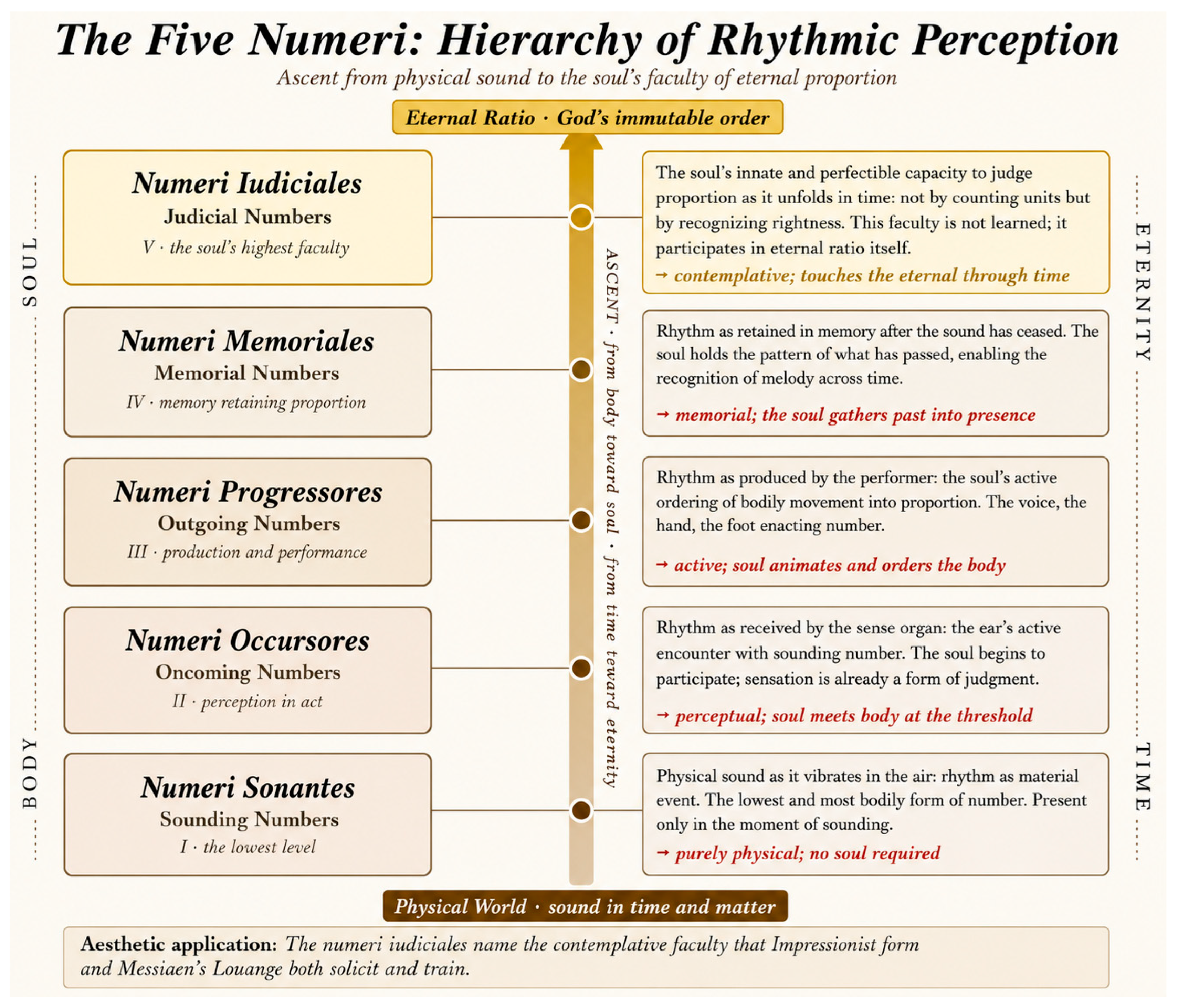
Pressing the question of what it means to measure time, Augustine arrives at a paradox: the past no longer is, the future is not yet, and the present has no extension. If time is to be measured, it must be measured in the soul. What Augustine calls distentio animi (the “distension” of the soul) names the mind’s active work of holding past, present, and future together in a single attentive act (Figure 3). “The mind performs three functions,” Augustine writes, “those of expectation, attention, and memory. The future, which it expects, passes through the present, to which it attends, into the past, which it remembers” (Augustine 1961, XI.28.38). Temporal experience is not a succession of vanishing instants but an integrative achievement: the soul’s work of making a whole from what would otherwise dissolve into mere sequence. This is precisely what Bergsonian durée cannot supply: where Bergson locates qualitative depth in the flow of experience itself, Augustine locates it in the soul’s gathering activity, which presupposes a form to be apprehended and a wholeness toward which attention tends.
The musical analogy Augustine employs is precise: a melody cannot be heard in a single instant. Each note has sounded and ceased before the melody is over; the melody as a whole is apprehended only by a soul that retains what has passed and anticipates what is coming while attending to what is now. In De Musica VI, Augustine elaborates this through his hierarchy of rhythm (numeri). At the summit are the numeri iudiciales: the soul’s innate and perfectible faculty for recognizing proportion as it unfolds in time (Augustine 1947, VI.xi–xvii). These name precisely the contemplative capacity that the works examined in the next section both solicit and train. It is worth noting that Scarry herself draws on Augustine’s De Musica as the classical source for beauty’s “lifesaving” function, citing his description of beauty as “a plank amid the waves of the sea” (Scarry 1999, p. 17). That the same text grounds both a secular philosophical defense of beauty’s life-renewing power and a theological account of the soul’s ascent through rhythm toward eternal proportion is not incidental; it reflects Augustine’s own conviction that the formal experience of proportion in time is itself a movement toward what is supremely proportioned. Paul Ricœur’s “concordant discordance” supplies its phenomenological articulation (Ricœur 1984), and Simone Weil’s formula completes the argument: “Attention is the natural prayer of the soul” (Weil 1952, p. 105).

7. Three Works: Ekphrastic Analyses

7.1. Monet, the Portal of Rouen Cathedral in Morning Light (1894): Claritas and the Inexhaustibility of Light

The following analyses test the central claim of this essay: that the formal operations of these works sustain, rather than merely illustrate, the theological account of perception advanced above. The argument proceeds not by conceptual imposition but by sustained attention to what the works themselves require to be seen and heard. The physical surface of a canvas is rarely itself evidence for a theological argument, but here it is. The theological claim, if it is to be sustained, must begin here.
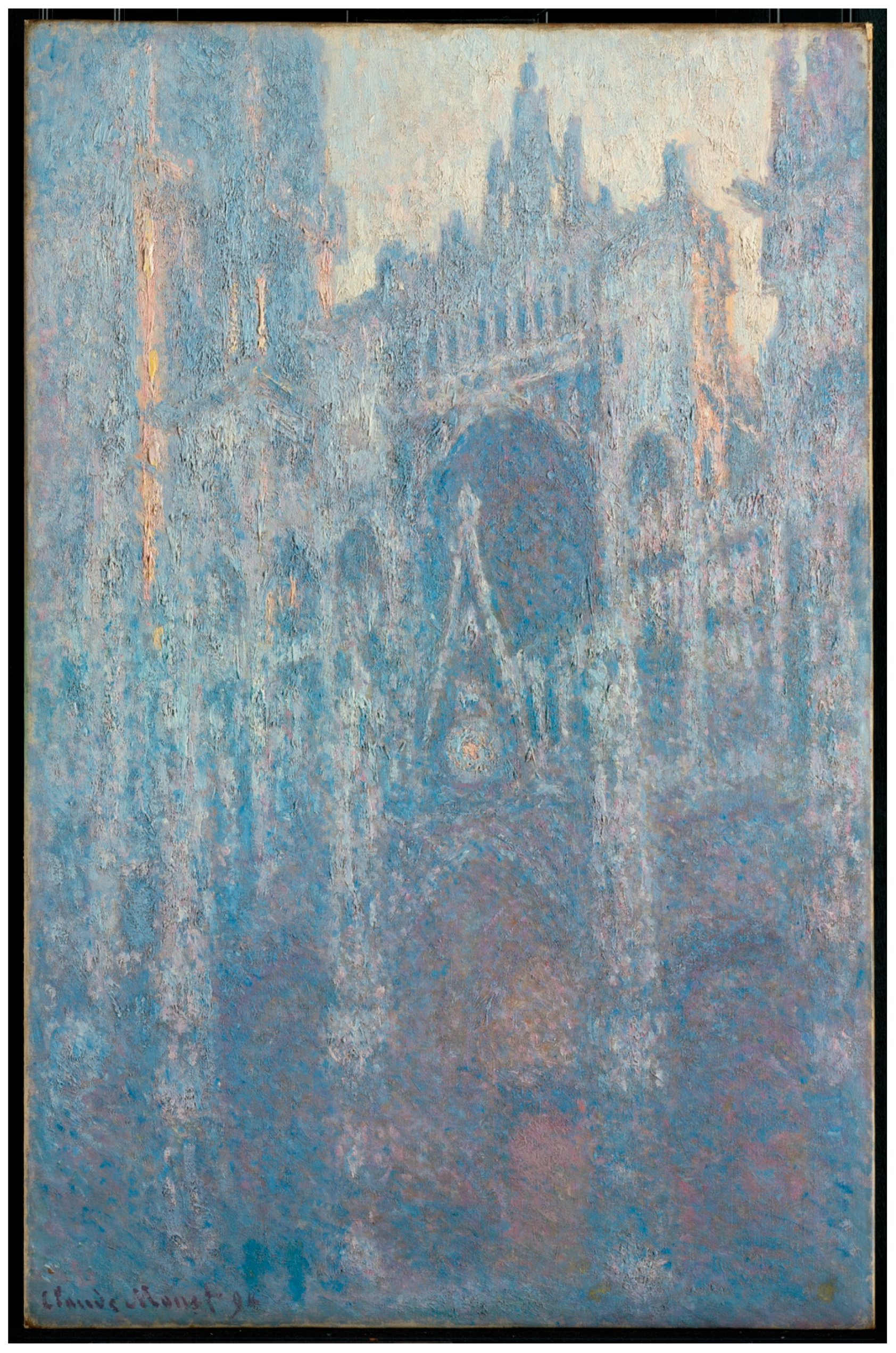
Monet’s Portal of Rouen Cathedral in Morning Light (Figure 4) is built as much as it is painted. Its encrusted surface of dry, thickly layered impasto, built up layer upon layer in the studio after the on-site sessions concluded, evokes the rough texture of weathered stone, absorbing and reflecting light as the cathedral’s own walls absorb and reflect it. This is not incidental craft but a formal argument: Monet has made the painted surface behave as stone behaves. Standing before it, one does not look through the paint toward a represented object; one is arrested by a material presence that has borrowed the ontological behavior of its subject.
The chromatic structure of the morning-effect canvas is Monet’s most theologically legible formal achievement. The dominant tonality is a warm rose-gold shot through with cool lilac-gray in the portal’s deep recesses. This complementary pairing is not accidental. Adjacent complementary hues intensify each other: the warm ochres are made more luminous by the violet shadows beside them, and the violet shadows are deepened by the ochre they border. John House demonstrates that this chromatic discipline was systematic and deliberate, not the spontaneous record of fleeting sensation that early criticism supposed: “from the mid-1860s onwards he began to use contrasts of complementary or near-complementary colours, and to subdivide his colours into many closely related but varied tints” (House 1986, p. 111). The compositional strategy reinforces this formal argument. Monet used an aggressively tight framing that cuts off the cathedral’s towers and admits no sky, no square, and no spatial recession. The eye cannot move through the image into depth; it can only move across the surface, dwelling on the shimmer of color relationships. This formal constraint enforces a mode of attention that is, in phenomenological terms, participatory rather than distancing. Joachim Pissarro frames the series in terms that unknowingly parallel the theological grammar this essay seeks to recover: “The Cathedral series is a study in time, the eternal presence of the cathedral, the routine of Monet’s working days, the changing light from morning to dusk, the variations in the weather, which could pass in a matter of minutes from full sun to clouded skies and hailstorms and back again to brilliant sunshine” (Pissarro 1990, p. 15, n1). To capture this profusion of atmospheric events, Monet worked on as many as nine or twelve individual canvases in a single day, shifting from one to another as the light changed.
What the series as a whole reveals is that this encounter is inexhaustible. The cathedral does not change; the light changes. The invariant structure (the Gothic portal, the Tour d’Albane, and the proportional relationships of arch within arch) persists through every atmospheric variation. This is the lux/lumen distinction in formal operation: the invariant radiance (lux) is disclosed through the endlessly variable created light (lumen), and no single instance of lumen exhausts lux. Monet, painting obsessively at the same fixed point, was formally enacting what the theological tradition has always claimed: that created light points beyond itself without abolishing what it illuminates. Clemenceau, reflecting on the completed series as preserved in Pissarro’s study, arrived intuitively at the same formulation: the paintings offer “the lasting vision, not of twenty, but of a hundred, of a thousand, of a million versions of the eternal cathedral in the immense cycle of the sun” (Pissarro 1990, p. 30). Clemenceau’s “eternal cathedral” is, of course, a phrase of aesthetic enthusiasm rather than metaphysical confession, but aesthetic enthusiasm is here tracking something real in the work itself, the persistence of invariant form through radically variable disclosure, which is precisely what the theological grammar of lux and lumen names.
It is here that Clive Bell’s account, developed in Since Cézanne, both illuminates and reaches its limit. Bell’s concept of significant form, the claim that certain arrangements of line and color produce an aesthetic emotion that puts the perceiver in contact with “the universal” or “the thing in itself,” captures something real about what the Rouen Cathedral series achieves (Bell 1922, pp. 41, 54, 153–56). Yet Bell’s aestheticism is also its own prison: significant form is significant, for Bell, precisely because it has nothing immediately to do with the viewer’s emotions and life. Nichols, pressing the point further, observes that “‘significant form’ is form behind which we catch some glimpse of ultimate reality” (Nichols 1999, p. 107). The reality that Bell declines to name, Balthasar’s claritas, does: the radiance of intelligible form shining through sensible appearance, the created thing disclosing its participation in being. Bell sees the shimmer; he does not care to say precisely what shimmers. Nichols’s earlier reading of the Post-Impressionist achievement sharpens the point still further. Writing of Max Beckmann, Nichols cites a programmatic formulation borrowed from the Jewish Kabbalah as a statement of what art “at its finest, can do for us: ‘To get hold of the invisible, penetrate as deeply as possible into the visible’” (Nichols 1980, p. 12). The Rouen series performs precisely this movement, though it does not describe it: to penetrate the visible with sufficient patience is to find that the visible is not self-enclosed. What happens to the perceiver in that encounter deserves a name. Elaine Scarry, drawing on Simone Weil and Iris Murdoch, calls it “radical decentering” or “opiated adjacency”: the moment when beauty causes us to “give up our imaginary position as the center.” In her own words: “It is not that we cease to stand at the center of the world, for we never stood there. It is that we cease to stand even at the center of our own world. We willingly cede our ground to the thing that stands before us” (Scarry 1999, pp. 111–12).
The decentering is therefore not a severance but a continuity of beholder and beheld: the perceiver, ceding ground, is drawn into relation with what is perceived, and the result is simultaneously an acute pleasure and a willing marginality. It is, she argues, the only phenomenon that produces both at once. That secular philosophical account is describing, in a register available without theological commitment, the same perceptual transformation that the Balthasarian analysis of claritas names at its deepest level: the soul’s recognition that it stands before a radiance that it did not generate and cannot exhaust. Scarry leaves the perceiver at the threshold (decentered, pleasurably marginal, newly alert) without naming what stands at the center of the experience. The theological account names it claritas, the radiance of created form participating in being itself. The decentering is not an end but a beginning: what Scarry identifies as a kind of blissful displacement, the theological tradition recognizes as the soul’s orientation toward what Augustine, in De Musica, describes as the soul’s movement from numeri sonantes toward numeri iudiciales: from the surface of sensation upward toward the soul’s deepest capacity for recognizing proportion as it participates in eternity.

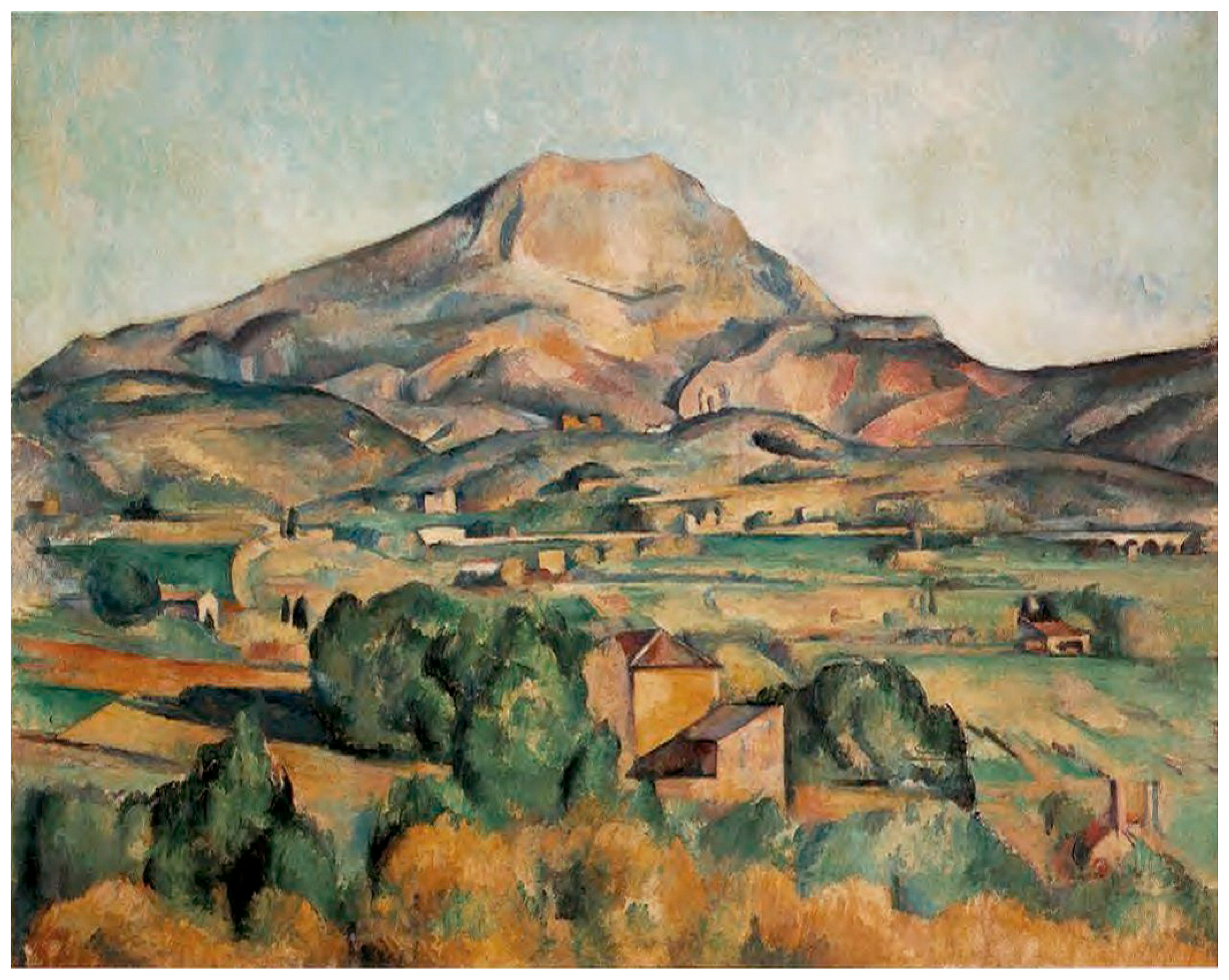
7.2. Cézanne, Mont Sainte-Victoire (c. 1902–1904): Consonantia and Ontological Depth

Cézanne occupies a singular position within this argument. Unlike Monet, whose practice the dominant art-historical tradition has most consistently read as a disciplined confinement to perceptual surface, Cézanne presents a figure in whom the immanentist reading strains against its own evidence. He was, throughout his life, a practicing Catholic, attending Mass regularly in Aix, never wavering in his religious observance. Of course, this biographical datum does not settle the interpretive question; the argument runs from the formal properties of the work outward. But the man who devoted forty years of almost monastic attention to a single mountain was not merely an epistemological experimenter. He was also a Catholic formed by habits of contemplation, and the convergence of that formation with what his canvases formally achieve is a fact that a complete account must reckon with (Danchev 2012, pp. 349–51).
The Philadelphia Mont Sainte-Victoire (Figure 5) is the most rigorous realization of Cézanne’s mature project. Where Monet disciplines attention to what light does at the surface, Cézanne disciplines attention to what underlies the surface: the formal structure that light’s variations simultaneously conceal and reveal. He is not painting how the mountain looks but what makes the mountain be. Individual forms dissolve into abstraction as short, parallel strokes lay out sharply distinct patches of color that emphasize the surface plane rather than the depth of space. Viewed close up, the surface appears to dissolve into an array of color patches (greens, ochres, blue-grays) that refuse to cohere into recognizable form. Viewed from a distance, these patches organize themselves into a convincing, even monumental landscape. The work performs, in the viewer’s own perceptual experience, the emergence of form from apparent chaos. Meyer Schapiro observed that the color patches are not merely a technique for suggesting depth but a philosophical commitment: the world is constituted within the active engagement between seeing subject and resistant object (Schapiro 1988, pp. 10, 15). Merleau-Ponty’s reading of Cézanne confirms this: the visible world must be seen into form, and this seeing is always a collaboration between the perceiver and what resists perception (Merleau-Ponty 1964, pp. 9–25). Nichols names the achievement more exactly. Cézanne’s art, he writes, “constrains you to say that the world is a place in which lies implicit the kind of transcendent order and harmony apprehended by the painter” (Nichols 1980, p. 11). The mountain, under Cézanne’s brush, is not merely seen; it is disclosed as ordered.
What is at stake formally can be made more precise. Cézanne’s color patches are not applied evenly across the canvas; they accumulate in clusters of greater density and chromatic intensity at the mountain’s summit, where the peak breaks against the sky. This differential weighting, more pictorial substance at the structural apex, is not a compositional convention carried over from the classical tradition. It is discovered by looking: the repeated observation that this mountain, at this point, concentrates attention. The painting does not impose harmonic order; it finds it. This is the Thomistic consonantia: right proportion as a property of being, discovered through patient looking rather than applied from without. Where Bell could see the formal harmony but could not name its ground, the Thomistic tradition names it: consonantia witnesses to the logos embedded in creation.
Theologically, the Philadelphia Mont Sainte-Victoire enacts what Luigi Pareyson called the ontology of the inexhaustible, his deliberate alternative to a mysticism of the ineffable. For Pareyson, truth is not elusive, hidden, or reducible to cipher and allusion; it is an outward radiation of meanings that grants itself to the word by stimulating it and conferring upon it new revelations. Inexhaustibility is not concealment, absence, or obscurity but hyperoche, pre-eminence, richness, fullness, excess, the anexichniaston ploutos, the “unsearchable richness” that shows its true origin precisely by never being exhausted in any single interpretation (Pareyson 2013, p. 23). Cézanne painted over eighty versions of the mountain across nearly four decades. This is not the repetition of an unreachable object that withdraws in secret; it is the progressive deepening of an encounter with a motif whose being is so rich that each canvas is a genuine possession of it, “the more genuine the more personal and multiple it is,” without exhausting what is given. The Thomistic criterion of consonantia, the harmony or right proportion that witnesses to the logos embedded in creation, is what Cézanne discovers through patient looking rather than imposing by convention. Bell could see the formal harmony but could not name its ground. The Thomistic tradition names it: consonantia is a property of being, not of the beholder’s preference, and its disclosure is inexhaustible because being itself is Ungrund, not the abyss of absence but the ungrounded ground of plenitude.

7.3. Messiaen, Louange à l’Immortalité de Jésus (1941): Duration, Synesthesia, and the End of Clock Time

Olivier Messiaen occupies a unique position in this argument because he made the implicit theology of visual Impressionism explicit in a different medium, from within the same chromatic and temporal sensibility, and with full theological self-consciousness. He also brought to this project a neurological condition that gave his formal procedures a double authority: Messiaen was a documented chromesthete, a synesthete who involuntarily perceived specific colors when hearing specific sounds or harmonies. This was not metaphor or poetic license but a verified perceptual phenomenon, a “neurological condition in which stimulation of one sensory modality leads to an automatic, involuntary experience in a second sensory modality” (Glasser 2016, p. 472). When Messiaen described his modes à transpositions limitées as producing specific color-combinations, mode 2 as dominated by “blue-violet rocks, speckled with little gray cubes, cobalt blue, deep Prussian blue, highlighted by a bit of violet-purple, gold, red, ruby, and stars of mauve, black and white” (Messiaen’s Traité, cited in Bernard 1986, p. 46), he was reporting something neurologically real: the involuntary co-activation of visual and auditory cortices that characterizes chromesthesia. As Jonathan Bernard’s foundational analysis of the sound-color correspondences demonstrates, Messiaen’s color responses exhibit “a high degree of internal consistency” across decades of compositional practice, confirming their perceptual rather than decorative character (Bernard 1986, p. 41).
The significance of this for the present argument is considerable. Impressionist painting disciplined visual attention to disclose chromatic depth in the seen world; Messiaen’s synesthesia meant that he experienced chromatic depth as an inescapable condition of the heard world. The painter who stands for hours before the same façade in changing light and the composer who hears color as an involuntary accompaniment to harmony are, at the level of perceptual structure, engaged in the same discovery: that the sensory world is not mute but speaks in multiple registers simultaneously. The difference is that the Impressionist painter must discipline attention to reach this discovery; Messiaen could not avoid it. His theology and his neurology were aligned.
The Quatuor pour la fin du Temps was composed at Stalag VIII-A in the winter of 1940–1941 and premiered in the unheated barracks of the camp on 15 January 1941 before an audience of approximately four hundred prisoners and guards (Rischin 2003, p. 62). The work is inspired by the tenth chapter of the Book of Revelation, the angel declaring that “there shall be time no longer,” and this theological program is constitutive of its formal structure, as Messiaen himself insisted in his preface to the score: “Its musical language is essentially transcendental, spiritual, and catholic. Certain modes … draw the listener into a sense of the eternity of space or time” (Messiaen 1942, Preface). The eighth and final movement, Louange à l’Immortalité de Jésus (Figure 6), is scored for violin and piano alone, marked extrêmement lent et tendre, extatique, at an eighth note equaling 36, a tempo so slow that conventional clock-time measurement becomes almost meaningless (Messiaen 1942, p. 46). The violin carries a single long melody in E major, rising gradually over the movement’s eight-plus minutes toward the instrument’s highest and most piercing register; the piano provides sustained harmonic support beneath the melodic line. Messiaen’s own gloss in the preface names the theological aim without reserve: “Its slow ascent to the acutely extreme is the ascent of man to his god, the child of God to his Father, the being made divine towards Paradise” (Messiaen 1942, Preface).
The piano’s E-major harmonic field is the formal analog of what the Rouen Cathedral series establishes visually: the invariant structure (lux) through which the variable melody (lumen) ascends, disclosing the relationship between them in real time. The very sparseness of the scoring forces duration itself to become audible. This is not slow music in the ordinary sense; it is music that converts the listener’s experience of time from quantitative to qualitative, from clock-time to what Augustine calls distentio animi, the soul’s stretched and gathered present (Augustine 1961, Book XI).
Anthony Pople’s detailed analysis of the movement clarifies how this lux/lumen relation is realized in technical terms. Messiaen described his modes à transpositions limitées as achieving a “tonal ubiquity, melodically and harmonically,” that “draw[s] the listener towards eternity in space or the infinite” (cited in Pople 1998, p. 11). The Louange à l’Immortalité de Jésus realizes this ubiquity through the systematic interaction of two pitch collections: the diatonic E-major scale and Messiaen’s second mode of limited transposition (the octatonic collection). As Pople demonstrates in his analysis of the opening theme, the harmony at any given moment is governed by both collections at once: the music is “essentially in mode 2, with ‘chromatic’ pitches derived from E major” (Pople 1998, p. 85). The violin’s slow weaving ascent traverses this dual harmonic field, and the closing cadence brings the two collections into equilibrium as the violin reaches the high E that is at once the tonic of the diatonic scale and a member of the “tonic” transposition of mode 2 (Pople 1998, p. 87). What the lux/lumen vocabulary names theologically, Messiaen’s harmonic syntax enacts musicologically: an invariant ground (the E-major tonal center) disclosed through, and never reducible to, the iridescent variability of the modal surface. That Messiaen explicitly placed his project in dialog with Bergson on the abolition of time, telling Antoine Goléa that his “initial thought was of the abolition of time itself, something infinitely mysterious and incomprehensible to most of the philosophers of time, from Plato to Bergson” (cited in Pople 1998, p. 13), confirms that the connections this essay has been tracing between durational perception, contemplative attention, and the disclosure of inexhaustible depth are not externally imposed but native to Messiaen’s own theological-compositional self-understanding.
The formal convergence of the three works is not imposed by the essay’s theological framework; it is disclosed by sustained attention to what each work formally achieves. Monet’s series establishes inexhaustibility through variation; Cézanne’s late canvases discover consonantia through ontological pressure; Messiaen’s Louange converts duration into eternity through ascent and synesthetic depth. All three enact, by formally different means, the same theological discovery: that sustained, non-instrumental attention to the given discloses an excess that the given alone cannot account for.

8. Conclusions: Impressionism as Praeparatio Evangelica

8.1. Beauty’s Privileged Pathway

The argument of this essay has moved from historiographic diagnosis through ekphrastic analysis to theological clarification. What remains is to name what this convergence reveals. The coherence of the sacramental vision is itself on display: that material reality is not merely matter but a lumen through which lux perpetually shines; that the soul’s deepest capacity is not analytical cognition but attentive receptivity; and that beauty, precisely beauty, not morality or argument, is the privileged pathway by which the soul is drawn toward what it cannot generate by its own effort. Hartmut Rosa’s concept of resonance returns here as secular confirmation: what Catholic theology calls praeparatio evangelica, social theory names resonance: the transformation of the subject through genuine encounter with something other (Rosa 2019, p. 174). Nichols, more than four decades ago, reached the same conclusion from a different angle. “It seems,” he wrote, “that our twentieth century is not the worst time for refreshing theology by attention to art” (Nichols 1980, p. 12). The present essay has sought to honor that judgment and to extend it: not only the century Nichols addressed, but its aftermath remains such a time, and Impressionism remains one of the sites where that refreshment is available.

8.2. From Gallery to Church: The Contemporary Stakes

The contemporary stakes of the argument are specific and urgent. The digital environment has produced an image-saturated culture that is perpetually stimulated but rarely arrested, perpetually connected but rarely present, characterized by the compulsive interruption of sustained engagement. Against this condition, Impressionist form offers something that cannot be scrolled past: a mode of visual attention that requires dwelling, returning, and receiving. Scarry’s image is apt: it is as though beautiful things “have been placed here and there throughout the world to serve as small wake-up calls to perception, spurring lapsed alertness back to its most acute level” (Scarry 1999, p. 81). This is not a nostalgic claim but a formally grounded one. The broken-brushwork surface, the refusal of stable contour, and the shimmer of complementary hues: each of these formal properties constitutively resists instantaneous consumption. They demand the kind of slow, gathered attention that Augustine’s distentio animi names: the soul’s active work of holding beginning and end simultaneously in view. The person who has undergone that formation has practiced, however small a register, the fundamental movement of contemplative perception. They are not yet at worship. But they have learned, perhaps for the first time in a thoroughly mediated environment, how to be still before something that exceeds them.
The contemporary relevance of this claim is sharpened by further consideration. The preceding sections have developed beauty as a theological category without ignoring the challenge that modernity’s catastrophes posed to it. The argument does not rehabilitate beauty as untouched consolation. Beauty, on the account offered here, resembles the Japanese practice of kintsugi: pottery whose fractures are filled with gold, disclosing depth not despite its brokenness but through it. The beauty that Impressionist form makes available to the modern perceiver is not innocent of the disenchantment it inhabits. Monet’s serial failures to capture the cathedral are not triumphs; they are records of inexhaustibility that resists possession. It is precisely this resistance, the refusal of the given to be exhausted, that constitutes beauty’s claim upon the perceiver as a moral and not merely aesthetic demand: a demand to attend, to be patient, to receive what cannot be manufactured. What Wolterstorff identifies as the relationship between beauty and justice, and Scarry as beauty’s call to acknowledge the reality of what is not oneself, are both implicitly enacted in any sustained ekphrastic encounter with a work that gives more than the eye can take in.
It is worth being precise about what Scarry’s account contributes here and where it parts company from the argument this essay has advanced. Her justice argument moves through the language of symmetry, fairness, and distribution: political-philosophical categories that are not the primary register of the present claim, which is ontological and contemplative rather than civic (Scarry 1999, pp. 57–95). And her account of beauty and truth is importantly open-ended: beauty, she argues, acquaints us with conviction and with error simultaneously, providing an introduction to the state of certainty without itself satisfying the desire for it (Scarry 1999, pp. 31–38). That epistemological openness is not a limitation of Scarry’s account but a fair description of what the immanent encounter with beauty can, on its own, deliver. The theological account advanced here claims to name what that encounter points toward without itself arriving at: not error resolved by further looking, but inexhaustibility recognized as the signature of claritas, created form radiating its participation in being. Scarry stands the perceiver at the threshold; the theological tradition names what stands on the far side of it. The reformed perception that Impressionism cultivates is therefore not a retreat from the brokenness of the contemporary world but a more adequate mode of inhabiting it.
The modern narrative of desacralization requires, in light of this analysis, qualification. Impressionism is one place (within the plurality of sites, traditions, and cultural forms that this Special Issue explores) where the capacity of the visible world to disclose depth persists, in altered form, within practices that do not explicitly name it. It reforms perception. It trains the eye to see what is given as more than it first appears. The formal claim the works themselves press upon any attentive viewer is prior to and independent of any particular confessional commitment: that what is given in light and time is inexhaustible, and that the eye trained to dwell rather than merely to register begins to recover the depth that modern perception has obscured. The stakes of this recovery extend beyond the gallery or the seminar room. In a cultural moment characterized by the eclipse of sustained attention, the deformation of shared perception, and the relegation of beauty to the ornamental, the capacity of Impressionist form to arrest, solicit, and transform the beholding eye constitutes a publicly available counter-formation: one that requires no confessional commitment but whose deepest structure, as this essay has argued, theological aesthetics is uniquely equipped to name. What appears, finally, is not a recovery of the sacred by declaration, but by attention: in the light that refuses exhaustion, in the form that exceeds its apprehension, and in the duration that opens beyond itself.

Funding

This research received no external funding.

Institutional Review Board Statement

Not applicable.

Informed Consent Statement

Not applicable.

Data Availability Statement

The original contributions presented in this study are included in the article. Further inquiries can be directed to the corresponding author.

Acknowledgments

In accordance with MDPI policy, the author discloses the use of Anthropic’s Claude (Claude Opus 4.7) during the preparation of this manuscript. The tool was used for checking grammar and prose clarity, stylistic suggestions at the sentence and paragraph level, and verifying citation details. All theological, philosophical, and art-historical arguments are the author’s own; all citations were independently verified; and the author takes full responsibility for the final content of the manuscript.

Conflicts of Interest

The author declares no conflicts of interest.

Notes

1
The literature is now substantial. See especially (Hart 2003; Quash 2013; Anderson and Dyrness 2016; Anderson 2025).
2
Eliade (1959, pp. 20–65); see also Eliade (1954, ch. 1). The concept of displaced sacrality is developed throughout his late essays, especially those collected in Eliade (1976).

References

  1. Anderson, Jonathan A. 2025. The Invisibility of Religion in Contemporary Art. Notre Dame: University of Notre Dame Press. [Google Scholar]
  2. Anderson, Jonathan A., and William A. Dyrness. 2016. Modern Art and the Life of a Culture: The Religious Impulses of Modernism. Downers Grove: IVP Academic. [Google Scholar]
  3. Aquinas, Thomas. n.d. Summa Theologiae. Translated by Alfred J. Freddoso. Notre Dame: University of Notre Dame. Available online: https://www.freddoso.com/summa-translation/TOC.htm (accessed on 2 April 2026).
  4. Augustine. 1947. De Musica. Translated by Robert Catesby Taliaferro. Fathers of the Church 4. Washington: Catholic University of America Press. [Google Scholar]
  5. Augustine. 1961. Confessions. Translated by R. S. Pine-Coffin. London: Penguin Books. [Google Scholar]
  6. Bailey, Colin B. 2015. How Paul Durand-Ruel Ruled Art. New York Review of Books. December 3. Available online: https://www.nybooks.com/articles/2015/12/03/how-paul-durand-ruel-ruled-art/ (accessed on 30 March 2026).
  7. Barzun, Jacques. 1961. Classic, Romantic and Modern. New York: Doubleday Anchor. [Google Scholar]
  8. Bell, Clive. 1922. Since Cézanne. London: Chatto & Windus. [Google Scholar]
  9. Berger, Peter. 1967. The Sacred Canopy: Elements of a Sociological Theory of Religion. New York: Anchor Books. [Google Scholar]
  10. Bergson, Henri. 1946. The Creative Mind: An Introduction to Metaphysics. Translated by Mabelle L. Andison. New York: Philosophical Library. [Google Scholar]
  11. Bernard, Jonathan W. 1986. Messiaen’s Synaesthesia: The Correspondence Between Color and Sound Structure in His Music. Music Perception 4: 41–68. [Google Scholar] [CrossRef]
  12. Burns, Emily C., and Alice M. Rudy Price, eds. 2021. Mapping Impressionist Painting in Transnational Contexts. New York: Routledge. [Google Scholar]
  13. Castagnary, Jules-Antoine. 1874. Exposition du boulevard des Capucines: Les Impressionnistes. Le Siècle, April 29.
  14. Clark, Alexis, and Frances Fowle, eds. 2020. Globalizing Impressionism: Reception, Translation and Transnationalism. New Haven: Yale University Press. [Google Scholar]
  15. Clark, T. J. 1999. Farewell to an Idea: Episodes from a History of Modernism. New Haven: Yale University Press. [Google Scholar]
  16. Crary, Jonathan. 1990. Techniques of the Observer: On Vision and Modernity in the Nineteenth Century. Cambridge: MIT Press. [Google Scholar]
  17. Danchev, Alex. 2012. Cézanne: A Life. New York: Pantheon. [Google Scholar]
  18. D’Arcy, Martin Cyril. 2017. The Nature of Belief. Providence: Cluny Media. [Google Scholar]
  19. Denis, Maurice. 1968. “Definition of Neotraditionism” (1890), “The Influence of Paul Gauguin” (1903), “Synthetism” (1907), and “Subjective and Objective Deformation” (1909). In Theories of Modern Art: A Source Book by Artists and Critics. Edited by Herschel B. Chipp. Berkeley: University of California Press, pp. 94–107. [Google Scholar]
  20. Durand-Ruel, Paul. 2014. Paul Durand-Ruel: Memoir of the First Impressionist Art Dealer (1831–1922). Edited by Paul-Louis Durand-Ruel and Flavie Durand-Ruel. Translated by Deke Dusinberre. Paris: Flammarion. First published 1939. [Google Scholar]
  21. Eliade, Mircea. 1954. The Myth of the Eternal Return. Translated by Willard R. Trask. New York: Pantheon. [Google Scholar]
  22. Eliade, Mircea. 1959. The Sacred and the Profane: The Nature of Religion. Translated by Willard R. Trask. New York: Harcourt, Brace. [Google Scholar]
  23. Eliade, Mircea. 1976. Occultism, Witchcraft, and Cultural Fashions: Essays in Comparative Religions. Chicago: University of Chicago Press. [Google Scholar]
  24. Evdokimov, Pavel. 1990. The Art of the Icon: A Theology of Beauty. Translated by Fr. Steven Bigham. Redondo Beach: Oakwood Publications. [Google Scholar]
  25. Fagerberg, David W. 2004. Theologia Prima: What Is Liturgical Theology? 2nd ed. Chicago: Hillenbrand Books. [Google Scholar]
  26. Florensky, Pavel. 1996. Iconostasis. Translated by Donald Sheehan, and Olga Andrejev. Crestwood: St. Vladimir’s Seminary Press. [Google Scholar]
  27. Gadamer, Hans-Georg. 1985. Truth and Method. Edited and Translated by Garrett Barden, and John Cumming. New York: Crossroad Publishing Company. [Google Scholar]
  28. Glasser, Solange. 2016. Synesthesia and Prodigiousness: The Case of Olivier Messiaen. In Musical Prodigies: Interpretations from Psychology, Education, Musicology, and Ethnomusicology. Edited by Gary E. McPherson. Oxford: Oxford University Press, pp. 471–92. [Google Scholar]
  29. Guardini, Romano. 1979. Sacred Signs. Translated by Grace Branham. Wilmington: Michael Glazier. [Google Scholar]
  30. Hart, David Bentley. 2003. The Beauty of the Infinite: The Aesthetics of Christian Truth. Grand Rapids: Eerdmans. [Google Scholar]
  31. Heidegger, Martin. 1971. The Origin of the Work of Art. In Poetry, Language, Thought. Translated by Albert Hofstadter. New York: Harper & Row, pp. 17–87. [Google Scholar]
  32. Herbert, Robert L. 1988. Impressionism: Art, Leisure, and Parisian Society. New Haven: Yale University Press. [Google Scholar]
  33. House, John. 1986. Monet: Nature into Art. New Haven: Yale University Press. [Google Scholar]
  34. Klee, Paul. 1968. Creative Credo. In The Inward Vision: Watercolors, Drawings, Writings by Paul Klee. Translated by Norbert Guterman. New York: Harry N. Abrams. [Google Scholar]
  35. Krauss, Rosalind E. 1993. The Optical Unconscious. Cambridge: MIT Press. [Google Scholar]
  36. Lewis, C. S. 1944. The Abolition of Man. Oxford: Oxford University Press. [Google Scholar]
  37. Lewis, Wyndham. 1927. Time and Western Man. London: Chatto & Windus. [Google Scholar]
  38. Marion, Jean-Luc. 2002. Being Given: Toward a Phenomenology of Givenness. Translated by Jeffrey L. Kosky. Stanford: Stanford University Press. [Google Scholar]
  39. Marotta, Mario. 2023. A Disenchanted World: Max Weber on Magic and Modernity. Journal of Classical Sociology 23: 3–22. [Google Scholar] [CrossRef]
  40. Merleau-Ponty, Maurice. 1964. Cézanne’s Doubt. In Sense and Non-Sense. Translated by Hubert L. Dreyfus, and Patricia Allen Dreyfus. Evanston: Northwestern University Press, pp. 9–25. [Google Scholar]
  41. Messiaen, Olivier. 1942. Quatuor pour la fin du Temps. Preface to the Score. Paris: Durand. [Google Scholar]
  42. Nichols, Aidan. 1980. The Art of God Incarnate: Theology and Image in Christian Tradition. New York: Paulist Press. [Google Scholar]
  43. Nichols, Aidan. 1999. Christendom Awake: On Re-Energising the Church in Culture. Edinburgh: T&T Clark. [Google Scholar]
  44. Nichols, Aidan. 2008. Redeeming Beauty: Soundings in Sacral Aesthetics. Aldershot: Ashgate. [Google Scholar]
  45. Nord, Philip. 1995. The Republican Moment: Struggles for Democracy in Nineteenth-Century France. Cambridge: Harvard University Press. [Google Scholar]
  46. Pareyson, Luigi. 2013. Truth and Interpretation. Translated with an Introduction by Robert T. Valgenti. Revised and Edited by Silvia Benso. Foreword by Gianni Vattimo. Albany: SUNY Press. [Google Scholar]
  47. Pieper, Josef. 1965. In Tune with the World: A Theory of Festivity. Translated by Richard Winston, and Clara Winston. Chicago: Franciscan Herald Press. [Google Scholar]
  48. Pissarro, Joachim. 1990. Monet’s Cathedral: Rouen 1892–1894. New York: Knopf. [Google Scholar]
  49. Pople, Anthony. 1998. Messiaen: Quatuor pour la fin du Temps. Cambridge Music Handbooks. Cambridge: Cambridge University Press. [Google Scholar]
  50. Quash, Ben. 2013. Found Theology: History, Imagination and the Holy Spirit. London: Bloomsbury. [Google Scholar]
  51. Ratzinger, Joseph. 2007. Europe Today and Tomorrow. San Francisco: Ignatius Press. [Google Scholar]
  52. Ricœur, Paul. 1984. Time and Narrative. Translated by Kathleen McLaughlin, and David Pellauer. Chicago: University of Chicago Press, vol. 1. [Google Scholar]
  53. Rischin, Rebecca. 2003. For the End of Time: The Story of the Messiaen Quartet. Ithaca: Cornell University Press. [Google Scholar]
  54. Rosa, Hartmut. 2019. Resonance: A Sociology of Our Relationship to the World, epub ed. Translated by James C. Wagner. Cambridge: Polity Press. [Google Scholar]
  55. Scarry, Elaine. 1999. On Beauty and Being Just. Princeton: Princeton University Press. [Google Scholar]
  56. Schapiro, Meyer. 1988. Paul Cézanne. New York: Harry N. Abrams. [Google Scholar]
  57. Schmemann, Alexander. 1973. Worship in a Secular Age. In For the Life of the World: Sacraments and Orthodoxy. Crestwood: St. Vladimir’s Seminary Press, Appendix 1. [Google Scholar]
  58. Toynbee, Arnold J. 1947. A Study of History. Edited by D. C. Somervell. New York and London: Oxford University Press, vols I–VI. [Google Scholar]
  59. Venturi, Lionello. 1941. The Aesthetic Idea of Impressionism. Journal of Aesthetics and Art Criticism 1: 34–45. [Google Scholar] [CrossRef]
  60. von Balthasar, Hans Urs. 1982. The Glory of the Lord: A Theological Aesthetics. vol. I: Seeing the Form. Translated by Erasmo Leiva-Merikakis. San Francisco: Ignatius Press. [Google Scholar]
  61. Weber, Max. 1946. From Max Weber: Essays in Sociology. Edited and Translated by H. H. Gerth, and C. Wright Mills. New York: Oxford University Press. [Google Scholar]
  62. Weil, Simone. 1952. Gravity and Grace. Translated by Emma Craufurd. London: Routledge and Kegan Paul. [Google Scholar]
  63. White, Harrison C., and Cynthia A. White. 1993. Canvases and Careers: Institutional Change in the French Painting World. Chicago: University of Chicago Press. [Google Scholar]
  64. Wolterstorff, Nicholas. 1980. Art in Action: Toward a Christian Aesthetic. Grand Rapids: Eerdmans. [Google Scholar]
Figure 1. Andrei Rublev, The Trinity, c. 1411. Tempera on panel, 142 × 114 cm. Tretyakov Gallery, Moscow. The paradigm case of reverse perspective in the Eastern Christian tradition.
Religions 17 00718 g001
Figure 2. Henri Matisse, Chapelle du Rosaire, Vence, France, 1948–1951. Interior view of the sanctuary, showing the Tree of Life stained-glass windows and the ceramic mural of St. Dominic.
Religions 17 00718 g002
Figure 3. Augustine’s five numeri from De Musica VI, ascending from numeri sonantes (physical sound) through numeri memoriales (memorial rhythms) to numeri iudiciales (the soul’s deepest faculty for recognizing proportion in time). The left axis tracks the ascent from body toward soul; the right axis tracks the ascent from time toward eternity.
Religions 17 00718 g003
Figure 4. Claude Monet, The Portal of Rouen Cathedral in Morning Light, 1894. Oil on canvas, 100.3 × 65.1 cm. J. Paul Getty Museum, Los Angeles.
Religions 17 00718 g004
Figure 5. Paul Cézanne, Mont Sainte-Victoire, c. 1902–1904. Oil on canvas, 83.8 × 65.1 cm. Philadelphia Museum of Art.
Religions 17 00718 g005
Figure 6. Diagram mapping the violin’s melodic ascent against the invariant E-major harmonic ground in Messiaen’s Louange à l’Immortalité de Jésus, illustrating the lux/lumen distinction.
Religions 17 00718 g006
Disclaimer/Publisher’s Note: The statements, opinions and data contained in all publications are solely those of the individual author(s) and contributor(s) and not of MDPI and/or the editor(s). MDPI and/or the editor(s) disclaim responsibility for any injury to people or property resulting from any ideas, methods, instructions or products referred to in the content.