1. Introduction
The Joseon Seon (禪) master Unbong Daeji (雲峰大智; 1606–1690) was a dharma-heir in the lineage of Cheongheo Hyujeong (清虚休靜; 1520–1604) and Pyeonyang Eongi (鞭羊彦機; 1581–1644), receiving transmission from Pungdam Uisim (楓潭義諶; 1592–1665). His sole surviving work is the
Treatise on Mind-Nature (
Simseong-non; 心性論), first brought to scholarly attention by Cho Myeong-gi (
Cho 1970) and later included in volume nine of
The Complete Works of Korean Buddhism (
Han’guk Bulgyo jeonseo; 韓國佛教全書) (
Lee 2011). Although the text was printed in the late seventeenth century, it long remained obscure. In recent years, however, it has attracted growing scholarly interest due to its connections with the late Joseon debates on mind-nature and with Buddhist–Confucian intellectual exchange. Within Daeji’s multi-faceted thought, however, his soteriology—and more specifically, his treatment of Sudden Awakening Sudden Cultivation—presents a distinctive problem that has yet to receive sustained analysis.
In his discussion of Sudden Awakening Sudden Cultivation within the Treatise on Mind-Nature, Daeji introduces an unexpected illustration: Sudhana (善財童子), despite the protracted southern pilgrimage during which he encountered one spiritual teacher after another, is ultimately identified as the paradigm of Sudden Awakening Sudden Cultivation (H. v9, p. 9b10-b22). Why should a process that is clearly sequential and chronologically extensive be characterized by “sudden”? This seemingly paradoxical classification exposes the internal tension inherent in the concept of Sudden Awakening Sudden Cultivation: how can “cultivation” be “sudden”? This immediately gives rise to a series of further inquiries: Does suddenness refer exclusively to an instantaneous moment? Is sudden cultivation inherently superior to gradual cultivation?
The tension between bodily cultivation and instant realization is already visible at the earliest strata of the Chan tradition. Shenxiu’s (神秀; 606–706) famous verse—“The body is the Bodhi tree; the mind is like a bright mirror-stand (身是菩提樹,心如明鏡臺)” (CBETA, T48, no. 2008, p. 348b24)—treats body and mind as substantial entities that must be polished through continuous Gradual Cultivation (漸修). Huineng’s (慧能; 638–713) rejoinder—“Bodhi is fundamentally without a tree; the bright mirror is also not a stand (菩提本無樹,明鏡亦非臺)” (CBETA, T48, no. 2008, p. 349a7-8) —dissolves both body and mind into emptiness (
Śūnyatā), thereby securing the possibility of an awakening that bypasses temporal sequence. From the outset, then, the Chan tradition confronts a question it never fully resolves: if the practitioner’s body is inescapably embedded in time and process, in what sense can cultivation be “sudden”? By Zongmi’s (宗密; 780–841) era, this tension had hardened into the sectarian shorthand of “Southern sudden, Northern gradual”—a simplification that, as modern scholarship has shown, obscures the far more complex picture of Northern School soteriology (
McRae 1986;
Han 2013). But the underlying philosophical problem—how bodily practice and sudden realization can coexist—persists beyond sectarian alignment.
In previous studies, the conceptual content of Sudden Awakening Sudden Cultivation and the specific theories of various Chan masters have undergone significant development and interpretation. The concept is no longer merely interpreted as a method applicable only to those of “superior capacity”, but is understood as a distinct soteriological system and lineage. Araki Kengo not only systematically organizes the structure of Zongmi’s theory of cultivation and awakening but also advances a contemporary philosophical interpretation of Chan soteriological theory (
Araki 1993). Furthermore, Gregory provides a comprehensive examination of Zongmi’s doctrines of mind-nature and practice (
Gregory 1987). Yanagi Mikiyasu explicitly identifies the distinct soteriological systems of Yongming Yanshou and Guifeng Zongmi, elucidating their positions within the intellectual history. Specifically, he highlights a key distinction between Zongmi and Yanshou regarding their views on time: Zongmi grounds his soteriology within the framework of endless
saṃsāra, whereas Yanshou’s soteriology is primarily oriented toward realization within the present life (
Yanagi 2016).
While these studies primarily focus on Chan masters in China, research on masters from Korea has only recently begun to develop. Jeong Young Sik (
Jeong 2013) asserts that Daeji’s soteriology is defined precisely as Sudden Awakening Sudden Cultivation, thereby constructing a tripartite framework of “Understanding→Sudden Cultivation→Realization.” Lee Jong Su (
Lee 2011) has provided the fundamental materials for studying Daeji’s thought through a full translation and annotated exegesis of the
Treatise on Mind-Nature. Park Hyun Joo (
Park 2017) demonstrates that Daeji’s doctrinal framework, including such key concepts as the typology of the Sudden and the Gradual, was deeply indebted to Zongmi’s commentaries on the
Awakening of Faith (《大乘起信論》疏 宗密註) and his
Preface to the Collected Writings on the Source of Chan (禪源諸詮集都序).
However, these studies have yet to examine how Daeji’s soteriology functions as a coherent system, nor have they addressed the question that his use of the Sudhana example so pointedly raises: how can a sequentially extended practice be classified as “sudden”? To answer this question, we must examine Zongmi and Yanshou (延壽; 904–975), whose treatments of Sudden Awakening Sudden Cultivation already diverge. The Treatise on Mind-Nature cites and assimilates the soteriological thought of Zongmi and Yanshou, both of whom engaged in extensive discussions regarding Sudden Awakening Sudden Cultivation. Drawing on the concepts of Saṃsāra (輪回) and Indriya (根機), Zongmi deconstructs Sudden Awakening Sudden Cultivation into a form of Sudden Awakening Gradual Cultivation—that is, a path understood to unfold over multiple lifetimes (CBETA, T48, no. 2015, p. 408a3-5). Conversely, Yanshou establishes Sudden Awakening Sudden Cultivation as the most vital method for “attaining Buddhahood in this very life” (CBETA, T48, no. 2016, p. 627b9-12). It is evident that while Zongmi, Yanshou, and Daeji share the terminology of Sudden Awakening Sudden Cultivation, their respective understandings and taxonomic evaluations differ significantly. What, then, is the source of this divergence?
This study contends that this discrepancy stems from the different emphases the three thinkers place on the subject of practice—namely, the “body”. In this study, “body” is not used in the anatomical sense. Rather, it refers to the operative locus of the practicing subject across its cognitive, karmic, and phenomenal dimensions. This usage is inspired by Yang Rubin’s view of the body (身體觀) in
The Confucian View of the Body (
Yang 1999). He proposes a four-fold integrated body model for Confucian study, which includes the spiritualized body (意識的身體), the physiological body (形軀的身體), the body of Qi transformation (自然氣化的身體), and the socialized body (社會的身體). However, Yang’s model is not fully transferable to the Buddhist soteriological context. The distinction between the physiological body and the body of Qi transformation is unclear in Buddhism, and the socialized body has no direct counterpart in the Buddhist soteriological context. Therefore, through careful reading of Zongmi, Yanshou, and Daeji, this study refines the framework into three dimensions—Spiritual, Karmic and Physical—termed the “Tripartite View of the Body”. The Spiritual Body contains consciousness and mind-nature as two parts, which is grounded in Zongmi’s clarification on three cases of Sudden Awakening Sudden Cultivation (the distinction between Understanding and Realization, and the essence-function (
ti-yong; 體用) relation of
samādhi and
prajñā; see
Section 2). The Karmic Body derives from his doctrine of multi-life perfuming and spiritual capacity (see
Section 3). The Physical Body refers to the present lifetime as the concrete horizon of practice, not merely the biological body (see
Section 4).
This study selects three figures—Zongmi, Yanshou and Daeji as key nodes in the intellectual history of Sudden Awakening Sudden Cultivation within China and Korea. Similar debates on awakening and cultivation appear in Japanese Zen as well, for instance, in Dōgen’s (道元; 1200–1253) concept of
shushō-ittō (修證一等), where cultivation and awakening are non-dual (
Matsuda 2014). Although this study does not examine Dōgen, this shared problematic across East Asia points to a broader field for future inquiry.
It should be noted that the modes of argumentation employed by these three thinkers differ: Zongmi proceeds via a typological classification and analogical reasoning, Yanshou employs merely analogical reasoning, and Daeji utilizes scriptural exegesis. This methodological asymmetry reveals that Sudden Awakening Sudden Cultivation is not a stable category with a fixed meaning, but rather a contested concept—its connotations shift according to the argumentative resources and historical contexts of its users.
The primary texts examined in this study include, in addition to Daeji’s Treatise on Mind-Nature, Zongmi’s Exegesis Notes on the Commentary of the Sutra of Perfect Enlightenment (hereafter Exegesis Notes) (Yuanjue jing dashu shiyi chao; 圓覺經大疏釋義鈔) and Preface to the Collected Writings on the Source of Chan (Chanyuan Zhuquanji Duxu; 禪源諸詮集都序), as well as Yanshou’s Record of Reflections of the Essential Truth (Zongjing lu; 宗鏡錄). These works are respectively representative of each Chan master’s thought. In terms of textual selection, this study focuses exclusively on passages closely related to Sudden Awakening Sudden Cultivation in the aforementioned works—passages that reveal how each master understood and approached this concept.
This study will argue that the disparities arise from the three masters’ different emphases on dimensions of the practicing subject, which are termed the Spiritual, Karmic, and Physical bodies. The following sections will demonstrate how each master’s position corresponds to a distinct bodily emphasis, and how this explains the shifting meaning of ‘sudden’ in Sudden Cultivation.
2. Spiritual Body: The Subject of Awakening and Cultivation
Zongmi’s treatment of Sudden Awakening Sudden Cultivation provides the earliest and most systematic framework among the three figures. What is Sudden Cultivation Sudden Awakening?
Exegesis Notes explained this point in the following passage:
First, the text presents Sudden Awakening and Sudden Cultivation using the metaphor of cutting and dyeing a skein of silk. Cutting represents Sudden Awakening, which means suddenly awakening to the truth that afflictions are fundamentally non-existent, which is defined as severing; it is like a skein of silk being unable to withstand one stroke of a sword, thus being severed all at once (this is the metaphor proposed by Heze (菏澤)). Dyeing represents Sudden Cultivation, which refers to suddenly aligning with the infinite merits inherent in one’s nature, practicing continuously in every single thought-moment without interruption; it is like dyeing a skein of silk where thousands or tens of thousands of individual threads take on the color simultaneously.
初標頓悟、頓修。以斬染綟絲為喻者,斬如頓悟,頓悟煩惱本無,即名為斷;如一綟之絲,不勝一劒,而頓斷故 (此是荷澤所舉之喻)。染如頓修,頓稱性上恒沙功德,念念無間而修;如染一綟之絲,千條、萬條,一時成色。
(CBETA, X09, no. 245, p. 536a7-11)
Zongmi illustrates his point with the metaphors of “cutting silk” and “dyeing silk”. He aligns “cutting silk” with sudden awakening, denoting the instantaneous realization of the inherent non-existence of afflictions as a metaphor for their severance. Conversely, he aligns “dyeing silk” with the cultivation of merit (Sudden Cultivation), signifying an instantaneous alignment with all virtues, whereby one possesses the totality of merit at every moment. In this context, Sudden Awakening and Sudden Cultivation both refer to soteriological methods that transcend mundane activities: while Sudden Awakening constitutes a thorough realization of the fundamental tenets of the Buddhist teaching, Sudden Cultivation represents the comprehensive reception of its merits.
However, when Sudden Awakening and Sudden Cultivation are combined into a unified soteriological model, their temporal and sequential order gives rise to theoretical distinctions. Zongmi identifies three distinct scenarios: Cultivation preceding Awakening (先修後悟), Awakening preceding Cultivation (先悟後修), and the simultaneity of Cultivation and Awakening (修悟一時).
In the commentary, under “Sudden Awakening and Sudden Cultivation,” all three pairings of awakening and cultivation are sudden in nature. However, because delusions and [awakening/cultivation] may either precede or follow each other, or occur simultaneously, this gives rise to the distinction between Understanding (解) and Realization (證).
疏若云頓悟、頓修下,三對悟、修皆頓,但以惑互先、後,或同時,故成解、證之異。
(CBETA, X09, no. 245, p. 536a6-7)
Within these three scenarios, if Sudden Cultivation precedes Sudden Awakening, it constitutes Realization; conversely, if Sudden Awakening precedes Sudden Cultivation, it constitutes Understanding.
Regarding “Awakening preceding Cultivation,” this is the first pairing. As the note explains, it means that by suddenly realizing that the body, mind, and external realms are all empty, one does not cling to appearances nor seek to attain the mind-nature, for mind-nature is inherently unmoving. Furthermore, by suddenly realizing that the myriad merits (as numerous as the sands of the Ganges) are already complete within oneself, every thought accords with them—this is called “matching the Path.” Since awakening comes first, it corresponds to “understanding”(解).
疏謂先悟,後修等者,初對也。如注所釋,謂由頓了身、心、塵、境皆空,故不著諸相,不證心性,心性本不動故;又由頓了恒沙功德皆備,故念念與之相應,名為合道。由悟於先,故當解也。
(CBETA, X09, no. 245, p. 536a13-17)
The first type is Understanding, the specific process of which involves Awakening preceding Cultivation, that is, first cognizing the underlying principle and subsequently producing the corresponding effects. For instance, by first understanding the emptiness of self and the emptiness of dharma, one becomes capable of not clinging to appearances, refraining from seeking to attain the mind-nature, and maintaining its immobility. By first realizing that all beings possess perfected merits, one is then able to achieve constant resonance with those merits at every moment. In this context, the practitioner’s consciousness is responsible for cognitive activity, while the practitioner’s internal mind-nature simultaneously aligns with all merits. Temporally, the cognition of Buddha-dharma and the alignment with merit both occur instantaneously; however, the cognitive activity takes precedence in a logical sense.
- 2.
The commentary regarding Cultivation preceding Awakening refers to the second pairing. It means that by suddenly severing all external conditions as cited above, thereby allowing the mind-ground to open wide. Because both the practitioner’s spiritual roots and aspirations are superior, this differs from the previously mentioned Sudden Cultivation Gradual Awakening. The annotation employs the metaphor of taking medicine where a single dose brings sudden accordance, while awakening is likened to the removal of a disease, much like when a fever breaks through sweating and the four limbs and all joints simultaneously become light and clear. This does not imply a gradual recovery; since awakening follows cultivation, it corresponds to “realization”(證). Nevertheless, this realization and the prior understanding are non-dual in their manifestation.
疏先修,後悟等者,次對也。謂頓由絕諸緣等云云(如上所引),故得心地豁開……注以修如服藥者,一服頓契也;悟如病除者,熱病得汗,四肢、百節一時輕清也。不取漸漸平復之意,以悟在修後,故當於證。然此證、解,前無二相。
(CBETA, X09, no. 245, p. 536a17-22)
The second type is Realization. Its process entails first eliminating various external disturbances, causing the mind-ground to open wide instantaneously, that is, an immediate and thorough penetration of various principles. This is analogous to the administration of medicine: the moment the medicine is ingested, the ailment is cured. Although both occur within a single instant temporally, the act of taking the medicine logically precedes the recovery. However, a subtle distinction emerges here: the “Sudden Cultivation” in the sequence of “Cultivation preceding Awakening” does not refer to the previously mentioned alignment with merits, but rather to the “sudden severance of all conditions” and other practices. What, then, is the specific meaning of the so-called “sudden severance of all conditions”? Referring to the preceding text below:
Gradual Awakening refers to those who, despite hearing the Perfect Teaching and believing in the Perfect Dharma, possess a dull spiritual capacity and are unable to achieve Sudden Awakening. Although they cannot attain Sudden Awakening, their spiritual aspiration is fervent; they deeply revere the principles of suddenness, suddenly arouse the Great Mind, suddenly sever all conditions, and suddenly subjugate afflictions. Through these preparatory practices, they gradually attain awakening.
漸悟者,謂雖聞圓教,信圓法,而根性遲鈍,不得頓悟;雖不得頓悟,而樂欲情殷,深宗頓理,頓發大心,頓絕諸緣,頓伏煩惱。由此加行,漸漸得悟。
(CBETA, X09, no. 245, p. 535c19-21)
The sudden severance of all conditions is intrinsically linked to the sudden arousal of the Great Mind and the sudden subjugation of afflictions—namely, arousing the Bodhi-mind, severing external conditions, and overcoming afflictions. This represents the necessary process prior to Awakening, during which the practitioner’s mind-nature eliminates all external disturbances and concentrates solely on Awakening. Since this state remains prior to Awakening, the mind-nature at this point does not yet manifest as Buddha-nature, nor has it achieved alignment with the totality of merits.
From the perspective of the active subject, the subject of Sudden Awakening is precisely consciousness—the cognitive faculty of the mind—since only consciousness possesses the capacity for understanding and knowledge. The subject of Sudden Cultivation, however, is the practitioner’s internal mind-nature—namely, Buddhahood—since only the inherently present Buddhahood can be perfectly attuned to all merits. Thus, regarding the fundamental essence of Sudden Awakening and Sudden Cultivation, their active subjects are consciousness and mind-nature; this study collectively terms these two the “Spiritual Body” to distinguish them from the practitioner’s physical body. Nevertheless, as Zongmi notes, there is no formal distinction between Realization and Understanding within the framework of Sudden Awakening Sudden Cultivation. In practice, both occur within a single instant and are manifest synchronously on a phenomenological level. It is only through the lens of logical and speculative analysis that the internal sequential priority between Realization and Understanding becomes discernible.
- 3.
Regarding “simultaneous cultivation and awakening,” this is the final pairing. It means taking formlessness as cultivation and clarity as awakening. Awakening is wisdom (Prajñā) and function (yong; 用); Cultivation is meditative concentration (Samādhi) and substance (ti; 體). 疏修、悟一時者,後對也。謂以無相為修,分明為悟。悟即慧也,用也;修即定也,體也。(CBETA, X09, no. 245, p. 536a22-23).
The third type is the Simultaneity of Cultivation and Awakening, in which Sudden Cultivation and Sudden Awakening manifest in an essence-function (
ti-yong; 體用) relationship. Within this framework, there is no priority between the two, whether temporal or logical. Here, Zongmi identifies these with the dual methods of
Samādhi and
Prajñā: “Formlessness—Cultivation—
Samādhi—Essence” and “Clarity—Awakening—
Prajñā—Function.” Sudden Cultivation denotes non-attachment to appearances (refraining from dwelling on any sensory realms) and the maintenance of
Samādhi; this constitutes the essence of one’s spiritual praxis. Sudden Awakening entails clear discernment and the illumination of all phenomena, with
Prajñā serving as the functional application of one’s spiritual effort. It can be concluded that Cultivation is the prerequisite for Awakening, just as Awakening is the prerequisite for Cultivation; they exist in an inseparable essence-function relationship. From this essence-function structure, it can be deduced that consciousness is the function and mind-nature is the essence. Since they are non-dual, they constitute a single unified subject—which this study terms the Spiritual Body.
Samādhi is the essence of the self-mind, and Prajñā is the function of the self-mind. Because Samādhi is identical to Prajñā, the essence is not separate from the function. Because Prajñā is identical to Samādhi, the function is not separate from the essence. In simultaneous negation (雙遮), both are equally extinguished; in simultaneous illumination (雙照), both equally persist. Essence and function are mutually constitutive, and negation and illumination are without obstruction. These two methods of Samādhi and Prajñā are the essentials of Buddhist practice. They constitute the great purport of the patriarchs and Buddhas, as expounded in both the sutras and treatises.
定是自心之體,慧是自心之用。定即慧故,體不離用。慧即定故,用不離體。雙遮則俱泯,雙照則俱存。體用相成,遮照無礙。此定慧二法,修行之要。祖佛大旨,經論同詮。
(CBETA, T48, no. 2016, p. 679c14-18)
The application of the essence-function relationship to analyze
Samādhi and
Prajñā was likewise adopted by Yanshou. In the
Zongjing lu, Yanshou writes that
Samādhi is the essence of the self-mind, while
Prajñā is its function; the two are neither identical nor separate, and these two methods constitute the essential purport of Buddhist soteriology.
From this, it is evident that the Simultaneity of Cultivation and Awakening within the framework of Sudden Awakening Sudden Cultivation corresponds precisely to the methods of Samādhi and Prajñā recognized by Chan and various Buddhist schools. The method of Samādhi involves non-attachment to appearances and the severance of all conditions, while the method of Prajñā entails the realization of the emptiness of self and dharma and the awakening to the totality of Buddhist wisdom.
In fact, the Simultaneity of Cultivation and Awakening already encompasses the various methods of Awakening preceding Cultivation and Cultivation preceding Awakening, representing the supreme state of Sudden Awakening Sudden Cultivation. Consequently, within this state of simultaneity, consciousness and mind-nature operate in conjunction; through the non-duality of essence and function, they together constitute the Spiritual Body.
At this point, we can observe that within Zongmi’s discourse on Sudden Awakening Sudden Cultivation, the Spiritual Body serves as the subject of the path. Its mind-nature component performs Sudden Cultivation, while its conscious component enacts Sudden Awakening. Phenomenally, both manifest within the instantaneity of “suddenness”, and only a relationship of logical priority remains. Ultimately oriented toward the non-duality of essence and function, the mode of existence of this Spiritual Body is fundamentally different from that of the body in the mundane world. It possesses a transcendental quality and stands as the true subject of Buddhist soteriology.
3. Karmic Body: Spiritual Capacity and Samsaric Temporality
Yet even the Spiritual Body, though it serves as the subject of Sudden Awakening and Sudden Cultivation, cannot fully explain why this method—elevated as it is to the logical zenith of Zongmi’s system—is nonetheless restricted to few practitioners. This necessitates an examination of the prerequisite Zongmi established for Sudden Awakening Sudden Cultivation: the issue of spiritual capacity (根機). This raises a further question: What is the source of the disparity between superior and inferior capacities? Why are some individuals endowed with superior faculties while others possess inferior ones?
Some say that Sudden Awakening Sudden Cultivation refers to the highest spiritual capacity (上上智根), where both innate disposition and aspiration are superior. (The superiority of disposition leads to awakening; the superiority of aspiration leads to cultivation.) Upon hearing [the Dharma] once, they awaken to a thousand truths and attain the Great Dhāraṇi. In a single thought, not a single stir arises, and the boundaries between before and after are severed.
有云“頓悟頓修”者,此說上上智根性,樂欲俱勝(根勝故悟,欲勝故修)一聞千悟得大總持。一念不生,前後際斷。
(CBETA, T48, no. 2015, p. 407c23-25).
Zongmi points out that Sudden Awakening Sudden Cultivation is directed at those of “highest spiritual capacity”. These individuals possess not only an exceptionally sharp innate capacity but also an intense desire for the Path, satisfying the two major prerequisites for sudden awakening and sudden cultivation. Consequently, they can achieve complete enlightenment the moment they hear the Dharma, while simultaneously severing all karmic obstacles and attaining all merits.
Some say that “the Dharma is without Suddenness or Gradualness; Suddenness and Gradualness reside in the capacity.” Truly, this principle is sound.
有云”法無頓漸,頓漸在機”者,誠哉此理。
(CBETA, T48, no. 2015, p. 408a5-6).
Zongmi concurs that the distinction between Suddenness and Gradualness is not a disparity within the Dharma itself, but a disparity within the subject of practice, namely, the issue of spiritual capacity. In other words, although sudden methods appear swift and gradual methods appear slow, such speed or slowness is not an intrinsic property of the methods themselves. Rather, it is the differences in the practitioners’ spiritual faculties that determine whether they can traverse the path swiftly or must proceed by degrees. Similar to Zongmi’s view, Yanshou also proposes that Sudden Awakening Sudden Cultivation is a method intended for those of the “highest capacity,” while Sudden Awakening Gradual Cultivation is for those of “high capacity” (頓漸四句中,若約上上根,是頓悟頓修;若約上根,或是頓悟漸修) (CBETA, T48, no. 2016, p. 626b16-18).
For this reason, Sudden Awakening Sudden Cultivation is restricted to those of the highest capacity. The central concern of this inquiry, however, is precisely how this hierarchy of spiritual capacity is determined. Why are some endowed with superior faculties while others possess inferior ones? In fact, this is fundamentally a matter of the accumulation of karma.
However, the above discussion is based only on the present life. If we trace back to past lives, there is only the gradual and no sudden. What is seen as sudden in the present is actually the manifestation of gradual perfuming (漸熏) over many lifetimes.
然上皆只約今生而論。若遠推宿世則唯漸無頓,今頓見者,已是多生漸熏而發現也。
(CBETA, T48, no. 2015, p. 408a3-5)
Subsequently, Zongmi employs a temporal perspective to equalize the status of those with superior and inferior spiritual capacities. An individual of superior capacity is simply one who, throughout numerous past lifetimes, has undergone continuous perfuming (
vāsanā; 熏習), thereby eradicating unwholesome karma and accumulating wholesome karma to manifest with superior faculties in the present life. Conversely, those of inferior capacity are merely those who have yet to engage in diligent cultivation to eventually transform into superior practitioners in the future.
Daeji’s discourse is similar to that of Zongmi. He regards “sudden awakening” as the “initial enlightenment” of “ordinary beings with high capacity.” He further distinguishes between Sudden Awakening Gradual Cultivation, suitable for those with “lesser capacity within the sudden gate”, and Sudden Awakening Sudden Cultivation, applicable to those with “superior capacity within the sudden gate”. He observes that individuals of inferior capacity are burdened by the profound weight of past karma, which creates formidable hindrances. As a result, their inherent faculties for cultivation and awakening are insufficient to attain both Sudden Awakening and Sudden Cultivation in an instant. After undergoing Gradual Cultivation and transmigrating through successive lifetimes, upon reaching this present life, they become awakened as soon as they hear the Buddhist teaching. (上根凡夫之始覺,此是頓悟也……頓修判事,又有遲速二義:一者,頓門根勝者,頓修後證悟……二者,頓門根劣者……雖聞頓法,信解修行,然障濃習重,觀劣、心浮,故未能頓成。輾轉流來,至於今生,聞即發悟。) (H. v9, p.9a21-b22)
Thus, the hierarchy of spiritual capacity originates from the accumulation of karma over multiple lifetimes. This study therefore terms the carrier of this karmic accumulation across lifetimes the Karmic Body.
4. Physical Body: The Horizon of Present-Life Practice
From the perspective of the Karmic Body, Sudden Awakening Sudden Cultivation could be traced back to karma accumulated over multiple lifetimes. But if that is the case, how can it still be considered “sudden”? Yanshou and Daeji seek to reassert the primacy and significance of Sudden Awakening Sudden Cultivation.
Furthermore, those of Sudden Awakening achieve liberation without leaving the present life. Like a lion cub, which is a true lion from the moment of birth; at the very moment of cultivation, one enters Buddha stage. It is like a bamboo shoot appearing in spring: before spring has passed, it has already equaled its mother in height.
又頓悟者,不離此生,即得解脫。如師子兒,初生之時,是真師子。即修之時,即入佛位。如竹春生筍,不離於春,即與母齊。
(CBETA, T48, no. 2016, p. 627b9-12)
Those who do not practice Sudden Awakening are like jackals (śṛgāla 野干) following a lion; even after hundreds of thousands of eons, they will never become lions.
不修頓悟,猶如野干隨逐師子,經百千劫,終不得成師子。
(CBETA, T48, no. 2016, p. 627b14-15)
In these two passages, Yanshou utilizes the metaphors of the lion and the bamboo shoot to pointedly argue that to attain Buddhahood, one must seize the present lifetime rather than place one’s hopes in the long arc of multiple incarnations. Yanshou deliberately anchors the path in this very life, which is to say, in this physical form that constitutes the only locus where practice can actually be executed.
Although the term Sudden Cultivation does not explicitly appear in the original text, the logic of the metaphors points unmistakably in this direction. The maturation of the lion cub and the bamboo shoot do, of course, involve a process of cultivation—but crucially, both attain their full stature within a single lifespan. This very swiftness and vigor, the completion of the entire path within the bounds of one present life, is precisely what defines Sudden Cultivation in Yanshou’s framework.
Daeji offered a comprehensive elaboration concerning Sudden Cultivation:
In judging the matters of Sudden Cultivation, there are two meanings: quickness and slowness. First, for those of superior capacity in the sudden gate, realization follows sudden cultivation. Here, cultivation and awakening occur simultaneously, and awakening encompasses both Understanding and Realization. This pairing is what [Zongmi of] Guishan called “discourse based entirely on the present life.” (The present life refers to a single lifetime.) It is like Sudhana (善財童子), who after his initial awakening, journeyed southward and met Mañjuśrī (文殊師利) once again. Upon hearing the Dharma, he achieved sudden realization; in that moment, he accomplished eons of Dharma-gates. Possessing the light of Great Wisdom in a single thought, he perceived good spiritual friends (善知識) as numerous as atoms in the trichiliocosm, even attaining the wisdom of unforgetting mindfulness. Second, for those of inferior capacity in the sudden gate. This pairing is what [Zongmi of] Guishan called “tracing back to past lives, where there is only gradual and no sudden.” (Past life refers to many incarnations.) Although they hear the sudden Dharma and cultivate with faith and understanding, their obstacles are dense and habits heavy; their contemplation is weak and minds floating, thus they cannot achieve sudden completion. Moving through cycles of existence into the present life, they awaken upon hearing [the Dharma].
頓修判事,又有遲速二義。一者,頓門根勝者,頓修後證悟。然修悟一時,悟通解、證。此一對圭山所謂”皆約今生論”者也。今生者,一生也。如善財童子悟後,漸次南行,再見文殊。聞法頓證時,言下成就阿僧祗法門,具足大智光明於一念中。悉見三千大千世界微塵數諸善知識,乃至得不忘念智者也。二者,頓門根劣者。此一對圭山所謂”远推宿世,唯漸无頓”者是也。宿世者,多生也。雖聞頓法,信解修行,然障濃習重,觀劣心浮,故未能頓成。展轉流來,至於今生,聞卽發悟。
(H. v9, p.9b10-b22)
Daeji’s framework resembles Zongmi’s in that he also asserts that Sudden Cultivation Sudden Awakening encompasses two scenarios: “Sudden Cultivation in the present life” and “Gradual Cultivation in past lives.” However, rather than equating the two, he uses this distinction to differentiate between them based on two types of spiritual capacity: first, the “superior capacity within the sudden gate” (頓門根勝者), who can achieve realization in this lifetime; and second, the “inferior capacity within the sudden gate” (頓門根劣者), who also achieve realization in the present life but as a result of Gradual Cultivation over many previous incarnations.
It is noteworthy that Daeji cites the example of Sudhana’s southward journey from the “Entry into the Dharma Realm” chapter of the Avataṃsaka Sutra (華嚴經) to illustrate the “superior capacity” model. Several points are significant here:
Sudhana is seen as the representative of “superior capacity,” meaning Daeji acknowledges the existence of practitioners with exceptionally strong spiritual potential.
Sudhana’s final realization occurs in the present life, affirming Daeji’s belief in the possibility of present life enlightenment.
Sudhana’s journey involved meeting good spiritual friends in sequence, which constitutes a gradual process within the scope of a single lifetime.
Daeji classifies this model as a form of Sudden Awakening Sudden Cultivation.
From this, we can see that for Daeji, the “sudden” in Sudden Cultivation does not refer to the “instant” in a chronological sense, but rather to the “present” within the framework of the three time periods (past, present, future)—specifically, the present life.
In the discourses of Yanshou and Daeji, Sudden Awakening Sudden Cultivation is no longer an abstract ideal but a practically viable soteriology. Yanshou and Daeji each emphasize a different aspect of it: Yanshou stresses its decisiveness—this method allows for no delay; to practice is to enter immediately. Daeji, by contrast, highlights its processual nature—within the confines of this method, practices such as Sudhana’s southward pilgrimage can unfold progressively. In their discourse, Sudden Awakening Sudden Cultivation embodies a theoretical tension: it needs both a unique locus of immediate cultivation and a period of time that can accommodate successive stages. Thus, Yanshou and Daeji adopted the present life (此生,今生,一生) as the locus of this method. In this study, this present life—as the concrete, finite horizon within which the practitioner acts and awakens—is termed the Physical Body. The Physical Body does not refer to corporeality alone, but to the existential and temporal situation of practice.
5. Understanding and Realization: The Practical Methods of Sudden Awakening Sudden Cultivation
At this point, the three dimensions—the Spiritual Body (the transcendent subject of awakening), the Karmic Body (the longitudinal carrier of spiritual capacity), and the Physical Body (the immediate field of cultivation)—have been fully articulated. Next, these three dimensions will be situated within the respective systems of these three masters to provide structural integration.
As previously mentioned, Zongmi proposed three scenarios: Cultivation preceding Awakening, Awakening preceding Cultivation, and the simultaneity of Cultivation and Awakening. Then, this section will conduct a deep inquiry into how they are to be practiced.
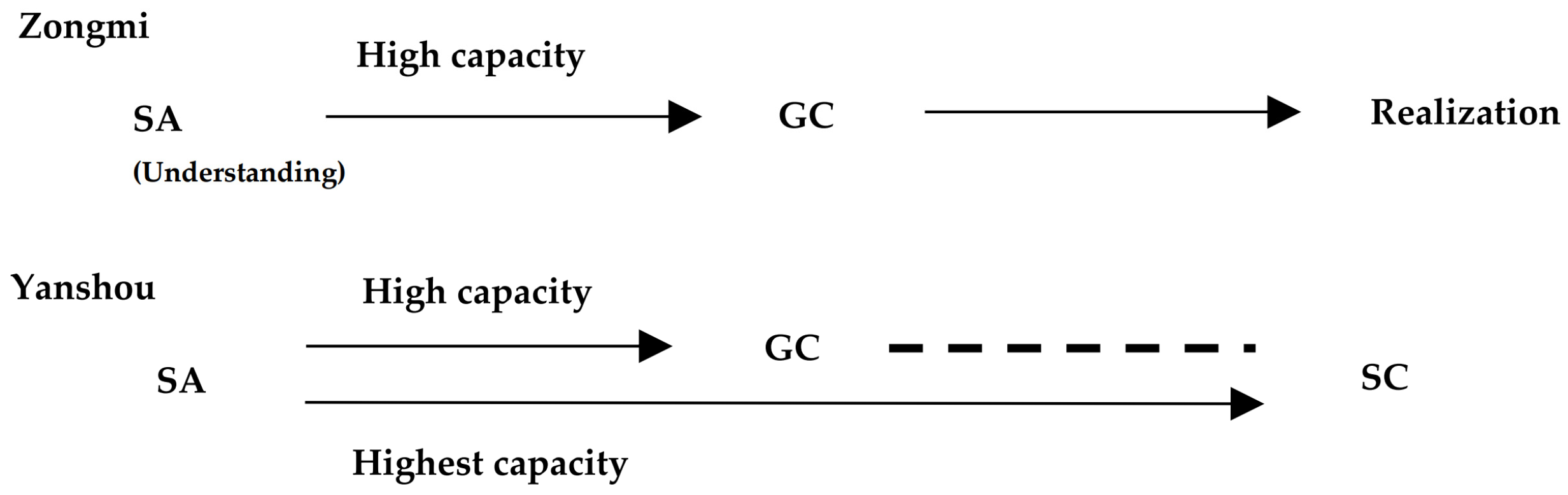
Accordingly, Yanagi Mikiyasu has provided a detailed analysis of the structural framework of Zongmi and Yanshou’s theory as follows:
As
Figure 1 shows, while Yanshou’s soteriology resembles Zongmi’s in certain features, their underlying structures differ: Zongmi’s is a “single-linear” path—namely, “Understanding (Sudden Awakening) → Gradual Cultivation → Realization”. In contrast, Yanshou’s is a “double-linear” path: “Understanding (Sudden Awakening) → Gradual Cultivation” for those of high capacity, and “Understanding (Sudden Awakening) → Sudden Cultivation” for those of the highest capacity (
Yanagi 2016, p. 66). Yanshou subsumes the process of “Sudden Awakening (Understanding) → Gradual Cultivation → Realization” established by Zongmi as the path for those of mediocre or inferior capacity to advance toward superior capacity, while supplementing it with a new shortcut of “Sudden Awakening → Sudden Cultivation” as the praxis for those of the highest capacity” (
Yanagi 2016, p. 69). That is to say, in Yanshou’s soteriology, Zongmi’s paradigm of Sudden Awakening Gradual Cultivation is regarded merely as a partial component of the path, whereas the authentic core of cultivation remains centered on Sudden Awakening Sudden Cultivation.
Jeong Young Sik (
Jeong 2013) interprets Daeji’s cultivation theory as a two-layered structure similar to that of Yanshou, distinguishing between superior and inferior spiritual capacities within the “Sudden Gate”:
Between the two ways in
Figure 2, Sudhana serves as the archetype for those of superior capacity within the Sudden Gate, who achieve ultimate Realization through the synergy of Sudden Awakening (specifically Understanding) and Sudden Cultivation. Conversely, for those within the Sudden Gate of inferior capacity, only the transition from Sudden Awakening to Gradual Cultivation is illustrated, while their eventual attainment of Realization following this Gradual Cultivation remains unaddressed.
Synthesizing the structural models delineated above, it becomes evident that Sudden Awakening (specifically, Understanding) constitutes the universal point of departure for all cultivation, while Realization remains the ultimate telos of the entire soteriological process. However, due to the constraints imposed by varying spiritual capacities, Chan masters do not always explicitly designate Realization as the terminal point in their discourses. Furthermore, for practitioners of superior capacity, Sudden Awakening and Sudden Cultivation arise simultaneously as essence and function; in such instances, the act of Sudden Cultivation inherently presupposes the state of Sudden Awakening. Consequently, the general trajectory of the path can be defined as commencing with Understanding, proceeding through the intermediary process of either Gradual or Sudden Cultivation, and culminating in Realization. This systemic framework finds its most lucid expression in Daeji’s commentary on the Śūraṃgama sutra (楞嚴經).
The sutra itself states: “The principle is awakened to suddenly, [and afflictions] are dissolved by taking advantage of awakening. Phenomena are not suddenly removed; they must be exhausted in sequence. 理則頓悟,乘悟併銷;事非頓除,因次第盡” (CBETA, T19, no. 945, p. 155a8-9). Daeji interpreted this passage as follows:
Regarding Sudden Awakening Sudden Cultivation, there are also the dual meanings of Understanding and Realization. “Awakening to the principle suddenly (理則頓悟)” refers to awakening through Understanding. “Eliminating [afflictions] by taking advantage of awakening (乘悟並消)” refers to sudden cultivation, much like the saying “sudden understanding, sudden cessation”. However, this belongs to the Gate of Inherent Nature (性具門), where principle and wisdom manifest, but the work of practice is not yet suddenly completed. “Phenomena are not suddenly removed; they [must be dealt with] through sequence (事非頓除,因次弟)” refers to gradual cultivation. “Exhaustion (盡)” refers to the awakening through Realization after Sudden Cultivation, much like the saying “sudden awakening, sudden exhaustion”. This belongs to the Gate of Meritorious Practice (功行門), where phenomenal wisdom manifests; there is no doubt that sudden cultivation judges the phenomena.
頓悟頓修者,亦有解、證二義。”理則頓悟”者,解悟也。”乘悟並消”者,頓修,如所謂”頓了頓息”者也。然此性具門理智現前,非功行頓畢也。”事非頓除,因次弟”者,漸修也。”盡”者,頓修後證悟,如所謂頓覺頓盡者。此功行門事智現前,頓修判事,無疑矣。
(H. v9, p.9a24-b13)
In his interpretation, “sudden awakening to principle” corresponds to Understanding; “eliminating through awakening” corresponds to Sudden Cultivation; “phenomena not suddenly removed” points to Gradual Cultivation; and “exhaustion” refers to Realization. Crucially, Sudden and Gradual Cultivation are not contradictory but represent two sequential phases within a unified practice.
The first phase, Sudden Cultivation (Gate of Inherent Nature), involves removing ignorance to reveal the mind-essence. The second, Gradual Cultivation (Gate of Meritorious Practice), involves eliminating karmic obstacles from countless eons to reach Buddhahood. To reach the final state, one needs a further “Realization after Sudden Cultivation” or “Sudden Awakening and sudden exhaustion,” referring to the final awakening that utterly extinguishes all afflictions.
Within this framework, “manifestation of principle-wisdom” means the mind-essence is revealed, but karmic obstacles remain, while “manifestation of phenomenal-wisdom” signifies the completion of practice and the total removal of obstacles. If this entire system can be realized within this lifetime, it is classified as Sudden Awakening Sudden Cultivation.
Thus, Daeji uses Sudden Cultivation as the anchor, integrating the preceding Understanding (Sudden Awakening), the concurrent Gradual Cultivation, and the subsequent Realization into a single thread in
Figure 3: Understanding (Sudden Awakening) → Sudden Cultivation (Principle) → Gradual Cultivation (Phenomena) → Realization. By drawing on the
Śūraṃgama Sutra’s discourse on Sudden Awakening and Gradual Cultivation, Daeji skillfully harmonizes principle and phenomena (理/事) with sudden and gradual, resolving their inherent tension.
Furthermore, the Gate of Inherent Nature, which establishes Sudden Cultivation at the level of principle, corresponds to the Spiritual Body, as it involves the immediate alignment of consciousness and mind-nature. The Gate of Meritorious Practice, which requires the gradual elimination of phenomenal obstructions, engages both the Physical Body (as the locus of present-life practice) and the Karmic Body (as the carrier of multi-life karma to be purified). The difference among the three masters lies in how they prioritize these two body dimensions within the Gate of Meritorious Practice.
6. Soteriology Under the View of the Body: A Structural Reinterpretation
Based on the systematic discourse of awakening and cultivation presented above, and in conjunction with the Tripartite View of the Body, this study proposes the following integration in
Table 1.
First, the Spiritual Body is the subject of the stages of Understanding and Realization in the Sudden Awakening Sudden Cultivation. While Sudden Awakening primarily involves the operations of consciousness, Sudden Cultivation involves the manifestation of mind-nature. Although conventional paradigms posit that Understanding precedes Cultivation and Realization follows it, the theoretical description of Sudden Awakening Sudden Cultivation maintains that the relationship between Sudden Awakening and Sudden Cultivation is strictly one of logical priority or ti-yong, with no temporal sequence whatsoever.
Second, the Karmic Body operates within the protracted interval of cultivation between initial Understanding and final Realization. Those defined as having inferior capacity are precisely those whose Karmic Bodies are burdened by the accumulation of past karma, which obstructs their attainment of Buddhahood in the present life.
Third, the Physical Body represents “the present life” mentioned by Zongmi, Yanshou, and Daeji. As the actual mode of existence for the practitioner, it is the phenomenal body within the world of dependent origination—a temporary vehicle that carries consciousness, mind-nature and the Karma. All opportunities for attaining Buddhahood must ultimately be undertaken and realized through this Physical Body.
It is within this structural framework that the distinct emphases of the three masters’ discourses are clearly revealed:
Zongmi assigns Sudden Awakening Sudden Cultivation to those he designates as having superior capacity, yet he simultaneously undercuts this very designation. Through the lens of samsaric time, what appears as sudden in the present is, he argues, merely the culmination of gradual perfuming over countless past lifetimes. The category of highest capacity thus dissolves into a temporary effect of karmic accumulation—an accumulation that, in principle, any practitioner can undertake. It is this karmic dimension, extending longitudinally across lifetimes, that occupies the gravitational center of Zongmi’s soteriology.
This temporal reframing detaches the practitioner from the confines of the immediate, mundane world and situates them within the boundless samsaric timeline of past, present, and future. In this sense, this study contends that Zongmi’s primary focus lies in the subject of cultivation that may be termed the Karmic Body. Thus, within Zongmi’s system, Sudden Awakening Sudden Cultivation remains pedagogically embedded in—and effectively subordinated to—a broader multi-life karmic architecture.
Yanshou emphasizes that the Zongjing lu centers on Sudden Awakening Sudden Cultivation (或頓悟頓修,正當宗鏡) (CBETA, T48, no. 2016, p. 626c24). Utilizing vivid metaphors such as the bamboo shoot and the lion, he argues that this simultaneous path is the optimal methodology for attaining Buddhahood. Yanshou stresses the necessity of seizing the possibility of attaining Buddhahood in the present life, practicing diligently within the current existential frame to achieve immediate realization. On the basis of this soteriological inclination, this study contends that Yanshou focuses primarily on the subject of cultivation termed the Physical Body—the immediate, transient, and phenomenal vessel of this world. Precisely because Yanshou’s emphasis shifts toward the Physical Body—and the inherent urgency of attainment in this lifetime—Sudden Awakening Sudden Cultivation is no longer an inaccessible ideal as it was in Zongmi’s system; instead, it is established as the direct shortcut in practice.
Daeji’s discourse explores Sudden Awakening Gradual Cultivation and Sudden Awakening Sudden Cultivation through the lens of spiritual capacity, effectively preserving both Yanshou’s emphasis on the latter and Zongmi’s valuation of the former. However, he does not simply combine their answers. Rather, he constructs a different structure: within the horizon of a single lifetime, the gradual process is contained within the sudden. Furthermore, compared to Yanshou, Daeji’s conception of Sudden Cultivation incorporates the processual character of cultivation. If Yanshou’s metaphors of the lion and the bamboo shoot represent the immediacy of entering the Buddha stage at the very moment of practice, then Daeji’s example of Sudhana encompasses a prolonged southern pilgrimage, illustrating a gradual progression unfolding within the horizon of a single lifetime.
Consequently, Daeji’s soteriology integrates the gradual process into sudden cultivation within the scope of the present life, while maintaining the dimension of gradualism within the scope of multiple lifetimes. In this sense, Daeji’s framework brings together the Karmic Body (multi-life continuity) and the Physical Body (present-life practice).
In summary, the Tripartite View of the Body provides a clear analytical framework for elucidating the interpretations of Sudden Awakening Sudden Cultivation held by these three masters. Although they do not explicitly employ this analysis within their texts, their divergent views on this doctrine reveal a profound theoretical choice regarding the subject of cultivation.
The Spiritual Body functions as the essential subject of awakening and cultivation; in an instant, it achieves full realization and encompasses infinite merit. As the essential subject of Sudden Awakening Sudden Cultivation—characterized by instantaneous realization and resonance with merit—the Spiritual Body is a point of consensus among the three masters and thus is not the source of their divergence. The true differentiation arises from how they perceive the aspect of the practitioner’s existence that is both constrained by reality and endowed with potential beyond the Spiritual Body. In reality, sentient beings differ enormously in their concrete situations and karmic accumulation. Zongmi’s emphasis on gradualism reveals his profound grasp of the constraints imposed by the Karmic Body, which is burdened by the weight of multiple lifetimes. Conversely, Yanshou’s emphasis on sudden cultivation points toward the breakthrough potential of the present life, anchoring itself in the agency of the Physical Body. Finally, Daeji’s construction of a multilayered Gradual–Sudden structure reflects the theoretical tension between the Physical and Karmic Bodies.
Ultimately, the introduction of the Tripartite View of the Body allows us to discern that the differing positions of these three masters are not accidental preferences. Rather, they stem from their respective emphases on different dimensions of the practitioner: the longitudinality of the Karmic Body, the immediacy of the Physical Body, and the subsumptive structure between the two. The divergent manifestations of Sudden Awakening Sudden Cultivation across these three thinkers derive their internal logic precisely from these shifting conceptualizations of the body.
Additionally, the three masters also differ in their modes of argumentation. Zongmi’s typological classification inherently relativizes Sudden Awakening Sudden Cultivation by placing it within a larger system of soteriological possibilities. Yanshou’s analogical reasoning and Daeji’s scriptural exegesis, in contrast, aim at demonstrating the efficacy and normative status of sudden cultivation rather than classifying it. This methodological asymmetry is not incidental; it shapes the very conclusions each master reaches.
7. Conclusions
To return to the initial questions: “sudden” in Sudden Cultivation does not require an instant, nor is it inherently superior to the gradual. Its meaning shifts with the body dimension each master prioritizes. Sudhana’s southern pilgrimage is classified as sudden because Daeji’s framework subsumes gradual process within the present life. And the present life itself could be called “sudden” in contrast to the multi-life scale of saṃsāra.
By analyzing the dimension of the body within the stages of cultivation, this study has proposed a Tripartite View of the Body—comprising the Spiritual, Karmic, and Physical bodies—to reveal the deep structures underlying the concept of Sudden Awakening Sudden Cultivation in the thought of Zongmi, Yanshou, and Daeji.
The emphasis on the Karmic Body led Zongmi to dissolve Sudden Cultivation into the gradual perfuming of multiple lifetimes. Conversely, the focus on the Physical Body allowed Yanshou to establish Sudden Cultivation as a direct shortcut within the present life. Daeji, drawing on both frameworks, constructed a subsumptive structure wherein the gradual is contained within the sudden. In this sense, Daeji’s designation of Sudhana as the archetype of Sudden Awakening Sudden Cultivation is not a mere taxonomic error; rather, it reveals the possibility of the Sudden concept: it is not a cancelation of process, but the subsumption of it.
The introduction of this Tripartite View of the Body re-contextualizes the temporal dichotomy of “Sudden/Gradual” and the capacity-based dichotomy of “Superior/Inferior” within a body-centered framework. By shifting the analytical focus from the speed of time and the quality of capacity to the thematic emphasis of the practitioner’s subjecthood, this study has traced the internal logic of soteriology throughout intellectual history.
Admittedly, this study focuses exclusively on Zongmi, Yanshou, and Daeji. The discourses of the Goryeo master Chinul, the lineages of Japanese Zen, and the further debates on the sudden/gradual problem in late Joseon Buddhism remain fertile ground for future research.