1. Introduction
Contemporary scholarship on sacred architecture has increasingly converged on the view that religious space is not merely a passive container of meaning, but an active, meaning-generating environment shaped through the interaction of spatial form, materiality, movement, and perception. This shift reflects a broader interdisciplinary turn that integrates architectural theory, religious studies, anthropology, and phenomenology to examine how the sacred is spatially produced and experientially mediated.
Over the past two decades, research on religious architecture in Europe and North America has increasingly adopted interdisciplinary frameworks, integrating semiotics, cultural studies, sociology, and environmental psychology. Scholars have reexamined religious buildings not only as symbolic expressions of belief but also as spatial mediators of social identity, political negotiation, and cultural inclusion within pluralistic urban contexts (
Barrie 2013;
Kong 2010). In response to globalization and shifting religious demography, recent architectural practices emphasize flexibility, openness, and contextual integration rather than purely historicist formal languages (
Fernández-Cobián 2022). Contemporary mosques, churches, and multi-faith complexes often combine traditional iconography with modern materials, digital fabrication, and sustainable technologies to produce spaces that accommodate both worship and community engagement (
Al Khalifa and Lafi 2025). At the experiential level, design research increasingly focuses on how light modulation, acoustic engineering, and tactile material strategies influence emotional resonance and contemplative states in sacred interiors (
Zou and Bahauddin 2024). Together, these theoretical and practical developments point toward a reconceptualization of religious architecture as a culturally hybrid, socially responsive, and sensorially calibrated spatial system rather than a fixed sacred typology.
However, in contemporary China, Buddhist architecture has generally continued to rely heavily on traditional architectural vocabularies rather than an overtly modernist design for several interrelated cultural, religious, and social reasons. Buddhist temples serve not only as ritual spaces but also as embodiments of historical continuity and cultural identity. The traditional architectural language—curved rooflines, bracket systems, axial layouts, courtyards, spatial hierarchies, and symbolic ornamentation, communicates an immediate association with China’s long-standing Buddhist heritage (
Steinhardt 1997;
Wang 2016). For devotees and visitors, these familiar forms help reinforce the temple’s authenticity and spiritual authority. At the same time, this architectural grammar is closely connected with ritual practice: spatial hierarchies, courtyards, gates, and axial sequences facilitate ceremonial movement, pilgrimage routes, bodily orientation, and the sacralization of space (
Naquin and Rawski 1987). For this reason, a temple built in an overtly modernist style may risk appearing secular, commercial, or insufficiently connected to established religious expectations. Thus, continuity of architectural vocabulary often also supports continuity of ritual practice.
The revival of Buddhism in contemporary China has also been accompanied by state and local interest in promoting “traditional culture.” Local governments often support temple construction as part of cultural tourism, heritage branding, and regional identity-making. In this context, traditional styles become recognizable symbols of “authentic Chinese culture,” attracting both pilgrims and tourists (
Goossaert and Palmer 2011;
Yang 2011). Modernist religious buildings, by contrast, may not serve this cultural–political function as immediately or effectively. Finally, there is a theological dimension: in Mahāyāna Buddhist cosmology, temple architecture may be understood as a spatial manifestation of sacred order or the pure land. Ornamental details, symbolic proportions, axial hierarchies, and historical aesthetics are therefore not arbitrary stylistic choices but may embody metaphysical principles (
Zürcher 2007). For these reasons—ritual continuity, cultural identity, political utility, and theological symbolism—many contemporary Buddhist buildings in China continue to favor historically recognizable architectural vocabularies over radical modernist experimentation.
This paper examines the Namaste Dagoba (Unioned Buddha Relic Tower) at Famen Temple, a unique modern Buddhist structure in China, as a case study in architectural theology: the idea that architecture itself can function as a medium of theological argument by structuring bodily engagement and symbolic orientation toward transcendence. Completed in the late 2000s, Namaste Dagoba’s praying-hands form and soaring verticality stage an embodied encounter with relic-centered devotion while deploying a contemporary vocabulary of scale and spectacle. Theoretically, this study combines architectural semiotics, sacred space theory, and theological aesthetics. Semiotics provides tools to read architectural elements as signs with syntactic and semantic relations, while phenomenology and sensory approaches tend to how those signs are apprehended by sentient bodies. Together these perspectives allow a focused analysis of how Dagoba’s material and spatial configurations produce modes of devotion such as circumambulation, prostration, and relic-reverence. Empirically, the paper draws on questionnaire responses, semi-structured interviews, and architectural field notes, together with visual and spatial analysis of the Namaste Dagoba’s form, materials, light, and movement-related settings.
By examining a contemporary Chinese Buddhist monument, this study builds on and integrates existing work in semiotics, phenomenology, and material religion to propose a process-oriented analytical framework, termed the empirical semiotics of sacred space, which reconceptualizes how religious meaning is generated within architectural environments. Moving beyond representational models that interpret sacred architecture as a system of fixed symbols, and beyond phenomenological approaches that privilege subjective perception alone, this framework emphasizes semiosis as an embodied, processual, and spatially mediated activity. In this view, sacred meaning does not reside inherently in architectural forms, nor solely in individual cognition, but emerges through the dynamic interaction between spatial configurations, sensory modulation, and ritualized bodily practices. By foregrounding the role of movement, perception, and environmental cues, the framework integrates semiotics with embodied practice, positioning architecture as an active participant in meaning production rather than a passive container of symbolic content. This approach enables a more precise analysis of how sacred space operates as a structured field in which meaning is continuously enacted and negotiated. Through this lens, the study not only offers a novel interpretation of contemporary Buddhist architecture but also contributes a transferable model for examining the experiential and semiotic dimensions of religious spaces across cultural contexts.
Accordingly, this study is framed as an exploratory pilot investigation within Experimental Theological Aesthetics (XTA). The paper asks three research questions: RQ1: How do visitors perceive the symbolic and aesthetic qualities of the Namaste Dagoba? RQ2: How are these perceptions associated with visitors’ reported embodied spatial and ritual-like experiences? RQ3: How do symbolic–aesthetic perception and embodied spatial experience relate to perceived sacred meaning? On this basis, the study proposes three directional hypotheses: H1: Symbolism and Aesthetic Experience (SAE) is positively associated with Embodied Spatial–Ritual Perception (ESRP). H2: ESRP is positively associated with Perceived Sacred Meaning (PSM). H3: ESRP partially mediates the relationship between SAE and PSM. Given the single-case design and modest sample size, these hypotheses are tested in an exploratory and model-building sense, and the findings are interpreted as suggestive rather than conclusive.
2. Literature Review
Early theoretical foundations in architectural semiotics conceptualize the built environment as a structured system of signs through which cultural meanings are encoded, transmitted, and interpreted. Foundational works by
Preziosi (
1979) and
Broadbent et al. (
1980) established architecture as a communicative medium governed by syntactic and semantic relationships analogous to language systems. Architectural elements, boundaries, axes, thresholds, and hierarchies function as signifiers organizing meaning within culturally recognizable codes.
Eco (
1986) extended this perspective, arguing that architecture conveys ideological and social meanings through culturally conditioned interpretive processes. Buildings thus operate as sign systems embedded in symbolic networks, rather than neutral physical objects.
Subsequent research emphasized perception and cognition as essential to architectural meaning-making.
Arnheim (
1977,
2009) demonstrated that spatial form and visual composition inherently guide interpretation independently of explicit symbolic content.
Krampen (
1979) highlighted environmental perception, asserting that architectural meaning emerges from interactions between physical form and human cognition. These approaches shifted attention from architecture as static representation to architecture as an experiential system, where meaning is generated through perception and interaction.
Parallel developments in spatial theory showed that architecture structures social practice and embodied behavior.
Hillier and Hanson (
1984) introduced space syntax theory, demonstrating how spatial configurations influence movement, visibility, and social interaction. Architectural layouts thus regulate social relations by organizing access, circulation, and hierarchy.
Bourdieu (
1990) framed spatial practice within habits and cultural reproduction, emphasizing that everyday bodily movements in architectural settings reinforce social norms and symbolic order. Collectively, these theories position architecture as an active mediator of behavior rather than a passive container.
Despite these advances, early semiotic and spatial theories were largely developed in secular contexts and did not fully address the experiential and transcendent dimensions of religious space. To account for these, scholars in religious studies turned to ritual theory and the phenomenology of sacred space.
Eliade (
1959) conceptualized sacred space as emerging from the symbolic differentiation between sacred and profane. Religious architecture establishes a cosmological center, often expressed through verticality or axial alignment that functions as an
axis mundi, connecting earthly and transcendent realms. This cosmological symbolism remains central in studies of temples, churches, mosques, and pilgrimage sites. Subsequent scholarship emphasized ritual practice as constitutive of sacred space.
Habel et al. (
1993) argued that sacred environments are enacted through myth, ritual, and spatial organization rather than symbolic form alone.
Smith (
1987) proposed that sacredness emerges through performance and cultural interpretation. These perspectives frame sacred architecture as a processual environment, where meaning develops through practice rather than static symbolism. More recent scholarships highlight mediation.
Meyer (
2012) contends that religious experience is produced through material and sensory mediations generating a sense of divine presence. Architecture functions as a medium shaping perception via light, sound, texture, and movement. Sacred space is thus relational, emerging from interactions between material forms and human practices. This focus on material mediation has become central to contemporary research on religious architecture.
Building on these insights, semiotic approaches increasingly explore how spatial elements function as performative sign systems activated through rituals.
Lukken and Searle (
1993) show church architecture encoding liturgical meaning via spatial arrangement, while
Jones (
2000) interprets sacred architecture as a hermeneutic process involving movement, perception, and interpretation. Features such as thresholds, vertical hierarchies, and processional pathways guide transitions from profane to sacred domains, acting as symbolic markers and behavioral scripts structuring religious experience. This performative dimension extends to pilgrimage and ritual movement.
Turner and Turner (
2011) conceptualize pilgrimage as transformative, producing liminality and communal identity.
Coleman and Eade (
2004), and
Coleman (
2022) emphasize mobility, arguing that pilgrimage involves dynamic interaction between bodies, spaces, and cultural narratives. Architectural space functions as a “spatial script,” choreographing ritual movement through pathways, stairs, and thresholds. These movement patterns form a grammar of embodied meaning, enacting theological narratives rather than merely representing them.
Phenomenological approaches deepen the analysis by prioritizing sensory experience. Following
Merleau-Ponty (
2012), perception is embodied, and architectural meaning arises through sensory engagement.
Casey (
2013) emphasizes place as experiential, shaped by memory, orientation, and bodily presence. Architecture thus becomes a field of lived experience rather than an abstract system. Empirical research supports this view.
Joye and Dewitte (
2016) found that monumental scale induces awe and slows behavior, indicating large structures affect emotional and cognitive responses.
Meagher (
2016,
2018) demonstrated that interpretations of sacred environments vary with religious orientation, showing perception is shaped by both design and belief. Such studies underscore the importance of psychological and sensory factors in sacred architecture. Recent research increasingly examines multisensory experience. Architectural acoustics studies reveal that reverberation and resonance enhance sacredness via immersive soundscapes (
Guillebaud and Lavandier 2019). Lighting and materiality research shows transitions between darkness and illumination evoke symbolic associations with spiritual transformation (
Matracchi 2021). Tactile materials like stone, wood, and metal provide sensory feedback during movement, shaping embodied experience (
Daelemans 2020). Sacred architecture thus operates as a multisensory system integrating visual, auditory, and tactile stimuli to produce religious meaning.
At the intersection of semiotics and phenomenology, interdisciplinary research frames sacred architecture as an integrated experiential system.
Kress and van Leeuwen (
2020) interpret spatial and visual elements as components of a broader semiotic grammar communicating meaning through composition, orientation, and scale.
Csordas (
2007) emphasizes embodiment as religious knowledge, suggesting bodily experience constitutes a primary mode of understanding the sacred. Architecture thus actively generates religious cognition, aligning bodily movement, sensory perception, and symbolic structure into a coherent experiential process. Theological perspectives further articulate how architecture mediates material form and spiritual meaning.
Balthasar (
1982–1991) argued that aesthetic form reveals theological truth through sensory perception.
Viladesau (
1999) and
Thiessen (
2004) contended that architecture functions as a theological medium, shaping emotional and spiritual responses. Architecture is both symbolic structure and instrument communicating religious meaning via sensory experience. In architectural history and liturgical studies, scholars examined how buildings embody doctrinal and ritual principles.
Kieckhefer (
2004) showed that medieval churches reflected theological cosmology through spatial hierarchy and geometry.
McNamara (
2009) and
Seasoltz (
2005) analyzed how liturgical architecture organizes ritual movement and participation.
Bergmann (
2011,
2014) linked theology, ecology, and architecture, framing sacred buildings as environments shaping ethical and spiritual relationships. Collectively, these studies support the concept of architecture as “material theology,” expressing doctrinal ideas through design.
Despite theoretical advances, gaps remain. Much research focuses on Western Christian contexts, limiting attention to non-Western traditions (
Kong 2010). Studies on Buddhist architecture often emphasize historical typologies rather than contemporary design and lived experience. Semiotic and spatial theories prioritize formal symbolism, while phenomenological approaches emphasize subjective perception, leaving a gap in integrating symbolic structure with sensory and affective dimensions. These limitations underscore the need for frameworks combining symbolic interpretation, spatial analysis, and empirical observation. Recent studies have further advanced empirical approaches to sacred architecture by incorporating eye-tracking technologies to examine how spatial form guides visual attention and perception under real conditions. For instance,
Bermudez et al. (
2024) demonstrate that measurable perceptual patterns can provide valuable insights into how architectural environments structure religious experience, reinforcing the importance of integrating sensory data into semiotic and phenomenological analysis. Contemporary religious architecture in modernizing societies like China presents challenges for traditional models. Revival of religious practice, cultural tourism, and modern construction technologies produce hybrid environments blending tradition and innovation (
Goossaert and Palmer 2011;
Yang 2011).
Scholarship on Buddhist architecture also cautions against reducing historical temples to static symbolic systems. Premodern Buddhist spaces were not experienced only through visual iconography or doctrinal symbolism; they were also structured through movement, bodily orientation, ritual sequence, sound, incense, light, threshold crossing, and spatial hierarchy. Courtyards, gates, halls, pagodas, relic chambers, corridors, and circumambulatory routes formed experiential sequences through which devotees and visitors encountered sacred meaning gradually. In this sense, historical Buddhist architecture already operated as a spatial and ritual medium. The contribution of the present study is therefore not to oppose “traditional symbolic space” to “contemporary experiential space,” but to examine how a contemporary monument such as the Namaste Dagoba reconfigures inherited symbolic and ritual–spatial mechanisms within a new architectural, touristic, and empirical context. The Namaste Dagoba at Famen Temple exemplifies a case examining modern reinterpretations of traditional symbolism while shaping pilgrimage experience. By integrating semiotic analysis, sacred space theory, and phenomenology, this study addresses the gap between symbolic structure and lived experience. It investigates how modern Buddhist architectural design mediates meaning through spatial choreography, sensory modulation, and embodied rituals. This interdisciplinary approach contributes to scholarship conceptualizing sacred architecture as an experiential and communicative system generating religious cognition in contemporary contexts.
3. Theoretical Framework and Methodology
3.1. Theoretical Framework
This study proposes an integrated theoretical framework that conceptualizes modern religious architecture as a dynamic system in which form, space, and sensory experience collectively produce religious cognition. Rather than treating architecture as a static container of symbolic meaning, the framework understands it as an interactive field where semiotic processes, spatial organization, and aesthetic perception converge. This perspective is particularly suited to the analysis of the Namaste Dagoba, whose design operates through the interplay of symbolic abstraction, ritual movement, and sensory modulation in modern Chinese context.
First, the framework redefines architectural semiotics as performative and relational. Architectural elements, such as geometry, axiality, and material articulation, are not approached as fixed symbols conveying predetermined meanings. Instead, they function as signifying processes activated through embodied engagement. Meaning emerges through the interaction between spatial configuration and human movement, rather than residing solely in the design itself. In this sense, symbolic motifs within the Dagoba, vertical ascent or circular progression, are not merely representational but are continuously reconstituted through ritual practice and perceptual experience.
Second, sacred space is understood as an operative condition rather than an inherent property. The distinction between sacred and profane is not statically inscribed in architectural form but is generated through spatial sequencing, threshold articulation, and bodily orientation. The Dagoba’s organization, its processional pathways, transitional boundaries, and hierarchical layering, guides visitors through gradual experiential and perceptual transformations. These spatial strategies actively produce sacredness by structuring movement, pause, and reorientation within the built environment.
Third, the framework emphasizes aesthetic experience as a mode of theological mediation. Aesthetics is not limited to visual appreciation but encompasses multisensory engagement, including light, sound, and materiality. These elements are integral to shaping the conditions under which the sacred becomes perceptible. Through carefully modulated sensory environments, architecture creates an atmosphere in which spiritual awareness can emerge. Theological meaning is thus disclosed through embodied perception, as spatial rhythm and atmospheric qualities align with human sensibility.
Finally, the framework highlights the co-constitution of architecture, body, and meaning. The visitor is not a passive observer but an active participant whose movement and perception actualize architectural potential. Through acts such as circulation, ascent, and stillness, the body becomes the medium through which spatial, symbolic, and sensory dimensions converge. By integrating these dimensions, the framework positions the Namaste Dagoba as an experiential system in which meaning is not merely represented but enacted emerging through the continuous interaction between architectural design, embodied practice, and perceptual engagement.
3.2. Methodology
This study is grounded in an expanded semiotic framework, in which meaning is not treated as a fixed symbolic structure but as an embodied and processual phenomenon. While the study is theoretically supported by architectural semiotics, sacred space theory, and phenomenological aesthetics, its methodological emphasis lies in examining how these conceptual frameworks correspond to lived, embodied experience. To bridge the gap between theoretical interpretation and experiential reality, the research integrates two primary empirical methods, namely questionnaire survey and semi-structured interviews, supplemented by architectural field notes. This mixed exploratory design allows the study to relate participants’ reported perceptions and experiences to the architectural and sensory conditions of the site. Fieldwork was conducted throughout 2025 to 2026 during three major Buddhist ceremonies and two normal regular relic-visiting days (
Table 1). The inclusion of both ceremonial and non-ceremonial contexts allows for a comparative understanding of how architectural meaning is activated under different experiential conditions.
While sacred experience is inherently complex and cannot be fully reduced to quantitative measures, structural equation modeling (SEM) is used here as an exploratory analytical framework for examining possible associations among perception, reported embodied spatial experience, and perceived meaning. SEM is a statistical approach that estimates relationships among latent constructs, that is, theoretical variables that cannot be directly observed but are inferred from multiple questionnaire items. In this study, the three latent constructs are Symbolism and Aesthetic Experience (SAE), Embodied Spatial–Ritual Perception (ESRP), and Perceived Sacred Meaning (PSM). Confirmatory factor analysis (CFA) was first used to examine whether the questionnaire items coherently represented these constructs, and the subsequent structural model explored the hypothesized relationships among them. It should be noted that the ESRP items do not measure objectively observed behavior. Rather, they measure participants’ self-reported perception of how the spatial arrangement, layout, and ritual atmosphere appeared to guide or influence movement and conduct. Items (such as ESRP1, ESRP2, and ESRP8) therefore refer to perceived spatial guidance and perceived behavioral atmosphere, not to independently recorded movement trajectories or verified behavioral change.
The study involved two related but distinct participant groups: questionnaire respondents and interview participants. The questionnaire survey generated 100 valid responses across five fieldwork occasions, with 20 valid responses collected on each occasion. Questionnaires were administered on-site between 4:00 p.m. and 5:00 p.m. on each fieldwork day near the exit of the visiting route and were completed by participants who had already finished their visit or ritual experience. By contrast, semi-structured interviews were conducted with 32 participants selected from willing questionnaire respondents and additional on-site visitors, with the interviewees being individuals who had already completed their worship or visit to Namaste Dagoba. Interviews were usually conducted after 11:00 a.m. and during the afternoon, and each interview lasted approximately 10–20 min. Participants included both Buddhist pilgrims, who primarily visited the site for ritual or devotional purposes, and general visitors, who approached the site mainly through cultural, architectural, or touristic interest. These two groups were treated as experientially distinct populations. Because of the modest sample size, especially when divided into subgroups, group differences are discussed descriptively and are not used as the basis for statistical validation.
Participants were recruited through on-site intercept sampling near the exit or resting areas of the Namaste Dagoba visiting route, with attention to variation in age, occupation, and participation type. Participation in both the questionnaire survey and the interviews was voluntary and anonymous, and no compensation was provided. The fieldwork followed a naturalistic design: participants were not assigned to an experimental route but moved through the site according to the ordinary visiting or ritual conditions of the day. The typical duration of the visit before questionnaire completion was approximately 40–70 min, and participants were allowed to pause, rest, or participate in ritual activities according to normal site conditions. The spatial route included the approach plaza, the area around the Dagoba, and the relic-related interior or threshold spaces, covering an approximate walking distance of 1.5 km. Before completing the paper questionnaire or taking part in an interview, participants were briefly informed of the academic purpose of the study, the anonymous nature of their responses, and their right to decline participation. All questionnaires were completed individually without discussion, with an average completion time of approximately 5–10 min.
The questionnaire was designed to capture general patterns in visitors’ perceptions, including emotional responses, perceived sacredness, and levels of engagement with architectural features. The results provide a preliminary quantitative reference for identifying reported experiential tendencies among participants. The questionnaire was developed based on the study’s theoretical framework integrating architectural semiotics, phenomenological aesthetics, and embodied ritual practice. It aims to examine how visitors perceive and construct meaning within the sacred architectural space of the Namaste Dagoba at Famen Temple. The questionnaire consists of three sections corresponding to the latent constructs in the exploratory structural model: Symbolism and Aesthetic Experience (SAE), Embodied Spatial–Ritual Perception (ESRP), and Perceived Sacred Meaning (PSM). While SAE and ESRP were developed from the theoretical framework and adapted to the case context, PSM was introduced as an outcome variable to capture participants’ subjective perception of sacredness. All items were rated on a four-point Likert scale ranging from 1 (strongly disagree) to 4 (strongly agree), in order to enhance response differentiation and avoid central tendency bias. The full questionnaire instrument is provided in
Appendix A. Because the study is based on a single case and a modest sample size, the quantitative model is treated as exploratory and hypothesis-generating rather than confirmatory.
The semi-structured interviews involved 32 participants with diverse demographic backgrounds. As shown in
Table 2, the sample covers a wide range of age groups and occupations, ensuring variation in experiential perspectives. More than half of the participants were ritual-oriented pilgrims, while the remainder consisted of general visitors engaging with the site from a cultural or touristic perspective. This diversity allows for a comparative interpretation of how sacred meaning is constructed across different user groups. The semi-structured interviews explored four dimensions: (1) emotional and affective responses to the architectural environment; (2) participants’ interpretations of symbolic form and religious meaning; (3) sensory impressions related to light, sound, materiality, scale, and atmosphere; (4) reported experiences of movement, pausing, offering, bowing, or other ritual-like engagement. The interview guide is provided in
Appendix C. Interviews lasted approximately 10–20 min and were conducted in Mandarin. With participants’ verbal agreement, responses were recorded through written notes.
The interview material was analyzed through qualitative content analysis. The first author conducted the initial coding using a preliminary codebook developed from the theoretical constructs of the study and an initial reading of the interview records. The codebook included symbolic recognition, sacred atmosphere, bodily slowing, spatial progression, light and verticality, ritual seriousness, and differences between pilgrims and general visitors. The second author reviewed the codebook and the thematic summary, and ambiguous cases were discussed between the authors until a shared interpretation was reached. Direct quotations are used in the Results and Discussion sections, presented as examples of broader themes rather than as isolated anecdotal evidence. The main themes identified through this coding are reported in
Section 5.3.
Architectural field notes focused on crowd density, general site conditions, and visible locations where practices such as circumambulation, prostration, and offering commonly occurred during the five fieldwork occasions. These notes documented general spatial settings, ritual contexts, crowd conditions, and sensory features such as light, sound, and material atmosphere. Individual trajectories were not systematically tracked or quantitatively analyzed. Accordingly, movement is discussed in this paper primarily as reported experience and architectural interpretation, rather than as independently verified behavioral evidence.
3.3. Architectural Basis for Questionnaire Operationalization
The questionnaire was not designed from an abstract list of sacred-space concepts alone. It was derived from a focused architectural reading of the Namaste Dagoba as experienced by visitors along the ordinary visiting route. This reading concentrated on spatial features that were directly accessible to participants during fieldwork: the external approach, the axial plaza, the visual emergence of the praying-hands form, threshold transitions, vertical enclosure, lighting atmosphere, relic-oriented spaces, and zones of pausing, offering, or circumambulation.
Because this study is an exploratory empirical investigation rather than a comprehensive architectural monograph, it does not attempt a full technical analysis of plans, sections, structure, or construction details. Instead, the architectural analysis is intentionally limited to those spatial and sensory conditions that visitors could plausibly perceive and report. This scope is sufficient for the questionnaire because the survey measures reported symbolic–aesthetic perception, reported embodied spatial–ritual perception, and perceived sacred meaning, rather than objective architectural performance or verified behavioral trajectories. Accordingly,
Table 3 summarizes how the perceivable architectural-spatial features of the Namaste Dagoba were translated into experiential conditions and related questionnaire constructs/items.
4. The Namaste Dagoba: Design and Empirical Semiotics
Famen Temple (法门寺), located in Famen Town, Fufeng County, Shaanxi Province, China, is one of the most historically significant Buddhist sites in China. Dating back to the Eastern Han Dynasty (25–220 CE), the temple has played a central role in the spread and development of Buddhism in China. The temple’s history spans over two millennia. It was initially established during the reign of the Han Emperor, Liu Zhi, who officially began to promote Buddhism in China. The temple’s fame grew during the Tang Dynasty (618–907 CE), when it became a prominent center for Buddhist pilgrimage. The temple’s stupa, or pagoda, built during the Tang period, was one of the most significant in China at the time. It was said to house a relic of the Buddha, believed to have been brought to China by the eminent monk Xuanzang, who is well known for his journey to India to retrieve sacred Buddhist texts. The relic of the Buddha, discovered during the 1987 excavation, was hidden in a stone chamber within the old stupa. This discovery drew international attention and highlighted the long-standing significance of Famen Temple as a site of Buddhist veneration. The relic, a finger bone of the Buddha, is considered one of the most important Buddhist relics in the world and is displayed in the modern museum near the temple, making Famen Temple a key pilgrimage site for Buddhists from around the world.
4.1. Architectural Form and Spatial Narrative
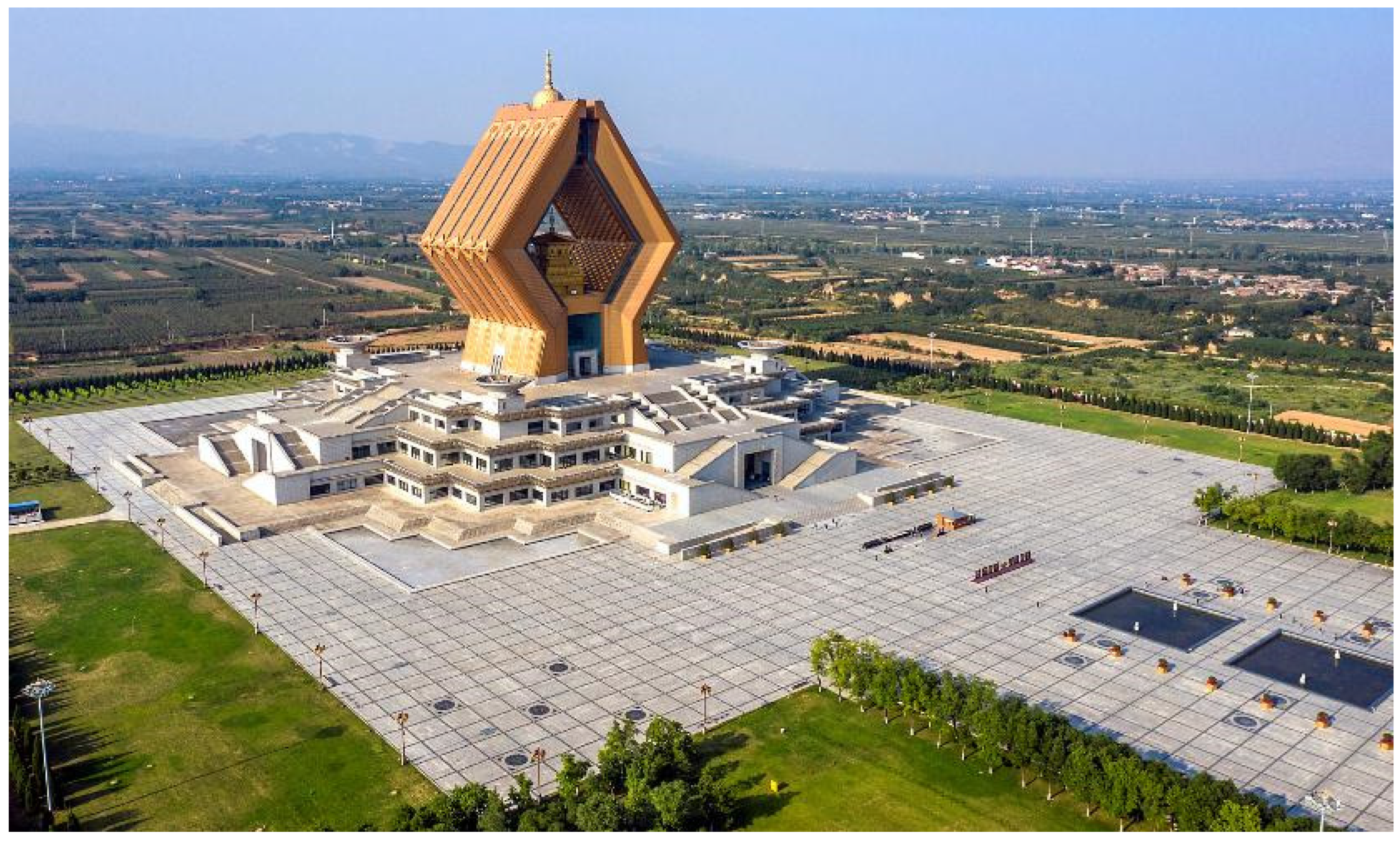
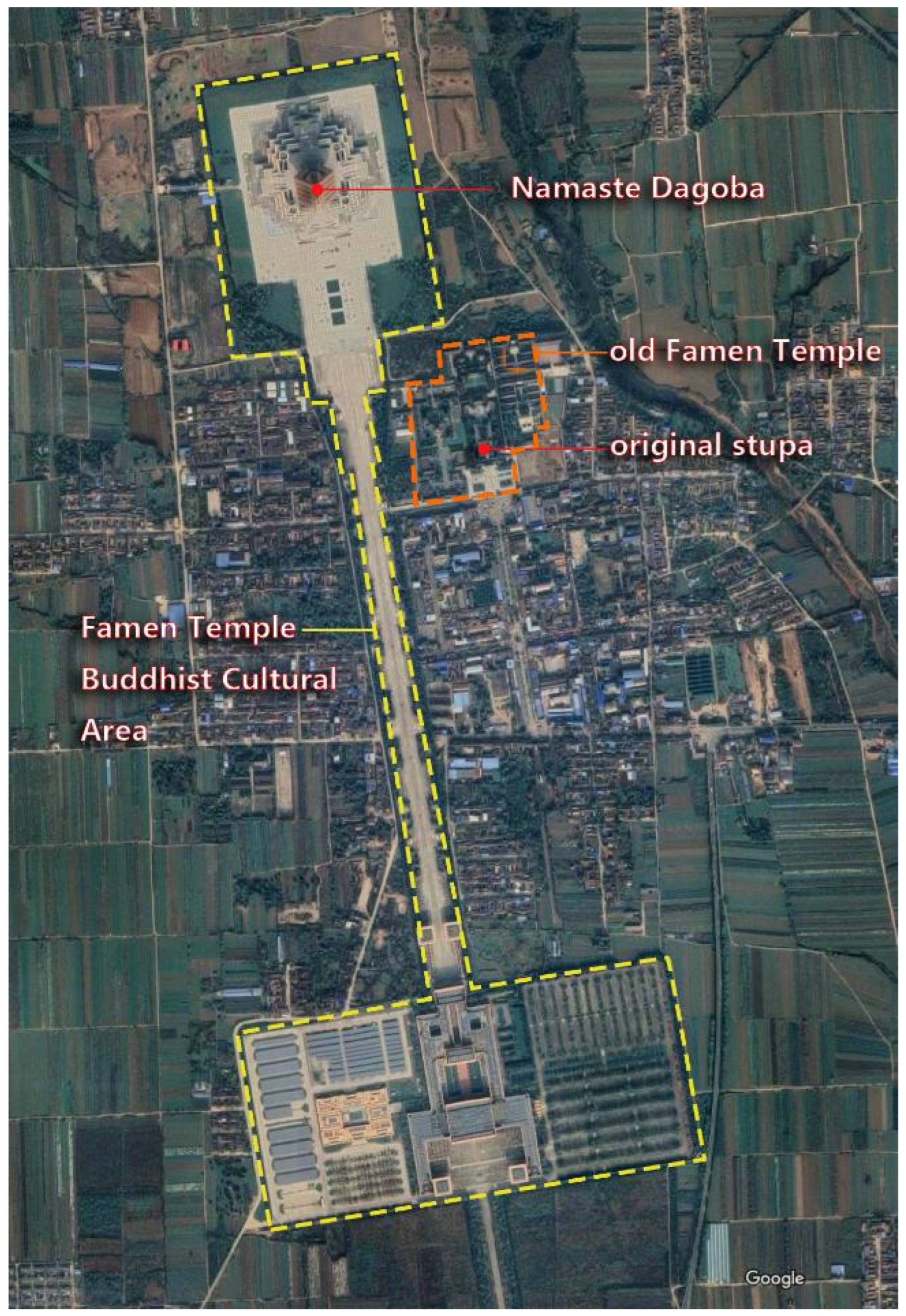
One of the most notable recent developments at Famen Temple is the construction of the Namaste Dagoba, a striking new pagoda located in close proximity to the original site of the ancient stupa (
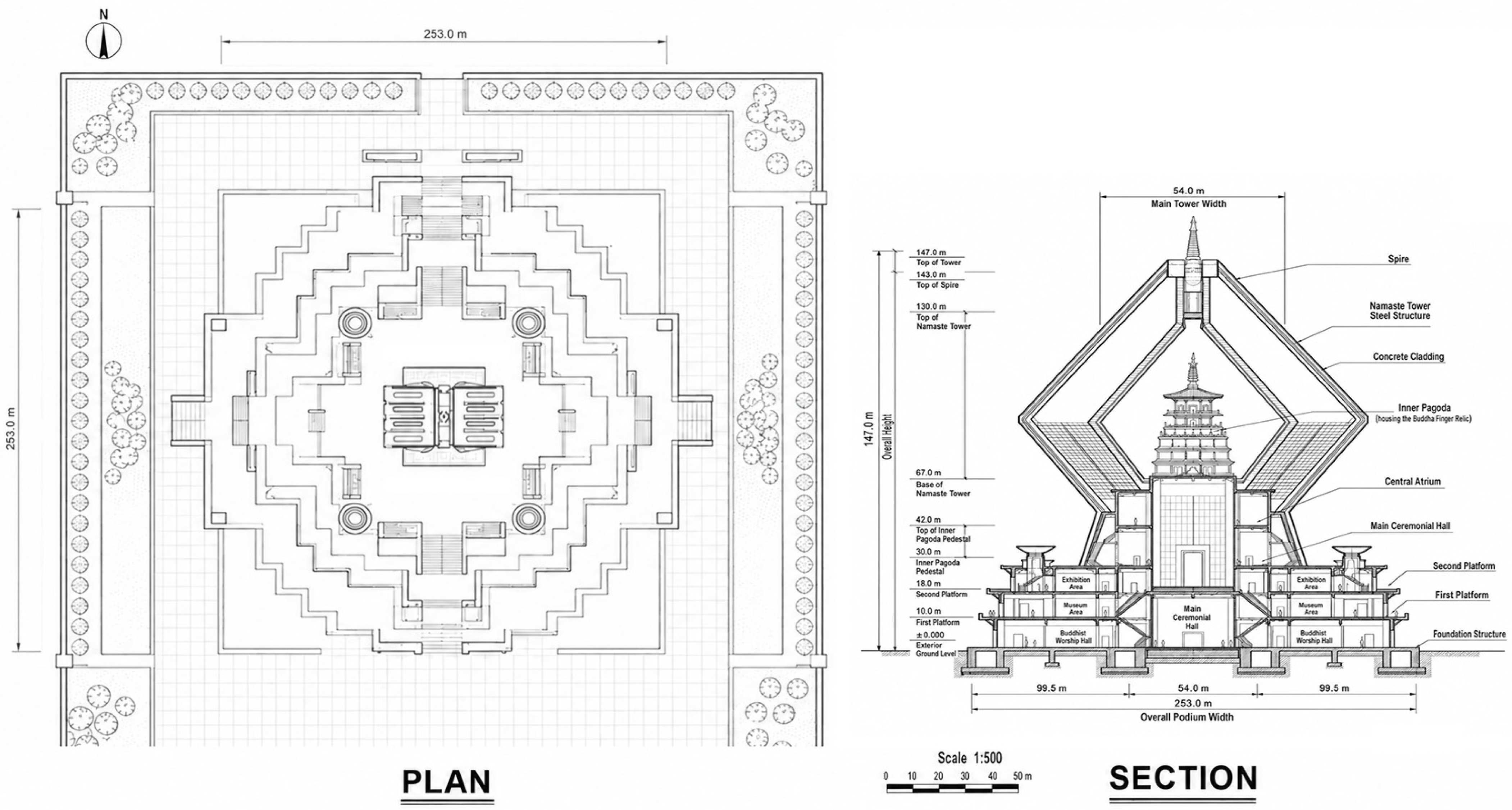
Figure 1). Completed in 2009, it was designed to blend traditional Buddhist architectural styles with modern elements. Its design is symbolic, with the “Namaste” gesture representing the greeting of the Buddha and a welcoming of the world to peace and spiritual harmony (
Figure 2). Namaste Dagoba’s relationship with the old Famen Temple and its original stupa is profound. While the ancient stupa was severely damaged over time, with much of its structure eroded or destroyed, the new Namaste Dagoba serves both as a modern tribute to the historical stupa and as a representation of the continuity of Buddhist tradition in China. The new pagoda is a symbolic renewal of the temple’s original purpose, to house and honor the Buddha’s relics and continue the tradition of Buddhist practice. Rising along the central axis of the Famen Temple complex, the Namaste Dagoba occupies a commanding position both visually and symbolically. Designed by architect C.Y. Lee (Li Zuyuan) in 2007, the structure translates the sacred gesture of namaskāra, palms joined in reverence, into monumental form. The architect’s office describes the project as an attempt to express ancient Buddhist religious culture through a modern architectural vocabulary, especially through the universally legible gesture of hands held in prayer. In this logic, the void between the two palms is not simply an empty architectural volume but a symbolic and experiential space that houses the relics and suggests the origin and nourishment of spiritual life (
Figure 3). This design intention aligns closely with the empirical findings of the present study: both pilgrims and general visitors tended to interpret the building through a combination of symbolic recognition, bodily orientation, vertical awe, and sacred atmosphere.
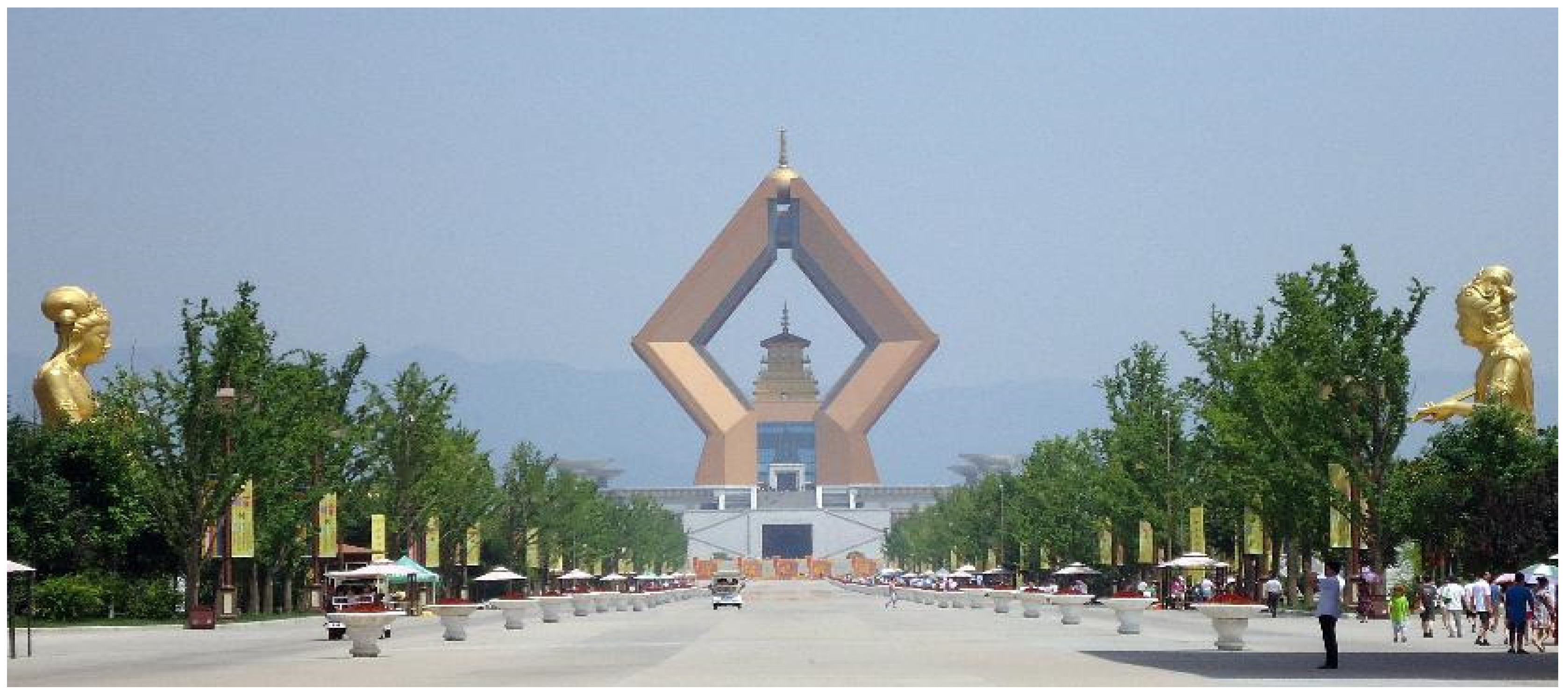
The grand structure is set within an expansive plaza that serves as a transitional space between the secular world and the sacred complex. Its surrounding environment is carefully organized through wide processional walkways leading toward the Dagoba, forming a gradual approach path that orients pilgrims and visitors toward the sacred core (
Figure 4). The plaza’s layout emphasizes axial alignment with the Dagoba, reinforcing its central spiritual role. The area is dotted with landscape gardens and decorative elements that enhance the serene atmosphere, while the minimalist surroundings contrast with the Dagoba’s monumental form.
The spatial narrative of the Namaste Dagoba begins before visitors enter the immediate sacred core. From the public arrival zone, the visitor first encounters a large-scale open precinct in which everyday movement gradually becomes oriented toward the distant vertical figure of the Dagoba (
Figure 1). This external approach is important because it establishes a liminal transition between ordinary public circulation and the more concentrated sacred environment around the relic tower. The long axial route, open plaza, controlled visual focus, and increasing monumentality of the praying-hands form together create a gradual shift from secular arrival to sacred attention. Rather than function as a neutral forecourt, the approach space operates as a preparatory threshold: it slows perception, directs the body forward, and encourages visitors to read the Dagoba not simply as an object but as the culmination of a spatial procession.
4.2. Operationalization of Semiotic and Experiential Constructs
The questionnaire constructs were developed from the theoretical framework and from the architectural characteristics of the Namaste Dagoba. Rather than treating the building as a set of fixed symbols, the study operationalizes architectural meaning as a sequence of perceived symbolic–aesthetic qualities, reported embodied spatial experience, and perceived sacred meaning. The architectural nodes used in the questionnaire should therefore be understood as experiential nodes rather than as exhaustive architectural components. The survey does not attempt to measure every planimetric, sectional, structural, or stylistic feature of the Dagoba. Instead, it focuses on those features most likely to be perceived by visitors during a normal visit: form, axiality, light, material atmosphere, threshold transition, movement guidance, bodily slowing, ritual-like conduct, and relic-centered sacred meaning. This operational choice keeps the questionnaire aligned with the empirical object of the study, visitors’ reported perceptions, while avoiding claims that would require a full architectural–technical analysis.
Symbolism and Aesthetic Experience (SAE) refers to participants’ perception of architectural form, spatial order, materiality, light, proportion, and atmosphere. In the case of the Namaste Dagoba, the praying-hands form, axial organization, vertical emphasis, material contrast, and controlled lighting provide the architectural basis for SAE items. These items do not require participants to identify specialized architectural concepts. Instead, they ask whether the form, layout, materials, light, and overall atmosphere are perceived as meaningful, harmonious, reverential, or spiritually suggestive.
Embodied Spatial–Ritual Perception (ESRP) refers to participants’ reported experience of movement, bodily awareness, spatial progression, and ritual-like engagement. The Namaste Dagoba is organized through approach routes, thresholds, axial progression, circumambulatory possibilities, and zones of pausing or gathering. ESRP items therefore ask participants whether they felt guided by the spatial arrangement, whether movement felt sequential or meaningful, whether the environment encouraged slower or more attentive conduct, and whether bodily movement appeared connected to the meaning of the place. The construct measures perceived embodied experience rather than independently verified behavioral trajectories.
Perceived Sacred Meaning (PSM) refers to the participant’s interpretation of the space as sacred, spiritually meaningful, or emotionally connected to religious presence. PSM is treated as an outcome construct because the study asks whether symbolic–aesthetic perception and reported embodied spatial experience are associated with the emergence of perceived sacredness. The three PSM items therefore focus on sacred presence, religious or spiritual meaning, and inner peace or spiritual connection.
This operationalization provides the basis for the exploratory SAE → ESRP → PSM model tested in the
Section 5. It also clarifies the scope of the study: the questionnaire evaluates participants’ reported perceptions and experiences, while the architectural analysis provides contextual interpretation of the spatial features to which those responses refer.
5. Results
5.1. Measurement Model
Descriptive statistics indicate that respondents generally reported positive evaluations across all constructs, suggesting a consistent recognition of symbolic, spatial, and experiential qualities of the Namaste Dagoba. Among the three constructs, Perceived Sacred Meaning (PSM) shows the highest mean value, followed by Symbolism and Aesthetic Experience (SAE) and Embodied Spatial–Ritual Perception (ESRP). This pattern suggests that participants not only perceived the architectural features but also developed a relatively strong sense of sacred significance. At the item level, responses indicate that lighting atmosphere and symbolic form are the most salient aspects of SAE, while slow movement and spatial progression dominate ESRP. This suggests that both sensory perception and guided movement are central to the visitor experience.
Reliability and validity tests indicate that the measurement model is internally consistent within this exploratory dataset, although the modest sample size requires cautious interpretation. All constructs demonstrate strong internal consistency, with Cronbach’s alpha and composite reliability values exceeding the recommended threshold of 0.70. Convergent validity is supported, as all factor loadings are above 0.60 and Average Variance Extracted (AVE) values exceed 0.50. The descriptive statistics, reliability indices, and convergent validity results are summarized in
Table 4.
Discriminant validity is also established. The square roots of AVE for each construct are greater than the corresponding inter-construct correlations, indicating that the constructs are empirically distinct.
Table 5 presents the Fornell–Larcker discriminant validity results, showing that each construct is empirically distinguishable from the others.
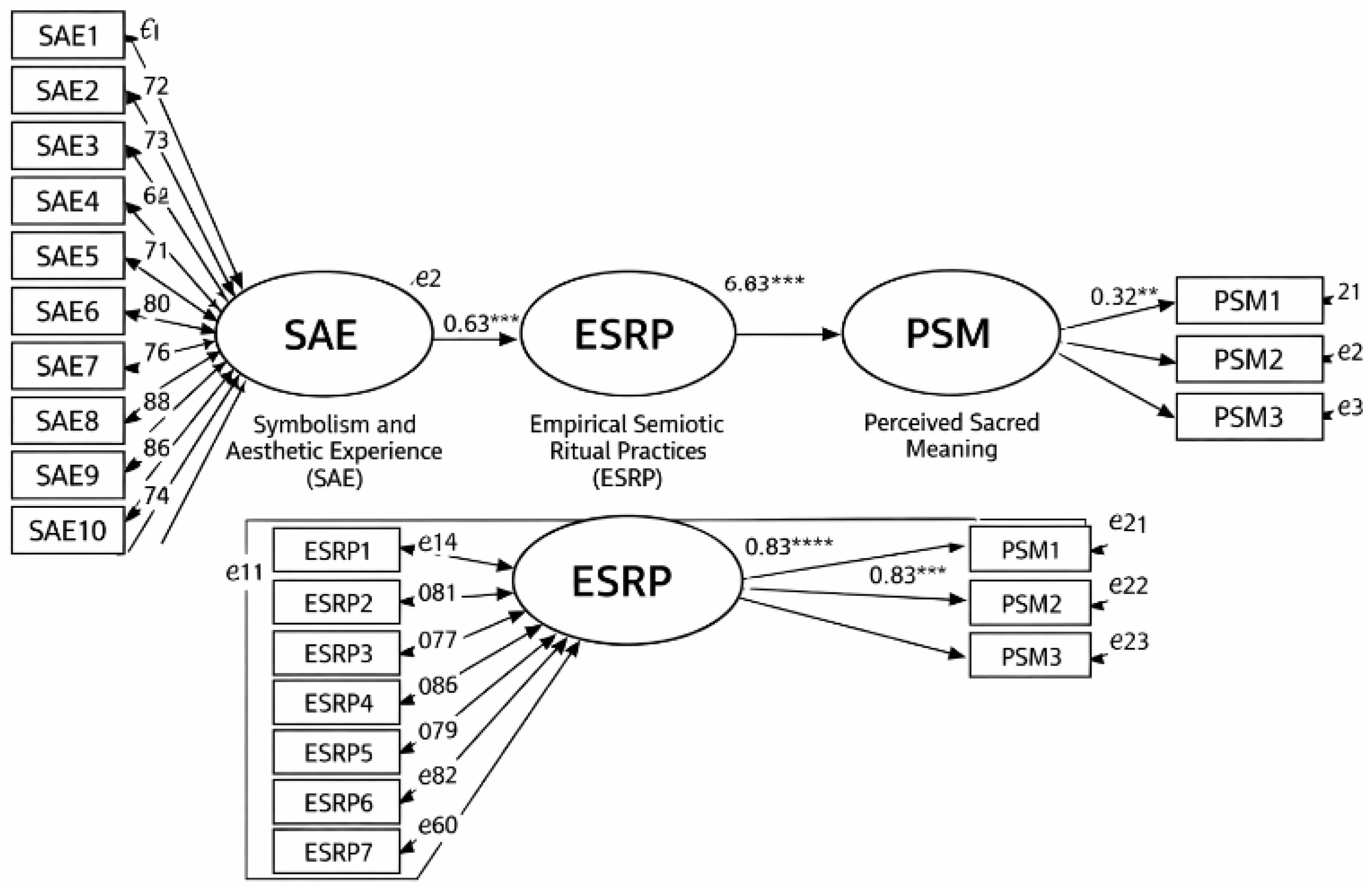
The confirmatory factor analysis (CFA) measurement model was constructed to examine the relationship between latent constructs and their observed indicators. As illustrated in
Figure 5, each construct, SAE, ESRP, and PSM, is represented as a latent variable measured by multiple observed items. All factor loadings are statistically significant and exceed the recommended threshold, indicating that the observed variables reliably reflect their respective constructs. The correlations among latent variables are moderate, supporting discriminant validity. Overall, the CFA results suggest that the measurement model shows an acceptable fit within this exploratory dataset and provides a preliminary basis for subsequent structural analysis.
5.2. Structural Model
After examining the measurement model, Structural Equation Modeling (SEM) was used as an exploratory model-building procedure to estimate the hypothesized relationships among SAE, ESRP, and PSM. The structural model shows an acceptable fit to the present dataset (χ
2/df = 2.45, CFI = 0.93, RMSEA = 0.068). Given the exploratory design and modest sample size, these results should be interpreted as indicating a plausible pattern of relationships rather than as definitive empirical support for the theoretical framework. The estimated path coefficients and significance levels are presented in
Table 6.
All hypothesized paths are statistically significant in this exploratory dataset. The strongest relationship is observed between ESRP and PSM, suggesting that reported embodied spatial–ritual perception may play an important role in perceived sacred meaning. The path from SAE to ESRP is also substantial, suggesting that symbolic and aesthetic perception is positively associated with how visitors report engaging with space through movement.
Importantly, SAE also shows a direct but weaker association with PSM, indicating that symbolic–aesthetic perception contributes to perceived sacred meaning but does not fully account for it within the exploratory model. Mediation analysis reveals that ESRP partially mediates the relationship between SAE and PSM, indicating that reported embodied spatial–ritual perception may function as a linking factor between symbolic–aesthetic perception and perceived sacred meaning.
5.3. Findings
The quantitative findings suggest a consistent but not uniform pattern of reported sacred and spatial experience. The following item-level interpretations are based on the full response distributions reported in
Appendix B. The strongest agreement appears in the PSM items. In particular, 88% of respondents agreed or strongly agreed that being in space evoked a sense of spiritual connection or inner peace (PSM3), while 87% agreed or strongly agreed that the place conveyed a sacred or special presence (PSM1) and expressed deep religious or spiritual meaning (PSM2). This indicates that perceived sacred meaning was the most consistently reported dimension of the visitor experience. Within SAE, the highest levels of agreement were associated with spatial layout, lighting, reverence, and symbolic details. SAE2, SAE4, SAE7, and SAE8 each received 85% combined agreement or strong agreement. This suggests that respondents were particularly responsive to the religious intentionality of the layout, the calm or sacred atmosphere created by lighting, the sense of reverence elicited by the building, and the symbolic character of architectural details. By contrast, other SAE items were only slightly lower, indicating that the responses were closely clustered rather than sharply differentiated.
Within ESRP, agreement was positive but somewhat less pronounced. Items concerning meaningful movement and spatial guidance generally received around 80–81% combined agreement, suggesting that many participants experienced the site as shaping movement or ritual-like progression. However, ESRP5 and ESRP6, which concern heightened bodily awareness and slow deliberate movement, showed relatively higher levels of disagreement. This suggests that embodied spatial experience was not universal across all participants and may vary according to participation type, religious orientation, crowd conditions, or individual familiarity with Buddhist ritual practice. Building on the qualitative content-analysis procedure described in
Section 3.2, the interview material helps clarify how participants articulated sacred atmosphere, symbolic recognition, spatial progression, sensory experience, and ritual-like conduct in their own words. These accounts do not serve as independent proof of behavioral change, but they provide contextual depth for interpreting the questionnaire patterns. Spatial progression, light, scale, verticality, and ritual seriousness also appeared repeatedly, but with slightly lower frequencies. This pattern is consistent with the quantitative results: perceived sacred meaning was the most consistently reported dimension, while embodied spatial experience was important but not universal across all participants. The main qualitative themes identified through the interview coding are summarized in
Table 7.
The interview material further illustrates these themes. One ritual-oriented pilgrim in the 46–60 age group described the approach to the Dagoba as a gradual transition from ordinary public space into a more reverential atmosphere, noting that the long path, increasing scale of the building, and visual focus on the Dagoba encouraged slower and more attentive movement. This account corresponds to the themes of spatial progression and ritual seriousness and helps explain why many respondents agreed that spatial design guided movement through the environment.
A general visitor in the 31–45 age group emphasized the sensory atmosphere created by scale and light. Although the participant did not visit primarily for devotional purposes, the height of the space, subdued lighting, and quiet atmosphere were described as producing a sense of respect and calmness. This supports the questionnaire pattern in which lighting atmosphere, reverence, and spiritual meaningfulness received high levels of agreement. Another pilgrim over 60 connected bodily conduct with sacred meaning, explaining that the relic-oriented space encouraged pausing, bowing, quietness, and more careful bodily movement. This account illustrates how spatial conditions may transform ordinary movement into a more attentive mode of ritual-like experience.
At the same time, the interviews also suggest that embodied spatial–ritual perception was not uniform across all participants. One tourism-oriented visitor in the 18–30 age group described the Dagoba primarily as a symbolic and impressive architectural landmark, while noting that the solemn atmosphere did not necessarily produce a strong sense of personal ritual involvement. This indicates that the Dagoba could be experienced as culturally or architecturally significant without necessarily generating devotional engagement.
The partial mediation result further suggests that while symbolic perception is directly associated with sacred meaning, this association may be strengthened through reported embodied spatial experience. This finding aligns with phenomenological theories emphasizing that meaning emerges through lived interaction rather than abstract cognition alone. The relatively lower direct association of SAE → PSM (β = 0.29) suggests that symbolic–aesthetic perception alone does not fully account for perceived sacred meaning within the exploratory model. The high overall PSM scores suggest that many respondents perceived the Dagoba as conveying a shared sense of sacred presence. The consistency of responses indicates that sacred meaning is not purely subjective but emerges from a structured interaction between architecture and human experience. This is consistent with the study’s view that religious architecture may operate as an integrated experiential system. The SEM results are consistent with the proposed SAE → ESRP → PSM model and provide exploratory quantitative support for the view that reported embodied spatial experience may mediate the relationship between symbolic–aesthetic perception and perceived sacred meaning. The findings contribute to broader discussions in religious studies and architectural theory by suggesting how contemporary sacred architecture may support perceived meaning-making through the coordination of symbolic form, spatial configuration, and sensory experience. These findings are further discussed below in relation to the spatial configuration, ritual setting, and sensory atmosphere of the Namaste Dagoba.
6. Discussion
6.1. Mechanisms of Empirical Semiotics in Sacred Space
In the context of contemporary sacred architecture, the study of the Namaste Dagoba at Famen Temple reveals how architectural forms mediate the production of religious meaning through symbolic perception, reported embodied experience, and sensory atmosphere. Traditional semiotic models of religious space often treat architecture as a static container of symbolic messages, where meaning is preordained and fixed within the built environment. However, the findings of this study support a more dynamic and processual understanding of architectural semiotics. The Namaste Dagoba, with its distinctive praying-hands geometry and axial spatial layout, does not merely represent Buddhist cosmology, but provides spatial and sensory conditions through which visitors may perceive sacred meaning. This shift from static representation to embodied semiosis is most evident in visitors’ reported experiences of movement, attention, reverence, and ritual-like awareness.
The former analysis of ritual semiotics is therefore repositioned here as a supplementary interpretation of spatial experience rather than as an independent behavioral results section.
Figure 6,
Figure 7 and
Figure 8 are retained as architectural and contextual illustrations, not as evidence of systematically tracked behavioral trajectories. They help clarify the spatial and sensory conditions through which visitors’ reported experiences of movement, pausing, reverence, and offering may have emerged.
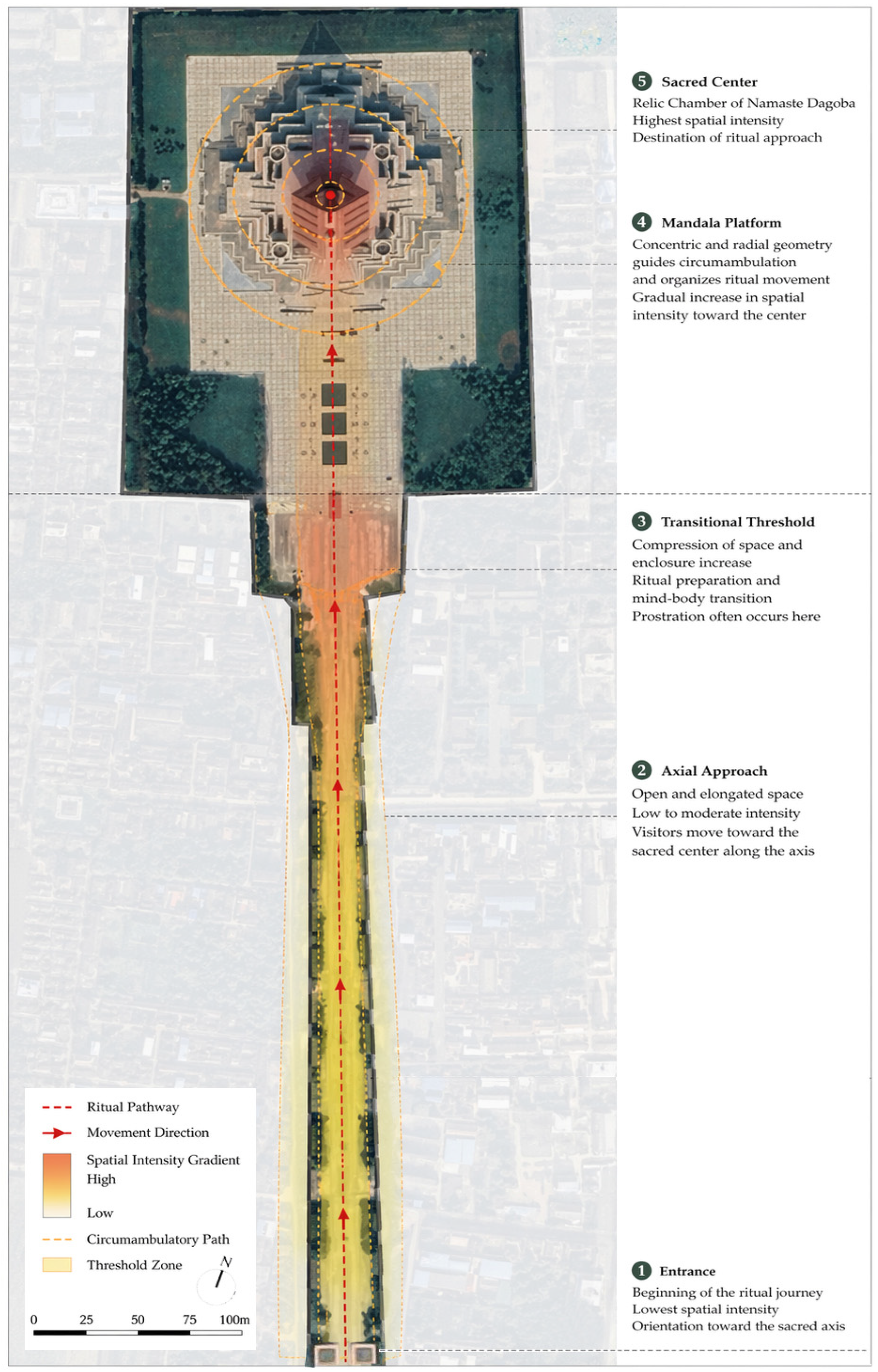
Figure 6 should be read as an interpretive diagram of spatial affordances rather than as a behavioral map of actual visitor trajectories. It identifies several spatial moments that structure the visitor’s possible experience: first, the external approach from the public arrival zone; second, the axial orientation toward the distant praying-hands form; third, the broad plaza where the body is exposed to scale, openness, and visual anticipation; fourth, the threshold zone where movement becomes more focused and attentive; fifth, the relic-oriented interior or ritual zone where pausing, offering, bowing, or circumambulation may occur.
This sequence helps explain why many respondents reported that movement through the site felt guided, gradual, or meaningful. The figure does not claim that all visitors followed the same path or experienced the same ritual intensity. Rather, it clarifies the architectural conditions under which movement could be perceived as ritual-like. The diagram therefore supports the questionnaire design by showing how the survey items on spatial guidance, bodily slowing, sequential journey, and ritual-like movement correspond to identifiable spatial conditions within the site.
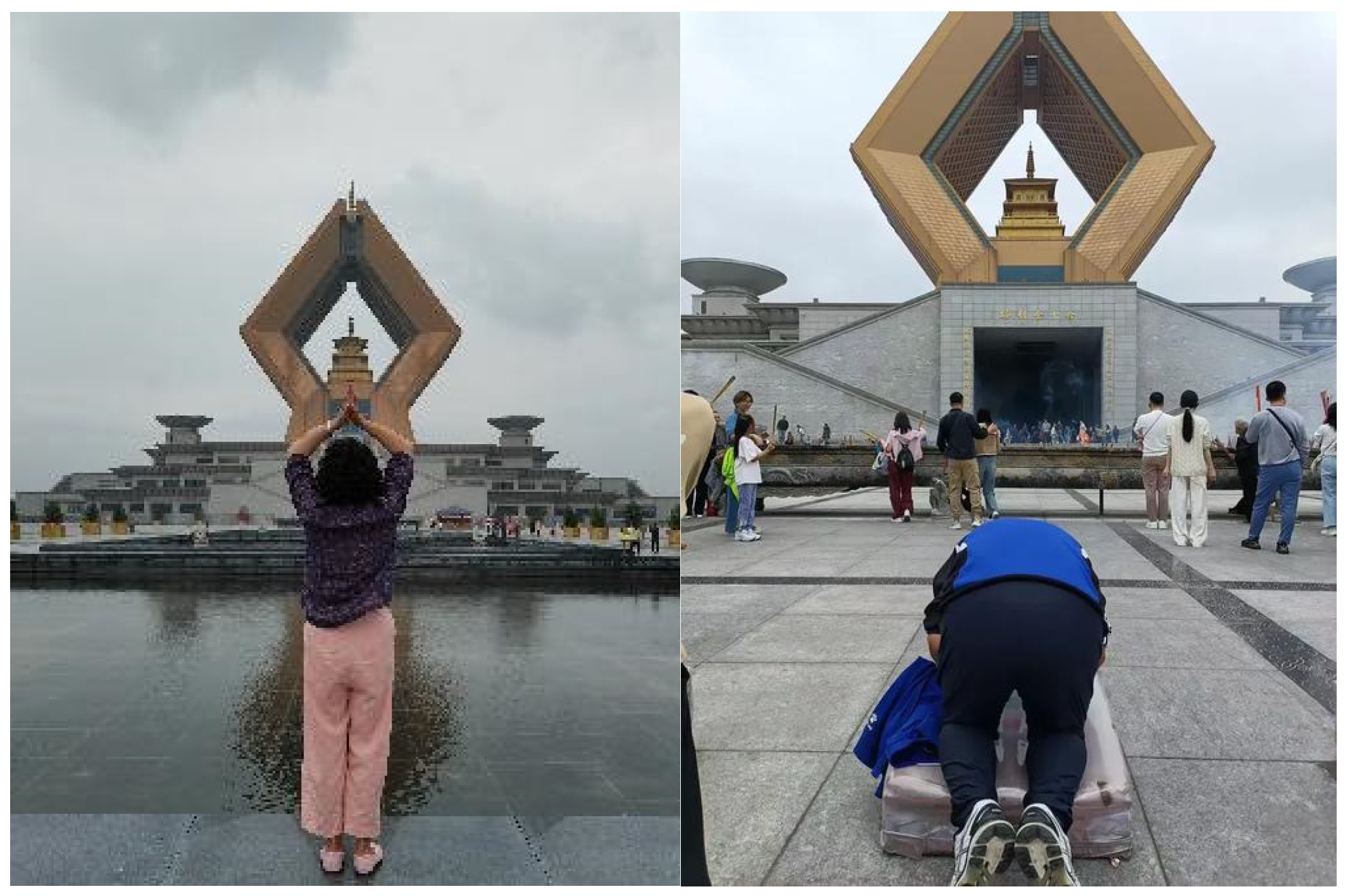
Figure 7 illustrates the relationship between ritual-related bodily posture and architectural threshold. Prostration is discussed here, not as systematically observed behavioral evidence, but as a practice reported by participants and contextualized by field notes. Such moments of bowing, pausing, or bodily lowering may intensify visitors’ awareness of transition from ordinary movement to a more attentive or reverential mode of experience. In this sense, architectural thresholds can be interpreted as spatial conditions that support ritual seriousness and embodied reflection.
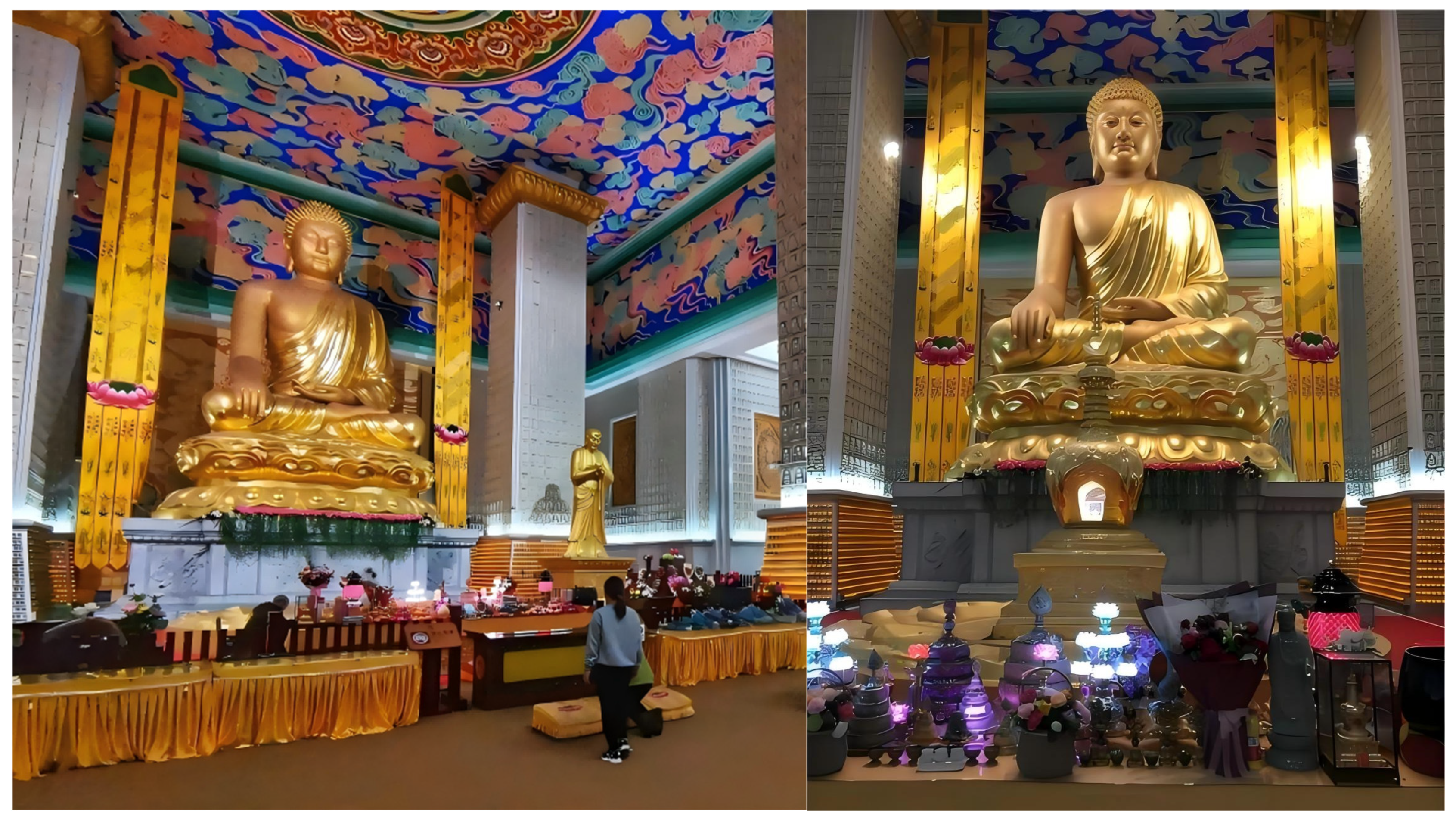
Figure 8 further contextualizes offering practices within the sensory atmosphere of the Dagoba. Incense, light, material surfaces, and spatial enclosure contribute to a multisensory environment in which sacred meaning is experienced through smell, vision, bodily proximity, and atmosphere. These sensory conditions help explain the strong questionnaire responses related to sacred ambiance, reverence, and inner peace, as well as interview accounts describing the space as calm, solemn, or spiritually meaningful.
Taken together, these spatial and visual materials support the study’s exploratory interpretation of the SAE → ESRP → PSM model. Symbolic and aesthetic perception may provide an initial interpretive basis; reported embodied spatial–ritual perception may then mediate how visitors connect architectural form with sacred meaning. Nevertheless, because this study does not systematically track individual trajectories or quantify observed behavior, claims about movement and ritual conduct remain interpretive. Future research could examine these dynamics more directly through systematic behavioral observation, video-based analysis, trajectory mapping, or mobile sensing methods. These interpretive observations collectively suggest that sacred space is not simply given by architectural form, but is perceived through the interaction between symbolic design, spatial sequence, sensory atmosphere, and embodied attention. Namaste Dagoba can therefore be understood as an experiential semiotic environment in which sacred meaning is approached through reported perception and spatial experience rather than through fixed symbolic recognition alone.
6.2. Reconfiguring Inherited Buddhist Spatial Experience
The findings of this study should not be interpreted as evidence that contemporary Buddhist architecture has simply moved from symbolic space to experiential space. Historical Chinese Buddhist temples were never merely visual or symbolic systems. Their axial layouts, courtyards, gates, halls, pagodas, incense spaces, ritual routes, and hierarchical thresholds also structured movement, bodily orientation, sensory transition, and devotional practice (
Prip-Møller 1937;
Lin 2014;
An 2019). In particular, studies of pagodas and circumambulatory corridors show that verticality, centrality, ascent, and circumambulation could operate as ritual–spatial mechanisms rather than as purely visual symbols (
Lin 2016;
An 2019). In this respect, traditional Buddhist architecture already operated through an integration of symbolic form and embodied spatial experience (
Miller 2015;
Kieschnick 2003).
The significance of the Namaste Dagoba lies instead in the way it recomposes these inherited mechanisms within a contemporary architectural and cultural setting. Its praying-hands form, monumental verticality, long axial approach, plaza sequence, controlled lighting, and relic-centered spaces do not abandon Buddhist spatial traditions. Rather, they abstract and intensify selected elements of those traditions—reverence, sacred centrality, procession, vertical aspiration, relic devotion, and bodily orientation through modern monumental vocabulary. The empirical findings support this more nuanced interpretation. Participants did not respond only to the building as an isolated symbolic object. They also described sacred meaning through movement, atmosphere, scale, light, pausing, offering, and bodily attentiveness. At the same time, these embodied responses were closely tied to recognizable Buddhist signs, especially the praying-hands form and relic-centered spatial organization. Sacred meaning therefore emerged neither from symbolic recognition alone nor from sensory experience alone, but from their interaction.
Namaste Dagoba may thus be understood as a post-traditional or recompositional sacred environment. The term “post-traditional” does not imply a rejection of tradition. It refers to a contemporary condition in which inherited Buddhist symbols and ritual–spatial logics are rearticulated through new scales, materials, circulation patterns, tourist-pilgrimage infrastructures, and empirical modes of reception. The case therefore suggests not a binary opposition between traditional symbolic temples and contemporary experiential architecture, but a shift in emphasis from the repetition of historically codified architectural forms toward the reconfiguration of Buddhist spatial meaning through symbolic abstraction, sensory atmosphere, and embodied visitor experience.
7. Conclusions
This exploratory pilot study suggests that sacred meaning in contemporary religious architecture is not solely embedded in symbolic form but is also associated with reported embodied spatial experience and sensory–aesthetic engagement. Using the Namaste Dagoba at Famen Temple as a case study, the research integrates architectural semiotics with exploratory questionnaire and interview methods to propose and examine a sequential model linking Symbolism and Aesthetic Experience (SAE), Embodied Spatial–Ritual Perception (ESRP), and Perceived Sacred Meaning (PSM). The findings indicate that while symbolic and aesthetic perception provides the initial interpretive framework, reported embodied spatial and ritual-like experience may contribute to the activation and intensification of perceived sacred meaning. The observed mediating effect of ESRP suggests that architecture may operate not as a static system of signs but as an experiential interface through which spatial configuration, mandala-based geometry, and gradients of spatial intensity are perceived as meaningful by visitors. In this sense, the Namaste Dagoba can be interpreted as an experiential semiotic environment in which cosmological symbolism is perceived through bodily and sensory engagement, allowing sacred meaning to be approached through interaction rather than solely through cultural or doctrinal knowledge.
The study contributes to two key respects. Methodologically, it illustrates the potential of combining exploratory structural equation modeling with interview-based qualitative analysis to examine both reported relationships and experiential depth in the study of religious space. Empirically, it suggests that the Namaste Dagoba represents one possible direction in contemporary Chinese Buddhist architecture, in which traditional cosmological principles, such as axiality, mandala geometry, and sacred centrality, are reinterpreted through spatial and sensory design. This case points to a possible reconfiguration of religious mediation in which symbol-centered representation and experience-centered interpretation are not opposed but mutually reinforced. The Namaste Dagoba suggests how contemporary Buddhist architecture may recombine inherited cosmological symbolism, ritual movement, sensory atmosphere, and visitor participation within a modern monumental setting. Despite its contributions, this study is subject to certain limitations. The analysis is based on a single case study, and although the Namaste Dagoba provides an illustrative example of contemporary experiential religious architecture, future research could extend the framework to comparative cases across different cultural and religious contexts to enhance generalizability. In addition, while the structural equation model identifies plausible associations among reported perceptions and experiences, it should not be treated as a confirmatory validation of causal relationships. Future research should integrate larger samples, systematic behavioral observation, longitudinal design, physiological measurement, or mobile tracking methods to examine the temporal dynamics and embodied intensity of ritual experience more directly.