1. Introduction
The rapid advancement of artificial intelligence (AI) is profoundly transforming contemporary education. The integration of algorithmic systems into teaching, assessment, and learning not only alters pedagogical practices but also reshapes the very understanding of human formation. Recent studies highlight that AI enables personalised learning, streamlines educational processes, and adapts content to individual needs (
Luckin et al. 2016;
Holmes et al. 2019;
UNESCO 2023). Consequently, education is increasingly reliant on digital infrastructure that optimises performance and access to information.
This technological shift prompts questions that go beyond pedagogy. The central issue is not only the efficiency of digital tools but also how they reshape relationships among humans, knowledge, interiority, and truth.
Zuboff (
2019, p. 216) warns that algorithmic systems create “instrumentarian power” that shapes behaviour and cognition through unseen digital infrastructures.
In education, this influence leads to the gradual externalisation of interiority. Functions such as memory, reflection, discernment, and synthesis are increasingly delegated to algorithmic systems (
Kasneci et al. 2023;
Dwivedi et al. 2023;
Stiegler 2010).
Carr (
2010, p. 115) observes that digital environments promote “rapid consumption of information” and diminish the capacity for deep reflection and contemplation. As a result, education risks becoming focused exclusively on cognitive performance and adaptation to technological environments (
Zawacki-Richter et al. 2019).
In contrast to this technological paradigm, the Christian theological tradition offers a different understanding of human formation. In Augustine of Hippo’s thought, true knowledge is attained not by accumulating external information but through inner illumination and spiritual transformation. In his
Confessions, Augustine writes of God: “You were more inward to me than my most inward part” (interior intimo meo) (
Augustine of Hippo 1991, p. 120). This statement expresses a fundamental idea of Christian anthropology: truth is inseparable from interiority and the divine presence in the human person.
This perspective is further developed in contemporary theology by Dumitru Stăniloae, John Zizioulas, and Christos Yannaras.
Stăniloae (
1998, p. 23) states that “the human person can only exist in communion,” emphasising that authentic formation surpasses the functional dimension and requires relational participation and openness toward God. Likewise,
Zizioulas (
1985, p. 18) asserts that “being is communion,” meaning that humans cannot be reduced to cognitive or performative abilities without losing their fundamental ontological dimension.
The tension between algorithmic externalisation and spiritual interiority is a central challenge in contemporary education. Artificial intelligence shapes human formation through efficiency, prediction, and optimisation, while theological anthropology maintains that true formation requires communion, inner reflection, and ontological transformation.
Heidegger (
1977, p. 12) cautions that technology is “a mode of revealing” reality, influencing how humans understand themselves and the world. In education, this means technology not only alters learning methods but also redefines what it means to be human.
Han (
2022, p. 34) similarly argues that digital society creates a “crisis of contemplation,” leading to the loss of silence, interiorization, and authentic presence. If education relies solely on digital acceleration and algorithmic mediation, it risks producing individuals who are technologically efficient but spiritually fragmented.
In this context, the article examines the relationship between artificial intelligence and the theological concept of divine indwelling from a theological anthropology perspective. It argues that uncritical integration of AI in education risks displacing interiority by transferring formative processes to external algorithmic systems. In contrast, Christian theological tradition views education as inner transformation directed toward communion and transcendence.
The research employs an interdisciplinary approach, integrating theology, the philosophy of technology, and contemporary studies of artificial intelligence in education. The analysis draws on key authors in digital education (Holmes, Selwyn, UNESCO, Carr), philosophy of technology (Heidegger, Ellul, Byung-Chul Han), and Christian theological anthropology (Augustine, Maximus the Confessor, Gregory Palamas, Dumitru Stăniloae, John Zizioulas, and Christos Yannaras).
The article’s main contribution is the Integrative Theological Formation Model (ITFM), which critically articulates three dimensions of human formation: functional, reflexive, and contemplative–relational. This model advances the current literature by offering a systematic theological alternative to prevailing techno-centric paradigms, highlighting the importance of spiritual interiority and ontological transformation. The ITFM thus promotes responsible integration of artificial intelligence in education while preserving interiority and openness to transcendence. By synthesising patristic anthropology and contemporary philosophy of technology, the article’s original contribution lies in reframing education as a process of inner transformation rather than merely technical adaptation.
Selwyn (
2022, p. 38) notes that educational technology is not neutral, as it reconfigures the conditions in which knowledge is produced and experienced.
Ultimately, the article contends that the key issue in contemporary education is not whether to use artificial intelligence, but whether its use enables humans to remain capable of reflection, communion, and spiritual transformation.
2. Materials and Methods
This article adopts a qualitative, theoretical research methodology, focused on interdisciplinary conceptual analysis. The approach integrates systematic theology, philosophy of technology, and contemporary educational theory, and does not involve empirical data collection or experimental procedures. Instead, the research relies on the synthesis and critical evaluation of the existing literature to develop a new, original conceptual model—the Integrative Theological Formation Model (ITFM)—that addresses the relationship among artificial intelligence, education, and theological anthropology.
The research method is purely theoretical and includes two main components: (1) the systematic analysis and integration of relevant theories and theological concepts from established sources; and (2) the creation of a specific conceptual model that articulates the intersections among AI, pedagogy, and theological anthropology.
The choice of this method is justified by the article’s aim: to articulate a new theoretical framework and to offer a critical alternative to prevailing techno-centric paradigms. This is consistent with research in educational technology and theology that emphasises the value of conceptual model-building in fields where empirical investigation is limited or secondary (
Biesta 2015). The study engages with current scholarship showing that AI-based systems modify not only pedagogical tools but also the structure of the learning process, the relationship between teacher and student, and the understanding of knowledge itself (
Luckin et al. 2016;
Holmes et al. 2019;
UNESCO 2023).
In summary, the methodology consists of a theoretical synthesis and the critical construction of a new model, rather than empirical testing. This approach is commonly used in the humanities and in the philosophy of education when the research focus is on articulating foundational concepts and frameworks.
However, technological optimism is accompanied by significant criticism.
Selwyn (
2022, p. 38) warns that educational technology is not neutral, as it “reconfigures the relationship between knowledge, power, and subjectivity.”
Biesta (
2015, p. 76) criticises the reduction of education to performance and measurement, stating that “the fundamental question of education is not efficiency, but what constitutes a good human existence.”
Carr (
2010) observes that digital environments affect the capacity for deep reflection, favouring fragmented attention and rapid consumption of information.
Turkle (
2011, p. 19) argues that digital society produces a culture of “connected solitude,” where authentic relationships are replaced by technologically mediated interactions.
This critique becomes even more relevant in the context of generative artificial intelligence.
Kasneci et al. (
2023) show that the use of advanced language models can lead to the externalisation of fundamental cognitive processes such as critical analysis, synthesis, and intellectual reflection.
Stiegler (
2010, p. 35) discusses the “proletarianization of the spirit,” in which technology transfers functions of memory and thought to external systems. Thus, education risks becoming a process dominated by algorithmic optimisation and functional adaptation, to the detriment of interiority and personal reflection.
In contrast to this technological paradigm, Christian theological anthropology develops a vision of education as a process of inner transformation and participation in divine life. In the patristic tradition, knowledge is not separate from the spiritual becoming of the person. For the Church Fathers, true knowledge is not purely intellectual, but existential and participatory (
Lossky 1976;
Yannaras 1984).
Augustine of Hippo is one of the fundamental voices of this perspective. In the Confessions, he states of God: “You were more inward to me than my most inward part” (interior intimo meo) (
Augustine of Hippo 1991, p. 120), suggesting that truth is not discovered exclusively through exteriority, but by turning toward one’s spiritual interiority. In De Magistro, Augustine affirms that “the only true Teacher is Christ,” since no human can communicate the truth without the inner illumination produced by God (
Augustine of Hippo 1991, p. 43). Thus, authentic education involves more than the transfer of information; it entails the inner transformation of the person.
This perspective is deepened in the Eastern tradition. Gregory of Nyssa asserts that humans are beings “in perpetual becoming toward God” (
Gregory of Nyssa 1978, p. 101), meaning that human formation cannot be reduced to functional competencies. Maximus the Confessor maintains that humans are called to unite the created world with God through love and communion (
Maximus the Confessor 1985, p. 145). For Maximus, true knowledge is inseparable from deification (theosis), and humans are fulfilled not by the accumulation of information but by participation in the divine life.
Likewise, Gregory Palamas develops the idea of participatory knowledge through the theology of the uncreated energies (
Gregory Palamas 1983, p. 67). For Palamas, God cannot be reduced to a concept or piece of information; rather, God is known through experience and communion. This perspective stands in radical contrast to the current technological paradigm, in which knowledge is often reduced to information processing and management.
The relational dimension of the person is further developed in contemporary theology by Dumitru Stăniloae, John Zizioulas, and Christos Yannaras.
Stăniloae (
1998, p. 311) affirms that “the human person can only exist in communion,” emphasising that humanity is defined by its living relationship with God and others. Similarly,
Zizioulas (
1985, p. 18) asserts that “being is communion,” meaning that authentic human existence cannot be reduced to individual autonomy or functional performance.
Yannaras (
1984, p. 48) maintains that “true knowledge is participation,” not mere intellectual accumulation. These theological perspectives profoundly challenge the digital culture’s tendency to transform humans into optimizable cognitive systems.
The critique of technology is also developed in contemporary philosophy.
Heidegger (
1977, p. 12) warns that modern technology transforms reality into a mere “standing-reserve” (Bestand), reducing humans and the world to criteria of efficiency and utility. He states that “the essence of technology is nothing technological,” suggesting that technology influences the very way humans perceive existence.
Ellul (
1964, p. 22) argues that technological society develops an autonomy of technique, in which efficiency becomes the supreme criterion of social and cultural organisation. Likewise,
Han (
2022, p. 34) claims that digital society produces the “disappearance of contemplation” as contemporary humans are unable to dwell in silence or engage in inner reflection.
These reflections converge on a fundamental problem: the crisis of interiority. If education becomes exclusively dependent on algorithmic systems and digital acceleration, there is a risk of a functionalist anthropology in which humans are defined by performance, adaptability, and informational processing (
Han 2022;
Carr 2010). In contrast, the theological tradition insists that humans are oriented toward transcendence, communion, and spiritual transformation through divine indwelling and theosis.
In this context, the relationship between artificial intelligence and education cannot be analysed solely at the technical or pedagogical levels. The issue is profoundly anthropological and theological. Two distinct models of human formation are in tension with one another. The first model, specific to algorithmic culture, understands education as cognitive optimisation and functional adaptation (
Selwyn 2022;
Zuboff 2019). The second model, specific to the Christian theological tradition, understands education as a process of interiorization, communion, and participation in divine life (
Zizioulas 1985;
Yannaras 1984).
Thus, the tension between algorithmic conditioning and divine indwelling is among the most important challenges of contemporary education (
Han 2022;
Zuboff 2019). Within this tension lies not only the future of pedagogy but also the way in which contemporary humans can preserve their capacity for reflection, interiority, and openness to transcendence.
3. Results
The analysis of the relationship between algorithmic conditioning and divine indwelling highlights a profound anthropological and spiritual crisis in contemporary education. The issue does not lie solely in the integration of artificial intelligence in educational processes, but in the subtle mutation of how human beings and the purpose of their formation are understood. Technological culture today tends to redefine the person in terms of performance, efficiency, and cognitive optimisation, while the Christian theological tradition understands humans as beings oriented toward communion, interiority, and transcendence.
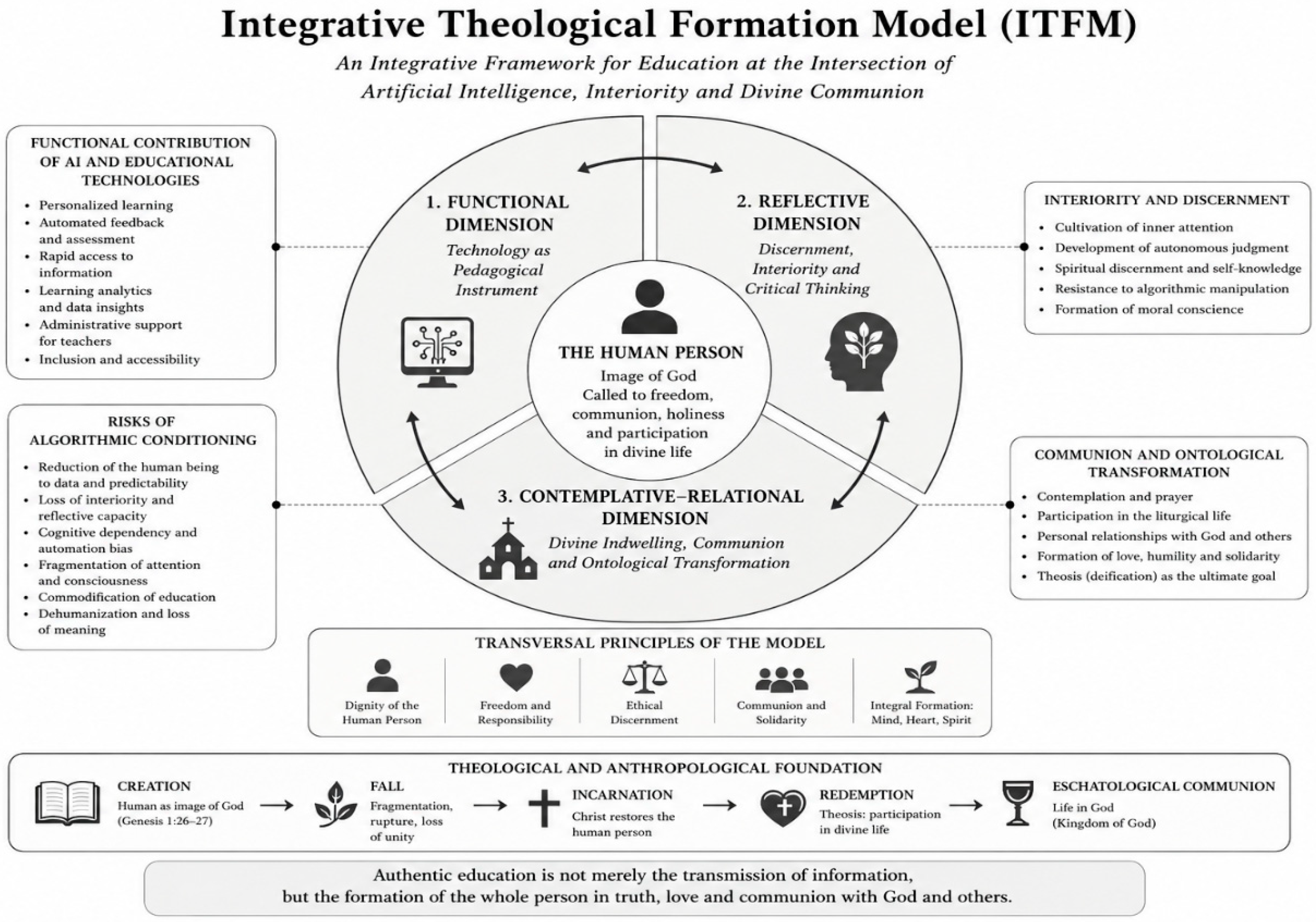
In this context, it is necessary to formulate an educational model that integrates technology without absolutizing algorithmic logic. The model proposed in this study—the Integrative Theological Formation Model (ITFM)—seeks to critically articulate the relationship between artificial intelligence and theological anthropology, starting from the idea that authentic education must cultivate not only cognitive competencies but also interiority, discernment, and communion.
Figure 1 illustrates the Integrative Theological Formation Model (ITFM), highlighting the relationship between artificial intelligence, interiority, discernment, and contemplative-relational formation within Christian theological anthropology.
Based on these perspectives, the proposed model is structured on three complementary dimensions: functional, reflexive, and contemplative-relational.
The foundation of this model lies in both contemporary critiques of technological culture and the Church’s patristic tradition.
Ellul (
1964, p. 22) warned that technological society tends to transform efficiency into an absolute value, while
Heidegger (
1977, p. 12) argued that modern technology risks reducing humans and the world to a mere “standing reserve” (Bestand). Similarly,
Postman (
1993, p. 48) maintains that technology not only changes the tools of culture but “redefines what culture considers true and valuable.” These observations are decisive for education, as algorithms now mediate not only information but also how humans perceive reality and relate to themselves.
In opposition to this functionalist anthropology, the theological tradition insists that humans are created for participation and communion. Irenaeus of Lyon states that “the glory of God is the living human” (
Irenaeus of Lyons 1992, p. 412), suggesting that true human fulfilment lies in participation in divine life, not in technical efficiency. Likewise, Athanasius the Great affirms in On the Incarnation: “God became man so that man might become god” (
Athanasius of Alexandria 2011, p. 93), thereby laying the foundation for the Christian anthropology of deification (theosis).
3.1. The Integrative Theological Formation Model (ITFM): Dimensions Functional Dimension: Technology as Instrument and the Limits of Algorithmic Optimisation
The first dimension concerns the functional use of artificial intelligence in education. At this level, AI can facilitate personalised learning, content adaptation, automated assessment, rapid access to information, and the development of digital competencies.
Luckin et al. (
2016, p. 10) argue that artificial intelligence can “expand the teacher’s capacity to respond to individual differences among students,” while
Holmes et al. (
2019, p. 24) suggest that AI has the potential to transform education into a more flexible and accessible process.
UNESCO (
2023, p. 7) emphasises that emerging technologies must be integrated in a “human-centred” manner to avoid excessive dependence on automation.
However, this functional dimension becomes problematic when technological efficiency is absolutized.
Biesta (
2015, p. 76) warns that contemporary education is dominated by “the language of measurement and performance,” thereby marginalising questions about the meaning and purpose of human existence.
Critiques of this functionalist reduction appear as early as the patristic tradition. St. Basil the Great affirms in his Address to Young Men on Greek Literature that education must be oriented toward the cultivation of virtue and moral discernment, not exclusively toward practical utility (
Basil the Great 2014, p. 33). For St. Basil, authentic knowledge is inseparable from character formation and a person’s spiritual orientation. Likewise, Clement of Alexandria argues in the Paedagogus that true education aims at “the healing of the soul” and leading humans toward likeness with God (
Clement of Alexandria 1885, p. 74). Thus, the functional dimension of education is legitimate only insofar as it remains subordinate to the integral development of the person.
3.2. Reflexive Dimension: Discernment and Recovery of Interiority
The second dimension concerns the recovery of critical reflection and interiority in a context dominated by digital acceleration and information overstimulation.
Carr (
2010, p. 115) observes that digital technologies fragment attention and reduce the human capacity for deep reflection.
Turkle (
2011, p. 19) states that digital society produces individuals “alone together,” permanently technologically connected yet incapable of authentic presence and relationship.
Stiegler (
2010, p. 35) speaks of an “externalisation of memory and thought,” while
Han (
2022, p. 34) claims that the performance society destroys the capacity for contemplation and interior silence.
This reflexive dimension presupposes: the cultivation of discernment; critical reflection on technology; the recovery of silence and attention; the development of intellectual autonomy; and resistance to algorithmic conditioning.
Patristic sources offer a profound anthropology of attention. Evagrius Ponticus develops the concept of nepsis—inner vigilance and attention to the movements of thoughts (
Evagrius Ponticus 1981, p. 41). He maintains that humans must distinguish between thoughts that lead toward God and those that fragment the soul. St. Isaac the Syrian affirms: “Enter into the chamber of your heart, and you will see the heavenly chamber” (
Isaac the Syrian 1984, p. 212), suggesting that true knowledge comes not from outward expansion but from descent into interiority. Likewise, John Climacus maintains that “silence is the mother of prayer and contemplation” (
John Climacus 1982, p. 21), underlining that spiritual formation requires stillness and deep reflection.
3.3. Contemplative–Relational Dimension: Divine Indwelling and the Transfiguration of the Person
The deepest dimension of the model is the contemplative–relational, where formation surpasses both technological functionality and intellectual reflection, orienting itself toward communion and ontological transformation.
In the patristic tradition, humans are defined by their capacity for participation in the life of God. St. Gregory of Nyssa asserts that humans are beings in a perpetual “infinite advance toward God” (epektasis) (
Gregory of Nyssa 1978, p. 98). Thus, human existence cannot be reduced to functionality or efficiency, as humans are ontologically oriented toward transcendence.
Maximus the Confessor states that humans are called to unite all creation in the love of God (
Maximus the Confessor 1985, p. 137). For Maximus, sin produces fragmentation and dispersion, while communion with God restores the unity of the person. This idea becomes fundamental in a digital culture characterised by dispersed attention and the hyperfragmentation of experience.
St. Gregory Palamas argues that true knowledge is participatory and contemplative (
Gregory Palamas 1983, p. 67). God is not known solely through rationalisation, but through experience and communion. In this sense, authentic education cannot be reduced to information processing, as humans are called to existential participation and spiritual transformation.
In contemporary theology, Stăniloae maintains that “the person is fulfilled only in love and communion” (
Stăniloae 1998, p. 23). Zizioulas asserts that “being is communion” (
Zizioulas 1985, p. 18), while Yannaras affirms that “true knowledge is participation in the existence of the other” (
Yannaras 1984, p. 48). These perspectives radically challenge the technological anthropology of performance and efficiency.
The contemplative–relational dimension presupposes the development of contemplation, prayer, spiritual reflection, communion, liturgical experience, authentic personal relationships, and interiority capable of transcendence.
Thus, the Integrative Theological Formation Model proposes a critical articulation of the relationship between technology and theological anthropology. The model does not reject artificial intelligence but states that it must be integrated into a vision of the human person grounded in interiority, communion, and participation in divine life.
The fundamental idea of the model is that artificial intelligence can support educational processes but cannot generate what constitutes the deep core of human existence: contemplation, love, communion, and the ontological transformation of the person.
Table 1 provides a synthetic overview of the Integrative Theological Formation Model (ITFM), emphasising the interplay between the functional, reflexive, contemplative–relational, and ontological dimensions of human formation in the context of artificial intelligence. Each dimension is associated with specific educational roles and formative practices, as well as inherent risks that arise when technology is not critically integrated. The functional dimension highlights the value of technology as a tool for optimisation and efficiency (
Luckin et al. 2016, p. 10;
Holmes et al. 2019, p. 24), but also warns of the dangers of reductionism and cognitive dependence (
Biesta 2015, p. 76;
Selwyn 2022, p. 38). The reflexive dimension underscores the need for discernment and inner attention (
Carr 2010, p. 115;
Turkle 2011, p. 19;
Han 2022, p. 44), fostering practices such as critical reflection and slow reading to counteract the fragmentation of attention. The contemplative–relational dimension, which cannot be produced by algorithms, centres on communion, theosis, and divine indwelling (
Yannaras 1984, p. 48;
Zizioulas 1985, p. 18;
Stăniloae 1998, p. 23), relying on formative practices such as prayer, silence, and community life to preserve interiority. Finally, the ontological dimension reminds us that authentic human formation concerns spiritual transformation and integral development, which cannot be reduced to performance or adaptability.
4. Discussion
The analysis of the relationship between artificial intelligence, education, and theological anthropology highlights that the development of algorithmic technologies does not merely bring about pedagogical transformations but fundamentally alters the conditions under which contemporary humans conceive knowledge, interiority, and their own existence. In this context, the tension between algorithmic conditioning and divine indwelling expresses the confrontation between two distinct anthropological paradigms: the functional–performative paradigm and the paradigm of ontological communion (
Zizioulas 1985, p. 18).
One of the main findings of this research is that artificial intelligence cannot be considered a neutral instrument in the educational process.
Heidegger (
1977, p. 12) warned that technology represents a mode of revealing reality, while
Ellul (
1964, p. 22) argued that technique fosters autonomy and the absolutisation of efficiency. Applied to education, these perspectives suggest that algorithmic systems influence not only pedagogical methods but also how human beings perceive themselves and understand the meaning of human formation.
Similarly,
Postman (
1993, p. 48) stated that every technology produces epistemological and cultural transformations, redefining what a society considers to be truth, authority, and legitimate knowledge. In the case of artificial intelligence, this mutation becomes evident through the progressive transfer of cognitive functions to external algorithmic infrastructures.
This tendency is also noted by
Stiegler (
2010, p. 35), who speaks of a “proletarianization of the spirit” resulting from the transfer of cognitive functions to technological systems. In the same vein,
Han (
2022, p. 44) argues that contemporary society is developing a culture of hyper-attention and continuous performance, resulting in the loss of contemplation and interiorization. Han states that “the performance society produces spiritual exhaustion and the loss of existential depth.” These reflections are highly relevant for education, as the formative process risks being reduced to cognitive efficiency and intellectual productivity.
Opposed to this technological paradigm, the Christian theological tradition develops an anthropology of interiority and communion. For the Church Fathers, humans are not defined by performance or functionality but by their capacity to participate in the life of God. Augustine affirms that “truth dwells in the inward person” (
Augustine of Hippo 1991, p. 120), suggesting that true knowledge cannot be separated from interiorization and spiritual transformation. See also
Maximus the Confessor (
1985, p. 137),
Gregory Palamas (
1983, p. 67),
Stăniloae (
1998, p. 23),
Zizioulas (
1985, p. 18),
Yannaras (
1984, p. 48).
Maximus the Confessor understands humans as beings called to reunify all creation in God, while Gregory Palamas asserts that true knowledge is participatory and contemplative. These perspectives radically challenge the reduction of education to information processing and technical efficiency. Similarly, Dumitru Stăniloae insists that the person is fulfilled only in love and communion, while John Zizioulas maintains that “being is communion.” Thus, theological anthropology understands human formation as a process of transfiguration rather than merely functional adaptation.
From this perspective, the central issue of contemporary education is not simply the integration of artificial intelligence, but the way it influences the structure of human interiority (
Klaiber 2024, p. 228). If education becomes exclusively dependent on algorithmic mediation, there is a risk of developing an anthropology of exteriority, in which humans lose their capacity for inner reflection and spiritual discernment (
Han 2022, p. 44;
Carr 2010, p. 115).
The conceptual model proposed in this study—the Integrative Theological Formation Model (ITFM)—seeks to address this crisis through an integrative perspective on human formation. The model recognises the functional value of artificial intelligence but insists that the technological dimension must be subordinated to an anthropology grounded in interiority, communion, and transcendence.
A significant aspect of this model is its refusal to accept a simplistic opposition between technology and theology (
Selwyn 2022, p. 38). The study does not propose a radical rejection of artificial intelligence, because technology can support certain dimensions of the educational process. The problem arises when technology implicitly assumes the role of the ultimate paradigm of human formation and transforms the person into an optimizable system.
In this context, theological reflection becomes essential for recovering an anthropology capable of protecting the dignity of the person and the spiritual dimension of human existence. The Church Fathers understand humans as beings created for communion with God and deification, and this perspective provides a fundamental critical criterion for evaluating contemporary algorithmic culture.
The proposed model also opens important directions for future research. It is necessary to deepen the relationship between artificial intelligence and interiority; between algorithmization and personal freedom; between technology and spiritual discernment; between digital culture and liturgical experience; and between automation and the anthropology of communion. Future empirical research should investigate the impact of artificial intelligence on students’ attention, reflection, and spiritual life. A dialogue among theology, the philosophy of technology, and the educational sciences thus becomes indispensable for understanding contemporary cultural transformations.
Clement of Alexandria, in the Paedagogus, affirms that the true educator is the one who leads the soul to healing and likeness with God (
Clement of Alexandria 1885, p. 74). St. John Chrysostom considers education to be a work of the heart and character formation, not only of the intellect (
John Chrysostom 1983, p. 42). He asserts that “nothing is more important than the formation of the soul.” Similarly, Basil the Great maintains that the teacher must cultivate discernment and virtue before acquiring knowledge (
Basil the Great 2014, p. 33).
These perspectives radically contrast with the contemporary tendency to transform education into an automated process oriented exclusively towards performance. In the proposed model, the educator remains a mediator of discernment, reflection, and personal relationships. Artificial intelligence can assist the educational process, but it cannot substitute the formative presence of the person.
Another fundamental implication concerns the recovery of interiority in the context of digital culture.
Han (
2022, p. 44) asserts that contemporary society produces “the exhaustion of contemplative capacity,” as humans are perpetually exposed to informational acceleration and the logic of performance. Similarly,
Carr (
2010, p. 115) notes that digital technologies diminish the ability for deep reflection and favour the fragmentation of attention.
In contrast, the Church’s ascetic tradition develops a true pedagogy of interiority. Isaac the Syrian states: “Enter into the chamber of your heart and you will see the heavenly chamber” (
Isaac the Syrian 1984, p. 212). For Isaac, true knowledge begins by descending into one’s spiritual interiority. Evagrius Ponticus insists on vigilance (nepsis) and inner attention as the foundation of authentic discernment (
Evagrius Ponticus 1981, p. 41). John Climacus maintains that “silence is the mother of contemplation” (
John Climacus 1982, p. 21), suggesting that spiritual formation presupposes the ability to dwell in stillness and reflection.
These perspectives have concrete pedagogical implications. Contemporary education must create spaces that resist digital fragmentation and algorithmic overstimulation. In this sense, the proposed model suggests introducing formative practices such as: critical reflection on the use of AI; slow reading; deep seminar dialogue; moments of silence and reflection; contemplative pedagogy; reflexive journaling; community and relational practices; recovery of liturgical and symbolic experience.
These practices do not aim to reject technology, but to restore the balance between exteriority and interiority in the formative process.
Theologically, the fundamental problem of contemporary education concerns the ultimate goal of human formation. If the technological paradigm defines success through performance and adaptability, Christian anthropology understands education as a path toward communion and deification. St. Athanasius the Great states that humans are called to participate in the life of God (
Athanasius of Alexandria 2011, p. 93), while Gregory of Nyssa speaks of human existence as an infinite movement toward transcendence (epektasis) (
Gregory of Nyssa 1978, p. 98). Dumitru Stăniloae develops this perspective by affirming that humans are fulfilled only in love and communion (
Stăniloae 1998, p. 23). Similarly, Zizioulas asserts that “being is communion” (
Zizioulas 1985, p. 18), suggesting that true formation cannot exist outside the living relationship between persons. Yannaras completes this anthropology by asserting that “true knowledge is participation,” not simply intellectual accumulation (
Yannaras 1984, p. 48).
Therefore, the major implication of this study is the need for an anthropological reconfiguration of contemporary education. Artificial intelligence must be integrated within a framework that preserves the centrality of the person and the spiritual dimension of human existence. Without this perspective, education risks producing technologically efficient individuals who are internally fragmented and incapable of contemplation, communion, and transcendence.
In this sense, the fundamental stake of contemporary education is not only adaptation to new technologies, but the human capacity to preserve interiority and its spiritual vocation in a culture dominated by algorithmic exteriority.
Limitations
This article is conceptual and does not include empirical research or primary data collection. Its limitations stem from the exclusively theoretical approach: while it synthesises major trends in theology, philosophy of technology, and educational studies (
Biesta 2015;
Han 2022), it does not test the proposed model in educational practice. Further, although the selection of sources is interdisciplinary, it is not exhaustive and focuses on key works and major trends. Future work could address these limitations by conducting empirical studies on the impact of AI on spiritual formation or by expanding the analysis to additional cultural or religious contexts.
5. Conclusions
This study aimed to analyse the relationship among artificial intelligence, education, and theological anthropology, beginning with the tension between algorithmic conditioning and divine indwelling. The research has shown that the integration of AI in education is not simply a technological transformation but a profound shift in how contemporary humans understand knowledge, interiority, and the meaning of human formation.
The analysis of the contemporary literature on digital education and philosophy of technology reveals that artificial intelligence supports processes of cognitive optimisation, automation, and the externalisation of functions traditionally associated with human reflection and discernment. Authors such as
Stiegler (
2010, p. 35),
Zuboff (
2019, p. 216), and
Han (
2022, p. 44) emphasise that algorithmic mediation produces significant transformations in attention, memory, and personal autonomy (At the same time, critical voices highlight the risks of excessive dependence on algorithmic infrastructures, which can result in the fragmentation of interiority, the weakening of autonomy, and the reduction of the formative process to measurable performance.
In contrast, the Christian theological tradition develops an anthropology of interiority and communion. The Church Fathers—from Augustine and Athanasius the Great to Maximus the Confessor and Gregory Palamas—understand human formation as participation in divine life and ontological transformation (
Augustine of Hippo 1991, p. 120;
Athanasius of Alexandria 2011, p. 93;
Maximus the Confessor 1985, p. 137;
Gregory Palamas 1983, p. 67). For them, true education cannot be reduced to technical efficiency or informational processing, as humans are created for communion and transcendence (
Zizioulas 1985, p. 18;
Yannaras 1984, p. 48). Education, in this sense, is not only the acquisition of skills, but an existential path towards becoming united with God and in communion with other peoples.
On the basis of this tension, the article has proposed the Integrative Theological Formation Model (ITFM), a conceptual model structured around three complementary dimensions: the functional, the reflexive, and the contemplative–relational. The model emphasises that artificial intelligence can support educational processes at the functional level—by optimising access to information, personalising learning, and automating evaluation—but cannot generate interiority, communion, contemplation, or ontological transformation.
A key contribution of the model is the articulation of specific formative practices that can resist the reductionist tendencies of algorithmic culture: critical reflection on the use of technology, slow reading, seminar dialogue, silence and contemplation, community life, and liturgical and symbolic experience (
Han 2022, p. 44;
Turkle 2011, p. 19). These practices do not reject technology, but seek to restore the balance between exteriority and interiority, and to preserve the spiritual openness of the human person.
Thus, the fundamental issue of contemporary education is not whether artificial intelligence should be used, but whether humans can remain contemplative beings in a culture dominated by algorithmic exteriorization and permanent performance. The answer proposed by this study is that only by recovering an anthropology of interiority and communion can education fulfil its vocation to form authentic persons, capable of love, discernment, and openness to God.
Ultimately, the future of education depends on the integration of technology within a framework that preserves the centrality of the person, the value of interiority, and the orientation towards transcendence. Without this recovery, there is a risk of a technologically efficient education that is incapable of forming genuine human beings, rooted in love, reflection, and spiritual transformation (
Stăniloae 1998, p. 23;
Zizioulas 1985, p. 18;
Yannaras 1984, p. 48).