Article

A Divine Compositionalism View of God’s Commitments and Human Choices: A Christian Ontology of Human Free Will

by
Lisanne D. Winslow
1,* and
Walter J. Schultz
2
1
Department of Historical Theology, Evangelical Theological Faculty, 3001 Leuven, Belgium
2
Department of Biblical and Theological Studies, University of Northwestern-St. Paul, Roseville, MN 55113, USA
*
Author to whom correspondence should be addressed.
Religions 2026, 17(6), 674; https://doi.org/10.3390/rel17060674
Submission received: 27 February 2026 / Revised: 10 April 2026 / Accepted: 30 May 2026 / Published: 4 June 2026

Abstract

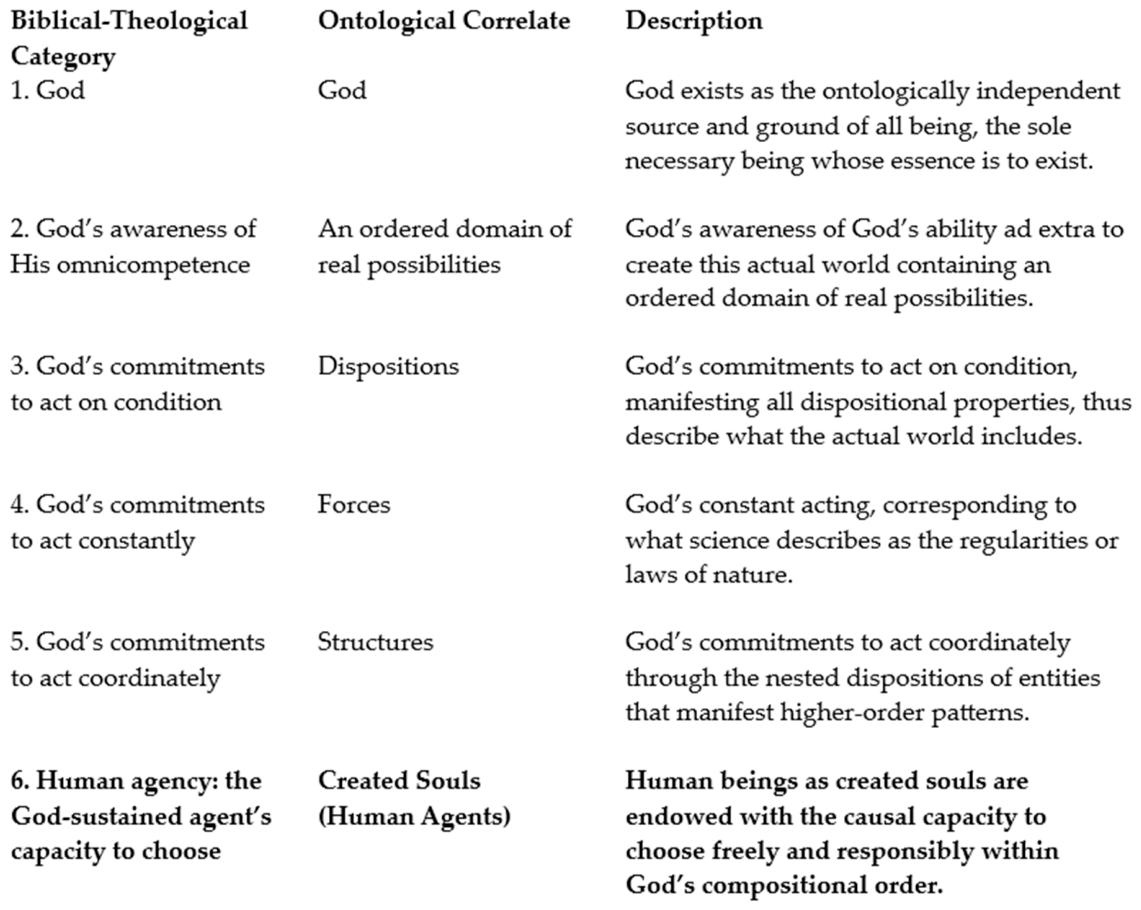
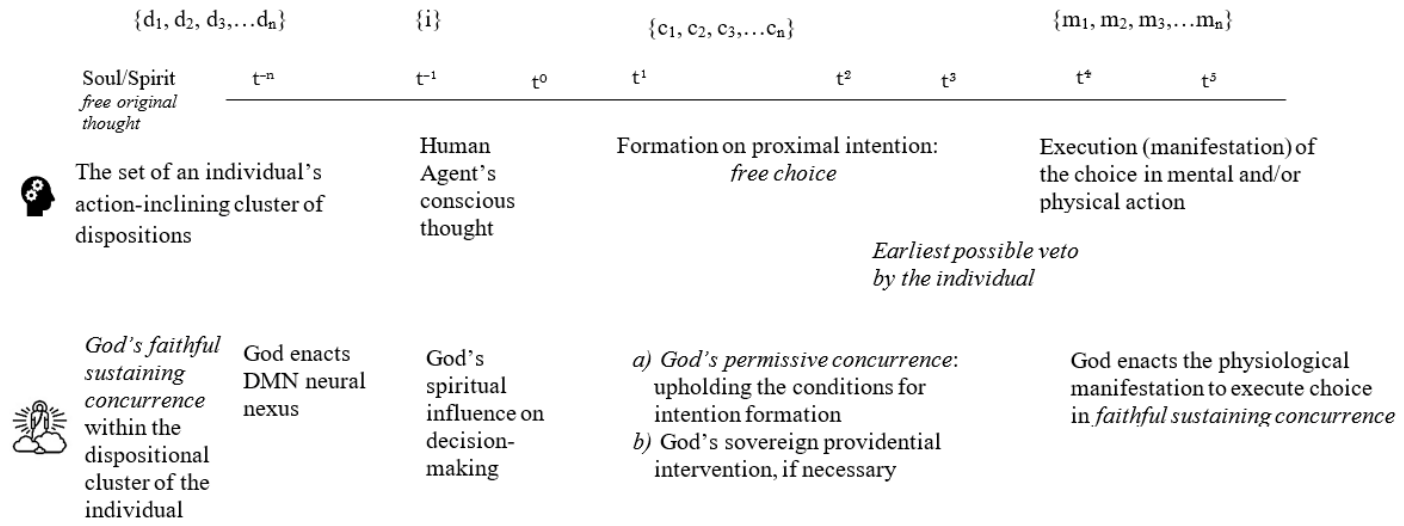
This paper advances Divine Compositionalism (DC) as a comprehensive theistic ontology capable of integrating divine sovereignty with genuine human libertarian freedom. Here we extend DC’s commitment to physical causation in natural mechanisms, to human agency, arguing that DC can accommodate a novel, integrated free will position without collapsing into classical occasionalism or reductive determinism. In a six-category ontology, God remains the continuous, existence-conferring cause of all physical processes, including the neurological and biological substrates of decision and action, while human agents possess genuine causal power to generate originate thoughts, intentions, and choices. In a precise mapping to the neuroscience of proximal intention formation, a model is given proposing that God acts differentially within the structures of human neurophysiology in an occasionalist manner and in a concurrentist manner with human agent free will. This preserves agent moral responsibility and divine non-culpability for sin and evil, while affirming God’s providential governance. By reconceptualizing the relationship between divine causality and human freedom, DC offers a synthetic position that transcends the traditional libertarian–compatibilist dichotomy. Freedom is neither illusory within a deterministic system nor an autonomous power severed from divine causality, but a contingent participation in God’s ongoing creative act. The result is a biblically grounded, metaphysically coherent framework that seeks to offer a theistic ontology in which God’s continuous, existence-conferring action in nature harmonizes with the genuine moral freedom of human persons.
Keywords: divine compositionalism; divine action; free will; physical occasionalism; Jonathan Edwards; concurrentism divine compositionalism; divine action; free will; physical occasionalism; Jonathan Edwards; concurrentism