Article

Constanza de Castilla’s Marian Doctrines in a Dominican Setting: Her ‘Officium Incarnacionis Domini Nostri Ihesus Christi’


by
Lesley Karen Twomey
School of Design, Art, and Creative Industries, Northumbria University, Newcastle upon Tyne NE1 8ST, UK
Religions 2026, 17(6), 671; https://doi.org/10.3390/rel17060671
Submission received: 14 April 2026 / Revised: 12 May 2026 / Accepted: 19 May 2026 / Published: 4 June 2026

Abstract

The Dominican Constanza de Castilla’s exceptional liturgical book, her Libro de devociones y oficios [Book of Devotions and Offices], served devotional and practical purposes in the convent of Santo Domingo el Real in Madrid. The article begins by examining Dominican nuns’ participation in Corpus Christi processions. It then examines Constanza’s liturgy for the Mass of the Incarnation (25 March). A study of liturgical calendars and offices both prior to and contemporary to Constanza reveals that there are no Castilian offices given the title ‘Incarnation of Our Lord’. Comparison of the contents of the office with the same liturgies reveals none with the exact same antiphons or readings. However, Constanza’s choice of the name ‘office of the Incarnation’ is matched to a similar wording in the account book of Franciscan nuns. They also give the name day of the Incarnation to the feast they celebrate on 25 March. The article also summarizes the theological theme of kenosis, Christ’s self-abasement, apparent elsewhere in the Book of Devotions and Offices and which is touched upon in the office of the Incarnation. Finally, it examines the links between Thomas Aquinas’s thinking on the Virgin Birth and where that is echoed by Constanza. This article concludes that, for this short office, Constanza’s Mass shows no signs of having been copied from existing offices, always with the proviso that what remains of fourteenth and fifteenth century liturgies provides an imperfect picture.

1. Introduction

Constanza de Castilla (c. 1395–1478) was Dominican prioress at the royal foundation, Santo Domingo el Real, in Madrid, from 1416 to 1465 (Surtz 1995, p. 44).1 Constanza was of royal blood, granddaughter of Pedro I of Castile (1334–1369). Pedro had abandoned his wife, Juana de Castro, the day after the marriage, leaving her pregnant with Juan, Constanza’s father (Surtz 1995, p. 41). Following the murder of Pedro I, Constanza’s father was imprisoned, because of the threat he posed to the usurping Trastámara dynasty. Whilst in prison, Juan married the daughter of his jailer, Elvira de Falces, and fathered two children, Pedro and Constanza. Constanza spent much of her young life in prison (Wilkins 1998, p. vii). On her release, she came under the aegis of her powerful cousin, Queen Catherine of Lancaster (1372–1418), also granddaughter of Pedro. Catherine was the daughter of another Constanza de Castilla (1354–1394), Pedro’s heir, and of John of Gaunt, Duke of Lancaster (1340–1399). It was Catherine who placed her cousin Constanza in the convent to protect her husband, Enrique or Henry III, nicknamed ‘the Sickly’, from any threatened plot (Surtz 1995, p. 42). Despite the vagaries of her childhood, Constanza de Castilla, was capable of writing in both Latin and Castilian. Writing in Latin was impossible, of course, for all but a few highly educated women (Ong 1959, pp. 102–24). Constanza became prioress at a young age and remained prioress until 1465.
Constanza’s exceptional liturgical book, her Libro de devociones y oficios [Book of Devotions and Offices] (BNE, MS 7495), was written for devotional and practical purposes, for liturgy lay at the heart of every activity in the medieval convent. It contains sections of private or group prayer, supplications at the hour of death, the joys of the Virgin, a pre-Communion devotion in forty-four parts, a devotion called the Commemoration of the Nails in both Castilian and Latin. According to Constance Wilkins: ‘The most original and the most deeply moving portions of the prayer book are the long opening prayer, the three lessons included in the Hours of the Nails, and the personal prayers of supplication’ (Wilkins 2003, p. 219). The above sections of the Libro de devociones y oficios comprise close to 40% of the whole.
In the convent of Santo Domingo el Real, where Constanza resided, liturgy marked the rhythm of the day and of the seasons, meaning that its value was far greater than simply a moment of prayer amidst other activities (Muschiol 2008, p. 191). Liturgy was the central tenet of the cloistered life. Liturgy was the very heart of the community’s economic activity, as members of the secular world, family members, and city dignitaries commissioned prayer, particularly prayer for the dead, bringing in revenue to the convent (Twomey, forthcoming).
Constanza also recognizes that liturgy became a didactic tool to provide knowledge in both Latin and Castilian for the nuns in her charge. Goodich (1981, p. 25), writing on European convents, notes the thirst for knowledge displayed by pious members of female orders. In Constanza’s liturgies, the theological content is often set down both in Latin and the vernacular, making it available to both the educated choir nuns and the less well-educated members of the community (Twomey, forthcoming). However, for the Office of the Incarnation of Our Lord, the manuscript contains only the Latin office (BNE, MS 7495, fols 41v–44r). In her Libro de devociones y oficios, Constanza expressed theological teaching about kenosis, eucharistic theology, atonement and the theology of the Cross, the theology of sin, and final judgement (Twomey, forthcoming). Constanza also writes of the aesthetics of beauty in how she expresses her theology of sin and atonement (Twomey 2016, p. 60).
Very briefly, Pérez Vidal (2016, p. 40) notes that Constanza de Castilla writes about the Passion and Incarnation of Christ, although without saying how. In her article, Pérez Vidal discusses how the incipient Corpus Christi doctrine was deeply embedded in Dominican convents, particularly Santo Domingo el Real in Toledo, a convent led by Constanza’s kinswomen, Teresa de Ayala (1353–1424), and her daughter, María de Ayala († 1424). Both became prioress of Santo Domingo el Real. Catalina de Castilla (1420–1480), also granddaughter of Pedro I, entered the convent to be educated under the guidance of her aunt and she was also briefly prioress of the convent (González de Fauve et al. 2008, p. 105). María de Ayala was godmother to María de Castilla (1401–1458), the eldest daughter of Catherine of Lancaster.
I have previously discussed Constanza’s thematic approach to kenosis throughout her Libro de devociones y oficios (Twomey, forthcoming). She begins the forty-four stages of her prayers to enable preparation for the eucharist, with how Christ descends from the bosom of his father into the tabernacle of the Virgin’s womb: ‘Ihesu, miserere mei, por virtud de la tu sancta encarnaçión, quando te plogo descender del seno de tu Padre en el sagrario de la Virgen Gloriosa’ [Jesus, have mercy on me, by virtue of your holy Incarnation, when you were pleased to descend from the bosom of the Father into the tabernacle of the Glorious Virgin] (Wilkins 1998, p. 3 [Constanza de Castilla, BNE, MS 7495, fol. 1r]).2 How Christ humbles himself is a model for how Constanza and the nuns in her community should also humble themselves, She asks God to free her from the sin of pride: ‘yo suplico a ti por la grandeza de tu humildat que me libres del pecado e sobervia’ [I pray to you by the greatness of your humility that you free me from the sin of pride] (Wilkins 1998, p. 3 [fol. 1v]) and she also asks for the gift of humility: ‘dame virtud de humildad complida’ [give me the virtue of true humility] (Wilkins 1998, p. 3 [fol. 1v]). The pre-Communion devotion has as its purpose to set out theological teaching on aspects of Christ’s life stage by stage and, also, to present how the nuns should react to Christ’s acts.
There is more to the teaching in this first stage of Constanza’s preparation for communion and that lies in the term ‘encarnaçión’ (fol. 1r). Constanza’s Libro de devociones contains a short liturgy in Latin: ‘Incipit officium Incarnationis Domini Nostri Ihesus Christi’ (Wilkins 1998, p. 49 [Constanza de Castilla, fol. 41v]). An office for the Incarnation looks, at first sight, to be a standard liturgy but a closer look reveals that relatively few liturgical calendars and sanctorals in any kingdom in the Peninsula include an Incarnation liturgy.3 The standard entry in liturgical calendars is for the Annunciation feast, although there is a small number of liturgical calendars or propers of saints which title the Annunciation as the ‘Annunciatio dominica’ [Annunciation of the Lord]. Constanza, therefore, in contrast to all the calendars and liturgical books decides to present her liturgy with a different focus, that of the Incarnation.
The feast of the Annunciation of the Lord, ‘Annunciatio domini’, is often found in female monasteries, particularly within the Cistercian Order. The liturgical books consulted originated within the female Order, in particular the convent of Sanctes Creus in Tarragona. The presence of the term may or may not be related to female perspectives on the Annunciation but there is insufficient evidence to prove the case.4
However, another association of female religious and the devotion to the Incarnation occurs in Valencia and pertains to the accounts book of the convent of Santa Isabel. In it, a female abbess, although not a Dominican one, records the name of the feast of the Annunciation as the Incarnation in the accounts:
doni disapte a xxii de març a la procuradora Sor Beatriu Soler per la messió de la setmana per ço com hya huna pitança que fa Sor Solera per la uerge Maria de l’incarnació axi mateix per ço com la uigilia dela dita festa lo conuent no dona ssino pa y aygua exceptat les dones de fora de seruir xxx liures iiii.
(Arxiu del Regne de València, Clero Libro 1105, fol. 124r)
[On Saturday 22 March I gave the procurator Sister Beatriu Soler thirty-one pounds four shillings for the expenses of the week as there was a donation for the Virgin Mary of the Incarnation given by Sister Soler, and because the convent gives only bread and water on the Vigil of the said feast except for the serving girls from outside the convent.]
The perspective shared by many Franciscans may derive from the teachings of St Clare of Assisi (1194–1253), the foundress of the Order of St Damian, forerunner of the Clare Order. In passages in Clare’s writings, found in her letters, where the Virgin Mary appears, ‘her role is overwhelmingly that of mother, Christ-carrier, and God-birther’ (Mooney 2016, p. 65). Clare writes not only of the intimate connection between Christ and the body of the Virgin but also of the way in which the holy virgins of her Order follow Christ. Like the Virgin, after receiving the Host, they carry him inside their chaste bodies:
Therefore, as the glorious Virgin of virgins carried [Him] materially, so you, too, by following in her footprints, especially [those] of poverty and humility, can, without any doubt, always carry Him spiritually in your chaste and virginal body […].
The connection Clare makes between the bodies of the nuns and the sacred womb of the Virgin was made by nuns of other Orders.
Over thirty years ago, Bynum (1991, p. 172) emphasized how female religious attained a relationship with God by sinking more deeply into stereotypical female physicality (suffering, vulnerability, and bleeding). Nuns’ lives included practices such as abstaining from food and rituals of fasting as penance for the body. Such practices can be set alongside rituals of gazing: devotion to the body of Christ in visible and present on earth in the Host. According to medieval optical theory, nuns’ desire to see the body of Christ in the Host, meant their common sense retained an image of the holy as a material presence (Lentes 2006, p. 361). Devotional practices turned towards not only receiving but also seeing the body of Christ, whilst ocular communion became part of eucharistic practice. Angela of Foligno (1248–1309) wrote about seeing the Christ-child inside the Host during its elevation (Astell 2006, p. 34). What is more, elevating the Host at consecration recalled the lifting of Christ’s body on the Cross (Astell 2006, p. 52) but it also recalled the presentation of the Christ child by his mother at the Purification or at the Epiphany.
By the early fourteenth century, Dominican nuns had developed deep devotion to the Corpus Christi, a feast initiated in 1264 by Pope Urban IV (c. 1195–1264). Corpus Christi celebrations were reinforced by John XXII (1244–1334) who instituted the exposition of the Host in 1319. In both Aragon and Castile, the first known depictions of the Corpus Christi procession belonged to female nunneries and were located in the nuns’ choir (Pérez Vidal 2016, p. 35).
One of the earliest depictions of a Corpus Christi procession is on the base of the Virgin of the Little Bird [‘Virgen del pajarito’] in the nuns’ choir at Santo Domingo el Real in Toledo (Pérez Vidal 2016, p. 36, Figure 1), a convent that Constanza had permission to visit. It depicts nuns taking an active role in processing with the Host. The nuns process under an elaborate canopy which is held over the Host. The prioress would be responsible for selecting the nuns in the community who would have the honour of carrying the poles of the canopy, much as, in later centuries, civic authorities made those decisions (Santos 2022, p. 125; 2024, n.p.).
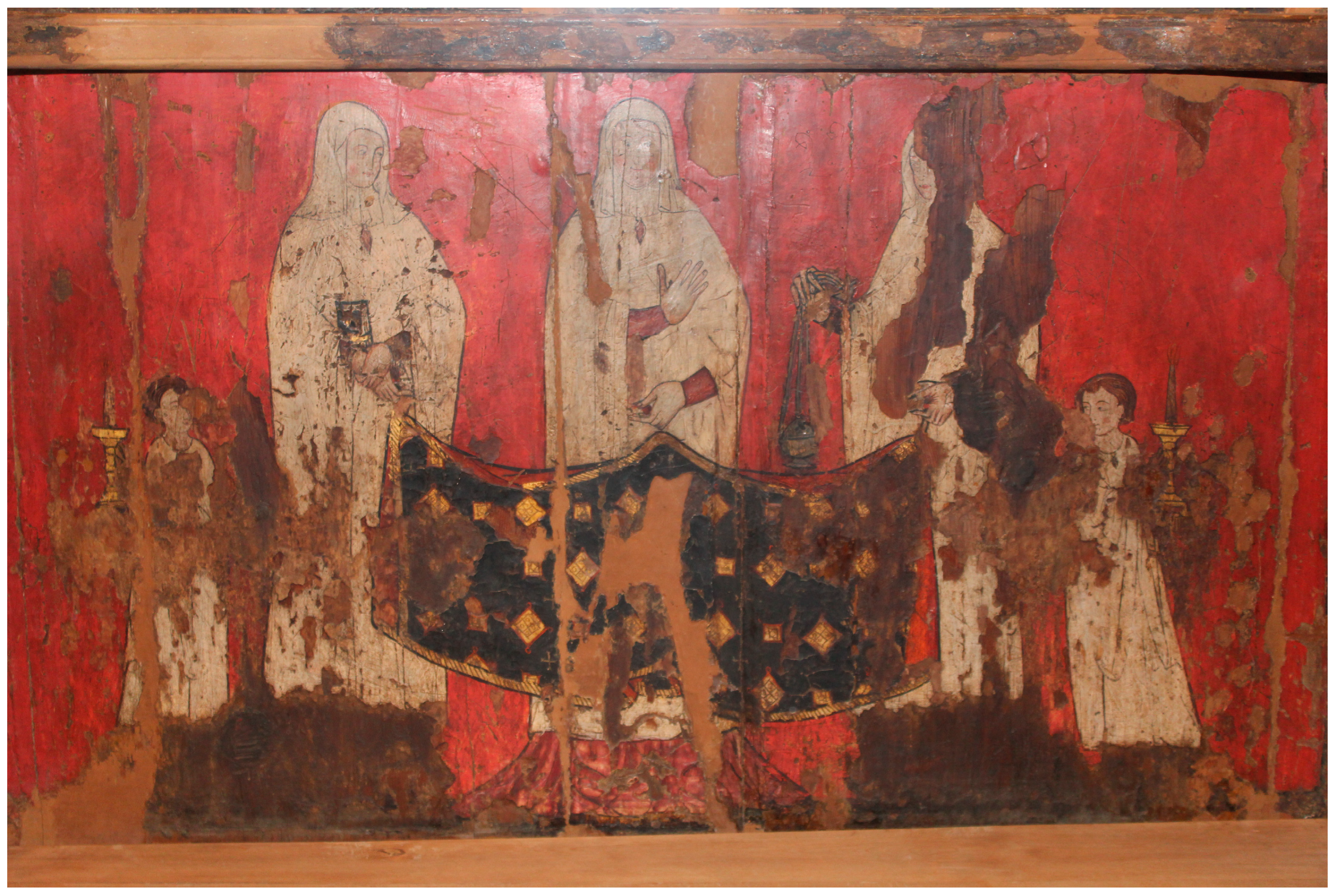
Another important manifestation of eucharistic processions, in which Dominican nuns participated, is depicted on the Prioress’s throne (Bernabé 2001) at Santa Maria de Sixena, Aragon, commissioned by Prioress Blanca d’Aragó i d’Anjou (1302–1348), daughter of James II of Aragon (1267–1327) and Blanche d’Anjou (1280–1310). The throne depicts the prioress with a eucharistic gremial held before her knees in a procession in which the prioress and principal nuns in the convent participate (Figure 1). Bernabé (2001, p. 363) identifies the nuns who flank Blanca as the subprioress and the convent sacristan. Sousa (2014) writes about the precious and jewelled objects (chalice, patten, monstrance, pyx, ciborium) but without discussing the textile objects which accompanied the processions, such as the gremial carried before the knees of Prioress Blanca and her principal office holders. On the throne, one of the principal nuns carries a censer (Figure 1).
At the base of the ‘Virgen del pajarito’, the Dominican friars are neither standing under nor carrying the processional canopy, which would be held over the Host in procession. This is contrary to Rubin’s assertion that ‘the eucharist could not be handled by a lay person, so its receptacle was always carried by priests’ (Rubin 1991, p. 255). When discussing the procession for Corpus Christi at Barking Abbey, she again indicates that ‘nuns were not in orders and were therefore barred from handling the eucharist (Rubin 1991, p. 247). Nevertheless, the prioress of Santo Domingo el Real carries a eucharistic vessel, which looks like a ciborium. Although the prioress’s hands are around the ciborium, it looks to have a baluster stem and foot. It may have a lid (London, V&A, inv. M.257, 2–1956) and be something like the Italian ciborium (London V&A, inv. 4285–1857) which dates from c. 1540. A Spanish ciborium in the V&A is not dissimilar in shape. It is silver gilt, with enamelled bosses, and dates from c. 1630. A lidded ciborium, made in Antwerp, also silver gilt is dated c. 1530 (London, V&A, inv. GILBERT.87:1–2008). Finally, a ciborium made in Italy in the late fifteenth century also has a baluster and foot with lid (London V&A, inv. H243–1891). There can be little doubt that the object the prioress is holding is a ciborium. The ciborium would normally be used to transport the Host after consecration and, in general, the Host would be processed under the canopy. A second nun, again a principal figure in the procession, holds an object which might be a lidded censer. Its curled base might suggest the chains of the censer, such as the fifteenth-century one made in Venice (London, V&A, inv. M.39–1951).
Pérez Vidal (2016, p. 36) does not speculate about the objects carried in the procession but merely notes a procession was taking place. Whilst it seems possible that high-ranking prioresses were allowed to carry the ciborium in procession, the important factor for this article is to emphasize the Dominican nuns’ devotion to the body of Christ, whether they were permitted to carry it in procession or not. In the ‘Virgen del pajarito’ procession, the clergy stand next to the canopy, with one of them carrying another liturgical container. It seems unlikely the cleric is carrying the Host, as he is outside the bounds of the canopy.
From this depiction, by no means unusual in the late Middle Ages, we can understand that women were not excluded from taking centre stage in liturgical processions. The canopy or ‘ombrellino’ is mounted on poles, the front two of which are visible and carried by female figures, presumably senior office holders or ‘discretas’ in the convent. What is more, kings took their place at the centre of Corpus Christi processions. As Rubin (1991, p. 255) demonstrates, across Europe, dignitaries enhanced their status by their proximity to the holy of holies. Both Blanca, daughter of a king, and Teresa de Ayala, mistress of Pedro I and mother of a princess, shared proximity to the royal family. Thus, they took their place at the centre of public demonstrations of devotion.
The second factor which the presence of the canopy informs us about is that the eucharist had taken on a sensory dimension beyond simply being visible. As Pazos López (2025, p. 138) demonstrates, textile objects gained increasing importance as part of eucharistic rituals: ‘The visual emphasis on curtains, combined with other textile elements such as altar cloths and frontals, underscores the tactile and aesthetic dimensions of medieval worship’. Pazos López (2025) does not discuss canopies but these were part of transferring the richly adorned altar to a processional space. In the case of the Dominican nuns, this may have been at different stations around the convent and cloisters.
Constanza’s focus on the Incarnation, therefore, takes as its context the growing emphasis on the Corpus Christi in Dominican priories. It also takes as its context the imitatio Mariae initiated in Clare convents. For both these reasons, the Incarnation held greater importance for Constanza that the Annunciation, which was a verbal message from angel to Virgin, rather than the materiality of the reception of Christ into female flesh. The Incarnation was key for women religious enabling them to engage as a body in imitatio Mariae. The cloister in which they dwelt should become the vessel, the container to hold the uncontainable Godhead (Ritchey 2014, p. 50). The nuns’ presence together in community was to be an imitation of the Virgin’s skill for containing the divine (Ritchey 2014, p. 50). Like the Virgin Mary, they could hold Christ within their body as she did at the Incarnation. The convent of Santo Domingo el Real had fifteen different representations of the Virgin Mary (Pérez Vidal 2011, p. 926), enabling the nuns to picture her in accordance with different advocations. The convent church had three images of the Annunciate Virgin. The nuns’ choir had a painting of the Annunciation which was one of the stations in a procession which was the first act of Christmas (Pérez Vidal 2011, p. 932, citing Arbeteta Mira 1996, p. 67). Among the fifteen representations of the Virgin was the Riojan-Navarrese Madona de Madrid, gifted to the convent by Sancho IV (1258–1295), as Lucía Gómez-Chacón convincingly argues (Lucía Gómez-Chacón 2018, p. 335), of whom Constanza was a direct descendent through her father Pedro I.
The Annunciation-Incarnation and eucharistic feast are closely related. As Buterain Schneider indicates:
Indeed, the Virgin Mary’s Eucharistic affinities are represented in altarpieces that reinforce her faith in receiving and conceiving the Word made flesh. Just as the liturgically exercised devout could imagine that the Holy Spirit had overshadowed her that she might miraculously conceive, so too the priest in consecrating the elements would be an instrument of the Holy Spirit’s action in transubstantiating them.
Schneider links the Annunciation and eucharist but there is more to the parallel than she envisages. The nuns, like the Virgin, offer their lives in obedience to God. In this, they imitate the Virgin Mary’s ‘fiat’ of offering absolute obedience to God. However, more importantly, when they receive the Host, taking it materially into their body, momentarily they each became a living tabernacle. In their eucharistic devotion, they also imitate the Virgin Mary.
The Annunciation was a feast which was accorded less prestige in Hispanic liturgies than the principal Marian feast, the Assumption.5 Rarely, it is celebrated with an entry for the octave in the Castilian calendars. I have not found it celebrated with a vigil in Castilian calendars. In England, however, the Annunciation was on occasion, though not always, accorded a vigil.6 It was mainly equivalent to the Assumption in importance and, what is more, with the majority of lyric poetry to the Virgin dedicated to it. However, in at least one breviary (Peterhouse MS 207), it is designated ‘duplex minus’ [lesser solemnity] whilst the Assumption is ‘principale duplex’ [principal solemnity].7 The main place of pilgrimage to Walsingham in England celebrated the little house at Nazareth where the Annunciation took place (Twomey 2022, p. 96).

2. Constanza’s Incarnation Liturgy and Fifteenth-Century Liturgies for 25 March

Constanza de Castilla follows the traditional elements for her Latin office for the Mass, which is in most Missals of the period, simply called ‘officium’. The sections she includes are ‘officium’ with its opening antiphon; oratio [prayer]; lectio [reading]; responsus [response]; [evangelium] [Gospel];8 ofrenda [offertory]; sacramenta [sacrament];9 comunicanda [communion preface]; post communicanda [post communion preface]. In the fifteenth-century Missal for military Order of St James, the structure of the Mass follows the same pattern.10 More importantly, in the fifteenth-century Missal, copied for use in the archdiocese, the named elements are the same.11
Constanza begins her Incarnation office with the antiphon: ‘Intuemini quantus sit iste gloriosus qui ingreditur ad salvandas gentes’ [You can sense how great is this glorious one who enters to save the nations] (Wilkins 1998, p. 49 [Constanza de Castilla, fol. 41v]). The antiphon continues ‘ipse est rex justitiae cujus generatio non habet finem’ [he is the King of glory whose generation is eternal] and it mirrors the antiphon in Assisi liturgies where it is found at the fourth Sunday of Advent.12 The same antiphon is present in several liturgies but most of those recorded are from the kingdom of Aragon or in other parts of Europe. One of the antiphons is from a Dominican monastery (Santo Domingo de Silos, Biblioteca de la Abadía, ‘Breviarium’, MS 9, fol. 13v), although originating in the Benedictine monastery of San Salvador de Celanova (Galicia)13. No Castilian liturgies for the Annunciation Mass begin with ‘Intuemini’, as outlined below. However, there is a small number of peninsular liturgies which take ‘Intuemini’ for the third week of Advent.14 Most of these liturgies are from the eastern Peninsula but there is one from the eastern part of Castile. This is the thirteenth-century manuscript from Santo Domingo de Silos (MS 9, fol. 13r). It is worth noting that Constanza’s feast may have also been written for the December Annunciation feast which takes place in Advent, sometimes called ‘Annunciatio domini’, sometimes called ‘Expectatio’, and sometimes called the ‘Commemoratio’.15 ‘Commemoratio’ is found most often in central Castile and in Seville. ‘Adnunciatio’ is found in Burgos diocese and as far as Toledo. ‘Expectatio’, found in Calahorra diocese, mirrors the name most often given the feast in the Kingdom of Aragon, with which it borders. The Book of Hours presented by Queen Sancha to Fernando I de León stands out because of naming the feast after Holy Mary, Virgin Mother.16
The opening antiphon in Castilian liturgies for the feast of the Annunciation varies and is sometimes: ‘Ecce virgo concipiet et pariet filium et uocabitur nomen eius Emmanuel’ (BNE, INC 415, unnumbered [image 315]) [behold the virgin will conceive and bear a son and will call his name Emmanuel].17 At other times this text becomes the short scripture or capitulum, whilst the opening antiphon is ‘Missus est Gabriel angelus’ (BNE, MS 713, fol. 311r).
Missals from the kingdom of Aragon often open the feast of the Annunciation with the antiphon: ‘Rorate celi de super et nubes pluuant iustu[m] ap[er]iatur terra et germinet saluatorem’ (Valencia, Archivo de la Catedral, MS 105, fol. 124v) [Drop dew from above, heavens, and let the clouds rain down righteousness. Let the earth open and bring forth the Saviour]. In another Valencian missal, dated 1469, ‘Rorate celi’ also is the opening antiphon at the Expectation feast (MS 85, fol. 254r). The same antiphon opens the thirteenth-century Cistercian missal from Sanctes Creus in Tarragona (Tarragona, Biblioteca Publica, MS 126, fol. 219v), showing how the liturgy did not vary over centuries in the kingdom. From the opening antiphon Constanza chooses, it becomes apparent that the Incarnation office is not a copy of existing offices.

3. Echoes of the Theology of Kenosis in Constanza’s Incarnation Office

In the prayers and devotions in Constanza’s Libro de devociones y oficios, the authorial-I recurs enabling scholars to reconstruct Constanza’s approach to authorship but also to acknowledging herself as a praying subject. Discussing Constanza’s pre-Communion prayer, Muñoz Fernández, therefore, indicates:
El yo-mi introducido en cada uno de los capítulos que componen esta oración es sistemáticamente reforzado por el carácter iterativo de la estructura. Pero el sujeto orante también se refuerza en términos cualitativos cada vez que cita todos y cada uno de los aspectos rememorados de la colosal empresa de la redención llevada a cabo por Cristo y su Madre, y se declara beneficiario de sus méritos.
[The I-my introduced in each of the chapters which make up this prayer is systematically reinforced by the iterative nature of the structure. But the praying subject is also reinforced in qualitative terms each time it cites each and every aspect recalled in the colossal work of Redemption brought about by Christ and his Mother.]
The Incarnation Office Constanza writes is very different. In it, there is no use of the authorial I and there is no header to claim authorship, unlike the ‘In Commemoratione clavorum passionis Jhesu Christi’ [in commemoration of the nails of the Passion of Jesus Christ], which is preceded by the words: ‘estas oras que se siguen ordenó la dicha soror de la Orden de Santo Domingo de los Predicadores’ (Wilkins 1998, p. 51 [Constanza de Castilla, fol. 44r]) [these hours which follow were set out by the said sister of the Order of St Dominic of the Preachers]. Nevertheless, the position of the short office of the Incarnation at the very heart of the Libro de devociones y oficios, indicates it is written by Constanza.
Constanza’s Latin office to be used at Mass for the Incarnation is written only in Latin, unlike her hours in commemoration of the nails at the Passion which is written in both Castilian and Latin. In order for it to be acceptable to the priest who would celebrate using it, it could not be in Castilian. Into the antiphons and readings for the Incarnation office she chooses, she meshes theological concepts already introduced elsewhere in her Libro de devociones y oficios and the first of these is the descent of Christ. The theology of kenosis, the emptying of Christ when he came down to earth (Phil. 3:2–10), recurs as a major theme throughout Constanza’s Libro de devociones y oficios. Aquinas, in his commentary on Philippians, demonstrated that the act of kenosis contains two principal movements, descent associated with the mystery of the Incarnation and humbling related to the mystery of the Passion (Emery 2019). Constanza’s echoes of kenosis occur at the very beginning of her pre-Communion prayer where she recounts Christ’s willing humility when he decided to come to earth and enter the holy tabernacle, the Virgin’s womb (Wilkins 1998, p. 3 [Constanza de Castilla, fol. 1r]; Twomey, forthcoming). In her Incarnation Mass, she returns to the kenosis theme when she selects a Scripture reading taken from the Song of Songs (6:2): ‘Dilectus meus descendit in ortum suum’ (Wilkins 1998, p. 49 [Constanza de Castilla, fol. 42r]) [My Beloved came down into his garden]. For the nuns, the ‘ortum’ [garden] would recall their own verdant cloister where Christ comes to meet them as they join in prayer. Here, it is valuable to note ‘Dilectus meus descendit’ is not normally selected for the short Scripture at the Annunciation feast in peninsular liturgies.18 It is found in some European liturgies recorded in the Cantus database (Cantus Database n.d.), the chant ‘Dilectus meus descendit’ occurs only in three liturgies. Most common in other Annunciation liturgies is the short Scripture from the message of the angel to the Virgin from Luke’s Gospel (1:26–38), beginning: ‘Missus est Gabriel angelus’ (BNE, MS 931, fol. 214r) [The angel Gabriel was sent]. Much as Hildegard of Bingen (†1179) did, Constanza portrays the Virgin’s body as a pleasure garden where the incarnate God took ample delight (Ritchey 2014, p. 71). Also, as Hildegard did (Ritchey 2014, p. 77), Constanza sees the work of the virginal community in the Divine Office as the recreation of the Incarnation. Although her liturgy seems to fit more readily into the standard pattern of fifteenth-century offices for the Mass, like Hildegard, she has taken charge of the liturgy and constructed her own Mass to offer her own concept of Incarnation.
Indeed, Constanza takes the full version of Luke’s angelic Annunciation as the Gospel for her office (Wilkins 1998, p. 50 [Constanza de Castilla, fols 42v–43r]). Other liturgies, such as the Incunable Toledo breviary, printed in Venice (Madrid, BNE, ‘Breviarium Toletanum’, INC 415 [1492]), take the Gospel reading from Matthew 1:21: ‘Ecce virgo concipiet et pariet filium et uocabitur nomen eius Hemanuel’ (BNE, INC 415, n. fol. [image 317]) [Behold the virgin will conceive and will bear a son and his name will be Emmanuel].
Constanza de Castilla had already used the willingness of Christ to humble himself to create a model for herself and the nuns who also must cast aside pride in her pre-Communion prayer. In the Incarnation office, her purpose is different. Constanza begins her Scripture with Song of Songs 6:2 as noted above but she then blends verses from other chapters of the Song of Songs for she presents the Beloved who comes into the garden to be with his many chaste conventual spouses as a man of beauty, not an incarnate child: ‘Dilectus meus candidus et rubicundus’ (Song of Songs 5:10; Wilkins 1998, p. 49 [Constanza de Castilla fol. 42r]). His features are akin to the most precious things earth can offer: ‘Capud eius aurum optimum’ (Song of Songs 5:11; Wilkins 1998, p. 49 [fol. 42r]) [his head is as of finest gold] and ‘Species eius ut Libani, electus ut cedri’ (Song of Songs 5:15; Wilkins 1998, p. 49 [fol. 42v]) [his features are like Lebanon, choice as its cedars]. She then turns to his perfume: ‘Gene illius sicut areole aromatum’ (Song of Songs 5:13) [his cheeks are as a bed of spices set by the perfumers], also ‘Labia eius lilia, distillantia et myrrham primam’ (Song of Songs 5:13; Wilkins 1998, p. 49 [Constanza de Castilla, fol. 42r]) [his lips are like lilies dripping with myrrh]. By blending chapters 5 and 6 of the Song of Songs, Constanza is able to include the physical attributes of the Beloved.
Significant also in her choice of the passage are the lilies from the Song of Songs: ‘Dilectus meus descendit in ortum suum ad areolam aromatis, ut pascatur montes et colligate lilia’ [Dilectus meus descendit in ortum suum ad areolam aromatis, ut pascatur montes et colligate lilia] (Wilkins 1998, p. 49 [Constanza de Castilla, fol. 42r]). The angel Gabriel bearing a lily at the Annunciation is found in numerous altarpieces, of which the majority are from the Kingdom of Aragon (Salvador González 2013, pp. 187–202). Among the Castilian painters, Salvador González includes Juan de Burgos (active in Valladolid, 1443–1464), Nicolás Francés (†1468) and Pedro Berruguete (c. 1450–1503). Juan de Burgos’s ‘Annunciation’ (Cambridge, MA, Fogg Museum of Art, inv. 1928.168) shows the Virgin at the Annunciation beside a vase of lilies; Francés’s panel from the altarpiece of La Bañeza shows a golden vase of lilies in the foreground, whilst Berruguete’s Annunciation, painted for the Carthusian monastery at Miraflores, Burgos, shows the lilies positioned between the angel and the Virgin as part of the background. Salvador González traces patristic use of the lily in connection with the Virgin and argues (Salvador González 2013, p. 206) it should be interpreted as a symbol of the incarnation of the Lord in a Virgin’s womb.
Later in the Incarnation office, Constanza reprises ‘descendit’, reworking a chant found elsewhere in the Peninsula, mostly in the east. At the ‘ofrenda’ [offertory], Constanza writes ‘Descendit de caelis Deus verus a patre genitus introivit in uterum virginis moram faciens novem mensibus’ [The true God, born of the Father, descended from the heavens and entered the womb of a virgin making his dwelling there for nine months] (Wilkins 1998, p. 50 [Constanza de Castilla, fol. 43v). Her offertory chant begins in the same way as thirteen other peninsular manuscripts, only one of which is from Castile:
Descendit de caelis Deus verus a patre genitus introivit in uterum virginis nobis ut appareret visibilis indutus carne humana protoparentis edita et exivit per clausam portam deus et homo lux et vita conditor mundi.19
[The true God, born of the Father, descended from the heavens and entered the womb of a virgin to appear to us, clothed in human flesh, born from the first parent and went out through the closed gate, God and man, light and life, creator of the world.]
Constanza adapts the chant found, for example, in Orense, Galicia, changing the ending to ‘moram faciens novem mensibus’ [making his dwelling there for nine months]. The ending to this chant is not found in any other peninsular or European liturgy.
The response to the Old Testament reading from Song of Songs begins ‘Dominus dixit ad me: Filius meus es tu, ego hodie genui te’ [the Lord said to me: you are my son, I procreated you today’.20 This chant can be found in other Hispanic antiphoners and other liturgical books at the liturgy for Christmas day. This is the case of the twelfth-century Mass for Christmas night found in a Missal from San Millán de la Cogolla (Logroño).21 The San Millán Missal was written with Aquitaine musical notation and may have originated there. In a fourteenth-century Castilian Gradual, the same antiphon is found also on Christmas Day.22 Also sung at Christmas day is the same antiphon in a book of Psalms, hymns and antiphons.23
The final prayer in Constanza’s Mass is one which occurs in other Castilian liturgies. For example, in the Mass for the military Order of Santiago, the same prayer ends the Mass of the Annunciation:24
Graciam tuam quesumus Domine mentibus nostri infunde [ut qui] angelo nunciante
Christi filii tui incarnacionem cognovimus per passionem eius et crucem de resurecionis gloriam perducamur.
(Wilkins 1998, p. 51 [Constanza de Castilla, fol. 44r])
This closing prayer is found in a number of peninsular missals including in the Annunciation Mass in a fifteenth-century Zaragoza missal, where the prayer ends the December Annunciation Mass.25 It is also found in Castilian ones, such as at the Annunciation Mass in the missal for the archdiocese of Toledo.26 While the prayer is not universal in the Kingdom of Castile and Leon at the Annunciation Mass,27 there is contemporary evidence of its existence in the archdiocese of Toledo.

4. St Thomas Aquinas and Constanza’s ‘Puella Intacta’

The eucharist is a central offering of the Incarnate Word, in accordance with the teaching of St Thomas Aquinas (c. 1225–1274): ‘the sacraments are not human acts pointing to God, but divine acts, God applying the work of salvation effected by the deeds and experiences of the Incarnate Word to the faithful in the Church, which is itself the body of the Incarnate Word’ (Holtz 2012, p. 454). The Incarnation and the eucharist were already unified in St John’s Gospel (Suggit 1985, p. 65), whilst Mary’s role in the new creation through her part in facilitating the Incarnation is replayed in her Nativity (Ritchey 2014, p.14) as well as in the commemoration of the Annunciation in Advent. Because of the Virgin’s fiat, her son is ‘one divine-and-human person whose humanity retains its own powers while serving as an instrument of the divinity’ (Gorman 2012, p. 432).28 Thus, for Aquinas, ‘it is the one Christ who, in one act, both touches a leper by virtue of his human power and heals him by virtue of his divine power’ (Aquinas 1989, pp. 502–3; Summa q.19, a.1). The eucharist is already a ‘divine act’ and creating words to be said at the Mass takes advantage of inserting the author’s own words to celebrate the Word made flesh.
Writing of Aquinas’s understanding of the link between the Incarnation with its salvific work and the consecration of the bread which becomes Christ’s body before the body of those present, Holtz unifies the incarnate Christ, the body and blood transubstantiated, and the congregation. It is doubtless for this reason that Constanza decided to write a Mass for the Incarnation. As a woman, Constanza’s writing of an office for the Mass is exceptional. She already had the privilege of appointing her own confessor and appointing the words to be said at the Mass exerts a further degree of control over the cleric appointed.29
Constanza seems to follow the mariological thinking of Aquinas on the Virgin, which is key to his Christology (Levering 2025, p. 153). Clearly, Aquinas was not the first theologian to address the problem.30 Aquinas follows the teaching of the fourth-century Church which affirmed the threefold virginity of the Virgin Mary: before, during, and after giving birth to Jesus (ante partum, in partu, post partum) (Goris 2024, p. 161). This idea had become classical since the late fourth century and had been codified by the Lateran Synod in 649. For Aquinas, the Incarnation was not a theoretical question but was essential to his understanding of the nature of Christ, ‘born of a woman’ (Gal. 4:4) but Mary’s role in it was an ‘eschatological sign of the new creation inaugurated by the Incarnation’ (Levering 2025, pp. 155–56). It is in the Tertia pars of his Summa that Aquinas writes of the corporal integrity of the Virgin Mary, essential for ensuring the appropriate dwelling for God in her womb. For Constanza, the eucharistic devotion of the great theologian of the Order provided a guide to her thinking, which she reflected to her nuns (Twomey, forthcoming). Aquinas indicates it was inconceivable that the Virgin should have had intercourse after the birth of Christ: ‘So we assert without qualification that the mother of God conceived as a virgin, gave birth as a virgin and remained virgin ever after the birth’ (Aquinas 1989, p. 515).
It seems possible that Constanza follows Aquinas when she writes in the response to the readings: ‘constantes estote et letamini quia mulier circundat virum, hec est virgo Maria, puela intacta’ [be constant and rejoice, for a woman encircles a man and she is the Virgin Mary, the young girl who is intact]. In the (Musica Hispanica Database n.d.), the response beginning ‘Constantes estote’ occurs many times in peninsular liturgies but never ends in the same way as it does in Constanza’s response.31 For example, at the Vigil of Christmas Eve, the antiphon is ‘Constantes estote videbitis auxilium domini super vos’ {be constant and you will see the help of the Lord come upon you].32 ‘Constantes’ is set at Christmas Eve, Christmas Day or its octave. Constanza introduces the concept of the Virgin being unblemished [intacta] to a pre-existing chant. Her concept of a woman surrounding the Son of God recalls another chant found in the Kingdom of Aragon: ‘beata viscera Marie virginis qui portauerunt eternum patris filium’ [blessed womb of Mary which carried the eternal son of the Father].33 This antiphon is sung in a Gerona Missal at the Communion. However, another antiphon is often sung at Christmas, at the octave of Christmas or as a memorial chant for the Virgin at Christmas: ‘Virgo dei genitrix quem totus non capit orbis in tua se clausit viscera factus homo vera fide genitus purgavit crimina mundi et tibi virginitas inviolata mmanet’ [Virgin Mother of God, of he whom, having become man, the whole world cannot contain, enclosed himself in your womb, generated with true faith and purified the sins of the world, and your virginity remains inviolate].34 This antiphon is found in the Silos manuscript (MS 9) at the Nativity of the Lord.35 It is found in a Huesca breviary (MS 7) at the memorial chants for the Virgin at Christmas.36
Yet another antiphon which seeks to represent the Virgin’s unspoilt virginity before and after giving birth through the image of a closed door is found in various breviaries in the Peninsula: ‘O Maria clausa porta quam nemo aperuit per quam princeps ille qui transivit qui deus et homo fuit nec ingressus violavit sed clausa permansit. Et quam prius non habebat sumpsit carnis fibulam sic rogatus tamquam sponsus suo processit thalamo’ [O Mary, closed door, which no one opened, so that the prince passed through, who was God and man, nor did he violate the bolt on entering, but asked for the latch and so the bridegroom went into his chamber].37 Both the Calahorra breviaries and the fragmentary Escorial Carthusian Breviary, where the above antiphon occurs, include it at the feast of the Virgin’s Conception (8 December).38 Constanza returns to the concept of the Virgin’s perfect virginity in her litany, which this time is marked as ordered or written by Constanza:
  • Mater toçius perfectionis.
  • Mater Dei et genitrix.
  • Templum Domini.
  • Sacrarium filii Dei.
  • Tabernaculum Spiritus Sancti.
  • Mater immaculata.
  • Mater intacta.
  • Mater inviolata.
  • Mater incontaminata.
  • Mater et virgo perpetua.
  • Mater benedicta
  • Mater omnium virginum. (Wilkins 1998, p. 87; Constanza de Castilla, fol. 80v)
  • [Mother of God and progenitor
  • Temple of God.
  • Sacristy of the Son of God.
  • Tabernacle of the Holy Spirit.
  • Inviolate Mother.
  • Uncontaminated Mother.
  • Mother and perpetual Virgin.
  • Blessed Mother.
  • Mother of all virgins.]
In this part of the litany, we can see, in expanded form, Constanza’s teaching on the perfect virginity the Virgin maintained, as she is ‘mater et virgo perpetua’ [Mother and ever-Virgin]. Constanza, as she does in her Office of the Incarnation, emphasizes Christ held in the Virgin’s womb as well as the absolute holiness of the container. Furthermore, Constanza expresses in litany form, her view of how the Virgin is the guide and protector of her nuns, as mother of all virgins.

5. Conclusions

Wilkins (2003, p. 219) did not consider that Constanza’s Office of the Incarnation of Our Lord Jesus Christ should be rated among her most original works. It is, however, significant, as it provides new insights into Constanza’s authority as a liturgist. She must, for example, have created her Mass using contemporary Mass books to source antiphons and prayers but, as I have demonstrated, Constanza did not simply copy the antiphons or other constituent elements but created her own liturgy to celebrate the Incarnation of Christ on 25 March.
It appears she did this because of her own theological emphasis on Incarnation, thus bringing a uniqueness to her Mass and, therefore, worthy of note, as Constanza’s emphasis on Incarnation is not found in other liturgical books I have so far studied. It is, however, the case that the Clare nuns of the Santa Isabel convent in Valencia refer to the feast of the Incarnation in their account book. Creating a Mass for the Incarnation demonstrates a confidence on Constanza’s part to be able to highlight an aspect of her faith that was so important it needed to be given a fresh emphasis in the liturgy for the Annunciation.
Another essential aspect of her Office for the Incarnation is how Constanza also sought to reveal how the inhabitants of the convent were to imitate the Virgin Mary through their obedient lives dedicated to God and through receiving the eucharist. She did so while still retaining the name of each of the sections of the Mass, ensuring it could be used without question to celebrate and consecrate the eucharist in her convent. She also wrote her office for the Incarnation in Latin, enabling her to take control of the most clerical of activities in the convent, the celebration of the Mass.
As demonstrated in this article, Constanza created her own antiphons and responses providing her own endings, even to recognizable chants which occur in other liturgies. As she does this, she is, for example, able to emphasize the presence of Christ for nine months in his mother’s womb, a presence which gives special value to a specifically female activity and, although the nuns cannot imitate the Virgin’s divine motherhood, they are alerted to how they can take Christ’s body into their own, when they receive the eucharist. Similarly, the nuns are shown how they can also imitate the Virgin’s obedience as a community into which Christ descends in the Mass.

Funding

This research is funded under the project Catálogo de Santas Vivas (Fase Final): Hacia el primer modelo de santidad femenina de la Contrarreforma (Proyecto I+D Ref.: PID2023-104237GB-I00) (Catalogue of Holy Saints (Final Phase): Devising the first model of female sainthood in the Counter-Reformation period [Research Project: PID2023-104237GB-I00]).

Institutional Review Board Statement

Not applicable.

Informed Consent Statement

No consent required. There are no living participants.

Data Availability Statement

Data sharing is not applicable to this research.

Conflicts of Interest

The author declares no conflict of interest.

Notes

1
This research contributes to the project Catálogo de Santas Vivas (Fase Final): Hacia el primer modelo de santidad femenina de la Contrarreforma (Proyecto I+D Ref.: PID2023-104237GB-I00; 1 September 2024–31 August 2028), https://visionarias.es/.
2
Henceforth BNE, MS 7495 is cited by folio number only.
3
As a set of examples from dioceses and Orders across Castile, see Madrid, BNE, ‘Breviarium franciscanum’, MS 716, fol. 2r: ‘annunciatio s[an]c[t]e Marie (fourteenth century); BNE, ‘Breviarium Toletanum’, INC 415, fol. 2r: ‘Annunciatio beate Marie’ (1492); BNE, ‘Breviarum secundum usum burgensis, INC 815, fol. 4r ‘Annunciatio Beate Marie’; BNE, ‘Breviarium romanum adaptado al uso de los jerónimos’, MS 9082, fol. 18r: ‘Adnunciatio beate Marie virginis’ (fourteenth-fifteenth century); BNE, ‘Breviarium secundum ritum et consuetudinem fratrum clericorum ordinis militiae sancti Iacobi de Spata’, MS 240, fol. 338r: ‘Annunciatio Beate Marie’ (fifteenth century); Burgo de Osma, Archivo de la Catedral de Burgo de Osma, ‘Breviario de Osma, MS 2A, fol. 2r: ‘Annunciatio’ (fifteenth century); León, Archivo Capitular de León, ‘Diurnale de León’, fol. 3r: ‘Annunciatio’ (fifteenth century); Archivo de la Catedral de Segovia, ‘Breviarium secundum consuetudinem ecclesie segobiensis’, MS B288, fol. 3r: ‘Annunciatio domini’ (thirteenth-fifteenth century); Archivo de la Catedral de Segovia, ‘Liber consuetudinarius ecclesiae segobiensis in celebrandis horis canonicis et aliis’, MS B428, fol. 2r: ‘Annunciatio’ (1484); Pamplona, Archivo de la Catedral, ‘Breviario de Pamplona’, MS 21, no folio numbering: ‘Annunciatio Beate Marie’ (fifteenth century); Seville, Biblioteca Colombina, ‘Missal de Sevilla’. MS 56-1-2, fol. 2r: ‘Annunciatio sancte Marie’ (fifteenth century); Seville, Biblioteca Colombina, ‘Missal de Sevilla’. MS 58-1-18, fol. 13r: ‘Annunciatio Sancte Marie’ (fifteenth century); Seville, Biblioteca Colombina, ‘Missal de Sevilla’. MS 60-1.15, fol. 2r: ‘Annunciatio Sancte Marie’ (fifteenth century); Seville, Biblioteca Colombina, ‘Missal de Sevilla’. MS 59-1-15, fol. 2r: ‘Annunciatio Sancte Marie’ (fifteenth century); Seville, Biblioteca Colombina, ‘Missal de Sevilla’. MS 85-8-6, fol. 2r: ‘Annunciatio Sancte Marie’ (fifteenth century); Seville, Biblioteca Colombina, ‘Missal de Sevilla’. MS 56-5-3, fol. 2r: ‘Annunciatio Sancte Marie’ (fifteenth century); Seville, Biblioteca Colombina, ‘Missal romano, Misal del Cardenal Mendoza’. MS Vitr., fol. 2r: ‘Annunciatio Sancte Marie’ (fifteenth century); Seville, Biblioteca Colombina, ‘Missal de Sevilla’. MS 62-2-17, fol. 2r: ‘Annunciatio Sancte Marie’ (fifteenth century); Cabano Vázquez and Fernández (1994). Missale Auriense 149. Estudio preliminar e edición (Santiago de Compostela: Xunta de Galicia/Conselleria de Cultura/Dirección Xeral de Cultura) [Missale Auriense impressum Monteregio eiusdem Diocesis arte et expensis Gundisalui Roderici de la Passe et Iohannis de Porres], fol. ii r: ‘annunciatio sancte Mariae’ (1494); Zamora, Archivo de la Catedral de Zamora, ‘Breviario de Zamora’, fol. 352r: ‘in festiuitate annunciationis Sancte Marie’ (1389).
4
The Cistercian monastery of Sanctes Cruces, near Tarragona, held a good number of liturgical books. All title the Annunciation, Annunciation of the Lord. Tarragona, Biblioteca pública (BP), ‘Missale cisterciense’, MS 154, fol. 2r: ‘Annunciatio dominica’ (fifteenth century); Tarragona, BP, ‘Missale cisterciense’, MS 70, fol. 104v: Annunciatio dominica (twelfth to thirteenth century); Tarragona BP, ‘Missale cisterciense’, MS 59, fol. 122r: Annunciatio beate Marie officium’ (thirteenth century); Tarragona BP, ‘Breviarium cisterciense’, MS 119, fol. 175r: ‘In Annunciatione beate Marie’; Tarragona BP, ‘Breviarium cisterciense’, MS 147, fol. 2r: ‘Annunciatio dominica’. The Cistercian calendar from Burgos Cathedral, which is from an unnamed Cistercian monastery, also gives the title Annunciation of the Lord: Burgos, Archivo de la Catedral de Burgos, ‘Calendario cisterciense’, MS 14, 2r: ‘Annunciatio dominica’, as does the Seville, Biblioteca Columbina Missal, MS 58-1-37, fol. 2r: ‘Annunciatio dominica’.
5
The Assumption was celebrated with vigil and octave from the earliest witnesses. The Annunciation was celebrated only occasionally with an octave (see, for example, Santiago de Compostela, Biblioteca, MS 609) and, rarely, with a vigil. An indicative selection is given. See, for example, Annunciation: Santiago de Compostela, ‘Libro de horas de Fernando I de León’, MS 609, fol. 2r (1055), no Annunciation entry; MS 609, fol. 3r, ‘Adsumcio sancte Marie’ (no vigil, no octave); Annunciation: Segovia, Archivo de la Catedral de Segovia, ‘Breviarium secundum consuetudinem ecclesie segobiensis’, MS B288 (thirteenth-fifteenth century), fol. 3r (no vigil, no octave); Assumption: MS B288, fol. 5v (vigil and octave); Madrid, Biblioteca Nacional de España (BNE), ‘Breviarium franciscanum’, MS 713 (fourteenth century), fols unnumbered [image 11]; Assumption (Vigil, Octave): MS 713, fols unnumbered [image 14]; Annunciation: Madrid, BNE, ‘Missale Toletanum’, MS Vitr. 4/4, fols 2r, 2v (no vigil, octave); Assumption: MS Vitr. 4/4, fol. 4v (vigil and octave); Annunciation: Zamora, Archivo de la Catedral, ‘Breviario de Zamora’ (1389), MS 209, fol. 2r (no vigil, no octave); Assumption: MS 209, fol. 4v (vigil and octave, red cross indicating principal feast day); Annunciation: León, Archivo de la Catedral, ‘Calendario de León’, MS 9, fol. 2r (thirteenth century) (no vigil, no octave); Assumption: MS 9, fol. 4v (vigil, octave); Annunciation: León, Archivo de la Catedral, ‘Diurnale de León’, MS 36, fol. 3r (fifteenth century) (no vigil, no octave): Assumption: MS 36, fol. 4v (vigil, octave).
6
See, for example, Annunciation: Cambridge, University Library, ‘Peterhouse Breviary’, MS 270, fol. 226v (no vigil); Assumption: MS 270, fol. 228v (vigil and octave); Annunciation: Aberdeen University Library, ‘The Burnet Psalter;, AUL MS 25, fols 4r (no vigil, no octave, entered in blue); Assumption: AUL MS 25, fol. 6v (vigil, octave, entry in blue); Annunciation: London, BL, ‘Book of hours, use of Rome [Dunois Hours]’, Yates Thompson MS 3, fol. 3v (c. 1439–c. 1450) (vigil, no octave). The calendar in the Dunois hours is according to the use of Paris. Annunciation: London, BL, ‘Book of hours, use of Sarum [Anne Boleyn’s book of hours], Kings MS 9, fol. 5r (early sixteenth century) (no vigil; Assumption: Kings MS 9, fol. 10r (vigil). Annunciation: London, BL, ‘Book of hours, Use of Sarum’, Harley MS 2915, fol. 3r (no vigil); Assumption: Harley MS 2915, fol. 5v (vigil). Annunciation: London, BL, ‘Book of hours [Hours of Yolande of Flanders], Yates Thompson MS 29, fol. 4v (1353–1363) (vigil, gold lettering); Assumption: Yates Thompson MS 29, fol. 8r (vigil). Annunciation: London, BL, ‘Books of Hours, Use of Sarum [Book of Joan Vaux, governess to Margaret Tudor]’, Add. MS 17012, fol. 3v (c. 1500) (no vigil); Assumption: Add. MS 17012, fol. 8v (vigil). Annunciation: London, BL, ‘Books of Hours, Use of Sarum [London Hours of William Lord Hastings]’, Add. MS 54782, fol. 3v (c. 1480) (no vigil). London, BL, ‘Book of Hours, use of Sarum [The Neville of Hornby Hours]’, Egerton MS 2781, fol. 3r (mid fourteenth century) (no vigil); Egerton MS 2781, fol. 5v (vigil, octave); Annunciation: London, BL, ‘The Book of Psalms, Psalter of the Virgin Mary, and Little Office of the Virgin Mary’, Arundel MS 157, fol. 14r (early thirteenth century) (no vigil, in blue lettering); Assumption: Arundel MS 157, fol. 16r (no vigil, no octave, blue lettering). Aberdeen, University Library, AUL MS 25, fol. 4r (no vigil, no octave, in blue lettering); Assumption: AUL MS 25, fol. 6v (vigil, in blue lettering).
7
In the Peterhouse breviary, the Assumption is ‘principale duplex’ [major solemn feast], while the Annunciation is ‘minus duplex’ [minor solemn feast day].
8
Constanza simply lists the Gospel reading without the term ‘Evangelium’: ‘secundum Lucham’ (Wilkins 1998, p. 50 [Constanza de Castilla, fol. 42v]).
9
In some Missals, the ‘sacramenta’ is called ‘Secreta’ and the ‘ofrenda’ is ‘offertorium’. See, for example, Madrid, BNE, ‘Misal de la Orden de Predicadores’, MS Res. 231 (1450–1500). The Missal for the Order of Preachers was produced in France. The same occurs with a Missal for Calahorra diocese, Missale secundum consuetudinem Calagurritane et Caciatensis ecclesiarum, produced in Lyon (Lyon: Gaspar Trechsel, 1554), final page).
10
Madrid, BNE, ‘Missale Sancti Jacobi secundum consuetudinem Romanae Curiae’, MS 931 (fifteenth century), fol. 214r.
11
See, for example, Madrid, BNE, ‘Missal de Toledo’, MS Vitr. 4/4, fols 28r–30r.
12
Assisi, Biblioteca Comunale, ‘Breviarium franciscanum’, MS 693, fol. 13r.
13
Musica hispanica database, https://musicahispanica.eu/id/003391 (accessed on 18 March 2026).
14
Musica hispánica database, https://musicahispanica.eu/chant/37207 (accessed on 9 April 2026). There are thirteen manuscripts cited. As an example, Archivo de la Catedral de Huesca, ‘Breviario de Huesca’, MS 7, fol. 27v (thirteenth to fourteenth century); Girona, Arxiu diocesà, MS 45 (olim San Feliu, MS 20), ‘Antiphonarium’, fol. 117r (twelfth century).
15
A selection of liturgical books will serve to demonstrate trends in naming the feast. Zamora, Archivo de la Catedral, MS 209, fol. 6v: ‘festiuitas sancte Marie principale’ [feast day of Holy Mary, principal feast]. León, Archivo de la Catedral, ‘Diurnale de León’, MS 36: ‘Commemoracio sancte Marie’ [commemoration of Holy Mary]; Burgo de Osma, Archivo de la Catedral, MS 2AB, fol. 6v: ‘Commemoratio sancte Marie’; Madrid, AHN, ‘Psalterium secundum consuetudinem Militiae Sancti Iacobi’, MS 930B, fol. 6v: ‘Commemoratio Sancte Marie’ (thirteenth century); Seville, Biblioteca Colombina, ‘Missal de Sevilla’, MS 59-1-15 (Vitr. BB 149-12), fol. 6v (fifteenth century): ‘Commemoratio Beate Marie’; Cabano Vázquez and Diaz Fernández 1994 (Missale auriense), fol. 7v: ‘Commemoratio sancte Marie’; Burgo de Osma, Archivo de la Catedral, ‘Evangelario’, MS 94, fol. 65v: ‘Adnunciatio sancte Marie’; Burgo de Osma, Archivo de la Catedral, ‘Evangelario’, MS 107 (thirteenth century): ‘Adnunciatio sancte Marie’; Madrid BNE, ‘Misal de Toledo’, Vitr. 4/4, fol. 6v: ‘Annunciatio domini’; Segovia, Archivo de la Catedral, ‘Breviario códice en pergamino’, MS B288, fols 7v, 282v: Annunciatio sancte Marie’; Segovia, Archivo de la Catedral, ‘Breviarium secundum consuetudinem ecclesie segobiensis’, MS B272, fol. 6v: ‘Annunciatio sancte Marie’; Calahorra, Archivo de la Catedral, ‘Breviario de Calahorra’, MS 17, fol. 8v: ‘Expectatio sancte Marie’. Some missals have no entry for the December Annunciation feast. For example, BNE, ‘Missale Sancti Jacobi secundum consuetudinem Romanae Curiae’, MS 931, fol. 294r (no entry); BNE, ‘Breviarium franciscanum’, MS 713, fols 6v, 294r (no entry). These latter liturgical books were copied in Italy.
16
Santiago, Universidade de Santiago de Compostela, ‘Libro de horas de Fernando I de León’, MS 609 (1055), fol. 4r: ‘Sancte Marie uirginis genitricis domini’.
17
Although the folio corresponding to the Annunciation is damaged, it is clear that the opening antiphon at Vespers for the Annunciation is ‘[Ecce uirgo] concipiet’, Zamora, Archivo de la Catedral, ‘Breviario de Zamora’, fol. 352r.
18
A German antiphoner (https://cantusdatabase.org/chant/619909 [accessed on 6 April 2026]); and two Austrian liturgies, Vorau, Stiftsbibliothek, 287 (olim XXIX) (https://cantusdatabase.org/chant/509887 [accessed on 6 April 2026]) and Klosterneuburg, Augustiner-Chorherrenstift—Bibliothek, CCl 1012 (https://cantusdatabase.org/chant/285268 [accessed on 6 April 2026]).
19
Santo Domingo de Silos, Biblioteca de la Abadía de Santo Domingo de Silos, ‘Breviarium’, MS 9, fol. 166r; https://musicahispanica.eu/chant/41464 (accessed on 3 April 2026).
20
León, Archivo Capitular de León, ‘Antifonario’, MS 8, fol. 69r (eleventh century); https://musicahispanica.eu/chant/63469 (accessed on 30 March 2026).
21
Madrid, Real Academia de la Historia, MS 8, fol. 13r–v. https://musicahispanica.eu/chant/26429 (accessed on 30 March 2026).
22
Madrid, BNE, ‘Graduale’, MS 3161, fol. 9v (fourteenth century). https://musicahispanica.eu/source/19872 (accessed on 30 March 2026). The same chant is found at the vigil of the Epiphany (fol. 14r).
23
Madrid, BNE, ‘Psalterium, liber canticorum et liber hymnorum’, MS 10001, fol. 115r. The same chant is sung in Advent (eleventh and twelfth century); https://musicahispanica.eu/chant/125655 (accessed on 30 March 2026).
24
Madrid, BNE, ‘Missale Sancti Jacobi secundum consuetudinem Romanae Curiae’, MS 931, fol. 214r.
25
Zaragoza, Archivo de La Seu, ‘Missal de Zaragoza’, MS 25-27, fol. 54v; Zaragoza, Archivo de La Seu, MS 25-28, fol. 53r (c. 1420).
26
Madrid, BNE, ‘Missal de Toledo’, MS Vitr. 4/4 (fifteenth century), fol. 30r.
27
Although damaged, the words in the Zamora breviary begin ‘quesumus de beata Marie Virginis’ and, therefore, cannot be the same. Zamora, Archivo de la Catedral, ‘Breviario de Zamora’, MS 291, fol. 314r.
28
On the eucharist and how it provides access to salvation through the sacraments in Aquinas’s writing, see also Van Nieuwenhove (2023).
29
Madrid, Archivo Histórico Nacional (AHN), Clero, Santo Domingo el Real, carpeta 1365, doc. 9 (17 July 1438).
30
For a brief summary of patristic teaching on the Virgin Birth, see Ku (2023, pp. 451–55). On Aquinas’s theology of the Virgin Birth, see Clark (2003).
31
See, for example, Girona, Arxiu diocesà, ‘Antiphonarium’, MS 45, fol. 117r. Musica Hispanica database, https://musicahispanica.eu/chant/76997 (accessed on 18 May 2026) and Archivo de la Catedral de Huesca, Breviario de Huesca, MS 7, fol. 26v. Music Hispanica database, https://musicahispanica.eu/chant/20696 (accessed on 18 May 2026).
32
London, BL, ‘Mozarabic Breviary (Silos)’, Add. MS 30848, fol. 23v (eleventh century). https://musicahispanica.eu/source/74655 (accessed on 5 April 2026); London, BL, ‘A Breviary of the Roman liturgy with calendar and musical notation’, Add. MS 30849, fol. 27r; https://musicahispanica.eu/chant/116434 (accessed on 5 April 2026); London, BL, ‘Antiphonal of the Roman Liturgy, including the office for Abbot Santo Domingo of Silos’, MS 30850, fol. 26r; https://musicahispanica.eu/chant/52887 (accessed on 5 April 2026); Huesca, Archivo de la Catedral, ‘Breviario de Huesca’, MS 7, fol. 57r; https://musicahispanica.eu/chant/20897 (accessed on 5 April 2026).
33
Girona, Arxiu de la Catedral, ‘Missale secundum consuetudinem gerundense’, MS 15, fol. 265r.
34
(Octave) London, BL, ‘Mozarabic Breviary (Silos)’, Add. MS 30848, fol. 29r (eleventh century; https://musicahispanica.eu/chant/81143 (accessed on 5 April 2026); London, BL, ‘A Breviary of the Roman liturgy with calendar and musical notation’, Add. MS 30849, fol. 49r; https://musicahispanica.eu/chant/116740 (accessed on 5 April 2026); London, BL, ‘Antiphonal of the Roman Liturgy, including the office for Abbot Santo Domingo of Silos’, MS 30850, fol. 26r; https://musicahispanica.eu/chant/52887 (accessed on 5 April 2026); The antiphon is also found in León, Archivo Capitular de León, ‘Diurnale de León’, MS 36 (fifteenth century), fol. 409v.
35
Santo Domingo de Silos, Biblioteca de la Abadía, ‘Breviarium’, MS 9, fols 151v; 155r; https://musicahispanica.eu/chant/41129 (accessed on 5 April 2026).
36
Huesca, Archivo de la Catedral, ‘Breviario de Huesca’, MS 7 (thirteenth to fourteenth century); https://musicahispanica.eu/chant/20897 (accessed on 5 April 2026); Girona, Arxiu diocesà, ‘Antiphonarium’, MS 45 (olim Sant Feliu MS 20), fol. 121r (twelfth century).
37
Lisbon, Biblioteca Nacional de Portugal, ‘Breviarium secundum consuetudinem Elboracensis ecclesiae’, MS RES. 253P, fol. 214r; https://pemdatabase.eu/musical-item/117930 (accessed on 5 April 2026). It is also found in the following breviaries: Calahorra, Archivo de la Catedral, ‘Breviario de Calahorra’, MS 17, fol. 13v (fourteenth century); Calahorra, Archivo de la Catedral, ‘Breviario de Calahorra’, MS 18, fol. 18r (fifteenth century); Escorial, Monasterio de San Lorenzo del, Biblioteca, ‘Breviarium ordinis carthusianorum’, MS b.III.15, fol. 2r (fifteenth century).
38
None of the antiphons are referenced in the (Cantus Database n.d.), which references only chants with musical notation in Hispanic liturgical books, as well as other European ones. Chants occur in liturgical works without musical notation.

References

  1. Primary Sources

    Aberdeen, University Library, ‘The Burnet Psalter’, AUL MS 25 (fifteenth century).
    Burgo de Osma, Archivo de la Catedral de Burgo de Osma, ‘Breviario de Osma’, MS 2A (fifteenth century).
    Burgo de Osma, Archivo de la Catedral, ‘Evangelario’, MS 94 (twelfth century).
    Burgo de Osma, Archivo de la Catedral, ‘Evangelario’, MS 107 (thirteenth century).
    Burgos, Archivo de la Catedral de Burgos, ‘Calendario cisterciense’, MS 14 (fourteenth century).
    Calahorra, Archivo de la Catedral, ‘Breviario de Calahorra’, MS 17 (fourteenth century).
    Calahorra, Archivo de la Catedral, Breviario de Calahorra, MS 18 (fifteenth century).
    Cambridge, University Library, ‘Peterhouse Breviary’, Peterhouse MS 270 (fourteenth century).
    Constanza de Castilla, Madrid, Biblioteca Nacional de España (BNE), ‘Libro de devociones e oficios’, MS 7495 (1454–1474).
    Escorial, Monasterio de San Lorenzo del, Biblioteca, ‘Breviarium ordinis carthusianorum’, MS b.III.15 (fifteenth century).
    Girona, Arxiu diocesà, ‘Antiphonarium’, MS 45 (olim Sant Feliu MS 20) (twelfth century).
    Huesca, Archivo de la Cedral, ‘Breviario de Huesca’, MS 7 (thirteenth to fourteenth century).
    León, Archivo Capitular de León, ‘Diurnale de León’, MS 36 (fifteenth century).
    León, Archivo Capitular de León, ‘Calendario de León’, MS 9 (thirteenth century).
    León, Archivo Capitular de León, ‘Antifonario’, MS 8 (eleventh century).
    Lisbon, Biblioteca Nacional de Portugal, ‘Breviarium secundum consuetudinem Elboracensis ecclesiae’, MS RES. 253P (1528).
    London, British Library (BL), ‘Book of hours, use of Rome [Dunois Hours]’, Yates Thompson MS 3 (c. 1439–c. 1450).
    London, BL, ‘Book of hours [Hours of Yolande of Flanders], Yates Thompson MS 29 (1353–1363).
    London, BL, ‘Book of hours, Use of Sarum’, Harley MS 2915 (c. 1440–c. 1460).
    London, BL, ‘Book of hours, Use of Sarum [Hours of Eleanor of Worcester]’, Harley MS 1251 (c. 1430–c. 1440).
    London, BL, ‘Book of hours, use of Sarum [Anne Boleyn’s book of hours], Kings MS 9 (early sixteenth century).
    London, BL, ‘Books of Hours, Use of Sarum [Book of Joan Vaux, governess to Margaret Tudor]’, Add. MS 17012 (c. 1500).
    London, BL, ‘Books of Hours, Use of Sarum [London Hours of William Lord Hastings]’, Add. MS 54782 (c. 1480).
    London, BL, ‘Book of Hours, use of Sarum [The Neville of Hornby Hours]’, Egerton MS 2781 (mid fourteenth century).
    London, BL, ‘The Book of Psalms, Psalter of the Virgin Mary, and Little Office of the Virgin Mary’, Arundel MS 571 (early thirteenth century).
    London, BL, ‘Breviarium silense’, MS 30848 (eleventh century).
    London, V & A, ‘Ciborium’ inv. M.257: 2–1956 (c. 1635). Available at https://collections.vam.ac.uk/item/O91772/pyx-unknown/#object-details (accessed on 27 March 2026).
    London, V&A, ‘Ciborium’, inv. 743-1891. Available at https://collections.vam.ac.uk/item/O382249/ciborium-unknown/ (accessed on 27 March 2026).
    London, V&A, ‘Ciborium’, inv. GILBERT.87:1-2008 (c. 1530). Available at https://collections.vam.ac.uk/item/O157657/ciborium-unknown/ (accessed on 27 March 2026).
    London V&A, ‘Ciborium’, inv. 4285-1857 (c. 1540). Available at https://collections.vam.ac.uk/item/O102890/ciborium-unknown/ (accessed on 27 March 2026).
    Madrid, Archivo Histórico Nacional (AHN), ‘Psalterium secundum consuetudinem Militae Sancti Iacobi’, MS 930B (thirteenth century).
    Madrid, AHN, Clero, Santo Domingo el Real, carpeta 1365, doc. 9 (17 July 1438).
    Madrid, BNE, ‘Breviarium franciscanum’, MS 716 (fourteenth century).
    Madrid, BNE, ‘Breviarium franciscanum’, MS 713 (thirteenth-fifteenth century).
    Madrid, BNE, ‘Breviarium Toletanum’, INC 415 (1492).
    Madrid, BNE, ‘Breviarium romanum adaptado al uso de los jerónimos’, MS 9082 (fourteenth-fifteenth century).
    Madrid, BNE, ‘Missal de Toledo’, MS Vitr. 4/4 (fifteenth century).
    Madrid, BNE, ‘Missale Sancti Jacobi secundum consuetudinem Romanae Curiae’, MS 931 (fifteenth century).
    Madrid, BNE, ‘Misal de la Orden de Predicadores’, MS Res. 231 (1450–1500).
    Madrid, BNE, ‘Breviarium secundum ritum et consuetudinem fratrum clericorum ordinis militiae sancti Iacobi de Spata’, MS 240 (fifteenth century).
    Madrid, BNE, ‘Graduale’, MS 3161 (fourteenth century).
    Madrid, BNE, ‘Psalterium, liber canticorum et liber hymnorum’, MS 10001 (eleventh and twelfth century).
    Madrid, Real Academia de la Historia, ‘Missale’, MS 8 (twelfth century).
    Missale secundum consuetudinem Calagurritane et Caciatensis ecclesiarum (Lyon: Gaspar Trechsel, 1554).
    Pamplona, Archivo de la Catedral, ‘Breviario de Pamplona’, MS 21 (fifteenth century).
    Santiago de Compostela, Universidade de Santiago de Compostela, Biblioteca Universitaria, ‘Libro de horas de Fernando I de León’, MS 609 (1055).
    Santo Domingo de Silos (Burgos), Biblioteca de la Abadía, ‘Breviarium’, MS 9 (thirteenth century).
    Segovia, Archivo de la Catedral de Segovia, ‘Breviarium secundum consuetudinem ecclesie segobiensis’, MS B288 (thirteenth-fifteenth century).
    Segovia, Archivo de la Catedral de Segovia, ‘Liber consuetudinarius ecclesiae segobiensis in celebrandis horis canonicis et aliis’, MS B428 (1484).
    Seville, Biblioteca Colombina, ‘Missal romano, Misal del Cardenal Mendoza’. MS Vitr., (fifteenth century).
    Seville, Biblioteca Colombina, ‘Misal mixto de Sevilla’, MS 56-1-8 (Vitr. BB 149-18) (fifteenth century).
    Seville, Biblioteca Colombina, ‘Missal de Sevilla’, MS 58-1-18 (fifteenth century).
    Seville, Biblioteca Colombina, ‘Missal dominico’, MS 58-1-37 (Vitr. BB 148–1) (fifteenth century).
    Seville, Biblioteca Colombina, ‘Missal de Sevilla’, MS 59-1-15 (MS Vitr. BB149–12) (fifteenth century).
    Seville, Biblioteca Colombina, ‘Missal de Sevilla’, MS 62-2-17 (fifteenth century).
    Seville, Biblioteca Colombina, ‘Missal de Sevilla’. MS 85-8-6 (fifteenth century).
    Tarragona Biblioteca pública (BP), ‘Missale cisterciense’, MS 59 (thirteenth century).
    Tarragona, BP, ‘Missale cisterciense’, MS 70 (twelfth to thirteenth century).
    Tarragona BP, ‘Breviarium cisterciense’, MS 119 (mid to late thirteenth century).
    Tarragona BP, ‘Breviarium cisterciense’, MS 147 (early fourteenth century).
    Tarragona, BP, ‘Missale cisterciense’, MS 154 (fifteenth century).
    Toledo, Archivo de la Catedral, ‘Antifonario’, MS 44.1 (eleventh century, c. 1020–1023).
    Valencia, Arxiu del Regne de València, Clero Libro, Clarisas, 1105, ‘Libro de recibos y gastos del convento, siendo abadesa sor Beatriz de Soler y Sor Damiata de Blanes’ (1461–1468).
    Zamora, Archivo de la Catedral de Zamora, ‘Breviario de Zamora’ MS 209 (1389).
    Zaragoza, Archivo de La Seu, ‘Missal de Zaragoza’, MS 25-27 (fifteenth century).
    Zaragoza, Archivo de La Seu, ‘Missal de Zaragoza’, MS 25-28 (c. 1420).
  2. Secondary Sources

  3. Aquinas, St Thomas. 1989. St Thomas Aquinas. Summa Theologiae: A Concise Translation. Edited by Timothy McDermott. Westminster: Christian Classics. [Google Scholar]
  4. Arbeteta Mira, Letizia. 1996. Vida y arte en las Clausuras Madrileñas: El Ciclo de la Navidad. Madrid: Museo Municipal. [Google Scholar]
  5. Armstrong, Regis J., ed. and trans. 2005. The Lady: Clare of Assisi: Early Documents. New York: New City Press. [Google Scholar]
  6. Astell, Ann W. 2006. Eating Beauty: The Eucharist and the Spiritual Arts of the Middle Ages. Ithaca: Cornell University Press. [Google Scholar]
  7. Bernabé, Carmen. 2001. Silla prioral de Blanca de Aragón de Anjou. In Maravillas de la España Medieval: Tesoro Sagrado y Monarquía. Edited by Isidro G. Bango Torviso. Madrid: Junta de Castilla y León, pp. 361–64. [Google Scholar]
  8. Bynum, Caroline Walker. 1991. Fragmentation and Redemption: Essays on Gender and the Human Body in Medieval Religion. New York: Zone Books. [Google Scholar]
  9. Cabano Vázquez, Ignacio, and Xosé María Díaz Fernández, eds. 1994. Missale Auriense 149. Estudio Preliminar e Edición. Santiago de Compostela: Xunta de Galicia/Conselleria de Cultura/Dirección Xeral de Cultura. [Google Scholar]
  10. Cantus Database. n.d. Available online: http://cantusdatabase.org (accessed on 6 April 2026).
  11. Clark, Alan C. 2003. Virgin Birth: A Theological Reappraisal. Theological Studies 34: 576–93. [Google Scholar] [CrossRef]
  12. Emery, Gilles. 2019. Kenosis, Christ, and the Trinity in Thomas Aquinas. Nova et Vetera 17: 839–69. [Google Scholar] [CrossRef]
  13. González de Fauve, María Estela, Isabel J. Las Heras, and Patricia de Forteza. 2008. Espacios de poder femenino en la Castilla bajomedieval. El caso del linaje de los Castilla. Cuadernos de Historia de España 82: 99–122. [Google Scholar]
  14. Goodich, Michael. 1981. The Contours of Female Piety in Later Medieval Hagiography. Church History 50: 20–32. [Google Scholar] [CrossRef]
  15. Goris, Harm. 2024. Thomas Aquinas on the Virgin Birth. In The Apostles’ Creed: Born of the Virgin Mary. Edited by Marcel Sarot and Archibald van Wieringen. Studies in Theology and Religion 34. Leiden: Brill, pp. 161–82. [Google Scholar] [CrossRef]
  16. Gorman, Michael. 2012. Incarnation. In The Oxford Handbook of Aquinas. Edited by Brian Davies. Oxford: Oxford University Press, pp. 428–35. [Google Scholar] [CrossRef]
  17. Holtz, Dominic. 2012. Sacraments. In The Oxford Handbook of Aquinas. Edited by Brian Davies. Oxford: Oxford University Press, pp. 448–57. [Google Scholar] [CrossRef]
  18. Ku, John Baptist. 2023. The Fittingness of Mary’s Virginity in Birth. The Thomist: A Speculative Quarterly Review 87: 451–62. [Google Scholar] [CrossRef]
  19. Lentes, Thomas. 2006. “As Far as the Eye can see”: Rituals of Gazing in the Late Middle Ages. In The Mind’s Eye: Art and Theological Argument in the Middle Ages. Edited by Jeffrey F. Hamburger and Anne-Marie Bouché. Princeton: Princeton University Press, pp. 360–73. [Google Scholar]
  20. Levering, Matthew. 2025. Mariology and the Tertia Pars. Wrocławski Przegląd Teologiczny 33: 151–80. [Google Scholar] [CrossRef]
  21. Lucía Gómez-Chacón, Diana. 2018. La Madona de Madrid: Una donación de Sancho IV al convento de Santo Domingo el Real de Madrid. Archivo Español de Arte 91: 333–48. [Google Scholar] [CrossRef]
  22. Mooney, Catherine M. 2016. Imitatio Christi or Imitatio Mariae? Clare of Assisi and Her Interpreters. In Gendered Voices. Edited by Catherine M. Mooney. Philadelphia: University of Pennsylvania Press, pp. 52–77. [Google Scholar]
  23. Muñoz Fernández, Ángela. 2012. Constanza de Castilla y las culturas de la introspección. Cuadernos de Historia de España 85–86: 493–508. [Google Scholar]
  24. Muschiol, Gisela. 2008. Time and Space: Liturgy and Rite in Female Monasteries. In Crown and Veil. Edited by Jeffrey F. Hamburger and Susan Martí. Translated by Dietlinde Hamburger. New York: Columbia University Press, pp. 191–206. [Google Scholar]
  25. Musica Hispanica Database. n.d. Available online: https://musicahispanica.eu/ (accessed on 20 March 2020).
  26. Ong, Walter. 1959. Latin Language Study as a Renaissance Puberty Rite. Studies in Philology 56: 102–24. [Google Scholar]
  27. Pazos López, Ángel. 2025. Introibo Ad Altare Dei—Visual Displaying and Liturgical Ornamentation of Christian Altars in the Late Medieval Illustrations of the Roman Rite. Religions 16: 112. [Google Scholar] [CrossRef]
  28. Pérez Vidal, Mercedes. 2011. Quince imágenes de Nuestra Señora. Arte y devoción mariana en el monasterio de Santo Domingo el Real de Madrid. In La Clausura Femenina en el Mundo Hispánico: Una Fidelidad Secular. Simposium (XIX Edición) San Lorenzo de El Escorial, del 2 al 5 de Septiembre de 2011. El Escorial: Real Centro Universitario Escorial-María Cristina: vol. II, pp. 921–44. [Google Scholar]
  29. Pérez Vidal, Mercedes. 2016. The Corpus Christi Devotion: Gender, Liturgy, and Authority among Dominican Nuns in Castile in the Middle Ages. Historical Reflections 42: 35–47. [Google Scholar] [CrossRef]
  30. Ritchey, Sara. 2014. Holy Matter: Changing Perceptions of the Material World in Late Medieval Christianity. Ithaca: Cornell University Press. [Google Scholar]
  31. Rubin, Miri. 1991. Corpus Christi: The Eucharist in Late Medieval Culture. Cambridge: Cambridge University Press. [Google Scholar]
  32. Salvador González, José María. 2013. Flos de radice Iesse. A Hermeneutic Approach to the Theme of the Lily in Spanish Gothic Painting of The Annunciation from Patristic and Theological Sources/Flos de radice Iesse. Aproximación hermenéutica al motivo del lirio en la pintura gótica española de La Anunciación a la luz de fuentes patrísticas y teológicas. Eikon-Imago 4: 183–222. [Google Scholar] [CrossRef]
  33. Santos, Beatriz Catão Cruz. 2022. From Dances to Awnings and Arches: The Corpus Christi Procession of Porto in the Eighteenth Century. e-Journal of Portuguese History 20: 123–43. [Google Scholar] [CrossRef]
  34. Santos, Beatriz Catão Cruz. 2024. The meanings of awnings and columns at the Lisbon Corpus Christi procession (1717–1777). Tempo (Rio de Janeiro, Brazil) 31: e310103. [Google Scholar] [CrossRef]
  35. Schneider, Leah Buturain. 2016. Site and Insight: Picturing the Annunciation as a means of imitatio Mariae in Medieval Devotional Praxis. Magistra 22: 41. [Google Scholar]
  36. Sousa, Ana Cristina Correia de. 2014. In the Name of the Lord: The Affirmation of the Cult of the Blessed Sacrament and the Liturgical Objects in the Late Medieval Period in Portugal. Anales de Historia del Arte 24: 543–58. [Google Scholar] [CrossRef]
  37. Suggit, J. N. 1985. John 13:1–30: The Mystery of the Incarnation and of the Eucharist. Neotestamentica 19: 64–70. [Google Scholar]
  38. Surtz, Ronald E. 1995. Writing Women in Early Modern Spain: The Mothers of Teresa of Avila. Philadelphia: University of Pennsylvania Press. [Google Scholar]
  39. Twomey, Lesley K. 2016. The Aesthetics of Beauty in the Writings of Cloistered Women in Late Medieval and Golden Age Spain (Constanza de Castilla, Teresa de Cartagena, Isabel de Villena, and Teresa de Ávila). e-Humanista 32: 50–68. [Google Scholar]
  40. Twomey, Lesley K. 2022. Catherine of Lancaster’s Devotion to Mary and the Influence of Middle English Annunciation Verse. In Corte y Poesía en Tiempos de los Primeros Trastámara Castellanos: Lecturas y Relecturas. Edited by Antonio Chas Aguión. Berlin: Peter Lang, pp. 91–113. [Google Scholar]
  41. Twomey, Lesley K. Forthcoming. The Liturgy of Constanza de Castilla, Princess and Prioress: A Theology of the Passion for Convent and Court. In Queens and Abbesses: Women’s Religious Devotion, Spirituality, and Theology in Iberia (1200–1600). Leiden: Brill.
  42. Van Nieuwenhove, Rik. 2023. Thomas Aquinas on the Sacrifice of Christ and the Eucharist: A Defence. New Blackfriars 104: 4–22. [Google Scholar] [CrossRef]
  43. Wilkins, Constance L., ed. 1998. Book of Devotions. Libro de devociones y oficios. Exeter: University of Exeter Press. [Google Scholar]
  44. Wilkins, Constance L. 2003. “En memoria de tu encarnaçión e pasión”: The Representation of Mary and Christ in the Prayerbook by Sor Constanza de Castilla. La corónica: A Journal of Medieval Hispanic Languages, Literatures and Cultures 31: 217–35. [Google Scholar] [CrossRef]
Figure 1. ‘Tron prioral’ © Museu de Lleida: diocesà i comarcal (fotografía VEGAP), inv. MLDC 19 (1321–1324).
Religions 17 00671 g001
Disclaimer/Publisher’s Note: The statements, opinions and data contained in all publications are solely those of the individual author(s) and contributor(s) and not of MDPI and/or the editor(s). MDPI and/or the editor(s) disclaim responsibility for any injury to people or property resulting from any ideas, methods, instructions or products referred to in the content.