Article

The Aesthetics of Appropriation: Yves Saint Laurent, Moroccan Influence, and the Ethics of Cultural Borrowing

Independent Researcher, 24027 Bergamo, Italy
Religions 2026, 17(5), 606; https://doi.org/10.3390/rel17050606
Submission received: 17 March 2026 / Revised: 19 April 2026 / Accepted: 11 May 2026 / Published: 18 May 2026

Abstract

This article examines the ethical and aesthetic stakes of cultural borrowing in fashion through the case of Yves Saint Laurent’s sustained engagement with Moroccan visual and material traditions. Drawing on postcolonial theory, fashion studies, and aesthetic philosophy and supported by visual analysis and qualitative research, this study interrogates the tension between cultural appreciation and appropriation that structures Saint Laurent’s legacy. His designs amplified global visibility for Moroccan craftsmanship, yet this visibility was mediated through Western systems of authorship that privileged the couturier while obscuring the cultural, spiritual, and artisanal labor underpinning the motifs he reinterpreted. Saint Laurent’s own positionality, born within the colonial milieu of French Algeria, further complicates this dynamic, enabling both cultural intimacy and the exercise of hierarchical distance from the traditions he transformed for Parisian haute couture. This discussion also requires acknowledging that Moroccan cultural heritage, shaped by the intertwined influences of Amazigh, Arab, Islamic, and Jewish traditions, embodies religious meanings that extend beyond the purely aesthetic. By considering the religious, symbolic, and communal values embedded within Moroccan aesthetic forms, this article foregrounds the ethical dilemmas that arise when culturally and spiritually situated practices are reframed within Western fashion. This study ultimately contends that acts of borrowing can serve both as homage and erasure, suggesting that the relationship between appropriation and appreciation is better understood as a flexible spectrum rather than a rigid binary.

1. Introduction

Few figures in twentieth-century fashion embody the complexities of cross-cultural exchange as fully as Yves Saint Laurent. Celebrated as one of the most influential couturiers of modern fashion, he repeatedly engaged with non-European aesthetic traditions, with Marrakech occupying a particularly central place in both his personal life and creative production. Moroccan colors, silhouettes, and artisanship became recurring features of his haute couture collections, contributing to the construction of a distinctive visual language that has since been canonized within Western fashion history. Although this engagement is often framed as a form of artistic openness, it also exposes unresolved tensions surrounding cultural borrowing. Within fashion studies, increasing attention has been given to how cultural influences circulate within global design systems. Scholars have examined how cultural exchange operates in practice and how meaning is shaped when elements are transferred across different cultural and institutional settings. Such debates are especially significant in a highly globalized world, where cultural references are easily recontextualized and reused as aesthetic inspiration without regard for their original context. However, these exchanges cannot be understood as neutral or purely aesthetic processes; they simultaneously raise unresolved ethical questions regarding cultural borrowing within a global fashion system shaped by colonial histories and unequal structures of cultural authority.
It is worth acknowledging, however, that the critical lens through which this study examines Saint Laurent’s practice is largely contemporary. The frameworks now used to interrogate cross-cultural exchange in fashion were either nascent or entirely absent during the decades in which he worked. Saint Laurent operated within a cultural moment when the movement of aesthetic forms across geographic and cultural boundaries was broadly accepted, even celebrated, as evidence of artistic sophistication and cosmopolitan curiosity. The ethical questions this study raises were not part of the conversation surrounding his work during his lifetime, and it would be misleading to suggest otherwise. Examining his practice through these frameworks today is therefore not an attempt to retrospectively condemn it, but rather an effort to illuminate dynamics and tensions that may have always been present, even when they went unnamed, unquestioned, or deliberately unacknowledged.
This study aims to critically examine the nature of Yves Saint Laurent’s cultural engagement with Moroccan heritage by exploring the sustained creative and personal relationship between the French couturier and a country that appears to have served as a central source of artistic inspiration throughout four decades of his practice. To do so, this article proceeds along four interconnected lines of inquiry. First, it traces the biographical and aesthetic dimensions of Saint Laurent’s connection to Morocco, considering how his colonial origins and long-term residency in Marrakech may have shaped the cultural translation of Moroccan dress, ornamentation, and textile traditions into his haute couture collections. Second, it situates this exchange within a postcolonial theoretical framework, examining how structural inequalities—rooted in colonial histories, Orientalist discourse, and the institutional authority of Parisian haute couture—might condition the ethics of cross-cultural borrowing and influence how authorship, recognition, and cultural legitimacy are distributed. Third, it attends to the religious and symbolic dimensions of Moroccan aesthetic forms, suggesting that their recontextualization within secular Western fashion may entail a significant transformation of meaning that ethical analysis cannot overlook. Fourth, in order to move beyond a purely theoretical perspective, this study incorporates an exploratory qualitative survey conducted among individuals who identify with Moroccan culture, whose responses reveal a complex and often ambivalent reception of Saint Laurent’s legacy. Taken together, these four lines of inquiry do not seek to deliver a definitive verdict on Saint Laurent’s practice, but rather to open a more nuanced and layered conversation about the ethical stakes of cultural borrowing in fashion, one that acknowledges the difficulty of separating admiration from the unequal structures within which it so often operates. It should be noted that this study deliberately limits its focus to Saint Laurent’s engagement with Moroccan culture specifically. While his creative practice drew upon a wide range of non-Western traditions, including Indian, Chinese, and Russian sources, a comparative analysis of all these influences falls outside the scope of this research. Morocco is foregrounded here not only because of the depth and duration of Saint Laurent’s personal connection to the country, but also because of the particular postcolonial dynamics that shaped the relationship between France and Morocco, which lend this case a historical and ethical specificity that warrants dedicated examination.
Before proceeding, it is necessary to acknowledge that the researcher’s positionality is central to this study and must be acknowledged as both a resource and a limitation. Being Moroccan by heritage but raised in a Western environment, I shift between insider and outsider perspectives. My Moroccan background provides me with a familiarity with cultural practices, values, and sentiments, allowing me to understand nuances and the symbolic significance of garments, traditions, and institutions in ways that an external observer might overlook. Moreover, my training in fashion, having completed a Bachelor’s degree in Fashion Design and a Master’s degree in Fashion Studies, further informs this analysis, equipping me with the technical vocabulary and visual sensitivity necessary to examine garment construction, silhouette, and stylistic translation. However, having grown up in Europe and received most of my education in Western institutions, I risk approaching Moroccan culture through frameworks shaped by Eurocentric epistemologies. This duality creates opportunities to bridge cultural perspectives, but also risks unconsciously framing Moroccan voices within Western academic expectations. Articulating this position clearly is essential for methodological transparency, helping the reader understand the standpoint from which meanings are constructed and recognizing the boundaries within which the analysis functions.

2. Identity, Encounter, and Aesthetic Translation

2.1. Hybridity, Identity, and Postcolonial Complicity

Yves Saint Laurent occupies a revealing position within global fashion, as his work consistently drew on non-European cultural references while operating within, and largely benefiting from, the prestige structures of Western haute couture institutions. Understanding the nature of this engagement requires moving beyond institutional recognition to consider the relationship between his biography, cultural positioning, and creative practice. Questions of cultural appreciation and appropriation in his work are therefore closely tied to issues of identity, origin, and positionality.
Saint Laurent was born on 1 August 1936, in Oran, Algeria, into the Pied-Noir community—a French settler population that occupied a socially and economically dominant position within the privileged strata of colonial society (Koehler 2021). This location provided access to the metropolitan French cultural capital while simultaneously situating him within the geographical and cultural context of North Africa. It was perhaps this same positioning that opened a path into the heart of the French fashion system: after completing his secondary studies, Saint Laurent enrolled at the École de la Chambre Syndicale de la Couture Parisienne (Baxter-Wright 2023)—a trajectory that may have been shaped, at least in part, by the social and cultural circumstances into which he was born.
This colonial background, however, was not simply a vehicle for professional opportunity; it also placed him in a deeply ambivalent cultural proximity, as he was both a participant in and an observer of the Maghrebi world. While he might have benefited from the structures of French colonial authority, his imagination was nonetheless shaped by the sensory immediacy of the region, the colors, sounds, and textures of indigenous North African life that filtered into his childhood experience, even if lived through the distance of segregation. Such a position could not be neatly reduced to the binary opposition of colonizer or colonized. This dual immersion between metropolitan French experience and indigenous Algerian lifeworld fostered a sense of an in-between consciousness, belonging fully to neither the imperial center nor the colonial margin. The result was therefore a self that could not be anchored in a stable essence but emerged instead through contradiction, negotiation, and ambivalence. Positioned within this fractured identity, Saint Laurent could neither fully claim indigeneity nor completely detach himself from the structures of privilege and power that had shaped his world. His creative gestures, therefore, emerge from a subjectivity situated at the in-between, a site that generates new cultural meanings while also risking the reaffirmation of colonial asymmetries.
The theorization of hybridity and in-betweenness provides a productive framework for interpreting cultural identities that defy simple classification. Identity cannot be simply reduced to an essential, originary core; it is produced in the interstices of cultural difference, in the spaces where traditions, discourses, and subjectivities encounter and displace one another. Through this emerges the concept of the “Third Space of enunciation,” which designates the interstitial zone where meaning and culture are articulated. This third space is not simply a point of compromise or synthesis; it is the enabling condition of cultural translation, a space of radical contingency in which cultural meanings are re-signified, and authority is destabilized. Identities that emerge in this space are necessarily fragmented, partial, and ambivalent, yet this incompleteness is precisely what grants them critical agency. Third Space creates the possibility of new solidarities and forms of belonging that are not grounded in essentialist claims but in the performative act of negotiation (Bhabha 1994). Such identities, however, are not free from contradiction, as the same interstitial position that generates novel cultural meanings can also reinscribe asymmetries of power, as hybridity remains entangled with the histories of colonial domination that make it possible. This ambivalence is not necessarily a weakness but the very condition of postcolonial subjectivity, which is always caught between the imaginative possibilities of hybridity and the complicities of colonial inheritance.
Although Yves Saint Laurent was born in colonial Algeria, his biography resists any straightforward classification as solely a beneficiary of colonial privilege. His formative years were nonetheless shaped by a colonial historical framework that structured relations between France and North Africa and conditioned the circulation of cultural forms between them. Rather than positioning him as either entirely complicit or entirely detached from colonial structures, his case suggests something more difficult to pin down—a subjectivity shaped simultaneously by inherited privilege, cultural proximity, and the unstable dynamics of colonial encounter. It is precisely this ambiguity that makes Saint Laurent a particularly complex figure through which to examine the ethics of cultural borrowing. His in-between positioning neither exempts his practice from postcolonial scrutiny nor reduces it to mere extraction; instead, it places it in a space where admiration and asymmetry coexist in ways that are not easily disentangled.

2.2. Marrakech as Creative Catalyst

This early familiarity with the Maghrebi environment might explain the informed nature of Saint Laurent’s later relationship with Morocco. His first visit to Marrakech in the winter of 1966 was transformative, serving as both a creative revelation and a deeply personal refuge. The city’s distinctive landscape and atmosphere evoked comforting memories of his birthplace, producing an immediate sense of belonging. Marrakech offered emotional and psychological sanctuary, an escape from the Parisian pressures and the social prejudices he experienced in other spheres of his life (Jamaluddin 2024). For over four decades, the city became Saint Laurent’s primary site of creative retreat. Twice annually, he withdrew to Marrakech for concentrated two-week periods during which he produced an extraordinary number of sketches that would serve as the conceptual foundation for his haute couture collections. This long-standing ritual made Morocco not merely a source of intermittent inspiration but a sustained locus of artistic production.
Morocco’s influence on Saint Laurent emerged most clearly in his engagement with its aesthetic vocabulary. He drew extensively from the fluid lines, chromatic intensity, and rich visual language of Moroccan design. Saint Laurent himself acknowledged this transformative experience, remarking: “I discovered Marrakech very late, and it was an extraordinary shock, especially for the color. This city brought me color” (Koehler 2021). It was within the chromatic environment of Marrakech that he first deeply connected with color; the vibrant and varied palette of the country left a lasting and formative mark on his artistic practice. This influence extended beyond color to form, particularly in how masculine garments offered him a source of silhouettes and structures that he reinterpreted for the feminine body, enabling him to challenge and expand the norms of European couture. Over several decades, the flowing lines and rich visual language of traditional Moroccan heritage echoed throughout his most iconic collections. Marrakech became a wellspring of inspiration, providing him with a chromatic and formal vocabulary that left a lasting and transformative imprint on his creative identity.
Moreover, the couturier’s involvement with Morocco was further shaped through his personal and creative exchanges, most notably his friendship with Tamy Tazi, one of the most important figures in the preservation and modernization of Moroccan heritage garments. It was in the late 1970s when she assumed the direction of Maison Joste, a prestigious Casablanca couture house that held the exclusive rights to represent Christian Dior and Yves Saint Laurent, playing an important role in introducing French high fashion in Morocco, allowing her to engage with the world of haute couture from an insider’s perspective (Jansen 2015). It was during this period that she met and formed a close friendship with Saint Laurent, a relationship that would have a significant impact on both parties. Saint Laurent’s admiration, public endorsement, and creative reinterpretations amplified the visibility of Tazi’s work. It elevated the Moroccan qaftan to the status of haute couture, transforming it into a globally celebrated emblem of elegance. This elevation reconfigured the garment’s position within the fashion hierarchy, granting it a level of prestige and critical attention previously reserved for European couture traditions. In turn, Tazi introduced Saint Laurent to the technical sophistication, symbolic depth, and artisanal richness of Moroccan craftsmanship, guiding him through an immersive understanding of its textile practices and embroidery traditions (Musée Yves Saint Laurent Marrakech n.d.). Ultimately, this friendship and exchange connected Saint Laurent deeply with Moroccan culture in ways that resist easy categorization. His relationship with Morocco was not that of a detached observer selectively extracting aesthetic elements for Western consumption, but rather one built over decades of sustained presence, genuine personal investment, and reciprocal creative dialogue. The bond with Tazi in particular exemplifies this depth: it was a relationship grounded in mutual admiration and intellectual exchange, through which Saint Laurent gained not only aesthetic knowledge but a more nuanced understanding of the cultural weight and artisanal intelligence embedded in Moroccan dress. His repeated returns to Marrakech, his emotional attachment to the city, and the centrality of Morocco to his creative process all suggest an engagement that went far beyond the occasional borrowing of motifs or surface-level exoticism, revealing instead a sustained and immersive cultural relationship that would leave an indelible mark on both his work and his identity as a designer.

2.3. Visual Translation of Moroccan Aesthetics

Having traced the biographical, personal, and relational dimensions of Saint Laurent’s connection to Morocco, it becomes possible to turn to the visual dimension of that engagement, examining how the aesthetic vocabulary he encountered and absorbed over decades found expression in his collections. To do so, this study adopts a methodological approach based on visual and cultural comparison, combining design analysis with semiotic interpretation. The goal is to explore how traditional Moroccan dress elements, such as silhouettes, ornamentation, color schemes, and textile techniques, are reimagined within Saint Laurent’s haute couture, and to identify the cultural meanings that are created, relocated, or neutralized through this process. To achieve this, a comparative method was employed by juxtaposing Saint Laurent’s designs with traditional Moroccan garments and decorative practices. The selected silhouettes, drawn from various haute couture collections spanning from the late 1960s to 2002, were chosen through a deliberately subjective process guided by personal resonance. As noted in the positionality statement above, this study is shaped by the researcher’s own cultural background; as a Moroccan with a background in fashion design, I was especially drawn to garments that evoked a sense of visual familiarity, subtly reflecting the forms, proportions, and symbolic language of traditional Moroccan attire1.
Within these collections, elements drawn from Moroccan material culture resurface in altered forms, revealing processes of reinterpretation and adaptation. The analysis reveals a consistent dialogue with structural and ornamental features associated with ceremonial and urban Moroccan dress, most notably the qaftan. Traditionally defined by its floor-length cut, elongated linear silhouette, and emphasis on frontal symmetry, this silhouette’s architectural verticality reappears across multiple collections from the late 1960s onward. In several instances, this construction is accompanied by a marked articulation at the waist, recalling the function of the mdamma, the corded or jewel-like belt traditionally used to cinch the waist and structure the body. Beyond womenswear, elements of the Moroccan male vestiaire are also recontextualized. The selham (or bernouss), a hooded cloak historically worn by men, is translated into couture silhouettes adapted for women, while accessories such as the fez—visible in collections of the late 1970s and early 1980s—further extend this gendered transposition. Ornamental practices likewise demonstrate continuity and transformation: Moroccan embroidery, characterized by frontal concentration and symmetrical composition, is repeatedly abstracted into bib-like panels or neckline embellishments, and the sfifa, the handcrafted braided trimming traditionally framing garment edges, is reinterpreted as decorative edging within couture construction. Additionally, references to Moroccan gold jewelry forms appear as stylized accessories, reinforcing the visual vocabulary of cultural citation.
What makes this comparative exercise analytically meaningful is not simply the act of identifying resemblance, but what that resemblance reveals about the process of aesthetic translation itself. Formal continuity between a Moroccan source and a Saint Laurent silhouette is never self-explanatory; it marks the beginning of an interpretive question rather than its resolution. To establish that a couture construction recalls the qaftan or that a trimming echoes sfifa is only the first step. What demands further attention is the nature of the distance between the two: the degree of abstraction applied, the extent to which the original form is legible or dissolved, and the layers of cultural meaning that are retained, transformed, or quietly set aside in the move from one aesthetic system to another.
A central challenge in analyzing Saint Laurent’s Moroccan references lies in their subtlety. His borrowings were rarely premier-degré, as they were not direct reproductions or straightforward citations but rather the product of abstraction, fragmentation, and synthesis, blending cultural motifs in ways that frequently obscure their origins. This sets his Moroccan references apart from his more explicit engagements with Indian, Chinese, or Russian sources, where visual citations tend to be more immediately legible. The Moroccan influence, by contrast, was neither confined to a single thematically explicit collection nor presented as a standalone moment of inspiration; instead, it exhibits temporal continuity and recurrence, reappearing across successive collections in altered forms that suggest an ongoing process of reinterpretation rather than a single act of citation. This layered, often subdued quality makes it genuinely difficult to determine where homage ends and extraction begins.
This interpretive difficulty is further compounded by the frequent juxtaposition of multiple non-Western cultural references within a single collection and, at times, within a single ensemble. Elements drawn from distinct geographic and historical traditions are often merged into unified couture compositions, producing hybrid looks that do not necessarily acknowledge the specificity or internal differences in the cultures they reference. When Moroccan motifs appear alongside references to other non-Western traditions within the same collection, the particularity of each source risks being dissolved into a generalized aesthetic register, one in which cultural difference functions primarily as visual texture rather than as historically situated meaning.
It is here that a broader Orientalist logic may become most visible. The recurring aesthetic atmosphere across many of Saint Laurent’s collections, marked by exoticism, romanticized “elsewheres,” and an evocation of distant geographies, does not necessarily reside in any single identifiable garment but rather in the overall visual mood that frames non-Western cultures collectively as sources of fantasy, richness, and aesthetic intensity within a Parisian couture setting. Saint Laurent did not engage exclusively with Moroccan culture; his creative vision drew upon a wide range of global traditions beyond the Western canon, and it is precisely this breadth that raises the question of whether diverse and historically distinct societies risk being collapsed into a singular, undifferentiated “other”—their dress practices transformed into interchangeable stylistic motifs available for Western creative use.

3. Power, Colonial Structures, and Ethical Meaning

3.1. Colonial Framework and Cultural Authority

Interpreting Saint Laurent’s relationship with Morocco demands engagement with the broader theoretical and historical structures that shape it. Central to this analysis is the question of cultural appropriation, a concept that has gained prominence in both academic and public discussions, particularly within the cultural and creative industries. The field of fashion studies has shown a growing commitment to examining the complex and often problematic aspects related to this phenomenon. Despite these scholarly advances, many questions remain unresolved, fueling ongoing academic debate and critical inquiry (Piancazzo 2024). Discussions of cultural appropriation often evoke images of dominant groups adopting elements from marginalized cultures without acknowledgment, credit, or contextual understanding. The phrase “cultural appropriation” itself implies wrongdoing, as the terminology conveys an assumption that the act presents a clear case for moral condemnation (Raustiala and Sprigman 2025). However, defining this phenomenon is inherently challenging due to its multidimensional nature and its grounding in the contested notion of culture itself. Within the social sciences, culture is a notoriously fluid and ambiguous term, lacking a singular, universally accepted definition. This conceptual vagueness makes it difficult to draw clear boundaries around when cultural appropriation begins or ends. The commonly cited definition of appropriation as “taking from a culture that is not one’s own” (Cambridge Dictionary n.d.), is overly simplistic and raises more questions than it answers.
What makes cultural appropriation particularly difficult to address, however, is that it cannot be understood as an isolated or individual act. It is deeply embedded in broader structural inequalities shaped by long-standing Eurocentric epistemologies, colonial legacies, and institutional hierarchies of cultural legitimacy that have historically determined whose cultural expressions are valued, protected, and attributed. These histories imposed conceptual boundaries that reinforced a persistent dichotomy between the West and the rest, shaping distinctions in power, identity, and global positioning (Lorusso 2019). Racial hierarchies were constructed to legitimize colonial conquest and gradually became embedded as structural organizing principles of the modern world, shaping systems of labor, cultural production, and knowledge according to assumptions of superiority and inferiority. Within such colonial systems, those rendered inferior were denied both a recognized history and a legitimate voice through which to represent themselves or claim authority over their own cultural expressions (Spivak 1988). From this perspective, coloniality should not be understood as a past historical phase but as an ongoing logic that continues to structure the global order. Capitalism, patriarchy, and Eurocentrism are therefore not separate systems but interconnected components of a broader framework of domination. Within this context, the concept of the “coloniality of power” refers to the enduring global hierarchy that places Western perspectives at the center of political, economic, and epistemic authority (Quijano 2000).
Particularly relevant to this discussion is Edward Said’s concept of Orientalism, a cornerstone of postcolonial theory that offers a critical framework for understanding how the West has historically represented the East not as it is, but as a constructed “Orient” through a projection of difference that reinforces Western superiority. Far from being objective or incidental, these representations reflect a deeply embedded system of thought rooted in Western epistemology. More than a collection of biased texts or colonial imagery, Orientalism is a discourse, not only tied to geography but also to a system of thought that constructs the “East” in opposition to a self-defined “West.” Through a persistent portrayal of Eastern societies as exotic, irrational, backward, and inferior, Orientalism has functioned as a structured discourse operating across literature, academia, art, travel writing, and popular media, legitimizing Western authority and reinforcing binary oppositions such as civilized/barbaric and modern/primitive, shaping how non-Western dress and cultural expressions continue to be interpreted and instrumentalized today (Burney 2012).
Closely related to this is the concept of the Colonial Gaze, as theorized in postcolonial scholarship, which has functioned as an ideological apparatus through which the Global South has not simply been observed but actively classified and orientalized through a Eurocentric lens. This gaze was sustained by deep-seated prejudice and misrepresentations, reinforcing structural hierarchies by positioning colonized subjects and societies as the Other, constructed as irrational, inferior, or uncivilized (Columpar 2002). These characterizations justified imperial, ideological, and cultural control under the guise of civilization or enlightenment, while simultaneously positioning the West as the universal standard of civilization, modernity, and aesthetic authority (Lorusso 2019). Furthermore, the aestheticization and romanticization of the so-called ‘Oriental look’ were fundamentally Western constructions, produced for and consumed by Western audiences. The rise in imperialism during the nineteenth century created the conditions under which Western individuals could adopt Eastern dress without relinquishing their own cultural and religious identity. Rather than signaling openness or cross-cultural curiosity, such sartorial borrowing functioned as an expression of imperial power, a performative display of dominance, cosmopolitan prestige, and colonial conquest (Kwon and Kim 2011).
These theoretical frameworks become particularly illuminating when applied to the institutional history of Western haute couture, a system in which aesthetic authority has long been concentrated within European structures that regulate value, authorship, and prestige. This asymmetrical logic of dominance extends beyond the formal end of colonial rule and continues to shape contemporary cultural industries, particularly those of Fashion. Clothing has played a central role in shaping Western systems of racial knowledge and in reflecting and solidifying distinctions of class, gender, and cultural affiliation (Crane 2000). The development of Parisian haute couture in the late 19th century not only marked the professionalization of fashion design but also the institutionalization of a hierarchical system of cultural legitimacy. Exclusivity in haute couture, then, became not merely an incidental outcome of exceptional craftsmanship but a status actively constructed and regulated through institutional mechanisms. The Chambre Syndicale de la Haute Couture, established in 1868, functioned as the primary arbiter of aesthetic value, defining who could claim the title and under what conditions (Palmer 2001). By doing so, it transformed fashion into a strictly organized and regulated field defined by formal criteria and standards, establishing a structural hierarchy that historically privileged Western aesthetic frameworks while simultaneously marginalizing the cultural expressions of the Other. Fashion systems outside the West were characterized as merely imitative, static, and limited to execution rather than invention, reduced to sources of inspiration or to a reservoir of skilled artisans. With the advent of production outsourcing, these regions became efficient implementers of Western ideas, reflecting a postmodern extension of the original Orientalist bias that denied them recognition as true authors (Ling et al. 2019).
It is precisely against these enduring structures of Orientalist thought and colonial authority that decolonial frameworks have emerged as a critical response. Decoloniality emerges as a form of epistemic disobedience (Mignolo 2011), seeking not merely to challenge coloniality from within its own terms but to detach from it altogether. It calls for the recovery of alternative ways of knowing and being that have been historically suppressed or rendered invisible by Western frameworks of knowledge (de Sousa Santos 2002). In this sense, decolonial thought rejects the universal claims of modernity and instead affirms a plurality of epistemologies, cosmologies, and lived realities rooted in the Global South and other marginalized spaces. Central to this process is the ongoing project of “decolonizing the mind,” which involves constructing a sense of self beyond colonial frameworks, reclaiming the authority to narrate one’s own histories, and critically examining the persistence of colonial discourse in the present (Ngũgĩ wa Thiong’o 1986). This process can be understood as a form of re-existence, through which knowledge, language, and identity are actively reclaimed from the lasting effects of colonial domination. Far from being purely theoretical, decoloniality represents a lived and collective struggle to dismantle both the epistemic and material legacies of an empire. Furthermore, the discourse of decolonization has moved closer to fashion itself, working to uncover silenced voices and practices, to question the power structures behind what is celebrated as fashion, and to ensure that cultural exchange does not repeat patterns of exploitation. The extent to which these ideas have gained broader institutional traction is perhaps most visible in frameworks such as the United Nations Declaration on the Rights of Indigenous Peoples. It establishes a normative framework that recognizes indigenous peoples’ rights to maintain, control, protect, and develop their cultural heritage, traditional knowledge, and cultural expressions. In particular, Articles 11 and 31 emphasize the protection of cultural manifestations, including designs and visual forms, and affirm the right to safeguard them against appropriation and misuse. Although not legally binding, the Declaration marks a significant shift in global recognition of cultural rights and highlights the ongoing tension between colonial legacies and emerging frameworks for cultural protection (United Nations 2007). Similarly, the World Intellectual Property Organization, through its Intergovernmental Committee on Intellectual Property and Genetic Resources, Traditional Knowledge and Folklore, has been developing legal instruments to safeguard traditional cultural expressions and prevent their misappropriation. Although neither framework is legally binding, together they signal a growing global recognition that cultural expressions carry rights and value that extend beyond the purely aesthetic—and that their misappropriation cannot be treated as a neutral or consequence-free act (World Intellectual Property Organization 2020).
Situated within this postcolonial analytical framework, and with full awareness of its limitations, this study approaches Saint Laurent’s engagement with Moroccan culture as a particularly layered and resistant case. Postcolonial theory offers valuable tools for illuminating the structural inequalities that may have shaped this exchange, but it does not provide a complete or unambiguous account of it. His sustained personal, emotional, and creative relationship with Morocco unfolded within a context shaped by France’s colonial history in the region, suggesting that aesthetic exchange and asymmetrical power relations may have been difficult to fully disentangle. His work draws extensively on Moroccan traditions, yet these references circulate within a system that has tended to privilege Western authorship, amplifying his creative authority while the cultural labor and symbolic systems from which his inspiration is drawn remain comparatively less visible. At the same time, reducing his practice to a straightforward case of colonial extraction would risk flattening the biographical complexity and genuine cultural intimacy that characterize his relationship with Morocco. It is precisely this tension between structural critique and individual nuance that this study seeks to hold open rather than resolve.

3.2. Production, Attribution, and Institutional Power

Within the framework of ethical cultural borrowing, it is important to examine the conditions under which Saint Laurent’s garments were made and to evaluate the extent of Moroccan involvement in this process. Morocco’s artisanal scene represents one of the most sustained and sophisticated textile traditions in the world, preserved across centuries through an intricate network of family workshops, urban craft guilds, and apprenticeship systems in which specialized knowledge is transmitted from one generation to the next. Practices such as detailed embroidery, brocade weaving, silk work, and decorative passementerie, cultivated in cultural hubs like Fez, Rabat, and Meknes, are not merely decorative accomplishments but form the backbone of a living socio-cultural economy in which craft, identity, and community are deeply intertwined. These are traditions sustained by skilled practitioners whose labor carries historical depth and cultural meaning that far exceeds its visual surface. The global significance of this heritage has been formally acknowledged through the inscription of the Moroccan Caftan on UNESCO’s Representative List of the Intangible Cultural Heritage of Humanity in 2025. Crucially, its production involves an entire ecosystem of skilled practitioners—weavers producing brocade, velvet, and silk fabrics; tailors shaping the garment; and specialist artisans crafting the buttons, braids, and embroidery—with knowledge transmitted through family traditions, workshop apprenticeships, and formal training (UNESCO 2025). This recognition affirms what Moroccan artisans have long known: that the caftan is not simply a garment but a living tradition, a marker of social belonging, and a source of collective cultural identity. In this sense, artisanal traditions should be understood as part of the cultural heritage of any community or nation, as they embody cultural identity, historical continuity, and uniqueness (Ding et al. 2025).
Although Saint Laurent frequently retreated to Marrakech to undertake the creative and conceptual phases of his designs, the actual execution of his sketches was carried out in the brand’s Parisian ateliers. There, the highly skilled artisans of his ateliers were responsible for turning the designer’s two-dimensional drawings into fully realized haute couture garments. This process involved meticulous steps such as pattern-making, cutting, hand-sewing, and detailed finishing, with hundreds of hours often spent on a single piece (Baxter-Wright 2023). The ateliers thus formed the technical and organizational core of the house, ensuring strict adherence to the high structural and aesthetic standards of haute couture. Morocco, on the other hand, does not appear to have participated as a producer throughout this process. Instead, it mainly served as a source of inspiration and raw materials, while Paris functioned as the center of production, validation, and ultimately cultural attribution within the global fashion system. This dynamic underscores the inequality in cross-cultural exchanges between Western couture houses and non-European craft traditions, in which the center of authorship and prestige remains deeply rooted in the European fashion capital.
However, the separation between the site of inspiration and the site of production was not accidental but structurally embedded within the institutional framework of haute couture. The Chambre Syndicale de la Haute Couture imposed strict rules requiring all couture production to occur within Paris-based ateliers. To be officially recognized as a couture house, a maison had to employ a prescribed minimum number of full-time seamstresses, produce at least two collections each year, and maintain a level of artisanal craftsmanship matching the highest standards of the Parisian couture tradition (Tilt 2021). These regulatory requirements ensured that, although Saint Laurent extensively drew on Moroccan craft traditions, the execution of his collections remained firmly rooted in Paris. Typically, Moroccan artisanal elements were integrated into haute couture only after passing through the ateliers on Avenue Marceau, where they were reinterpreted to align with the technical systems, labor rhythms, and hierarchies established by the Chambre Syndicale.
The issue of cultural appropriation in fashion is closely linked to the institutional and material processes surrounding garment production, attribution, and legitimacy. When designs based on non-Western traditions are produced in European ateliers, a hierarchy of value is reinforced: textiles, motifs, and artisanal techniques may originate abroad, but authorship and prestige are assigned only after these elements are adapted within the Parisian couture system. This process not only excludes the artisans who sustain these crafts from recognition in the cultural and economic circuits generated by haute couture but also renders their contributions invisible, disconnecting craft from the social and cultural contexts that have historically given it significance.
Beyond personal inspiration, it is essential to analyze how this Moroccan legacy was actively preserved and institutionalized, as well as the initiatives implemented to reciprocate Morocco’s cultural influence. Following his death, the Fondation Pierre Bergé—Yves Saint Laurent, established in 2002, assumed an expanded role as the principal custodian of the designer’s work and legacy. Its collections include a comprehensive archive of haute couture garments, sketches, and accessories, which serve as the foundation for regular exhibitions in France and abroad. Besides safeguarding fashion heritage, the institution has positioned itself as a supporter of cultural initiatives and a promoter of emerging artistic talents (Fondation Pierre Bergé—Yves Saint Laurent n.d.). It also aims to give back to the Moroccan community and supports various cultural and educational projects. The foundation contributed to preserving Morocco’s heritage by restoring historic sites and promoting local artisanal practices, thereby connecting Saint Laurent’s personal affinities to broader heritage conservation. Additionally, choosing Marrakech, along with Paris, as the location of the Yves Saint Laurent Museum, inaugurated in 2017, was intended as a tribute to the designer’s enduring legacy and his profound connection to the country. Located next to the famous Jardin Majorelle, also under the foundation’s stewardship, the museum’s façade is made of terracotta and concrete, creating visual continuity with both its architectural context and Marrakech’s natural landscape. The renovation of the Villa Oasis and the creation of the Berber Museum further demonstrate how Saint Laurent and Bergé ensured the long-term preservation and enhancement of the Jardin Majorelle as a cultural site. These cultural institutions, associated with the couturier, have long reshaped cultural tourism in Morocco, especially in Marrakech. This process contributes to the institutionalization of cultural production and redefines the relationship between fashion, art, and heritage, while also diversifying the cultural economy and boosting Marrakech’s profile as a global hub for creative tourism (Weekly L’Economiste 2024).
The atelier represented the physical space where authorship was established during Saint Laurent’s lifetime, while the museum functions as the symbolic site where that authorship is historicized and memorialized. Production and preservation thus operate under the same logic of institutional authority. The ethical question, therefore, is not simply whether Saint Laurent appreciated Moroccan culture, but how systems of production, regulation, and heritage management shape visibility, prestige, and economic value. Cultural borrowing becomes ethically complex when inspiration crosses borders, but authorship, recognition, and capital remain structurally fixed.

3.3. Religion, Meaning, and Cultural Transformation

The aesthetic forms, artisanal practices, and cultural symbols that nourished Saint Laurent’s connection with Marrakech were never just visual or decorative resources. They stem from cultural traditions where form, dress, and ornament are deeply rooted in ethical, communal, and spiritual systems of meaning. Understanding this deeper dimension is crucial for grasping what is at stake when Moroccan aesthetics are adapted into Western haute couture, and it offers the essential framework for exploring the religious and symbolic roots of Moroccan visual culture. These traditions result from a long process of cultural syncretism shaped by Amazigh cosmologies, Islamic ethical and aesthetic principles, and the lasting artistic contributions of Jewish communities. This convergence has created a rich and unified aesthetic system in which garments, patterns, colors, and silhouettes carry spiritual, communal, and historical significance. In this cultural context, traditional garments often serve as tangible carriers of religious values, moral principles, and collective identity. As a result, garments come from a cultural universe where clothing is inherently linked to spiritual obligations and moral aesthetics.
Rooted primarily in Islamic conceptions of modesty (ḥayāʾ), Moroccan garments operate as instruments of visual ethics, shaping a disciplined relationship between the body, the gaze, and moral values. Modesty in Islamic thought functions not just as a social rule but as a religiously based practice of self-control, influencing bodily behavior, public appearance, and ethical subjectivity. In this framework, religion is not limited to abstract beliefs or the correct performance of devotional duties; it acts as a guiding structure for how people move, look, and act in social settings (Mahmood 2005). Physically, modesty is closely connected to the concept of ʿawra, an Arabic term denoting areas of the body understood as inviolable and needing protection from exposure (El Guindi 1999). Garments such as the qaftan and the djellaba embody this ethic through enveloping silhouettes, volumetric layering, and deliberate concealment, expressing humility, restraint, and dignity as virtues. These garments do more than cover the body; they actively influence how the body exists in social space, acting as a bridge between personal presence and community responsibility. Comparable logics operate within Amazigh and Moroccan Jewish textile traditions, where dress has historically functioned as a semiotic system encoding religious affiliation, ritual status, and cosmological beliefs.
Moroccan Jewish garments carry deep spiritual and communal significance. Jewish communities in Morocco were subject to strict clothing regulations which required them to dress in ways that visually distinguished them from the Muslim population, leading to characteristic features of Jewish dress that came to encode a distinct religious and social identity. Within this context, garments became markers not only of aesthetic tradition but of communal belonging and religious affiliation. A particularly significant example is the keswa kebira, literally ‘the grand dress’ in Arabic, which was the ceremonial garment worn by married Jewish women in Morocco until the mid-twentieth century. Functioning as the quintessential wedding dress, it was traditionally gifted by the father to his daughter and first worn during the henna ceremony, marking her passage into married life (Jansen 2005).
Likewise, Amazigh societies create and wear public visual symbols of Amazigh ethnic identity, such as woven textiles, tattoos, and particular styles of jewelry and dress. Each phase of a person’s life is signaled through a distinct mode of dress that carries social significance, shapes values, and transmits frameworks of identity so deeply embedded that they become part of one’s habitual self, exerting a formative influence on how individuals are socialized into their community. The most important and well-known symbolic element of Amazigh societies is tattoos, created to connect women’s bodies to their collective identity and to improve their social standing by making the significance of women in maintaining group identity visible in a permanent and public way (Becker 2006).
Finally, beyond textiles and dress, adornment in Morocco extends to jewelry, which plays a central role across Jewish, Muslim, and Amazigh communities. It is not only valued as a financial investment but also serves as a symbol of social status and a source of financial security for women, as they are permitted to retain their jewelry in cases of divorce or the death of a husband. Women typically wear jewelry in their everyday lives as well as during celebrations, with the main difference being that they wear more elaborate and abundant pieces during festive occasions (Jansen 2005).
In these interconnected traditions, textiles act not only as aesthetic embellishments but also as material mediators between the individual, the community, and the sacred, embedding religious knowledge and ethical values into everyday life. Clothing thus functions as a lived theology, making spiritual principles visible, wearable, and socially operative. When Saint Laurent incorporated elements of Moroccan traditional dress into his collections, he engaged with a visual language historically embedded in religious, communal, and ritual frameworks. These forms were not neutral aesthetic resources but carriers of ethical values and collective meanings shaped by spiritual practice and social regulation (Geczy 2013). In his reinterpretations, elements that had traditionally symbolized spiritual modesty, moral behavior, and communal belonging were reconfigured as vehicles of sensuality, theatrical display, and individual artistic expression. This aesthetic translation involved a significant shift in meaning, where culturally and religiously rooted forms were detached from their original contexts and re-inscribed within a secular fashion discourse. Sacred garments were transformed into objects of luxury consumption, separated from the moral and spiritual principles that once structured their use. The act of covering the body, originally a visual expression of humility before God and community, was reinterpreted as a fashion device to cultivate mystery, sensuous opacity, and dramatic silhouette. This reinterpretation reflects an asymmetric dynamic of cultural translation. While Moroccan garments carry centuries of spiritual knowledge and everyday ethical practices, Saint Laurent’s reinterpretations risk reducing them to pure aesthetic abstraction, valued mainly for their formal qualities rather than the religious systems that originally endowed them with meaning. Therefore, these elements, when integrated into a Western perspective, entered a distinctly different institutional and cultural context, risking being stripped of the layers of history, ritual, and identity that shape their significance (Vézina 2019).
This shift from the sacred to the secular is not aesthetically neutral; it reveals a broader dynamic of cultural appropriation within the global fashion system. Western haute couture has long wielded the power to extract cultural forms from their contexts, decontextualize them, and reassign them to new fields of meaning and value. As culturally situated forms cross institutional boundaries, they undergo recontextualization that redistributes interpretive authority and alters their ethical and symbolic functions. While this movement of garments from religious or communal contexts into haute couture does not necessarily entail deliberate desacralization, it risks displacing the social, historical, and spiritual frameworks that once structured their use. Western fashion institutions possess the power to frame cultural forms primarily as aesthetic resources, often separate from the social and historical conditions of their creation. In this sense, Saint Laurent’s reinterpretations show how garments, shaped by religious and cultural influences, can become objects of global fashion without fully carrying forward the systems of meaning from which they originated. Elements once rooted in faith, ritual, and moral discipline are reframed as objects of aesthetic innovation, personal expression, and commercial exchange.
Yet it is worth recognizing that such movement does not automatically constitute destruction. The ethical concern arises precisely when the risk of misrepresentation is high, making a solid, genuine understanding of the source culture not merely desirable but necessary. The closer and more sustained a designer’s proximity to the culture they draw from, the less likely that translation collapses into surface-level aesthetic extraction. Familiarity, immersion, and genuine cultural engagement serve as safeguards against reducing deeply meaningful traditions to mere visual ornament.
In this light, understanding Saint Laurent’s work in Morocco requires recognizing that his aesthetic influences are connected to deeper structures of religious meaning. This transformation does not simply relocate garments geographically; it reorients their ontological status, shifting them from embodiments of shared belief and social continuity to objects of curated artistic expression. This process exposes the tension between transcendent cultural forms and the secular trends of Western fashion, showing how spirituality can be aestheticized and reconstituted as commodities addressed to global audiences.

3.4. Moroccan Perspectives (Survey)

Highlighting Moroccan voices in this research is not merely an additional gesture but a key methodological and ethical imperative. Postcolonial theory has long shown that cultural narratives produced in the aftermath of colonialism often favor the colonizer’s views while marginalizing, distorting, or erasing those of the represented communities. In discussions of Yves Saint Laurent’s link with Morocco, much of the existing scholarship and popular commentary are written from Western viewpoints that praise his creativity, often without considering how Moroccans themselves interpret his influences. To address this imbalance, it is essential to center Moroccan perspectives, which offer alternative narratives to dominant Western accounts and illuminate the real experiences of those whose cultural heritage has been reshaped, commercialized, or reframed through the lens of a European designer. Portraying others is never a neutral act; it can define, categorize, and narrate, often reinforcing unequal relationships between those who speak and those who are spoken for. Including these voices is more than anecdotal; it is a strategic intervention aligned with decolonial scholarship’s call to “return the gaze” and allow those being represented to express their own views (Smith 2012). By prioritizing Moroccan voices, this study actively challenges discursive silencing and creates space for interpretations of Saint Laurent’s legacy rooted in Moroccan cultural contexts rather than external impositions.
This qualitative research took the form of a survey designed for individuals who identify with Moroccan culture and have a strong emotional connection to it. The survey was distributed through social media platforms, where it was shared openly to reach this target audience. To ensure ethical transparency, the survey included a formal description outlining its academic purpose and research aims, providing participants with a clear understanding of the study they were supporting. Participation was voluntary and anonymous, and no personally identifiable information, such as age, gender, or professional background, was collected. This decision was made to maintain a simple, open-ended qualitative approach focused on capturing general sentiments rather than establishing statistically representative patterns. While this limits the ability to draw conclusions across specific social groups, it provides valuable initial insight into the diversity and complexity of Moroccan perspectives. As such, the findings should be understood as indicative rather than representative, offering a preliminary basis for future research that could adopt more targeted sampling strategies and incorporate demographic variables to deepen and expand the analysis.
To promote inclusivity and reflect Morocco’s multilingual reality and ongoing linguistic plurality, the survey was made available in Moroccan Darija, French, and English. It consisted of 13 open-ended questions designed to gather in-depth, reflective responses regarding participants’ familiarity with Yves Saint Laurent as both an iconic fashion designer and a global brand, as well as their awareness of his personal and artistic ties to Marrakech. Respondents were encouraged to share their emotional reactions to Saint Laurent’s engagement with Moroccan cultural elements, revealing sentiments ranging from national pride and admiration to discomfort and concerns about potential cultural exploitation. The survey also assessed participants’ understanding of cultural appropriation, including their familiarity with the concept and its relevance to Saint Laurent’s use of Moroccan symbols, motifs, and aesthetics. Participants were asked to position his work along a spectrum between cultural appropriation and cultural appreciation, justifying their perspectives through personal experience, cultural identity, or broader socio-historical context. Additionally, the survey examined perceptions of the Jardin Majorelle and the Yves Saint Laurent Museum in Marrakech, focusing on their symbolic and material roles in Moroccan cultural heritage and tourism, while highlighting both pride in their international recognition and critical reflections on issues of ownership, representation, and the distribution of benefits within the local community.
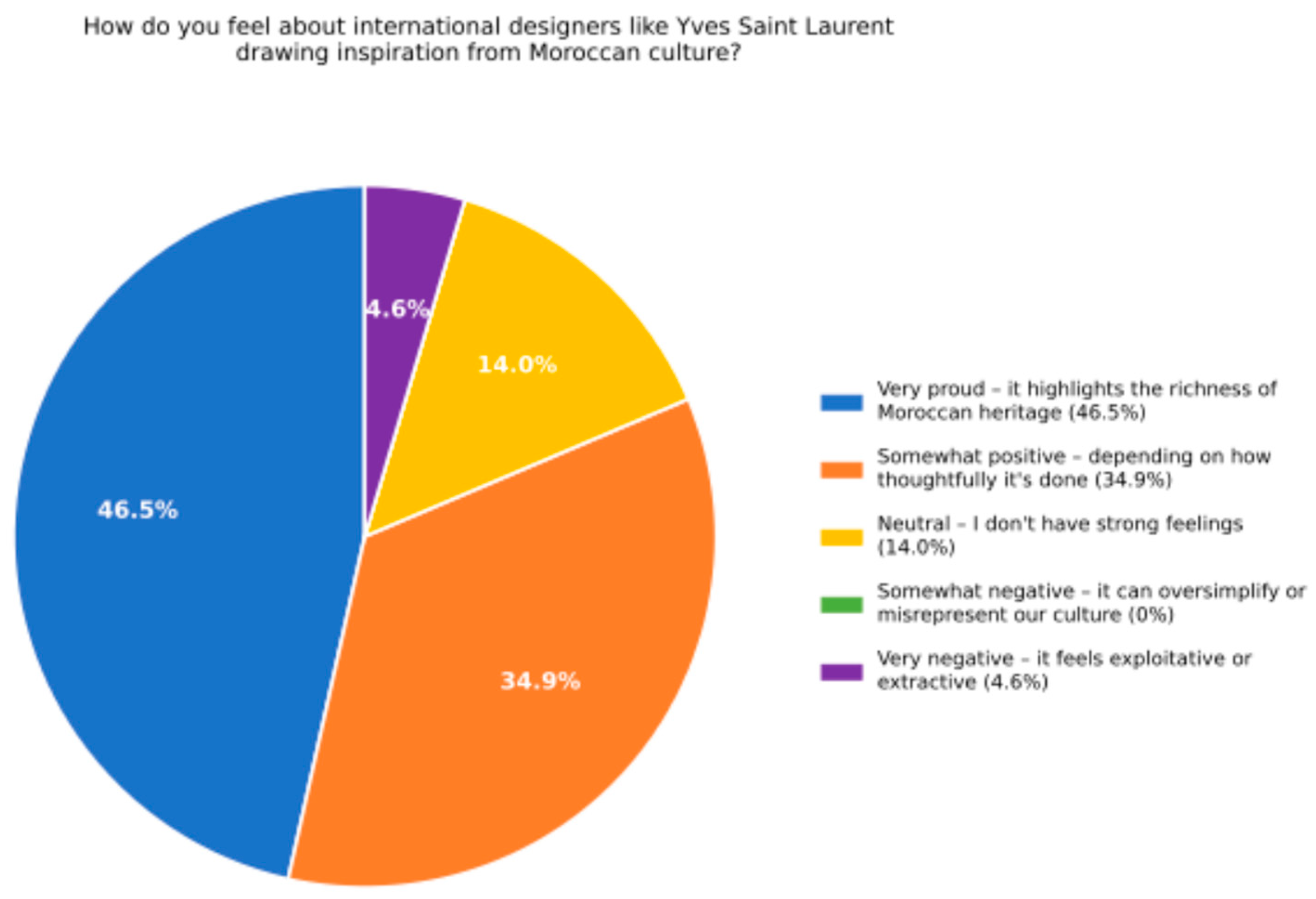
The survey results (Figure 1) reveal a complex and nuanced Moroccan response to Yves Saint Laurent’s engagement with Moroccan culture, characterized by a dynamic interplay between pride, appreciation, and critical ambivalence. A large majority of respondents expressed great pride in his incorporation of Moroccan aesthetics, viewing it as a symbolic affirmation of Morocco’s cultural richness and a form of recognition within global fashion systems traditionally led by Western narratives.
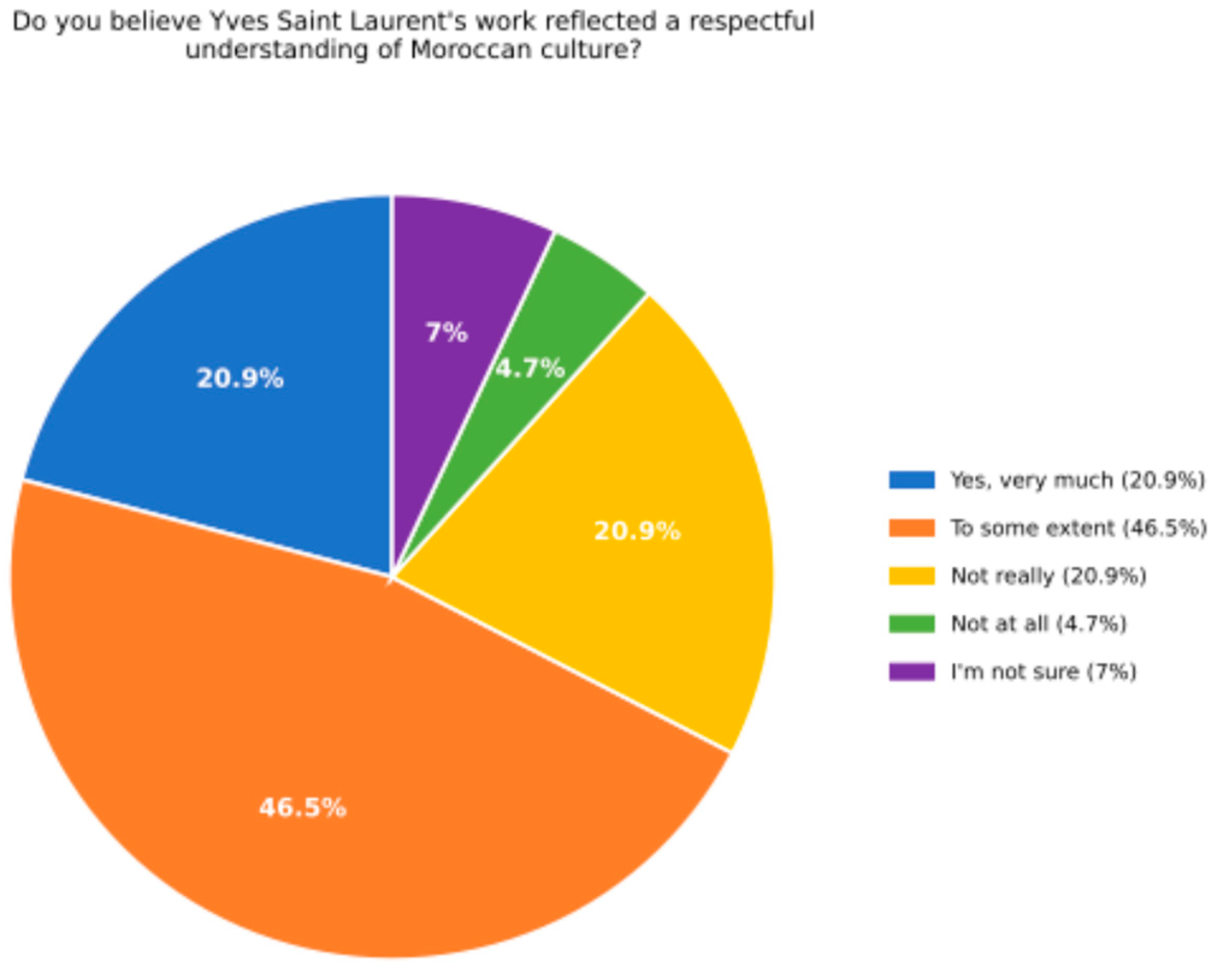
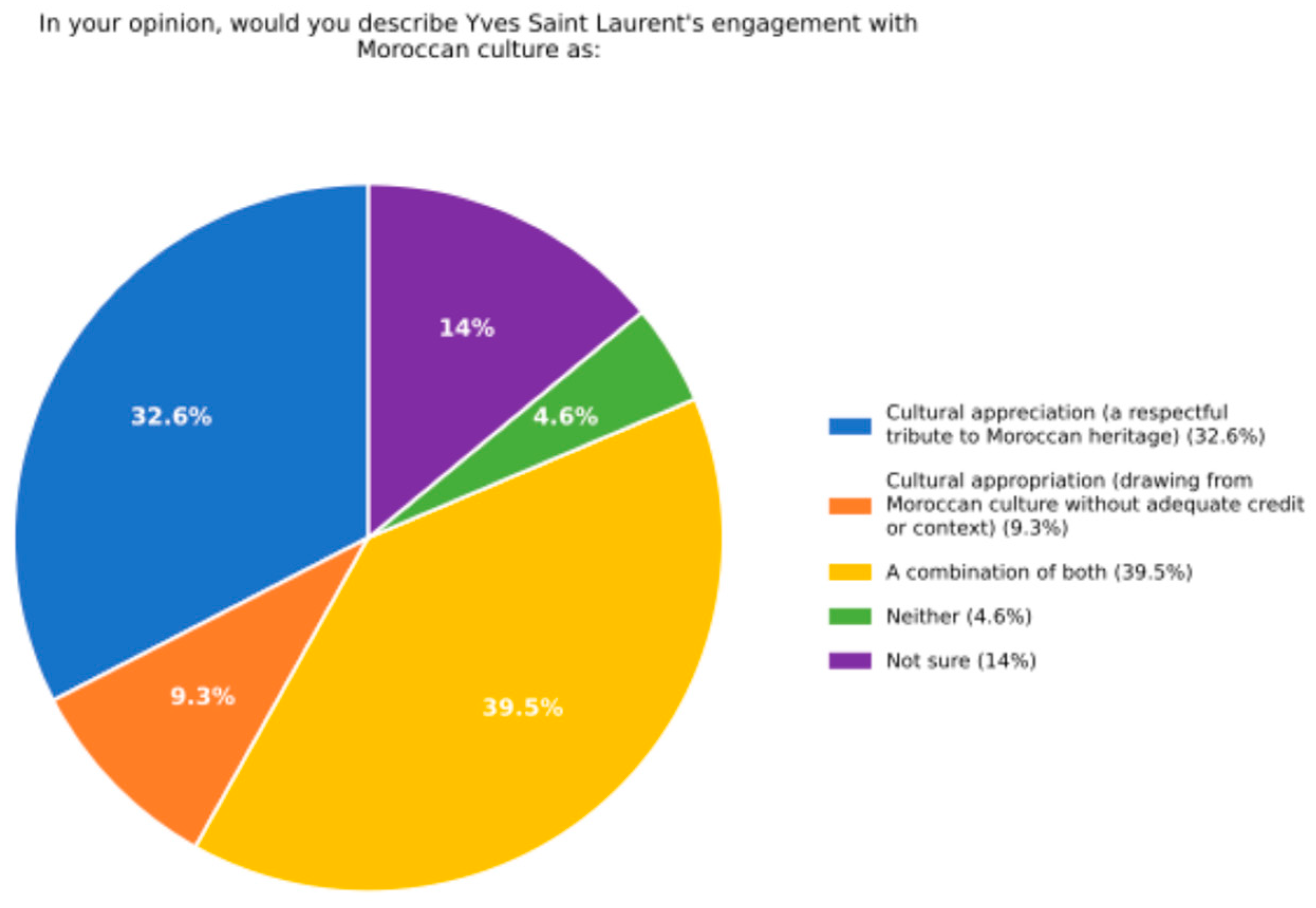
However, this positive view was balanced by concerns about the depth and limits of Saint Laurent’s cultural involvement (Figure 2), with many participants suggesting that his understanding of Moroccan culture was partial and unable to fully capture its complexity. Furthermore, the responses presented reveal a complex and ambivalent evaluative landscape rather than a unified consensus (Figure 3). Although a significant portion of respondents described Saint Laurent’s engagement with Moroccan culture as a form of cultural appreciation, the most prominent position framed his work as occupying a space between admiration and exploitation. Many participants acknowledged his long-term personal connection to Morocco and his visible admiration for its aesthetic traditions, while simultaneously expressing reservations about the structural inequalities that shape cultural translation within Western haute couture. A smaller but notable group characterized his engagement more critically as cultural appropriation, pointing to concerns related to decontextualization, commercialization, and the persistence of postcolonial hierarchies. Moreover, the responses highlight that this sense of pride is primarily rooted in the global visibility Saint Laurent afforded Moroccan aesthetics and his overt public crediting of the country as a primary influence. For many respondents, his decades-long residence in Marrakech distinguishes his work from superficial commercial trends, framing it instead as a product of genuine, sustained cultural engagement.
Among the various responses identified in the survey, the recurring expression of pride merits particular analytical attention. While this pride initially seems to signal cultural visibility and global recognition, a closer look reveals a far more complex emotional landscape shaped by the lasting effects of colonialism. The pride expressed by many respondents often depends on Western validation: the belief that Moroccan aesthetics gain legitimacy when endorsed or made fashionable by a European couturier. This ambivalence aligns with what postcolonial theorists call internalized coloniality, a persistent psychological consequence of colonial rule. Colonial power did not just conquer territories; it imposed a gaze that influenced how colonized subjects perceived themselves. Through schooling, cultural policies, and representations, colonial authorities spread the idea of European cultural superiority, fostering an internalized sense of inferiority among colonized populations (Memmi 1991). Therefore, the pride seen in the survey may reflect both genuine admiration and a historically conditioned desire for Western approval rooted in long-standing power imbalances.


4. Conclusions

The objective of this research is not to definitively determine whether Yves Saint Laurent’s work constitutes cultural appropriation or appreciation, but rather to place it along a spectrum that spans between the two. When exploring the French designer’s relationship with Moroccan culture, his creative practice cannot be easily labeled as appropriation in the contemporary sense. To condemn or absolve it entirely would be to misrepresent the very complexity this study has sought to illuminate. It was rooted in long-term personal engagement and a genuine affinity with Moroccan culture, reflecting a process of maturation and internal development rather than superficial borrowing or fabrication. His references were often subtle, layered, and not immediately obvious to viewers, though this subtlety does not in itself diminish the structural inequalities through which they operated. Biographical research into Saint Laurent’s identity, his experiences living in Morocco, and his ongoing efforts to become part of its cultural fabric also contribute to complicating such claims: extended stays in Marrakech, lasting social and professional ties, and support for local cultural sites and collections indicate a situated engagement that nonetheless remained embedded within asymmetrical systems of cultural power. Nevertheless, his work cannot be fully understood as pure appreciation either, given the enduring complexities of colonial legacies. These forces are embedded in the broader historical relationship between France and Morocco, shaped by decades of political dominance, economic reliance, and cultural hierarchies established under colonial rule. Even when an individual act of borrowing or reinterpretation is based on admiration, it remains entangled in power structures that give the Western designer more visibility, authority, and legitimacy than the culture from which inspiration is drawn. Additionally, this process of aesthetic reinterpretation can displace Moroccan cultural expressions from the spiritual and social worlds that give them coherence. Forms of dress that once operated within systems of religious discipline, communal belonging, and moral symbolism may, within the framework of Western haute couture, be recoded primarily as stylistic innovation or artistic signature. In this shift, garments risk losing their embeddedness in lived traditions, as their sacred, historical, and ethical dimensions become secondary to their visual and commercial appeal.
In Saint Laurent’s case, the prestige of the Parisian haute couture system amplified his Moroccan-inspired creations in ways Moroccan artisans or designers rarely achieved on their own. This imbalance is not necessarily driven by deliberate exploitation by Saint Laurent, but rather a result of systemic conditions produced by colonial histories and sustained by global fashion networks. Therefore, while his personal connection to Morocco may have been genuine and heartfelt, it cannot be separated from the larger cultural framework in which Western appropriation of non-Western forms has often been normalized, celebrated, and commercialized. These layered dynamics make it difficult to classify his work solely as appropriation or appreciation. This is what I propose to call unequal appreciation: a condition in which genuine admiration and sustained cultural engagement coexist with inherited hierarchies that shape how creativity is credited, circulated, and rewarded, without those hierarchies ever being fully dissolved by the sincerity of the exchange. For this reason, I present appropriation and appreciation as a spectrum rather than as absolute binaries. The binary assumes that the meaning of a cultural reference remains fixed, that intention aligns precisely with impact, and that power functions uniformly across different contexts. None of these assumptions holds. Meanings shift as objects and motifs travel between creators, markets, and audiences; intentions are often mixed, blending admiration, ambition, and aesthetic curiosity; and power is unevenly distributed over time and institutions. A spectrum captures this instability without reducing it to relativism. It enables analysis to recognize degrees of proximity, reciprocity, attribution, and benefit; to consider how techniques and symbols are framed and contextualized; and to trace how gatekeeping institutions amplify some translations while silencing others. Importantly, the spectrum is not a moral excuse but an analytical tool: it acknowledges that the same practice can be both appreciative and extractive in its effects, and that its position can change as new collaborations develop, sources are revealed, or as originating communities articulate responses. Therefore, a spectrum resists the false conclusion of verdicts that are final. It keeps analysis focused on temporality—how long a designer engages with a culture; on positionality—who has the authority to narrate and profit from the translation; and on afterlives—how the work is archived, taught, and included in canon. By emphasizing these relational and institutional dimensions, the spectrum enables us to differentiate between an aesthetic that merely stages otherness and one that is accountable to the people and practices it borrows from.
Yet perhaps the most thought-provoking question this study can raise is whether the direction of cultural attribution itself might be challenged. Rather than only asking what Saint Laurent extracted from Morocco, one might ask the opposite: could his prolonged and transformative immersion in Moroccan culture be understood, at least partially, as Morocco shaping and claiming him? His decades in Marrakech, his deep entanglement with its visual language, his friendships with Moroccan cultural figures, and the degree to which that environment became inseparable from his creative output, all raise the possibility that Saint Laurent did not simply borrow from Morocco—but that Morocco, in some sense, produced him. If authorship is understood as something formed through sustained cultural encounter rather than fixed by nationality or institutional affiliation, then Saint Laurent’s creative identity might be as much Moroccan as it is French, and the boundaries between “the designer who borrows” and “the culture that is borrowed from” become considerably less stable.
This, however, remains a deliberately provocative thought experiment rather than a claim to symmetry. Within the structural realities of global fashion, such a reversal cannot be taken literally: Morocco holds no institutional power to formally claim Saint Laurent’s legacy, and the economic and cultural capital generated by his work remained firmly within Parisian systems, rarely returning to the communities that nourished it. Yet the provocation is precisely its value—it exposes how deeply one-directional our assumptions about cultural influence tend to be and how the postcolonial framework itself may struggle to account for exchanges that are genuinely, if unequally, transformative in both directions. Whether Saint Laurent should be read as a Western designer who drew from Morocco, or as a creative figure partially made by Morocco yet celebrated exclusively within Western institutions, may ultimately be an unanswerable question—but it is one worth sitting with, as it reveals just how inadequate our existing categories remain when confronted with the true complexity of cultural entanglement.

Funding

This research received no external fundings.

Institutional Review Board Statement

This study was based on an anonymous voluntary survey. No personally identifiable information, special category data, or sensitive demographic information was collected from participants. Participants were informed about the purpose and nature of the research before participation, and participation was entirely voluntary. As the study did not involve the processing of personal data within the meaning of Regulation (EU) 2016/679 (GDPR), and did not include clinical, biomedical, or otherwise sensitive human-subject research procedures, formal ethical committee approval was not required under the applicable institutional and national research guidelines.

Informed Consent Statement

Participation in this study was voluntary, and all respondents were informed about the aims and nature of the research before completing the survey. The questionnaire was conducted anonymously, and no personally identifiable information was collected from participants.

Data Availability Statement

Data sharing is not applicable.

Conflicts of Interest

The author declares no conflict of interest.

Note

1
The visual analysis developed in this section was conducted through direct examination of Saint Laurent’s haute couture garments and archival collection imagery. The reproduction of comparative visual documentation could not be secured within the scope of this publication due to copyright restrictions governing both the fashion archive materials and the documentary photographs of traditional Moroccan garments consulted during the research process. Readers are encouraged to refer to the holdings of the Musée Yves Saint Laurent Marrakech and the Musée Yves Saint Laurent Paris, as well as to published catalogues of the designer’s work, for visual documentation of the collections discussed.

References

  1. Baxter-Wright, Emma. 2023. Yves Saint Laurent. La storia del celebre stilista. Translated by Laura Bernaschi. Pozzolengo: Il Castello, p. 133. [Google Scholar]
  2. Becker, Cynthia J. 2006. Amazigh Arts in Morocco: Women Shaping Berber Identity. Austin: University of Texas Press. Available online: https://ia903208.us.archive.org/6/items/AmazighArtsInMorocco/Cynthia%20J.%20Becke%20-%20Amazigh%20Arts%20in%20Morocco.pdf (accessed on 15 August 2025).
  3. Bhabha, Homi K. 1994. The Location of Culture. London: Routledge. [Google Scholar]
  4. Burney, Shehla. 2012. Orientalism: The Making of the Other. In Pedagogy of the Other: Edward Said, Postcolonial Theory, and Strategies for Critique. New York: Peter Lang, pp. 23–39. [Google Scholar]
  5. Cambridge Dictionary. n.d. Cultural Appropriation. Cambridge: Cambridge University Press. Available online: https://dictionary.cambridge.org/dictionary/english/cultural-appropriation (accessed on 19 April 2026).
  6. Columpar, Corinn. 2002. The Gaze as Theoretical Touchstone: The Intersection of Film Studies, Feminist Theory, and Postcolonial Theory. Women’s Studies Quarterly 30: 25–44. [Google Scholar]
  7. Crane, Diana. 2000. Fashion and Its Social Agendas: Class, Gender, and Identity in Clothing. Chicago: University of Chicago Press. [Google Scholar]
  8. de Sousa Santos, Boaventura. 2002. Para uma Sociologia das Ausências e uma Sociologia das Emergências. Revista Crítica de Ciências Sociais 63: 237–80. Available online: https://journals.openedition.org/rccs/1285 (accessed on 17 April 2026). [CrossRef]
  9. Ding, Chen, Nor Atiah Ismail, Mohd Kher Hussein, and Norhuzailin Hussain. 2025. A systematic review of traditional handicrafts preservation toward sustainable intangible cultural heritage. SAGE Open 15: 1–15. [Google Scholar] [CrossRef]
  10. El Guindi, Fadwa. 1999. Veil: Modesty, Privacy and Resistance. Oxford and New York: Berg. [Google Scholar]
  11. Fondation Pierre Bergé—Yves Saint Laurent. n.d. About the Fondation. Musée Yves Saint Laurent Paris. Available online: https://museeyslparis.com/fondation (accessed on 15 August 2025).
  12. Geczy, Adam. 2013. Fashion and Orientalism: Dress, Textiles and Culture from the 17th to the 21st Century. London: Bloomsbury Academic. [Google Scholar]
  13. Jamaluddin, Aqilah. 2024. A Tale of Love and Legacy: How Morocco Influenced Yves Saint Laurent’s Life. GCC Media. April 6. Available online: https://gccmedia.co/culture/how-morocco-influenced-yves-saint-laurents-life/ (accessed on 13 August 2025).
  14. Jansen, Maria Angela. 2005. Keswa Kebira: The Grand Costume. Khilʿa Journal for Dress and Textiles of the Islamic World 1: 79–105. [Google Scholar]
  15. Jansen, Maria Angela. 2015. Moroccan Fashion: Design, Tradition and Modernity. London: Bloomsbury Academic, pp. 39–40. [Google Scholar]
  16. Koehler, Jeff. 2021. The North African Eye of Yves Saint Laurent. AramcoWorld. July 1. Available online: https://www.aramcoworld.com/articles/2021/the-north-african-eye-of-yves-saint-laurent (accessed on 18 August 2025).
  17. Kwon, Yoo Jin, and Min-Ja Kim. 2011. Orientalism in Fashion. Paideusis—Journal for Interdisciplinary and Cross-Cultural Studies 5: B1–B18. [Google Scholar]
  18. Ling, Wessie, Lorusso Mariella, and Segre Reinach Simona. 2019. Critical studies in global fashion. ZoneModa Journal 9: V–XV. [Google Scholar] [CrossRef]
  19. Lorusso, Mariella. 2019. The Global ‘Wordrobe’: Ethnic counter-conquest in the language of fashion (p. 93). ZoneModa Journal 9: 89–102. [Google Scholar] [CrossRef]
  20. Mahmood, Saba. 2005. Politics of Piety: The Islamic Revival and the Feminist Subject. Princeton: Princeton University Press. [Google Scholar]
  21. Memmi, Albert. 1991. The Colonizer and the Colonized. Boston: Beacon Press. [Google Scholar]
  22. Mignolo, Walter. 2011. Epistemic Disobedience and the Decolonial Option: A Manifesto. Transmodernity: Journal of Peripheral Cultural Production of the Luso-Hispanic World 1: 44–66. [Google Scholar] [CrossRef]
  23. Musée Yves Saint Laurent Marrakech. n.d. Une amitié marocaine—Tamy Tazi—Fernando Sanchez—Yves Saint Laurent [Exhibition information]. Available online: https://www.museeyslmarrakech.com/en/_expositions/une-amitie-marocaine/ (accessed on 12 August 2025).
  24. Ngũgĩ wa Thiong’o. 1986. Decolonising the Mind: The Politics of Language in African Literature. London: James Currey. [Google Scholar]
  25. Palmer, Alexandra. 2001. Couture and Commerce: The Transatlantic Fashion Trade in the 1950s. Oakland: Berg Publishers. [Google Scholar]
  26. Piancazzo, Flavia. 2024. Analisi dell’eurocentrismo nella moda: Tra appropriazione, stereotipi e nuove progettualità. Doctoral dissertation, Università degli Studi di Bologna, Bologna, Italy; p. 9. [Google Scholar]
  27. Quijano, Aníbal. 2000. Coloniality of Power, Eurocentrism, and Latin America. In Nepantla: Views from South. Durham: Duke University Press, vol. 1, pp. 533–80. [Google Scholar]
  28. Raustiala, Kal, and Christopher Jon Sprigman. 2025. Culture Appropriation and the Global Fashion Industry. In Fashion and Intellectual Property. Edited by David Tan, Jeanne Fromer and Dev Gangjee. Cambridge: Cambridge University Press. [Google Scholar] [CrossRef]
  29. Smith, Linda Tuhiwai. 2012. Decolonizing Methodologies: Research and Indigenous Peoples, 2nd ed. London: Zed Books. [Google Scholar]
  30. Spivak, Gayatri Chakravorty. 1988. Can the subaltern speak? In Marxism and the Interpretation of Culture. Edited by Cary Nelson and Lawrence Grossberg. Basingstoke: Macmillan Education, pp. 271–313. [Google Scholar]
  31. Tilt, David. 2021. Understanding the role of “the city” in developing complex regulatory frameworks: The case study of haute couture. GLSA Research Series 1: 1–24. [Google Scholar] [CrossRef]
  32. UNESCO. 2025. Moroccan Caftan: Art, Traditions and Skills. Available online: https://ich.unesco.org/en/RL/moroccan-caftan-art-traditions-and-skills-02077 (accessed on 17 April 2026).
  33. United Nations. 2007. United Nations Declaration on the Rights of Indigenous Peoples. Available online: https://www.un.org/development/desa/indigenouspeoples/wp-content/uploads/sites/19/2018/11/UNDRIP_E_web.pdf (accessed on 17 April 2026).
  34. Vézina, Brigitte. 2019. Curbing Cultural Appropriation in the Fashion Industry. Waterloo: Centre for International Governance Innovation. [Google Scholar]
  35. Weekly L’Economiste. 2024. 1.2 Million Visitors to the Majorelle Garden. March 28. Available online: https://weekly.leconomiste.com/1-2-million-visitors-to-the-majorelle-garden/ (accessed on 2 September 2025).
  36. World Intellectual Property Organization. 2020. What Is Intellectual Property? Available online: https://www.wipo.int/edocs/pubdocs/en/wipo_pub_450_2020.pdf (accessed on 17 April 2026).
Figure 1. Distribution of responses regarding perceptions of international designers, including Yves Saint Laurent, drawing inspiration from Moroccan culture (n = 43).
Religions 17 00606 g001
Figure 2. Distribution of responses regarding whether Yves Saint Laurent’s work reflected a respectful understanding of Moroccan culture (n = 43).
Religions 17 00606 g002
Figure 3. Distribution of responses regarding the description of Yves Saint Laurent’s engagement with Moroccan culture (n = 43).
Religions 17 00606 g003
Disclaimer/Publisher’s Note: The statements, opinions and data contained in all publications are solely those of the individual author(s) and contributor(s) and not of MDPI and/or the editor(s). MDPI and/or the editor(s) disclaim responsibility for any injury to people or property resulting from any ideas, methods, instructions or products referred to in the content.