1. Introduction
Contemporary religious tourism constitutes one of the most dynamic forms of cultural and spiritual mobility, encompassing both traditional pilgrimages and more broadly understood journeys motivated by the search for meaning, the experience of the sacred, or engagement with religious heritage (
Timothy and Olsen 2006;
Raj and Griffin 2015). Under conditions of globalization, the intensification of tourist flows, and the growing commodification of cultural spaces, sacred sites increasingly function simultaneously as spaces of worship, heritage, and the consumption of experiences (
Jackson and Henrie 1983;
Olsen 2019;
Liutikas 2023;
Aulet 2024). On the one hand, this generates economic benefits and supports regional revitalization; on the other, it gives rise to tensions between religious and touristic functions, between the rhythm of liturgical life and the seasonality of visitor flows, and between communities of faith and the global tourism market.
Previous research on religious tourism has focused primarily on the motivations of pilgrims and tourists (e.g.,
Blackwell 2010;
Olsen 2014), the management of shrines and pilgrimage routes (
Shackley 2001;
Lois-González and Santos 2015), as well as on issues related to the authenticity of religious experience (
Belhassen et al. 2008;
Ning 2017). The literature emphasizes that pilgrimage space constitutes a site of negotiated meanings, in which diverse groups of actors: believers, tourists, local communities, ecclesiastical institutions, and commercial stakeholders, both co-create and contest its significance (
Eade and Sallnow 2000). At the same time, the development of the sustainable tourism paradigm has introduced questions of environmental and socio-cultural responsibility into the discussion (
Butler 2018), highlighting the need to protect both tangible and intangible heritage and to mitigate the negative consequences of excessive touristification.
However, despite the growing amount of research on sustainable religious tourism, the dimension of the spiritual integrity of sacred places remains relatively underoperationalized. While the literature addresses issues of heritage protection, authenticity, and community participation, it less frequently examines how tourism affects the very quality of the experience of the sacred and the capacity of religious communities to sustain the practices and meanings that constitute a site as holy (
Olsen 2019). In this context, the classical sustainability model, focused primarily on minimizing negative impacts, proves insufficient, as it fails to account for the relational and axiological character of sacred space. A response to these limitations may be found in the emerging paradigm of regenerative tourism, which shifts the emphasis from harm reduction to the restoration and strengthening of relationships among place, community, and visitors (
Dredge 2022;
Bellato et al. 2023). From a regenerative perspective, a place is not merely a resource to be managed, but a living relational system in which cultural and spiritual values constitute an integral component of sustainability. Such an approach resonates with relational theories of space and religion (
Knott 2015;
Kong 2010), which emphasize that the sacred is not simply an attribute of an object, but the outcome of practices, narratives, and communal interactions.
This proposal adopts the assumption that a key condition for integrating the regenerative approach with religious tourism is the conceptualization of the category of “religious sensitivity.” It is proposed to understand this concept as the capacity of tourism management systems, interpretative practices, and visitor behaviours to recognize, respect, and reinforce the sacred significance of a place and its cultic function. Religious sensitivity thus extends beyond general cultural sensitivity, referring directly to the ontological and axiological status of sacred space.
The aim of this article is therefore threefold: (1) to conceptualize religious sensitivity as both a normative and analytical category; (2) to demonstrate how the paradigm of regenerative tourism may support the spiritual integrity of sacred sites; and (3) to propose a theoretical model integrating these two approaches. Accordingly, the following research questions are formulated: How can religious sensitivity be defined and operationalized in the context of tourism? In what ways does the regenerative approach differ from the sustainability model with respect to sacred spaces? What conditions foster the preservation of the spiritual integrity of holy places under increasing tourism pressure?
The paper is based on an interdisciplinary analysis of literature in religious studies, the geography of religion, and tourism studies, as well as on a comparative analysis of selected sacred sites that simultaneously function as tourist destinations. The adopted perspective is conceptual and interpretative in nature, aiming to develop a theoretical model that may serve as a foundation for further empirical research.
Theoretical Positioning and Conceptual Contribution
Building upon the preceding discussion of the tensions inherent in contemporary religious tourism and the limitations of the sustainability paradigm, it becomes necessary to more precisely position the theoretical contribution of the present study. While the literature on religious tourism, sacred space, and sustainability has developed significantly in recent years, it remains characterized by a certain degree of fragmentation, particularly regarding the integration of relational, spiritual, and systemic perspectives.
Research in religious tourism has increasingly moved beyond descriptive accounts of pilgrimage flows and motivations toward more interpretative approaches that emphasize meaning-making, embodiment, and the experiential dimensions of the sacred (
Olsen 2019;
Liutikas 2023;
Kong 2024). At the same time, the geography of religion has undergone a “relational turn,” highlighting that sacred space is not an inherent property of a location, but rather emerges through interactions among practices, narratives, material settings, and communities (
Knott 2015;
Trono 2021;
Kong 2010,
2024). These perspectives converge in the recognition that the sacred is dynamically produced and negotiated, rather than statically given.
However, despite these advances, the application of relational thinking within tourism studies (particularly in the context of sacred destinations) remains limited. Much of the existing literature continues to rely on binary distinctions, such as pilgrim vs. tourist or sacred vs. secular (
Raj and Griffin 2015;
Olsen 2019;
Roszak 2023;
Andrade Suárez et al. 2024), which tend to oversimplify the complex and hybrid character of contemporary spiritual mobility. Moreover, research on the impacts of tourism on sacred sites has predominantly focused on issues such as commodification, authenticity, and visitor management, often conceptualized in terms of external pressures acting upon a site. Such approaches, while valuable, do not fully capture how tourism may influence the ongoing reproduction of sacred meanings and ritual practices.
The emergence of the regenerative tourism paradigm introduces a significant shift in how tourism-place relationships are conceptualized. Moving beyond the logic of impact mitigation, regenerative tourism emphasizes the restoration and strengthening of socio-ecological systems, framing destinations as relational entities characterized by interdependence and adaptive capacity (
Dredge 2022;
Bellato et al. 2023;
Dhan Gahalot and Gupta 2025;
Bellato 2025). This perspective resonates with relational theories of space and aligns with calls for more holistic and value-oriented approaches to tourism development. Nevertheless, the application of regenerative thinking to religious tourism remains insufficiently developed. Existing frameworks tend to prioritize environmental and community regeneration, while the spiritual and ontological dimensions of sacred space receive comparatively little attention (
Cheer et al. 2017;
Olsen 2019;
Aulet 2024). In particular, the question of how tourism contributes to either the regeneration or erosion of sacred meaning, understood as a relational and practice-based phenomenon, has not yet been systematically addressed.
At the same time, the growing popularity of regenerative tourism has also generated important critical reflections. Several scholars caution that regeneration risks becoming a normative and fashionable label if not accompanied by structural change in governance, resource distribution, and local participation (
Dredge 2022;
Bellato et al. 2023;
Bellato and Pollock 2025). In this sense, regenerative discourse may reproduce earlier limitations of sustainability rhetoric, where ambitious values coexist with conventional growth-oriented tourism practices. From a critical perspective, the concept is sometimes criticized for conceptual ambiguity and for the lack of clear indicators allowing empirical verification of whether destinations are truly being “regenerated” rather than merely rebranded (
Hussain and Haley 2022). Questions therefore emerge concerning who defines regeneration, who benefits from it, and whether local communities possess genuine decision-making power in such processes. These concerns are particularly relevant in sacred destinations. In religious contexts, regeneration cannot be reduced to environmental renewal, improved visitor experiences, or economic revitalization alone. If tourism simultaneously weakens ritual life, marginalizes faith communities, or transforms sacred narratives into marketable experiences, claims of regeneration remain questionable. Consequently, the regenerative paradigm requires complementary ethical and cultural criteria capable of assessing the quality of relationships between tourism and the sacred.
For this reason, the present study argues that religious sensitivity provides a necessary critical lens for regenerative tourism. It helps distinguish between superficial regenerative branding and processes that genuinely strengthen the spiritual, communal, spatial, and interpretative integrity of sacred places. It also introduces the concept of religious sensitivity as a bridging analytical category that connects relational theories of sacred space with the normative orientation of regenerative tourism. Religious sensitivity is understood not merely as an ethical disposition or form of cultural awareness, but as a multi-dimensional capacity embedded in tourism systems, encompassing governance structures, spatial organization, interpretative practices, and visitor behaviour (
Sharma 2019;
Huang and Pearce 2019). This reconceptualization allows for a shift in analytical focus from the management of impacts to the quality of relationships that sustain the sacred character of place.
Adopting this perspective entails a fundamental redefinition of sacred tourism space interactions. Rather than treating tourism as an external force acting upon a passive site, the present study approaches sacred space as co-constituted through tourism-related practices, alongside religious rituals, community life, and symbolic narratives (
Mankowski and Rappaport 2000;
Eade and Sallnow 2000;
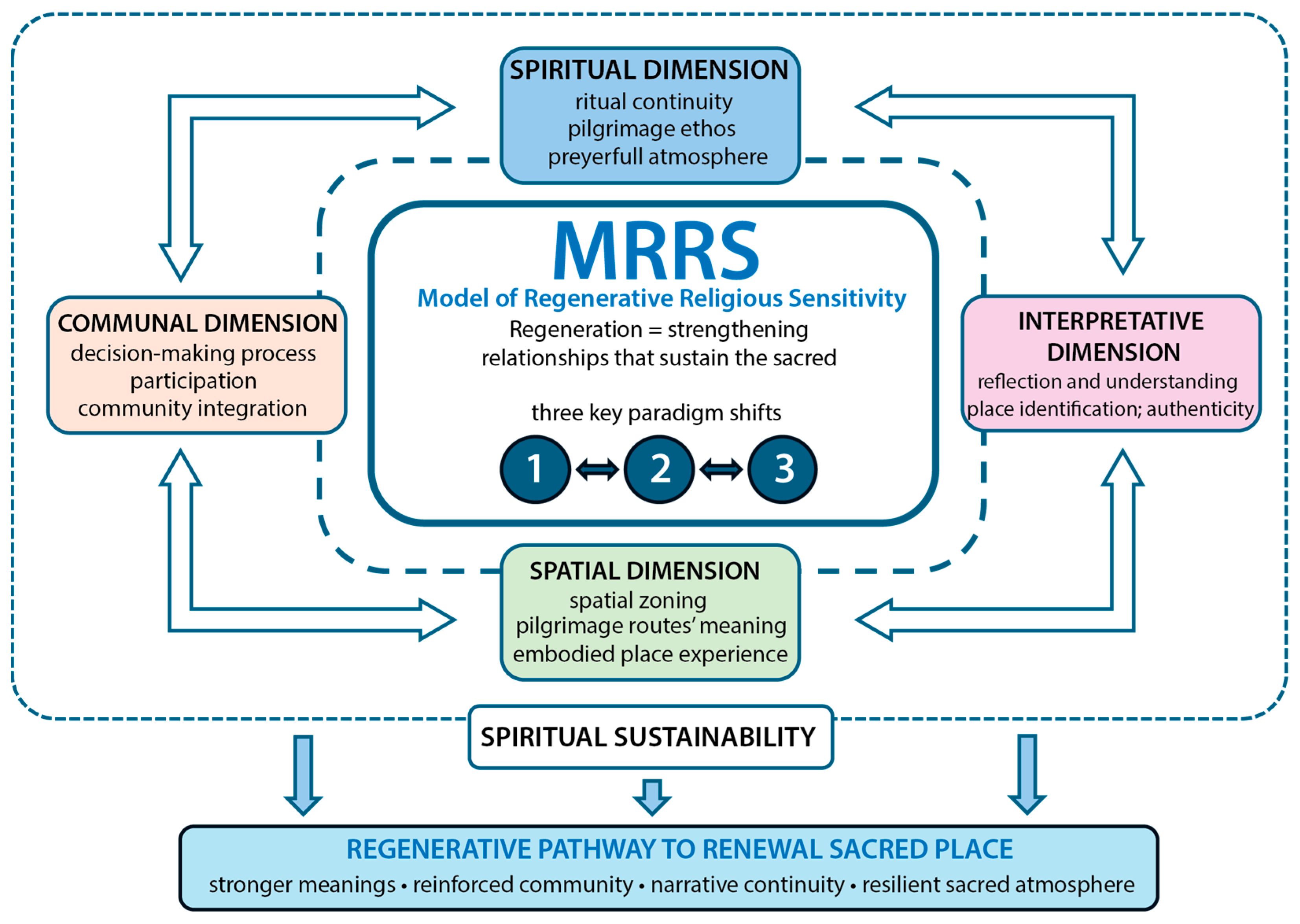
Knott 2015). Consequently, the key analytical question is not whether tourism harms or preserves a site, but whether it contributes to the regeneration or erosion of relational integrity, understood as the alignment between spiritual meanings, communal practices, and spatial arrangements. The Model of Regenerative Religious Sensitivity (MRRS), proposed in this article, operationalizes this perspective by identifying four interrelated dimensions: spiritual, communal, spatial, and interpretative that together determine the capacity of a sacred site to sustain its meaning under conditions of tourism pressure. While each of these dimensions has been addressed separately in previous research, their integration into a coherent relational framework represents a distinct contribution. In this sense, the theoretical contribution of the present study lies not only in the development of the MRRS model, but also in the reframing of the relationship between tourism and the sacred. By situating religious sensitivity at the intersection of relational ontology and regenerative practice, the article provides a conceptual framework that is both analytically robust and applicable to the management of sacred destinations. It thus contributes to ongoing debates on the future of religious tourism in contexts of intensifying global mobility and cultural diversification.
2. Materials and Methods
This study adopts a qualitative, theory-building research design, combining elements of conceptual analysis with an exploratory case study approach. The methodological framework is grounded in interpretative social science traditions, particularly those applied in human geography and religious studies (
Knott 2015;
Kong 2010), where the objective is not hypothesis testing, but the development of analytically robust conceptual models.
The research proceeds in three interrelated stages:
Systematic literature review—focusing on three domains: (a) religious tourism and pilgrimage studies, (b) sustainable and regenerative tourism and (c) theories of sacred space and spatial relationality. The literature review was conducted between January and March 2026 using the Scopus and Web of Science databases. Search strings combined terms such as “religious tourism”, “pilgrimage”, “sacred space”, “spiritual sustainability”, “regenerative tourism”, and “sacred heritage”. Only peer-reviewed journal articles, academic books, and edited volume chapters published in English were considered. Priority was given to publications issued after 2010, although selected earlier foundational works were retained where theoretically necessary (e.g.,
Olsen 2019;
Bellato et al. 2023).
The initial search produced a broad corpus of sources, which was subsequently refined through relevance screening based on three criteria: (1) direct engagement with tourism in sacred or pilgrimage contexts; (2) conceptual relevance to sustainability, regeneration, or relational theories of place; and (3) scholarly influence and citation recognition within the field. Duplicate, purely descriptive, or weakly related sources were excluded. The final selection was intended to ensure both conceptual breadth and analytical relevance rather than statistical exhaustiveness.
Conceptual synthesis, involving the identification of key analytical gaps and the construction of the category of “religious sensitivity” as a bridging concept. This stage follows an abductive logic, where theoretical insights are iteratively refined through engagement with empirical examples (
Timmermans and Tavory 2012).
Comparative case-based interpretation, applied to the Way of St. Olav as an illustrative case. The Way of St. Olav was selected through purposive case selection as an analytically suitable example rather than a representative sample. Three criteria guided this choice: (1) the route simultaneously functions as a pilgrimage space, cultural heritage corridor, and tourism destination; (2) it demonstrates relatively balanced visitor intensity, allowing observation of management processes beyond overtourism contexts; and (3) it offers a well-documented example of the coexistence of spiritual practice, community participation, and transnational route governance. In methodological terms, the case was chosen for its heuristic value, enabling the exploration and operationalization of the proposed MRRS framework in a real-world setting (
Yin 2018).
The empirical layer of the study has been based on secondary data analysis, including academic publications, policy documents, and official materials related to the Way of St. Olav, as well as the author’s prior research and field experience related to pilgrimage routes in Scandinavia (
Duda 2016) and documented practices of route management and interpretation, including institutional frameworks and pilgrimage infrastructure. This triangulation enhances the analytical robustness of the case study by integrating theoretical insights with observed practices (
Denzin 2012).
The analysis employs a relational interpretative framework, in which sacred space is understood as a product of interactions among actors, practices, and narratives (
Knott 2015). The four dimensions of religious sensitivity (spiritual, communal, spatial, interpretative) are used as analytical categories to examine the extent to which tourism practices contribute to either the erosion or regeneration of sacred meaning. The study evaluates the quality of relationships and the coherence of meaning-making processes, aligning with the epistemological assumptions of regenerative tourism theory (
Dredge 2022;
Bellato et al. 2023).
5. Case Study: The Way of St. Olav as a Space for Operationalizing Religious Sensitivity and Implementing Regenerative Practices
The Way of St. Olav (St. Olavsleden) constitutes a network of pilgrimage routes of transnational character, extending across Scandinavia, leading to Nidaros Cathedral in Trondheim (Norway). The most prominent section, St. Olavsleden (approx. 580 km), traverses diverse cultural landscapes, from coastal zones and forested uplands to rural settlements shaped by centuries of agrarian practices, thereby embedding the pilgrimage experience within a multilayered geographical context (
Pettersson and Viken 2007;
Duda 2016). Beyond its physical dimension, the route operates as a “corridor of meanings,” where movement through space becomes simultaneously a process of engaging with history, identity, and spirituality. As argued by
Nilsson and Tesfahuney (
2016), contemporary Nordic pilgrimage routes, including the Way of St. Olav, should be understood as relational spaces in which mobility generates new forms of belonging and reinterprets cultural landscapes through embodied experience.
The cultural and symbolic significance of the route is intrinsically linked to the figure of Olaf II Haraldsson (c. 995–1030), king of Norway and a main agent in the Christianization process of the region, who was canonized shortly after his death at the Battle of Stiklestad. His cult rapidly spread across Northern Europe, making Nidaros one of the most important medieval pilgrimage centres in Scandinavia (
Bagge 2014;
Ekroll 2015). In contemporary interpretations of the route, St. Olav is presented in a multidimensional manner: as a historical ruler, a martyr and saint, but also as a symbolic figure mediating between past and present, religion and culture, and national and transnational identities. This polyvalent interpretation reflects broader trends in Scandinavian heritage discourse, where the saint is not reduced to a purely confessional figure but becomes part of an inclusive narrative framework that accommodates both religious pilgrims and secular walkers (
Olsen 2019;
Aulet and Duda 2020). Consequently, the Way of St. Olav functions not only as a significant cultural route in the sense of the Council of Europe but also as a living laboratory for examining how sacred heritage can be interpreted, negotiated, and regenerated within European societies.
The pilgrim route, leading to Nidaros Cathedral, represents an example of the contemporary reconstruction of a medieval pilgrimage route that simultaneously functions as a cultural tourism product, a space of spiritual mobility, and an instrument of regional development (
Duda 2016). Its cross-border character (Norway–Sweden), combined with a relatively moderate intensity of visitor flows, allows it to be analysed as a model space for negotiating relationships among the sacred, heritage, and tourism. Considering the preceding theoretical aspects, the St. Olav’s Way provides a compelling example of a transition from a sustainable model, focused on landscape and infrastructure protection, to a regenerative model oriented toward strengthening relationships and meanings.
5.1. Religious Sensitivity in Practice
The spiritual dimension is manifested in the maintenance of a clearly defined pilgrimage goal: Nidaros Cathedral as a site of worship and the place of the relics of St. Olav. Liturgical services organized for pilgrims, as well as rituals marking the completion of the journey, integrate the experience of walking with religious practice, thereby reinforcing the sacred core of the route. The touristic function does not dominate over the liturgical function within the cathedral space, which indicates the preservation of a hierarchy of meanings.
The communal dimension is visible in the involvement of parishes, volunteers, and local church institutions in sustaining the pilgrimage tradition. The relational character of the route, like, e.g., encounters with residents and accommodation in parish facilities, fosters the building of bonds and helps prevent the complete commodification of the experience.
The spatial dimension is realized through limited infrastructural intervention in the landscape and the preservation of the route’s clear symbolic markers. Minimalist signage and the absence of excessive development support experiences of silence and contemplation, which are crucial for the spiritual sustainability of the site.
The interpretative dimension consists of integrating historical and religious narratives. The figure of St. Olav is presented not merely as an element of heritage, but as a reference point for contemporary religious identity. Although the interpretative framework is inclusive in character, it retains explicit reference to the Christian roots of the route.
5.2. Elements of Sustainability and Regenerative Potential
The Way of St. Olav aligns with the model of sustainable tourism through its relatively low intensity of visitation, support for local communities, and limited environmental pressure. The dispersed character of the route contributes to the diversification of visitor flows, thereby minimizing overtourism phenomena typical of more mass-oriented pilgrimage destinations. However, in line with the argument developed in the second section, environmental and economic sustainability do not automatically guarantee the preservation of spiritual integrity. The most important is the way the route is interpreted and managed.
When analysing the Way through the lens of the transition from a sustainable to a regenerative model, the main issue is not the scale of tourist mobility, but the quality of the relationships that constitute the pilgrimage experience. The route may be understood as a relational system whose durability depends on its capacity to reproduce meanings, bonds, and practices. Its regenerative potential is revealed in three interconnected dimensions: transformational (individual), relational (communal), and narrative–identity-based (translocal).
The first dimension concerns the transformative potential of the walking experience itself. Pilgrimage, understood as a liminal process, leads to a temporary suspension of everyday social roles and opens a space for existential reflection. The literature emphasizes that the experience of the journey (the repetitive rhythm of walking, contact with nature, and physical effort) encourages introspection and the redefinition of values (
Belhassen et al. 2008;
Olsen 2014). In the context of the St. Olaf’s Way, however, this transformative quality need not be limited to traditional institutional religiosity. Even participants motivated by secular intentions may experience a process of “reorientation”: a strengthening of their sense of meaning, connection to the landscape, or awareness of their dependence on the environment and on others. Such experiences align with a regenerative understanding of tourism as a space for shaping attitudes and values, rather than consuming attractions. From the perspective of spiritual sustainability (see
Section 3.3), this transformative dimension has a dual significance. First, it strengthens the individual participant’s relationship with the dimension of the sacred. Second, it contributes to reinforcing the meaning of the place as a spiritual, rather than scenic, environment. Regeneration thus occurs at the subjective level: the participant does not simply make use of the route’s infrastructure but co-creates its significance through lived experience.
The second dimension of regenerative potential concerns the relationships between pilgrims and local communities. In contrast to the model of mass tourism, in which interactions tend to be transactional and short-lived, the Way of St. Olav fosters encounters of a more personal and dialogical character. Accommodation in small-scale facilities, the support of parishes and volunteers, and direct engagement with residents strengthen the communal dimension of the experience. Regeneration thus consists of reinforcing this network rather than protecting its material components. The route creates a space of exchange of experiences, narratives, and religious practices that may contribute to rebuilding social capital in small rural communities.
The third dimension relates to the role of the Way of St. Olav in constructing and renewing identity narratives at a transnational spatial scale. The figure of Saint Olav as a symbol of the Christianization of Scandinavia serves as a link between past and present, and between local communities and a shared European heritage. The route becomes a space in which history is not only reconstructed, but also reinterpreted and reactivated. From a regenerative perspective, it is important that this narrative is neither closed nor purely museal in character. Rather, it is “activated” by contemporary pilgrims who, through their journey, inscribe themselves into the continuity of tradition. Regeneration therefore occurs at the symbolic level: the route not only preserves heritage but gives it renewed life under changing social conditions.
The transboundary character of the Way of St. Olav further reinforces this dimension. The shared religious narrative of Norway and Sweden (as well as neighbouring countries such as Finland and parts of northern Germany and Poland) may be interpreted as contributing to the construction of a supranational community of memory and values. Regeneration thus extends beyond the local scale to encompass a broader cultural and religious context.
The analysis of the three dimensions of regenerative potential allows us to conclude that the Way of St. Olav’s functions as a system capable of restoring and strengthening relationships: between the individual and the sacred (transformational dimension), between the community and the pilgrim (relational dimension), and between history and the present (narrative–identity dimension). The Way thus illustrates that regeneration in religious tourism is a multi-layered process encompassing individual, social, and symbolic spheres alike. It is precisely within these relational and meaning-making domains that it is determined whether tourism becomes a factor of erosion or of renewal for sacred space.
7. Conclusions
Religious tourism today stands at a point of tension between commercialization and spirituality, between global mobility and local identity. The transition from a sustainable to a regenerative model requires a redefinition of responsibility, not as the technical control of flows, but as an ethical concern for the relationships that constitute the sacred.
The aim of this paper has been to propose a conceptual framework integrating the paradigm of regenerative tourism with research on religious tourism through the operationalization of the category of religious sensitivity. The point of departure was the identification of a research gap: although the literature on sustainable religious tourism is developing dynamically, it still insufficiently addresses the spiritual integrity of sacred sites as a central rather than peripheral category. Its primary objective has not been to provide statistically generalizable empirical findings, but to develop an analytically grounded framework that helps interpret the relationships between tourism, sacred space, and regenerative practice. In response, the Model of Regenerative Religious Sensitivity (MRRS) was proposed, combining four dimensions: spiritual, communal, spatial, and interpretative into a coherent analytical framework.
The theoretical analyses and case study allow us to return to the core problem formulated in the research questions presented in the Introduction. The first concerned the possibility of defining and operationalizing religious sensitivity in the context of tourism. The literature review and case analysis demonstrate that religious sensitivity may be understood as the capacity of management systems, interpretative practices, and visitor behaviours to recognize, respect, and reinforce the sacred significance of a place. Its operationalization is achievable through the identification of the four dimensions of the MRRS model. Religious sensitivity is therefore not merely a normative category but may serve as a diagnostic tool for assessing the degree to which tourism is integrated with the cultic function of space.
The second research question concerned the differences between the sustainable and regenerative approaches in relation to sacred sites. It has been demonstrated that the sustainable model focuses primarily on reducing negative impacts, e.g., environmental protection, flow control, and the minimization of conflicts. In the case of sacred spaces, such an approach is necessary, yet insufficient. The regenerative paradigm shifts the emphasis from resource protection to the strengthening of relationships and meanings. This implies that tourism may not only “do no harm,” but can actively support the spiritual sustainability of a site through community participation, responsible narrative framing, and the preservation of the sacred hierarchy of space.
The third question addressed the conditions that foster the preservation of the spiritual integrity of holy places under increasing tourism pressure. The analysis indicates that the following factors are of key importance: (1) the primacy of the religious function over the touristic one; (2) the genuine inclusion of the religious community in management processes; (3) the protection of the symbolic structure of space; and (4) interpretative practices that emphasize the living dimension of the sacred. The case study of the Way of St. Olav demonstrated that even with a moderate scale of visitation, the absence of a coherent narrative and community participation may lead to gradual secularization. Conversely, preserving the relational character of the experience fosters the regeneration of meanings.
Based on the analyses conducted, the final thesis of the article may be formulated as follows: religious tourism can become a factor in the regeneration of sacred spaces only when it is rooted in religious sensitivity understood as a systemic concern for the spiritual integrity of place. This implies that regeneration in religious tourism does not consist in increasing visitor numbers or expanding infrastructure, but in strengthening the relationships that constitute the sacred. Religious sensitivity thus represents a necessary condition for the transition from a model of defensive protection to one of relational renewal. Without it, even the most advanced strategies of sustainable management may result in the formal preservation of a site while simultaneously contributing to the erosion of its meaning. Ultimately, it is the quality of relationships among space, community, and visitors that determines whether tourism becomes a force of erosion or of renewal for sacred space.
The present study is conceptual and analytical in character, based on a review of the literature and selected case studies. Its limitation lies in the absence of extensive empirical research encompassing diverse cultural and religious contexts. The MRRS requires further validation through qualitative research (including stakeholder interviews and participant observation) as well as quantitative approaches (such as analyses of visitor and local community perceptions). In addition, the analysis has focused primarily on a Christian and European context. Future research should examine whether the proposed model is applicable to other religious traditions, where the relationship between tourism and the sacred may assume different normative and institutional forms.