Operationalizing Higher Ethical Objectives: Piety, Ethics, and Institutional Practice in Pakistan’s Islamic Financial Sector

Abstract
1. Introduction
- How do practitioners believe Islamic financial institutions are guided to achieve maqasid al Shariah?
- What are the constructs for operationalization of maqasid al Shariah at the level of industry?
2. Theoretical Background
2.1. Foundations of Maqasid al Shariah
2.2. Classical Era
2.3. Contemporary Research
3. Methodology
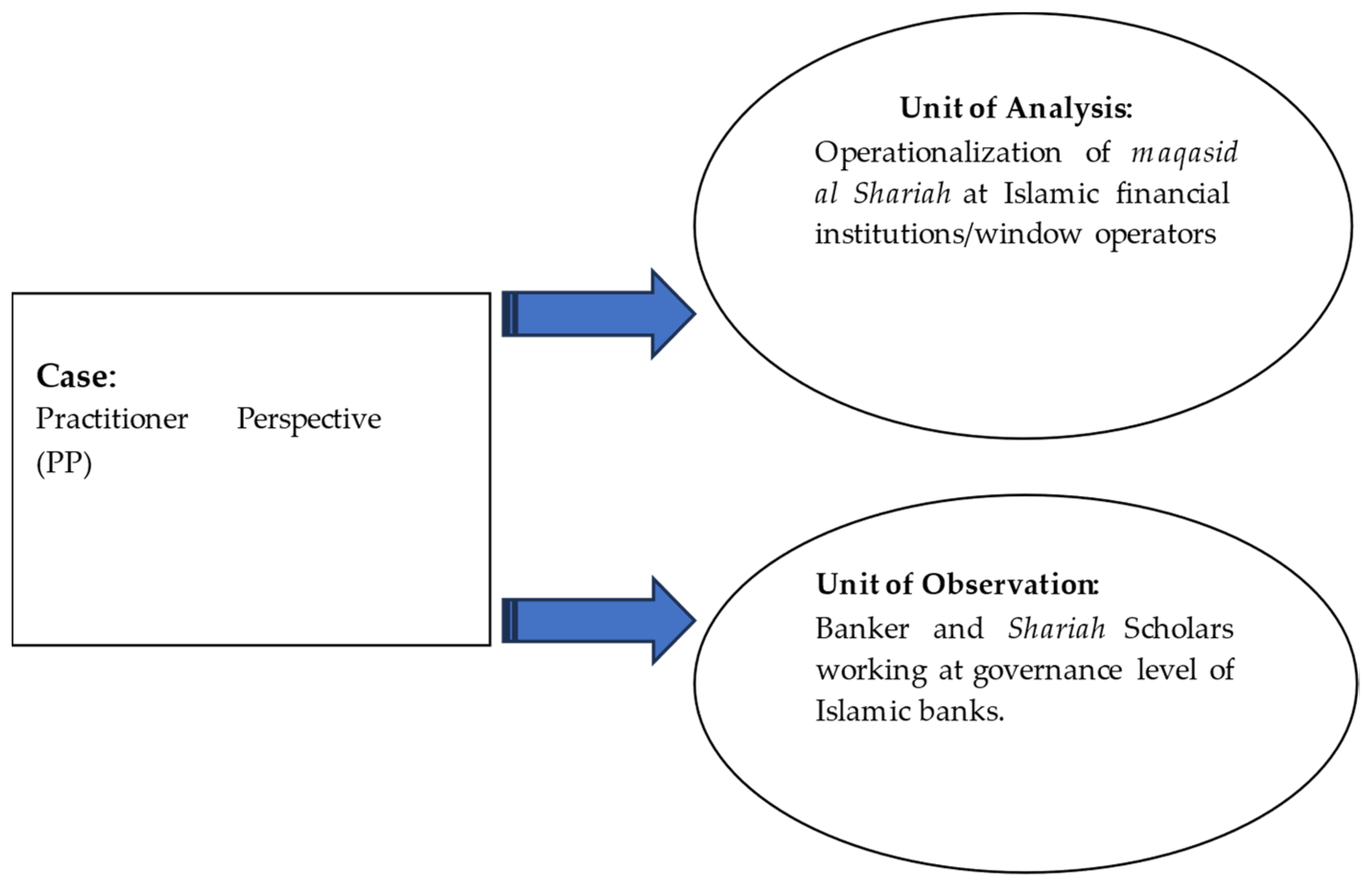
3.1. Case: Practitioners’ Perspectives
3.2. Data Collection Method
3.3. Data Analysis
4. Findings
4.1. Maslahah (Public Welfare)
Profitability is there, but not at the cost of the client. A bank is not a charitable organization; bankers also have families associated with them, and they take care of them, and the same goes for the clients. Therefore, we need to create a niche where we can facilitate (rather than compensate) the client by offering different free services (e.g., lockers, insurance, travel insurance, ATM insurance) once a certain threshold amount is maintained.
Source: B6, Head product development
We make sure that our bank is not involved in any kind of unethical and socially unacceptable activities. There are certain businesses which are not prohibited but are still not good, for example, tobacco, which does not fall under explicit prohibitions but is socially considered a harmful activity.
Source: B2, Head Shariah compliance and product development
Taking care of depositor’s money is also important from an amanah point of view. Even routing it to the wrong industry would be khayanat. Providing a loan to a person who wants to construct a house for himself is also helping in the eradication of poverty or broadly providing a better lifestyle and a better place to live is also contributing to the achievement of maqasid (probably tehsiniyat).
Source: S5, RSBM
We also introduced the scheme of free-of-cost Hajj and Umrah for the employees, which has been approved by our board. Now we will be sending one employee with his /her spouse or parent for the Hajj every year. We have also introduced paternity leave for the male employees up to 5 days. We have increased the medical insurance limits for employees, which were previously available for all the dependents collectively, and now apply individually to each dependent.
Source: B4, CEO
4.2. Business Motives Alongside Which Banks Do Not Consider Maqasid al Shariah as Their Responsibility
Islam in no way prohibits earning halal profit; it comes under the ambit of ‘jawaz’, and we cannot call it unethical. If they are performing all Shariah-compliant activities and all other requirements are also properly met, then, in the case of saving accounts, if they are not distributing profit, there is no harm in it.
Source: S6, RSBM
They [Islamic banks] are for-profit organizations. They may perform sadaqat, zakat, charity, help people. When a product comes before us, we do check the maqasid in it, though not too much focus, but we do check what impact it will have.
Source: S5, RSBM
So, it is our business objective to sell halal products to the people and earn justifiable profit on them.
Source: B4, CEO
The profitability of the banks is not enough to take care of the society. Placing additional pressure on the bank, in the form of maqasid al Shariah, could potentially harm them.
Source: B5, Head Shariah structuring
4.3. Wrong Interpretation and Incorrect Evaluation of Islamic Institutions Based on Maqasid
I would evaluate it on the basis of the relevant materials from ‘fiqh’. If something is declared legal, this automatically means that it is in compliance with maqasid. Directly in the name of maqasid al Shariah, there is nothing from the board of directors nor from the regulators. It is just that no objective of Shariah should be violated during the process.
Source: S5, RSBM
I think maqasid al Shariah is being applied this way, and these maqasid are more applicable to individual human beings than corporate bodies. Banks tend to engage in those activities where they find more profit (the non-participatory modes). At times banks even go non-Shariah compliant just to earn more profit.
Source: B1, Risk management officer
In my point of view, there is nothing wrong with maqasid al Shariah, but they cannot be measured. There is a lot of subjectivity in the measurement of maqasid al Shariah.
Source: S6, RSBM
4.4. New Industry and Over-Expectation from the Industry
We ignore the 95% of the pie, since they are free to do anything, and try to implement maqasid al Shariah in the remaining 5% of the activities, which becomes really challenging. When new things start, it takes time to reach a certain level, and for that, major stakeholders are supposed to be on board, which unfortunately has still not been achieved in Pakistan.
Source: S1, RSBM
It is true that an Islamic bank is just an organ of the whole Islamic economic system, but if we want to get maximum benefit out of it, we can play our role, but only if we specially target it. Presently it is not being done.
Source: S2, RSBM
Maqasid al Shariah is a framework, but it is being treated selectively by extracting only the economic dimension. The regulator should not make it mandatory to achieve maqasid al Shariah because, for the time being, we are still trying to correct our basic practices.
Source: B1, Risk management officer
I agree that maqasid al Shariah are not fully being accomplished, but the industry is still in a premature phase. Yes, maqasid al Shariah should be achieved, but give them some time.
Source: B3, Head Islamic banking
Achieving maqasid is included in our charter, but it will take time. We are not disagreeing with the mandate they have, but the Islamic banking industry is still at an early stage and cannot bear the burden of this huge responsibility. Moreover, it should not be blamed for all these expectations, since it represents only a small part of the whole banking industry.
Source: B6, Head consumer products
4.5. Justice/Equity
If they [banks] want to do it [charity], then they must do it with their own money and not with customers’ funds; otherwise, depositors lose trust in the bank and stop bringing their money to it.
Source: B1, Risk management officer
We have the humanitarian sentiments, but not at the cost of our depositors, since they also expect justice from us.
Source: B3, Head Islamic Banking
Source: B4, CEO
Overall, financial institutions are expected to maintain justice and fairness by providing higher returns on customers’ deposits, while at the same time earning reasonable dividends for shareholders and contributing to charitable initiatives aimed at improving the living standards of the underprivileged in society.
4.6. Bankers Consider Auto Inclusion of Maqasid al Shariah in Every Transaction
Whenever a product is developed, it is already assumed that it is being designed for halal “maal”. In this case, the achievement of maqasid al Shariah is considered automatic.
Source: S1, RSBM
Practitioners firmly believe that the ultimate source of everything is Shariah, and since maqasid al Shariah have been developed by scholars through the interpretation and extension of Shariah principles, when financial products are developed and approved by Shariah scholars, the maqasid are considered to be automatically incorporated. For example, banks earn halal income by investing depositors’ money in Shariah-compliant products. In this way, they protect and grow the wealth of investors, which is one of the objectives of Shariah. As I said, maqasid al Shariah emerged after shariat, so if institutions are following shariat, I am hopeful that they are achieving maqasid al Shariah to some extent. So, you can see that betterment in society, or in other words, achievement of maqasid al Shariah, occurs automatically.
Source: B3, Head Islamic banking
4.7. Prevention from Prohibitions and Provisioning of Halal Options
Gharar, riba, qimar, interest, deception, all of these must be avoided. Therefore, the bank considered avoidance of such activities as an essential step toward achieving Shariah compliance.
Source: B2, Head Shariah compliance
4.8. Shariah Compliance
At least Shariah compliance is mandatory. All the focus remains on Shariah compliance. All our operations or products must meet the minimum criteria for conformity with Shariah standards.
Source: S4, Shariah board member
If I am not doing any non-compliance, then this in itself reflects compliance with maqasid. The first priority is to ensure the rules of Shariah are not violated. At the very least, Shariah compliance is mandatory. All the focus is on Shariah compliance.
Source: S5, RSBM
4.9. More Focused on the Protection of Wealth
In my opinion, protection of wealth should be the foremost priority since it will make sure that customers’ money is not misused.
Source: S3, RSBM
Our bank is supposed to provide Shariah-compliant halal options to the people and is supposed to ensure protection of wealth for the society.
Source: B2, Head Shariah compliance
4.10. Maqasid Are Not Divine but Are Man-Made Interpretations
Maqasid al Shariah is not directly stated in the Quran and Hadiths; rather, they are a human-developed concept.
Source: S2, RSBM
The original “asaal” is the shariat, while maqasid al Shariah are the derived concepts, and that too by humans. First step is shariat, and only afterward comes maqasid al Shariah. Therefore, if we ever see a decision of shariat that does not fulfil maqasid al Shariah, we will consider it right because maqasid al Shariah are developed by a human and are not a divine law.
Source: B3, Head Islamic banking
5. Discussion and Theoretical Contribution
- Public welfare (maslahah);
- Business motives, alongside which banks do not consider maqasid al Shariah as their responsibility;
- Wrong interpretation and wrong evaluation of Islamic institutions on maqasid;
- New industry and over expectation from the industry;
- Justice/equity;
- Bankers consider auto inclusion of maqasid al Shariah in every transaction;
- Prevention from prohibitions and provisioning of halal options;
- Shariah compliance;
- More focused on protection of wealth;
- Maqasid are not divine but are man-made interpretations.
6. Policy Implications
7. Limitations and Future Research
Author Contributions
Funding
Institutional Review Board Statement
Informed Consent Statement
Data Availability Statement
Conflicts of Interest
Abbreviations
| SBP | State Bank of Pakistan |
| PP | Practitioner perspectives |
| IFI | Islamic financial institution |
| IBF | Islamic Banking and Finance |
| AAOIFI | Accounting and Auditing Organization for Islamic Financial Institutions |
| RSBM | Resident Shariah Board Member |
Appendix A
References
- Abdelkader, Deina. 2003. Modernity, the Principles of Public Welfare (Maṣlaḥa) and the End Goals of Sharīʿa (Maqāṣid) in Muslim Legal Thought. Islam and Christian-Muslim Relations 14: 163–74. [Google Scholar] [CrossRef]
- Abozaid, Abdulazeem, and Asyraf Wajdi Dusuki. 2007. The Challenges of Realizing Maqasid al-Shariah in Islamic Banking and Finance. In IIUM International Conference on Islamic Banking and Finance. Kuala Lumpur: IIUM Institute of Islamic Banking and Finance. [Google Scholar]
- Afzal, Muhammad, and Muhammad Khubaib. 2021. Flexibility in the Implementation of Islamic Criminal Law in Modern Islamic Society in the Light of Qur’ān and Sunnah. Journal of Islamic Thought and Civilization 11: 396–410. [Google Scholar] [CrossRef]
- Al-Ashūr, Muhammad. 2001. Maqāṣid al-Sharīʿah al-Islāmiyyah. Edited by Muhammad al-Misāw. Beirut: Dār al-Nafāʾis. [Google Scholar]
- Al Ghazālī, Muhammad. 1992. Al-Mustaṣfā min ʿIlm al-Uṣūl. Edited by Hamzah Hāfiẓ. Madinah: Syarikah al-Madinah al-Munawwar lil-Ṭibāʿah. [Google Scholar]
- Ali, Nor Aishah Mohd, Zakiah Muhammadun Mohamed, Shahida Shahimi, and Zurina Shafii. 2016. Knowledge for Shari’ah Auditors’ Competency in Islamic Financial Institutions. International Journal of Trade, Economics and Finance 7: 113–20. [Google Scholar] [CrossRef]
- al Qaradawi, Yusuf. 1999. Kayfa Nata‘amal ma‘a al-Qur’ān al- ‘Aẓīm? 1st ed. Cairo: Dār al-Shorūq. [Google Scholar]
- Al-Sharfī, Abd. al Majid al-Soswah. 1997. Al-Ijtihād al-Jamāʿī fī al-Tashrīʿ al-Islāmī. Kuwait City: Wizārat al-Awqāf wa al-Shuʾūn al-Islāmiyyah. [Google Scholar]
- al-Shāṭibī, Ibrāhīm. 2003. Al-Muwāfaqāt fī Uṣūl al-Sharīʿah. Edited by ʿAbd Allāh Darrāz. Beirut: Dār al-Kutub al-ʿIlmiyyah. [Google Scholar]
- Al-Yūbī, Muhammad. 1998. Maqāṣid al-Sharīʿah al-Islāmiyyah wa ʿAlāqatuhā bi al-Adillah al-Sharʿiyyah. Cairo: Dār al-Ḥijrah. [Google Scholar]
- Asutay, Mehmet. 2013. Islamic Moral Economy as the Foundation of Islamic Finance. In Islamic Finance in Europe. Cheltenham: Edward Elgar. [Google Scholar]
- Auda, Jasser. 2008a. Maqasid al-Shariah: A Beginner’s Guide. London: International Institute of Islamic Thought. [Google Scholar]
- Auda, Jasser. 2008b. Maqasid al-Shariah as Philosophy of Islamic Law: A Systems Approach. London and Washington: International Institute of Islamic Thought. [Google Scholar]
- Auda, Jasser. 2011. A Maqasidi approach to contemporary application of the Shariah. Intellectual Discourse 19: 193–217. [Google Scholar]
- Bedoui, Houssem Eddine. 2012. Ethical Competitive Advantage for Islamic Finance Institutions: How Should They Measure Their Performance? Cambridge: Harvard University. [Google Scholar]
- Bell, Robin, and Vesselsa Warren. 2023. Illuminating a methodological pathway for doctor of business administration researchers: Utilizing case studies and mixed methods for applied research. Social Sciences & Humanities Open 7: 100391. [Google Scholar] [CrossRef]
- Burr, Vivien. 1995. An Introduction to Social Constructionism. London: Routledge. [Google Scholar]
- Chapra, Muhammad Umar. 2007. The Islamic Vision of Development in the Light of Maqāsid al-Sharīʿah. Jeddah: Islamic Research and Training Institute. [Google Scholar]
- Creswell, John W. 2013. Qualitative Inquiry and Research Design: Choosing Among Five Approaches, 3rd ed. Thousand Oaks: SAGE Publications. [Google Scholar]
- Creswell, John W., and Cheryl Poth. 2018. Qualitative Inquiry and Research Design: Choosing Among Five Approaches, 4th ed. Thousand Oaks: SAGE Publications. [Google Scholar]
- Dirie, Khadar Ahmed, Md. Mahmudul Alam, and Selemah Maamor. 2023. Islamic social finance for achieving sustainable development goals: A systematic literature review and future research agenda. International Journal of Ethics and Systems 40: 676–98. [Google Scholar] [CrossRef]
- Farrar, Salim, and Tanvir Uddin. 2020. Building Islamic Ethics into Development: Exploring the Role and Limitations of ‘Islamic’ Microfinance in Poverty Alleviation—An Indonesian Case Study. Law and Development Review 13: 371–406. [Google Scholar] [CrossRef]
- Ferrari, Joseph. 2016. A Narrative Case Study Examining the Experiences of Men Teaching Special Education in the Elementary Grades. Ph.D. dissertation, University of Maryland, College Park, MD, USA. [Google Scholar]
- Guest, Greg, Arwen Bunce, and Laura Johnson. 2006. How many interviews are enough? An experiment with data saturation and variability. Field Methods 18: 59–82. [Google Scholar] [CrossRef]
- Güney, Necmettin. 2024. Maqāsid al-Sharīʿa in Islamic Finance: A Critical Analysis of Modern Discourses. Religions 15: 114. [Google Scholar] [CrossRef]
- Hamīdān, Mohammad. 2004. Maqāṣid al-Sharīʿah al-Islāmiyyah. Beirut: Muʾassasat al-Risālah. [Google Scholar]
- Jaiyeoba, Haruna B., Mohammad Aizat Jamaludin, Saheed Abdullahi Busari, and Yusuff Jelili Amuda. 2024. The Implications of Maqasid al-Shariʿah for Integrated Sustainability Practices among Businesses. Qualitative Research in Financial Markets 17: 511–31. [Google Scholar] [CrossRef]
- Jamil, Fauzan. 1995. The Muhammadiyah and the Theory of Maqasid al-Shariʿah. Studia Islamika 2: 53–68. [Google Scholar] [CrossRef]
- Jan, Shafiullah. 2013. A Critique of Islamic Finance in Conceptualising a Development Model of Islam: An Attempt in Islamic Moral Economy. Ph.D. dissertation, Durham University, Durham, UK. [Google Scholar]
- Jan, Shafiullah, and Mehmet Asutay. 2019. A Model for Islamic Development: An Approach in Islamic Moral Economy. Cheltenham: Edward Elgar. [Google Scholar]
- Jan, Shafiullah, Zahoor Khan, and Karim Ullah. 2018. Institutionalising Justice in Islamic Finance. Journal of Islamic Economics, Banking and Finance 14: 205–16. [Google Scholar] [CrossRef]
- Kamali, Mohammad H. 2008. Maqasid al-Shariah Made Simple. London: International Institute of Islamic Thought. [Google Scholar]
- Khalil, Muhmmad N., and Talat Hussain. 2022. Qualitative Analysis of Maqasid al-Shariah-Based Model in Islamic Banks. Journal of Economic Impact 4: 83–90. [Google Scholar] [CrossRef]
- Liaqat, Hajira, Ishfaq Ahmed, and Sheikh Usman Yousaf. 2024. An Exploratory Insight into Religion-Based Communication in Islamic Financial Institutions. Journal of Islamic Accounting and Business Research 17: 631–50. [Google Scholar] [CrossRef]
- Malik, Adnan, Karim Ullah, Shafiullah Jan, Muhammad Atiq, and Ali Abdullah. 2021. The Role of Knowledge Diffusion in Evolving Governance Principles for Islamic Banking. International Journal of Islamic and Middle Eastern Finance and Management 14: 835–50. [Google Scholar] [CrossRef]
- Malterud, Kirsti, Volkert D. Siersma, and Ann D. Guassora. 2016. Sample size in qualitative interview studies: Guided by information power. Qualitative Health Research 26: 1753–60. [Google Scholar] [CrossRef]
- Marshak, Robert J., and David Grant. 2008. Organizational Discourse and New Organization Development Practices. British Journal of Management 19: S7–S19. [Google Scholar] [CrossRef]
- Mouna, Reda. 2025. Beyond Profits: Islamic Finance, an Ethical and Sustainable System. RMd Economics Management & Social Sciences 2: 107–24. [Google Scholar]
- Nouman, Muhammad, Karim Ullah, Shafiullah Jan, and Farman Ullah Khan. 2024. Organizational Learning and Adaptation in Participatory Islamic Finance. Qualitative Research in Financial Markets 16: 331–54. [Google Scholar] [CrossRef]
- Nouman, Muhammad, Muhammad Fahad Siddiqi, Karim Ullah, and Shafiullah Jan. 2021. Nexus between Higher Ethical Objectives (Maqasid al-Shariʿah) and Participatory Finance. Qualitative Research in Financial Markets 13: 226–51. [Google Scholar] [CrossRef]
- Patton, Michael Quinn. 2015. Qualitative Research & Evaluation Methods, 4th ed. Thousand Oaks: SAGE Publications. [Google Scholar]
- Sheikh, Rafiullah, and Khalid Hussain. 2025. Harmony or discord: Analyzing stakeholders’ viewpoints on Islamic banking. Qualitative Research in Financial Markets, 1–27. [Google Scholar] [CrossRef]
- Shinkafi, Akilu Aliyu, and Nor Aini Ali. 2017. Contemporary Islamic Economic Studies on Maqasid Shariʿah. Humanomics 33: 315–34. [Google Scholar] [CrossRef]
- Siddiqi, Muhmmad F., Shafiullah Jan, and Karim Ullah. 2019. Maqasid al-Shariah and Stakeholders’ Wellbeing in Islamic Banks. Business and Economic Review 11: 83–102. [Google Scholar] [CrossRef]
- State Bank of Pakistan. 2025. Islamic Banking Bulletin: January–March 2025. Karachi: State Bank of Pakistan. [Google Scholar]
- Tarigan, Azhari. A., Ismail, Kamaruddin, Pandapotan, and Iskandar Muda. 2021. The Quran as the Basis of Islamic Economics. Turkish Online Journal of Qualitative Inquiry 12: 7284–96. [Google Scholar]
- Thelwall, Mike, and Tamara Nevill. 2021. Is Research with Qualitative Data More Prevalent and Impactful Now? Interviews, Case Studies, Focus Groups and Ethnographies. Library & Information Science Research 43: 101094. [Google Scholar] [CrossRef]
- Whedbee, Judy C. 2009. A Narrative Analysis Using Multiple Case Studies of Nursing Graduates Who Overcame Academic Adversity. Ph.D. dissertation, Andrews University, Berrien Springs, MI, USA. [Google Scholar]
- Yin, Robert K. 2014. Case Study Research: Design and Methods, 5th ed. Thousand Oaks: SAGE Publications. [Google Scholar]
- Yin, Robert K. 2018. Case Study Research: Design and Methods, 6th ed. Thousand Oaks: SAGE Publications. [Google Scholar]
- Yusuf, Abdulhameed B. 2020. Conceptual Foundations of Maqāṣid al-Sharīʿah. Islamic Quarterly 64: 527–46. [Google Scholar]


| Scholar | Era | Significance | Main Contribution |
|---|---|---|---|
| Imam al-Juwayni | d. (478). AH/1085 CE | Presented purposive reasoning and public interest (maṣlaḥah). | Provision of early foundations for maqasid reasoning. |
| Abu Hamid al-Ghazali | d. (505). AH/1111 CE | Framed the five essential objectives of Shariah. | Systematized maqasid within uṣūl al-fiqh. |
| Fakhr al-Din al-Razi | d. (606). AH/1209 CE | Extended rational inquiry into legal objectives. | Improved theoretical rigor of maqasid discourse. |
| Najm al-Din al-Tufi | d. (716). AH/1316 CE | Ordered maṣlaḥah in socio-legal matters. | Presented flexibility in legal application. |
| Ibn Taymiyyah | d. (728). AH/1328 CE | Highlighted justice, intent, and public welfare. | Connected maqasid with ethical realism. |
| Ibn Qayyim al-Jawziyya | d. (751). AH/1350 CE | Asserted Shariah aims at justice and mercy. | Ethical framing of maqasid principles. |
| Al Shatibi | d. (790). AH/1388 CE | Arranged maqasid into hierarchical categories. | Recognized maqasid as an independent methodology. |
| Scholar | Era | Main Contribution | Relevance |
|---|---|---|---|
| Muhammad al-Tahir Ibn Ashur | 1879–1973 | Extended maqasid to include freedom and human dignity. | Chains societal and institutional development. |
| Rashid Rida | 1865–1935 | Linked maqasid with reform and renewal. | Appropriate to governance and regulatory reform. |
| Muhammad al-Ghazali | 1917–1996 | Highlighted ethical revival and justice. | Reinforces normative ethical foundations. |
| Yusuf al-Qaradawi | 1926–2022 | Expressed universal maqasid and human rights. | Lines up Shariah with human development goals. |
| Taha Jabir al-Alwani | 1935–2016 | Proposed civilizational level maqasid. | Strategic framework for Islamic institutions. |
| Jasser Auda | Contemporary | Presented systems-based maqasid analysis. | Valuable for institutional and performance evaluation. |
| Monzer Kahf | Contemporary | Presented systems-based maqasid analysis. | Direct application to Islamic banking outcomes. |
| SNO | Code | Designation |
|---|---|---|
| 1 | S1 | Resident Shariah Board Member (RSBM) |
| 2 | S2 | Resident Shariah Board Member (RSBM) |
| 3 | S3 | Resident Shariah Board Member (RSBM) |
| 4 | S4 | Resident Shariah Board Member (RSBM) |
| 5 | S5 | Resident Shariah Board Member (RSBM) |
| 6 | S6 | Resident Shariah Board Member (RSBM) |
| 7 | S7 | Shariah Audit Officer |
| 8 | S8 | Shariah Audit Officer |
| 9 | S9 | Resident Shariah Board Member (RSBM) |
| 10 | S10 | Resident Shariah Board Member (RSBM) |
| 11 | B1 | Head of Risk Management Department |
| 12 | B2 | Head of Product Development and Shariah Compliance Department |
| 13 | B3 | Head of Islamic banking |
| 14 | B4 | Chief Executive Officer |
| 15 | B5 | Head of Shariah Compliance Department |
| 16 | B6 | Head of consumer products |
| 17 | B7 | Group Head, Islamic Bank |
| 18 | B8 | Head of Shariah Compliance Department |
| 19 | B9 | Head of Shariah Compliance Department |
| 20 | B10 | Head of Product Development |
Disclaimer/Publisher’s Note: The statements, opinions and data contained in all publications are solely those of the individual author(s) and contributor(s) and not of MDPI and/or the editor(s). MDPI and/or the editor(s) disclaim responsibility for any injury to people or property resulting from any ideas, methods, instructions or products referred to in the content. |
© 2026 by the authors. Licensee MDPI, Basel, Switzerland. This article is an open access article distributed under the terms and conditions of the Creative Commons Attribution (CC BY) license.
Share and Cite
Jan, S.; Abdullah, A.; Muzafar, N. Operationalizing Higher Ethical Objectives: Piety, Ethics, and Institutional Practice in Pakistan’s Islamic Financial Sector. Religions 2026, 17, 468. https://doi.org/10.3390/rel17040468
Jan S, Abdullah A, Muzafar N. Operationalizing Higher Ethical Objectives: Piety, Ethics, and Institutional Practice in Pakistan’s Islamic Financial Sector. Religions. 2026; 17(4):468. https://doi.org/10.3390/rel17040468
Chicago/Turabian StyleJan, Shafiullah, Ali Abdullah, and Naeem Muzafar. 2026. "Operationalizing Higher Ethical Objectives: Piety, Ethics, and Institutional Practice in Pakistan’s Islamic Financial Sector" Religions 17, no. 4: 468. https://doi.org/10.3390/rel17040468
APA StyleJan, S., Abdullah, A., & Muzafar, N. (2026). Operationalizing Higher Ethical Objectives: Piety, Ethics, and Institutional Practice in Pakistan’s Islamic Financial Sector. Religions, 17(4), 468. https://doi.org/10.3390/rel17040468