St. Thomas Aquinas on the Separated Soul and Its Personhood: A Mixed View


Abstract
1. Introduction
2. The Middle Way: The Separated Soul as an Incomplete Person
2.1. The Criteria of Personhood
2.2. Separated Soul as Incomplete Person
2.3. A Reflection on the Middle Way
3. The Mixed View
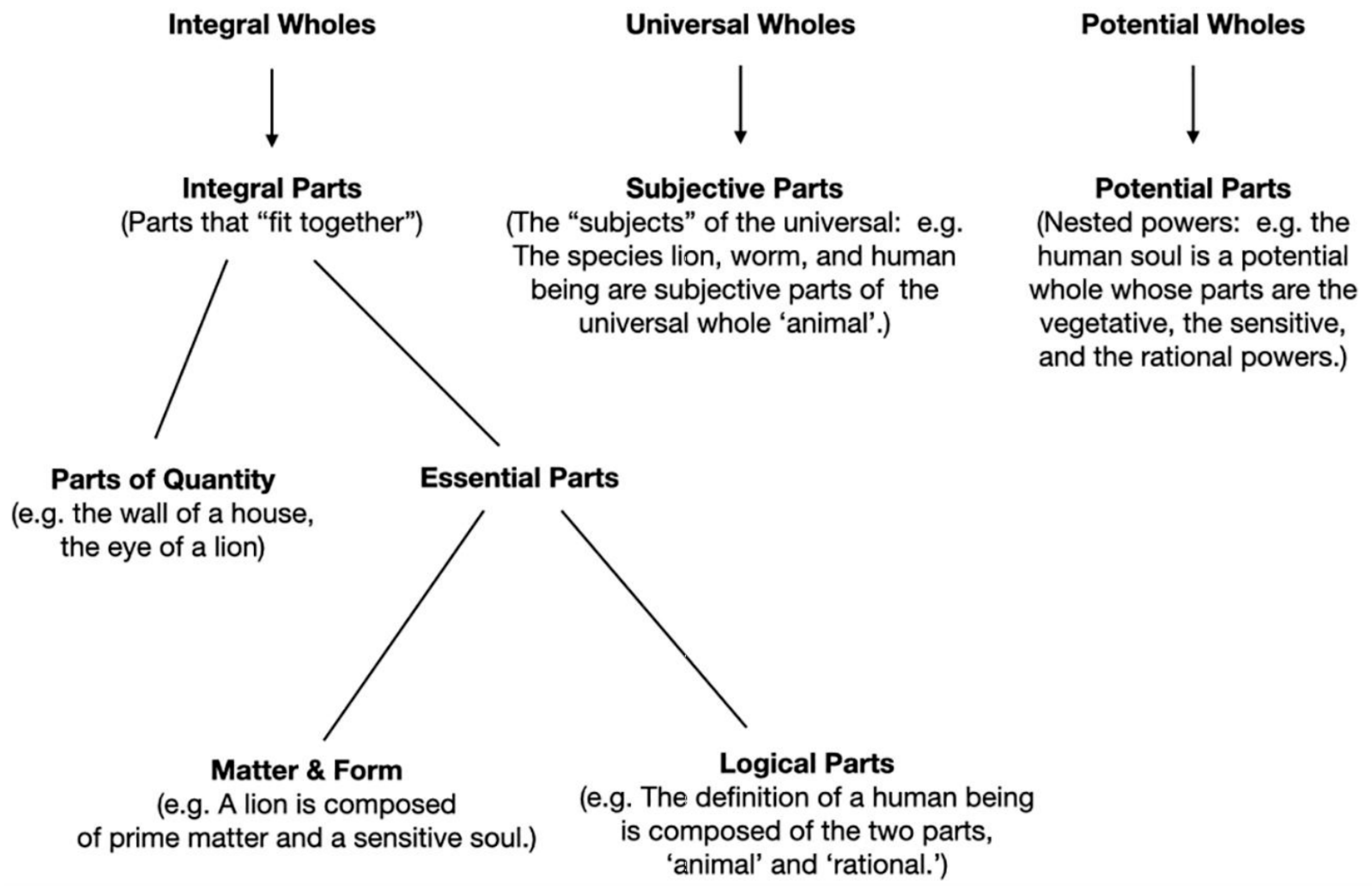
3.1. Aquinas on Part, Whole and Composition
3.2. Aquinas on the Criterion of the Numerical Identity of Substances
3.3. Core Claims of the Mixed View
- S1 = Socrates before death.
- SF1 = the substantial form or soul of S1.
- SF2 = the separated soul of Socrates after death.
- S2 = the substance composed solely of SF2.
- (i)
- SF1 is a proper part of S1.
- (ii)
- S1 is a person.
- (iii)
- SF1 is numerically identical to SF2.
- (iv)
- SF2 is the sole proper part of S2.
- (v)
- SF2 is not numerically identical to S2.
- (vi)
- S1 is numerically identical to S2.
4. Potential Objections and Responses
4.1. What Kind of Person S2 Is?
4.2. How to Characterize Death as a Substantial Change?
4.3. Why Single-Part-Composition Is Exceptional?
5. Theoretical Advantages and Significance of the Mixed View
Author Contributions
Funding
Institutional Review Board Statement
Informed Consent Statement
Data Availability Statement
Conflicts of Interest
Abbreviations
| ST | Summa theologiae |
| SCG | Summa contra Gentiles |
| In Sent | Scriptum super Libros Sententiarum magistri Petri Lombardi |
| Super Cor | Super Epistolas S. Pauli Lectura |
| In Meta | In Duodecim Libros Metaphysicorum Aristotelis Expositio |
| DPN | De principiis naturae |
| DEE | De ente et essentia |
| De unitate intel | De unitate intellectus |
| CT | Compendium theologiae |
| De anima | Quaestiones disputatae de anima |
| De spir | Quaestiones disputatae de spiritualibus creaturis |
| 1 | I use the term “body” here following the standard convention of both Aquinas’s own discussions of anthropology and the long-standing Thomistic debate over the personhood of the separated soul. I am grateful to an anonymous reviewer for pointing out that, in a strict metaphysical sense, the soul is a co-principle with (prime) matter. This terminology of “body” is adopted for methodological continuity and does not imply an identity between the “body” and “prime matter”, although some scholars have argued for such an identification (see Wu 2017). Therefore, while maintaining metaphysical rigor regarding the role of prime matter, “body” remains the appropriate term for engaging with the historical and contemporary literature on this specific problem. |
| 2 | In III Sent. d. 5, q. 3, a. 2, resp: “ideo anima separata non potest dici persona.” All English translations of Aquinas’s Latin text are my own. |
| 3 | E.g., De anima, q. 1, co: “Anima igitur humana est hoc aliquid et forma.” Also see In II Sent, d. 17, q. 1, a. 2, ad. 1; In II Sent, d. 19, q. 1, a. 1, ad. 4; In III Sent, d. 5, q. 3, a. 2, ad. 3; ST. I, q. 75, a. 2, ad. 1. For Survivalists’s defense of the claim, see Stump (2006); Oderberg (2005, 2012). |
| 4 | For more unacceptable consequences of corruptionists, cf. De Haan and Dahm (2019, p. 636). |
| 5 | ST I, q. 29, a. 1: “persona est rationalis naturae individua substantia.” |
| 6 | ST. I, q. 29, a. 1, resp: “Et ideo in praedicta definitione personae ponitur substantia individua, inquantum significat singulare in genere substantiae, additur autem rationalis naturae, inquantum significat singulare in rationalibus substantiis.” |
| 7 | In I Sent, d. 5, q. 1, a. 1, resp: “quod in creaturis actus sunt suppositorum; et essentia non agit, sed est principium actus in supposito.” |
| 8 | De spir, a. 2, ad. 2: “homo enim videt oculo, ambulat pede, et similiter intelligit per animam.” |
| 9 | De anima, q. 1, co: “Est autem hoc aliquid et per se subsistens cum per se operetur.” |
| 10 | De anima, q. 1, resp: “quod hoc aliquid proprie dicitur individuum in genere substantiae.” |
| 11 | In III Sent, d, 5, q. 3, a. 2, ad. 3: “quod anima rationalis dicitur hoc aliquid per modum quo esse subsistens est hoc aliquid, etiam si habeat naturam partis; sed ad rationem personae exigitur ulterius quod sit totum completum.” |
| 12 | De anima, q. 1, resp: “Individuum autem in genere substantiae non solum habet ut per se possit subsistere, sed quod sit aliquid completum in aliqua specie et genere substantiae.” |
| 13 | De anima, q. 1, ad. 1: “non tamen habet speciem completam, sed corpus advenit ei ad complementum speciei.” |
| 14 | De anima, q. 1, ad. 4: “quod licet anima humana per se possit subsistere, non tamen per se habet speciem completam.” |
| 15 | De anima, q. 1, ad. 3: “quod anima humana non est hoc aliquid sicut substantia completam speciem habens, sed sicut pars habentis speciem completam.” |
| 16 | ST. I-II, q. 4, a. 5, ad. 2: “Unde relinquitur quod post separationem a corpore perfectum esse habeat, unde et perfectam operationem habere potest; licet non habeat perfectam naturam speciei.” |
| 17 | |
| 18 | Of course, mereological hylomorphism (MH)—the view that treats form as a literal “part” of the substance—is still under contemporary debate. Critics such as Liva Rotkale (2018) and Anna Marmodoro (2013) argue against MH. Moreover, as an anonymous reviewer has noted, when Aquinas states that the form (soul) is a “part”, he is talking metaphorically, given the form is the principle of unity and being. Due to the scope and space constraints of this paper, I cannot offer a full defense of MH here. Instead, I take it as a theoretical default. Nonetheless, MH is far from an unacceptable position in current scholarship. Beyond Thomistic proponents like Brower, Skrzypek, and Stump, many non-Thomistic hylomorphists—including Kathrin Koslicki (2008) and William Jaworski (2019)—have robustly defended MH. Adopting MH offers distinct theoretical advantages: it facilitates a fruitful dialogue with other mereology-based ontologies (such as various bundle theories or haecceity mereology) and provides a rigorous framework for understanding property possession (see Brower 2014, pp. 139–43). |
| 19 | In VII Meta. lect. 17, n. 1674: “quod ipsum compositum non sit ea ex quibus componitur: sicut syllaba non est elementa.” |
| 20 | By “proper part” in the context of Single-Part-Composition, I specifically mean an “essential part” (i.e., a part that belongs to the essence of a substance, such as form and matter in composite substances). This paper does not take a stance on whether being (esse) qualifies as a “part” or “constituent” of a substance—a question that remains controversial in Thomistic scholarship. Wippel (2000, pp. 132–76) and Meixner (2023) defend the view that being is a genuine constituent of substance, while Freddoso (2002, pp. xxvii–xxviii) and Brower hold a contrary opinion, as Brower states, Aquinas’s “talk of creatures being ‘composed’ of essence and existence is a figurative way of expressing this same point, and hence not to be taken literally” (Brower 2014, pp. 17–18). It is also worth noting that many contemporary Thomists take being to be the (or a) principle of individuation of substance, e.g., Owens (1994). Notably, agreement on being as a genuine constituent of substance does not entail agreement on its individuating role, see Wippel (2000, pp. 378–99). I remain neutral on this issue and only commits to two minimal claims: (1) SF2 is the sole essential part of S2; (2) S2 is metaphysically composite in the sense that its essence is distinct from its esse and its operation.” |
| 21 | In II Sent, d. 3, q. 1, a. 3, ad. 1: “Alio modo dicitur ‘unum’ quod est principium numeri, qui est discreta quantitas, causatus ex divisione materiae vel continui.” |
| 22 | SCG II, c. 73, n. 5: “Ab eodem aliquid habet esse et unitatem: unum enim et ens se consequuntur. Sed unumquodque habet esse per suam formam. Ergo et unitas rei sequitur unitatem formae.” |
| 23 | ST. I, q. 75, a. 7, arg. 3: “anima ab angelo differre non videtur nisi per hoc, quod est corpori unita.” |
| 24 | ST. I, q. 75, a. 7, ad. 3: “ quod corpus non est de essentia animae, sed anima ex natura suae essentiae habet quod sit corpori unibilis. Unde nec proprie anima est in specie; sed compositum.” |
| 25 | The phrase “is X” inherently implies “is composed of X” in certain contexts. For instance, “Water is H2O” can be understood as “A water molecule is composed of two hydrogen atoms and one oxygen atom,” and “The statue is bronze” can be understood as “The statue is composed of bronze.” Likewise, when Aquinas states that “an angel is a subsistent form,” it leaves space for a Single-Part-Composition interpretation: “An angel is composed solely of a form.” |
| 26 | ST. I, q. 50, a. 4, resp: “Ea enim quae conveniunt specie et differunt numero, conveniunt in forma, et distinguuntur materialiter.” |
| 27 | Whether “angel” is a genus containing all ranks of angels, or whether it analogically signifies all angelic species like the term “being,” this paper remains neutral. |
| 28 | CT. I, c. 85: “Impossibile est autem quod forma eadem numero sit diversorum secundum numerum, quia diversorum secundum numerum non est idem esse; unumquodque autem habet esse per suam formam.” |
| 29 | It must be noted that the premise “act of being is conferred by the substantial form” does not, by itself, entail that every substance possesses a unique “conferrer of existence.” For instance, in creation, God confers being to all entities (creatio ex nihilo) as efficient cause; in this sense, God, as an individual, is the universal Conferrer of being. However, God is not “shared” by all beings in the sense of being a part of plural substances. In this context, “sharing” should be understood as “serving as a part of a substance.” The implicit premises of this argument are: (a) that a substantial form is a part “possessed” by the substance it composes, and (b) that a single substantial form cannot serve as a part of plural substances simultaneously. While the latter premise may appear to border on begging the question—as the non-shareability of the substantial form is both the premise and the intended conclusion—Aquinas would nonetheless affirm this non-shareability, whether as a demonstrated result of his metaphysics or as a fundamental axiom regarding the nature of substantial forms. |
| 30 | ST. I, q. 76, a. 4, co: “unius rei est unum esse substantiale. Sed forma substantialis dat esse substantiale. Ergo unius rei est una tantum forma substantialis. Anima autem est forma substantialis hominis. Ergo impossibile est quod in homine sit aliqua alia forma substantialis quam anima intellectiva.” |
| 31 | SCG. II, c. 69, n. 5: “Nec tamen per hoc quod substantia intellectualis unitur corpori ut forma, removetur quod a philosophis dicitur, intellectum esse a corpore separatum.” |
| 32 | SCG. II, c. 69, n. 6: “Iam enim ostensum est quod anima humana non sit talis forma quae sit totaliter immersa materiae.” |
| 33 | ST. I, q. 89, a. 1, resp: “non ita quod uniri corpori sit ei accidentale, sed per rationem suae naturae corpori unitur.” |
| 34 | ST. I, q. 89, a. 1, resp: “Sic ergo patet quod propter melius animae est ut corpori uniatur.” |
References
- Brower, Jeffrey E. 2014. Aquinas’s Ontology of the Material World: Change, Hylomorphism, and Material Objects. Oxford: Oxford University Press. [Google Scholar]
- Brown, Christopher M. 2005. Aquinas and the Ship of Theseus: Solving Puzzles About Material Objects. London: Continuum. [Google Scholar]
- Cameron, Ross P. 2014. Parts generate the whole but they are not identical to it. In Composition as Identity. Edited by Aaron J. Cotnoir and Donald L. M. Baxter. Oxford: Oxford University Press, pp. 90–107. [Google Scholar]
- De Haan, Daniel D., and Brandon Dahm. 2019. Thomas Aquinas on Separated Souls as Incomplete Human Persons. The Thomist 83: 589–637. [Google Scholar] [CrossRef] [Scilit]
- De Haan, Daniel D., and Brandon Dahm. 2020. After Survivalism and Corruptionism: Separated Souls as Incomplete Persons. Quaestiones Disputatae 10: 161–76. [Google Scholar] [CrossRef] [Scilit]
- Freddoso, Alfred J. 2002. Introduction. In Francisco Suarez. On Creation, Conservation, and Concurrence: Metaphysical Disputations 20, 21, and 22. Translated by Alfred J. Freddoso. South Bend: St. Augustine’s Press, pp. xi–cxxiii. [Google Scholar]
- Jaworski, William. 2019. Hylomorphism and Part-Whole Realism. Ancient Philosophy Today 1: 108–27. [Google Scholar] [CrossRef] [Scilit]
- Koslicki, Kathrin. 2008. The Structure of Objects. New York: Oxford University Press. [Google Scholar]
- Lowe, Edward J. 1998. Form without matter. Ratio 11: 214–34. [Google Scholar] [CrossRef] [Scilit]
- Marmodoro, Anna. 2013. Aristotle’s hylomorphism without reconditioning. Philosophical Inquiry 37: 5–22. [Google Scholar] [CrossRef] [Scilit]
- Meixner, Uwe. 2023. An Axiomatization of the Thomasic Ontology of Composition. Revista Portuguesa de Filosofia 79: 65–136. [Google Scholar] [CrossRef] [Scilit]
- Oderberg, David S. 2005. Hylemorphic dualism. Social Philosophy and Policy 22: 70–99. [Google Scholar] [CrossRef] [Scilit]
- Oderberg, David S. 2012. Survivalism, Corruptionism, and Mereology. European Journal for Philosophy of Religion 4: 1–26. [Google Scholar] [CrossRef] [Scilit]
- Owens, Joseph. 1994. Thomas Aquinas. In Individuation in Scholasticism: The Latter Middle Ages and the Counter-Reformation (1150–1650). Edited by Jorge J. E. Gracia. Albany: State University of New York Press, pp. 173–94. [Google Scholar]
- Pasnau, Robert, and Christopher John Shields. 2004. The Philosophy of Aquinas. New York: Westview. [Google Scholar]
- Rotkale, Liva. 2018. The Form is Not a Proper Part in Aristotle’s Metaphysics Z.17, 1041b11–33. Metaphysics 1: 75–87. [Google Scholar] [CrossRef] [Scilit]
- Salzillo, Raphael Mary. 2021. The mereology of Thomas Aquinas. Philosophy Compass 16: E12728. [Google Scholar] [CrossRef] [Scilit]
- Skrzypek, Jeremy. 2017. Hylomorphism and the Priority Principle. Metaphysica 18: 207–29. [Google Scholar] [CrossRef] [Scilit]
- Spencer, Mark K. 2020. Survivalist, Platonist, Thomistic Hylomorphism: A Reply to Daniel De Haan and Brandon Dahm. Quaestiones Disputatae 10: 177–84. [Google Scholar] [CrossRef] [Scilit]
- Storck, Michael. 2014. Pars Integralis in St. Thomas Aquinas and the Parts of Living Substances. The Thomist 78: 379–99. [Google Scholar] [CrossRef] [Scilit]
- Stump, Eleonore. 2003. Aquinas. London: Routledge. [Google Scholar]
- Stump, Eleonore. 2006. Resurrection, Reassembly, and Reconstitution: Aquinas on the Soul. In Die menschliche Seele: Brauchen wir den Dualismus? Edited by Bruno Niederberger and Edmund Runggaldier. Berlin and Boston: De Gruyter, pp. 151–72. [Google Scholar] [CrossRef] [Scilit]
- Svoboda, David. 2012. Thomas Aquinas on whole and part. The Thomist 76: 273–304. [Google Scholar] [CrossRef] [Scilit]
- Toner, Patrick. 2010. St. Thomas Aquinas on death and the separated soul. Pacific Philosophical Quarterly 91: 587–99. [Google Scholar] [CrossRef] [Scilit]
- Varzi, Achille. 2016. Mereology. Stanford Encyclopedia of Philosophy. Available online: https://plato.stanford.edu/entries/mereology/ (accessed on 23 March 2026).
- Wippel, John F. 2000. The Metaphysical Thought of Thomas Aquinas: From Finite Being to Uncreated Being. Washington, DC: The Catholic University of America Press. [Google Scholar]
- Wu, Tianyue. 2017. The Ontological Status of the Body in Aquinas’s Hylomorphism. Studia Neoaristotelica 14: 5–38. [Google Scholar] [CrossRef] [Scilit]


| Standpoint | What Survives After Socrates’s Death? | Is It a Person? | Is It a Human Person? |
|---|---|---|---|
| Corruptionism | Socrates’s soul. | No. | No. |
| Survivalism (standard) | Socrates’s soul. | Yes. | Yes. |
| The Middle Way | Socrates’s soul. | Not completely is, nor completely not. | Not completely is, nor completely not. |
| Brower’s Survivalism | Socrates. | Yes. | Yes, in a broader sense. |
| The Mixed View | Socrates. | Yes. | No. |
Disclaimer/Publisher’s Note: The statements, opinions and data contained in all publications are solely those of the individual author(s) and contributor(s) and not of MDPI and/or the editor(s). MDPI and/or the editor(s) disclaim responsibility for any injury to people or property resulting from any ideas, methods, instructions or products referred to in the content. |
© 2026 by the authors. Licensee MDPI, Basel, Switzerland. This article is an open access article distributed under the terms and conditions of the Creative Commons Attribution (CC BY) license.
Share and Cite
Pai, H.; Dong, S. St. Thomas Aquinas on the Separated Soul and Its Personhood: A Mixed View. Religions 2026, 17, 465. https://doi.org/10.3390/rel17040465
Pai H, Dong S. St. Thomas Aquinas on the Separated Soul and Its Personhood: A Mixed View. Religions. 2026; 17(4):465. https://doi.org/10.3390/rel17040465
Chicago/Turabian StylePai, Hao, and Shangwen Dong. 2026. "St. Thomas Aquinas on the Separated Soul and Its Personhood: A Mixed View" Religions 17, no. 4: 465. https://doi.org/10.3390/rel17040465
APA StylePai, H., & Dong, S. (2026). St. Thomas Aquinas on the Separated Soul and Its Personhood: A Mixed View. Religions, 17(4), 465. https://doi.org/10.3390/rel17040465