Article

Strange Realms in Late Ming Landscape: The Visual Production of Daoist Space in Wu Bin’s 吳彬 Fanghu Tu 方壺圖

1
College of Arts and Crafts, Putian University, Putian 351100, China
2
Department of Philosophy, Xiamen University, Xiamen 361005, China
*
Author to whom correspondence should be addressed.
Religions 2026, 17(4), 462; https://doi.org/10.3390/rel17040462
Submission received: 2 February 2026 / Revised: 30 March 2026 / Accepted: 2 April 2026 / Published: 8 April 2026
(This article belongs to the Special Issue Landscape (山水) as Transcendent Existence)

Abstract

In late Ming China, landscape (shanshui 山水) painting could function not only as a scenic representation but also as a pictorial means of making sacred space perceptible. This article examines Wu Bin’s hanging scroll Fanghu Tu 方壺圖 (1626; Palace Museum, Beijing) and asks how the painting renders Daoist sacred space visible through relations of distance, access, concealment, and uneven disclosure. To avoid treating “Daoist aesthetics” as a general label, the analysis uses schema and pictorial organization as limited descriptive terms for the structuring of spatial experience within the image. The close reading identifies two recurrent pictorial formations brought into relation in Fanghu Tu: a sea-boundary, distant-view configuration that emphasizes separation and delay, and a pavilion-centered enclosure that produces a more concentrated middle field. It then shows how layered waves and broken shoreline, cloud and mist, middle-zone enclosure, and the thinning legibility of the upper peaks prevent the scene from stabilizing into a single resolved destination. Read in relation to late Ming discussions of cultivated “strangeness” (qi 奇) in landscape painting, these features suggest that Daoist sacred space in Fanghu Tu takes shape as an uneven and mediated experience, structured through provisional concentration, interrupted visibility, and renewed distance. The article argues that late Ming landscape painting could render Daoist-inflected sacred spatial experience visible not only through iconography, but also through the pictorial distribution of visibility, access, and reorientation.

1. Introduction

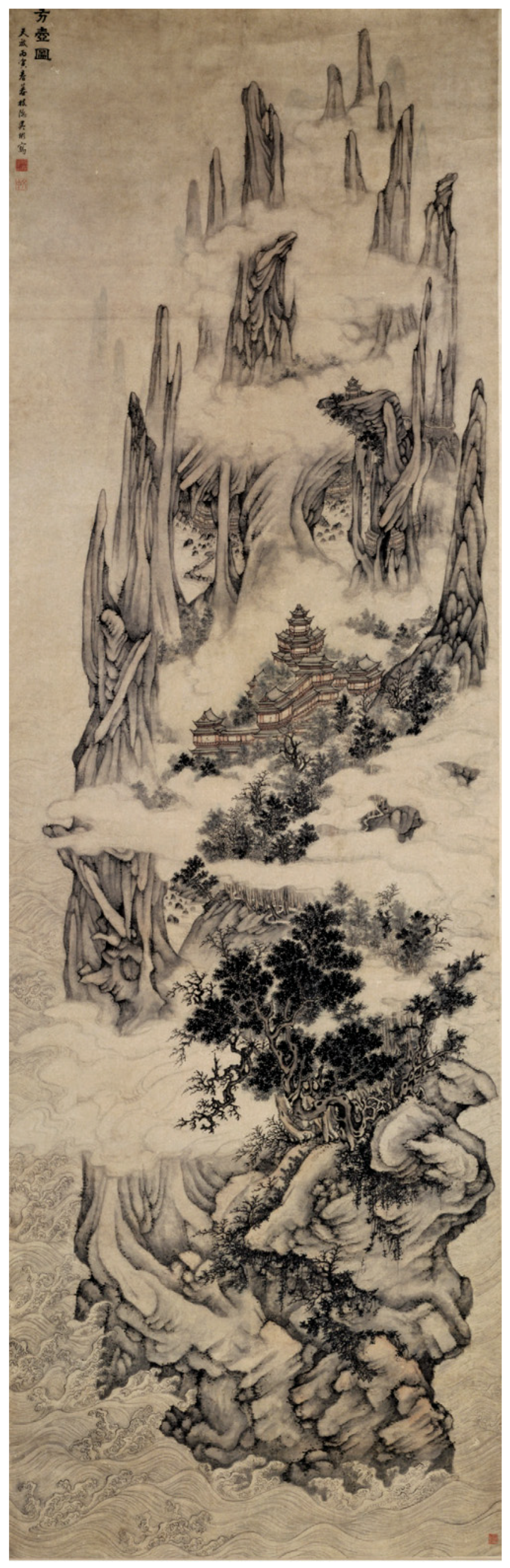
Wu Bin 吳彬 (active during the Wanli 萬曆 and Tianqi 天啟 reigns)1 is often associated with the cultivated “strangeness” (qi 奇) of late Ming landscape painting. His hanging scroll Fanghu Tu 方壺圖 is a major late work and is now in the collection of the Palace Museum, Beijing. The painting is a hanging scroll in ink and color on paper, measuring 320 cm in height and 101 cm in width (Figure 1). Wu inscribed it, “Fanghu Tu. By Wu Bin (Zhiyin), late spring, Tianqi bingyin year. 方壺圖, 天啟丙寅春暮,枝隱吳彬寫”, and impressed it with two seals, “Wu Bin zhi yin” and “Wenzhong.” The “Tianqi bingyin” date corresponds to 1626.
The subject draws on the long-standing imagination of Fanghu as an immortal mountain. The scroll assembles familiar elements of the motif: ocean waves, an isolated mountain mass, drifting cloud and mist, strange peaks, pavilions and temple-like buildings, pine trees, and small figures. At the bottom, the sea surges and rocks rise sharply from the water. In the middle section, mountain forms fold on themselves, while vapors coil around the slopes and partially veil the buildings embedded within them. Above, the peaks tower upward, while the far distance dissolves into dim blankness. These features suggest that the painting invites not only iconographic identification, but also a closer account of how visibility, distance, enclosure, and orientation are structured within the image.
To avoid treating “Daoist aesthetics” as a catch-all label, this article adopts two restricted descriptive terms: schema and pictorial organization. Here, “schema” refers to recurring structural devices, spatial groupings, and combinatory relations traceable across the longer visual history of the Fanghu motif. The term is used not as a total explanatory model, but as a way of identifying repeatable compositional resources that later painters could reorganize in different ways. “Pictorial organization”, in turn, refers to how the painting distributes visibility, directional cues, enclosure, blockage, and points of pause within the viewer’s encounter with the image. The aim is not to prescribe a single route of viewing, but to describe how formal arrangement makes some movements of attention more likely than others. Used together, these terms help clarify not only what Fanghu Tu represents iconographically, but also how the painting organizes visibility, orientation, and access within the image—questions not fully resolved by iconographic or style-historical analysis alone. In this respect, the discussion is closer to art-historical approaches that move beyond style alone toward questions of pictorial meaning, painter-viewer interaction, and the organization of attention. As later scholarship has also noted, style remains important, but does not by itself explain how pictorial meaning emerges through formal arrangement and viewing conditions (Huang and Chen 2018).
Existing scholarship on Fanghu Tu and the broader Fanghu theme has mostly approached the subject through iconographic motifs and the genealogy of recurring compositional types.2 A second line of work focuses on how the “immortal isle in the sea” is pictorially constructed, especially through the combination of sea, island, clouds or vapors, and pavilion architecture to stage an “immortal-mountain” space.3 Another influential approach emphasizes close comparison between texts and images, asking how Daoist and poetic descriptions of paradise are translated into visible form.4 More recently, studies have also traced the visual sources of the image type and noted possible connections to Daoist print culture and inscriptional practice.5 While scholarship directly focused on Fanghu Tu remains largely concentrated in Chinese-language studies, English-language research on Wu Bin and late Ming pictoriality has opened up related questions concerning visual worldmaking, originality, and the experiential dimensions of image-making. Although these studies do not always take Fanghu Tu itself as their primary object, they provide an important broader context for understanding how pictorial form may structure experience.6 Together, these lines of inquiry leave relatively little sustained analysis of how the painting organizes spatial relations and viewerly orientation within the image itself.
A more focused question, then, is not simply whether Fanghu Tu contains Daoist subject matter, but how its formal arrangement makes sacred space visible and experientially legible. The article asks what kinds of distance relations, threshold effects, enclosure devices, and interruptions of sight are built into the painting’s composition. These features matter because the painting does not merely present an immortal mountain as an object of recognition; it also organizes the conditions under which that mountain may be approached, partially accessed, or kept at a distance within the viewer’s encounter with the image.
A comparable shift in emphasis can be seen in Seung Hee Oh’s reading of Wu Bin, which treats seeing as a process of worldmaking rather than as a purely mimetic problem (Oh 2022, pp. 1–2). Building on that insight, the discussion here proceeds cautiously from visible structure to interpretive claim. It first identifies recurring compositional resources associated with the Fanghu motif and then asks how, in this painting, those resources are rearranged to produce a distinctive spatial experience.
In this context, the painting’s qi 奇 is approached not simply as a matter of style, but as a problem of spatial construction and visual effect. The discussion proceeds in two stages. The first traces several recurrent schema-like configurations in the longer history of Fanghu imagery and related sacred-space models. The second turns to a close reading of Wu Bin’s scroll in order to examine how foreground boundaries, mist, enclosure, openings, vertical extension, and recession shape the viewer’s relation to the scene. On that basis, the article considers whether the painting gives sacred space a distinctive experiential form—one structured not by immediate availability, but by a shifting relation among threshold, uneven disclosure, and recurrent distance.

2. The Historical Genealogy of the Fanghu Motif: Myth, Imagery, and Grotto-Heaven Spatial Models

The purpose of this section is to lay the historical groundwork for the later discussion of Wu Bin’s Fanghu Tu. The materials gathered here are not treated as equivalent case studies, but as historically dispersed points of reference. Taken together, they help identify several recurrent visual and spatial resources associated with immortal-mountain representation, including sea-bounded distance, clustered mountain forms, pavilion-centered enclosure, and imaginations of interior sacred space. Rather than reducing grotto-heavens and “pot-heavens” (dongtian/hutian) to subject matter alone, this section asks what kinds of describable spatial relations these traditions made available to later image-making. In this sense, the materials discussed here are approached less as a linear chain of iconographic sources than as a historically available repertoire of pictorial and expressive possibilities, comparable to what Shi Shouqian has described as transmissible modes of pictorial understanding and “painting ideas” that can continue to organize later visual production even where direct lines of object-to-object derivation are unavailable (Shi 2015, pp. 11–12). With this groundwork in place, the later discussion turns to how such inherited resources are reworked in Fanghu Tu and given a more specific experiential form through pictorial organization.

2.1. Myths of the Immortal Mountains and Their Visual Features

Before moving into a breakdown of the pictorial structure of Fanghu Tu, it is necessary to return to the mythic records themselves. Fanghu is not a late invention. It appears within an early and recognizable genealogy of immortal mountains in mythic and historiographical writing, and is later taken up and reworked in Daoist textual traditions. As the Liezi 列子 states, Fanghu appears early as one of the “Five Mountains.” The text specifies its height, its flat summit, and visual elements such as terrace-like structures, trees, and animals. These details later offered a concrete textual basis for making images of immortal mountains:
“There are five mountains: the first is Daiyu, the second Yuanjiao, the third Fanghu, the fourth Yingzhou, and the fifth Penglai. Each mountain rises and extends thirty thousand li in circumference, and its summit is flat for nine thousand li. The mountains are separated from one another by seventy thousand li, yet they are taken as neighbors. On them, the terrace structures are all of gold and jade, and the birds and beasts are all pure white. Trees of pearls and precious stones grow in dense clusters, and their flowers and fruits have a rich flavor. Those who eat them do not grow old and do not die. The inhabitants are all a kind of immortals and sages. In a single day and night, those who fly back and forth among them cannot be counted. 其中有五山焉:一曰岱輿,二曰員嶠,三曰方壺,四曰瀛洲,五曰蓬萊。其山高下周旋三萬裏,其頂平處九千裏。山之中間相去七萬裏,以為鄰居焉。其上臺觀皆金玉,其上禽獸皆純縞。珠玕之樹皆叢生,花實皆有滋味;食之皆不老不死。所居之人皆仙聖之種,一日一夕飛相往來者,不可數焉。”.
(Yang 2016, pp. 159–60)
What matters in this passage is that it does not speak of “immortality” in abstract terms. It gives a cluster of visible spatial and material features: a flat summit, terrace structures of gold and jade, white animals, dense growth of jewel-like trees, and constant movement of immortals. In other words, the sacredness of the immortal mountain is first defined through a set of elements that can be pictured. It is imagined not only as a landform, but as an inhabitable world composed of terraces, trees, animals, and immortal inhabitants.
In the Records of the Grand Historian (Shiji 史記), Fangzhang/Fanghu is firmly fixed within the system of the “three sacred mountains” in the sea. More importantly, the text does not merely recycle stock features of paradise, such as immortals and palaces of gold and silver. It builds “visible yet unreachable” into a narrative-and-visual mechanism. Distance is established from the outset. The text binds desirability and distance together and then turns the approach itself into a repeated frustration.
It first secures the object and its desirability through the memorial attributed to Xu Shi and others: “In the sea there are three sacred mountains, named Penglai, Fangzhang, and Yingzhou; immortals dwell there 齊人徐市等上書,言海中有三神山,名曰:蓬萊、方丈、瀛洲,仙人居之” (Sima 2021, p. 241). It then turns unattainability from an abstract claim into a repeatable process. The sacred mountains are said to lie in the Bohai and “not far from human beings,” yet “before reaching them, one looks toward them and they seem like clouds; when one draws near, the three sacred mountains sink beneath the water; as one approaches, the wind repeatedly draws the boat away; in the end none is able to reach them 在渤海中,去人不遠……未至,望之如雲;及到,三神山反居水下;臨之,患風輒引去;終莫能至” (Sima 2021, pp. 1220–21). What matters here is less whether the mountains “exist” than how they are allowed to enter the field of vision: from afar they appear as something seeable (“like clouds”), but at the moment of nearness they withdraw (“sinking beneath the water”), and the very attempt to close the distance is redirected by external force. Paradise is thus fashioned as a form of regulated visibility. It is made seeable enough to arouse pursuit, yet it is also structurally arranged to block arrival. In this way, the possibility of “entry” and the verdict of “never arriving” are built into the same viewing experience.
This passage matters because it turns sacredness into an experiential structure. The mountain is said to be near, yet it cannot be arrived at. It can be seen, yet it withdraws at the moment of arrival. The narrative builds a repeated rhythm of approaching and being pushed back. In later visual traditions of the immortal mountains, this rhythm offers a powerful narrative resource for organizing distance, blockage, and delayed approach.
Compared with the Liezi, the line “Before arriving at them, one looks toward them and they seem like clouds; when one comes close … the wind pulls the boat away, and in the end no one can reach them” had an especially lasting impact on later images of the immortal mountains. It shifts the mountain’s mystery from a piling up of marvelous objects to something closer to an experiential structure. The mountain can be seen, but it cannot be reached. As one approaches, some force pulls one back. This kind of narrative gives later images a very concrete visual task. How can a painting make “seeing from afar” convincing? How can it give visual form to the rhythm of approach and withdrawal?
For the Fanghu theme, the Records of the Grand Historian also sharpens the setting into a clearer, more picturable list: sea, clouds, boats, white birds and animals, palaces of gold and silver, immortals, and the drug of immortality. Together, these elements form a kind of reusable visual vocabulary for representing the immortal isles.
Later texts push Fanghu or Fangzhang further, from being one of the “three mountains in the sea” to being something with a describable shape. In this way, the form of the “pot” becomes an important clue for imagining how the mountain should look. The Record of Lost Matters (Shiyi ji 拾遺記) directly defines the three mountains as “shaped like a pot vessel” and stresses a structural feature of being wide at the top, narrow in the middle, and squared below:
“The three pots are the three mountains in the sea. The first is Fanghu, that is, Fangzhang. The second is Penghu, that is, Penglai. The third is Yinghu, that is, Yingzhou. Their form is like a pot vessel. These three mountains are broad above, narrow in the middle, and squared below. All are as if crafted by skilled work, like Mount Hua, as though it had been carved and cut. 三壺則海中三山也。一曰方壺,則方丈也;二曰蓬壺,則蓬萊也;三曰瀛壺,則瀛洲也。形如壺器。此三山上廣中狹下方,皆如工制,猶華山之似削成。”.
(J. Wang 2015, p. 20)
Xujian 徐堅’s Records for Elementary Learning (Chuxue ji 初學記) cites the Record of Lost Matters, but its description of the three mountains’ shape is slightly different. It states:
“In the sea there are three mountains. The first is called Fanghu (Fangzhang), the second is called Penghu (Penglai), and the third is called Yingzhou. Their form is like a pot, broad above and narrow below. 海中三山,一名方壺方丈、二名蓬壺蓬萊、三名瀛洲, 形如壺,上廣下狹。”.
(J. Xu 2004, p. 92)
Both accounts link the appearance of the immortal mountains to the form of a pot vessel. To understand how “pot” provides a bodily model, later explanations turn to dictionaries and classical commentaries to clarify what a hu 壺 is. From the angle of ritual vessels, a deep belly, and a tightened mouth, these texts offer a more operational shape reference for Fanghu:
How should the character hu (壺) be explained? Xu Shen 許慎’s Explaining Graphs and Analyzing Characters (Shuowen jiezi 說文解字) says: “It has a deep belly and a gathered mouth. Most are round, though there are also square and oval forms. A hu is a round vessel from Kunwu. 深腹,斂口,多為圓形,也有方形、橢圓等形制。壺,昆吾圓器也。” (S. Xu 2011, p. 435).
Gongyang Commentary (Gongyang zhuan 公羊傳): “The state student holds a pot of drink.” Commentary: “A ritual vessel. If the belly is square and the mouth is round, it is called a hu. If it is the reverse, it is called a ‘square pot’ (fanghu). It has finial-like decorations. 國子執壺漿。注:“禮器, 腹方口圓曰壺,反之曰方壺,有爵飾。”(He 2014, p. 1010).
These materials do not belong to a single doctrinal lineage. Some derive from broader mythic and historiographical traditions, while others reflect later Daoist systematization and reinterpretation.
At the same time, the mythic system is not limited to the “three mountains in the sea.” Kunlun 昆侖 also appears as a major immortal mountain, and it is closely tied to a sea-and-enclosure structure. The Record of the Ten Isles within the Seas (Hainei shizhou ji 海內十洲記) compares Kunlun’s form to an “overturned basin” (yanpen 偃盆) and stresses that it is narrow below and broad above. Record of Lost Matters and Seven Slips from a Cloudy Satchel (Yunji qiqian 雲笈七簽) also keeps linking Kunlun to the “blue sea” or the “western sea.” This makes Kunlun structurally resemble the sea isles in its spatial setup.
The Record of the Ten Isles within the Seas records: “Kunlun … is square and broad for ten thousand li. Its form resembles an overturned basin, narrow below and broad above. Therefore it is called Kunlun. 昆侖……方廣萬裏,形似偃盆,下狹上廣,故曰昆侖。” (W. Wang 2008, p. 14).
The Record of Lost Matters states: “Kunlun Mountain has the land of Kunling. Its high places rise above the sun and moon … Kunlun Mountain, in the west, is called Mount Sumeru. It lies beneath the Seven Stars and emerges from within the blue sea. 昆侖山有昆陵之地,其高處昆日月之上……昆侖山者,西方曰須彌山,對七星下,出碧海之中。” (J. Wang 2015, p. 221).
Seven Slips from a Cloudy Satchel, an important Daoist classic, lists Kunlun as one of the three isles: “It is in the western sea, at the xu position, and in the northern sea, at the hai position. 在西海戌地,北海之亥地。”(J. Zhang 2003, p. 604).
These different records all point to Kunlun’s connection with sea water. Tang Huisheng 湯惠生 notes: “Before the Han dynasty, Kunlun was a religious or mythic concept. Only after roughly the Han did Kunlun become the name of a specific geographic mountain range.” (Tang 1996, p. 184).
Taken together, these materials make two recurrent features increasingly visible: first, the immortal mountain is repeatedly presented as seeable yet difficult to reach; second, later descriptions of Fanghu as a vessel-like form give this remoteness a more concrete spatial contour, one marked by breadth above, constriction below, enclosure, and interior depth. The next section follows this line at the level of visual tradition, asking how such features were stabilized, varied, and recombined in image-making.

2.2. The Visual Tradition of Immortal Mountains and the Formation of Two Immortal-Mountain Schemas

Corresponding to the textual records discussed above, early images of paradise first formed a relatively stable cluster of motifs. Over a long historical process, these motifs gradually differentiated into two common schemas for representing immortal mountains. A painted panel from the Han dynasty, the red-ground polychrome “coffin-top panel” from Tomb No. 1 at Mawangdui, Changsha, is often read as an image of the Kunlun paradise. In this composition, Kunlun takes the form of a single, column-like mountain mass. Two deer appear on each side of the mountain. Cloud vapors coil around their bodies, as if the deer are guiding the deceased’s soul upward. This pairing of Kunlun, deer, and clouds became a key motif set for picturing an immortal realm.
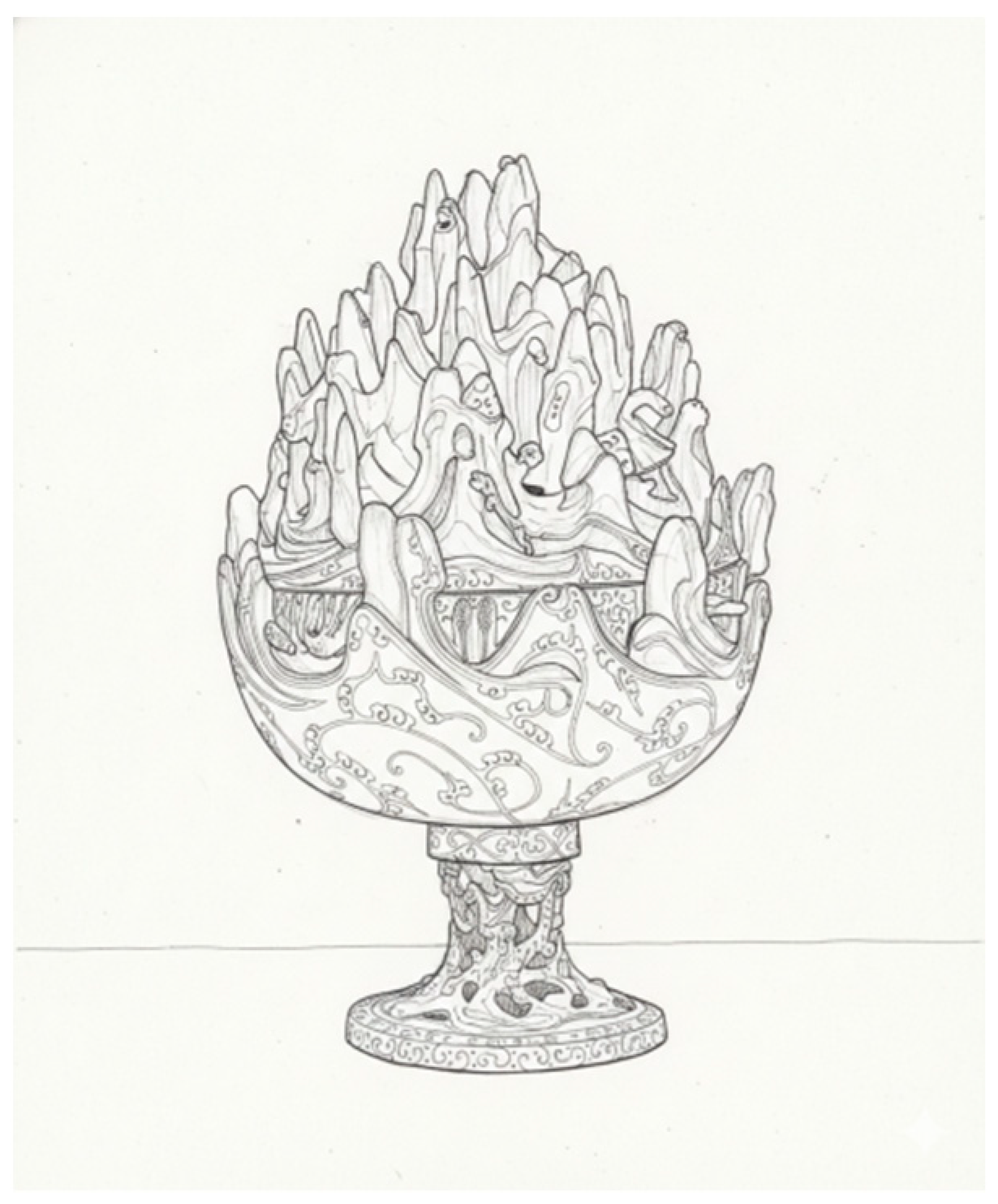
At the same time, Han dynasty boshanlu incense burners presented a paradise vision through vessel form. They combine sea, mountains, clouds, immortals, and auspicious animals into one object. Taking the Boshan incense burner (boshan lu 博山爐) unearthed from the tomb of Liu Sheng 劉勝 in Hebei as an example (Figure 2), the structure can be read in three layers. The circular foot is decorated with cloud patterns. The base is openworked with ocean waves. On the body of the burner, gilt-inlaid waves shift into three dragons. Above this rises a layered world of peaks, a “spirit-and-immortal” landscape where immortals, tigers and leopards, and many kinds of creatures move through the mountain space.
When incense smoke rises from inside, it matches what Lü Dalin 呂大臨 wrote in the Illustrated Investigations of Antiquities (Kaogu tu 考古圖): “The incense burner resembles Mount Bo in the sea. Below, a dish of hot water makes moist vapor steam up and carry the fragrance, to symbolize the encircling of the four seas. 香爐象海中博山,下矃盤湯使潤氣蒸香,以象四海之環。” (Lü 2016, p. 153). In this sense, Han-period immortal-mountain images and related objects already contained a basic vocabulary of paradise representation: cloud patterns, ocean waves, mountains, vapors, immortals, and auspicious animals. This vocabulary later became a shared resource for visual recombination.
One point needs to be stressed here. Early images of paradise do not necessarily include pavilion architecture. At the level of texts, Han and Jin poetry and prose already link towers and terraces with immortals. But in visual form, the relatively early and clear cases where “pavilions or palaces” are stably placed on top of a “sacred mountain,” and where the two are combined into a repeatable structure, appear instead in Buddhist art.
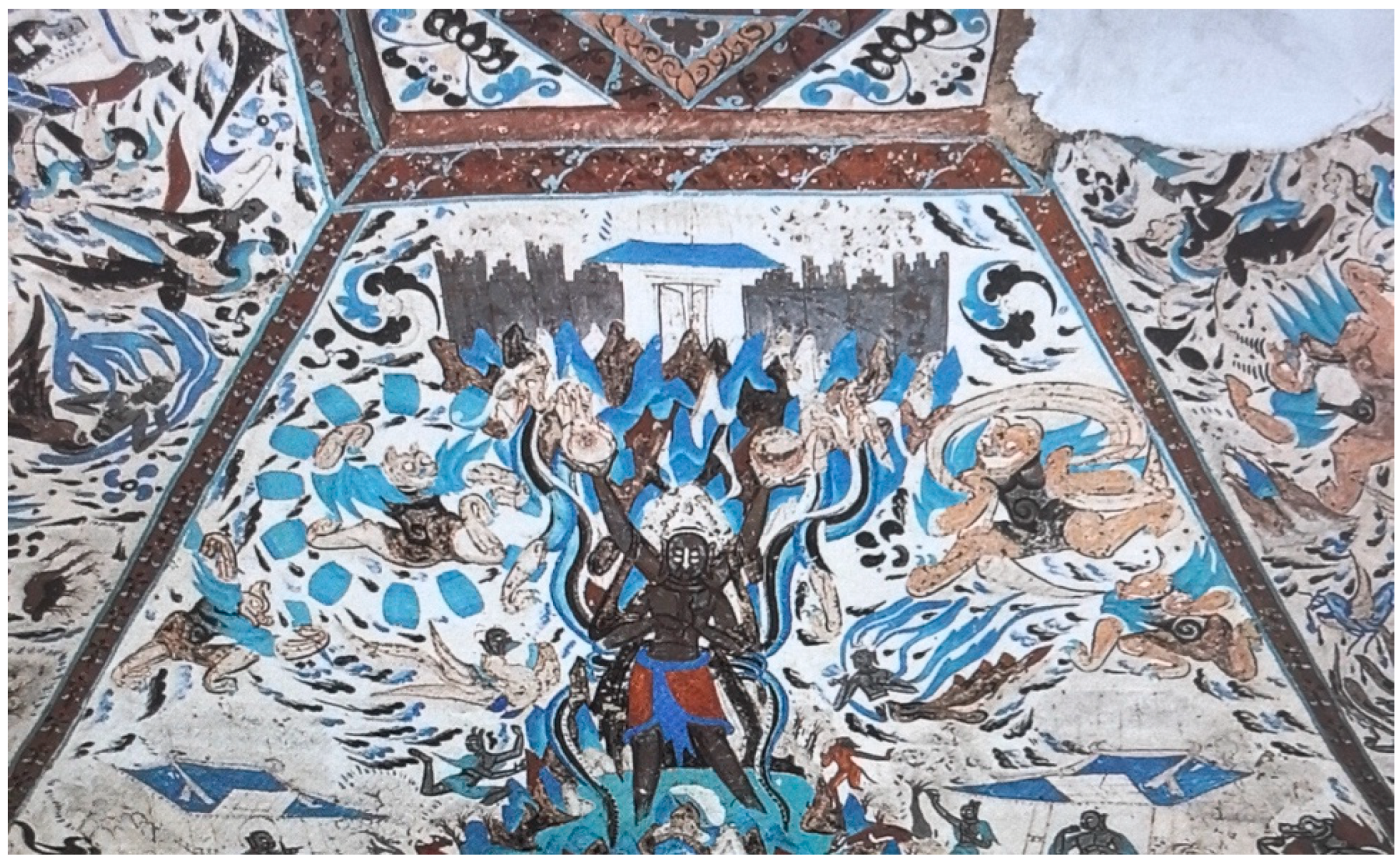
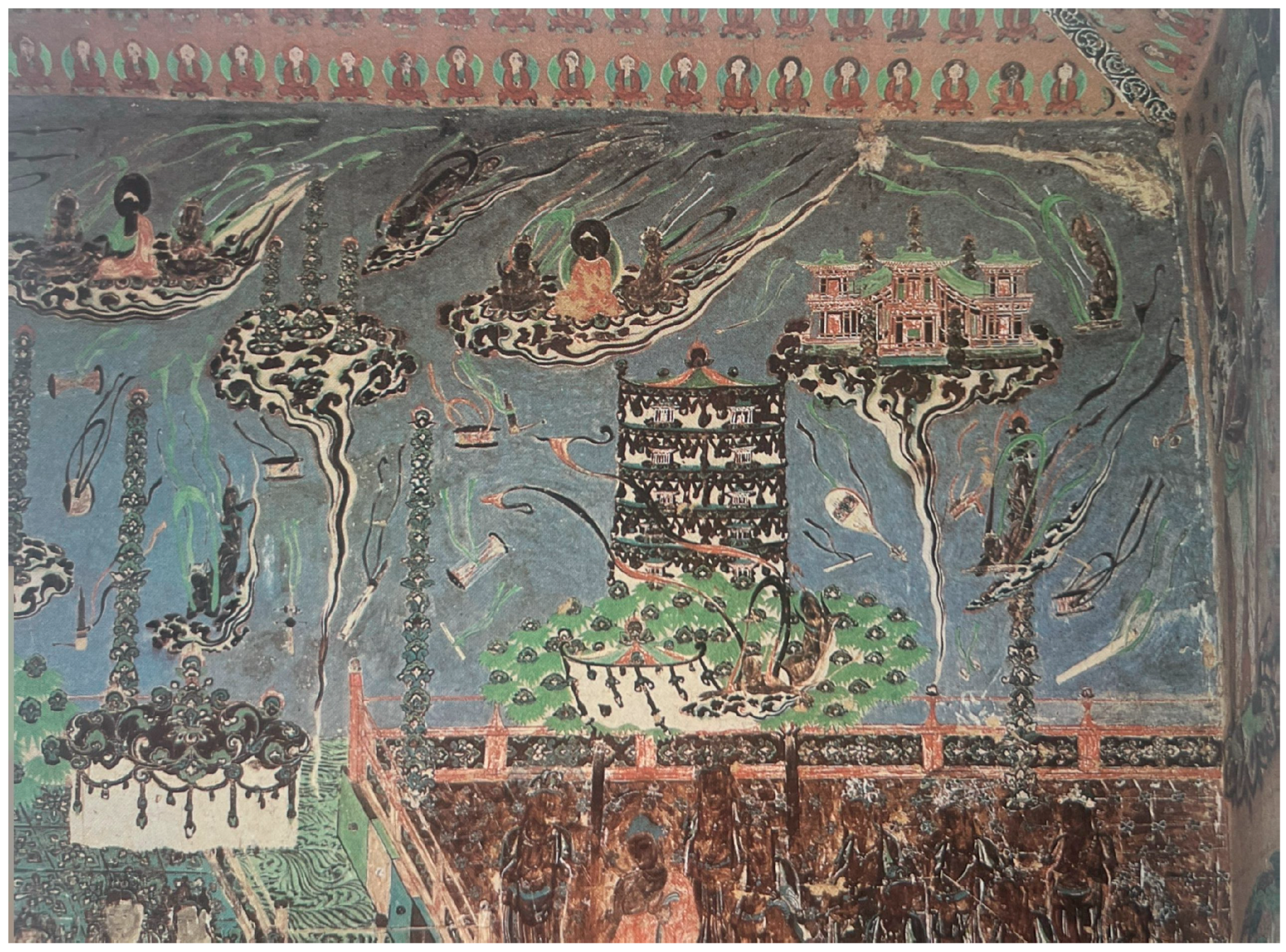
A surviving example is the Mount Sumeru image in Mogao Cave 249 from the Western Wei (Figure 3).
It borrows a local Kunlun-style mountain schema, broad above and narrow below, to represent a heavenly palace. An asura stands in the sea. Behind him, the mountain form is broad above and narrow below. A palace is painted on the summit. At the center of the city, a palace gate is half open, indicating the Trāyastriṃśa Heaven. Although the Sumeru image itself reflects Central Asian influence, the sacred mountain still follows a local model that had been established since the Han (Zhao 2005, p. 27). It can therefore be taken as early visual evidence for a “pavilions–sacred mountain” conjunction. A mural from the early Tang in Cave 321, the Amitāyurdhyāna Sūtra tableau (Figure 4), also shows auspicious clouds lifting a palace.
The cloud form is consistent with the local Kunlun schema. It takes a column-like shape that is broad above and narrow below. After the early Tang, the combination of pavilions, white clouds, and sacred mountains becomes more mature. This “heavenly palace atop a sacred mountain” structure shows a comparable visual continuity with later Daoist motifs of immortal mountains crowned with pavilion complexes.
After the Tang, visual materials related to the immortal realm or paradise themes can be grouped, in broad terms, into three types: tomb murals, handscroll or hanging-scroll paintings, and bronze mirrors. For scroll painting in particular, written sources link the subject “Immortal Mountains and Pavilion Complexes” (Xianshan louge tu 仙山樓閣圖) to Li Sixun 李思訓 (ca. 651–716). Although surviving copies are much later, they can still serve as a reference point for pictorial structure.
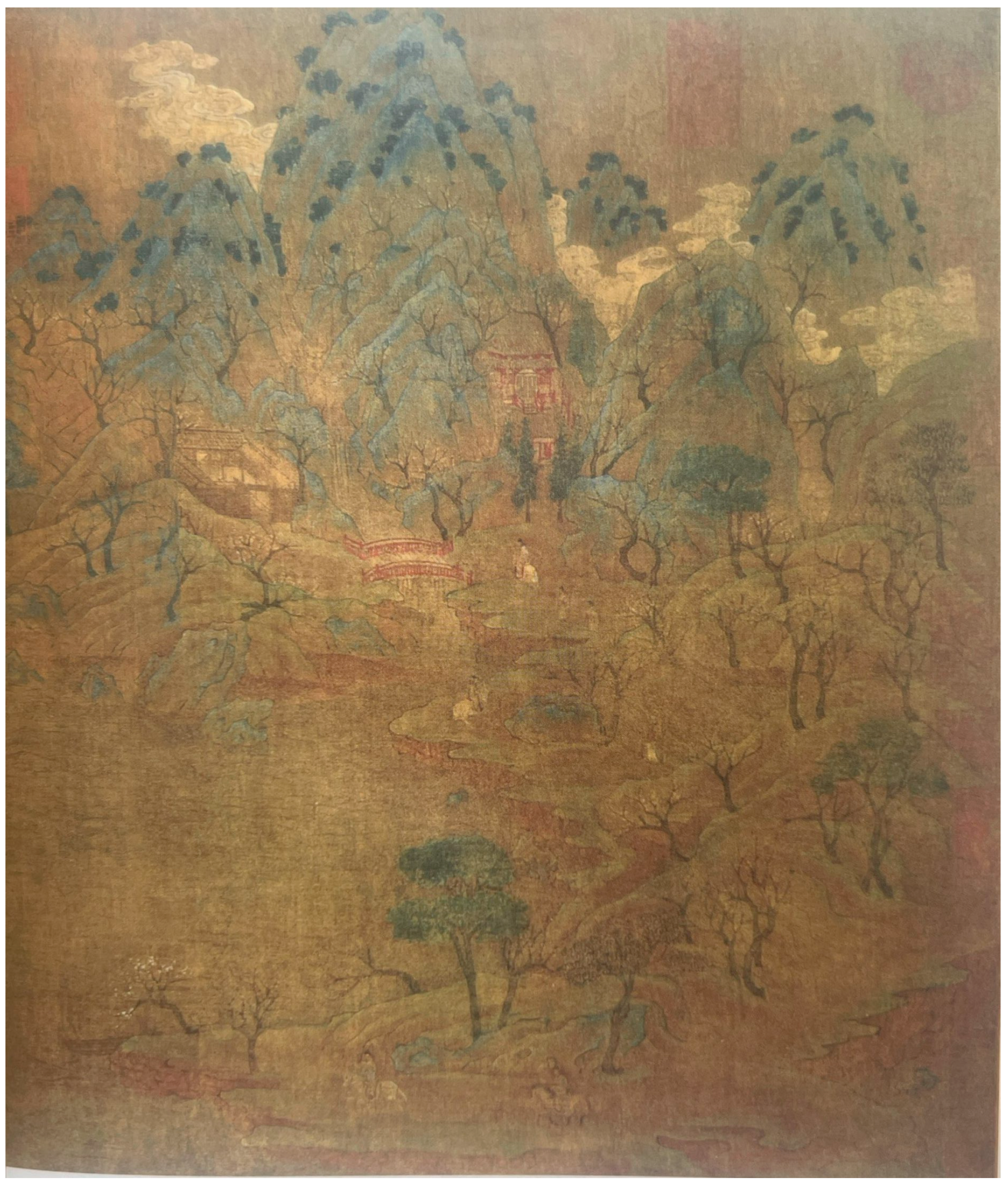
In Spring Outing (Youchun tu 遊春圖), attributed to Zhan Ziqian 展子虔, the pavilion architecture (Figure 5) has red walls and red gates on all four sides. It may represent a Daoist temple complex.
The site is embraced by high mountains and forms a schema in which mountains enclose pavilion buildings, in effect, an “immortal mountain surrounding pavilions” arrangement. Xu Bangda 徐邦達 argues that the work cannot be fully confirmed as Zhan Ziqian’s, but he considers it a piece from the early Tang (B. Xu and Xue 2016, p. 93). Taken together, archaeological materials and scroll paintings suggest that by the Tang, images of the “immortal mountain with pavilions” type were already emerging. In the examples discussed here, the composition no longer centers on a single column-like sacred peak. Instead, mountain forms begin to cluster around built structures, so that space is articulated through surrounding ridges, partial enclosure, and the formation of a more localized inner field.
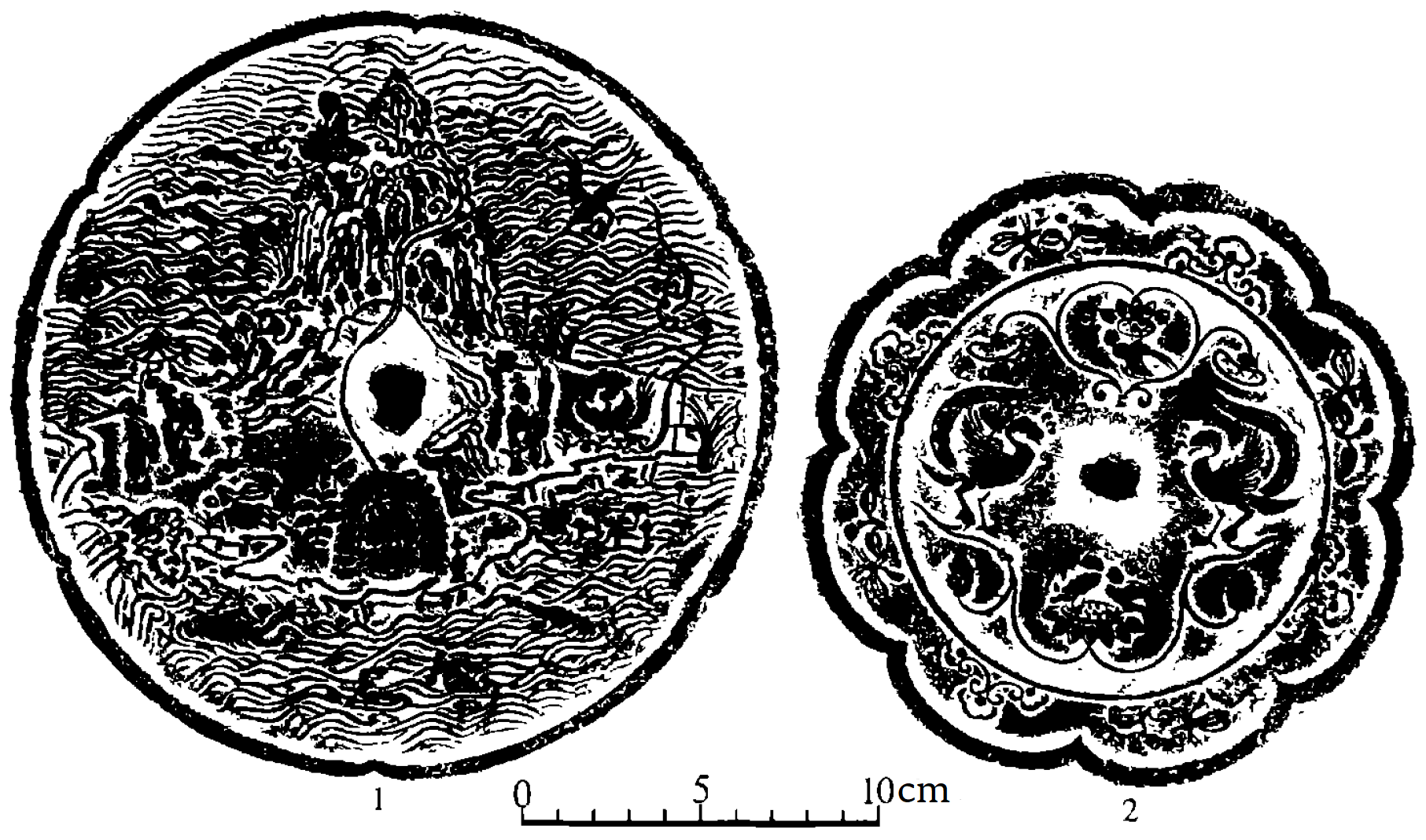
In contrast to the “immortal mountains with pavilion complexes” type, bronze mirrors more clearly show how the “immortal isle in the sea” schema became stabilized in the Tang. A bronze mirror excavated in 1965 at the Sanmenxia Printing and Dyeing Factory site, dated to the fourth year of Yuanhe under Emperor Xianzong (809), is titled “Six-Petaled Sea-Island Figure Mirror” (Liuchu haidao renwu 六出海島人物) (Figure 6).
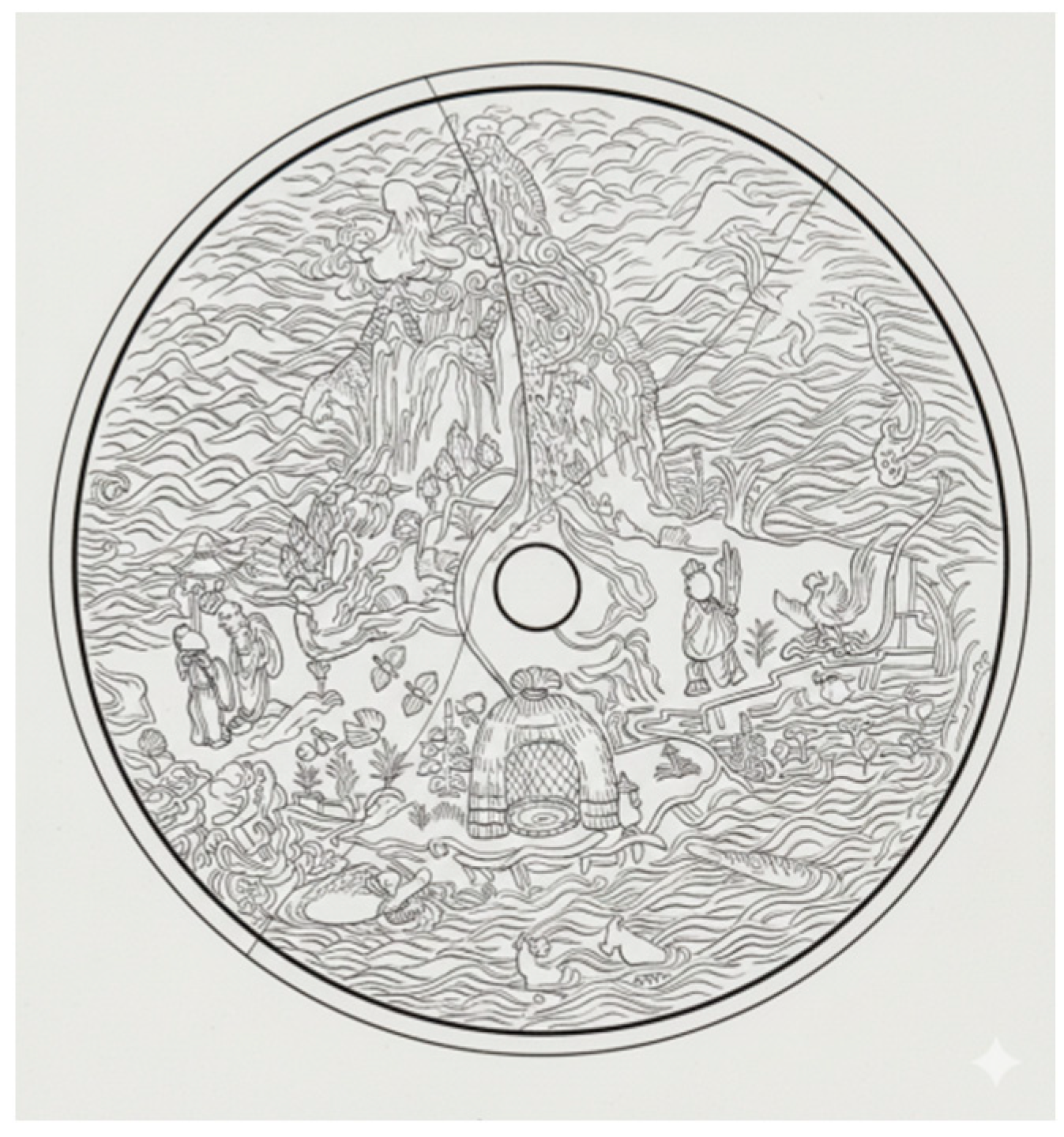
Its pictorial schema is unmistakably the “immortal isle in the sea” mode, and the excavation report reads it as an image of paradise (Heng and Mao 2002). The central image is similar to that on another Tang mirror (Figure 7).
Both show mountains rising from the sea together with figures, and they are taken to evoke the Penglai paradise. The figures and narrative arrangement on the reverse have also been interpreted as Daoist in subject matter (G. Wang 2016, p. 214).
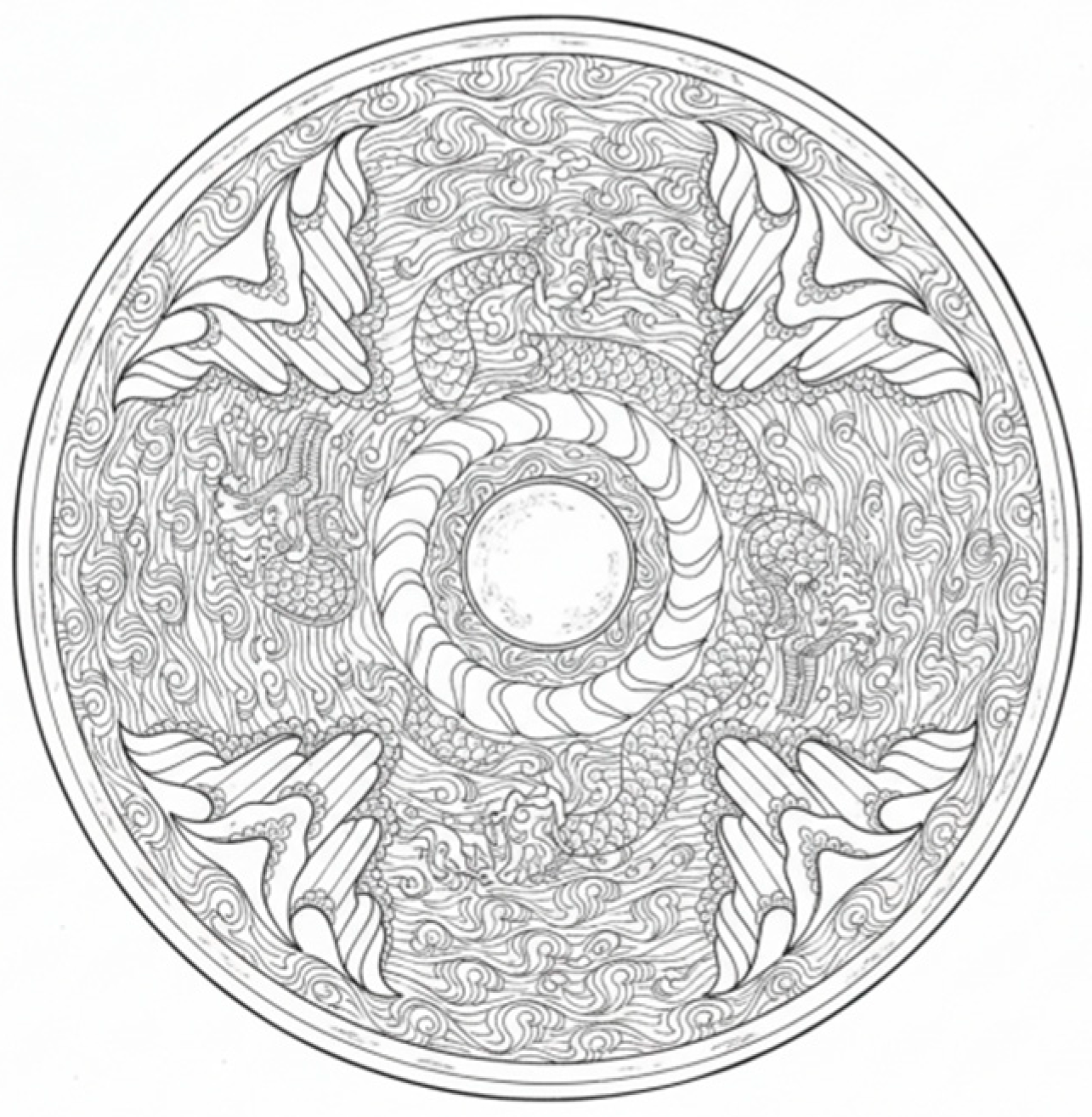
There is also the Japanese imperial treasure at Hōryūji, the “Penglai Paradise Story Mirror” (Figure 8).
Here, the knob and its base form a kind of “overhead view” of a mountain mass. Outside the base, four tall peaks stand in the surrounding sea. The excavation report again explains the image as referring to the Penglai paradise. (G. Wang 2016, p. 216).
Du Fu 杜甫’s poem praising a painting of immortal mountains by Wang Zai 王宰 offers a further point of cross-confirmation with the bronze-mirror material. The description highlights “distant force” and the effect of “ten thousand li within a few inches.” This closely matches the viewing effect typical of the “immortal isle in the sea” schema:
“In ten days he paints one stretch of water, in five days one rock. He can make them free from cramped pressure. Only then does Wang Zai agree to leave a true trace. Magnificent is the Kunlun Fanghu painting. It hangs on the plain wall of your high hall. Baling and Dongting are east of Japan. Red shores and waters connect with the Milky Way. Within it, cloud vapors follow flying dragons. Boatmen and fishermen surge like rapids. Mountain trees all bend before the flood-tide wind. He is especially skilled with distant force. None of the ancients can match it. Within inches, one must speak of ‘ten thousand li’ (i.e., an immense distance). How could I get that swift Bingzhou scissors, to cut away half the river water of Wu Song?
十日畫一水,五日畫一石。
能使不受相促迫,王宰始肯留真跡。
壯哉昆侖方壺圖,掛君高堂之素壁。
巴陵洞庭日本東,赤岸水與銀河通。
中有雲氣隨飛龍,舟人漁子如浦激,山木盡亞洪濤風。
尤工遠勢古莫比,咫尺應須論萬裏,焉得並州快剪刀,剪去吳松半江水。”.
In summary, a rough developmental line becomes visible. Early Han materials often privilege a single sacred mountain rising from the sea together with a basic vocabulary of paradisal signs. From the Wei-Jin through the Sui-Tang period, mountain-and-pavilion combinations become increasingly stable, while Tang mirrors and related materials continue to preserve the “immortal isle in the sea” mode. By the Tang-Song period, two recurrent pictorial tendencies can be distinguished more clearly: one emphasizes the sea boundary, distant viewing, and remoteness; the other more often uses mountain clusters, enclosure, and an interior field to place architecture and paradisal life within the image. These tendencies do not function as rigid types, but they provide a useful historical framework for understanding how later paintings could combine distance, enclosure, and mediated access in different proportions. Seen in this light, the issue is not only the persistence of certain motifs, but the recurrence of several compositional habits: linked local units, inserted architecture, and spatial fields that are segmented yet still visually intelligible, in a manner comparable to Shi Shouqian’s discussion of early landscape painting (Shi 2015, pp. 106–7).

2.3. Daoist Temple Layouts as Spatial Points of Reference for Visual Organization

If images of “immortal mountains with pavilions” offer a point of comparison at the level of visual motif, the siting and layout of Daoist temple complexes provide a more grounded spatial analogue. Pavilion architecture in painting does not need to correspond to any single historical temple. Still, the coexistence of temple architecture, grotto-heaven doctrine, and sacred-mountain topography made available a repertoire of spatial relations—enclosure, frontal opening, protected interiority, and mediated access—that later paintings could selectively reactivate. In this sense, the relevance of Daoist temple layouts lies less in direct iconographic derivation than in the fact that they render certain spatial relations historically legible. This point may be clarified further by recalling Shi Shouqian’s discussion of early landscape space as organized through relatively discrete but visually linked built units embedded within a larger mountain field (Shi 2015, p. 106).
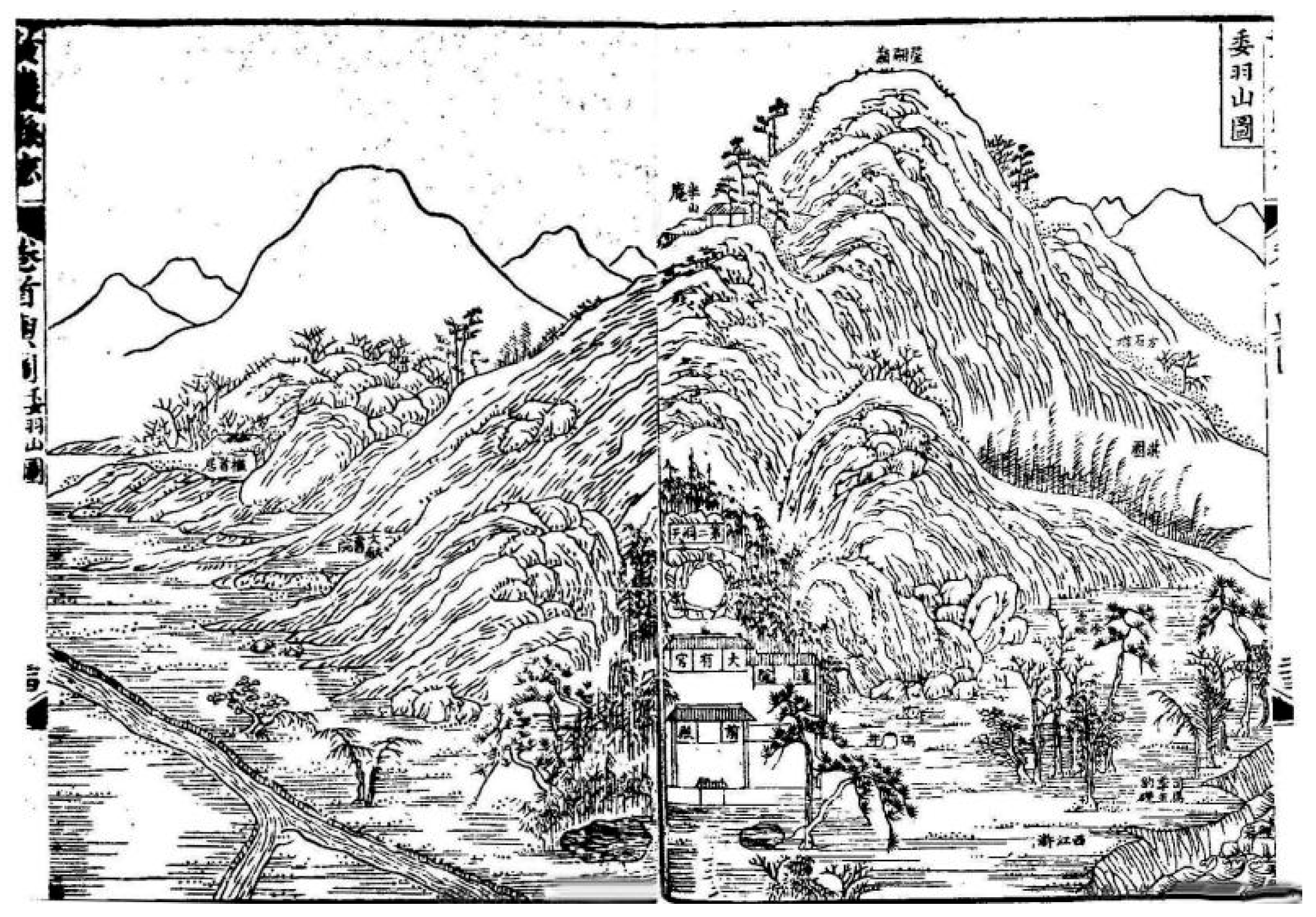
While immortal-mountain motifs belong to a broader Chinese cultural and literary tradition, Daoist grotto-heaven doctrine gave some of these spaces a more specific institutional and ritual geography. With the formation of the doctrine of sacred grotto-heavens and blessed places (dongtian fudi), Daoist temples were typically sited near famous mountains and rivers, and especially near grotto-heavens and blessed places. For example, near the Second Grotto-Heaven, Weiyu Mountain, the Dayou Palace was built (Figure 9).
Within the Sixth Grotto-Heaven, Yujing Cave, the Hall of the Three Pure Ones (Sanqing dian) was established. Near the Eighth Grotto-Heaven, Huayang Cave on Mount Mao, the Jiuxiao Wanfu Palace was built. Near the Ninth Grotto-Heaven, Linwu Cave, the Shenyuo Palace was established. Many of these temples were founded gradually during the Tang, later falling into decline or being expanded. Some aspects of their layouts can still be observed today.
For the Dayou Palace at Weiyu Mountain, associated with the Second Grotto-Heaven, Gazetteer of Weiyu Mountain (Weiyu shan zhi 委羽山志) gives a relatively specific record of its location:
“The Dayou Palace lies about one li northeast of the mountain and formerly stood 120 paces in front of the cave. Its name derives from the celestial realm called the ‘Great Empty and Luminous Heaven,’ although the date of its earliest construction cannot be verified. In the Sui, Xiao Ziyun inscribed the plaque. In the renxu year of Shaoxing in the Song, the county magistrate Li Duanmin rebuilt it. The Daoist priest Dong Dafang presided and renamed it Weiyu Daoist Temple …大有宮在山東北一裏許,舊在洞前一百二十步。因取大有空明之天而名,初建莫考,隋蕭子雲題額,至宋紹興壬戌邑令李端民重修,道士董大方主持更名委羽道觀…” (National Central Library Branch 國家圖書館分館 2004, vol. 20, p. 479).
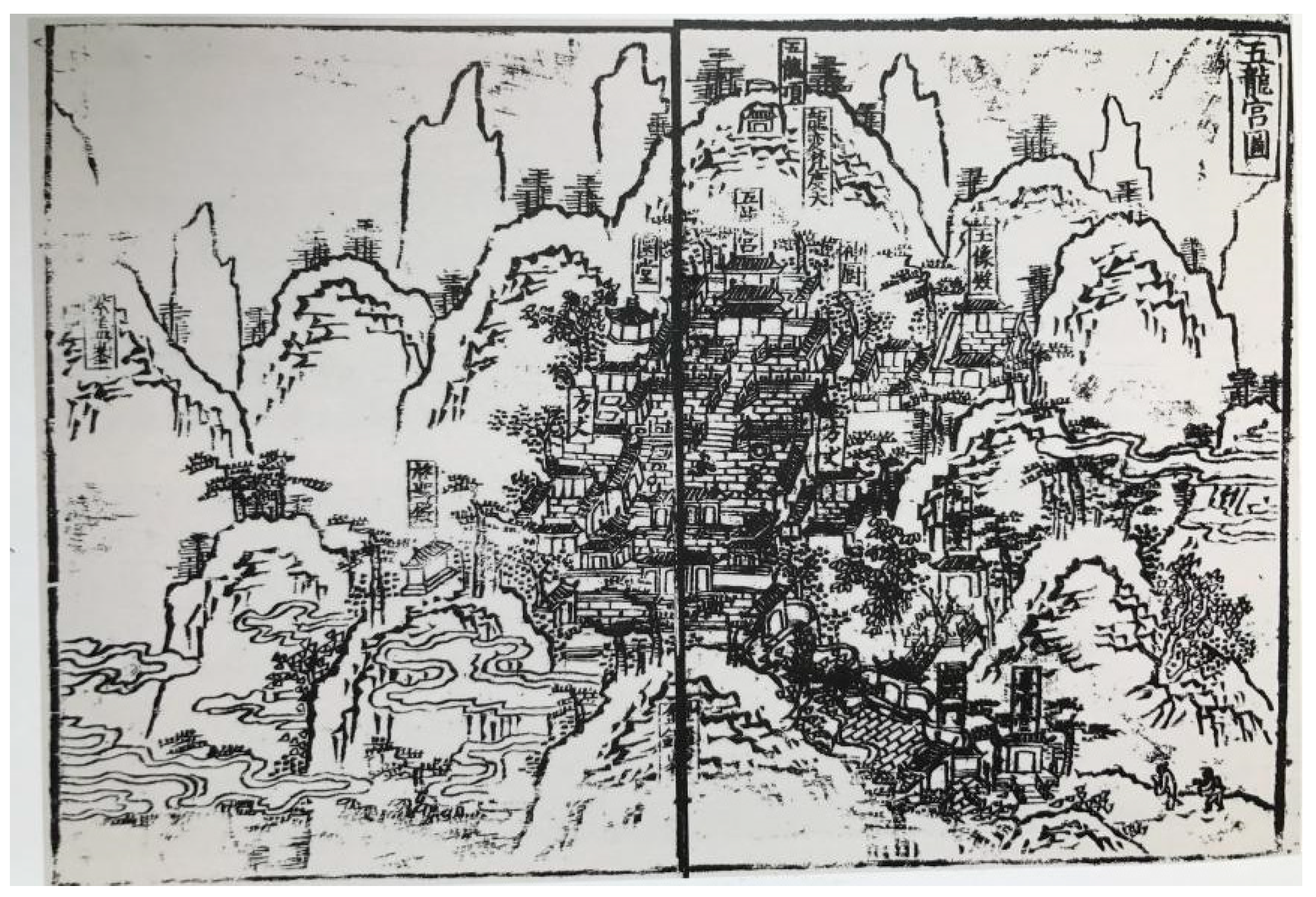
On a descriptive level, the cases discussed here can be provisionally grouped into four spatial patterns. First is an enclosed “pot-heaven” pattern, seen in the siting of complexes such as the Dayou Palace at Weiyu Mountain and the Wulong Palace (Figure 10).
These sites lean against a major mountain. Smaller hills wrap around on both sides. A narrow passage is left in front as an entrance. Second is a peak-top pattern, as in the Jiuxiao Wanfu Palace on the summit of Mount Mao. Third is an in-cave pattern, where temple buildings are constructed inside a grotto-heaven itself, such as the Hall of the Three Pure Ones in Yujing Cave. Fourth is a mid-slope pass pattern, where temples are placed at strategic narrow points and use the mountain terrain as a protective screen. Among these patterns, the enclosed “pot-heaven” arrangement is especially relevant because it makes enclosure, frontal opening, and inner-field formation visible at the same time. An interior field is formed, yet an entry route is preserved at the front.
This spatial model need not be treated as a matter of direct iconographic derivation. Its relevance lies in offering a historically grounded way to think about how visibility, access, and interiority may be structured within a single image. In this sense, the architecture in Spring Outing can be read less as a depiction of a specific Daoist site than as an image-level analogue of enclosed sacred space, one in which surrounding forms produce an “inside” while a frontal opening still suggests possible entry. What matters for the later reading of Wu Bin’s Fanghu Tu is therefore not the identification of a temple source, but the availability of a spatial grammar: enclosure, opening, inner field, and mediated approach. Here, Shi Shouqian’s account of early landscape representation is useful not because it supplies a direct source, but because it helps describe a comparable mode of spatial construction—one built through embedded architecture, layered local relations, and stacked or partially discontinuous spatial extension (Shi 2015, pp. 106–7).

3. Close Reading: Spatial Organization and Viewerly Orientation in Fanghu Tu

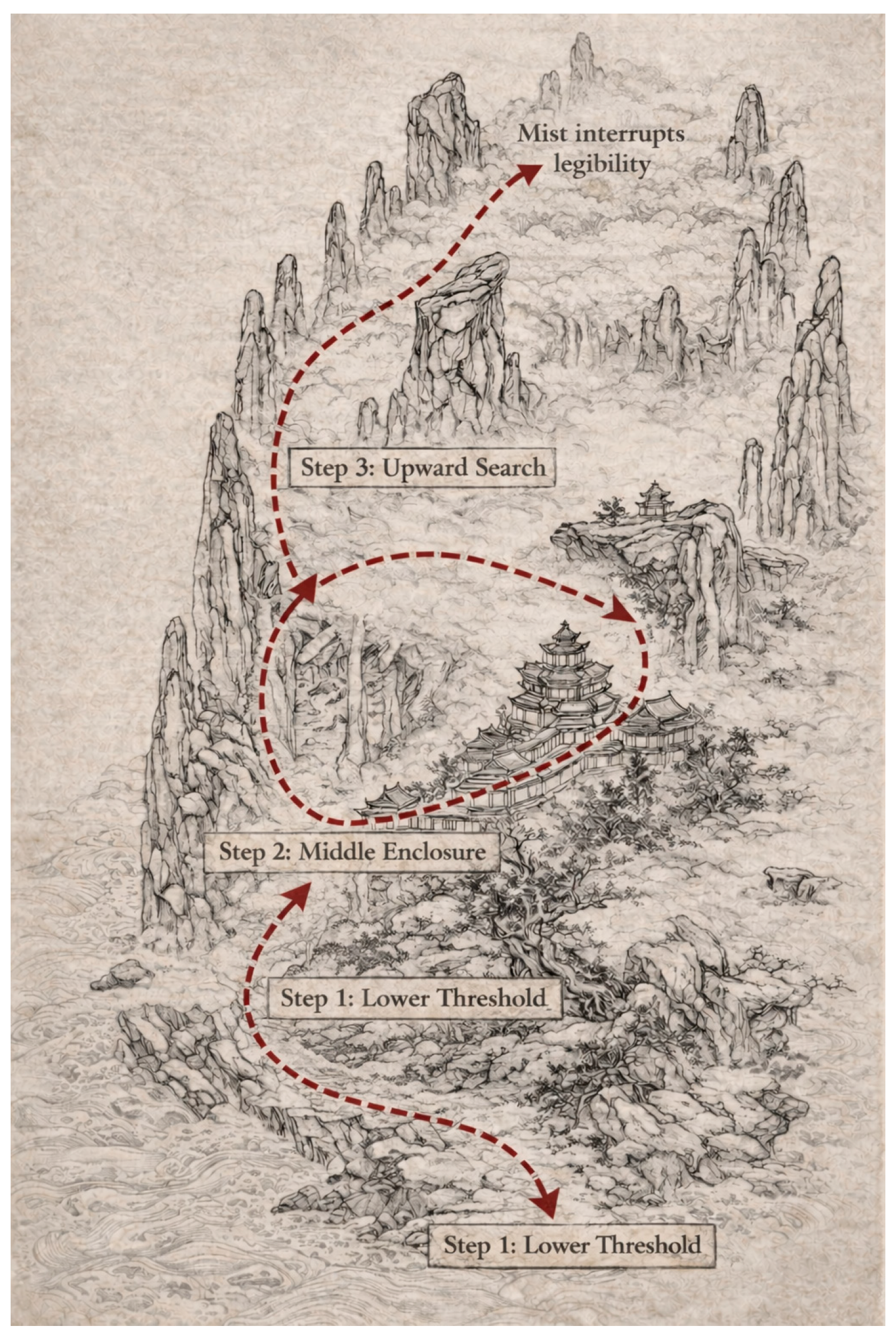
Rather than presenting a single, unified mountain type, Fanghu Tu brings together several recurrent pictorial formations associated with immortal-mountain imagery. At the lower edge, layered waves and abruptly rising rock establish a broken foreground threshold; in the middle zone, enclosing peaks, vapor bands, and pavilion architecture gather into a more concentrated field; above, tall peaks and haze extend the scene upward while reducing distant forms to partial contour, faint planes, and zones of blankness. These features also recall earlier Fanghu image-types discussed in studies of immortal-mountain iconography and pictorial sources (Lin 2018; Jiang 2022).
The close reading that follows does not begin from a single fixed route of viewing. Instead, it moves through several recurring pictorial features in the scroll: the sea boundary and rocky foreground at the lower edge, the opening-and-closing effects of cloud and mist, the formation of an enclosed pavilion-centered middle field, and finally, the arrangement of pauses, upward extension, and return-looking. Each subsection anchors its claim in visible elements of the painting—wave bands, broken shoreline, vapor layers, interrupted contours, clustered rooflines, and the thinning legibility of the upper peaks—in order to show how these formal elements produce a broken threshold below, a more concentrated but only partially available middle zone, and an upper field that draws the eye upward without allowing it to settle. Read in this way, the painting may be approached through spatial problems already noted in discussions of early landscape representation: embedded built units, locally concentrated fields, and a larger pictorial extension that remains only partially continuous or fully resolved (Shi 2015, pp. 106–7).

3.1. Sea Boundary and Rocky Foreground: Establishing Distance at the Lower Edge

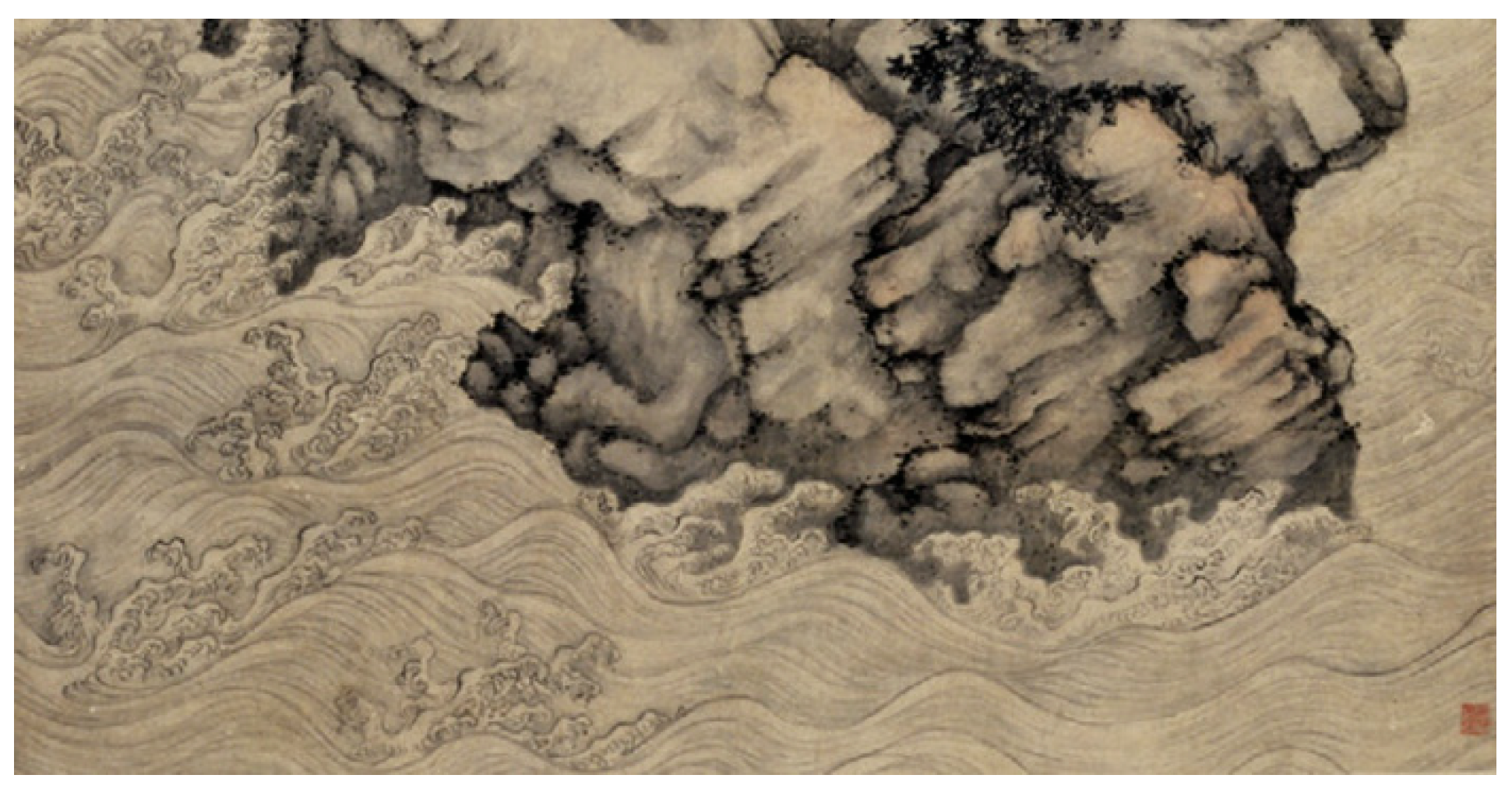
At the lower edge of Fanghu Tu, surging waves and sharply rising rocks establish the painting’s first strong relation of distance. Rather than serving as a neutral foreground, the sea and rocky outcrops place the mountain across a broken threshold and deny any visually continuous approach surface from the outset (Figure 11).
The painting opens with surging waves whose crests stack in dense layers, leaving little room to imagine a stable place to stand. In Figure 11, the water is rendered not as an open horizontal expanse but as tightly packed wave bands that press against one another, leaving no calm strip of shore at the point where the eye might expect landing. The sea, therefore, functions less as neutral ground than as a strengthened foreground boundary, placing the mountain across water and making the first relation to the scene one of separation rather than easy passage.
Connected to the waves are rock masses thrusting up from the surface. They do not ease into the mountain through a gentle shoreline. Instead, they rise abruptly and steeply from the water in broken, jagged contours, so that sea and land meet as a cut rather than a transition. There is no sandbar to step onto and no mild slope to climb. The lower edge thus presents the mountain as fully visible yet without any stable surface through which it might be approached from the viewer’s side.
The sea boundary does not function only as a lower-edge marker. The repeated wave patterns establish a visual rhythm that reappears later in the scroll in the movement of mist and veiling, so that water at the bottom already anticipates other unstable zones of transition above. The lower boundary is therefore not simply a fixed border but a shifting foreground field in which contour, motion, and interruption work together. Similar effects have been noted in discussions of “blankness” and atmospheric veiling in Chinese landscape painting, where such elements operate not as empty space but as active conditions of visibility and attention (Diep 2016). The wave rhythm below and the fractured rock edge above work together: one keeps the water unstable, the other denies any continuous landing edge. Even when attention moves upward along the mountain body, the lower zone remains active: the surge of water keeps the base unsettled, while the abrupt rise in rock prevents the eye from imagining a smooth entry surface.
In Figure 11, the sea-bound lower edge does not offer a shallow shelf, continuous shoreline, or gently rising bank through which land normally becomes traversable. Instead, stacked wave bands meet abruptly rising rock, so that the mountain appears across a cut foreground rather than across a continuous approach surface. Separation and discontinuity are thus emphasized at the very point where contact might otherwise be expected. The lower edge establishes a condition that remains important for the scroll as a whole: the mountain is fully visible as an object of attention, yet the surface through which it might be pictorially approached is never made continuous or secure.

3.2. Cloud and Mist: Regulating Visibility and Redirecting Attention

If the sea boundary and reefs place the mountain at a visible distance, cloud and mist make that separation less fixed and more variable across the scroll. In Fanghu Tu, vapor is not confined to a single zone. It threads through the upper peaks, the middle enclosure, and the spaces around the pavilion cluster, alternately thinning distant forms, interrupting contour continuity, and partially revealing built structures. Cloud and mist are therefore not merely atmospheric additions. They are among the main means by which visibility is distributed unevenly within the painting (Figure 12).
First, mist alters the upper zone by preventing distant forms from resolving into a fully legible far view. The peaks continue upward, but many of their outlines are broken by haze and reduced to narrow vertical thrusts, faint planes, or partial contours. In Figure 12, the upper peaks do not disappear uniformly; some survive as thin vertical needles, others as faint shadowed planes, while still others are cut off halfway by vapor. What appears at the top of the scroll is therefore not a fully stabilized distance, but a field in which far forms remain fragmentary and partially withdrawn from view. The eye is drawn upward, yet it does not find a fully articulated destination there, and is consequently brought back toward the middle zone where forms become more legible. What fails here is not movement itself, but the consolidation of a clearly legible upper destination. Comparable effects of blankness and veiling as active conditions of looking have been discussed in studies of Chinese landscape painting (Sun 2023, pp. 380–82).
Second, mist is not a uniform veil. It opens and closes, taking on different densities and edges across zones. In some areas, light washes dissolve boundaries so that mountain and blank space pass into each other; elsewhere, more defined cloud bands cut across masses and create a legible blocking layer. This variation produces uneven visibility, and that partiality is especially evident around the pavilion complex, which is rarely given full exposure. Rooflines, terraces, and building edges emerge between vapor layers and then recede again as the mist thickens: a roof ridge becomes legible, then disappears; a terrace edge comes forward, then loses continuity behind another vapor band. As a result, attention does not move forward in a single continuous way. Moments of architectural clarity are followed by interruption, pause, and renewed searching. Visibility and concealment thus shape the tempo of looking within the middle zone.
Beyond this local alternation of exposure and veiling, cloud and mist also disrupt any continuous visual transition from the lower boundary to the enclosed middle zone. Openings do appear between folds, ridges, and vapor bands, but they do not remain stable for long. A gap that seems to connect one area to another is quickly complicated by another layer of haze or by the overlapping of mountain forms. Openings are therefore local and temporary rather than cumulative. What emerges is not a clearly traceable route through the painting, but a sequence of provisional alignments that invite advance only in part and then break apart again.
This opening-and-closing dynamic shapes visibility across the scroll as a whole. Mist keeps distant peaks only partially legible and allows the pavilion cluster to appear through brief intervals of clarity, while repeatedly preventing either zone from becoming fully settled or completely available to the eye. It organizes a fluctuating field of perception in which emergence is repeatedly accompanied by interruption.

3.3. Enclosure and Pavilion Cluster: Forming an Inner Spatial Field

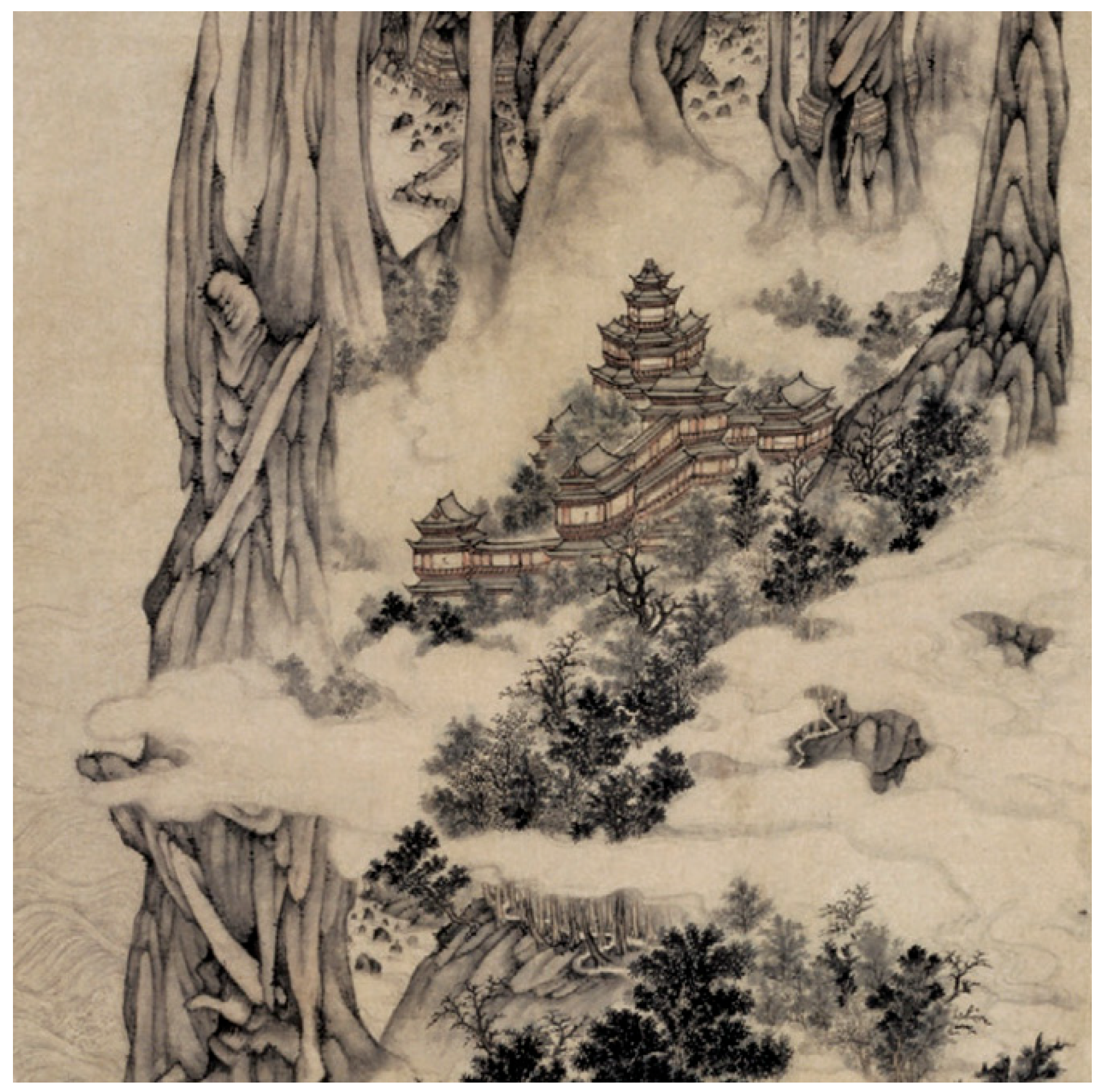
Yet the painting does not remain entirely organized by distance and obstruction. In the middle section of Fanghu Tu, the pavilion complex is set within an enclosure of peaks, and the surrounding mountain forms, together with bands of cloud, gather into a more concentrated middle field. Rather than presenting the mountain only as a distant object, this configuration draws attention inward: enclosing peaks and vapor gather around the pavilion cluster, while the architecture becomes one of the most sharply articulated zones in the scroll. At the same time, this middle field does not open into a fully secured interior. It remains only partially accessible, as surrounding forms continue to segment and veil it. What forms here is a locally coherent middle field in which built units gain temporary clarity without being absorbed into a fully continuous spatial whole (Shi 2015, p. 106; Wu and Jin 2022).
Placement is crucial. The buildings are not placed on the highest summit or exposed to the water’s edge. Instead, they occupy a middle register where mountain forms fold back and gather around them. In front, sloping rock and thinning vapor create a shallower visual transition than at the sea-bound lower edge, while steep peaks and jagged stones on both sides frame the cluster and tighten its enclosure (Figure 13).
The effect of enclosure is not simply to isolate the pavilion complex, but to bind roofs, terraces, enclosing peaks, and veiling bands into a denser middle-zone arrangement. What might otherwise remain a distant architectural detail becomes, within this clustered field, a more concentrated visual center. Attention does not simply rest on a decorative motif here. It pauses, gathers, and reorients itself within a bounded middle field.
At the same time, this enclosure is not sealed. Wu Bin leaves a frontal opening between enclosing forms, but its function is less that of a literal entrance than of a directional cue. It gathers attention toward the middle zone and suggests a possible inward orientation without converting the enclosed field into a fully continuous passage. What emerges is not a fully open route toward an inner core, but a more concentrated middle zone organized through partial accessibility. Architectural clustering, frontal openings, and layered enclosure work together to make this area more visually approachable than the lower sea-bound threshold, while still leaving its boundaries only intermittently negotiable.
The pavilion complex also introduces a denser pattern of internal differentiation within the middle zone. Rooflines, terraces, and architectural edges create points at which attention can briefly settle, while the surrounding peaks fold back around them to produce a layered sense of enclosure. The result is not a single stable passage through the mountain, but a more articulated internal field in which looking can pause and shift among clustered forms. In this respect, the enclosed middle zone recalls spatial features often associated with grotto-heaven imaginaries, especially enclosure, layered access, and the partial opening of an interiorized sacred domain.
What emerges in the middle zone is not a fully opened interior, but a denser cluster of visible relations: roof ridges step across the complex at different heights, terrace edges create short horizontal rests, and enclosing peaks fold back around them so that attention gathers locally without being released into a continuous route. Compared with the lower boundary, this zone offers stronger cues of inward orientation and temporary visual settlement, yet these remain dependent on partial openings and layered enclosure rather than on any fully continuous access. Its importance lies less in opening a completed interior than in changing the terms of viewing: after the unstable threshold of sea and rock, the scroll offers a zone in which clustered forms, architectural detail, and layered framing allow attention to settle more locally, though never fully or for long.
A further question then emerges: if the middle enclosure offers the clearest local concentration in the scroll, why does that concentration still fail to stabilize into a lasting point of visual rest? Fanghu Tu does not allow the gaze to remain at the pavilion cluster for long. Rising peaks, dissolving distance, and renewed veiling continue to unsettle the middle zone and redirect attention elsewhere in the scroll. The next section examines how pausing points, upward extension, and return-looking are arranged within the image.

3.4. Pausing Points, Upward Extension, and Return-Looking

The pavilion-centered middle zone offers one of the clearest places at which attention can pause, but the painting does not allow that pause to stabilize into full visual command. What matters here is not a simple contrast between stopping and moving on, but the way temporary settlement is followed by renewed displacement. Through the arrangement of architectural detail, upward-thrusting peaks, thinning distance, and intermittent veiling, Fanghu Tu repeatedly shifts attention between local concentration and broader reorientation across the scroll. This dynamic belongs to a broader pictorial problem already noted in discussions of early landscape space: moments of local articulation do not resolve the larger field into a continuous visual advance, so that looking proceeds by renewed adjustment rather than by steady progression. (Shi 2015, pp. 106–7).
What makes such a pause possible, however, is not full clarity but a condition of partial legibility. Building outlines are recognizable, while cloud and mist interrupt them enough that they cannot be fully seen through. The viewer therefore lingers over relations among terrace levels, roofline directions, and structural links, and this lingering gives the middle zone a denser temporal texture than the lower boundary. These are not symbolic details added after the fact, but the very features that slow looking by multiplying local relations within the cluster. Small motifs around the complex, such as pines and tiny figures, further supply a sense of measure, so that the enclosure reads as a world with its own scale and internal articulation. Comparable forms of slowed, temporally extended looking have been discussed in studies of Ming landscape viewing (Liu 2016/2017).
Yet this pause does not anchor attention for long. Above the pavilion cluster, the composition restarts an upward movement: peaks continue to rise in sharp points or elongated pillar-like thrusts, extending the scene beyond the relative concentration of the middle zone. Once attention rests at the pavilions, it is drawn further upward, but the higher register does not become more fully legible in return. Distance thins into haze; ridges lose solidity and remain as outline, shadow, or partial contour. The result is not a fully legible upper destination, but an increasingly unstable field in which attention can continue to ascend without securing a final point of rest.
Return-looking emerges from this instability of the upper register. It is not simply a matter of the viewer deciding to look again, but of the composition failing to secure the ascent it has initiated. When the higher zone dissolves into haze and partial contour, attention is drawn back toward areas of stronger articulation below, especially the pavilion enclosure and, more distantly, the sea-bound lower threshold. What this produces is less a closed cycle than a repeated redistribution of attention across the scroll: pause gives way to upward extension, upward extension to thinning legibility, and thinning legibility to renewed concentration elsewhere (Figure 14).
To sum up, the eye moves from tightly layered water and broken shoreline, to partially veiled rooflines and clustered terraces, and then upward into peaks that thin into haze and partial contour. What is never secured is a single fully legible destination for the gaze: each zone clarifies something locally, but each is also interrupted before it can stabilize the whole scene. Instead, the painting redistributes attention across the scroll through alternating moments of concentration, interruption, upward extension, and return. The next section considers how this pictorial organization may be related to late Ming discussions of qi and pictorial strangeness.

4. Late Ming “Strange-Realm” Aesthetics and the Visual Production of Daoist Spatial Experience

Placed back in the late Ming context, the qi 奇 of Fanghu Tu is best understood not simply as a stylistic label, but as part of a broader pictorial problem: how landscape form could be made visually arresting, unstable, and difficult to resolve. In Fanghu Tu, this effect is not produced simply by sharp peaks or unusual subject matter. Rather, it emerges from the conjunction of a sea-bound lower threshold, a pavilion-centered middle enclosure, and an upper field of thinning forms and haze, through which the sacred mountain is made visible without becoming scenically settled or fully accessible.
This argument also needs to be situated more explicitly within late Ming art-historical discussion. Jonathan Hay has influentially shown that by the seventeenth century, qi could name not only the strange or extraordinary, but also a broader imaginative orientation in painting, one connected to novelty, pictorial invention, and the reconfiguration of visual experience (Hay 1995). More recent studies of late Ming painting have likewise suggested that the rise in the taste for the strange and marvelous (shangqi 尚奇) should be understood not as a merely decorative preference, but as part of a broader transformation in artistic thought and landscape practice (Y. Chen 2023). In this context, pictorial invention was often negotiated against claims of lineage, antiquity, and legitimacy, rather than simply opposed to them. What counted as “strange” or “new” was therefore inseparable from ongoing debates over how painting might depart from inherited models without forfeiting historical credibility. Read against this broader historiography, Wu Bin’s qi should not be reduced to eccentricity of style. It may instead be understood as a mode of pictorial construction through which instability, concentration, and visual difficulty were deliberately intensified. In this sense, qi helps frame not a generalized rhetoric of “strangeness,” but a historically grounded way of understanding why pictorial instability, uneven disclosure, and unusual spatial concentration mattered in late Ming landscape painting.
To understand the religious force of Fanghu Tu, however, it is not enough merely to identify Daoist subject matter. What matters is how pictorial form organizes relations of enclosure, veiling, and passage without allowing them to settle into ordinary scenic coherence. In this respect, grotto-heaven imagery matters not because it supplies a symbolic key in advance, but because it brings into view a sacred spatial logic organized through partial opening, layered mediation, and controlled disclosure.
In his discussion of grotto-heavens (dongtian 洞天), Verellen emphasizes their function as passages between different worlds and notes that dong carries connotations of penetration, communication, and discernment (Verellen 1995, p. 265). These observations do not provide a direct key for reading the painting, but they help clarify a broader religious understanding of sacred space as something defined through partial access, mediation, and transformation rather than stable occupation. Read in this light, the spatial organization of Fanghu Tu does not simply represent a “place” that can be entered. It constructs a differentiated field in which enclosure, veiling, and layered relations make visibility uneven and access provisional, rather than presenting sacred space as a stable scenic site available at a glance.
For this reason, the kind of pictorial organization that most closely corresponds to grotto-heaven experience is not a calm, level-distance landscape, but one that makes viewing itself unstable, layered, and temporally extended. This is where the pictorial force of qi in Fanghu Tu becomes most legible. Grotto-heaven and pot-heaven are no longer only labels for sacred sites; they become modes of spatial construction that can be repeatedly apprehended through shifting relations of enclosure, veiling, concentration, and recession. In this sense, the painting’s religious force does not depend on an added narrative of immortals. It is produced through pictorial organization itself: by making access partial, concentration local, and recession continually unstable, the painting keeps sacred space experientially active rather than scenically resolved.
Seen in terms of visual production, Fanghu Tu translates this sacred spatial tension into a set of workable formal means. Exaggerated peak forms first raise spatial pressure: ridges thrust upward, sharpen, and overlap, pushing attention into vertical extension and upward looking. Upward looking may produce a sense of transcendence, yet the higher register does not become more fully graspable in return. At the same time, the movement of cloud and mist turns that instability into a dynamic visual condition. Mist neither fully blocks nor fully opens; it modulates visibility through alternating moments of disclosure and concealment. Delayed pathways and interrupted openings further shift the grotto-heaven experience away from symbolic explanation and into the organization of viewing itself. The image offers cues of orientation, yet repeatedly changes the conditions under which those cues can be followed. In this sense, the close readings of sea boundary, mist, enclosure, pausing points, and return-looking are not scattered “techniques.” Together they form an integrated set of devices through which the grotto-heaven experience is pictorially articulated.
The crucial point is that this “strange-realm” effect is not created ex nihilo. It is produced through a reordering of inherited visual resources, so that multiple immortal-mountain configurations are brought into tension within a single image. The sea-bound lower threshold strengthens a sense of separation across water, while the enclosed middle field provides a provisional resting point of greater concentration. Yet this concentration is never fully stabilized, because the upper recession of peaks and haze continually disperses attention again. In this sense, qi is not exhausted by visual stimulation alone. It is also bound to a patterned redistribution of attention, in which lower threshold, middle enclosure, and upper recession repeatedly modify one another. Sacred space requires no additional narrative proof here; it is produced through this unstable yet highly controlled pictorial organization.
Why does this strategy suit the late Ming so well, and why does it suit Wu Bin in particular? On the one hand, late Ming culture fostered strong habits of appreciating novelty, visual intensity, and unusual worlds. Material culture, connoisseurial writing, image circulation, and urban life together shaped ways of looking that were highly responsive to visual surprise, instability, and imaginative elaboration (Clunas 2004). Recent studies of shangqi aesthetics and late Ming landscape transformation likewise suggest that this appetite for the unusual was not confined to isolated motifs but extended to broader shifts in artistic thought, visual structure, and mountain representation (A. Zhang 2024; M. Chen 2022; Z. Chen 2023). Seen in this context, Wu Bin does not merely cater to curiosity. He translates a late Ming appetite for unusual pictorial experience into the construction of Daoist-inflected sacred space. On the other hand, Wu Bin’s qi should also be placed within a more specific discourse of painting criticism. Re-evaluations of the strange and the orthodox, the new and the ancient, and the status of pictorial originality were central issues in seventeenth-century art theory. Scholarship has accordingly situated Wu Bin within broader genealogies of originality and qi (Burnett 2013). In this sense, his distinctiveness lies not simply in choosing the subject of the immortal mountain, but in reworking inherited visual resources into a repeatable structure of uneven disclosure, provisional concentration, and unstable recession.
In this way, “strange-realm” spatialization can be understood as a strategy of visual production. It pulls grotto-heaven and pot-heaven away from merely mythic labels and resituates them within the organization of space and the rhythm of viewing. The qi of the immortal mountain is therefore not an exaggeration of nature for its own sake, but a formal articulation of sacred spatial experience.
In Fanghu Tu, tightly layered water and broken shoreline establish a lower threshold; clustered roofs, enclosing peaks, and vapor bands produce a concentrated but only partially available middle field; above, tall peaks thin into haze and partial contour, drawing the eye upward without granting a final visual resting point. What Wu Bin achieves is not a single resolved route into paradise, but a patterned redistribution of attention across threshold, enclosure, ascent, and return. Read in this light, the painting’s religious force lies in the selective reassembly of inherited spatial resources into a pictorial structure of uneven visibility, mediated access, and unstable recession.

5. Conclusions

What matters in Wu Bin’s Fanghu Tu is less the addition of a new symbolic gloss to the Fanghu motif than the way inherited ideas of grotto-heaven and pot-heaven are reworked into a pictorially organized experience of sacred space. The close reading above suggests that the painting selectively reassembles inherited immortal-mountain resources within a single hanging scroll, but does so in a way that prevents sacred space from settling into stable scenic coherence. Rather than offering a single transparent route, the composition tends to distribute attention across a lower threshold of sea and rock, a middle zone of partial enclosure around the pavilion cluster, and an upper recession of distance, haze, and incomplete contour. In this sense, sacred space appears less as a stable place awaiting recognition than as a differentiated field of visibility, concentration, interruption, and renewed orientation.
Seen in this light, the sea boundary, mist, enclosure, pauses, and moments of return-looking are better understood not as isolated effects, but as related pictorial means through which sacred space becomes intermittently visible while remaining only partially available to view. Together, they shape a patterned but uneven distribution of visibility across the scroll. The lower zone establishes separation across water; the middle enclosure offers a more concentrated field in which attention can settle locally; and the upper recession of peaks and haze disperses that settlement again by refusing to stabilize distance into a fully graspable destination. What emerges is therefore not a simple opposition between nearness and remoteness, but a patterned redistribution of attention across the scroll. In this context, Wu Bin’s qi is better understood not simply as stylistic exaggeration, but in relation to late Ming efforts to intensify pictorial experience through instability, unusual spatial concentration, and controlled visual difficulty (Hay 1995).
In broader terms, this case suggests that sacred space in painting need not be treated as a passive background or merely as the illustration of doctrine. In Fanghu Tu, sacred space is produced through pictorial organization itself. Landscape here is not only something to be seen, but a medium that positions the viewer and differentiates relations of threshold, enclosure, mediation, and recession (Lefebvre 1991). For this reason, the article has used schema and pictorial organization not as total explanatory models, but as restricted descriptive terms for showing how inherited visual resources are selectively recombined and how attention is unevenly distributed across the image. From this angle, Wu Bin’s Fanghu Tu can be read as giving visible form to a Daoist-inflected experience of sacred space while also placing that experience in relation to late Ming concerns with qi and pictorial strangeness.
At the same time, the discussion leaves several directions open. First, if more materials on image circulation are brought into view, such as related prints, illustrated manuals, and other reproductive formats connected to viewing and travel, it may become possible to specify more precisely how these inherited visual resources were sourced and re-edited within the late Ming visual environment. Second, if high-resolution details and fuller version information can be examined, observations on rhythms of visibility, the siting of the inner enclosure, and the redistribution of attention across the scroll can be pushed toward more fine-grained formal analysis. Even so, the discussion points to a more limited conclusion: through the selective reassembly of inherited schema-like resources and the pictorial organization of attention, Wu Bin’s Fanghu Tu makes sacred space visible not as an immediately available destination, but as something unevenly disclosed in the act of viewing.

Author Contributions

Conceptualization, X.Z.; Investigation, X.Z.; Resources, X.Z.; Writing—original draft, D.Z.; Writing—review & editing, D.Z.; Supervision, D.Z. All authors have read and agreed to the published version of the manuscript.

Funding

Fujian Provincial Social Science Foundation: FJ2022JDZ058.

Institutional Review Board Statement

Not applicable.

Informed Consent Statement

Not applicable.

Data Availability Statement

No new data were created or analyzed in this study. Data sharing is not applicable to this article.

Conflicts of Interest

The authors declare no conflicts of interest.

Notes

1
The Wanli reign (r. 1573–1620) and the Tianqi reign (r. 1621–1627) were reign periods of the Ming dynasty.
2
Xu Wenmei’s catalogue essay offers an exhibition-grounded overview of immortal-mountain painting, using selected objects to sketch how recurring pictorial schemas take shape and circulate across works (W. Xu 2018, p. 178). At a different historical level, earlier Chinese landscape discourse often valued the “walkable, viewable, wanderable, and inhabitable” image, as in Guo Xi’s Linquan Gaozhi (Guo 2010, p. 16). The present argument does not reject this tradition, but asks how Fanghu Tu reworks sacred landscape through a different organization of threshold, enclosure, and visibility.
3
Lin Shengzhi approaches Wen Boren’s 文伯仁 Fanghu Tu through its visual sources, reconstructing lines of transmission and paying particular attention to the compositional making of an “immortal isle in the sea” through sea, island, clouds/vapors, and pavilion architecture (Lin 2018, p. 45).
4
Chou Fang-mei’s dissertation develops a text–image comparative method: Daoist writings and poetic narratives supply descriptive resources, and the analysis asks how such textual features of paradise are converted into pictorial form (Chou 1997).
5
Two further observations are especially relevant here: Lin points to the importance of visual materials in the background of the image type, while Wang notes that certain inscription practices can borrow from the formal repertoire of Daoist talismans (Lin 2018, p. 45; Y. Wang 1995, pp. 91–92).
6
For related English-language scholarship on Wu Bin and late Ming pictoriality, see Oh (2022), Burnett (2006), and Burnett (2013).

References

  1. Burnett, Katharine P. 2006. Travel and Transformation: Wu Bin’s Enjoying Scenery along the Min River. Oriental Art 50: 2–15. [Google Scholar]
  2. Burnett, Katharine P. 2013. Dimensions of Originality: Essays on Seventeenth-Century Chinese Art Theory and Criticism. Hong Kong: The Chinese University Press. [Google Scholar]
  3. Chen, Mingzhe 陳明哲. 2022. Wan Ming “shangqi” meixue sichao xia de Zhongguo shanshui hua biange 晚明“尚奇”美學思潮下的中國山水畫變革 [Transformations of Chinese Landscape Painting under the Late Ming Aesthetic Trend of “Esteeming the Unusual”]. Shuhua Yishu 書畫藝術 2022: 36–37. [Google Scholar]
  4. Chen, Yunru 陳韻如. 2023. Qizi yu zhipu—cong Wu Bin dao Fang Yizhi de wan Ming huashi fengshang 奇姿與質樸—從吳彬到方以智的晚明畫石風尚 [Extraordinary Forms and Rustic Simplicity: Late-Ming Rock Aesthetics from Wu Bin to Fang Yizhi]. Chinese Studies (Hanxue Yanjiu 漢學研究) 41: 37–90. [Google Scholar]
  5. Chen, Zheyuan 陳哲元. 2023. Lun wan Ming de qishi shanshui: Yi Wu Bin, Mi Wanzhong wei zhongxin 論晚明的奇石山水:以吳彬、米萬鍾為中心 [On the Fantastic Rock Landscapes of the Late Ming: Centering on Wu Bin and Mi Wanzhong]. Meishu Daguan 美術大觀 2023: 54–62. [Google Scholar]
  6. Chou, Fang-mei. 1997. The Life and Art of Wen Boren (1502–1575). Ph.D. dissertation, New York University, New York, NY, USA. [Google Scholar]
  7. Clunas, Craig. 2004. Superfluous Things: Material Culture and Social Status in Early Modern China. Honolulu: University of Hawai‘i Press. [Google Scholar]
  8. Diep, Van Thi. 2016. The landscape of the void: Truth and magic in Chinese landscape painting. Journal of Visual Art Practice 16: 77–86. [Google Scholar] [CrossRef]
  9. Du, Fu 杜甫, and Zhao’ao Qiu 仇兆鰲. 1979. Dushi xiangzhu 杜詩詳注 [Detailed Annotations to Du Fu’s Poems]. Beijing 北京: Zhonghua Book Company (Zhonghua Shuju 中華書局). [Google Scholar]
  10. Dunhuang Cultural Relics Research Institute 敦煌文物研究所. 1987. Zhongguo shiku: Dunhuang Mogao ku, di san juan 中國石窟:敦煌莫高窟·第三卷 [Chinese Grottoes: Dunhuang Mogao Caves, Vol. 3]. Beijing 北京: Cultural Relics Press (Wenwu Chubanshe 文物出版社). Tokyo 東京: Heibonsha (Heibonsha 平凡社). [Google Scholar]
  11. Fan, Jinshi 樊錦詩, ed. 2014. Dunhuang: Sichou zhi lu mingzhu Fojiao wenhua baozang 敦煌:絲綢之路明珠 佛教文化寶藏 [Dunhuang: Pearl of the Silk Road, Treasury of Buddhist Culture]. Beijing 北京: China Tourism Press (Zhongguo Lüyou Chubanshe 中國旅遊出版社). [Google Scholar]
  12. Guo, Xi 郭熙. 2010. Linquan gaozhi 林泉高致 [Lofty Ambitions in Forests and Streams]. Jinan 濟南: Shandong Pictorial Publishing House (Shandong Huabao Chubanshe 山東畫報出版社). [Google Scholar]
  13. Hay, Jonathan. 1995. Art of the Ming Dynasty (1368–1644). In Storia Universale dell’Arte: La Cina. Edited by Michèle Pirazzoli t’Serstevens. Torino: UTET. [Google Scholar]
  14. He, Xiu 何休. 2014. Chunqiu Gongyang zhuan zhushu 春秋公羊傳注疏 [Subcommentary on the Gongyang Commentary (Gongyang zhuan 公羊傳) to the Spring and Autumn Annals]. Shanghai 上海: Shanghai Classics Publishing House (Shanghai Guji Chubanshe 上海古籍出版社). [Google Scholar]
  15. Heng, Yunhua 衡雲花, and Jieying Mao 毛傑英. 2002. Henan Sanmenxia shi yinran chang Tangmu qingli jianbao 河南三門峽市印染廠唐墓清理簡報 [Brief Report on the Excavation of a Tang Tomb at the Sanmenxia Dyeing Factory, Henan]. Huaxia Kaogu 華夏考古 2002: 12–17+113. [Google Scholar]
  16. Huang, Houming 黃厚明, and Yunhai Chen 陳雲海. 2018. Huajia yu guanzhong de hudong—Zhongguo shanshuihua shi yanjiu de xin shiye 畫家與觀眾的互動—中國山水畫史研究的新視野 [The Interaction between Painter and Viewer: A New Perspective on the Study of the History of Chinese Landscape Painting]. Xin Meishu 新美術 39: 25–37. [Google Scholar]
  17. Jiang, Yongshuai 姜永帥. 2022. Xianshan de xingzhuang—yi Wen Boren Fanghu tu wei zhongxin 仙山的形狀—以文伯仁《方壺圖》為中心 [The Shape of Immortal Mountains: Centering on Wen Boren’s Fanghu Tu]. Nanjing Yishu Xueyuan Xuebao (Meishu yu Sheji Ban) 南京藝術學院學報 (美術與設計版) 2022: 5–14. [Google Scholar]
  18. Lefebvre, Henri. 1991. The Production of Space. Translated by Donald Nicholson-Smith. Oxford: Blackwell. [Google Scholar]
  19. Lin, Shengzhi 林聖智. 2018. Youli xiandao—Wen Boren Fanghu tu de tuxiang yuanliu 遊歷仙島—文伯仁〈方壺圖〉的圖像源流 [Touring the Immortal Isles: The Iconographic Sources of Wen Boren’s Fanghu Tu]. National Palace Museum Monthly of Chinese Art (Gugong Wenwu Yuekan 故宮文物月刊) 2018: 42–53. [Google Scholar]
  20. Liu, Lihong. 2016/2017. Path, Place, and Pace in Mid-Ming Suzhou Landscape Painting. RES: Anthropology and Aesthetics 67/68: 207–24. [Google Scholar] [CrossRef]
  21. Lü, Dalin 呂大臨. 2016. Kaogu tu: Wai wu zhong 考古圖:外五種 [Illustrated Survey of Antiquities: Five Supplementary Works]. Shanghai 上海: Shanghai Bookstore Publishing House (Shanghai Shudian Chubanshe 上海書店出版社). [Google Scholar]
  22. National Central Library Branch 國家圖書館分館, ed. 2004. Zhonghua shanshui zhi congkan 中華山水志叢刊,山志卷,第二十冊,第二十九冊 [Collected Gazetteers of Chinese Mountains and Waters: Mountain Gazetteers, Vols. 20 and 29]. 影印本. Beijing 北京: Thread-Bound Books Publishing House (Xianzhuang Shuju 線裝書局). [Google Scholar]
  23. Oh, Seung Hee. 2022. Seeing as Worldmaking: Ten Views of a Lingbi Rock and Yogācārin Epistemology in Late Ming China. Religions 13: 1182. [Google Scholar] [CrossRef]
  24. Shi, Shouqian 石守謙. 2015. Cong fengge dao huayi: Fansi Zhongguo meishu shi 從風格到畫意:反思中國美術史 [From Style to Pictorial Meaning: Rethinking Chinese Art History]. Beijing 北京: SDX Joint Publishing Company (Shenghuo·Dushu·Xinzhi Sanlian Shudian 生活·讀書·新知三聯書店). [Google Scholar]
  25. Sima, Qian 司馬遷. 2021. Shiji 史記 [Records of the Grand Historian]. Changsha 長沙: Yuelu Press (Yuelu Shushe 岳麓書社). [Google Scholar]
  26. Sun, Wenke. 2023. The “unthought” of gaze: An investigation through Su Shi, liubai and art practice. Journal of Visual Art Practice 22: 373–92. [Google Scholar] [CrossRef]
  27. Tang, Huisheng 湯惠生. 1996. Shenhua zhong zhi Kunlunshan kaoshu 神話中之崑崙山考述 [A Study of Mount Kunlun in Myth]. Social Sciences in China (Zhongguo Shehui Kexue 中國社會科學) 1996: 171–85. [Google Scholar]
  28. Verellen, Franciscus. 1995. The Beyond Within: Grotto-Heavens (dongtian 洞天) in Taoist Ritual and Cosmology. Cahiers d’Extrême-Asie 8: 265–90. [Google Scholar] [CrossRef]
  29. Wang, Ganghuai 王綱懷. 2016. Tangshi yu Tangjing 唐詩與唐鏡 [Tang Poetry and Tang Mirrors]. Shanghai 上海: Shanghai People’s Publishing House (Shanghai Renmin Chubanshe 上海人民出版社). [Google Scholar]
  30. Wang, Jia 王嘉. 2015. Shiyi ji 拾遺記 [The Record of Lost Matters]. Beijing 北京: Zhonghua Book Company (Zhonghua Shuju 中華書局). [Google Scholar]
  31. Wang, Wenru 王文濡, comp. 2008. Shuoku 說庫 [Compendium of Sayings], 影印本. Yangzhou 揚州: Guangling Press (Guangling Shushe 廣陵書社). [Google Scholar]
  32. Wang, Yaoting 王耀庭. 1995. Qinglü shanshui te zhan tulu·Ming Wen Boren Fanghu tu 青綠山水特展圖錄·明文伯仁〈方壺圖〉 [Blue-and-Green Landscape Painting Exhibition Catalogue: Ming Wen Boren’s Fanghu Tu]. Taibei 台北: National Palace Museum (Taibei Gugong Bowuyuan 台北“故宮博物院”). [Google Scholar]
  33. Wu, Hui 吳會, and Hexian Jin 金荷仙. 2022. Dongtian fudi ticai huihua zhong de xianjing jingguan liubian qudongli yu chengxian yaosu “洞天福地”題材繪畫中的仙境景觀流變驅動力與呈現要素 [Driving Forces and Representational Elements in the Evolution of Immortal Landscapes in “Grotto-Heavens and Blissful Realms” Themed Paintings]. Chinese Landscape Architecture (Zhongguo Yuanlin 中國園林) 38: 134–38. [Google Scholar]
  34. Xu, Bangda 徐邦達, and Xue Yongnian 薛永年. 2016. Xu Bangda xiansheng tan shuhua jianding (zhi er) Xue Yongnian biji 徐邦達先生談書畫鑑定(之二)薛永年筆記 [Mr. Xu Bangda on the Authentication of Calligraphy and Painting (II): Notes by Xue Yongnian]. Forbidden City (Zijincheng 紫禁城) 2016: 92–131. [Google Scholar]
  35. Xu, Jian 徐堅. 2004. Chuxue ji 初學記 [Records for Elementary Learning], 第2版. Beijing 北京: Zhonghua Book Company (Zhonghua Shuju 中華書局). [Google Scholar]
  36. Xu, Shen 許慎. 2011. Shuowen jiezi 說文解字 [Explaining Graphs and Analyzing Characters]. Hangzhou 杭州: Zhejiang Ancient Books Publishing House (Zhejiang Guji Chubanshe 浙江古籍出版社). [Google Scholar]
  37. Xu, Wenmei 許文美. 2018. Tanjiu xianshan zhuti huihua—yi zhanpin wei li 探究仙山主題繪畫—以展品為例 [Exploring Xianshan-Themed Paintings: Taking the Exhibits as Examples]. In Hechu shi Penglai: Xianshan tu te zhan tulu 何處是蓬萊:仙山圖特展圖錄 [Where Is Penglai? Exhibition Catalogue of Immortal-Mountain Paintings]. Taibei 台北: National Palace Museum (Taibei Gugong Bowuyuan 台北“故宮博物院”). [Google Scholar]
  38. Yang, Bojun 楊伯峻. 2016. Liezi jishi 列子集釋 [Collected Annotations to the Liezi]. Beijing 北京: Zhonghua Book Company (Zhonghua Shuju 中華書局). [Google Scholar]
  39. Ye, Zi 葉子. 2007. Jianshi Youchun tu: Guobao zhenwei zhi mi 鑑識遊春圖:國寶真偽之謎 [Authenticating Spring Outing: The Mystery of a National Treasure’s Authenticity]. Hangzhou 杭州: Zhejiang Ancient Books Publishing House (Zhejiang Guji Chubanshe 浙江古籍出版社). [Google Scholar]
  40. Yu, Zongjian 俞宗建, comp. 2015. Wubin huaji 吳彬畫集 [Collected Paintings of Wu Bin]. Hangzhou 杭州: China Academy of Art Press (Zhongguo Meishu Xueyuan Chubanshe 中國美術學院出版社). [Google Scholar]
  41. Zhang, Aikun 張愛坤. 2024. Shangqi quwei yu wan Ming huihua de yishu guannian zhuanxing 尚奇趣味與晚明繪畫的藝術觀念轉型 [The Transformation of Artistic Concepts in Late Ming Painting under the Taste for the Unusual]. Meiyu Shidai 美與時代 (下) 2024: 10–14. [Google Scholar]
  42. Zhang, Junfang 張君房 (Song). 2003. Yunji qiqian 雲笈七籤 [Seven Slips from the Cloudy Satchel]. Beijing 北京: Zhonghua Book Company (Zhonghua Shuju 中華書局). [Google Scholar]
  43. Zhao, Shengliang 趙聲良. 2005. Dunhuang bihua fengjing yanjiu 敦煌壁畫風景研究 [A Study of Landscape Imagery in Dunhuang Murals]. Beijing 北京: Zhonghua Book Company (Zhonghua Shuju 中華書局). [Google Scholar]
Figure 1. Wu Bin 吳彬 (late Ming), Fanghu Tu 方壺圖, hanging scroll, ink and color on paper, 320 × 101 cm. Palace Museum, Beijing (Yu 2015, p. 94).
Religions 17 00462 g001
Figure 2. Boshanlu 博山爐 (Western Han), excavated from the tomb of Liu Sheng 劉勝 in Hebei; collection of the Hebei Museum. (Interpretive line drawing generated with AI assistance after the published illustration on the official website of the Hebei Museum.).
Religions 17 00462 g002
Figure 3. Sumeru Mountain imagery (Xumishan 須彌山), Western Wei dynasty; mural painting, Cave 249, Mogao Caves, Dunhuang (Fan 2014, p. 52).
Religions 17 00462 g003
Figure 4. Early Tang dynasty, Amitāyurdhyāna Sūtra transformation tableau (Guan Wuliangshou jing bian 觀無量壽經變圖), mural painting, Mogao Caves, Dunhuang, Cave 321. (Dunhuang Cultural Relics Research Institute 敦煌文物研究所 1987, p. 54).
Religions 17 00462 g004
Figure 5. Spring Outing (Youchun tu 遊春圖) handscroll, Sui dynasty, attributed to Zhan Ziqian 展子虔; color on silk, 43 × 80.5 cm. Collection of the Palace Museum, Beijing. (Ye 2007, p. 69).
Religions 17 00462 g005
Figure 6. “Six-Petaled Sea-Island Figure” [mirror], Tang dynasty, diameter 22 cm (Heng and Mao 2002, p. 13).
Religions 17 00462 g006
Figure 7. “Playing the Xiao to Summon the Phoenix” (Chuixiao yin feng Penglai 吹簫引鳳蓬萊) mirror, Tang dynasty. Diameter: 21.9 cm. Collection of Zhang Tieshan 張鐵山. (Interpretive line drawing generated with AI assistance after the published illustration in Jiang 2022, Figure 9).
Religions 17 00462 g007
Figure 8. “Penglai Immortal-Realm Narrative” (Penglai xianjing gushi 蓬萊仙境故事) mirror, Tang dynasty. Diameter: 45.8 cm. Hōryū-ji Hōmotsu-kan collection (Japanese imperial object; offering to Hōryū-ji). (Interpretive line drawing generated with AI assistance after the published illustration in Jiang 2022, Figure 10).
Religions 17 00462 g008
Figure 9. Weiyu Mountain (Weiyu shan 委羽山) illustration, Ming dynasty. (National Central Library Branch 國家圖書館分館 2004, vol. 20, p. 479).
Religions 17 00462 g009
Figure 10. “Five-Dragon Palace” (Wulong gong 五龍宮) illustration, Ming dynasty, from Brief Records of the Great Mountain (Dayue zhi lüe 大嶽志略) (original Wuyuan Fang clan edition, Jiajing 15 [1536]); National Library of China (Jiang 2022, p. 10).
Religions 17 00462 g010
Figure 11. Detail of the sea-bound lower threshold: layered wave bands and broken shoreline.
Religions 17 00462 g011
Figure 12. Detail of mist and partial legibility in the upper and middle registers.
Religions 17 00462 g012
Figure 13. Detail of the pavilion-centered middle enclosure and clustered architectural field.
Religions 17 00462 g013
Figure 14. Schematic diagram of shifting attention across the lower threshold, middle enclosure, and upward search in Fanghu Tu. (AI-assisted, author-generated diagram; simplified and not to scale; produced for analytical illustration only).
Religions 17 00462 g014
Disclaimer/Publisher’s Note: The statements, opinions and data contained in all publications are solely those of the individual author(s) and contributor(s) and not of MDPI and/or the editor(s). MDPI and/or the editor(s) disclaim responsibility for any injury to people or property resulting from any ideas, methods, instructions or products referred to in the content.