1. Introduction
The account of the Green City in
Tīh Banī Isrāʾīl (the wilderness associated with the biblical wandering of the Israelites) in Sinai represents a rare and marginal narrative within Mamluk historiography. According to the narrative preserved by al-Jazarī, transmitted by al-Dhahabī, and recorded by Ibn al-Dawādārī and later referenced by al-Maqrīzī (
Al-Dhahabī 1993, vol. 48, pp. 12–13;
Ibn al-Dawādārī 1971, vol. 8, p. 25;
Al-Maqrīzī 1997, vol. 1, p. 483), a group of Baḥriyya mamluks fleeing Egypt after the assassination of the amir Fāris al-Dīn Aqṭāy in 652/1254 wandered into the Sinai wilderness. During their journey, they reportedly encountered a mysterious city whose walls and gates were made of green glass. The city appeared abandoned yet strangely preserved beneath shifting sands, and after the travellers left it vanished again
Al-Dhahabī (
1993, vol. 48, pp. 12–13),
Ibn al-Dawādārī (
1971, vol. 8, p. 25), and later references in
Al-Maqrīzī (
1997, vol. 1, p. 483). Despite its dramatic character, the story survives only in a small number of later Mamluk historical works.
A useful comparative context can be found in the traditions surrounding the legendary city of Iram (or Ubar), which circulated in Islamic literature as accounts of a lost or hidden city in the Arabian desert. Medieval interpretations of Qurʾān 89:6–8 gradually transformed Iram into a magnificent but vanished city, a motif that later entered broader literary culture. However, traditions of “lost cities” are better understood as products of literary imagination and historiographical elaboration rather than reflections of historical reality (see
Elmaz 2018;
Edgell 2004).
The term Tīh Banī Isrāʾīl refers both to a geographical region and to the biblical and Qurʾanic narrative of the Children of Israel’s forty-year wandering in the wilderness (Qurʾan 5:26). In medieval Arabic writing, it could therefore denote both a physical landscape and a symbolic space associated with divine punishment, collective memory, and sacred history. The Green City narrative survives only through a few scattered references, reflecting the dominant priorities of Mamluk historical writing, which typically focused on political events and elite figures. While chronicles and biographical works devoted extensive attention to sultans, amirs, and ministers, narratives associated with lower-ranking mamluks were seldom recorded in detail. The Green City story appears in connection with the flight of a group of mamluks to Bilād al-Shām following the assassination of al-Amīr Fāris al-Dīn Aqṭāy by Sultan al-Muʿizz Aybak in 652 AH/1254 CE. This disparity raises important questions about marginal historical imaginations, the transmission of folkloric or legendary narratives, and the criteria that shaped their inclusion in Mamluk historical writing.
Recent scholarship highlights that medieval Islamic historiography functioned at the intersection of history, marvel, and imagination. Narratives of wonder, myth, and imaginative geography were not marginal curiosities but served as significant explanatory frameworks for interpreting events, landscapes, and historical change.
Antrim (
2012) demonstrates that medieval Arabic texts from the third/ninth to the fifth/eleventh centuries articulated a coherent “discourse of place,” wherein land was conceptualised as an object of desire and belonging, and geographical imagination shaped political, religious, and emotional understandings of territory. Similarly,
Muhanna (
2018) shows that marvel narratives in Mamluk historical writing were incorporated through intentional scholarly practices rather than preserved as uncritical folklore.
Sheir (
2022) offers a comparable perspective in his study of the legend of Prester John, where an extraordinary and geographically elusive kingdom circulated as an authoritative narrative shaping political expectations and ideological frameworks.
The Green City in Mamluk appears as a legendary space and should be contextualised within the interconnected historiographical culture of the Mamluk period, which was characterised by the wide circulation of chronicles and the frequent borrowing, adaptation, and reworking of earlier material. Authors such as Ibn al-Dawādārī and Shams al-Dīn al-Jazarī wrote within a historiographical environment characterised by strong textual interdependence, where narratives were continually reshaped through transmission and compilation. Within this context, the Green City narrative’s limited circulation and later variations reflect processes of selective preservation, adaptation, and marginalisation in Mamluk historiography. This narrative culture also accommodated accounts of charismatic figures, visions, and miracles, as seen in traditions surrounding figures such as Shaykh Khidr al-Mihrānī and Christian ascetic saints (
Amir 2024).
Additional scholarship examined prophetic and eschatological motifs among Muslim scholars whose reputations were shaped by claims of supernatural insight or prediction, such as Shaykh Khadir al-Mihrānī (
Holt 1983;
Mazor 2018). Other research explores analogous narrative constructions within Christian contexts, particularly in the hagiographical traditions surrounding monks and ascetics in Mamluk Egypt and Syria. The cults and miracle traditions associated with figures such as Paul the Anchorite during the reign of al-Ẓāhir Baybars and Barsūmā al-ʿAryān under al-Nāṣir Muḥammad b. Qalāwūn illustrate the enduring presence of sanctity, miracle narratives, and popular devotion in the period’s religious landscape (
El-Gendi 2011;
Papaconstantinou 2006;
Parker 2015;
Sahner 2018). This perspective is reinforced by studies on the broader religious and social environment of the Mamluk sultanate, including scholarship on conversion, interconfessional relations, religious policy, and martyr traditions in medieval Egypt and the eastern Mediterranean (
Little 1976;
O’Sullivan 2006;
Perlmann 1942;
Mahamid 2023;
Rapoport 2012;
Kolia-Dermitzaki 2002). These studies demonstrate that narratives of prophecy, sanctity, miracles, and martyrdom formed an important component of the narrative imagination of the Mamluk period and circulated across both Muslim and Christian textual traditions. However, far less attention has been paid to how Mamluk historians incorporated legendary or imaginative motifs into geographical and historical narratives—an issue illustrated by the case of the Green City tradition examined in this article.
Research on Mamluk historiography demonstrates that historians frequently adapted earlier reports to achieve specific narrative objectives (
Little 1970;
Haarmann 1970). More recent work has highlighted the increasingly literary character of Mamluk chronicles, which often employ narrative techniques and rhetorical strategies to construct historical meaning (
Van Steenbergen 2015;
Conermann 2018). Ulrich Haarmann, in particular, emphasised the importance of systematic source criticism in analysing the extensive corpus of Mamluk chronicles. Through his detailed examination of the works of al-Jazarī and Ibn al-Dawādārī, he demonstrated the complex textual interdependence of Mamluk historical writing and analysed the compositional strategies through which historians organised and reshaped their material (
Haarmann 1970). He further argued that this period witnessed a gradual transformation in the style of historical writing, marked by the incorporation of anecdotal material, elements of adab literature, and narrative devices derived from popular storytelling traditions.
Within this historiographical framework, Konrad Hirschler’s concept of historians as active narrative agents offers a significant methodological perspective. Medieval historians did not merely transmit information; they shaped historical interpretation through processes of selection, organisation, and narrative framing (
Hirschler 2006, pp. 1–12, 63–85). Hirschler’s subsequent work further develops this approach by emphasising the “cultural turn” in the study of Mamluk historiography, which regards chronicles and biographical dictionaries not simply as repositories of historical information but as narrative texts shaped by the social logic of remembrance and the intellectual contexts in which they were produced (
Hirschler 2013, pp. 159–86). Similarly, Frenkel contends that Mamluk chronicles should be understood as narrative constructions reflecting processes of evaluation, literary organisation, and historical interpretation rather than as straightforward records of events (
Frenkel 2018). In this context, the inclusion of legendary and explanatory narratives within Mamluk historiography is not anomalous. For example,
van den Bent (
2021) demonstrates that Ibn al-Dawādārī incorporated Mongol origin legends into his chronicles, utilising oral traditions and literary motifs to interpret contemporary historical developments.
Against this historiographical and methodological background, the present study examines the narrative of the so-called Green City associated with
Tīh Banī Isrāʾīl as preserved in a small group of Mamluk sources. The analysis focuses on the version recorded by Shams al-Dīn al-Jazarī and preserved through
Al-Dhahabī (
1993, vol. 48, pp. 12–13),
Ibn al-Dawādārī (
1971, vol. 8, p. 25), and later references in
Al-Maqrīzī (
1997, vol. 1, p. 483). The study aims to clarify the narrative’s historiographical significance and the circumstances that shaped its transmission in Mamluk historical writing. It argues that the Green City story offers a revealing case study of how extraordinary or legendary traditions entered Mamluk historiography. Rather than functioning as a straightforward historical report, the account illustrates the interplay of oral testimony, desert traditions, and historiographical selection in the construction of historical knowledge. Its limited circulation among Mamluk historians, therefore, sheds light on the processes through which marginal or legendary material could be preserved, reshaped, or excluded in medieval Islamic chronicles.
Although the Green City narrative survives only in a small number of Mamluk sources, its transmission reflects broader narrative practices within Mamluk historiography. The account is presented as originating from the testimony of a specific individual who claimed to have witnessed the event. It was later transmitted by al-Jazarī, while Ibn al-Dawādārī records that he heard the story from his grandfather. Framed through such chains of personal testimony, the report illustrates how claims of eyewitness authority and interpersonal transmission could function as strategies of plausibility in historical writing. Rather than treating the account as a straightforward historical report, this study approaches it as a narrative construct whose circulation may have served particular historiographical purposes. Special attention is therefore given to the role of the mamluk ʿIzz al-Dīn Aybak al-Fārisī, whose report appears to have formed the basis of the narrative’s transmission. In addition, a brief survey of selected Jewish materials, particularly Genizah documents and medieval travel accounts, is undertaken to determine whether a comparable motif existed in Jewish textual traditions. This survey is not intended as a comparison between Jewish and Islamic narrative traditions but rather as a contextual enquiry into whether such a motif existed outside the Mamluk sources.
Therefore, the study adopts a micro-historical and critical approach based on close textual analysis of the available sources. It considers the possibility that the narrative functioned as a legendary or imaginative account whose circulation could have benefited several actors connected to the story’s transmission, including the Baḥriyya mamluks involved in the events following the death of Fāris al-Dīn Aqṭāy, the Jewish figures in al-Karak who affirmed the story’s credibility, and the Bedouin of Banū Mahdī who appear in the narrative as guides familiar with the desert landscape. Within this framework, the article addresses several related questions: how and why did the Green City narrative emerge and circulate within a limited circle of Mamluk historians? What does the story reveal about the interaction between oral testimony, desert knowledge, and written historiography? And to what extent does the narrative reflect broader traditions of desert lore, marvel literature, or symbolic interpretations of the wilderness associated with the wanderings of Banī Isrāʾīl? To explore these issues, the discussion proceeds along three main axes: the political context of the Baḥriyya mamluks after Aqṭāy’s death, the textual problems and limitations of the Mamluk sources that transmit the narrative, and the relationship between the Green City story and the symbolic landscape of Tīh Banī Isrāʾīl.
2. Aqṭāy’s Assassination and the Baḥriyya Mamluks’ Escape
In the transitional period that followed the decline of Ayyubid rule and preceded the consolidation of the Mamluk sultanate, military commanders increasingly assumed effective political authority in Egypt, a development that proved decisive in the formation of Mamluk sovereignty (
El-Merheb 2024). Among the most prominent figures of this phase were Fāris al-Dīn Aqṭāy al-Jamdār, known as al-Ṣāliḥī (d. 652/1254), the leading commander of the Baḥriyya Mamluks, and Shajar al-Durr (r. 648/1250), the astute widow of Sultan al-Malik al-Ṣāliḥ Najm al-Dīn Ayyūb (r. 637–647/1240–1249), who herself briefly assumed the sultanate (
Ibn Wāṣil 2004, vol. 6, pp. 156–57, 176;
Al-Qalqashandī 1987, vol. 5, p. 431;
Al-Baqlī 1983, p. 90;
Ibn al-ʿIbrī (Bar Hebraeus) 1992, p. 260). Aqṭāy was originally among the mamluks of al-Zakī Ibrāhīm al-Jazarī, known as al-Ḥubaylī. He was purchased in Damascus and subsequently sold for one thousand dinars to Sultan al-Malik al-Ṣāliḥ Najm al-Dīn Ayyūb, from whom he acquired the nisba al-Ṣāliḥī (
Ṣ. a.-D. K. Al-Ṣafadī 2000, vol. 9, p. 185;
Al-ʿAynī 2010, vol. 1, p. 24;
Ibn al-Fuwaṭī 1995, vol. 2, p. 477). The name Aqṭāy is of Turkic origin and is generally understood to denote a large and swift colt, a meaning that reflects the martial connotations associated with Mamluk elite culture (
Abū al-Fidāʾ n.d., vol. 3, p. 183;
ʿAbd al-Ḥāfiẓ 2024, p. 62).
Aqṭāy’s political prominence became particularly evident during the Seventh Crusade (646–652/1248–1254) against Damietta. Al-Dhahabī mentioned Aqṭāy in 648/1250, indicating that he played a significant role in confronting the forces of the Seventh Crusade, especially since he ranked among the senior Mamluk princes and was one of the early figures to rise through service to Najm al-Dīn Ayyūb (
Al-Dhahabī 1985b, vol. 23, pp. 195, 298). Following the death of Najm al-Dīn Ayyūb in 647/1249, Aqṭāy assumed responsibility for escorting the sultan’s son, al-Malik al-Muʿaẓẓam Turān Shāh (r. 647–648/1249–1250), from Ḥiṣn Kayfā in the Levant to Egypt (
Al-Yāfiʿī 1997, vol. 4, p. 99). Acting in his capacity as leader of the Baḥriyya Mamluks, Aqṭāy coordinated this move through correspondence with Shajar al-Durr (
Al-Maqrīzī 1997, vol. 1, p. 457;
Al-Yāfiʿī 1997, vol. 4, p. 99). It seems that Turān Shāh promised Aqṭāy a provincial governorship (
Ibn al-ʿIbrī (Bar Hebraeus) 1992, p. 260;
Abū al-Fidāʾ n.d., vol. 3, p. 183;
Ibn al-Fuwaṭī 1995, vol. 2, p. 477), but turned against his father’s Mamluks, including Aqṭāy. Aqṭāy thus withdrew his support and allowed the Mamluk princes, among them Baybars, to conspire against and kill him (
Ibn Wāṣil 2004, vol. 6, pp. 176, 178;
Ibn al-Dawādārī 1972, vol. 7, p. 382).
Aqṭāy’s aspirations to political dominance appear to have intensified amid this period of instability, particularly in the aftermath of the sultan’s death and the subsequent killing of his heir (
Ibn al-ʿIbrī (Bar Hebraeus) 1992, p. 260;
Abū al-Fidāʾ n.d., vol. 3, p. 183;
Ibn al-Fuwaṭī 1995, vol. 2, p. 477). His increasingly assertive and uncompromising disposition, however, alarmed Shajar al-Durr, who briefly assumed power as sultan. She reportedly feared that marriage to Aqṭāy would enable him to eclipse her authority and marginalise her political role (
Ibn al-Wardī 1996, vol. 2, p. 187). Instead, she chose to marry ʿIzz al-Dīn Aybak (r. 648/1250; 652–655/1254–1257), a former associate of Aqṭāy (
Al-Yūnīnī 1992, vol. 1, p. 55;
Al-ʿUmarī 2002, vol. 27, p. 359), thereby triggering a rivalry that intensified as Aqṭāy’s influence continued to expand. By 652/1254, Aqṭāy was increasingly acting as a de facto ruler: he travelled to Upper Egypt, levied taxes without the sultan’s authorisation, and exercised authority in the region in a manner befitting a reigning sovereign (
Ibn al-Jawzī 2013, vol. 22, p. 425;
Ibn Kathīr 2013, vol. 15, p. 286;
Al-Udfuwī 1966, p. 504). Aybak perceived these actions as a direct and mounting challenge to his authority.
Tensions intensified as Aqṭāy increasingly and overtly challenged Aybak’s authority. He participated in ceremonial processions bearing the insignia of sovereignty and accessed the state treasury without the sultan’s authorisation, actions that amounted to a symbolic and practical usurpation of royal prerogatives. In 651/1253, he contracted marriage with the daughter of the Ayyubid ruler of Ḥamāh and informed Aybak that he had established his residence with her in the Citadel, a gesture widely understood as an explicit claim to the sultanate (
Al-Dhahabī 1985a, vol. 3, p. 324;
Al-Dhahabī 1998, vol. 4, p. 144;
Al-Dhahabī 1985b, vol. 23, p. 195;
Al-Yāfiʿī 1997, vol. 4, p. 298;
Al-Maqrīzī 1997, vol. 1, p. 457). Aybak interpreted this marriage as a calculated political alliance intended to consolidate Aqṭāy’s ties with the remaining Ayyubid elites in Syria, particularly following his unsuccessful attempt to marry Shajar al-Durr (
Al-Maqrīzī 1997, vol. 1, p. 457). The union, therefore, constituted a direct challenge to the fragile Mamluk regime, significantly expanding Aqṭāy’s political leverage and intensifying Aybak’s anxieties regarding his rival’s ambitions (
Ṣ. a.-D. K. Al-Ṣafadī 2000, vol. 9, pp. 185–86).
The confrontation was brought to a rapid conclusion when Sultan Aybak, in concert with Shajar al-Durr, moved decisively against Aqṭāy, who was killed within the Citadel in Shaʿbān 652/1254 (
a.-Ḥ. b. A. M. Al-Ṣafadī 2003, p. 146). An eyewitness account attributed to the mamluk ʿIzz al-Dīn Aybak al-Fārisī reports that Aqṭāy was deliberately lured into a narrow passage near the treasury, where he was set upon and killed by Aybak’s mamluk Sayf ad-Dīn Quṭuz (r. 657–658/1259–1260) and a group of armed retainers. His severed head was subsequently thrown to his followers, an act that precipitated the immediate flight of the Baḥriyya Mamluks, estimated at around seven hundred mounted men, many of whom dispersed towards Greater Syria. Aqṭāy’s killing had a profound impact on the fragmentation of the Baḥriyya mamluks, particularly among those bound to him by ties of khushdāshiyya (master–disciple affiliation). Among these was Baybars al-Bunduqdārī, who fled with a segment of the Baḥriyya to Greater Syria and Palestine (
Ṣ. a.-D. K. Al-Ṣafadī 2000, vol. 9, pp. 185–86). As the Baḥriyya dispersed in multiple directions, the mamluk ʿIzz al-Dīn Aybak al-Fārisī, an eyewitness to Aqṭāy’s assassination, came to occupy a distinctive position in the sources, later emerging as the sole Mamluk narrator of the account of the Green City in the wilderness of Sinai.
3. The Green City Legend in Mamluk Sources: A Critical Reading
Following the assassination of Fāris al-Dīn Aqṭāy in the Citadel of Cairo, the Baḥriyya mamluks fled through Bāb al-Qarāṭīn, which was closed at the time. To escape, they set it on fire, after which it became known as al-Bāb al-Maḥrūq (“the Burnt Gate”). Their number was reported to be approximately 700 mamluks. As they were pursued by the mamluks of Sultan al-Muʿizz Aybak, the fugitives fragmented into several groups. One group, including Baybars, Qalāwūn, and several amirs, travelled to Greater Syria under the protection of al-Malik al-Nāṣir Ṣalāḥ al-Dīn Yūsuf. A second group sought refuge in al-Karak, where its ruler, al-Malik al-Mughīth, received them. The third group, central to the present study, also headed toward the Levant and consisted of several marginalised mamluks led by the mamluk ʿIzz al-Dīn Aybak al-Fārisī, later identified as the alleged eyewitness and sole narrator of the Green City account in
Tīh Banī Isrāʾīl in Sinai. He was accompanied by his fellow mamluk (khashdāsh), Sanqar al-Kabīr, and twelve Baḥriyya mamluks (
Ibn al-Dawādārī 1971, vol. 8, p. 25).
The narrative of the Green City is preserved across multiple Mamluk historiographical traditions. A condensed version is found in the work of Ibn al-Dawādārī, who presents it as a transmitted report received from his maternal grandfather, introduced with the formula “my grandfather, the father of my mother, to my father, may God have mercy on them, related to me” (
Ibn al-Dawādārī 1971, vol. 8, p. 25). The narrative then proceeds as follows: “Aybak said: We departed from Cairo at night, fleeing the Mamluks who were chasing us, and God caused us to enter
Tīh Banī Isrāʾīl (the Wilderness of the Children of Israel). We remained in the
Tīh for five days, during which we had no water with us and were on the brink of destruction. Throughout the night, we continued travelling without rest. On the fifth day, as the sun bore down upon us on the sixth day, a dark shape appeared in the distance, resembling a structure. We turned towards it and reached it at midday, though the ground had disoriented us. Overcome by thirst, we halted, our horses likewise stopping from exhaustion, and there we found a city with walls and gates, all of them made of green glass. We entered the city and observed sand rising from the ground, reaching the ceilings of the building. We found the markets as they were, open and stocked with goods, including cloth and copper; yet whatever we touched disintegrated into dust. Even the copper crumbled when we grasped it with effort. In one of the shops, we found a copper tray with a scale, and when we lifted it, it too disintegrated. Within that tray, we found nine gold dinars, engraved with the image of a gazelle and inscribed with Hebrew characters. We continued wandering through the city, sustained by nothing except our search for water. We then identified a location with a trace of seepage. We dug to a depth of approximately two cubits, and a green slab appeared. When we lifted it, we discovered a cistern containing water colder than ice. We drank from it, watered our horses, praised God Most High for this, then slaughtered a camel, roasted its meat, ate, and rested for that day. Afterwards, we continued our journey through the city in the hope of finding some wealth, but found nothing beyond those nine dinars. We departed from that place and resumed our wandering, uncertain of our direction, and remained so for another day and night. God then caused us to encounter a tribe of Arabs from the Banū Mahdī, the Arabs of al-Karak. They took us with them and brought us up to al-Karak to al-Malik al-Mughīth [Al-Malik al-Mughīth Fatḥ al-Dīn ʿUmar ibn al-Malik al-ʿĀdil, d. 662/1264], who ordered that we be accommodated, and we lodged in the ribāṭ [i.e., hostel for travellers]. We then went to the shop of an elderly Jewish moneychanger and exchanged some gold that we had with him. We then showed him one of those dinars. When he saw it, he cried out and fainted for a moment. When he regained consciousness, we asked him about it, and he said: This gold was struck in the days of Moses, son of ʿImrān. He then asked: From where did you obtain it? We told him of our story, whereupon he said: You have spoken the truth. By God, this Green City was built when Moses—peace be upon him—and the Children of Israel were in the Tīh (wilderness). It was constructed of green glass rather than stone. It has a flood of sand that flows like a spring, sometimes increasing and sometimes decreasing. It remains hidden by the knowledge of God Most High, and from time to time, some people see it by chance. He then asked them, Do you have more of these dinars? We showed him the nine dinars, and he bought each from us for 100 silver dirhams. He received us generously and showed us hospitality. The Jews then began to receive us and to ask eagerly about the city and what we had seen, seeking blessings from us during our stay in al-Karak. Here ends the words of Aybak, and the narrative returns to its historical context” (
Ibn al-Dawādārī 1971, vol. 8, pp. 26–28).
1A more elaborate version of the narrative is preserved by al-Jazarī (d. 739/1338) and transmitted through his student al-Dhahabī (d. 748/1348).
2 Although this account was recorded later than that of Ibn al-Dawādārī, it is explicitly attributed to al-Jazarī as an eyewitness narrator and contains additional descriptive detail, placing greater emphasis on personal experience and narrative authority. Al-Dhahabī introduces the report under the heading “The Account of ʿIzz al-Dīn Aybak al-Fārisī in the History of Ibn al-Jazarī”, noting that Shams al-Dīn Ibn al-Jazarī stated that ʿIzz al-Dīn Aybak al-Fārisī related this story to him in the year 709/1309–1310. In addition to transmitting the narrative of the Green City itself, al-Dhahabī also records a further report saying that Ibn al-Jazarī recounted, “Later I performed the pilgrimage and hired a guide from Maʿān (in southern Jordan), together with a man from the Banū Mahdī, to travel with me to Jerusalem. I asked him about it [the Green City], and he replied: We are now in this
Tīh, yet I have seen nothing. However, my father told me that while hunting in the
Tīh he came upon a green city and saw that its walls were made of green glass. When I returned, I informed my people, and they loaded camels with provisions of food and water. We then went to that place, but we did not see it, and it disappeared from us. From time to time, someone sees it only by chance. The Arabs, [i.e., Bedouins] of that region guide the Jews to it so that they may visit it, yet few are those who see it” (
Al-Dhahabī 1993, vol. 48, pp. 12–13;
1988, pp. 236–37).
A close reading of the two reports nevertheless highlights several historiographical features that shape the way in which the narrative was transmitted and framed within Mamluk historical writing. The account ultimately depends on a single narrator, the mamluk ʿIzz al-Dīn Aybak al-Fārisī, whose testimony was recorded by al-Jazarī and Ibn al-Dawādārī and later reproduced by historians such as
Al-Maqrīzī (
1997, vol. 1, pp. 483–84). Significantly, Ibn al-Dawādārī appears to signal a degree of narrative distance in his presentation of the report. This is suggested by the concluding line of his account, where he explicitly separates the transmitted story from his own historical narrative by stating: “Here ends the words of Aybak, and the narrative returns to its historical context” (
Ibn al-Dawādārī 1971, vol. 8, p. 28). Such a formulation establishes a clear boundary between the extraordinary episode attributed to Aybak al-Fārisī and the author’s broader historiographical framework. The limited circulation of the account within Mamluk historiography is also noteworthy. Despite the narrative’s association with the flight of a group of Baḥriyya mamluks and its placement within a well-documented political context, it appears only in a small number of later historical works. This restricted transmission suggests that the episode remained marginal within the broader corpus of contemporary historical writing. Additional ambiguity arises from the narrative’s reference to Jewish figures encountered in the quarter of the moneychangers, whose identities remain unspecified in the sources. The absence of identifiable individuals makes it difficult to determine their narrative roles or the extent to which the account drew on existing local traditions associated with the region of al-Karak.
The narrative’s conceptual framework raises further questions. Medieval Qurʾānic exegesis and early historical literature do not associate the wanderings of the Children of Israel in Sinai with the construction of an urban settlement, especially not a city described as built of green glass. In contrast, the Qurʾānic account of the tīh emphasises prolonged wandering, disorientation, and divine punishment over forty years (Qurʾān 5:26), a condition typically interpreted in medieval commentary as one of instability rather than permanent settlement. Consequently, the depiction of a structured, architecturally elaborate city introduces an element that appears inconsistent with the scriptural framework within which the wilderness narrative is generally understood.
The material descriptions attributed to Aybak al-Fārisī introduce several narrative tensions. The account describes houses, markets, and shops as intact and apparently stocked with goods, yet simultaneously reports that objects made of metal, textiles, or wood disintegrated into dust upon contact. Comparable ambiguities arise in the treatment of metal objects: copper vessels are said to crumble when handled, while a copper tray found with its scale remained intact even though the scale itself collapsed. In contrast, nine dinars are described as surviving without damage, retaining their gazelle motifs and Hebrew inscriptions (
Ibn al-Dawādārī 1971, vol. 8, pp. 26–28;
Al-Dhahabī 1993, vol. 48, pp. 12–13). These details contribute to the narrative’s distinctive texture and prompt questions about the conceptual environment implied by the story, especially since the presence of coinage presupposes economic exchange not typically associated with scriptural accounts of the wilderness experience. In addition, the description of the water source similarly reflects the narrative’s imaginative character. Aybak al-Fārisī recounts that after digging into the sand, the travellers uncovered a ṣahrīj (cistern) whose water was “colder than ice and sweeter than honey.” Such language closely resembles familiar tropes of abundance and purity found in medieval narrative literature. A comparable motif appears in the depiction of the city as buried beneath a “sea of sand” that periodically re-emerges as the sands recede. These elements function less as empirical description than as part of a broader literary vocabulary through which extraordinary landscapes and hidden places were represented in medieval storytelling traditions, shaping the symbolic texture of the Green City narrative.
It is noteworthy that
Al-Maqrīzī (
1997, vol. 1, pp. 483–84) expressed similar reservations. He modifies a key element of the description by referring to walls of green marble rather than green glass, a change that renders the account materially more plausible, as marble could better withstand long-term environmental exposure than glass. The aim of this discussion is not to determine whether the Green City existed as a historical settlement, but to examine how the narrative developed through its transmission in Mamluk historiography. Variations in the description of the city’s material composition suggest that later authors, such as al-Maqrīzī, adapted the inherited story to more credible physical conditions while preserving the transmitted narrative.
The narrative also highlights the role of Bedouin intermediaries in the desert landscape. After leaving the Green City, the group reportedly encountered members of the Banū Mahdī, who guided them to al-Karak. Genealogical sources identify the Banū Mahdī as a branch of Banū Ṭarīf of Judhām, of Qaḥṭānī origin, whose settlements extended across al-Balqāʾ in Greater Syria (
Al-ʿUmarī 1988, p. 113;
Al-Qalqashandī 1982, p. 66;
1987, vol. 4, pp. 220–21;
Al-Qalqashandī 1980, p. 427). The same group is said to have accompanied Ibn al-Jazarī during his attempt to verify the story, with one guide claiming that his father had previously encountered the city. These details suggest that the story’s circulation reflects the role of Bedouin groups as intermediaries in desert travel. Tribes such as the Banū Mahdī, known for their knowledge of desert routes, could guide travellers to remote places and help connect landscapes with legendary or sacred narratives. At the same time, the transmission of such stories fits broader Mamluk historiographical practices, in which historians often incorporated narrative material through borrowing, adaptation, and oral testimony when compiling their chronicles. (
Haarmann 1970;
Guo 1997).
This context is also significant given the considerable political influence of Bedouin tribes in the region during the Mamluk period, when they often posed challenges to state authority in Egypt and Syria. Such circumstances may partly explain the limited attention given to the Green City narrative in Mamluk historiography, particularly since Bedouin groups and Jewish figures appear as central actors in the account. Contemporary sources indicate that the Mamluk state managed relations with these tribes through a combination of coercion and accommodation. Sultan al-Ẓāhir Baybars, for example, initially attempted to suppress Bedouin power by destroying their settlements, but later granted them financial rewards and iqṭāʿāt in return for protecting travellers, pilgrims, and commercial caravans along major routes (
Ibn Ṭūlūn 1929, p. 59). Through such measures, the Mamluk authorities sought to establish political communication with Bedouin elites and incorporate them into the broader system of governance rather than treating them as peripheral actors. As emphasised in recent scholarship, medieval textual representations of Bedouins often reflect urban perspectives and shifting historical contexts, underscoring the need to analyse desert, rural, and urban societies as interconnected components of regional history (
Franz et al. 2015).
4. Mamluk Historiography in Dialogue with Jewish Narrative Traditions
Islamic and Jewish texts about
Tīh Banī Isrāʾīl do not mention a city like the Green City found in the Mamluk narrative. This is notable, especially since studies of medieval Middle Eastern religious stories show that deserts often symbolise spiritual trial, exile, and collective memory, especially in Christian and Jewish traditions under Islamic rule (
Papaconstantinou 2006;
Sahner 2018). Among the most important of these sources is the Cairo Genizah, which preserves a rich corpus of documentary, liturgical, and literary texts reflecting Jewish memory, ritual practice, and historical imagination in the medieval and early modern Islamicate world. Despite its breadth, the Genizah corpus contains no explicit reference to a concealed or intermittently reappearing city in the Sinai wilderness. Instead, one fragmentary but revealing item offers a different mode of engagement with the wilderness tradition.
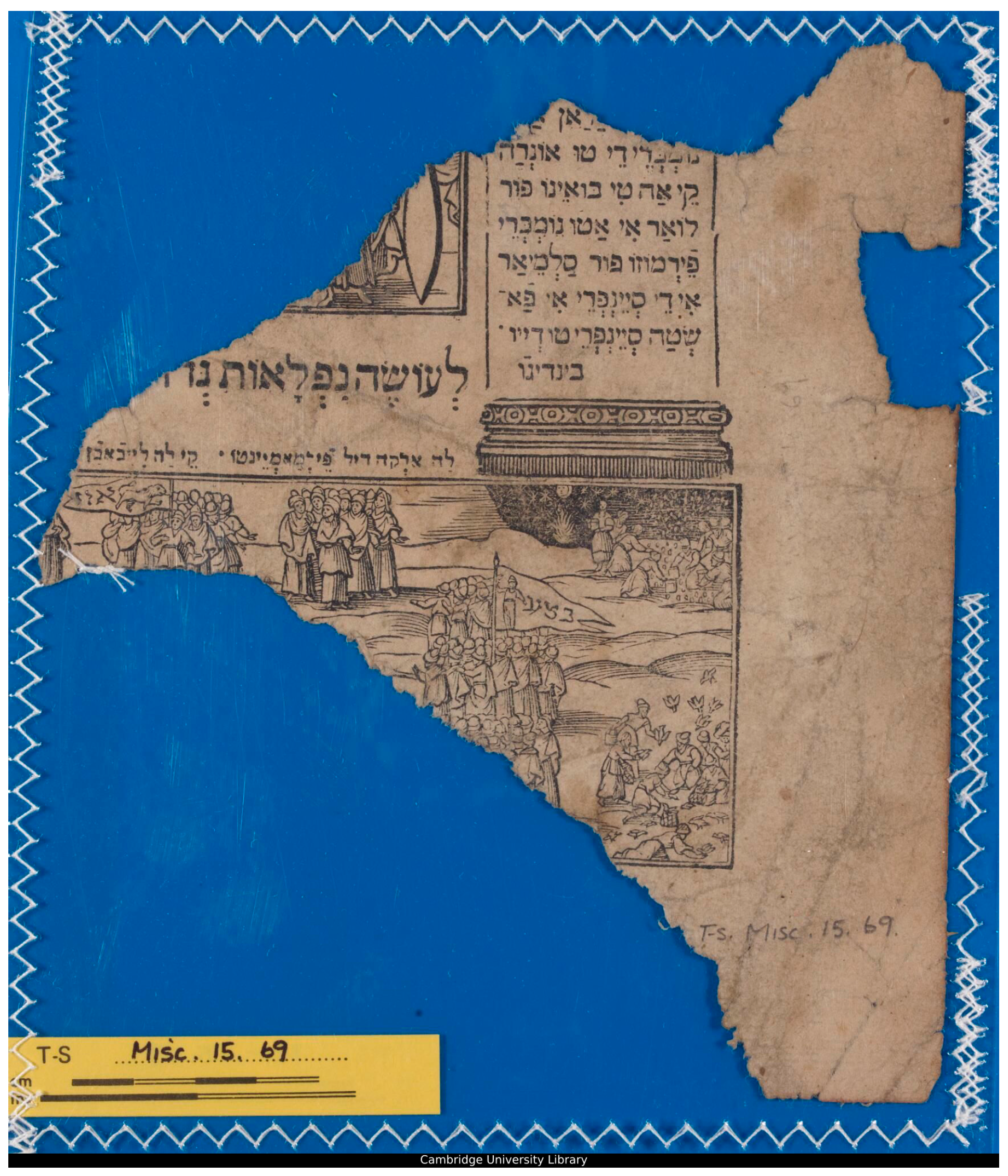
One particularly revealing example is a unique fragment with a woodcut image (
Figure 1) preserved in the Cairo Genizah at the Cambridge University Library (CUL, T-S Misc. 15.69v), which provides rare evidence of an early modern visualisation of the wilderness, datable to approximately the fifteenth to seventeenth centuries. The fragment derives from a printed Passover Haggadah in Hebrew and Ladino, produced for a Sephardi readership, and brings together vernacular translation, liturgical text, and visual imagery within a single artefact. It preserves portions of woodcut illustrations depicting episodes from the Israelites’ wanderings in the desert, accompanied by Ladino renderings of Hebrew passages that are now lost. The surviving composition shows figures gathered around a centrally elevated individual, a visual arrangement that evokes proclamation, judgement, or the exercise of authority, and thus suggests a structured social and political order rather than a scene of chaos or abandonment.
This woodcut image is identical to that found in the Venice Haggadah of 1609 (Bodleian Library, University of Oxford, Opp. Add. III, Fol. 468)
4. Although it does not derive from the same edition, the woodcut image is identical, while the accompanying text is set in a different typeface, indicating a slightly variant printing. The scene depicts the Israelites encamped in the desert, and the reuse of the same woodcut across editions highlights the stability and recognisability of its visual language. These visual and textual elements present the wilderness not as an empty or exclusively punitive space, but as an ordered and inhabited landscape in which authority is enacted, communal norms are articulated, and collective identity is shaped.
The significance of this Genizah fragment for the present study lies in the insight it provides into how traditions associated with
Tīh Banī Isrāʾīl circulated across confessional, linguistic, and generic boundaries, assuming diverse textual and visual forms. Although the fragment originates in a Jewish liturgical context rather than within Islamic historiography, its depiction of the wilderness as an ordered and meaningful space aligns with broader narrative patterns associated with the Sinai landscape. At the same time, it underscores the absence of any explicit reference to the Green City within Jewish textual traditions. The consultation of Jewish sources is therefore not intended to reconstruct Jewish narrative traditions or to propose direct comparison or borrowing between Jewish and Islamic accounts. Rather, the aim is contextual: to determine whether the notion of a concealed or periodically reappearing city formed part of Jewish representations of the Sinai wilderness. A survey of Genizah materials, medieval Jewish travel accounts, and related scholarship reveals no such motif. Narratives preserved in the Genizah corpus and in Jewish travel writing instead emphasise themes of loss, displacement, and memory—particularly the destruction of the Temple and the enduring hope for the Promised Land (CUL T-S NS 314.34; CUL T-S NS 314;
Sheir 2024,
2025). In these texts, the wilderness of Sinai appears primarily as a symbolic and historical landscape associated with revelation, wandering, and divine trial rather than as a setting for hidden urban settlements (
Elkan 1987;
Sheir and Outhwaite 2024). The absence of any clear parallel to the Green City motif therefore suggests that the narrative represents a distinct imaginative development within Mamluk historiography rather than a tradition rooted in Jewish textual memory.
Jewish travel narratives from the medieval and early modern periods provide abundant descriptions of wilderness spaces. Yet, none attest to the existence of a concealed 1or intermittently reappearing city comparable to the Green City of the Mamluk account. These texts repeatedly depict the wilderness as a vast, inhospitable landscape characterised by scarcity of water, absence of vegetation, danger from raiders, and extreme hardship for travellers. Accounts describe long journeys across deserts devoid of pasture, littered with the remains of animals that perished from thirst, and navigable only with the aid of caravans, guides, and established routes. At the same time, Jewish travellers frequently embedded these landscapes within broader frameworks of memory and expectation, associating them with biblical geography, tribal dispersion, and hopes for eventual restoration to the Promised Land. Legendary motifs do appear—such as remote Jewish polities, the river Sambation, or encounters with strange peoples inhabiting desert margins—but these are consistently situated beyond the wilderness proper, at its edges or in distant, inaccessible regions. The wilderness itself is never described as harbouring a functioning city, whether buried, abandoned, or miraculously preserved (
Elkan 1987, pp. 34, 54–56, 124, 225, 231–32, 246–47, 266–67, 294–95). The absence of a comparable narrative within Jewish textual and travel traditions suggests that the Green City narrative represents a distinctive, marginal legendary narrative within Mamluk historiography rather than a theme derived from Jewish storytelling.
5. Contextualising the Green City Narrative and Problematics of Mamluk Sources
Following the assassination of Amīr Fāris al-Dīn Aqṭāy in the Citadel of Cairo in 652/1254, the Baḥriyya mamluks fled Egypt and sought refuge in Greater Syria. According to al-Nuwayrī, they first travelled to Nablus, then to al-Malik al-Mughīth in al-Karak, where they arrived on 10 Shawwāl 652/1254 and were received favourably. Hoping to return to Egypt, they persuaded al-Mughīth to support their cause. His forces eventually confronted the Egyptian army under Sayf al-Dīn Quṭuz in Dhū al-Qaʿda 655/1257, where the coalition was defeated and their baggage seized (
Al-Nuwayrī 2002, vol. 29, pp. 434–35). Although the Green City narrative is chronologically connected to these events, it is almost entirely absent from contemporary historiography. Mamluk chroniclers focused overwhelmingly on Aqṭāy’s assassination and its political consequences, while the Green City episode appears only in a handful of later sources. Notably, historians of the seventh/thirteenth century, including Sibṭ Ibn al-Jawzī, Abū Shāmah, Ibn Khallikān, Ibn Shaddād, Ibn al-ʿIbrī, Ibn ʿAbd al-Ẓāhir, Ibn Wāṣil, and Shāfiʿ b. ʿAlī, make no reference to the story. This collective silence raises an important historiographical question: why did the narrative fail to enter the historical record of contemporary authors? The answer lies partly in the selective nature of medieval historiography. As
Hirschler (
2006) has shown, Arabic historians exercised considerable discretion in determining which reports merited inclusion. Material that appeared unreliable, marginal, or incompatible with established narrative frameworks could easily be excluded.
As
van den Bent (
2021) has demonstrated, Ibn al-Dawādārī’s chronicle occasionally integrates legendary narrative traditions into historical accounts, illustrating how oral traditions could intersect with written historiography in Mamluk historical writing. The Green City narrative may represent a comparable case. It rests entirely on the testimony of a single narrator, the mamluk ʿIzz al-Dīn Aybak al-Fārisī, whose report circulated only within a limited textual context. The narrative’s transmission chronology reinforces this interpretation. According to al-Dhahabī, Shams al-Dīn al-Jazarī heard the story directly from Aybak al-Fārisī in 679/1280, approximately twenty-seven years after the events themselves (
Al-Dhahabī 1988, p. 236;
1993, vol. 48, p. 12). Ibn al-Dawādārī likewise recorded the narrative in
Kanz al-Durar, stating that he received it through his maternal grandfather, who had heard it from the same narrator (
Ibn al-Dawādārī 1971, vol. 8, p. 25). The delayed and mediated nature of this transmission provides a plausible explanation for its absence from earlier historical works. Further doubts arise from the narrator’s own obscurity. Aybak al-Fārisī does not appear in Mamluk biographical dictionaries or annalistic sources, leaving his historical profile largely unknown. Moreover, although the episode allegedly involved twelve mamluks, none of the other participants appears to have transmitted the story. The identities of these companions remain almost entirely unknown, with the sole exception of Sanqar al-Kabīr mentioned by
Ibn al-Dawādārī (
1971, vol. 8, p. 26), for whom no further information survives.
The question of whether Ibn al-Dawādārī borrowed the Green City narrative from al-Jazarī, as suggested by Ulrich Haarmann’s comparative analysis of their chronicles (1970), remains analytically complex. Although Ibn al-Dawādārī is known to have relied on al-Jazarī for several historical reports (
Haarmann 1970;
Aḥmad 1974, p. 74), the case of the Green City narrative does not conform neatly to a simple model of textual borrowing. At first glance, the close similarity between the two versions might suggest direct dependence. Yet Ibn al-Dawādārī does not present the account merely as a report attributed to the Mamluk Aybak al-Fārisī. Instead, he explicitly identifies the intermediary through whom the story reached him—his maternal grandfather—who claimed to have heard it directly from Aybak al-Fārisī in the market (Sūq) al-Rammāḥīn in Damascus (
Ibn al-Dawādārī 1971, vol. 8, p. 25). While the two historians therefore share the same narrator and narrative content, their chains of transmission differ significantly. Al-Jazarī frames the account as a direct report from the alleged eyewitness, Aybak al-Fārisī himself, whereas Ibn al-Dawādārī embeds the narrative within a familial chain of transmission. From a historiographical perspective, this distinction complicates the assumption of direct textual borrowing and arguably lends greater weight to al-Jazarī’s version as the earlier recorded form of the account. The broader intellectual contexts of the two historians further illuminate the conditions under which the narrative circulated. Although al-Jazarī showed interest in recording unusual events and curiosities (
Al-Tamīmī 2015, pp. 203–18), the Green City story does not appear in sections of his chronicle devoted to marvels, which is notable given its extraordinary character. By contrast, Ibn al-Dawādārī provides no indication that he attempted to verify the account with local informants, despite his close connections with Bedouin groups familiar with the Sinai region (
Aḥmad 1974, pp. 20–21). This silence contrasts with al-Jazarī’s reported effort to investigate the claim through a Bedouin guide and suggests different historiographical approaches to the treatment of extraordinary narratives.
The marginalisation of the Green City narrative may partly reflect its limited political relevance within the priorities of Mamluk historiography. Chroniclers of the period tended to focus on events involving leading political actors and major military developments. Unlike episodes associated with prominent figures such as Baybars or Qalāwūn, the Green City story centred on relatively obscure individuals and therefore fell outside the main concerns of political narrative. As a result, reports transmitted by marginal figures were less likely to attract sustained historiographical attention. The silence of contemporary historians may thus reflect not only scepticism regarding the account’s credibility but also the hierarchical logic that structured the selection of material in Mamluk historical writing. Confessional framing may have further influenced the narrative’s reception. Within certain Jewish interpretive contexts, the story could be read symbolically as a response to the punishment imposed upon the Israelites during their wandering in the Sinai wilderness, transforming the desert from a space of divine trial into one capable of sustaining continuity and redemption. Such meanings, however, would not necessarily have encouraged its inclusion in Muslim historiography if perceived as rooted in specifically Jewish interpretive frameworks. Evidence of selective reshaping appears in later adaptations of the narrative. Historians of the ninth–tenth/fifteenth–sixteenth centuries—including al-Maqrīzī, al-ʿAynī, and Ibn Iyās—transmitted versions derived from earlier sources while omitting references to the Jewish figures present in the earliest accounts (
Al-Maqrīzī 1997, vol. 1, pp. 483–84;
Al-ʿAynī 2010, vol. 1, pp. 88–89;
Ibn Iyās n.d., vol. 1:1, p. 292). These omissions appear to reflect an effort to erase the Jewish presence in al-Karak, despite independent evidence of a substantial ahl al-dhimma community there.
Al-Maqrīzī (
2002, vol. 2, p. 245), for example, notes that the Christians al-Karak possessed considerable wealth from their work in money-changing. This may illustrate how confessional and historiographical priorities shaped the narrative’s transmission.
Manuscript evidence raises additional methodological questions regarding the transmission of the Green City narrative. Examination of surviving manuscript copies of al-Jazarī’s chronicle preserved in Rabat, Gotha, and Paris indicates that the account does not appear in the extant sections covering the events of 652/1254 (
Jubrān 2007, p. 143). The survival of the narrative, therefore, depends largely on al-Dhahabī, who transmitted it from his teacher al-Jazarī in
Tārīkh al-Islām and
al-Mukhtār min Tārīkh Ibn al-Jazarī (
Al-Dhahabī 1988, pp. 236–37;
1993, vol. 48, pp. 12–13). Although the story continued to circulate in later historiography, subsequent versions diverge from the account attributed to al-Jazarī. While al-Jazarī reports that the mamluks entered the city on the seventh day and describes its walls as constructed of green glass, later historians—following Ibn al-Dawādārī—place the entry on the sixth day and describe the city as built of green marble. These later adaptations also omit both the original narrator’s name and references to Jewish inhabitants. Such modifications may reflect attempts by later authors to render the story more materially plausible. In the earliest attestations, the city’s walls are described as green glass, whereas later historians appear to substitute marble, perhaps because glass structures would be unlikely to survive prolonged exposure to the environment. These adjustments illustrate how inherited narratives could be reshaped during transmission in order to align them with more credible physical conditions.
Al-Jazarī himself appears to have been the only historian to investigate the claim directly. During his pilgrimage in 681/1282, he travelled with a guide from the Banū Mahdī into the
Tīh Banī Isrāʾīl and questioned him about the city. The guide denied having seen it but reported that his father had once encountered such a city while hunting, describing walls of green glass and shifting sands resembling waves. When he later returned with companions, however, the city had disappeared (
Al-Dhahabī 1988, p. 237;
1993, vol. 48, p. 13). This report suggests that stories of the Green City circulated among Bedouin communities familiar with the Sinai wilderness. According to al-Dhahabī, Bedouin groups associated the city with the wanderings of the Children of Israel and occasionally guided Jewish visitors through the desert in the hope of locating it. Interestingly, despite undertaking this investigation, al-Jazarī did not incorporate the episode into the extant recension of his chronicle. Knowledge of the journey survives only through al-Dhahabī’s transmission, which may indicate either that al-Jazarī considered the evidence inconclusive or that he ultimately chose to omit the account from his historical narrative. The Green City episode thus illustrates the dynamics of narrative transmission in Mamluk historiography, where extraordinary reports could be preserved, modified, or excluded depending on their perceived credibility, relevance, and compatibility with prevailing historiographical conventions. In this respect, the narrative resembles other legendary materials preserved in Mamluk chronicles, where extraordinary accounts functioned less as empirical descriptions than as narrative explanations embedded within historical writing.
6. Conclusions
This study has shown that the narrative of the Green City occupies a marginal yet revealing position within Mamluk historiography. Its transmission is marked by uncertainty, textual instability, and selective preservation. The account ultimately reaches us through a single principal channel, that of Shams al-Dīn al-Jazarī, whose version survives only through its transmission by his student al-Dhahabī in al-Mukhtār min Tārīkh Ibn al-Jazarī, where it appears under the events of 652/1254. Notably, however, all surviving manuscript copies of al-Jazarī’s original chronicle for that year omit the narrative entirely. This absence leaves unresolved whether the account was removed during copying, excluded during authorial revision, or simply lost through the contingencies of textual transmission. The historiographical record, therefore, reflects an initial uncertainty not only regarding the narrative itself but also concerning the mechanisms through which it entered and circulated within historical writing.
As the narrative moved through later Mamluk sources, it underwent a noticeable transformation. Early versions describe the city’s walls and gates as constructed of green glass, whereas later historians substituted green marble, a material more consistent with familiar architectural descriptions. Likewise, early accounts present Jewish figures in al-Karak as participants in the narrative, whereas later retellings omit any reference to a Jewish presence. Such changes are difficult to explain solely as scribal error. Rather, they suggest processes of selective reshaping in which historians adapted inherited narratives to evolving historiographical conventions and confessional sensitivities. The variations preserved in different sources, therefore, illuminate the ways in which historical writing could accommodate, modify, or suppress elements of extraordinary narratives.
Attention to the account’s internal texture further highlights the narrative environment in which it circulated. The descriptions attributed to ʿIzz al-Dīn Aybak al-Fārisī combine elements of eyewitness testimony with motifs characteristic of medieval narrative traditions, including preserved urban spaces, unusual material objects, and hidden landscapes revealed only temporarily to travellers. Read within this framework, the narrative appears less as a straightforward description of a physical site than as an example of how extraordinary experiences were articulated through established narrative conventions. In this respect, the Green City story reflects broader processes through which historians evaluated and transmitted unusual reports, selecting material according to its narrative resonance and interpretive value rather than strictly empirical criteria.
At the same time, the story’s circulation intersected with the interests of several actors. For Aybak al-Fārisī, the sole named narrator, the account offered a means of securing narrative visibility within the historical record. The Jewish moneychangers of al-Karak, as represented in the narrative, appear as interpreters of the story’s meaning within a sacred historical framework connected to the wanderings of the Children of Israel. Bedouin groups such as the Banū Mahdī, described as guides in the account, likewise occupy a role that reflects their broader importance as intermediaries in desert travel and local knowledge. Several aspects of the narrative remain open to interpretation. The specification that the group consisted of twelve Baḥriyya mamluks invites comparison with symbolic numerologies associated with the twelve tribes of Israel and other scriptural traditions. The persistent emphasis on the colour green, whether expressed through glass or marble, similarly evokes symbolic associations widely present in Islamic cultural and religious imagery. While these elements cannot be interpreted conclusively, they point toward the layered symbolic vocabulary within which the narrative was shaped. Considered as a whole, the Green City account illustrates how marginal narratives could illuminate the processes through which medieval historians negotiated the boundaries between history, memory, and imaginative geography. Precisely because of its marginal position within the sources, the Green City narrative provides a valuable case study for understanding how Mamluk historians negotiated the boundaries between historical reporting, narrative imagination, and the interpretive frameworks through which extraordinary accounts were incorporated into historiography.