1. Introduction
The arrival of Macassan (or
Makassan) Muslims from the Indonesian Archipelago in the northern parts of Australia (Kimberley and Arnhem Land, known as
Kayu Jawa and
Marege) represents a fascinating chapter in Australia’s history. The Yolŋu (or
Yolngu) are Australian Aboriginal people inhabiting north-eastern Arnhem Land in the Northern Territory of Australia. Yolŋu comprise several distinct groups, differentiated by their languages, but generally sharing similarities in ritual life and in the hunter-gathering economic and cultural lifestyles in the eastern Arnhem Land. The Yolŋu culture in East Arnhem Land is possibly one of the oldest living cultures on Earth, dating back about 65,000 years. The terms Murngin, Wulamba, Yalnumata, Murrgin, and Yulangor were formerly used to refer to the Yolŋu. The term Yolŋu has been used since the mid-20th century. Arnhem Land is a historical region of the Northern Territory of Australia, located in the north-eastern corner of the territory, and is around 500 km from Darwin. The Kimberley is the northernmost region of Western Australia, bordering on the west by the Indian Ocean, and on the north by the Timor Sea (Yolngu of Arnhem Land: History, Music, Traditional Life, Customs;
https://ioa.factsanddetails.com/article/entry-919.html, accessed on 1 March 2025).
The significance of this work lies in encounters between Macassan Muslims and Aboriginal peoples, as well as in the dissemination of the Islamic message among the Australian Indigenous population. Thus, the study of Islamic civilisation extends beyond Muslim-majority regions to encompass a broader historical context, including adjacent areas such as Australia, to enhance understanding of humanity’s collective destiny (
Aljunied 2018, p. 110). It is essential to acknowledge that Islam is not merely a religion; it is a civilisation with its contribution to humanity. To understand the earliest arrival of Macassan Muslims in Australia, one must consider the golden age of Islamic civilisation, which lasted from the 8th to the 15th centuries. This period had a significant impact both regionally and globally. Islamic civilisation spread from Arabia and the Middle East to West Africa, South Europe, Russia, Persia, the Philippines, and even reached as far as China and the southern islands of the Indonesian Archipelago. By the 15th century, its influence had extended to distant outposts, including Makassar (
Ujung Pandang) (
Haveric 2012).
Contemporary Aboriginal and Macassan communities commemorate 500 years of intercultural encounters, which contrasts with earlier estimates of a 400-year history (
Ganter 2008, p. 3;
2006, pp. 6–7). Recent research by
Haveric (
2019) has extended the timeframe of these interactions to earlier periods, including the 15th century. A painting held in the Queensland Art Gallery documents more than 500 years of contact between the Yolŋu people of north-east Arnhem Land and Macassan fishermen from South Sulawesi. (
QAGOMA (
n.d.), Queensland Art Gallery and Gallery of Modern Art) While Macknight dated the inception of the trepang industry in Australia to the 1720s–1750s, he did not exclude the possibility of earlier, less organised contact (
Ganter 2008, p. 3).
Mulvaney and Kamminga (
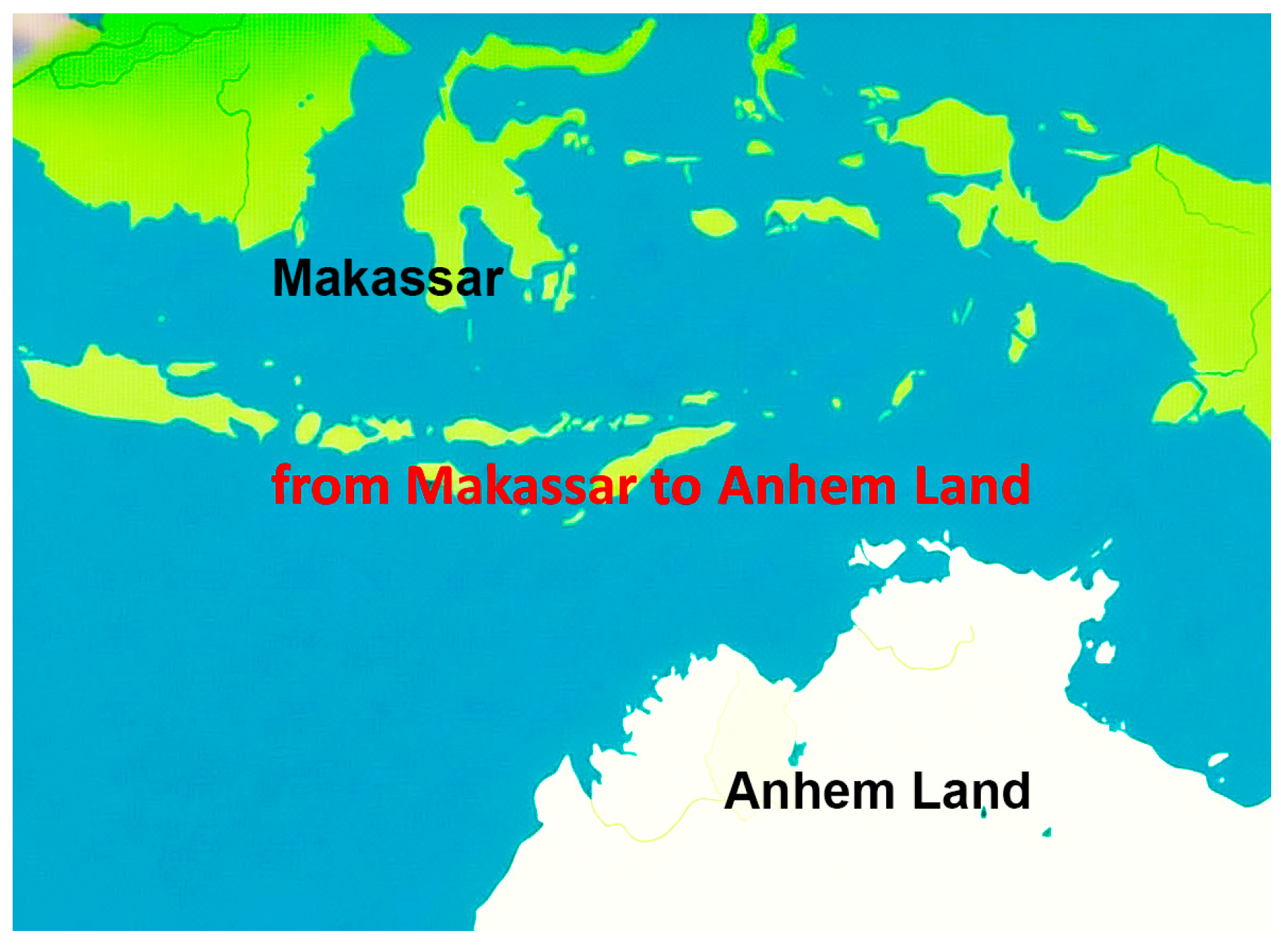
1999) observed that the earliest documented account of Macassan fishermen in Australia originated with Emanuel Godinho de Eredia (1563–1623), a chronicler and cartographer of Malay and Portuguese descent, educated by Jesuits in Malacca and Goa. According to Lontares, or leaf texts, Eredia recorded that “…trepang fishing in Australian waters had been going on for 600 years…” Thus, the Malays and the Macassans were known to the Aborigines [Yolŋu] and the Aborigines [Yolŋu] to the Malays and the Macassans (pp. 420–21) (
Figure 1). Similarly, Annie Clarke dated archaeological findings at Groote Eylandt as evidence of Southeast Asian—Aboriginal contact as early as the 11th or 12th century. It was centuries earlier that contact may have been more sporadic than the later annual trepanging voyages from the 18th century (
Lee 2025, p. 66).
The phenomenon of conversion pathways to Islam in Western societies has gained considerable attention within both academia and the mass media (
Mitchell 2023, n. p.). In Australia, there is a lack of comprehensive studies on the scale of conversion to Islam (
Martinot and Ozalp 2020, p. 29), particularly among Aboriginal populations, and research on the impact of Sufism is virtually absent. Scholars have examined Macassan influences on Aboriginal people across religion, ethnicity, language, art, health, music, and economic life (
Ormond-Parker 2020, p. 5). However, much of this research has focused on Macassan fishing, trade, arts and frequently on tools such as items such as canoes, sails, hooks, fishing lines, and beads, rather than on their interactions as Muslims and the practice of Islam. For example, Werner, Berndt(s), Macknight, Langton, Ganter, Clark, and Thomas, among others, primarily approached the topic from cultural, linguistic, archaeological, and anthropological perspectives. The spiritual impact of the Macassans on Aboriginal people was also substantial and extended beyond the exchange of items (
Mulvaney and Kamminga 1999, p. 418). The enduring legacy of these extended encounters is reflected not only in tamarind trees and stone lines that once supported cooking pots, but also in the distinctive rock art associated with Macassan visitation (
McIntosh 2013, pp. 103–4). Thus, a comprehensive understanding of the outcomes of these encounters requires an examination of the conditions under which they occurred (
Macknight 1976, p. 285), with particular emphasis on the Islamic influence of religion during this period.
The process of “Islamisation” was a complex and creative fusion of Islamic practices with local customs (
Hermansen 2014, p. 632). The role of Islamic ritual is important in the conversion experience among Australian Aboriginals, often attracted to join in activities such as
dhikr (chanting pious phrases or names of God) sessions,
salah (prayer), and
iftar (fast-breaking) in Ramadan (
Hermansen 2014, p. 652). The six descriptive motifs of religious conversion in history proposed by some scholars, such as
Lofland and Skonovd (
1981), include intellectual, mystical, experimental, affectional, revivalist and coercive conversion (
Mitchell 2023, p. 21). During the initial conversion process, individuals consciously decide to commit to a religion that necessitates a comprehensive transformation of identity, including observable changes in behaviour, dress, diet, and language (
Martinot and Ozalp 2020, p. 26).
This paper seeks to determine whether Islamic conversion among Aboriginals constituted a complete transformation or an “incomplete” (partial) conversion, in which they adopted only certain practices of the Islamic faith. Incomplete conversion is a sign of syncretism, where elements of the original beliefs, that is, of Aboriginal spirituality, mixed with the new religion, Islam. Syncretism is a “capsulated” term in which it has been observed blending traits of cultural beliefs and practices (
Rahaman 2016, p. 51), manifest in many examples of Macassan and Aboriginal encounters. This Aboriginal convergence of syncretic manifestations corresponded with Islamic spiritual elements evident in beliefs in eternity, asceticism, local traditions, worship practices involving the ground, certain ritual observance, evocations, storytelling, mysticism, abstention from forbidden meat (pork), and a lifestyle centred on temporary camps and tribal organisation (
Haveric 2019).
It was an important platform of multi-cultural streams and inter-faith amalgam. Indeed, syncretism is the fusion of Islamic beliefs and practices among Aboriginals (
Rahaman 2016, p. 51). It particularly explores how Yolŋu went through “mystical” conversions as individual experiences, considered to be influenced not by social pressure, but rather “perceived mystical encounters” (
Mitchell 2023, p. 22). These colourful mixed kinds of beliefs have clearly been seen in the manifestation of Sufism in Islam, running to strengthen the belief of monotheism (
Rahaman 2016, p. 51).
Stephenson maintains that for some Indigenous converts, perceptions of a cultural convergence between Islam and Indigenous belief systems provide a “strong motivation for embracing Islam.” She also considers the notion of “kinversion” amongst Indigenous Australians as “an Indigenous connection to Islam that is culturally—usually family or kin—based” (
Stephenson 2010, p. 91;
Mitchell 2023, p. 58). Another important factor was that Islam provided a counter to the scars of colonisation and Christianisation of Indigenous people (
Martinot and Ozalp 2020, p. 30).
Merging and exchanging are considered “forms of civilised culture”, and the blending of cultures is described as a “human cultural phenomenon” (
Langton and Sloggett 2014, p. 5), which is also evident in shared Islamic values. Early Australian history is characterised by an “aura” of Islamic belief, which Indigenous peoples recognised and, to some extent, adopted as a “blend.” The acceptance of Islamic beliefs and practices among Aboriginal communities was facilitated by the alignment of many Islamic ethical teachings with existing local values, such as respect for land, tradition, and women (
Haveric 2019).
Although Islam has maintained a presence in Australia for five centuries, its history remains largely undocumented. Few studies, such as those by McIntosh and Werner, have examined the influence of Islam in north-east Arnhem Land, particularly within Yolŋu mythology and ritual (
McIntosh (
1996);
Warner (
1932,
[1937] 1958)).
Ganter (
2008, p. 2),
Stephenson (
2010),
Clark and May (
2013a), and
Haveric (
2019), among others, identify this as a valuable source for understanding the creative adaptation of Islam by Aboriginal people. However, scholarly analysis of the relationship between the spread of Islam in Indonesia and its manifestation in Australia remains limited. In particular,
Haveric’s (
2006,
2019) works approach the subject from a Muslim historical perspective, considering various Islamic aspects of Macassan life in Australia.
Sneddon (
2020) offers a sociological perspective on the interactions between the Macassans and Aboriginal people at both micro and meso levels, incorporating elements of Islamic history.
This paper began with the arrival of Islam in Makassar, highlighting the role of trade and Sufi influence. The spread of Islam in Makassar is an important part of better understanding the arrival of Muslims from Sulawesi and the surrounding islands in Australia. A comprehensive examination of the commercial history of South Sulawesi in relation to northern Australia is crucial for understanding the cultural and spiritual exchanges between Aboriginal peoples and Macassans. The Macassan–Aboriginal relationship was driven by commercial opportunities and involved regular Macassan visits to northern Australia (
Lee 2025, p. 66). When Macassans came consistently, and in large numbers, they came to Australia primarily to fish for trepangs (
Lee 2025, p. 66). “Hand in hand” with trade activities, Muslim missionaries were also on the move.
By the 15th century, Islam had been introduced to Makassar, after which Macassan Muslims began trading with Australia and simultaneously transmitted Islamic beliefs. Macassan traders explored regions of the northern Australian coastline, including Arnhem Land, and established camps along the shore and adjacent islands for trepang processing (
O’Connor and Arrow 2008;
Russell 2004).
An inclusive understanding of the history of Islam, as introduced by the Macassans, is essential for analysing its impact on the built environment. Islamic teachings encompass all aspects of human activity and need, including spiritual, socio-cultural, economic, political, architectural, and environmental dimensions. Islam functions not only as a religion but also as a comprehensive framework for community and daily life (
Hwaish 2015, p. 86).
This paper focuses on the central aspects of Macassan heritage during their settlements among Aboriginal peoples, with particular attention to the influence of the Macassan Sufi spiritual tradition and Macassan huts. Given the role of Sufis in the Islamisation of the Indonesian archipelago and the Malay peninsula, this hypothesis may be reasonable (
Sneddon 2020, p. 68). Across the ages, different cultures have blended and spiritual encounters have sparked, weaving rich new tapestries in the story of humanity. However, a comprehensive study of how that process occurred has not appeared until now. A novel dimension of this study addresses the previously overlooked presence of Macassan mosques. Thus, this work aims to document, from a Muslim historical perspective, the lesser-known or overlooked aspects of Macassan encounters with Aboriginal people in Arnhem Land, which are part of the early Islamic history in Australia’s pre-colonial period.
Despite the Muslim call to invite to Islam people of other countries, including Yolŋu, “the results are not guaranteed” because of various reasons—“some will become Muslims, some not.” (
Dutton n.d., p. 164) While the term “religious conversion” (reverse) is widely used in the literature,
Dutton (
n.d., p. 151) notes that there is no Arabic term for “conversion” per se. Rather, there is the idea of “becoming a Muslim,” for which the verb
aslama (literally, “to submit”) is used. Historically, religious conversion in various regions has been attributed to the pursuit of spiritual fulfilment, as well as to factors such as racism, colonialism, and disillusionment with Western values and Christianity (
Arkilic 2020). Resistance to conversion to Islam may arise from language barriers, a strong sense of personal identity, established lifestyle habits, feelings of detachment from the community, the absence of meaningful roles within a new Muslim community, or setbacks in the progress of Islamisation caused by colonial invasions in the regions.
Some parallels in conversion can be drawn from examples of Indigenous peoples in New Zealand and North America. Similar to Yolnu in Australia, initial conversations with Māoris in New Zealand also show that conversion has improved their wellbeing and sense of empowerment (
Arkilic 2020). There are cultural similarities between Islam and
Te Ao Māori (Māori world) with
wairua (spirituality), and between Islam and an Aboriginal world with
Dreaming. Islam was a good option for Yolngu as it is a “better option for Māori than any other religion” (
Arkilic 2025).
Muslim practices were present among Indigenous peoples across various regions of Turtle Island, now known as North America, prior to European colonisation. Islam was introduced to the original inhabitants of these lands centuries ago. Like Australian Aboriginals, many Native Americans were raised within cultural systems that honour spirituality, ritual practices, beliefs, and native traditions, often emphasising a strong connection to nature. Similar to the Yolŋu in Arnhem Land, Islam provided Native Americans with a comparable framework for cultivating relationships with “the self, the environment, and the Creator” (
Hakim 2023).
This article draws on historical analysis and recent Yolŋu and Macassan testimonies to give an overview of religious history and examine Islam’s impact on Indigenous communities. It contributes new research on Muslim conversion in countries like Australia, where Muslims are a minority. The article also builds on studies of spatial dynamics, religious history, sociology, and global religious change with a refreshing historical account. In doing so, it adds to the broader conversation about Indigenous conversions to Islam.
4. Cultural and Spiritual Encounters in “Top North”
The Macassans played a significant role in shaping Yolŋu economic life. For centuries, Makassar was a major power in the trepang trade. According to Bradley, the Macassans represent “Australia’s first major, successful attempt at international relations—they traded together—it was fair; there was no racial judgment, no race policy” (Bradley cited in
Rogers 2014). Trade, as initiated by the commercial history of South Sulawesi, played a crucial role in enabling intercultural interactions in Australia’s Top North between Macassan Muslims and Aboriginal peoples, particularly within the broader context of Islamic history. From the 15th to the early 20th centuries, Muslim traders frequently travelled to northern Australia, with fleets primarily navigating routes through Timor or the Aru Islands (
Ganter 2008, p. 3;
Haveric 2006) until the Australian government banned the Macassans from coming to Australia in 1906 (
Lee 2025, p. 74).
The visiting fleets were ethnically diverse, including Sama Bajo (referred to as ‘sea gypsies’), Timorese, Aru Islanders, Malays, Bugis, Bajinis, Javanese, numerous seamen, fishermen, captains, and crew from Makassar, as well as individuals from other Sulawesi kingdoms and occasional Chinese traders and New Guineans (
Ganter 2008, p. 3;
Taçon and May 2013, p. 128). Recognising this diversity, the term “Macassans” in its Anglicised form remains appropriate, as it denotes a historical phenomenon primarily linked to the Macassans (
Ganter 2008, p. 3). Historical accounts describe skilled Macassan sailors as the “Phoenicians of the medieval world” and as “great corsairs and mariners”, and “excellent navigators” possessing “many ships and great navigators and many rowing galleys” (
Haveric 2019, p. 14;
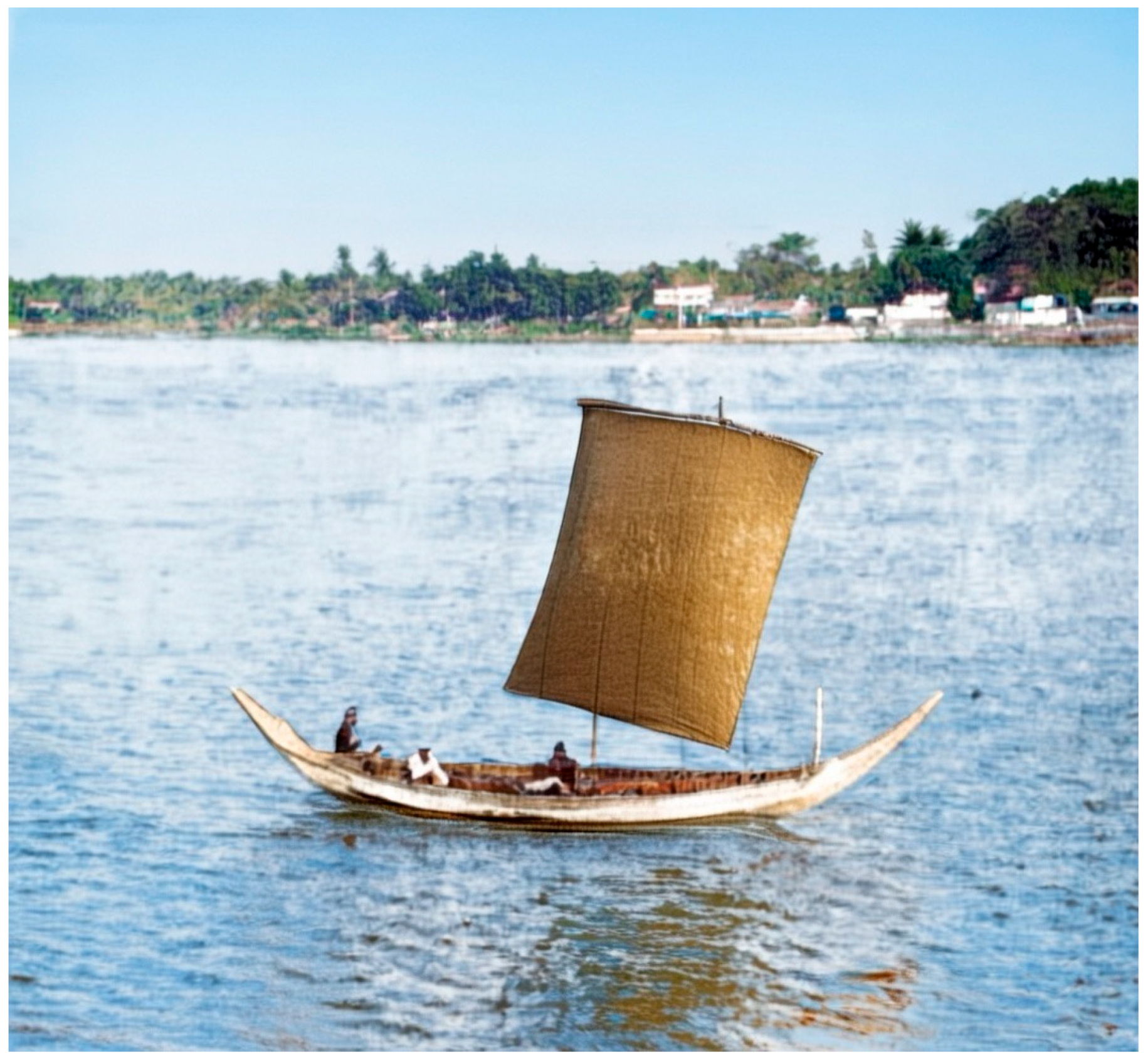
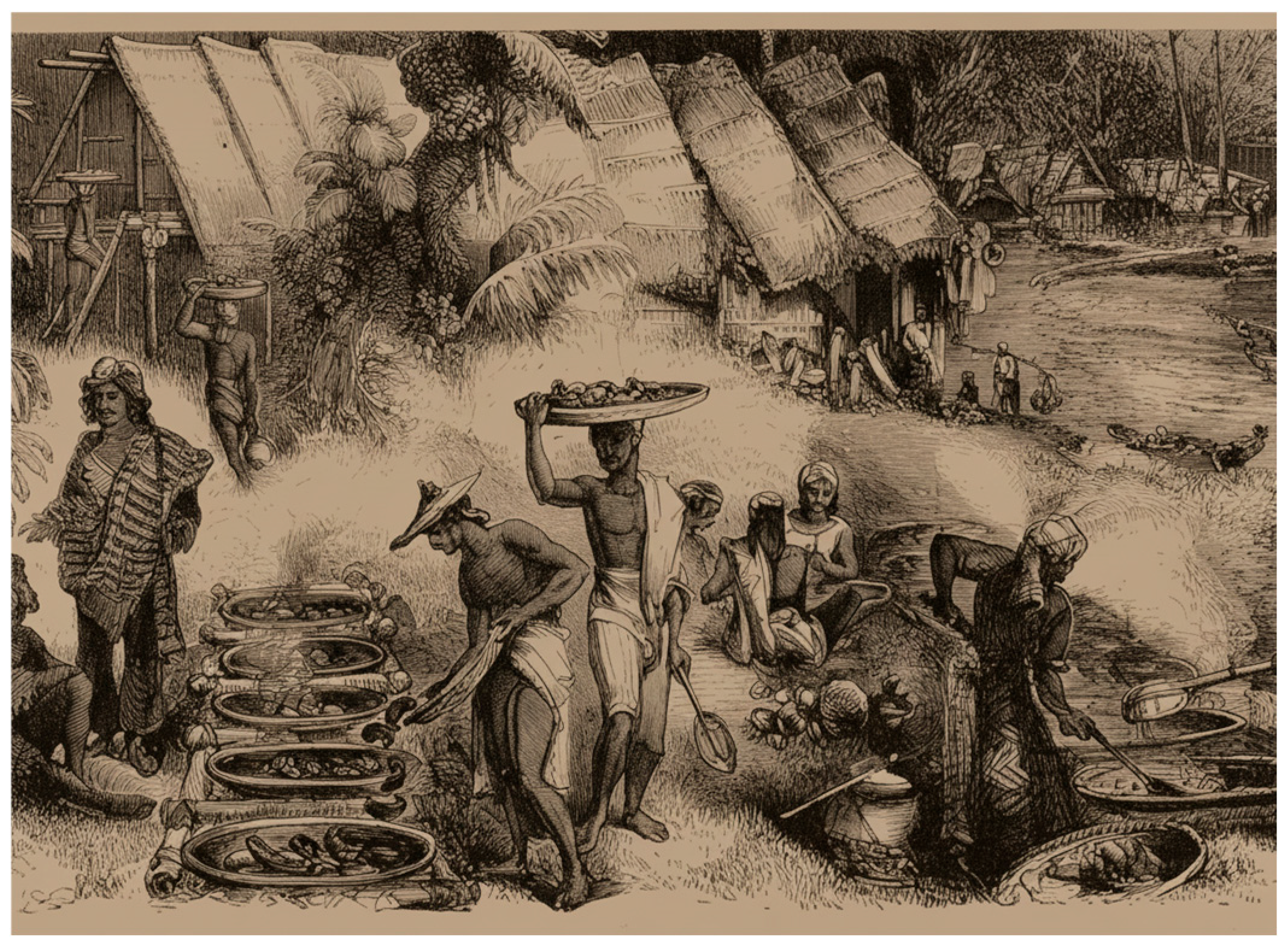
Keay 2005, p. 9). Their fast boats, known as “praus” (prahus), further exemplify their maritime expertise (
Figure 2).
The Macassans played a central role in fishing and trading along the northern Australian coast, while also disseminating the Sufi message of Islam. The pursuit of trepang (
sea cucumber) was the primary motivation for their voyages from Makassar to Australia. Prior to their activities in northern Australia, Macassan prayers were conducted by a ritual expert. A range of prayers, known as
dua (du’a) or
doa in Malay and Makassarese, were recited on specific days of travel. These included the prayer of departure,
doa palamakang or doa perahu berlayar, and were accompanied by ritual practices during both sailing and fishing activities (
Haveric 2019, p. 40). These rituals functioned as a historical stimulus to the emergence of Islam, the youngest Abrahamic religion, and to the ancient Aboriginal spirituality of the Dreaming.
Captains were expected to possess esoteric knowledge (
pangatonang/
ilmu). Various
duas were recited, each corresponding to the day of travel, and ritual practices accompanied both sailing and fishing activities. Prayers were offered to manage hazardous weather, repel evil spirits and misfortune, and rituals were performed during boat repairs at sea. Additionally, prayers were recited in response to crew illness, to avert misfortune, and to seek guidance and strength, all of which were integral to farewell rituals (
Haveric 2019, p. 40).
Traditional Makassar departure rituals for voyages to Australia were closely integrated with Islamic
da’wah (call to Islam) and included syncretic practices. The
prau was manoeuvred through the canal into the harbour using long bamboo poles. Local custom dictated that a man, holding a jug of water, would recite a prayer into it before entering the cabin and descending to the boat’s hull. At the keel’s navel, he placed an offering and recited brief prayers. Offerings such as rice, vegetables, cakes, cigarettes, betel nut, tobacco, and bananas were arranged on a tray beside the navel. The water from the jug was then poured over the navel, after which the man exited the cabin, moved along the right side of the deck, and continued pouring water over various sections of the boat from bow to stern. At the tiller, another short prayer was recited. Three lit candles were positioned at the centre, bow, and stern of the hull. The liturgist subsequently burned incense and conducted a series of prayers. After the candles had burned down, additional incense was burned, water was again poured over the navel, and a communal prayer was held. The departure from Makassar was formally marked by a handshake with the boat’s owner as the vessel set sail (
Haveric 2019, p. 36).
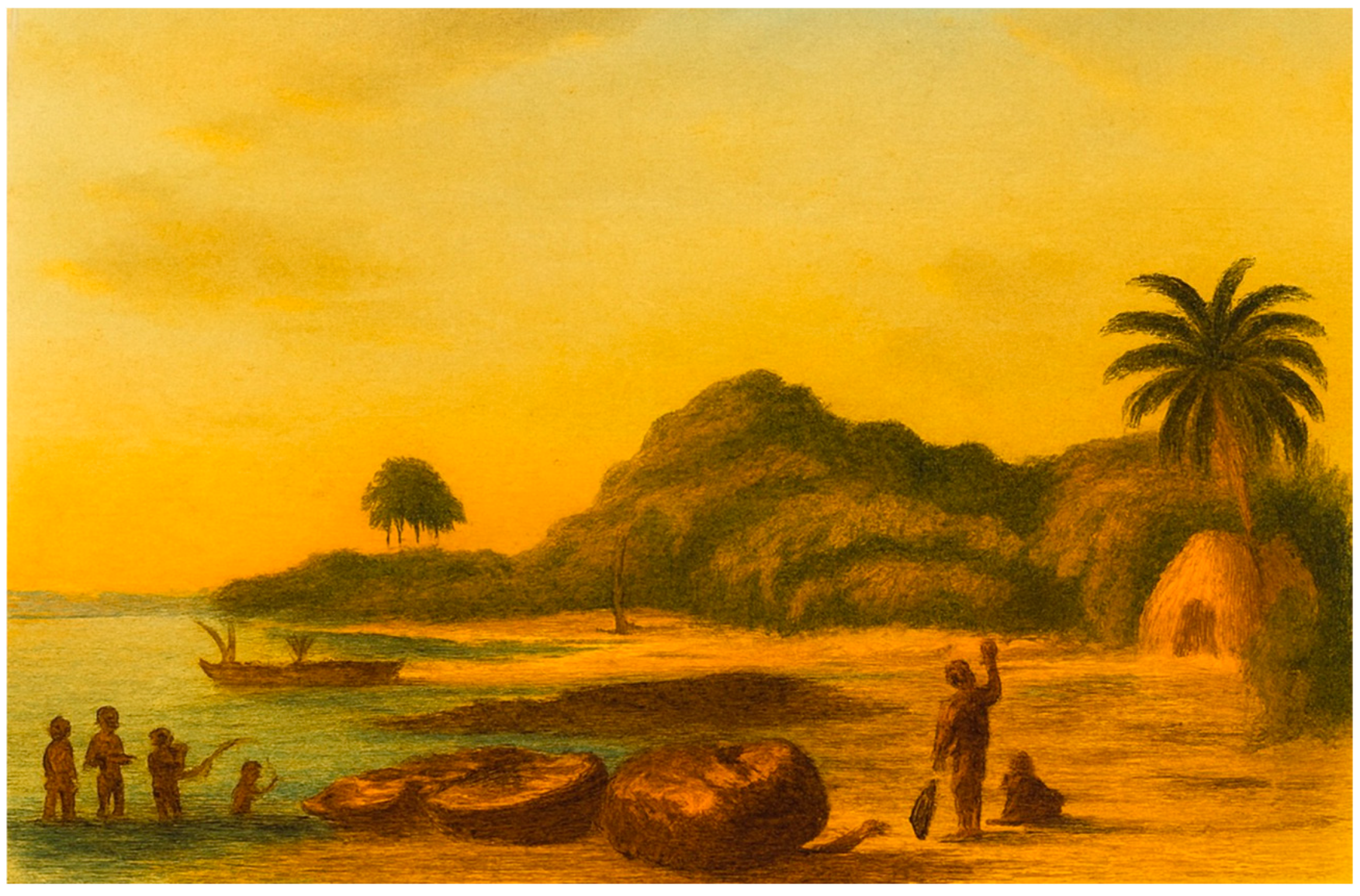
These traders depended on the western monsoon winds, which typically commenced in early December. Known as “monsoon traders”, they spent several months collaborating with Aboriginal communities to collect and process trepang, a commodity highly prized in Chinese markets (
Figure 3). After completing their activities, the traders returned home using the easterly winds (
Langton and Sloggett 2014, p. 6). The significant demand for trepang as a delicacy ensured that the costs associated with its exploitation were offset by its high market value (
Haveric 2019), whose “trade was worth millions” (
Hill 1963, p. 34).
Macassan fishing and pearl-seeking communities played a significant role in Australian history. The longstanding interactions between Aboriginal peoples and the Macassans are evident in both tangible and intangible cultural forms. Intercontinental trade routes connecting Australia and Asia have existed for a much longer period than is commonly recognised (
Langton and Sloggett 2014, p. 5). A network of smaller trade routes contributed to the prosperity of the port of Macassar. This era of trade, together with the introduction of Islamic influences among Indigenous populations, is often referred to as the “trepang era” (
Haveric 2019, p. 9).
Over several centuries, the Macassans exerted significant influence on Aboriginal peoples by demonstrating notable skills in their interactions. This influence is evident in three key areas requiring respect for Aboriginal peoples: the treatment of women, ownership of land and sea country, and spirituality (
Russell 2004, p. 14). While residing in nearby settlements that practiced Islamic rituals, many Aboriginal people sought association with Macassans, who were seen as exemplifying exemplary character traits. These interactions resulted in some intermarriages.
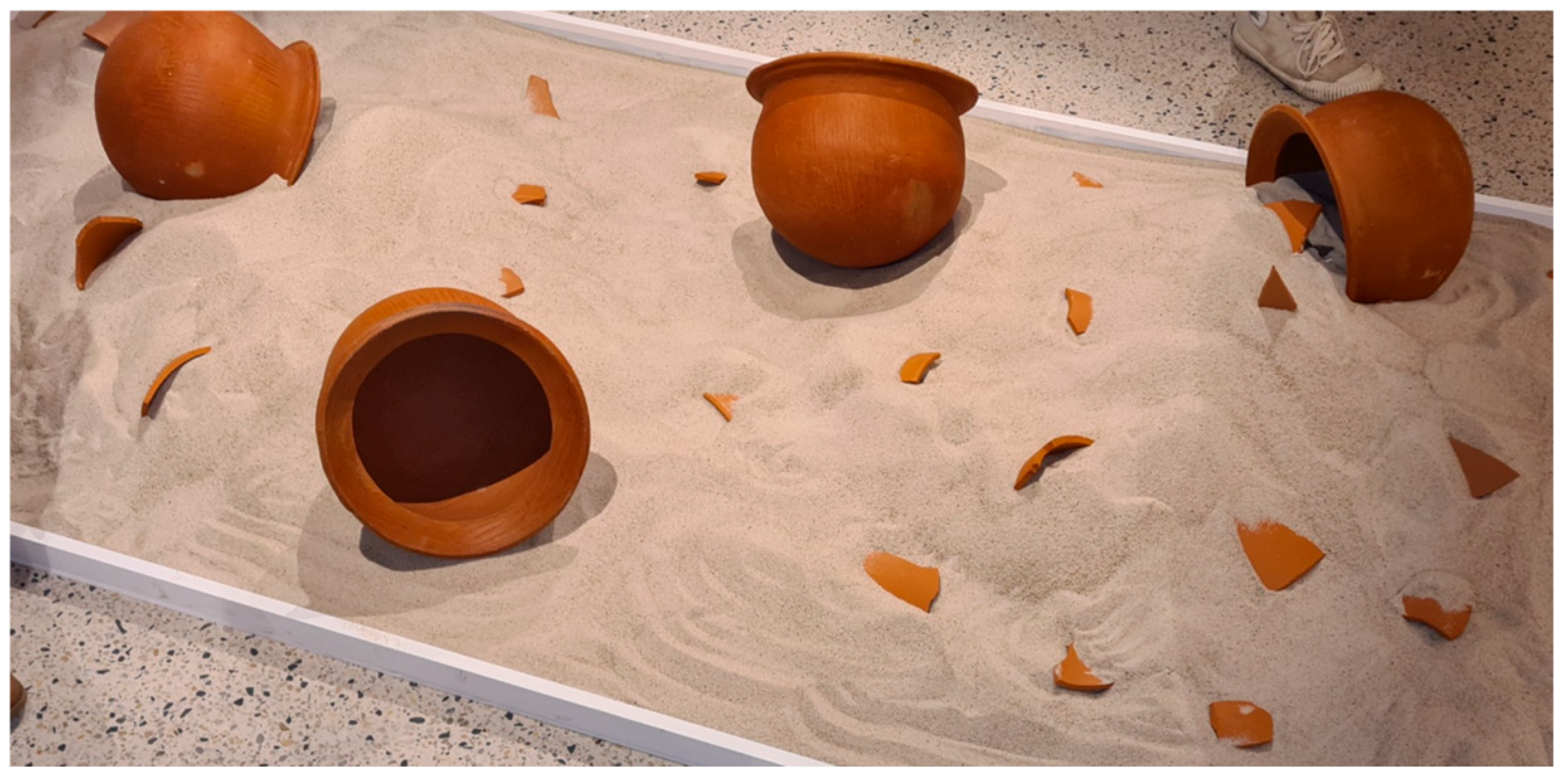
The trade-oriented Macassans introduced a range of items to the Arnhem Landers, including metal knives, axes, fishhooks, glass, ceramic pots, cloth, and pipes. Additional introductions comprised tobacco, rice, bamboo, tamarind trees, syrup, and alcohol (
Figure 4). The Macassans also imparted knowledge and skills for constructing dugout canoes, which facilitated movement between the mainland and the islands. These goods and technologies were exchanged as gifts or traded with Aboriginal hosts. The adoption of Macassan technologies, such as dugout canoes, prompted Yolŋu communities to shift their economies from primarily land-based activities to a more sea-oriented industry. The integration of Macassan items, including sails, boats, and flags, as clan totems, along with the continued use of Macassan personal names, demonstrates the depth of relationships established between Aboriginal people and Macassans (
Haveric 2019, p. 21). Despite some opposition to the Macassan presence and trade, as well as reported incidents that led to the stance “Yolŋu for Yolŋu and Macassan for Macassan” (
McIntosh 2013, p. 98;
Ganter 2006), interactions persisted. At some point, the spread of smallpox in Arnhem Land and nearby islands resulted in the demise of many tribes (
McIntosh 2013, p. 99). Nevertheless, both parties continued to trade and foster prosperity, underpinned by a prevailing sense of trust (
McIntosh 1996, p. 94).
The Yolŋu people of northeast Arnhem Land played a significant role in the Macassan trepang trade, regularly receiving large numbers of Macassan trepangers. Both Matthew Flinders and Nicolas Baudin documented encounters with fleets of
praus (or
prahus, Macassan boats) in northern Australian waters in 1803, underscoring the scale of this trade. Flinders met the captain of six vessels named Pobassoo, which formed part of a larger fleet of sixty vessels, crewed by approximately 1000 men. This fleet was under the authority of the Rajah of Boni and commanded by a leader named Salloo (
Langton and Sloggett 2014, p. 6). The trade links with the Macassans ended in 1906 following the South Australian government’s imposition of tariffs on foreign vessels and the subsequent prohibition of these annual visits. Over a century later, references to the Macassan trade, including its practices, relationships, and customs, remain deeply embedded in Yolŋu culture. The legacy of this trade continues to be celebrated through diverse forms of cultural expression (
Langton and Sloggett 2014, pp. 6–7).
The process of living and making a living also involved “relations between people” (
Warner [1937] 1958, p. 516). Since the Macassans settled in the “Land of the Trepang”, their pursuit of trepang and pearls fostered relationships with Aboriginal communities along the coast that were generally friendly and mutually beneficial. Macassans maintained effective working relationships with Aboriginal groups. According to Aboriginal oral histories, Macassan traders and fishermen have a longstanding tradition of seeking permission from Aboriginal tribes to collect trepang. These traders would approach the chief or leader of the traditional Aboriginal owners to obtain consent within their estate, which was typically granted. Consequently, partnerships developed between the leaders of the trading expeditions and the heads of Aboriginal clans, who were regarded as “kings”. This interaction also facilitated trade between the two groups (Choo cited in
Haveric 2019, p. 20). As a result, cordial relations became a defining feature of their interactions, as Peter Worsley noted:
If one listens to Aboriginal accounts… the Macassan era was a Golden Age, a time when food was given away in vast quantities, when the Aborigines had only to ask their Macassan ‘brothers’ in order to be given unlimited tobacco, cloth, knives, etc. Moreover, they say, ‘we were treated with equality; we ate at the same table, ate the same food, and used the same dishes.’…
In
The first encounter between Muslim people and the Aboriginal Australians,
Dodson (
2007, p. 2) also asserted the values of their individuality and mutual recognition:
Two cultures who met to trade and exchange commerce, two cultures that showed mutual respect and understanding of each other’s values, language, customs and laws… Two cultures that sustained a coequal relationship for three centuries without ever having fought a war, they never sought to establish government over the other, they traded and engaged in commerce as business partners and never felt so insecure in their own culture that they needed to destroy or diminish the cultural symbols of the other…
Macassan groups established trading settlements for periods of three, six, or nine months before returning the following year. During these periods, the Macassans introduced Malay (Makassar) vocabulary for goods, tools, and place names, which Aboriginal communities subsequently adopted. Examples of Macassan toponyms in Australia include
Lembana Panrea for Melville Bay,
Lemba Peo for Blue Mud Bay, and
Limbamammo for Popham Bay. Elcho Island was referred to as
Takarrina, and the Wellesley Islands as
Pulona Tallumbatua and Koa
Gowa, among others (
Reed 1979;
Haveric 2019). The camps were frequently surrounded by tamarind trees (asem, or
Tamarindus indicus), which were deliberately planted as botanical markers on small islands, promontories, and sandy beaches (
Mulvaney and Kamminga 1999, p. 414). These settlements comprised makeshift huts and shelters also encircled by mangrove trees (balo, or
Avicenna marina—after the Persian Sufi Ibn Sina), as well as processing sites that included some stone structures. It is inaccurate to assume that religious practices occurred exclusively under trees or by the shore, or that all huts were constructed solely for dwelling or trepang processing.
Structures such as temporary (makeshift) huts have historically been constructed for worship. The presence of Muslims, especially for centuries, has been intrinsically connected to the existence of mosques. There is no Muslim community without a mosque, and no mosque exists without a Muslim community. The religious practices of the Macassans in northern coastal communities prompted the construction of the first makeshift mosques in Australia. “A Sufism psyche was among the most important players in mosque construction even was without symbols, minarets or domes” (
Bahauddin and Hakimi 2018, p. 161). The establishment of these early mosques or shelters served not only as places of worship but also as symbols of Islam’s arrival in the region (
Pattiasina et al. 2022, p. 356). These structures became symbols of communal gathering and the fostering of spiritual connections within the community.
Macassan makeshift hut mosques exemplify the adaptation of a nascent faith within an ancient landscape. These lightweight structures were essential to temporary Macassan settlements, supporting strategies for Islamic continuity, enabling adaptation to life in Australia, and engaging with Aboriginal communities. Skilled Macassan builders, originating from a peripatetic society cantered around the coastal Islamic court in Macassar, required basic provisions for congregational worship in their Australian settlements. Due to the society’s high mobility, there was likely a significant demand for the spatial and material manifestation of worship beyond the individual prayer carpet, or
secade (
Hayes 2010, p. 39).
Following the establishment of several Islamic beachheads, Macassan Muslims peacefully imparted their religious influence on the coastal population. This influence became an enduring aspect of Macassan Muslim presence in the region. Gerry Blitner, an Aboriginal leader, later identified a sacred religious site regarded with deep reverence:
The Macassans created at least three camps on the Bickerton Island (Arnhem Land). Two of these were ordinary camps that you would expect of people engaged in the trepang industry. The third was different. A person he described as a ‘holy man’ [an imam, or a Sufi, or a guru] stayed there, and he and his camp were to be approached with reverence and in a quiet manner. Did a Muslim cleric reside there, or perhaps a member of an important family? Was it the place which Cole recorded as Guru Le’leng, meaning [Macassan] ‘Black Guru’…?
Evidence indicates that a Muslim community was present in a specific camp, where adherents gathered in huts for religious observances led by their religious leader. Many ceremonies and rituals were conducted in and around the hut mosques. Within these camps, many Macassan hut houses or shelters bore the personal names of Macassan boat captains. Each captain was expected to possess esoteric knowledge (
pangatonang/
ilmu) and to demonstrate this knowledge in huts for Macassan fishermen and seamen (
Haveric 2019, p. 40). Arnhem Landers observed certain religious customs practiced by Macassan ‘holy men’, who were described as ceremonial leaders. According to Yolŋu elders, an imam named Deingaru accompanied the Macassan trepang fleets. He was described as follows:
When the mast of a prau was erected, as it prepared to set out on the journey to another settlement or to return to the Sulawesi, a prayer-man would climb the mast and chant [djela war]. Or at sunset the prayer-man would emerge from his hut and bow towards the west, repeating the name of Allah. This prayer man, whom the Aborigines called a “sick man” [buwagerul] was known as Deingaru or sometimes as Baleidjaka. He would move his head from side to side; then, holding it with one hand, he would seize with the other the post of his hut, and look towards the sunset, saying: ‘ama’ (amin or amen)! Then he would bow his head to the ground, calling out [wali tha ’wali tha]. The prayer-man first addresses God as ‘Father,’ then addresses him as the “Most High God” [i.e., wali tha ’wali tha].
Until now, these fragile huts associated with Islamic rituals in coastal camps, which predate mosques recorded in historical documents, have remained largely ignored in post-colonial history. Although early colonial artists documented various aspects of their era, their rare paintings of Macassan buildings have seldom been interpreted from a historical perspective. Recently discovered evidence in their paintings brings new insight into the issue.
Colonial artists’ illustrations believe that Macassan huts, or shelters, functioned as
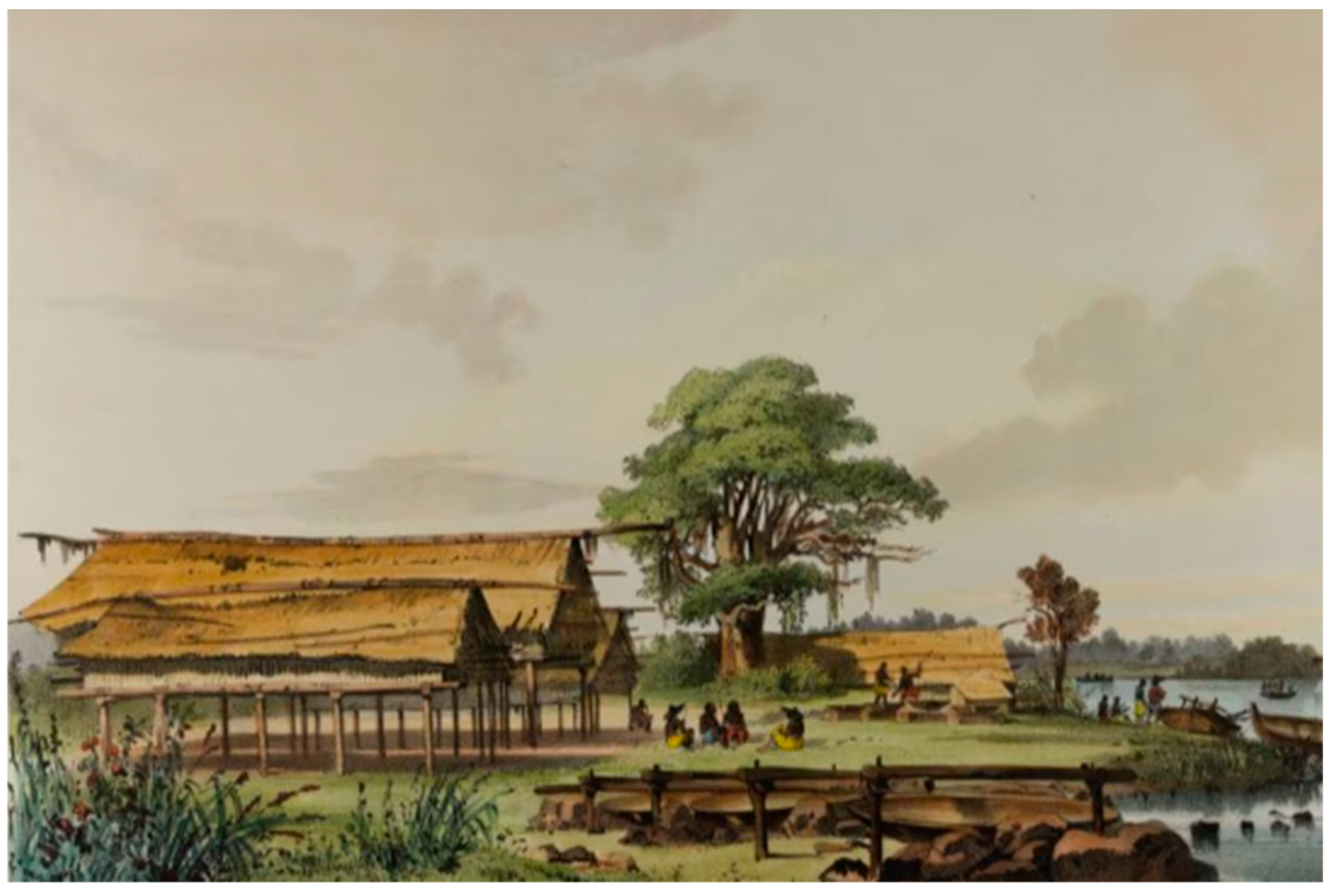
masjids, paralleling numerous examples of makeshift mosque architecture throughout Islamic civilisation, including during the era of the Prophet Muhammadﷺ. For example, thatched-roof mosques of this type were present on many islands in the Timor Sea and across the broader Archipelago. Colonial sketches and paintings provide substantial evidence of this period, comparable to the distinctive cave paintings of Macassan boats created by Aboriginal peoples. Historical paintings serve as valuable documents, capturing communities and structures, as demonstrated by two early examples of Macassan makeshift mosques in Northern Territory settlements. One example is a hut in Port Essington, painted by Harden Sidney Melville in 1845, and the other is a shelter in Raffles Bay, painted by Louis Le Breton in 1839 (
Figure 5).
The painting of the Port Essington camp is the sole surviving example in Australian history depicting a small Macassan village with elevated coastal huts. These makeshift huts, although smaller in scale, are comparable to those found in Dobbo village on the Aru Islands. Notably, one hut in Port Essington closely resembles a mosque without a minaret, similar to a structure in Dobbo village. The hut structures in this region later influenced architectural practices for constructing tropical houses and establishing acceptable living standards in northern Australia (
Ryan 2013, p. 56). The peaked roofs, characteristic of coastal vernacular architecture, are effective at shedding rainwater but generally limit the overall size of buildings. These small Macassan houses, often called “prayer houses”, featured woven bamboo walls and a single room with a thatched roof. As temporary constructions, they were not intended to endure indefinitely. From a Muslim viewpoint, the Raffles Bay makeshift mosque shows that the Macassans did not confine prayer to enclosed spaces (
Figure 6). Along the shallow waters of seas or creeks, Macassans set up shelters as places of prayer, allowing collective worship in an undisturbed environment and fostering a connection with the Creator.
This example of Raffles Bay open mosque also demonstrates that Macassans in Australia adopted shelter forms consistent with those found in early Islamic times and throughout the Archipelago. There is further evidence, derived from recent first-hand accounts of an extremely rare Aboriginal sketch of a mosque and testimonies from Yolŋu and Macassan people, which also provides significant insight into the historical presence of mosques.
At the “500 Years celebration” during the
Wind Talks: Yolŋu–
Macassan Encounters event in Broadmeadows Town, Melbourne,
Timmy Djawa Murrnmurrnga Burarrwanga, a Yolŋu community leader, in the panel discussion provided an account of a makeshift mosque rooted in shared history with the Macassans. By illustrating a Macassan mosque and referring to it in Aboriginal as
madayn waga (“sacred home’), he explained, “His ancestors passed him the story that Macassans built their type of light construction of mosque” (
Testimony by Uncle Timmy Djawa Murrnmurrnga Burarrwanga 2023). Several other Yolŋu individuals present also publicly affirmed that “Macassans erected hut mosques” (
Testimony by a group of the Yolŋu people 2023). Visiting Macassan artists and scholars further recalled “the existence of this earliest mosque in the form of shelters”, stating, “Our ancestors must have needed their huts or shelters for religious congregation, especially during bad weather” (
Testimony by a group of Macassans 2023). These makeshift mosques facilitated greater friendships and connections, with the Macassans welcoming Aboriginal people. Another Yolŋu man confirmed, citing ancestral accounts, “sometimes our [Aboriginal] houses were visited by the Macassans too” (
Testimony by a group of the Yolŋu people 2023). Mutual visits to each other’s dwellings are a significant aspect of peaceful encounters. It is also reflected in Aboriginal–Macassan songs, such as “Allah hu, Allah hu, Allah hu” (God just He), which were also performed with traditional instruments to showcase the rich cultural heritage of the Macassans.
The panel discussion about makeshift mosques was informative, attracting a large audience and offering new perspectives on the topic. Hearing the unified Yolŋu–Macassan viewpoints on previously unaddressed questions about the makeshift mosques was particularly valuable. The open consultation with the author also provided an excellent opportunity to record first-hand information.
A significant aspect of these findings is the previously overlooked presence of Macassan mosques. Information from both Yolŋu and Macassan sources regarding the existence of mosques yields significant historical, religious, and cultural insights. The evidence demonstrates that Islam is intrinsically linked to the existence of mosques, confirming that there are no Muslims without mosques, nor mosques without rituals, regardless of how modest these makeshift mosques were during the centuries-long presence of the Macassans. The Yolŋu–Macassan statements highlight that hut mosques existed during periods of fruitful ancestral encounters. Although these structures have vanished over time due to their lightweight construction, a subsequent example of the bush bamboo mosque further illustrates this phenomenon.
During the 1880s, Javanese settlers constructed a makeshift mosque in Mackay, Queensland (
Kabir 2007, p. 411;
Haveric 2019). While no images of the mosque remain, contemporary accounts and recollections from older Javanese residents confirm its existence (the author’s record of remarks from the Muslim community in Mackay (Haveric 2018).
De Jong and Beynon (
2011, p. 498) report that these indentured labourers from Java built a small mosque in the sugarcane fields of the Palms Estate. The structure, designed in the Javanese style, was made of grass and bamboo to meet religious and cultural needs. The bamboo mosque was ultimately destroyed by fire and no longer exists (
Harris 2013, p. 342). Makeshift mosques established by Macassan traders disappeared prior to the construction of Afghan makeshift mosques in the subsequent period.
The diffusion of early Islamic influence established Macassar as the cultural “Mecca of the north-east Arnhem Landers” (
The Aborigines of Arnhem Land 1953 Advocate, 12 December 1953, p. 13). Most of Makassar’s explorers, fishermen, and traders converted to Islam, often under the influence of Sufism, which spread throughout the region and beyond (
Sneddon 2020, p. 68). In addition to charismatic itinerant Sufis, there were also religious figures such as imams and captains who possessed knowledge of Islam and adhered to Sufi teachings.
Muslim spiritual missionaries soon followed the traders, and the spread of a new sacred message occurred alongside the growth of business and commerce (
Haveric 2019, p. 36). The Macassan crews and captains were predominantly Muslim, and references to Muslim prayers persist in certain sacred incantations along the northern Australian shores, invoking “Allah” in silence (
Ganter 2008, p. 3). As they travelled from island to island, Muslim traders and spiritual preachers not only transported spices but also introduced a text-centred faith and fostered intercultural connections. Due to the absence of historical records, the earliest Islamic preachers or Sufis remain “nameless”. Islamic influence in Australia developed gradually and pluralistically, rather than being shaped by a single spiritual leader, alim, or mystic who traversed the Timor and Arafura seas. Through the chanting of
dhikr along maritime routes of spiritual exchange, these Muslims maintained their traditions across generations (
Haveric 2019, p. 36).
Sufi orders (
tariqa) served as key agents in expanding Islam’s influence (
Reid 2006, p. 340). Historically, the evolution of Islamic beliefs and their syncretic forms is largely attributable to Sufis, who acted as peaceful bridge-builders between diverse communities. Their heritage represents a profound, enduring, and syncretic force that emerged from Islamic teachings mixed with Hindu–Buddhist traditions, and various local beliefs. Such perspectives were apparent in historical interactions with Aboriginal peoples, particularly through processes of syncretism. The syncretic elements of Islam, along with its openness to and respect for Aboriginal peoples, served as significant factors in establishing enduring contacts through micro- and meso-level dialogue (
Sneddon 2020, p. 80).
Sufism developed aspects that deal with behaviours of “new persuades” (
Aljunied 2018, p. 85). Their Islamic teaching in Australia was perceived as partial, idiomatic, and syncretic, differing from what many Muslims consider to be genuine or “orthodox” practice (
Berndt and Berndt 1954, p. 117). Islam transmitted by Sufis from Makassar was based much more on a personal, emotional approach to God than on orthodoxy (
Missen 1972, p. 125). Its flexibility reflected the choice to be either an important part of the community system or only nominal (
Missen 1972, p. 125). The Macassans demonstrated adaptability and proactive engagement with their environment rather than strict adherence to established doctrine. Mystical connections among initiators and leaders subsequently gained importance (
Berndt and Berndt 1954, p. 117). Northern Aboriginal groups were influenced by mystical or so-called “miraculous events,” as recounted in the Yolŋu narrative, “the one day when the first lightning [appeared] Macassan came across the sea” (
Twelve canoes n.d.). Spiritually, it symbolised sharing one world. Such motivations may include dreams regarded as mystical or divine, or the belief that prayers for a miracle or divine sign were fulfilled (
Mitchell 2023, p. 37).
Syncretism, by blending different beliefs, also served as a response to various social and economic challenges arising from isolation. This convergence encompassed spiritual beliefs in eternity, ascetic practices, syncretic expressions of local traditions, worship conducted from the ground, Sufi ritual observance with evocations, storytelling, mystical wandering, and a lifestyle centered on the temporary establishment of camps and tribal organisation. In later periods, this also included the rejection of forbidden meat, specifically pork. Additional commonalities included boys’ circumcision and its associated ceremony marking the transition to manhood, arranged marriages, reverence for land, and respect for the authority of elders (
Haveric 2019, p. 38).
The Macassans engaged in Islamic rituals, which influenced the Indigenous population to adopt specific perceptions, terminology, and practices. For the Yolŋu, the possibility of cultural exchange and Islamic influence was made possible through the ability to communicate at both the “mundane and the abstract levels” (
Thomas 2013, p. 70). The Macassan Sufis were potentially the key conduits of cultural and Malay language influence: “Australia’s first interpreters” (
Thomas 2013, p. 70). Subsequently, Aboriginal understandings and beliefs regarding divinity, as well as the term
Walitha’walitha used for God, may indicate Islamic influence. Several scholars have asserted that the Aboriginal term
Walitha’walitha refers to the creation spirit, often translating it as “the most high God”, “the Exalted”, or “God” (“Allah”) from the Arabic phrase “
Allah ta’ala” (
Stephenson 2010, p. 28). Yolŋu chants addressed to ‘Allah’ in the
Walitha‘walitha manikay comprise a series of songs transmitted across generations from the ancestral beings who originally shaped and named the Yolŋu homelands (
Haveric 2019). Sufi devotional practices originate from Islamic teachings, which emphasise the veneration of God focused on inner spiritual experience (
Aljunied 2018, p. 94).
Walitha’walitha is also closely associated with funeral rituals, which can include other Islamic elements like facing west during prayers—roughly the direction of Mecca—and ritual prostration reminiscent of the Muslim
sujood (to prostrate) (
Stephenson 2010, p. 29).
From the earliest periods,
du’a functioned as a conventional invocation or blessing intended to protect individuals from evil and calamity, as well as to ensure safety and happiness (
Reid 2006, p. 341). Islamic influence is apparent in certain Aboriginal manifestations, including linguistic expressions. One important practice was the Aboriginal mortuary ceremony, part of the
Wurramu song cycle. This ceremony was performed when the mast of a Macassan
prau broke or when a Macassan man was close to death. It was believed to be a Macassan prayer. During the funeral, two or more men would lift the deceased’s body up and down as if they were raising a mast. According to
Warner (
[1937] 1958, p. 420) and
McIntosh (
1996), the words of prayer were:
O-o-o-o-o-a-ha-la…
A-ha-la…A-ha-la, which contains appeals to the God in the heavens’ (cited in
Haveric 2019). The phonetic similarity between elements of this phrase and the Arabic word for God, “Allah” is significant. The phrase may represent a first part of Islam’s fundamental declaration of faith, the
shahadah, which means, “There is no god but God” (
Warner [1937] 1958, p. 420;
Sneddon 2020, p. 77). The next reciting phrase sounded like
Ra-bin-a-la la-ha-ma-ha-ma, which resembles the Arabic “Rabb-il-‘alamin”, meaning “the Lord of the Worlds”. The word “ama” resembles ‘amen, amen, or amin’, meaning “verily”, “truly”, “so be it”, “let it be”, or “I agree”, to express agreement with God’s truth (cited in
Haveric 2019). Following the initial invocation, two men in unison say what the natives believe to be a Macassar prayer (
Djel-la-war, Malay term);
Sil-li-la-mo-ha-mo ha-mo-sil-li-li, which may refer “very like [the Arabic] ‘
salli ala Muhammed nil murselin’ which [may] describe, “Invoke blessings upon the Prophet Muhammadﷺ” (
Sneddon 2020, p. 76). Although these expressions are significant, they can be primarily attributed to the Aboriginal sporadic or incomplete process of Islamic conversion. Although language barriers in Arabic may have existed for the Yolŋu, oral tradition suggests that Macassan spiritual missionaries also relied on oral transmission rather than written texts to convey Islamic teachings (
Haveric 2019).
Other Islamic terms or practices were interwoven in Yolŋu rituals, which may also lead only to sporadic conversion. The term
djambayang is derived from the Indonesian word
sembayang, meaning
salat (“Muslim prayer”).
Walitha’walitha was also associated with funeral rituals, shared with Macassans, which included other Islamic elements like facing west during prayers—roughly the direction of Mecca—and ritual prostration reminiscent of the Muslim
sujood (
Haveric 2019). In the Nunggubuyu language in southeast Arnhem Land, there is a note in the local school’s dictionary for native speakers that the word
Ramadan means “singing” (
Stephenson 2010, p. 34;
Haveric 2019).
Djambayang—‘Birrinydji’s dance’ prayer—Ramadan is a required period of Muslim fasting (
Macknight 1972, p. 314). When the ship mast was up and the flag flying, a Macassan would do the Djambayang dance—this meant ‘he has achieved oneness’ (
McIntosh 1996). Through this ritual, they also tried to achieve union with Divine linked with syncretic elements.
Two distinct, largely overlooked rare sources on early Sufism in Australia that came after the Macassan Sufis are especially worthy of mention. In the 1890s, Malay Muslim students in the Cocos (Keeling) Islands, an Australian external territory, studied the Qur’an under the guidance of the mystical, venerated Imam Suma (also known as Sumah). Local sources refer to the grave of Imam Suma, suggesting that its location may have held “mystical significance.” The grave’s location at the top of the kampong was believed to provide “spiritual protection” to the people of Home Island (
Haveric 2019, p. 134). The grave is listed in the Australian Heritage List. In the 1880s, the Javanese community was regarded as the oldest Muslim community in Queensland, Australia. Among these Javanese, there were two types of Muslims:
Santri and
Abangan, who met Aboriginal people. The practising Muslims were
Santris, who were “very pure in their religion,” while the
Abangans were only concerned with “the customs in their lives” (
Kabir 2007, p. 411). The
Abangans practised a much more syncretic version of Islam under Hindu–Buddhist influence than the more practising
Santris, who adhered to Islamic law (
Nurish 2021, pp. 22, 35). Historically, following the Macassans, these can be regarded among the earliest Sufis in Australia.
In traditional societies, such as those of the Yolŋu in Arnhem Land, exchange goes far deeper than commodity exchange; it also involves “trust, reciprocity and relationship” (
Ganter 2006, p. 29). Indeed, “nowhere else in Arnhem Land is the sense of Macassan influence so strong” (
Cole 1980, p. 74). Many Aboriginal stories of encounters attest to the bestowal of Islamic and Makassarese terms and to the exchange of sacred objects, cultural expression, and ceremonies (
Ganter 2006, p. 55).
Aboriginal ceremonies in Arnhem Land, influenced by Macassan cultural and spiritual practices, have been described as “especially complex and spectacular” (
Warner [1937] 1958, p. 471). For centuries, these cultural and spiritual forces have greatly influenced the lives of Yolŋu (
Cole 1980, p. 119). Interactions between Macassans and Aboriginal peoples resulted in the development of distinct artistic and mystical forms in Arnhem Land. Islamic prayers, rituals, and traditions were incorporated alongside Aboriginal ceremonies, motifs, myths, totems, songs, dances, and funerals to suit their own cultural practices. These syncretic expressions blended both belief systems and cultural forms without excluding either (
Haveric 2019, pp. 36, 38).
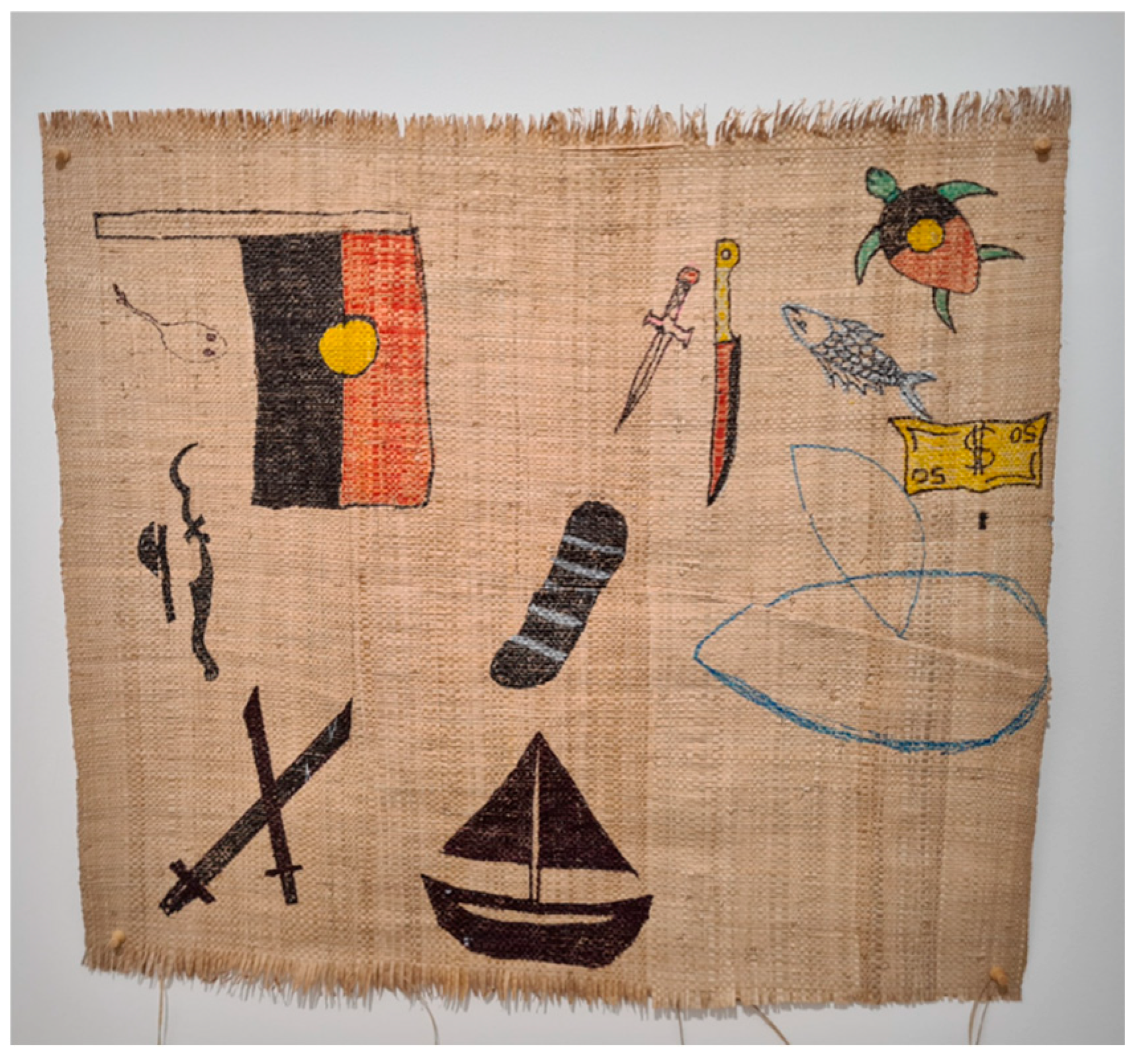
Yolŋu singers incorporated sacred texts and icons derived from their contact with the Macassans, including artefacts such as ships, anchors, swords, and flags, which became significant symbols within their narratives and songs (
Figure 7).
These ceremonial songs serve to commemorate the interactions between Aboriginal communities and Macassan traders. In one documented instance, an Aboriginal man sings with two Macassan traders who instruct him in the call to prayer. He characterises this as “a beautiful moment with these men in white and their prayer mats… a full prayer sung with these beautiful voices”. Linguistic analysis of certain expressions reveals connections to these encounters, as evidenced by the observation: “you are hearing hymns to Allah or at least certain prayers to Allah” (Bradley cited in
Rogers 2014).
In particular, Yolŋu
manikay (songs) document the historical interactions and relationships between the visiting Macassans and the Aboriginal people of Arnhem Land. These songs are instrumental in preserving and communicating this cultural exchange: “The traditional
manikay repertoires of Yolŋu clans such as the Dhalwaŋu possess vocal melodies similar to those heard in classical Arabic religious music” (
Corn and Marrett 2011, p. 73 cited in
Langton and Sloggett 2014, p. 7). Yolŋu
bunggul (dances) incorporate brightly coloured flags, referencing the traditional method by which owners signalled their readiness to trade. The
miny’tji (designs) associated with the ancestral hero of the Dhalwaŋu clan, Birinydji the Swordsman, feature flags,
prau, anchors, and swords, which serve as important icons of Birrinydji’s ancestral power. These symbols are also prevalent among other Yolŋu clans who “recognise Macassan ancestral figures of their own” (
Corn and Marrett 2011, pp. 73–74; cited in
Langton and Sloggett 2014, p. 7).
The ancestral figure is firmly rooted, with its arms resting on adjacent objects. Following this, the carver, his companions, a
jiriifa singing man, and a bamboo player commence a segment of the Macassan song cycle. The songs address a range of themes, including the
Wurramu, the Macassan wharves, rice fields, monetary exchange, iron production, timber cutting, prau construction, women gathering lily roots, women bathing, and aspects of domestic life, among others (
Haveric 2019, p. 42).
The commemoration of the deceased represents a significant cultural focus among the Macassans (
Reid 2006, p. 341). Carved
Wurramu figures typically depict an individual wearing a
songkok or
fez (a Muslim cap) (
Warner [1937] 1958, p. 435). All Macassans participate in the burial dance that encircles the
Wurramu figure.
Berndt and Berndt (
1949) indicates that this dance is specifically associated with funerary practices. He asserted that during the ritual, “participants turn their backs to a post, bow their heads, and close their eyes. Subsequently, they open their eyes and sing. This ritual lasts several hours”. In the Torres Strait, there is also evidence of a ‘cultural merger’ between the Islanders and Southeast Asian Muslim rites. In this way, Islamic burial customs were followed, as recorded:
When Nene [grandma] died… Wipe all the body down and dress her in white calico [cloth] and no clothes, wrapping only. Make like a scarf out of the same material… Had to use all the material. If got 10 yards, had to use it all on the body… Whatever was left was cut up and tied round our wrists. We had to wear it until it fell off by itself. Usually lasted over a hundred days…
Muslim funeral rituals commonly conclude with commemorative observances on the third, seventh, fortieth, and hundredth days following burial. Certain features added to Aboriginal
Wurramu funerary practices were also influenced by Macassan cultural traditions. The ceremonial raising of a mast, which evokes the act of vessels preparing to depart, was incorporated into Aboriginal burial ceremonies as a gesture of farewell. Furthermore, one or two days after burial, Aboriginal communities erected carved wooden grave posts in the Macassan style to serve as a final symbol of the deceased’s journey (
Haveric 2006, p. 100).
The vibrant environment of Sulawesi and the surrounding islands is reflected in Aboriginal songs composed in traditional forms by Aboriginal people who historically travelled to these regions. In contrast, Macassan-influenced ceremonies, such as the migratory ritual, involved the annual return of Macassans to Australian waters. The Macassans introduced “talismanic flags” to mark their arrivals and facilitate cross-cultural interactions. These flags were subsequently incorporated as clan totems within Aboriginal ceremonial practices (
Haveric 2019, p. 22). When they raise flags from the ground on the poles, they have to say certain words in Makassarese before they look into the sea (
Ganter 2006, p. 29). The adoption and adaptation of Islamic terminology by the Yolŋu people demonstrates a process of cross-cultural borrowing (
Stephenson 2010, p. 34). Macassan words are far more common in ceremonial language than in everyday language, and “this level of language was received for important ceremonies” (
Ganter 2006, p. 29).
The Macassans did not change the basic social structure of the Arnhem Landers, who were able to cope with the changes that they brought (
Cole 1980, p. 119). In numerous regions, Aboriginal women engaged in barter, which contributed to the formation of the Macassan–Yolŋu population (
Cole 1980, p. 17). Dozens, if not hundreds, of Aboriginal sojourners sailed on the return voyage to Makassar, settling there and beginning families with local women (
Clark and May 2013b, 2). Intermarriage between Macassans and Yolŋu has led some Yolŋu to claim Islamic ancestry. Their history of intermarriage for generations provides a new, personal dimension to Australia’s historical relations with Indonesia (
Martinez 2011, p. 194). Intermarriage between Macassans and Yolŋu has led some Yolŋu to claim Islamic ancestry. Similarly, Malays who intermarried with local Aboriginal people introduced Islamic religious and cultural practices. Many families in northern Australia adopted Muslim names, which demonstrates the significant Islamic influence resulting from these interactions. Family bonds continue to connect these communities, and the enduring strength of these relationships is articulated by the Yolŋu, who state regarding the Macassans, “we are
one spirit” (
Haveric 2019, p. 21).