


Abstract
This article discusses the link between secularisation and the rights of religious and belief minorities. Using data from the Atlas of Religious or Belief Minority Rights, it measures the extent to which RBM rights are respected, promoted and restricted. Taking the number of ‘nones’ in a country as an indicator of the secularisation of its legal system, it examines the impact of secularisation on the promotion of religious minority rights and the equal treatment of minorities, as well as the gap between their rights and those of the majority. The article concludes that secularisation does not directly promote RBM rights. Instead, it reduces the disparity between the rights enjoyed by the various minorities and between them and the majority Church. Notably, there is a clear correlation between secularisation and the majority–minority rights gap: highly secularised states tend to reduce it, whereas less secularised states tend to widen it. In terms of equal treatment, a highly secularised state does not guarantee equal treatment of all RBMs. However, a less secularised state makes equal treatment even more difficult.
1. Introduction
This article aims to discuss the link between secularisation and the rights of religious and belief minorities (RBMs) by answering the following questions. Is there a correlation between the number of “nones” in a country—with this being taken as an indicator of the secularisation of its legal system—and RBM rights? If so, what effect does this correlation have on the promotion of these rights, the equal treatment of minorities and the gap between their rights and those of the majority? Do different forms of secularisation have different impacts on RBM rights? Finally, is the impact similar or different in the various policy areas analysed by the Atlas?
To answer these questions, we will use data from the Atlas of Religious or Belief Minority Rights (the Atlas), which measures the respect, promotion, and restriction of RBM rights.1 The Atlas takes 13 RBMs into account: Buddhist communities, the Catholic Church, the Church of Jesus Christ of Latter-Day Saints, Hindu communities, Islamic communities, Jehovah’s Witnesses, Jewish communities, Orthodox Churches, Protestant Churches (Mainline and Evangelical), Scientology, Sikh communities and Belief Organisations (i.e., atheist, agnostic and humanist organisations). The research project aims to cover all EU member states, but for the time being, it considers 16 EU countries: Austria, Belgium, Croatia, Denmark, Estonia, Finland, France (with the exception of Alsace–Moselle), Greece (with the exception of Western Thrace), Hungary, Italy, Poland, Portugal, Republic of Cyprus, Romania, Spain and Sweden.2 Up to now, five policy areas have been analysed. These are: the legal status of RBMs; religious education in public schools; marriage and family; religious symbols; and spiritual care in prisons, hospitals and the armed forces. Each policy area is divided into clusters, each of which comprises a number of indicators concerning a specific legal issue (for example, the right of an RBM to teach its religion in public schools). Disaggregating the Atlas data into clusters provides a more precise and analytical understanding of each RBM right.
The Atlas maps and measures RBM rights through three indices: the promotion index (P-index), the equal treatment index (E-index) and the majority/minority gap index (G-index). All of these indices use international minority rights standards as a benchmark.
The P-index measures the extent to which RBM rights are respected and promoted within the 16 EU countries taken as a whole, within each member state and within each policy area. It is characterised by scores ranging from −1 to 1, where (a) “0” indicates the respect for international standards of protection of the right to freedom of religion or belief (FoRB); (b) a negative score highlights restrictions of RBM rights to a level that is inconsistent with the minimum level of protection that must be afforded by all states under the aforementioned international standards; and (c) a score above “0” and up to “1” points to measures promoting RBM rights.
States do not promote RBM rights equally: frequently, one RBM is entitled to more rights than another. The E-index is used to measure the equal treatment of RBMs by the state. A score of “0” indicates maximum equal treatment among RBMs, while a score of “1” indicates minimum equal treatment, as some RBMs enjoy rights that are denied to others. It should be noted that “equal” treatment is not a synonym of “fair” treatment, because RBMs may be equally subjected to restrictive legal provisions.
Thirdly, the G-index measures the gap between the rights granted to the religious majority and those granted to the RBMs in each country, on a scale ranging from “0” (minimum gap) to “−1” (maximum gap).3
Finally, it is important to bear in mind that the Atlas is a legal project and instrument. Therefore, the article focuses on the secularisation of state legal systems, rather than secularisation as a more general topic. With this in mind, the article is structured as follows: it begins with a section discussing the concepts of secularisation and RBM rights; this is followed by five sections examining the relationship between secularisation and minority rights in relation to the policy areas considered by the Atlas; the final section provides an overview of secularisation and RBM rights, together with a suggested explanation for these findings.
2. Secularisation and RBM Rights
Law is a complex system that regulates human activity and behaviour. It is incorrect to view law simply as a set of rules. These constitute only the most superficial layer of a legal system. Beneath the legal provisions lie ways of thinking, visions of society and conceptions of the individual and their rights, which constitute the structure of a legal system. A failure to bear this distinction in mind makes it impossible to correctly analyse the secularisation of a legal system. The process of secularisation can affect both levels of law, or only one of them, and this difference exerts a substantial influence on the extent to which secularisation affects the life of individuals through the medium of law. For example, it is possible that all references to religion are removed from the legal provisions, yet the structure of the legal system continues to replicate a model that is deeply influenced by religious conceptions of life and the world—especially when a religious tradition has dominated a country’s social and cultural life for centuries.
The introduction of compulsory civil marriage in Italy with the Civil Code of 1865 is an example of this. Until then, marriage was regulated by Church law (or that of some other religious organisations), but since then it has been regulated by state law. While the rules changed radically and religion largely disappeared from legal provisions, the structure of the institution of marriage remained almost unchanged (Punzi Nicolò 1986, vol. 97). For over a century, the Christian conception of marriage as a monogamous, heterosexual, indissoluble contract continued to inform civil marriage, until divorce was introduced (1970) and same-sex civil unions were legally recognised (2016). During its initial phase, which lasted for over a century, secularisation only affected the most superficial layer of law: the norms. It was only later that it extended to the structure of the legal system. Carl Schmitt described this phenomenon—the permanence of religion concealed beneath a cloak of secularisation—in a sentence that became famous: “All significant concepts of the modern theory of the state are secularised theological concepts” (Schmitt 1985, p. 36). Ernst-Wolfgang Böckenförde expressed the same concept indirectly, stating that “the liberal secular state lives on premises that it cannot itself guarantee” (Böckenförde 1976, p. 60). In this perspective, secularisation does not necessarily determine the retreat of religion from the public sphere: it may entail only its concealment. Religion is no longer visible but continues to inform, in an underground but no less effective way, political, legal and institutional choices.
It is also possible that the reverse process will occur: legal provisions containing references to religion remain unchanged but are stripped of their religious significance. This has happened relatively recently, through the culturalization of religion, i.e., the transformation of religious symbols, practices and beliefs into symbols, practices and beliefs that are part of the cultural heritage of a social group (Laniel 2016, pp. 372–88). The most striking example is provided by the ruling of the European Court of Human Rights in the Lautsi case, in which the display of crucifixes in Italian classrooms was deemed legitimate on the grounds that they had now become a symbol of the culture, tradition and identity of the Italian people (Temperman 2012). In this case, there is no concealment of religion: the reference to religion remains visible in the legal provisions that prescribe the display of crucifixes in public schools. However, these provisions have been deprived of their original religious significance and reconceptualised in a way that is acceptable to a secular state.
With regard to minority rights, the culturalization of religion is particularly relevant, since only the symbols and manifestations of the majority religion can be “culturalized”. While it could be argued that the crucifix is an expression of Italy’s historical and cultural tradition, it would be absurd to suggest that the symbols of other religions (e.g., the Jewish kippah) are an equally important part of this tradition. Thus, the culturalization of religion accentuates the disparities between different religions, favouring the religion that has historically been dominant in a country.
The concealment and the culturalization of religion are not the only forms that the secularisation of law can take. However, these examples serve to illustrate the complexity of this notion, which cannot simply be reduced to “the process by which sectors of society and culture are removed from the domination of religious institutions and symbols” (Berger 1967, p. 107). The removal of religion from the various fields that comprise a legal system can take many forms, and they can have different impacts on the rights of religious minorities and majorities, as demonstrated in the case of the culturalization of religion.
This article aims at determining whether a correlation between the secularisation of law and RBM rights exists and, if so, which one(s). This requires not only clarifying the concept of secularisation (which we have done so far) but also measuring it. Measuring secularisation is a complex matter; sociologists have suggested various indicators for this purpose. In the following analysis, we will adopt one of them, which is particularly helpful for measuring the secularisation of law: the percentage of people who do not identify with any religious organisation (those who are known as “nones”: see Table 1). The rationale behind this choice is straightforward: the greater the proportion of “nones” in relation to a country’s total population, the less likely it is that religion will influence the law-making process in that country. This correlation should be treated with caution, given that the process of secularisation is driven by various factors and the term ‘nones’ also encompasses people who, without identifying with any religious organisation, adhere to some kind of religious or spiritual beliefs and practices in their personal life (Balazka 2020; Ketola 2025). However, when it comes to drafting laws, it is unlikely that these people will exert the same influence as committed members of a religious organisation on the inclusion of norms which explicitly or implicitly give relevance to the beliefs and practices of these organisations in the country’s legal system. Moreover, classifications of countries’ degrees of secularisation based on multiple indicators substantially confirm that the percentage of people who do not identify with any religious organisation can be a useful starting point for measuring secularisation (see Smith and Shapiro 2021).
Table 1.
Percentages of nones in the 15 EU countries concerned.
Based on these preliminary considerations, we can now proceed with the analysis of the five policy areas considered by the Atlas. Following this examination, we will draw our conclusions in order to answer the four research questions formulated at the beginning of the introduction (Section 1).
3. Legal Status of RBMs
Legal status requires a specific public recognition (OSCE ODIHR 2014; Ventura 2021). In this area, secularisation generally—although not exclusively—takes the form of culturalization of religion.
The average P-index is 0.24. Looking at the disaggregated data of clusters A (ratification of international treaties), B (constitutional provisions on religions/beliefs and on RBMs), C (laws on FoRB and religious/belief associations, and statutory provisions on RBMs), D (bilateral agreements) and E (different systems to obtain legal personality), it emerges that none of the 15 examined states has a negative score. The right of RBMs to exist and operate legally in a given national territory is not questioned. However, whereas RBM rights are formally respected, it is more difficult to assess the extent of their promotion, not least because European states have different legal rules concerning the conferral of legal personality to RBMs. Some have an overly complex system for registering or recognising RBMs, with different levels and different rights for each RBM.
The countries that most strongly promote the rights of RBMs in terms of legal status are Poland and Sweden, whose P-index is 0.31. They ensure the protection and promotion of RBMs at both international and national levels, guarantee the right to be registered/recognised as religious organisations to a good number of RBMs, and do not place particularly severe constraints on the acquisition of legal personality. The two countries with the highest P-index are nevertheless characterised by significant religious, cultural and legal differences, including the number of nones. Poland is the country with the fourth lowest percentage (8.6%)—data that is consistent with the hypothesis that RBM rights are promoted more in countries with a low degree of secularisation. Sweden, however, is the country with the fourth highest percentage of nones (28.9%), which indicates that other factors are relevant in explaining this country’s ranking in the P-index, as we shall see below.
The countries with the highest percentage of nones are Estonia (43.6%), France (42.6%) and Belgium (39%). Estonia’s P-index (0.28) is higher than average, and also higher than that of most countries with a low degree of secularisation. France and Belgium are among the countries with the lowest P-index (respectively 0.16 and 0.14). France is disadvantaged primarily because of its failure to ratify the Framework Convention for the Protection of National Minorities (FCNM) and for its reservation concerning Art. 27 of the International Covenant on Civil and Political Rights. Although the related legal provisions concern minorities as a whole, it is undeniable that the protection of their existence and identity has been far more effective with regard to ethnic and language groups than religious ones. The latter raise the issue of the recognition of heteronomous legal rules: that is, rules whose origin is attributed to an external authority, regarded as superior to human beings, thus posing a challenge to the state’s monopoly of law (S. Ferrari 2016, pp. 8–11). Belgium has not ratified the FCNM either; furthermore, it has allowed only a limited number of RBMs to obtain legal personalities as religious organisations.
The difficulty in drawing straightforward conclusions regarding the links between the levels of promotion of RBM rights and secularisation in this area is highlighted by the case of Greece. It is the country with the second lowest percentage of nones (4.7%), but its P-index is 0.16. Conversely, the low scores of France in clusters A and B are counterbalanced by a high score in cluster E. One thing can, however, be safely concluded from the available data: with respect to legal status, the best way to promote RBM rights is to provide a simple legal system, based on a single level of recognition/registration, with easy access to all RBMs, as in the case not only of France, but also of Estonia and Sweden.
As noted, the number of nones—the indicator of secularisation adopted in this article—emerges as an appropriate interpretation key to explain the P-index in some national contexts, but not in others. This particularly applies to the seven countries whose percentage of nones is above the average (22.6%). Two of them (France and Belgium) have indices of promotion of RBM rights that are lower than the average P-index, Spain has a P-index that corresponds to the average one, and the remaining four states (Estonia, Sweden, Hungary and Finland) have a higher-than-average P-index. By contrast, when looking at the group of countries whose percentage of nones is below the average, the broader picture appears more homogeneous. In five countries out of eight (that is, Denmark, Portugal, Italy, Poland and Croatia, with the exclusion of Austria, Greece and Romania) there is a negative correlation between the degree of secularisation and the level of promotion of RBM rights. To sum up, in the area of legal status, states with a lower-than-average percentage of nones tend to promote RBM rights more than those with a higher percentage.
Moving on to examine the relationship between the process of secularisation and the equal treatment of RBMs, it should be noted that the former has not determined the disappearance of religion from the public sphere, but it has transformed its presence: the rights that were once granted only to the majority religions have been extended to RBMs. However, this extension is uneven. In this area, the average E-index is 0.04. A correlation between a low percentage of nones and a more unequal treatment of RBMs is found in no more than half of the countries under review: that is, Greece, Portugal, Italy and Poland. The correlation between a high degree of secularisation and a more equal treatment of RBMs is even weaker, since it only applies to three out of seven cases (Estonia, France and Sweden).
The culturalization of religion has favoured those RBMs whose doctrinal heritage and/or institutional organisation “resemble” the majority religion more closely. Thus, the RBMs whose rights are positively promoted are, in descending order, the Catholic and Orthodox churches and, on an equal footing, the Protestant churches, together with the Jewish and Islamic communities. The Buddhist communities, Jehovah’s Witnesses and Mormons are placed a step lower. The Hindu and Sikh communities (whose small numbers make it difficult, in most but not all countries, to attain the legal status of larger communities), BOs (which gain equality with religious organisations only in Belgium) and Scientology (which is particularly disadvantaged in France and Belgium) fare worse in this respect.
This ranking is confirmed by the G-index. Christian minorities are the RBMs coming closest to the legal status of the majority religion; Scientology and BOs are those that are furthest away. From the state perspective, the average G-index is −0.17. Among the five countries with a higher-than-average percentage of nones (Estonia and Hungary are excluded from this analysis because they have no majority religion), only France shows a correlation between a higher degree of secularisation and a lower gap between the majority religion and RBMs, while Sweden, Spain and Finland have scores that do not corroborate this hypothesis (respectively, −0.18, −0.22 and −0.23). It is safer to conclude that countries with a below average percentage of nones have a wider majority–minority gap. This finding can be found in Denmark, Portugal, Italy, Poland and Croatia. Austria and Greece have an average G-index. Therefore, the only exception to this general trend is Romania (whose G-index is −0.09).
4. Religious Education in Public Schools
The analysis of religious education in public schools reveals a complex ecosystem characterised by multiple interconnected variables. These include national normative frameworks, historical traditions of state–church relations, student demographic composition and models of religious instruction. The need to examine possible correlations between the growth of nones and the indices provided by the Atlas arises from evidence that these phenomena do not operate in isolation. Rather, they influence one another through complex mechanisms of social and institutional feedback. The growth of the religiously unaffiliated population can simultaneously be both a cause and an effect of transformations within systems of religious education.
In Europe, two main models of religious education in public schools can be identified: (a) the teaching of religion, and (b) teaching about religion. The first model entails the teaching of one or more specific religions, usually by members of that religious tradition and/or under the supervision of institutions representing it. The second refers to the possibility for students to learn about different religions. This form of instruction is typically non-denominational and organised directly by schools and teachers (S. Ferrari 2014).
These models vary across countries. In the teaching of religion model(s), important questions arise, including which religions are taught, who decides the content and textbooks, and how much influence religious organisations exercise. In the teaching about religion model, the issues concerned are broader, e.g., general instruction about religions, a focus on religions relevant to students’ backgrounds, and the treatment of religion as a cross-disciplinary topic integrated across subjects. This analysis is carried out through the four clusters: the presence of religious or belief instruction in school (cluster A); the type of system of religious education in place (B and C); the right to exemption and the possibility of following parallel courses (D); and the visibility of religion through symbols, clothing and food (E).
In the P-index, both systems receive the same score. This choice reflects the prevailing international standards, which do not privilege one model over the other, provided that some requirements are respected. Instead, they emphasise the importance of enabling families to request religious instruction that is consistent with their convictions. Where such provisions are unavailable, international standards recognise the right of families to withdraw their children from school-based religious instruction or to request alternative curricula. This principle applies especially within the teaching of religion paradigm. Conversely, international standards permit comparative teaching of religious history and ethics, provided such instruction is delivered in a neutral and objective manner.
In the P-index, five countries score above average (≥0.42). Among them, only France shows a correlation with high percentages of nones (42.6%). By contrast, among the ten countries below the P-index average, six have a percentage of nones that is above average, suggesting that the promotion of RBM rights can proceed independently from secularisation.
The correlation between P-index scores and the proportion of nones becomes more meaningful when viewed in relation to national models of religious education. In France and Estonia (in the latter, the percentage of nones is 43.6%), where there are high levels of religious disaffiliation, schools adopt approaches that minimise or avoid denominational teaching. In France, characterised by a strong separation of state and religion, religion is addressed as a transversal theme within other disciplines. By contrast, in Estonia, historically marked by Orthodox and Lutheran traditions but without a dominant majority religion, the prevailing model is teaching about religion: this pluralistic model of teaching, which achieves a promotion score just below the average, is an optional and non-denominational framework. It is offered only upon request and focused on cultural understanding rather than faith, and it embodies a secular yet pluralistic approach to religion in education.
Similarly, Sweden and Denmark—with 28.4% and 16.6% of nones, respectively—rely on forms of religious instruction that balance national traditions with secular educational aims. In Denmark, in particular, the subject is compulsory at primary level and centred on Christianity as cultural heritage, while in secondary education it assumes a comparative and fully non-denominational character. In both countries, the medium–high percentage of nones appears to reinforce the legitimacy of school systems designed to ensure neutrality and pluralism. By contrast, in Spain (26.4% of nones), Poland (8.6%) and Romania (under 1%), denominational religious instruction remains formally present in public schools. Unlike in other countries, the high proportion of nones in Spain does not reduce the gap between the religious majority and minorities in public schools, thus constituting a hiatus between societal change and institutions. Poland and Romania, conversely, show that cooperative state–religion models are related to the offer of various teachings of religion, while secularisation advances more slowly.
In the light of the above remarks, we can infer that high degrees of secularisation do not automatically result in higher scores in the P-index. In countries where religious traditions remain closely linked to state institutions, such as Poland or Romania, RBM rights are formally promoted, but the social weight of the majority religion persists. Furthermore, the cases of Estonia and Sweden—where high rates of nones coexist with models of teaching about religion that still recognise the cultural significance of religious traditions while avoiding confessional commitments—show that secularisation here takes the form of culturalization of religion.
Expanding the analysis to the E-index, eight countries score below the average (≤0.12), meaning that they ensure a certain level of equal treatment. Five of them also have a high percentage of nones. When considering these scores together with those of the P-index, Portugal, France, Estonia, Denmark and Sweden are the countries with the best performance. In Hungary and Estonia, where there is no majority religion and RBMs are treated equally, the percentage of nones is also high. Moving on to the G-index (average score: −0.20), seven countries are above average: Sweden (0), Denmark (0), Finland (−0.05), France (−0.09), Portugal (−0.11), Poland (−0.15) and Belgium (−0.19). These scores indicate that there are minimal gaps between the majority and RBMs. Four of them—Sweden, Finland, France, and Belgium—show a clear correlation between low gaps and higher degrees of secularisation. Conversely, in countries with wider gaps—such as Greece (−0.40), Spain (−0.36), Croatia (−0.33), Italy (−0.32), Romania (−0.30) and Austria (−0.27)—the presence of nones remains relatively low. Spain stands out as the exception (as already noted with regard to the P-index): although it has one of the widest gaps, it records a significant percentage of nones (26.4%).
To sum up, a high degree of secularisation seems to foster the reduction in the majority–minority gap and, though less markedly, a more equal treatment of RBMs. Here, too, secularisation as culturalization of religion offers a key to understanding the persistence of dominant religious traditions within secular legal frameworks.
5. Marriage and Family
The areas of law regulating marriage and family in the EU display a high level of homogeneity. The data provided by the Atlas shows that differences between national legal systems are minimal: much less so than in other policy areas affecting the same countries.
This uniformity clearly emerges in the three indices, and it is primarily explained by the process of state’s assumption of competence in matters concerning family and marriage, and by its partial homogenisation within the EU (Rohe 2014). Whilst all EU states adopt civil marriage and family law systems, Christian tradition—as mediated through Church institutions and norms (Mair 2011)—continues to shape the institutions of marriage, divorce, and inheritance, setting the role of the family and parent–child relationships in society (Sörgjerd 2012; Casanova 1994). This is to say that, in this policy area, secularisation takes the form of concealment of religion. However, it is difficult to trace a straightforward correlation between the number of nones and the results shown by the P-index, the E-index and the G-index.
The average P-index in this area is 0.09. The disaggregated data of clusters B (dissolution of marriage), C (inheritance), D (dowry) and E (relations between parents–children) shows that the 15 countries examined scored 0. The result indicates the mere respect for the international standards of protection of the right to freedom of religion or belief, independently of the number of nones in each state. Different results emerge from cluster A (celebration of marriage), where we have found significant differences among the states concerned. This divergence can be explained by the fact that there are two systems of marriage celebration in force in EU countries. In some countries, civil marriage is mandatory, while in others it is possible to enter into a religious marriage as an alternative to civil marriage, which, under certain conditions, can obtain civil status. This second group of countries has a higher score in the P-index, as they attach legal relevance to RBM marriages and, therefore, this gives RBMs the opportunity to publicly manifest and strengthen their identity.
The average P-index of cluster A is 0.27. The countries that promote RBM rights the most regarding the celebration of marriage are Croatia, Portugal and Spain (all scoring 0.72). Then, there are, in decreasing order, Poland and Italy (whose scores are, respectively, 0.61 and 0.46), followed by Denmark, Finland, Greece and Sweden (all of which score 0.38). These countries, which rank above the P-index average, are characterised by different percentages of nones. Only in the case of Sweden, Finland and Spain, the data shows a positive correlation between the high number of nones and a high P-index score.
Three countries have negative scores—Belgium, France and Romania (−0.25)—as they prohibit the celebration of a religious marriage before a civil ceremony (the only marriage which is valid for the state). While France and Belgium have a similar percentage of nones (respectively 42.6% and 39%), in Romania, this is below the average (<1 percent). On the contrary, Belgium, France, Romania, Estonia, Austria and Hungary are below the average. Therefore, a negative correlation between the number of nones and the promotion of RBM rights emerges with regards to Belgium, France, Estonia and Hungary.
Coming now to the countries with a low number of nones, the data shows a positive correlation between the degree of secularisation and the level of RBM rights promotion in Romania and Austria. In these countries, a low number of nones corresponds to a low degree of RBM rights promotion, particularly with regards to the celebration of marriage. Conversely, a negative correlation emerges in Denmark, Portugal, Poland, Italy, Croatia and Greece between the degree of secularisation (low) and the level of promotion of RBM rights (high). In other words, the majority of countries with lower percentages of nones display a high level of promotion of RBM rights. Specifically regarding the celebration of marriage, the results show that less secularised states promote RBM rights more than those characterised by a higher degree of secularisation.
In the E-index, the group of countries, which recognise the civil status of RBMs’ marriage, obtain a higher-than-average score than those with mandatory civil marriage, because the right to celebrate a religious marriage that is valid under state law is granted only to certain RBMs, thus creating disparities between them. At the same time, the choice of either system of marriage celebration is a variable that appears to be more related to a country’s legal tradition than to its degree of secularisation.
The average E-index with regards to cluster A is 0.15. The Atlas data indicates that in countries where it is possible to perform a religious marriage that is valid under the state legal system, not all the RBMs enjoy equal treatment in this regard. This occurs because it is up to the state to choose the RBMs to which this possibility is offered. The state choice is determined by a variety of historical, social and political elements, as well as by the number of believers, the attitude of each religious community towards state authorities, and their organisational and lobbying ability. Among the countries with a percentage of nones above the average, Belgium, France, Sweden and Hungary rank below the average, whereas Spain, Finland and Estonia are above the average. Among the countries with a percentage of nones below the average, only Austria scores below the average in the E-index. Denmark, Croatia, Greece, Italy, Poland, Romania and Portugal have an above-average score, which indicates that a low percentage of nones is connected to a low level of equal treatment. This data, in turn, shows that countries with a low degree of secularisation are less likely to grant equal treatment than countries with a high degree.
Finally, examining the G-index data considered as a whole, there appears to be no clear correlation between the number of nones and the degree of the gap between the rights granted to majority religions and RBMs. While countries with a low number of nones tend to have a larger gap than those with a high number, the difference is not substantial.
6. Religious and Belief Symbols
The notion of symbols can vary according to religion, law and tradition. This is why it can be difficult for the state to define what a religious or belief symbol (RBS) is. It could be something worn or displayed on a wall; the way hair is combed or covered; food; or how an animal is slaughtered (Howard 2020; Poniatowski 2021; A. Ferrari 2023).
According to international standards, wearing religious symbols is a manifestation of the right to freedom of religion or belief (UN Human Rights Committee 1993, p. 6; Council of Europe 2022, pp. 96–116). Although religious symbols play an integral role in how individuals practise their faith, wide limitations may be legitimately applied on several grounds, including secularisation, which—in this area—takes the form of the culturalization of religion.
The fact that the Atlas data is largely derived from an analysis of legislation4 explains why the results concerning RBSs are similar across many countries. Although these data need to be supplemented by an examination of case law, which is outside the scope of the Atlas, they still provide a good starting point for our analysis. For this reason, this policy area is divided into the following clusters: A (RBSs in the public workplace), B (RBSs in the private workplace), C (RBSs for members of parliament, judges and police officers), D (RBSs in public spaces), E (official display of RBSs in hospitals, prisons and army barracks) and F (display of RBSs by inmates, patients and military personnel in their private spaces).
The average P-index is 0.44. The scores of the P-index in the 15 EU countries concerned are similar, regardless of the number of nones. This indicates that the rights of RBMs regarding religious symbols appear to be promoted in a similar manner in more- as well as less-secularised societies: even when the number of nones is low in a country, its P-index is still above average. Romania, Greece, Croatia, Poland, Portugal, Italy and Austria have a percentage of nones below average, yet all these states have an above-average P-index. In countries where the percentage of nones is higher than the average (Finland, Spain, Hungary, Sweden and Estonia), the P-index score is also higher than the average.
The scores are below average only in countries where some limitations have been implemented with respect to wearing or displaying religious symbols in public and institutional spaces: that is, France and Belgium (both with a percentage of nones above average) and Denmark (with a percentage below average). In particular, restrictions apply to members of parliament and public employees in France, which has the second-highest percentage of nones (42.6%), which is comparable to Estonia’s figure (43.6%). Both France and Estonia—as already noted—have a high degree of secularisation, but they do not have the same scores in the P-index (0.19 in the former and 0.45 in the latter). This difference emerges especially in clusters A and B, where Estonia scores 0.50, whereas France has the worst possible score in cluster A (−1) and 0.25 in cluster B. The reason is largely due to Islam being a heavily targeted minority in France, with restrictions affecting the wearing of Islamic religious symbols, as well as the Sikh and Jewish ones. On the other hand, the private sphere is not an issue, since no RBM is affected by a restriction on the right to wear or display religious symbols, even in private spaces which are located within prisons, hospitals and the army (cluster F). The situation is somewhat different in cluster D. The prohibition of full-face coverings in public spaces in Austria, Belgium, Denmark and France clearly targets a specific RBM. Regardless of the percentage of nones, these countries score worse than all the others in the P-index (as well as in the G- and E-indices), because this restriction not only prevents the promotion of rights among the Islamic minority, but also creates disparity between this minority and all the others and widens the gap between RBMs and the majority. To sum up, the percentage of nones does not seem to be a key factor concerning the promotion of RBM rights in this policy area.
By contrast, the scores in the E- and G-indices appear to be linked to the percentages of nones. In countries with a low percentage of nones, such as Romania, Greece, Croatia, Poland, Austria, Portugal and Italy, the distribution of rights among RBMs is more selective, and the gap between the rights enjoyed by the majority religion and RBMs is greater. A partial exception is Denmark, where the percentage of nones is below average. In the other states, where the percentage of nones is above average (Finland, Hungary, Sweden, Estonia, Belgium, France and Spain), the situation is less clear. A high percentage of nones combines with the more equal treatment of RBMs in Finland, Sweden, Estonia and Hungary, and with a low gap between the majority and RBMs’ rights in Finland and Sweden (as already noted, Estonia and Hungary have no majority religion). In Spain, however, both the E- and G-indices show poor performance. In Belgium, the former displays a medium score and the latter a poor one. France performs well in the E-index and poorly in the G-index, because it has reduced the privileges accorded to the majority religion, but does not grant equal treatment of RBMs (for example, many limitations on wearing RBSs in public spaces apply only to certain RBMs). In conclusion, this data indicates that low degrees of secularisation are strongly correlated with unequal treatment of RBMs and a wide majority–minority gap. In contrast, high degrees of secularisation are strongly correlated with a low majority–minority gap (with the exception of Spain) and, to a lesser extent, with equal treatment of RBMs.
7. Spiritual Assistance in Prisons, Hospitals and the Armed Forces
The provision of spiritual assistance in so-called “protected” public facilities, where individuals are not afforded full freedom of movement and therefore religious freedom, is influenced by a number of factors (Tretera and Horák 2019). The preponderance of a religious majority in a given country may result in an imbalance with regard to access to spiritual assistance. This inequality can be exacerbated if the specific needs of RBMs are not catered for by a comprehensive system. Whilst the advent of greater religious diversity in the European context highlights the deficiencies of legal systems that have historically favoured religious majorities, the impact of secularisation may also be of significance. In this policy area, we can mainly find forms of concealment.
The clusters of this policy area are: the right to receive spiritual assistance from representatives of one’s religious or belief organisation in prison (A), health institutions (C) and armed forces (E); the availability of places to pray and meet in prisons (B), health institutions (D) and armed forces (F); the right to practice one’s religion (G), which includes, inter alia, the right to accede to food that is not prohibited by one’s religion, and to enter a place to pray and meet that holds symbolic significance.
The average P-index is 0.22. Whilst the analysis of the disaggregated data indicates a broadly positive outcome for the 15 countries under consideration, significant polarisation is evident between certain groupings of countries. The data reveals homogeneity with a low P-index in three countries, namely Greece (0.15), Italy (0.16) and Spain (0.15), where there is a traditionally significant religious majority. The paucity of promotion of RBMs is attributable, specifically, to the so-called right to have a chaplain in the relevant institution (clusters A, C and E), a right which is recognised only for the religious majority, resulting in low scores in those countries (Greece: 0.14; Italy: 0.14; Spain: 0.15). These considerations also apply to the availability of spaces to pray and meet (clusters B, D and F), which are to be regarded as stable and exclusive. While no country under scrutiny provides dedicated spaces for RBMs, in the three abovementioned countries, the right to a chapel is recognised on a permanent basis only for religious majorities. The countries with above-average promotion rates are France (0.33), Belgium (0.30) and Portugal (0.29), where the proportion of RBMs with access to continuous religious assistance is notably higher.
Regarding the relation between these results and secularisation, it can be inferred that the rights of RBMs are more robustly protected in countries that are characterised by high degrees of secularisation (the percentages of nones, as already noted, are 42.6% in France and 39% in Belgium). Greece and, to an extent, Italy (with percentages of 4.7% and 13.3%, respectively) have a low score on the P-index. At the same time, there are some countries that do not fit this interpretative scheme. Spain, where the percentage of nones is above average (26.4%) and Portugal, where this is similar to that of Italy (13.8%), have comparably higher P-index scores. Spain, in particular, shows this difference with regard to clusters B, D and F. In the context of the gradual conversion of Catholic chapels within prisons into versatile spaces, which are utilised, albeit not exclusively, for the practice of other religious traditions (Martínez-Ariño 2020, p. 350), there is a rising preference for the establishment of quiet rooms in newly built facilities. This constitutes a new development. On the one hand, quiet rooms ensure universal access to locations that are conducive to spiritual contemplation, devoid of any explicit religious implications. On the other, there is a risk of the exclusion of certain RBMs in favour of others. It can be argued that the removal of the more strictly religious and symbolic dimension of places of worship seems to constitute a form of secularisation as concealment of religion, favouring private spiritual choices over less visible confessional ones. Nonetheless, the adoption of privatised spirituality for all does not always result in adequate provision for the spiritual requirements of RBMs, notably in the case of Islam and those RBMs necessitating distinctive symbols and architectural structures in their places to pray and meet (see Bobrowicz 2018).
The average of the E-index is 0.084. Here, the scores do not show a clear correlation between the percentages of nones and the levels of equal treatment among RBMs. The three countries (Greece, Italy and Spain) where the differences in treatment are smallest are the same as those in which the rights of RBMs are least promoted. Their scores are 0 (Greece), 0.01 (Italy) and 0.04 (Spain). In contrast, France and Belgium have a high E-index scores of 0.15 and 0.17, respectively. This data seems to show that an increase in the promotion of RBM rights is associated with a decrease in the equal treatment of RBMs, in the context of a selective promotion of RBMs.
The G-index has an average of −0.31. The countries with noticeably above-average scores are Greece (−0.41), Italy (−0.47) and Spain (−0.46), whereas Sweden and France are characterised by the lowest gap (with scores of respectively −0.06 and −0.19). The former, in particular, is the only country to show a correlation between a higher percentage of nones (28.9%) and a smaller gap between the majority and RBMs. Conversely, countries with low percentages of nones, such as Greece and Romania, in conjunction with Poland, Italy and Portugal, are characterised by a wider gap. As with the P-index, here, too, the notable exception is Spain, where the ongoing rise in secularisation does not appear to have had a favourable effect on the divide between the religious majority and RBMs. This appears to signify a rapidly evolving social context that, as yet, does not inherently impact the legal system.
In conclusion, above-average percentages of nones can be found in countries with very different scores in the P-, E- and G-indices. Spain stands in stark contrast to France, where there a high degree of secularisation (in the form of concealment of religion), which goes hand-in-hand with an above-average promotion of RBM rights, a more equal treatment of RBMs and a smaller gap between the majority and RBMs. This demonstrates that systems protecting as many RBMs as possible can do so in a context of increasing rates of numbers of nones. On the other hand, there are systems, such as the Spanish one, which persist in offering inadequate protection for the rights of RBMs, despite their higher degree of secularisation.
8. Secularisation and RBM Rights: An Overview and Explanation
The analysis conducted in the previous sections reveals the various forms that secularisation may take in each of the five policy areas considered by the Atlas. It also shows the extent to which a high or low number of “nones” affects the RBM rights in each area. At this point, just one question remains to be answered: considering the data emerging from the five policy areas together, what is the impact of the number of nones, taken as an indicator of secularisation, on RBM rights in general? Reiterating that this paper does not measure the impact of secularisation as such, but rather the impact of the presence of nones on RBM rights, we can provide three answers, each of which is illustrated by a graph.
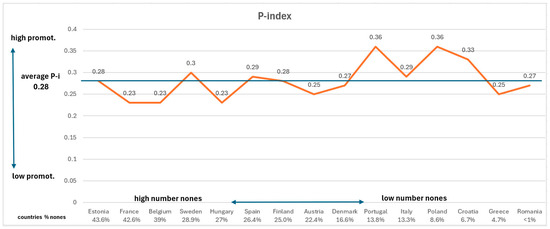
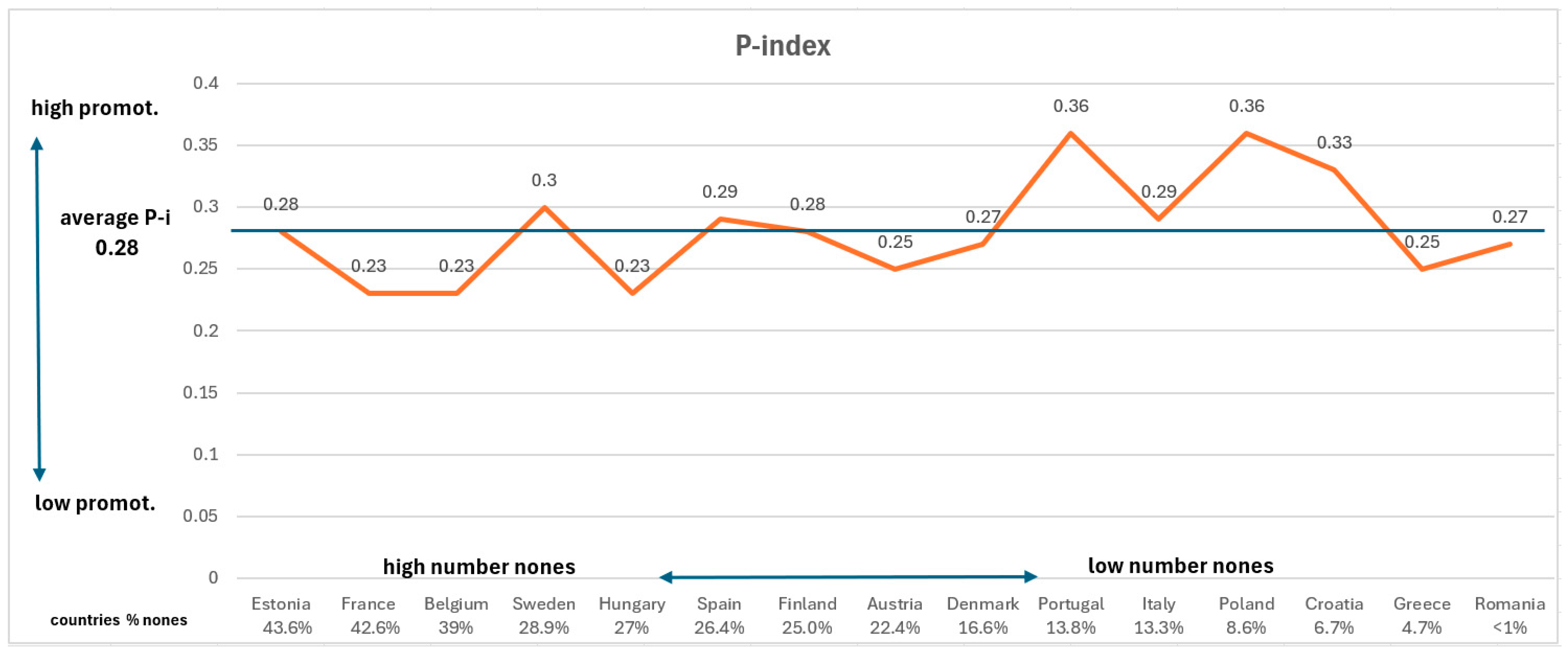
Figure 1 shows that there is no clear correlation between the number of nones and the promotion of RBM rights. The average percentage of ‘nones’ in the sixteen countries covered by this study is 22.4%. Among countries with an above-average proportion of nones, only Sweden and Spain have a higher degree of promotion than the P-index average. The other countries have an index that is equal to the P-index average (Estonia and Finland) or lower (France, Belgium and Hungary). Conversely, Portugal, Italy, Poland and Croatia have a higher-than-average degree of promotion, despite having a low number of nones. This is in contrast to Austria, Denmark, Greece and Romania, where a low number of nones corresponds to little promotion of minority rights. RBM rights are promoted slightly more in countries with a below-average proportion of nones, but the difference between the two groups of countries is relatively small.
Figure 1.
Number of nones and P-index.
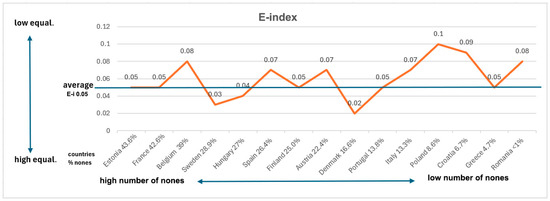
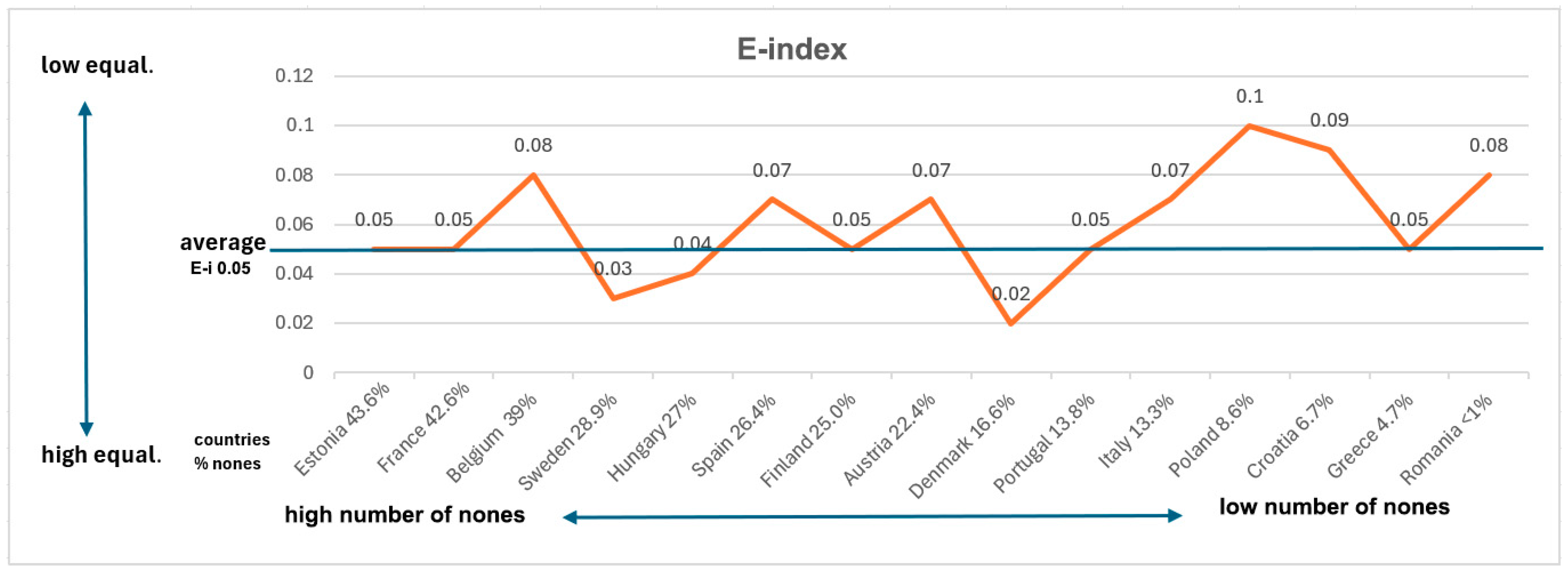
Figure 2 illustrates the distribution of rights among the thirteen RBMs covered by the Atlas. Starting with countries that have an above-average number of “nones”, (as already mentioned the average percentage of “nones” is 22.4%), it indicates a positive correlation between a high number of nones and the equal treatment of RBMs in two countries: Sweden and Hungary. In two others (Belgium and Spain), however, the correlation is negative. The remaining three countries (Estonia, France and Finland) have an E-index score that is equal to the average. Turning to countries with a low number of nones, a positive correlation exists between low numbers of nones and low equal treatment in five out of six cases (Austria, Italy, Poland, Croatia and Romania). Denmark is the exception, with a low number of nones and a high degree of equal treatment. Finally, Portugal and Greece have an E-index that is identical to the average one.
Figure 2.
Number of nones and E-index.
In summary, while the correlation between a high number of nones and a high degree of equal treatment is not proven, the correlation between a low number of nones and low equal treatment is evident. A below-average number of nones is associated with greater inequality, but a high number of nones does not necessarily lead to greater equality.
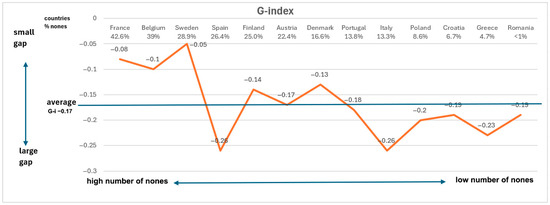
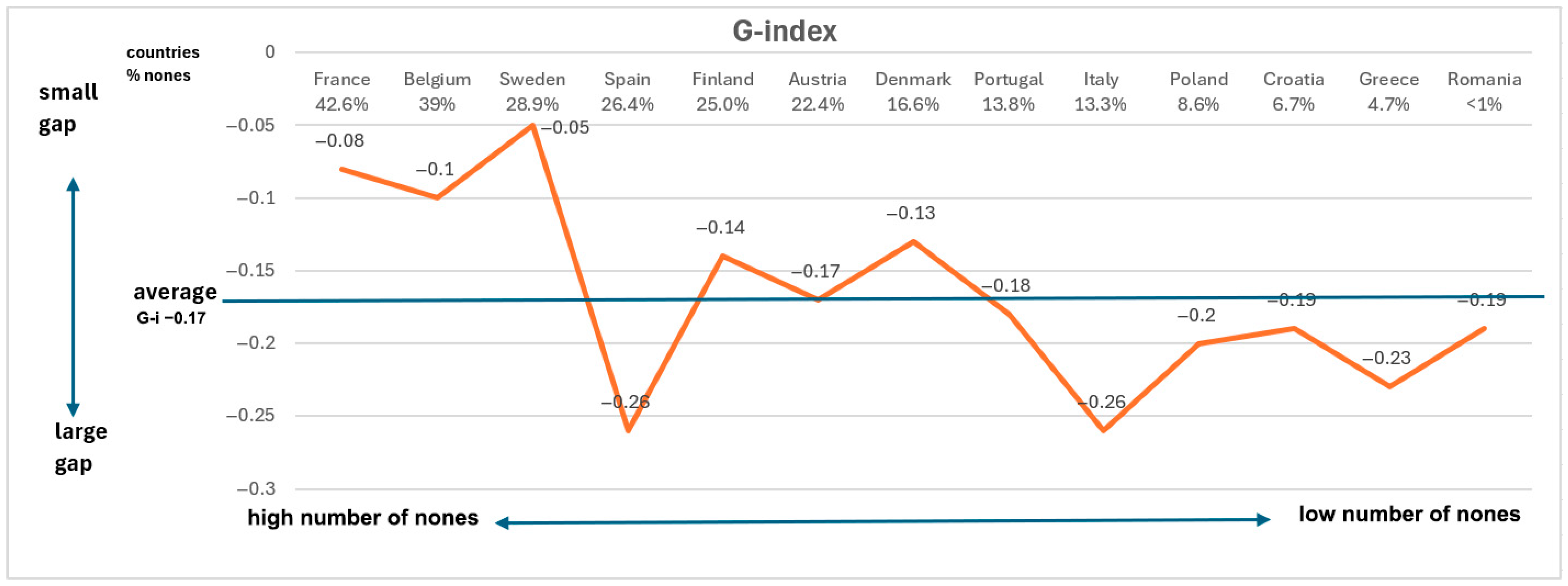
Finally, Figure 3, which measures the extent of the difference between the rights granted to the majority and to minorities, shows that a clear correlation exists between the number of nones and the extent of this difference in 10 out of 12 cases. Specifically, a high number of nones leads to a small difference in four out of five cases, while a low number of nones leads to a large gap in six out of seven cases. Thus, assuming that the number of nones reflects the level of secularisation in a country, the Atlas data indicates that secularisation does not promote RBM rights as such. Instead, it reduces the disparity between them, and between the rights enjoyed by RBMs and the majority Church. In particular, there is a clear correlation between the number of nones and the majority–minority rights gap: highly secularised states tend to reduce it, while less secularised states tend to widen it. In terms of equal treatment, a highly secularised state does not guarantee equal treatment of all RBMs; however, a less secularised state tends to make equal treatment even more difficult.
Figure 3.
Number of nones and G-index.
What explanations can be found for the results shown in the figures set out above?
There are two key factors that can help to explain these results. The first is the features that the process of secularisation assumes in the field of public law. Since Grotius’s “Etsi Deus non daretur”, the theoretical basis of a secular state has been that religion is irrelevant in determining entitlement to rights. All citizens must be recognised as having the same civil and political rights, regardless of whether or not they profess a religion and, if so, which religion. However, this principle, which underpins the secularisation of the legal systems of European countries, sits uneasily alongside the idea that RBMs should be granted special rights to bring them into line with the majority. This explains why countries with a high proportion of nones—where the process of secularisation should be more advanced—promote RBM rights slightly less than countries with a low proportion of nones, as shown in the first graph.
The same principle helps us to understand the results of the second figure. It shows that countries with a low number of nones ensure equal treatment of RBMs to a lesser extent than countries with a high number of nones. The irrelevance of religion in determining entitlement to civil and political rights encourages the application of the same legal rules to all RBMs. In contrast, where religion still plays a role in the public sphere, rights are more likely to be attributed differently, depending on an individual’s or group’s professed religion.
Finally, the same logic underpins the results of the third figure, which measures the gap between the rights granted to the majority religion and those granted to RBMs. In countries with a high proportion of nones, this gap is significantly smaller because, in a state where religious affiliation is irrelevant, the number of followers and how deeply a religion is rooted in a nation’s social fabric cannot justify legal disparities. In principle, this is true; however, in practice, when we move from the entitlement to the actual enjoyment of rights, numbers matter, tradition carries significant weight, and some RBMs are “more equal than others”. Even a secular state cannot disregard the social and political force of certain religions and beliefs, which explains the discrepancy between the proclamation of rights and their implementation.
The second key factor is the link between secularisation and the uniformity of law in continental Europe. The process of legal secularisation has been driven by European states imposing the same rules on citizens and groups. State uniform law has replaced laws based on customs, ethnicity, social status and religion. As the promotion of RBM rights means promoting diversity (e.g., different days of rest, different foods in public canteens, different ways of celebrating and dissolving marriages, and so on), states where the process of secularisation is more advanced tend to promote RBM rights less, not only because they question the relevance of religion in the public sphere, but also because they question the supremacy of state law (Croce 2015). In conclusion, it is possible that the process of secularisation will grow in EU countries, but it is unlikely that it will help to increase the promotion of RBM rights. It is more probable that it will result in a decrease in the rights of the majority churches.
This conclusion is not surprising when we consider the type of secularism prevailing in continental Europe. A secular state—one that does not identify with any religion or privilege religion over non-religion—can manage religious diversity through uniformity or plurality. The former strategy is easier and tends to apply the same rules to all religions, while the latter is more complex and tends to adopt an even-handed legal pluralism. In the former, there is little scope for promoting RBM rights, as this requires the state to take positive action to promote RBM-specific identities. Secularism rooted in uniformity prioritises the equal treatment of RBMs over the advancement of their rights, which, according to the Atlas data, is precisely what is occurring in EU countries where the process of secularisation is more advanced.
Author Contributions
Conceptualization, S.F.; methodology, S.F.; formal analysis, all authors; investigation, all authors; resources, all authors; data curation, all authors; writing—original draft preparation, all authors; writing—review and editing, all authors. All authors have read and agreed to the published version of the manuscript.
Funding
This research received no external funding.
Institutional Review Board Statement
Not applicable.
Informed Consent Statement
Not applicable.
Data Availability Statement
Data are available at https://atlasminorityrights.eu.
Conflicts of Interest
The authors declare no conflicts of interest.
Notes
| 1 | “Respect means ensuring that the rights granted to an individual or group of people under international human rights standards are not violated. Promote means putting in place the conditions that facilitate the enjoyment of these rights and foster the development of RBM identity and the participation in the social, cultural and political life of the country where they live”. Cfr. https://atlasminorityrights.eu/about/Methodology.php, accessed on 15 February 2026. |
| 2 | For the reason explained in Table 1, the Republic of Cyprus is not considered in this article. Therefore, although the Atlas data covers 16 countries, this article only considers 15. |
| 3 | Detailed information on the Atlas objectives, content and methodology is available at www.atlasminorityrights.eu, accessed on 15 February 2026. |
| 4 | In most EU countries, the issue of RBSs is addressed through case law: the judge is in the best position to seek a reasonable accommodation between the different stakeholders. |
References
- Balazka, Dominik. 2020. Mapping Religious Nones in 112 Countries: An Overview of European Values Study and World Values Survey Data (1981–2020). Available online: https://isr.fbk.eu/wp-content/uploads/2020/07/Mapping-Religious-Nones-in-112-Countries-Report.pdf (accessed on 15 February 2026).
- Berger, Peter. 1967. The Sacred Canopy. Elements of a Sociological Theory of Religion. New York: Doubleday. [Google Scholar]
- Bobrowicz, Ryszard. 2018. Multi-Faith Spaces Uncover Secular Premises Behind the Multi-Faith Paradigm. Religions 9: 37. [Google Scholar] [CrossRef] [Scilit]
- Böckenförde, Ernst-Wolfgang. 1976. Staat, Gesellschaft, Freiheit. Frankfurt: Suhrkamp. [Google Scholar]
- Casanova, José. 1994. Public Religions in the Modern World. Chicago: The University of Chicago Press. [Google Scholar]
- Council of Europe. European Court of Human Rights. 2022. Guide on Article 9 of the European Convention on Human Rights: Freedom of Thought, Conscience and Religion. Strasbourg: Council of Europe. [Google Scholar]
- Croce, Mariano. 2015. Secularization, Legal Pluralism, and the Question of Relationship-Recognition Regimes. The European Legacy 20: 151–65. [Google Scholar] [CrossRef] [Scilit]
- Ferrari, Alessandro. 2023. Human Rights and the Osmosis between Secular and Religious Legal Systems: The Post-modern European Right to Freedom of Religion through the Prism of the Islamic Veil. Stato, Chiese e Pluralismo confessionale (www.statoeechiese.it) 9: 61–88. [Google Scholar]
- Ferrari, Silvio. 2014. Teaching Religion in the European Union: A Legal Overview. In Religious Education and the Challenge of Pluralism. Edited by Adam B. Seligman. Oxford: Oxford University Press, pp. 25–44. [Google Scholar]
- Ferrari, Silvio. 2016. Religious Rules and Legal Pluralism: An Introduction. In Religious Rules, State Law, and Normative Pluralism—A Comparative Overview. Edited by Rossella Bottoni, Rinaldo Cristofori and Silvio Ferrari. Berlin: Springer, pp. 1–25. [Google Scholar]
- Howard, Erica. 2020. Law and the Wearing of Religious Symbols in Europe. Abingdon: Routledge. [Google Scholar]
- Ketola, Kimmo. 2025. Who are the ‘Spiritual but Not Religious’? Complex Patterns of Religiosity in Nordic Countries. In Changing Religiosities in the Nordic Countries: A Complexity Perspective. Edited by Peter B. Andersen and Peter Gundelach. Leiden: Brill, pp. 167–87. [Google Scholar]
- Laniel, Jean-François. 2016. What ‘cultural religion’ says about secularization and national identity: A neglected religio-political configuration. Social Compass 63: 372–88. [Google Scholar] [CrossRef] [Scilit]
- Mair, Jane. 2011. The place of religion in family law: A comparative search. In The Place of Religion in Family Law: A Comparative Search. Edited by Esin Örücü and Jane Mair. Louvain-la-Neuve: Intersentia, pp. 359–85. [Google Scholar]
- Martínez-Ariño, Julia. 2020. Spain: Religion in Prisons—Socio-Legal Perspectives. In Religion and Prison: An Overview of Contemporary Europe. Edited by Julia Martínez-Ariño and Anne-Laure Zwilling. Cham: Springer, pp. 339–58. [Google Scholar]
- OSCE ODIHR. 2014. Guidelines on the Legal Personality of Religious or Belief Communities. Warsaw: OSCE Office for Democratic Institutions and Human Rights. [Google Scholar]
- Poniatowski, Michał. 2021. Religious Symbols in the Public Sphere in the Case Law of the European Court of Human Rights. In Religious Symbols in the Public Sphere. Analysis on Certain Central European Countries. Edited by Paweł Soboczyk. Budapest: Central European Academic Publishing. [Google Scholar]
- Punzi Nicolò, Anna Maria. 1986. Due modelli di matrimonio. Il Diritto Ecclesiastico 97: 6–43. [Google Scholar]
- Rohe, Mathias. 2014. Family and the Law in Europe: Bringing Together Secular Legal Orders and Religious Norms and Needs. In Family, Religion and Law. Cultural Encounters in Europe. Edited by Prakash Shah, Marie-Claire Foblets and Mathias. Rohe. Farnham: Ashgate, pp. 49–78. [Google Scholar]
- Schmitt, Carl. 1985. Political Theology: Four Chapters on the Concept of Sovereignty. Chicago: The University of Chicago Press. [Google Scholar]
- Smith, Tom W., and Benjamin Shapiro. 2021. Secularization Around the World. Available online: https://gss.norc.org/content/dam/gss/get-documentation/pdf/reports/cross-national-reports/CNR%2037%20-%20Secularization%20Around%20the%20World.pdf (accessed on 15 February 2026).
- Sörgjerd, Caroline. 2012. Reconstructing Marriage. The Legal Status of Relationships in a Changing Society. Louvain-la-Neuve: Intersentia. [Google Scholar]
- Temperman, Jeroen, ed. 2012. The Lautsi Papers: Multidisciplinary Reflections on Religious Symbols in the Public School Classroom. Leiden: Brill. [Google Scholar]
- Tretera, Jiří Rajmund, and Záboj Horák, eds. 2019. Spiritual Care in Public Institutions in Europe. Berlin: Berliner Wissenschafts-Verlag. [Google Scholar]
- United Nations Human Rights Committee. 1993. General Comment No. 22: Article 18 (Freedom of Thought, Conscience or Religion). Available online: https://digitallibrary.un.org/record/182777?v=pdf (accessed on 15 February 2026).
- Ventura, Marco, ed. 2021. The Legal Status of Old and New Religious Minorities in the European Union. Granada: Comares. [Google Scholar]
Disclaimer/Publisher’s Note: The statements, opinions and data contained in all publications are solely those of the individual author(s) and contributor(s) and not of MDPI and/or the editor(s). MDPI and/or the editor(s) disclaim responsibility for any injury to people or property resulting from any ideas, methods, instructions or products referred to in the content. |
© 2026 by the authors. Licensee MDPI, Basel, Switzerland. This article is an open access article distributed under the terms and conditions of the Creative Commons Attribution (CC BY) license.