2. Preliminary Questions
The main Nahua stories that retell this account were written in Nahuatl and thus reflect its worldview, yet the construction of that worldview is said to have been influenced by different sources. Louise Burkhart’s
Before Guadalupe: The Virgin Mary in Early Colonial Nahuatl Literature (
Burkhart 2001) argues that the Guadalupe cult was not a sudden, miraculous synthesis of Spanish and Indigenous beliefs, but rather, through close analysis of sermons, doctrinal works, devotional texts, and theatrical pieces written by friars and Indigenous collaborators, a developmental idea that should consider the Virgin Mary as presented by Nahua rhetorical forms, metaphors, and theological categories, making her intelligible within preexisting indigenous conceptual frameworks.
The translated Virgin brought with her new styles of speaking, of singing, of praying, of telling stories. But, translated, she became a cihuapilli ‘noblewoman’ instead of a señora, an ichpochtli ‘girl, young woman’ instead of a virgen; she became tonantzin ‘our mother’; she became a speaker of Nahuatl; she became known and familiar. She became an object of affection as well as wonderment and respect. The ground was prepared for the blossoming of the Guadalupe devotion in later years.
Other recent scholarship, such as Tesiu Rosas Xelhuantzi’s “De Roma al Tepeyac” (
Rosas Xelhuantzi 2025, p. 61), brings different literary genealogies to the fore. In this instance, Rosas Xelhuantzi’s study of the
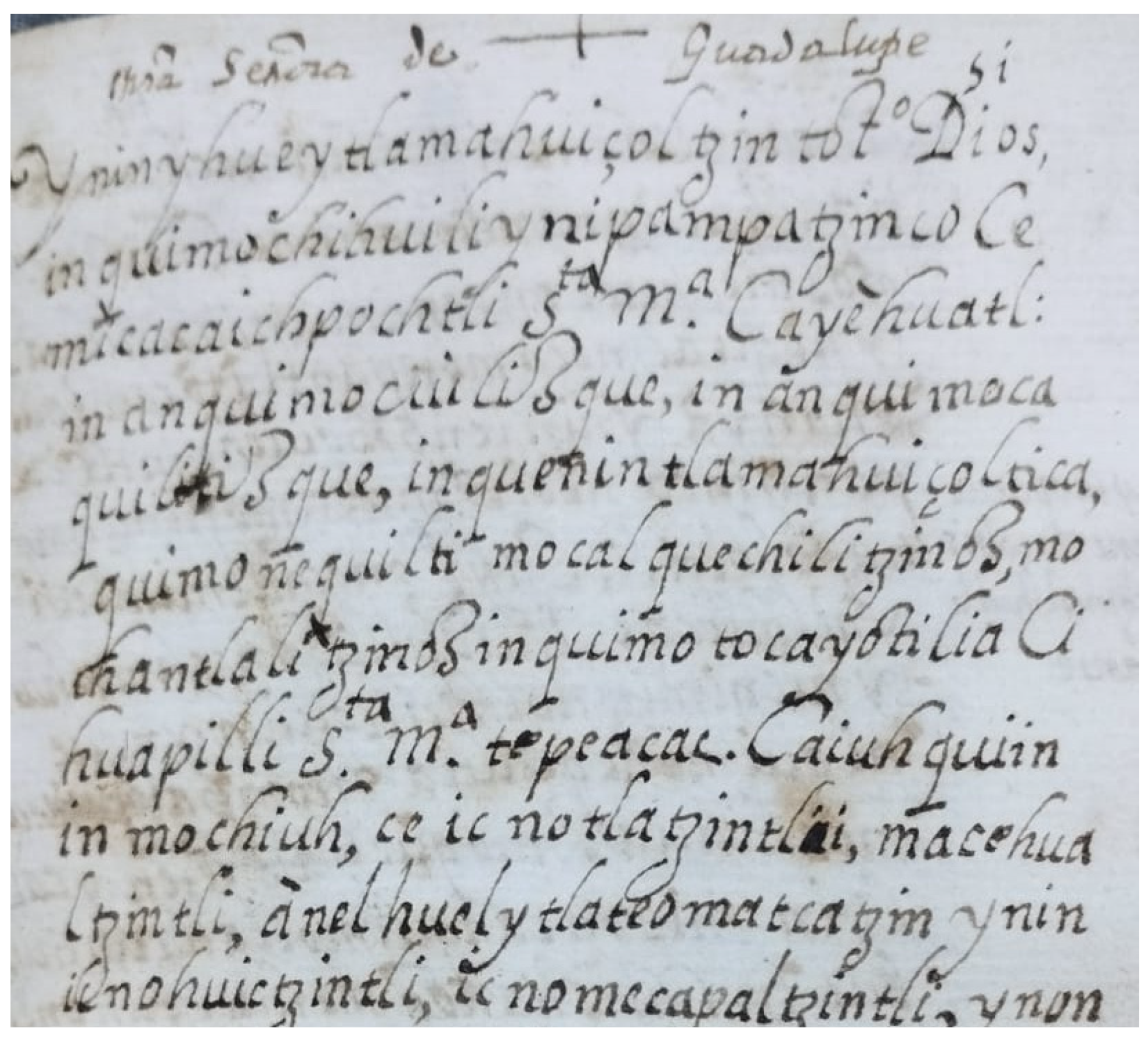
Nican Motecpana (the miracles following the apparitions to Juan Diego) can be considered a continuation of Poole’s argument about the standard genre of miraculous apparitions in the
Nican Mopohua.
2 Rosas Xelhuantzi argues that this Guadalupan narrative in New Spain emerged through a layered process of symbolic and textual transfer that joined medieval European Marian hagiography with Nahua sacred geography (
Rosas Xelhuantzi 2025, p. 84). The Miguel Sánchez Lasso de la Vega Guadalupe
cocoliztli, or epidemic narrative, closely parallels the story of the Roman plague under Gregory the Great, as recounted in Jacobus de Voragine’s Legenda Aurea (1475 ed.) (
Vorágine 1475) and later expanded by Alonso de Villegas in
Flos Sanctorum (1588) (
Villegas 1794).
Thus, in Voragine/Villegas (European tradition): (1) Rome experienced a plague, (2) Romans processed with the Virgin Mary, (3) the Virgin Mary was taken to Seville and hidden in Guadalupe (Extremadura), and (4) the plague ceased. In parallel with American events, Mexico is struck by cocoliztli, or an epidemic; the natives undertake a pilgrimage to Our Lady of Guadalupe, and the deadly disease ceases. Especially noteworthy is his analysis of the Nahua religious landscape.
Additionally, can it be argued that intellectuals from Spanish America were not passive recipients of European knowledge but active producers of historical and epistemological authority? Jorge Cañizares-Esguerra’s
How to Write the History of the New World argues for a developing “patriotic epistemology” as a sophisticated methodology for reading historical sources (such as Mesoamerican codices and colonial chronicles) to prove the dignity and antiquity of their past (
Cañizares-Esguerra 2001, p. 224). Creoles constructed the Guadalupan tradition as a providential sign of divine election for New Spain. By embedding the apparition narrative in sacred history, they reframed Mexico not as a peripheral appendix but as a chosen land with apostolic and eschatological significance.
Cañizares-Esguerra argues that this was not naïve credulity but a sophisticated baroque historiographical strategy: Creole writers deployed biblical exegesis, antiquarian scholarship, and historical method to defend the antiquity and legitimacy of the Guadalupan cult against European skepticism, thereby using Guadalupe as a cornerstone in the making of American Creole identity and epistemic authority in the Atlantic world (
Cañizares-Esguerra 2001, p. 223). What further influences are behind the Nahuatl Guadalupe stories? Are modern authors reworking the epistemic dynamics of similar Creole intellectuals? What is development among such Nahua accounts? One last contextual piece will conclude with the laying of the field.
In Edward Osowski’s
Indigenous Miracles. Nahua Authority in Colonial Mexico, the author describes the juridical and social systems within which Indigenous people lived and how they immersed themselves in Catholicism, particularly in the phenomenon of miracles, as a means of validation and recognition through which they exercised a degree of independence (
Osowski 2010, p. 197). After the conquest, certain sites came to be regarded as sacred because God and the saints appeared to specific Indigenous leaders, caciques, who thus obtained approval from both the Crown and their own communities.
Osowski explains how Indigenous people even appropriated the religion itself. An example is
Sacromonte (Amecameca), a cave where Martín de Valencia performed penance and which, after his death, became a site of Franciscan veneration—only later to be appropriated when Indigenous people placed an image of the dead Christ there, and it was renamed as the site of the Holy Sepulcher. That cave, which had pre-Columbian and Franciscan significance, was subsequently re-signified in Indigenous popular piety. The memory of the ancient religion was reconfigured within memory in a continuous environment of sacrality (
Osowski 2010, p. 20). The author thus describes how certain Indigenous families acquired privileges in this way:
Nahua leaders also stood to gain personally from participating in Christian foundation rituals. When don Felipe Páez de Mendoza contributed to transforming Valencia’s cave into the Santo Entierro of the Sacromonte, it was the first act among several that aligned his family with the avenues of power of the Spanish colonial order. In the 1590s the Páez de Mendoza family ventured to gain official recognition of their local authority from the colonial government. In 1591 don Felipe petitioned successfully to Viceroy don Luis de Velasco for a license to arm himself with a sword, ride a horse, and dress in a Spanish style.
Both the triumph that established the “true religion” and the memory of their ancient beliefs became intertwined in viceregal miracles. This self-acceptance of being Christian functioned as a mechanism of social mobility, since Indigenous individuals who were favored with the discovery of holy images were also generally remembered as the founders of their towns. How does this intertwine with the Guadalupe account? Did Juan Diego use religion as a power dynamic? Is this story like many other miracle stories of the epoch? Osowski confirms that Our Lady of Guadalupe is atypical compared to the miracles analyzed here [
Indigenous Miracles]. In the miracle tales told here, indigenous rulers, not humble Indians like Juan Diego, were the first to receive miraculous images. They then established them in chapels on topographical features that were historical markers of the territories of their communities. In contrast to the miracle stories recounted in this book, Guadalupe does not involve Juan Diego’s community or his work creating a shrine within it (
Osowski 2010, p. 14).
This atypicality, furthered by philological studies, has led authors to argue that Our Lady of Guadalupe is strictly Creole and European, and even if the stories have vital Nahua elements
in the translation, that is, the original that was in Spanish (perhaps by Miguel Sánchez) and then was reworked in Nahuatl, those elements seem to have been incorporated from a non-native writer (Luis Lasso de la Vega). Lisa Sousa, Stafford Poole, and James Lockhart argue that Lasso de la Vega authored the
Nican Mopohua in Nahuatl (
Sousa et al. 1998, p. 4). The present work offers a partial answer to this thesis; much more work remains to be done, yet there are several points to consider.
Lockhart, in The Nahuas After the Conquest, says the following:
The tale itself is so smooth that it gives the impression of having been through the polishing process of frequent telling by various narrators. The entire Lasso de la Vega publication is in excellent Nahuatl. Lasso de la Vega specifically says that he wrote it, but since Spanish ecclesiastics had long been wont to ignore the fact that their indigenous aides actually put the texts they published into Nahuatl, there is nothing to prevent us from assuming the existence of a Nahua ghostwriter who could have had much latitude, writing as he pleased, or alternatively could have been narrowly restricted to translating Lasso de la Vega’s Spanish or correcting his Nahuatl drafts. On the other hand, we cannot be absolutely sure any such figure was involved. To me, the introduction and appendix have the flavor of translations from Spanish, while the story proper does not. (Deep textual investigation might throw more light on this question.) The story is in a Nahuatl that could have been written at any time from 1550 or 1560 forward, with overwhelmingly indigenous and traditional vocabulary and idiom, no obvious calques, and a few Spanish loan nouns; in other words, the text bears the earmarks of what I call Stage 2.
The Story of Guadalupe begins by stating that the research presented in their study supersedes it. This is especially the case as
Poole’s (
2017) historical book
Our Lady of Guadalupe sets out to prove the contemporary 16th-century evidence for the apparition of the Virgin Mary to Juan Diego and to argue that the story was a mid-17th-century “pious invention.” The authors infer that Lasso de la Vega based his work on Sáchez’s, as no other story of Our Lady of Guadalupe was known at the time, yet they cannot conclusively establish his literary dependence (
Sousa et al. 1998, p. 8). Lasso de la Vega’s authorship is very contentious, not only because this is his only known writing in Nahuatl but because, as the authors themselves admit, there are nuances among the main Guadalupe stories:
The overall tendency, as in most ecclesiastical writing, is to use loanwords relatively sparingly, with at the same time no hesitation to resort to them when necessary. Even so, the reader may get the impression that loanwords are handled differently in different sections (with possible implications of different authorship). The Nican Mopohua, especially the story proper, seems to have very few loans indeed, and those of a very basic nature, common in Nahuatl speech at any time from about 1550 forward. In the Nican Motecpana, on the other hand, loanwords seem more numerous and central to the presentation, and some of them look to be of a type which one would hardly expect before perhaps the last quarter of the sixteenth century (such as estribo, “stirrup,” or freno, “reins”).
Miguel León-Portilla addresses these authors, alluding to how they allegedly support his thesis:
Certainly the linguistic and philological examinations carried out by Primo Feliciano Velázquez and the editors of the English version confirm that the account of the Nican Mopohua is in a very carefully composed Nahuatl that may well represent the form in which it was written by its best practitioners toward the middle of the sixteenth century.
Additionally, the authors admit that they rely first on the 1926 edition of Primo Feliciano Velázquez
3 and then on Lasso de la Vega’s own edition held at the John Carter Brown Library (
Sousa et al. 1998, p. 4), but they did not consult the manuscript text in the Lenox Collection of the New York Public Library, where it can be observed that both the
Nican Mopohua and the
Nican Motecpana contain editorial differences that they overlook in the section titled “Diacritics, orthography, and spacing.” Additionally, not using the manuscript as the base text, but only the published version, led the authors to overlook the fact that the New York manuscript shows that Lasso de la Vega’s edition, for example, contains two folios placed out of order from their original order (
Chávez Sánchez and Arredondo Sevilla 2018).
Further work remains on the complexity of dating the Guadalupan stories, a task that would overshadow the present work. Sousa, Poole, and Lockhart raise many other valid points that warrant further examination and respect. These preliminary questions have presented various ways to understand the Guadalupe Nahua accounts. This present work will address, complement and analyze overlooked aspects of how the stories of Our Lady of Guadalupe came to be studied within the Nahua worldview through philology and by modern authors in their respective fields.
3. A Philological Quest
The image is a Mexican hieroglyph of those called compounds, and contains the symbol of faith; but when the hieroglyphics were united to the phrases of the language, with such sublimity and delicacy, it seemed that it did not fit in the rudeness of the Indians, neophytes in the time of Saint Thomas [Apostle], as [well as those] recently in the conquest, to encrypt the articles of faith in this way. Servando Teresa de Mier.
Ángel María Garibay was a scholar of Nahuatl literature and a pioneer of Nahua (culture) studies. The erudite scholar carved mind maps and studied extant sources to revive Indigenous philology.
The Franciscan Colloquies and Book XII of the
Florentine Codex are examples Garibay offers of surviving Indigenous works, including the NM, which he calls the “Account of the Guadalupan Apparitions” (
Garibay Kintana 1954, p. 256). Book XII is now the least questionable source out of the three, yet the Guadalupe examination marks a new line of research in this scholarship, which had previously focused only on historical and Western theological matters. Garibay admits that before him, Primo Feliciano Velázquez was the only other scholar who had systematically engaged with Guadalupe scholarship through the language, but only to translate the source in a literary rather than a literal sense (
Garibay Kintana 1954, p. 256).
Garibay situates the NM among the general Nahuatl corpus and compares it with other literary sources in terms of genre, styles, themes, and methods. Regarding the beginning of the NM, “ten years now since Mexico City was conquered…”, for example, he states that it is “[an] introduction that is elaborated by no other than the old stories learned from memory or the knowers of these who seek to imitate them” (
Garibay Kintana 1954, p. 260). He would go on to assert that whoever composed the NM had tremendous knowledge of the old ways to the point of conjecturing it was formed by a cohort of erudite Indigenous people. In other words, the Christian NM had a substantial influx of Indigenous mentality.
Garibay analyzes Juan Diego’s monologue upon climbing atop Tepeyac, “Am I worthy of that which I am listening?” To the philologist, this is proof that the NM, though a historical reality, is infused with poetry, as no
macehual or commoner speaks as Juan Diego does (
Garibay Kintana 1954, p. 260). How the neophyte talked is more closely related to the poems of the Nahua people before the conquest; “in its general contexture it [the NM] does not differ from the style used in the
Cantares or the
Huehuetlatolli” (
Garibay Kintana 1954, p. 261).
The
Huehuetlatolli can otherwise be known as
Tenonotzaliztli (scolding or advice), as Nahua scholar Mario Sánchez Aguilera argues (
Sánchez Aguilera 2022, p. 200). These sorts of dialogues have a moralizing character. They can be set apart from regular or everyday speech as they contain, according to Mesoamericanist Mercedes Montes de Oca Vega, (1) the presence of couplets and (2) the use of parallelisms as a constitutive, constructive, and organizational element, and (3) were enunciated by an authorized spokesperson of an organization like the family, government,
calmecac, etc. (
Montes de Oca Vega 2013, p. 333).
An additional NM quotation, “Am I not here who am your mother?”, is infused with the Nahua cosmovision, Garibay notes (
Garibay Kintana 1954, p. 261). In the dialogue between Our Lady of Guadalupe and Juan Diego, as he tries to avoid her, Garibay notes that this discourse resonates with the advice, scoldings, and tender yet strict parental guidance given to Nahua children. Echoes of Book VI of the
Florentine Codex are indeed heard in that last Tepeyac encounter where Our Lady of Guadalupe, as an attentive parent,
watches,
judges, and
acts within the culture and spiritual standing of the neophyte (
Garibay Kintana 1954, p. 261).
In this same vein, it is paramount to listen to the beginning of their final dialogue. Juan Diego is about to lose his sick uncle, Juan Bernardino. The elder represents the truth that resonates in the community as he carries in his memory and life living tradition; the elder—the well-rooted person—possesses the truth and shares it as sap rises from the root,
nelhuayotl. Truth is rooted in this sensible subsoil (
Johansson 2002, p. 20). Upon the thought of losing his past, his very identity, Juan Diego echoes the thoughts of existential anguish, feelings of orphanhood, and anxious speculations about the afterlife expressed in the
Cantares Mexicanos. This is what the commoner says to Our Lady of Guadalupe, as translated into English by Sousa, Poole and Lockhart:
A great illness has come upon him [Juan Bernardino], of which he will soon die. And first I am hurrying to your home of Mexico [church] to summon one of those beloved of our Lord, our friars, to go hear his confession and prepare him, for what we were born for is to come to await our duty of death (italics mine).
Miguel León-Portilla, a recognized Nahua scholar who upholds his professor’s hermeneutical tradition, extends Garibay’s study by presenting several sources that resonate with Juan Diego’s words. Death as a duty or even as a tribute is present in Book VI of the
Florentine Codex, when a prayer to Tezcatlipoca is extended regarding the
cocoliztli epidemic, “Where indeed is there to go, in vain? For our tribute is death; [it is] awarded us in common as merited. And on earth there prevaileth the coming to pay the tribute of death” (
León-Portilla 2013, p. 54).
4 The sentiment of waiting for the trouble of death is also present in
Cantares Mexicanos, folios 19v, 21v, 26r, 53r, and 66r (
Siller Acuña 1990, p. 82;
León-Portilla 2013, p. 54).
“The present world does not offer truth; it is only in the other world where there is true life. We are sleeping, and uncertainty fills this ever-changing world, this ever-moving reality” (
León-Portilla 2013, p. 44).
5 The couplet
flower and song, poetry, expresses this feeling as Juan Diego, at the beginning of the NM, going up the Tepeyac hill, listens to songs and chants and asks himself whether he is worthy, evoking a key Nahua concept that is palpable in the Christian faith:
Human beings were restored to the world by virtue of a divine and bloody sacrifice. If for the Christian that sacrifice was that of Jesus on the Cross, for the Nahuatl man it was the immolation of the gods and in particular of Quetzalcoatl who, in Tamoanchan, with his blood restored life to the bones of the humans who had existed in another cosmic age, so that life would sprout again in the world.
The sacrifice of the gods that gave life to humanity is a response to the human’s restless heart, which seeks communion with the divine. The Nahua world shows genuine movements of spiritual longing in which (Christian) truth is not yet fully present, and, on the one hand, the existing world does not fully satisfy them. On the other hand, the ritual killings the Nahuas engaged in are part of this
gift, correspondence with the divine, as Marcel Mauss would argue (
Mauss 2000, pp. 14–17).
In other words, the songs Juan Diego heard as he ascended Tepeyac made him question whether the spiritual longing, expressed in his culture through offerings to gods and humans, was being fulfilled. The final response is given in the flowers Our Lady of Guadalupe offers. The NM begins with songs up the Tepeyac and ends in flowers down the hill, as anything true and beautiful, like a flower, has a past, ancestry, and therefore a good root. Needless to say, in Nahuatl, both the word for
truth and
root share a common
racine (
León Portilla 2017, p. 101).
This couplet, flower and song, poetry, is the only true thing in this world since it is what can offer a corolla glimpse of the other world. Nahuatl poetry does not shy away from existential woe or impotence for not being able to possess or be in truth in this present world. Juan Diego, facing the reality of the death of those he held dearest—his elder, his culture—is told by Our Lady of Guadalupe not to be afraid, as these will not die. His culture, his uncle, and his beliefs will be healed in her, as the Nahua people and those who trust her are protected by her mantle.
4. From Philology to Religious Anthropology
A new wave of scholars has taken up the growing body of scholarship on Nahuatl literature to better understand the NM. It is especially advantageous to examine those who understand Classical Nahuatl, such as
Rojas Sánchez (
2011) and
Guerrero Rosado (
2018). Beginning with the former, his contributions include setting the standard for the verses mainly used by Guadalupe centers in Mexico. Mario Rojas published a new translation of the NM in 1978; the translation by Primo Feliciano Velázquez (1926) was not academically popular because it covered Luis Lasso de la Vega’s introductory text, and therefore, the verse count did not begin with the NM.
Rojas offers further insights into how the Nahua worldview infuses the Guadalupan Event. The temporal references, for example, especially to the darkness, the twilight, and before dawn breaks, are found in verses 68, 97, 99, 148, and 168 of the NM; Rojas asserts that
in oc yohuayan (when it was still night) “for the pre-Hispanics means the beginning of things” (
Rojas Sánchez 2011, p. 36). This idea of a new life is present in other Nahua writings (
Garibay Kintana 1940, p. 125).
Additional couplets and phrases Our Lady of Guadalupe assumes from the Nahua culture are
nimitzcuiltonoz,
nimitztlamachtiz (NM, v. 35),
I will enrich you; I will glorify you, which are metaphors, Sahagún explains in Book VI (
Sullivan 1963, p. 158, proverb 57).
6 The bliss she promises Juan Diego, thanking him for being her messenger, is not ordinary, as Rojas notes, since it originates in the divine (
Rojas Sánchez 2011, p. 38).
The couplet, in this same vein, echoes the Nahua description of those who have died in flowery wars and now dwell in the heavens, in the house of the sun; they have their reward, as “forever, perpetually, time without end, they
rejoice, they live
in abundance, where they suck the different flowers, the fragrant, the savory.”
7 The same verbs,
motlamachtia and
mocuiltonoa, are used to describe the Aztec afterlife realm and the celestial promise of Our Lady to Juan Diego. In other words, the text seems to suggest she promises a heaven shared by both the Nahuas and Christians.
In this theological vein, Juan Diego’s journey opens with chants and songs; right after the darkness of a new beginning, this new earth blooms. As Juan Diego confounds the ancient-promised heavens, those that Our Lady of Guadalupe, in the couplet nimitzcuiltonoz, nimitztlamachtiz, seems to invoke and assume, a new heaven and new earth are formed under their feet as those heavens, could very well be like the flower of the Tepeyac, whose root, the base, is where Our Lady asks Juan Diego to build for her Son a sacred little temple, echoing the temple built by the Mexica as they founded their civilization.
In this same verse, theologian Siller Acuña tells us that the song, which was without flowers, shows that “the truth of the Tepeyac is incomplete, it is just being done […] it [truth] will be carried out if man collaborates with the divine” (
Siller Acuña 1990, p. 62). A perfect inculturation is underway as Juan Diego begins to fully acknowledge his native tradition as not opposed to the Christian one, as most missionaries had preached. There was truth in his native beliefs, and they were not “decontaminated” but instead fulfilled.
A new line of research began to emerge in the second half of the twentieth century, as several Nahuatl songs were analyzed as adaptations to Christianity, or Indigenous poem verses were exegetically compared with the NM to argue for inculturation and religious typologies. A Western example of this was the ancient Babylonian deluge, later assumed in the story of Noah’s ark. It was the era of religious structuralism, sociology, and philology. In particular, Mario Rojas, whose Nahuatl experience was complemented by modern Nahuatl, pioneered the methodology for the Christian reading of Nahua sources, later re-reading the NM and considering what was already present in Nahua culture. This practice, however, is at best ambiguous.
He strongly emphasized, for example, verse 215 of the NM, which consists of a single word:
Huallateomatia. It can be parsed out as
hualla-
teo-
matia,
they came to know it [the imprinted cloak]
as something divine. This verse refers to the natives’ reception of the imprinted image after Juan Diego showed the flowers-sign to the bishop. Rojas assumes here a predominant Indigenous devotion and thus says that since the imprinted cloak was divinely composed, “with extremely demanding criteria, our Indigenous ancestors had to judge if this painting was a thing of God” (
Rojas Sánchez 2011, p. 41).
If God is likened to a painter, Rojas suggests, certain verses in Nahuatl poetry can shed further light on the engraved meanings. Loose examples of this point can be made throughout Nahuatl poetry; in the
Cantares Mexicanos, the “Cinteotl Monologue”, for example, says that the divine “created you, as a flower begets you, painted you as a song” (
Garibay Kintana 1993, p. 3, Cantares, f. 26v–27v.). Another example can be found four folios later: “I am the painter of flowers, I, who gives life.”(
Garibay Kintana 1993, p. 17, Cantares, f. 30v.)
In the Ballads of the Lords of the New Spain (1582), a poem anthology or cancionero that shares content with the Cantares, poem I, for example, “resembles” Juan Diego’s journey:
From Green Places he descends. It’s Life Giver. He provides himself/with song petals, he adorns himself with flowers here beside the/drum. They’re whirled, they come from you, these drunken flowers./Be entertained!/“Friends, I’ve come to string them as jewels, spread them out as/trogons, make them stir as spirit swans, twirl them as gold, these/comrades. As plume-captives I’ll snare them. I’ll song-whirl these/companions, in this palace I’ll bring them forth. Ah, all of us, then in/a moment all of us will have departed for the dead land. For we only/come to borrow them./“I come, I appear! Friends, I come created as a song, come fashioned as/a song. God sends me here…
Several elements follow the NM scheme: the divine descending, being surrounded by flowers and songs, going to the palace for a mission, and having a life–death introspection. Additionally, the divine sends the poet–singer forth. Another poem of this sort —the first poem of the
Cantares—must be mentioned here due to its proximity to the NM. José Luis Guerrero Rosado initially posed this relation (
Guerrero Rosado 1993, pp. 100–2). Most recent scholarship has also drawn from the
Cantares a similar Juan Diego journey scheme, especially from the “
cuicapeuhcayotl” song (
Gonzalez and González 2023, p. 4).
I wonder where I can get some good sweet flowers. […] Let me wander through this needle grove where the trogons are, let me wander through this flower grove of roseate swans. That’s where they’re bending with sunstruck dew. That’s where they blossom in beauty. Perhaps I’ll find them there. If they showed them to me, I’d gather a cloakful […] Ah, here’s where they live! I hear their flower songs. It’s as though mountains were echoing them. Ah, the plume water, the cotinga spring, is flowing in their midst. And there the mockingbird is throbbing with song, reverberating with song. The bellbird echoes these precious ones, these sundry songbirds: they’re rattle-shrilling: they’re eulogizing World Owner (Tlalticpaque) there.
The poem continues by describing the singer, who persevered on his journey and was shown the flower paradise by the chanting birds; his bliss was great. As he wished to share this place with his friends and was praising the divine, he realized—or so it seemed—that he was back on earth. How could one be worthy of such happiness? How can anyone obtain these precious flowers? God of Far and Near (Tloque Nahuaque) is the one who makes one worthy on earth. The singer–poet weeps on earth as he desires and longs for the afterlife, which he so graciously foretasted.
A Christian re-reading would assert that Our Lady of Guadalupe, upon offering and arranging for Juan Diego some flowers, fulfills that sacred Nahua desire. Yet, as a two-edged sword, Miguel León-Portilla argues that the NM was inspired by the
cuicatl, or chant, genre (
León-Portilla 2013, p. 34). León-Portilla, especially in his analysis of the recently presented chant, adds it as an appendix to his work
Tonantzin, arguing that it begets the NM (
León-Portilla 2013, p. 149). The most contemporary work on this subject belongs to the former interpretation, as found in the work of
Gonzalez and González (
2023) and
Cristino (
2021), who wrote his eclesiastical licentiate thesis comparing some verses of the NM and the
Cantares Mexicanos.
The influence of the
Cantares and the
Romances (Ballads) on the composition of the NM has not always been understood in the same way, especially when different epistemic frameworks are applied. John Bierhorst, for example, offers a detailed reference of where the composer of the NM obtained the Juan Diego-Guadalupe dialogues, as well as many of the couplets, themes, and general imagery.
9 This poetic genealogy is mainly taken from the
Cantares and the
Ballads.
A final approach in this NM ambit is José Luis Guerrero’s
Nican Mopohua. Un Intento de Exégesis, which analyzed and juxtaposed, verse by verse, all the available translations of the NM until then. These included the translations of: Garibay, Boturini (commissioned), Archbishop Lorenza (commissioned), Primo Feliciano, Janet Barber, and Richard Nebel, among others. Guerrero offers holistic research that is both anthropological and linguistic (
Guerrero Rosado 1996).
Following this vein of studies, we will present an innovative sample that sheds light on how the Nahua mentality understands corporality in the NM. This subsection will proceed with a section that deals with the contributions of several authors in this emerging field. This work will then be finalized with the development of the Guadalupan narratives (Teponazcuicatl, Inin Hueitlamahuilzoltzin, and Relación Mercuriana) in the Nahuatl language; this last endeavor is carried out to introduce different narratives that should be considered for future studies to see the depth of the “nahuatization of Christianity” throughout the different Indigenous Guadalupan narratives.
5. Prostrating and Kneeling: Religious Mentality in the Nican Mopohua
Much has been written about NM’s dating and its historicity. Still, far less has been said about how its linguistic and semantic features provide more precise guidance for understanding the religious description intended for its audience. The NM provides details regarding the postures Juan Diego assumed before Our Lady of Guadalupe and Bishop Zumárraga.
Nahua researcher Justyna Olko, in her article “Body Language in the Preconquest and Colonial Nahua World” (
Olko 2014), examines specific gestures and bodily expressions characteristic of the Mexica people and Mesoamerica in general. Body language evolves, and many expressions are derived from Christian culture, such as kneeling and praying in the European style. Others have been maintained over the years; among the somatic manifestations of the Nahua world, we find, for example, kissing the earth with the hand (or eating a bit of dirt) and crossing the hands behind one’s back (like embracing oneself).
The former is performed in reverence to the divinity when one makes a promise, while the latter serves as a sign of humility before the divine. This section thus seeks to deepen our understanding of how the author of the NM portrayed each religious belief through Juan Diego’s corporal language. What does his body language convey, and how can it help us understand his beliefs?
Juan Diego kneels before the prelate whenever he sees him; the main verb that describes this is
motlancuaquetz (NM, v. 43, 72), which is in the preterite. Olko informs us that in the Nahua world, kneeling images are rare, even during the early contact period, and it is not until the seventeenth century that they became more prevalent; “Nonetheless, the main verb referring to this act,
tlanquaquetza (refl.), is very common in the second half of the sixteenth century [… it] apparently lacked ritual meaning before Spanish contact but probably designated a physical act that could easily be identified with a European kneeling posture” (
Olko 2014, p. 160).
Motlancuaquetzque[h] is the same verb used by the prelate and his entourage when the neophyte releases his
tilma, on which the image of the Virgin of Guadalupe is printed (NM, v. 185). We can say that this verb carries a Christian connotation or was regarded in this way and written as such.
This kneeling is conceived as prayer or spiritual acceptance, and before the clergy, submission. Juan Diego carried out this action, using it before the ecclesiastical authority. This verb would also be used in Nahuatl to describe the respect shown towards the first twelve Franciscans who arrived in Mexico in 1524. Cortés, as related by Bernal Díaz del Castillo, “ordered the Spaniards with all humility, to fall on their knees and kiss their hands and garments, (so that the Indians might observe it and follow their example)” (
Díaz del Castillo 2008, p. 355). Sahagún, for example, in his collection of sermons, uses this verb to designate this Christian reverence (
Sahagún 2022, p. 272).
The main verb used to describe Juan Diego’s bodily expression when he sees the Virgin of Guadalupe is
mopechtecac (also in the preterite), which means to prostrate oneself, humble oneself, or bow. The somatic term is used numerous times before the Virgin Mary (NM, v. 22, 38, 49, 109); in none of these occasions is
motlancuaquetz present. The Nahua religious gesture associated with this verb predates the Spanish conquest, as Olko notes that
bowing, like kneeling, is a Christian custom. Nevertheless, this verb in its “terminology [
pechteca] and the gesture itself, predated the Spanish conquest, being part of traditional Nahua behavior and rhetoric as an important element of pre-Hispanic body language” (
Olko 2014, p. 165). It is thus essential to note how Juan Diego sees the Virgin of Guadalupe as a model proper to his culture, as described in the verb “to prostrate” in Nahua usage, even if he understands that she was the “Mother of Our Savior” (NM, v. 75).
There are other notes to consider. In the last encounter between Juan Diego and the bishop, a shift in mentality can be observed, as Juan Diego (NM, v. 162) prostrates himself before the bishop exclusively in the Nahua mentality, mopechtecac. In the first encounter between Juan Diego and the bishop, the couplet motlancuaquetz, mopechtecac was used (NM, v. 43). Is the neophyte recognizing something of his culture in this new religion as he prostrates himself before the head of the Church? The bishop and his people, as previously stated, in turn, kneel (v. 185) motlancuaquetzque[h], as a Christian would, before the Indigenous Virgin Mary; are they accepting the truth found outside the Western world? Theologian Timothy Matovina presents a similar insight into the dignity of the neophyte:
At the outset of the account Juan Diego kneels before the bishop; in the end the stooped
indio stands erect while the bishop and his household kneel before him and venerate the image on his tilma. Throughout the account Juan Diego must journey to the center of the city from Tepeyac some three miles to the north; at the end of the narration the bishop and his entourage accompany Juan Diego to the periphery of Tepeyac, where they will build the temple that Guadalupe requested. Symbolically—and physically—the presence of the ecclesial leadership and the church they are constructing are thus moved from the center of their capital city out to the margins among the indigenous people. From this perspective, Guadalupe reveals a new vision, one in which the lowly are entrusted with a mission and the powerful are instructed to accompany them. Guadalupe, in other words, manifests God’s preferential love for the poor and the transformation of church and society that such a love of preference demands (
Matovina 2019, pp. 167–68).
We can also attest that the only time Juan Diego casts himself toward the ground,
motlalchitlaz (NM, v.49), the term used to describe this action,
tlalchitlaza, “must have been in use in the sixteenth-century” (
Olko 2014, p. 164), and it was expressed before Our Lady of Guadalupe. How is Juan Diego described, and how does his worldview inform other gestures? In the Nahua world, rulers were those who wept, felt sadness, put themselves in the hands of the divine, and
prostrated themselves.
10 Olko reiterates, however, that this act was not unique to people of special status, but also to people with “education” and “exemplary behavior,” citing Book X, Chapter XIII of the
Florentine Codex. Coming from Cuautitlan, of Tepanec-Chichimeca roots, Juan Diego may have been trained in a Toltec tradition, a people of wisdom in Mesoamerica who were no strangers to the noble language (
Navarrete Linares 2019, p. 269).
Finally, we see that Juan Diego
motololtiticac, (preterite) had a downcast head (NM, v. 152), and the verb
toloa, as Olko relates it, based on the sixth book of the
Florentine Codex (
Sahagún et al. 2023, Bk. VI: fol. 7r), has been used for pious and humble Nahua priests who recognize that they are nothing without the divine, who gives them comfort and happiness (
Olko 2014, p. 166). In this case, Juan Diego awaits a meeting with the bishop, holding his cloak filled with flowers. The body language used by the Nahuas in various respects differed in meaning, though not always in signifiers, since many prostrations, gestures, and body positions were similar.
It is noteworthy to acknowledge how Juan Diego generally expresses himself in posture according to the worldview he addresses, presenting a consciousness of incorporating values that integrate Christian beliefs while reiterating traditional ones before the manifestation of Tonantzin Guadalupe, without necessarily being syncretic, but respecting the proper ways and customs of his Nahua culture. Is there evidence of this expression of faith being carried out into contemporary belief?
Jennifer Scheper-Hughes’ “Cradling the Sacred: Image, Ritual, and Affect in Mexican and Mesoamerican Material Religion” (
Scheper-Hughes 2016) argues that
cradling is a ritual gesture of an affective-material relationship that could extend from contemporary Mexican Catholic practices (e.g., cradling Niño Dios and San Judas Tadeo images) back into pre-Hispanic Mesoamerican traditions. Her scholarship can be related to this study of postures in two respects.
First, Scheper-Hughes’ work shows how sacred objects in modern-day Mexico are not considered
things but
beings (
Scheper-Hughes 2016, p. 55); the numen or sacred power indwelling the Nahua Image of Our Lady of Guadalupe elicits a reaction within Juan Diego’s culture, one that could be inculturated even to this day. Secondly, Scheper-Hughes’ research shows how ritual gestures in today’s faith expressions could be rooted in past cultures. Is it possible that the same signifier (kneeling) could have two meanings whose semantic values do not contradict but over the centuries complement each other?
Further study is required for other Nahua actions whose cultural valency can be translated into contemporary religious practices. Research is needed, for example, on the shared activities of Juan Diego and the Theteomamaqueh priests. Scheper-Hughes asserts the following:
There were practices that can be understood as ritual analogs. Both the Nahua and Hausteca of central Mexico engaged in devotional practices in which they cared for sacred effigies, especially swaddled bundles, as dependent infants. Theteomamaque (from the Nahuatl theo ‘God’ and mama ‘to carry or assume a burden’) were priests identified as god-bearers on sacred pilgrimage. Indeed the carrying of sacred bundles as back burdens was one of the definitive ceremonial acts for the priesthood among the Nahua and other cultural groups of central Mexico. In some instances, this practice formed part of a ritual reenactment and memorialization of historically significant migrations (italics mine).
Tlaquimilolli is the Nahuatl term for the sacred bundles generally carried by a Nahua priest when, usually in ritual processions, he embodies the divine. The priest is a
teixiptla or vicarious (divine) image who also is“ carrying the god in the sacred bundle” (
Bassett 2015, p. 131). Juan Diego becomes a
teomama (divine -carrier) and
teixiptla, as he is sent by the divine in a sacred
pilgrimage, like the one the Mexica undertook while founding their empire. Many parallels can be drawn as Juan Diego carries the foundational image of Christianity in America, ideas that contemporary authors would reformulate using different sciences and methods.
6. Guadalupe as Told by the Authors
It is paramount to note that many of the innovations of Guadalupan authors are heuristic and, in many cases, seem to draw on Nahua culture to support preconceived theses. In other instances, a genuine interest in the cosmovision has led many authors to examine how native peoples might have understood the stories of Our Lady of Guadalupe, given the social and political problems they faced. This section will continue to recount how the NM has been contrasted with Nahua cosmovision in recent scholarship.
José Luis Guerrero, a canon lawyer and Nahua scholar, wrote in a particular context. In the Guadalupan scholarship, Juan Diego’s canonization process began to encompass Nahua studies beyond philology, a trend established by historian Ramón Sánchez Flores in
Juan Diego. Personalidad Histórica (
Sánchez Flores 1981). He laid the groundwork for a different Nahua approach: a historical and anthropological approach. Sánchez Flores studied the Indigenous mentality of Juan Diego, an effort that José Luis Guerrero would take up in his work
Los Dos Mundos de un Indio Santo during the canonization process (
Guerrero Rosado 1991). For more on the Canonization Process, see my work (
Arredondo Sevilla 2024).
Guerrero was chosen to collaborate in the beatification of Juan Diego for his work
Flor y Canto del Nacimiento de México (
Guerrero Rosado 1980). In both texts, he studied Mexica cosmology, philosophy, and broader religious beliefs to argue for the inculturation of Our Lady of Guadalupe while situating the drama of the conquest in a historical context. He built upon Garibay and Portilla’s endeavors while also undertaking a theological analysis of authors like
Sánchez (
1648) and
Ita y Parra (
1737). Guerrero, therefore, studied the NM using Nahua sources alongside Biblical verses.
Guerrero expounded on his reflections in “La Madre del Señor en la cultura,” as presented at the Second Mexican Mariological Symposium (1993). There, he would carry out this Nahua–Scripture duo method more systematically. In that conference, for example, he alluded to Jn 17:11, “that all may be one”, to refer to how Our Lady of Guadalupe sought this same Christian desire, “
Ixquichtin […]
ancepantlaca”, all of you people as one (NM, v. 30) (
Guerrero Rosado 1993, p. 120). In his magnum opus,
Nican Mopohua: Un intento de exégesis (
Guerrero Rosado 1996), he assumes the Nahua worldview, as sustained by historical sources, to provide the most authentic reflection of what could have been an indigenous perspective on the Guadalupan Event.
Guerrero uses the Nahua cosmovision to understand why Our Lady of Guadalupe instructs Juan Diego only to open his flower-filled cloak before the bishop. The prelate became the owner of the Image,
amoxhua, meaning “owner of the codex” to the Mexican people. Book X of the
Florentine Codex can clarify who owned the codices (
Sahagún et al. 2023, Bk. X: fol. 140v). Father Guerrero would complement this NM passage with biblical scripture, alluding to how the Virgin Mary operates in the same way, albeit in different terms, as when she told the servants at the wedding at Cana to do as Jesus
tells you; she is now instructing Juan Diego to do what the bishop tells him. To complete the ecclesial weight of this instruction, Juan Diego, the active layperson, is her “
teomana, bearer of the divine in the New Kingdom” (
Guerrero Rosado 1996, p. 414).
Additionally, Guerrero links the NM to the Nahua recipients’ view of the rainbow’s light radiance in the fog or mist (
Guerrero Rosado 1996, p. 156). He states that a known couplet in the Nahua world,
mixtitlan ayauhtitlan, in the clouds, in the mist, alluded to what Juan Diego experienced when climbing the Tepeyac (NM, v.20). This couplet was synonymous with the presence of the divine. He cites other sources that use this couplet to understand its fuller meaning. When Moctezuma meets Cortés, the emperor describes the newcomer as coming from a “mysterious place from which you have come,
among clouds and mist” (
Sahagún 1953–1982, p. 44).
11 The
Florentine Codex also explains this couplet in Book VI: “
In the clouds, in the mist. This saying was said of the highly esteemed, the very great; of those never before seen, of those never before known, nor anywhere seen in times of yore” (
Sahagún 1953–1982, p. 244).
12. The central insight José Luis Guerrero offers in his writings is his methodology, which takes sources from both the Nahua world and the Bible to interpret Guadalupan inculturation.
Virgilio Elizondo, the founder of U.S. Latino Theology, offers various original reflections on the NM. Of special interest is the one he reworked from the same phenomenon Ángel María Garibay and Mario Rojas had interpreted: the darkness passages of the NM
when it was still night. Elizondo reads it from an entirely theological perspective. It was the Saturday before the resurrection, moments before the Mexicas had been “crucified” in a war where their culture and belief system had been annihilated. Although conquered mainly by fellow Indigenous peoples, they had no idea their alliance with Spain would lead to the eradication of everything they held dear while being offered a hopeless Christ by the Spaniards’ devilish testimony. Darkness was weakening, and Juan Diego arrived at Tepeyac, the site of a new creation when dawn was at hand, when the resurrection was at hand after the indigenous calvary (
Elizondo 1997, p. 93).
Truth,
flower and song, expressed through poetry, is what moved Juan Diego’s heart, as Elizondo expresses it, without threats of hell or manipulation of his will, “he had been on his way to Tlatelolco to learn about God, but he hears God speaking in the language of his people: in beautiful singing” (
Elizondo 1997, p. 35). Elizondo tells us that, contrary to his forefathers, who would climb the mountain-temple, or “cu”, for ritual executions, as a neophyte, Juan Diego has a different encounter with the divine atop, one that entails understanding the sacrifice of Jesus on the cross. In the same vein, regarding Juan Diego’s forefathers, Elizondo emphasizes that Our Lady of Guadalupe assumes a sacred lineage of the divine, as did the Aztecs when they respected the deities of conquered peoples. She assumes divine titles and attributes:
By using the names of the Gods [nelli Teotl Dios, in Ipalnemohuani, in Teyocoyani, in Tloque Nahuaque, in Ilhuicahua, in Tlalticpaque] of the ancient Nahuatl pantheon, Our Lady is affirming that she is their mother too. (Her litany of names is in some ways equivalent to saying, “the God of Abraham, Isaac, Jacob, Moses, David and Jesus.”) She is the mother of their ancestors who are thus to be revered and venerated […] Guadalupe assumes them in the same plane of veracity and dignity as the God of the missionaries.
Elizondo goes on to draw a parallel between Paul preaching to the Greeks and naming the Agnostos Theos, the unknown God. Our Lady of Guadalupe, therefore, corrects the missionary approach that viewed everything in Nahua culture as demonic. She even, Elizondo insists, corrects the image the Europeans had of God by presenting this inculturation as truth in non-Western terms. Elizondo’s contribution is the integration of US Latino theology and Nahua sources to offer a rich analysis of who Our Lady of Guadalupe is to the believer. This theological initiative was, in many respects, inspired by a lesser-known Mexican scholar.
Clodomiro Siller Acuña was a priest in charge of an Indigenous community that sparked innovative theological reflections on the Guadalupan story. Siller Acuña studies the NM within the Nahua cultural framework, emphasizing its synchronic meanings. He, for example, explains that
in ye omoman in mitl in chimalli (NM, v.1),
already deposed the arrows, the shields, means that these combat weapons “were symbols of the wars by which the Aztecs had become a people, this phrase is a symbolic way of saying ’our people’s historical essence was destroyed’ or ’the very being of our people collapsed’” (
Siller Acuña 1990, p. 58).
Huel oc yohuatzinco, still very early in the morning, Siller tells us, is “a phrase used in Nahuatl mythology to explain the origins of things and persons. To create the Fifth Sun, the gods got together at Teotihuacan ’when it was still night’” (
Siller Acuña 1990, p. 61;
Elizondo 1997, p. 32). Additionally, Siller also deepens our understanding of Juan Bernardino’s sickness and what his healing meant to Juan Diego. In Nahua culture, “uncle” refers to the mother’s brother, who “inherited his nephews and not his children.” He is the “root of the people” (
Siller Acuña 1990, p. 80).
By extension, the elder was the person who ordinarily kept the truth of the culture throughout the passing of the years, the wisdom of the past. Juan Diego was losing his own identity as his uncle fell sick with a foreign disease. It would follow that Our Lady of Guadalupe, by healing the ill uncle, also brings a reconciliation of the misdeeds carried out against the Nahua peoples. Contrary to the missionaries, she evangelizes without despising the culture and incorporates it into her message. She does not “purify”; she brings forth the truth already present within the people’s religious expressions and their restless hearts. Siller’s scholarship abstracts from liberation theology and Nahua sources to understand the Guadalupan message as a rescuing of the dignity of an oppressed people.
The interpretations of Elizondo, Siller, and Guerrero share many similarities. They intend to provide an Indigenous perspective on the symbols in the NM and the Image of Our Lady of Guadalupe. They have all argued in favor of an inculturation in which Our Lady of Guadalupe does not reprimand acts proper to the Nahua cosmovision but assumes that which can lead the natives, the Spanish, and the mestizos into a new civilization of love. Rojas and Guerrero did communicate their conjectures to each other and probably influenced each other in some aspects of their iconographic hermeneutics. Elizondo was well acquainted with Guerrero’s work and reworks Siller. These authors’ research still resonates in Guadalupan studies, yet more work remains to be done. It is imperative to study, through another author, one theme allegedly derived from the Nahua mentality: time.
Unique in this field is
Chávez Sánchez’s (
2012) study on the feast of Panquetzaliztli, a month in the Mexica calendar whose translation is the “raising of flags.” Schwaller tells us that this month clearly had important ritual significance to the Mexica because they chose it to be one of the four months during which subject peoples were required to pay their tribute to the Triple Alliance. It also fell near an important celestial event, the winter solstice, and marked the beginning of the season of warfare for preconquest societies in central Mexico […] Moreover, the month also focused on the celebration of the Mexica national god, Huitzilopochtli (
Schwaller 2019, p. 9).
Chávez claims that there was a yearly ceremony, which was initially commemorated every Nahua century, every 52 years; in the tying of the years, the priests were watchful of the cosmic battle between darkness and light, between their efforts to maintain cosmic unity in movement through sacred liquid nourishment and the fatality of gazing at their world’s end. It was precisely on the winter solstice, the cosmic time when there is more night than day (unlike the summer solstice), that this existential uncertainty reached its zenith (
Chávez Sánchez 2012, p. 24).
The Nahuas came to believe that the continuance of every century would be determined during this time. According to the author, after 52 years of sun nourishment, they witnessed the promotion of life for one more century. The Mexicas and neighboring peoples would extinguish every fire for the duration of the New Fire feast, and priests would ascend to the central mountains, which served as ceremonial centers or astronomical observatories. They would all wait for the sign from Huizachtepetl mountain, the leading ceremonial site (Iztapalapa, on the east side of Mexico City), to know if light had defeated darkness, to know if their offerings had been sufficient for the sun to rise victorious. The sign was the new fire. Sahagún and his informants describe the tension:
And when it came to pass that night fell, all were frightened and filled with dread. Thus it was said: it was claimed that if fire could not be drawn, then [the sun] would be destroyed forever; all would be ended; there would evermore be night. Nevermore would the sun come forth. Night would prevail forever, and the demons of darkness would descend, to eat men
When the Pleiades surpassed the zenith, it meant that the cosmos were not destroyed and there would be another century of life; a new fire was lit atop the chest of a man ritually executed to signal this existential continuance. The sign would be seen and kindled by others alike, and, through messengers, carried to other towns and ceremonial centers. The month in which this ceremony took place was Panquetzaliztli (raising banners), and its name derives from the paper flags smeared with penitential blood. It is not entirely clear from Chávez Sánchez’s study when this flag-raising occurred, nor whether it was part of the New Fire Ceremony or was taken from the month’s name. The ceremonies that occurred in said month are not clearly divided by the author.
In any case, what relation does this New Fire Ceremony have with Our Lady of Guadalupe? To answer this, it is essential first to understand that within this feast, the amaranth, which represented the divine, was solemnly eaten (
Sahagún et al. 2023, Bk. VII: fol. 20v).
Codex Telleriano-Remensis describes it thusly: “In this month there was a festival of the bun, and it was like this: they made a large bun of pigweed seed that they call
tzoalli and honey and then they blessed it in their own way and made it little pieces and the great priest threw it into some very clean vessels and took a spike of maguey and with it he took out with great reverence a little piece of it and put it in the mouths of the Indians as if by way of communion” (
Florimond 1901, fol. 5r.).
According to Chávez Sánchez, Our Lady of Guadalupe appears during the feast day of Panquetzaliztli, assuming the Nahua mentality of a new epoch beginning (
Chávez Sánchez 2012, 84s). Since she imprinted herself on the 12th of December in the Julian Calendar, which corresponds to the 22nd in the Gregorian Calendar, this date actually matches the winter solstice. She appears at the breaking of dawn when the true Light comes to the world. The Seeds of the Word are especially resounding in the Eucharistic allusion to the Nahuas’ own
tzoalli, divine food, and she fulfills these rites in Jesus.
Chávez Sánchez also connects the Nahua New Fire Ceremony to Easter’s new fire rite, a Christian ritual in which Jesus comes as the Light of the world and defeats sin and death at the dawn of Sunday. Chávez additionally remarks on the great and extensive penances the Nahuas did to prepare for the New Fire Ceremony and, like the Franciscan missionaries of the time, calls the period previous to this Ceremony the native “lent,” further evoking that Our Lady of Guadalupe is not syncretic, but instead “takes what is in the human heart, the deep longing for life in fullness, which like all human beings, the Indigenous people enclose in their hearts, in their souls, in the most intimate part of their being” (
Chávez Sánchez 2012, p. 57).
Spurred by Guerrero’s conjectures in this same ambit (
Guerrero Rosado 2018, p. 11), Chávez Sánchez’s work is creative, as he bases his entire premise on a 1660 contribution by Guadalupan scholar Mateo de la Cruz. It was not until De la Cruz that the dates December 9–12 were associated with the Mexican devotion.
14 As stated earlier, this section analyzes time, both in the Nahua concept of a new era arising from shadows and in the dating of the Guadalupan encounter with Juan Diego. The NM tells us that it took place “in the year 1531, a few days into the month of December…” (NM, v.3) and the story begins on “Saturday” (NM, v.6).
In both the Julian and Gregorian calendars, the first Saturday of December does not coincide with the ninth of December, but seven days earlier. A more thorough study of the history of the of how the Guadalupan feast became the 9th to the 12th is indispensable to precisely determine when people’s devotion was liturgically expressed on the second Saturday of December (9–12th in the now Gregorian Calendar), rather than the first weekend (2–5 of December in the Julian; and 5–8 of December in the Gregorian). It seems that De la Cruz already adjusted the feast by 10 days, and modern authors adjusted it again without considering the original adjustment, thereby relating the apparitions to the Winter Solstice. The feast was probably structured around its proximity to the feast of the Immaculate Conception. This, however, does not diminish the historical value of the apparitions, as, mutatis mutandis, not knowing the exact date of Jesus’ birth does not deny that he was born. Additionally, John F. Schwaller’s The Fifteenth Month: Aztec History in the Rituals of Panquetzaliztli could work as a companion piece to elucidate Chávez Sánchez’s study.
Moving beyond the NM as a Guadalupan Account and contemporary authors’ contributions, a Nahua song that addresses how Our Lady of Guadalupe was said to have been relocated from the Iglesia Mayor to the first hermitage sheds light on how Nahua songs were adapted to Christianity. The question contested by Garibay and Rojas is whether this source, the Teponazcuicatl (fol. 26v–27v) in the Cantares, refers to Our Lady of Guadalupe? This section thus begins the study of different Guadalupe Nahua accounts beyond the NM.
7. Teponazcuicatl
It consists of three parts, yet only the first two are relevant to this study: the first deals with the fall of Tula from its might, as Quetzalcoatl’s remote greatness is expressed; the second with a poet’s reflection on
flower and
song, symbolizing what is left behind after death. It is the second one (and some verses from the third) that has been identified as the chant composed by Francisco Plácido, known as
Pregón del Atabal, or Drum Proclamation (
Rocha 2010, pp. 181–84). Seventeenth-century historian Francisco de Florencia reports that Luis Becerra Tanco heard it as a boy and obtained a copy of this source from scholar Carlos de Sigüenza y Góngora, who found it in the papers of annalist Chimalpain. The song was allegedly chanted during the transfer of the Image of Guadalupe from Bishop Zumárraga’s house, its imprinting site, to the primitive hermitage not long after Our Lady of Guadalupe’s last apparition (
Florencia 1895, p. 97).
Mario Rojas and Nahua scholar Manuel Moreno translated this section of the
Cantares (26v–27v) as published by Lauro López Beltrán (
López Beltrán 1980, pp. 15–16) with an allusion to Our Lady of Guadalupe. Perhaps for narrative purposes, the translators omit an entire stanza (XVII). We must also note Mariano Cuevas has a translation of his own, but the most concise study belongs to Xavier Noguez in his
Documentos Guadalupanos, which offers four translations of the poem by different authors to verify the attitudes with which the piece is read (
Noguez 1993, pp. 39–46). Focusing on a single stanza is indispensable for understanding how Nahua poetry, through translation, has presented hermeneutical challenges and has been modified to fit, at least in this case, into the Guadalupe evidence catalog.
Rojas-Moreno translated stanza XIV, “Yehuan dios mitzyocox aya xochitla ya mitztlacatili yan cuicatl mitzicuiloa Santa María in obispo”
15, as follows: “God created you, holy Mary! Among abundant flowers and once again gave you life, painting you in the bishopric” (
López Beltrán 1980, pp. 15–16). Garibay omits the Christian references and offers the following translation of the same stanza: “the god created you, as a flower begets you, painted you as a song” (
Garibay Kintana 1993, p. 3: f. 26v–27v). The original does contain “Santa María” and “obispo”; why then does Garibay make these omissions?
Ángel María Garibay, in “Temas Guadalupanos,” published in
Ábside magazine (
Garibay Kintana 1945), offers a thorough explanation of whether there are any chants that refer to Our Lady of Guadalupe. The erudite goes over several
Cantares that, throughout their verses, were modified from the original due to substitutions of proper names. A laudatory chant for Ehecatl, the wind god, for example, could have been rewritten or ecclesiastically approved by simply substituting the deity’s name for the “Christian equivalent,” the
Holy Spirit. Many of Sahagún’s doctrinal writings, especially his
Psalmodia Christiana, were created so the natives would sing Christian chants instead of “profane” ones (
Sahagún 2022, p. 68). In most instances, the new imposition lacks any character or sense within the poem, which is structured around a different divine cosmovision.
According to Garibay, this is the case with the inserted “Santa María,” which is replaced by a maize deity, and “obispo,” which was most likely substituted by the Atempan priest.
16 Garibay in the stanza in question tells us that the “subject of the creative action (
yocox), begets (
tlacatili), and paints (
icuiloa), is the sun: he transforms maize into a garden by the various forms of color given to maize (
xochitla)” and concludes,
Seen in this way, the song has a harmonious connection to the first part, where the remote greatness of Quetzalcoatl is celebrated, as well as his flight to Tlapala, marked by a series of dramatic stages. If the poet concludes the first part crying for Quetzalcoatl’s absence, the new poet in the second part ponders the glories of Quetzalcoatl living in the Maize, the foundation of life and, by extension, culture. They were not just dead paintings, but the living painting of the maize that he left.
By omitting the Christian names that were amended and replaced by the original Nahua ones, Garibay asserts that what is painted is not the Virgin Mary, but maize, which god made; it was given birth to, or begotten, like a flower, and painted as a song. It was not the bishop who received this multicolored maize, but a Nahua priest. Garibay concludes that this chant,
Teponazcuicatl, known as
Pregón del Atabal, or Drum Proclamation, does not refer to Our Lady of Guadalupe and was most likely not sung during the mentioned procession (
Garibay Kintana 1945, p. 408).
Finally, Andrew Laird’s
Aztec Latin: Renaissance Learning and Nahuatl Traditions in Early Colonial Mexico (
Laird 2024) examines the influence of the Classical worldview on humanism introduced to New Spain. Many Nahua stories, traditions, and philosophies are interwoven with such Western traditions: “The currents of indigenous thought and protocols of performance that have been discerned in the
Cantares mexicanos (‘Songs in the Mexican Language’) and the
Romances de los señores de la Nueva España will probably always elude conclusive interpretation” (
Laird 2024, p. 319).
In summary, Guadalupan sources must be examined to verify their authenticity. The tendency to read the apparition into Nahuatl documents has come at great cost to this scholarship, which has been seen as tendentious and speculative in some cases. It must be admitted that history is never clear-cut, yet studying the same object from different angles can shed light on the complexity of religious beliefs.
8. “Guadalupe” and Her Stories
This final section will examine Guadalupe accounts in Nahuatl and their relationship to common themes in this field, such as the alleged Nahuatl origin of the “Guadalupe” name. Additionally, the evolution of the story of Our Lady of Guadalupe beyond the NM will be succinctly addressed. In other words, as an elementary description of the Nahua reading of the Guadalupe story, other Nahuatl sources that retell it must be considered for future scholarship, despite having been composed centuries apart.
Since the 16th century, there has been suspicion that the Mexican devotion assumed the “Guadalupe” name from Extremadura. The name was reportedly used because they “looked alike,” according to viceroy Martín Enríquez in a letter to King Phillip II (1575) (
Torre Villar and Navarro de Anda 1982, p. 149). It was also believed to have been a satellite shrine of the one in Spain; historian García Icazbalceta tells us that those who move to faraway lands tend to repeat names in their homeland (
García Icazbalceta 1896, p. 66); additionally, Eduardo Ángel Cruz studied dozens of depositions of witnesses in 1562 and came to the conclusion that Archbishop Montufar “baptized” the Holy Shrine of Tepeyac as “Guadalupe” in order to enrich himself (
García and Cruz 2019). The other side of the coin is that “Guadalupe” is a distortion of a Nahuatl name the Spaniards could not pronounce, as Juan Bernardino first recounted when he said the Virgin Mary told him her name.
In addition to this last theory posed by Becerra Tanco,
17 Mario Rojas proposed a supplementary Nahua origin: “
Cuahtlapcupeuh […] The meaning of this name, in its simplest form, would be: The one that comes from the region of light, like the eagle of fire” (
Rojas Sánchez 2011, p. 40). José Luis Guerrero states that Roja’s conjecture, albeit just that, is the “happiest” of them all (
Guerrero Rosado 1996, p. 442). Siller Acuña also adopts this word-construction (
Siller Acuña 1990, p. 94). Richard Nebel’s
Santa María Tonantzin also addresses this point (
Nebel 1995, p. 125). In this query for the analysis of distorted names and the Guadalupe story tradition in Nahua terms, an understudied Nahuatl document written in Amecameca in 1712 and translated into Spanish sheds light on these themes.
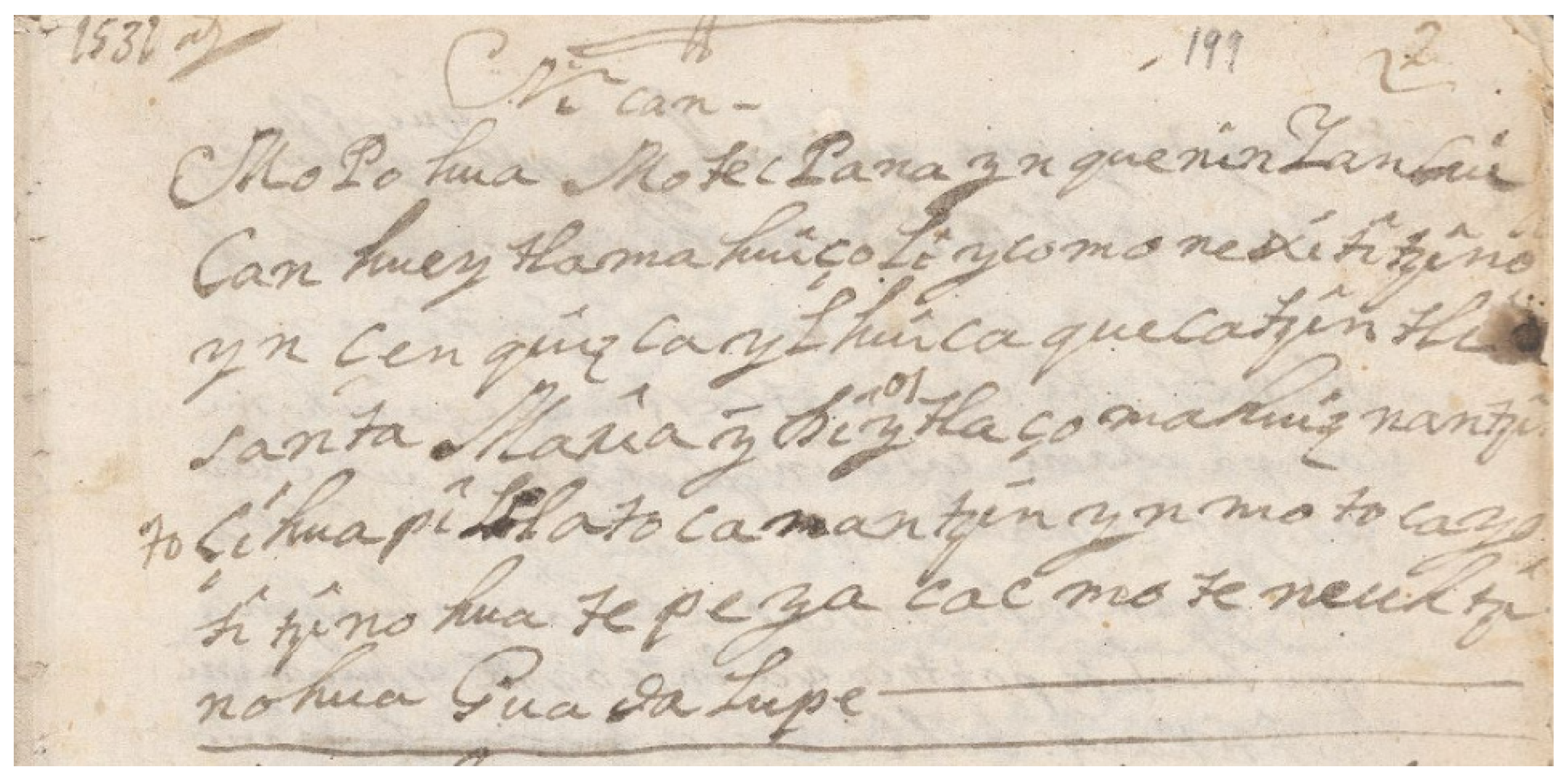
The
Relación Mercurina, or Mercurian Account (
Figure 2), proposes a different name for Our Lady of Guadalupe, among other innovative contributions presented below. The copy source, found at the Princeton Library, is signed by Joseph Pérez de la Fuente on 6 May 1712, and is preceded by a Spanish–Nahuatl confessionary, translated Nahuatl prayers from several sources, rosary mystery reflections, and other devotional pieces. The original Mercurian Account source is held at the
Bibliotheque Nationale de France (BNF). The source was written in a devotional style.
Contrary to the NM, this account lacks an introduction that describes the temporal setting, which places the apparition 10 years after the conquest. Several precious stone names are represented in Juan Diego’s way, atop Tepeyac. Our Lady of Guadalupe is referred to as a “beautiful deity,” and throughout the text, she is described as “divine.” Furthermore, the Spanish translation omits vital information in the Nahuatl original, such as the proper name of Tepeyac. Still, it translates it as “cavo cerros,” meaning the extreme or end of the hills.
The “Palacio Episcopal” is close to the “Hospital, which is known as Bubas” or Bubo Hospital. Our Lady says she wants a house to protect her loved ones from perils, such as the recent earthquake in Mexico City (1711). There is great emphasis on Juan Diego’s blessedness and goodness, as well as on speaking to the Virgin Mary in the Mexican language. These elements appear multiple times throughout the text. The Virgin Mary does not say the construction of the temple ought to be at the root of the hill, as in the NM, and there is more focus on alleviating wretched poverty. This pro-indigenous stance most likely reflects the centuries of struggles the natives had endured by that time, and the figure Our Lady of Guadalupe reminded them of their celestial advocate.
The temple’s construction is intended to manifest her love for the people of this “empire.” The ambiguity of the political structure she referred to is clarified before the bishop; Juan Diego retells how the Virgin Mary wants a sacred temple where she would “support the naturals.” Once Juan Diego is rejected and returns to meet the Virgin Mary, he does not use the descriptive Nahua imagery of a porter’s rope, back frame, etc., but says he is worthless, “a poor man.” It seems much of the Nahuatl pre-conquest imagery is lost.
The bishop is said to have believed Juan Diego after the neophyte confidently asked what he would want as a sign from the Virgin Mary, yet waited for the sign while still sending his servants after him. Followed by the bishop’s servants, Juan Diego did not mind or notice anything, as those “who are so focused on celestial things seldom focus on earthly ones” (Relación Mercuriana, 125r.). In this account, on Tuesday morning, after Juan Diego tries to avoid the Virgin Mary, he is neither fatalistic nor reproachful towards life or its meaning, as the NM shows; instead, he says, “At last, we are all mortals” (Relación Mercuriana, 125v).
The Virgin Mary, instead of appearing to Juan Bernardino at the same time as she consoles Juan Diego, goes to Juan Bernardino and heals him when Juan Diego is cutting the flowers, thereby delivering her healing after she promises that the dying uncle was already healed. Traditionally, she would wait under the cazahuate tree for Juan Diego to return from cutting the flowers, but instead, she takes that time to heal his dying uncle.
Finally, the most remarkable innovation in this account is that Juan Bernardino received the name
Tequanitalopan. The Spanish translation of this Account leaves the Nahuatl caption, “the reason for this was not revealed.” The word itself is complex.
18 It could relate to the second conjecture Becerra Tanco posits, as they both account for the noun
tecuani, or wild beast. Tanco says she scares off wild beasts.
The account differs from the NM in portraying the indigenous Juan Diego in consistently positive, more saintly terms. It is less florid and poetic, probably due to its late date of composition. The Mercurian Account is also very pro-indigenous concerning the Virgin’s thelos, as she came for the Indigenous people, and the temple is for the “naturals.” Such an emphasis is also evident in other Guadalupan sources of the time, such as sermons.
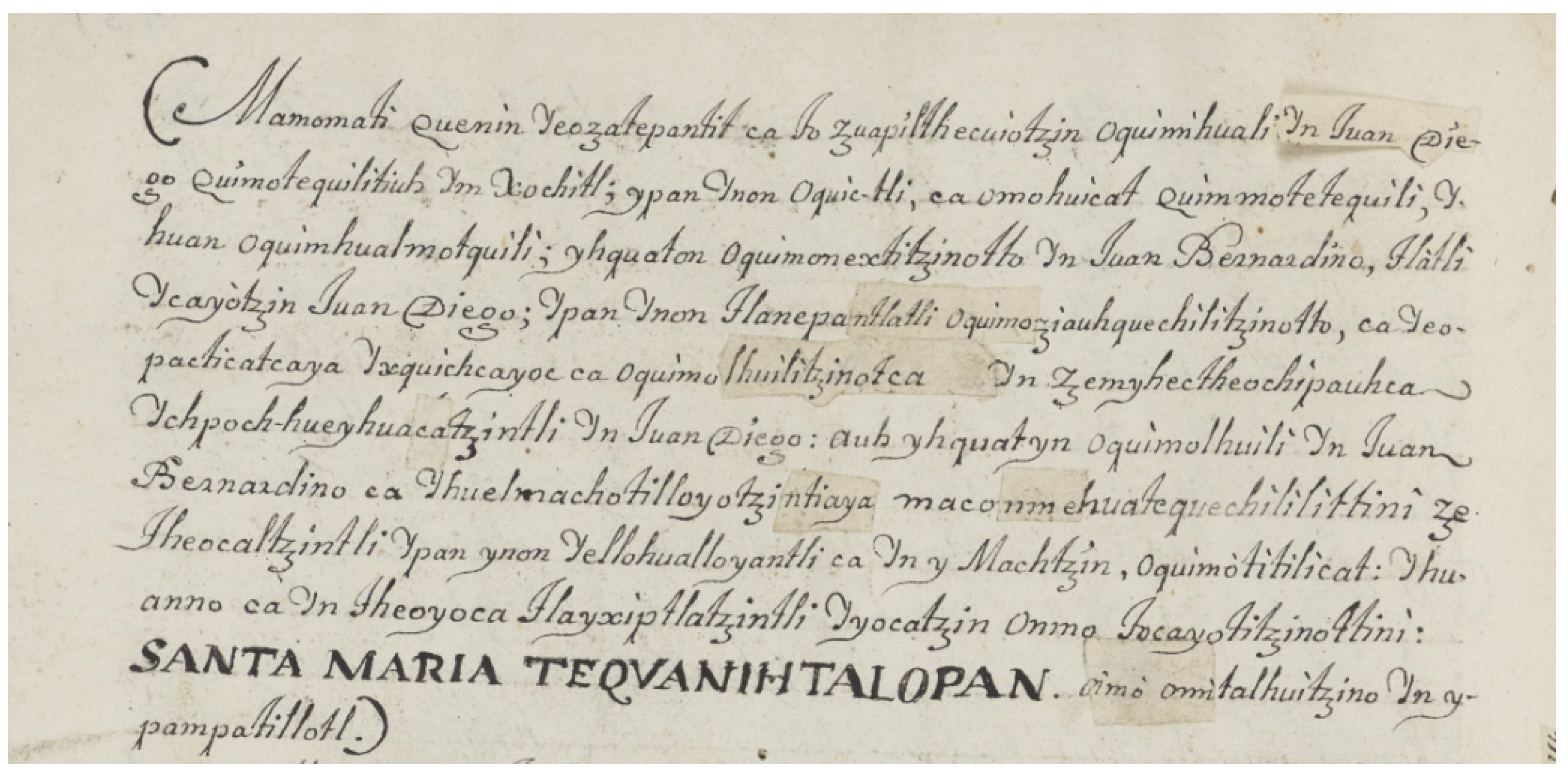
In their study,
Alcántara Rojas and Cabrera Vázquez (
2021) analyze an 18th-century Nahuatl sermon that characterizes the Virgin of Guadalupe as an Indigenous woman, “
Nuestra Amada y Maravillosa Madre Mexicana” (“Our Beloved and Wondrous Mexican Mother”) (
Figure 3). The sermon, preserved in manuscript 1493 of the Biblioteca Nacional de México, was written by a Jesuit for Indigenous audiences and likely used during mission preaching. It emphasizes the Virgin’s appearance to Juan Diego as a
macegual (commoner) and her deliberate choice to dress like a Nahua woman, reinforcing her identity as a mother specifically for the Indigenous people of Mexico. The authors argue that this text is a unique and early example of the Guadalupan image being explicitly indigenized in religious literature, reflecting both ecclesial strategies of evangelization and Indigenous reception of Christian symbols (
Alcántara Rojas and Cabrera Vázquez 2021). While manuscript 1493 (and Ms. 1481) might be the first source to refer to Guadalupe as an actual indigenous woman, her name is still “Guadalupe.”
The other document that refers to Our Lady of Guadalupe as
Tequanitalopan is a play entitled
El portento mexicano, comedia original escrita en verso Mexicano. Copiada de un antiguo Ms.19 Since this source takes artistic liberties, it falls beyond the scope of this study; however, further research on other Guadalupe sermons (at least two other known ones) and plays written in Nahuatl during the seventeenth and eighteenth centuries, is indispensable (
Poole 2017, p. 295). The NM and the
Relación Mercurina do not stand alone in telling the apparition story in Nahuatl.
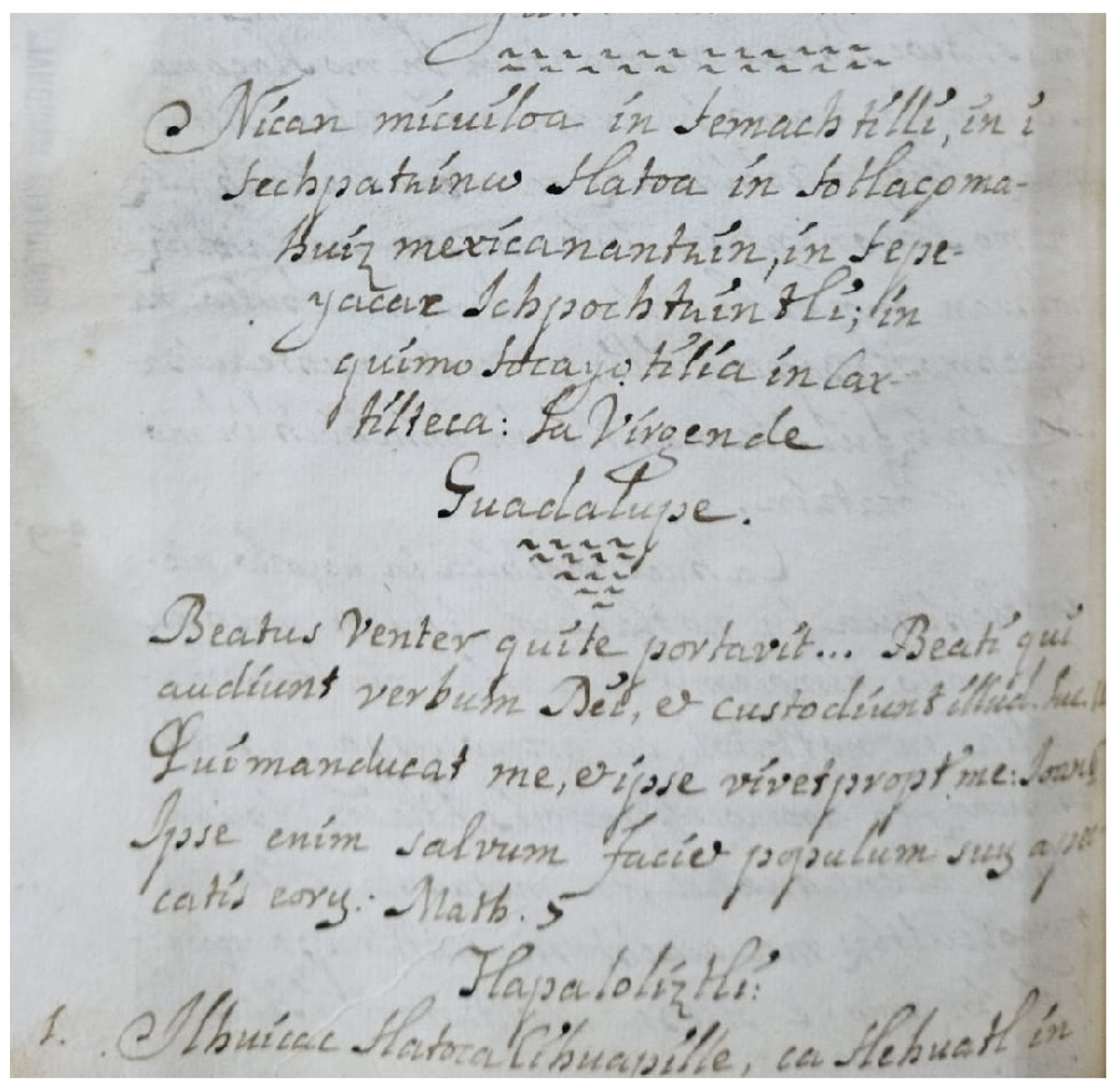
The
Inin Hueitlamahuilzoltzin, known as
Relación Primitiva or
Primitive Account (
Figure 4), is another source that alludes to the Guadalupan story.
20 Its date has been debated, ranging from around 1548 to the middle of the seventeenth century. In this apparition story, there are no proper names at all, not even those associated with the Guadalupan Event: “Guadalupe” (except for the title that contains it), “Juan Diego”, or “Fray Juan de Zumárraga”; there is not even a reference to Juan Bernardino.
21Juan Diego is presented as an Indian who has nowhere to be, a “poor man of the people,” but is pious. The “little man” is considered by the “archbishop” (note that this source de facto dates the document after the year 1548, the year when the prelate was consecrated “archbishop”) as a dreamer or drunkard. Apart from these notes, it is only important to point out the considerable omissions in the general tradition; four apparitions are condensed into two. This may be why it is called primitive.
Historian Edmundo O’Gorman devotes the entire section VI of his second appendix in
Destierro de sombras to this source because of Garibay’s poignant assertion that its author was Juan Gonzales, the linguistic interpreter of Bishop Zumárraga. Therefore, the document’s dating did not exceed the sixteenth century. Another criticism of this document is made by Stafford Poole, who, relying on Roberto Moreno de los Arcos, says that “all the sermons in the first volume of the
Santoral [where this story is hagiographically incorporated with others] appear to be in an eighteenth-century hand” (
Poole 2017, p. 43). Both authors refute what was published by Mariano Cuevas (who claimed the authorship was that of the Jesuit Juan de Tovar, without offering proof) and by Garibay. Additionally, Louise Burkhart dates this document “to any time in the very late sixteenth century or the early decades of the seventeenth century”(
Burkhart 1993, p. 217). She also says elsewhere, “A variant of the apparition legend, found in a Jesuit manuscript that probably predates the 1649 [Luis Lasso de la Vega’s] book, could be considered an exception, but its date and origins are impossible to ascertain for certain; it also lacks the specificity of the canonical version” (
Burkhart 2001, p. 131).
Given this, a recent study on the
Primitive Account by UNAM researcher Tesiu Rosas Xelhuantzi analyzes the Guadalupan extract (
Section 7) both historically and linguistically within the entire manuscript of the factitious title (
Santoral in Mexican) to derive a comprehensive analysis. Rosas Xelhuantzi concludes that the manuscript “could be a draft version of the
Flos Sanctorum of the Jesuit Juan de Tovar, which began in 1585” (
Rosas Xelhuantzi 2023, p. 112). He adds that it was written in the recumbent Nahua graphic system used by the Jesuit school of New Spain, in which diacritics were systematically established by Father Carochi in 1645. Additionally, the presence of excerpts in the Otomí language further limits the authorship to Juan de Tovar and his Jesuit school (
Rosas Xelhuantzi 2023, p. 113).
The Primitive Account is concise, providing only general information about the Nahua world. The author shows slight favoritism toward Juan Diego and shows little regard for historical details. If Tesiu Rosas Xelhuantzi is correct about its dating, the account acquires more historical relevance. This Account raises awareness of how the Nahua and even the Otomi people regarded Our Lady of Guadalupe as part of hagiographic history, as this story is part of an unpublished collection of saints’ lives.