Article

Just Peace or Just War? Theological, Ethical and Technological Reflections on Armed Conflict

1
Faculty of Humanities and Social Sciences, Pázmány Péter Catholic University, Szentkirályi u. 28-30, H-1088 Budapest, Hungary
2
Harry Radzyner Law School, Reichman University, P.O. Box 167, Herzliya 4610101, Israel
3
Faculty of Information Technology and Bionics, Pázmány Péter Catholic University, Práter utca 50/A, H-1083 Budapest, Hungary
*
Author to whom correspondence should be addressed.
Religions 2026, 17(3), 374; https://doi.org/10.3390/rel17030374
Submission received: 31 December 2025 / Revised: 18 February 2026 / Accepted: 24 February 2026 / Published: 17 March 2026
(This article belongs to the Special Issue The Ethics of War and Peace: Religious Traditions in Dialogue)

Abstract

Armed conflict management increasingly demands new normative and strategic frameworks that preserve human life while maintaining effective deterrence capabilities. This study develops a multidisciplinary framework for rethinking armed conflict through the concept of just peace, integrating theology, ethics, law, technology, and empirical communication analysis. The research analyzes 7957 YouTube videos from NATO, the United Nations, and the Vatican, published over two years, employing semantic network analysis, modularity-based community detection, and sentiment analysis to identify emerging discourse patterns around peace, technology, and regulatory complexity. The findings suggest that contemporary socio-technological conditions are increasingly framed in ways that open a discursive space for rethinking conflict management beyond exclusive reliance on large-scale lethal force. Positive messaging correlates with higher audience engagement, while concepts such as law, ethics, religion, and technical standards emerge as interconnected regulatory domains. The study concludes that just peace is not naïve pacifism but a strategic, normatively grounded reorientation in contemporary deterrence thinking. Effective implementation requires integrated regulatory frameworks combining legal norms, ethical principles, religious values, and technical standards. The evolving technological landscape may allow deterrence systems to move beyond exclusive reliance on lethal force toward more humane and efficient conflict-management mechanisms.

1. Introduction

1.1. Just Peace—New Facts, New Challenges, the Ideal of Just War

The development of the theory of just war is partly due to Roman legal traditions and partly to early medieval Christian theology (Mæland 2023). In the Latin Christian tradition, this disciplining project is classically associated with Augustine’s attempt to reconcile the pursuit of peace with the responsibilities of political authority, and later with Aquinas’s more systematic articulation of the criteria of a just war (Walzer 2015; Justenhoven 2012). Importantly, the medieval category of iusta causa was broader than defensive war alone and could include, for example, the redress of grave injustices, the recovery of what had been wrongfully taken, or the punishment of serious wrongdoing under legitimate authority (Walzer 2015). Moreover, just cause was never the only criterion: right authority and right intention (and later the development of proportionality and discrimination in conduct) formed an interlocking set of constraints within the classical tradition (Walzer 2015; Cahill 2019). The tendency to reduce just cause primarily to self-defense became especially prominent in 20th-century debates and remains contested within contemporary Christian moral theology (Cahill 2019; Mæland 2023); the present article therefore does not treat “legitimate defense” as the sole or timeless exception to a presumed rule of absolute nonviolence, but as one historically prominent—and normatively debated—strand within a wider tradition.
According to these theories, there is a type of legitimate defense in which communities have the right to defend themselves against aggression. The following analysis approaches this tradition from a specific theological standpoint. The present analysis is conducted within the framework of Catholic social thought and therefore presupposes a particular anthropological understanding of human dignity, moral agency, and normative development in political ethics. It does not claim to represent the full spectrum of Christian theological traditions. In recent years, within Catholic theological discourse, there has been an increasing emphasis on the concept of “just peace”, which emphasizes the importance of reconciliation, nonviolence, and action against structural injustices, not merely the use of justified violence (Cavanaugh 2009; Cahill 2003). The commandment “You shall not kill” occupies a central place in monotheistic moral reasoning; however, within the Mosaic legal tradition, it does not function as an undifferentiated absolute prohibition of all killing (Levenson 1993). Rather, it primarily prohibits wrongful or private killing and must be read within a wider normative framework that distinguishes forms of violence, authority, and responsibility. This historical nuance is important because Christian reflection on war did not develop from an abstract principle of absolute nonviolence with rare “exceptions,” but from an attempt to discipline coercion under moral and juridical constraints (Mæland 2023; Cahill 2019).
As demographic data increasingly highlight the unique and unrepeatable value of human life, the commandment “You shall not kill” may receive a new interpretation. The moral dilemmas of nuclear deterrence are especially emphasized from the perspective of religious ethics: theologians and philosophers alike point out that the possibility of mass destruction underlying deterrence is deeply incompatible with the Christian view of humanity and the fundamental principles of peace ethics (Mæland 2023).
The interpretation of the commandment “You shall not kill” has evolved over the centuries. Texts such as the story of Abraham and Isaac demonstrate that the rejection of violence is not absolute but context-dependent (Levenson 1993). At the same time, prophetic traditions, most notably Isaiah’s vision of swords being turned into ploughshares (Isaiah 2:4), articulate a powerful eschatological critique of violence, presenting peace not merely as political prudence but as a transformative divine horizon. In contemporary theology and human rights thinking, the dignity of human life is therefore affirmed as paramount under all circumstances (Küng 1997; Bock 2025). While Jesus’ mission was not that of a political insurgent, his rejection of the “sword” reflects more than a difference in role; it expresses a distinctive moral logic grounded in enemy-love and the transformation of violence. Both just war and just peace function as normative ideals within Catholic social thought; neither constitutes a fully realized historical condition, but rather a moral framework guiding discernment under changing circumstances. In this article, “just peace” is used as a working concept within the broader just war tradition rather than as its negation. It designates an approach that retains the core moral constraints of just war reasoning while shifting the primary emphasis toward preventive and constructive practices—reconciliation, nonviolent conflict transformation, and the removal of structural injustices—that aim to reduce the conditions under which lethal force is judged to be permissible (Cahill 2003, 2019; Mæland 2023). Just peace emerged from within modern Christian moral theology as an internal development of just war thinking and remains conceptually continuous with it; it does not replace just war reasoning but reorders its moral priorities (Justenhoven 2012; Christiansen 2006). Accordingly, the title’s “or” should be read as a heuristic tension rather than a strict opposition between two mutually exclusive paradigms. We draw on a practice-oriented account of just peace that articulates actionable norms for constructive conflict engagement, breaking cycles of violence, and building sustainable peace (McCarthy 2020).
The doctrine of deterrence—Si vis pacem, para bellum—is a modern concept, yet it is based on a classical Roman legal principle, which Clausewitz developed into an ideology. According to these interpretations, war represents the right of the stronger, which can only be restrained by law. Of course, the law alone means little if it is not backed by military power that possesses sufficient deterrent force against the other side. Precisely for this reason, the development of deterrent capabilities has become a fundamental pillar of modern warfare. However, this situation has been reinterpreted in the age of nuclear weapons, which can destroy all humanity—or more precisely, the entirety of civilization as we know it today. Accordingly, deterrence has acquired a new meaning: wars, assuming rationality, should only be pursued if they do not lead to total annihilation (Allison 2023). The doctrine derived from the Roman legal principle has become the basis of modern military strategies. According to Clausewitz, war is the continuation of politics by other means, but since the nuclear arms race of the 20th century, this logic has entered a dangerous dead end (Walzer 2015). Christian theologians consider nuclear weapons to be morally unacceptable (Ujházi 2025).
It is important to distinguish between absolute pacifism, passive non-resistance, and active nonviolent conflict transformation. The present study does not advocate the absolute prohibition of all forms of force, nor does it deny the responsibility of political authority to protect the innocent. Rather, it explores whether contemporary technological and normative developments make it increasingly possible to minimize or even replace lethal force in conflict management.
This concept, which has been developed by Christian theologians, is not only limited to Christian thinking, but is present in both Jewish and Muslim legal thinking. Recognizing that war should only be the used as a last resort, Islamic theological legal thinking recognizes the need to peacefully conduct conflicts. If and when war is inevitable, principles of proportionality should be applied as well. The safeguarding and core values embodied within what we today recognize as international humanitarian law are also found in ancient Islamic theological and legal thinking (Ahmad et al. 2023, pp. 153–54).
A just peace may be understood as a normative–technological reorientation. In contemporary societies, the advanced state of technology, the foreseeable decline in the global population and the growing complexity of regulatory frameworks together make it conceivable, at least at the level of normative and strategic imagination, that certain forms of conflict management might progressively reduce reliance on killing. In such a framework, the purpose of weapons could be reconceptualized as shifting from the destruction of persons toward the neutralization of hostile machine systems, as well as the weakening and transformation of the organizational principles of adversarial societies. While the complete elimination of human harm remains unrealistic, technological mediation may expand the spectrum of non-lethal conflict management tools. This theoretical horizon is not presented here as an empirically verified reality, but as a normative hypothesis concerning the possible reconfiguration of deterrence under contemporary socio-technological conditions. The central research question of this study is therefore whether and to what extent the public communication of major international institutions reflects discursive openness toward such a reorientation. To address this question, this study analyzes the titles of publicly available video materials published over the past three years by NATO, the United Nations, and the Vatican, using network analysis and sentiment analysis to identify dominant thematic patterns and normative framings.

1.2. Demographic Facts

The fundamental logic of the economy is based on growing demand. Until recently, it seemed that our increasingly populous planet could guarantee enough consumers. Today, it has become clear that (over)population is turning into population decline (Peri-Rotem 2022). In Western cultures, this is already a tangible phenomenon; in poorer countries, it is currently visible in decreasing birth rates (GBD 2021 Fertility and Forecasting Collaborators 2024, pp. 2057–99). This also means that human life, even according to economic logic, is becoming increasingly valuable. Precisely for this reason, during armed conflicts, special attention must be paid to the preservation of human life (Erk 2022).
Religious anthropologies and charitable organizations may also play a particularly important role in this area. These are opportunities that have yet to be fully utilized, but their significance is increasing. Education also has an important role, particularly in preventing armed conflicts (Holy See 2025b). This seemingly worked well at the “end of history,” but this benefit was superficial, as it simply ignored the possibility of serious armed conflict instead of actively working to prevent it. History, after all, cannot end with the fall of an empire. On the contrary—it begins there. Beyond Western conceptions of post-imperial order, alternative civilizational frameworks also emphasize morally grounded and relational visions of global order; Zhao’s reinterpretation of the Chinese concept of Tianxia (“All-under-Heaven”) conceptualizes peace and political authority as a responsibility-oriented and inclusive system extending beyond sovereign competition (Zhao 2006).

1.3. New Technological Possibilities

Observability, measurability, and analyzability—these concepts are fundamental to optimization, which is indispensable even in the context of social dynamics. Today, thanks to technological development, it has become possible to collect and analyze data on social communication, social networks, and financial flows. All of this provides solid modeling opportunities for decision-making situations (Basilico et al. 2012). Beyond this, the application of AI creates new possibilities both for analysis and for product development (Banks et al. 2022). Technological and technical advances also make room for new paradigms of warfare.
The development of technology not only introduces new tools but also raises new moral questions. According to religious ethics, the impersonal nature of decision-making (e.g., through autonomous systems) poses a risk to human dignity and moral responsibility (Mæland 2023). The emergence of autonomous systems cannot be regulated solely through legal means; it is increasingly necessary to take ethical principles into account (Engelhardt and Kessler 2024; Anderson et al. 2020).
Artificial intelligence, surveillance systems, and big data analytics raise new ethical challenges, especially in military applications (Crawford 2022). Automating decision-making processes may reduce human accountability—both Christian and Jewish ethics and religion respond sensitively to this possibility (Vaughan and Szűts-Novák 2025).
Economic (logistical) and cyber warfare offer serious power projection capabilities without direct armed conflict due to global interconnectivity. However, perceived threats in these domains may also lead to actual armed conflict. These considerations are assessed in the doctrine of Mutual Assured Economic Destruction. It seems evident, however, that war between nuclear powers (due to the scale of the destruction) cannot be considered rational.
On the other hand, it is highly important to recognize that parallel to the ongoing technological developments and improvement, the existing doctrines of International Humanitarian Law (IHL), on which most international humanitarian law is adjudicated, are somewhat time-obsolete. Current contemporary conflicts, such as the war in Ukraine and the war in Gaza, demonstrate the existing current structures’ inability to deal and come up with efficient solutions to ensure the safeguarding of the noncombatant individual (Hathaway 2024).
A significant portion of wars can be waged through modeling. By assessing the available conditions, the outcomes of conflicts can be estimated with reasonable accuracy. The application of game theory and other computational methods (Stein et al. 2025) can greatly help in minimizing the likelihood of actual armed conflict. This requires the high-level development of decision theories, where quantum computing (Krelina 2021) will play a particularly significant role (Smith and Paoli 2024).
The advancement of autonomous systems does not eliminate the moral dilemmas of war; however, technological mediation may expand the spectrum of non-lethal conflict management tools. Society must be prepared for this new form of warfare, and traditional military production must also be transformed. Instead of killing, it may become possible to incapacitate the enemy (i.e., the humans who program the enemy machines) without destroying them. Considerable resources must be invested in defense industries to develop procedures, tools, and materials that do not kill but merely neutralize combat capability in each situation.
The significance of live combat is no longer only related to physical strength, but also access to tools and information. Military activity must focus on how to prevent the enemy from accessing these resources. Game theory and computational modeling can also be applied to peacebuilding. Early critiques of computational rationality warned against reducing human judgment to calculative processes, emphasizing the moral limits of delegating human decision-making to machines (Weizenbaum 1976). However, the deployment of autonomous systems leads to the risk that human values will be sidelined (Roff and Moyes 2016). Ethical warfare is only achievable if the primacy of human life is not questioned—even by machines (Schwarz 2021). Beyond Western ethical frameworks, non-Western philosophical and religious traditions likewise offer relational and process-oriented approaches to human–technology interactions, emphasizing fluidity, interdependence, and moral embeddedness in the evaluation of artificial intelligence (Trothen et al. 2024).
The developments in international law since 1945 have expanded into new fields of relevance, and a ground-ring of recognized individual rights are protected by international humanitarian law, including the rights of individuals to act against states (Hessbruegge 2017).

1.4. Si Vis Pacem, Para Pacem

The newly emerging social and scientific changes may render the realization of the concept of just peace more thinkable within contemporary normative discourse. Humanity may increasingly reduce their reliance on lethal force in certain conflict contexts. The foundation of this is intention grounded in common sense, which recognizes that protecting human life is treated as a normatively binding commitment grounded in human dignity, and that there are more effective ways of acquiring power than through killing.
Once this realization occurs, systems of deterrence would need to be reimagined that use more effective tools than those designed primarily for lethal force. Just peace does not imply a naïve pacifism. Absolute pacifism faces serious challenges in contexts where innocent lives require protection. Rather, just peace reasoning seeks to develop methods that preserve human life while remaining capable of responsibly protecting the vulnerable and contributing to more just political conditions, without presuming total control over human will or historical processes (Christiansen 2006).
It is important to note that Catholic moral theology does not operate exclusively through rule-based prohibitions. Beyond legal norms and moral constraints, it also relies on virtue-based ethical reasoning and just peace moral reflection (Cahill 2019), emphasizing prudence, justice, fortitude, and charity as formative dispositions guiding political and military decision-making. In a similar vein, contemporary interpretations of Jesus’ teaching on non-retaliation (e.g., “turn the other cheek”) increasingly emphasize not withdrawal into private piety, but the public, dignity-affirming logic of creative nonviolent resistance to oppression. The moral evaluation of “force” in Christian thought therefore depends on a careful distinction between destructive violence and forms of nonviolent resistance that seek to confront injustice without negating human dignity (Cahill 2019). The distinction between affirming the dignity or faith of a person and endorsing the moral legitimacy of a particular profession or institution is crucial in biblical interpretation. The New Testament does not offer a direct doctrinal resolution of the ethics of military service but invites ongoing moral discernment within concrete historical circumstances.
In this sense, just peace should not be understood merely as a regulatory alternative to just war, but as a moral horizon grounded in practical wisdom (phronesis) and the cultivation of virtues oriented toward the protection of human dignity. Within the framework of Catholic social thought, this theological understanding is reinforced by recent papal teaching, which frames peace as an “unarmed and disarming” reality grounded in Christian anthropology rather than in deterrence or fear, as articulated in the Message of His Holiness Pope Leo XIV for the 59th World Day of Peace (Holy See 2025a). Recent scholarship on religion and artificial intelligence further suggests that such methods cannot rely solely on external rules or deterrent mechanisms but must also draw on forms of moral discernment and practical wisdom that guide human judgment in technologically mediated contexts (Vaughan et al. 2025).
The peace ethics articulated during the pontificate of Pope John Paul II exemplify how deterrence-oriented thinking can be reoriented toward peacebuilding without abandoning responsibilities regarding security (Justenhoven 2012). Critical political theory nonetheless cautions that discourses of peace can themselves become instruments of control, transforming peace into a form of pacification rather than emancipation (Neocleous 2010, pp. 8–17).
Naturally, this concept of just peace must also be supported by a system of rules based on standards, legislation, morality, and religious convictions. Establishing true peace is not naïve pacifism, but the application of effective, life-preserving conflict-management tools. A sustainable peace and deterrence system in the long-term requires the harmonized implementation of standardization, legal frameworks, moral norms, and religious convictions (Moe-Lobeda 2013).

2. Regulatory Complexity: Law, Ethics, Religion, and Standards in the Governance of Modern Societies

2.1. Regulatory Complexity and the Limits of Legal Regulation

For the new possibilities outlined in the introduction to contribute to reducing the number and scale of deadly wars, a novel approach to regulatory questions is also required. In what follows, we present the foundations of this methodology, which focuses on the theory of regulatory complexity. It is increasingly evident that Enlightenment-era Western narratives are no longer tenable when it comes to the dominance of law. The legal regulatory system, which gained strength after the First and Second World Wars, is now beginning to unravel—one transparent sign of this is the functioning of the International Criminal Court.
It is also a fact that the logic of deterrence cannot function without the parallel development of appropriate regulatory frameworks. One of the essential tasks for the future is to establish such regulatory systems. In developing new regulations, it is no longer sufficient to rely solely on legal norms based on sociology or common sense, as the law increasingly fails to conceal the self-serving interests of either the electorate or those in power. This obvious selfishness undermines the credibility of the legal order. Another emerging form of regulation—rules based on standards and protocols—undermines the credibility of legal regulation because they appear to be more precise, and are seemingly more objective and professionally grounded, thereby showing greater efficiency than legal statutes. For these reasons, a return to ethical and religious norms has become necessary (Birher 2025). Morality does not operate in the dichotomy of legal/illegal, but in binary categories closely tied to human life—good/evil, just/unjust. Precisely for this reason, it is strongly anthropomorphic. Moreover, moral and religious traditions contribute not only additional rules but also a virtue-oriented horizon in which rules and standards are understood as providing a basis for the practical judgment and dispositions (e.g., prudence, restraint, responsibility) needed for constructive conflict engagement.
And, in the age of artificial intelligence, regulation in technologically mediated environments increasingly requires the inclusion of anthropomorphic considerations (if the protection of human dignity, understood within a Christian anthropological framework, remains the primary normative reference point). The regulatory frameworks provided by religions add value to this anthropomorphic regulatory environment by providing meaning to human existence (Trotta et al. 2024).
Without the joint interpretation of these norms, the sustainable operation of the doctrine of deterrence is unimaginable. This question arises with increasing urgency in the regulation of autonomous weapons systems (AWS), where—alongside law and ethics—natural law (O’Connell 2023) also appears as one of the key pillars of religious regulation.
The issue at hand is of great relevance here, whereas a lack of internal defense and the balancing mechanism of the legal systems regarding the existence of the rule of law, and other mechanisms aimed to protect human rights and human dignity, especially in times of crisis and conflict, might create unbalanced strength in favor of extremists.
The experience and legacy of the Third Reich to our discussion was that pure positivism (Radbruch 1946), and a lack of acceptance of higher morals and norms within our legal system, would lead us to decisions that are immoral and unjust. Rather than positioning law as the sole umbrella under which moral and religious norms are subsumed, this study advances the hypothesis of a complementary relationship in which legal regulation, ethical reasoning, and religious anthropology interact at different but interconnected levels of normativity. A complementary model is not without challenges. Critics may argue that introducing religious or moral frameworks alongside legal regulation risks fragmenting normative authority or weakening the coherence of governmental law. This tension is acknowledged as part of the broader debate on plural normative orders within constitutional democracies.
In the early 21st century, the regulation of social, political, and technological life has become an increasingly complex and layered endeavor. The rise of global crises—ranging from demographic decline and environmental degradation to war, inequality, and the disruptive force of new technologies—has exposed the limitations of relying on any single normative system, such as law or ethics, to ensure social cohesion and justice. Instead, a new paradigm is emerging, one that recognizes the interdependence and necessary cooperation of law, ethics, religion, (Tsuria and Tsuria 2024) and, more recently, standards and technical guidelines (Üzelgün et al. 2024) as regulatory systems (Gultom 2025). Religious traditions further illustrate that normative systems are not static but capable of conscious adaptation and innovation in response to social change, as demonstrated by studies on the development of modern Jewish ritual practices (Ochs 2010).

2.2. The Need for Complementarity

It is now widely recognized that the law cannot function effectively in isolation. The regulatory failures of recent decades have triggered two opposing trends: an increase in formalized, technical regulation, and a renewed search for more human, community-based forms of governance rooted in ethics and religion. The challenge is to develop regulatory systems that are both fair and effective, combining the strengths of each normative order. Standards and technical guidelines have emerged as a fourth pillar of regulation, complementing law, ethics, and religion.
These standards—whether in the form of ISO certifications, medical protocols, or algorithmic guidelines—offer precision, adaptability, and the promise of global harmonization (Caritas Internationalis 2021). In fields such as artificial intelligence, data privacy, and healthcare, standards often fill regulatory gaps left by slow-moving legal systems. While standards are often seen as neutral and objective, they are, in fact, products of social negotiation and reflect underlying values and power dynamics. The technical language of standards can obscure their ethical and social implications, making it difficult for laypersons to understand or challenge them.
Moreover, the proliferation of overlapping and sometimes conflicting standards can create confusion and regulatory fragmentation. Religious traditions have long developed their own standards—of ritual, conduct, and community life—that serve as models for secular standardization. The integration of religious and ethical principles into technical standards is increasingly recognized as essential, especially in areas like healthcare, social work, and emerging technologies. The Rome Call for AI Ethics, for example, represents an attempt to infuse technical regulation with moral and spiritual values. Contrary to earlier secularist assumptions, spirituality and religion have proven historically significant in shaping regulatory cultures. Purely materialist or technocratic approaches are inadequate for addressing complex human realities such as suffering, love, and community (Tsuria and Tsuria 2024).
The resurgence of religious language and concepts in scientific, legal, and policy discourse reflects a growing recognition of this fact. No single normative system—law, ethics, religion, or standards—can claim exclusive authority over social regulation. This recognition of plural normative orders does not imply normative relativism. Rather, it reflects the institutional reality of modern societies, where legal, ethical, religious, and technical frameworks operate according to distinct logics (Gultom 2025; Üzelgün et al. 2024). The argument advanced here is therefore not that religion supersedes law, nor that law absorbs religion, but that sustainable governance requires structured mediation among partially overlapping normative domains. Each operates according to its own logic and code, but all must cooperate to shape a just and sustainable future. The challenge is to define the relationships between these systems in ways that respect their distinctiveness while enabling effective collaboration. Debates about whether law contains moral or religious elements, or whether ethical rules have legal force, are ultimately less important than the practical question of how normative systems can be harmonized without violating their methodological integrity. The goal is not to conflate or replace one system with another, but to develop higher-order frameworks that allow for mutual recognition and cooperation.
As technological and social change accelerates, (Yao 2024) the need for integrated, flexible, and value-driven regulatory systems will only grow. The challenge is to create frameworks that are both adaptable and rooted in enduring moral and spiritual principles. The cooperation of law, ethics, religion, and standards is not merely desirable, but indispensable for the governance of modern societies (Irfan and Duffey 2015).
Practical steps for integration are as follows:
  • Interdisciplinary Dialogue: Forums and institutions that facilitate dialogue between legal, ethical, religious, and technical experts are essential for developing integrated regulatory frameworks (Cohen 2019).
  • Second Education and Training: Professional education should include training in all normative systems, preparing practitioners to navigate complex regulatory environments.
  • Policy Innovation: Policymakers should establish institutionalized channels of consultation that allow legal, ethical, religious, and technical expertise to inform decision-making processes in structured and context-sensitive ways (Åhman and Thorén 2021).
  • Community Engagement: Regulatory frameworks must be responsive to the needs and values of the communities they serve, including their spiritual and religious dimensions.
The regulation of social life in the 21st century is an inherently complex and multifaceted task. The failures of monolithic regulatory systems—whether legal, ethical, or religious—underscore the necessity of conscious integration and cooperation. Drawing on the insights of contemporary theology, social science, and regulatory practice, this chapter has argued that appear particularly well-positioned to address the challenges of our time (Abdelnour 2025).
Christianity, with its emphasis on love, solidarity, and the fulfillment of law through caritas, offers a compelling model for regulatory integration. Religious traditions themselves are internally plural and historically implicated in both the legitimation of violence and the pursuit of peacemaking. The present argument therefore does not idealize religion as such but engages those strands of religious reflection that explicitly seek to discipline coercive power under moral and juridical constraints. The rise in standards and technical protocols, while promising efficiency and objectivity, must be balanced by ethical and spiritual values. As global crises deepen and technological change accelerates, the path forward lies in regulatory complexity: a dynamic, interdisciplinary, and value-driven approach to governance that places the dignity of the human person at its center.
Comparable normative commitments can also be identified within Jewish and Islamic legal and theological traditions, although these traditions exhibit significant internal diversity and interpretive disagreement (Ahmad et al. 2023; Ochs 2010). Rather than presupposing a uniform “universal core,” this study refers to historically influential strands within these traditions that emphasize the protection of human dignity, proportionality in the use of force, and moral accountability of political authority (Ahmad et al. 2023). These traditions, however, do not function as unified moral authorities in plural modern societies, but as historically embedded normative resources that interact with legal and ethical frameworks in context-dependent ways.
It is also important to note that contemporary armed conflicts that cause governments to consider their conduct, all measured under current international humanitarian law, have led some to incorporate the principles of this discipline of law into their decision-making process, without recognizing the full applicability of the international humanitarian law within their national system. Such is the case in the current armed conflict in Gaza (Shereshevsky 2019).
The Israeli example, as illustrated by former Supreme Court Judge Aharon Barak, shows the need for the existing legal system rooted on the principles of rule of law, and proportionality, to incorporate certain historically influential moral principles articulated within strands of monotheistic traditions into constitutional reasoning. With this important step, one adds to the system an important control valve, ensuring that the decision-making process includes multiple political levels, as military command must consider international humanitarian principles that are not only based upon legal existing binding norms, but a supreme higher norm in the system that is elevated to a constitutional principle (Barak 2012).

3. An Empirical Investigation

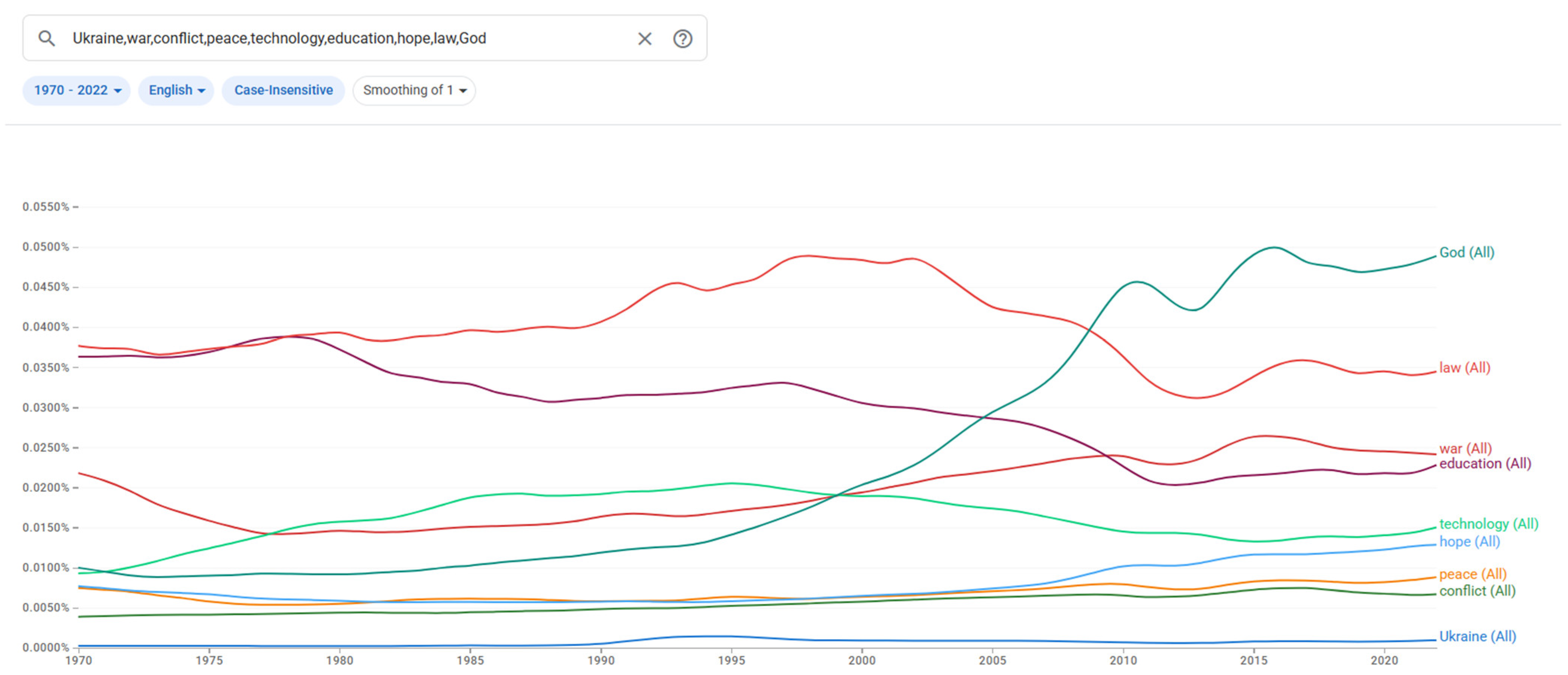
As a first step, the scope of the empirical investigation was defined using the Google Ngram Viewer to analyze long-term trends in word usage frequency. The results indicate a significant increase over recent decades in the relative frequency of the terms “God,” “hope,” and “war,” while the usage of “law,” “education,” and “technology” has declined (Figure 1). This shift suggests a growing emphasis on religious and symbolic layers of regulation, alongside a potential weakening in the perceived effectiveness or prominence of legal–regulatory approaches. Such trends provide an important contextual backdrop for understanding contemporary discourses on conflict, governance, and peace (Chaudhary 2024).
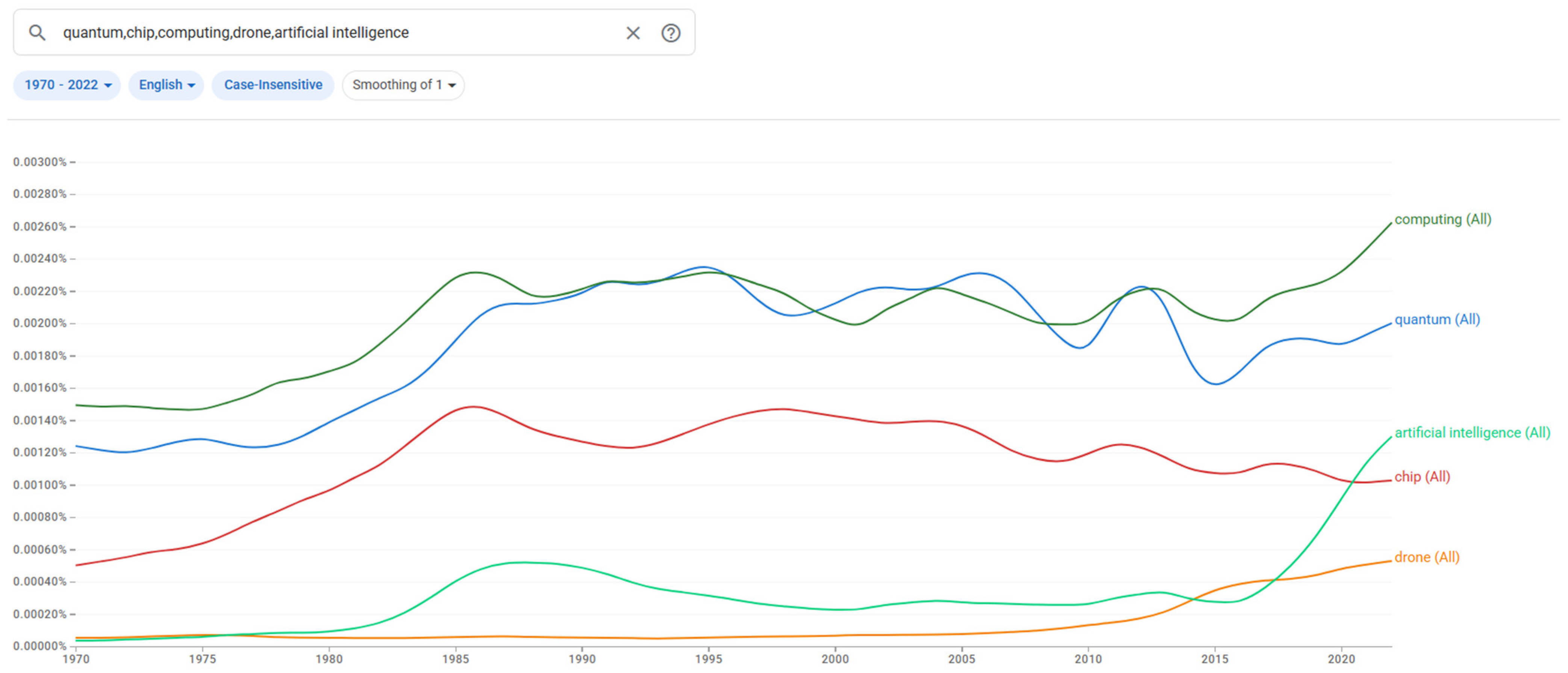
Regarding the application of technologies, the usage frequency of the terms “computing” and “artificial intelligence” has increased substantially (Figure 2). It is important to note that the available linguistic data extends only up to 2022. Nevertheless, this trend supports our hypothesis that contemporary conflicts are unfolding in an environment that is increasingly modellable, computable, and heavily reliant on machine-based systems.

3.1. Methodology

This section is included for transparency; readers primarily interested in the substantive argument may proceed directly to Section 3.2.
Political communication increasingly unfolds within platform-based environments, where digital infrastructures shape visibility, engagement, and the circulation of narratives (Papathanassopoulos and Giannouli 2025). These platform environments are not neutral communication spaces but operate as economic and power structures based on large-scale data extraction and behavioral influence, a phenomenon conceptualized by Zuboff as “surveillance capitalism” (Zuboff 2019).
The normative hypothesis outlined above—namely, that contemporary socio-technological developments may open discursive space for rethinking conflict management beyond an exclusive reliance on lethal force—was explored through an empirical investigation of institutional communication. The analysis examined whether and to what extent international organizations actively engaged in armed conflict frame emerging technologies related to peace as strategically significant within their public discourse. Attention is devoted to artificial intelligence (AI) and autonomous weapon systems (AWS). Regulatory considerations also form a central analytical dimension, as reflected in the recurring presence of concepts such as law, ethics, religion, and standards.
The analysis drew on a dataset of 7957 YouTube videos, corresponding to a total of 230,343.68 min of video content. The data were collected from the official YouTube channels of NATO, the Vatican, and the United Nations, covering the complete range of content published over the past two years (since December 2023). The data collection encompassed both short, vertically oriented videos and longer, horizontally formatted videos.
For each video, the following metadata were retrieved: the name and URL of the publishing channel, number of subscribers, video title, number of views, number of likes, number of comments, and video length. These variables were selected for analysis because communication via social media plays an increasingly significant role in both political and religious discourse (Dommett et al. 2023). This trend is well-documented in the literature and reflects the growing influence of digital platforms on public communication and agenda-setting (Giacomini 2023).
Based on the cited studies, it is reasonable to conclude that the importance of social media–based communication continues to grow. Accordingly, the analysis of data generated on social media platforms enables the identification of distinct communication patterns and supports the formulation of conclusions that contribute to a deeper understanding of the interconnections between economics, religion, and politics. These relationships are examined in greater detail in the subsequent sections of the study.
The analytical framework applied in this research is based on transforming natural language data (video titles) into a semantic network. The methodology consists of three main steps:
  • Graph–theoretical formalization of the corpus;
  • Exploration of internal structures through modularity-based community detection;
  • Visualization of topological relationships using force-directed spatial layouts.
The analyses are grounded in a weighted, undirected graph G = ( V , E , w ) , which represents the associative network of keywords occurring in the examined document set (video titles).
Let D = { d 1 , d 2 , , d m } denote the set of processed documents. Let T ( d i ) represent the sequence of tokens obtained after tokenization and cleaning of document d i . The set S s t o p denotes stopwords to be excluded, while S a l l o w e d contains domain-relevant abbreviations that constitute exceptions to standard filtering rules.
The node set V of the graph consists of the most frequent N elements of the corpus that satisfy the following filtering conditions: only tokens that are not stopwords and that either exceed a minimum length threshold or belong to the predefined set of domain-relevant abbreviations are included.
V { u d D T d u S s t o p u > 3 u S a l l o w e d }
where V N , and the selection is based on global frequency (frequency rank).
The edges of the graph encode the co-occurrence of concepts. The edge set E consists of unordered pairs u v , where u , v V and u v . The strength of the relationships is described by the adjacency matrix W u v :
W u v = k = 1 m I u d k v d k
where I ( ) denotes the indicator function. To reduce noise, only statistically significant relationships are included in the graph, based on a predefined threshold τ :
E = { { u , v } W u v τ }
The weight function w : E N + assigns to each edge the corresponding frequency value W u v .
To identify latent thematic groups in the network, we applied the Louvain algorithm. The objective of the procedure is to maximize the modularity Q of the network, which quantifies the quality of a given partition relative to a random null model. The modularity is defined as:
Q = 1 2 m i , j W i j k i k j 2 m δ c i , c j
where m = 1 2 i , j W i j is the total weight of the edges in the network, k i = j W i j is the weighted degree of node i , c i denotes the community membership (cluster index) of node i , δ ( c i , c j ) is the Kronecker delta function.
The optimization yields a mapping P : V { 1 , , K } , which assigns each node to a disjoint community, thereby forming semantically coherent topics.
  • For the visual representation of the semantic network, we employed the Fruchterman–Reingold force-directed algorithm. This method models the graph as a physical system in a 2D Euclidean space, where the position of each node p u R 2 is determined by the equilibrium of the following forces:
  • Attractive force, a spring-like force acting between connected nodes, increasing quadratically with distance;
    F a t t r d = d 2 k
  • Repulsive force, an electrostatic-like force acting between all pairs of nodes.
    F r e p d = k 2 d
Here, d =   p u p v denotes the distance between nodes, and k is a scaling parameter controlling the optimal average distance between nodes. Increasing the value of k enhances the separation between clusters, thereby improving the readability of the visualization.
To explore the relationship between semantic clusters and communication channels (sources), we analyzed a frequency matrix M projected onto the source set: C s r c = { c h 1 , , c h r } . The matrix M N V × C s r c is defined as:
M i j = count u i source = c h j
During visualization, the row vectors of the matrix were ordered according to the community index P ( u i ) , enabling an examination of how different thematic clusters are represented across the various information channels.
Beyond the topological properties of the network, the visualization incorporates an additional dimension: the size of the nodes (keywords) reflects the audience impact of the associated media content, specifically the average number of views. Let D u D denote the subset of videos whose titles contain the keyword u V , and let view ( d ) represent the number of views of video d . The visual size of node u S u is determined by logarithmic scaling of the average view count:
S u ln 1 + 1 D u view d
where the summation runs over all d D u . The use of the logarithmic transformation is motivated by the pronounced skewness observed in the data distribution (due to orders-of-magnitude differences in view counts). This normalization step ensures that exceptionally high-view (“viral”) topics are prominently displayed without visually overwhelming the finer structures of the network, thereby maintaining the overall readability of the figure despite the high variance in the data.

3.2. Analyses

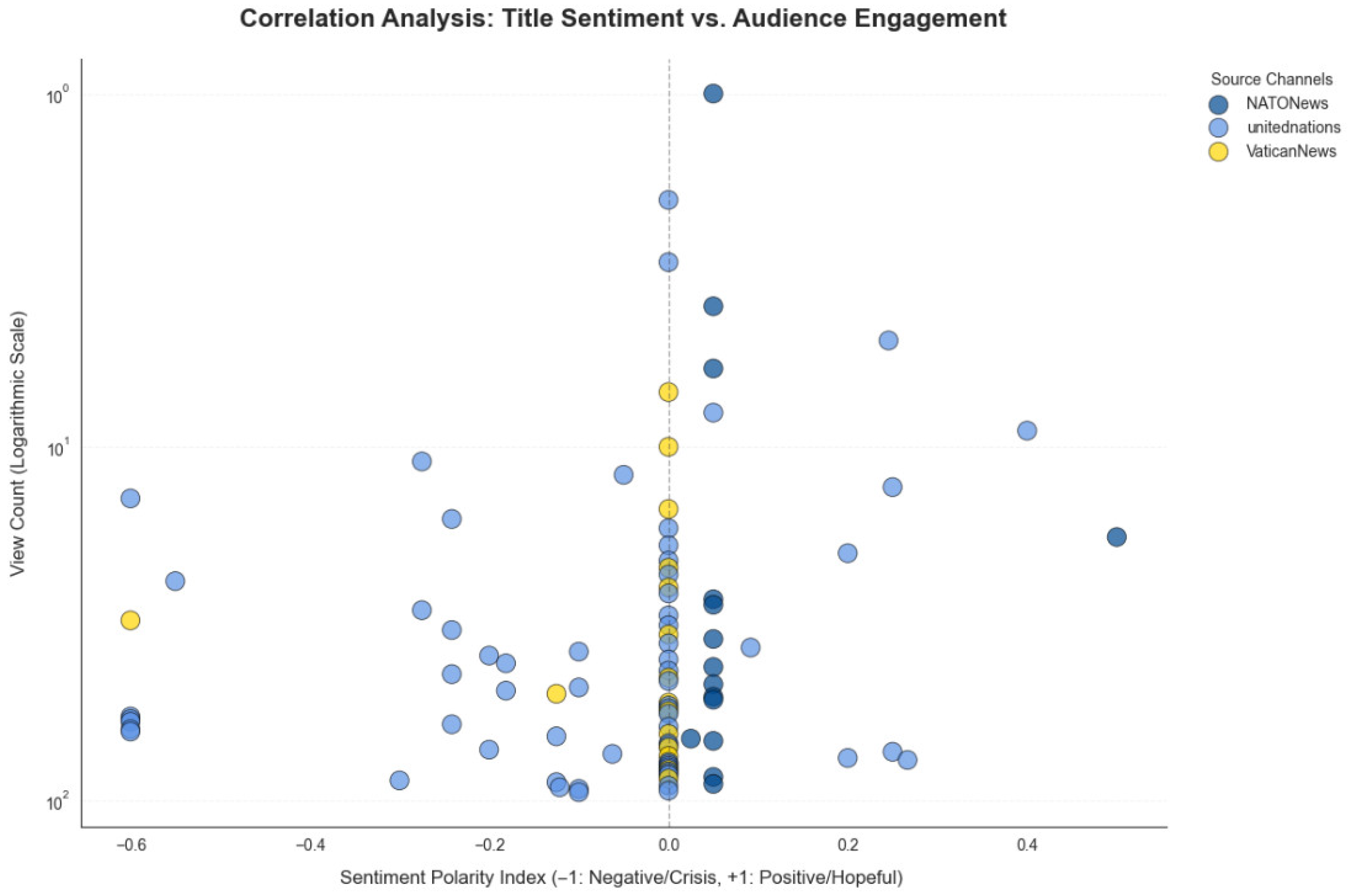
As a small diagnostic probe, we also checked for explicit “nonviolence/non-violent” terminology in the titles; compared to “peace,” “law,” “ethics,” and “dignity,” such terminology appears relatively infrequent, suggesting that de-escalation is more often framed through legal–regulatory and peacebuilding vocabularies than through explicit nonviolence terminology. As shown in Figure 3, the emotional tone of video headlines exhibits a non-linear relationship with audience reach, with neutral to moderately positive sentiment corresponding to significantly higher view counts than strongly negative framing.
An examination of overall viewership patterns reveals that videos conveying positive messages tend to attract significantly higher levels of attention than those with predominantly negative content. This tendency persists even in the case of videos addressing armed conflicts, indicating that audience engagement is not driven solely by the gravity of the subject matter but also by its emotional framing.
The analysis further shows that communication-related terms play a prominent role across the examined content. Consequently, the study of communication itself emerges as an indispensable dimension of conflict management, as the ways in which conflicts are framed and discussed substantially influence public reception and interpretation.
It can also be observed that the themes considered most important by content producers do not necessarily correspond to those that resonate most strongly with audiences.
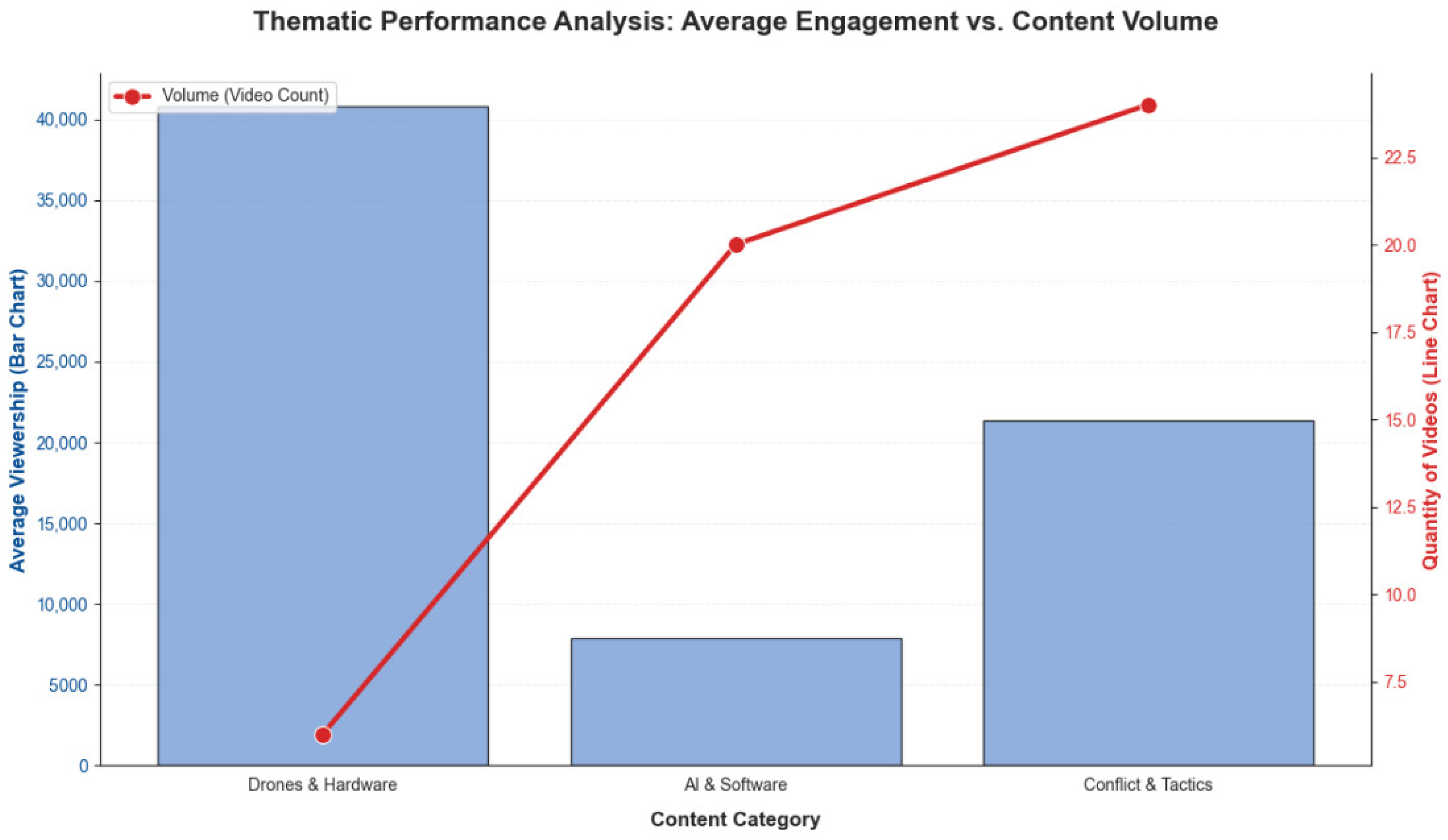
Figure 4 compares thematic popularity and publication volume across selected content categories, revealing a marked discrepancy between production frequency and audience engagement. For this reason, the continuous monitoring of audience preferences and consumption patterns is essential. As illustrated in the analysis, relatively few videos focus on drones; however, the limited number of such videos achieves viewership figures that far exceed those of the much more frequent videos dealing with battlefields and direct conflict. This disparity may be related to the fact that audiences are generally more receptive to positively framed technological topics (such as drone development) than to explicitly negative themes (such as violence and armed confrontation).
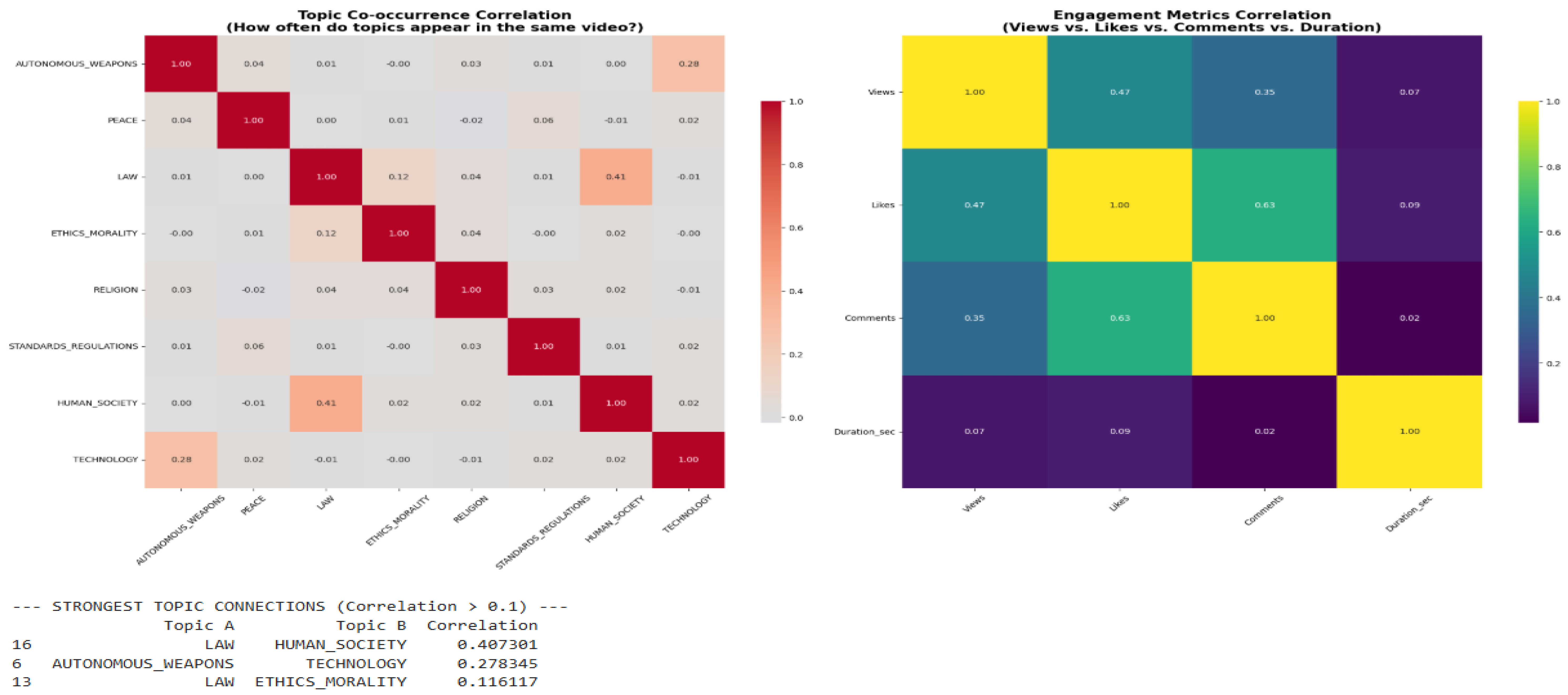
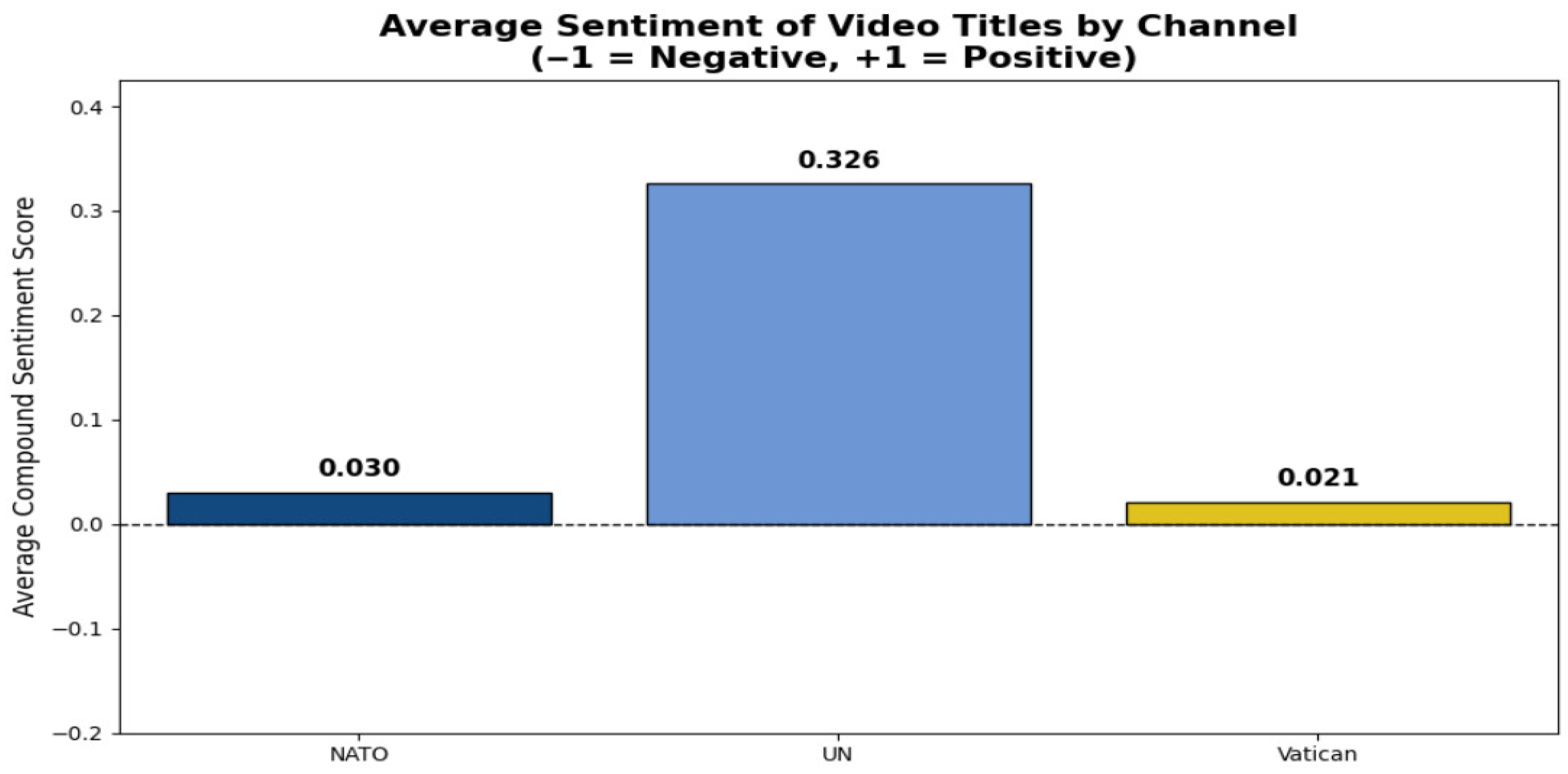
Sentiment analysis of the videos indicates that content published by the United Nations is characterized by the most consistently positive tone. Moreover, positive sentiment shows a clear correlation with higher levels of viewership, suggesting that affective framing plays a significant role in audience engagement. As illustrated in Figure 5, content published by the United Nations displays a markedly more positive average emotional tone compared to NATO and Vatican channels. Figure 6 presents the correlation patterns between thematic co-occurrence and audience engagement metrics, highlighting strong associations among views, likes, and comments, alongside weaker correlations with video duration. Correlation analysis across thematic categories further confirms a strong association between the concepts of law and society, as well as between law and ethics, while the concept of technology is closely linked to that of modern weaponry. A more detailed examination of the interrelationships among these normative domains is provided in subsequent sections of the study.
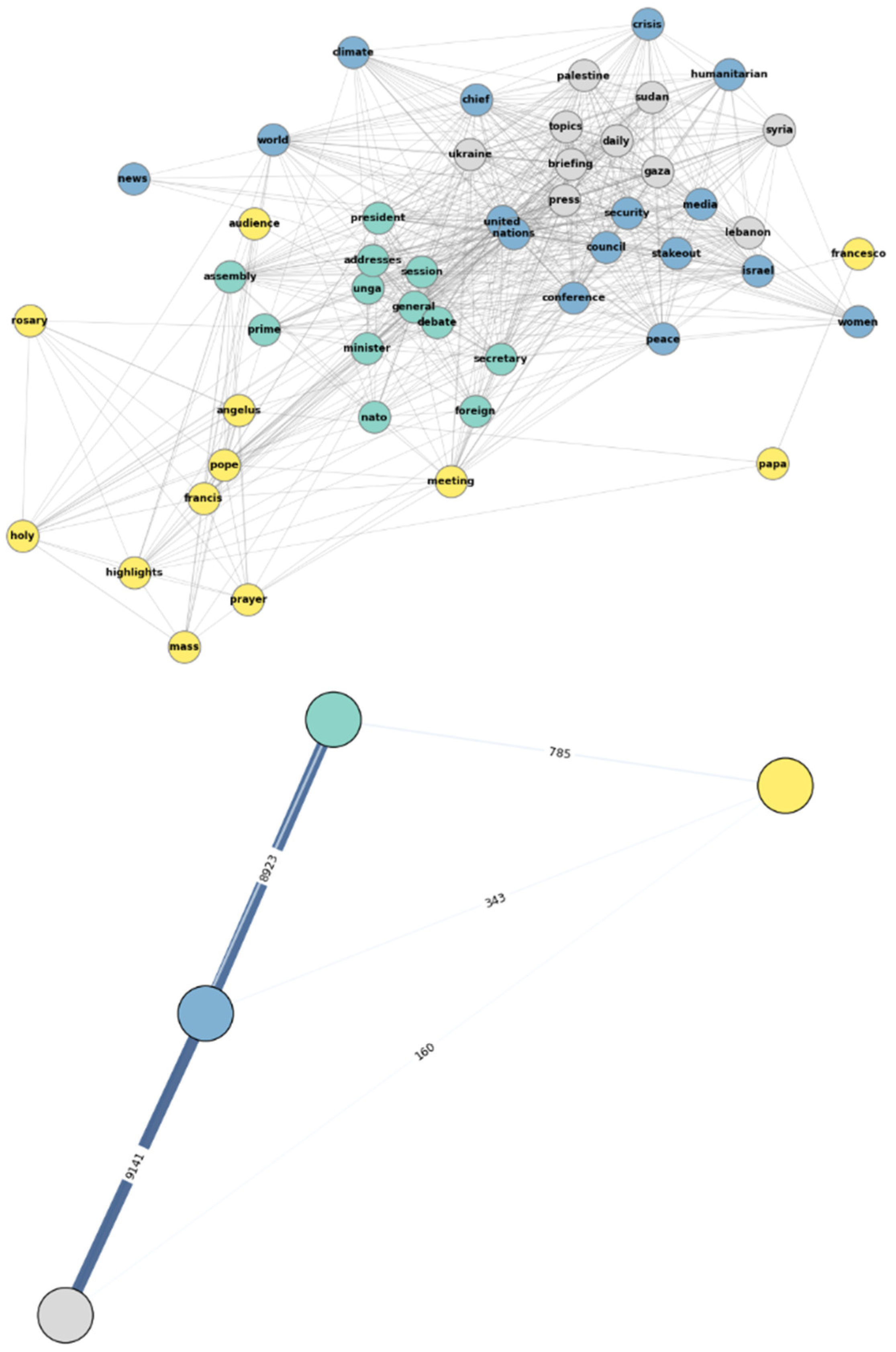
Figure 7 visualizes the thematic clusters identified through modularity-based community detection, as well as the intensity of their interconnections across institutional communication channels. The cluster analysis clearly shows that the vocabularies of the individual channels form largely distinct and self-contained clusters. The primary exception to this pattern is found in the titles of United Nations videos, where two overlapping clusters can be identified. The visualization highlights the most frequently referenced geographical areas—Syria, Gaza, Ukraine, Palestine, Lebanon, and Sudan. In contrast, Israel appears in a separate cluster, in which the United Nations, peace, and broader concepts related to global security are more prominently represented. The analysis further reveals that the cluster of terms associated with governance and administration is clearly separated from the vocabulary characteristic of Vatican communication. At the same time, there are strong connective edges between these clusters in relation to communication-related concepts, indicating significant thematic interaction despite institutional and discursive differentiation.
Taken together, Figure 1, Figure 2, Figure 3, Figure 4, Figure 5, Figure 6 and Figure 7 reveal three overarching patterns. First, institutional communication consistently integrates technological terminology (AI, drones, autonomous systems) within broader security and governance narratives rather than treating such developments as isolated technical phenomena. Second, peace-related discourse frequently co-occurs with regulatory and normative vocabulary, including law, ethics, religion, and standards, suggesting that technological issues are framed within normative constraints. Third, thematic clustering indicates a structural differentiation between human-centered, technological, and regulatory discourses, while maintaining significant interconnections among them. These patterns provide an empirical grounding for examining whether contemporary institutional communication reflects discursive openness toward a reconfiguration of deterrence logic.
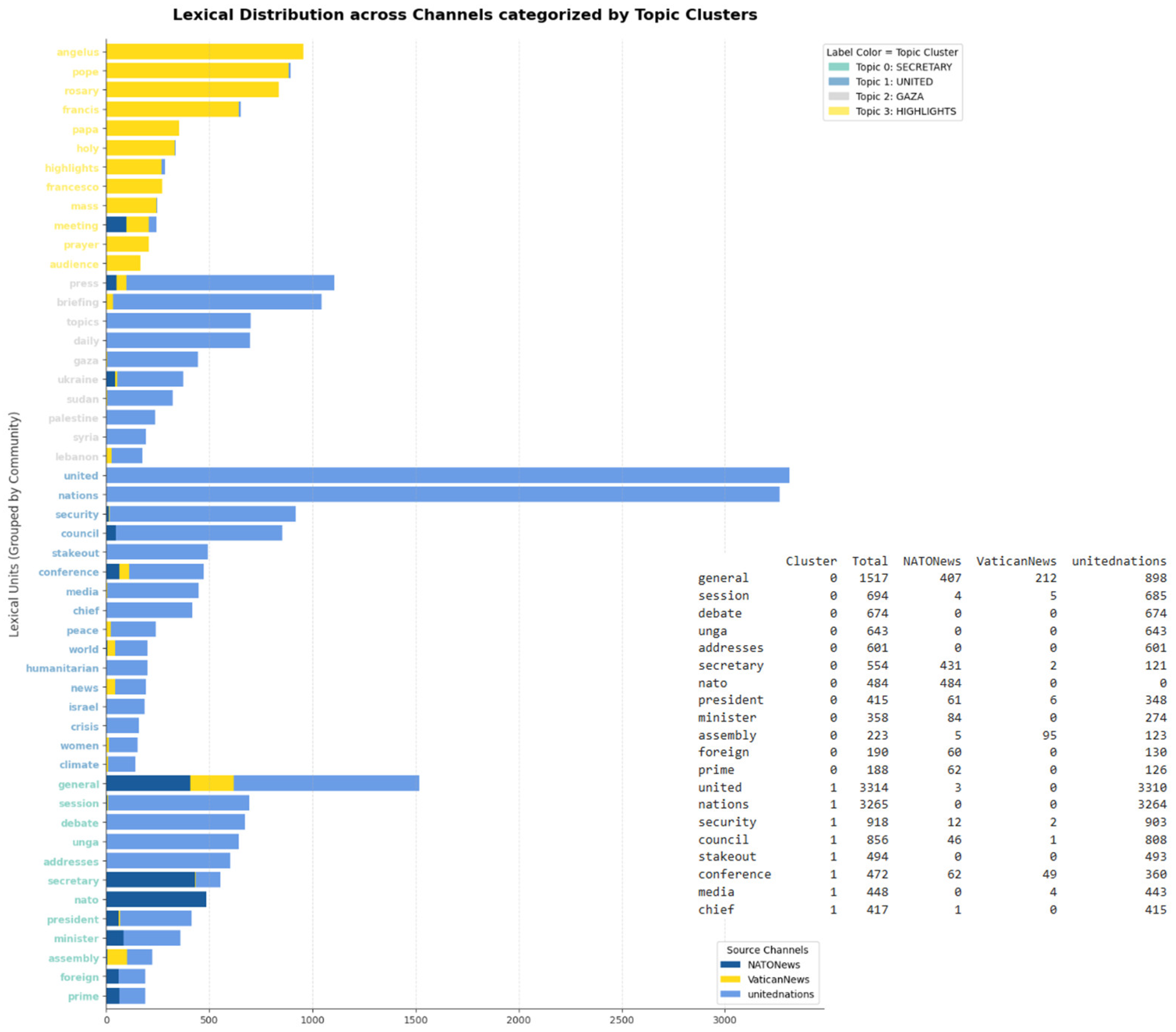
Figure 8 provides a comparative overview of the most frequently occurring keywords and their distribution across NATO, United Nations, and Vatican communication channels. We also examined individual keywords across different thematic domains. The analysis clearly highlights the roles of the press, conferences, and various international organizations, as well as the territorial focal points of contemporary conflicts. In addition, the terms “peace” and “solution” exhibit particularly high edge weights, indicating their central importance within the semantic networks.
In the context of conflicts, communication—and especially the ideological orientation of that communication—plays a decisive role. This pattern is also evident in videos related to technology, where AI emerges as a particularly prominent concept. It is important to emphasize that across all thematic domains, the United Nations occupies a central position in the analysis. This is partly attributable to the fact that more than one-third of the analyzed videos originate from UN channels, but it also reflects the organization’s continuing relevance in global discourse. This central position could be leveraged more effectively than is currently the case. The prominence of the United Nations is further reinforced by the analysis of the concept of peace, in which the UN again appears at the core of the semantic structure. Notably, the concept of peace is closely connected to issues of climate change and women’s rights, and there is a direct semantic linkage between peace and security. This indicates that the realization of security is inseparable from the realization of peace.
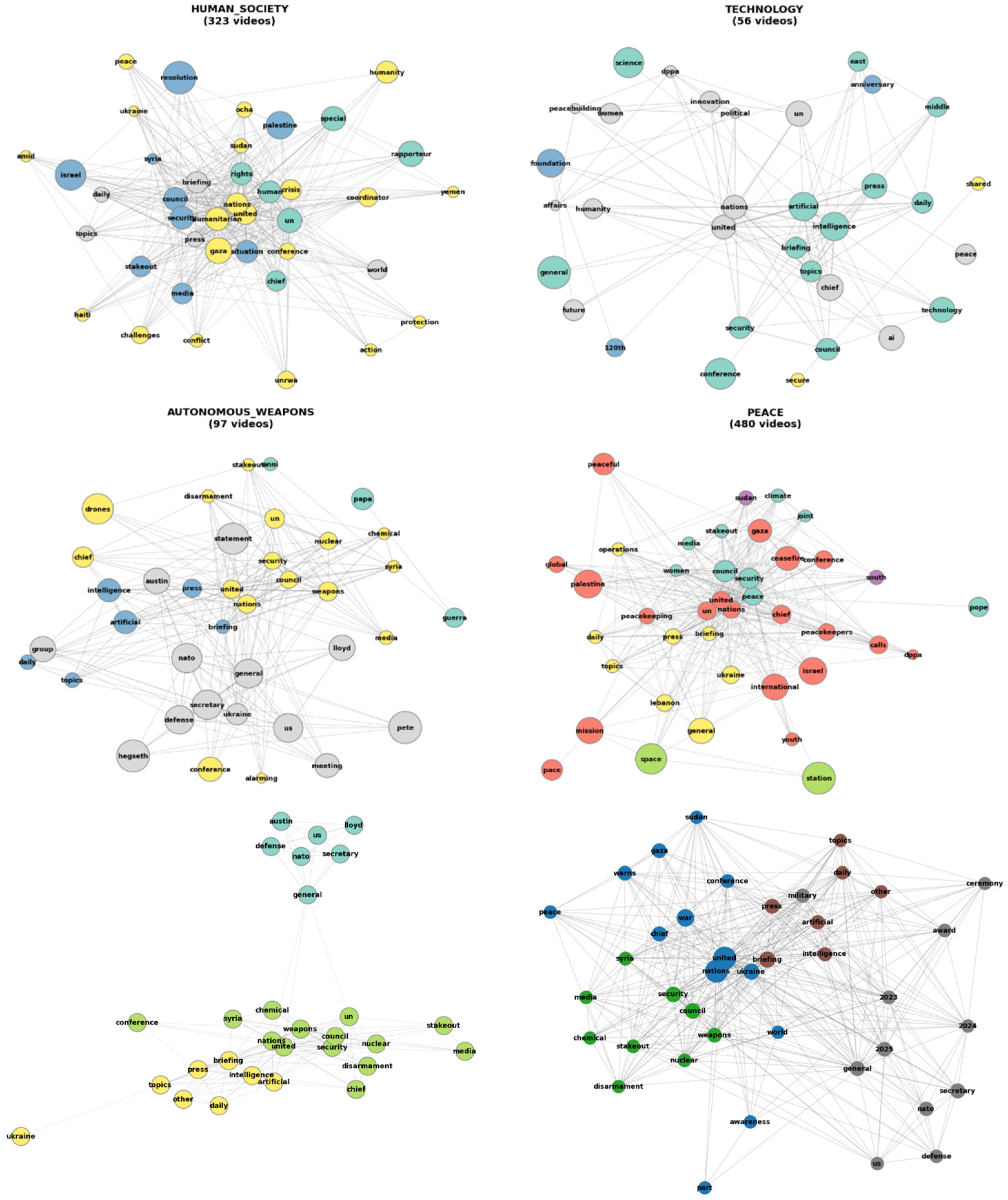
However, the data suggests that contemporary institutional communication increasingly frames security in relation to technological capacities and regulatory considerations, rather than exclusively in terms of weapons-based force. In this sense, the empirical findings suggest the presence of discursive elements that may be compatible with a normative orientation seeking to minimize lethal force. This orientation is also reflected in the semantic network surrounding autonomous weapons, where security occupies the central position. At the same time, the issue of autonomous weapons entails extreme risks, particularly regarding the potential deployment of nuclear or chemical weapons without direct human decision-making. For this reason, this paradigm shift does not in itself establish normative conclusions, but it highlights discursive conditions under which renewed reflection on just peace becomes possible.
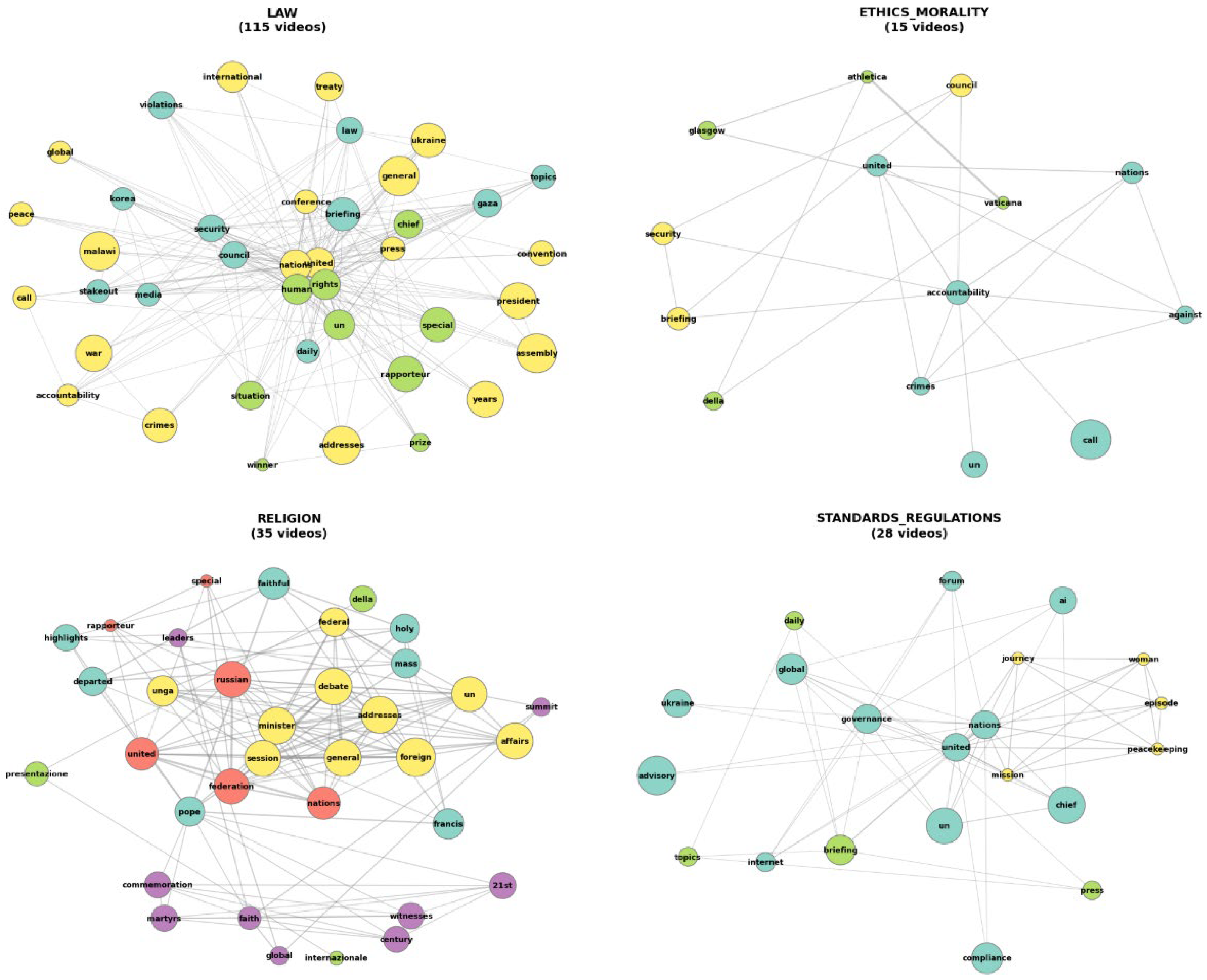
As shown in Figure 9, technology- and security-related themes form densely interconnected semantic subnetworks, whereas peace- and society-oriented discourse appears more fragmented and heterogeneous. Regarding regulatory complexity, we analyzed videos addressing the domains of law, ethics, religion, and standards. Figure 10 demonstrates how law, ethics, religion, and standards constitute distinct yet interconnected normative discursive domains within institutional communication on conflict and governance. One striking finding is that nearly twice as many videos were produced on standards as on ethics. The predominance of legal themes is understandable; however, when viewed considering the Google Ngram analysis, it is not certain that this emphasis reflects audience demand. A similar observation applies to the relative underrepresentation of religion. In this respect, general patterns of word usage in broader discourse and the communicative practices of the analyzed organizations do not appear to be fully aligned. Within the legal domain, references primarily concern human rights, yet the concept of security remains central. The notion of the press also occupies a core position in this semantic field. In the case of ethics, legal aspects emerge through the concept of crime, while the Vatican appears with comparatively low edge weight. In the religious domain, the Pope constitutes the central node, accompanied by key concepts of international administration. Notably, the term “Russian” appears with substantial edge weight within this semantic space, suggesting that Orthodoxy may play a significant role in contemporary peace-related discourse. Regarding standards, the concept of governance assumes a central position, indicating that regulation is becoming increasingly technical in its orientation toward governance. At the same time, compliance emerges as a key technical element of international governance, underscoring the growing procedural and standardized character of regulatory frameworks.
Taken together, Figure 8, Figure 9 and Figure 10 provide a more focused examination of conflict-specific discourse patterns. These visualizations were selected to assess whether the discursive openness identified at the general institutional level also appears in the context of a concrete and highly contested armed conflict. The results indicate that technological terminology remains embedded within broader security and geopolitical narratives, while normative vocabulary related to law, ethics, and regulation continues to co-occur with conflict-related themes. This suggests that even in highly polarized conflict settings, emerging technologies are not framed purely in operational terms but are discursively linked to regulatory and normative considerations. The selection of these figures therefore serves to test the robustness of the study’s central hypothesis in a concrete geopolitical context.

4. Reflections on the Israel–Palestine Conflict

A good example of the importance of the existence of non-governmental organizations advocating for civil and human rights can be demonstrated with the framework of visibility and presence of the Israeli–Hamas armed conflict that escalated since the October 7th Hamas attacks on Israeli territories. From this study, we can observe the significant presence of this conflict on social media, since many independent non-governmental organizations are sharing information that is gathered either via sources within Gaza or open sources in Israel. This disproportionate exposure of this conflict compared to other regional conflicts (such as those in Syria or Sudan) shows the larger scope of collective interest in this specific battlefield. Reporting by non-directed sources allows us to create a larger picture or understanding of the situation on the ground and, no less importantly, assists in forming cases based on international humanitarian law regarding potential violations by both sides in the conflict. It is through this discussion that the case of South Africa vs. Israel came before the International Court of Justice (ICJ), or the intermediate warrants issued by the International Criminal Court (ICC). Even contested forms of coverage concerning Gaza, including reporting that challenges claims of “independent” coverage or seeks to document developments in areas physically closed by the Israeli military, illustrate how such media practices and public discourse may contribute to fact-finding and to the formation of potential international humanitarian law cases in real time. Like the situation relating to the war in Ukraine, the Gaza conflict, particularly its social media coverage, demonstrates once more the soft power of networks to share information and formulate opinions in the international arena. This, however, is not always unbiased or undriven by third parties. Information that does not come from official state sources is sometimes a tool used by others to create or influence the international mindset regarding the upholding of international humanitarian law. Having said this, the mere existence of such monitoring tools forces combating forces to at least formulate and strategize steps in accordance with international law.
Unlike the situation in Ukraine, the Gaza conflict is between a sovereign state and a military political organization that is not recognized by the UN and other international bodies (differing from the Palestinian Authority). In that respect, some technical legal complications arise, mainly regarding the applicability of State obligations relating to combatants in Hamas forces. This dilemma does not, however, infringe on the core findings of this article, regarding soft law and the contribution of this coverage to controlling and monitoring possible violations of international humanitarian law.
One could argue that, in real life, transforming or exporting the battlefield from Gaza to international media, through initiating a discussion or providing media coverage of the potential war crimes that are potentially committed, is a much more effective political tool to apply political pressure on the combating sides. With the integration of ongoing political discussions, either between sides or within the framework of the UN, diplomatic work can be carried out alongside the hostilities, and a less lethal outcome could be achieved in such a conflict.

5. Summary

By combining theological–ethical reflection with an empirical analysis of institutional communication, the study has examined whether contemporary discourse among major international organizations reflects openness toward rethinking conflict management beyond an exclusive reliance on lethal force. The findings do not demonstrate the feasibility of a fully non-lethal paradigm. Rather, they indicate that emerging technologies, including AI and autonomous systems, are increasingly framed within normative and regulatory vocabularies concerned with law, ethics, and human dignity. In this sense, just peace appears not as a utopian abstraction, but as a discursive horizon that resonates with identifiable patterns in contemporary institutional communication. The analysis suggests that reconsidering exclusive reliance on weapons-based security may be discursively and normatively conceivable, even if its practical realization remains contingent and unresolved.
Read through this practice-oriented lens, the empirical findings are best treated as indicators of discursive conditions that can support constructive conflict engagement, rather than as evidence of moral progress or technological feasibility. The prominence of peace- and solution-oriented vocabulary alongside law-, ethics-, and dignity-framings coheres with an emphasis on prevention, protection of the vulnerable, accountability, and durable peacebuilding. The association between moderately positive framing and higher audience reach further suggests that institutional communication can reinforce de-escalatory, rehumanizing, and solution-focused orientations without collapsing into naïve pacifism (McCarthy 2020).

Author Contributions

Conceptualization, N.B.; Methodology, N.P.B.; Formal analysis, N.P.B.; Investigation, A.W.; Resources, N.S. and M.J.F.; Data curation, N.B.; Writing—original draft, N.B.; Writing—review and editing, N.S. and M.J.F.; Visualization, N.P.B.; Supervision, N.B. All authors have read and agreed to the published version of the manuscript.

Funding

This research received no external funding.

Institutional Review Board Statement

Not applicable.

Informed Consent Statement

Not applicable.

Data Availability Statement

The data supporting the findings of this study were generated through the analysis of publicly available online content. Due to platform-specific terms of service and ethical considerations related to the redistribution of scraped or derived data, the raw datasets are not publicly shared. Aggregated data and analytical outputs used to support the conclusions of this study are available from the corresponding author upon reasonable request.

Conflicts of Interest

The authors declare no conflicts of interest.

Abbreviations

The following abbreviations are used in this manuscript:
AIArtificial Intelligence
AWSAutonomous Weapon Systems
ICCInternational Criminal Court
ICJInternational Court of Justice
IHLInternational Humanitarian Law
ISOInternational Organization for Standardization
NATONorth Atlantic Treaty Organization
UNUnited Nations

References

  1. Abdelnour, Mohamed G. 2025. Artificial Intelligence and the Islamic Theology of Technology: From ‘Means’ to ‘Meanings’ and from ‘Minds’ to ‘Hearts’. Religions 16: 796. [Google Scholar] [CrossRef]
  2. Ahmad, Nehaluddin, Gary Lilienthal, and Siti Sara Ahmad. 2023. Islamic Laws of War and Contemporary International Humanitarian Law: Discrimination and Proportionality. Asian Journal of International Law 16: 105–24. [Google Scholar]
  3. Allison, Graham. 2023. Háborúra ítélve [Destined for War]. Budapest: Magyar Vezetőképző Alapítvány. (In Hungarian) [Google Scholar]
  4. Anderson, Justin, Joseph R. Laracy, and Thomas Marlowe. 2020. A Multi-Disciplinary Analysis of Catholic Social Teaching with Implications for Engineering and Technology. Journal of Systemics, Cybernetics, and Informatics 18: 41–49. [Google Scholar]
  5. Åhman, Henrik, and Claes Thorén. 2021. When Facebook Becomes Faithbook: Exploring Religious Communication in a Social Media Context. Social Media + Society 7: 1–12. [Google Scholar] [CrossRef]
  6. Banks, David, Victor Gallego, Rafael Naveiro, and David R. Insua. 2022. Adversarial Risk Analysis: An Overview. WIREs Computational Statistics 14: e1530. [Google Scholar] [CrossRef]
  7. Barak, Aharon. 2012. Proportionality: Sources, Nature, Function. In Proportionality: Constitutional Rights and Their Limitations. Cambridge Studies in Constitutional Law. Cambridge: Cambridge University Press, pp. 129–30. [Google Scholar]
  8. Basilico, Nicola, Nicola Gatti, and Francesco Amigoni. 2012. Patrolling Security Games: Definition and Algorithms for Solving Large Instances with Single Patroller and Single Intruder. Artificial Intelligence 184: 78–123. [Google Scholar] [CrossRef]
  9. Birher, Nándor. 2025. The Return of the Soul—The Role of Religion in Regulating Social Life. Religions 16: 252. [Google Scholar] [CrossRef]
  10. Bock, Gregory L. 2025. Bonhoeffer, Kierkegaard, and Conditional Pacifism. Religions 16: 536. [Google Scholar] [CrossRef]
  11. Cahill, Lisa Sowle. 2003. Just Peacemaking: Theory, Practice, and Perspective. Journal of the Society of Christian Ethics 23: 195–212. [Google Scholar] [CrossRef]
  12. Cahill, Lisa Sowle. 2019. Just War, Pacifism, Just Peace, and Peacebuilding. Theological Studies 80: 169–85. [Google Scholar] [CrossRef]
  13. Caritas Internationalis. 2021. Caritas Management Standards. Available online: https://www.caritas.org/wordpress/wp-content/uploads/2021/03/Revised-Caritas-Internationalis-Management-Standards-2021.pdf (accessed on 23 February 2026).
  14. Cavanaugh, William T. 2009. The Myth of Religious Violence: Secular Ideology and the Roots of Modern Conflict. Oxford: Oxford University Press. [Google Scholar]
  15. Chaudhary, Yaqub. 2024. Islam and Artificial Intelligence. In The Cambridge Companion to Religion and Artificial Intelligence. Edited by Beth Singler and Fraser Watts. Cambridge: Cambridge University Press, pp. 109–28. [Google Scholar]
  16. Christiansen, Drew. 2006. Catholic Peacemaking, 1991–2005: The Legacy of Pope John Paul II. The Review of Faith & International Affairs 4: 21–28. [Google Scholar] [CrossRef]
  17. Cohen, Julie E. 2019. Between Truth and Power: The Legal Constructions of Informational Capitalism. Oxford: Oxford University Press. [Google Scholar]
  18. Crawford, Kate. 2022. Atlas of AI: Power, Politics, and the Planetary Costs of Artificial Intelligence. New Haven: Yale University Press. [Google Scholar]
  19. Dommett, Katharine, Alex Barclay, and Rachel Gibson. 2023. Just What Is Data-Driven Campaigning? A Systematic Review. Information, Communication & Society 27: 1–22. [Google Scholar] [CrossRef]
  20. Engelhardt, Wolfgang, and Volker Kessler. 2024. The Ethical Debate about the Use of Autonomous Weapon Systems from a Theological Perspective. Verbum et Ecclesia 45: a3176. [Google Scholar] [CrossRef]
  21. Erk, Christian. 2022. The Ethics of Killing: Life, Death and Human Nature. Cham: Palgrave Macmillan. [Google Scholar]
  22. GBD 2021 Fertility and Forecasting Collaborators. 2024. Global fertility in 204 countries and territories, 1950–2021, with forecasts to 2100: A comprehensive demographic analysis for the Global Burden of Disease Study 2021. The Lancet 403: 2057–99. [Google Scholar] [CrossRef]
  23. Giacomini, Giulia. 2023. Disintermediation and/or Neointermediation? The ‘Fourth Power’ of Small and Large Intermediaries in the Digital Public Sphere. Polish Sociological Review 222: 249–62. [Google Scholar]
  24. Gultom, Junifrius. 2025. Pentecostalism and Marginalised Ethnicity in Indonesia: Chinese Identity Assimilation. HTS Teologiese Studies/Theological Studies 81: a10871. [Google Scholar] [CrossRef]
  25. Hathaway, Oona A. 2024. War Unbound: Gaza, Ukraine, and the Breakdown of International Law. Foreign Affairs 103: 84–96. [Google Scholar]
  26. Hessbruegge, Jan Arno. 2017. Personal Self-Defense in Military-Led Operations. In Human Rights and Personal Self-Defense in International Law. Oxford: Oxford University Press, pp. 299–300. [Google Scholar]
  27. Holy See. 2025a. Address of His Holiness Pope Leo XIV at the Meeting with Students on the Occasion of the Jubilee of the World of Education. Audience Hall, Vatican City. October 30. Available online: https://www.vatican.va/content/leo-xiv/en/speeches/2025/october/documents/20251030-giubileo-studenti.html (accessed on 23 February 2026).
  28. Holy See. 2025b. Message of His Holiness Pope Leo XIV for the 59th World Day of Peace. Vatican City. December 8. Available online: https://www.vatican.va/content/leo-xiv/en/messages/peace/documents/20251208-messaggio-pace.html (accessed on 23 February 2026).
  29. Irfan, Omar, and Michael Duffey. 2015. Peacemaking and the Challenge of Violence in World Religions. Oxford: Wiley Blackwell. [Google Scholar]
  30. Justenhoven, Heinz-Gerhard. 2012. The Peace Ethics of Pope John Paul II. In From Just War to Modern Peace Ethics. Edited by Heinz-Gerhard Justenhoven and William A. Barbieri. Berlin: De Gruyter, pp. 313–45. [Google Scholar]
  31. Krelina, Michal. 2021. Quantum Technology for Military Applications. EPJ Quantum Technology 8: 24. [Google Scholar] [CrossRef]
  32. Küng, Hans. 1997. A Global Ethic for Global Politics and Economics. New York: Oxford University Press. [Google Scholar]
  33. Levenson, Jon D. 1993. The Death and Resurrection of the Beloved Son: The Transformation of Child Sacrifice in Judaism and Christianity. New Haven: Yale University Press. [Google Scholar]
  34. Mæland, Bård. 2023. Just Peace or Just War? Christian Perspectives on Peacebuilding in the Context of Armed Conflict. Religions 14: 460. [Google Scholar]
  35. McCarthy, Eli S., ed. 2020. A Just Peace Ethic Primer: Building Sustainable Peace and Breaking Cycles of Violence. Washington, DC: Georgetown University Press. [Google Scholar]
  36. Moe-Lobeda, Cynthia. 2013. Resisting Structural Evil: Love as Ecological-Economic Vocation. Minneapolis: Fortress Press. [Google Scholar]
  37. Neocleous, Mark. 2010. War as Peace, Peace as Pacification. Radical Philosophy 159: 8–17. [Google Scholar]
  38. Ochs, Vanessa L. 2010. Inventing Jewish Ritual. Philadelphia: Jewish Publication Society. [Google Scholar]
  39. O’Connell, Mary Ellen. 2023. Banning Autonomous Weapons: A Legal and Ethical Mandate. Ethics & International Affairs 37: 287–98. [Google Scholar] [CrossRef]
  40. Papathanassopoulos, Stylianos, and Ifigeneia Giannouli. 2025. Political Communication in the Age of Platforms. Encyclopedia 5: 77. [Google Scholar] [CrossRef]
  41. Peri-Rotem, Nitzan. 2022. Global Fertility and the Future of Religion: Addressing Empirical and Theoretical Challenges. Religion, Brain & Behavior 12: 413–17. [Google Scholar] [CrossRef]
  42. Radbruch, Gustav. 1946. Statutory Lawlessness and Supra-Statutory Law. Oxford Journal of Legal Studies 21: 1–11. [Google Scholar]
  43. Roff, Heather M., and Richard Moyes. 2016. Meaningful Human Control, Artificial Intelligence and Autonomous Weapons. Briefing Paper, Article 36. Available online: https://article36.org/wp-content/uploads/2016/04/MHC-AI-and-AWS-FINAL.pdf (accessed on 23 February 2026).
  44. Schwarz, Elke. 2021. Autonomous Weapons Systems, Artificial Intelligence, and the Problem of Meaningful Human Control. The Philosophical Journal of Conflict and Violence 5: 52–72. [Google Scholar] [CrossRef]
  45. Shereshevsky, Yoram. 2019. HCJ 3003/18 Yesh Din—Volunteers for Human Rights v. Chief of General Staff, Israel Defense Forces (IDF). American Journal of International Law 113: 361–68. [Google Scholar] [CrossRef]
  46. Smith, Zhanna L. Malekos, and Giacomo Persi Paoli. 2024. Quantum Technology, Peace and Security: A Primer. Geneva: UNIDIR. [Google Scholar]
  47. Stein, Jonas, Maximilian Zorn, Leo Sünkel, and Thomas Gabor. 2025. Quantum Optimization Algorithms. arXiv arXiv:2511.12379. [Google Scholar] [CrossRef]
  48. Trothen, Tracy J., Pui Lan Kwok, and Benjamin Lee. 2024. AI and East Asian Philosophical and Religious Traditions: Relationality and Fluidity. Religions 15: 593. [Google Scholar] [CrossRef]
  49. Trotta, Susanna, Deborah Sabrina Iannotti, and Boris Rähme. 2024. Religious Actors and Artificial Intelligence: Examples from the Field and Suggestions for Further Research. Religion and Development 1: 1–25. [Google Scholar] [CrossRef]
  50. Tsuria, Ruth, and Yossi Tsuria. 2024. Artificial Intelligence’s Understanding of Religion: Investigating the Moralistic Approaches Presented by Generative Artificial Intelligence Tools. Religions 15: 375. [Google Scholar] [CrossRef]
  51. Ujházi, Lóránd. 2025. El papel de los institutos de vida consagrada al servicio de la paz. Estudios Eclesiásticos 100: 925–68. [Google Scholar] [CrossRef]
  52. Üzelgün, Mehmet Ali, Iliana Giannouli, Ioanna Archontaki, Klára Odstrčilová, Barbara Thomass, and Cláudia Álvares. 2024. Transforming Toxic Debates towards European Futures. Central European Journal of Communication 17: 82–102. [Google Scholar] [CrossRef]
  53. Vaughan, Geoff, and Rita Szűts-Novák. 2025. Distant Noises: Expert Voices. Magyar Nyelvőr 149: 692–702. [Google Scholar] [CrossRef]
  54. Vaughan, George, Jihyun Yoo, and Róbert Szűts-Novák. 2025. Wisdom of the Heart: A Contemporary Review of Religion and AI. Religions 16: 834. [Google Scholar] [CrossRef]
  55. Walzer, Michael. 2015. Just and Unjust Wars: A Moral Argument with Historical Illustrations, 5th ed. New York: Basic Books. [Google Scholar]
  56. Weizenbaum, Joseph. 1976. Computer Power and Human Reason: From Judgment to Calculation. New York: W. H. Freeman. [Google Scholar]
  57. Yao, Dedo Williams Johannes. 2024. The Role of Artificial Intelligence in Shaping Religion and Social Studies. Convergence Chronicles 5: 334–42. [Google Scholar]
  58. Zhao, Tingyang. 2006. Rethinking Empire from a Chinese Concept ‘All-under-Heaven’ (Tianxia 天下). Social Identities 12: 29–41. [Google Scholar] [CrossRef]
  59. Zuboff, Shoshana. 2019. The Age of Surveillance Capitalism: The Fight for a Human Future at the New Frontier of Power. New York: PublicAffairs. [Google Scholar]
Figure 1. Temporal evolution of selected key terms (Ukraine, war, conflict, peace, technology, education, hope, law, God) in English-language discourse between 1970 and 2022, showing the growing prominence of technology- and religion-related concepts alongside conflict-related terms in the post-2000 period.
Religions 17 00374 g001
Figure 2. Long-term trends in the frequency of selected technology-related terms (quantum, chip, computing, drone, artificial intelligence) in English-language discourse between 1970 and 2022, highlighting the recent acceleration of artificial intelligence and drone-related concepts alongside sustained growth in computing and quantum technologies.
Religions 17 00374 g002
Figure 3. Relationship between headline sentiment and audience reach on a logarithmic scale. The figure illustrates the association between the emotional tone of headlines and the number of views across content published by selected international actors (NATO News, NASA, Vatican News, United Nations). The horizontal axis represents headline sentiment (−1 = negative/fear-inducing; +1 = positive/enthusiastic), while the vertical axis shows the number of views on a logarithmic scale. The dashed vertical line marks neutral sentiment (0). The distribution suggests that neutral or moderately positive headlines tend to have a higher audience reach, whereas strongly negative emotional framing does not necessarily correlate with increased visibility.
Religions 17 00374 g003
Figure 4. Comparison of thematic popularity and publication volume across selected content categories. The bar chart displays the average number of views for three thematic categories (Drones/Hardware, AI/Software, Warfare/Conflict), while the overlaid line indicates the corresponding number of published videos. The results show that Drones/Hardware content achieves the highest average audience reach despite a relatively low volume of publication, whereas AI/Software content is produced in greater quantity but attracts fewer views on average. Warfare/Conflict topics occupy an intermediate position, combining moderate popularity with a high frequency of publication.
Religions 17 00374 g004
Figure 5. Average sentiment of video titles by institutional channel. The figure presents the mean compound sentiment scores of video titles published by NATO, the United Nations, and the Vatican, based on a normalized sentiment scale ranging from −1 (negative) to +1 (positive). The results indicate a markedly more positive average tone in content published by the United Nations, while NATO and Vatican channels exhibit near-neutral sentiment on average. This divergence suggests differing communication strategies in the emotional framing of institutional messaging.
Religions 17 00374 g005
Figure 6. Correlation patterns between thematic co-occurrence and audience engagement metrics. The left panel shows the correlation matrix of thematic co-occurrence, indicating how frequently selected topics (e.g., autonomous weapons, law, ethics, religion, technology) appear together within the same video. Stronger correlations suggest thematic clustering in content production. The right panel presents correlations among audience engagement metrics (views, likes, comments, and video duration), revealing strong positive associations between views, likes, and comments, while video duration shows only weak correlations with engagement. Together, the results illustrate how thematic framing and audience interaction follow distinct but partially overlapping patterns in digital communication.
Religions 17 00374 g006
Figure 7. Network representation of thematic clusters and their interconnections in institutional communication. The upper panel displays a keyword co-occurrence network, where nodes represent frequently used terms and edges indicate their co-appearance within the same content items. Node colors denote distinct thematic clusters, highlighting areas such as security and conflict, international diplomacy, and religious discourse. The lower panel presents a simplified inter-cluster network (minimum edge weight = 2), illustrating the aggregated strength of connections between thematic clusters. Edge thickness reflects the intensity of cross-cluster interaction, indicating that security- and diplomacy-related themes form a dense core, while religious topics remain connected yet more peripheral. Together, the visualizations reveal both the internal structure of thematic narratives and the degree of integration between institutional discursive domains.
Religions 17 00374 g007
Figure 8. Distribution of frequently occurring words across thematic clusters and institutional sources. The bar chart on the left illustrates the frequency of selected keywords, with color coding indicating cluster membership (e.g., Security, Diplomacy, Religion). The table on the right provides a detailed breakdown of the top 20 most frequent terms, showing their occurrence across content produced by NATO News, Vatican News, and the United Nations, as well as total frequencies. The combined visualization highlights both thematic concentration within clusters and differences in lexical emphasis across institutional communicators, revealing how specific vocabularies structure distinct narrative domains.
Religions 17 00374 g008
Figure 9. Thematic subnetworks of keyword co-occurrence across major content domains. The figure presents separate keyword co-occurrence networks for selected thematic domains, including Human Society, Technology, Autonomous Weapons, and Peace. In each panel, nodes represent frequently occurring terms, while edges indicate their co-appearance within the same videos; node size reflects term frequency, and edge density indicates the strength of thematic association. Node colors indicate communities identified through modularity-based clustering, reflecting structurally coherent thematic groupings within the co-occurrence network. The lower panels further detail keyword structures related to autonomous weapons and peace narratives. The visualization demonstrates that technology- and security-related themes form densely interconnected networks, whereas peace- and society-oriented discourse exhibits more dispersed and heterogeneous structures, reflecting differing modes of narrative organization across domains.
Religions 17 00374 g009
Figure 10. Keyword co-occurrence networks within normative and regulatory thematic domains. The figure displays separate keyword co-occurrence networks for four normative domains: Law, Ethics/Morality, Religion, and Standards/Regulations. In each panel, nodes represent frequently used terms within the respective thematic corpus, while edges indicate their co-occurrence within the same videos; node size reflects relative term frequency, and network density indicates the degree of internal thematic cohesion. The visualizations reveal that Law and Religion exhibit relatively dense and interconnected lexical structures, whereas Ethics/Morality and Standards/Regulations form sparser networks, suggesting more specialized and less internally consolidated discursive patterns across these domains.
Religions 17 00374 g010
Disclaimer/Publisher’s Note: The statements, opinions and data contained in all publications are solely those of the individual author(s) and contributor(s) and not of MDPI and/or the editor(s). MDPI and/or the editor(s) disclaim responsibility for any injury to people or property resulting from any ideas, methods, instructions or products referred to in the content.