1. Introduction
Since its establishment as a republic in 1923, Türkiye has struggled to define its national identity through conflicting ideological lenses, mainly secularism and religion. Both forces have influenced grassroots social movements, but they have also been deployed as top-down, state-led initiatives to consolidate power and shape the nation’s character. This paper does not aim to evaluate forms of government or regime types; instead, it explores how two distinct types of government have used secularism and religion as core pillars to consolidate authority and influence society. Additionally, this research does not aim to assess or classify the political orientations of ruling powers, nor to speculate on the intentions or personal motivations of their leaders—whether those leaders sought to establish a democratic order or otherwise.
1 Rather, moving beyond the realm of individual agency, it examines how these ruling authorities have consistently prioritized ideological conformity and state control over the advancement of democratic principles.
The concept of
Sovereign Islam provides a novel lens for understanding these dynamics. Sovereign Islam in this study refers to the strategic appropriation of Islam by the state as a political resource to construct legitimacy, define national identity, and centralize authority. Under this framework, Islam—whether subordinated under secularist policies or reintegrated under Islamist governance—is treated not primarily as a spiritual or cultural practice, but as a tool for political consolidation. Islam, in both secular and Islamist forms, has been mobilized as an instrument of state control and was not primarily understood to foster democratic dialogue or pluralism. Instead, it became part of a political strategy designed to consolidate state power and reinforce citizens’ loyalty (
Esposito and Voll 2000).
The Ottoman past provides important context for understanding the roots of both Atatürk’s secularism and contemporary approaches to politicized Islam. From the late eighteenth century onward, elite Ottoman responses to external threats—beginning with Napoleon’s invasion of Egypt in 1798—fostered a military-led reformist mentality that reshaped perceptions of religion, governance, and modernization. This trajectory continued through the Tanzimat reforms, the Committee of Union and Progress (CUP) takeover during the Young Turk Revolution of 1908, and the upheavals following World War I, culminating in the British occupation of Istanbul (
Deringil 1998;
Karpat 2001;
Hanioğlu 2008). These historical developments established a precedent for state-led regulation of religion as a means of political order, shaping elite strategies for consolidating authority.
Atatürk’s secularism can also be read as the culmination of a longer Ottoman–Turkish tradition of state-centric, military-bureaucratic reform. Rooted in a reformist lineage that privileged state authority as the primary agent of modernization, this form of secularism asserted the primacy of government sovereignty over autonomous religious power. Atatürk instrumentalized and subordinated Islam to a rational-bureaucratic state framework, confining it to the private sphere and stripping it of independent authority. In this conception, religion was not inherently incompatible with society but was deemed incompatible with modernization and national unity when permitted to operate outside the state’s rigid control.
The notion of “Sovereign Islam” captures how contemporary leaders—most notably Erdoğan—reverse this legacy by repositioning Islam as a source of political legitimacy and state authority. Rather than subordinating religion to the state, Islam is mobilized to define national identity, legitimize power, and consolidate political authority (
Tuğal 2009;
White 2013). This inversion, however, is not ahistorical, as with Atatürk’s secularism. Erdoğan’s approach draws on deep-rooted traditions of popular resistance to elite-led, military-ushered reform or revolution, most visibly articulated in the late Ottoman period. (
Karpat 2001;
Göle 1997). In particular, the reign of Sultan Abdülhamid II exemplified an early fusion of Islamic legitimacy and centralized sovereignty through Pan-Islamism and the strategic activation of the caliphate as a counterweight to Westernization and internal dissent (
Deringil 1998). In contemporary Türkiye, this historical Pan-Islamist orientation has been rearticulated as neo-Ottomanism, most systematically articulated by the AK Party and Ahmet Davutoğlu’s
Strategic Depth doctrine, which situates Türkiye’s Islamic-Ottoman heritage as a foundational resource for geopolitical influence and sovereign authority (
Davutoğlu 2010).
Atatürk, a career military officer trained within the late Ottoman army, carried the worldview of the military-led reform tradition into the founding principles of the Turkish Republic (
Aydemir [1965] 1987). His secularism was neither neutral nor detached from his formative experiences; it was shaped by his military background and reflected an assertive, state-controlled approach to religion. Under his leadership, the republic promoted secularism as part of a broader Turkish national identity, positioning Islam as private and personal and excluding it from the public sphere. This model of Sovereign Islam enabled the state to regulate religious institutions and limit the political influence of Islamic groups. Erdoğan, by contrast, emerged as a civilian politician shaped by Turkey’s Islamist National Outlook (
Milli Görüş) tradition and by experiences of political marginalization under Kemalist secularism, rising through electoral politics rather than military authority (
Türegün 2025). His Islamism integrates Islam into national and state identity through a vision of the “New Türkiye (Sultan),” which emphasizes Islamic values while embedding them within a religious framework and the Ummah (
Çağaptay 2020). In this case, Sovereign Islam functions as a mechanism through which loyalty to the state and government is framed as loyalty to Islam itself. Unlike routine state formation, both leaders centralized power through personalized, ideologically driven control, instrumentalizing Islam to legitimize authority and delimit dissent.
Under Atatürk, Islamists, conservatives, and other political forces opposing secularism were often silenced or excluded from political life, reflecting the Kemalist elite’s belief that secularism was the primary path to modernity (
Keyman 2007). Similarly, Erdoğan has shown limited tolerance for opposition from secularists, leftists, moderate Islamists, and former party members who have challenged or criticized his policies. Religious symbolism in political discourse has helped frame dissent not just as political opposition but as a challenge to the identity of the nation and religion, producing a highly polarized political climate (
Gürlesin 2023).
Türkiye’s democratic challenges are not inherent to Islam itself but emerge from the state’s strategic deployment of religion under the framework of Sovereign Islam. In this context, religion has been mobilized to shape the boundaries of democratic debate and manage political dissent. Across both secular and religious periods, religion has functioned primarily as a component of state policy rather than as an autonomous expression of belief. Its role has intersected with broader efforts to construct national identity and support the prevailing structures of governance
Through a comparative analysis of these two distinct periods, Atatürk’s secular republicanism and the AK Party’s religiously infused governance, this study demonstrates that Türkiye’s persistent struggle with democratization is not only deeply intertwined with the state’s instrumentalization of Islam but also extends beyond it. By applying the framework of Sovereign Islam, this paper highlights how religion has been mobilized as an instrument of political authority to influence national identity, support state legitimacy, and shape the boundaries of democratic practices.
2. Theoretical Framework
This paper advances an interdisciplinary theoretical framework combining political theory and the study of religion to examine how Islam has been instrumentalized as a mechanism of sovereignty under Atatürk and Erdoğan. While state formation theory posits that the expansion of administrative authority is a normal process in state formation, this paper emphasizes the ideological mechanisms—through religion—that uniquely enable political elites to shape identity, loyalty, and dissent (
Eriksen 2011). Drawing on Foucault’s concepts of governmentality and pastoral power (
Foucault 1978), the framework examines how political elites have mobilized religion through exclusion or reintegration to regulate conduct, exercise excessive power, shape subjectivities, establish a monopoly on truth, and produce political loyalty. Rather than treating secularism and Islamism as opposing regime types, the paper shows how both function as techniques of rule that discipline populations and delimit legitimate dissent (
Wright 1992). It argues that Türkiye’s democratic challenges stem not from Islam itself, but from the ways in which it has been integrated into state initiatives that emphasize centralized governance over pluralism
2.1. Atatürk’s Secularism as Cultural Modernization
Atatürk’s approach to secularism is at the heart of his vision for a modern Turkish state and society. For Atatürk, secularism was not a neutral principle, but a political project designed to break with the Ottoman Empire’s Islamic legacy and align Türkiye with the West. The theoretical perspective on secularism draws on the work of José Casanova, who distinguishes between two types of secularism: those that involve the separation of religion and state, and those that aim to privatize religion in the public sphere (
Casanova 2009). Atatürk’s secularism, as defined by Casanova, was a form of political secularism that sought to actively marginalize religion from public life and remove its influence over state institutions. In this sense, secularism was regarded as necessary for Türkiye’s modernization, understood as inherently tied to Western notions of progress, rationality, and industrial development.
Charles Taylor’s work on secularism, particularly his exploration of the secularization process in modernity, provides further context (
Taylor 1992,
1996). Taylor argues that secularism in the modern era is often part of a larger ideological project that redefines the role of religion in the public and private spheres (
Taylor 1992). For Atatürk, Islam was not simply to be excluded from politics—it had to be redefined in terms of its place in Turkish society. Atatürk and the central republican pillar—the Turkish military, which at the time functioned as the most institutionalized and cohesive state structure—drew their core support from nationalist, Western-educated elites originating largely from the Balkans, the Aegean, and the Caucasus, whose formative experiences shaped the Kemalist understanding of secularism, nationalism, and state authority (
Zürcher 2017). Islam was framed as an obstacle to progress, and secularism was promoted as essential to building a rational, national, and modern state. Atatürk’s secularism, thus, did not merely seek to separate religion from the state but to actively reshape the relationship between the state and religion, thereby reducing the influence of religious institutions on policy and law.
Recent work emphasizes that secularization is contingent rather than inevitable, shaped by cultural, institutional, and existential factors (
Norris and Inglehart 2004). This perspective challenges classical accounts that frame modernization as automatically reducing religious influence, showing instead that religion persists or adapts depending on social security, state structures, and cultural context. In Türkiye, early republican secularization under Atatürk coexisted with persistent religious practices and loyalties, while Erdoğan’s religious nationalism unfolds amid NATO membership, global capital flows, and neoliberal reforms. These dynamics demonstrate that Islam has not simply declined but has been instrumentalized as a technology of sovereignty—
Sovereign Islam—allowing political elites to regulate conduct, shape subjectivities, and consolidate authority both domestically and in response to global pressures.
2.2. Erdoğan’s Islamism as Political Identity
In contrast to Atatürk’s elite, military-bureaucratic support base, Erdoğan initially drew strong backing from non-elite and emerging middle-class constituencies in central and eastern Anatolia—groups often marginalized by Kemalist elites, including significant segments of the Kurdish population (
White 2013). Moreover, unlike Atatürk’s secularism, Islamism under Erdoğan reintegrates Islam into the public sphere to build a political identity grounded in Islamic principles. Defined as a modern ideology that organizes the state and society around Islamic norms (
Mozaffari 2007), it differs from personal religiosity in treating Islam as a tool for governance and public morality. Erdoğan’s shift—from an early left-center reformist stance to far-right nationalist and Islamist politics—illustrates how religion is strategically mobilized to consolidate authority, shape institutions, and cultivate political loyalty, demonstrating the instrumentalized, political nature of
Sovereign Islam.
Building on
Tariq Ramadan’s (
2009) work on Islamic revivalism and
Asef Bayat’s (
2013) concept of post-Islamism, this paper examines how Erdoğan has utilized Islam as a personal or cultural identity and as a key political tool to consolidate his power. Erdoğan’s approach to Islamism can be seen to strengthen the ideological roots of his rule—using Islam to form a broad political coalition based on religious identity, national pride, and conservative Islamic values.
Sayyid Qutb and Hassan al-Banna, key figures in the ideological development of political Islam, emphasized that Islam is not a private matter but a comprehensive system that governs all aspects of life, including politics (
Ayoob and Lussier 2020). Erdoğan has adopted these ideas, seeking to integrate Islamic values into state policies, education, social life, and even legal frameworks. For Erdoğan, Islamism functions as a tool to reclaim national sovereignty and Islamic identity, which he views as having been lost under the influence of Western secularism and foreign powers (
Çaksu 2025). Theoretical frameworks of Islamism suggest that Erdoğan’s political identity is rooted in a vision of Türkiye as a model Islamic society, with Islam at the core of its national identity.
Bayat’s concept of post-Islamism offers a new perspective on Erdoğan’s political trajectory. While the early years of the AK Party (2001–2011) featured a more moderate, reformist form of Islamism—like Tunisia’s Ennahda (Renaissance) or Indonesia’s Partai Keadilan Sejahtera (Prosperous Justice Party) (PKS)—Erdoğan’s policies have evolved toward a more centralized and majoritarian model of governance, blending Islamic conservatism, populism, and nationalist narratives.
Compared with other Muslim political actors, Erdoğan’s positionality can be seen as hybrid:
Unlike the Muslim Brotherhood in Egypt, which pursued ideological Islamism through social mobilization and political reform, Erdoğan’s project is more state-centered and nationalist, especially in the last decade of his rule.
Unlike Iran’s revolutionary Shi‘i Islamism, his vision is Sunni and pragmatic rather than theocratic.
Moreover, unlike the Gulf monarchies, whose Islam is mostly conservative but apolitical, Erdoğan employs Islam as a populist instrument to secure legitimacy and regional influence.
This evolution illustrates that Islamism, once framed as a platform for democratic engagement and social reform, can also play a role in reinforcing centralized political authority, particularly when Islamic symbolism is integrated into projects aimed at strengthening state power and redefining national identity. Erdoğan thus occupies a middle ground on the Islamist spectrum: a post-Islamist populist who blends Islamic moral discourse with nationalist power politics, transforming Islamism from a movement of reform into an ideology of state control.
2.3. The Consolidation of Executive Authority
The theoretical framework also engages with debates on centralized governance to examine how both Atatürk and Erdoğan used religion to shape political authority and influence the scope of political pluralism.
Juan José Linz’s (
2000) work on authoritarian regimes highlights how political elites manipulate state institutions, public discourse, and religion to create centralized systems of control. Linz argues that highly centralized regimes can arise when political elites leverage state structures and ideology to manage opposition, regulate freedoms, and maintain political stability.
For both Atatürk and Erdoğan, religion served to build loyalty and mobilize support from key constituencies. In Atatürk’s case, the removal of Islam from the political sphere helped to consolidate the authority of the secular state and ensure that no competing authority—religious or otherwise—could challenge his political power. In Erdoğan’s case, Islamic identity has been integrated into political strategy to reinforce governance, influence political opposition, and contribute to a cohesive national narrative emphasizing religious and cultural unity.
2.4. Stealth Islamization and the Logic of Sovereign Islam
Gümüşcü’s (
2024) recent framework of
stealth Islamization also provides critical theoretical grounding for understanding Erdoğan’s contemporary mode of religious politics. Gümüşcü defines stealth Islamization as the gradual, top-down reconfiguration of social, political, and institutional life through Islamic references and norms, carried out within ostensibly democratic frameworks. She identifies mechanisms such as (1) reshaping the Diyanet (Presidency of Religious Affairs) into a vehicle of political messaging, (2) reforming education and media to promote Islamic morality, (3) normalizing pious lifestyles through symbolic politics, and (4) reframing secularism as moral decay (
Gümüşcü 2024, p. 371).
This process aligns with the broader concept of Sovereign Islam discussed in this paper, which views religion as a tool the state uses to maintain its authority and legitimacy. While Gümüşcü focuses on the step-by-step nature of Islamization, Sovereign Islam emphasizes its goal: to strengthen the state’s moral sovereignty and legitimacy. This demonstrates that the political significance of religion in Türkiye is less about strict theological beliefs and more about its role in shaping loyalty and supporting centralized political authority.” In this way, Erdoğan’s Islamism continues—not breaks—with Atatürk’s tradition of state control over religion—only now, the language of legitimacy has shifted from secular modernity to divine authenticity.
2.5. Bridging Toward Democratic Deficits
Together, these frameworks reveal a striking continuity beneath Türkiye’s apparent ideological shifts. Both Atatürk’s secularism and Erdoğan’s Islamism operate within a logic of Sovereign Islam, in which religion is subordinated to the imperatives of political power and political ideologies. In both cases, the state defines the boundaries of acceptable belief, dictates the moral order, and marginalizes dissenting voices. Consequently, Türkiye’s democratic deficits emerge not from Islam itself but from the political instrumentalization of Islam—whether through exclusion (secularism) or reintegration (Islamism). The following section examines how this dynamic has shaped Türkiye’s institutional development, civil society, and patterns of political pluralism during the early Republic under Atatürk and in later periods under Erdoğan. In other words, the section analyzes reforms implemented in both periods that sought to consolidate political authority and legitimacy through the state’s management of religion, either by limiting its public role or by reintegrating it into governance and society.
2.6. Democratic Deficits and Political Legitimacy
The key theoretical lens for examining Türkiye’s democratic deficits derive from the works of Alexis de Tocqueville and Samuel Huntington. Tocqueville emphasizes that democracy requires a pluralistic public sphere in which diverse political opinions can coexist, and civil liberties are protected (
de Tocqueville 1835). Similarly,
Huntington (
1991) discusses the “third wave” of democratization, which highlights the challenges faced by countries attempting to democratize after prolonged periods of authoritarianism or conflict. In both cases, the erosion of pluralism and the centralization of power in the hands of a few political elites are key drivers of democratic backsliding.
In Türkiye, both Atatürk’s secular reforms and Erdoğan’s integration of Islam into governance have influenced the development of a political culture that shapes the scope of democratic pluralism and alternative political voices. While Atatürk aimed to establish a secular, Western-oriented state, Erdoğan’s policies have emphasized the role of Islamic identity in political legitimacy. Despite their differences, both approaches share a common feature: they prioritize centralized authority and the regulation of political contestation, thereby shaping the exercise of democratic freedoms and pluralistic engagement.
2.7. Contribution to the Literature: Sovereign Islam
This paper contributes to the scholarship on secularism, Islamism, and political authority in Türkiye by providing a comparative analysis of how Islam has been mobilized as a source of political legitimacy under two distinct periods: Atatürk’s secular reforms and the later pro-Islamist governance. While much of the existing literature treats these figures in isolation—focusing either on Atatürk’s secularist modernization (
Zürcher 2017;
Mango 2022) or Erdoğan’s populist Islamism (
Yavuz and Öztürk 2020;
Kirdiş 2021)—this paper bridges the two by examining how both leaders have mobilized religion as an instrument of state power. In doing so, it contributes to broader debates on the political mobilization of Islam and the continuities of centralized authority in contemporary Türkiye (
Yenigün 2021;
Akçay 2021).
The paper introduces the original concept of “Sovereign Islam” to describe how state leaders strategically use Islam to build and legitimize political power.
Sovereign Islam involves the state’s appropriation of Islamic identity, discourse, and institutions to control the public sphere and reinforce national sovereignty. In this framework, Islam is not primarily viewed as a spiritual or theological system, but rather as a political resource—a tool through which rulers define the moral boundaries of citizenship, national identity, and political legitimacy (
Nasr 2001). Both Atatürk and Erdoğan exemplify this: Atatürk aimed to domesticate and control apolitical Islam within a secular national framework, while Erdoğan re-politicized it, using it as a symbol of resistance and civilizational revival against the secular state’s approach, which was interpreted as a departure from Türkiye’s true essence: being Eastern and Muslim (
Yavuz 2004).
In addition, this analysis emphasizes that Türkiye’s democratic challenges arise not from any inherent characteristics of Islam, but from the ways in which political elites have strategically mobilized religion. Both secular and Islamist actors have mobilized religion to consolidate authority and define the boundaries of political pluralism. By focusing on centralized political practices rather than essentialist claims about Islam, this paper shifts the debate from questions of religious compatibility to an analysis of how political elites and the state mobilize religion as a tool of governance (
Dreher 2020). This framework provides a nuanced perspective on Türkiye’s political trajectory, illustrating how the strategic use of religion in both secular and Islamist contexts has influenced the development of democratic norms.
In conclusion, this paper offers an interdisciplinary framework linking political theory and religious studies to analyze how Islam has interacted with state-building processes and the consolidation of political leadership. The concept of Sovereign Islam enables an understanding of religion as a flexible instrument of political authority that regimes can deploy to consolidate power and regulate the space for pluralistic politics.
3. The Republic of Türkiye: Secular Modernization and the Instrumentalization of Irreligion
The Republic was officially proclaimed in 1923, following the establishment of the Grand National Assembly in Ankara in 1920 under Atatürk’s leadership. Both the date of the Republic’s declaration and Atatürk himself became key symbols of Türkiye’s new political identity from 1923 to 1938 (until his death). Atatürk was elected as the first president and granted broad powers, effectively merging state authority with his personal leadership (
Hanioğlu 2011). During this formative period, the leader and the state became unified, embodying the spirit of national renewal and guiding the ideological direction of the Republic. Therefore, although the Republic was proclaimed more than a century ago, the application of its foundational principles has remained a contested process since its inception.
The founding of the Republic marked more than a political break; it was a conscious ideological break from the Ottoman-Islamic past. The early Republican elite portrayed this change as a civilizational effort of modernization and Westernization. However, while Western dress, language reforms, and consumer culture were quickly adopted, these changes largely remained elusive, reflecting a top-down modernization effort rather than a profound social transformation. Modernization, therefore, served mainly as an aspirational and performative narrative rather than an inclusive process.
Atatürk’s vision of modernity was inseparable from secularism, which was conceived not merely as a separation of religion and state but as the active subordination of religion to state authority. Islam, deeply intertwined with Ottoman governance, was portrayed as an impediment to progress and rational governance. Therefore, as will be elaborated, religion was not regarded as an independent sphere to be separated from state authority, but as a social force that required regulation and containment within both public and private life. The new Republic sought to create a “rational,” “scientific,” and “modern” citizenry by eliminating Islam’s influence from public life (
Yavuz 2009, p. 68). “This agenda produced a paradoxical dynamic: while secularism was promoted as a pathway to modernization, it was implemented through highly centralized measures that limited religious participation in politics and constrained dissent.
Three defining features characterized this early period. First, there was a conscious effort to erase the Ottoman legacy, which was framed as backward and antithetical to modernity. The Ottoman institutions, religious establishments, and the empire’s multilingual, multiethnic character were dismantled and replaced by a unitary, secular nation-state (
Çevik 2024, p. 605).
Second, the Republic redefined national identity around secular Türkiye, excluding religious minorities and religious beliefs. The 1924 Constitution omitted any reference to non-Turkish ethnic groups, symbolizing the homogenization of the nation (
Kadioglu 2007). Third, despite the establishment of a parliamentary system, the Republic functioned as a single-party state under the leadership of the Republican People’s Party (CHP). Organized opposition was viewed as a threat to unity and change, and dissenters—especially those invoking Ottoman or Islamic symbols—were marginalized or silenced.
Moreover, the state assumed a paternalistic and interventionist role in shaping society. It monopolized the reform process, positioning itself as the sole agent of enlightenment and progress (
Zürcher 2017). This state-centered approach to modernization limited pluralistic political participation, relied on bureaucratic oversight, and reflects what scholars have described as a form of centralized secular governance (
Kaya 2017, p. 18). The result was a society in which modernization and secularization were equated with loyalty to the state, while religious or alternative voices were dismissed as reactionary.
From a theoretical standpoint, Atatürk’s secularization project can be understood through the lens of political instrumentalism—not of religion, but of irreligion. Secularism became a political instrument for consolidating power, enforcing ideological conformity, and constructing a national identity distinct from the Ottoman-Islamic past. As political elites such as Erdoğan would later use Islam to legitimize authority, Atatürk instrumentalized secularism to achieve state-building, cohesion, and control. Both approaches illustrate how ideology, whether secular or religious, can be employed to reinforce state authority and shape the boundaries of political pluralism.
In conclusion, the early Republic combined an extensive modernization agenda with a strong emphasis on centralized political leadership. While Atatürk’s pro-secular reforms sought to modernize society and reduce the influence of religion in public life, they also centralized political authority and limited avenues for opposition, affecting the exercise of democratic freedoms.
From 1923 until 1946, Türkiye was effectively a single-party state dominated by Atatürk’s CHP. Opposition parties were either banned, absorbed, or tightly controlled (
Ryan 2017).
2 Elections were largely symbolic, and political participation was restricted, leaving citizens with little real influence over policy or leadership decisions. As will be explored in the following section, this foundational period established a pattern in Turkish political history: the state’s use of change and ideological tools to structure and maintain control over society and legitimize its authority.
3.1. Abolition of the Caliphate
The Ottoman Caliphate, which passed to the Ottoman Empire in the 16th century following Sultan Selim I’s conquest of Egypt, represented both spiritual and temporal authority over Muslims within and beyond Ottoman lands (
Casale 2010). The Caliphate’s symbolic power extended across the broader Islamic world, fostering a sense of unity among Muslims under Ottoman leadership. During the Turkish War of Independence (1919–1923), this authority still carried significant practical implications; for instance, Muslim communities in South Asia demonstrated solidarity with the Ottoman cause, and some Indian Muslims even volunteered to fight in defense of the Caliphate’s prestige (
Pay 2015, pp. 285–86). Despite the Empire’s decline, the Caliphate remained a potent source of legitimacy and transnational influence (
Deringil 1991, p. 349).
Following the military and political collapse of the Ottoman order, Atatürk sought to dismantle the institutional foundations of imperial and religious power, thereby building a modern, secular nation-state. In 1922, the Turkish Grand National Assembly abolished the Sultanate, thereby ending the Ottoman monarchy (
Zürcher 2023). However, Atatürk initially preserved the Caliphate, recognizing its symbolic utility during the fragile transition period. Retaining the Caliphate temporarily allowed him to maintain support from conservative and religious circles and to reassure the broader Muslim world of Türkiye’s continued leadership role (
Pamuk 2021). Once the new Republic secured international recognition through the Lausanne Treaty in 1923, Atatürk moved decisively to formally abolish the Caliphate in 1924 (
İnalcık 1982).
The abolition of the Caliphate was not solely a secular reform but also a strategic political measure that strengthened Atatürk’s authority and reduced competing sources of social and political influence. Religion was deliberately excluded from state affairs, and the last caliph, Abdülmecid II, along with the Ottoman royal family, was exiled to prevent the reemergence of religious or dynastic opposition (
Kazimi 2008, p. 12). With this act, Atatürk effectively centralized political power within the Republic and positioned himself as the sole legitimate leader of the new secular order, both domestically and internationally. The removal of religious authority ensured that no individual or institution could challenge the state’s sovereignty through appeals to Islam.
Nonetheless, resistance to this radical transformation emerged swiftly. The Sheikh Said Rebellion of 1925, often interpreted as an ethnic Kurdish uprising, was in fact deeply rooted in religious opposition to the abolition of the Caliphate and the secularization of state institutions (
Olson 2013). Similarly, the Menemen Incident in 1930 reflected the discontent of conservative groups who viewed secular reforms as an attack on Islamic tradition (
Emrence 2000). In both cases, the government responded with harsh repression, using these events to justify the strengthening of state authority and the expansion of security measures.
Thus, while Atatürk’s radical secular reform, including the abolition of the Caliphate, was presented as a step toward Westernization and modernization, it also entailed the centralization of political authority and the limitation of alternative sources of social and moral authority. The abolition of the Caliphate, the Islamic pillar of Ottoman-Islamic governance, allowed the Republic to construct a new secular identity. Yet, this process also established a pattern of centralized secular governance, in which religion was subordinated to the state and political dissent, whether expressed through religious belief or ideology, was closely managed (
Copson 2017).
3.2. New Latin Alphabets: Secularism in Cultural Form
Under the Ottoman Empire, the written language—Ottoman Turkish—was a complex blend of Turkish, Arabic, and Persian elements, reflecting the empire’s multilingual and Islamic character (
Aytürk 2004). However, this linguistic system was primarily accessible to the educated elite and closely associated with Islamic scholarship and the Ottoman bureaucracy. In 1928, as part of his broader project of modernization and Westernization, Atatürk initiated a radical language reform, replacing the Arabic-based Ottoman script with a modified Latin alphabet (
Lewis 1999). The reform was grounded in the belief that adopting the Latin script would symbolize Türkiye’s alignment with Europe and accelerate cultural modernization. In other words, Westernization was accepted as a state project (
Zarakol 2010, pp. 157–58)
For the founders of the Republic, Westernization and secularization were inseparable. The Ottoman script, with its deep religious and imperial associations, was viewed as incompatible with the creation of a modern, secular national identity. The Alphabet Law of 1928 mandated the use of the new Latin-based script, effectively severing linguistic continuity with the Ottoman past (
Lewis 1999). Overnight, millions of books became unreadable to the public, and a large portion of the population, including many Ottoman-era scholars, lost access to their written cultural heritage (
Zürcher 2017, pp. 190–95). Although the reform was presented as a literacy initiative, its rapid, top-down implementation also reflected the state’s centralized approach to modernization.
The reform carried significant religio-political implications. Because the Ottoman script was closely tied to Arabic and thus to the Qur’an, it had enabled a form of religious literacy that strengthened Islamic identity. Atatürk’s government viewed this as a challenge to the secularization of the new Republic, since Qur’anic literacy could reinforce the influence of Sharia and clerical authority. Consequently, the state promoted Turkish translations of the Qur’an and other religious texts, arguing that Islam should be understood through the lens of national culture rather than through the Arabic religious tradition (
Wilson 2009). This was part of a broader strategy to nationalize and control religion, keeping it within boundaries defined by the state.
In the same spirit, Atatürk ordered that the adhan (call to prayer) be recited in Turkish rather than Arabic, symbolizing the replacement of Islamic universality with a Turkish national identity in 1932 (
Ertürk 2022;
Şentürk 2014). Even the term
Allah was occasionally replaced by
Tanrı in official discourse, reinforcing the attempt to detach the nation’s religious vocabulary from its Arabic-Islamic roots. These reforms, unprecedented in any other Muslim-majority country, aimed to redefine the relationship between faith and nationhood within a secular framework.
Ultimately, language reform functioned as a powerful instrument of political, social, and cultural engineering. The Ottoman script represented imperial and religious continuity; the Latin alphabet symbolized a clean break and a secular rebirth. Beyond its practical modernization goals, the reform aimed to sever the intellectual and emotional ties between the Turkish population and its Ottoman-Islamic past, thereby creating a new generation of citizens whose cultural memory would be shaped by the Republic rather than the Empire. Türkiye’s deliberate linguistic rupture reflected the nation-building priorities over cultural continuity. In essence, the alphabet reform exemplified Atatürk’s broader strategy: to employ secularism not only as an ideal of progress but as a mechanism of power, ensuring that cultural identity and religious expression remained firmly under state control.
3.3. Education Reform as an Instrument of Secular Control
During the Ottoman era, madrasahs provided education in both Qur’anic studies and the sciences, including mathematics, physics, and chemistry (
İhsanoğlu and Al-Hassani 2004, pp. 6–15). These institutions embodied the Ottoman synthesis of religion and science, reflecting a worldview in which faith and knowledge were complementary rather than contradictory. Madrasahs trained the intellectual elite of the empire—architects, judges (
kadıs), imams (
hodjas), and bureaucrats—and thus played a vital role in maintaining both the administrative and religious fabric of Ottoman society.
With the founding of the Republic, however, madrasahs came to be seen as obstacles to secular modernization. Their integration of religion and science contradicted the Republican vision of progress through rational, Western-style education (
Keyman 2007, p. 222). Atatürk and his reformist allies argued that religious conservatism had impeded intellectual freedom and modernization during the Ottoman era, and that Türkiye could not advance unless education were liberated from religious authority (
Keyman 2007, pp. 222–28).
To achieve this goal, the government enacted the Law on the Unification of Education (Tevhid-i Tedrisat Kanunu) on 3 March 1924, which placed all educational institutions under the control of the Ministry of National Education, leading to the closure of the madrasahs (
Kiral and Kiral 2021). This law not only centralized education but also ensured that curriculum content reflected the ideological priorities of the new Republic—secularism, modernism, and loyalty to the state. The reform institutionalized the idea that scientific education, rather than religious learning, was the foundation of modern citizenship.
In the years that followed, coeducation became widespread, and subjects such as Qur’anic studies, Arabic, and Islamic jurisprudence (
fiqh) were removed from public school curricula (
Gelişli 2005, pp. 128–31). Religious instruction became optional and was strictly regulated by the state. Through these reforms, Atatürk aimed to foster a generation loyal to the secular Republic rather than to religious or dynastic authority. The education system thus became a key instrument of ideological socialization, teaching citizens to embrace secularism and modernity as fundamental values of Turkish identity.
While these reforms advanced literacy and scientific education, they also represented a deliberate estrangement from the Ottoman-Islamic heritage. The closure of madrasahs symbolized both a modernization effort and the state’s determination to sever institutional ties to the Ottoman past and to redefine the relationship among knowledge, faith, and authority. In this way, educational reform—like Atatürk’s other secular initiatives—served the dual purpose of promoting modernization and consolidating state control by reshaping society’s ideological foundation.
3.4. Clothing Reform and the Construction of a Secular Public Sphere
According to Atatürk, Türkiye would be ruled by positivism rather than superstition (
İnalcık 1982, p. 365), reflecting his conviction that social modernization necessitated a clear break from the Ottoman-Islamic past. Among his most significant initiatives were reforms in dress and appearance aimed at transforming both the physical and cultural identities of Turkish citizens. On 25 November 1925, the Turkish Parliament enacted the Hat Law, which made Western-style hats compulsory for all male civil servants and banned traditional Ottoman headgear, such as the fez, sarık, and cübbe, in public spaces (
Nereid 2011, pp. 707–13). Religious attire was henceforth permitted only within places of worship.
In 1934, further legislation extended these reforms to include religious officials, explicitly prohibiting the wearing of robes, veils, and headscarves outside religious settings (
H. Yılmaz 2013). These measures effectively criminalized public expressions of Islamic identity, compelling both men and women to adopt Western clothing styles as visible markers of modernity and secular citizenship. The purpose was not merely aesthetic but ideological: to assert the dominance of secular rationalism over religious custom and to align Türkiye’s image with that of the modern West.
This policy was deeply controversial, particularly regarding women’s attire. Since the Qur’an prescribes modest covering for women, many Muslims viewed the prohibition of headscarves in public institutions as a direct challenge to Islamic law (
Boulanouar 2006, p. 140). Yet this was precisely the point of the reform, which sought to redefine the boundaries between religion and the state by removing Islam from the public sphere and restricting it to the private realm of worship. In doing so, Atatürk and his allies demonstrated their determination to subordinate religious norms to secular state authority and to eliminate visible symbols of Ottoman religiosity from public life.
Through these reforms, the Republic sought to reshape the public sphere into a secular, uniform space in which outward displays of piety were deemed incompatible with modern citizenship. Clothing became a political tool of social engineering, used to regulate bodies and identities according to the principles of totalitarian secularism. The “civilized” appearance of citizens was equated with loyalty to the Republic, while traditional attire was seen as a sign of resistance to progress. Consequently, dress reform—like language and education reforms—served as both a cultural and political mechanism for consolidating state power and redefining the meaning of modern Turkish identity.
3.5. The Closure of Religious Orders and the Centralization of Religious Authority
In 1925, the Turkish Parliament enacted a law ordering the closure of tekkes, zawiyas, and türbes—institutions that had long served as spiritual lodges and community centers for dervishes, Sufi orders, and their followers (
Keseroğlu 2016, p. 184). These sites were integral to Ottoman religious and social life, functioning as hubs of local authority, charity, and spiritual guidance. Religious figures such as sheikhs and dervishes commanded significant influence, often independent of state control. The new Republic viewed this autonomy as a potential threat to its effort to establish a centralized, secular state. Accordingly, the law not only closed these religious establishments but also abolished all religious titles, thereby declaring all citizens legally equal, regardless of their spiritual standing (
Smith 2005, p. 310).
The closures were officially justified on the grounds that these lodges had become centers of superstition, political agitation, and the exploitation of religious sentiment (
Smith 2005). Atatürk explicitly rejected the idea of Türkiye as a land of dervishes and religious sects, declaring, “Türkiye cannot be a place of sheikhs, dervishes, and tarikats. Türkiye will be a country of civilization, which is the only true path” (
Mango 2022, p. 435). By framing Sufi and other religious movements as backward and irrational, the state positioned itself as the guardian of reason, science, and national unity.
This reform also had a deeply political dimension. The tekkes and Sufi orders had historically provided networks of local authority that operated parallel to the state and often held the loyalty of large communities. Their closure dismantled these autonomous religious power bases, ensuring that all forms of spiritual leadership were either eliminated or subordinated to the state’s control. The establishment of the Diyanet shortly thereafter institutionalized this control by bringing religious affairs under bureaucratic management, ensuring that religion would serve, rather than challenge, the state’s secular-national agenda.
The elimination of religious orders was thus both a symbolic and practical act of centralization. Symbolically, it represented the severing of Türkiye’s connection to the Ottoman-Islamic past, in which religious brotherhoods had shaped social and political life. Practically, it strengthened the state’s monopoly over spiritual authority, preventing alternative centers of influence from mobilizing opposition to the new secular regime. In this way, the closure of tekkes and the banning of religious titles advanced the broader Kemalist goal of transforming Türkiye into a modern, rational, and unitary nation-state—one in which religious life existed only under state supervision and in which secularism served as both an ideology and an instrument of political power.
3.6. The Closure of Sharia Courts and the Adoption of Secular Law
In 1924, as part of the sweeping secularization of the early Republic, the Turkish Parliament formally abolished the Sharia courts, which had previously applied Islamic law derived directly from the Qur’an and classical jurisprudence (
Salim 2008). These courts, central to the Ottoman legal system, conflicted with Atatürk’s vision of a modern state grounded in rationalism and positivist science rather than divine authority. Their abolition marked a decisive step in dismantling the institutional structures of the Ottoman-Islamic order and establishing a new legal system consistent with Western models.
To replace the religious legal framework, the government introduced comprehensive legal codes inspired by various European systems, including Italian criminal law, Swiss civil law, and German commercial law (
Oguz 2005). This reform established a unified civil legal system, thereby eliminating the prior duality between civil and Islamic courts. The new judiciary was designed to reflect the principles of equality, secularism, and universality. By excluding Sharia from the legal sphere, the Republic sought to guarantee that all citizens—Muslims, Christians, Jews, and non-believers alike—could be judged according to uniform, secular standards (
Şirin 2014, pp. 61–65).
However, the adoption of secular law also had a deeper political and ideological function. It symbolized the transfer of authority from religion to the secular state, consolidating political power under the new Republic and affirming that legitimacy derived not from religion but from the nation’s will, as expressed through its laws. This transition effectively redefined the source of moral and legal order, establishing the state—not Islam—as the supreme arbiter of justice.
Atatürk’s legal reforms thus served as a cornerstone of Kemalist secularism, embedding positivist thought and Western legal rationality into the very foundations of governance (
Özman 2010, p. 71). In doing so, the reforms modernized Türkiye’s institutions, further reinforced the centralization of state power, and marginalized religious authority. The courtroom, once a space where divine law prevailed, became a stage for the Republic’s new ideology—one that equated modernization with secularization and defined citizenship through obedience to the nation-state rather than devotion to faith.
3.7. The Abolition of Islam as the State Religion in the Constitution
In 1928, the Turkish Parliament amended the 1924 Constitution to remove the phrase “The religion of the state is Islam,” marking a historic turning point in the Republic’s legal and ideological transformation. (
Ardıç 2010). This act formally severed the constitutional link between religion and state authority, establishing Türkiye as a secular polity for the first time in its history. Under the Ottoman Empire, by contrast, the Şeyhülislam—the highest clerical authority—had exercised significant influence over both religious and judicial matters, symbolizing the fusion of political power and Islamic legitimacy (
Kuru and Stepan 2012).
By eliminating Islam’s constitutional status, Atatürk and his reformist circle sought to institutionalize secularism as the foundation of governance. This change removed any formal requirement for the state to uphold or promote religious law, ensuring that legislation and policy would derive exclusively from rational, human-made principles. In doing so, the reform symbolically displaced divine authority in favor of scientific rationalism and national sovereignty—a core tenet of Kemalist ideology. As Atatürk declared, “Our true mentor in life is science” (
Haskara 2024, p. 71).
The 1928 amendment also eliminated the constitutional clause requiring the government to ensure the “fulfillment of religious orders,” thereby freeing the Turkish Parliament and judiciary from any religious duties or references (
Şirin 2014, p. 62). Together, these changes created the legal framework necessary for secular governance, reinforcing the idea that the state’s legitimacy depended not on Islam but on the will of the people and the rule of law.
Beyond its legal implications, the reform had significant political and symbolic consequences. It represented the culmination of Atatürk’s broader project to consolidate power by removing religion as an alternative source of moral or political authority. The state became the sole arbiter of public morality and law, while Islam was relegated to the private sphere, subject to oversight by the state.
Thus, the removal of Islam as the state religion was not merely a legal adjustment—it was the definitive act of ideological restructuring, transforming Türkiye from an Islamic empire into a secular nation-state. By embedding secularism in the constitution, Atatürk ensured that the Republic’s identity, legitimacy, and moral authority were derived from the principles of science, reason, and rationalism, rather than divine revelation.
3.8. The Turkish Civil Code of 1926 and the Secularization of Family Law
In 1926, the Turkish Parliament enacted the Turkish Civil Code, modeled primarily on the Swiss Civil Code, as a cornerstone of Atatürk’s project to modernize Turkish society and sever ties with Ottoman-Islamic legal traditions. This comprehensive legal reform aimed to promote equality, social justice, and the protection of individual rights regardless of gender (
Mango 2022).
One of its most transformative features was the establishment of legal equality between men and women with respect to inheritance, testimony, and family law. Under this code, men no longer inherited twice as much as women, and women’s testimony was legally recognized as equal to men’s in court (
Ertuğrul 1991). The reform also banned polygamy and made civil marriage registration compulsory for both men and women—a decisive departure from Ottoman practices, where polygamy was permissible under Islamic law and religious marriages were the norm (
Zürcher 2017, p. 195).
The Ottoman legal system reflected religious doctrines that favored men in family law, including inheritance and testimony, thereby institutionalizing gender inequality within Sharia-based legal structures (
Ertuğrul 1991). In contrast, the new civil code abolished these hierarchies and incorporated gender equality and secular principles into the Republic’s legal framework.
By replacing Sharia-based laws with a secular, Western-style legal system, the Turkish Republic not only advanced women’s rights but also symbolically and practically strengthened the secularization of the state. This reform, like the rest, was central to Atatürk’s broader vision of transforming Türkiye into a modern, rational, and Western-oriented secular state, guided not by religious law but by human reason and universal civil principles (
Mango 2022;
Zürcher 2017).
3.9. The Establishment of the Presidency of Religious Affairs (Diyanet)
The Presidency of Religious Affairs
(Diyanet İşleri Başkanlığı), commonly known as the Diyanet, was founded in 1924 by the Turkish Republic as a state agency to regulate and oversee Islamic affairs, replacing the multiple and fragmented religious authorities of the Empire (
Lord 2018). Atatürk’s goal was to reduce the influence of independent religious leaders—such as sects, hodjas, and sheikhs—by bringing all Islamic institutions under centralized government control (
Berkes 1999).
Under the new structure, the Diyanet was directly subordinated to the government, with its president appointed by the government. Legally, it was tasked “to administer the affairs related to faith and worship of the religion of Islam” (
Gözaydın 2008, pp. 217–20). Through this framework, the state positioned itself as the ultimate authority over Islam, ensuring that religion operated within the limits defined by secular governance.
The Diyanet was also responsible for overseeing mosques, imams, and Quranic instruction, thereby standardizing religious teaching and practice nationwide. Sermons were centrally written and distributed to all mosques, reinforcing a uniform, state-approved interpretation of Islam (
Gözaydın 2008).
This institutional arrangement symbolized a unique form of secularism, rather than separating religion from the state, Atatürk’s secularism absorbed and bureaucratized it. The Diyanet thus became a tool for both controlling religious expression and ensuring that Islam aligned with the Republic’s secular principles. As Berkes notes, the creation of the Diyanet demonstrated that secularization in Türkiye extended not only to politics and society but also to the state’s direct management of religion itself (
Berkes 1999, p. 384).
To summarize, the secularization and modernization reforms implemented under Atatürk fundamentally transformed Türkiye’s society, establishing a state in which religion was subordinate to governmental authority and public life was governed by Western-inspired laws and norms. However, while these reforms created a framework for secular governance, they also alienated large segments of the population who were deeply religious or loyal to Ottoman-era traditions.
Over the decades, state-led restrictions on religious expression—such as bans on veiling in schools and limitations on religiously affiliated political parties—fostered social grievances among religious communities. Economic crises, political instability, and perceived injustices compounded these grievances, leaving many citizens feeling excluded from the political and social mainstream. By the early 2000s, these long-standing tensions, combined with economic turmoil and widespread dissatisfaction with the existing political elite, had created fertile ground for the rise of the Justice and Development Party (AK Party). Led by Erdoğan, the AK Party successfully mobilized religious, conservative, and somewhat liberal constituencies by promising greater social inclusion, economic development, and political representation, marking a significant shift in Turkish politics from the early Republic’s rigid secularism to a governance model that reintroduced religion as a central element of public life.
4. The New Türkiye: Islam and Governance (2002–2025)
The Turkish state has instrumentalized Islam since Atatürk’s era initially through secularization policies that aligned the new republic with Western modernity and international norms, while marginalizing religious authorities to consolidate centralized control. Under Erdoğan, this instrumentalization shifted as Islam was reintegrated into public and political life, thereby facilitating domestic legitimacy amid changing global dynamics, including NATO membership, neoliberal economic integration, and evolving geopolitical alliances. These framings highlight that Sovereign Islam functions as both a domestic technology of control and a strategic mechanism through which political elites negotiate legitimacy and navigate pressures within a globalized political economy.
Since coming to power, Erdoğan and the AK Party have gradually consolidated authority, culminating in the 2017 constitutional referendum, which transformed Türkiye from a parliamentary system to a presidential system. Initially, the AK Party aimed for full membership in the European Union (EU) and implemented reforms to achieve this goal. However, it later turned its attention toward Muslim Middle Eastern countries and Russia to gain greater geopolitical strength. This shift contributed to a more centralized political system in Türkiye, expanding executive powers such as issuing decrees, appointing judges, and dissolving parliament with limited oversight, while also affecting institutional pluralism and the functioning of democratic accountability mechanisms (
Z. Yılmaz 2020).
While Atatürk’s early Republican project articulated a top-down secular-nationalist vision, Erdoğan’s political trajectory marks a significant shift from an initial positioning as a moderate, reformist figure to one that embraces far-right nationalist and Islamist discourses. This ideological transformation reflects a strategic recalibration of Sovereign Islam, in which religion is reintegrated to consolidate political authority and mobilize new bases of support amid growing political polarization. Understanding this shift is important for analyzing how the religious sphere has been utilized to support political and ideological objectives, influencing the development of democratic practices in Türkiye.
The Diyanet, originally established under Atatürk, has been expanded and integrated into broader political and administrative structures under Erdoğan. Its budget and influence have grown substantially, and it has been used to promote state-aligned religious messaging, including emphasis on conservative family values, loyalty to the AK Party, and Turkish-Islamic identity (
Öztürk and Baser 2022). This mirrors Atatürk’s top-down control but inverts it, so that religion is now mobilized to reinforce Erdoğan’s political legitimacy rather than to constrain it.
Opposition parties, journalists, academics, and civil society groups have faced arrests, prosecutions, and media restrictions. For example, after the 2016 coup attempt, the government purged over 150,000 civil servants and closed hundreds of media outlets and NGOs, often using allegations of terrorism or anti-state activity (
Avincan 2024, pp. 70–73;
Ruys and Turkut 2018, p. 545). Opposition is frequently framed as undermining both national and Islamic identity, reinforcing loyalty to Erdoğan’s vision of a religious-nationalist state.
Erdoğan’s government has strategically reinforced Islamic symbols and rhetoric in education, law, and public life. Examples include the revival of religious schools (İmam Hatip schools); the promotion of Quranic education; public speeches emphasizing Türkiye’s leadership in the Muslim world and linking national pride to Islamic values; and legal and social reforms that have privileged conservative interpretations of Islam in family and gender norms.
Political disagreements are often portrayed as threats to both Islamic orders and national identity. For instance, opposition parties, secularist activists, and even moderate religious critics are depicted as enemies of Türkiye’s Islamic-nationalist identity. This polarization restricts democratic debate and contributes to the consolidation of political authority, intertwining political leadership roles with religious influence (
Demir 2025, pp. 62–63).
However, unlike Atatürk’s single-party secular era, the AK Party has achieved successive electoral victories in multi-party elections by primarily appealing to religious and, later, nationalist themes. The AK Party’s victory came after persecution and discrimination against Türkiye’s religious population by pro-secular and republican forces. Although nearly a century has passed since Atatürk’s republican era, its legacy has fostered an exclusionary political approach toward religious segments of society, thereby contributing to the rise of the pro-religious AK Party. Therefore, Atatürk’s and Erdoğan’s eras are connected, not separate. For example, the religious political party Welfare was shut down by the Constitutional Court on secular grounds dating back to the founding of the Turkish Republic, and its leader, Necmettin Erbakan, was barred from politics (
M. E. Yılmaz 2012, p. 376). Additionally, veiled girls were barred from attending schools, and students with religiously oriented high school diplomas faced institutional discouragement from entering fields like law and engineering through reduced grades in non-religious subjects (
Zengin and Hendek 2023, p. 3).
Moreover, the 1999 Izmit earthquake resulted in over 17,000 people dying, thousands being injured, and many more being left homeless (
Spence and So 2009, p. 14), marking a turning point for Türkiye, especially concerning the rise of the AK Party. Because Izmit is a hub of heavy industry, the earthquake significantly damaged Türkiye’s economy and contributed to the 2001 economic crisis. The 2001 Turkish economic crisis was a significant financial crisis that profoundly affected Türkiye’s economy and political landscape (
Özatay and Sak 2002).
In the period leading up to the crisis, Türkiye experienced high inflation, substantial public debt, and a fragile banking system. In addition, political conflicts between the coalition government and the central bank undermined investor confidence (
Cizre and Yeldan 2005, p. 398). In late 2000 and early 2001, the Turkish lira depreciated significantly, and the economy further weakened due to the government’s inability to manage budget deficits and maintain fiscal discipline. In February 2001, a crisis erupted when the central bank sharply raised interest rates to support the lira, triggering a credit crunch and panic (
Marois 2012).
The crisis led to the collapse of numerous banks, a sharp decline in GDP, and a rise in unemployment and poverty. The government adopted austerity measures and negotiated a bailout with the International Monetary Fund (IMF) (
Taskinsoy 2019). In return, Türkiye agreed to structural reforms aimed at stabilizing the economy and rebuilding investor confidence (
Taskinsoy 2019). This economic crisis significantly transformed Türkiye’s political landscape. Subsequently, the secular Prime Minister Bulent Ecevit and his coalition resigned, paving the way for early elections in November 2002 (
Heper 2003). During this turbulent period, the AK Party emerged victorious, marking a significant shift in Turkish politics. Following this, Türkiye implemented reforms to stabilize its economy, which led to high growth rates and an export-driven development strategy. Nevertheless, the impact of the 2001 crisis persisted in Türkiye’s society, fueling ongoing debates about economic governance and resilience.
In short, prolonged persecution of religious segments of society and the economic crisis helped the rise of the AK Party. The two most common or populist problems, those were state-led exclusion of religious groups and long-term financial hardship, created a demand for a popular party with inclusive and restorative promises. Its name, Justice and Development, symbolized justice for religiously marginalized communities and development for economic prosperity. Thus, those suffering under the previous secularist state policies and economic inequalities embraced the AK Party as a solution. Erdoğan and his party emerged as a popular response to Türkiye’s prevailing crises in justice and the economy.
Accordingly, the pro-Islamic AK Party’s rise exemplifies the concept of Sovereign Islam, wherein religion became a strategic political resource for legitimacy and social cohesion. By invoking Islamic identity while promising modernization and prosperity, Erdoğan redefined the relationship between Islam and the state—not as a separation, but as an instrument of sovereignty. While the AK Party initially achieved notable economic success, liberalization, and broad societal support, the following section examines how it later intensified its use of Islamic values in governance to consolidate authority and maintain power amid economic stagnation and a democratic crisis.
4.1. The End of the Hijab Ban
The headscarf ban and its reversal demonstrate how political actors in Türkiye have manipulated Islam to shape issues of inclusion, exclusion, political participation, and loyalty identity. Under Atatürk’s secular nation umbrella, visible signs of Islamic identity, like wearing a headscarf in public institutions, were seen as obstacles to the modern, secular republic. Just before the rise of the AK Party, the 1997 military-led “post-modern coup” enforced the headscarf ban as part of the Kemalist state’s efforts to keep Islam out of public life. The military and secular elites acted as the enforcers of that vision.
In contrast, when Erdoğan and the AK Party came to power, they recalibrated the state’s relationship with Islam, signaling a departure from the early Republic’s rigid secularism. One of the most visible aspects of this transformation was the progressive lifting of the headscarf ban, first in universities and later in the civil service, culminating in a significant reform in October 2013, when Türkiye officially removed the decades-old prohibition on headscarves for most public-sector employees (
Karahan and Tuğsuz 2022). Through these reforms, Erdoğan symbolically and institutionally reversed the secular exclusion that had characterized Kemalist modernization. Religiously observant women, and more broadly, religious conservatives, were now incorporated into state institutions, the educational system, and public employment, marking a significant reconfiguration of the boundaries among religion, gender, and citizenship in the public sphere.
This reversal did more than expand rights because it served as a political gesture toward Türkiye’s religious conservative electorate, reinforcing Erdoğan’s support base and signaling that the state now aligned with “people like us” (conservative, pious, headscarfed) rather than excluding them. Policy changes rewarded loyalty, increased the number of potential state actors who could identify with the regime, and weakened the secular establishment’s dominance over state institutions. However, initially liberal-appearing reforms produced new exclusions: unveiled women were often treated as less important or less pro-AK Party than veiled women, who could use visibility to gain influence within the party. Transnational Islamist networks have reinforced this domestic strategy. For example, Saudi funding of Turkish mosques and charitable foundations (
Köni 2012, pp. 104–6), along with Qatar’s support for charities and humanitarian organizations operating in Türkiye’s civil society, such as İHH (Humanitarian Relief Foundation), has strengthened loyalist religious actors (
Qatar Charity and İHH 2014). These flows amplify Erdoğan’s ability to co-opt Islam as a tool of political mobilization, embedding
Sovereign Islam within both domestic governance and global Islamist networks.
Moreover, Erdoğan’s broader political discourse and policy moves underscore how Islam has become a component of his governing strategy. As Akyol argues in his analysis of “Erdoğanism,” Erdoğan has used religious themes, us-versus-them rhetoric, and public identification with Islam to craft his political persona and mobilize support (
Akyol 2016). For instance, the idea of “good, pious Muslims” versus “secular, anti-religious elites” creates a dichotomous narrative that helps rally his supporters and undermine opposition.
By allowing headscarves and promoting Islamic identity in the public sphere, Erdoğan also undermined one of the major bastions of secular power (the military, judiciary, and bureaucracy), which had been aligned with Atatürk’s vision of secularism. Thus, the change signaled a policy shift and a realignment of state power along religiously congruent lines. Conservative women who had previously been excluded became a symbolic constituency of the new regime. The policy change, therefore, helped Erdoğan reconfigure political loyalty, expand his social base, and weaken potential challengers rooted in the secular state establishment.
However, this incorporation of Islam into the state and society did not translate into expanded pluralism or genuine democratic liberalization. Instead, the policy of reintegration functioned as part of a broader strategy of centralizing control. By framing religious conservatism as aligned with the regime and the secular opposition as aligned with the old elite, Erdoğan effectively used religion as a tool of political polarization and control. The headscarf reversal thus served as a symbolic turning point and a mechanism for consolidating power, rather than a genuine broadening of democratic participation.
In summary, the headscarf controversy and its reversal illustrate the core argument of this paper: whether, through secular exclusion (Atatürk) or religious reintegration (Erdoğan), Islam has been mobilized by political actors as an instrument of state power, loyalty, and dissent. Erdoğan’s use of Islam in consolidating power did not simply expand religious freedoms; it also reshaped the political landscape in ways that aligned state institutions, public policy, and identity narratives more closely with a religious-conservative constituency, while placing less emphasis on certain aspects of democratic pluralism in favor of a stronger executive-centered governance model.
4.2. The Opening of Haji Sophia as a Mosque
The reopening of Hagia Sophia as a mosque in July 2020 was a significant cultural and political event, resonating deeply within Türkiye and beyond (
Tokdoğan 2024, p. 116). Originally built as a cathedral in 537 AD, Hagia Sophia has served various religious purposes throughout its history, including its conversion into a mosque after the Ottoman conquest of Constantinople in 1453 (
Benjamin Anderson 2024). However, in 1934, as part of broader efforts to secularize society, Atatürk designated it as a museum, thereby symbolizing a secular conception of Turkish identity and cultural heritage (
Eldem 2021).
The reopening of Hagia Sophia as a mosque was announced at a time when President Erdoğan and the AK Party faced economic difficulties and a decline in public approval. Reopening Hagia Sophia as a mosque strongly appealed to conservative, nationalist, and religious voters, reinforcing Erdoğan’s reputation as a defender of Islamic identity and Ottoman heritage (
Sofos 2021). It also served to unite supporters and shift public attention away from domestic issues, such as inflation, unemployment, and political pressure (
Eldem 2021). Erdoğan described the move as an assertion of Türkiye’s full sovereignty, emphasizing that the decision was made solely by the Turkish nation, not by international institutions or foreign governments (
Tokdoğan 2024). The government’s message was “a strong symbolic manifestation of the AKP’s power and was expected to find support among the people” (
Tokdoğan 2024, p. 117). This greatly pleased the religious and nationalist segments of Türkiye’s society, especially the ultra-nationalist ones.
Supporters viewed it as a reclaiming of Islamic heritage or neo-Ottomanism, and as a move to assert Türkiye’s historical identity (
Tokdoğan 2024, p. 114). As AK Party’s Former Foreign Minister and Prime Minister Davutoğlu claimed, Türkiye’s Ottoman history, geography, and cultural ties give it a natural leadership role across multiple neighboring regions, especially the Balkans, the Middle East, the Caucasus, and Central Asia, where modern Türkiye can reactivate its leadership through diplomacy, trade, mediation, and soft power (
Davutoğlu 2010). Many regarded it as a return to its roots as an active Muslim place of worship. Conversely, critics, including international organizations and religious leaders, expressed concern about its impact on ecumenical dialogue and cultural heritage, arguing that it could further strain relations among religious communities (
Oztig and Adisonmez 2024). Turning Hagia Sophia back into a mosque was also a symbolic reversal of Atatürk’s 1934 secularization decision, showing that Erdoğan’s Türkiye was redefining secularism on its own terms. It marked a broader ideological shift from Atatürk’s Western-oriented secularism to Erdoğan’s vision of a more religiously infused national identity.
Following the reopening, religious services resumed, and discussions ensued regarding access for tourists and non-Muslim visitors. The event highlighted ongoing debates in Türkiye’s society about secularism, nationalism, and the role of religion in public life, reflecting a broader narrative about Türkiye’s direction under Erdoğan’s leadership. Overall, the reconversion of Hagia Sophia serves as a potent symbol of the intersection of history, politics, and religion in contemporary Türkiye (
Hoff 2021).
4.3. The Rise of Religious Education
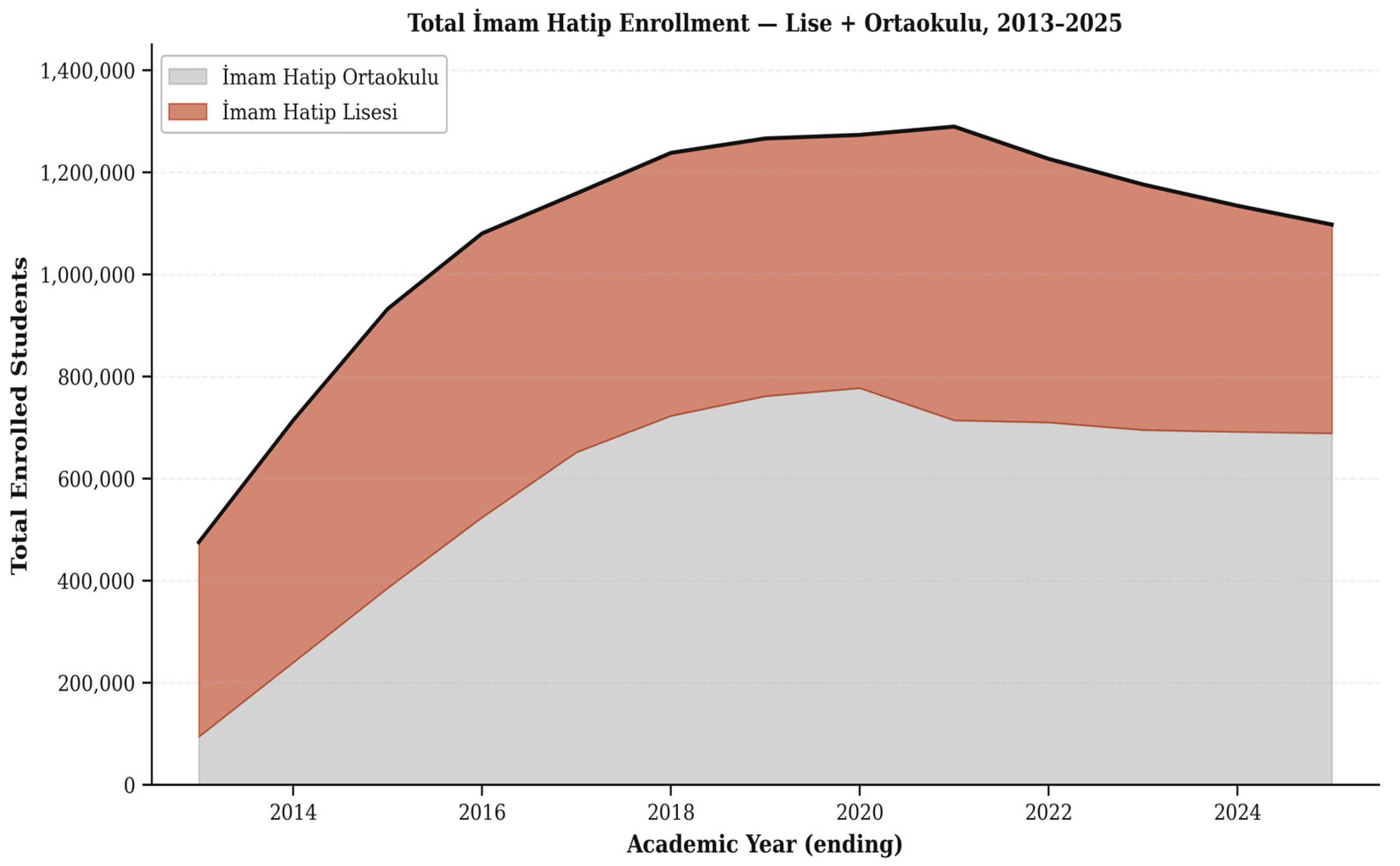
The transformation of religious education under the AK Party reflects a deliberate strategy by Erdoğan to embed Islam into the Turkish state apparatus and society as a means of political consolidation. The rapid expansion of İmam Hatip schools, which are religious vocational high schools that combine a secular curriculum with Islamic education, symbolizes more than educational reform. When the AK Party came to power in 2002, there were around 450 İmam Hatip high schools with about 65,000 students; over the next two decades, especially following reforms like the “4+4+4” system introduced in 2012, which allowed lower secondary İmam Hatip, the number of such schools expanded significantly (
Coşkun and Şentürk 2012). By the 2022–2023 school year, the number of İmam Hatip high schools exceeded 1700, with middle and secondary İmam Hatip schools numbering approximately 3400 to 3500, reflecting the increase in student enrollment (see
Figure 1;
Republic of Türkiye Ministry of National Education 2013–2025). It represents an intentional social engineering project aimed at shaping new generations within an Islamic framework aligned with the AK Party’s conservative and neo-Ottoman ideological vision.
Moreover, the incorporation of compulsory religious courses, such as Religious Culture and Moral Knowledge (Din Kültürü ve Ahlak Bilgisi), and the introduction of elective courses on Islamic theology and the life of Prophet Muhammad across public schools mark a significant departure from Atatürk’s secularist educational model (
Türkmen 2009, pp. 390–91). These changes aim to normalize religious expressions in public institutions and foster an Islamic moral framework that aligns with the AK Party’s political narrative.
This educational policy closely aligns with Erdoğan’s frequently repeated goal of cultivating “pious generations” (
Türegün 2025), reflecting a deliberate effort to merge religious identity with national pride and political allegiance. By combining faith and nationalism, the AK Party seeks to promote a form of conservative modernization that diverges from the purely secular republican ideal, which emphasizes the removal of religion from public life. This strategy helps build a social base whose loyalty to Erdoğan’s regime is strengthened by a shared religious and moral identity.
Critics warn that this state-led Islamization of education risks undermining Türkiye’s secular foundations and deepening societal cleavages between religious conservatives and secularists (
Özgen 2014). The privileging of Sunni Islamic values within public education marginalizes religious minorities and non-religious citizens, thereby reducing pluralism and increasing polarization (
Albayrak 2019, pp. 11–12).
From a theoretical perspective, the use of religious education illustrates how political actors can mobilize religion to strengthen political authority while framing it as religious liberalization and cultural renewal. Religious education, in this context, operates less as an expression of pluralism or democratic engagement and more as a mechanism of political socialization that reinforces loyalty to the state and shapes the contours of political dissent. It forms part of broader political strategies to influence Türkiye’s national identity and governance structures by mobilizing Islam as a resource, thereby intertwining religion and politics (
Mufti 2014, pp. 30–33).
In summary, the AK Party’s policies on religious education demonstrate how Islam is strategically deployed to reshape Türkiye’s socio-political order. They support the paper’s main argument: Islam itself is not inherently opposed to democracy. Instead, it is the political exploitation of religion by leaders, through institutions such as education, that limits pluralism and democratic freedoms in their pursuit of centralized, personalized power.
4.4. Integrating Religious and Nationalist Politics
“The use of Islam to consolidate political authority in Türkiye extends beyond individual policy changes or rhetorical appeals; it is part of a longer-term strategy that integrates religion with nationalist discourse. The alliance between the AK Party and the Nationalist Movement Party (MHP), often referred to as the “People’s Alliance” (Cumhur İttifakı), demonstrates how religion and nationalism can be mobilized to reinforce state authority, encourage political loyalty, and influence pluralistic dynamics within Türkiye’s diverse political landscape.
In the first years of government, Erdoğan mobilized a conservative Islamic identity to challenge the secular establishment that had dominated Turkish politics since Atatürk’s reforms. By emphasizing the moral, cultural, and civilizational dimensions of Islam, Erdoğan positioned himself as a protector of the pious and a counterweight to what many supporters perceived as an exclusionary secular elite. However, amid regional and domestic seismic changes,
3 Erdoğan incorporated nationalist rhetoric and symbolism to broaden his base beyond strictly religious constituencies. The MHP’s emphasis on Turkishness, national unity, and the primacy of Turkish ethnicity provided a complementary framework for the AK Party’s Islamic identity politics, enabling Erdoğan to appeal simultaneously to religious and nationalist voters. In this sense, religion is not perceived merely as a set of beliefs but as a political instrument deployed to legitimize authority and consolidate power within a broader nationalist narrative (
Brubaker 2012, p. 15).
This coalition leverages religion and nationalism in multiple ways. Policy initiatives, such as the expansion of religious education through İmam Hatip schools, the reintroduction of religious content into the public-school curriculum, and reforms that increase the visibility of Islamic practices in public institutions, demonstrate a deliberate strategy to socialize a generation of citizens aligned with the AK Party’s ideological vision. At the same time, nationalist policies, including constitutional changes that reinforce the executive presidency, nationalist narratives centered on territorial integrity, and an emphasis on Türkiye’s historical and cultural legacy, unite voters around a common political and ideological identity. This dual approach ensures broad electoral support, even in the face of economic crises since 2018 or political opposition, while marginalizing dissenting groups and alternative political voices (
Yabancı 2023).
The theoretical perspective of Anderson’s
Imagined Communities offers valuable insight into this process. By portraying Türkiye as a unified political and cultural community shaped by shared religious and ethnic identities, the AK Party promotes a sense of belonging and collective purpose among its supporters, including the MHP. Erdoğan’s narrative merges Islam and Turkishness into a coherent vision of the state, generating loyalty not only through policy benefits but also through ideology-based emotional bonds (
Benedict Anderson 1983, p. 197). Likewise, the notion of the political use of religion emphasizes that Islam is not inherently incompatible with democratic governance; rather, its political significance depends on how it is interpreted and mobilized by those in positions of authority. Religion is exploited to create moral legitimacy for policies, justify centralized authority, and normalize the political dominance of a particular party(s) and leader(s) (
Driessen 2014).
4.5. Constitutional Transformation and the Consolidation of Executive Power
The 15 July 2016 coup attempt and the AK Party’s strategic alliance with the MHP created a political opening for transformative constitutional reforms that reshaped Türkiye’s governance. Historically, Türkiye has operated under a parliamentary system characterized by the separation of powers, with a prime minister serving as head of government and the president holding primarily ceremonial authority (
B. Yılmaz 2018). This system, established during the republican period, aimed to balance power among the executive, legislative, and judicial branches.
The 2017 constitutional referendum, which passed narrowly amid contentious campaigning, marked a decisive shift from parliamentary to presidential governance. Key modifications included the abolition of the prime minister’s office and the concentration of executive authority in the presidency. The president was granted the ability to issue decrees, appoint vice presidents, ministers, and senior bureaucrats without parliamentary approval, and influence judicial appointments (
B. Yılmaz 2018). While supporters argued that these reforms would streamline decision-making and improve policy efficiency, critics cautioned that the changes could reduce institutional checks and balances, limit parliamentary oversight, and constrain pluralistic democratic practices (
Bilgin and Erdoğan 2018).
The AK Party-MHP coalition played a crucial role in driving this political shift. By bringing together religiously conservative and nationalist voters, the coalition gathered the electoral support needed to justify significant constitutional changes. This alliance demonstrates the deliberate integration of religious and national ideas to advance government goals because religion is used to reinforce moral and cultural authority, while nationalist ideas emphasize territorial integrity, sovereignty, and ideological unity, thereby creating a strong narrative of shared identity (
Yabancı 2023). From this perspective, the referendum is understood not merely as an institutional change but as a symbolic act that strengthens Erdoğan’s leadership and integrates religious-nationalist ideas into the political system.
Anderson’s concept of imagined communities once again offers insight into how the AK Party frames this transformation. The party depicts the Turkish nation as a unified community rooted in shared religious and ethnic ties, fostering emotional loyalty that extends beyond formal political structures (
Benedict Anderson 1983). In this framework, the presidency becomes both a practical and symbolic embodiment of the nation’s moral, religious, and cultural unity. Thus, such political instrumentalism of religion once again highlights that Islam is strategically deployed to legitimate, maintain, and strengthen authority (
Riaz 2024).
The post-2017 political system has also reinforced patterns of religious nationalism established under Erdoğan’s broader rule. Constitutional changes enabled policies that favor conservative Islamic education, support visible religious expressions in public, and boost nationalist narratives stressing Turkish superiority and territorial unity. These mechanisms work together to build a loyal political base, normalize centralized executive power, and weaken institutional constraints, illustrating how legal and institutional reforms are linked to the strategic use of religious politics.
In conclusion, the 2017 constitutional reform, examined through the lenses of religious nationalism and political instrumentalism, reveals how Erdoğan has transformed Türkiye’s governance structure to align with his ideological project. The integration of Islam and nationalism into the institutional framework of the presidency supports the paper’s central argument: that challenges to democratic practices in Türkiye stem less from inherent religious characteristics and more from the strategic mobilization of religion by political actors to consolidate authority and shape political pluralism.
5. Conclusions
In conclusion, Türkiye’s democratic challenges stem not from Islam itself but from the ways in which political leaders have engaged with the religious sphere—whether by circumscribing it or by reintegrating it—within broader projects of power consolidation. While the concentration of authority is often a feature of state formation, its expansion in the absence of robust institutional constraints can limit pluralism and weaken democratic governance.
During the early Republic, Atatürk initiated a decisive break with the Ottoman-Islamic legacy by removing religion from formal political authority and advancing a secular-national vision. Although this transformation laid important foundations for modernization, its top-down implementation prioritized rapid state-building, at times narrowing space for dissent and political diversity.
Decades later, under Erdoğan and the Justice and Development Party, religion was reintroduced into public and political life not merely as a matter of personal belief but as a component of national identity and state legitimacy. However, this reconfiguration did not necessarily deepen democratic practice. Instead, religious themes became embedded within a centralized-party framework characterized by expanded executive authority, weakened institutional oversight, and a more controlled civic sphere (
Müftüler-Baç and Keyman 2012, pp. 97–98).
While Atatürk and the officer corps of his era were largely drawn from nationalist, secular, and formally educated elites, Erdoğan’s political ascent rested primarily on mass support from Anatolia. Despite this sociological divergence, neither leader operated outside the longue durée of Ottoman political development. Rather, both emerged as products and culminations of a deeply entrenched military-bureaucratic reform tradition and a persistent state-centric conception of governance that structured political authority from the late Ottoman period into the Republican era.
Paradoxically, despite Erdoğan’s efforts to reintegrate Islam into public life and promote an Islamic identity, surveys indicate that Türkiye’s society is becoming increasingly secular or less religious, particularly among younger generations. Data indicate a decline in daily prayer, mosque attendance, and self-reported religiosity among the citizens of Türkiye, despite the state’s emphasis on Islamic values in education and public discourse (
Kenton 2019). This points to a growing divergence between state-sponsored interpretations of Islam and patterns of popular religiosity, suggesting that while Erdoğan draws on religion as part of his political strategy, younger generations may not fully adopt or practice the form of religiosity promoted by the state. Over time, Türkiye appears to have experienced both a narrowing of democratic space and a shift in the public role of religion.
This trend highlights a critical limitation of Sovereign Islam. Mobilizing religion as a political resource does not automatically translate into deeper religious commitment among citizens, and attempts to enforce religious identity top-down can generate resistance, indifference, or secularization at the societal level. It also highlights the distinction between political Islam as a tool of state strategy and the everyday practice of Islam among citizens, indicating that the consolidation of political authority often relies more on the symbolic and institutional deployment of religion than on widespread popular religiosity.
Thus, the primary challenge to democratic consolidation in Türkiye lies not in the presence or absence of Islam, but in the state’s control over religion, whether by limiting its public role, as in the early secular period, or by integrating it into governance in more recent periods. In both cases, the pattern remains the same: religion becomes a vector of state authority rather than a space for independent civic life. As long as the state treats religion as an instrument of power rather than as a means of facilitating genuine freedom of belief and diversity, the conditions for a fully-fledged democracy remain unmet.
If the society of Türkiye, particularly its younger generations, aims for a more modern, pluralistic, and consolidated democratic and liberal future, the central challenge is neither the complete removal of religion from public life nor its instrumentalization for political ends, but rather the redefinition of the relationship between religion and state politics. In other words, transforming religion from a tool of governance into an independent sphere within an inclusive democratic framework. Although this shift alone cannot guarantee a thriving democracy in Türkiye, the analysis in this study shows that it is a critical prerequisite for democratic consolidation and for a state structure that is more compatible with Islamic values, social equality, and plural conceptions of truth.