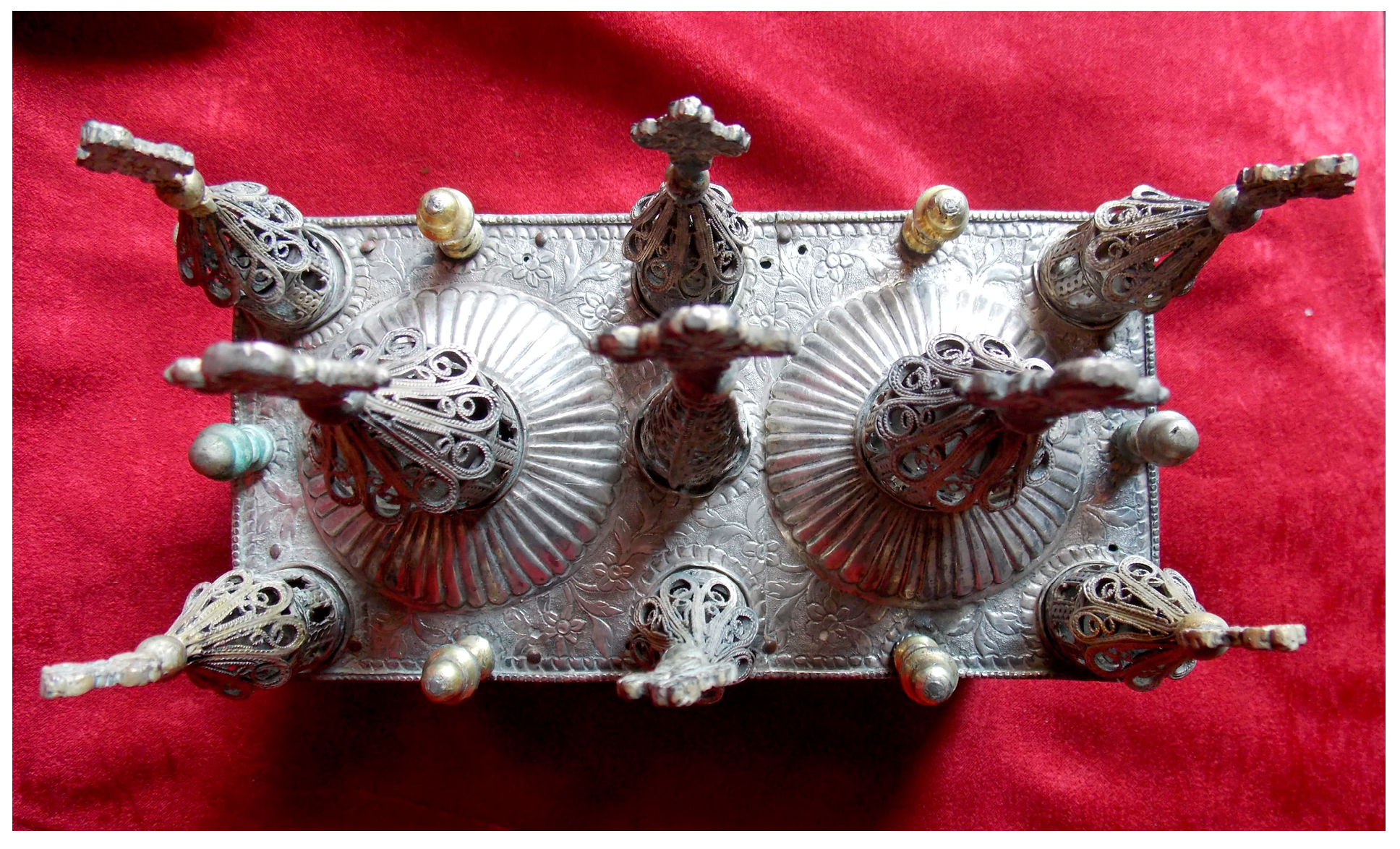
A Silver Ark in the Collection of the Armenian Diocese of Romania: An Image of the Heavenly Jerusalem?


Abstract
1. Introduction1
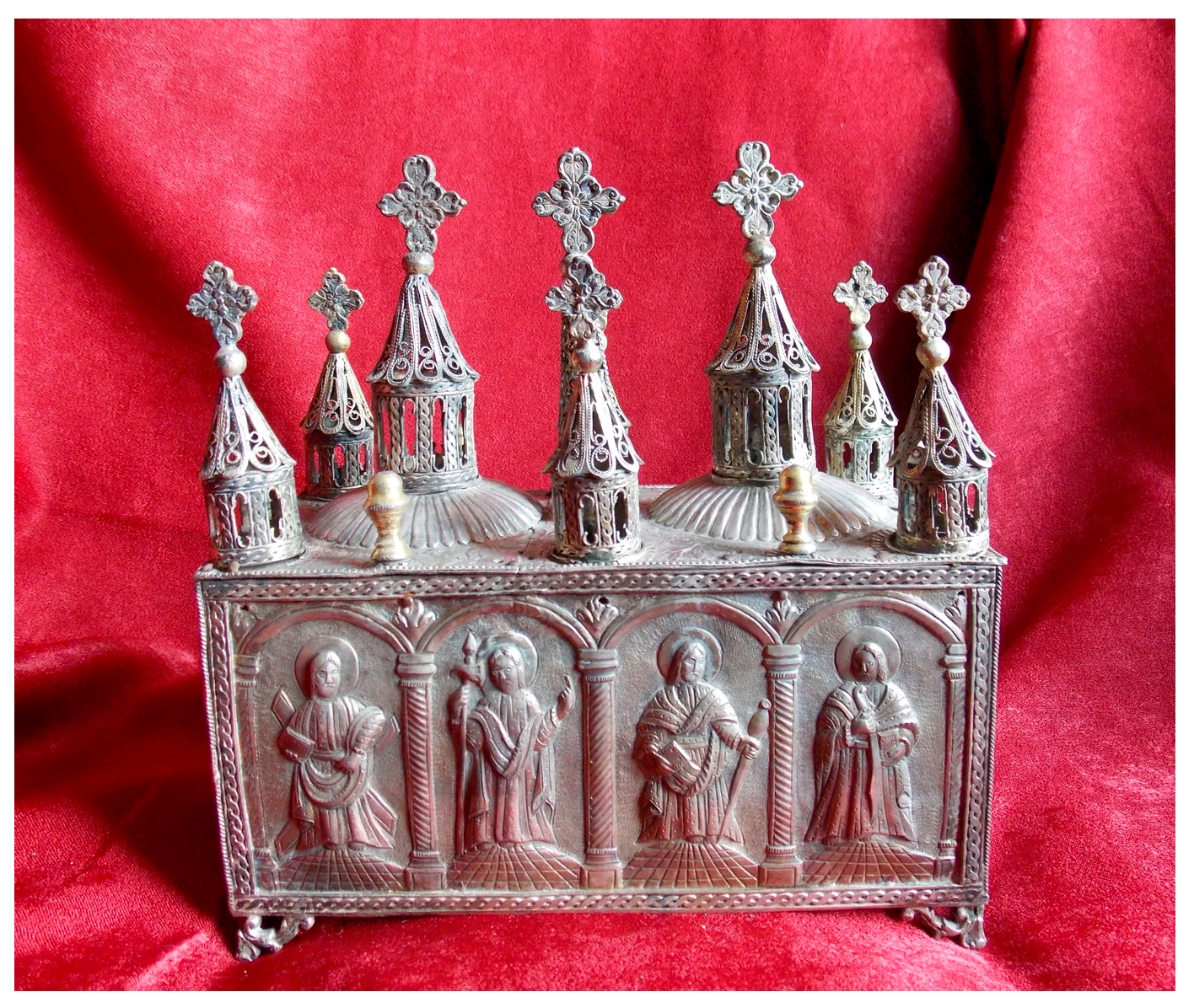
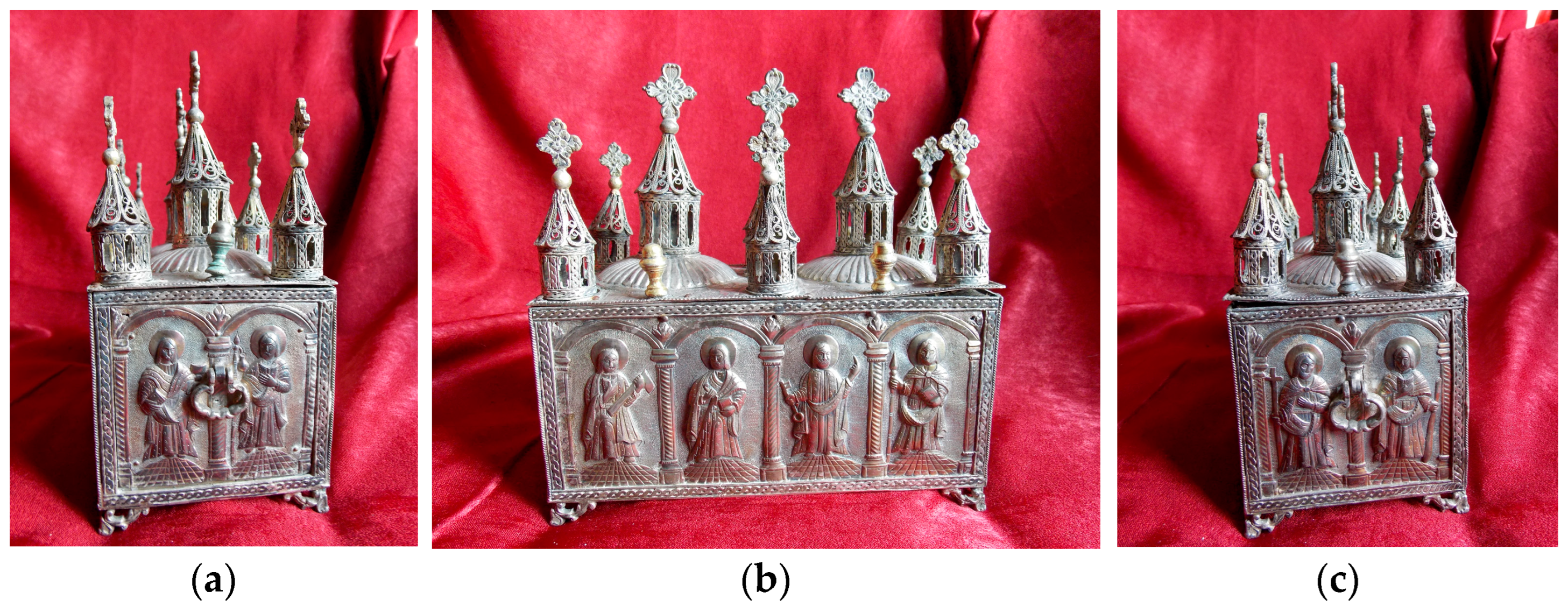
2. Description of the Object
3. Terminology and the Problems of Identification of the Object
4. The Ark as Evidence of Pilgrimage and Devotion
5. The Characteristics, Function and Symbolic Significance of the Church-Shaped Objects
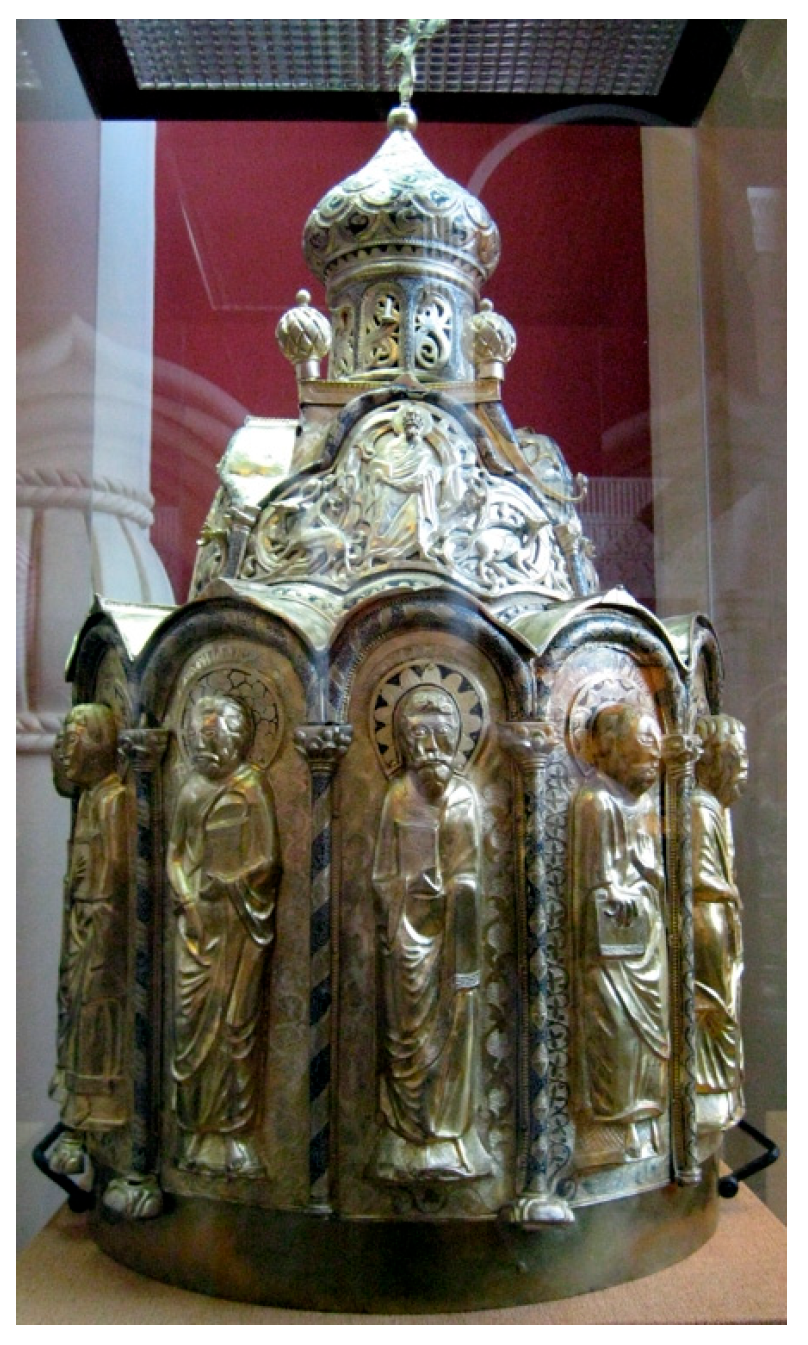
6. The Ark as a Symbol of the Heavenly Jerusalem
7. “Constantinople Style” and Armenian Silversmithing in Constantinople
8. Artistic Analysis of the Ark
9. Conclusions
Funding
Institutional Review Board Statement
Informed Consent Statement
Data Availability Statement
Acknowledgments
- I wish to express my deepest appreciation and heartfelt gratitude to my scientific supervisor, Levon Chookaszian, and to the Head of the Armenian Diocese of Romania, Bishop Datev Hakobian, for initiating and supporting the study of the Armenian art treasures of Romania and for their constant guidance and encouragement throughout this research. I am equally grateful to all the members of the Armenian Diocese of Romania for their continued support.
- My sincere thanks go to Fr. Hovhannes Haik Azarian for always finding time for meaningful conversations on ritual objects and for generously sharing his knowledge and insight.
- I am profoundly grateful to the Union of Armenians of Romania, represented by the President Varujan Vosganian, and especially to Arsen Arzumanyan, who stood by my side throughout the research process and offered unwavering support in every matter.
- I would also like to thank Davit Ghazaryan, Arsen Harutyunyan, Haykanush Mesropyan, and Ani Avetisyan for their valuable assistance in reading and interpreting the inscription.
- My warm thanks extend to Seyranush Manukyan, Zaruhy Hakobyan, and Inesa Danielyan for their constant readiness to help, their thoughtful advice, and their encouragement.
- My special gratitude goes to Vlad Bedros for believing in me and for quietly inspiring me through his work and professional example.
- Finally, I would like to express my sincere appreciation to the editorial board of the journal and to the two academic editors of this special issue for their invitation to publish this article without charge, and for their valuable feedback, which significantly enhanced the quality of my research.
Conflicts of Interest
| 1 | For transliterations is used the Hübschmann-Benveniste-Meillet system. |
| 2 | Scholars hold differing views regarding the formation of Armenian communities in the territory of present-day Romania. Nevertheless, the official date for the establishment of the community is generally considered to be 1401, when, by a decree of Alexander the Good, Prince of Moldavia, the creation of a diocese of the Armenian Church was permitted. There is no precise information regarding the exact period of Armenian settlement in Focșani. At present, a small Armenian community exists, and three churches remain standing: the Church of St. George (beginning of 18th century), the Church of St. Mary (18th century) and the Holy Resurrection Chapel in the Armenian cemetery (1891) (Siruni 1966, pp. 66–67). M. Mirakhorian mentions four churches, of which the oldest has not been preserved (Mirakhorian n.d., p. 2). |
| 3 | A lineage name or surname. |
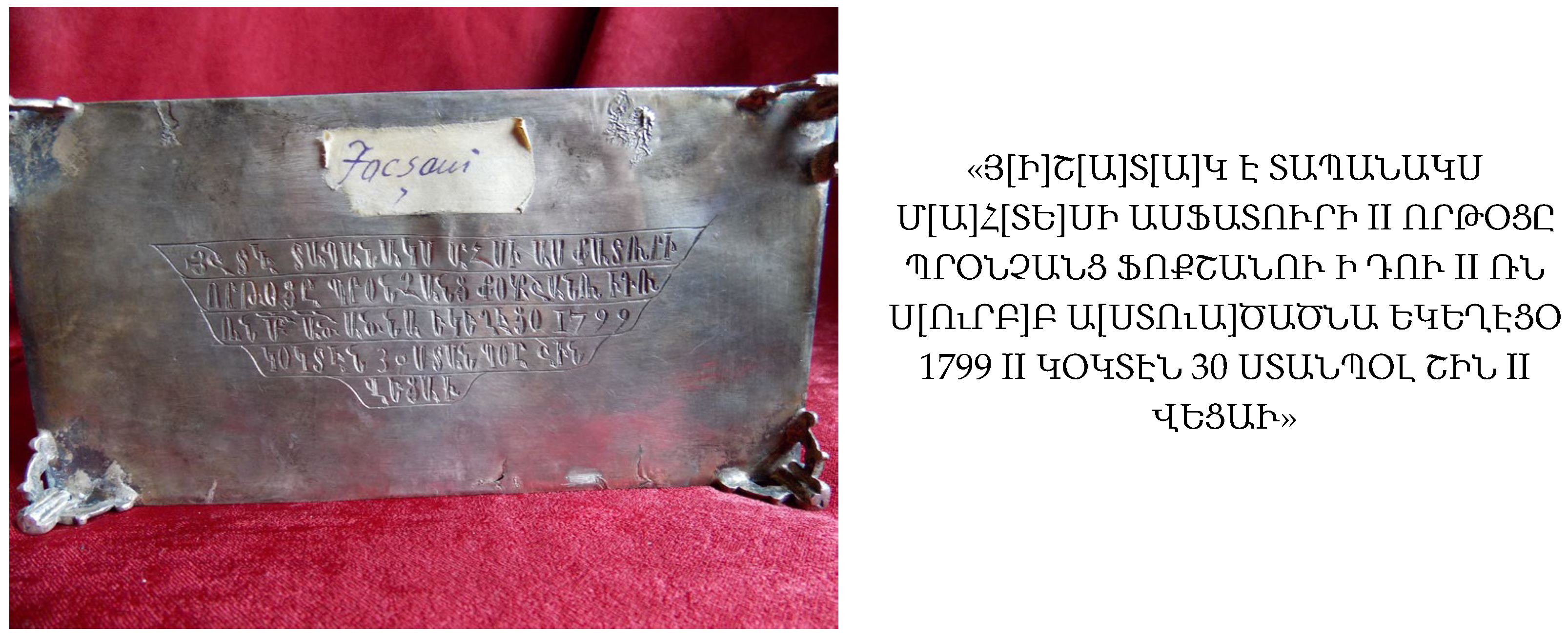
| 4 | The word “Kokten” (ԿՕԿՏԷՆ), which appears in the inscription, cannot be interpreted or linked to the context of the sentence, as no such word exists. The first hypothesis was that it is the name of a month; however, this form cannot be identified with any known month name. According to the Turkologist A. J. Avetisyan, this is a case of a scribal error, which is frequently encountered, especially in foreign-language texts written in Armenian script. In her view, the correct form should be “Konten” (ԿՕՆՏԷՆ), corresponding to the Turkish word “gün” (day), while “konten” represents the Armenian dialectal transcription of the word in the ablative case. In this case, the inscription becomes much more intelligible. It should be punctuated։ «Յ[Ի]Շ[Ա]Տ[Ա]Կ Է ՏԱՊԱՆԱԿՍ Մ[Ա]Հ[ՏԵ]ՍԻ ԱՍՖԱՏՈՒՐԻ II ՈՐԹՕՑԸ ՊՐՕՆՉԱՆՑ ՖՈՔՇԱՆՈՒ, Ի ԴՈՒ II ՌՆ Ս[ՈւՐԲ]Բ Ա[ՍՏՈւԱ]ԾԱԾՆԱ ԵԿԵՂԷՑՕ 1799: II ԿՕԿՏԷՆ 30 ՍՏԱՆՊՕԼ ՇԻՆ II ՎԵՑԱՒ», and can be translated accordingly: “This ark is a memory for sons of Mahtesi Asfatur from the Pronchants of Focsani, to the Church of Saint Mary in 1799. It was created in Stanpol (=Istanbul) within 30 days.” |
| 5 | Archbishop Małachia Ormanian—An Armenian theologian, historian and philologist. From 1896 to 1908 was the Armenian Patriarch of Constantinople. |
| 6 | Fr. Giwt Ałanyants is a cultural, church and public figure, educator, writer, translator, philologist, ethnographer, historian, publisher, and editor. |
| 7 | For exhibition methods aimed at emphasizing the significance of museum objects, see: (Johnson and Macnaughton 2024). |
| 8 | During the period under discussion, up to 1878, the region of Southern Dobruja, where the city of Dobrich is located, belonged to Romania. |
| 9 | A. Lidov, describing the image of Heavenly Jerusalem with numerous domes in Byzantine miniatures, believes that it is not at all necessary that it represents or resembles any particular church. The many domes may symbolize the many churches in Jerusalem, see: (Lidov 1998, p. 351). |
| 10 | On tempietto in the margins of manuscripts, see: (Manukyan 2012, pp. 88–96). |
| 11 | On light and transparency, see: (Kilgore 2017, p. 64) |
| 12 | There are currently many studies on architecture and light, see: (Gerstel and Cothren 2017, pp. 465–78; Nicuță 2022, pp. 95–107). |
| 13 | On one side is St. Matthias, on the other side is St. Peter pointing upwards his hand gesture. |
| 14 | Personal correspondence with Prof. Ronald T. Marchese University of Minnesota, researcher of the Armenian collections of Constantinople, 2014–2020. |
| 15 | Van Sichem, known for his book engravings, also produced copies of works by famous artists such as Albrecht Dürer, Abraham Vloemaert, and Hendrick Golzius (Ishkhanyan 1981, pp. 58–59). |
| 16 | For example, the copes, which are fastened at the chest with a buckle often made of silver, are typical Armenian. The cope is the principal vestment of the priestly rank. It is a colorful and richly decorated cape-like liturgical vestment, distinguished by its brilliance and elaborate ornamentation. See: (Ormanian 1992, pp. 107–8). |
| 17 | https://www.metmuseum.org/art/collection/search/468348 [accessed 13 January 2026]. https://www.metmuseum.org/art/collection/search/466137 [accessed 13 January 2026]. |
| 18 | The busts of the apostles are depicted in round medallions under the arches resting on the twisted columns on the dome of the Holy See Etchmiadzin Cathedral. See: (A. Ghazaryan 2007, p. 77). |
References
- Ačaṙyan, Hrachʿya. 1979. Hayeren Armatakan Baṙaran [Armenian Etymological Dictionary]. Yerevan: Yerevan University Press, vol. 4. [Google Scholar]
- Ališan, Łewond. 1910. Hin Hawatk῾ Kam Het῾Anosakan Krônk῾ Hayoc. Venice: San Lazzaro. [Google Scholar]
- Ałaneancʽ, Giwt. 1902. Karg Astvacapaštowt῾ean Hayastaneayc῾ S. Ekełec῾woy (Order of Piety of Armenian Holy Church). Tbilisi: Printing House M. Martirosyanc’. [Google Scholar]
- Bayburdyan, Vahan. 2011. Ôsmanyan Kaysrowt῾Yan Patmowt῾Yown [History of the Ottoman Empire]. Yerevan: Yerevan State University Press. [Google Scholar]
- Buckton, David. 1985. The Treasury of San Marco. Catalogue. Milan: Olivetti. [Google Scholar]
- Chookaszian, Levon. 2020. On New Paths for the Exploration of the Armenian Art. L’arte Armena. Storia Critica e Nuove Prospettive Studies in Armenian and Eastern Christian Art 2020: 50–61. [Google Scholar] [CrossRef] [Scilit]
- Darkevich, Vladislav. 1975. Svetskoe iskusstvo Vizantii [Secular Art of Byzantium]. Moscow: Iskusstvo. [Google Scholar]
- Davtyan, Hakob. 1965. K․ Polsi hay-kat῾olikneri gałtni tparanə [The Secret Printing House of the Armenian Catholics of Constantinople]. Bulletin of the Academy of Sciences of the Armenian SSR: Social Sciences 1: 29–40. Available online: https://arar.sci.am/dlibra/publication/120215/edition/109420?language=en (accessed on 11 February 2026).
- Denis, Valentin. 1965. L’art D’occident des Catacombs a la fin du XVe Siècle. Bruxelles: Éditions Meddens. [Google Scholar]
- Evance, Helen, and Sylvie Merian. 1994. The Final Centuries. Armenian Manuscripts of the Diaspora. In Treasures in Heaven: Armenian Illuminated Manuscripts. Edited by Matheus Thomas and Wieck Roger. New York: Princeton University Press, pp. 104–23. [Google Scholar]
- Faroqhi, Suraiya. 2013a. Subjects of the Sultan. Culture and Daily Life in the Ottoman Empire. London and New York: I.B. Tauris. [Google Scholar]
- Faroqhi, Suraiya. 2013b. The Ottoman Empire and the World Around It. London and New York: I.B. Tauris. [Google Scholar]
- Foskolou, Vicky. 2018. “Reading” the Images on Pilgrim Mementoes (Eulogies): Their Iconography as a Source for the Cult of Saints in the Early Byzantine Period. In Für Seelenheil und Lebensglück Das Byzantinische Pilgerwesen und Seine Wurzeln. Edited by I. Eichner and D. Ariantzi. Mainz: Verlag des Römisch-Germanischen Zentralmuseums, pp. 315–25. [Google Scholar]
- Galpagian, Yovhannes. 1979. Rumanahay Gałut‛ə [Armenian Community in Romania]. Erusałem: Srboc‛ Hakobeanc‛ Press. [Google Scholar]
- Garrison, Eliza. 2010. A Curious Commission: The Reliquary of St. Servatius in Quedlinburg. Gesta 49: 17–29. [Google Scholar] [CrossRef] [Scilit]
- Gatti, Evan. 2000. Reviving the Relic: An Investigation of the Form and Function of the Reliquary of St. Servatius, Quedlinburg. ATHANOR XVIII 18: 7–15. [Google Scholar]
- Gerstel, Sharon E. J., and Michael W. Cothren. 2017. The Iconography of Light. In The Routledge Companion to Medieval Iconography. Edited by Colum Hourihane. London and New York: Routledge, pp. 465–478. [Google Scholar]
- Ghazaryan, Armen. 1994. Rotonda Voskresenija i ikonografija rannesrednevekovyx xramov Armenii [Rotunda of the Resurrection and the Iconography of Early Medieval Temples in Armenia]. In Vostočnoxristianskij Xram. Liturgija i Iskusstvo [Eastern Christian Church. Liturgy and Art]. Edited by Aleksey Lidov. Saint Petersburg: Dmitry Bulanin, pp. 107–20. [Google Scholar]
- Ghazaryan, Armen. 2007. Kafedralʹnyj sobor Surb Èčmiadzin i vostočnoxristianskoe zodčestvo IV—VII vekov [Saint Echmiadzin Cathedral and Eastern Christian architecture of the 4th-7th centuries]. Moscow: Loctus Standi. [Google Scholar]
- Ghazaryan, Armen. 2009. «Novyj Ierusalim» v prostranstvennyx koncepcijax i arxitekturnyx formax srednevekovoj Armenii [“New Jerusalem” in spatial concepts and architectural forms of medieval Armenia]. In Нoвые Иерусалимы. Иерoтoпия и икoнoграфия сакральных прoстранств. Collection of Articles. Edited by Aleksey Lidoov. Moscow: Indrik, pp. 520–43. [Google Scholar]
- Ghazaryan, Flora. 2017. Western Iconographic Influences on Armenian Silver Book Bindings from Ottoman Constantinople (Eighteenth-Nineteenth Centuries). Master’s thesis, Central European University, Budapest, Hungary. Available online: https://www.researchgate.net/publication/323382754 (accessed on 11 February 2026).
- Goltz, Herman, and Klaus Goltz. 2000. Rescued Armenian Treasures from Cilicia. Sacred Art of the Kilikia Museum Antelias, Lebanon. Wiesbaden: Reichert. [Google Scholar]
- Güngörürler, Selim, and Henry Shapiro. 2023. Catholic Missionary Activity in the Early Modern Ottoman Empire from the Perspectives of State and Convert. Journal of the Ottoman and Turkish Studies Association 10: 79–97. [Google Scholar] [CrossRef] [Scilit]
- Hatsuni, Fr․ V. 1907. Srboc῾ nšxarnerə [The relics of saints]. “Bazmavep” an Armenian Studies, Philological, and Literary Journal 45: 6–12. [Google Scholar]
- Ishkhanyan, Rafayel. 1981. Hay girk῾ə 1512–1920 [Armenian Book 1512–1920]. Yerevan: Academy of Sciences of the Armenian SSR. [Google Scholar]
- Izmaylova, Tatyana. 1979. Armjanskaja Miniatjura 11 Veka [Armenian Miniature of the 11th Century]. Moscow: Iskusstvo. [Google Scholar]
- Johnson, Charlotte, and Lindsay H. Macnaughton. 2024. Making a case for cases: The transformative power of display furniture. Museum History Journal 17: 95–107. [Google Scholar] [CrossRef] [Scilit]
- Kalavrezou, Ioli. 2022. The Reliquary of St. Niphon. Relations between Wallachia, Constantinople, and Mt. Athos. In The Land Between Two Seas. Art on the Move in the Med-Iterranean and the Black Sea 1300–1700. Edited by Alina Payne. Leiden-Boston: Brill, pp. 239–51. [Google Scholar] [CrossRef] [Scilit]
- Kharatyan, Albert. 2012. Hay gratpowt῾yownə K. Polsowm ew Zmyowr̄niayowm (1567–1860-akan t῾t῾.) [Armenian Printing in Constantinople and Smyrna (1567–1860s)]. Herald of the Socil Sciences 4: 3–11. [Google Scholar]
- Kilgore, Claire. 2017. Viewing Heaven: Rock Crystal, Reliquaries, and Transparency in Fourteenth-Century Aachen. Master’s thesis, University of Nebraska-Lincoln, Lincoln, NE, USA, May 13. Available online: https://digitalcommons.unl.edu/artstudents/121/ (accessed on 11 February 2026).
- Klein, Holger. 2010. Relics & Reliquaries. Arthophorion (Reliquary of Saint Anastasius the Persian). In Treasures of Heaven. Saints, Relics and Devotion in Medieval Europe. Edited by Klein Holger, Mann Griffith, Robinson James and Bagnoli Margarita. Baltimore: Walters Art Museum. [Google Scholar]
- Korkotyan, Qnarik. 1964. Hay tpagir grk῾ə Kostandnowpolsowm (1567–1850) [Armenian Printed Book in Constantinople (1567–1850)]. Yerevan: Republic Library after Al. Myasnikyan. [Google Scholar]
- Kousouni, Christina-Konstantina, and Adamantia Panagopoulou. 2018. Non-destructive Physi-cochemical Analysis and Conservation of Metallic Book Covers of Ecclesiastical Books from Saint Mavra and Tiomtheos Church in Zakynthos (Greece). Scientific Culture (Journal of Applied Science & Technology to Cultural Heritage Issues) 4: 85–95. [Google Scholar] [CrossRef]
- Kürkman, Garo. 1996. Ottoman Silver Mаrks. Istanbul: Mathusalem Publications. [Google Scholar]
- Kürkman, Garo. 2019. Sultan’s Jewelers in the Ottoman Palace 1853–1871. Istanbul: Korpus Yayinlari. [Google Scholar]
- Lafontaine-Dosogne, Jaqueline. 1982. Splendeur de Byzance. Catalogue. Bruxelles: Musées royaux d’Art et d’Histoire. [Google Scholar]
- Lexikon. 1994. Lexikon der Christlichen Ikonographie. Allgemeine Ikonographie. Bd. 6. Freiburg: Herder, Freiburger Graphische Betriebe. [Google Scholar]
- Lidov, Aleksey. 1998. Heavenly Jerusalem: The Byzanitine Approach. The Real and Ideal Jerusalem in Jewish, Christian, and Islamic Art: Studies in Honor of Bezalel Narkiss on the Occasion of His Seventieth Birthday. Edited by Aliza Cohen-Mushlin Bianca Kühnel. Jerusalem: Hebrew University of Jerusalem, Center for Jewish Art, pp. 340–53. [Google Scholar] [CrossRef]
- Lidov, Aleksey. 2014. Ikony. Mir Svjatyx Obrazov i v Vizantii i na Rusi [Icons. The World of Holy Images in Byzantium and Rus’]. Moscow: Feoria. [Google Scholar]
- Manukyan, Seyranush. 2012. Obraz Ierusalimskogo Xrama na poljax armjanskix Evangelij [The image of the Jerusalem Temple on the margins of the Armenian Gospels]. In Lazarev Readings: Art of Byzantium, Ancient Rus’, Western Europe. Proceedings of the Scientific Conference. Moscow: Moscow University Publishing House, pp. 88–96. [Google Scholar]
- Manukyan, Seyranush. 2015. Freski Tateva (930) [Murals of Tatev (930). In “Genesis Forest”, Collected Articles in Memory of Felix Ter-Martirosov. Yerevan: YSU Publ. House, pp. 296–325. [Google Scholar]
- Marchese, Ronald. 2018. Sociological Implications in Armenian Religious Art in the Late Ottoman Period: Data from the Armenian Churches of Constantinople During the Second Armenian Renaissance—Post 1700. Available online: https://www.researchgate.net/publication/327053118_Sociological_Implications_in_Armenian_Religious_Art_in_the_Late_Ottoman_Period_Data_From_the_Armenian_Churches_of_Constantinople_during_the_Second_Armenian_Renaissance_-_post_1700 (accessed on 11 February 2026).
- Marchese, Ronald, and Marlene Breu. 2015. Treasures of Faith. Sacred Relics and Artifacts from the Armenian Orthodox Churches of Istanbul. Istanbul: Citlembik Publications. [Google Scholar]
- Merian, Sylvie. 2013. The Armenian Silversmiths of Kesaria/Kayseri in the Sixteenth and Seventeenth centuries. In Armenian Kesaria/Kayseri and Cappadocia. Edited by Hovhannisian Richard. Costa Mesa: Mazda Publishers, pp. 117–85. [Google Scholar]
- Mirakhorian, Manowel Vantsi. n.d. Patmowt῾iwn (patkerazard) Fôk῾šan k῾ałak῾i hayoc῾ ew irianc῾ č῾ors ekełec῾iac῾… 1650–1932 [History (Illustrated) of Armenians of the City of Focsani and their Four Churches… 1650–1932]. Unpublished.
- Nicuţă, Oana-Maria. 2022. The Iconography of Light in Renaissance Painting and its Medieval Heritage. ANASTASIS IX: 95–107. [Google Scholar] [CrossRef] [Scilit]
- Olar, Ovidiu. 2024. ‘Libertà et licenza… di stampare mille heræsie et schismi:’ The Propaganda Fide and the Greek Printing Press at Constantinople (1627–1628). In Arabic-Type Books Printed in Wallachia, Istanbul, and Beyond. Berlin and Boston: De Gruyter, pp. 89–120. [Google Scholar] [CrossRef] [Scilit]
- Ormanian, Malachia Archbishop. 1992. Cisakan bar̄aran [Ritual Dictionary], Yerevan, 1992. Yerevan: Hayastan. [Google Scholar]
- Piatnitsky, Yuri. 2005. Pilgrims’ Eulogias from the Holy Land in the Hermitage Museum Collection, St. Petersburg. ECA: Eastern Christian Art in Its Late Antique and Islamic Contenxts, PEETERS Online Journals 2: 103–18. [Google Scholar]
- Pokrovskij, Nikolaj. 1912. Drevnjaja Sofijskaja riznica v Novgorode [Ancient Sophia Sacristy in Novgorod]. Moscow: Printing House of G. Lissner and D. Sobko. [Google Scholar]
- Quataert, Donald. 2005. Ottoman Empire 1700–1922. Cambridge: Cambridge University Press. [Google Scholar]
- Ruiu, Adina. 2014. Conflicting Visions of the Jesuit Missions to the Ottoman Empire, 1609–1628. Journal of Jesuit Studies 1: 260–80. [Google Scholar] [CrossRef] [Scilit]
- Sakisian, Armenak. 1930. K. Polsoy hay oskerč῾owt῾iwnə. ŽƏ-ŽT῾ dar [Armenian Jewelry of Constantinople: 18th–19th Centuries]. “Anahit” Journal of Thinking and Art 5: 9–14. [Google Scholar]
- Simion, Victor. 1997. Masterpieces of the Precious Metalwork Art in Romania (Capodopedere ale Artei metalor Preţioase din România). Bucharest: Editura Technicâ. [Google Scholar]
- Siruni, Hakob. 1966. Hay ekełec‛in rumen hołi vra [Armenian Church in Romania]. Etchmiadzin: Mayr At‛oṙ Surb Ēǰmiacin. [Google Scholar]
- Smbatyan, Nelli, and Mariam Vardanyan. 2014. Hay arvesti stełcagorcowt῾yownneri owsowmnasirowt῾yownə Ṙowminiayowm [The Study of Armenian Works of Art in Romania]. Armenological Issues 2: 241–46. [Google Scholar]
- Srsic, Elizabeth. 2014. Mapping the Heavenly Jerusalem: An Examination of the Quedlinburg Casket (c.870–1200), 2014. Austin: The University of Texas. Available online: https://www.academia.edu/20228174/Mapping_the_Heavenly_Jerusalem_An_Examination_of_the_Quedlinburg_Casket_c_870_1200_ (accessed on 11 February 2026).
- Stepanyan, Hasmik. 2011. Hayeri Nerdrowmn Ôsmanyan Kaysrowt῾Yownowm [Armenian Contribution to the Ottoman Empire]. Yerevan: Gasprint. [Google Scholar]
- Sterligova, Irina. 2016. Ierusalimy [Jerusalem]. «Naše nasledie». History, Culture, Art. Illustrated Cultural and Historical Magazine 119: 112–17. Available online: https://www.nn.media/magazine/119/159/ (accessed on 11 February 2026).
- Sullivan, Alice, Vladimir Ivanovici, and Gabriel Herea. 2021. Space, Image, Light: Toward an Understanding of Moldavian Architecture in the Fifteenth Century. Gesta 60: 81–100. [Google Scholar] [CrossRef] [Scilit]
- Tokat, Osep. 2005. Armenian Master Silversmiths. Los Angeles: Van. [Google Scholar]
- Trahoulia, Nicolette. 2008. The Scent of an Emperor: Desire and the San Marco Incense Burner. Arte Medievale 7: 33–40. [Google Scholar]
- Vardanyan, Edda. 2012. Reflets d’Arménie. Manuscrits et Art Religieux/Reflections of Armenia. Manuscripts and Religious Art. Paris: ACHCByz. [Google Scholar]
- Vardanyan, Mariam. 2017. The Collection of Silver Book Binding of the Armenian Museum in Bucharest and Their Relationship to Eastern and Western Arts. Series Byzantina XV, Studies on Byzantine and Post-Byzantine Art 15: 81–97. [Google Scholar]
- Vardanyan, Mariam. 2024. Artistic Features of Armenian Liturgical Objects. MEΘEXIS: Journal of Research in Values and Spirituality IV: 13–42. [Google Scholar] [CrossRef] [Scilit]
- Yarman, Arsen. 2022. Osmanli Döneminde Mücevher ve Ermeni Kuyumcular. 2 vols, Istanbul: Yapi Kredi Yayinlari. [Google Scholar]
- Yartmian, Fr. T. 2000. Hayastani vank῾erown ew ekełec῾inerown mêǰ pahowac sowrberow masownk῾ner ew srbazan ar̄arkaner [Relics of Saints and Sacred Objects Preserved in the Monasteries and Churches of Armenia]. “Bazmavep” an Armenian Studies, Philological, and Literary Journal 158: 128–61. [Google Scholar]


Disclaimer/Publisher’s Note: The statements, opinions and data contained in all publications are solely those of the individual author(s) and contributor(s) and not of MDPI and/or the editor(s). MDPI and/or the editor(s) disclaim responsibility for any injury to people or property resulting from any ideas, methods, instructions or products referred to in the content. |
© 2026 by the author. Licensee MDPI, Basel, Switzerland. This article is an open access article distributed under the terms and conditions of the Creative Commons Attribution (CC BY) license.
Share and Cite
Vardanyan, M. A Silver Ark in the Collection of the Armenian Diocese of Romania: An Image of the Heavenly Jerusalem? Religions 2026, 17, 285. https://doi.org/10.3390/rel17030285
Vardanyan M. A Silver Ark in the Collection of the Armenian Diocese of Romania: An Image of the Heavenly Jerusalem? Religions. 2026; 17(3):285. https://doi.org/10.3390/rel17030285
Chicago/Turabian StyleVardanyan, Mariam. 2026. "A Silver Ark in the Collection of the Armenian Diocese of Romania: An Image of the Heavenly Jerusalem?" Religions 17, no. 3: 285. https://doi.org/10.3390/rel17030285
APA StyleVardanyan, M. (2026). A Silver Ark in the Collection of the Armenian Diocese of Romania: An Image of the Heavenly Jerusalem? Religions, 17(3), 285. https://doi.org/10.3390/rel17030285