A Medium for Chanting the Buddha’s Name for Rebirth in the Pure Land: The Woodblock Print of Kwŏnsu-Chŏngŏp-Wangsaeng-Ch’ŏpkyŏngdo in Chosŏn Korea

Abstract
1. Introduction
2. Pure Land Faith and Yŏmbul-Sŏn (念佛禪) in Chosŏn
3. Iconography and Composition of Wangsaeng-Ch’ŏpkyŏngdo
The Pure Land exists only in the mind, with no separate land;Self-nature is Amitābha—how could there be any different form?Sentient beings, deluded by this, remain in the dusty world;Therefore the Buddha opened the Pure Land.One day, seven days, forty-nine days—Nine times the lotus blossoms in sequence;Regardless of noble or lowly birth, those who wish to be born there—That Buddha’s name and characteristics reside within the mind.惟心淨土別無地 自性彌陁何異形 衆生迷此在塵中 是故能仁開淨土 一日七日七七日 三三瑞蕚次第開 無問貴賤欲生彼 彼佛名相在心頭(Archive of Buddhist Canons (ABC) n.d.b, H0220, v10, pp. 153c22–54a02)3
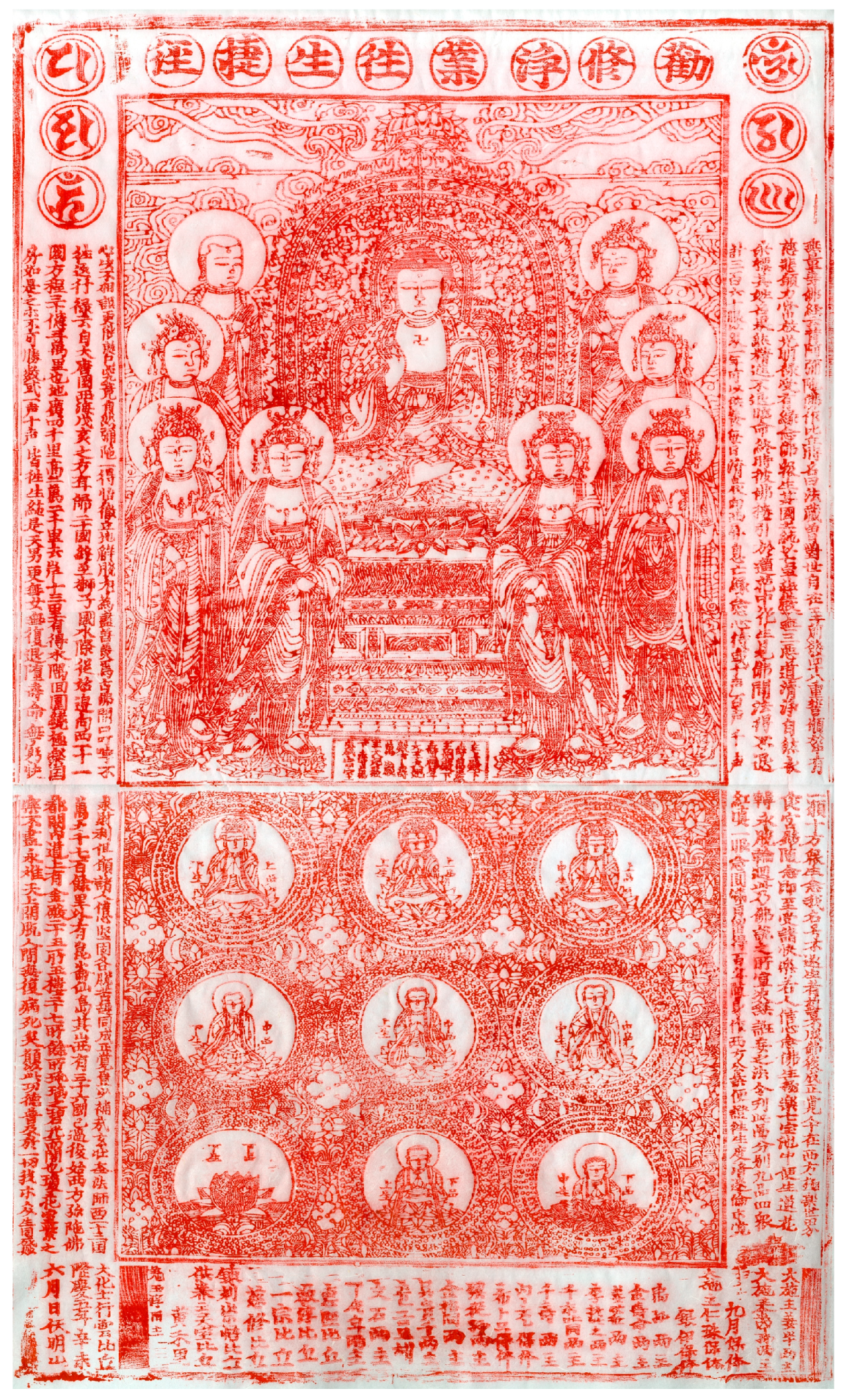
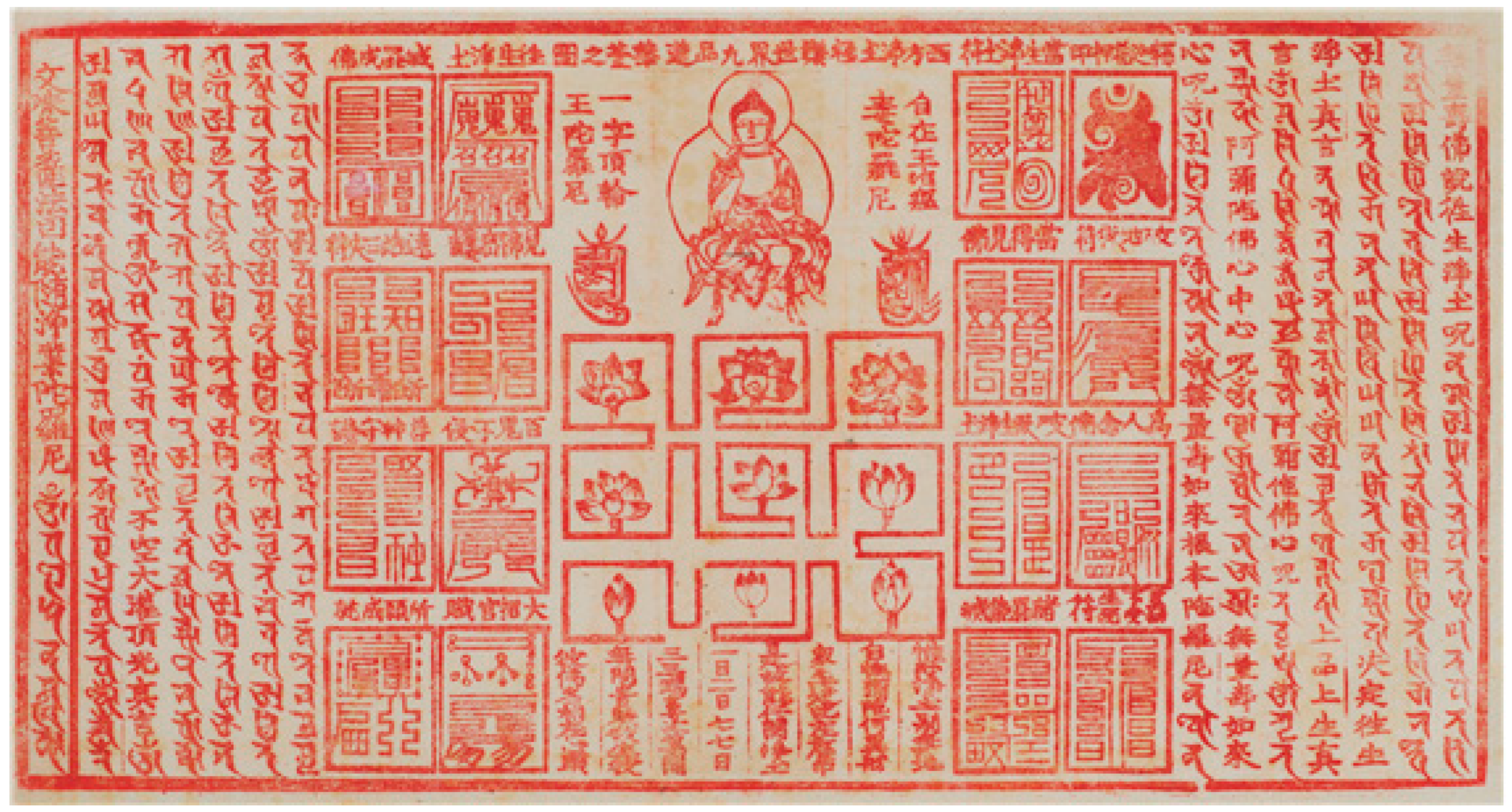
無量壽佛經云 昔阿彌陀佛 作此比丘時 名曰法藏 曾對世自在王前 發四十八重誓願 於中有一願 十方衆生 念我名號 不遂生者 誓不成佛 後成正覺 今在西方極樂世界 慈悲願力常放光明 祿受有緣念佛衆生 其國土純 以七寶莊嚴 無三惡道 淸淨自然 衣食宮殿隨念卽至 受諸快樂 若人心信念佛 生極樂七寶池中 便生蓮花朶 標其姓名 果然精進不退 臨命終時 彼佛接引於蓮花中化生 見佛聞法 得不退轉 永脫輪廻 此乃佛說之所宣 決無誑妄之法 今刊此圖分別九品四衆 計三百六十眼 以象一年 可以供養 每日淸晨 向西屛息亡緣 念心持或十聲百聲千聲 紅塡一眼 念圓滿月留得百年隨身 作西方公業 便證往生 度濟迷倫等覺心決不相誤 更能就已究竟 自然彌陀一得悟徹立地解脫 尤爲盡善羙焉 古佛開口叮嚀 不求財利 但願諸人 信心堅固 各脫苦趣 同成正覺 豈以補哉... 願以此功德 普及於一切我等衆生同成妙.
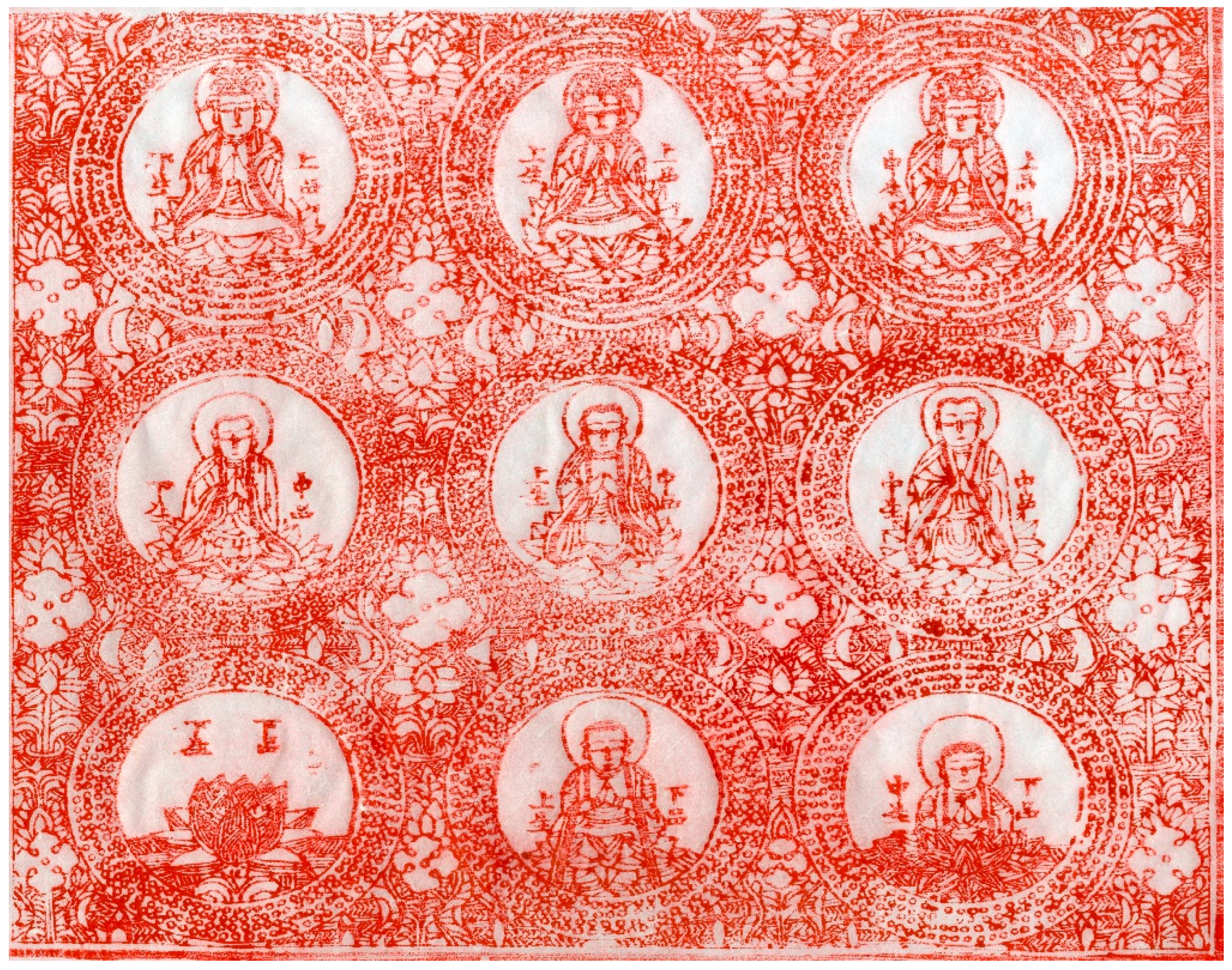
“… Now this print is published, distinguishing the nine grades and four groups of disciples, with a total of 360 sections symbolizing one year, making it possible to offer devotions. Each morning, one should face west, quiet the mind, and detach from external conditions, recite the Buddha’s name in one’s mind ten, one hundred, or one thousand times, and fill in one cell with red. When reciting with aspiration that the Perfect Moon (Amitābha Buddha) remains with one’s body for a lifetime, making rebirth in the Western Pure Land one’s central practice, one will attain rebirth…”
- Practitioners hung this image facing west each morning and used it as a medium for yŏmbul practice.
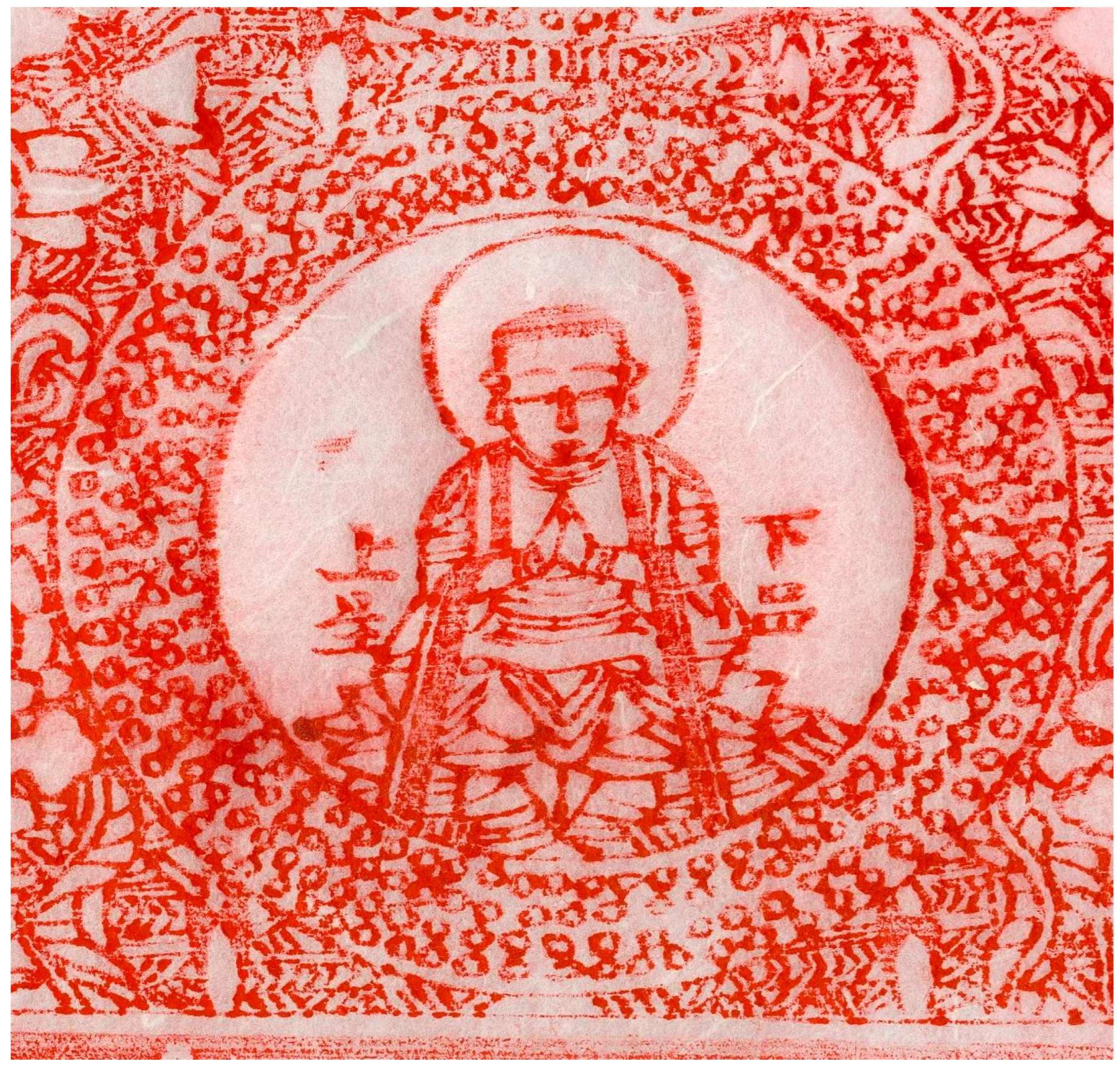
- Practitioners utilized this image as a tool for continuous yŏmbul practice by filling in the small circles surrounding the images of the nine grades of rebirth day by day. (The four-layered circular patterns of pearl borders surrounding the nine-grade images are heavily worn in many areas, making precise counting difficult, but they can be roughly estimated at approximately 100-94-86-80 from the outermost layer inward, totaling 360. This number corresponds to the annual count mentioned in the publication colophon. The colophon’s instruction to fill in each section with red pigment during yŏmbul practice presumably refers to these circular patterns.) (Figure 6).
4. The Dissemination of Wangsaeng-Ch’ŏpkyŏngdo
5. Conclusions
Funding
Institutional Review Board Statement
Informed Consent Statement
Data Availability Statement
Conflicts of Interest
| 1 | Unlike the Sixth Patriarch Huineng 六祖惠能 (638–713), who rejected and criticised Pure Land faith in the Western Paradise, Yongming Yanshou embraced the Western Pure Land and advocated the unity of Sŏn and Pure Land (禪淨一致). He practised Dual Cultivation of Sŏn and Pure Land (禪淨雙修, Kor. Sŏnchŏngssangsu, Ch. chanjing shuangxiu), seeking to realise the truth of mind through seated meditation (坐禪, Kor. Chwasŏn, Ch. zuochan) and to achieve rebirth in the Pure Land after death through Buddha recitation. He acknowledged not only Amitabha’s Pure Land in the west but also the pure lands of all Buddhas (諸佛淨土, Kor. Chebulchŏngto, Ch. zhufo jingtu), whilst also advocating the Mind-Only Pure Land (唯心淨土). |
| 2 | Although Kihwa did not acknowledge the actual existence of the Pure Land, he maintained that one could expound on the Pure Land and hell for the purpose of teaching sentient beings. As a Chan master who held the view of Mind-Only Pure Land (唯心淨土), he is understood to have tolerated Pure Land faith in the Western Paradise for the sake of instructing the masses. Kihwa’s approach to practice can be seen as an inclusive attitude that recognised Chan meditation as the highest level of cultivation whilst accepting doctrinal study and directional Buddha recitation with form and characteristics (chipangipsang, 指方立相, Ch. zhifang lixiang). |
| 3 | The Sammun chikchi represents an important Buddhist text demonstrating the development of the Three Gates study system and the expansion of Buddha recitation faith during the late Chosŏn period. |
| 4 | Here, ‘section (眼)’ refers to compartments or small circular spaces, a format frequently found in Buddhist practice record charts or Buddha recitation diagrams (yŏmbuldo 念佛圖). These 360 compartments were designed to correspond to the days of a lunar year (approximately 360 days), allowing practitioners to fill in the compartment for each respective date with red colour after completing their daily Buddha recitation practice, thereby recording their practice progress. This type of Buddha recitation diagram serves as both a practice calendar and a visual record chart, functioning as a tool to help practitioners maintain their daily Buddha recitation practice consistently. In this context, it refers to the 360 compartments that serve as a practical cultivation tool provided alongside the iconographic image. |
| 5 | Yi argued that the Kwangyŏng sipyuk kwan pyŏnsangdo (Contemplation Sutra Sixteen Contemplations Transformation Tableau), which had faithfully depicted the sixteen contemplations of the Contemplation Sutra during the Koryŏ and early Chosŏn periods, underwent a transformation beginning with the Sŏbang kupum yongsŏn chŏpin hoedo 西方九品龍船接引會圖 (Nine Grades of the Western Paradise and Dragon Boat Reception Assembly Painting) produced in 1582, shifting towards emphasising the final stage of the three worship contemplations (sampae kwan 三拜觀), namely the nine grades of the Pure Land (kŭngnak kupum 極樂九品). He pointed out that this tendency can also be confirmed through the literary collections of sixteenth-century monks, presenting as evidence the fact that Chŏnghŏ Hyujŏng composed an enshrinement record for the Amitabha Assembly and the Nine Grades Assembly of the Western Paradise on the dharma hall walls of Tosŏlam Kŭngnakchŏn at Mount Kŭmgang, and that his disciple Kiam Pŏpkyŏn 奇巖法堅 (1559–1636) wrote a text encouraging the restoration of the Yŏngsanhoesangdo 靈山會上圖 (Vulture Peak Assembly Painting) and the Nine Grades Assembly of the Western Pure Land at Changŭngsa on Mount Sangdu in Yŏju. |
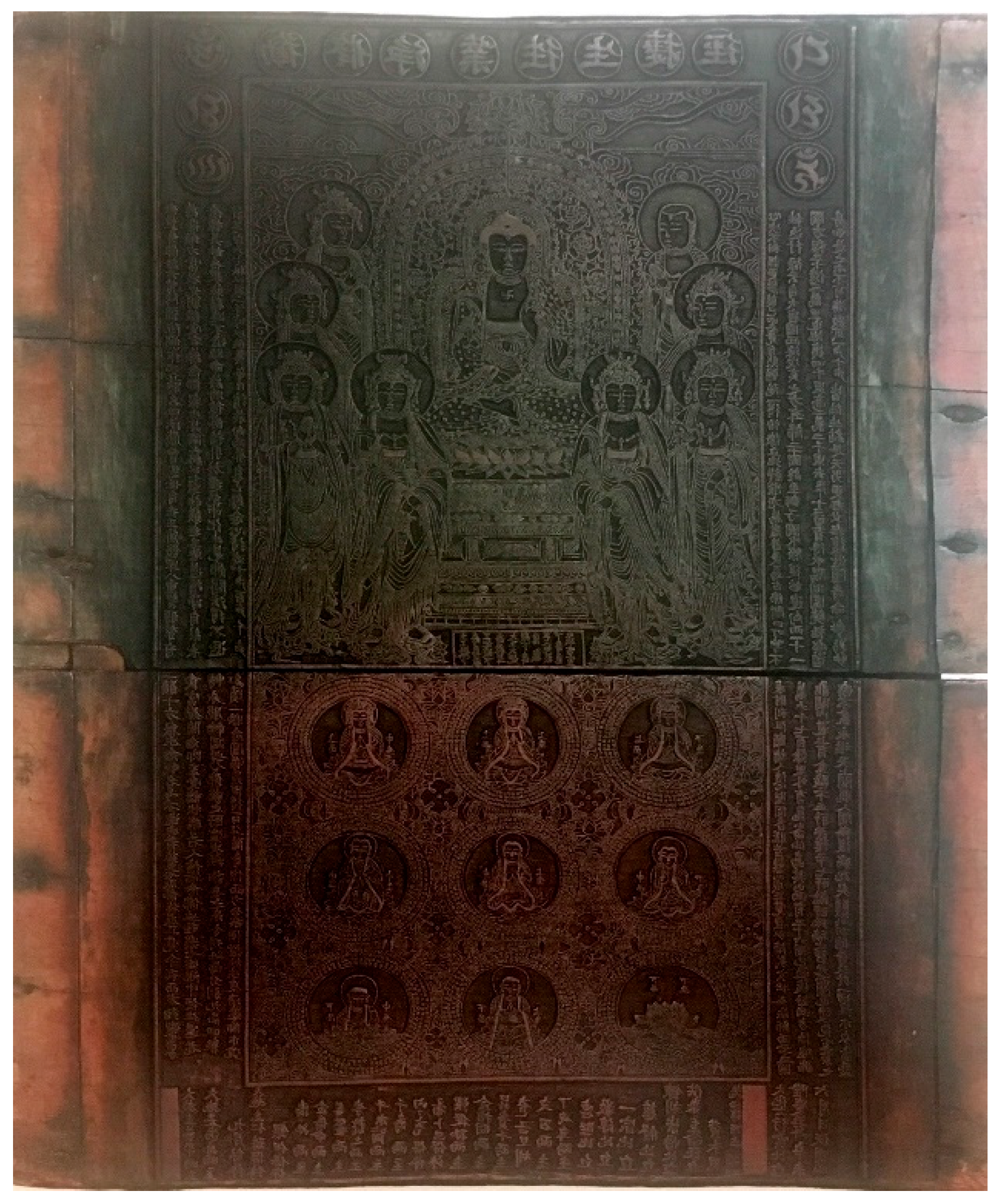
| 6 | While the Ssanggyesa version carved the Amitabha and Eight Great Bodhisattvas painting and the Nine Grades of Rebirth transformation tableau on two separate woodblocks, the Sin’ansa version differs in that it carved the two transformation tableaux on the front and back of a single woodblock. However, both share the common feature of dividing one transformation tableau into two parts for production. This contrasts with later transformation tableaux that carved both upper and lower iconographic elements on a single woodblock. |
| 7 | Sŏngchŏng 性渟 carved the Kofŏng hwasang sŏnyo 高峰和尙禪要 (Essential Chan Teachings of Master Kofŏng) and the Kŭmgang kyŏng 金剛經 (Diamond Sutra) at Ansimsa 安心寺 in Kosan 高山 in 1575, and records confirm his participation in 1576 in the carving of the Nŭngsŏng Ku-ssi sŏngbo 綾城具氏姓譜 (Genealogy of the Ku Clan of Nŭngsŏng) at Posalsa 菩薩寺 in Ch’ŏngju 淸州, a project involving forty-four woodblock carvers. |
| 8 | The manilhoe 萬日會 (Ten Thousand Days Assembly) received its name because both monastics and laypeople committed to practising Buddha recitation for ten thousand days, and it represents a distinctive practice method unique to Korea. |
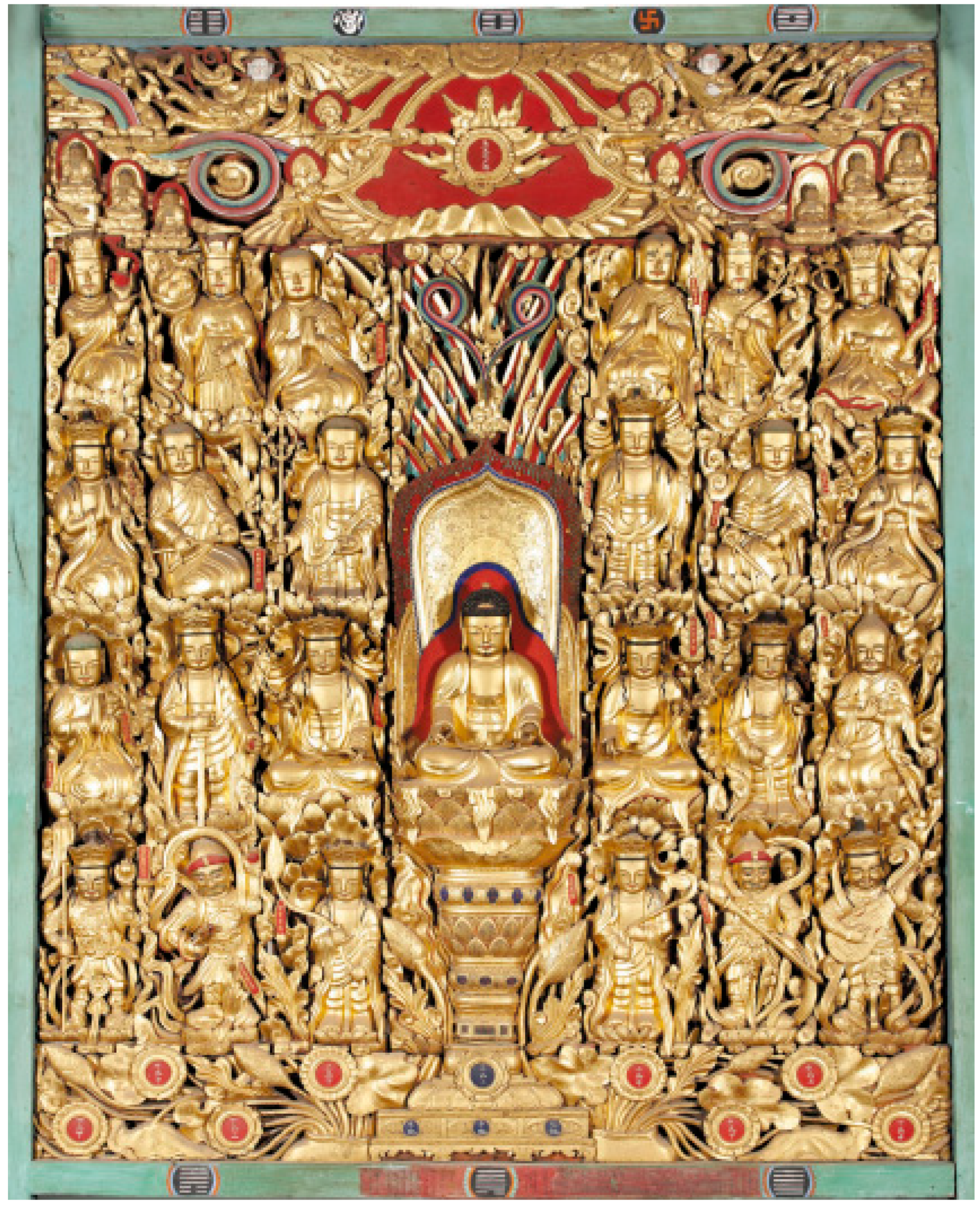
| 9 | The extant Mokgak Amit’a yŏrae sŏlbŏpsang 木刻阿彌陀如來說法像 (Wood-Carved Amitabha Buddha Preaching Images) comprise a total of six pieces: the Taesŭngsa Mokgak Amit’a yŏrae sŏlbŏpsang 大乘寺木刻阿彌陀如來說法像 in Mungyŏng 聞慶 (1675), the Yongmunsa Mokgak Amit’a yŏrae sŏlbŏpsang 龍門寺木刻阿彌陀如來說法像 in Yech’ŏn 醴泉 (1684), the Kyŏngguksa Mokgak Amit’a yŏrae sŏlbŏpsang 慶國寺木刻阿彌陀如來說法像 in Seoul (late 17th century), the Namjangsa Kwanŭmam Mokgak Amit’a yŏrae sŏlbŏpsang 南長寺觀音庵木刻阿彌陀如來說法像 in Sangju 尙州 (1694), the Namjangsa Pokwangchŏn Mokgak Amit’a yŏrae sŏlbŏpsang 南長寺普光殿木刻阿彌陀如來說法像 in Sangju (late 17th to early 18th century), and the Silsangsa Yaksuan Mokgak Amit’a yŏrae sŏlbŏpsang 實相寺藥水庵木刻阿彌陀如來說法像 in Namwŏn 南原 (1782). For a detailed study of the Wood-Carved Amitabha Buddha Preaching Images of the late Chosŏn period, see Chongmun Yi (1996) and Yu (2007). |
| 10 | Assessment of Ŭich’ŏn and Singyŏng can be inferred from the inscription on Ŭich’ŏn’s portrait, which reads “Sŏsan Hyujŏng’s direct descendant, P’yŏnyang’s direct disciple, dwelling nowhere permanently, preeminent in dhūta practice” (西山嫡孫鞭羊親弟居止不定頭陀第一), and from the record in “Ssanggyesa Nŭnginam ki” 雙磎寺楞伽庵記 [Record of Nŭnginam Hermitage at Ssanggyesa Temple] by P’unggye Myŏngch’al 楓溪明察 (1640–1708), P’ungye chip 楓溪集 [Collected Works of P’ungye], kwŏn chi ha 卷之下 (Archive of Buddhist Canons (ABC) n.d.a, H0182 v9, p. 150a), where Soyŏng is praised as a figure who did not compete with worldly people for fame and profit, lived in seclusion in stone caves, thoroughly cleansed himself of worldly afflictions, and cultivated the Way (toŏp 道業), becoming outstanding in his practice for his generation. |
References
Primary Sources
Chinhŏ P’algwan 振虛捌關. Sammun chikchi 三門直指 [Direct Pointing to the Three Gates]. Woodblock print. Ŭnjŏksa 隱寂寺, Anju 安州, 1769.Chinhŏ P’algwan 振虛捌關. Sammun chikchi 三門直指. H0220 v10, p.153c22–p.154a02.Kwŏnsu-chŏngŏp-wangsaeng-ch’ŏpkyŏngdo 勸修淨業往生捷徑圖 [Diagram Encouraging the Cultivation of Pure Karma as a Direct Path to Rebirth]. Woodblock print. Ssanggyesa 雙溪寺, Ŭnjin 恩津, 1571.Kwŏnsu-chŏngŏp-wangsaeng-ch’ŏpkyŏngdo 勸修淨業往生捷徑圖. Woodblock print. Sin’ansa 身安寺, Kŭmsan 錦山, 1576.Kwŏnsu-chŏngŏp-wangsaeng-ch’ŏpkyŏngdo 勸修淨業往生捷徑圖. Woodblock print. Yŏngwŏnsa 靈源寺, Chirisan 智異山, 1640.Kwŏnsu-chŏngŏp-wangsaeng-ch’ŏpkyŏngdo 勸修淨業往生捷徑圖. Woodblock print. Unhŭngsa 雲興寺, Wŏnchŏksan 圓寂山, 1678.Kwŏnsu-chŏngŏp-wangsaeng-ch’ŏpkyŏngdo 勸修淨業往生捷徑圖. Woodblock print. Yŏngwŏam 靈源庵, 1781.Muryang subul kyŏng 無量壽佛經 [Ch. Wuliangshou fo jing, Skt. Sukhāvatīvyūha-sūtra; Sutra of Immeasurable Life]. 2 juan. Trans. Saṅghavarman (Sengjiabamo 僧伽跋摩; d.u.) T no. 360, vol. 12.P’unggye Myŏngch’al 楓溪明察. “Ssanggyesa Nŭnginam ki” 雙溪寺能仁庵記. P’ungye chip kwŏn chi ha 楓溪集卷之下. H0182 v9, p. 150a.Secondary Sources
- Archive of Buddhist Canons (ABC). n.d.a Dongguk University. Available online: https://kabc.dongguk.edu/viewer/view?dataId=ABC_BJ_H0182_T_004&imgId=009_0150_a (accessed on 4 January 2026).
- Archive of Buddhist Canons (ABC). n.d.b Dongguk University. Available online: https://kabc.dongguk.edu/viewer/view?dataId=ABC_BJ_H0220_T_002&imgId=010_0153_c (accessed on 4 January 2026).
- Buddhist Records Cultural Heritage Archive Project Team 불교기록문화유산 아카이브사업단. 2017. Pulgyo Kirok Munhwa Yusan Ak’aibu Saŏptan Komunhŏn Torok 1—Wŏnkaksa ŭi pulgyo munhŏn 불교기록문화유산 아카이브사업단 고문헌 도록 1—원각사의 불교문헌 [Buddhist Records Cultural Heritage Archive Project Team Ancient Document Catalogue 1—Buddhist Literature of Wŏnkaksa]. Seoul: Dongguk University Buddhist Studies Research Institute 동국대학교 불교학술원. [Google Scholar]
- Han, Pogwang 한보광. 2000. Manil Yŏmbul Kyŏlsaŭi Sŏngnipkwa kŭ Yŏkhal 萬日念佛結社의 成立과 그 役割 [The Establishment and Role of the Ten Thousand Days Buddha Recitation Society (Manil Yŏmbul Kyŏlsa)]. In Sinang Kyŏlsa Yŏn’gu 信仰結社硏究 [Studies on Religious Associations]. Seoul: Yŏraejang 여래장. [Google Scholar]
- Kim, Jahyŏn 김자현. 2017. Chosŏn Chŏn’gi Pulgyo Pyŏnsang P’anhwa Yŏn’gu 朝鮮前期 佛敎變相版畵 硏究 [A Study on Buddhist Transformation Prints During the Early Chosŏn Period]. Ph.D. dissertation, Department of Art History, Dongguk University, Seoul, Republic of Korea. [Google Scholar]
- Kim, Sangho 김상호. 1990. Chosŏnjo Sach’alp’an Kaksue Kwanhan Yŏn’gu 조선조 사찰판 각수에 관한 연구 [A Study on the Woodblock Carvers of Temple Publications During the Chosŏn Dynasty]. Ph.D. dissertation, Department of Library and Information Science, Sŏnggyun’gwan University, Seoul, Republic of Korea. [Google Scholar]
- National Heritage Portal. n.d. Korean Heritage Service. Available online: https://www.heritage.go.kr (accessed on 17 August 2025).
- Park, Haedang 박해당. 1996. Kihwa ŭi Pulgyo Sasang Yŏn’gu 己和의 佛敎思想 硏究 [A Study on the Buddhist Thought of Kihwa]. Ph.D. dissertation, Department of Philosophy, Seoul National University, Seoul, Republic of Korea. [Google Scholar]
- Yi, Chongmun 이종문. 1996. Chosŏn hugi hubul mokgŭkchang yŏn’gu 朝鮮後期 後佛木刻幀 硏究 [A Study of the Wooden Relief Panels Placed Behind the Buddhist Images of the Late Choseon Period]. Korean Journal of Art History 美術史學硏究 209: 39–85. [Google Scholar]
- Yi, Chongsu 이종수. 2010. Chosŏn Hugi Pulgyoŭi Suhyŏng Ch’egye Yŏn’gu: Sammun Suhagŭl Chungsimŭro 조선후기 불교의 수행체계 연구: 三門修學을 중심으로 [A Study on the Practice System of Buddhism in the Late Chosŏn Period: Focusing on the Three Gates of Learning]. Ph.D. dissertation, Department of History, Dongguk University, Seoul, Republic of Korea. [Google Scholar]
- Yi, Yongyun 이용윤. 2013. Chosŏn hugi Kyŏngsangdo chiyŏk esŏ chejak toen Kwangyŏng sipyuk kwan pyŏnsangdo wa yŏmbul sŏn 조선 후기 경상도 지역에서 제작된 觀經十六觀變相圖와 念佛禪 [The Sixteen Contemplations Transformation Tableaux and Buddha-Name Recitation Meditation Produced in the Kyŏngsang Region During the Late Chosŏn Period]. Misulsanondan 미술사논단 36: 61–90. [Google Scholar]
- Yi, Yongyun 이용윤. 2015. Chosŏn Hugi Yŏngnam ŭi Pulhwa wa Sŭngnyo Munjung 조선후기 嶺南의 佛畵와 僧侶門中 [Buddhist Paintings and Monastic Lineages in Yŏngnam Region during the Late Chosŏn Period]. Ph.D. dissertation, Department of Art History, Hongik University, Seoul, Republic of Korea. [Google Scholar]
- Yi, Yongyun 이용윤. 2017. Taesŭngsa Mokgŭk Kŭngnak Segye Kupum Hoedo ŭi Chohyŏngsŏng kwa Sangjingsŏng 대승사 木刻極樂世界九品會圖의 조형성과 상징성 [The Formative and Symbolic Characteristics of the Wooden Relief of the Nine Grades Assembly of the Pure Land at Taesŭngsa]. Ihwa Sahak Yŏn’gu 이화사학연구 55: 77–110. [Google Scholar]
- Yu, Mari 유마리. 2007. Chosŏn hugi mokgŭkchang e natanan kŭngnak kupum yŏn’gu 조선후기 木刻幀에 나타난 극락구품 연구 [Study on the Paradise of Amitabha Presented in the Amitabha Wooden Wall Sculptures in the Late Joseon Period]. Kangchamisulsa 講座美術史 28: 153–75. [Google Scholar]



 |  |
| Sin’ansa edition (1576, 57.5 × 39.5 cm) | Yŏngwŏnsa edition (1640, 66.5 × 38.0 cm) |
 |  |
| Unhŭngsa edition (1678, 68.5 × 46.0 cm) | Yŏngwŏam edition (1781, 63.0 × 39.5 cm) |
Disclaimer/Publisher’s Note: The statements, opinions and data contained in all publications are solely those of the individual author(s) and contributor(s) and not of MDPI and/or the editor(s). MDPI and/or the editor(s) disclaim responsibility for any injury to people or property resulting from any ideas, methods, instructions or products referred to in the content. |
© 2026 by the author. Licensee MDPI, Basel, Switzerland. This article is an open access article distributed under the terms and conditions of the Creative Commons Attribution (CC BY) license.
Share and Cite
Kim, J. A Medium for Chanting the Buddha’s Name for Rebirth in the Pure Land: The Woodblock Print of Kwŏnsu-Chŏngŏp-Wangsaeng-Ch’ŏpkyŏngdo in Chosŏn Korea. Religions 2026, 17, 99. https://doi.org/10.3390/rel17010099
Kim J. A Medium for Chanting the Buddha’s Name for Rebirth in the Pure Land: The Woodblock Print of Kwŏnsu-Chŏngŏp-Wangsaeng-Ch’ŏpkyŏngdo in Chosŏn Korea. Religions. 2026; 17(1):99. https://doi.org/10.3390/rel17010099
Chicago/Turabian StyleKim, Jahyun. 2026. "A Medium for Chanting the Buddha’s Name for Rebirth in the Pure Land: The Woodblock Print of Kwŏnsu-Chŏngŏp-Wangsaeng-Ch’ŏpkyŏngdo in Chosŏn Korea" Religions 17, no. 1: 99. https://doi.org/10.3390/rel17010099
APA StyleKim, J. (2026). A Medium for Chanting the Buddha’s Name for Rebirth in the Pure Land: The Woodblock Print of Kwŏnsu-Chŏngŏp-Wangsaeng-Ch’ŏpkyŏngdo in Chosŏn Korea. Religions, 17(1), 99. https://doi.org/10.3390/rel17010099