


The Symbolic Value of a “Romanian” Saint: The Life of Saint John the New from Suceava and Its Multiple Nuances

Abstract
1. Introduction
- The consolation of the imperial family [the canonization of Flacilla, the first wife of Emperor Theodosius the Great, in 386 (Boicu 2017, p. 174), or of Theophanes Martinakia, the first wife of Emperor Leo VI, in 898 (Tougher 1997, p. 117; N. Chifăr 2007, p. 271)];
- The expression of gratitude (the canonization of emperors who organize Ecumenical Councils)2;
- The reconciliation of divided communities [on 27 January, 438 John Chrysostom is officially canonized by Bishop Proclus (Boicu 2020, pp. 177–94); Patriarch Ignatius is canonized by his former rival Photius, c. 878 (N. Chifăr 2007, p. 342); and the feast of the Three Holy Hierarchs is established, c. 1100 (Parry et al. 1999, pp. 491–92)];
- The emphasis and consolidation of a certain position of the Church [canonizations made by ROC in 1950–1955 of fighters for Orthodoxy against Calvinist and Uniate coercions (Păcurariu 1994a, p. 393)];
- The highlighting of a significant moment in local history [the canonizations of Saints Iachint of Vicina (Bălan 2005, pp. 83–85) and Ghelasie of Râmeț (Păcurariu 1994b, pp. 38–39), the first bishops of some ecclesial structures on the territory of Romania, about which we otherwise do not have much information].
2. Short Hagiographic Sketch
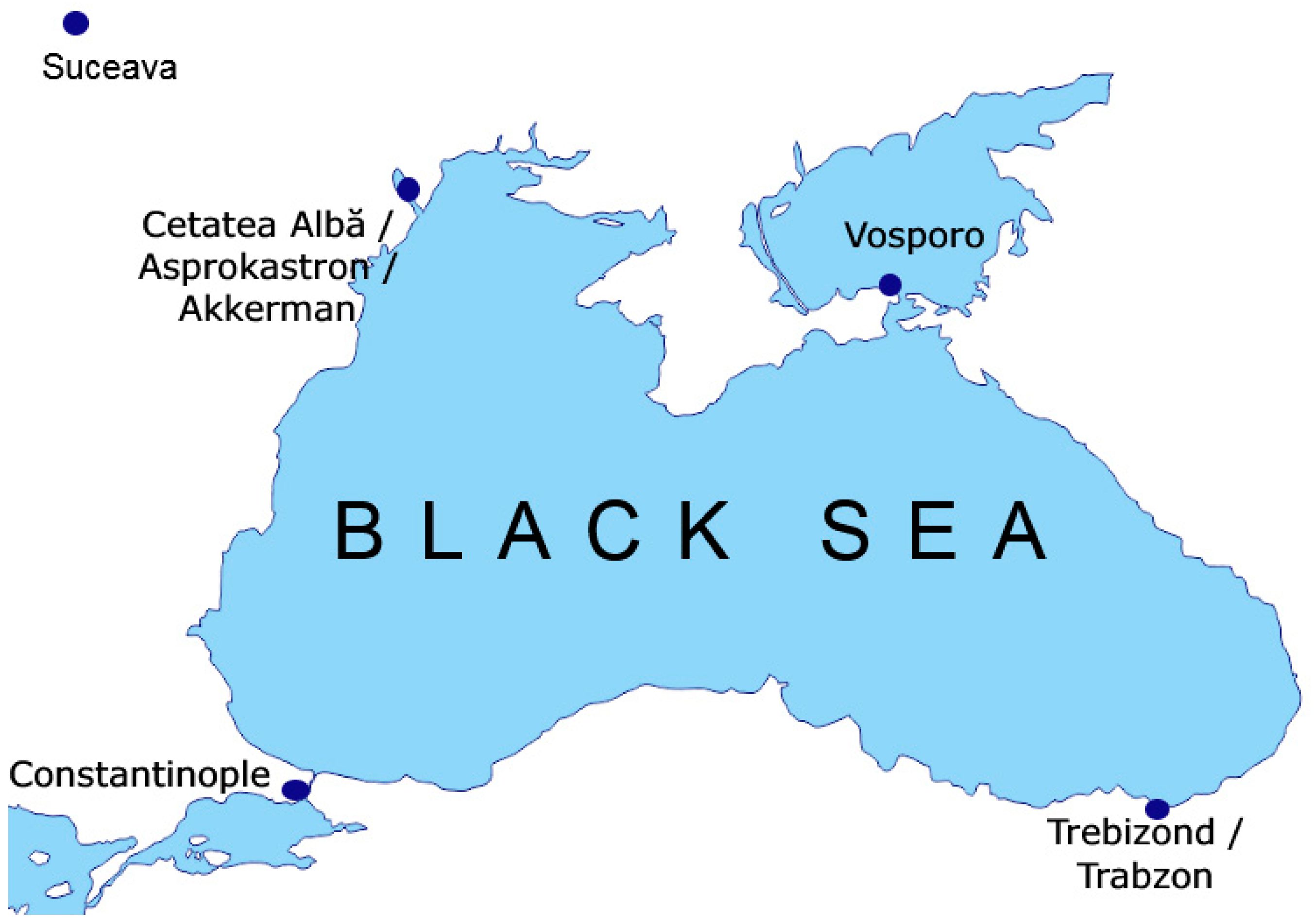
“He was a merchant, devout and firm in his Orthodoxy, and generous to the poor. Once, he happened to be sailing on a ship while pursuing his trading activities. The captain of the ship was not Orthodox, but got into an argument about the Faith with St John.
Having been vanquished by the saint’s words, the captain resolved to make trouble for him when they got to Belgorod (White Citadel). During the ship’s stay at Belgorod, the captain went to the city ruler, a fire-worshipper, and suggested that on his ship was a studious man who also desired to become a fire-worshipper.
The city ruler invited St John to join the fire-worshippers and renounce his faith in Christ.
The saint prayed secretly, calling on the help of Lord […] and God gave him the courage and understanding to counter all the claims of the impious and firmly confess himself a Christian. After this, the saint was so fiercely beaten with rods that his entire body was lacerated, and the flesh came off in pieces. The holy martyr thanked God for being found worthy to shed his blood for Him and thereby wash away his sins.
Afterwards they put him in chains and dragged him away to prison. In the morning the city ruler ordered the saint brought forth again. The martyr came before him with a bright and cheerful face. The intrepid martyr absolutely refused to deny Christ, denouncing the governor as a tool of Satan. Then they beat him again with rods, so that all his insides were laid bare.
The gathering crowd could not bear this horrible spectacle, and they began to shout angrily, denouncing the governor for tormenting a defenseless man. The governor, having the beating stopped, gave orders to tie the Great Martyr to the tail of a wild horse to drag him by the legs through the streets of the city. Residents of the Jewish quarter particularly scoffed at the martyr and threw stones at him. Finally, someone took a sword and cut off his head.
St John’s body with his severed head lay there until evening, and none of the Christians dared to take him away. By night a luminous pillar was seen over him, and a multitude of burning lamps. Three light-bearing men sang Psalms and censed the body of the saint. One of the Jews, thinking that these were Christians coming to take up the remains of the martyr, grabbed a bow and tried to shoot an arrow at them, but he was restrained by the invisible power of God, and became rigid.
In the morning the vision vanished, but the archer continued to stand motionless. Having told the gathering inhabitants of the city about the vision and what was done to him by the command of God, he was freed from his invisible bonds. Having learned about the occurrence, the ruler gave permission to bury the body of the martyr in the local church. […]
The captain who had betrayed St John repented of his deed, and decided secretly to convey the relics to his own country, but the saint appeared in a dream to the priest of the church, and prevented this.” (The Orthodox Calendar. Feasts and Saints 2025).
3. Navigating Through Sources
- The earliest source is certainly Myнїe cтгo и cлaвнaгo мчнкя Iѡaнa Hoвaгo, ижe въ Бeльгpaдъ мж чившaгocѧ. Cъпиcaнo Гpигѡpieмь мниxoмь, и пpeзвиtepoмб, въ вeликoи ҷ pкви Moлдoвлaxi иcкoи/Martyrdom of the Holy and Glorious Martyr John the New, who was martyred in the White Fortress (Belgrade). Written by Gregory the monk and presbyter in the Great Church of Moldavia (included by Gavriil Uric in a Slavonic Sbornic from 1439, f. 324–380) (Manuscript 164, reproduced in (Ştefănescu 1884)). It is assumed that another Slavonic text, Pohvalnoe slovo svetomo i slavnomo veliko mucanicomo Iovaanny Novomy, Word of praise for the holy and glorious great martyr John the New, attributed to Abbot Theodosius of Neamţ in 1534, is actually an abbreviated retelling of Gregory’s text (Rezuş 1956, p. 336).
- Metropolitan Varlaam of Moldavia (†1657)—Muceniciia Svântului şi slăvitului Marelui Măcenic Ioan cel Nou de la Soceavă/The Martyrdom of the Holy and Glorious Great Martyr John the New of Suceava, in the edition published in Cazania, printed in 1643 (Varlaam 1643).
- Patriarch Nikiphoros of Alexandria (†1645)—Μαρτύριον τοῦ αὐτοῦ ἁγίου Ἰωάννου [τοῦ Τραπεζουντίου νεομάρτυρος ἀθλήσαντος τῶ 1500 ἐν Λευκοπόλει ἑορτάζεται δὲ τὴν Πέμτην μετὰ τὴν Πεντηκοστήν]/The martyrdom of the same holy John [the Neomartyr of Trebizond, who suffered in the year 1500 in Leukopolis, and is commemorated on the Thursday after Pentecost] (Manuscript 812); the text is also preserved in a Slavonic translation (Myчeничecтвo 1875).
- Meletius Syrigos (†1664)—Μαρτύριον τοῦ ἀγίου ἐνδόξου μεγαλομάρτυρος Ἰωάννου, τοῦ έκ Τραπεζοῦντος μέν ὁρμωμένου, ἐν τῶ Ἀσπροκάστρῳ δέ μαρτυρήσαντος, έν δέ Σοτζαβία τῇ κατὰ Μολδάβιαν μετατεθέντος, ὡς κεῖται ἐν τῷ βουλγαρικῷ/The martyrdom of the holy and glorious great martyr John, who was originally from Trebizond, suffered martyrdom in Asprokastro, and whose relics were transferred to Suceava in Moldavia, as it is recorded in the Bulgarian (edited in (Gonis 1984b)).
- Patriarch Callinicus the 3rd of Constantinople (†1791)—Βίος καί άθλησις τοϋ αγίου Ίωάννου του νέου μάρτυρος μεταφρασθείς άπό τό σλωβανικόν καί διορθωθείς παρά τοΰ πανιερωτάτου μητροπολίτου Προϊλάβου κυρίου Καλλινίκου/The life and contest of Saint John the New Martyr, translated from the Slavonic and revised by the most reverend Metropolitan of Proilabos, Lord Callinicus (edited in (Gonis 1984a)).
- Nicodemus the Hagiorite (†1809)—Ἐμαρτύρησεν ὁ ἁγίος Ἰωάννης ἐν Aσπροκάστρω/Saint John who was martyred in Asprokastro, published in the Neomartyrologhion and printed in Venice in 1799 (Hagiorite 1799).
- (a)
- The kratima3 of the protopsalter Eustathius of Putna dedicated to Saint John (ca. 1511, Slavonic).
- (b)
- The service dedicated to Saint John that accompanies the Panegyric attributed to Abbot Theodosius of Neamţ (1534), but which seems to have an earlier Russian origin (Dogvan 2021, p. 15; Turdeanu 1985, pp. 169–70).
- (c)
- The service composed by Patriarch Nicephorus of Alexandria, Ἀκολουθία τοῦ ἁγίου μάρτυρος Ἰωάννου τοῦ Τραπεζουντίου ὑπο τοῦ πατριάρχου Ἀλεξανδρείας κυρίου Νικηφόρου τοῦ Κρητός (Manuscript 812, ff. 43–56), edited by Thomas Bougioukos from Trebizond, Iaşi 1819 (Nikiphoros of Crete 1819).
- (d)
- The service composed by Meletius Syrigos: Ἀκολουθία, Μαρτύριον καὶ Παρακλητικὸς κανὼν εἰς τὸν Ἅγιον Ἰωάννην τὸν ἐκ Τραπεζοῦντος, ἐν Ἀσπροκλαστρῳμαρτυρήσαντα καὶ ἐν Σουζαβία τῆ Μολδαβίας μεταθέντα (Gonis 1984b; Chaldaiake 1995).
- (e)
- The service composed by Justin Dekadyos, published in Venice in 1752.
“[…] and utterly casting down the pride of the Persians and trampling the tyrant underfoot by his patience, he became the model and superscription for martyrs”.(Little Vespers, Glory…)
“Having sustained well thy life on earth with almsgiving, and frequent prayers and tears, O athlete, thou didst manfully hasten to suffering, and didst denounce the ungodliness of the Persians; wherefore, thou hast become a firm foundation for the Church and the boast of Christians, O ever-memorable John.”.(Apolytikion)
“the sword honed sharp by the sayings of the prophets, by whom Christ, Who hath great mercy, hath laid low the uprisings of the Persians?”.(Great Vespers, sticheron)
“’When many wounds blossom forth on my flesh, then shall I hope to be granted a most splendid crown,’ the athlete said to the Persian”.(Matins, Canon of the Great Martyr, ode IV)
“How awesome and glorious was thine opposition, which amazed the peoples who attended thy contest, so that they praised thy patience; but the Persians and the Jews, put to shame, were clothed in humiliation.”.(Matins, Canon of the Great Martyr, ode V)
“The divine John, reviling the mindless edict of the ungodly governor, denounced the error of Persian arrogance”.(Matins, Canon of the Great Martyr, ode V)
“Once the nations and lawless people raged, imagining vain things against Christ the Lord; and now the Persians have gathered together, flaying John, while the Jews slew him.”.(Matins, Canon of the Great Martyr, ode VIII) (Meniaon, 2nd June)
4. 14th Century
I—Gregory the Monk, Slavonic
- (a)
- „Iaжe й въ cлoyxa пpїидѡшѧ ижe тoгдa блгoчьcтивaгo гocпoдcтвoyѫщoмoy въceѫ мoлдoвлaxїѫ й пoмopїv” (And then they reached the ears of the then pious ruler of Moldavia and the land by the sea).
- (b)
- „й cъ cъвѣoмь ижe тoгдa цpкѡ внaa пpaвѧщaгo cщeннѣишaгo apxieпкпa Iѡcиφa” (And with the advice of the one who then led the true faith in the Church, His Holiness Archbishop Joseph).
“Intimate contact with the relics was part of a representational construct of power, ostentatiously emphasizing the alliance between political authority and the new saint—an alliance which, moreover, extended over the ruler’s subjects, granting divine legitimization to his power. In the case of John the New, this idea is reinforced by the final invocation of the martyr as protector of the country (and implicitly of the princely house), as well as by the decision to place the relics permanently in ‘his radiant city of Suceava, his seat,’ that is, in the voivode’s center of power—an important aspect of how power functioned in the Middle Ages. The entire passage describing the reception of the relics by Alexandru the Good, and especially the final elements mentioned, reveal the political and ideological implications attributed to the new cult from the moment of its adoption in Moldavia, while also highlighting the hagiographic text’s character as a ‘manifesto of power,’ as previously noted in historiography”.(Firea 2022, p. 46)
5. 17th Century
5.1. II—Varlaam, Romanian
“[…] Rather, you should learn from me the mystery of truth. Cast off, I beseech you, this darkness of impiety [from yourself], which has enveloped your soul, and be deemed worthy to become a son of light, shining more brightly than the sun through the dawns of the Divine Baptism. But do not suppose that this luminary [the sun] is God, for it was created by our Creator for the service of humankind, being a creation of fire, made on the fourth day. How, then, can a creature be God?”(I-G.S.)
“[…] Rather, you must learn from me what is true. Cast away the darkness of unbelief that lies within your soul, that you may be found worthy to become a son of light through the holy baptism, which shines brighter than the sun, to enlighten you toward the Kingdom of Heaven.”(II–V.R.)
- Alexandru cel Bun (1400–1 January 1432);
- Alexandru II or Alexăndrel (December 1448–12 October 1449/February 1452–August 1454/February 1455–25 March 1455);
- Alexandru Cornea (December 1540–February 1541);
- Alexandru Lăpușneanu (September 1552–November 1561/March 1564–9 March 1568);
- Alexandru Movilă (November 1615–July 1616);
- Alexandru Iliaș (September 1620–September 1621);
- Alexandru Coconul (September 1629–April 1630).
5.2. III—Nikiphoros, Greek
“The present service (acolouthia) of Saint John of Trebizond, which—as the title states—was composed by Nikiphoros, Patriarch of Alexandria, had until now been preserved in manuscript form in several churches of Iași. Having been copied by various scribes, additions, omissions, and many errors crept in, as was the case with all old manuscript works before the discovery of printing. In addition to this, other services of the same saint were also composed by different poets who, wishing to appear as authors of the hymn, did not wish to borrow anything from the first composition, but instead created entirely new hymns. Thus, with three or four such services in circulation, when the feast day of the saint arrived, the head of the church was sometimes uncertain which one to use. In order to eliminate this confusion and to ensure that this service would be disseminated everywhere—but especially in the saint’s birthplace—so that he might be honored by Christians as the first martyr who was slain by the descendants of Agar (πρῶτος μάρτυς ὑπὸ υἱῶν τῆς Ἄγαρ σφαγιασθείς), the noble Lord Toma Buiuchis of the town of Rizion in the eparchy of Trebizond took it upon himself to bring it to light through print, correcting it where necessary for the benefit of his soul. At the same time, he hastened to have an image of the saint engraved in copper after an old icon preserved in the Bârnova Monastery here. Receive, therefore, all Orthodox Christians, this book with a joyful heart, giving thanks to God, who strengthens the faithful in their belief even in the most difficult circumstances; and celebrate the saint with psalms and hymns for your salvation and help.”(Copied in (Bianu et al. 1936, pp. 315–16).)
5.3. IV—Meletius, Greek
6. 18th Century
6.1. V—Callinicus, Greek
“The captain of the ship, who, being Latin, discussed daily with the saint about the five differences, especially regarding the primacy of the pope and the procession of the Holy Spirit [Filioque], and tried to draw him to his teachings. And because he did not succeed in achieving his aim, since the saint had sufficient knowledge and power regarding the divine Scriptures, their prior friendship turned into hatred.”.(V–C.G. §3)
“having received permission and a decree from the Porte [λαβών ἄδειαν καὶ ὁρισμὸν ἀπὸ τὴν Πόρταν] and from the ruler of the Church at that time, [Voivode Ioan Alexandru] sent his ministers with a great multitude of people and his own carriage to bring the saint’s relics with great devotion and honor”.(V–C.G. §17)
6.2. VI—Hagiorite, Greek
- To bring about a renewal of the entire Orthodox faith;
- So that those of another faith may be left without excuse on the Day of Judgment;
- To serve, on the one hand, as glory and praise for the Eastern Church, and on the other, as a rebuke to those who believe otherwise;
- To provide an example of patience for all Orthodox Christians suffering under the heavy yoke of bondage;
- To encourage and inspire imitation of their martyric end among all Christians who are compelled to confess their faith in various circumstances, and especially among those who have already fallen away from the Orthodox faith.” (VI–H.G.)
7. Conclusions
Funding
Institutional Review Board Statement
Informed Consent Statement
Data Availability Statement
Conflicts of Interest
| 1 | In July 2024, to the accusations brought by the Elie Wiesel National Institute for Holocaust Studies that some recently canonized clergy had connections with the legionary movement, the ROC responded that in the case of each person’s passage among the saints (canonization), several “canonical, historical and pastoral-missionary criteria” were taken into account. “Some saints who are honored in the Orthodox Church had, at certain moments of their lives, attitudes and gestures that were difficult to understand or even contrary to Christian teaching, but the Church takes into account the change in the sinner’s life and, especially, the way in which they ended their lives, without, however, encouraging (sanctifying) certain slippages that the respective persons had during their lives.” (Comunicat 2024). This inner change and the energy dedicated by these sanctified persons to helping their fellow human beings become the core of the hagiographic narratives written today. |
| 2 | In addition to the Holy Emperors Constantine and Helena, considered not only the moral authors of the Christianization of the Roman Empire, but also the endorsers of the First Ecumenical Council (Nicaea–325), Theodosius the Great (17 January) and his wife Flacilla (14 September) were also canonized for the initiative of convening the Second Ecumenical Council (Constantinople–381), Theodosius II (29 July) for convening the Third Ecumenical Council (Ephesus–431), Marcian (17 February) and Pulcheria (17 February, 10 September, respectively) for organizing the Fourth Ecumenical Council (Chalcedon–451), Justinian and Theodora (14 November) as patrons of the Fifth Ecumenical Council (Constantinople–553), Constantine IV (3 September) for the reunion of the bishops at the Sixth Ecumenical Council (Constantinople–680–681), Justinian II (2 August) for organizing the Council Quinisext (Constantinople–691–692), Irene (7 August) for organizing the Seventh Ecumenical Council (Nicaea–787) and Theodora (11 February) for the support given to the definitive restoration of the cult of holy icons within the Constantinople Council of 843. The argumentation is explained in the Synaxarion of the day contained in the (Menaion 2000) of the coresponding month. |
| 3 | Kratima is, usually a free composition using meaningless syllables, and it is sung to elongate the melody, especially in cases where a long hymn has finished but the priest needs more time. Unlike the traditional meaningless sequence, Eustathius’ kratima has the following content: “You who hold the land of the north, rejoice and be glad, be glad, for you have in your midst the star that does not set and the very bright dawn of the rising sun, John the great-named, the good-faithful from the root of the martyrs, eternally fruitful and chosen, who loved Christ much and was loved by him and who shares much mercy with us.” |
| 4 | This expression should be viewed as evidence against assigning the text to Gregory Tsamblak, who, in February 1418, served as the Orthodox Church’s delegate to the Council of Constance for discussions on a possible union with the Catholic Church. |
| 5 | https://patriarchateofconstantinople.com/index.html; “As the Archbishop of Constantinople he is one among equals, as the Patriarch of Constantinople he is first among equals, and as the Ecumenical Patriarch of Constantinople he is primus sines paribus” (accessed on 15 October 2025). |
References
- Alankiozides, Konstantinos. 2023. Συγγραφείς, Κείμενα, Θέματα. Συμβολή στη μελέτη της μεταβυζαντινής αγιολογικής γραμματείας. Thessaloniki. [Google Scholar]
- Bălan, Ioanichie. 2005. Patericul Românesc. Sihăstria: Editura Mănăstirea Sihăstria. [Google Scholar]
- Bianu, Ioan, Nerva Hodoş, and Dan Simonescu, eds. 1936. Bibliografia românească veche 1508–1830, tom. III, 1809–1830. Bucureşti: Editura Academiei Române. [Google Scholar]
- Boicu, Dragoş. 2017. Împăratul Teodosian–patron al ecumenicităţii bisericii. In Imperiu şi Sacerdoţiu. Dinamica raporturilor Biserică-Stat în Imperiul Romano-Bizantin (306–867). Edited by Nicolae Chifăr and Dragoş Boicu. Iaşi: Doxologia, pp. 148–263. [Google Scholar]
- Boicu, Dragoş. 2020. “Domine, Conserva Ecclesiam…” Pastoraţia Hrisostomică şi Schisma Ioanită. Cluj-Napoca: Presa Universitară Clujeană. [Google Scholar]
- Boicu, Dragoş. 2024. Textul hagiografic și valențele lui multiple: Două perspective asupra vieții sf. Ioan cel nou de la Suceava. Candela III: 85–106. [Google Scholar]
- Canale, Michele Giuseppe. 1855. Commentari Storici Della Crimea, del suo Commercio e dei suoi Dominatori dalle Origini Fine ai di Nostril. Genova: Tipi del R.I. de Surdo-muti, vol. 2 II. [Google Scholar]
- Cazacu, Matei. 2001. Saint Jean le Nouveau, ses reliques et leur translation à Suceava (1415). In L’empereur Hagiographe. Culte des Saints et Monarchie Byzantine et Post-byzantine. Edited by Petre Guran and Bernard Flusin. Bucureşti: Colegiul Noua Europă, pp. 137–58. [Google Scholar]
- Cernovodeanu, Paul. 2001. La double histoire de sainte Philothee d’Argeş et ses miracles. In L’empereur hagiographe. Culte des saints et monarchie byzantine et post-byzantine. Edited by Petre Guran and Bernard Flusin. Bucureşti: Colegiul Noua Europă, pp. 159–76. [Google Scholar]
- Chaldaiake, Ahilleos. 1995. Μελετίου Συρίγου Aνέκδοτος Aκολουθία προς τιμήν Aγίου Ιγνατίου του Oμολογητού. Παρνασσός 37: 456–68. [Google Scholar]
- Chifăr, Nicolae. 2007. Istoria creştinismului. Sibiu: Editura Universităţii “Lucian Blaga” din Sibiu, vol. I. [Google Scholar]
- Cojocaru, Constantin. 1994. Grigorie monahul şi prezviterul Marii Biserici a Moldovlahiei. Cronica Episcopiei Romanului şi Huşilor IV: 529–32. [Google Scholar]
- Comunicat: Punct de vedere asupra canonizărilor recente ale Sfântului Sinod al Bisericii Ortodoxe Române. 2024. Available online: https://basilica.ro/comunicat-punct-de-vedere-canonizari-recente-ale-sfantului-sinod-al-bisericii-ortodoxe-romane/?swcfpc=1 (accessed on 23 October 2025).
- Damian, Iulian Mihai. 2011. Ioan de Capestrano şi Cruciada Târzie. Cluj-Napoca: Academia Română. [Google Scholar]
- Danielian, Gayane. 2015. Armenian Genocide Victims Canonized by Church. April 24. Available online: https://www.azatutyun.am/a/26975019.html (accessed on 20 November 2025).
- Dicționarul explicativ al limbii române. 1998. Bucureşti: Editura Univers Enciclopedic.
- Dogvan, Eutichius Felix. 2021. The Meaning the Veneration of the Holy Great Martyr John of Suceava, the Patron Saint of Trade. Teologia 87: 12–28. [Google Scholar]
- Dorneanul, Damaschin. 2022. Chipul Sf. Mare Mucenic Ioan cel Nou de la Suceava reflectat în texte imnografice. Candela II: 35–56. [Google Scholar]
- Dorneanul, Damaschin. 2023. Chipul Sf. Mare Mucenic Ioan cel Nou de la Suceava reflectat în texte imnografice. Slujba utreniei. Candela III: 37–68. [Google Scholar]
- Firea, Elena. 2012. Despre un episod uitat din istoria moaștelor Sf. Ioan cel Nou de la Suceava și implicațiile lui. In Aut via inveniam aut faciam. In honorem Ștefan Andreescu. Edited by Ovidiu Cristea, Petronel Zahariuc and Gheorghe Lazăr. Iași: Universității “Al. I. Cuza”, pp. 367–83. [Google Scholar]
- Firea, Elena. 2022. Nașterea unui cult. Sfântul Ioan cel Nou de la Suceava și reprezentările sale medievale (sec. XV–XVII). Cluj-Napoca: Mega. [Google Scholar]
- Gonis, Dimitrios. 1982. Νεοελληνικαί μεταφράσεις–διασκευαί του μαρτυρίου του Aγίου Ιωάννου του Νέου του εν Λευκόπολει, συνταχθέντος υπό Γρηγορίου Τσαμπλάκ. Θεολογία 22: 227–49. [Google Scholar]
- Gonis, Dimitrios. 1984a. Καλλινίκου Γ’ Μαρτύριον Ιωάννου του Νέου του εν Λευκοπόλει (e. + 1330). Επιστημονική επετηρίς της Θεολογικής Σχολής του εν Aθήνησι Πανεπιστημίου 26: 495–533. [Google Scholar]
- Gonis, Dimitrios. 1984b. Μελετίου Συρίγου, Μαρτύριον, ακολουθία παρακλητικός Κανών εις του Aγίου Ιωάννου του Νέου τον εν Λευκόπολει. 1330. Athena: Γραφικές Τέχνες Ευάγ. Μπουλούκος - Aντ. Λογοθέτης O. Ε. [Google Scholar]
- Gonis, Dimitrios. 2015. Τὸ Μαρτυρολόγιο τοῦ Ἁγίου Ἰωάννου τοῦ Τραπεζουντίου σὲ ρουμανικὴ διασκευὴ (1643). Fragmenta Hellenoslavica, Ψηφιακ ή Επετηρίδα της Ένωσης Ελλήνων Σλαβολόγων 2: 153–68. [Google Scholar]
- Gorovei, Ştefan. 2003. Mucenicia Sfântului Ioan cel Nou. Noi puncte de vedere. In Închinare lui Petre Ş. Năsturel la 80 de ani. Edited by Ionel Cândea, Paul Cernovodeanu and Gheorghe Lazăr. Brăila: Istros, pp. 559–65. [Google Scholar]
- Guran, Petru. 1998. Invention et translation des reliques-un cérémonial monarchique? Revue des Études Sud-Est Européennesi 36: 195–229. [Google Scholar]
- Hagiorite, Nicodemus. 1799. Νέον μαρτυρολόγιον: ἡτοι μαρτύρια τῶν νεοφανών μαρτύρων τὼν μετά τὴν ἄλωσιν τὴς Κωνσταντινουπόλεως κατὰ διαφόρους καιροὺς, καὶ τόπους μαρτυρησάντων. Venice: Νικολαος Γλυκειτος εξ Ιωαννινων. [Google Scholar]
- Heyd, Wilhelm von. 1886. Histoire du commerce du levant au Moyen-Age. Leipzig: Otto Harrassowitz, vol. 2. [Google Scholar]
- Kocoj, Ewa. 2019. A saint defender. The veneration of Saint John the New of Suceava in Bukovina–from history to contemporary culture. Analele Bucovinei 26-2: 491–506. [Google Scholar]
- Lascarov-Moldovanu, Alexandru. 2002. Viaţa Sfântului Ioan cel Nou de la Suceava. Bucureşti: Editura Anastasia. [Google Scholar]
- Lăudat, Ion. 1984. Gregorie Camblac et la tradition roumaine. Tъpнoвcкa книжoвнa шкoлa 3: 127–35. [Google Scholar]
- Linaritakes, Emmanouel. 1996. Oικουμενικός Πατριάρχης Καλλίνικος ο Γ΄ (Δ΄) και το θέμα του αναβαπτισμού. Ph.D. thesis, University of Crete, Rethymno, Greece. [Google Scholar]
- Manuscript Slavonic. 164. Library of Romanian Academy, 15th Century. [Google Scholar]
- Manuscript Vatopaidi. 812. Greek, 18th Century. [Google Scholar]
- Menaion (June). 2000. Translated in English by Isaac Lambertsen. Available online: https://www.ponomar.net/maktabah/MenaionLambertsenJune2000/index.html#0602 (accessed on 20 November 2025).
- Michaelides, George P. 1943. The Greek Orthodox Position on the Confession of Cyril Lucaris. Church History 12: 118–29. [Google Scholar] [CrossRef]
- 1875. Myчeничecтвo и житиe cвятoгo, вcexвaльнoгo вeликoмyчeникa Иoaннa нoвoгo Tpaпeзyнтcкoгo, пocтpaдaвшeгo в Лeвкoпoлe, нaзывaeмoм, пo oбщeмy yпoтpeблeнию, Aккepмaн. Зaпиcки Oдeccкoгo oбщecтвa иcтopии и дpeвнocтeй. (ZOOID) IX: 255–60.
- Năsturel, Petre. 1971. Une prétendue oeuvre de Grégoire Tsamblak: Le Martyr de Saint Jean le Nouveau. Actes du Premier Congrès International des Etudes balkaniques sud-est européennes VII: 345–51. [Google Scholar]
- Nikiphoros of Crete. 1819. Ἀκολουθία τοῦ ἁγίου μάρτυρος Ἰωάννου τοῦ Τραπεζουντίου. Iaşi: Ελληνικα Τυπογραφια. [Google Scholar]
- Pargoire, Jules. 1908. Mélétios Syrigos, sa vie et ses oeuvres. Échos d’Orient 11: 264–80. [Google Scholar] [CrossRef]
- Pargoire, Jules. 1909. Mélétios Syrigos, sa vie et ses oeuvres (fin). Échos d’Orient 12: 336–42. [Google Scholar] [CrossRef]
- Parry, Ken, David J. Melling, Dimitri Brady, Sidney H. Griffith, and John F. Healey, eds. 1999. The Blackwell Dictionary of Eastern Christianity. Oxford: Blackwell. [Google Scholar]
- Pava, Radu. 1962. Cartea de cântece a lui Eustatie de la Putna. Studii și Materiale de Istorie Medie 5: 335–48. [Google Scholar]
- Păcurariu, Mircea. 1994a. Istoria Bisericii Ortodoxe Române. Bucureşti: EIBMBOR, vol. II. [Google Scholar]
- Păcurariu, Mircea. 1994b. Sfinţi daco-romani şi români. Iaşi: Trintas. [Google Scholar]
- Perşa, Răzvan. 2023. Canonizarea Sfinţilor în Biserica Ortodoxă. Act de proclamare sau de recunoaştere a sfinţeniei? Altarul Reîntregirii 2: 45–112. [Google Scholar] [CrossRef]
- Popescu, Anton I. 1943. Viaţa, pătimirile şi minunile Sfântului Mucenic Ioan cel Nou ce s-a zis şi de la Suceava. Craiova: Tipografia Mitropoliei Olteniei. [Google Scholar]
- Rezuş, Petru. 1956. Viaţa şi faptele Sfântului Ioan cel Nou de la Suceava. Mitropolia Moldovei şi Sucevei 32: 322–37. [Google Scholar]
- Runciman, Steven. 1985. The Great Church in Captivity. Cambridge: University Press. [Google Scholar]
- Rusev, Penje, and Anghel Davidov. 1966. Grigoriy Tsamblak v Rumaniya i v starata rumanska literature. Sofia: Bulgarian Academy of Sciences. [Google Scholar]
- Strates, Dimitrios. 2004. Aνέκδοτη ακολουθία του Μελετίου Συρίγου στον άγιο νεομάρτυρα Ιωάννη τον Θάσιο. Θασιακά 11: 233–58. [Google Scholar]
- Ştefănescu, Melchisedec. 1884. Viaţa Sfântului Ioan cel Nou de la Suceva scrisă în limba slavonă de mitropolitul Grigorie Ţamblac. Revista pentru Istorie, Arheologie şi Filologie 2: 163–74. [Google Scholar]
- The Orthodox Calendar. Feasts and Saints. 2025. Available online: https://basilica.ro/en/orthodox-calendar-june-2/ (accessed on 20 November 2025).
- Tougher, Shaun. 1997. The Reign of Leo VI. Leiden, New York and Koln: Brill. [Google Scholar]
- Turdeanu, Emil. 1985. Etudes de litterature roumaine et d’ecrites slaves et grecs de Principautes Roumaines. Leiden: Brill. [Google Scholar]
- Varlaam. 1643. Carte românească de învăţătură. Anastatic edition by Dan Zmafirescu. Bucureşti: Editura: Roza Vânturilor, 2011. [Google Scholar]
- Veretennikov, Makarij. 1998. Makar’evskie sobory 1547 i 1549 godov i ikh znachenie. Russkaya khudozhestvennaya kul’tura XV–XVI vekov 40: 2–19. [Google Scholar]
- Wolski, Jan Mikołaj. 2021. The Non-Orthodox in The Martyrdom of John the New by Gregory Camblak Patterns of Dehumanization. Studia Ceranea 11: 763–81. [Google Scholar] [CrossRef]
- Zaharia, Ciprian. 1987. Iosif I Muşat, întâiul mare ierarh roman. Roman: Editura Episcopiei Romanului şi Huşilor. [Google Scholar]

| Label | Chronological Order | Author | Language |
|---|---|---|---|
| I–G.S. | first source | Gregory | Slavonic |
| II–V.R. | second source | Varlaam | Romanian |
| III–N.G. | third source | Nikiphoros | Greek |
| IV–M.G. | fourth source | Meletius | Greek |
| V–C.G. | fifth source | Callinicus | Greek |
| VI–H.G. | sixth source | Hagiorite (Nicodemus) | Greek |
| I–G.S. | II–V.R. | III–N.G. |
|---|---|---|
| His deeds, however, caused the ship’s captain, who was “of the Latin heresy” [лaтинcкьiѧ epecи cѫщa] and very angry and inhuman, to turn against him. | [The Devil] fills with enmity the ship’s captain, who was “of the Latin heresy, a very wicked and merciless man” | The captain of the ship he boarded was Frankish, one of those people who believe in the dogmas of the Western church. This man was very evil and inclined to irreconcilable enmity […] this monster did not cease, every day, to confront John about dogmas, especially about the procession of the Holy Spirit; then John, having divine grace in himself, would overcome him by showing him the futility of his labors and how false his dogmas were. |
| I–G.S. | II–V.R. | III–N.G. |
|---|---|---|
| Arriving in the Jewish quarter, “the Jews began to shout, and turning their faces, they threw everything they had in their hands at the Saint, uttering incoherent and absurd shouts. And one of them, running into the house, brought a sword and, reaching the Saint, immediately cut off his honorable head.” | Arriving in the Jewish quarter: “the Jews shouted with laughter and insults and threw whatever they had in their hands at him. They laughed and shouted, and one of them ran into the house and pulled out a sword and when he reached the saint, he immediately cut off his honorable head.” | Arriving in the Jewish quarter: “then the enemies of the Christian faith—the Jews—were shouting, mocking and blaspheming the saint and throwing at him wood, stones and anything they could find to shame the martyr. One of the Jews, driven by hatred for Christ and urged on by the impure Mohammedans, ran to his house, took his sword and, coming out in front of the dragged saint, cut off his head.” |
| Source | Text |
|---|---|
| I–G.S. | John’s Refusal: His Address to Heaven (cf. Mt 10:18–19) and theological confrontation with the eparch “Satan, having entered into you as into a vessel of dishonor and speaking through you, hopes to drag me to destruction and to compel me to turn away from the true God—our Creator, and the Creator of all beings, both visible and invisible, and of the sun itself… But rather, learn from me the mystery of truth: cast off, I beg you, this darkness of impiety that has enveloped your soul, and make yourself worthy to become a son of light, shining more brightly than the sun through the dawns of divine Baptism. Yet do not imagine that this luminary [the sun] is God, for it was created by our Creator for the service of humankind—a creation of fire, brought into being on the fourth day. How, then, can a creature be God? |
| II–V.R. | John’s Refusal: his address to heaven (Mt 10:18–19) and theological confrontation with the eparch (O, Qadi): “Rather, learn from me what is true. Cast away the darkness of unbelief that lies within your soul, so that you may be found worthy to become a son of light through holy baptism, which shines brighter than the sun and enlightens you toward the kingdom of heaven.” |
| III–N.G. | John’s Refusal: his address to heaven (Mt 10:18–19) and his theological confrontation with the eparch (the governor): “Better yet, hear the truth from me, cleansing your clouded mind of the errors in which you dwell; miserable man, consent to come into the light through holy baptism, to become a son of light and to know the one God in Trinity, whose knowledge shines brighter than the sun, that you may be made worthy of the heavenly kingdom.” |
| IV–M.G. | John’s Refusal: his address to heaven (mt 10:18–19) and theological confrontation with the governor (that deceitful and treacherous Agarenian): “Learn from me what the true faith is, and drive away from your soul the darkness of unbelief, that you may be worthy to become a son of light through holy baptism, which shines more brightly than the sun. It will enlighten you and guide you into the heavenly kingdom, keeping you from straying far from the divine path into the darkness of perdition.” |
| V–C.G. | John’s Refusal: his address ‘with the eyes of his mind lifted toward heaven’ (Mt 10:18–19), and theological argument: “O governor, you should learn from my words what the truth is; cast off the darkness of unbelief that abides in your soul, that you may be deemed worthy to become a son of light through the sanctity of holy baptism, which shines above the sun, that it may also guide you toward the heavenly kingdom, so that you may not be brought into eternal torments.” |
| VI–H.G. | John’s Refusal: his address to heaven (“Let me not deny You, O Lord!”) and confrontation with the eparch: “I was born a Christian, and a Christian I shall die. I desire neither your riches nor to become a Muslim, for I believe in my Lord and Master, Jesus Christ, the true God.” |
Disclaimer/Publisher’s Note: The statements, opinions and data contained in all publications are solely those of the individual author(s) and contributor(s) and not of MDPI and/or the editor(s). MDPI and/or the editor(s) disclaim responsibility for any injury to people or property resulting from any ideas, methods, instructions or products referred to in the content. |
© 2025 by the author. Licensee MDPI, Basel, Switzerland. This article is an open access article distributed under the terms and conditions of the Creative Commons Attribution (CC BY) license.
Share and Cite
Boicu, D. The Symbolic Value of a “Romanian” Saint: The Life of Saint John the New from Suceava and Its Multiple Nuances. Religions 2026, 17, 13. https://doi.org/10.3390/rel17010013
Boicu D. The Symbolic Value of a “Romanian” Saint: The Life of Saint John the New from Suceava and Its Multiple Nuances. Religions. 2026; 17(1):13. https://doi.org/10.3390/rel17010013
Chicago/Turabian StyleBoicu, Dragoş. 2026. "The Symbolic Value of a “Romanian” Saint: The Life of Saint John the New from Suceava and Its Multiple Nuances" Religions 17, no. 1: 13. https://doi.org/10.3390/rel17010013
APA StyleBoicu, D. (2026). The Symbolic Value of a “Romanian” Saint: The Life of Saint John the New from Suceava and Its Multiple Nuances. Religions, 17(1), 13. https://doi.org/10.3390/rel17010013

