The Sacristy of the Virgin of the Basílica del Pilar: Breviary of Marian Apology

Abstract
1. Introduction
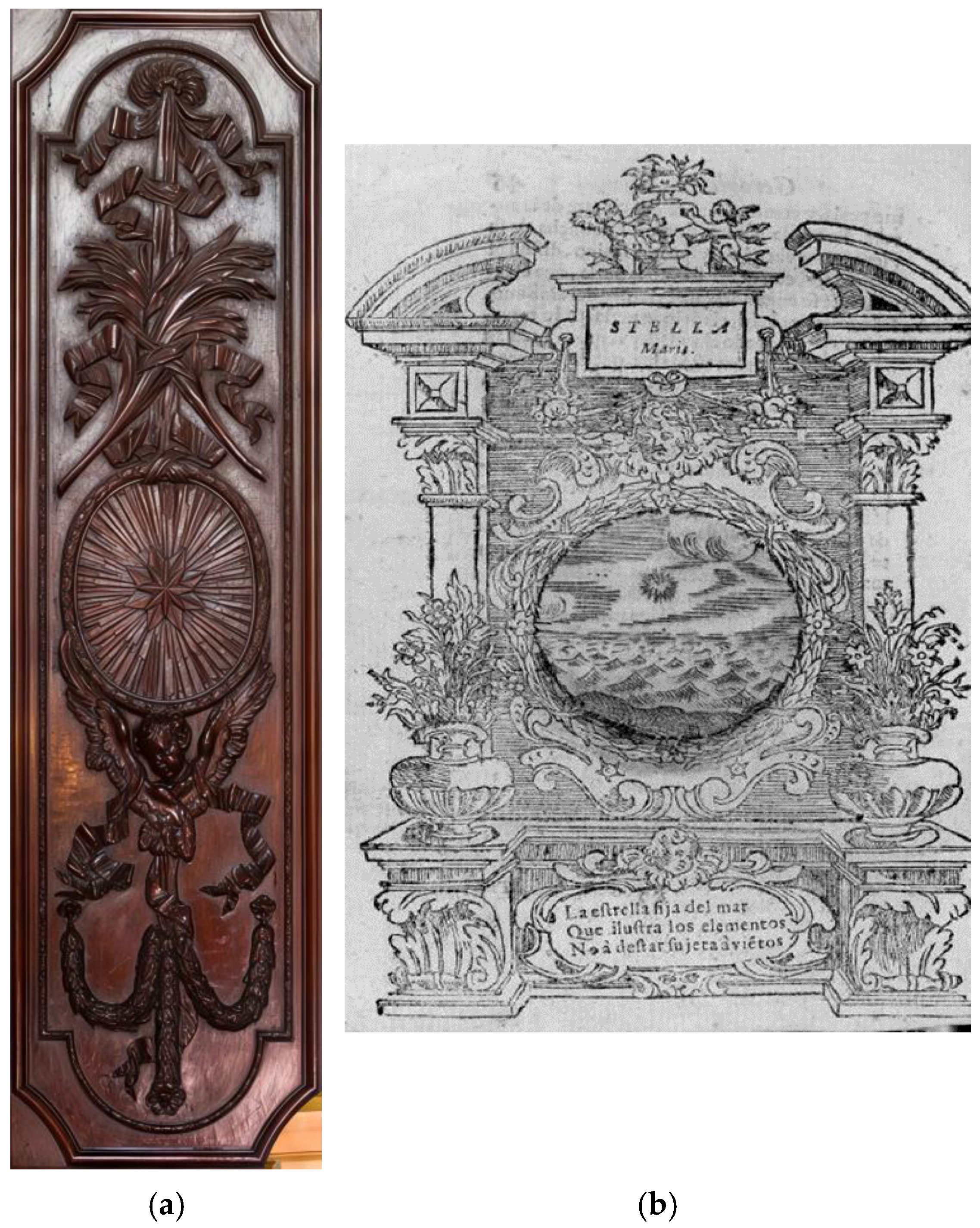
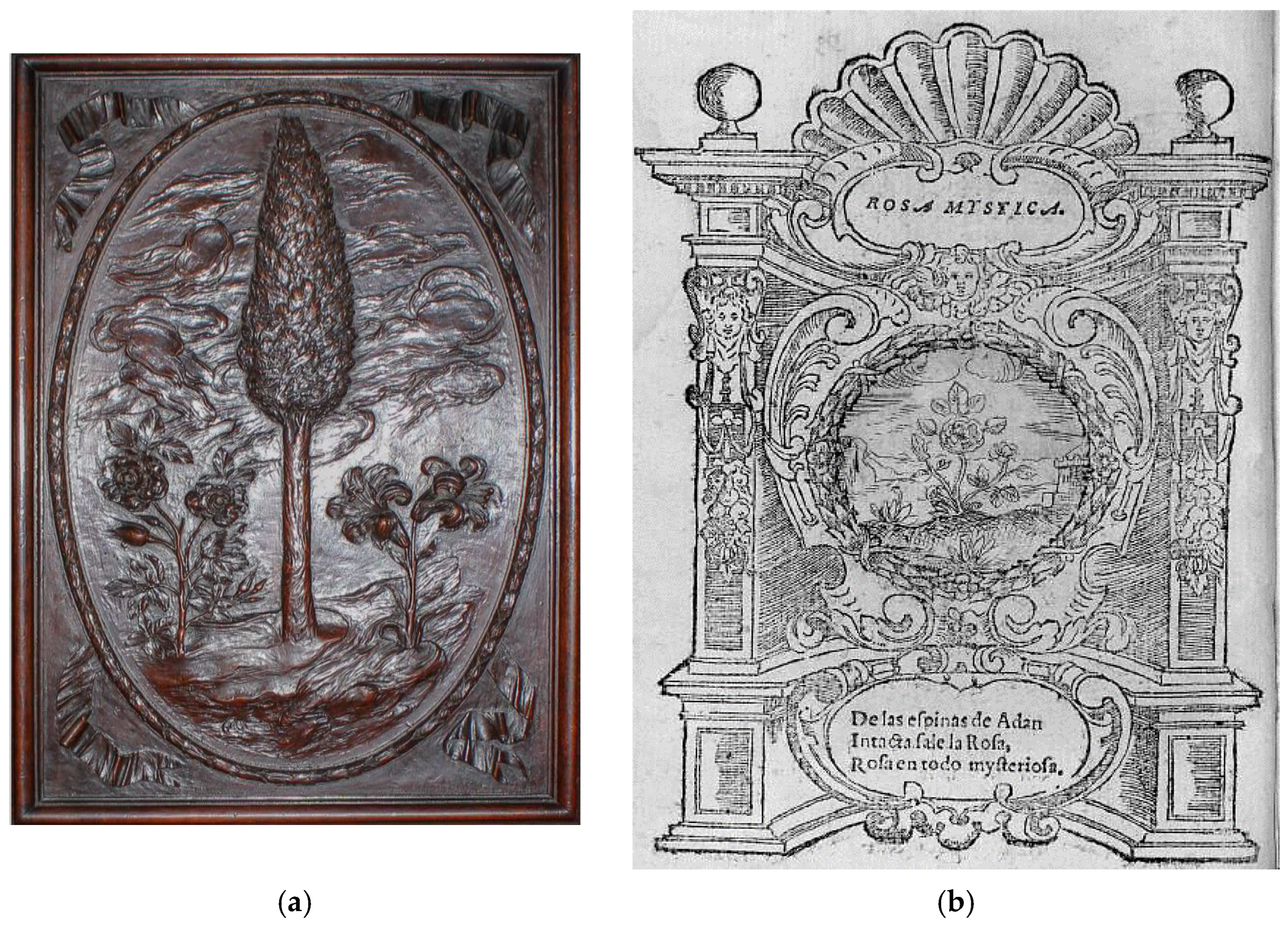
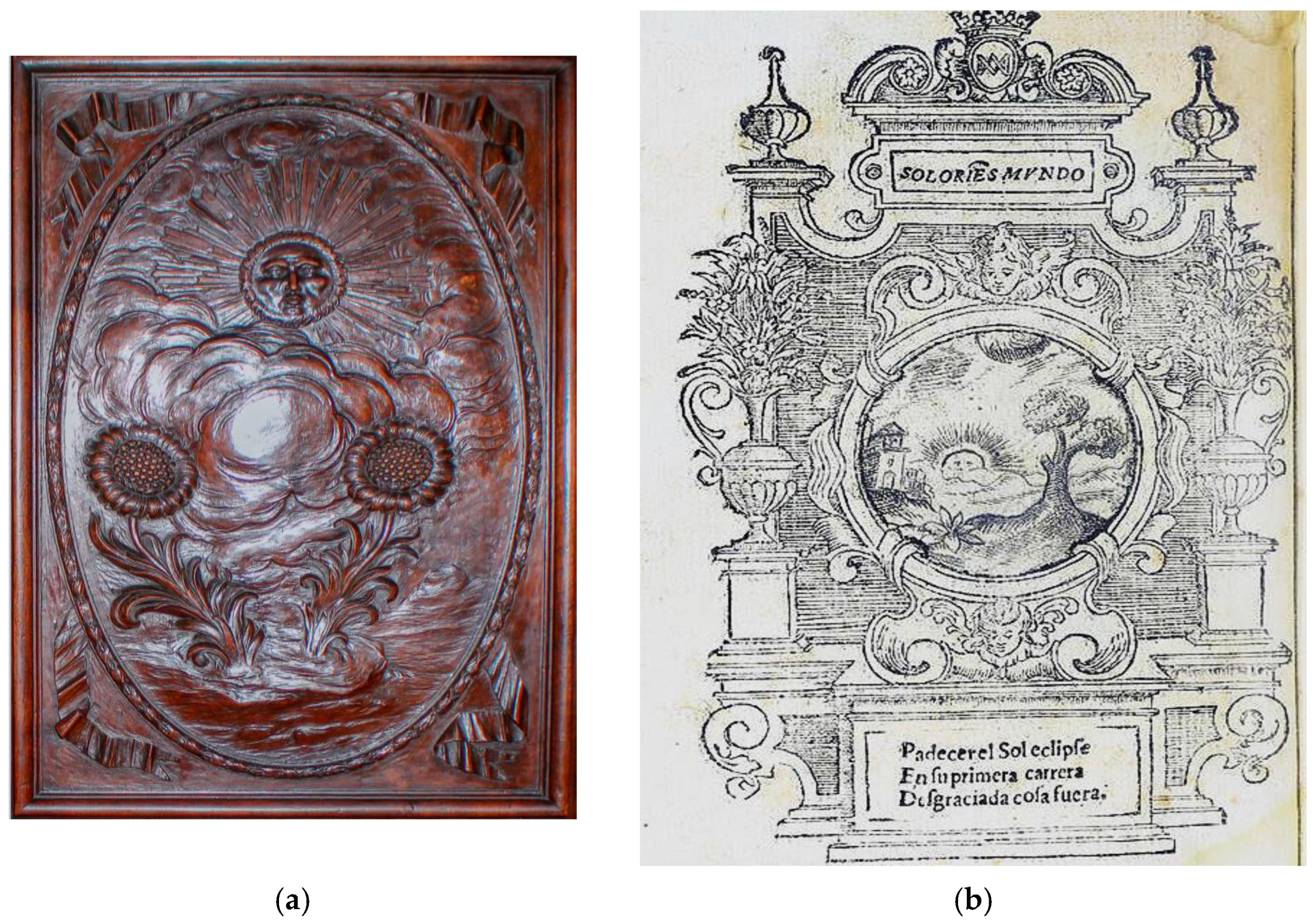
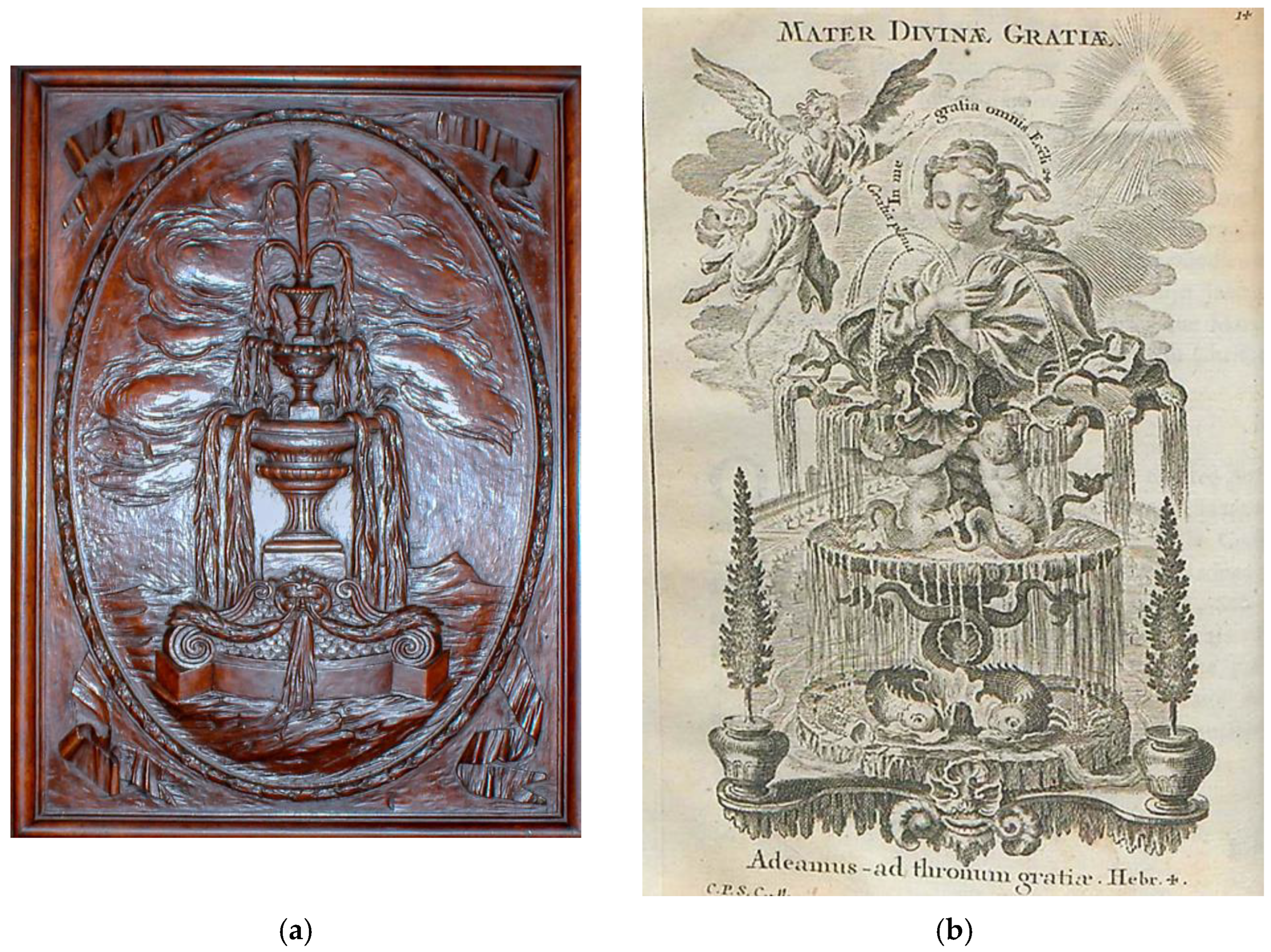
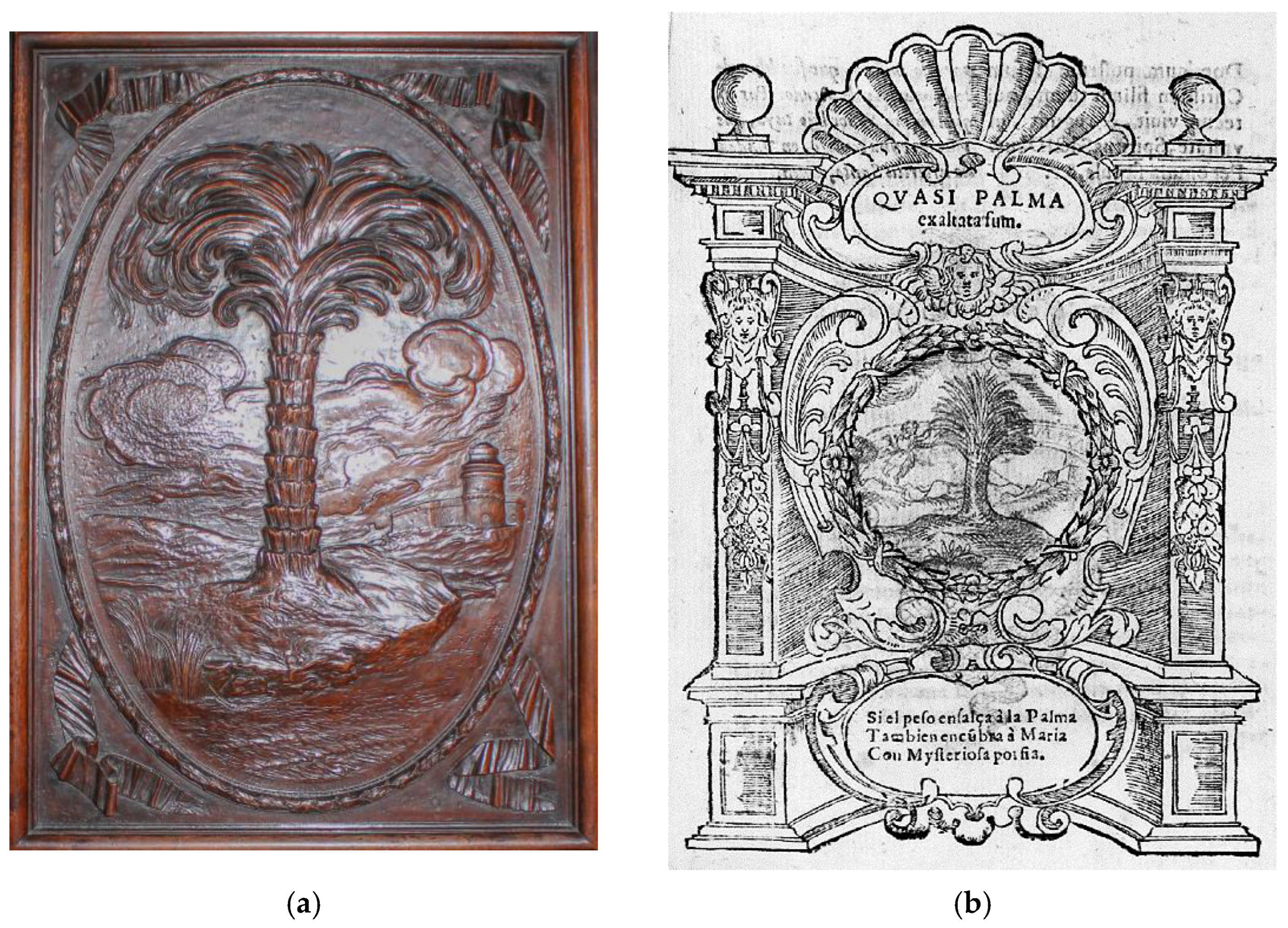
2. The Marian Apologetic Exegesis of the Sculptural Ensemble of the Sacristy of the Virgin of the Basílica del Pilar
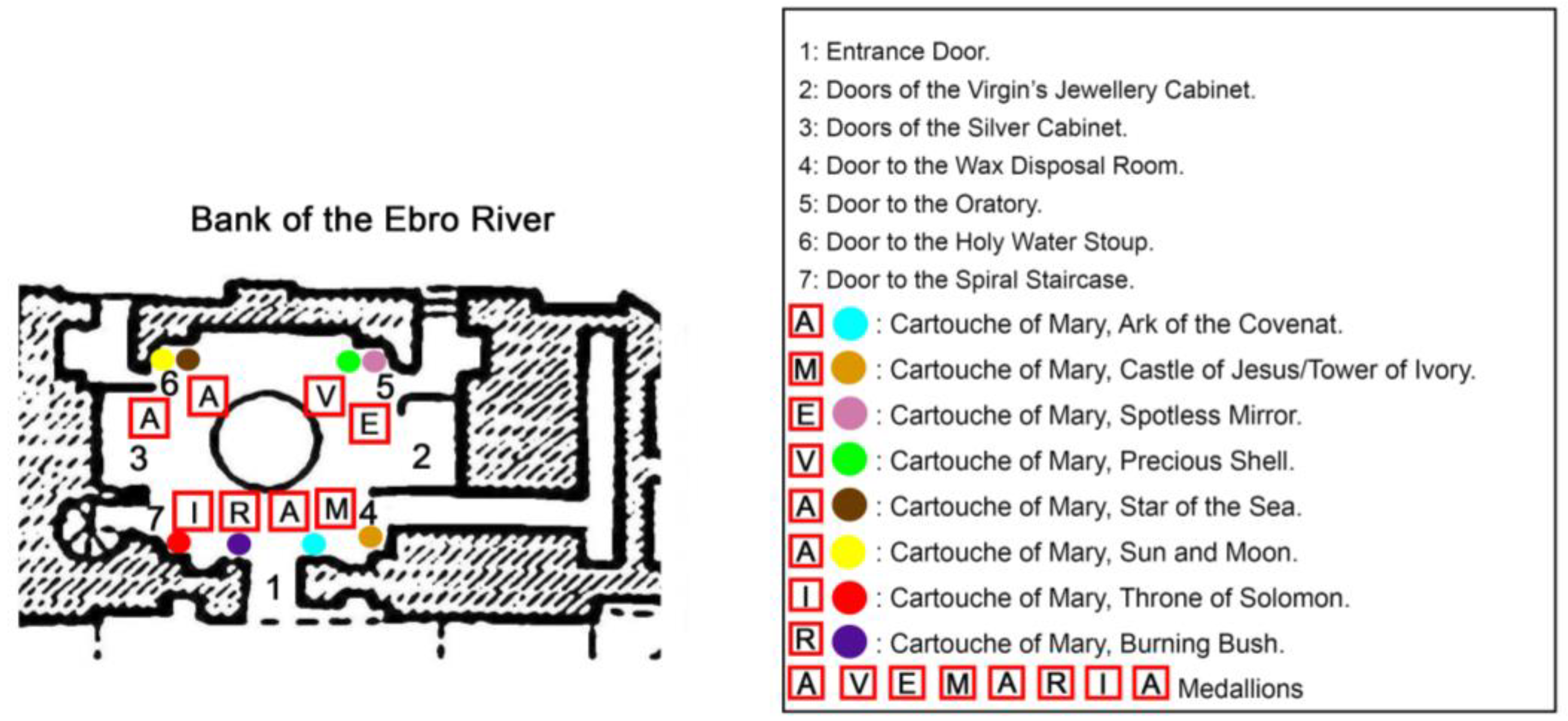
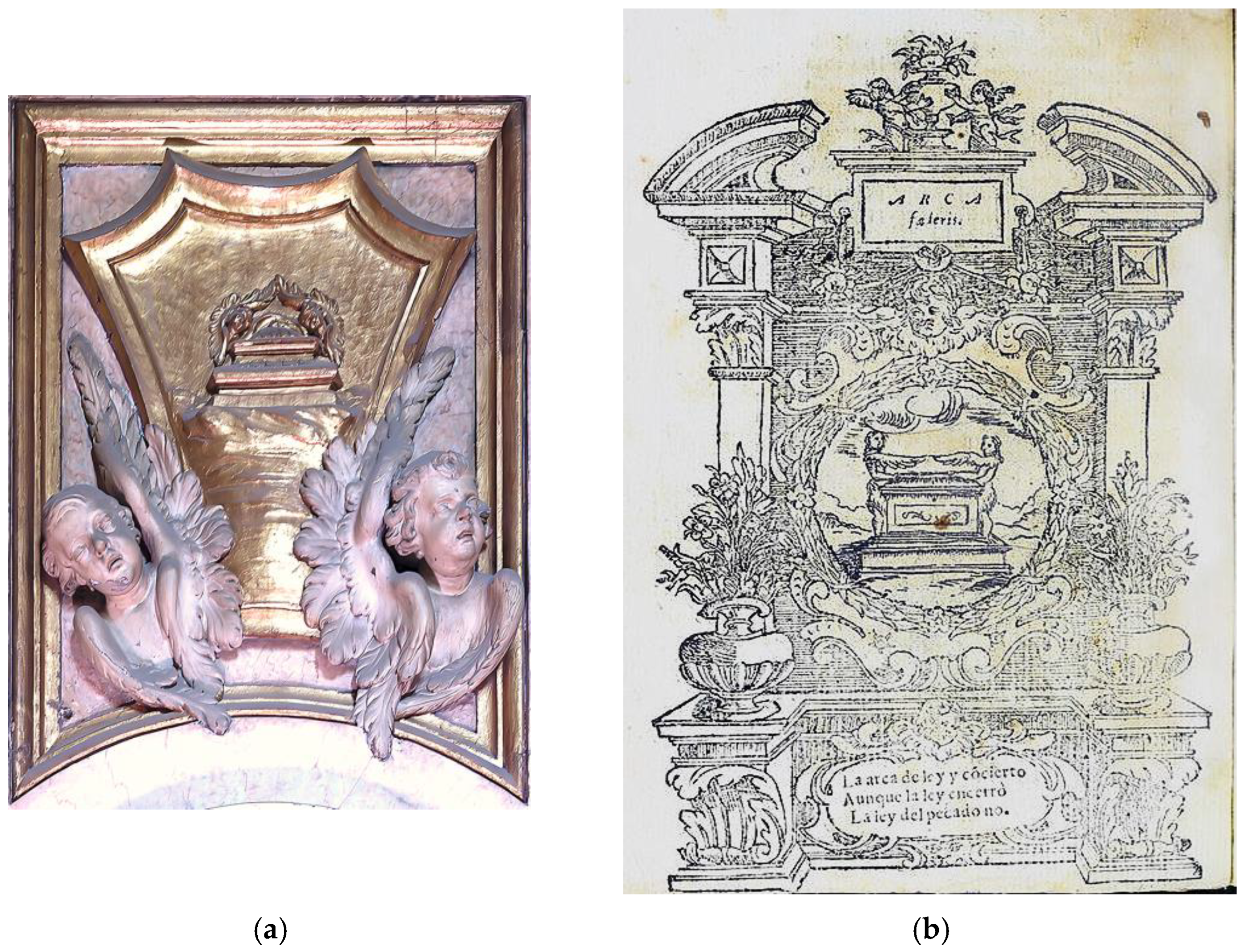
 ). The relief depicts Mary as the “Ark of the Covenant” of the Exodus,76 guarded by two cherubim77 (Figure 13a).
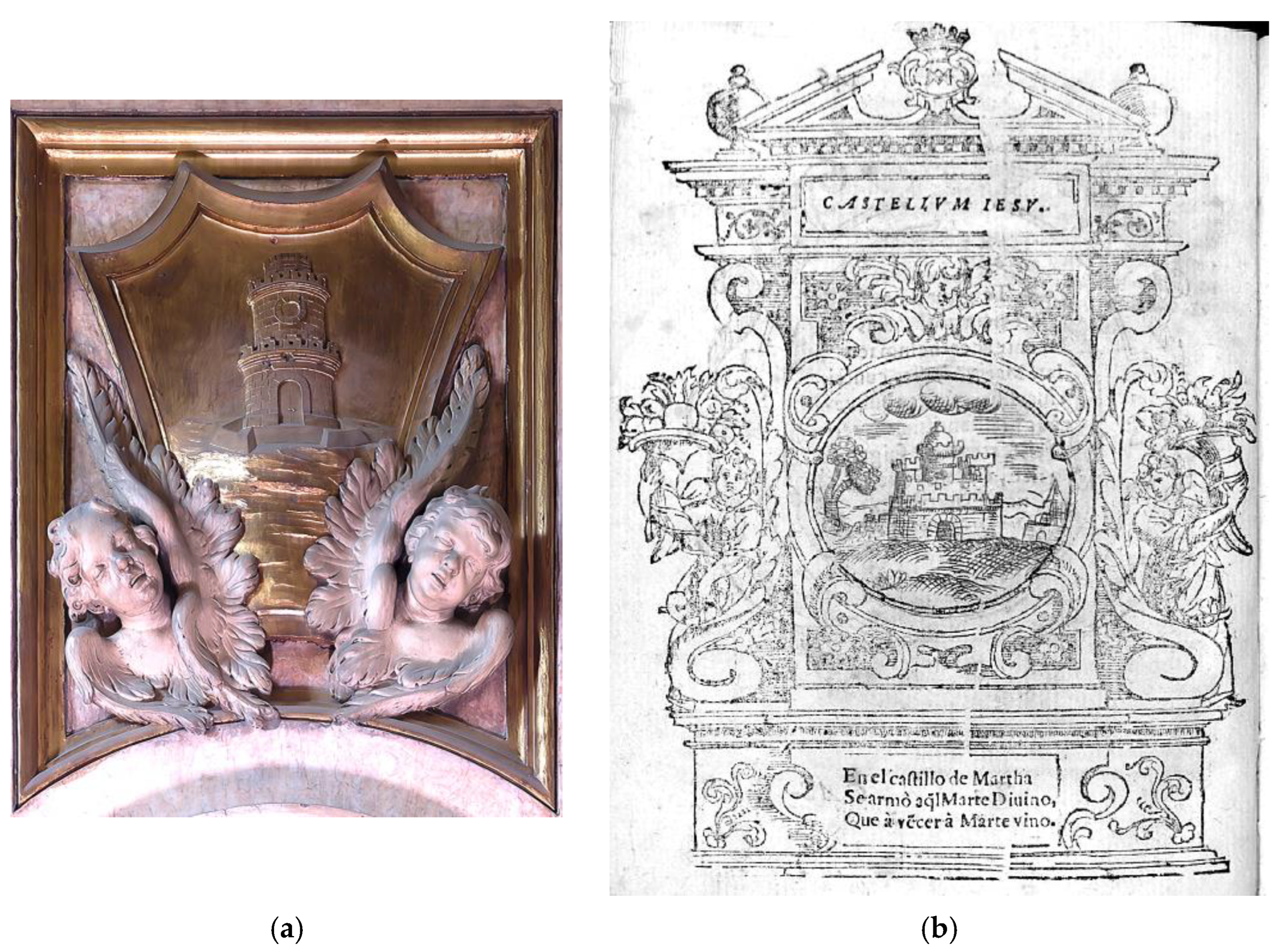
 ) the second cartouche is positioned, depicting Mary as the “Castle of Jesus or Tower of Ivory” (Figure 14a).
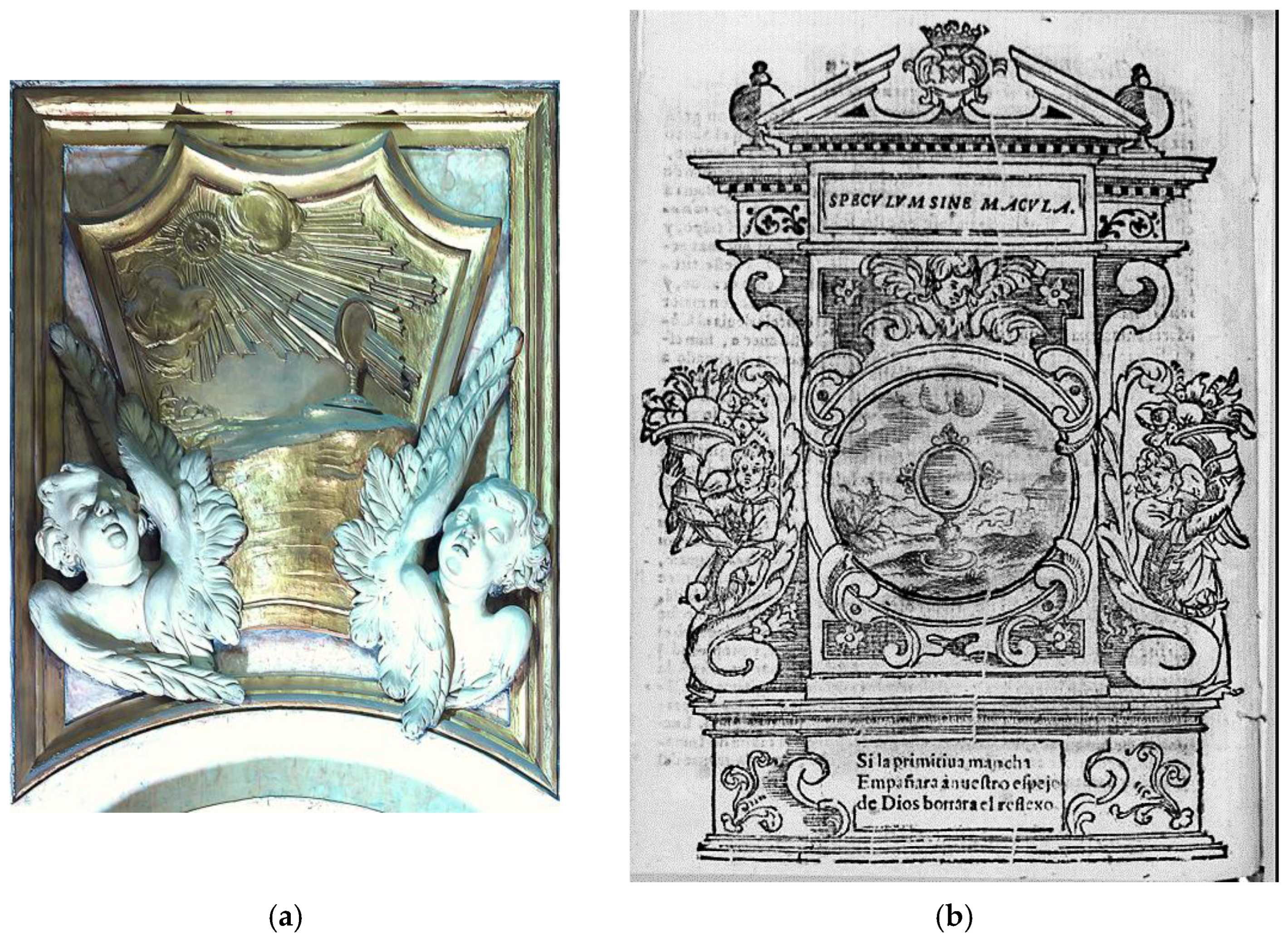
 ), adorned with a bas-relief in which an immaculate mirror appears in the foreground, struck by the rays of the Sun of Justice (Christ), which emerges from among the clouds. On the horizon, a small fortified building rises, possibly the walled city of Jerusalem (Figure 15a).
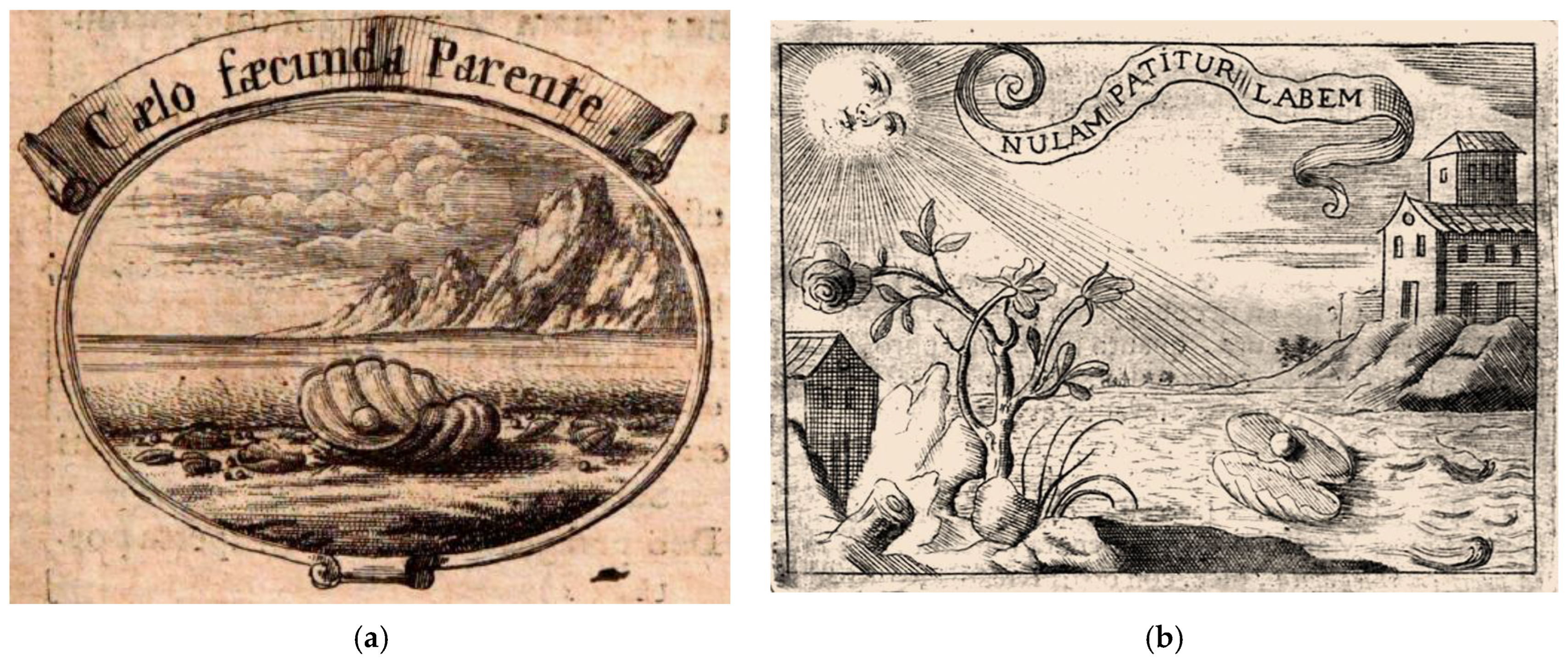
 ). The bas-relief it houses constitutes a singularity within the visual program of the Sacristy of the Virgin, as it does not refer to the treatise Flores de Miraflores (De la Iglesia 1659). In it, Mary is represented as the “precious shell,” fertilized by the pure morning dew (Figure 16a).
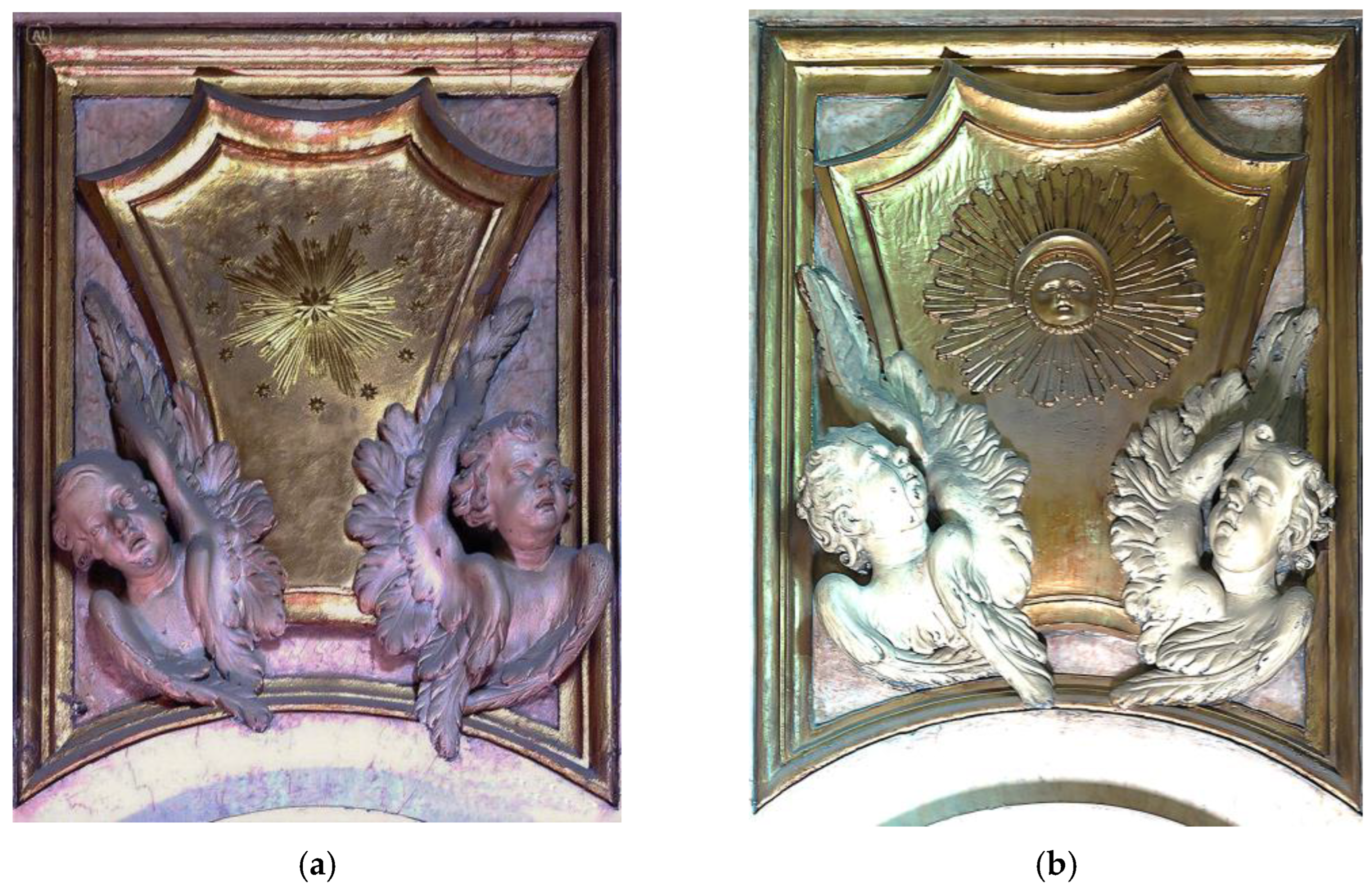
 ), previously addressed on the inner side of the entrance door to the Sacristy of the Virgin (Figure 18a).
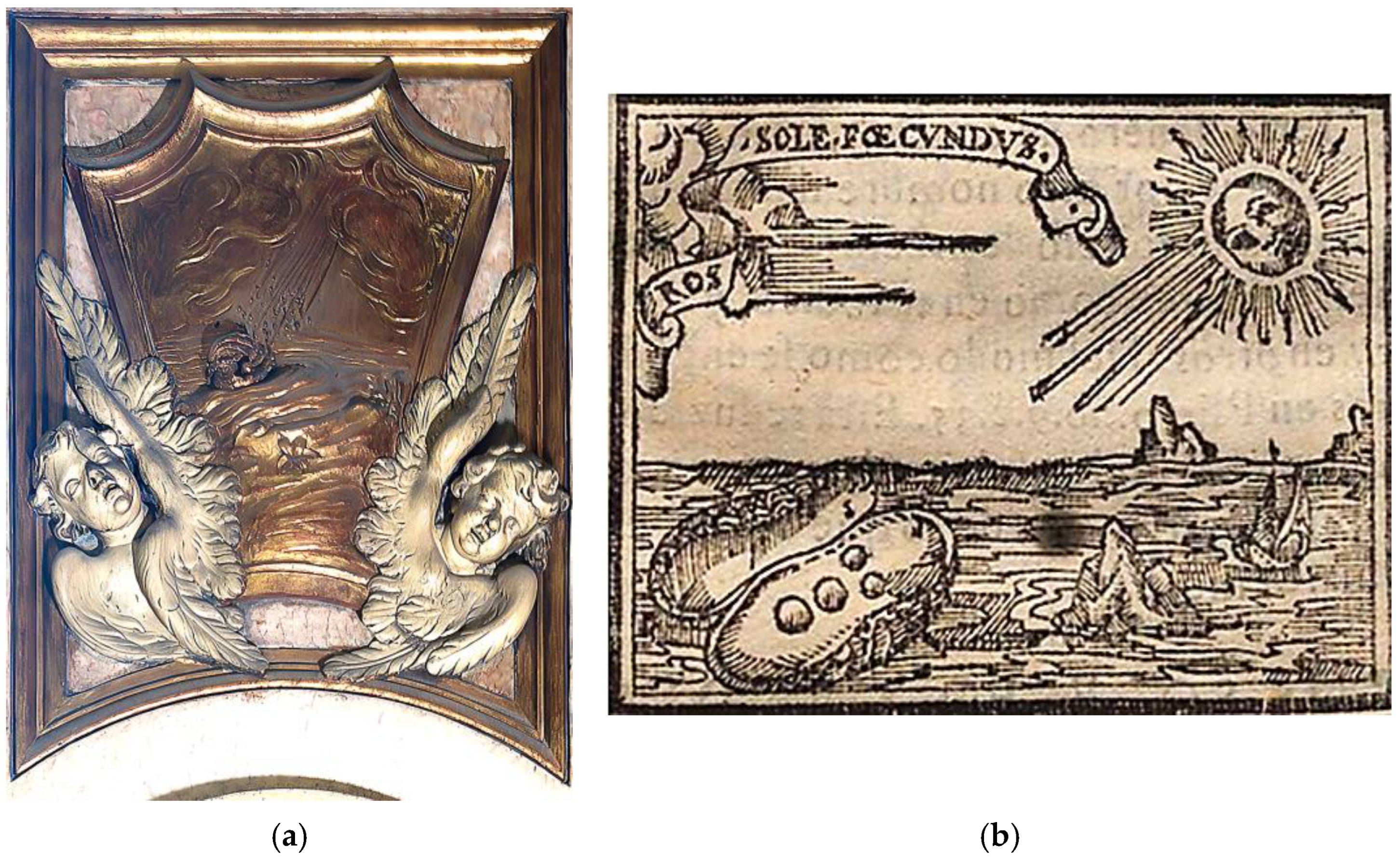
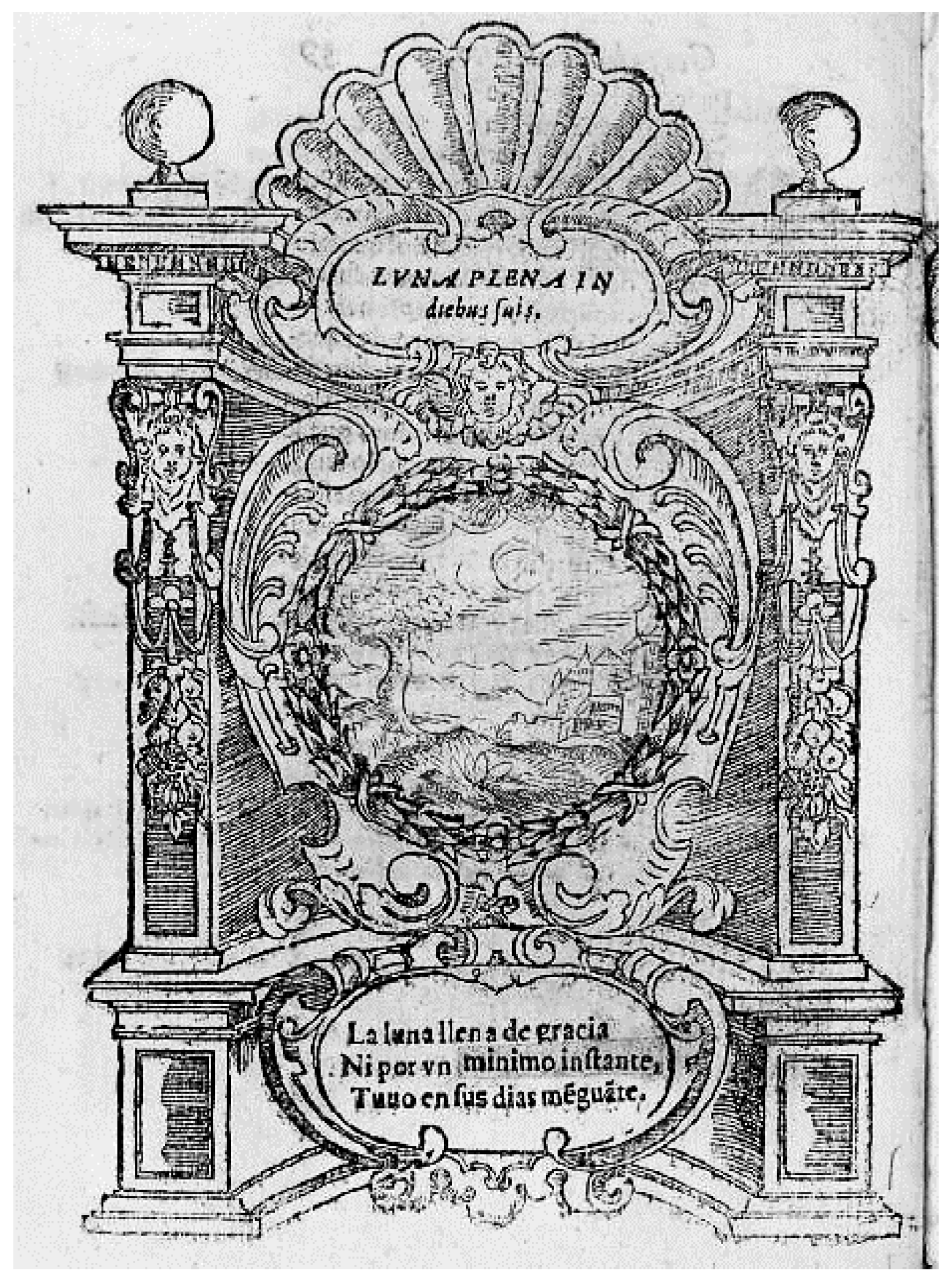
 ). In it, Mary is presented under the dual image of the Sun and the Moon, referring to the Genesis passage depicted on the door of the former oratory (Figure 18b). Here, both celestial bodies are intertwined within a single composition to exalt her purity. Hence, the Moon—like the Sun—was adopted by scholastic thought as a theological figure of superlative virtue, grace, and hope, as already observed by the Benedictine cardinal Peter Damian (1007–1072).101 Over time, this formulation gave rise to a rich hermeneutic network. Authors such as Bonaventure (ca. 1221–1274)102 and Albert the Great (ca. 1193/1206–1280) enriched the cardinal’s reflections with their own nuances—particularly the latter, who introduced the concept of Mary as Co-Redemptrix and guide of sinners.103 In this way, the metaphor gradually expanded toward more complex horizons. In his ninth hieroglyph (Figure 19),104 Fr Nicolás, while maintaining the theses of his predecessors, associated the Moon with the apocalyptic verse of the “woman clothed with the sun”.105
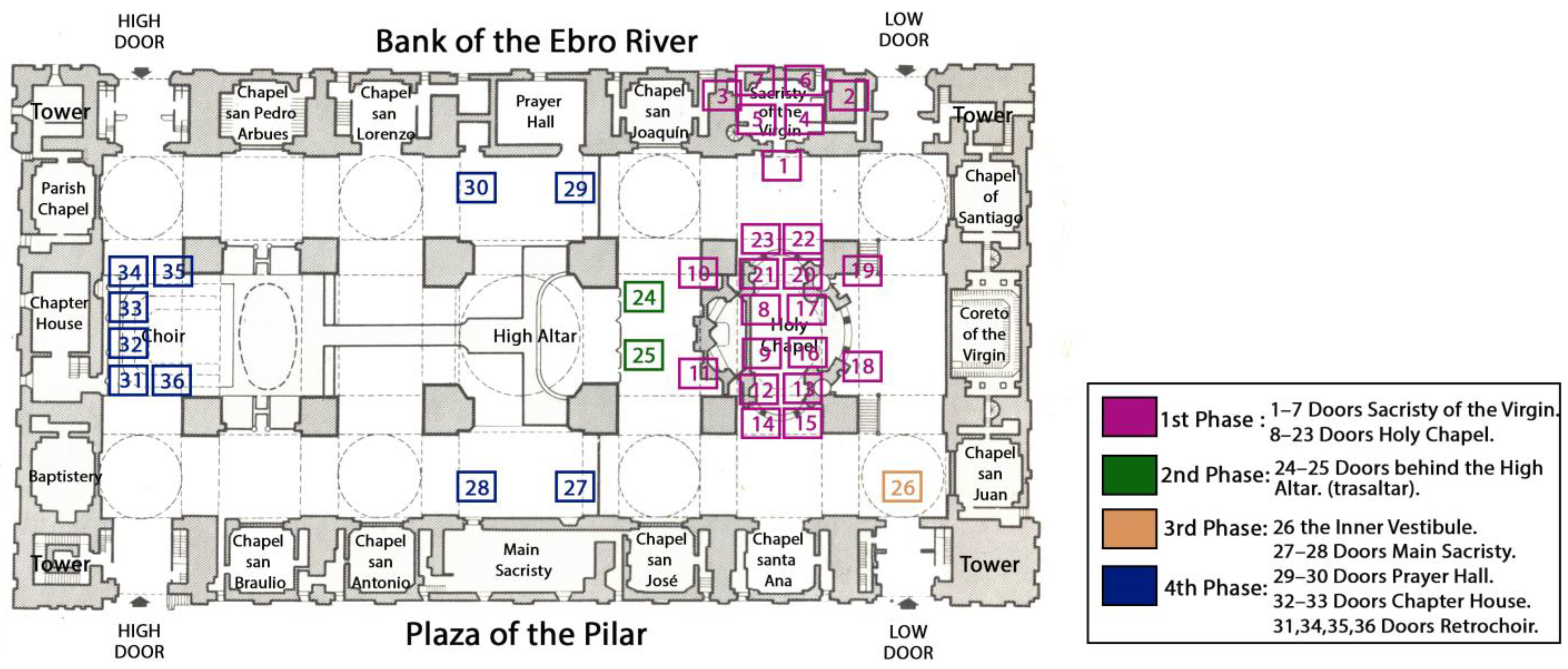
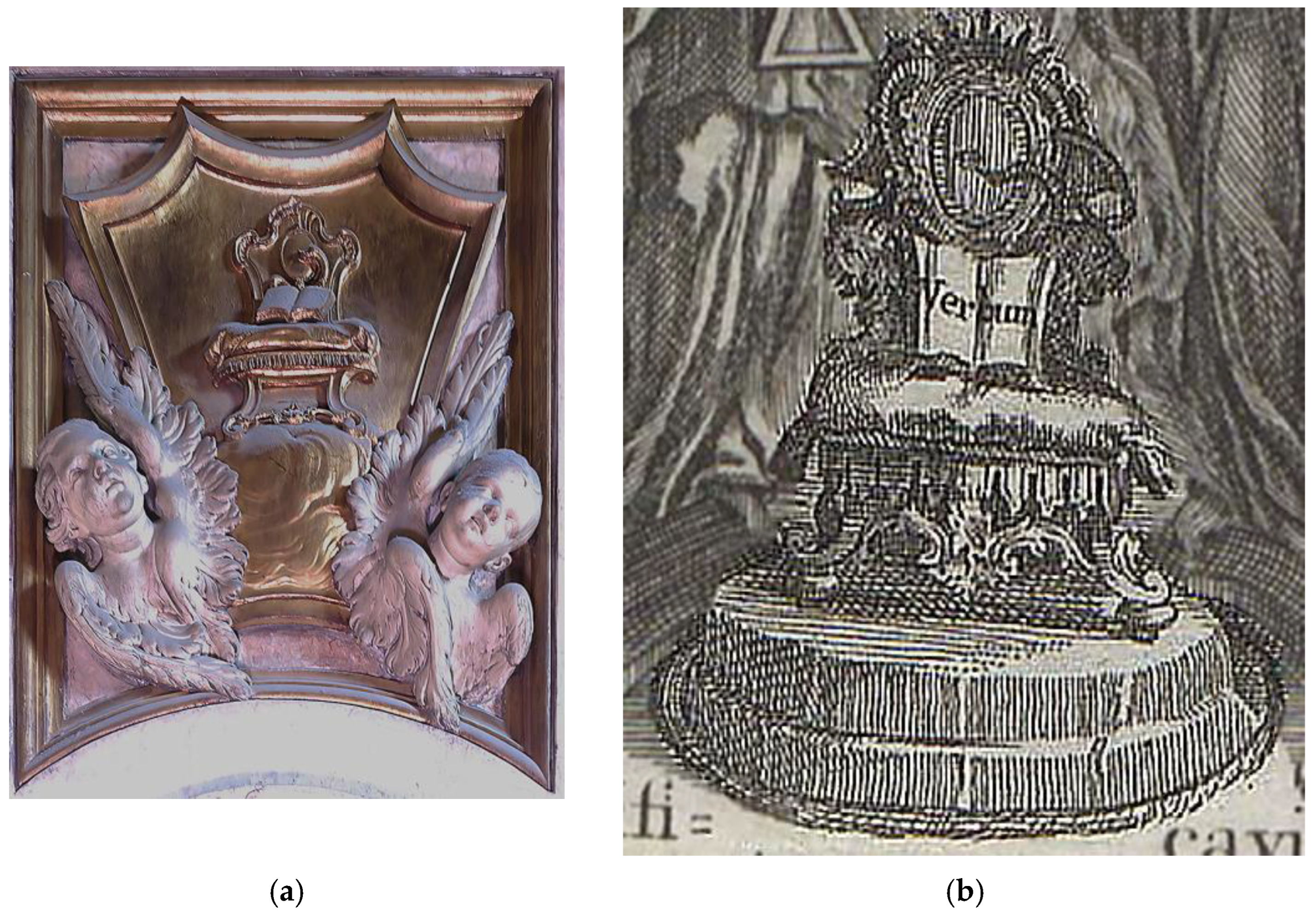
 ), in which Mary is revealed as the biblical “Throne of Solomon”106 (Figure 20a). Although Fr Nicolás (De la Iglesia 1659) dedicated his forty-fifth hieroglyph to this emblem, the iconography of the relief studied here draws more immediately from the print of the Sedes Sapientiae invocation in Francisco Xavier Dornn’s Litany of Loreto (18th c.) (Figure 20b).
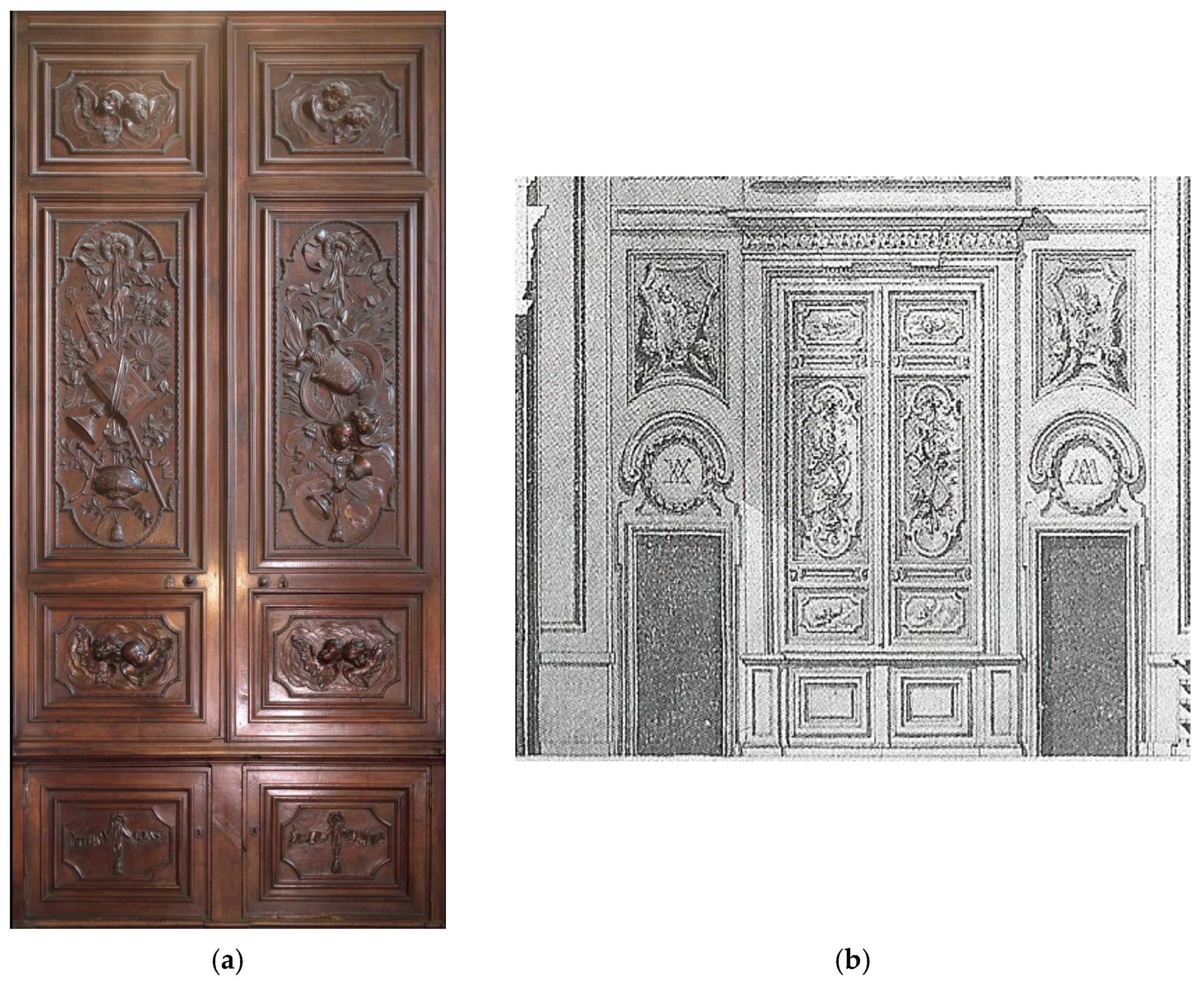
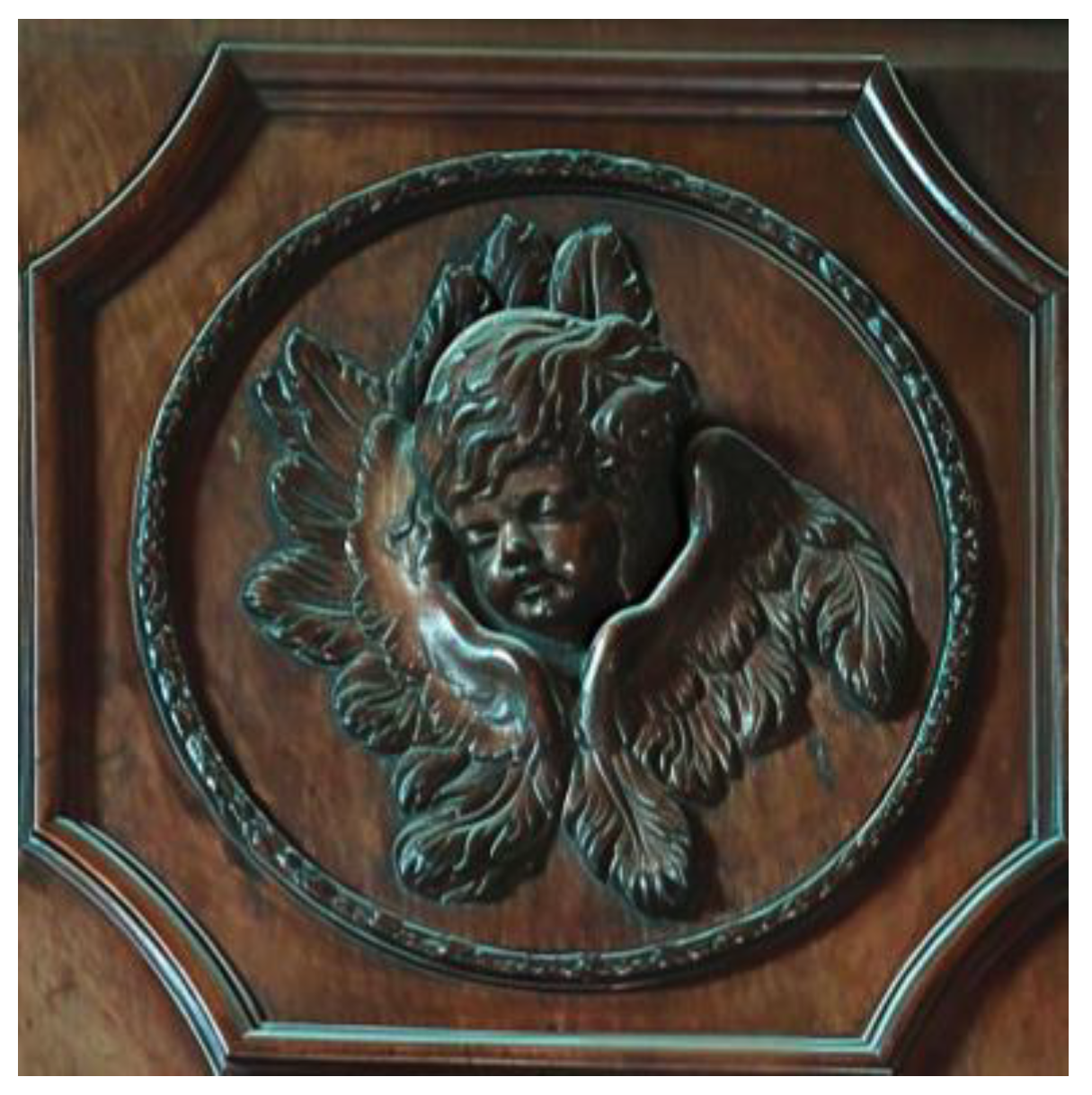
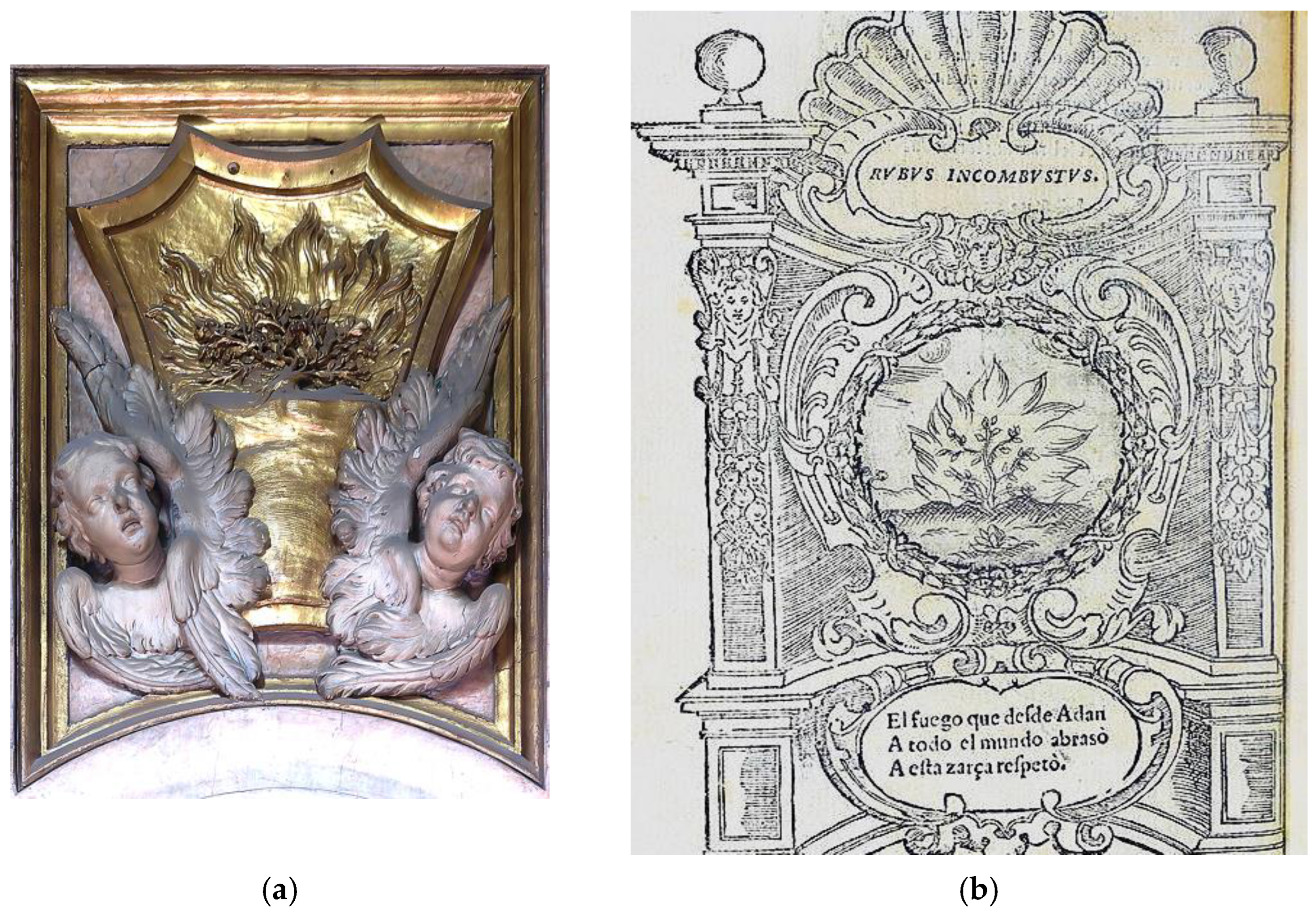
 ), where Mary is revealed as the “burning bush of Moses”109 (Figure 21a). This biblically rooted motif is reinterpreted in Marian terms as an exaltation of her incorrupt virginity. Nevertheless, the bush embodies a deeper significance, serving as a manifest sign of her superiority as the one chosen by God, through a visual paraphrase of the passage from Exodus: “Ego sum qui Sum”.110
3. Conclusions
Funding
Institutional Review Board Statement
Informed Consent Statement
Data Availability Statement
Conflicts of Interest
Abbreviations
| ACP | Archivo Capitular del Pilar |
| DARA | Documentos y Archivos de Aragón |
| PG | Migne, Jacques-Paul (ed.), Patrologiae Cursus Completus, Series Graeca, Paris, 1853–1891, 166 vols. |
| PL | Migne, Jacques-Paul (ed.), Patrologiae Cursus Completus, Series Latina, Paris. 1853–1891, 221 vols. |
| 1 | Numerous authors have addressed the study of the Basilica of the Pilar, and consequently, of the Sacristy of the Virgin. Among the earliest works are Manuel Vicente Aramburu (Aramburu de la Cruz 1766, pp. 127–28; Antonio Ponz 1788, pp. 11, 14, 19). After a hiatus of more than seven decades, (Nougués Secall 1862, pp. 322–23) resumed the study of this subject, followed by the publication of (Mullé de la Cerda 1872, pp. 170–72). Eight years later, following the line of his predecessors, we find (Supervía 1880, p. 14). The twentieth century began with limited interest, although some contributions stand out, such as (Iñiguez Almech 1949; Ríos Balaguer 1925). Finally, in the second half of the century and up to the present, notable studies include (Torralba Soriano 1974, pp. 60–62; Ansón Navarro 1987, pp. 302–3; Ansón Navarro 2008, pp. 317–18), among others. |
| 2 | Original documents in Spanish. For better comprehension, they have been translated into English, while preserving, as much as possible, the punctuation and grammar of the transcribed texts. |
| 3 | ACP, Junta de Fábrica 1745–1816, 2-6-0, fol. 96. Cited in (Ortiz Gutiérrez 2019, pp. 44–46). |
| 4 | “[…] bajorrelieves de Puertas de la Sacristía trabajadas por las dos caras, y las del guarda joyas, y Armario de la Plata: Y las cuatro del Oratorio, Lavatorio, Caracol, Retrete de la Cera” (ACP, Recibos, 1756–1759, 6-11-11, no. 53 r-v. Cited in Ibid., p. 46). |
| 5 | Thanks to a two-section plan of the Sacristy of the Virgin, signed and dated by Ventura Rodríguez in 1755 (previously published by Iñiguez Almech 1949, p. 471), we can identify a hitherto overlooked detail. As observed in the left transversal section, the sketches that were later executed in the bas-reliefs of the silver cabinet doors already appear in the hand of the Royal Architect himself. In the absence of documentary evidence, this allows us to reasonably posit his involvement in the design of the remaining ornamental sculptural motifs within the sacred chamber. |
| 6 | As a consequence of the immense undertaking that a comprehensive study of the primary sources for each of the Marian emblems would entail, we have been compelled to limit our analysis to a selection of the principal authors, as well as those cited by Fr Nicolás de la Iglesia. |
| 7 | (De la Iglesia 1659). This treatise was written in 1659 by Friar Nicolás de la Iglesia, a monk of the Miraflores Carthusian Monastery in Burgos. As the Carthusian himself recounts, the growing devotion to the Virgin of Miraflores motivated the transfer of her image to an individual chapel. However, this chapel lacked the necessary stature to house the sacred image, which led Friar Nicolás to transform it into one of the most relevant spaces of the temple through the pictorial ornamentation of its walls. The decorative program was structured around a series of anagrams (hieroglyphs, as the monk called them), drawn from various passages of the Holy Scriptures and usually represented around the figure of the Tota pulchra. Several years after the completion of the mural decoration, the Carthusian undertook the writing of a work dedicated to the virtues of Mary, in which he integrated not only the emblems included in the wall decoration but also others newly created. Naturally, when discussing the work of Friar Nicolás de la Iglesia, it is essential to cite (Escalera Pérez 2009). |
| 8 | While it is true that Fr Nicolás’s manual has been established as an essential roadmap for interpreting the iconographic discourse of the sculptural ensemble of the Pilar, it is necessary to clarify that each of the references cited in this article has been duly cross-checked with the original documents. |
| 9 | Completing the ornamentation of the Sacristy of the Virgin, we find the paintings by Joaquín Inza on the upper parts of the walls and ceiling, depicting Saint James in the Battle of Clavijo (tradition holds that on the eve of the Battle of Clavijo, in the year 844, the apostle appeared in a dream to King Ramiro I, urging him to fight and invoke him during the battle. On the appointed day, the monarch followed Saint James’ instructions, who miraculously intervened on behalf of the Christians, killing more than five thousand Muslims, as well as the two beheaded heads of Saint Paul and Saint Peter, protected in rococo urns attributed to José Ramírez.). |
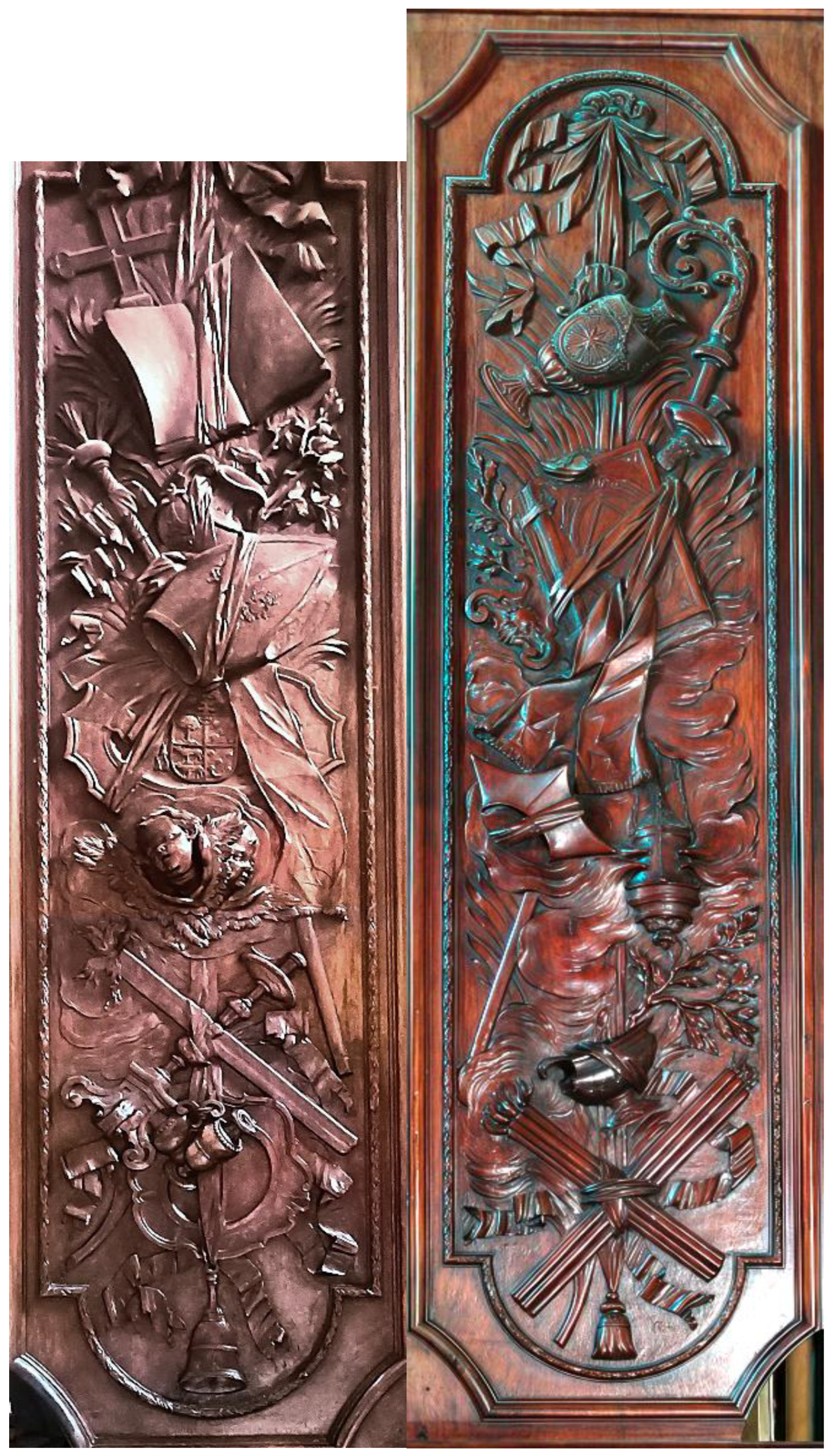
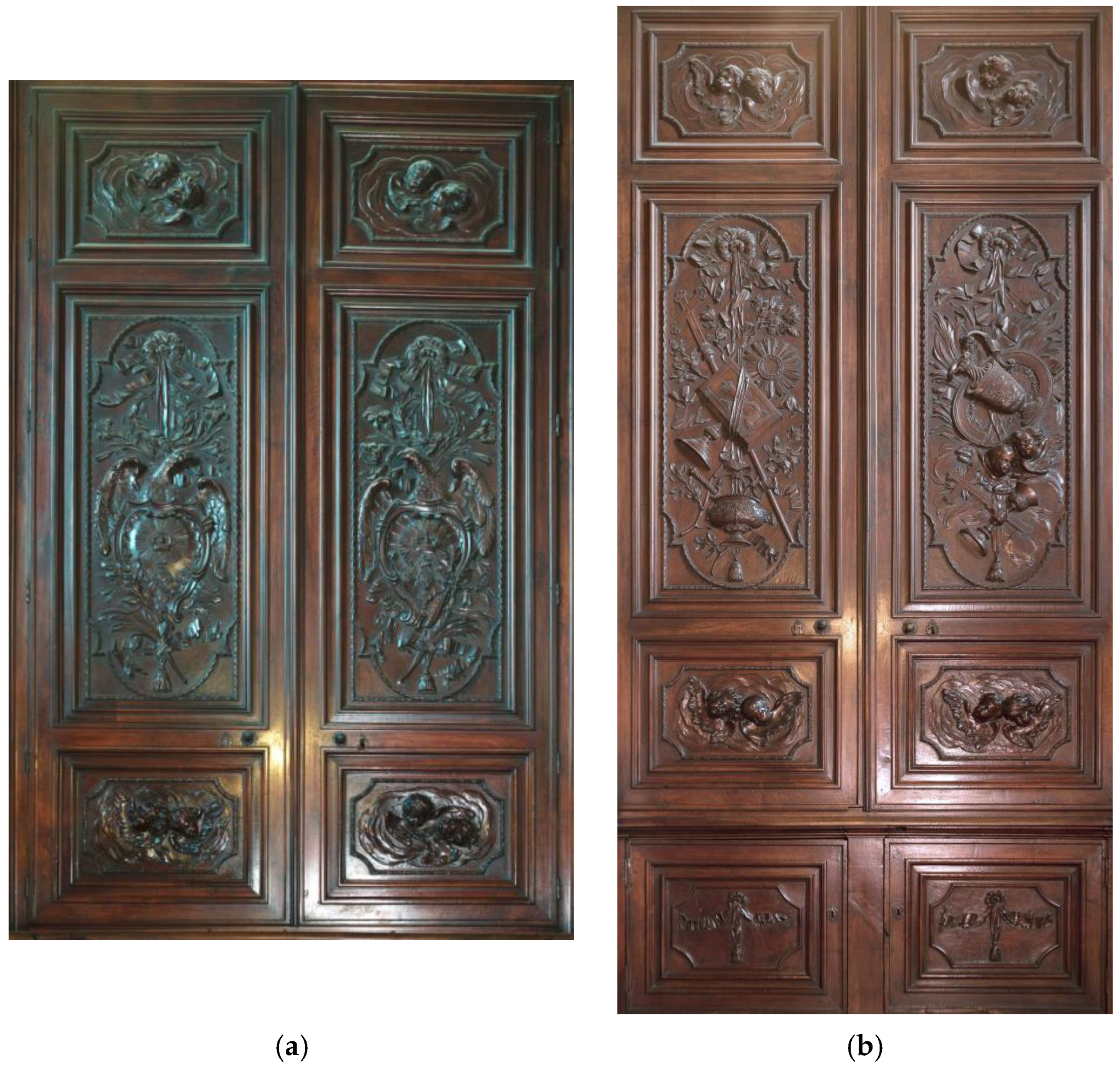
| 10 | Although the doors under study were produced between 1756 and 1760, they constitute the beginning of a sculptural project that extended over one hundred and eleven years, articulated in four distinct phases. The first coincides with the project of the Holy Chapel (1750–1765), resulting from the collaboration between the sculptor José Ramírez and the Royal Architect Ventura Rodríguez as its designer. According to the documents, this initial stage corresponds to the installation of the doors of the Sacristy of the Virgin (1756–1760): the entrance door, those of the cabinets for the Virgin’s jewels and silver, and the four doors of the wall bays; as well as those of the Holy Chapel (1760–1765). The second phase (ca. 1788) plausibly relates to the construction of the two doors of the rear altar. Despite the absence of documentary records, a reference in (Ponz 1788, p. 28) suggests the possibility of their attribution to the sculptor Joaquín Aralí. Subsequently, the third phase comprises the making of the low door screen of the south façade (1846–1850), a work by the carpenter Manuel Sarte and the sculptor José Alegre. Finally, the fourth phase (1866–1868) corresponds to the ten doors mentioned above (Figure 2). This article is part of a broader line of research dedicated to the study of the symbolic development of Marian emblems represented in the sculptural ensemble of the thirty-six doors ornamented with bas-reliefs in the Basílica del Pilar (Ortiz Gutiérrez 2024a, 2024b, 2026). |
| 11 | Monumental walnut door carved on both sides (approximately 4.56 m high × 2.14 m wide), flanked by a pair of Corinthian columns. The door consists of two leaves divided by a pair of stiles into three panels, decorated with mixed-molded squares containing bas-reliefs executed in the schiacciato technique. |
| 12 | “I am the rose of Sharon, the lily of the valleys. As lily among the thistles, so is my love among the maidens.” (Song of Songs 2: 1–2. The Jerusalem Bible 1966, p. 994). We shall adopt this version as it is the closest to the Spanish translations. It must be remembered that the bas-reliefs were carved by an Aragonese sculptor for a temple in Spain, which makes it highly probable that the biblical sources employed were drawn from vernacular Spanish editions or, failing that, from the Latin Vulgate. Returning to the emblem of the Lily, we also find a passage in the Gospel according to Saint Matthew in which Christ Himself exalts the lily of the fields as an example of glory: “And why worry about clothing? Think of the flowers [lily in other versions] growing in the fields; they never have to work or spin; yet I assure you that not even Solomon in all his regalia was robed like one of these” (Matthew 6: 28–29. The Jerusalem Bible 1966, p. 24). |
| 13 | “O speciosissima dulcissimaque puella! o lilium inter spinas, ex generosissima et maxime regia radice Davidica progenitum! Per te regnum sacerdotio locupletatum est […] O rosa [can be extrapolated to the lily], quae ex spinis, Judaeis scilicet, orta es divinoque odore cuncta perfudisti” (Iohannes Damascenus 1891b, p. 670). Cited in (Salvador González 2014, p. 21). |
| 14 | “Ave, gratia plena, quoniam super lilia fragrans fuisti, et super rosas rubicunda, ac super varie decorum ver effloruisti” (Iohannes Damascenus 1891d, p. 655). Cited in (Salvador González 2014, p. 21). |
| 15 | “Non tamen haec idcirco dixerimus, quod Dominus qui peccatores vocare venit, dedignatus sit matrem suam peccatores habere cognatos, inter quos speciosa velut inter spinas lilium apparet” (Fulberti Carnotensis 1853, p. 321). |
| 16 | “Candor ipsa merito dicit Sponsus Caticorum secundo: Ego flos campi et lilium convallium. Sicut lilium inter spinas, sic amica mea inter filias. Aliae enim filiae et virgines spinae sunt propter aculeos et punctiones concupiscentiae non omnino in eis exstinctae; hace autem fuit lilium candens et redolens” (Bonaventure Bagnoregio 1947g, pp. 894–97). Cited in (Salvador González 2014, p. 25). |
| 17 | “Lilium vocatur Christus, lilium dicitur et mater Christi, sicut in eodem Cantico subinfertur: ‘Sicut lilium inter spinas, sic amica mea inter filias’ (Ibid.)” (Petrus Damianus 1853b, p. 754). Cited in (Salvador González 2014, p. 22). |
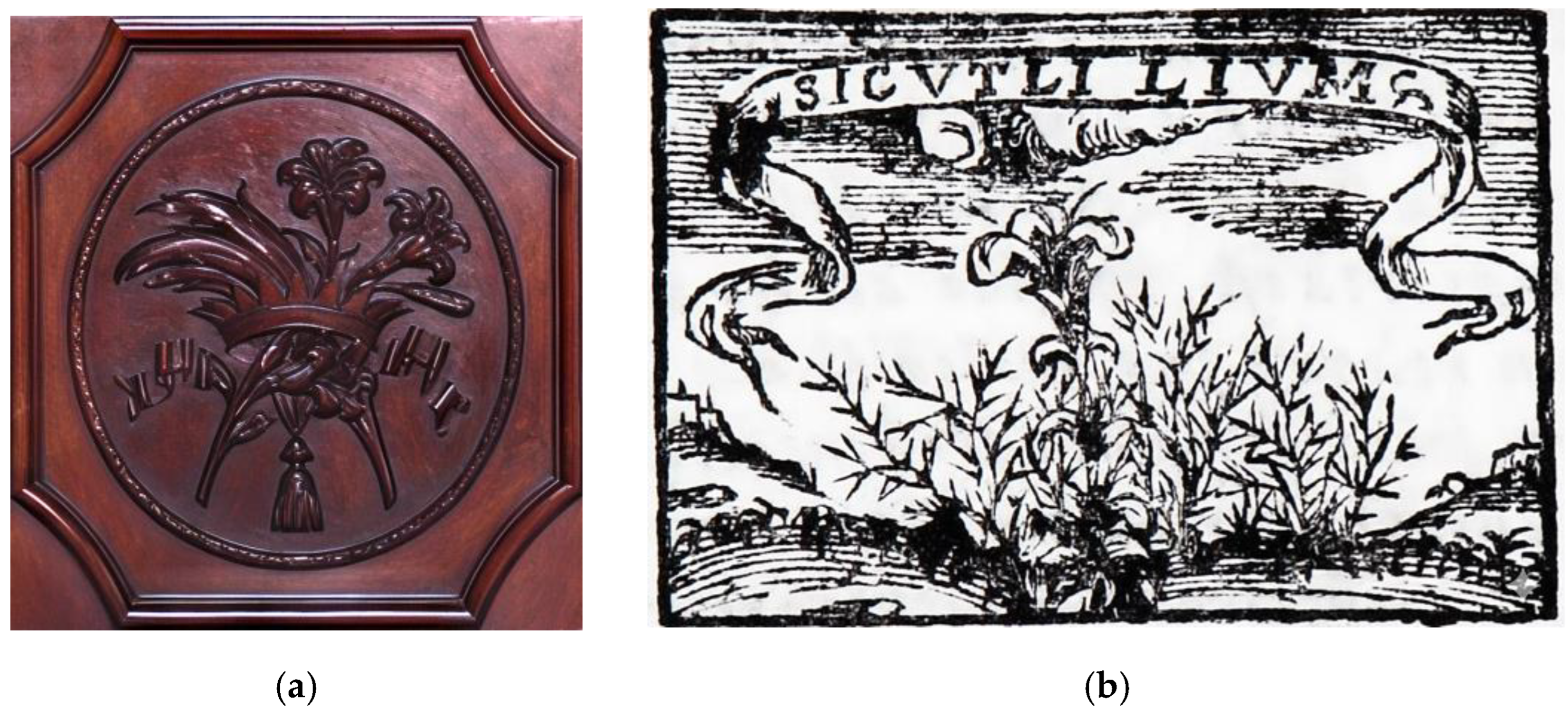
| 18 | Juan Horozco y Covarrubias, Sacra Symbola (Sicily: n.p., 1601), n. pag. |
| 19 | (Horozco y Covarrubias 2017, p. 421). Covarrubias treats the rose and the lily interchangeably in this emblem. |
| 20 | “Il lauro, l’olivo, e la palma, furono da gli Antiche usati per segno di honore, il quale volevano dimostrare doversi a coloio, che haverssero riportata vittoria de nemici in beneficio della Patria […]”. Translation: “The laurel, the olive, and the palm were used by the Ancients as a sign of honour, which they wished to show was owed to those who had gained victory over the enemies for the benefit of the Fatherland” (Ripa 1625, p. 729). |
| 21 | According to the account, Mary, weary from the desert heat, asked her husband Joseph to halt their journey and seek shelter under the shade of a palm tree. Hungry, the Virgin noticed the dates hanging from the crown and expressed her desire to eat them, though they were out of reach. While Joseph, more concerned with dehydration than hunger, diligently searched for water during the arduous trek, a miracle occurred: the Child Jesus caused the palm tree to bend so that its fruit could be offered to His mother, and water sprang from its roots to quench their thirst. The following day, before resuming their journey, the Child granted a privilege to the palm tree as a sign of gratitude for the aid it had provided: “one of your branches” would be transported to the “paradise of my Father,” so that those who have triumphed in any struggle could say they had “obtained the palm of victory” (The Infancy Gospel of Pseudo-Matthew 20–21: 1. The Apocryphal Gospels and Other Documents Relating to the History Os Christ 1867, pp. 59–61). |
| 22 | “In stature like the palm tree, its fruit-clusters your breasts” (Song of Songs 7: 8. The Jerusalem Bible 1966, pp. 1001–2). |
| 23 | “Quasi palma exalta sum” (Ecclesiasticus 24: 18, Nova Vulgata. Bibliorum Sacrorum Editio 1986, p. 1197). The literal rendering states: “I have been exalted like a palm.” However, in later versions, the verse underwent a transformation and is now commonly translated as: “I have grown tall as a palm in Engedi” (Ecclesiasticus 24: 18. The Jerusalem Bible 1966, p. 1068). |
| 24 | “[…] obtiene dos victorias. El primero, encierra, y abraza todo el discurso de su vida, desde su Concepcion, hasta su transito; y deste, habla el esposo en el los Cantares. El segundo, se refiere al estado, y modo con que seva aclarando, y publicando la verdad del Mysterio, en que se encierra el principio, y progresso de su primera victoria, que por ser tan glorioso, le celebra ella, diciendo: ‘Quasi Palma exalta sum in cades’ [Ecclesiasticus 24: 18, Nova Vulgata. Bibliorum Sacrorum Editio 1986, p. 1197]” (De la Iglesia 1659, 6r). |
| 25 | Of particular interest for this Marian emblem are the studies by (Valtierra Lacalle 2017, pp. 109–11) and (Salvador González 2011, p. 11). Valtierra Lacalle offers an evolutionary overview of the symbolism of the palm, from its origins to its consolidation as a Christian Marian and Christological motif, highlighting its indomitable character as a metaphor for the life of the “good Christian” and, in the case of Mary, for her purity, as well as its connection with Paradise and immortality. Moreover, Salvador González explores this symbolism through the interpretation of primary and apocryphal texts related to the Dormition of the Virgin, specifically in John of Thessalonica III. (Los Evangelios Apócrifos 1956, pp. 654–55) and Joseph of Arimathea IV. (Los Evangelios Apócrifos 1956, p. 689). |
| 26 | Francisco de Añoa y Busto (1684–1764). Archbishop of Zaragoza from 1742 to 1764 and major patron of the Baroque refurbishment of the Holy Chapel and the Virgin’s Sacristy. (Boloqui 1983, p. 401). |
| 27 | Of classical origin, it was later reinterpreted by Christianity as a symbol of victory in the struggle between good and evil. |
| 28 | Ecclesiasticus 24: 19. (The Jerusalem Bible 1966, p. 1068). |
| 29 | “Si enim olivae proprietatem inspiciamus, in hoc primo eleganter satis beatae Mariae congruit, quia viret hyeme et aestate, nec aliqua frigoris sive tempestatis, aut etiam aestivi caloris intemperantia speciem suae viriditatis amitit. Aestate autem futurae vitae claritas accipienda […] Oliva ergo nostra et aestate et hyeme virorem suum retinet, quia beata Virgo Maria humore spiritalium gratiarum perfusa praesentis vitae torpore non aruit, et aeternae vitae amenitatem inter omnes filias Evae gloriosa suscepit” (Abbatis Absalonis 1855b, p. 266). |
| 30 | “El quia ipsa Virgo gloriosa misericors est ad omnes, comparat olivae, dicens, Eccles. 24. Quasi oliva speciosa in campis. Oliva significat misericordiam, quia óleum fructus est lenitiuum, & dulce. Ad olivam, quae est speciosa in campis, omnes postunt accedere, & accipere fructum eius, sie ad Mariam & iusti & peccatores accedere possunt, ut inde misericordia, accipiant. Ipsa est illa sancta Iudith, quae ex magna misericordia ad populum suum eum magna providencia, & fortitudine occidit Holofernem ferocissimum obsidentem, & captivare, &exterminarevo letem populum Dei, diabolum infernalem” (Antoninus Florentinus 1648a, p. 702). |
| 31 | In this study, the term Co-Redemptrix is used strictly in a historical and iconographic context, grounded in patristic, scholastic, and Early Modern sources. Its use here does not constitute an endorsement of the contemporary application of the title in official Church doctrine. As clarified by the Dicastery for the Doctrine of the Faith (‘Mater Populi Fidelis’, 7 October 2025), the term is not employed in current theological discourse, which emphasises the unique mediatory role of Christ in the Redemption. Within the eighteenth-century visual and devotional programmes analysed here, however, Co-Redemptrix functions symbolically to represent Mary as intercessor and protector of Humanity |
| 32 | “Nec sideri radius […] cuius radius universum orbbem illuminat, cuius splendor et praefulget un supernis, et ínferos penetrat, terras etiam perlustrans […] Ipsa inquam, est praeclara et eximia stella, super hoc mare magnum et spatiosum necesario sublevata, micans meritis, illustrans exemplis. O quisquis te intelligis in huis saeculi profluvio magis inter […] O quisquis te intelligis in huis saeculi profluvio magis inter procelas et tempestates fluctuare quam per terram ambulare, ne avertas oculos a fulgore huius sideris, si non vis obrui procellis! Si insurgant venti tentationum, si incurras scopulos tribulationum, réspice stellam, boca Mariam. Si iactaris superbiae undis, si ambitionis, si detractionis, si aemulationis, respice stellam, boca Mariam” (Bernardus Claraevallensis 1994, pp. 636–39). |
| 33 | “Plane ipsa, quam diximus, maris stella tribus modis stellis caeteris praeminere invenitur, videlicet altitudine, inmobilitate, et luminus communione. Altitudine, quia in vertice mundi posita, sicut caput membris, ita et illa caeteris stellis super exioltirur. Unde et pocta dicit: hic vertex nobis semper sublimis, at illum (hoc est ejus oppositum). Sub pedibus styx astra videt manesque profundi. Immobilitate, quoniam quasi in centro firmamenti consti uta caeteris vario motu modo ad occasunt tendeutibus, ipsa inmobilis persistit. Communione luminis, quia caeteris vicissim lumen suum praebentibus, haec sine vicissitudine, semper aequali radio, quantum in se est, cunctis viventibus claritatem effudit. Haec de stella, sed illa eadem diligens investigator invenies in Maria” (Abbatis Absalonis 1855a, p. 251). |
| 34 | “Maria stella, quae recte viantes dirigis errantes reducis, periclitantes ad portum salutis restituis. Juste maris stella appellata es, quae ratione quadam similitudinis, sicut illa mari ita et tu mundo profuntura eras” (Ibid. p. 251). |
| 35 | “Quid est Maria? Illuminatrix. Quid est Maria? Domina. O Maria, o maris stella, o illuminatrix, o domina. O maris stella, non timet naufragium que ad te potest habere confugium; qui te habuerit propiatiatricem. O illuminatrix, secure trnsibit per umbram mortis, quem tu illustraveris, quem tu praeibis” (Petrus Cellensis 1855c, p. 714). |
| 36 | “[…] virgo gloriosa (est,) maris stella purificans eos qui sunt in mari huius mundo, illuminans et perficiens. Sequamur igitur stellam maris purificantem per gemitum compuntionis amarae, stellam maris illuminantem per stadium virtutis illuminativae, stellam maris perficientem per votum perfectionis” (Bonaventure Bagnoregio 1947b, pp. 638–41). |
| 37 | “El nombre de la Virgen, es Maria. Y Maria, como todos saben, quere decir: Estrella de Mar” (De la Iglesia 1659, 46r). |
| 38 | Both cabinets, crafted in walnut, feature the same double-leaf structure with two sections. The upper section, with panels carved on both sides, is articulated like the access door, while the lower section consists of two mixed-line panels between a pair of uprights, all surmounted by a cornice. |
| 39 | They no longer serve that function. Most of the Virgin’s crowns and other jewellery are now displayed in the Pilarist Museum, and the same applies to the Silver Cabinet. |
| 40 | One day, Apollo was harassing Cupid, when the latter, enraged by the affronts he had suffered, resolved to exact his revenge. Cupid drew two arrows from his quiver: one of gold, which inspired love, and another of lead, which produced the opposite effect. With the golden arrow, he struck Apollo, while with the leaden one, he pierced the nymph Daphne, a devoted virgin consecrated to the goddess Artemis. Apollo’s passionate love ultimately drove Daphne to flee; yet, fearful of being overtaken, she implored her father, the river Peneus, to transform her. Suddenly, the young woman underwent a gradual metamorphosis: first, her body became covered in bark, then her hair turned into foliage and her arms into branches, until she was finally transformed into the laurel tree (Ovid 2002, vv. 452–552). |
| 41 | “Since you cannot be my wife, you shall surely be my tree. O laurel, I shall forever have you in my hair, on my lyre and quiver. You will be there with Roman chieftains when joyful voices sing out their triumphs and long processions march up within sight of the Capito […]” (Ibid., vv. 557–61, 27). |
| 42 | Smaller in size than the previous ones (approximately 2.15 m high by 0.92 m wide), these four doors perfectly embody the typological criteria of the Royal Architect Ventura Rodríguez: small, lintelled, and crowned with tondi. Structurally, each leaf is divided by a horizontal rail (peinazo) into two panels, the upper decorated with a medallion bearing Marian bas-reliefs, while the lower is ornamented with ribbon-like motifs. |
| 43 | According to (Vorágine 1996, pp. 568–69). Mary was conceived through an embrace between Saint Joachim and Saint Anne before the Golden Gate of Jerusalem. |
| 44 | Ecclesiasticus 24: 18. (The Jerusalem Bible 1966, p. 1068). |
| 45 | “O rosa, quae ex spinis, Judaeis scilicet, orta es divinoque odore cuncta perfudisti” (Iohannes Damascenus 1891a, p. 670). Cited in (Salvador González 2014, p. 20). |
| 46 | “rosa purpurea in Jericho” (Anselmi Cantuariensis 1864b, p. 962). Cited in (Salvador González 2014, p. 22). |
| 47 | “Sic igitur rosa orta de spinis, sive oliva speciosa in campis, de medulla cedri, et adipe frumenti sanctissimum corpus accepit” (Petrus Cellensis 1855b, p. 855). Cited in (Salvador González 2014, p. 25). |
| 48 | “Fructus divini sunt omnes sancti et iusti, sed specialiter ipse Iesus Christus, qui est Deo Patre genitus et a Virgine Maria conceptus per Spiritum sanctum, qui ex humana natura pullulavit sicut rosa de spina, quae inter flores ratione pulcritudinis obtinet principatum […]” (Bonaventure Bagnoregio 1947e, pp. 766–67). Cited in (Salvador González 2014, pp. 25–26). |
| 49 | “Beatissima Virgo dicitur Virgo virginum […] ut rosa flos florum, id est, dignissimus inter flores […]” (Albertus Magnus 1651c, p. 67). |
| 50 | “El Espíritu Santo comparó la excelencia de María a la planta de la rosa, no a la rosa abstraiendo de la planta, […]. Porque la excelencia de esta Virgen, consiste en aver salido rosa pura y sin resabio de espina, de un tronco rudo y espinoso, sin calidades de rosa” (De la Iglesia 1659, 93v). |
| 51 | The Archangel Gabriel, kneeling before the Virgin, customarily holds a lily in his hands; alternatively, it may appear placed in a vase within the Virgin’s chamber, depicted at various stages of blossoming. |
| 52 | According to Ovid’s account, the cypress finds its origin in the myth of Cyparissus, beloved of Apollo. The young man felt a special affection for a sacred stag, which he tended with great care. One day, he accidentally wounded it with a javelin and, unable to endure the grief over its death, he implored the gods to allow him to weep for it eternally. His plea was heard, and, transformed into a cypress, he became a symbol of mourning and of incorruptibility in the memory of the dead (Ovid 2002, vv. 106–47). |
| 53 | We will not enter into a discussion of the exact dating of the Song of Songs (c. 10th–3rd c. B.C.), as this issue has been addressed by several scholars. Among them, (Pope 1971, pp. 22–33), one of the leading authorities in its exegesis. |
| 54 | “Your shoots form an orchard of pomegranate trees, the rarest essences are yours” (Song of Songs 4: 13. The Jerusalem Bible 1966, p. 998). Both the Masoretic texts and the Spanish versions of the Bible add: “with cypresses and nards” (Cantar de los Cantares 4: 13. Sagrada Biblia 1968, p. 872.) |
| 55 | “In Cypro quae habet semen candidum, notatur castitas […]” (Albertus Magnus 1651b, p. 329). |
| 56 | “’Dei Genitriz’ hortus conclusus, fons signatus. Emissiones tuae paradisus malorum Punicorum cum pomorum fructibus. Cyprus cum nardo, nardus et crocus […]” (Rupertus Tuitiensis 1854, p. 895). |
| 57 | “[…] al ciprés contra la corrupción de los cuerpos muertos y por eso los Romanos, quando salían à quemar los cuerpos de los difuntos […] llevan à este acto funeral, ramos de ciprés […] dio el mismo Señor a su madre esta calidad fragante, para purificar el aire contra la corrupción de los cuerpos vivos, y contra este contagio pestilente de la sensualidad, que tan inficionado tiene al mundo” (Joseph de Jesús María 1652, p. 196). |
| 58 | “Están sus ramas, que con ser frondosas precepto guardan a su tronco unidas sin ser reprehendidas por viciosas. […] El pomposo Ciprés es importante alvergue de los paxajaros menores, porque no los disgregue ni quebrante la noche en sus tinieblas y rigores: y como de la Iglesia militante hijos pequeños son los pecadores, en ti [la Virgen] se amparan por tener contigo para la noche de la muerte abrigo […] Si conforta el Ciprés, Virgen divina, humanos cuerpos con su olor fragante, el que ofrece tu planta peregrina a confortar las almas fue bastante: pues como el Orbe universal termina de tu fama el olor, al vigilante Dionysio provocó, y su amor profundo surcó por verte, la mitad del mundo”. Translation: “Its branches, though leafy, faithfully remain united to the trunk, without being reproached as corrupt. […] The stately cypress is an important refuge for the smaller birds, so that the night does not scatter or harm them in its darkness and rigors; and just as the small children of the militant Church are sinners, they take shelter in you [the Virgin], having with you a refuge for the night of death […] If the Cypress comforts, O Divine Virgin, human bodies with its fragrant scent, how much more does your pilgrim plant suffice to comfort souls: for as the fragrance of your fame reaches the ends of the universal sphere, it stirred the vigilant Dionysius, and his profound love traversed half the world to behold you” (Bonilla 1624, p. 121). |
| 59 | According to Caesarius of Heisterbach (1180–1240) in his Dialogus Miraculorum, the origin dates back to the late twelfth century, when a Cistercian monk, caught in profound ecstasy, had a vision of the Virgin sheltering the Cistercian Order beneath her mantle. “Monachus quidam ordinis nostri Dominan nostram plurium diligens, ante paucos annos mente excedens, ad contemplationem gloriae coelestis deductus est. Ubi dum diversos Ecclesiae triumphantis ordines videret, Angelorum videlicet, Patriarcharum, Prophetarum, Apostolorum, Martyrum, Confesorum, et eosdem certis caracteribus distinctos, id est in Canonicos, Regulares, Praemonstrantenses, sive Cluniacenses, de suo ordine sollicitus, cum staret el circumspiceret, net aliquam de illo personam in ella gloria reperiret, ad beatam Dei Genitricem cum gemitu respiciens, ait: Quid est sanctisima Domina, quod de ordine Cisterciensi neminem hic video? Quare famuli tui tibi tam devote servientes, a consortio tantae beatitudinis excluduntur? Videns eum turbatum Regina coetli respondit: Ita mihi dilecti ac familiares sunt hi qui de ordine Cisterciensi sunt, ut eos etiam sub ulnis meis foveam. Aperiensque pallium suum quo amicta videbatur, quod mirae erat latitudinis, innumerabilem multitudinem monachorum, conversorum, sanctimonialium illi ostendit”. Translation: “A monk of our Order, who loved Our Lady very much, some years ago, leaving his mind to contemplation, was taken into the contemplation of heavenly glory. When he saw the different orders of the Church Triumphant, namely Angels, Patriarchs, Prophets, Apostles, Martyrs, Confessors, and, distributed according to their insignia, the Canons Regular, the Premonstratensians, the Cluniacs […] When the [Cistercian monk] stood up and looked around and did not find anyone of his own [of the Cistercians] in that glory, looking with a sigh at the Blessed Mother of God, he said: Most Holy Lady, I do not see here anyone of the Cistercian Order […] The Queen of Heaven, seeing him so troubled, answered: those of the Cistercian Order are, on the contrary, so dear and familiar to me that I warm them beneath my arms. And opening the mantle that covered her, which was of a marvellous width, she showed him a multitude of innumerable monks, lay brothers and nuns” (Caesarii Heisterbacensis 1851, pp. 79–80). |
| 60 | (Sandaei 1629, pp. 249–317), devoted a section to the heliotrope; nonetheless, we consider that in this relief the presence of the sunflowers serves primarily as an iconographic reinforcement of the principal motif: Mary as the rising sun of the world. |
| 61 | Who is this arising like the dawn, fair as the moon, resplendent as the sun, terrible as an army with banners? (Song of Songs 6: 10. The Jerusalem Bible 1966, pp. 1000–1). |
| 62 | “Quae est ista quae ascendit dealbata? Tota pulchra, resplendens ut sol? […] dulci eam susurro compella Veni, pulchra, próxima mea, quae virginitatis forma solem ipsum splendoribus superas” (Iohannes Damascenus 1891c, pp. 758–59). |
| 63 | “In sole, decit, id est in beata Virgine, quae recte sol dicitur, quia amicta fuit sole et impleta lumine claritatis aeternae […] Si diligentius inspicias, nihil virtutis est, nihil speciositatis, nihil candoris et gloriae, quod ex ea non resplendeat” (Bonaventure Bagnoregio 1947f, pp. 774–76). |
| 64 | “As the sun in shining looks on all things, so the work of the Lord is full of his glory” (Ecclesiasticus 42: 16. The Jerusalem Bible 1966, p. 1095). |
| 65 | “Común, y repetida es, la comparación de María, con el Sol fundada en lo que de ella dize el Espiritu Santo, en los Cantares quæ est ista quæ progreditur quasi aurora consurgens, pulchra ut Luna, electa ut Sol [Vulgate, Cantico Canticorum 6: 9] […] que los tres títulos le ajusten, poniendo lo ojos en su Concepción Inmaculada. Atendiendo a este assumpto; no hallé título más ajustado, que tenga respecto al Sol, en la Concepción de María, como el que ofrece el Eclesiástico, en el capítulo 26 […] María es Sol, y Sol que nace al mundo, Sol que no puede tener ocaso, Sol que siempre está naciendo para ilustrar el cielo, y a las alturas, con su gloriosa Magestad” (De la Iglesia 1659, 38r. v). |
| 66 | “A modest wife is a boon twice over, a chaste character cannot be weighed on scales. Like the sun rising over the mountains of the Lord is the beauty of a good wife in a well-kept house” (Ecclesiasticus 26: 20–21. The Jerusalem Bible 1966, p. 1071). |
| 67 | “María, como Madre de la Divina Gracia […] fuente, que por todas partes está rebozando agua: pues esta Señora es llena de gracia, según la salutación Angélica: de modo, que puede decir de sí: En mi se halla toda la gracia: porque assi como el mar abunda de muchas aguas, assi María, cuyo nombre se deriva de Mar, abunda de muchas gracias: y si todos los ríos se juntan en el mar, en María se hallan unidas todas las gracias […]” (Dornn 1768, p. 27). The first edition of this litany was published in Latin in 1750: (Dornn 1750). Eighteen years later, it was translated into Spanish and published in Valencia by the Widow of José de Orga in two different versions: one with the original engravings by the Klauber brothers (the one used for this study), and another with engravings copied by Lucchesini: (Dornn 1768). |
| 68 | “She is a garden enclosed, my sister, my promised bride; a garden enclosed, a sealed fountain” (Song of Songs 4: 12. The Jerusalem Bible 1966, p. 998). |
| 69 | “Fons signatus es, virgo, nemo aquam tuam polluat, nemo conturbet; ut imaginem tuam in fonte tuo Semper attendas” (Ambrosius Mediolanensis 1845, p. 321). Cited in (Salvador González 2024, p. 4). |
| 70 | “[…] sed fons signatus permansit, quando Deus et homo natus est ex ea, nec tamen fontem pudoris aut sanguinis integritatem violavit” (Ildefonsus Toletanus 1862, pp. 214–15). Cited in (Salvador González 2024, pp. 4–5). |
| 71 | “Tertio comparatur beata Virgo fonti signato propter pudicitiae integritatem; unde in Canticis: Hortus conclusus, soror mea sponsa, hortus conclusus, Fons signatus. Eminniones tuae paradisus. Clausio horti est signatio fontis coniuncta sunt, quia qui vult habere pudicitiam castitatis, oportet, quod habeat et venustatem verecundiae. Ista claudunt hortum beatae Virginis; fecunda fuit, sed tamen virgo fuit: hortus conclusus, quia intacta, impolluta et incontaminata fuit; fuit Fons signatus, quia clausus” (Bonaventure Bagnoregio 1947f, pp. 886–87). |
| 72 | “[…] totus Trinitatis veluti fons gratiae divinioribus, ella eadem Virgo consecrata est figillis maioris, & sublimioris potentiae Sacramentis” (Alanus Varenius 1648, p. 508). |
| 73 | “La fuente sale del mar, y pasando por arcaduzes subterráneos, se endulza, y se haze potable. Assi la Virgen tuvo origen del pueblo amargo de los Iudios. Este pueblo que le podía comunicar, sino la amargura de la culpa? Pero con la gracia del Espiritu Santo, fue endulzada de tal suerte, que después distilò (sic) aguas sabrosissimas” (De la Iglesia 1659, 89r). |
| 74 | “Fons signatus figillo totius Trinitatis. Fos de meri oritur, sed permeatus subterráneos transiens dulcoratur, & sie de ipsa aqua dulcorata fonti immietitur, & potabilis redditur” (Antoninus Florentinus 1648b, p. 473). |
| 75 | The Infancy Gospel of Pseudo-Matthew 20–21: 1. (The Apocryphal Gospels and Other Documents Relating to the History Os Christ 1867, pp. 59–61). |
| 76 | Exodus 25: 10–21. (The Jerusalem Bible 1966, pp. 108–9). |
| 77 | They are recognised by their two pairs of wings. |
| 78 | The apologia concerning the Divine Motherhood of Mary has been present in Patristics since the earliest centuries of Christianity. In the fourth century, the struggle against Arianism led the Fathers of the Church to a staunch defence of Christian precepts through the establishment of the principal Christological and Mariological dogmas. In response to this need, two of the most important councils of the Catholic Church were convened: the Ecumenical Councils of Nicaea (325) and Ephesus (431). Under the direction of Cyril, Patriarch of Alexandria, the divine nature of Jesus Christ as the Son of God was decreed and, consequently, as (Salvador González 2013, pp. 12–13): “the dogma of the divine motherhood of Mary, recognising in her the true Mother of God (Theotókos), and not merely the mother of Christ the man.”. |
| 79 | “Arcam autem quid nisi sancta Mariam dixerimus? Si quidem arca intrinsecus portabat testamenti tabulas, Maria autem ipsius testamenti gestabat haeredem. Illa intra semet legem, hace Evangelium retinebat. Illa Dei vocem habebat, hace verbum: veruntamen arca intus foris quae auri nitore radiabat, sed & sancta Maria intus foris quae virginitatis splendore fulgebat. Illa terreno ornabatur auro, iste coelesti” (Ambrosius Mediolanensis 1567a, p. 304). |
| 80 | “Te olim arca figuravit, id qua secundi mundo semen servatum fuit. Te enim Christum mundo salutem peperisti, qui peccatum quidem submersit, ejusque fluctus sedavit” (Iohannes Damascenus 1891c, p. 711). |
| 81 | “Praeterea de foederis arca vel potius sanctificationis quid aliud dicam, nisi quod et mater arca est foederis, continens in se quidquid est sanctificationis vel creaturae vel creantis: el Filius in matre similiter arca sanctificationis est potius existens quam continens sanctificationum sanctificationem?” (Petrus Cellensis 1855a, p. 1020). |
| 82 | “Propter puritatem intellectualium sive contemplativarum virtutum comparatur Virgo gloriosa auro: unde in Exodo: Arcam Domino de lignis setim compingite, deaurabis eam auro mundissimo. Arca, super quam erant duo Cherubim obumbrantia propitiatorium, est Virgo gloriosa, repleta luminibus deificis, circa divina tota intenta” (Bonaventure Bagnoregio 1947b, pp. 646–47). |
| 83 | “María de ley y concierto: pues no solo llevò en su seno la ley: no solo encerrò al testamento; sino al heredero del testamento, al promulgador de la ley, y à la ley Santa, que este Legislador divino promulgò, que es la ley de gracia, el Evangelio sagrado” (De la Iglesia 1659, 106r). |
| 84 | “En este castillo que sirve de hospedage, y de huespeda: de armeria, y ministro de las armas; de casa, y aposentadora […] En esta entrada tenemos la puerta abierta, para vèr la grandeza del castillo, su pureza, su inocencia, y su victoria. Y no menos se conocerà la grandeza de la huespeda, que arma al Marte Dios, que aposenta al Verbo Eterno” (Ibid., 147v). |
| 85 | “Castellum enim dicitur quaelibet turris, et murus in circuito ejus. Quae duo sese invicem defendunt, ita ut hostes per murum ab arce, et a muro per arcem arceantur. Hujusmodi castello non incongrue Virgo Maria assimilator, quam virginitas mentis et corporis, quasi murus, ita undique vallavit, ut nullus unquam libidini ad eam esset accessurus, nec sensus ejus aliqua corrumperentur illecebra” (Anselmi Cantuariensis 1864a, p. 645). |
| 86 | “In the course of their journey he came to a village, and a woman named Martha welcomed him into her house” (Luke 10: 38. The Jerusalem Bible 1966, p. 111). |
| 87 | “Sed quid introisse eum dicimus in castellum? Etiam in angustissimum virginalis uteri diversorium introivit. Denique et mulier quoedam except illum in domun suam” (Bernardus Claraevallensis 1835, p. 377). |
| 88 | “Your neck is an ivory tower. Your eyes, the pools of Heshbon, by the gate of Bath-rabbim. Your nose, the Tower of Lebanon, sentinel facing Damascus” (Song of Songs 7: 5. The Jerusalem Bible 1966, p. 1001). |
| 89 | “Tu illa nubes lucifera, coelum & fydera, dealbata turris ebúrnea, colorata sora purpurea […]” (Anónimo 1648, p. 367). |
| 90 | “Ebur enim castitatem […]” (Alanus Insulensis 1648, pp. 575–76). |
| 91 | “Collum tuum, id est, humilitas tua sicut turris eburnea. Sicut turris, id est, erecta ad coelestia, quorum amore te humilias. Vel sicut turris, id est, defensio innocentium & continentium qui sunt eburnei. Eburnea etiam quoad te per candorem innocentiae & frigiditatem continentiae” (Albertus Magnus 1651b, p. 173). |
| 92 | “She is a reflection of the eternal light, untarnished mirror of God’s active power, image of his goodness” (Wisdom 7: 26. The Jerusalem Bible 1966, p. 1015). |
| 93 | “Ita et Beata Virgo est speculum imperialis palatii, quod omnes electorum animae summon desiderio contemplantur, et in quo universorum beatorum facies resultant et elucent” (Albertus Magnus 1883, p. 451). |
| 94 | “Fuit enim in ea omnis sanctificationis receltaculum mundum ex gratiae divinae plenitudine fuit omnis sanctificationis speculum praeclarum ex conversationis suae graciositate; fuit et tertio omnis sanctificationis principium diffusivum ex Filii Dei conception; fuit etiam quarto omnis sanctificationis exemplar imitandum ex purificationis suae celebritate” (Bonaventure Bagnoregio 1947d, pp. 660–61). |
| 95 | “Et talium fulgorum patiens conspicit filium mater, sacratioris luminis effecta par-ticeps: aureos venerabilitis suscipiens de divinitate radios: illis supra captum omnem inter suscipiendum coagens: tanta ibi inventa sympathia, & diviniore concordia, ut nullibi melior aut sonorior fuerit unquam comperta. U terq; speculum sine macula, rosa sine spena, & lilium inter spinas desissimas candidissimum” (Alanus Varenius 1648, p. 508). |
| 96 | “[…] es Maria candor, y claridad de la luz eterna Christo, porque qui videt me videt et matrem […] Es el espejo sin manchan […] Espejo, porque en Maria, como en espejo se vèn todos los bienaventurados […]” (De la Iglesia 1659, 161r). |
| 97 | “Margarita enim Christus est dominus” (Ambrosius Mediolanensis 1567b, p. 231). |
| 98 | “Hodie perflarunt aurae totius orbis gaudii praenuntiae. Laetentur coeli desuper, terraque infra exsultet, mundi mare commoveatur. In hoc enim concha gignitur, quae coelitus ex divino fulgetro in útero habebit, parietque pretiosissimam margaritam Christum: ex qua Rex gloriae” (Iohannes Damascenus 1891e, pp. 666–67). |
| 99 | “Ratio est: virtus celestis ex rore cadente super concham Marinam generat lapidem preciosum qui dicitur margarita in visceribus conchae vel comchilij: sic virtute divina in visceribus Virginis rore Divinitatis descendente: formata illa Christi humanitas” (Armandus de Bellovisu 1610, p. 186). |
| 100 | “[…] ista coclea est B. Virgo Maria, quae rore coelesti perfusa, generavit de suis visceribus Margaritam preciosam” (Albertus de Marquesiis 1648, p. 91). |
| 101 | “Pulchra ut luna. Quid luna pulchrius, cum stellis coruscantibus in signifero limite reliquorum siderum splendorem excedit? […] Quantumlibet aliae stellae reluceant, luna tamen et magnitudine praeeminet et splendore. Sic utramque naturam Virgo singularis exsuperat et immensiate gratiae et fulgore virtutum” (Petrus Damianus 1853a, p. 720). |
| 102 | “[…] quod dicitur pulcra ut luna, pulcritudo pudicitiae sive temperantiae […]” (Bonaventure Bagnoregio 1947c, pp. 918–19). |
| 103 | “[…] lunam, hoc est, Mariam, ut praeestet nocti, id est, ad illuminandum peccatoriribus […]” (Albertus Magnus 1651b, p. 212). |
| 104 | “[…] compara el Espíritu Santo, a la [hermosura] de la Luna en los Cantares. Pero notó Grislerio [Ghislieri], que se ha de entender de Luna, no como quiera, sino llena, y sin menguas, ni defectos. El menguante de la Luna, esta debaxo de los pies de esta Princesa. La mutabilidad de este planeta, no es propia de la entereza de María. La hermosura si: y por esso, si ha de ser Luna María, por lo que tiene de hermosa, es forçoso acompañe a essa hermosura, el lleno de su perfecta plenitud” (De la Iglesia 1659, 40r). Inspired by the discourse of the future Pope Pius V (1504–1572), (Ghisleriis 1617, p. 894). |
| 105 | “Now a great sing appeared in heaven: a woman adorned with the sun, standing on the moon and with the twelve stars on her head for a crown” (Revelation 12: 1. The Jerusalem Bible 1966, p. 440). |
| 106 | “The king also made a great ivory throne, and plated it with refined gold. The throne had six steps, and bulls’ heads at the back of it, and arms at either side of the seat; two lions stood beside the arms, and twelve lions stood on either side of the six steps. No throne like this was ever made in any other kingdom” (1 Kings 10: 18–20. The Jerusalem Bible 1966, p. 434). |
| 107 | “Hic thronus fuit de ebore, quia Maria fuit candida innocentia, frígida sine libidinis ardore. In ipsa fuerunt sex gradus, qui notantur in Evangelio. Primus. Fuit verecundia: Turbata est in sermone euis […] Secundus. Prudentia: […] Et cogitabat, qualis esset ista salutatio. Tertius. Modestia, Quomodo fiet istud? Quartus. Constantia in bono propósito. Unde Quoniam virum non cognosen. Quintus. Humilitas. Ecce ancilla Domini. Sextus. Obedientia: Fiat mibi fecundum verbum tuum. Iste thronus fuit vestitus auro paupertatis. O aurca paupertas gloriosae Virginis, quae Dei Filium pamnis involvisti: in praesepio collocasti. Et bene dicit vestinit. Paupertas enim animam vestit virtutibus […] Et summitas throni rotunda in parte posteriori. Beatae Mariae summitas fuit charitas; ob cuis meritum in posteriori parte, idest aeterna beatitudine summum tenet locum, fine, & principio carente. Et duae manus, & sedile aureum, idest, scabellum fuit humilitas Beatae Mariae, quam tenuerunt duae manus, idest, vita activa, & contemplativa […] Duo leones, idest, Gabriel, & Ioannes Evangelista, vei Ioseph, &Ioannes, stábat hinc, & inde iuxta manus […] duodecim leunculi, idest, duodecim Apostoli hinc, & inde venerantes, & ei obsequentes” (Antonius Paduanus 1648, p. 586). |
| 108 | “Ferculum [aunque se traduce como “servicio de mesa”, aquí se entiende como trono] a ferendo dictum, id est sedes, dicitur Virgo gloriosa; unde dixit quídam: ‘Salve, Mater pietatis et totius Trinitatis nobile triclinium’” (Bonaventure Bagnoregio 1947b, pp. 646–49). |
| 109 | “There the angel of Yahweh appeared to him in the shape of a flame of fire, coming from the middle of a bush. Moses looked; there was the bush blazing but it was not being burnt up. ‘I must go and look at this strange sight,’ Moses said ‘and see why the bush is not burnt.’ Now Yahweh saw him go forward to look, and God called to him from the middle of the bush. ‘Moses, Moses!’ he said. ‘Here I am’ he answered. ‘Come no nearer’ he said. ‘Take off your shoes, for the place on which you stand is holy ground’” (Exodus: 3: 2–5. The Jerusalem Bible 1966, p. 80). |
| 110 | “And God said to Moses, ‘I Am who I Am.’ ‘This’ he added ‘is what you must say to the sons of Israel: ‘I Am has sent me to you’’” (Exodus 3: 14. The Jerusalem Bible 1966, p. 80). |
| 111 | Sanctus immortalis, sanctissimus Spiritu, qui divinitatis suae rore te conservavit, ne ab igne divimo absumpta fueris. Nam et hoc quoque Moysis ille rubus praesignabat (Iohannes Damascenus 1891a, p. 678). |
| 112 | “Quid deinde rubus ille quondam Mosaicus portendebat, flammas qudem emittens, sed ardens, nisi Mariam parientem et dolorem son sentientem?” (Bernardus Claraevallensis 1994, pp. 620–21). |
| 113 | “Sequitur de secundo, (quod est) puritas conceptionis, quia fuit mirabilis et supernaturalis, scilicet sine corruptione carnis, sine successione temporis, sine delectatione libidinis; ideo tribus mirabilibus et supernaturalibus metaphoris est figurata, scilicet rubi mirabiliter candentis, virgae subito virescentis, velleris supernaturaliter madentis. Singulis singula sunt reddenda” (Bonaventure Bagnoregio 1947a, pp. 710–11). |
| 114 | “Quia revera Maria, quae rubi proprietates superius positas praecunctis habuit, ardere, hoc est dictu virginitatem perdidisse visa est, in quantum scilicet filium genuit & peperit, incombusta tamen mansit, in quantum in partu & ante & post partum virginitatem habuit & servavit” (Petri Berchoriis 1598, p. 278). |
| 115 | “[…] esta zarza sin quemarse en medio del fuego, es María Virgen, antes del parto, en el parto, y después del aver parido. Pero tiene tal conexión en esta Virgen, el Mysterio de su admirable Concepción activa, y Encarnación del Verbo, y parto suyo virginal, con su Concepción pasiva, pura, y sin mancha de pecado, que siendo zarza intacta, tan intacta ha de ser de la culpa, como de la corrupción” (De la Iglesia 1659, 54r). |
| 116 | Continues along the perimeter of the room. |
References
Primary Sources
Abbatis Absalonis. 1855a. In Assumptione Gloriose Virginis Mariae. In PL 211. Lyon: J. P. Migne, pp. 250–56.Abbatis Absalonis. 1855b. Sermo XLVII In Nativitate Beatae Virginis Mariae. In PL 211. Lyon: J. P. Migne, pp. 265–70.Alanus Insulensis. 1648. Capitulum VII De B. Virgine Maria Cantica Canticorum Elucidatio. In Bibliotheca Virginalis Sive Mariae Mare Magnum. Edited by Pedro de Alva y Astorga. Madrid: Typographia Regia, vol. 3, pp. 575–78.Alanus Varenius. 1648. In Laudes Super Sancta Dei Genitricis Maria Sermones. In Bibliotheca Virginalis Sive Mariae Mare Magnum. Edited by Pedro de Alva y Astorga. Madrid: Typographia Regia, vol. 3, pp. 507–30.Albertus de Marquesiis. 1648. Capitulum 76. De B. Virgine Maria Coeliloquia Moralia. In Bibliotheca Virginalis Sive Mariae Mare Magnum. Edited by Pedro de Alva y Astorga. Madrid: Typographia Regia, vol. 3, pp. 90–94.Albertus Magnus. 1651a. Biblia Mariana. In Beati Alberti Magni Ratisbonensis Episcopi Ordinis Praedicatorum. Edited by R A P F Petrum Jammy. Lyon: Claude Prost, Pierre Rigaud, Claude Rigaud, Jérôme de La Garde y Jean Antoine Huguetan, vol. 20, pp. 1–40.Albertus Magnus. 1651b. De Laudibus B. Mariae Virgini. In Beati Alberti Magni Ratisbonensis Episcopi Ordinis Praedicatorum. Edited by R A P F Petrum Jammy. Lyon: Claude Prost, Pierre Rigaud, Claude Rigaud, Jérôme de La Garde y Jean Antoine Huguetan, vol. 20, pp. 1–462.Albertus Magnus. 1651c. Mariale Sive Quaestiones Super Evangelium. In Beati Alberti Magni Ratisbonensis Episcopi Ordinis Praedicatorum. Edited by R A P F Petrum Jammy. Lyon: Claude Prost, Pierre Rigaud, Claude Rigaud, Jérôme de La Garde y Jean Antoine Huguetan, vol. 20, pp. 1–156.Albertus Magnus. 1883. Sermo XXXIX Item In Eodem Festo Nativitatis Beatae Mariae. In Beati Alberti Magni Ratisbonensis Episcopi Ordinis Praedicatorum Sermones. Edited by Petrum Jammy R.A.P.F., editio nov. Toulouse: Édouard Privat libraire-Éditeur, pp. 450–53.Ambrosius Mediolanensis. 1567a. Sermo LXXX Increpatio Ad Plebem, de Eo Quod Scriptum Est in Evangelio: Qui Habet Dabitur Ei, Cantanibus Nobis, Non Saltastis. In Omnia Qvotqvot Extant D. Ambrosii Episcopi Mediolanensis Opera. Basel: Episcopius, pp. 303–4.Ambrosius Mediolanensis. 1567b. Sermo VI. De Margarita. In Omnia Qvotqvot Extant D. Ambrosii Episcopi Mediolanensis Opera. Basel: Episcopius, pp. 230–31.Ambrosius Mediolanensis. 1845. De Institutione Virginis et S. Mariae Virginitate Perpetua. Liber Unus. In PL 16. París: J. P. Migne, pp. 305–66.Anónimo. 1648. Cap. 5 Corona Beatae Virginis. In Bibliotheca Virginalis Sive Mariae Mare Magnum. Edited by Pedro de Alva y Astorga. Madrid: Typographia Regia, vol. 2, pp. 366–67.Anselmi Cantuariensis. 1864a. ‘Homilia IX In Evangelium Secundum Lucam: Intravit Jesus in Quoddam Castellum: Et Mulier Quoedam, Martha Nomine, Excepit Illum in Domum Suam, Etc’. In PL 158. París: J. P. Migne, pp. 644–49.Anselmi Cantuariensis. 1864b. Oratio LV Ad Eamdem Sanctam Virginem Mariam. In PL 158. París: J. P. Migne, pp. 961–62.Antoninus Florentinus. 1648a. Capit 4. De Multiplici Misericordia, Quam Accepimus a Deo, Mediante B. Maria. De B. Virgine Maria Opuscula, Sermones et Flores. In Bibliotheca Virginalis Sive Mariae Mare Magnum. Edited by Pedro de Alva y Astorga. Madrid: Typographia Regia, vol. 2, pp. 699–704.Antoninus Florentinus. 1648b. Capit 5. De Nativitate Sancta Mariae Sermo. De B. Virgine Maria Opuscula, Sermones et Flores. In Bibliotheca Virginalis Sive Mariae Mare Magnum. Edited by Pedro de Alva y Astorga. Madrid: Typographia Regia, vol. 2, pp. 471–75.Antonius Paduanus. 1648. Festivitatibus B. Virginis Mariae. Ex Dominica Quinta Post Trinitatem. In Bibliotheca Virginalis Sive Mariae Mare Magnum. Edited by Pedro de Alva y Astorga. Madrid: Typographia Regia, vol. 3, pp. 583–87.Aramburu de la Cruz, Manuel Vicente. 1766. Historia Chronológica de La Santa, Angélica, y Apostólica Capilla de Nuestra Señora Del Pilar de La Ciudad de Zaragoza, y de Los Progresos de Sus Reedificaciones. Relación Panegyrica de Las Solemnes Fiestas, Que Ha Celebrado La Misma Augusta, Imperial Ci. Zaragoza: Imprenta Real.Armandus de Bellovisu. 1610. Sermo LX. De Annunciatione Dominica, Vel Natali Domini. In Sermones de Tempore et de Sanctis. Brescia: Petrum Mariam Marchettum, pp. 185–88.Bernardus Claraevallensis. 1835. Sermo II In Assumptione B. V. Mariae. In Sancti Bernardi, Abbatis Primi Claraevallensis Opera Genuina. París: Gauthier fratem et Soc., vol. 2, pp. 377–80.Bernardus Claraevallensis. 1994. Homilia II In Laudibus Virginis Matris. In Obras Completas de San Bernardo. Edición Bilingüe. Madrid: Biblioteca de Autores Cristianos, vol. 2, pp. 614–39.Bonaventure Bagnoregio. 1947a. Sermo I De Annuntiatione B. Virginis Mariae. In Obras de San Buenaventura. Edición Bilingüe. Madrid: Biblioteca de Autores Cristianos, vol. 4, pp. 708–19.Bonaventure Bagnoregio. 1947b. Sermo I De Purificatione B. Virginis Mariae. In Obras de San Buenaventura. Edición Bilingüe. Madrid: Biblioteca de Autores Cristianos, vol. 4, pp. 624–57.Bonaventure Bagnoregio. 1947c. Sermo II De Nativitate B. Virginis Mariae. In Obras de San Buenaventura. Edición Bilingüe. Madrid: Biblioteca de Autores Cristianos, vol. 4, pp. 910–27.Bonaventure Bagnoregio. 1947d. Sermo II De Purificatione B. Virginis Mariae. In Obras de San Buenaventura. Edición Bilingüe. Madrid: Biblioteca de Autores Cristianos, vol. 4, pp. 656–73.Bonaventure Bagnoregio. 1947e. Sermo III Collatio De Annuntiatione B. Virginis Mariae. In Obras de San Buenaventura. Edición Bilingüe. Madrid: Biblioteca de Autores Cristianos, vol. 4, pp. 764–72.Bonaventure Bagnoregio. 1947f. Sermo IV De Annuntiatione B. Virginis Mariae. In Obras de San Buenaventura. Edición Bilingüe. Madrid: Biblioteca de Autores Cristianos, vol. 4, pp. 773–99.Bonaventure Bagnoregio. 1947g. Sermo V De Assumtione B. Virginis Mariae. In Obras de San Buenaventura. Edición Bilingüe. Madrid: Biblioteca de Autores Cristianos, vol. 4, pp. 894–903.Bonilla, Alonso. 1624. Nombres y Atributos de La Impecable Siempre Virgen María Señora Nuestra. Baeza: Pedro de la Cuesta.Caesarii Heisterbacensis. 1851. Dialogus Miraculorum. Vol. 2. Colonia: J. S. Steven.Chrysippus Hierosolymitanus. 1677. Sancta Maria Deipara, Sermo. In Maxima Bibliotheca Veterum Patrum. Edited by Margarin de la Bigne. Lyon: Anissonios, vol. 11, pp. 1044–45.Covarrubias Orozco, Sebastián. 1610. Emblemas Morales. Madrid: Luis Sánchez.De la Iglesia, Nicolás. 1659. Flores de Miraflores, Hieroglificos Sagrados, Verdades Figuradas, Sombras Verdaderas Del Mysterio de La Inmaculada Concepción de La Virgen y Madre de Dios María Señora Nuestra. Burgos: Diego de Nieva y Murillo, a costa de la Real Cartuxa de Miraflores.Dornn, Francisco Xavier. 1750. Litaniae Lauretanae Ad Beatae Virginis, Caelique Reginae Mariae, Honorem, et Gloriam Prima Vice in Domo Lauretana a Sanctis Angelis Decantatae, Postea Ab Ecclesia Catholica. Approbatae & Confirmatae, Symbolicis Ac Biblicis Figuris in Quinquaginta Septem I. Augsburgo: Joannis Baptistae Burckhart.Dornn, Francisco Xavier. 1768. Letanía Lauretana de La Virgen Santísima Expresada En Cincuenta y Ocho Estampas e Ilustrada Con Devotas Meditaciones, y Oraciones, Que Compuso En Latín Francisco Xavier Dornn Predicador En Fridberg y Tradujo Un Devoto. Valencia: Viuda de Joseph de Orga.Fulberti Carnotensis. 1853. Sermo IV. De Nativitate Beatissimae Mariae Virginis. In PL 141, París: J. P. Migne, pp. 320–24.Ghisleriis, Michaelis. 1617. Commetarii Michaelis Ghisleriis Romanii In Canticum Canticorum Salomonis. 4a. Venecia: Baptistam Ciottum, & Socios.Horozco y Covarrubias, Juan. 1601. Sacra Symbola. Sicily: n.p.Horozco y Covarrubias, Juan de; María del Mar Agudo Romeo; Alfredo Encuentra Ortega and Juan Francisco Esteban Lorente. 2017. Trescientos Emblemas Morales. Juan de Horozco y Covarrubias de Leyva. Edited by Alfredo Encuentra Ortega y Juan Francisco Esteban Lorente María del Mar Agudo Romeo. Zaragoza: Prensa de la Universidad de Zaragoza.Ildefonsus Toletanus. 1862. De Partu Virginis. In PL 96. París: J. P. Migne, pp. 205–36.Iohannes Damascenus. 1891a. Homilia I in Nativitatem B. V. Mariae. In PG 96. París: J. P. Migne, pp. 674–80.Iohannes Damascenus. 1891b. Homilia II in Nativitatem B. V. Mariae. In PG 96. París: J. P. Migne, pp. 682–98.Iohannes Damascenus. 1891c. Homilia III in Dormitionem B. V. Mariae. In PG 96. París: J. P. Migne, pp. 754–60.Iohannes Damascenus. 1891d. Homilia In Annuntiationem B.V. Mariae. In PG 96. París: J. P. Migne, pp. 643–60.Iohannes Damascenus. 1891e. In Nativitatem B. V. Mariae. In PG 96. París: J. P. Migne, pp. 621–72.Joseph de Jesús María. 1652. Historia de La Virgen María Nuestra Señora. Con La Declaración de Algunas de Sus Excelencias. Amberes: Francisco Canisio.Los Evangelios Apócrifos. 1956. Madrid: Biblioteca de Autores Cristianos.Mullé de la Cerda, Gerardo. 1872. El Templo Del Pilar: Vicisitudes Porque Ha Pasado Hasta Nuestros Días, y Su Descripción Después de Las Nuevas Obras. Zaragoza: Imprenta de Manuel Sola.Nougués Secall, Mariano. 1862. Historia Crítica y Apologética de La Virgen Nuestra Señora Del Pilar de Zaragoza y de Su Templo y Tabernáculo Desde El Siglo I Hasta Nuestros Días. Madrid: Alejandro Gómez Fuentenebro.Nova Vulgata. Bibliorum Sacrorum Editio. 1986. Editio typ. Roma: Libreria Editrice Vaticana.Ovid. 2002. Metamorfosis. Translated by Ana Pérez Vega. Alicante: Biblioteca Virtual Miguel de Cervantes.Petri Berchoriis. 1598. Dictionarii Sev Repertorii Moralis Petri Berchoriis Pictavienensis Ordinis Divis Benedicti. Pars Tertia. Venecia: Gasparum Bindonum: Sumptibus Sociorum.Petrus Cellensis. 1855a. Liber de Panibus. In PL 203. París: J. P. Migne, pp. 929–1046.Petrus Cellensis. 1855b. Sermo LXIX De Assumptione Beatae Mariae Virginis III. In PL 202. París: J. P. Migne, pp. 851–60.Petrus Cellensis. 1855c. Sermo XXIV In Annuntiatione Domini III. In PL 202. París: J. P. Migne, pp. 711–15.Petrus Damianus. 1853a. Sermo XL In Assumptione Beatissimae Mariae Virginis. In PL 144:2. París: J. P. Migne, pp. 717–20.Petrus Damianus. 1853b. Sermo XLVI In Nativitate Beatissimae Virginis Mariae. In PL 144:2. París: J. P. Migne, pp. 748–61.Pliny the Elder. 2010a. Libro IX. (54–59) Las Perlas. Cómo y Dónde Nacen. In Historia Natural. Libros VII-XI. Madrid: Editorial Gredos, pp. 297–99.Pliny the Elder. 2010b. Libro XV. 30(39) El Laurel. Sus Trece Clases. In Historia Natural. Libros XII-XVI. Madrid: Editorial Gredos, pp. 333–38.Pliny the Elder. 2010c. Libro XVI. 33(60) Los Cipreses. In Historia Natural. Libros XII-XVI. Madrid: Editorial Gredos, p. 423.Pliny the Elder. 2010d. Libro XVI. 42(81) Maderas de Construcción. In Historia Natural. Libros XII-XVI. Madrid: Editorial Gredos, pp. 465–66.Ponz, Antonio. 1788. Viage de España. Vol. 15. Madrid: Viuda de Ibarra, hijos y compañía.Ripa, Cesare. 1625. Della Novissima Iconologia Di Cesare Ripa Pervgino Cavalier de SS. Maurutio & Lazzaro…: Opera Utile Ad Oratori, Predicatori, Poeti, Pittori. Scultori, Disegnatori & Ad’ogni Studioso…/Ampliata in Quest’última Editione Nou Solo Dallo Stesso Auttore Di. Padova: Pietro Paolo Tozzi.Rupertus Tuitiensis. 1854. ‘Liber Quartus. In Cantica Canticorum de Incarnatione Domini Comentarium’. In PL 168. París: J. P. Migne, pp. 893–910.Sagrada Biblia. 1968. Versión Directa de Las Lenguas Originales. Madrid: Biblioteca de autores cristianos.Solis Villaluz, Fray Luis de. 1734. Geroglificos Varios, Sacros, y Divinos Epitectos; En Que Se Cifran Algunas de Las Eminentissimas Glorias, y Prerrogativas de María Santissima, Señora Nuestra, Sobre Los Tymbres de La Letanía, Que En Honra Suya Canta Nuestra Santa Madre Iglesia. Vol. 1. Madrid: Imprenta de Juan de Ariztia.Supervía, Mariano. 1880. La Virgen Del Pilar, Su Templo y Su Culto. 2a. Zaragoza: Mariano Salas.The Apocryphal Gospels and Other Documents Relating to the History Os Christ. 1867. London: Williams and Norgate.The Jerusalem Bible. 1966. New York: Doubleday & Company, Inc.Theophilo Mariophilo. 1680. Stella Ex Jacob Orta Maria, Cujus Sacrae Litaniae Lauretanae. Vienna: Leopoldi Voigt.Vorágine, Beato Jacobo de. 1996. La Leyenda Dorada. 8a. Vol. 2. Madrid: Alianza Forma.Secondary Sources
- Ansón Navarro, Arturo y Belén Boloqui Larraya. 1987. Catedral Basílica de Nuestra Señora Del Pilar. In Las Catedrales de Aragón. Edited by Domingo Buesa Conde. Zaragoza: Caja de Ahorros de Zaragoza, pp. 243–306. [Google Scholar]
- Ansón Navarro, Arturo y Belén Boloqui Larraya. 2008. Basílica de Nuestra Señora Del Pilar. In Guía Histórico-Artística de Zaragoza, 4th ed. Edited by Guillermo Fatás. Zaragoza: Delegación de Patrimonio Histórico-Artístico, pp. 287–322. [Google Scholar]
- Boloqui, Belén. 1983. Escultura Zaragozana En La Época de Los Ramírez 1710–1780. Madrid: Dirección General de Bellas Artes y Archivos, Centro Nacional de Información Artística, Arqueológica y Etnológica, vol. 1. [Google Scholar]
- Escalera Pérez, Reyes. 2009. Emblemática Mariana. Flores de Miraflores de Fray Nicolas de La Iglesia. Imago. Revista de Emblemática y Cultural Visual 1: 45–63. [Google Scholar]
- Iñiguez Almech, Francisco. 1949. Breve Historia de Zaragoza. Revista Nacional de Arquitectura 9: 463–72. [Google Scholar]
- López Calderón, Carme. 2016. Letanías Emblemáticas: Símbolos Marianos de Maternidad, Virginidad y Mediación En La Edad Moderna. In Regina Mater Misericordiae: Estudios Históricos, Artísticos y Antropológicos de Advocaciones Marianas. Edited by Ramón de la Campa Carmona and Juan Aranda Doncel. Presezzo: Litopress, pp. 413–30. [Google Scholar]
- Ortiz Gutiérrez, Esther. 2019. Ventura Rodríguez y José Ramírez. Nuevos Datos Sobre El Diseño y La Ejecución de Las Puertas de La Sacristía de La Virgen de La Basílica Del Pilar de Zaragoza. In III Jornadas de Investigadores Predoctorales. La Historia Del Arte Desde Aragón. Zaragoza: Prensas de la Universidad de Zaragoza, pp. 41–49. [Google Scholar]
- Ortiz Gutiérrez, Esther. 2024a. La Herencia Patrística y Teológica Medieval En Las Puertas de La Santa Capilla de La Basílica de Nuestra Señora Del Pilar de Zaragoza. De Medio Aevo 13: 417–43. [Google Scholar] [CrossRef]
- Ortiz Gutiérrez, Esther. 2024b. Las Puertas de Las Sala de Oración de La Basílica de Nuestra Señora Del Pilar de Zaragoza. Eikón Imago 12: 1–18. [Google Scholar] [CrossRef]
- Ortiz Gutiérrez, Esther. 2026. Una visión patrística y medieval de las Letanías Lauretanas de las puertas de la Sacristía Mayor, la Sala de Oración y la Sala Capitular de la Basílica de Nuestra Señora del Pilar de Zaragoza. De Medio Aevo 15: 1–28. [Google Scholar]
- Pope, Marvin H. 1971. Song of Songs a New Translation with Introduction and Commentary by Marvin H. Pope. New York: Doubleday & Company, Inc., pp. 22–33. [Google Scholar]
- Ríos Balaguer, Teodoro. 1925. Algunos Datos Para La Historia de Las Obras Del Actual Santo Templo Metropolitano de Nuestra Señora Del Pilar de Zaragoza. Boletín Del Museo Provincial de Bellas Artes de Zaragoza 11: 1–94. [Google Scholar]
- Salvador González, José María. 2011. Iconografía de La Dormición de La Virgen En Los Siglos X-XII. Análisis a Partir de Sus Fuentes Legendarias. Anales de Historia Del Arte 21: 9–52. [Google Scholar] [CrossRef]
- Salvador González, José María. 2013. Benedicta in Mulieribus: La Virgen María Como Paradigma de La Mujer En La Tradición Patrística y Su Posible Reflejo En La Pintura Gótica Española. Mirabilia: Electronic Journal of Antiquity, Middle & Modern Ages 17: 12–51. [Google Scholar]
- Salvador González, José María. 2014. Sicut Lilium Inter Spinas. Metáforas Florales En La Iconografía Mariana Bajomedieval a La Luz de Fuentes Patrísticas y Teológicas. Eikón Imago 3: 1–32. [Google Scholar] [CrossRef]
- Salvador González, José María. 2024. Hortus Conclusus: A Mariological Symbol in Some Quattrocento Annunciations, According to Church Fathers and Medieval Theologians. Religions 15: 143. [Google Scholar] [CrossRef]
- Sandaei, Maximiliano. 1629. Maria Flos Mysticus Sive Orationes Ad Sodales in Festiuitatibus Deiparae Habitae Desumpta Materia a Floribus Cum Figuris Eneis. Maguncia: Godefridum Schonwetterum, pp. 249–317. [Google Scholar]
- Torralba Soriano, Federico. 1974. El Pilar de Zaragoza. Zaragoza: Everest. [Google Scholar]
- Valtierra Lacalle, Ana. 2017. La Palmera y La Palma. Adaptación Medieval de Una Antigua Iconografía. Revista Digital de Iconografía Medieval 9: 105–24. [Google Scholar]


Disclaimer/Publisher’s Note: The statements, opinions and data contained in all publications are solely those of the individual author(s) and contributor(s) and not of MDPI and/or the editor(s). MDPI and/or the editor(s) disclaim responsibility for any injury to people or property resulting from any ideas, methods, instructions or products referred to in the content. |
© 2026 by the author. Licensee MDPI, Basel, Switzerland. This article is an open access article distributed under the terms and conditions of the Creative Commons Attribution (CC BY) license.
Share and Cite
Ortiz, E. The Sacristy of the Virgin of the Basílica del Pilar: Breviary of Marian Apology. Religions 2026, 17, 126. https://doi.org/10.3390/rel17010126
Ortiz E. The Sacristy of the Virgin of the Basílica del Pilar: Breviary of Marian Apology. Religions. 2026; 17(1):126. https://doi.org/10.3390/rel17010126
Chicago/Turabian StyleOrtiz, Esther. 2026. "The Sacristy of the Virgin of the Basílica del Pilar: Breviary of Marian Apology" Religions 17, no. 1: 126. https://doi.org/10.3390/rel17010126
APA StyleOrtiz, E. (2026). The Sacristy of the Virgin of the Basílica del Pilar: Breviary of Marian Apology. Religions, 17(1), 126. https://doi.org/10.3390/rel17010126