Abstract
In the history of Turkish-Islamic culture, every stage of human life—from birth to death—has been ritualized with profound symbolic and spiritual meanings. Turkish religious music has functioned as a fundamental element in these transitional phases, possessing both aesthetic and devotional dimensions. In individual rites of passage such as naming, circumcision, beginning school, and marriage, as well as in collective rituals such as bidding farewell to and welcoming Hajj pilgrims or observing religious days and nights, Turkish religious music has held a significant place. Confronting death—an inevitable and sorrowful reality of life—Turkish society has employed religious music as a consolatory and spiritually guiding medium, transforming it into a ritual mode of expression intended to soften the disruptive impact of death and to give meaning to the mourning process. Sufi order funerals represent one of the manifestations of this aesthetic depth. In this context, (Janāza) funeral ceremonies are not merely occasions of farewell but also rites of metaphysical acceptance and surrender. Since death is considered not an end but “wuṣlat,” that is, reunion with the Absolute Truth (al-Ḥaqq), within Sufi thought, the funeral rites of Sufi orders have been shaped accordingly. In Mawlawī, Bektāshī, Jarrahī, and Rifāʿī orders, not only the canonical funeral prayer (ṣalāt al-janāza) but also various forms of religious music are performed, imparting both aesthetic and spiritual depth to the ceremony. This study aims to examine the religious musical practices present in the funeral ceremonies of these four major Sufi orders, all of which have historically maintained a close relationship with music. A qualitative ritual-musicological approach has been adopted; semi-structured interviews were conducted with the Shaykh of the Rifāʿī order, the Zakirbaşı of the Jarrahī branch of the Khalwatī order, and a Dede of the Bektāshī order. The data sources of the study consist of interview materials, archival-based works, literature on the history of Sufism, sources on Turkish religious music, and digital recordings of Sufi orders’ funeral rituals. The limited number of interviews were analyzed through thematic analysis, while textual analysis and contextual interpretation were employed to examine in detail “the musical forms, thematic structures, performance contexts, and symbolic functions” present in these rituals. Preliminary findings indicate that the music unique to Sufi order funerals fulfills multiple functions, including “spiritual consolation, strengthening social solidarity, doctrinal expression of belief in the afterlife, and transforming mourning into a sacred experience.” The funeral traditions of the four orders examined possess distinctive musical structures, and these structures constitute an identifiable aesthetic form within the Ottoman and Turkish religious-musical tradition. It has also been determined that the repertory performed in Sufi orders’ funeral ceremonies is largely rooted in the tekke (Sufi lodge) musical tradition and that various forms of Turkish religious music are prominently represented in these rituals. This study has brought to light the religious musical repertory performed within the funeral rituals of Sufi orders—an area that has remained insufficiently explored to date—and has demonstrated that this repertory exerts positive psychosocial effects on both Sufi adherents and other participants in their approach to death. In this respect, the study sheds light on the repertory of Turkish religious music and offers an original contribution to the scholarly literature.
Keywords:
Turkish religious music; death; Mawlawī; Bektāshī; Jarrahī; Rifāʿī; Janāza rituals; Shab-e Arūs 1. Introduction
The Sufi perspective does not merely evaluate the relationship between life and death as a physiological existence or non-existence in the absolute sense. Instead, it can view the dimension of worldly life evolving towards death as a reason that eliminates contradictions, unifies life, and transforms it into real life (Çelik 2009, p. 121). One of the famous expressions summarizing this approach is Junayd al-Baghdādī’s definition of Sufism (Taṣawwuf)1: “Sufism is the process whereby the Truth (al-Ḥaqq)2 annihilates your ego-self and revives you through His own being” (Kuşeyri 1991, p. 451). According to this approach, death means freeing oneself from the influence of negative emotions and thoughts belonging to the self (nafs), and thus awakening to Divine Reality with the authenticity of divine emotions and thoughts, which is resurrection.
Sufis, as a requirement of their understanding of awakening to Divine Reality, adopt different methods of opposing the self and, within the framework of such practices, they speak of various types of death. In one of the prominent classifications, it is observed that they prefer to name death (mawt) by dividing it into colors. The first of these types of death is based on the principle of opposition to the desires of the ego and is called “Red Death” (‘al-mawt al-ahmar). The second is practiced in the form of hunger and fasting; this color of death illuminates the inner world and whitens the face of the heart, which is called “White Death” (‘al-mawt al-abyad). The third form of death, which is based on actions aimed at eliminating pride and arrogance by wearing worthless and patched clothes that are displeasing to the ego instead of new clothes considered as symbols of worldly desire, is called “Green Death” (‘al-mawt al-ahdar). The last of the death colors, “Black Death” (‘al-mawt al-aswad), is enduring the hardship and suffering from creation while knowing that the true doer is Allāh. The self cannot awaken to absolute reality by comprehending the truth without experiencing these deaths (Kuşeyri 1991, p. 292; Ankaravi 2011, pp. 227–28; Kelâbâzî 1992, p. 292).
Sufism, as a system of thought grounded in ethics and contemplation and comprising diverse interpretations of principles shaped by the inclinations of the heart, points to the mystical dimension of human existence and the journey toward spiritual refinement. Through its schools known as Sufi orders (ṭarīqahs) (See Table A1), it has developed distinctive methods of spiritual training aimed at translating the understanding of the temporality of worldly life and the eternity of the soul into practical modes of living (Kara 1990, p. 18). According to another classification made by Sufis, death is considered in the form of “Tajaddud al-amthāl” “Teceddüd-i emsâl” (renewal of similar things), “Mawt al-ıztırari” (physiological death), and “mawt al-ikhtiyari” (voluntary death) (Kayserî 2023, p. 91) (Also See Table A1). Sufi orders have considered the saying “Die before you die,” which they describe as “voluntary death” (al-mawt al-ikhtiyari), as an important spiritual training (seyr u sulūk) principle and have incorporated it into their educational practices (Kara 1990, p. 164). Some Sufi orders have aimed to detach their followers from worldly attachments and increase their spiritual familiarity with the eternal realm by instructing them to contemplate death (tadhakkur al-mawt) (tezekkür-i mevt) for a specific duration as part of the daily litanies and invocations (dhikr) practiced by darwishes. This concept of death essentially means for the members of the religious order to strive to attain the secret of “dying before death” and to ascend from mortality (fanā)3 to immortality (baqāʾ)4 while still alive (Gündüz 1984, pp. 231–32). “It is observed that the secret of “dying before death” is reflected in the symbolic meanings that Sufi orders attribute to the aesthetic garments worn during dhikr. Indeed, in the Mawlawī order, the cloak worn by the whirling darwish during the Samā5 (See Table A1) ceremony symbolizes the grave; the skirt (tennure) represents the shroud, and the conical hat (sikke) symbolizes the tombstone. The whirling darwish’s removal of the black cloak symbolizing earth during the samā ceremony, remaining in the white tennure symbolizing the shroud, represents the idea of shedding earthly ties and resurrection after death. The whirling darwish contemplates that his journey to Allāh has begun, with the awareness that the sikke on his head represents a gravestone. The purpose of the rotations and movements in the dhikr assemblies of all Sufi orders is to ascend to the divine realm and reach Allāh (uruj). In this context, the darwish who performs the samā as a “contemplation of death” aims to: in the First Salutation, realize their own servitude and attain consciousness of servitude; in the Second Salutation, feel admiration in the face of Allāh’s greatness and sublimity; in the Third Salutation, transform the feeling of admiration into love; and in the Fourth Salutation, return to the duty of servitude, which is their purpose in creation. This contemplation (tafakkur) performed by the darwish during the samā is a reflection directed towards the highest station (maqām), which is the station of servitude, as in Islamic faith, the most superior and exalted station is to be a servant to Allāh (Ceylan 2023, p. 3066).
Taṣawwuf, as an ‘ilm al-khal6 of spiritual states representing the spiritual dimension of Islam, regards the phenomenon of death within this system of thought as a form of transformation or return to Allāh(rucū‘). This perspective is determinative in both the ritual structure and spiritual atmosphere of funerals within Sufi orders. Sufi orders can shape not only the individual’s perception of departure from this world but also that of the community they address. In this context, a funeral is seen not merely as an end, but as the highest form of joining unity (wahdat). For this reason, religious music in the funerals of Sufi orders is not only an aesthetic element but also a spiritual tool. In this research, I aimed to identify the elements of Turkish religious music and Turkish religious music performances used in funeral ceremonies of four Sufi orders. In terms of scope, I chose to focus particularly on the forms of tekke (Sufi lodge) music. I evaluated the traditional forms of melodic forms used in mosque, such as Qurʾān recitation7 and salā8 (See Table A1) chanting, within the framework of general practices performed at funerals. I attempted to examine the funerals of four Sufi orders within the context of each order’s specific ceremonies, particularly focusing on the forms of tekke music. Due to limited resources and the need for more extensive research, this study is unable to examine all Sufi orders and their branches in these ceremonies, which vary according to different orders. Beyond the field research based on interviews, I also aimed to enrich the study with written sources.
Considering the Sufi orders associated with Turkish religious music, I deemed it appropriate to examine the funeral ceremonies of the “Mawlawī “, “Bektashī “, “ Jarrahī “ (a branch of the Khalwatī order), and “Rifāʿī” (See Table A1) orders, with the approach that this would provide a general idea of the Turkish religious musical practices performed at the funerals of Sufi orders. I attempted to identify the repertoire of Turkish religious music forms performed during the funeral ceremonies of four Sufi orders through interviews and a literature review, and presented separate tables for each of them. Since including the complete musical scores of all the works I could access was not suitable for the paper writing format, I chose to include the scores of a few works in the Appendix A section of our article as examples of funeral hymns belonging to the Sufi orders I examined. Moreover, in this study, terms grounded in Turkish pronunciation have been retained in their original forms, and their definitions have been provided in the glossary section.
This article consists of the conceptual framework, methodology, the findings presented under the headings ‘The Meaning of Music between Death and Life According to Sufis,’ ‘Funeral Ceremonies in Sufi Orders,’ ‘Religious Music at Sufi Order Funerals,’ ‘Religious Music in Funeral Ceremonies of the Mawlawī Order,’ ‘Religious Music in Funeral Ceremonies of the Bektashī Order,’ ‘Religious Music in Funeral Ceremonies of the Jarrahī Order,’ and ‘Religious Music in Funeral Ceremonies of the Rifāʿī Order,’ as well as the conclusion section.
2. Conceptual Framework
The conceptual framework of this study is built upon a multidimensional approach that examines Turkish religious music performed in Sufi orders ṭarīqa funerals both as a ritual and as a musical phenomenon. Historically, Turkish religious music has served as an inseparable component of transitional rites in the Turkish-Islamic cultural world, functioning simultaneously as an act of worship and as an aesthetic mode of expression. In this context, the conceptual axis of the study is shaped around the key notions of Turkish religious music, ritual, the Sufi understanding of death and union (wuṣlat) (See Table A1), and the musical culture of tekke (Ergun 2017, pp. 38–40).
Ritual and Rites of Passage
The concept of ritual refers to a symbolic and repeatable practice that makes visible the belief and value system of a particular community and serves as a carrier of cultural memory. In the Turkish-Islamic tradition, rites of passage extending from birth to death frame the individual’s transitions in social status within a sacred context. In this research, the funeral ceremony is approached both as a liminal ritual through which the individual is bid farewell from communal memory to a metaphysical plane, and as a form of collective behavior that regulates communal mourning, acceptance, and consolation processes (Koç 2021, p. 697).
Within Sufi tradition, death is interpreted not as the cessation of earthly existence but as wuṣlat—the moment of “union with al-Ḥaqq (The Absolute Truth).” This perspective forms a central distinction between Sufi order funerals and other Islamic funeral practices. The concept of wuṣlat shapes the ritual atmosphere and informs the emotional and symbolic tone of the musical forms employed. In many Sufi orders, from the Mawlawī order to the Bektāshī tradition, death is perceived as a transformation and spiritual completion rather than annihilation. Accordingly, religious music becomes the aesthetic expression of the soul’s journey in the act of walking toward al-Ḥaqq (Ocak 2014, p. 182).
Turkish religious music emerged within the Ottoman–Turkish artistic tradition as an aesthetic reflection of Islamic art, particularly through tekke musical forms. Sufi order rituals—such as dhikr, devrān, and ceremonies led by postnişīn—generated a rich repertoire consisting of hymn (ilāhī), nafas, şugul, qaṣīda, mersiye, and āyīn-i sharīf (muqābala) forms (See Table A1). This repertoire diversifies according to the thematic needs of Sufi order rituals, including funeral ceremonies. In this study, the music performed in funerary contexts is regarded as a cultural code that allows us to understand both the historical continuity and the ritual transformation of tekke musical tradition (Alvan and Alvan 2016, pp. 281–82; Kılıç 2007, pp. 137–42).
The music employed in Sufi order funerals largely draws upon the tekke repertoire and reflects both the distinctive and shared stylistic characteristics of the four Sufi orders examined in this research. Modal structures (maqāmāt), melodic progressions (seyir), and the selection of texts (güfte) constitute the essential elements shaping the spiritual tone of the ritual. Modes such as ḥicāz, segāh, uşşāq, ḥüseynī, ḥüzzām, and kürdī function as expressive tools for managing emotions related to sorrow, submission, and spiritual intensity, and serve as mechanisms for coping with bereavement. Repertoire selection is typically guided by experienced ritual leaders such as the zākirbaşı or dede, underscoring the importance of musical memory in the transmission of tradition.
Turkish religious music in funerary rituals is not merely an aesthetic element but a symbolic mode of communication with theological, psychological, and sociological functions. Through its structure and performance practice, music reminds participants that death is not an end but a transition and an inevitable reality. It reinforces communal solidarity and strengthens the emotional foundations of beliefs concerning the afterlife. The modes and texts performed during the ritual serve as “spiritual guidance” accompanying the soul’s metaphysical journey. In this regard, religious music is a multidimensional aesthetic art that activates both individual and collective memory (Özdamar 1997, p. 210).
The historical transformation of tekke and Sufi orders structures—especially during the Turkish Republican era—has influenced the visibility and transmission of Turkish religious musical practices. Nevertheless, funeral music in Mawlawī, Bektāshī, Rifāʿī, and Jarraḥī orders remains one of the few domains in which traditional structure is partially preserved. Digital recording technologies and contemporary musical sensibilities have opened new avenues for interpretation within the repertoire; however, the ritual’s symbolic and spiritual core has remained relatively intact (Revnakoğlu 2003, p. 215).
3. Methodology
The central hypothesis of this study is that Turkish religious music repertoire employed in the funeral ceremonies of Sufi orders transforms death rituals both aesthetically and spiritually, thereby strengthening the processes of mourning, acceptance, and spiritual consolation. Grounded in this hypothesis, the study adopts a qualitative research design to examine the religious musical practices performed during the funeral ceremonies of Sufi orders within the Turkish-Islamic mystical tradition. The methodology is grounded in a ritual-musicological framework that integrates the interview technique with ritual analysis and musicological approaches commonly employed in similar studies. This framework enables a holistic examination of the theological, symbolic, and aesthetic dimensions of rituals alongside the structural and functional characteristics of musical practices.
In this research, I aimed to identify the elements of Turkish religious music and the forms of religious musical performance used in the funeral ceremonies of selected Sufi orders. In terms of scope, particular attention was given to forms associated with the tekke music tradition. Classical melodic forms used in mosques—such as Qurʾānic recitation and salā chanting—were evaluated within the broader context of funeral practices. I sought to examine the funerals of Sufi orders within the framework of each order’s specific ceremonial tradition, with a particular focus on the musical forms associated with tekke music. Given the limited availability of sources and the need for more extensive research, it was not possible to include all Sufi orders and their branches, whose funeral practices vary considerably across traditions.
During the data collection process, semi-structured interviews were conducted with the Rifāʿī shaykh, the zakirbaşı9 of the Jarrahī branch of the Khalwatī order, and the dede10 representing the Bektāshī tradition. The interview questions were structured around key thematic areas such as the ritual’s musical repertoire, modes of performance, functional roles within the ceremony, and historical continuity. Participants’ direct accounts of their ritual experience enabled an in-depth examination of both contemporary practices and interpretive understandings of the tradition.
While this study investigates the religious musical practices employed in the funeral ceremonies of contemporary Sufi orders in Türkiye, it does not interpret these practices as historically limited to the geographical boundaries of today’s Türkiye. Sufi funeral rituals are part of a longstanding tradition shaped by Islamic references and nourished by the religious-musical and artistic milieu of the Ottoman period. For this reason, current practices in Türkiye were examined alongside Ottoman-era musical texts, literature, and ritual descriptions, which were analyzed through a historical-comparative approach. The data obtained from the limited number of interviews were evaluated and interpreted together with this historical material. This methodological combination has made it possible to identify the dynamics of continuity, transformation, and cultural transmission underlying contemporary performances.
The secondary data sources of the study consist of literature on the history of Sufism, archival-based works from the Ottoman and Turkish Republican periods, studies on Turkish religious music, biographical texts reflecting the transmission of Sufi traditions, and digitally recorded Sufi orders’ funeral ritual footage. This multi-sourced structure provided the necessary diversity for conducting a comparative analysis of historical and contemporary ritual practices. The data were analyzed using thematic analysis, a method widely employed in qualitative research. First, interview transcripts and ritual recordings were examined through open coding; subsequently, the codes were grouped under broader analytical categories such as musical form, thematic content, symbolic functions, and performance context. Written sources were subjected to textual analysis and contextual interpretation to assess the historical origins, theological background, and mystical semantic world of the repertoire performed in Sufi funeral rituals.
The study approaches the funeral traditions of the Mawlawī, Bektāshī, Jarrahī, and Rifāʿī orders from a comparative perspective. This comparison illuminates both the distinctive musical-aesthetic characteristics of each order and the shared elements that unite them within the broader tradition of tekke music.
The primary limitation of the research concerns the small number of Sufi orders included in the study and the limited number of interview participants, due partly to the scarcity of qualified individuals available for consultation and partly to the esoteric nature of the subject, which participants may be reluctant to disclose in full. Nevertheless, the diversification of data sources and the use of triangulation in the analytical process are believed to have strengthened the reliability of the findings.
In conclusion, this methodological framework has enabled a comprehensive analysis of the musical practices embedded within Sufi funeral rituals and has contributed to the identification of significant findings concerning this relatively unexplored aspect of the Turkish-Islamic religious music tradition.
4. Findings
4.1. The Meaning of Music Between Death and Life According to Sufis
In Sufi thought, death is not perceived as a painful loss or a separation that plunges one into deep sorrow, as it is commonly understood by the general public. Instead, it is seen more as a reunion and a longed-for encounter. This approach stems from the Sufis’ division of death into two categories: death not dependent on will (Mawt al-ıztırari/physiological death) and death dependent on will (mawt al-ikhtiyārī/voluntary death) (Muslu 2009, pp. 65–66). The concept of voluntary death associated with Sufi training also reveals the Sufis’ perspective on worldly life; for they are those who cling to the principle of ‘Die before you die” in order to attain the secret of immortality in this realm, who devote their lives to the Absolute Beloved with the delight that ‘lovers never die,’ and who, in Rūmī’s words, regard death as ‘Shab-e Arus’—the wedding night. According to this understanding, death means: burning with longing for those who remain, attaining union for those who depart, the liberation of the soul bird from the cage of the body, and the tearing of the veil of worldly attachments between al-Ḥaqq and the individual. In this case, the deceased person is celebrating, while those left behind are in mourning. In line with the principles brought by these thoughts and acceptances, Sufis send off their deceased to the afterlife with a unique ceremony that they organize with great care and spiritual grandeur (Ocak 2014, pp. 182–83).
There is a connection between Sufism and fine art, and among the types of fine arts, music has been the aesthetic art form they have used the most. The majority of members of the ṭarīqa have utilized this art form, especially during dhikr gatherings, throughout their spiritual journey, and they have not given up music during their lives or even at the time of their death. They did not view music and its complementary elements (samā, dance, etc.) as a game or entertainment, but rather as a means of getting closer to Allāh, not as an end in itself. The concept of “Samā” in Sufism can be considered a natural manifestation of the need for music.
Sufis speak of two complementary types of divine address in the verses of the Holy Qurʾān regarding the source of the theory of samā (spiritual audition). One of these is the command “Be!” (Kun!) (See Table A1) which they describe as the “Melody of Creation” (Surah Al-Baqarah, 2:117 and Surah Al-Imran, 3:59). It is believed that the first auditory pleasure reaching the souls was conveyed to its addressees through this command. According to them, the sound given by the supreme creator, who perfectly created everything in a measure and order, with the command “Be!” forms the essence of existence. The resonance (vibration) of this divine sound creates a perfect melody11 that echoes in every particle of the universe. Samā is the phenomenon of hearing and feeling this address of creation. Sufis who believed that samā originated from the divine command “Kun: Be!”, focused on the measured and harmonious movements and relationships existing in the world of beings. Sufis such as Junayd al-Baghdadi (d. 297/909), al-Ghazali (d. 505/1111), and Fakhr al-Din Iraqi (d. 688/1289), who put forward the view that samā takes its source from the “Bazm-i Alast” (the Primordial Covenant), attempted to establish a connection between humans listening to samā and the ascension and descent of the soul. Certainly, these two views are not opposed to each other; on the contrary, they are complementary. For without the existence of a melody, it is impossible for the soul to hear. As Bağdatlı Rûhî mentions in his stanza: “Aşḳ säzendesi bir naġme-i pür-ḥälet ile Şevḳe ṣalmış güneşi çarḫa ḳomış gerdūnı” (Buyruk 2015, p. 107). The minstrel of love played such a melody that it increased the brightness of the sun and set the world whirling in ecstasy. Since the foundation of creation is this melody and song, harmonious and rhythmic relationships have manifested in each of the beings in different ways. This harmony exists in all living and non-living entities (M. Demirci 2024, p. 50).
According to the concept of Samā, the souls addressed by the Creator’s call “Am I not your Lord?” (Araf, 7:172) become intoxicated and almost lose themselves upon hearing the divine voice. When these souls are clothed in bodily form and sent to the world, they remember that divine voice and music (mūsīqī)12 in every sound13, from the chirping of birds to the rustling of leaves, from the measured sounds of instruments to the unique melodies of soulful folk songs. Therefore, for the Sufis, the art of music has the quality of reminding them of this divine call and bringing their souls closer to the owner of that voice (Ocak 2014, p. 127).
Sufis draw attention to the effective mission of sound (music) in all processes from the beginning of creation until the Day of Judgment. According to Sufi understanding the fact that human life, which begins with the divine command “Be!”, ends with the command “Die!”, and that musical elements are present even in the process of the world’s end, are among the important reasons for the mission that some Sufis attribute to music. The Sufis base their understanding of this matter on references drawn from the Qurʾān. Indeed, the verse in the Holy Qurʾān that states, “The day He says ‘Be!’, everything comes into existence at once. His word is the truth. On the day when the Trumpet is blown, all sovereignty and absolute dominion belong to Him.” (Yasin, 36:51) is one of the references that the Day of Judgment will occur when an angel named Israfil blows the trumpet called “Sûr” (Ocak 2014, p. 127). In the dictionary, “Sûr” (ṣūr), derived from the root “sawr” (ṣ-w-r) meaning “to call out, to make a sound”, refers to a curved horn that produces sound. The term “Sûr”, which is also the name of a musical instrument, is used in ten verses of the Qurʾān in conjunction with verbs derived from the root “nefh”, which means “to blow, to puff”. Among these, three verses indicate that the order of the heavens and earth will be disrupted by the blowing of the Sûr, while the other verses state that people will rise from their graves and proceed to the presence of Allāh (Bebek 2009, pp. 533–34). As can be understood from these expressions, both the beginning of the apocalypse and the invitation to the divine presence at the gathering place will be realized by the blowing of the trumpet, which is a wind instrument.
4.2. Funeral Ceremonies in Sufi Orders
In Arabic, the word Janāza/funeral is used to mean both “the dead” and “coffin”. According to Islamic literature, a person who is about to die is called “muhtazar”, the general preparations that need to be made for the deceased person are called “teçhiz”, washing the corpse is called “gasil” (ghasl) (See Table A1), the process of shrouding after washing is called “tekfin”, carrying the body in a coffin to the place where the funeral prayer will be performed and then to the grave is called “teşyi”, and the burial in the grave is called “defin” (K. Demirci 1993, p. 353).
Sufi orders carry out all their practices within the framework of established methods, adhering to fundamental rules they call “adab-u erkan” (etiquette and principles). These organizations are centuries-old traditions that transcend individuals as a natural manifestation of a collective spirit and understanding. As it is known, members of Sufi orders are obligated to perform certain daily dhikrs and wirds (litanies) individually for their spiritual development. In addition, they must participate in common practices specific to their spiritual path, thus becoming part of a shared tarīqa culture that nourishes the spirit of unity.
The Sufi orders possess dhikr assemblies, ceremonies, and rituals specific to these ceremonies, which are conducted within the framework of certain manners and methods that are inclusive of all their adherents. These special ceremonies performed in tekke (darwish lodge) environments ensure that religious life is reflected to all segments of society with a common belief and state of mind outside of places of worship (Revnakoğlu 2003, p. 215).
It is observed that in Sufi orders, special idioms and terms such as “migrated”, “returned Allāh (al-Ḥaqq)”14 “rested the mold”15 are used instead of the concept of “death” for deceased members16 (Atasoy 2016, pp. 2–3). This verbal attention that Sufis show to the event of death (reunion), which they consider as the final stage of the “journey to the beloved,” is also manifested in the ceremonies they perform when sending off their loved ones’ funerals to the al-Ḥaqq. These ceremonies are funeral rites that Sufis meticulously practiced and maintained as a tradition until the date when tekkes were closed17. Indeed, these ceremonies are special practices that contain some variations according to different Sufi orders, encompassing every stage “from washing the deceased, shrouding, preparing the departure trousseau, placing in the coffin, purification, performing the funeral prayer, carrying to the burial site, lowering into the grave, secretly giving final instructions, to the practices carried out on the night of burial and afterwards” (Muslu 2009, p. 70).
Due to the unique practices it contains within itself, Sufi order funerals have not been able to escape being the target of some debates and criticisms.18 Cemaleddin S. Revnakoğlu (d. 1968), who examined Istanbul’s social life from a historical perspective and is our most comprehensive source of information on Sufi order funerals, mentions this topic while noting that the scholars of Islamic jurisprudence (fiqh), whom he refers to as the “apparent scholars,” did not consider the practices in the funeral ceremonies of Sufi order members to be permissible. He then emphasizes the impact of these Sufi-specific practices on the living. These ceremonies, performed with great magnificence and care, not only leave spectators in awe but also have the most beautiful effect of dispelling the unpleasantness and coldness of death, providing consolation to sorrowful hearts. Bidding farewell to the deceased in this manner, with a celestial, spiritual fervor and effort, accompanied by a majestic divine chorus, truly carried a meaningful, message-bearing, captivating, and compelling nature in every aspect (Koç 2021, p. 705).
4.3. Religious Music at Sufi Order Funerals
The recitation of the Holy Qurʾān is an important form of Turkish religious music performed on various occasions, primarily in mosques, as well as in tekkes, funeral ceremonies, gatherings, social events, significant days and nights, and on visual and auditory media platforms. When performed vocally, its relationship with music and whether there is a place for modal vocalization and melody during worship recitation have been subjects of debate.19 Indeed, the widespread practice of reciting the Holy Qurʾān melodiously and with beautiful voices, both inside and outside places of worship, has not only served as a source for religious musical forms but has also contributed to the formation of the essence of all non-religious musical genres (Özcan 1993, p. 82).
When examining the musical characteristics of funeral ceremonies from the Ottoman period to the present day, apart from the recitation of the Qurʾān, the “Salā” emerges as the primary form of religious music. The Salā form is used both for announcing and declaring the funeral to the public, as well as during the process of transporting the deceased. It is also mentioned in sources that upon the death of the Prophet Muhammad, some elegies written by famous poets were recited from minarets in the Salā form to announce the funeral to the public (Pakalın 1993, p. 279).
In Sufi orders, after the completion of three separate ablutions (three waters) performed while washing the sheikh’s body, the salā would be recited. The practice of giving salā was not performed for every sheikh, as this custom was conditional on the sheikh being known as the oldest and most senior among the sheikhs of his time. After the first ablution, the recitation of the sheikh’s order’s “awrād-i sharifa” (sacred litanies) (See Table A1) would begin. During the second ablution, “the tawhīd-i sharif” (declaration of Allāh’s oneness) would be recited, and during the third ablution, the “ism-i Celāl” (ism-i Jalāl) (the exalted name of Allāh) (See Table A1) would be recited. After these procedures were completed, one of the chanters or another person with a beautiful voice would receive permission from the sheikh who was managing the ceremony, come to the foot of the bier, face the qibla with their feet sealed, and recite the salā. This salā, recited similarly to the Friday salā, would be performed in a more sorrowful and heartfelt manner (Revnakoğlu 2003, p. 705).
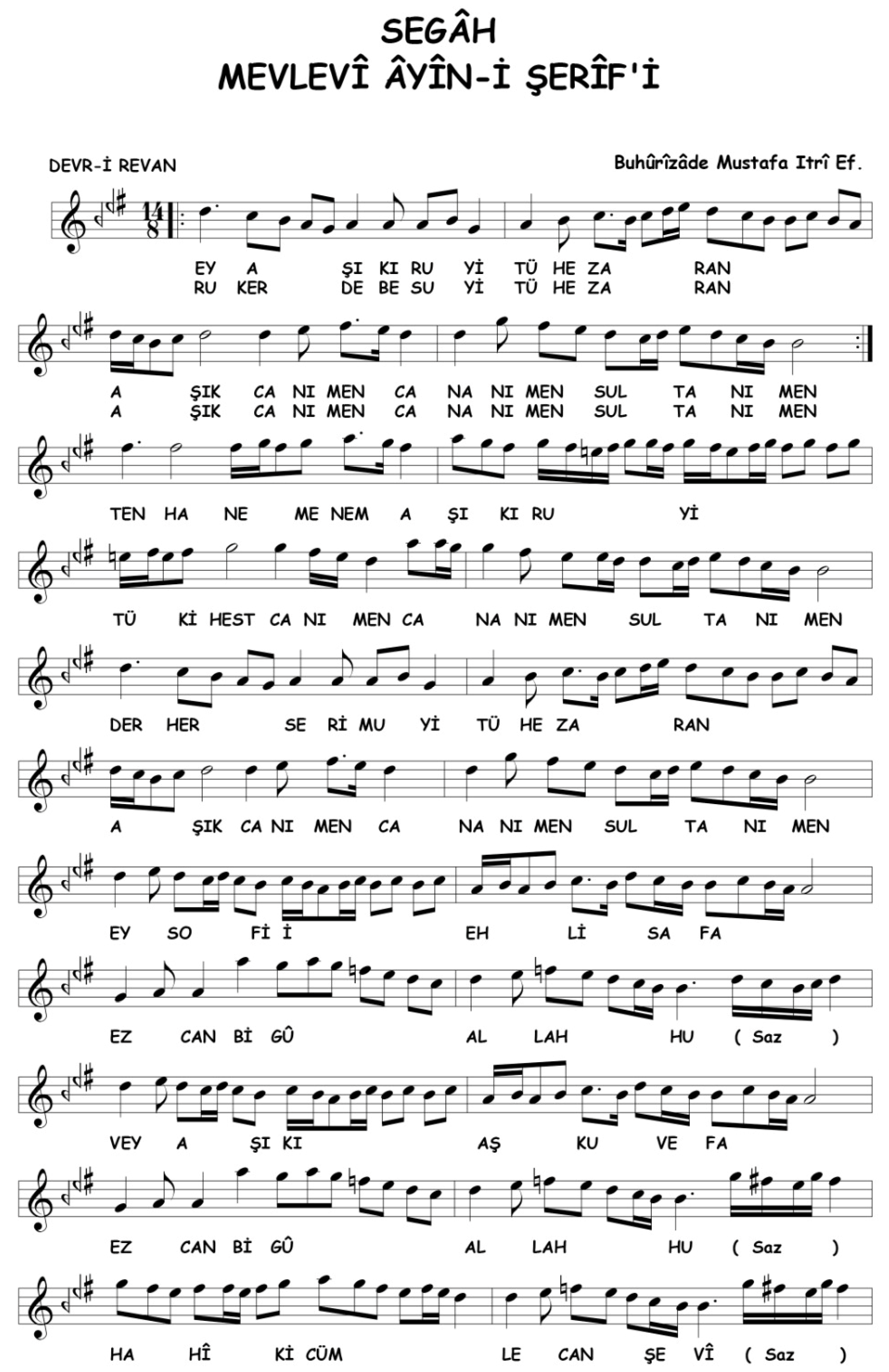
During the funeral ceremonies of members of Sufi orders, rituals specific to the order represented by the sheikhs were performed. For example, the ghazal written by Rūmī (d. 672/1273) on the occasion of Selahaddin Zerkubi’s (d. 657/1258) death is the lyrics of the first Salutation of the “Segāh Âyin-i Şerîf” (See Table A1) performed during the washing of Mawlawī sheikhs. The lyrics of this ritual are specifically chosen because they contain expressions addressing the sheikh, meaning “the earth and sky weep in your absence.” Reading this piece during the washing of the body is part of the Mawlawī customs (Koç 2021, p. 298).
In these ceremonies, hymns containing themes of the transience of the world, death, and the afterlife were also sung. These hymns, known as “Funeral Hymns,” served as a reminder to those attending the funeral about death and what comes after, and invited them to reflect on the deceptive nature of worldly life. For example, at the funeral ceremony of the famous musician Zekai Dede (d. 1897), the uşşāq maqām (modes) hymn that begins with the verse: “What shall I do with the world, I need my Allāh/I don’t need anything else, I need my Allāh” (Neyleyeyim dünyayı bana Allāh’ım gerek/Gerekmez masivayı bana Allāh’ım gerek) was composed by Sheikh Sinan Efendi, with lyrics by Aziz Mahmud Hüdaî (d. 1038/1628), along with the lyrics20 belonging to Yunus Emre.
A hymn in the neva maqām, composed by Muallim İsmail Hakkı Bey, which begins with the verse “You have created a board and inscribed my fate upon it/My Lord, what You have written there, how can Your servants know?” (Bir tahta yaratmışsın halim anda yazmışsın/Mevlam ne yazdın anda kullar anı ne bilsin) has been recited. Another religious musical piece performed in these ceremonies is the hymn in the rast maqām, with lyrics by Yunus Emre, beginning with the verse “Before the rose of life’s garden withers.” (Ömür bahçesinin gülü Solmadan) (Uzun 2000, pp. 64–68).
Another work that Sufis recite during the washing of the deceased (ghasl) is a hymn belonging to Darwish Himmet, which begins with the verses: “Wake up, O heedless one, from the sleep of negligence/Has your life come and gone, are you aware?” (Uyan behey gâfil hâb-ı gafletten/Ömrün geldi geçti haberin var mı?). The composition of this piece in the rast maqām belongs to Hayrullah Taceddin Efendi. After the performance of this hymn, which is sung for the deceased being washed on the bier, another hymn by Yunus Emre is recited, beginning with the verses “O darwishes, o brothers/What a strange affliction I have!” (Ey dervişler, ey kardeşler/Ne aceb derdim var benim!) as if spoken from the mouth of the deceased to those around. The composer of this piece in the hüseynî maqām is unknown (Özdamar 1997, pp. 217/231).
During the ritual washing, the sacred litanies of the sheikh’s order would be recited, but unlike the usual recitations, it would continue in lower, less shrill tones. After the litany recitations were completed, the darwishes would begin reciting the declaration of Allāh’s oneness under the guidance of the senior sheikh, while the chanters would start intoning hymns. In addition to the aforementioned hymns, a piece composed in the acem and mustear maqāms, in düyek rhythm, with the lyrics “The sea of mercy has overflowed/May all sinners be drowned in it” (Taştı rahmet deryası/Gark olsun cümle âsi) would be performed.
Another washing hymn in the uşşāq maqām is the piece in düyek rhythm that begins with the verses “If this body is torn with Your love/I still say there is no god but Allāh.” (Âşkınla çâk olsa bu ten/Ben yine illAllāh derim). While reciting, “Oh Allāh” (Aman Allāh) is added to the end of the third verse. If the deceased sheikh was one of the Khalwatī-Devrani order’s sheikhs, a whirling ceremony (devran) (See Table A1) would be performed after the declaration of Allāh’s oneness. If the place where the washing was performed was not suitable for whirling, they would continue the “Hû”21 invocation while standing, swaying slightly from side to side in a rhythmic and measured manner, as if moving in place. The hymns sung during the whirling ceremony would be repeated in sequence during the washing ceremony as well (Koç 2021, pp. 702–3).
After the funeral prayer, the imam begins the purification prayer and asks the congregation for forgiveness on behalf of the deceased. Following this reconciliation phase, everyone recites Surat al-Fatiha, and as the deceased is carried to the cemetery on the shoulders of loved ones, the Yunus hymn beginning with the verse “Let us obey Allāh’s command/Let us be immersed in His mercy” (Allāh emrin tutalım/rahmetine batalım) would be chanted. The composition of this famous hymn in the uşşāq maqām belongs to Zekai Dede (Özdamar 1997, pp. 217/231). If the deceased person was a Rifāʿī sheikh, while the coffin was being carried to the grave, the hymn “My proof in the path of al-Ḥaqq/Is Rifai Seyyid Ahmed” (Tarîk-ı Hak’ta burhânım/Rifâ’i Seyyid Ahmed’dir) composed in the evç maqām and düyek rhythm, would primarily be chanted (Koç 2021, p. 703).
In some Sufi orders, during the funerals of elderly, senior, and respected sheikhs considered among the spiritual leaders, the procession to the grave would proceed with a large crowd of rows consisting of designated chanters (zakir) in front, followed by darwishes reciting the Kalima-i Tawḥīd (Lā ilāha illā Allāh) and. The funeral procession, moving with slow steps, would be divided into three tiers: at the forefront, the chanting of “ism-i hû” (the name of Hû), behind that the declaration of Allāh’s oneness, and further back the “salât u selâm” (blessings and peace). While these were being recited in their own mournful manner, one of the melodious-voiced chanters or someone from the back rows would come forward to recite supplications, praise of the Prophet (na’t-ı şerîf), and odes (qaṣīda) (Koç 2021, p. 705).
After the burial process is completed during the cemetery phase of funeral ceremonies, or during a tomb visit, if the deceased person (male or female) was a member of a religious order, a “Grave Tawḥīd” (Kabir Tevhidi)22 dhikr, which is one of the standing ritual styles, is performed for that person. A dhikr circle is formed standing around the grave, and the Kalima-i Tawḥīd (Lā ilāha illā Allāh) is initiated by a sheikh or a senior darwish present there, recited collectively and aloud. A typical example of the “Grave Tawḥīd” ritual performed during tomb visits was practiced at the Jelveti darwish lodge. Similarly, at the Aziz Mahmud Hudayi Lodge, on Thursdays and Sundays, people would enter the tomb and collectively perform the dhikr of the kelime-i tevhid while standing. After the Tawḥīd dhikr performed at the tomb, the chief chanter or imam would recite Surah Al-Mulk, followed by the sheikh’s prayer and the gülbank (See Table A1), concluding the ceremony at the tomb. In the courtyard of the darwish lodge, the tomb keeper would draw water from the well in the tomb, fill bowls, and offer it to visitors, who would drink it for healing purposes. During this time, hymns with lyrics by Aziz Mahmud Hüdayî (d. 1038/1628) would be sung (İnançer 2015, p. 326).
The dhikr of Tawḥīd performed while carrying the deceased to the grave, apart from the Tawḥīd performed at the head of the grave or tomb, is called “Janāza Tawḥīd” (Cenaze Tevhidi) (See Table A1). For example, in the Jarrahī tradition, if a funeral was to be buried somewhere in Istanbul, the hafizes (Qurʾān reciters) at the front would recite the Tawḥīd known as “Funeral Tawḥīd” during the journey to the cemetery (Akkuş 2023, pp. 113–14).
Since dhikr is the main theme in the spiritual journey practices of the tekke, many works recited during this time deal with topics related to Allāh Almighty. These dhikrs are performed in different names and forms according to various Sufi orders. Such practices generally consist of the “âyîn-i şerif” (sacred ceremony) performed by the Mawlawī s and the dhikr assemblies held in the tekkes of other major Sufi orders. These are dhikrs performed by repeating various names and attributes, known by names such as “kelime-i tevhid” (declaration of Allāh’s oneness), “ism-i a’zam” (the greatest name), and “ism-i celâl” (the exalted name of Allāh) (M. Demirci 2024, p. 33). In Sufi funerals, after performing a brief ritual called “grave Tawḥīd,” the dhikr of the exalted name of Allāh and Hû would be recited. The exalted name of Allāh holds a special place in the arts of music and calligraphy (Koç 2021, p. 709; Özdamar 1997, p. 218).
Gülbanks (a special prayers), which are recited during certain ceremonies in palaces and on various occasions in tekkes, are more commonly encountered in Mawlawī order, and the “Funeral Gülbank” (Cenaze Gülbangı) is one of them (Koç 2021, p. 709).
The funeral ceremonies performed upon the death of a caliph or darwish in Sufi orders were not significantly different from each other, but they did contain some minor variations. For example, if the death of a tekke sheikh occurred during dhikr or if such news arrived during dhikr, regardless of which divine name was being recited in the sacred ceremony, it would immediately be changed to the “ism-i Hayy” (the Divine Name ‘the Ever-Living’) (See Table A1), and the curtain would fall. If the sheikh’s son was present and was qualified and authorized to act as a sheikh, he would take over the management of the dhikr and continue from where it left off. If not, a senior khalifa would begin to lead the sacred ceremony, and if they were not available, the dhikr circle would be entrusted to a senior sheikh from another tarīqa closest to their own. The sacred ceremony would continue in this manner until the end, without disrupting the methods and principles, and absolutely no rhythmic hymns or lively melodic works would be performed. Even the chanter’s division would occur in a solemn and calm manner. The Sheikh’s body would be brought to the tekke and laid upon the mihrab post. When the dhikr ended, everyone would leave, and the darwishes of the lodge would keep vigil over the Sheikh’s body (Koç 2021, p. 700).
4.4. Religious Music in Funeral Ceremonies of Mawlawī Order
In the Mawlawī tradition, during the washing ritual performed upon the death of a Mawlawī sheikh or dede, the Na’t-ı Mevlânâ (see Table 1) (Also see Table A1) composed by Buhurizâde Mustafa Efendi (d. 1123/1711) in the maqām of rast would first be recited around the deceased, followed by one of the sacred ceremonies. During the performance of the sacred ceremony, those present would recite the exalted name of Allāh together in a solemn manner and with intervals. The dhikr would continue intermittently in this manner until the washing process was complete. The most frequently recited work was Itri’s Segāh Âyin-i Şerif (see Table 1), which was performed in the devr-i revân rhythm. As it was the first salutation of the Segāh âyin, this section would be recited first when the samā began:
- “O beloved, with your face adored by thousands of lovers
- Thousands of lovers have turned towards you
- O Sufi of the pure-hearted
- From your soul, say Allāh Hû
- O lover of faithful love
- From your soul, say Allāh Hû”
- (Ey âşık-ı rûy-i tû hezârân âşık
- Rû kerde be-sûy-i tâ hezârân âşık
- Ey sûf-i ehl-i safâ
- Ez can bigû Allāh hû
- Vey âşık-ı aşk-vefâ
- Ez can bigû Allāh Hû)
Table 1.
List of Religious Musical Works Performed at Mawlawī Order Funerals.
In these final sections, it was said, “O Sufi of pure pleasure, O faithful lover, say Allāh from your heart and soul, say Hû…” (Ey safâ ehli Sufi, ey vefâkâr âşık, candan gönülden Allāh de, hû de…). The ending would conclude in a manner similar to chants, as follows: “Hey hey hey hey hey-My beloved, my master.” (Hey hey hey hey hey-Yâr-ı men pîr-i men). While the funeral procession was being carried out, the exalted names of Allāh and Hû were continuously recited. Sheikhs and caliphs from other orders who joined the funeral would take their places alongside and among the Mawlawī sheikhs according to their seniority. The leading of the recitation of the names of Allāh and Hû would be given to one of the senior sheikhs for a period. If there were musicians among the participants who came to the funeral from outside, they would be taken to the side of the chanters (Koç 2021, pp. 697–98).
While the funeral procession was being carried out, the exalted names of Allāh and Hû were recited continuously, and the name of Allāh was uttered in a broken manner, divided into two syllables as “Al-laaaaah!” The division of Allāh’s name into these two syllables was adjusted according to the steps of those reciting. The second, third, and subsequent recitations of Allāh’s name followed one another in the same tempo and manner, albeit in a slow rhythm, while it took quite some time for the coffin to reach the grave (Koç 2021, p. 698).
In the Mawlawī order, after the burial of a deceased member of the order, a circle is formed around the grave, and the name of Allāh is recited. Following this, the person leading the dhikr recites a gülbank (a special prayer) in a loud voice. Then, all those present say “hû” in unison and bow their heads before departing from the grave. The text of the Funeral Gülbank (Janāza Gülbank) is as follows: “May this noble time be auspicious, may goodness prevail, may evil be dispelled, darwish … (name of darwish) … may the soul of our deceased brother be joyous and happy, be forgiven and pardoned, be immersed in Allāh’s mercy, enter the garden of paradise (attain the garden of paradise), may his master be pleased; may his comfort increase in his resting place (may his rest increase in his place), may his destination be blessed, may those who remain be in safety. By the breath of Hazrat Rūmī, the secret of Shams of Tabriz, the generosity of Imam Ali, let us say Ali Hû, Hûûû” (Vakt-i şerif hayrola, hayırlar fethola, şerler defola, derviş … (name of darwish) … merhum karındaşımızın rûh-i revânı şâd ü handân, mazhar-ı afv ü gufrân, garka-i garîk-ı rahmet-i Yezdân, dâhil-i ravza-i rıdvân (nâil-i ravza-i rıdvân), hâcesi hoşnûd ola; medarında râhatı müzdâd ola (mekânında istirâhatı müzdâd) menzili mübârek ola, bâkil selâmette kala, dem-i Hazret-i Mevlânâ, sırr-ı Şems-i Tebrîzî, kerem-i imâm Ali Ali hû diyelim hûuu). During the recitation of the gülbank, hands would be placed on the shoulders in a crossed position. Those around would chant “Allāh, Allāh, Allāh, Allāh” in unison (Özcan 1993, pp. 357–58).
4.5. Religious Music in Funeral Ceremonies of Bektashī Order
In the Bektashī23 order (See Table A1), the deceased is always washed by a “baba” (father/spiritual leader) regardless of location. If a father is not present or lacks the competence to wash the deceased, this duty is performed by a Bektashī member from within the community, as appointed by the father. The deceased was not shown to or washed by non-members of the order. As with the Cem ceremony, the entry of outsiders is strictly forbidden, for the bodies of the order’s members are considered private and not to be seen by those outside the order. If the person who passed away to the afterlife was a father, those who wished would come to visit him before he was placed in the coffin, showing him the same respect as if he were still alive. If the father had stated in his will, “Let me rest for one night,” meaning “let me stay among you,” they would leave him in the gathering room for one night (Koç 2021, p. 699).
It is observed that the Bektashī do not perform any musical practices until the burial process of the deceased is completed. However, whether this situation applies to all Bektashī is a separate research topic. On the night the father is enshrouded (the evening of burial), candles would be lit in his own tekke or in the place where he passed away, halva would be prepared, and after the evening meal, they would enter into prayer. Here, the cem ceremony begins, and the Holy Qurʾān, mawlid (celebration of the Prophet’s birth), or elegy is recited. The ceremony continues in this manner, sometimes until dawn, and even if the ritual ends, the ceremonial grounds would remain open until sunrise. After the father’s burial, this procedure would be repeated in the same way on the seventh and fortieth nights as a “night of charity” (Koç 2021, p. 700).
The concept of death in Alawī–Bektashī tradition is influenced by the understanding of reincarnation, cyclical existence, and the unity of existence, and therefore death is expressed as “returning to Al-Ḥaqq.” The funeral rite is performed in two stages: the burial phase and the rite of lowering from the dar. The burial phase begins when the deceased surrenders their soul, is wrapped in a sheet, and placed on the “Hakk Döşeği” followed by the transfer of the body to the washing table. While the deceased is being carried to the washing table, the dede recites this gülbank:24
“For the beauty of Muhammad, the perfection of Imam Hasan, Shah Hussein, let us heartily send blessings to those who recognize Ali as their spiritual guide (blessings are recited). The world is temporary, the afterlife is eternal. God’s decree has been carried out. May the Almighty God lead you to a blessed destination. May your grave be illuminated, and your abode be paradise. May the King of the Brave (Ali) protect you under his banner and await you. To the truth, Hû …” (Ber cemal-i Muhammed, kemal-i İmam Hasan, Şah Hüseyin, Ali’yi pir bilene verelim candan salâvat (salevat getirilir). Dünya geçicidir, ahiret yurdu kalıcıdır. Tanrının hükmü yürüdü. Ulu Tanrı seni kutlu bir menzile yetirsin. Kabrin ışıklı, mekânın cennet olsun. Şah-ı Merdan seni sancağı altında saklasın, beklesin. Gerçeğe Hü …) (Kük 2021, p. 155).
The Dârdan İndirme Erkânı (doorstep ceremony) (See Table A1) is a spiritual ceremony that is performed as if the deceased person had died without reconciling with their spouse, friends, and those they had dealings with. It is a ritual conducted by the deceased’s heirs to ensure the soul’s rest and peace, similar to how the person would have performed this ceremony while alive. During this ceremony, chanters recite nafas (spiritual poems) and düvaz (devotional poems) to honor the spirit of the deceased. After the farewell phase of the soul journeying to Al-Ḥaqq is completed, the gülbank (prayer) is recited, and the twelve imams, fourteen innocents and pure ones, and seventeen waist-tied ones are commemorated. The name of the departing soul is mentioned, and acceptance is requested for the sacrificial animal offered and the prayers recited on their behalf. The congregation collectively offers niyaz (supplication), and then the sazandar (musician) performs spiritual hymns of prominent al-Ḥaqq lovers in the Alawī–Bektashī tradition, various miracname (ascension narratives), etc., accompanied by the saz (a stringed instrument). Those present in the circle who wish to do so perform the whirl, and the spiritual guide offers prayers for these services (Coşkun 2013, pp. 276–77).
In 2012, as part of the “Unity in the Lodge” efforts, the “Hakk’a Yürüme Erkânı” prepared by the “Commissions for Examining and Compiling Rites” established by the Hünkar Hacı Bektaş Veli Foundation provides important information about Alawī–Bektashī funeral ceremonies. The scope of application for this rite includes All Alawī, Dedegans, Çelebi Branch, Babagan Bektashī s, Kizilbash, Tahtaci, Çepni, Sıraç Communities, and Balkan Bektashīs. In the interwiew with Aşık Dertli Divani25, his statement establishes that religious music constitutes a central element that restores ritual integrity within the Alawī–Bektashī tradition. The text emphasizes that, despite the debates that emerged during the adaptation of the Hakk’a Yürüme Erkânı (See Table A1) to contemporary conditions, the performance of nefes, düvaz, and devriye accompanied by the saz ensures sacred continuity by carrying their functions in the cem ritual into the funeral ceremony.
In Alawī–Bektashī tradition, the term “Can” (Soul) 26 is used for everyone, regardless of whether they are men, women, children, or infants. This usage emphasizes that every individual is equal in the presence of the Al-Ḥaqq and the people. In the Alawī–Bektashī understanding, “death” is the event of a person changing their form and reuniting with the Al-Ḥaqq. Therefore, according to Alawī–Bektashī teachings, instead of the concept of “dying,” expressions such as “Returning to Al-Ḥaqq,” “Resting the Mold,” “Changing Form,” and “Migrating from the World” are used. According to this, the departure of the soul from the body is called “Returning to the Al-Ḥaqq,” which signifies the human’s liberation from the state of “form” and return to the “Essence.” For the Soul returning to the Al-Ḥaqq to achieve union, it must experience “dying before death,” meaning the Soul must purify itself from bad habits and traits by disciplining the ego. As a reflection of this approach, expressions such as “making a secret” and “enshrouding” are used to describe the burial process, that is, the interment of the deceased. In this context, all funeral services for the Soul to be sent off to the Al-Ḥaqq are conducted in accordance with the “Death Ritual”. The cloth that is placed over the body after the clothes of the Can (soul) who has “returning to Al-Ḥaqq” are removed is called the “Veil of Mystery.” In this sense, the ceremony is a ritual of bidding farewell to the body to the earth and the soul to the Beloved. After the clothes of the Can (soul) who has returning to Al-Ḥaqq are removed, the cloth that is draped over them is called the “Veil of Mystery.” “Death Ritual”, in this sense, is a ritual of bidding farewell to the body to the earth and the soul to the Beloved. During this ceremony, taking into account local uniqueness and differences, gülbanks, deyiş (religious poems), nafas (spiritual poems), düvaz (devotional poems), and devriye (cyclical poems) can be recited. For this reason, it is recommended that every Can (soul) who will participate in this ceremony should know and learning all of this.
The eyes of the soul who returning to Al-Ḥaqq are closed by a family member or a fellow Can (soul) while reciting the following gülbank (prayer):
- “With the permission of the Pir… In the name of the Shah… Allāh Allāh…”
- For our can (soul) who has passed on to the Al-Ḥaqq;
- The eyes of the body have reached the secret,
- May they reach the Al-Ḥaqq with the eyes of the Can (Soul).
- Hû to the Truth!”
- (Destur-u Pir… Bismişah… Allāh Allāh…
- Hakk’a yürüyen canımızın;
- Ten gözleri erdi sırra,
- Can gözüyle Hakk’a vara.
- Gerçeğe Hü!)
“With the permission of the Pir… In the name of the Shah… Allāh Allāh…” (Destur-u Pir… Bismişah… Allāh Allāh…) is said as the chin and feet are tied. With the same expressions, the body is laid on its bed and covered. During the washing, deyiş, nafas, or düvaz (can be recited: For example, “The Bird of the Heart Rose and Took Flight” is one of these nafas (Hünkar Hacı Bektaş Veli Foundation Council of Elders Research and Compilation Committee 2016, p. 8). Then, the stage of dressing the journey shirt begins, and a qualified person says, “With the Pir’s permission… In the name of the Shah… Allāh Allāh…” (Destur-u Pir… Bismişah… Allāh Allāh…) and ties the “Oath Belt” around the waist of the soul who has passed on to the Al-Ḥaqq. After, a dialogue is conducted in the form of question–answer (consent) from those attending the funeral, asking if they are content (Hünkar Hacı Bektaş Veli Foundation Council of Elders Research and Compilation Committee 2016, p. 11).
- “May the tongues that say ‘Allāh EyvAllāh!’ be spared from sorrow, grief, pain, and suffering.
- May the given consents be accepted in the Court of Al-Ḥaqq, Muhammad, and Ali.
- May all our souls that have passed on to Al-Ḥaqq have an eternal/easy cycle!”
- (“Allāh EyvAllāh!” diyen diller dert, keder, ağrı, acı görmeye.
- Verilen rızalıklar, Hakk, Muhammed, Ali Diva-nı’nda kabul ola.
- Hakk’a yürüyen cümle canlarımızın devr-î daim/devr-î asan ola!”)
After the gülbank in this form, three nafas and one düvaz describing the journey to God can be performed, if possible, by chanters accompanied by saz or recited verbally by qualified individuals/chanters (Hünkar Hacı Bektaş Veli Foundation Council of Elders Research and Compilation Committee 2016, p. 12).
During the phase of “burying the deceased in the earth”:
- “With the permission of the Pir… In the name of the Shah… Allāh Allāh…
- To the rose-like countenance of Muhammad,
- To the perfection of Hasan and Hussein,
- To the path of Ali the Chosen,
- Allāh is friend, EyvAllāh Hû!”
- (“Destur-u Pir… Bismişah… Allāh Allāh…”
- Muhammed’in gül cemaline,
- Hasan’la Hüseyin’in kemaline,
- Aliyyel Murtaza’nın yoluna,
- Allāh dost eyvAllāh Hü!)
The gülbank is recited, followed by nafas such as “Cihan Var Olmadan Ketm-i Âdemde”, “Dostlar Beni Hatırlasın” along with other hymns, düvaz imam (hymns praising the Twelve Imams) (See Table A1), and devriye which can be performed with a saz when appropriate conditions allow (See Table 2). After the nafas are recited and the soul is given to the earth, the souls stand with their right hand on their chest, left hand at their side, feet as close together as possible, in a position of reverence, and once again recite the gülbank (Hünkar Hacı Bektaş Veli Foundation Council of Elders Research and Compilation Committee 2016, pp. 15–16). Afterwards, the saying “Yandım da Geldim” by Shah Hatayi is recited. Finally, as the name plaque of the deceased soul is erected and water is poured over the grave, the following gülbank is read (Hünkar Hacı Bektaş Veli Foundation Council of Elders Research and Compilation Committee 2016, p. 17):
- “Permission from the Pir… In the name of the Shah… Allāh Allāh…”
- We performed this service; for the love of Al-Ḥaqq, Muhammad, Ali,
- We performed this service; for the love of our Mother Fatima, Bozatlı Hızır,
- We performed this service; for the love of our Pir Hünkâr Hacı Bektaş Veli,
- We performed this service; for the love of Hallaj Mansur, Seyyid Nesimi,
- We performed this service; for the love of Abdal Musa, Kaygusuz Sultan,
- We performed this service; for the love of Kalender Çelebi and all saints,
- We performed this service; for the love of the soul that has returned to Al-Ḥaqq,
- For the unity of Al-Ḥaqq, Muhammad, Ali,
- For the spiritual guidance of Hünkâr Hacı Bektaş Veli,
- To the moment of true saints, Hu!
- (“Destur-u Pir… Bismişah… Allāh Allāh…”
- Eyledik bu hizmeti; Hak, Muhammed, Ali aşkına,
- Eyledik bu hizmeti; Fatıma Anamız, Bozatlı Hızır aşkına,
- Eyledik bu hizmeti; Pirimiz Hünkâr Hacı Bektaş Veli aşkına,
- Eyledik bu hizmeti; Hallac-ı Mansur, Seyyid Nesimi aşkına,
- Eyledik bu hizmeti; Abdal Musa, Kaygusuz Sultan aşkına,
- Eyledik bu hizmet; Kalender Çelebi ve cümle evliya aşkına,
- Eyledik bu hizmeti; Hakk’a yürüyen can aşkına,
- Hak Muhammed Ali birliğine,
- Hünkâr Hacı Bektaş Veli Pirliğine,
- Gerçek erenler demine Hü!)
Table 2.
List of Religious Musical Works Performed at Bektashī Order Funerals.
The thematic analysis of the Alawī–Bektashī Hakk’a Yürüme ritual demonstrates that the ceremony integrates its doctrinal beliefs and musical structure within a holistic spiritual framework. Conceptualizing death not as annihilation but as a return to ultimate truth reveals that the journey—beginning with purification rituals—is constructed as a spiritual transition; meanwhile, the mechanisms of communal consent and the cemal–cemalelik (See Table A1) arrangement affirm the community’s ethical and emotional cohesion. Themes such as the doctrine of divine unity, devotion to the Ahl al-Bayt, and the vow of commitment (ikrar) constitute the ritual’s theological backbone, while musical elements—including devriye hymns, düvaz imam recitations, nafas, and gülbank—render this belief dimension audible through rhythmic and melodic expression. Symbolic components such as sırlama, the dar posture, and ritual coverings associate death with the notion of “sacred mystery,” adding metaphysical depth, whereas the themes of mourning and Karbala endow the ritual with historical memory and a sense of collective grief. The institution of zakirlik shapes the emotional atmosphere of the ceremony through its role as musical guide. Ultimately, through the continuity of oral tradition, these ritual and musical practices are transmitted across generations, making the Hakk’a Yürüme ceremony a living structure that embodies social, theological, and aesthetic dimensions (See Table 3).
Table 3.
Thematic Analysis for Alawī-Bektashī Order Funerals.
4.6. Religious Music in Funeral Ceremonies of Jarrahī Order
In the Jarrahī tradition, a branch of the Khalwatī order, the funeral ceremony is the final duty performed with great sensitivity for members of the order, as in other orders. The corpse washed in the ghusl room is classified as sheikh, caliph, or darwish. Unlike for darwishes, if the corpse belongs to a sheikh or caliph, a branched arakiye (a type of headgear) (See Table A1) is put on during the washing. While washing the sheikh’s corpse, the sacred litanies and hymns related to death are collectively recited. The Yunus hymn titled “Hayıf bunca Geçen Ömrüme”, composed in the hüseyni maqām, is an exemplary piece of this kind (See Table 4). If the funeral belongs to a caliph or darwish, only the sacred litanies are recited in front of the washing gate. If the deceased is to be buried somewhere in Istanbul, the funeral procession stops at the “Keskin Dede” cemetery, which is on the way to the tekke. While passing through there, the coffin is lowered from the shoulders to the hands, which is an expression of respect. During the Jarrahī funeral ceremony, if the deceased was to be buried somewhere in Istanbul, from the tomb to the cemetery, the hafiz (Qurʾān reciters) in the front would recite the “Maye Funeral Salā “or “Hüseyni Funeral Salā “composed by Hatip Zakiri Hasan Efendi, while the people at the back would simultaneously recite the “Funeral Tawḥīd” (Akkuş 2023, p. 113).
Table 4.
List of Religious Music Works Performed at Jarrahī Order Funerals.
There is another form of Tawḥīd performed after the burial process in the Jarrahī order, which is called “Grave Tawḥīd.” The Sheikh Efendi or whoever is next in line is brought to the face level of the grave, with the head of the grave opposite. Here, the phrase of Tawḥīd called “grave Tawḥīd,” along with the names of Allāh and Hû are recited. Then the ceremony is completed with the Fatiha. If the funeral is for the sheikh efendi, the sheikh’s body is brought to the tomb after the funeral prayer. While the body is being placed in the grave, prayers and recitations continue outside, and the body is placed in the grave and its coffin is covered. At the head of the sarcophagus, Itrī’s “Segāh Tekbîr” is recited, and the sacred crown (tâc-ı şerîf) is placed on the coffin (Akkuş 2023, p. 114).
The funeral ceremony of Jarrahī Sheikh Ibrahim Fahreddin Cerrahi, which took place in 1966, carries important concrete information about such ceremonies performed for tarīqa elders from the past to the present: According to the account of Cerrahi Sefer Efendi (d. 1999), the funeral ceremony began with the Tawḥīd dhikr led by Sheikh Husameddin Turabi, one of the tarīqa elders. Chanters recited hymns, darwishes performed dhikr, and the preparation and shrouding of the body were carried out in accordance with his will Fahreddin Efendi’s (d. 1966) coffin was brought out to the ablution fountain courtyard of the tekke on Friday, where the funeral prayer was led by Muzaffer Ozak (d. 1985). In the presence of those gathered there, with purification and prayer, it was set out towards the Fatih Mosque. Sebilci Hüseyin began to recite an elegy with his sweet and affecting voice. Those accompanying the funeral continued their dhikr under the leadership of Sheikh Hüsameddin Efendi. Fahreddin Efendi’s funeral was brought to the Fatih Mosque sometimes accompanied by hymns, and at other times by odes and elegies. In the mosque courtyard, three groups performed dhikr separately (Dal 2006, p. 19). After the Friday funeral prayer, three groups of dhikr performers surrounded the coffin being carried towards the darwish lodge in Karagumruk. The first group of dhikr performers loudly recited the hüseyni Tawḥīd (Feth-i Esmâ), while the hafizes chanted the Dilkeşāverān funeral salā composed by Hatip Zakiri (d. 1032/1623). While the second group of dhikr performers were reciting the Divine name of Allāh, the hafizes were reading the na’ats (praises of the Prophet Muhammad) beginning with the verses “O my lord, you are the Sultan of the messengers, the glorified Shah” (Sultân-ı rusul şâh-ı mümeccedsin efendim), by Sheikh Ghalib (d. 1213/1799), and “Someone had to understand his passionate heart” (Eyleyen uşşâkı şeydâ daimâ) by Nasuhi Mehmed Efendi. They were also reciting poignant elegies starting with the verses “The Creator turns the crescent into a full moon, and the full moon back into a crescent” (Hilâli bedr-ider Hâlık yine bedri hilâl eyler) and “O heart, seek and find a scale to measure yourself.” (Ey gönül kendini vezn-etmeye kantar ara bul). The third group of dhikr performers preceding the coffin were performing the Hû dhikr (See Table A1), while the lead dhikr performers were chanting the hymn by Yunus Emre beginning with the verses “When I arrive at the grave tomorrow/When the angel asks questions” (Yarın kabre varınca/Melek suâl sorunca) composed by Zekai Dede (d. 1897) in the uşşāq maqām, and the hymn composed by Hacı Nazif Bey (d. 1913) in the uşşāq maqām, with lyrics by Seyyid Nizamoğlu (d. 1010/1601) beginning with the verse “If this body is torn with Your love.” (Aşkınla çâk olsa bu ten) (Özdamar 1997, pp. 225–32) (Also see: Table 4).
Some great figures of Sufi orders would leave testaments regarding the hymns they wished to be recited at their funeral ceremonies, departing from the routine practices in ceremonies. As Zakirbaşı Hakan Alvan27 states in the interwiew with him
“In the tekke tradition, there is the concept of reciting hymns according to the time and setting, and also the practice of selecting hymns appropriate to the Arabic lunar months. Even if we did not hold a formal funeral ceremony when an elder from the ihvan passed away, during the meşk at the lodge that day we would recite hymns on themes of death and the hereafter. In fact, we observe that the same repertoire is used in the funeral rites of sheikhs as well.” Also, it is seen in the literature sources for example, Fahreddin Efendi had bequeathed that the hymn “I Never Tire of Burning, My Lord” (Yanmaktan Usanmazam Mevlam) be recited during the washing of his body, that is, while his corpse was being washed. Another hymn he wanted to be recited during the ceremony was the work belonging to Yunus Emre, which begins with the verse “Alas for all my years that have passed.” (Hayf benim bunca geçen ömrüme) (Dal 2006, pp. 18–19). Again, during the washing of Mehmed Rızâeddîn Yaşar Efendi’s body at his funeral, after the chanters recited the salā in front of the door of the gathering room, when Sheikh Mehmed Râşid Efendi began the Hû dhikr, simultaneously those accompanying him chanted the hymn “My Lord, the tears from my eyes flow like a flood/They descend into the vast sea and become a lake” (Mevlâm gözüm yaşı akar sel olur/İner engin deryâsına göl olur) to its well-known melody28 (Dal 2006, pp. 473–74).
Religious music plays an important role in the funeral ceremonies of Jarrahī sheikhs, during and after the processes of washing, preparation, shrouding, funeral prayer, and burial. Considering that the Khalwatī order has numerous branches, the recent funeral ceremonies of the Jarrahī order, which continue to this day, contain important information about similar practices that include other branches of the Khalwatī order. I can say that this information generally serves as a comprehensive picture of the religious musical forms performed at tarīqa funerals.
In the tradition of Jarrahī funeral ceremonies, religious music practices are carried out with great sensitivity, starting from the washing of the body (ghusl) and encompassing the burial and its aftermath. These ceremonies include both inward-focused practices specific to the order and outward-focused practices that address the general public. The funeral procedures performed inside the darwish lodge are completed in the form of washing, preparation (general preparations required for the deceased), shrouding (wrapping in a shroud after washing), and placement in the coffin. There is important information regarding the practices in question in the description of the funeral of Sheikh Ibrahim Efendi, one of the Jarrahī sheikhs: “After performing the washing ritual according to the principles of the order, that night he lay in his exalted coffin, resting his head in peaceful sleep amidst the clamor of the noble declaration of God’s unity and the recitation of the complete Holy Qurʾān.” (Dal 2006, p. 335). As mentioned, the members of the darwish lodge perform the Tawḥīd dhikr during the washing of the sheikh’s body and after it is placed in the coffin, and they fulfill their duties by reciting the entire Qurʾān (khatm al-Qurʾān). Thus, the deceased is prepared (teşyi) to be taken to the place where the funeral prayer will be performed. According to the traditions of the tarīqa, the sheikh’s body is taken to the mosque accompanied by dhikrs, Tawḥīds, and mournful chants being vocalized. After the funeral prayer is performed, they return to the darwish lodge in the same manner, with dhikrs, Tawḥīds, and mournful chants being vocalized, and after all the procedures of the tarīqa are carried out, the burial process takes place (Dal 2006, pp. 374–75).
The funeral ceremonies of Jarrahī sheikhs are not limited to the members of the order, and these ceremonies continue even after the burial. The funeral ceremonies were also attended by sheikhs and chief chanters from other Khalwatī branches, as well as sheikhs from other orders, hafizs, darwishes, elders, scholars, deputies, and viziers. While washing the body of Sheikh Abdülazîz Zihni Efendi el-Cerrâhî, whose funeral was attended by members of other Sufi orders, Sheikh Mehmed Nûri Efendi, the chief chanter of Pîr Sünbül Sinan lodge, began the salā (call to funeral prayer) and recited it together with other chanters; on the night when the sheikh’s coffin was placed in the prayer hall, the completion of the recitation of the Holy Qurʾān by the hafizes; the recitation of seventy thousand kelime-i tevhid while holding prayer beads by Alyanak Sheikh Ali er-Rifāʿī, from the Rifāʿī order; the next Thursday, with the participation of sheikhs, darwishes, elders, scholars, representatives, and viziers gathered in the darwish lodge, Sheikh Feyzullah Efendi en-Naqshbandi, the sheikh of Sheikh Murad Efendi lodge located in Eyüp Nişancı, performed a purification ceremony and prayer in the prayer hall and afterwards, performing the dhikr of the kelime-i tevhid according to the method of the tarīqa; one of the examples of this rich participation is the recitation of hymns by Şikârîzâde Efendi, the chief chanter of the darwish lodge, accompanied by the dhikr of the name Hû, which was initiated by Sheikh Râzı Efendi es-Sünbülî (Dal 2006, p. 415).
Another noteworthy aspect of these ceremonies is that representatives of each Sufi order form a row, starting from the front, creating a dhikr assembly according to their own order’s practices and performing religious music during the funeral ceremony. For example, at the funeral of Sheikh Abdülazîz Zihni Efendi el-Cerrâhî, those in the second row under the leadership of Rûşen Efendi el-Celvetî began dhikr of the name Hû, while Sheikh Mehmed Efendi, the chief chanter of the aforementioned darwish lodge, performed hymns together with other chanters. In the rows behind them, Alyanak Sheikh Ali Efendi er-Rifâî had the kelime-i tevhid recited with his well-known composition (Dal 2006, p. 415). Behind these rows, Hopçuzâde Şâkir Efendi, the chief chanter of the Kâdirîhâne, chanted mournful hymns and recited the well-known salā t. Following them, Sheikh Osman Efendi of the Galata Mawlawī Lodge, along with the darwishes, recited the the exalted name of Allāh. Finally, behind them, the followers of the Jerrah order performed the dhikr of name of Hayy (the Divine Name “the Ever-Living) with their hands placed over their hearts. During the burial, dhikr and darwish whirling were performed in the prayer hall under the direction of Sheikh Razi Efendi, the postnişin (the sheikh who sits on the post in the darwish lodge) of Pir Sunbul Sinan’s darwish lodge. After grave Tawḥīd Kucuk Hafiz Efendi performed the telkîn (final instruction to the deceased) (Dal 2006, pp. 416–17).
The religious rituals performed for the funeral of Jarrahī sheikhs do not end with the burial process; in fact, activities similar to those performed before the burial continue for forty days. Indeed, after the passing of the aforementioned Abdülaziz Efendi, for forty nights in the darwish lodge, between the evening and isha prayers, fifteen hafizs recited a complete Qurʾān every night, and seventy thousand kelime-i tevhid were recited in accordance with the isha prayer custom. On the fortieth night of this forty-night ceremony, the mawlid-i sharif was recited and the ṭarīqa ritual was performed (Dal 2006, p. 417). Again, from the Monday evening when Sheikh Yahya Galib Efendi was buried until the following Monday night, every evening before the night prayer, a complete recitation of the Qurʾān was performed by the hafizes. After the night prayer, the darwishes recited seventy thousand kelime-i tevhid according to the Monday custom, and prayers were offered. On the Monday evening of his week’s commemoration, the mawlid was recited with a large crowd and dedicated to the soul of the deceased (Dal 2006, p. 450). On the thirty-sixth day after the Sheikh’s passing, which was a Monday, a devran dhikr was performed in the tekke according to the Tarīqa tradition, hymns composed from his own poems were sung, and the mawlid was recited (Dal 2006, p. 451).
In the funeral ceremonies of the Khalwatī-Jarrahī order, generally starting with the “Salā “, there are recitations of the “Holy Qurʾān”, dhikr of “Tawḥīd” (Oneness of Allāh), “name of Hû”, “name of Hayy” and “exalted name of Allāh” as well as “Takbir”, “Salāt”, “Mawlid”, “Hymn”, and “Elegy” forms of hymns are vocalized, while simultaneously performing the order’s rituals.
As the table demonstrates, the article reveals that religious music in funeral ceremonies is not merely an aesthetic component but a multilayered structural element that shapes every stage of the ritual. Musical components ranging from the leadership of the zakirbaşı to maqām preferences, from repertoire sources to the tradition of musical training, ensure both the technical and emotional coherence of the ceremony. The musical pieces selected for each stage—from the washing (ghasl) phase to the soothing post-burial section—guide the emotional intensity of the ritual, while during the procession, the musalla stage, and communal dhikr, music functions as a strategic tool that regulates collective movement. The repertoire’s foundation in both oral tradition and notated sources reinforces the continuity and historical depth of the practice. Religious–Sufi themes such as vuslat, contemplation, sorrow, and aesthetic unity reflect the spiritual meaning of music, framing death not as a separation but as a Divine Reunion. Moreover, the structure of the tarīqa and the dynamics of the community show that music plays a decisive role not only in individual emotion regulation but also in sustaining collective identity. In conclusion, the table clearly demonstrates that religious music assumes a central role in funeral rituals, operating simultaneously on symbolic and psychological levels (See Table 5).
Table 5.
List of Thematic Analysis for Jarrahī Order.
4.7. Religious Music in Funeral Ceremonies of Rifāʿī Order
In the Rifāʿī order, the spiritual journey (seyr u sulūk) process for adherents is arranged in the following sequence: Âşık (Mystic Lover), Mürid (Disciple), Muhib (Affectionate), Mutteki (Pious), Derviş (Darwish), Nakıb (Leader), and Şeyh (Sheikh).29 As Rifāʿī Sheikh30 mentions in the interview “the funeral ceremonies of Sufi order members are conducted according to the spiritual ranks attained during their mystical journey”. The deceased Sheikh is respectfully washed by Sheikhs wearing special garments, preferably in the ritual hall of the tekke or if not possible, in the courtyard of the tekke. This ceremony begins with the “Evrād -ı Rifāʿī” (dhikr) and “esmâ” (divine names). If available, a hymn favored by the deceased is sung; otherwise, a hymn deemed appropriate by the Rifāʿī Sheikhs is preferred to be recited. For example, on the evening of the death of Râik Mustafa er-Rifai Haznedar Baba (d. 1974), one of the sheikhs of the Üsküp Rifāʿī Lodge, the hymn titled “Kudret Kandili”, which was one of his favorite hymns, was performed at the tekke before his burial.31 During the burial at the same funeral, salutations, praises, declarations of Allāh’s oneness, exalted name of Allāh, and name of Hû invocations were performed. The participants also recited the work “Ömrün Şu Biten Neşvesi”. While the sheikhs carry the deceased to the grave, they engage in remembrance using the names of Allāh (divine names). During this time, the sheikhs line up in front of the coffin and recite, “Ya Allāh, Ya Allāh” (O Allāh, O Allāh), “El-Melik” (The King), “El-Kuddûs” (The Holy), “Es-Selām” (The Source of Peace), “Ya Hayy”, “Ya Hû”. After each divine name, the darwishes say “Hû” in unison. The washing of the Sheikh’s body is performed by other sheikhs. Close darwishes may also perform this duty with the Sheikh’s permission. The washing of the body is not performed in the ritual hall but preferably in the tekke courtyard, accompanied by the recitation of evrād (litanies) and divine name, along with an appropriate hymn. After the ablution of the deceased, the Evrād-ı Rifāʿī begins, followed by the divine names and a suitable hymn.32 It is not mandatory to recite a specific hymn verse; it is chosen by the person leading the dhikr.
While the funeral is being taken to the cemetery, remembrances such as “Lā ilāha illā Allāh” and “Allāh Hû” are vocalized. The Rifāʿī Darwish is washed in his own home. After performing the ritual ablution (ghusl), accompanied by litanies and divine names, the hymn “Şehitlerin Ser Çeşmesi” in the uşşāq maqām, the hymn “Devran bu Devran” composed in the rast maqām, and the prayer “Nad-i Ali” are recited (See Table 6). For the Mutteki and Mürid, only divine name and hymn are recited. For the Âşık, only three divine names dhikrs are performed. After the burial, a black flag (şed) is hung in the tekke. Litanies and dhikr continue until the new Sheikh takes his seat, during which time no musical instruments are used. Subsequently, ceremonies are held for the Sheikh on the seventh day, fortieth day, six months, and one year after their passing.33
Table 6.
List of Religious Music Works Performed at Rifāʿī Order Funerals.
The “nevbe”34 form, known to be performed in recent (2011) funeral ceremonies of the “Kayyali”35 branch of the Rifāʿī order, maintained its relevance in Turkish Religious Music until the last century. Although it was not significantly practiced in the geography of Türkiye after the Republic, it is observed that it continued to exist in some regions belonging to the same civilization (Erdaş 2023c, p. 55). Safiye Şeyda Erdaş’s analysis of the video recording of the funeral procession for Hasan el-Keyyâlî and İbrahim el-Keyyâlî, sheikhs of the Aleppo Bâbü’l-Hadîd Kayyali Lodge who passed away in 2011, provides important information about the religious musical practices in the funeral ceremonies of the Rifāʿī order. It is understood that this funeral nevbe was performed while the deceased were being carried on shoulders through the streets of Aleppo to their burial sites (Erdaş 2023c, p. 59).
Generally, in the nevbe where five bandirs36 and one cymbal are used, the group stands while the “tashīf”37 text is read, and after the reading of the “tashīf”, the chanters at the front play the bandir and cymbal and recite hymns as they move forward with the group. It is observed that in this funeral ceremony, the nevbe is performed in seven sections. This type of nevbe performance begins with salā wat in a seated position, continues while standing, and then proceeds to accelerate accompanied by rhythmic instruments. After the rhythmic beats gain considerable speed, the instruments fall silent and everyone sits down again. Then, the double-time (düm-tek) beats start at a normal pace, the rhythm gradually accelerates until finally the rhythms fall silent. Subsequently, a prayer is offered, and the Nebevî38 section begins. In this section, the hymn “Akbele’l-bedru aleyna” is performed. Then, other hymns are sung one after another with an increasing rhythmic understanding. When the rhythms reach their peak speed at the end of the section, the section also concludes. After this, another similar section begins. However, this new section is performed standing up and starts with salā wat. After the tashīf phase, a qasida is recited. Following the qasida, the second section of the nevbe begins. Just as the nevbe starts with salā wat, it also concludes with salāwat (Erdaş 2023c, p. 56). Here, a qasida is recited following the tashīf and the content of this qasida is chosen according to the purpose of the nevbe’s performance. In this section, şugul (hymn with Arabic lyrics) are also vocalized chorally. Towards the end of the section, the final phase called Kerte begins, where rhythm instruments are seen to accelerate with double-time (düm-tek) beats. Kerte also signals the end of that section. In this phase, the sound increases in parallel with the increasing speed of the rhythm instruments, and it concludes when the rhythmic speed reaches its peak (Erdaş 2023c, p. 57).
The sections in the funeral nevbe are considerably shorter compared to other nevbe sections performed in the Kayyali order. The tashīf which is recited seven times in the funeral nevbe, is recited only once in general performances. According to the recorded funeral nevbe, the number of works recited in each section is fewer. The recitation of the hymn is limited to one or two couplets of their lyrics. The increased number of sections in this type of nevbe also has an impact on this practice. The number of sections has increased, but the duration of section, number of pieces, and volume have decreased. In the first section, two hymns are recited, which are in the ḥicāz maqām and are the “Salâtullâh selâmullâh aleyke Yâ Rasûlallâh” and “Rifâî leyyâ” hymns. This hymn is actually a continuation of the “Aleyke sallallâh” hymn, which will be seen in the next section (Erdaş 2023c, p. 59). In the second section, the hymn in the ḥicāz maqām, namely “Allāhümme salli alā Muhammed” “Aleyke sallAllāh” and “ Efdalu’l-Âlemîn” are recited. In the third section after arranging the nevbe the “ Rifâî leyyâ” hymn chanted, as in the previous chapters. In the fourth section, a hymn is performed that shares the same melody as the hymn “Aşkın ile Aşıklar” in the Segāh maqām, which begins with the verse “Ente nüshatü’l-ekvân” and is performed in Istanbul’s tekke music. Subsequently, another hymn is performed that shares the same melody as the hymn “Bağrımdaki biten başlar” in the hüzzam maqām, which begins with the verse “Mâ medde li hayri’l-halki yedâ”. In the fifth and sixth sections, when the funeral procession reaches the burial site, a hymn beginning with the verse “Yâ erhame’r-rahimin” is recited (See: Table 6). In the seventh and final section, a hymn with indistinguishable lyrics and melody is performed. The nevbe concludes along with the burial process, accompanied by rhythmic instruments (Erdaş 2023c, p. 61).
The musical dimension of the ritual progresses in parallel with the hierarchical structure of the order; while only asmāʾ dhikr is employed at lower levels, higher stages incorporate hymns, Awrād-i Rifāʿī, various dhikr forms, and instrumental leadership. At this stage, music ceases to be merely a form of vocal expression and becomes a medium that facilitates spiritual transition; hymns and dhikr carry the emotional and spiritual weight of the ritual. Musical intensity increases particularly during the funerals of the Shaykh and the Khalīfa, whereas it remains minimal at the Āshiq level. This period also functions as a form of “religious music detox”: the rituals are intentionally simplified, and the aim is to experience mourning not through music, but through the inner depth produced by the balance between silence and dhikr. Once the new shaykh assumes the spiritual seat, music fully resumes its integrated role within the ritual. Dhikr provides musical coherence through its rhythmic structures; Awrād and Asmāʾ represent the unity of text and sound in the Rifāʿī tradition. Melodic lines frequently draw on modal maqāms such as Uşşāq, Rast, Hüseynî, Ḥicāz, Segāh, Hüzzām, and Çargāh. The choice of space influences both the acoustical and symbolic dimensions of the music performed, thereby shaping its field of meaning. Although musical modes, rhythmic patterns, and dhikr forms vary across Sufi orders in Türkiye, their structural foundations remain similar; the Rifāʿī tradition, in particular, is distinguished by its collective and rhythmically intense dhikr performance. Within this framework, the functions of religious music converge at individual, social, and metaphysical levels: on the individual level, it soothes emotions and guides the listener toward contemplation; on the social level, it produces a sense of unity and rhythmic cohesion; and on the metaphysical level, it symbolically supports the soul’s journey (See Table 7).
Table 7.
Thematic Analysis for Rifāʿī Order Funerals.
5. Conclusions
The mystical schools of thought in Islam, known as Sufi orders, do not view death as an end or annihilation in terms of belief. According to them, death means the return and reunion of the soul, which has been separated from Allāh, to its rightful place. Members of these orders spend their lives preparing for this divine journey (death). In this respect, it can be said that the funeral ceremonies of Sufi orders are rituals that embody the understanding of death in Islamic mysticism.
Sufi order funerals are not merely a farewell, but a spiritual accompaniment process adorned with prayers, dhikr, and melodies for a divine journey. These ceremonies aim to strengthen not only the individual’s return to Allāh but also the community’s attitude, acceptance, and resignation in the face of death.
The dhikrs performed by members of Sufi orders in such ceremonies, the hymns they recite, and the prayers they offer help replace the experienced pain and sorrow with submission. Moreover, the religious musical performances and related rituals conducted at Sufi order funerals are a spiritual heritage that nourishes collective memory and is passed down from generation to generation.
In the Sufi tradition, religious music is not only a means of individual contemplation but also an indispensable element of religious-spiritual rituals that have been established in collective memory. In branches of Sufism such as Mawlawī, Bektāshī, Rifāʿī, and Khalwatī-Jarrahī orders, music, which is attributed importance throughout the spiritual education process known as seyr u sulūk (spiritual journey), has also assumed a similar function in funeral ceremonies organized after the death of order members.
The recitation of the Holy Qurʾān, salāt, Tawḥīd, dhikr of the divine names (Ism al-Jalāl), hymns, tasbīḥ, qaṣīda, elegy, muqābala and mawlid, as well as other forms of religious music performed during funeral ceremonies, are not merely a tradition; they also gain significance as a spiritual demonstration of loyalty to the deceased. In the funerals of sheikhs, caliphs, and darwishes, the performances conducted in accordance with the musical understanding of their respective orders make their Sufi identities visible even in their final journey.
Although the public visibility of such ceremonies has decreased with the official closure of darwish lodges, these gatherings continue to exist both domestically and internationally today. This situation demonstrates that religious music continues to be a carrier of both individual and collective memory within the Turkish Sufi tradition.
In the Sufi order tradition, religious music has been effectively used not only during worship or dhikr but also in funeral ceremonies, which are the final stage of life. Particularly in orders directly associated with music such as Mawlawī, Bektashī, Jarrahī, and Rifāʿī, funeral ceremonies have been shaped by a rich musical repertoire; these rituals have both increased spiritual depth and served to transmit cultural continuity.
The “Segāh Âyin-i Şerîf” performed in the Mawlawī order’s first salutation section, the “gülbank” recited in Bektashīsm, the Cem ceremony, and the “düvaz,” “nafas,” and “mîracname” readings in the Alawī–Bektashī tradition demonstrate this diversity. The “qabr tawḥīd” (See Table A1) recited at the graveside in the Jarrahī order, the “Maye Funeral Salā “ that is read, and Zekâî Dede’s hymn in the uşşāq maqām called “Yarın kabre varınca,” along with the “Awrād-i Rifāʿī” read in the Rifāʿī order, the performed “Janāza nevbe,” and “Ḥicāz Şugul” and similar works clearly illustrate the rich musical heritage these ṭarīqas possess in their funeral ceremonies.
While all these orders share the understanding of death as a spiritual reunion and place religious music at the center of funeral rituals, they differ significantly in the forms, maqāms, and symbolic meanings of their performances. For example, Mawlawī funerals emphasize composed and makam-based works rooted in Mevlevi ayin tradition, whereas Alawī-Bektāshī rituals foreground collective recitations and gülbank; deyiş; düvaz; nafas formulas that highlight communal identity and spiritual solidarity. Jarrahī and Rifāʿī funerals, on the other hand, exhibit a stronger emphasis on dhikr-centered performative acts such as qabr tawḥīd or Janāza nevbe, which reflect their own theological and ritual orientations. These similarities and differences show that while religious music functions as a unifying spiritual language, each order expresses this language through distinct ritual codes, musical genres, and ceremonial sequences.
These examples demonstrate that Sufi order traditions view funerals not merely as a farewell, but as a spiritual reunion, and accordingly place religious music at the center of the ceremony. Therefore, Sufi order funerals serve as both an aesthetic expression of faith and a living stage where cultural heritage is kept alive.
In this research, the evaluation of ritual practices relies primarily on written literature, limited archival materials, and interviews conducted with representatives or members of certain Sufi orders. Since many rituals continue through oral transmission, the available sources reflect both the incompleteness and the fragmentary nature of this tradition. Thus, the information presented here should be understood as emerging from a combination of textual sources and oral testimonies, each shaped by its historical and social context.
In this research, within the framework of existing literature and limited resources, an attempt has been made to present a general overview of the musical forms and works performed in funeral ceremonies by certain religious orders known for their religious music. The musical elements found in death rituals of various branches of Mawlawī, Bektashī, Rifāʿī, and Khalwatī orders not only reflect the perception of death in Sufi thought but also hold significance as an indicator of cultural continuity. However, due to the limited nature of existing studies in this field and the fact that most rituals are transmitted within oral culture, there is a need to support the subject with more in-depth and comparative field research. In particular, interdisciplinary studies based on direct observation, recording, and analysis of ceremonial music of the orders that keep these traditions alive today will make significant contributions to the field. Therefore, this study which is based on limited interviews both sheds light on historical memory and serves as a groundwork-laying start for new research.
Funding
This research received no external funding.
Institutional Review Board Statement
Not applicable.
Informed Consent Statement
Not applicable.
Data Availability Statement
Further inquiries can be directed to the corresponding author.
Conflicts of Interest
The author declares no conflicts of interest.
Appendix A
Appendix A.1
Refer to (Mutriban n.d.).


Appendix A.2
Refer to (Erdaş 2020, pp. 220–39).

Appendix A.3
Refer to (Dîvân Makam n.d.).

Appendix A.4
Refer to (Defter-i Uşşâk n.d.).

Appendix A.5
Refer to (Neyzen n.d.).

Table A1.
Alphabetical Glossary Table.
Table A1.
Alphabetical Glossary Table.
| Term | Academic Definition |
|---|---|
| Āyīn-i Sharīf | A major Mawlawī ritual-musical composition performed as part of the samā ceremony, characterized by a structured modal and rhythmic organization; frequently excerpted during funerary washing rites for sheikhs. |
| Alawī–Bektashī Nafas | Doctrinal poetic hymns central to Alawī-Bektashī ritual life, performed during death rites to articulate theological principles and communal identity. |
| Arakiye | A distinctively crafted ceremonial headgear placed upon the deceased sheikh or caliph before or during washing within the Jarrahī branch of the Halveti order. |
| Awrād-i Sharīfa | Canonical litanies belonging to a Sufi order, systematically recited in prescribed order during the three-stage ritual washing of the deceased (awrād, tawḥīd, ism-i jalāl). |
| Bektashī Order Cemal-Cemalelik (Jamāl-Jamāla) | A syncretic mystical tradition emphasizing the metaphysical interpretation of death as “Returning to al-Ḥaqq,” incorporating nafas, düvaz, devriye, and ritual supplications in funerary contexts. It is defined as a state of spiritual and bodily wholeness in which the individual, within Alevi social and ritual life, both becomes integrated with the community and reveals their own truth. |
| Janāza Gülbank | A formalized ritual prayer recited collectively following burial, serving as a benediction for the deceased; particularly canonical in Mawlawī and Bektashī funerary tradition. |
| Dâr’dan İndirme | A Bektashī reconciliation rite symbolizing the deceased’s posthumous spiritual and social rectification, incorporating nafas, düvaz, and communal assent (rıza). |
| Devran | A circular, rhythmically coordinated dhikr ritual performed in several Sufi orders; executed in subdued form during funerary proceedings. |
| Düvaz İmam | A devotional poetic genre venerating the Twelve Imams; integral to Alawī–Bektashī funerary ceremonies as an affirmation of lineage and spiritual authority. |
| Janāza Tawḥīd | A collective dhikr recited either during the carrying of the coffin or around the grave, emphasizing eschatological unity and spiritual solidarity. |
| Ghasl | The ceremonial purification of the deceased’s body, during which Sufi orders integrate hymnody and dhikr as symbolic enactments of spiritual transition. |
| Gülbank | A solemn, formulaic collective supplication performed at key ritual moments within Mawlawī and Bektashī traditions; central to death rites. |
| Hakk’a Yürümek | A theological expression in Alawī–Bektashī thought describing death as the soul’s return to ultimate Reality, rejecting the notion of annihilation. |
| Hû Dhikr | The rhythmic repetition of the divine pronoun “Hû,” representing the Absolute Being; common in funerary processions and post-burial rituals. |
| Ism-i Hayy | The divine name “al-Hayy” (The Ever-Living). Dhikr is shifted to this name immediately if a sheikh dies during a ceremony. |
| Ism-i Jalāl | The prolonged, modulated recitation of the name “Allāh,” typically forming the climax of the three-stage washing ritual. |
| Jarrahī Order | A Sufi lineage notable for its structured funeral rites, including specialized salā forms, solemn dhikr, and hierarchical positioning during processions. |
| Qabr Tawḥīd | A dhikr performed collectively at the graveside, immediately following burial, to affirm divine unity and invoke mercy for the deceased. |
| Kun | The command of “Be”. The Qurʾānic creative imperative interpreted in Sufi metaphysics as the primordial sound-melody underlying cosmic existence and the theoretical foundation of samā. |
| Mawt al-Ikhtiyārī | Voluntary Death. A Sufi pedagogical principle meaning “Die before you die,” referring to the annihilation of the ego prior to physical death through ascetic discipline. |
| Mawlawī Order | A major Sufi order rooted in the teachings of Jalāl al-Dīn Rūmī, distinguished by its semā ceremony, ritual music (āyīn), and symbolic funerary practices. |
| Na‘t | A poetic genre praising the Prophet Muḥammad; recited in funerary washing rites, especially the Na‘t-i Mevlânâ in the Mawlawī tradition. |
| Nafas | Mystically instructive lyrical compositions in Alawī–Bektashī ritual life, conveying metaphysical concepts and performed during funeral ceremonies. |
| Rifā‘ī Order | A Sufi order recognized for intense dhikr and devran rituals, employing distinctive hymns in funerary settings, particularly those glorifying Seyyid Ahmed Rifā‘ī. |
| Salā | A melodic call, frequently performed from minarets, used to announce a death and accompany the transportation of the body in funeral rites. |
| Samā | A ritual of spiritual audition and movement; in Mawlawī symbolism, it embodies metaphysical resurrection and the ascent of the soul following bodily death. |
| Segāh Āyīn-i Sharīf | One of the principal Mawlawī musical compositions, historically performed during the washing of deceased sheikhs, containing Rūmī’s elegiac verses. |
| Tarīqa | Sufi Order. A structured system of spiritual training within Sufism, encompassing ritual practice, musical repertoire, and esoteric pedagogy; the article studies four: Mawlawī, Bektashī, Jarrahī, and Rifā‘ī. |
| Kalima-i Tawḥīd Kalima al- Tawḥīd | The formula “Lā ilāha illā Allāh,” performed melodically in funeral rites to reinforce theological unity and prepare participants for the metaphysical dimensions of death. |
| Tekke Wuṣlat | Sufi lodge The Sufi conceptualization of death as mystical union with the Divine (al-Ḥaqq), forming the interpretive framework for Sufi funerary aesthetics. |
Notes
| 1 | While Sufism provides the human being with a spiritual elevation, mysticism is characterized by transient and passing states of ecstasy. In mysticism, “suffering” (istirāp) is of central importance, whereas in Sufism suffering does not hold a special place. The disciplinary methods in Sufism vary according to individual temperament, a diversity that is not present in mysticism. In Sufism, spiritual advancement requires personal effort; in mysticism, such a requirement does not exist. A mystic is solely a person of ecstasy (a state of spiritual rapture), whereas a Sufi seeks both ecstasy (wajd) and knowledge (‘ilm). Unlike mysticism, Sufism is grounded in dhikr and in accompanying the spiritual master (sohbet). While the aim in Sufism is to purify the soul and guide it toward union with the Divine (Wuṣlat al-Ḥaqq), in mysticism the emphasis lies on the soul’s domination over the body (Yılmaz 2004, p. 14) |
| 2 | In Western religious studies, the term ‘God’ is commonly used, whereas in Turkish and Arabic Islamic studies, the term ‘Allāh’ is used instead. I preferred the Islamic tradition and used the term Allāh. Al-Ḥaqq (الحقّ), ‘the Absolute Truth’, is one of the names of God in the Qurʾān. Sufis prefer this to indicate Allāh. |
| 3 | Fanā: This term denotes the servant’s annihilation of the carnal and animalistic desires of the nafs, the loss of self-awareness through a state of spiritual ecstasy, and the dissolution of one’s capacity for discernment. It further signifies becoming effaced from created things (ashyāʾ) due to being wholly preoccupied with the Divine Reality in which the self is continually annihilated (Kelâbâzî 1992, pp. 182–83). |
| 4 | Baqā: Following fanā, baqā refers to the servant’s subsistence in that which pertains to the Divine after having become annihilated in all that pertains to the nafs. In other words, it denote (Kelâbâzî 1992, pp. 182–83). |
| 5 | It is a Sufi term referring to a mystic’s ability to hear things both outwardly (ẓāhir) and inwardly (bāṭin). Samā in Turkish Sema; Persian سَماع is a Sufi ceremony performed as part of the meditation and prayer practice dhikr. This term denotes an act of perceptive audition, whereas dhikr corresponds to a remembrance practice rooted in wajd (ecstasy) (Ceyhan 2009, pp. 455–57) Although samah does not completely correspond to the Samā in Mawlawī Sufi order, in Bektashī tradition it is a special Sufi ritual called samah, performed as a ceremony with similar thoughts and emotions. |
| 6 | Since Sufis describe Sufism as an ‘ilm al-ḥāl’, which refers to address a person’s spiritual state (Yılmaz 2004, p. 14). I also preferred to use the expression ‘ilm al-ḥāl’ here (Yılmaz 2004, p. 14). |
| 7 | The first feature perceived in the Qur’ān’s nazm is its sonic structure, which produces an aesthetically pleasing harmony to the ear. The distribution of vowels (ḥarakāt), rests (sukūn), elongations (madd), and nasalizations (ghunna) is so balanced and varied that it evokes a continual sense of freshness and rhythm for the reciter. This structure reveals the superiority of the Qur’ān’s sound pattern and its unique musical impact (Çağıl 2015, pp. 330–31). The Qur’ānic texts possess a distinctive harmony of their own. As can be understood from this, the vocal rendering of the Qur’ān and the inherently rhythmic nature of its texts naturally lead to an association between Qur’ānic recitation and music. This association, however, has given rise to various debates due to differing perspectives on bringing together music and sacred texts. As al-Faruqi emphasizes, Qurʾānic recitation cannot be regarded as an uncomplicated musical performance. Rather, it is executed as a vocal art grounded exclusively in the human voice, performed freely and without instrumental accompaniment (Al-Faruqi 1985, pp. 20–25). In light of Faruqi’s rationale, Qurʾānic recitation, within a comparable conceptual framework, may be situated among the sacred (maʿbed) forms of Turkish religious music (Al-Faruqi 1985, pp. 20–25). |
| 8 | Ṣalā is a form in Turkish religious music. ṣalā (ṣalāt), meaning “supplication” and “prayer” in Arabic, refers to religious compositions recited in a melodic or free form that convey invocations of mercy and peace upon the Prophet Muhammad, praise him, and request his intercession. In Ottoman culture, numerous salâ texts emerged within the tradition of invoking blessings upon the Prophet. These Arabic-language compositions were named according to the time and context in which they were recited, such as the morning ṣalā, the Friday and Eid ṣalā, and the funeral ṣalā. In detail the salāt u salām recited freely and spontaneously in a melodic form from the minaret (known in everyday Turkish as salâ or selâ) appears in various forms, such as the funeral ṣalā, the Friday (Jum’a) ṣalā, and the Eid ṣalā. The salāt u salām recited in a melodic, composed form in the mosque or the tekke is known as salawāt, such as the ṣalāt-i ummiyyah, ṣalāt-i kamāliyya, and others (Özcan 2009, pp. 15–16). |
| 9 | In Sufi orders, both individual and collective forms of dhikr are performed in accordance with specific numerical sequences and prescribed ritual principles (erkân). The zâkirbaşı is the individual who leads the collective dhikr in the tekke and, by virtue of this role, stands as the head of the other zâkirs. Within the tekke setting, the term zâkirbaşı denotes the person who brings rhythmic cohesion to the ritual and, when necessary, encourages the darwishes in their dhikr through his knowledge of music (Olgaç 1995, p. 12; Çubukçu 2017, p. 1; Erdaş 2018, p. 12). For the details of zâkir in the Bektashī tradition: (Coşkun 2013, pp. 276–77). |
| 10 | The term “dede” is a spiritual title that carries different meanings across various Sufi orders in the history of Anatolian mysticism. Although the concept appears occasionally within the Bektashī order, the central office is that of the “baba.” In the Alawī–Bektashī tradition, however, “dede” refers to an individual authorized to provide religious guidance, conduct rituals (erkân), and offer spiritual leadership to the community affiliated with a particular ocak lineage. In Mawlawīsm—where the term is widely used—the title “dede” is bestowed upon an individual who, after completing 1001 days of service, undergoes the period of spiritual retreat (çile) and attains the rank of darwish, thereby becoming eligible to reside in a hücre (cell) (Uludağ 1994, pp. 132–33). |
| 11 | It is derived from the Arabic word “nagam.” It actually means “sound.” In Turkish Music, it is mostly used in the sense of “motif.” In this way, it refers to the part that forms the basis of the construction of a lahin (melodic) fragment. From sounds come nağme, from nağme come phrases, from phrases come sections (hâne), and from sections a complete musical work is built. Turkish: ezgi, ır; Persian: neva; Greek: melos; French: mélodie; English: melody; German: Melodie (Öztuna 1990, p. 96). |
| 12 | The art in which human emotions and thoughts are expressed through sound. Among the various views on the origin of the term mūsīqī (music), the most widely accepted is the view that traces it to the Latin musica. The root of musica, which is considered to derive from the Ancient Greek mousikē (from mousa, “muse”), is the word muse. In Arabic, the term appears as mūsīqā, while in Persian and Turkish it is pronounced as mûsikî (Özcan and Çetinkaya 2020, pp. 257–61). |
| 13 | It is the phenomenon in which the vibrations produced by a moving object are transmitted through a conductive medium and perceived by our auditory system. Sound is generated through the vibration of an object. It is expressed by the French term son, the English term sound, and the German term Klang (Say 2012, p. 475). |
| 14 | According to the Göktürk Inscriptions, in Turkish belief, the human soul takes the form of a bird or insect after death. This is why they say “flew away” for a deceased person. Even after accepting Islam, Western Turks say “şunkar boldu,” meaning “became a falcon,” instead of “died.” According to the Yakut Turks, when a person dies, the “kut,” or “soul,” leaves the body and takes the form of a bird. It perches on the branches of the “World Tree” that encompasses the universe. In Yakut belief, the soul can also take animal forms. The Mongolian Shaman has wings that allow him to transform into a bird. In the Orkhon Inscriptions and Divanü Lügati’t-Türk, heaven is described with the term “uçmak, uçmağ” (to fly). Alawīs, on the other hand, say for a deceased person “changed garment,” “migrated,” “returned to the God (Al-Ḥaqq),” or “rested the mold,” but never say “died.” (Eröz 1992, p. 68; Cemal 2006, p. 82). |
| 15 | “There are two main interpretations of death in Alawīsm. The first is “biological death”. They express biological death with terms such as “dying (ölme)”, “death (ölüm)”, “resting the mold”, and “returning to the Al-Ḥaqq”. Among these terms, “resting the mold” and “returning to the Al-Ḥaqq” stem from the belief that death is not an end, but the beginning of a new state. The mold mentioned here is the body, and the body has aged; it is tired or damaged. It is in a condition where it cannot fulfill its function. In this case, the body (mold) is abandoned. The one who leaves the mold came from God and will return to God. Therefore, it is said that one leaves the mold (returns to the Al-Ḥaqq) to reach God.” (Göde et al. 2015, pp. 67–68) |
| 16 | (Atasoy 2016, p. 398) In Turkmen tradition, instead of saying “death,” expressions such as: ‘He renewed his homeland’, ‘He returned his trust’, ‘He reunited with his owner’, ‘He attained God’s mercy’, ‘changing form’, ‘becoming a secret’, ‘returning the trust’, ‘reuniting with the Beauty and the Face (of God)’ are used. (Yıldız 2012, pp. 2–3) |
| 17 | In accordance with the 1924 Constitution—the founding constitution of the Turkish Republic—Law No. 677 on the Abolition of Darwish Lodges and Convents was enacted, resulting in the closure of all tekkes and zāviyas. See: Official Gazette, 13 December 1925. |
| 18 | It is observed that the practices carried out while the deceased is being taken to the cemetery in Sufi orders are generally expressed as reciting verses from the Qurʾān and remembering Allāh. “It is stated that the dhikr performed during the transportation of the deceased is often done loudly, sometimes while spinning, sometimes for a fee, and sometimes with the purpose of raising people’s awareness, especially when the funeral procession passes through crowded places like marketplaces, with loud voices and shouting.” In the fatwas given regarding the ruling of dhikr performed in this manner, it is advised to “remember Allāh with decorum and dignity, avoiding the loud dhikr which is considered makruh (disliked) by scholars.” It is also declared that “the testimony of those who perform dhikr while spinning and receive payment for their dhikr will not be accepted.” (Bıyık 2019, p. 305) |
| 19 | For fatwas regarding the permissibility of musical performance in Qurʾānic recitation, (Bıyık 2019, pp. 123–28) |
| 20 | Lyrics: A musical term used to denote the textual component of songs or poems. In Turkish music, it refers to the text/poem/güfte of both religious and non-religious compositions written in forms such as kâr, beste, semaî, şarkı, türkü, ilâhî, and nafas. The term söz, which carries the same meaning as the Persian-derived word güfte, is used in the sense of “a poem written to be set to music.” In Turkish religious music, however, the textual component of forms such as tekbir, teşbih, and salâ is referred to as the metin (“text”) (Özkan 1996, pp. 217–18.) |
| 21 | The holy name of the Divine Hu refers to Allāh’s absolute and unknowable essence, and is often used in dhikr and meditation in seeking to connect with the Divine Presence of the Absolute, and to transcend the self. The term “Hû” in the Bektashī tradition is vocalized as “Hü” in hymns, and in the literature, studies related to the Bektashī tradition also use it in the form “Hü” (Tatçı and Kurnaz 2016, p. 1). |
| 22 | Those standing at and around the grave collectively recite the Kalima al-Tawḥīd (Lā ilāha illā Allāh) in accordance with the ritual practice of the Sufi order. (Revnakoğlu 2003, pp. 245–46). |
| 23 | The term Alawī–Bektashī is widely used as an umbrella concept encompassing both Alawī culture and the Bektashī tradition. Although there are no major differences between Alawīsm and Bektashīsm in terms of beliefs and rituals, certain distinctions stemming from their social bases and lifestyles do exist. Therefore, in this study, I employ B Bektashī as an overarching concept and base my analysis on the funeral rituals of the Alawī–Bektashī tradition. |
| 24 | Gülbank is a Persian compound term meaning “sound of a rose.” It is a general expression used for a set of specially arranged prayers. Gülbank is a form in Turkish religious music. The word gülbank comes from Persian and means “the sound of the rose.” It refers to a fervently and loudly recited sequence of prayers and hymns, traditionally performed according to a specific order during various Sufi ceremonies (such as in Bektashī tradition, Mawlawī and Khalwatī Sufi orders), as well as in palace, guild, Janissary corps, mehter (Ottoman military band), and other ceremonial settings. The term also has usage examples carrying the meanings of shouting, the cry soldiers utter during battle, the sound of a nightingale, and good news (Ayverdi 2008; Uzun 1996, pp. 232–35; Öztuna 1990, p. 311). |
| 25 | Dede and Alawī–Bektashī Âşık/folk poet. |
| 26 | “Can” is a word claimed to be of Sanskrit origin. It passed from Sanskrit into Persian and, having acquired different meanings, came to be pronounced in similar ways across Eastern languages, including Turkish. It denotes meanings such as wind, soul, spirit, and the essential element that provides vitality to the body. In Arabic literature it is used with the meaning of rūḥ (spirit), while in Turkish and Persian literature—alongside the meaning of spirit—it is more commonly used to signify the element that gives the body its vitality. As a Sufi term, can may mean the human soul, as well as serve as a metaphor for the nafs-i raḥmānī and divine manifestations. In this article, however, it is used in the sense of ‘spirit.’ (Uzun 1993, pp. 138–39.) Here it is needed to clarify the concept of “rouh” (soul); The etymology of the concept of “ruh” (spirit) takes shape around the semantic fields of “breath,” “air,” “wind,” and “vitality” in various languages. Derived from the Arabic root r-w-ḥ ( ر -و- ح), rūḥ primarily denotes “breath” and “breeze.” Similarly, the Greek terms psyche and pneuma, the Latin spiritus and anima, the French âme, the German Seele, and the English soul all share semantic associations with “breath,” “air,” or a “life-giving force” (Uysal 2019, p. 22). In sum, can denotes the life-sustaining force, whereas rūḥ signifies the spiritual dimension of the human self. |
| 27 | Zakirbaşı of Jarrahī Sufi order (Karagumruk Tekke/Istanbul) |
| 28 | We do not have a definitive idea about the known composition of the work. There is an “Acemaşiran” composition of the piece, whose lyrics belong to Seyyid Nizamoğlu, recently made by Cüneyd Kosal. Another work with an unknown composer is in the “Bayatî” mode. Considering that Kosal lived in a later period, although not certain, we believe that the “Bayatî” composition fits the definition of “known composition” more appropriately. |
| 29 | “Âşık is someone who newly arrives at the tekke (darwish lodge), meets with the members of the tekke, and begins to inquire about the tekke’s customs. Mürid is the person who has started learning the rules of the tekke, essentially in the position of a student. Muhib is the individual whom the sheikh accepts into the tekke and grants membership status. Mutteki is elevated to a higher level by the sheikh, given more service and responsibility within the framework of the sincerity and maturity they have attained. Derviş is the title given to one whom the sheikh, after granting “ikrar” (avow), takes into his close circle and teaches the methods of the tarīqa, patience, and the etiquette of prayer, considering their services and loyalty over time. Nakib receives this title after learning the methods of the tarīqa and gains the authority to serve elsewhere. A person with the title of Nakib becomes a Sheikh. Sheikh prioritizes instruments such as dhikr, kudum, cymbals, and bend, but does not have the authority to grant darwish status; for Muhib, they have the authority to offer sherbet but not to grant “ikrar”. Sheikh (Caliph) possesses all the authorities of the Rifāʿī order. They combine duties such as awrād (litanies), dhikr, flag, kudum, cymbals (halile), can grant darwish status, and can train sheikhs.” Source Person: Kosova Rahovec Sheikh Haji Ilyas Efendi Dergah Sheikh Haji Abdulbaki Shehu Sheikh Haji Mehdi Shehu |
| 30 | Sheik Hacı Abdulbaqi Shehu Sheik Hacı Mehdi Shehu Cosova Rahovec Sheik (Hacı İlyas Efendi Dergahı) |
| 31 | This information belongs to a participant who wishes to remain anonymous (22 June 2025). |
| 32 | For information on the Rifāʿī devotions from a procedural and musical perspective, see (Erdaş 2023a, pp. 32, 52, 90–161) |
| 33 | Source: Sheikh Haji Abdulbaki Shehu and Sheikh Haji Mehdi Shehu of the Sheikh Haji Ilyas Efendi Darwish Lodge in Rahovec, Kosovo |
| 34 | Nevbe: The name of an instrumental ensemble and a rhythmic instrument that participates in various ceremonies performed in tekkes, accompanied by music played with rhythm instruments. (Agayeva 2007, pp. 37–38) |
| 35 | Kayyali: “It was founded by Ismail al-Meczûb al-Keyyâl, who was born in the village of Ümmüabîde. Sheikh Ismail left his homeland after the Mongols entered Iraq in 656 (1258 CE) and went to Aleppo, where he remained active until his death.” (Tahralı 2008, pp. 99–103) |
| 36 | The bandir is a traditional percussion instrument that is an indispensable part of Eastern music. Commonly used in folk music and classical music, the bandir also appears in different cultures around the world with similar structures. The bandir is a percussion instrument belonging to the family of frame drums. Bandir is traditional wooden-framed instrument for rthym. |
| 37 | Tashīf if; is an Arabic text read as a “nevbe sermon” in the Kayyali order. It is a form of seeking permission from the great figures of the order by mentioning their names and serves as an invitation to send blessings and prayers to the Prophet Muhammad. It does not have a melodic structure. (Erdaş 2023b, pp. 27–28) |
| 38 | The Nebevi section is the 2nd chapter where the word “Allāh” (the exalted name) is mentioned and the veil-lifting practice takes place. (Erdaş 2023b, p. 26) |
References
- Agayeva, Süreyya. 2007. Nevbe in Türkiye Diyanet Vakfı İslâm Ansiklopedisi. İstanbul: TDV Publications, vol. 33, pp. 37–38. [Google Scholar]
- Akkuş, Mustafa Asım. 2023. Cerrâhîlik’te Dinî Mûsikî. Ankara: Fecr Publications. [Google Scholar]
- Al-Faruqi, Lois Lamya. 1985. İslama Göre Müzik ve Müzisyenler. Translated by Taha Yardım. Exeter: Akabe Publishing. [Google Scholar]
- Alvan, Türkan, and Mustafa Hakan Alvan. 2016. Saz ve Söz Meclisi. Istanbul: Şule Publishing. [Google Scholar]
- Ankaravi, İsmail. 2011. Minhâcu’l-Fukarâ. Edited by Saadettin Ekici and Meral Kuzu. İstanbul: İnsan Publications. [Google Scholar]
- Atasoy, Nurhan. 2016. Derviş Çeyizi. İstanbul: IBB Kültür A.Ş. Publications. [Google Scholar]
- Ayverdi, İlhan. 2008. Misalli Büyük Türkçe Sözlük. İstanbul: Kubbealtı Publishing, vol. I–III. [Google Scholar]
- Bebek, Adil. 2009. Sûr in Türk Diyanet Vakfı İslam Ansiklopedisi. İstanbul: TDV Publications, vol. 37, pp. 533–34. [Google Scholar]
- Bıyık, Tacetdin. 2019. Osmanlı Fetvalarında Musiki. Ph.D. thesis, Süleyman Demirel Üniversitesi Sosyal Bilimler Enstitüsü, Isparta, Türkiye. [Google Scholar]
- Buyruk, İbrahim Ethem. 2015. Bağdatlı Rûhî Divanı’nda sosyal hayat. Ph.D. thesis, Selçuk Üniversitesi, Sosyal Bilimler Enstitüsü, Eski Türk Edebiyatı Anabilim Dalı, Konya, Türkiye. [Google Scholar]
- Cemal, Şener. 2006. Aleviler Aleviliği Tartışıyor. İstanbul: Kalkedon Publications. [Google Scholar]
- Ceyhan, Semih. 2009. Semâ in TDV İslâm Ansiklopedisi. Ankara: TDV Publishing, vol. 36, pp. 455–57. [Google Scholar]
- Ceylan, Murat. 2023. Postnişin Fahri Özçakıl Anlatımı ile Kültür Değerlerimizden Mevlevîlik ve Mevlevî Semâ Âyini. International Journal of Social and Humanities Sciences Research 10: 3051–71. [Google Scholar] [CrossRef]
- Coşkun, Nilgün Çıblak. 2013. Alevi-Bektaşi Geleneğinde Dârdan İndirme Cemi ve Bu Cemin Toplum Yaşamındaki Önemi. Türk Kültürü ve Hacı Bektaş Veli Araştırma Dergisi 65: 276–77. [Google Scholar]
- Çağıl, Necdet. 2015. Kur’an Kıraatinde Musiki: Ses Uyumu, Ezgilendirme/Teganni ve Kıraatlerde Fonoloji/Ses-Anlam İlişkisi. Tarihten Günümüze Kıraat İlmi: Uluslararası Kıraat Sempozyumu 285: 327–361. [Google Scholar]
- Çelik, İsa. 2009. Türk Tasavvuf Düşüncesinde Ölüm. A.Ü. Türkiyat Araştırmaları Enstitüsü Dergisi 16: 119–46. [Google Scholar] [CrossRef]
- Çubukçu, Hatice. 2017. Sayı sembolizminin tasavvuftaki zikir sayılarına etkisi. Türk Dünyası Araştırmaları Vakfı, Türk Sosyal Bilimler Enstitüsü Dergisi 60: 1–10. [Google Scholar]
- Dal, M. Fahreddin. 2006. Fahreddin Efendi’nin Tasavvufî Görüşleri. Master’s thesis, İstanbul Marmara Üniversitesi Sosyal Bilimler Enstitüsü, İstanbul, Türkiye. [Google Scholar]
- Defter-i Uşşâk. n.d.Neyleyeyim Dünyâyı Bana Allâh’ım Gerek. Available online: https://defter-i-ussak.blogspot.com/2017/01/neyleyeyim-dunyay-bana-allahm-gerek.html (accessed on 3 November 2024).
- Demirci, Kürşat. 1993. Cenaze in Türk Diyanet Vakfı İslam Ansiklopedisi. İstanbul: TDV Publications, vol. 7, p. 353. [Google Scholar]
- Demirci, Mustafa. 2024. Arapça Güfte ve Metinlerin Türk Din Mûsikîsindeki Yeri. Chisinau: Lambert Academic Publishing. [Google Scholar]
- Dîvân Makam. n.d.Devran Bu Devran Seyran Bu Seyran—Sadeddin Rifâî Efendi (Rast). Available online: https://divanmakam.com/forum/devran-bu-devran-seyran-bu-seyran-sadettin-rifai-efendi-rast.11582/ (accessed on 18 July 2025).
- Erdaş, Safiye Şeyda. 2018. Evrâd Okuma Geleneği İçerisinde Rifâî Evrâdı (İstanbul ve Rumeli Mukayeseli Örneği). Unpublished Ph.D. dissertation, Marmara Üniversitesi, Sosyal Bilimler Enstitüsü, İstanbul, Türkiye. [Google Scholar]
- Erdaş, Safiye Şeyda. 2020. Üsküp Rifâî âsitânesi Şeyhi Sa’deddîn Sırrî Efendi’nin Mûsikî Yönü ve Bestelenmiş Eserleri [The Musical Aspect and Compositions of Sa’deddîn Sırrî Efendi, Sheikh of the Üsküp Rifâî Âsitâne]. Çukurova Üniversitesi İlahiyat Fakültesi Dergisi 20: 220–239. [Google Scholar] [CrossRef]
- Erdaş, Safiye Şeyda. 2023a. Evrâd Okuma Geleneği İçerisinde Rifâî Evrâdı. İstanbul: Dörtmevsim Publications. [Google Scholar]
- Erdaş, Safiye Şeyda. 2023b. Tekke Mûsikîsinde Nevbe Tertibi: Kayyâliyye Örneği [Nevbe Arrangement in Tekke Music: The Kayyâliyye Example]. İstanbul: IFAV Publications. [Google Scholar]
- Erdaş, Safiye Şeyda. 2023c. Türk Din Musikisi Formlarından Cenâze Nevbesi İcrasının İncelenmesi: Halep Örneği [Investigation of the Performance of Funeral Nevbe in Turkish Religious Music Forms: The Aleppo Example]. Rast Musicology Journal 11: 55–73. [Google Scholar] [CrossRef]
- Ergun, Sadeddin Nüzhet. 2017. Türk Musikisi Antolojisi, 2nd ed. Ankara: Vadi Publishing. [Google Scholar]
- Eröz, Mehmet. 1992. Eski Türk Dini (Gök Tanrı İnancı) ve Alevilik-Bektaşilik. İstanbul: Türk Dünyası Araştırmaları Vakfı Publishing. [Google Scholar]
- Göde, Halil, Türkan Altay, and Hüseyin Kürşat. 2015. Karaağaç Arap Nusayri Alevilerinde Ölüm İnançları ve Ritüelleri Üzerine Bir İnceleme. Türk Kültürü ve Hacı Bektaş Velî Araştırma Dergisi 73: 67–68. [Google Scholar]
- Gündüz, İrfan. 1984. Gümüşhânevî Ahmed Ziyaüddîn. İstanbul: Seha Publications. [Google Scholar]
- Hünkar Hacı Bektaş Veli Foundation Council of Elders Research and Compilation Committee. 2016. Hakk’a Yürüme Erkânı. İstanbul: Serçeşme Publications. [Google Scholar]
- İnançer, Ömer Tuğrul. 2015. Antik Çağdan XXI. Yüzyıla Büyük İstanbul Tarihi. İstanbul: İBB Kültür A.Ş. Publishing, Vol. 5. [Google Scholar]
- Kara, Mustafa. 1990. Tasavvuf ve Tarikatlar Tarihi. İstanbul: Dergah Publications. [Google Scholar]
- Kayserî, Davûd. 2023. Fusûsu’l-Hikem Şerhi. Translated by Tahir Uluç. İstanbul: Ketebe Publications. [Google Scholar]
- Kelâbâzî. 1992. Doğuş Devrinde Tasavvuf (Ta’arruf). Edited by Süleyman Uludağ. İstanbul: Dergah Publications. [Google Scholar]
- Kılıç, Mahmut Erol. 2007. Sûfî ve Şiir, 6th ed. İstanbul: İnsan Publishing. [Google Scholar]
- Koç, Mustafa, ed. 2021. Revnakoğlu’nun İstanbul’u. İstanbul: Fatih Municipality. [Google Scholar]
- Kuşeyri, Abdülkerim. 1991. Risale. Translated by Süleyman Uludağ. İstanbul: Dergah Publications. [Google Scholar]
- Kük, Gülçin Didem. 2021. Alevi-Bektaşi Gülbankları. Ph.D. thesis, Denizli Pamukkale Üniversitesi Sosyal Bilimler Enstitüsü, Denizli, Türkiye. [Google Scholar]
- Muslu, Ramazan. 2009. Türk Tasavvuf Kültüründe Sûfîlerin Ölüme Bakışı ve Cenaze Merasimleri. Ekev Academy Journal 38: 61–86. [Google Scholar]
- Mutriban. n.d.Segāh Âyin-i Şerîf. Available online: https://www.mutriban.com/mevlevi/ayin-i-serifler/segah-ayin-i-serif/ (accessed on 3 November 2024).
- Neyzen. n.d.Allâh Emrin Tutalım. Zekâî Dede (Uşşâk) [PDF]. Available online: https://www.neyzen.com/nota_arsivi/01_ilahiler/096_ussak/allah_emrin_tutalim_zekai_ney.pdf (accessed on 18 July 2025).
- Ocak, Ahmet Yaşar. 2014. Osmanlı Toplumunda Tasavvuf ve Sufiler. Ankara: TTK Publications. [Google Scholar]
- Olgaç, İsmet. 1995. Mûsikîmizde Zâkirbaşılık Müessesesi ve Hatib Zâkiri Hasan Efendi. Unpublished Master’s thesis, İstanbul Teknik Üniversitesi, Sosyal Bilimler Enstitüsü, İstanbul, Türkiye. [Google Scholar]
- Özcan, Nuri. 1993. Cenâze Gülbangı in Türkiye Diyanet Vakfı İslam Ansiklopedisi. İstanbul: TDV Publications, vol. 7, pp. 357–58. [Google Scholar]
- Özcan, Nuri. 2009. Salâ. In TDV İslâm Ansiklopedisi. İstanbul: TDV Publishing, vol. 36, pp. 15–16. [Google Scholar]
- Özcan, Nuri, and Yalçın Çetinkaya. 2020. Mûsikî. In TDV İslâm Ansiklopedisi. Ankara: TDV Publishing, vol. 31, pp. 257–61. [Google Scholar]
- Özdamar, Mustafa. 1997. Doğumdan Ölüme Mûsiki. İstanbul: Kırk Kandil Publications. [Google Scholar]
- Özkan, İsmail Hakkı. 1996. Güfte. In TDV İslâm Ansiklopedisi. İstanbul: TDV Publishing, vol. 14, pp. 217–18. [Google Scholar]
- Öztuna, Y. 1990. Büyük Türk Mûsikîsi Ansiklopedisi. İstanbul: Kültür Bakanlığı Publishing, vols. I and II, 2nd part. [Google Scholar]
- Pakalın, Zeki. 1993. Tarih Deyimleri ve Terimler Sözlüğü. İstanbul: Milli Eğitim Bakanlığı Kültür Publishing, vol. 1. [Google Scholar]
- Revnakoğlu, Cemaleddin Server. 2003. Eski Sosyal Hayatımızda Tasavvuf ve Tarîkat Kültürü. İstanbul: Kırkambar Publishing. [Google Scholar]
- Say, Ahmet. 2012. Müzik Sözlüğü, 4th ed. Ankara: Müzik Ansiklopedisi Publishing. [Google Scholar]
- Tahralı, Mustafa. 2008. Rifâiyye in Türkiye Diyanet Vakfı İslâm Ansiklopedisi. İstanbul: TDV Publications, vol. 35, pp. 99–103. [Google Scholar]
- Tatçı, Mustafa, and Cemal Kurnaz. 2016. Türk Edebiyatında Hû Şiirleri. İstanbul: H Publishing. [Google Scholar]
- Uludağ, Süleyman. 1994. Dede in Türkiye Diyanet Vakfı İslâm Ansiklopedisi. İstanbul: TDV Publications, vol. 9, p. 76. [Google Scholar]
- Uysal, Saliha. 2019. Ölüme Uyanmak. İstanbul: Marmara Akademi Publishing. [Google Scholar]
- Uzun, M. İ. 1993. Can in Türkiye Diyanet Vakfı İslâm Ansiklopedisi. İstanbul: TDV Publications, vol. 7, pp. 138–39. [Google Scholar]
- Uzun, M. İ. 1996. Gülbank in Türkiye Diyanet Vakfı İslâm Ansiklopedisi. İstanbul: TDV Publications, vol. 14, pp. 232–35. [Google Scholar]
- Uzun, M. İ. 2000. İlahi in Türkiye Diyanet Vakfı İslâm Ansiklopedisi. İstanbul: TDV Publications, vol. 22, pp. 64–68. [Google Scholar]
- Yıldız, Harun. 2012. Alevi Geleneğinde Ölüm ve Ölüm Sonrası Tören ve Ritüeller. Türk Kültürü ve Hacı Bektaş Veli Araştırma Dergisi 42: 1–21. [Google Scholar]
- Yılmaz, Hasan Kamil. 2004. Anahatlarıyla Tasavvuf ve Tarikatlar. Istanbul: Ensar Publishing. [Google Scholar]
Disclaimer/Publisher’s Note: The statements, opinions and data contained in all publications are solely those of the individual author(s) and contributor(s) and not of MDPI and/or the editor(s). MDPI and/or the editor(s) disclaim responsibility for any injury to people or property resulting from any ideas, methods, instructions or products referred to in the content. |
© 2025 by the author. Licensee MDPI, Basel, Switzerland. This article is an open access article distributed under the terms and conditions of the Creative Commons Attribution (CC BY) license (https://creativecommons.org/licenses/by/4.0/).