Article

Artistic Integration and Localized Adaptation: An Analysis of Roof Ridge Decorations in the Sinicization Process of the Yungang Grottoes

by
Zi Wang
1,* and
Qing Chang
2
1
Centre of Buddhist Studies, The University of Hong Kong, Hong Kong, China
2
College of Arts, Sichuan University, Chengdu 610207, China
*
Author to whom correspondence should be addressed.
Religions 2025, 16(12), 1562; https://doi.org/10.3390/rel16121562
Submission received: 11 October 2025 / Revised: 9 December 2025 / Accepted: 10 December 2025 / Published: 11 December 2025
(This article belongs to the Special Issue Temple Art, Architecture and Theatre)

Abstract

The Yungang Grottoes, carved by imperial commission from the Xianbei 鮮卑 royal family of the Northern Wei Dynasty, represent a pivotal site for understanding Buddhism’s sinicization in China. This study examines the roof ridge decorations from the Yungang Grottoes as material evidence of cultural transformation during the eastward dissemination of Buddhism along the Silk Road. Through systematic analysis of five decorative elements—chiwei 鴟尾, phoenix, garuda 金翅鳥, triangular patterns, and flame beads—this research reveals how indigenous Chinese architectural traditions integrated with Buddhist iconography. The findings suggest that these roof ridge decorations offer compelling evidence of the sinicization of Buddhist art in China, a process that established a distinctive esthetic synthesis balancing foreign religious symbolism with local cultural expression. This localization process created foundational models for Buddhist artistic development throughout East Asia, illuminating the mechanisms of cross-cultural religious adaptation in medieval China.

1. Introduction

The Yungang Grottoes, commissioned under imperial patronage during the Northern Wei Dynasty, exemplify the complex cultural negotiations that occurred as Buddhism encountered established Chinese traditions along the Silk Road. The dynasty’s large-scale population relocations and state patronage brought together skilled craftsmen and Buddhist clergy from across the empire, creating exceptional conditions for monumental cave temple construction that would facilitate the localization of Buddhist art in China (Chang 2021, p. 58). This study examines the roof ridge decorations of the Yungang Grottoes as material evidence of Buddhism’s early sinicization in Chinese art.
The political intention driving this monumental project was explicit and foundational. The initial Tanyao Caves (Phase I) were conceived primarily as “imperial memorials,” designed to equate the Northern Wei rulers with the living Tathāgata1 and thereby legitimize their power (Yi 2018). However, by the second phase—the period in which the roof ridge decorations become a prominent feature—this political expression evolved. The objective shifted from direct iconographic equation to the creation of a more comprehensive, sinicized architectural language. This new system was intended to visually cement the cultural and political supremacy of the Northern Wei, and the roof ridge decorations served as a crucial component of this grander vision.
Roof ridge decorations in traditional Chinese architecture serve both functional and symbolic purposes, protecting buildings from fire while embodying cosmological beliefs rooted in Wuxing 五行2. The Yungang Grottoes, primarily during their second construction phase, exhibit a notable synthesis of indigenous Chinese architectural elements—including chiwei 鴟尾, phoenix motifs, and flame patterns—with Buddhist iconography such as garuda 金翅鳥 figures. This architectural innovation represents more than decorative fusion; it constitutes a significant integration of Buddhist religious symbolism with Chinese cultural expression.
Prior research has analyzed individual decorative elements or general sinicization processes separately, yet few studies have examined how roof ridge decorations functioned as an integrated system of cultural adaptation. These approaches have not adequately addressed how diverse elements combined with their spatial positioning to create new forms of Chinese Buddhist architectural identity. This research demonstrates that the roof ridge decorations of the Yungang Grottoes constitute an important example of Buddhist art’s sinicization in China, establishing influential models for subsequent Buddhist architectural development throughout East Asia. Through systematic analysis of five primary decorative elements with their spatial arrangements, this study reveals how foreign religious symbols were strategically adapted through three design principles—positional hierarchy places indigenous elements at structural junctions; functional equivalence enables garuda-phoenix interchangeability; adaptive deployment allows elements to shift from primary to supporting roles—thereby creating a distinctive esthetic synthesis that balanced Buddhist spiritual meaning with Chinese cultural expression.

2. Research Context and Methodological Framework

To understand roof ridge decorations at Yungang Grottoes as expressions of Buddhist architectural sinicization, this section sets up two essential foundations: positioning this work within existing scholarship on Buddhist art, architectural iconography, and cultural transmission, and articulating the analytical methods that guide the investigation. Section 2.1 takes stock of previous research on Yungang’s architectural decoration and Buddhist sinicization, along with related iconographic studies, identifying where gaps remain that this research aims to fill. The methodological framework appears in Section 2.2, which brings together formal-typological analysis, iconographic interpretation, and comparative-historical research—an integrated approach that structures the analysis unfolding in Section 3 and Section 4.

2.1. Previous Scholarship and Related Issues

Understanding how roof ridge decorations functioned as vehicles for Buddhist architectural sinicization in the Yungang Grottoes builds upon foundational scholarship that identified the significance of architectural details in cultural transformation. Alexander Soper’s pioneering work established crucial principles for understanding how foreign Buddhist elements were integrated into Chinese architectural traditions. In The Art and Architecture of China (1968), Soper demonstrated that Han architecture was characterized by “an invasion…by sculpture,” where “the entanglement of structure and symbolic decoration” became a defining feature of monumental buildings (Sickman and Coburn 1968, pp. 224–25). His analysis of early Buddhist architecture revealed that Chinese builders approached adaptation not through the wholesale adoption of foreign forms, but by modifying “their well-established wooden lou, the belvedere used since Han” to serve new religious purposes (Sickman and Coburn 1968, p. 230). This seminal insight—that sinicization operated through the strategic adaptation of existing architectural vocabularies—provides the theoretical foundation for subsequent studies of Buddhist architectural transformation in China.
Soper’s (1959) Literary Evidence for Early Buddhist Art in China further established a systematic methodology for integrating textual sources with material evidence, compiling Chinese historical sources—dynastic histories, monastic biographies, and gazetteers—to document Buddhist sculptural production, materials, and patronage networks. His comprehensive approach demonstrated the necessity of coordinating documentary and archeological evidence when analyzing Buddhist monuments. Additionally, his article “Imperial Cave-Chapels of the Northern Dynasties” (Soper 1966) provided crucial analysis of Northern Wei cave temple patronage and development, establishing methodological precedents for studying sites like Yungang within their socio-political contexts.
Su Bai’s periodization of the Yungang Grottoes (B. Su 1978) built upon this framework to establish the essential chronological and stylistic scaffolding for understanding the site’s development. His systematic analysis identified that “foreign Buddhist cave art began its gradual sinicization most notably during the Second Period,” when there emerged an “increasing presence of traditional Chinese architectural forms and their decorations.” Su Bai’s work provided the indispensable temporal structure and the critical observation that the Second Period marked the pivotal phase of architectural sinicization at Yungang.
Caswell’s (1988) The Written and Unwritten extended this methodological foundation by offering a critical theoretical lens for interpreting the cultural dynamics at play. Caswell’s approach encourages viewing art not merely as a reflection of history but as “unwritten history” itself—a material record of cultural negotiation. His theoretical framework validates deeper inquiry into visual forms as sites of complex synthesis, moving beyond the simple cataloging of individual motifs to analyze how their combinations create new, syncretic architectural languages.
Wong’s (2004) Chinese Steles: Pre-Buddhist and Buddhist Use of a Symbolic Form demonstrated the systematic operation of this synthesis at Northern Wei imperial sites, observing that Buddhist art “was derived from Indian and Central Asian prototypes… But gradually it became tempered with the Han Chinese sense of design… especially after the Northern Wei moved its capital to Luoyang” (Wong 2004, p. 176). This process—beginning at Yungang as the Northern Wei “type-site” and evolving through sustained contact with Chinese traditions—provides a valuable methodological parallel for understanding how roof ridge decorations similarly evolved from foreign prototypes into sinicized forms. Wong’s methodology, combining formal analysis with iconographic and socio-historical interpretation, offers an analytical model for examining how architectural elements like chiwei and phoenix were integrated with the Buddhist garuda to create hybrid decorative systems.
Japanese scholar Yagi Haruo’s extensive research provides both macro-historical context and micro-analytical foundations. In Sinicization of Chinese Buddhist Art (Yagi 2004), Yagi traces the stylistic evolution from the robust “Pingcheng style” of early Yungang to the elegant “Luoyang style” after the capital’s relocation, arguing this shift reflected the Northern Wei court’s deliberate Hanification agenda. His earlier Study of Yungang Ornamentation (Yagi 2000) offers exhaustive micro-level analysis, functioning as a near-complete typological compendium of decorative patterns that reveals the complex fusion of Indian, Central Asian, and Chinese visual vocabularies. However, while Yagi contextualizes state-level motivations and catalogs individual decorative elements, he does not address how specific components were systematically coordinated to function as coherent symbolic systems.
Robert Sharf’s influential work (Sharf 2002) challenged simplistic assimilation models, emphasizing the “dynamic and contextual nature of Buddhist adaptation,” providing theoretical frameworks that have advanced understanding of Buddhist cultural synthesis. Building upon such theoretical insights, Yi’s (2018) comprehensive study Yungang: Art, History, Archaeology, Liturgy provides concrete empirical evidence for understanding systematic cultural adaptation at Yungang, demonstrating that “Yungang artists never wholeheartedly embraced or copied Western workmanship” but instead “rejected some ‘inappropriate’ elements, using instead images that were better suited to Chinese taste and culture” (Yi 2018, p. 42). This selective adaptation—preserving core religious function while modifying visual form—confirms that cultural synthesis operated through deliberate design choices rather than passive imitation, corroborating Sharf’s theoretical framework with material evidence from Yungang.
While scholarship on specific ridge elements has documented important findings—H. Zhang (2007) identified Yungang chiwei’s distinctive “Northern Wei characteristics,” Wen (2012) traced chiwei’s historical genealogy, Han (2015) elucidated chiwei’s Five Elements symbolism, and recent studies by J. Li (2022) and Z. Ren (2023) examined garuda’s symbolic transformation—these element-specific approaches leave underaddressed the systematic logic governing how different roof ridge decorations functioned together.
Building upon the theoretical frameworks established by Soper, the periodization provided by Su Bai, the analytical approaches advanced by Caswell and Wong, and the detailed cataloging by Yagi, this study addresses a specific dimension of architectural sinicization that remains underexplored in existing scholarship. Specifically, this study investigates how the typological combinations and spatial arrangements of roof ridge ornaments—chiwei, phoenix, garuda, triangular patterns, and flame beads—functioned as an integrated decorative system. It aims to reveal the strategic principles governing cultural transformation and the influence this systematized approach exerted on later Chinese Buddhist architectural development throughout East Asia.
This research demonstrates how ridge decoration combinations reveal specific pathways through which Buddhist art achieved architectural integration with Chinese traditions. The methodology combines iconographic analysis with extensive field documentation, including original photographic surveys conducted at Yungang Grottoes and comparative examination of contemporaneous cave temple sites. This approach enables detailed visual analysis of spatial relationships, symbolic interactions, and evolutionary patterns of garuda, phoenix, and chiwei within their architectural contexts, establishing how ridge decorations functioned not merely as transplanted symbols but as active agents in creating new forms of Chinese Buddhist architectural identity. This reveals that Buddhist architectural sinicization occurred not through simple substitution of foreign elements with Chinese ones, but through strategic combination and spatial positioning of diverse symbolic elements that created a distinctively Sino-Buddhist architectural vocabularies—a process that established precedents for subsequent Chinese Buddhist architectural traditions.

2.2. Methodological Framework

This study employs an integrated art historical methodology to examine the roof ridge decorations at Yungang as material evidence of Buddhist sinicization, combining formal analysis, iconographic interpretation, and comparative-historical research. This approach aligns with Dorothy Wong’s analytical framework, which demonstrates that understanding sinicization requires examining how “native and foreign art styles” were systematically synthesized in Northern Wei Buddhist art (Wong 2004, p. 9). The methodology analyzes roof ridge decorations through multiple dimensions—formal typology, iconographic genealogy, and spatial and historical context—to reveal patterns of cultural integration.
The methodology begins with a formal-typological analysis, detailed in Section 3, which establishes a systematic classification of the ridge decorations. This classification is based on the types of decorative elements used, their spatial positioning on either the main or vertical ridges, and the patterns in which they are combined. The resulting typological framework, summarized in Table 1, identifies five primary types with several sub-variants, enabling systematic comparison across cave sites and an analysis of distributional patterns. This formal classification provides the structural foundation for the subsequent iconographic and cultural interpretation.
Following this, Section 4 presents an iconographic analysis that examines each decorative element through a genealogical investigation of its symbolic meanings, visual forms, and cultural functions. This inquiry involves tracing these elements to their source traditions in Indian Buddhism, Han Chinese architecture, and Central Asian intermediaries. It also includes analyzing their visual transformations by comparatively examining precedent and contemporaneous examples across multiple media, including stone sculpture, ceramic models, murals, and reliefs. The analysis further interprets their symbolic adaptations by consulting primary textual sources, from Chinese historical texts to Buddhist scriptures. This multi-source iconographic approach reveals not merely what elements were adopted, but how and why their forms and meanings were transformed during sinicization.
Throughout the study, the Yungang roof ridge decorations are contextualized through both diachronic and synchronic comparison. The diachronic approach traces developments from Han Dynasty precedents, through Northern Wei innovations, to their subsequent transmission at sites like Longmen, Maijishan, and Dunhuang. Simultaneously, the synchronic approach examines variations within second-phase caves and parallel developments at contemporary sites. This dual temporal-spatial comparison identifies both the innovative aspects of Yungang’s synthesis and its replication as a standardized “Yungang Model.” The full analysis is grounded in original field documentation from Yungang, published archeological reports, and comparative visual materials from other key sites and museum collections. Ultimately, this integrated methodology enables the analysis of roof ridge decorations not as isolated motifs, but as systemic architectural solutions to the challenge of creating a visually coherent Buddhist art that satisfied both doctrinal requirements and local cultural expectations.
This approach enables a detailed analysis of the decorations’ spatial relationships and symbolic interactions, establishing that they functioned not merely as transplanted symbols but as active agents in forging a new Chinese Buddhist architectural identity. It reveals that this identity emerged not through the simple substitution of foreign elements with Chinese ones, but through the strategic combination and spatial positioning of diverse symbols to create new architectural vocabularies. This synthetic process, in turn, established a foundational precedent for all subsequent Chinese Buddhist architectural traditions.

3. Classification of Roof Ridge Decorations in Yungang Grottoes

The carved roof ridges in the Yungang Grottoes are mainly concentrated in the second phase of the project. The second phase of Yungang Grottoes consists of five primary cave groups, comprising five main groups of caves, which include twin caves consisting of Cave 1 and Cave 2, Cave 5 and Cave 6, Cave 7 and Cave 8, as well as Cave 9 and Cave 10. Furthermore, there is one set of three caves, specifically Cave 11, Cave 12, and Cave 13 (Figure 1). Yi observed that during Yungang’s second phase, “roofed niches in imitation of Chinese wooden structures began to appear in the caves,” noting that these niches “usually consist of chiwei (roof ridge ornaments), a bird in the middle of the roof, rafters, brackets, triangular ornaments, and side pillars” (Yi 2018, p. 44). Among these architectural components, the roof ridge decorations are particularly significant, consisting of five main elements: the garuda and phoenix bird, chiwei positioned on vertical ridges, triangular patterns, and flame beads. Based on the arrangement and combination of these elements on the main ridge and vertical ridge, the roof ridge decorations of the Yungang Grottoes can be classified into different types.
Based on the arrangement and combination of these decorative elements, the roof ridge decorations can be classified into five distinct types. Type A features garuda-centered designs, with the garuda figure positioned centrally on the main ridge. This type includes three variations: Type Aa displays forward-facing garuda on the main ridge with profile garuda figures on the vertical ridges, Type Ab presents a central garuda on the main ridge with backward-facing garuda figures on the vertical ridges, and Type Ac features a central garuda on the main ridge while leaving the vertical ridges undecorated. Type B is characterized by triangular pattern-dominated designs, where triangular motifs form the primary decoration on the main ridge. Type Ba combines triangular patterns on the main ridge with garuda and chiwei figures on the vertical ridges, Type Bb employs triangular patterns on both main and vertical ridges, while Type Bc features triangular patterns exclusively on the main ridge with undecorated vertical ridges. Type C represents vertical ridge-focused designs, including Type Ca with an undecorated main ridge and triangular patterns on vertical ridges, and Type Cb which lacks decorative elements on either ridge. Type D presents a phoenix-centered design, featuring a phoenix figure on the main ridge accompanied by garuda and chiwei figures on the vertical ridges. Finally, Type E displays a composite design that alternates triangular patterns and flame beads on the main ridge while maintaining triangular patterns on the vertical ridges.
The illustration above demonstrates that the roof ridge styles of the Yungang Grottoes can be classified into five distinct varieties, determined by the different decorative elements found on the main ridge and the vertical ridge. The primary elements of the roof ridge decorations consist of the garuda, phoenix bird, chiwei, triangle motif, and bead.
In traditional Indian mythology, the garuda was a golden-winged bird that represented the deification of solar radiance; thus, like the phoenix in Western mythology, it served as a symbol of fire or flame. Within Buddhist cosmology, garudas are described as one of eight mythical classes of nonhuman beings that pay homage to the Buddha in both mainstream and Mahāyāna traditions (Buswell and Lopez 2014, p. 314).
In Chinese mythology, the Peng 鵬 is a giant bird that appears in two different forms, known as the Kun 鯤 and the Peng 鵬. Historical documents indicate that the term ‘Peng 鵬’ is the gu zi 古字 (ancient characters)3 for ‘Feng 鳳’ (Guo 2012, p. 3) The first recorded documentation of the Peng can be found in Zhuangzi 莊子, which describes it as a bird of enormous size and wings.4 (Guo 2012, p. 2) Jātaka stories also describe the garuda as a giant creature of immense size and strength, which is capable of splitting the ocean by flapping its wings, creating an enormous breeze known as the garuda wind (Buswell and Lopez 2014, p. 314). The resemblance between these two emblems also adds to the stylistic amalgamation of the garuda and the phoenix bird in the Yungang Grottoes.
Chiwei is a decorative motif originating in traditional Chinese architecture and art. It can be traced back to the Han dynasty, when it appeared on pottery architectural models, que-towers 闕, tomb murals, and stone reliefs. (Liu 2003, pp. 535–39) chiwei sculptures can be seen at both ends of all the main ridges of the Yungang Grottoes.
The cintāmani, in Sanskrit, refers to a gem that has the power to fulfill wishes. It is also commonly known as Ruyi baozhu 如意寶珠. According to the Ruyi baozhu zhuanlun mimi xianshen chengfo jinlunzhuowang jing如意寶珠轉輪秘密現身成佛金輪咒王經, the cintāmani is often used as a metaphor for various stages of the path, including the initial aspiration to achieve Buddhahood. In the Guan Wuliangshou jing 觀無量壽經, this gem is said to come from the heart of a garuda bird (Jizang et al. 1990, p. 24). Furthermore, flame beads are a traditional symbol that originates from China (Zhu 2006, p. 78). During the Han Dynasty, the hua-xiang-shi 畫像石 (Han Stone reliefs) commonly featured a triangular flame pattern instead of the phoenix.
Out of these elements, the garuda was introduced to China as a result of the dissemination of Buddhism, whilst the chiwei and phoenix are indigenous to China. Both the bead and triangular patterns are inherent to Buddhism and indigenous in China. The incorporation of these elements into the roof ridge decorations at Yungang is a distinctive development in China (H. Zhang 2007, p. 18). This distinctive decoration, which developed prominently at Yungang, represents not only the fusion of traditional Chinese culture and foreign religion but also the outcome of sinicization of Buddhism introduced to China.

4. Symbolic Meaning of Roof Ridge Decorations in Yungang Grottoes

The roof ornamentation in traditional Chinese architecture focuses largely on the ridge, which serves as the central point of decoration (Gao 2009, p. 18). The Yungang Grottoes feature numerous ridge designs that serve as expressions of Buddhist niche architecture, showing a blend of conventional Chinese architecture and Buddhist art. Certain decorative symbols embody the fusion of Buddhism with indigenous Chinese culture, while others, through their composite forms, represent the process of assimilating Buddhism into Chinese society after its entry into the Central Plains. The subsequent section examines each of these ornamental motifs found on the roof ridges in the Yungang Grottoes.

4.1. Symbolic Meaning of the Chiwei

Chiwei occupies a unique position in the roof ridge decoration system of Yungang Grottoes. As Table 1 demonstrates, it appears at the main ridge terminals across all decorated types, making it the most ubiquitous element. While garuda and phoenix alternate as central motifs, chiwei maintains a fixed structural position at the ridge ends. This placement suggests it functioned as an indigenous anchoring element that facilitated the introduction of Buddhist elements. The significance lies not in the chiwei forms themselves—which clearly derive from Han precedents—but in how their systematic pairing with Buddhist iconography forged an integrated architectural identity in Chinese Buddhist art.
Chiwei are ornamental elements positioned at both ends of the main roof ridge, facing outward. Prior to the mid-Tang Dynasty, this element was referred to as a chiwei 蚩尾, but following the mid-Tang Dynasty, became known as a chiwen 蚩吻 (Han 2015, p. 75). As stated in the Shuijing zhu 水經注 (Commentary on the Water Classic) compiled by Li Daoyuan酈道元 during the Northern Wei Dynasty in front of the tomb of Li Gang 李剛 of Eastern Han Dynasty:
有石闕、祠堂、石室三間,椽架高丈余,鏤石作椽,瓦室施鴟尾造。
(郦道元《水經注》)
There are stone que, ancestral shrine, and stone room. The ceiling height exceeds ten feet, featuring stonework for the rafters. The tile room is designed in the chiwei style.
During that period, Li Daoyuan used the name chiwei to refer to a certain architectural concept. In addition, Li Gang 李剛, an Cishi 刺史5 (regional governor) from Jingzhou荊州 during the late Eastern Han Dynasty, had the tomb adorned with the chiwei style. This suggests that the chiwei style already existed during the Eastern Han Dynasty, but the phrase ‘chiwei 鴟尾’ had not yet been officially used. This can be verified in additional narratives of the Later Han. As stated in the chapter Helü neizhuan 闔閭內傳 (Inner Biography of King Helü) from the Wu Yue Chunqiu 吳越春秋 (Spring and Autumn Annals of Wu and Yue):
吳在辰,其位龍也,故小城南門上反羽為兩鯢鱙,以象龍角。越在巳地,其位蛇也,故南大門上有木蛇,北向首內,示越屬於吳也。
(趙曄《吳越春秋·闔閭內傳》)
For the Wu Kingdom, located in the Chen 辰 position, with high status resembling that of a dragon, had the two feathers reflected on the top of the south gate of a small town transformed into two images of the Ni and Zha (dragon-like creatures), symbolizing the dragon’s horns. As for the Yue Kingdom, located in the Si position, its position was akin to that of a snake. Thus, a wooden snake was placed on the south gate, facing north towards the city, to indicate that the Yue Kingdom belonged to the Wu Kingdom.
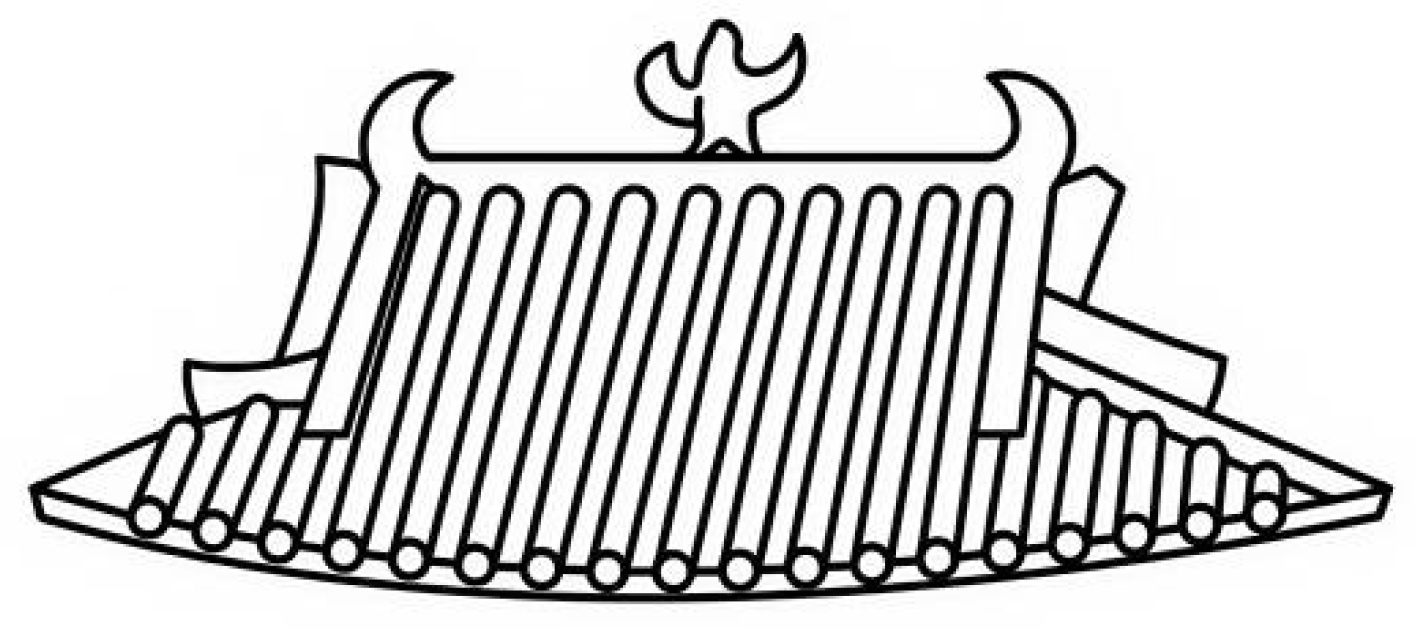
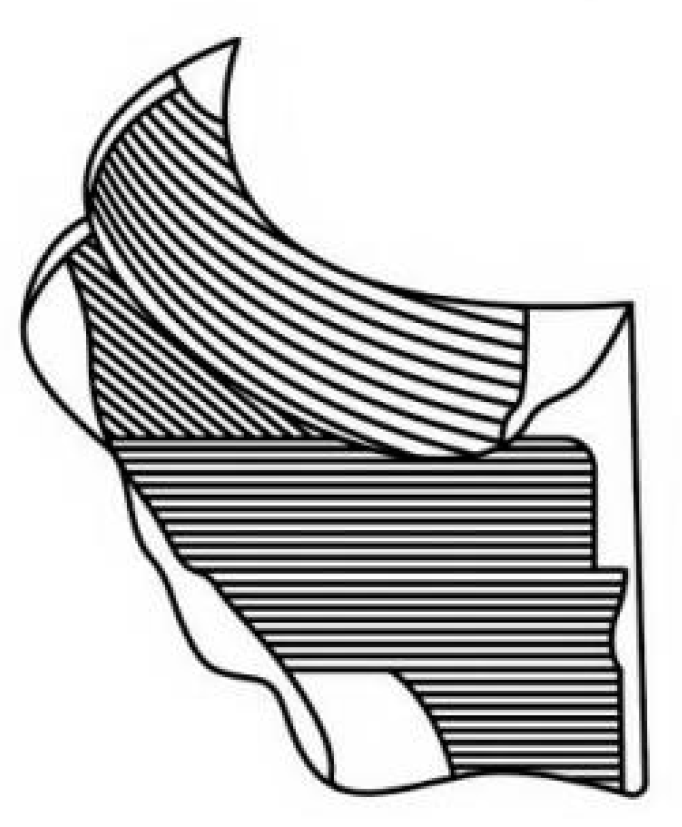
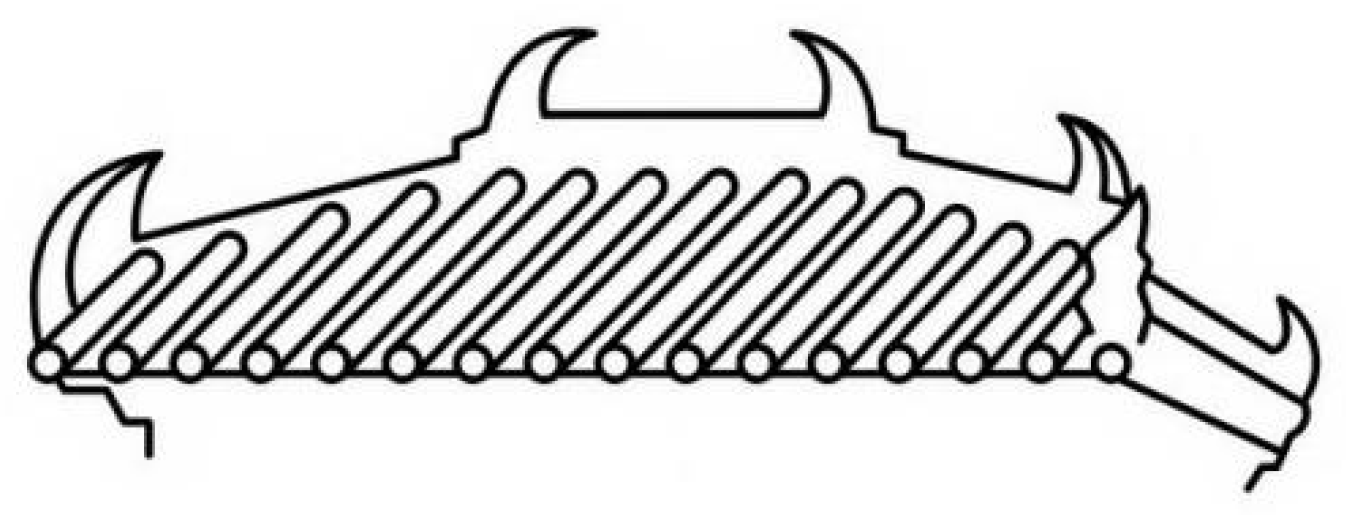
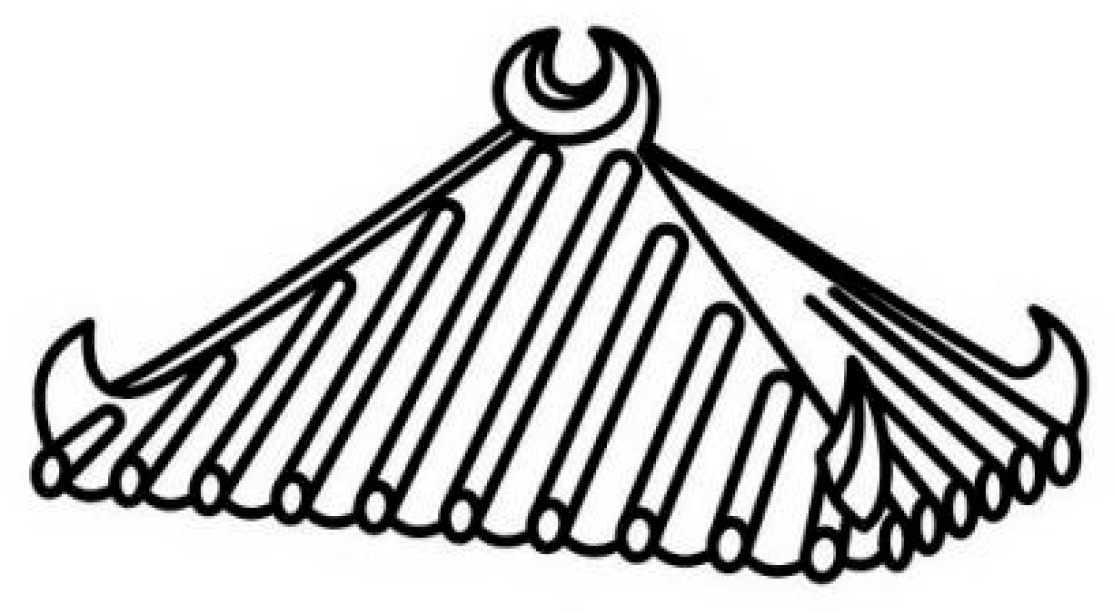
The dragon-like creature mentioned here may be related to the chiwei patterns found in later periods (Qi 1978, p. 62). Early chiwei sculptures appear during the Western Han Dynasty. The lower portion of the chiwei ornament is relatively straight, while the tail curves upward, characteristic of early chiwei ridge designs (Wen 2012, p. 147) (Figure 2). This type of chiwei design was fairly prevalent during the Han Dynasty and can also be observed on the roofs of ceramic buildings unearthed from this period (Figure 3 and Figure 4).
The symbolic meaning of chiwei sculptures relates to the traditional Chinese concept of the destructive cycle within Wuxing theory, which was prevalent during the Han Dynasty. As stated in the Fengshan Shu 封禪書 (Treatise on the Feng and Shan Sacrifices), a chapter in Sima Qian 司馬遷’s Shiji 史記 (Records of the Grand Historian):
越俗有火災,復起屋必以大,用勝服之。
(司馬遷《史記·封禪書》)
After a fire in the Yue region, the rebuilt buildings are consistently enlarged and equipped with talismans to overcome fire.
Su-e 蘇鶚 in the Tang Dynasty in the Sushi Yanyi 蘇氏演義 in the citation of this sentence, for the explanation that
蚩尾能避火災,置之殿堂,用勝服之。
(蘇鶚《蘇氏演義》)
Chiwei can prevent the fire by strategically placing it in the Hall and using the talisman to overcome it.
The chiwei symbol represents the tail of aquatic creatures Ni 鯢 and Zha 鱙, embodying the water element in Wuxing theory. According to the destructive cycle of Wuxing, water overcomes fire. The chiwei sculptures at each end of the ridge signify burning fire and protecting against evil spirits, showing a common architectural theme from the Han region.
As shown in Table 1 above, the main ridge of the Wudian roof 廡殿頂6 in the Yungang Grottoes is adorned with chiwei sculptures at both ends, which is adorned with a fire extinguishing symbol. These sculptures are of the same sort as was utilized during the Han Dynasty.
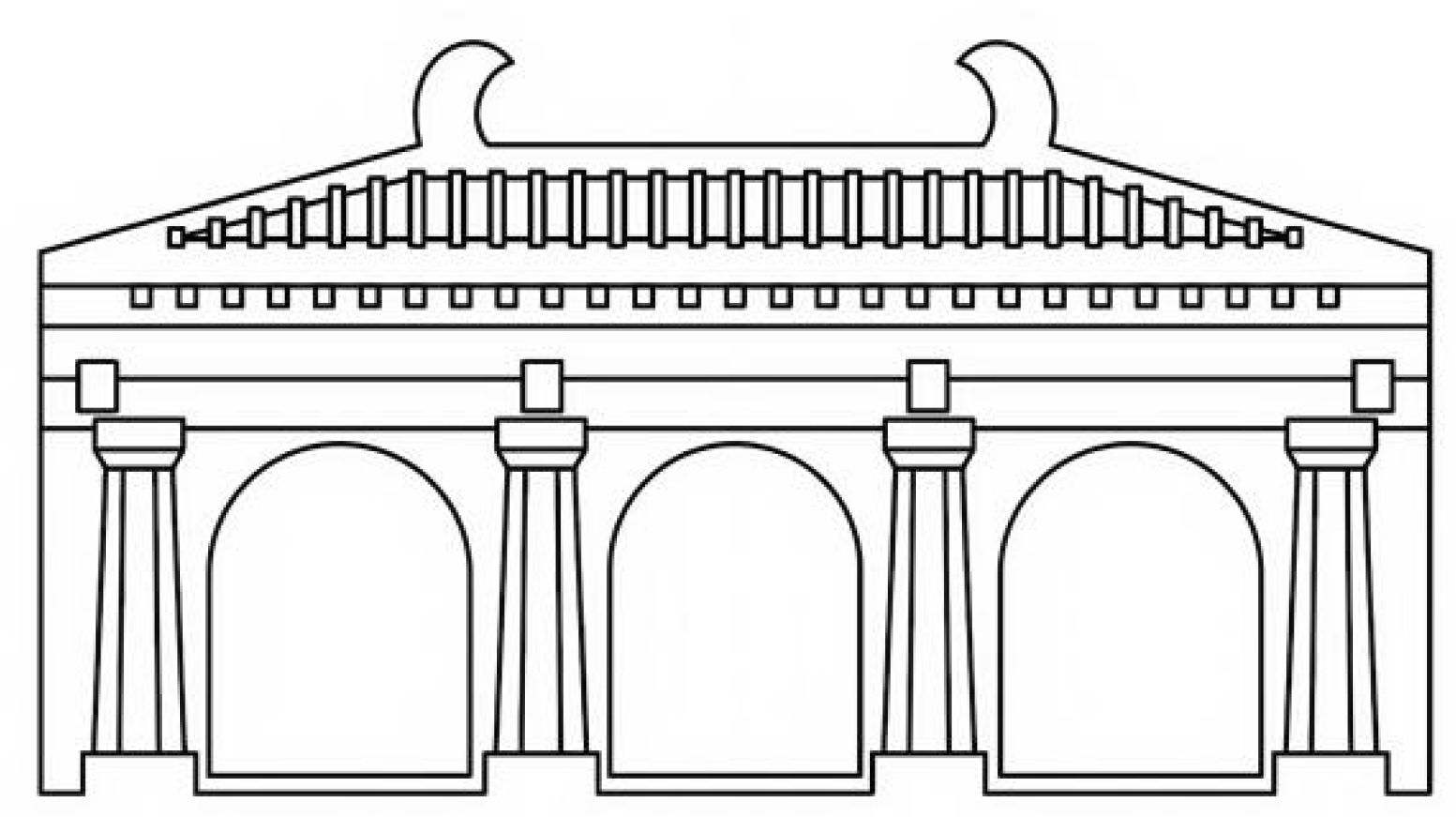
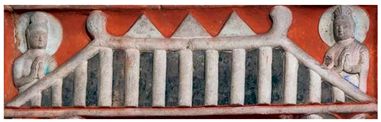
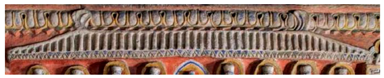
During the Northern Wei dynasty, chiwei sculptures in the Yungang Grottoes featured slightly curved inner edges, semi-circular outer contours, and inward-rolling frames that formed pointed tails without posterior fins (see examples in Table 1, Types Aa through E). This shape is also depicted in the architecture of the south wall painting of Cave 257 in the Mogao Grottoes, the Guyang cave 古陽洞 in the Longmen Grottoes, and the roof of the architecture outside Cave 30 of Maijishan Grottoes, all constructed during the Northern Wei dynasty (Figure 5 and Figure 6).
Chiwei, an indigenous ornamental element originating from the Han region, carries fire-extinguishing symbolism. Positioned at the extremities of the main roof ridge, these components serve as connecting points between the main and vertical ridges. Their frequent use during the Northern Wei dynasty, a period of flourishing Buddhist art, demonstrates the fusion of Buddhist and traditional Chinese architectural elements.
Yet chiwei’s role at Yungang extended beyond this traditional symbolism. Its systematic deployment reveals an additional, structural function. By appearing consistently at every ridge terminal—whether the central motif was Buddhist or indigenous—chiwei operated as the architectural constant that enabled cultural variation elsewhere. This points to a deliberate design principle. Indigenous elements occupy fixed, structural junctions, while syncretic Buddhist-Chinese motifs alternate in the more prominent central positions. Framing foreign Buddhist symbols within these established Chinese forms was crucial, making them comprehensible and ultimately acceptable.

4.2. Symbolic Meaning of the Phoenix

The interchangeability of garuda and phoenix on main roof ridges is central to understanding how Buddhist architecture was sinicized. As Table 1 shows, phoenix figures replace garuda in certain configurations without altering the chiwei terminals or vertical ridge arrangements—evidence that artisans saw these two birds as functionally equivalent. What made this substitution possible was their shared symbolism: both generate wind and embody fire. The historical analysis that follows traces how these convergent attributes enabled phoenix to assume garuda’s architectural role.
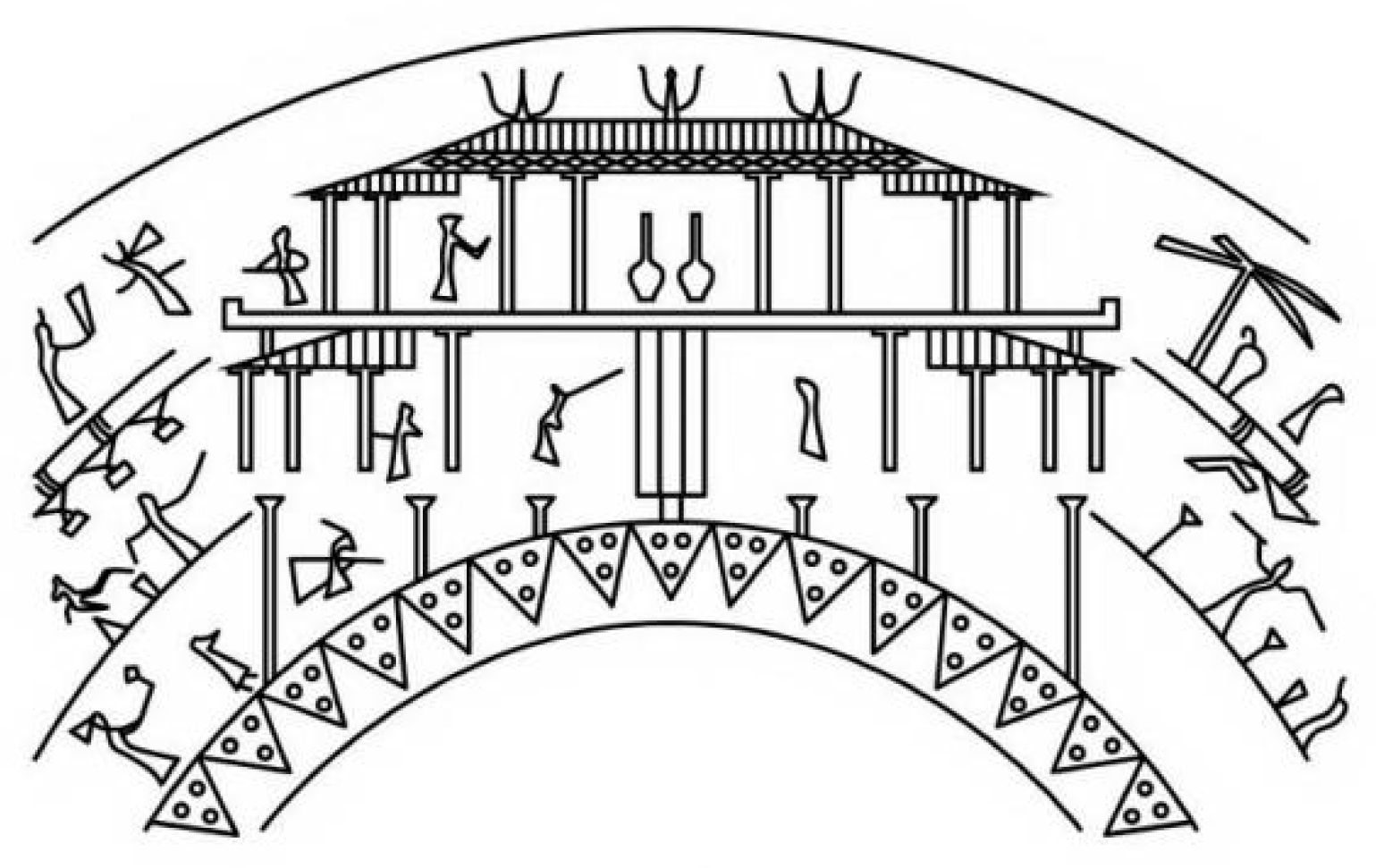
During the Warring States period, ridge ornaments shaped like phoenix birds were widely prevalent. Despite the absence of complete main ridge structures, architectural artifacts discovered from the Warring States period nevertheless exhibit discernible phoenix bird shapes on the left and central sections of the main ridge (Figure 7) (Fu 2004).
During the Han Dynasty, phoenix-shaped ridge decorations remained favored. Numerous historical records from this period reflect the prevalence of phoenix-shaped ridge decorations. The Sanfu Jiushi三輔舊事 records:
建章宮7周回三十里8。東起別風闕,高二十五丈9,乘高以望遠。又於宮門北起圓闕,高二十五丈,上有銅鳳凰,赤眉賊壞之。
(陳直《三輔黃圖校正》)
The perimeter of Jianzhang Palace measures 30 li. Biefeng Que, located in the east, stands at a height of 25 zhang and provides a panoramic view from its elevated location. In addition, located to the north of the palace gates is a cylindrical structure, similarly measuring 25 zhang in height, adorned with a copper phoenix positioned on its apex. it was destroyed by the Red Eyebrows Army.
The Phoenix-shaped ridge decoration is also vividly depicted in the Jianzhang Fengque Fu 建章鳳闕賦 by Fan Qin繁欽.
築雙鳳之崇闕,表大路以遐通。上規圜以穹隆,下矩折而繩直。長楹森以駢停,修桷揭以舒翼。
(费振剛《全漢賦校註》)
The Chongque of Twin Phoenixes was erected, and a primary thoroughfare was developed to ease transit. The upper section of the building exhibits a round and grandiose design, but the lower section possesses a square and robust structure. The columns of the structure are lofty and erect, meticulously arranged akin to avian wings unfurling. The structural elements of the building, such as the beams and rafters, possess a high density and robustness, akin to the expansive wingspan of birds.
During the Western Han Dynasty, the Lu Lingguang Hall 魯靈光殿 featured phoenix ridge ornamentation, as described by Liu Yanshou 劉延壽 in the Lu Lingguang Dian Fu 魯靈光殿賦:
朱鳥舒翼以峙衡,騰蛇蟉虬而繞榱。
(费振剛《全漢賦校註》)
The red bird extends its wings and perches on the horizontal beam, projecting an aura of solemnity and stability. The brackets and pillars are adorned with serpent and crab designs that intertwine.
These three historical documents demonstrate that Han Dynasty architectural ridge decoration incorporated phoenix motifs, either as single entities or in pairs. The phoenix ridge decoration exhibited the distinctive feature of outspread wings and was predominantly found on elevated structures.
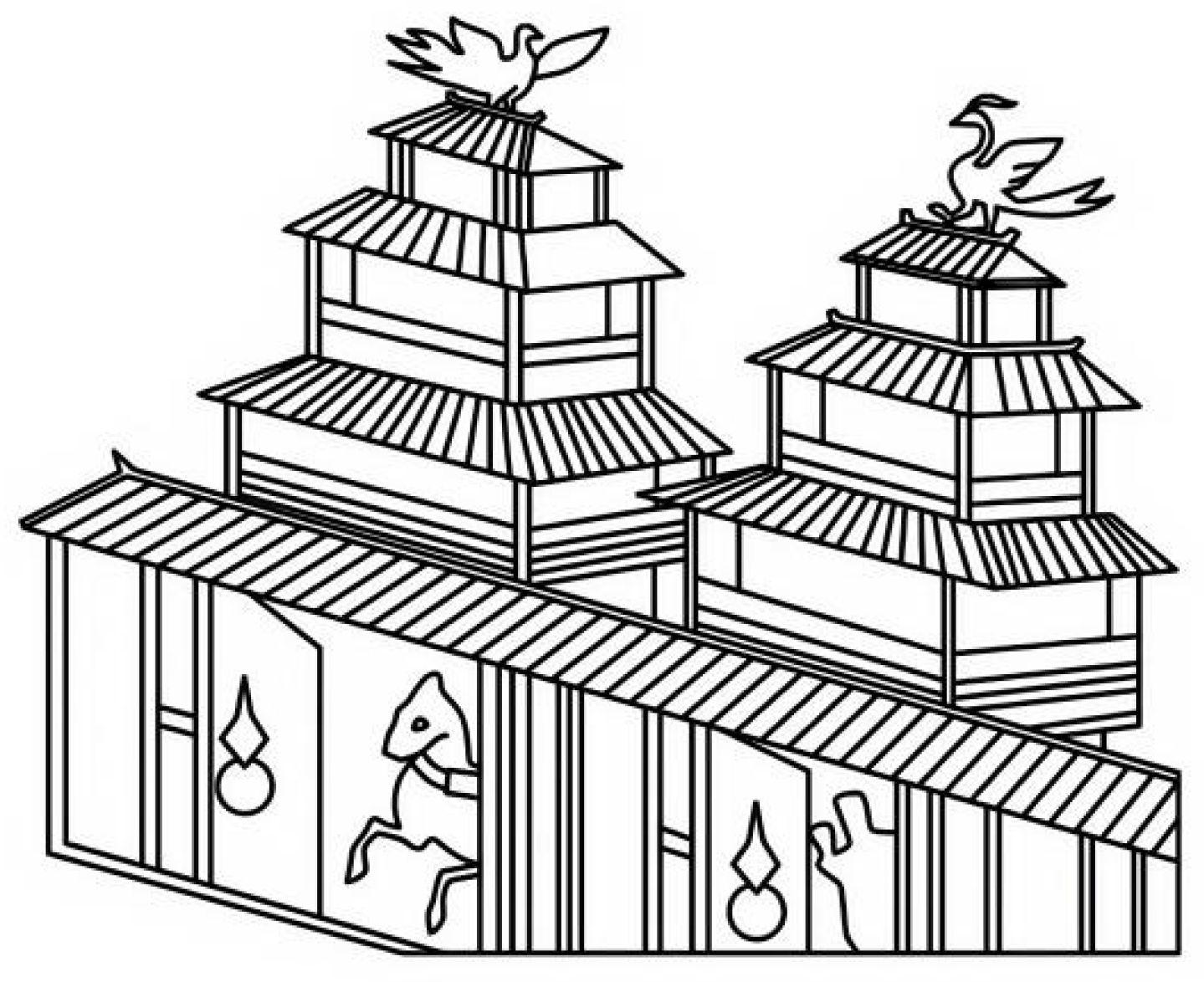
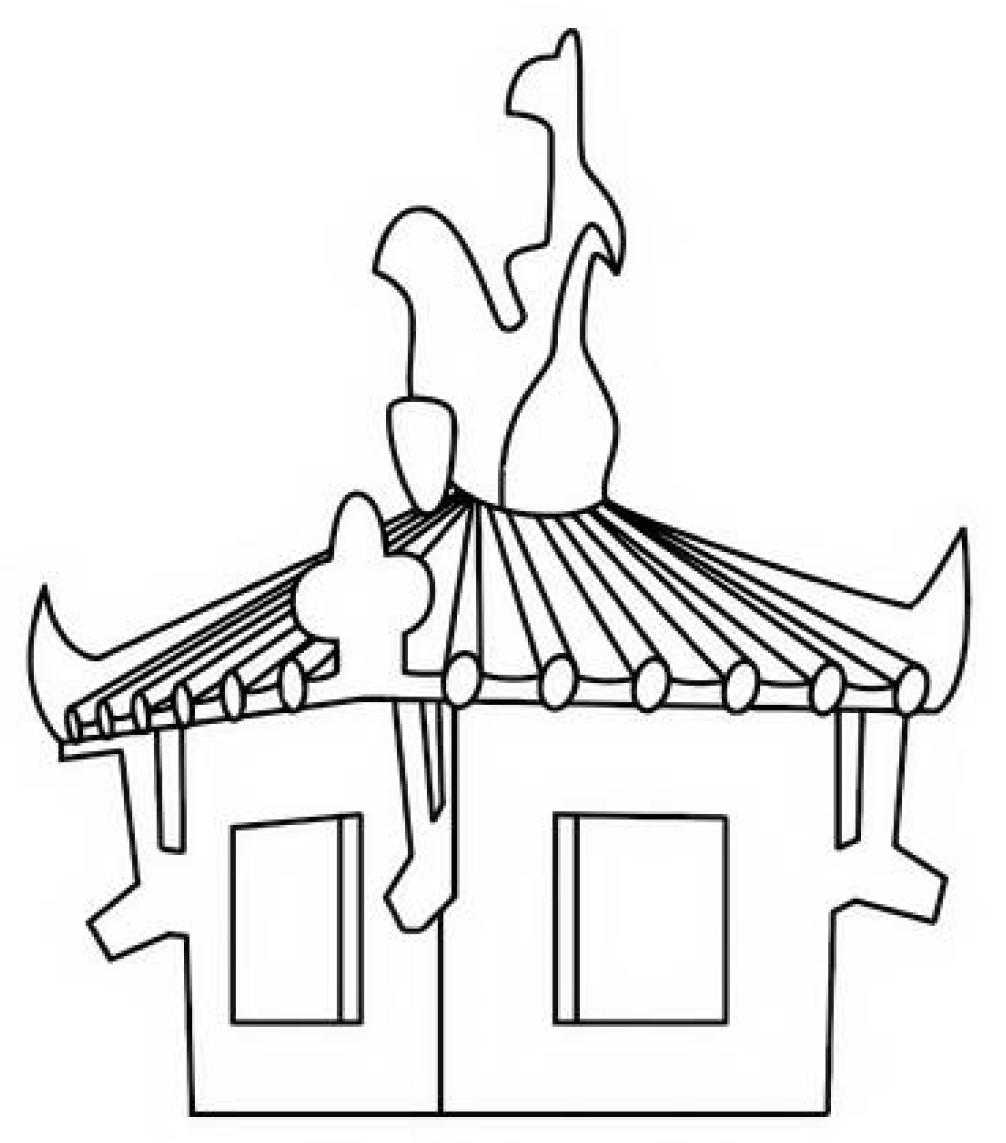
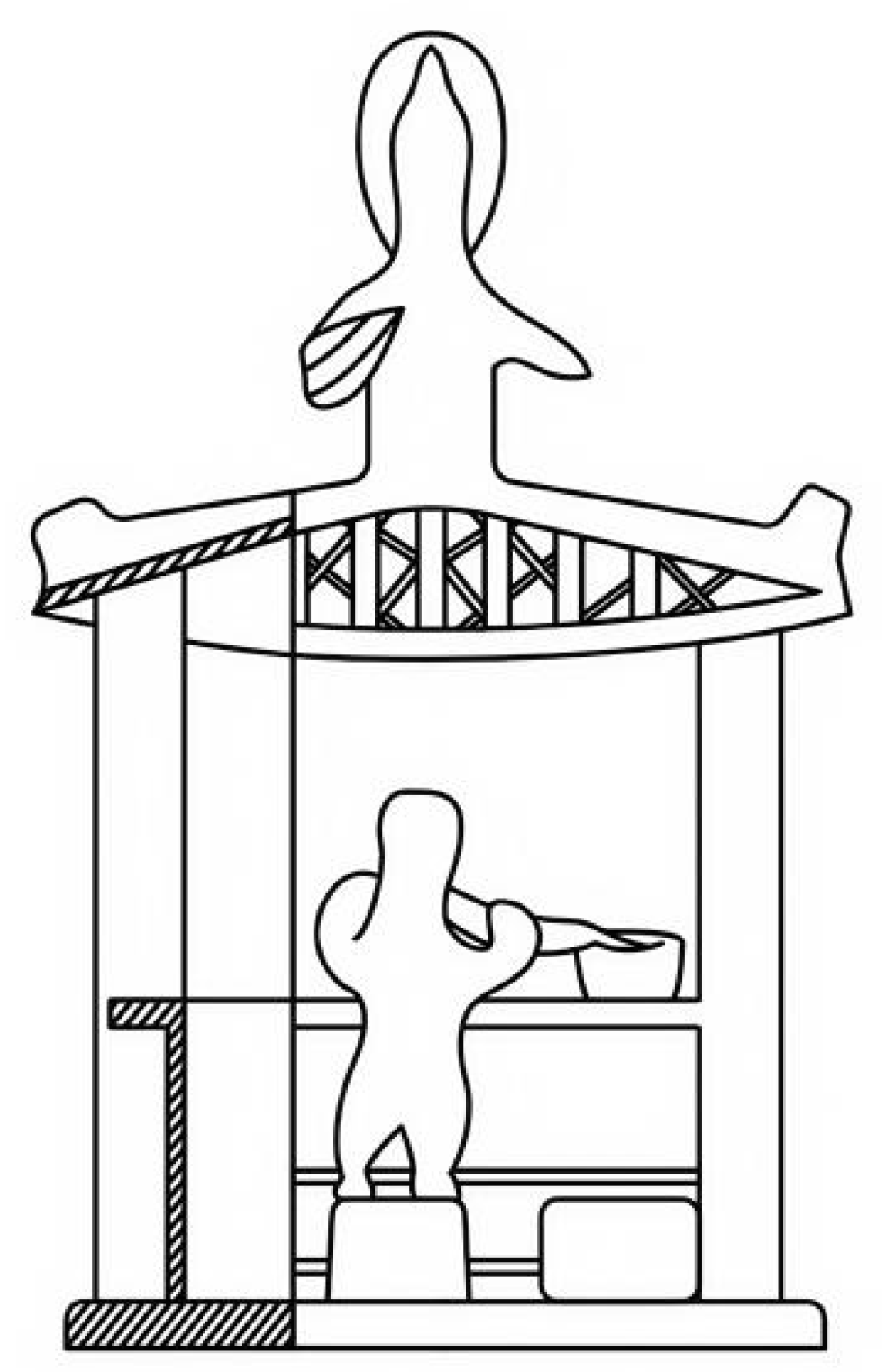
Architectural drawings from Han Dynasty hua-xiang-shi exhibit the phoenix ridge ornamentation prevalent during that period. The hua-xiang-shi at the Museum of Fine Arts in Boston portrays two four-story wooden structures with wudian roofs. The primary ridge is embellished with phoenixes extending their wings in flight (Figure 8). The architectural design of a small ancestral shrine discovered in Dongyan Village 東沿村 during the third year of the Yuan He 元和10 era features a broad, substantial ridge in an inverted triangular form, with phoenix ridge decoration positioned at the center (Figure 9). In Xiangcheng County 項城縣, archeologists unearthed an ancient three-story ceramic building adorned with a prominent phoenix ornament on the roof’s main ridge, transformed into a vertical, four-sided figure (Figure 10). The well of Han tomb unearthed at Honghuagang 紅花崗 in the eastern suburbs of Guangzhou during the Eastern Han Dynasty also demonstrates similar phoenix ridge ornamentation in its architectural representations (Figure 11).
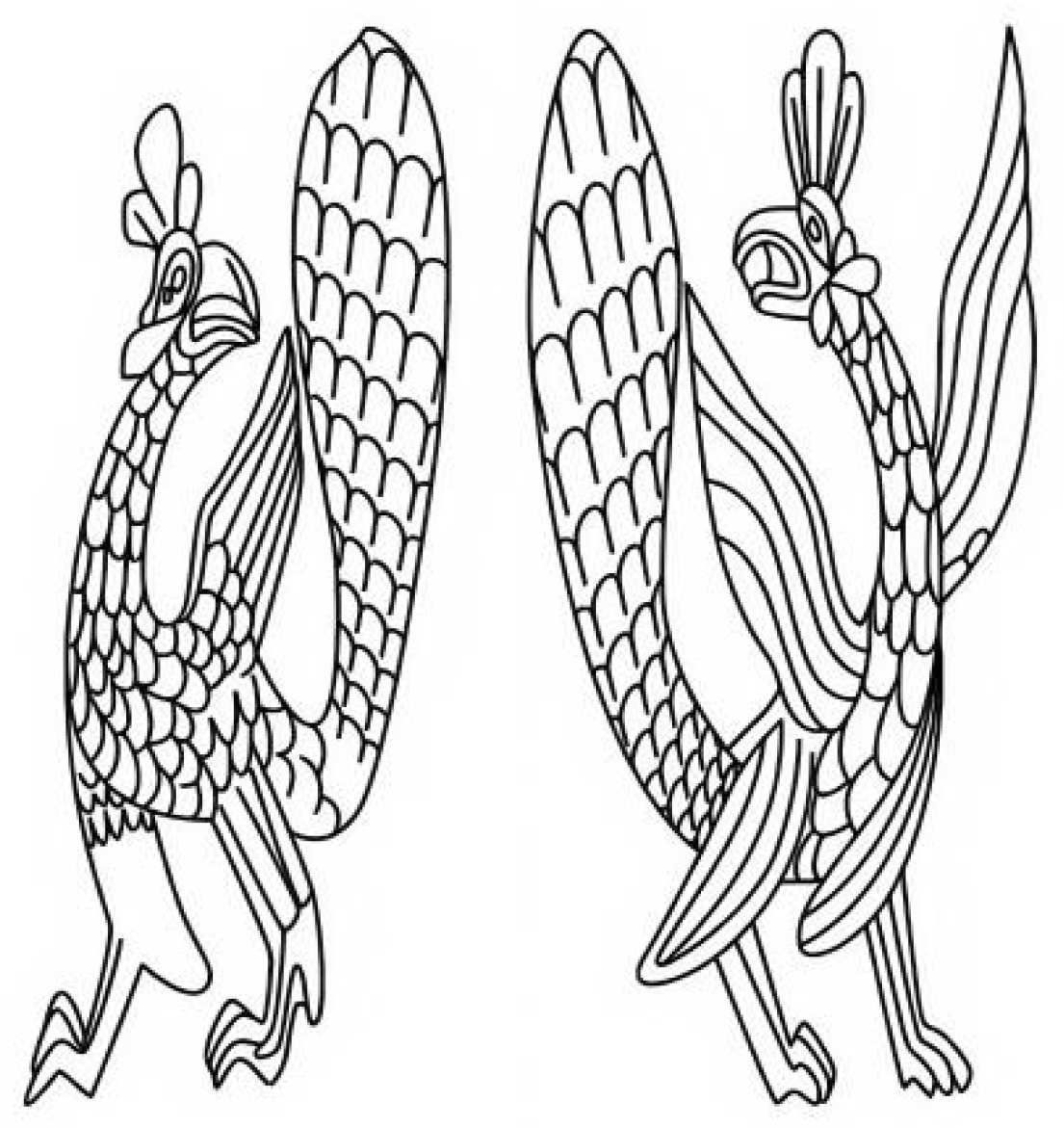
These observations demonstrate that traditional Chinese depictions of the phoenix typically feature a slender, elongated neck resembling that of a goose, accompanied by expansive wings often depicted in a spread-out manner. The tail is commonly portrayed as either separated into multiple strands or shaped like a single-piece fan.
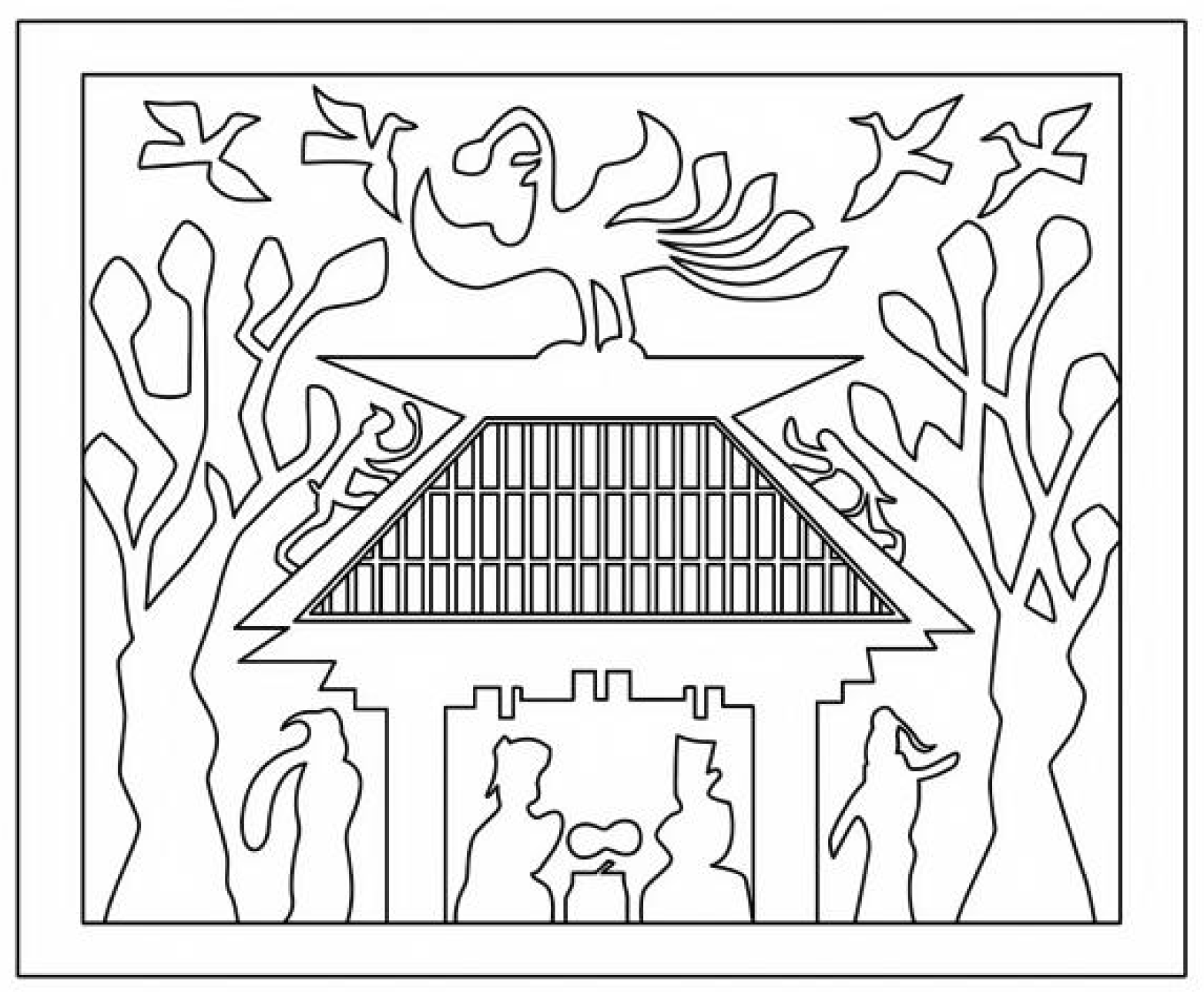
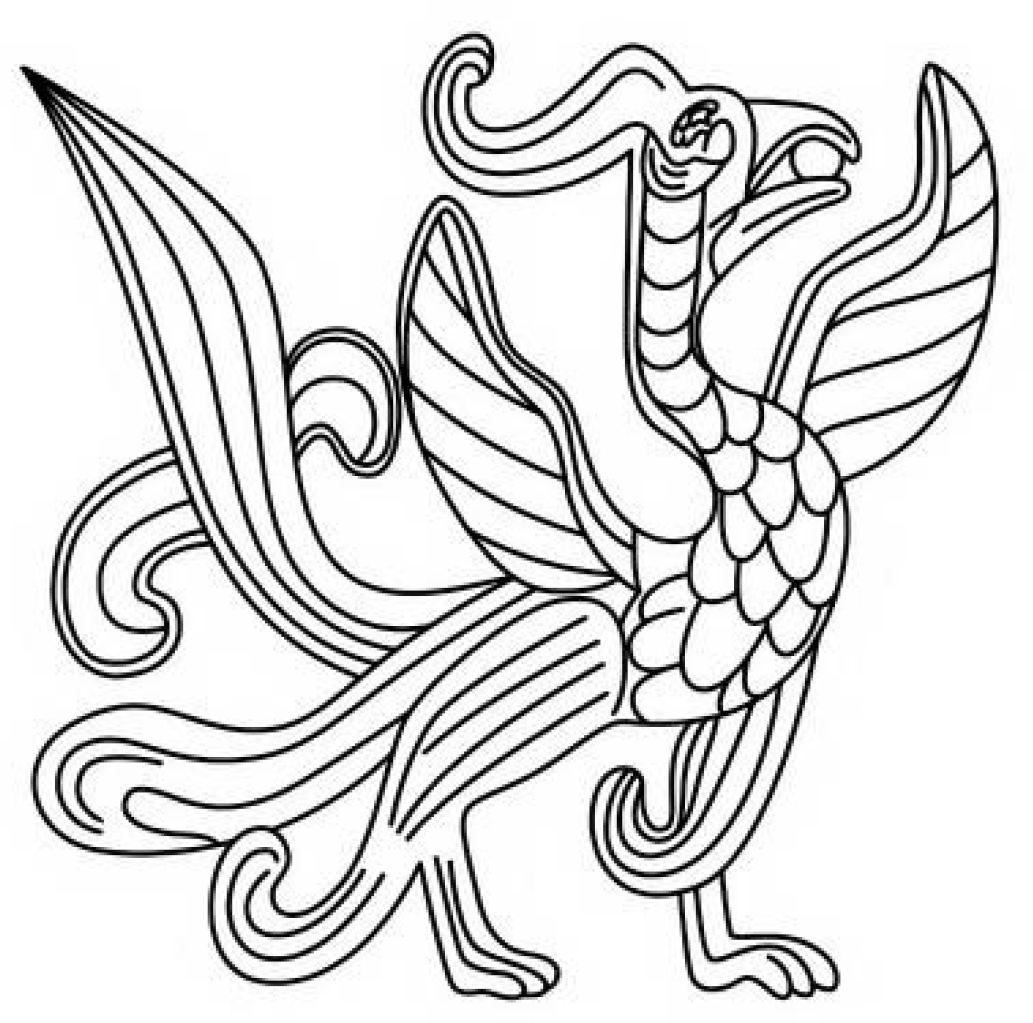
In the Yungang Grottoes, on the east and west sides of the south wall in Cave 13, the ends of the ridges of the house-shaped niches feature chiwei ridge ornaments, while the center displays phoenix bird decoration. This design is identical to the one discovered on the niche lintel in the lower layer of the south face of the central pillar in Cave 6 (Table 1, Type D; Figure 12 and Figure 13). These closely resemble the phoenix images presented in Figure 10 and Figure 11, displaying numerous shared characteristics. These features consist of a pronounced avian beak with a distinctly curved tip, reminiscent of an eagle’s beak; an elongated neck resembling that of a goose; a crest similar to that of a bird; expansive wings; and a tail that is fashioned like a fan shape or has the appearance of petals dispersed in various directions.
The phoenix is an indigenous Chinese emblem and a harbinger of auspiciousness. As stated in the Shangshu, Yiji尚書·益稷 (Book of Documents, Yi and Ji):
簫韶11九成,鳳凰來儀。
When the Xiao and Shao music reaches its ninth perfection, the phoenix arrives in all its glory.
The expression denotes the magnificent and remarkable appearance of the phoenix, considered a symbol of auspiciousness in ancient China.
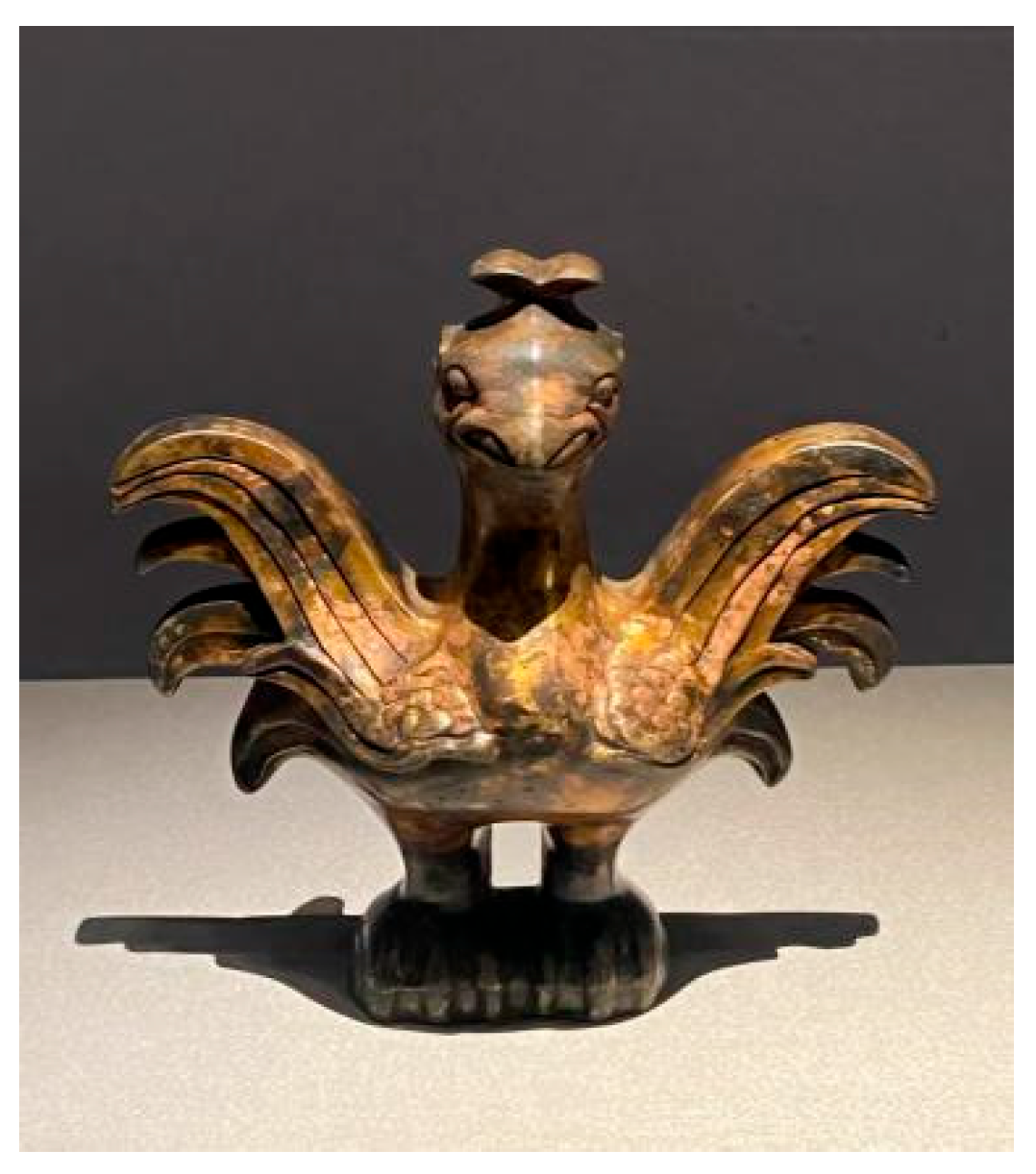
In the Illustration of Confucius Expounding the Spring and Autumn Annals 春秋演孔圖, it is written that the phoenix is the essence of fire.12 The Spring and Autumn Annals Yuan Ming Bao 春秋元命苞 also mentioned that the phoenix is formed from Fire and the Li trigram 離卦.13 The phoenix sculpture has been positioned centrally on the main ridge, representing the Chu 楚people’s deep respect for fire and the phoenix. Liu Bang劉邦, also known as the Emperor Gaozu of Han 漢高祖, hailed from the Chu region楚地. The Chu people are descended from Zhu Rong 祝融, the ancestor of their clan and the divinity of fire (Hu 1934, p. 26). Consequently, they held fire in high regard and erected the symbol of the phoenix, which is closely linked with the element of fire, on the center of the roof. This fire-worshiping ideology can also be manifested in the flame bead mentioned below. Furthermore, the words fēng (wind) 風 and fèng (phoenix) 鳳 share the same origin in the oracle bone inscriptions. The phoenix is also the god of the wind. In ancient wind beliefs, it was believed that the wind was generated by a large bird flapping its wings. This wind-producing bird was the phoenix, which is why the phoenix was also known as the god of wind. This is also a complementary reason for the flying momentum of the phoenix bird, whether depicted on the main ridge of the Yungang Grottoes, a Buddhist monument, or on the roof of traditional Han architecture, which spreads its wings and soars. This shared wind-fire symbolism explains the architectural logic documented in Table 1. Phoenix appears in Type D configurations occupying the exact position garuda holds in Type A, with identical chiwei terminals and vertical ridge arrangements. This interchangeability was not accidental but deliberate—artisans recognized these birds as functionally equivalent for architectural purposes. The extensive historical precedent for phoenix ridge ornaments in Han tradition meant that substituting phoenix for garuda rendered Buddhist architectural forms immediately legible within Chinese visual conventions.
The garuda and phoenix bird statues at Yungang appear close together, and both generate wind and embody fire. But the convergence goes beyond symbolism. Phoenix figures have slender necks, spread wings, and dynamic poses drawn from Chinese tradition. Artisans rendered garuda according to these same visual conventions, which meant Buddhist and indigenous symbols could swap in for each other without disrupting the composition. This ability to substitute one for the other is what made sinicization work in the ridge decoration system. The phoenix became a cultural bridge—it allowed Chinese beliefs and Buddhist iconography to merge while keeping its distinctly Chinese character. That flexibility was crucial for Buddhism’s spread in the Central Plains.

4.3. Symbolic Meaning of the Garuda

In Buddhism, garuda were originally conceived as wrathful creatures antagonistic toward serpents; however, following their conversion by the Buddha, they became protectors of his teachings. Both mainstream and Mahāyāna sources describe garudas as one of eight mythical classes of non-human beings that pay homage to the Buddha. In traditional Indian mythology, garuda manifested as a golden-winged bird representing the deification of solar brilliance, functioning—like the phoenix in Western mythology—as a symbol of fire and flame. Jātaka literature depicts garudas as colossal birds of immense size and strength, capable of parting oceans through wing movement and generating the powerful “garuda wind” (Buswell and Lopez 2014, p. 315). Therefore, garuda, as an exotic symbol embodying solar attributes and wind-generating power, aligns seamlessly with the characteristics of the indigenous Chinese phoenix. This cultural correspondence facilitated garuda’s assimilation into the sinicization process within the Yungang Grottoes.
During the Eastern Han Dynasty, the garuda was introduced to China alongside Buddhism, serving as the sacred mount and protector of Shakyamuni Buddha. As Buddhism developed in China, the garuda statues underwent a process of localization, displaying a different esthetic in the styling (Z. Ren 2023, p. 43).
The earliest garuda depictions emerged in India, exemplified by sculptures on the eastern entrance lintel of Sanchi Stupa. Constructed in the third century BCE under Mauryan King Ashoka, Sanchi Stupa represents a quintessential early Buddhist monument. The stupa’s carvings predominantly feature the Bodhi tree surrounded by various animals. The left-side garuda displays a robust frame, short thick neck, aquiline beak, and generally sturdy, powerful, static appearance with head tilted sideways toward the Bodhi tree. Five-headed deadly snakes appear before the garuda. This garuda-serpent combat motif, established at Sanchi, subsequently became common in Kizil and Dunhuang cave murals.
Moreover, cave paintings from the Kucha region similarly depict garudas grasping venomous serpents in their beaks. garuda paintings in Kumtura Cave 23 (L. Zhao 2016b) and Kizil Cave 118 (L. Zhao 2016a), dating from the Northern and Southern Dynasties through the Sui period, exhibit meticulously rendered feather patterns, robust serpent-adorned beaks, and intense facial expressions that effectively convey the creature’s formidable presence and regal characteristics.
In Buddhist symbolism, serpents represent anger and rage—emotions constituting one of the three poisons (Triviṣa 三毒) that practitioners strive to eliminate. Within the Kucha region’s Theravada Buddhist context, practitioners pursued complete eradication of these three poisons to achieve Arhat status. The Kucha cave murals depicting garuda represent practitioners’ victory over these negative emotions (J. Li 2022, p. 43).
Dunhuang murals also feature full bird-shaped garuda forms, as seen in the paintings from Cave 9 and Cave 196 of Mogao Caves during the Later Tang Dynasty. The Cave 196 garuda displays a slender neck that bears greater similarity to Han-region phoenix characteristics (Figure 9 and Figure 10), while the Cave 9 depiction exhibits a more robust neck structure characteristic of Indian garuda forms (Dunhuang Yanjiuyuan 敦煌研究院 Dunhuang Academy 2016). The fluid lines that capture the bird’s motion convey the graceful form, while its eagle-like mandible emphasizes its nature in combat against the venomous dragon.
This visual transformation had systematic consequences. By rendering garuda according to Chinese phoenix conventions, artisans created a Buddhist element that could operate within the same decorative framework as indigenous symbols. Table 1 demonstrates this integration, as garuda appears in both central positions and supporting roles on vertical ridges, adapting to different compositional contexts while maintaining visual coherence with chiwei terminals and triangular patterns. This positional flexibility—unlike chiwei’s structural fixity—reveals garuda’s intermediate status as a foreign element undergoing systematic sinicization.
Based on the above illustrations, it becomes apparent that earlier representations of garuda, whether from India or the Kucha region, display a more awkward posture compared to the garuda figures used as ridge ornaments in the Yungang Grottoes. Specifically, these earlier depictions feature thicker necks and heavier, broader bodies, emphasizing garuda’s sense of strength. In contrast, the garuda statues found in the Yungang Grottoes show influence from the Chinese phoenix of the Central Plains. They exhibit more phoenix-like characteristics, with longer, more slender necks, more delicate bodies, and more graceful, dynamic poses (Table 1, Types Aa and Ab). The garuda imagery found in Cave 196 of the Mogao Grottoes, which emerged during the Late Tang Dynasty, clearly demonstrates the influence of the phoenix-like garuda representations from the Yungang Grottoes. This evolution in artistic style reflects a notable cultural exchange and esthetic transformation across different periods and regions of Chinese Buddhist art.
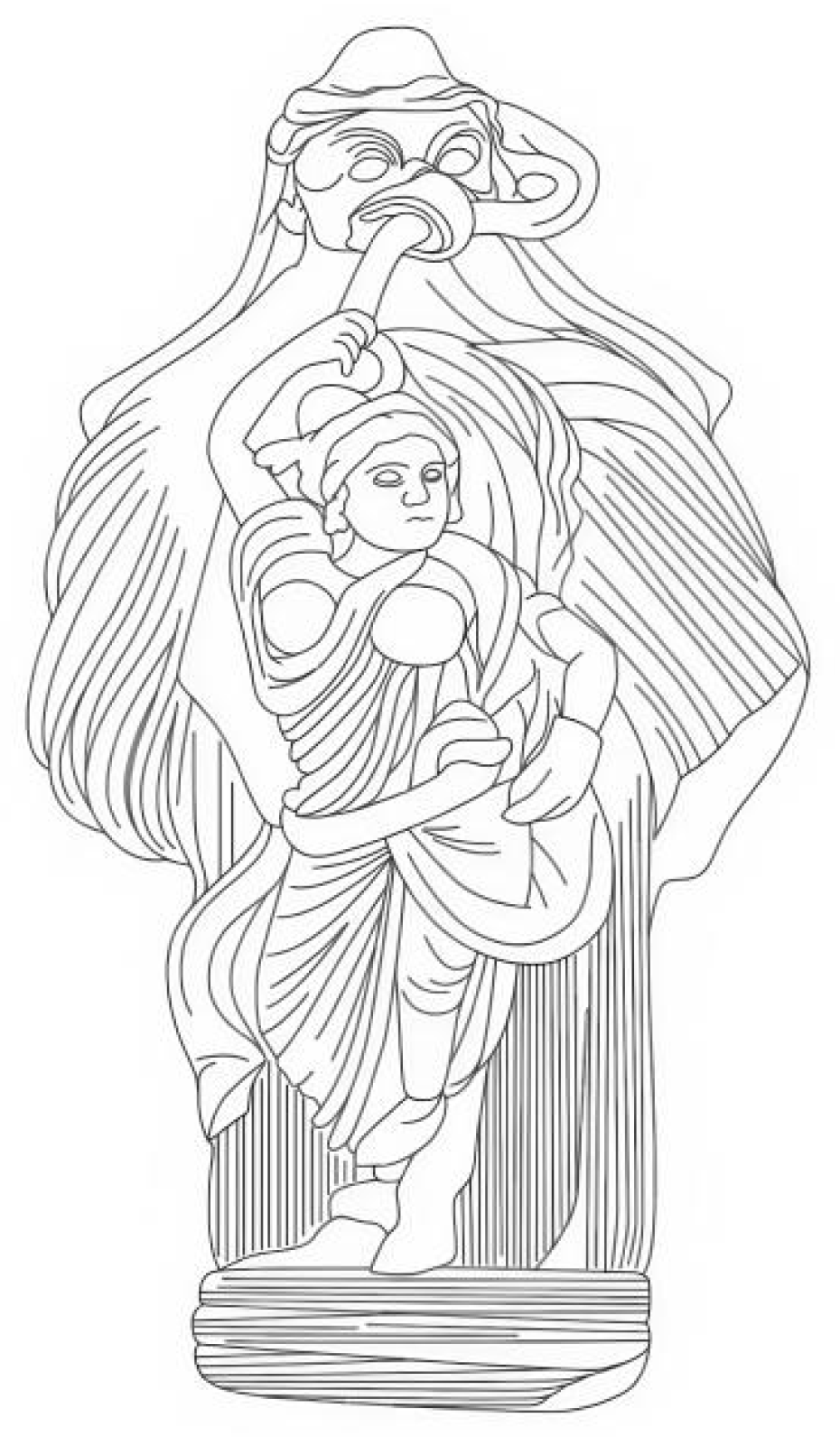
Furthermore, the Gandhara carving depicts a garuda, clutching a poisonous snake in its eagle beak and displaying a furious expression. The garuda statue here exhibits a human-like face, showcasing an alternative depiction of the garuda as a hybrid creature with a human face and a bird’s body. The Kizil Caves also feature human-like face garuda images, such as the garuda painting found in Cave 171 (Xinjiang Research Institute of Grottoes 2017). These representations inherit traits from early Indian Buddhist art, often portraying the garuda with a venomous dragon in its mouth or a fierce countenance (Figure 14). Such designs subsequently influenced the garuda motifs found in the Yungang Grottoes. A prime example is the front-facing garuda sculpture on the western wall of the antechamber in Cave 12. This figure exhibits a long, sharp eagle’s beak, powerful talons, and a humanoid face. Its head is adorned with an elaborate crown of flowers and vines, while its round eyes and overall expression convey a sense of ferocity (Figure 15). Notably, compared to the traditional phoenix imagery from Central Plains (Figure 16), the front-facing garuda in Cave 12 bears a distinctive bodhisattva crown, clearly indicating its Buddhist influence (Figure 15).
Additionally, compared to the garuda image on the main ridge, the two backward-facing garuda sculptures on the vertical ridges exhibit elongated, slender necks resembling Western Jin Dynasty phoenix depictions from Dunhuang (H. Ren 2014, p. 16). Furthermore, both their outstretched wings and trailing tails demonstrate striking similarities to Han-region phoenix forms.
The garuda sculptures found in the Yungang Grottoes exemplify a noteworthy amalgamation of Indian Buddhist iconography and Chinese esthetic traditions. During the passage from Indian to Chinese art, these legendary birds underwent sinicization, which involved assimilating the traits of the native Chinese phoenix. Their change is apparent in their elegant postures, lengthened necks, and energetic poses, which contrast with previous, sturdier Indian representations. The garuda’s connection with wind and fire corresponds to comparable characteristics of the Chinese phoenix, enabling its incorporation into local iconography. Moreover, the inclusion of anthropomorphic characteristics and bodhisattva crowns in certain depictions of garuda highlights the intricate cultural interchange taking place in Buddhist art during this era. The stylistic changes shown here are a manifestation of the wider process of Buddhist assimilation in China. They illustrate how religious symbols from foreign origins were modified to align with the artistic preferences of the local culture.
This pattern of transformation characterized Northern Wei Buddhist art more broadly. Imagery “was derived from Indian and Central Asian prototypes, which followed established iconographic conventions and displayed the Indian propensity for plastic forms,” yet “gradually it became tempered with the Han Chinese sense of design and preference for linear treatment of surfaces” (Wong 2004, p. 176). The garuda carvings at Yungang exhibit precisely this trajectory. From the robust, thick-necked forms characteristic of Indian and Kucha-region prototypes to the slender, elongated figures with graceful poses and phoenix-like characteristics at Yungang, the garuda underwent deliberate esthetic recalibration to align with indigenous Chinese artistic preferences.
This transformation of the garuda from a robust, fierce creature to a more slender and graceful bird mirrors a broader pattern of selective adaptation evident throughout Yungang. Lidu Yi has compellingly demonstrated this process with the Buddha’s robes; the Indian bare-shouldered style, considered improper in China, was consciously modified by artisans who added a covering garment (pianshan 偏衫) (Yi 2018, p. 42). Similarly, the reshaping of the garuda to align with the indigenous phoenix esthetic was not an accidental stylistic drift, but a deliberate design choice to make a foreign symbol culturally legible and resonant within a Chinese context. This evidence suggests that artisans at Yungang employed a systematic approach to cultural translation, selectively adapting foreign motifs to serve both religious and esthetic imperatives.

4.4. Symbolic Meaning of the Flame Element

Triangular patterns and flame beads appear on both main and vertical ridges in various combinations, following a distinctive distributional pattern. Their significance lies in their mediating role. Unlike chiwei, rooted in Chinese tradition, or garuda, drawn from Buddhist iconography, these flame elements resonate across both cultural systems. The alternating arrangement of triangular motifs and flame beads on certain ridges shows deliberate compositional thinking—this pattern cannot be explained by simple imitation of existing models. The analysis below traces where both elements came from before showing how their combination produced new ornamental forms.
The triangular pattern and flame motif constitute distinct ornamental elements in hua-xiang-shi architecture. The decorative triangular pattern, alternatively termed “basic triangle,” “flame triangle,” or “lantern triangle,” appears on both the main ridge and lateral ridges of the roof, serving multiple functional and symbolic purposes. This motif not only represents the continuation of traditional Chinese architectural patterns but also indicates the localization of Buddhist art.
The emergence of triangular decorative motifs during the Han Dynasty can be traced to the hua-xiang-shi architectural tradition from the Han Dynasty to the Sui Dynasty. Rather than featuring a phoenix at the ridge center, many Han Dynasty architectural drawings display triangular flame patterns. This pattern, known as a “flame-shaped triangle” or “flame bead,” replaces the phoenix (Han 2015, p. 75). The hua-xiang-shi, unearthed in Jiawang Town in Xuzhou City, measures 81 cm in length, 81 cm in width, and 26 cm in thickness. The stone displays a partially reversed representation of the primary ridge on both sides, with the central portion featuring flame symbolism (Xu 1995) (Figure 17). This decorative type persisted into the Northern and Southern Dynasties and became integrated with the symbolic traditions of the phoenix. The hua-xiang-shi from the Han Dynasty frequently features triangular flame patterns, which serve as backdrops for mythological creatures or auspicious symbols. These designs symbolize architectural excellence and spiritual transcendence.
Flame motifs represent an important iconographic element in early Indian Buddhist art. Flame aureoles surrounding the Buddha’s head and shoulders frequently appear in early Buddhist sculpture as symbols of spiritual awakening and divine wisdom. This iconographic convention is evident in surviving examples such as the Great Miracle at Sravasti in Shiva, Buddha sculptures, and cave paintings at the Ajanta Museum (Administration and Cultural Heritage of the Ajanta Museum, Paris). These works demonstrate the consistent use of flame imagery to convey concepts of enlightenment within the early Buddhist visual tradition. The adoption of flame symbolism in Buddhist art reflects broader South Asian religious traditions, while the adaptation of this iconography in Chinese contexts suggests cross-cultural iconographic exchange in the formation of Buddhist visual culture.
Flame triangle patterns are extensively utilized in the architectural embellishments of the Yungang Grottoes, particularly on the ridge ornaments of the roofs. Flame triangular patterns are frequently employed on the upper sections of the house-shaped recesses found in Caves 9 and 10 of the second stage of Yungang Grottoes (Table 1, Types Ca and Cb). Notably, the flame triangle patterns of the Yungang Grottoes are frequently integrated with other components to produce intricate ornamental effects. As an illustration, within the house-shaped recess on the southern wall of Cave 6, there are flame-shaped triangular designs alternating with wish-fulfilling diamonds, resulting in a distinctive visual impact (C. Zhang 2011) (Table 1, Type E).
In Buddhism, flames serve as a symbolic representation of the illuminating power of wisdom, which eradicates afflictions and dispels ignorance. In traditional Chinese culture, triangle shapes are commonly associated with the purpose of repelling malevolent forces and preventing calamities. The fusion of these two cultural aspects imbues the triangular flame patterns with more profound cultural significance. The extensive utilization of flame triangle motifs in the Yungang Grottoes exemplifies the integration of Buddhist art and traditional Chinese art. This fusion is evident in both the structure and the substance. The flame triangular patterns found in the Yungang Grottoes exhibit typical Chinese design features while also containing elements of Buddhist art. These patterns serve as significant evidence of the adaptation and integration of Buddhist art within the local Chinese artistic heritage (Lai and Wang 2017, p. 178).
The distributional analysis shows that triangular patterns and flame beads serve a unique function. They combine equally with Buddhist garuda and with indigenous elements, and they also appear independently on various ridge configurations. Where flame beads and triangular patterns alternate on certain ridges, they create rhythmic variation that does not derive from a single precedent. This neutral mediating capacity suggests something important about sinicization. The process required not just Buddhist and Chinese elements, but also culturally ambiguous forms that could bridge the two traditions. The flame elements worked this way because of their dual genealogy.

5. Conclusions

This study has demonstrated that the roof ridge decorations of the Yungang Grottoes constitute not a haphazard collection of motifs, but a highly integrated architectural system that provides critical material evidence for the sinicization of Buddhist art in China. This system operated on a set of coherent principles that governed how indigenous and foreign elements were combined. A positional hierarchy distinguished indigenous components like chiwei, which occupied structurally fixed locations, from Buddhist-Chinese hybrid forms that showed greater positional flexibility. Functional equivalence facilitated synthesis, as garuda and phoenix substituted for each other on the main ridge through their shared symbolic attributes of fire and wind. Motifs also demonstrated adaptive deployment, with garuda shifting between primary and supporting roles based on compositional context. The phoenix-garuda synthesis represents the most significant achievement in this cultural integration, creating hybrid forms that satisfied both Chinese esthetic preferences and Buddhist doctrinal requirements. Similarly, flame beads and triangular patterns demonstrate how traditional Chinese decorative systems accommodated and recontextualized Buddhist symbolic content within established architectural frameworks. These architectural ornaments thus functioned as critical sites of cultural negotiation, revealing that sinicization at Yungang worked not merely through adapting individual motifs, but through strategic combination and spatial positioning.
The material foundation for this synthesis is profoundly significant. As the pioneering architectural historian Liang Sicheng established, because no timber-frame buildings from the Northern Wei have survived, the stone-carved architecture at Yungang constitutes the “sole major corpus of physical evidence” for the period’s structural and esthetic principles. Crucially, Liang observed that while the sculptural art displayed clear foreign influences, the architectural forms it replicated were “overwhelmingly of indigenous Chinese convention.” This insight provides the structural basis for the selective adaptation detailed in this study: the sinicization of Buddhist iconography unfolded not in a vacuum, but within the familiar and resilient grammar of a native architectural system. This cultural synthesis created a replicable model for resolving the inherent tension between a foreign religion and deeply rooted local cultural traditions (Liang 1947).
The significance of this process extends far beyond Yungang itself. The architectural vocabulary forged on these carved roofs was not a singular, localized experiment but established a foundational paradigm that influenced subsequent Buddhist artistic development. This foundational paradigm was the direct result of the immense concentration of imperial resources, political will, and artisanal skill in the capital of Pingcheng. This consolidation of power enabled the creation of a standardized and authoritative template for cave temple construction—a system that has come to be known as the “Yungang Model”. The “Yungang Model” was not merely an artistic style but a comprehensive system of design and iconography that was actively disseminated and replicated across Northern Wei territories, establishing the very blueprint that would define the era’s religious architecture (B. Su 1991). The active dissemination of this “Yungang Model” is confirmed by the appearance of major provincial cave sites, such as the Dafoshan cliff carvings in modern Gaoping, which so faithfully replicate Yungang’s stylistic and iconographic programs that they suggest the direct involvement of artisans trained in the capital (Li and Yi 2015). The stylistic evolution from the robust ‘Yungang style’ to the later, refined ‘Longmen style’ was given its foundational art-historical framework by scholars like Sofukawa Hiroshi, who first defined this critical transition (Sofukawa 2009). This sustained influence is powerfully evidenced in the development of later imperial cave temples, as substantiated by Amy McNair’s seminal study, Donors of Longmen: Faith, Politics, and Patronage in Medieval Chinese Buddhist Sculpture. Although focused on Longmen, McNair repeatedly demonstrates that its early patrons and artisans consciously looked to Yungang as their primary model. She argues convincingly that the initial program of the Guyang Cave directly imitated Yungang’s Cave 16, and that the imperial commission for the Binyang Grottoes explicitly mandated that they be based on the standard of “Lingyan Monastery,” the contemporary name for Yungang (McNair 2007).
Ultimately, the roof ridge decorations of the Yungang Grottoes emerge not merely as ornaments but as the material embodiment of a foundational paradigm that shaped the trajectory of Buddhist art across East Asia. These decorations demonstrate that cultural adaptation, when supported by appropriate institutional conditions, can produce innovative artistic forms that honor multiple traditions while creating new possibilities for cultural expression.

Author Contributions

Conceptualization, Z.W.; methodology, Z.W.; software, Z.W.; validation, Z.W.; formal analysis, Z.W.; investigation, Z.W.; resources, Z.W.; data curation, Z.W. and Q.C.; writing—original draft preparation, Z.W.; writing—review and editing, Z.W. and Q.C.; supervision, Q.C. All authors have read and agreed to the published version of the manuscript.

Funding

This research received no external funding.

Institutional Review Board Statement

Not applicable.

Informed Consent Statement

Not applicable.

Data Availability Statement

The original contributions presented in this study are included in the article. Further inquiries can be directed to the corresponding author.

Conflicts of Interest

The authors declare no conflicts of interest.

Notes

1
One of the most important titles for the Buddha is the Sanskrit word Tathāgata, often translated as “the Thus Come One” in English and as 如來 in Chinese.
2
Wuxing 五行 theory posits that five elements (wood, fire, earth, metal, water) interact through productive and destructive cycles. In the destructive cycle, water overcomes fire, which explains the water-related symbolism of chiwei as fire prevention.
3
Ancient characters (gu zi 古字) refer to the earlier orthographic forms used to represent specific lexical items in classical Chinese texts before being replaced by later character variants in subsequent historical periods.
4
北冥有魚,其名為鯤。鯤之大,不知其幾千里也。化而為鳥,其名為鵬。鵬之背,不知其幾千里也。怒而飛,其翼若垂天之雲。 Watson translates: In the Northern Darkness there is a fish and his name is K’un. The K’un is so huge I do not know how many thousand li, he measures. He changes and becomes a bird whose name is P’eng. The back of the P’eng measures I do not know how many thousand li, across and, when he rises up and flies off, his wings are like clouds all over the sky. (Watson 1968)
5
Cishi 刺史: The Cishi system of the Han Dynasty was a balanced power structure created by ancient Chinese statesmen to regulate the relationship between central authority and local governance, ensuring long-term national unity and peace.
6
Wudian Roof 廡殿頂, also known as a hip roof, this is the highest-ranking and most prestigious roof type in traditional Chinese architecture. Characterized by five ridges and four fully sloped sides, its use was strictly reserved for imperial palaces and the most important state temples, symbolizing supreme authority.
7
Jianzhang Palace 建章宮, constructed by Emperor Wu of the Western Han Dynasty, was located southwest of Chang’an. It served as the imperial palace during the reigns of Emperor Wu and Emperor Zhaodi of the Han Dynasty. Unfortunately, it was destroyed by the Red Eyebrows Army赤眉軍 towards the end of the Western Han Dynasty.
8
Li 里, commonly referred to as the Chinese mile, is a conventional measurement of distance in China. The length of the li currently has been standardized to a length of half a kilometer.
9
Zhang 丈 is a traditional unit of length in China. In 1930, this was modified to a precise measurement of 3⅓ m.
10
Yuan He 元和: Yuan He was the second reign title of Emperor Zhang of Eastern Han Dynasty, Liu Da 劉炟.
11
Xiao Shao 簫韶: There are two categories of ancient Chinese music. The term “Xiao” designates the musical style associated with Emperor Shun, whereas “Shao” designates the musical style associated with Emperor Yao. Both individuals are regarded as paragons of virtuous governance in Chinese history.
12
《春秋演孔圖》 Chunqiu Yan Kong Tu:「鳳,火精。」
13
《春秋元命苞》 Chunqiu Yuan Ming Bao: 「火離為鳳。」; Fire火: one of the Wuxing 五行, specifically the element of fire; Li離: one of the eight trigrams 八卦, associated with fire.

References

  1. Buswell, Robert E., and Donald S. Lopez. 2014. The Princeton Dictionary of Buddhism. Princeton: Princeton University Press. [Google Scholar]
  2. Caswell, James O. 1988. The Written and Unwritten: A New History of the Buddhist Caves at Yungang. Vancouver: University of British Columbia Press. [Google Scholar]
  3. Chang, Qing 常青. 2021. Zhongguo Shiku Jianshi 中國石窟簡史 [A Brief History of Chinese Grottoes]. Hangzhou: Zhejiang Guji Chubanshe 浙江古籍出版社 [Zhejiang Ancient Books Publishing House]. [Google Scholar]
  4. Chen, Zhi 陳直. 1980. Sanfu Huangtu Jiaozheng 三輔黃圖校正 [Correction of the Sanfu Huangtu]. Shaanxi: Shaanxi renmin chubanshe陝西人民出版社 [Shaanxi People’s Publishing House]. [Google Scholar]
  5. Dunhuang Yanjiuyuan 敦煌研究院 Dunhuang Academy. 2016. Dunhuang shiku yishu quanji 9 Baoen jinghua juan 敦煌石窟藝術全集 9 報恩經畫卷 [Complete Collection of Dunhuang Cave Art 9: Illustrated Scrolls of the Sutra of Requiting Kindness]. Shanghai: Tongji daxue chubanshe 同濟大學出版社 [Tongji University Press]. [Google Scholar]
  6. Fei, Zhenggang 費振剛. 2004. Quanhanfu Jiaozhu 全漢賦校註 [Annotated Complete Collection of Han Dynasty Fu]. Guangdong: Guangdong Jiaoyu Chubanshe 廣東教育出版社 [Guangdong Education Publishing House]. [Google Scholar]
  7. Fu, Xinian 傅熹年. 2004. Zhongguo Gudai Jianzhu Shi Lun 中國古代建築十論 [Ten Essays on Ancient Chinese Architecture]. Shanghai: Fudan Daxue Chubanshe 复旦大学出版社 [Fudan University Press]. [Google Scholar]
  8. Gao, Yang 高陽. 2009. Zhongguo Chuantong Jianzhu Zhuangshi中國傳統建築裝飾 [Traditional Chinese Architectural Decoration], 1st ed. Tianjin: Baihua Wenyi Chubanshe 百花文艺出版社 [Baihua Literature and Art Publishing House]. [Google Scholar]
  9. Guo, Qingfan 郭慶藩. 2012. Zhuangzi Jishi 莊子集釋 [Collected Commentaries on the Zhuangzi], 3rd ed. Beijing: Zhonghua Shuju 中華書局 [Zhonghua Book Company]. [Google Scholar]
  10. Han, Bing 韓冰. 2015. Handai Jianzhushang de Wuji Zhuangshi 漢代建築上的屋脊裝飾 [Roof Ridge Decoration on Han Dynasty Architecture]. Henan: Zhongyuan wenwu 中原文物 [Cultural Relics of Central China]. [Google Scholar]
  11. Hu, Houxuan 胡厚宣. 1934. Chu Minzu Yuanyu Dongfang Kao 楚民族源於東方考 [Investigation on the Eastern Origin of the Chu People]. Beijing: Beijing Daxue Chubanshe 北京大學出版社 [Peking University Press]. [Google Scholar]
  12. Jizang 吉藏, Huiyuan 慧遠, and Zhiyi 智顗. 1990. Wuliangshoujing Yishu 無量壽經義疏 [Commentary on the Larger Sukhāvatīvyūha Sūtra]. Shanghai: Shanghai Guji Chubanshe 上海古籍出版社 [Shanghai Classics Publishing House]. [Google Scholar]
  13. Lai, Yonghai 賴永海, and Yueqing Wang 王月清. 2017. Zhongguo Fojiao Yishushi 中國佛教藝術史 [History of Chinese Buddhist Art]. Nanjing: Nanjing Daxue Chubanshe 南京大學出版社 Nanjing University Press. [Google Scholar]
  14. Li, Daoyuan 酈道元. 2007. Shuijing Zhu Jiaozheng 水經注校證 [Proofreading of the Commentary on the Water Classic]. Proofread by Chen Qiaoyi 陳橋驛. Beijing: Zhonghua SHUJU 中華書局 [Zhonghua Book Company]. [Google Scholar]
  15. Li, Jingjie 李靜傑. 2022. Jinchiniao Tuxiang Fenxi 金翅鳥圖像分析 [Analysis of Garuda Images]. Gansu: Dunhuang Yanjiu 敦煌研究Dunhuang Academy. [Google Scholar]
  16. Li, Yuqun 李裕群, and Lidu Yi. 2015. Shanxi Gaoping Dafoshan Moya Zaoxiang Kao——“Yungang Moshi” Nanchuan de Zhongyao Lizheng 山西高平大佛山摩崖造像考—“云冈模式”南传的重要例证 [On the Dafoshan Cliff-side Sculptures in Gaoping, Shanxi—An Important Evidence of the Southward Diffusion of the “Yungang Mode”]. Beijing: Wenwu 文物 [Cultural Relics]. [Google Scholar]
  17. Liang, Sicheng 梁思成. 1947. Yungang Shiku Zhong Biaoxian de Beiwei Jianzhu 雲岡石窟中所表現的北魏建築 [The Northern Wei Architecture as Expressed in the Yungang Grottoes]. Beijing: Zhongguo Yingzao Xueshe Huikan 中國營造學社彙刊 [Bulletin of the Society for Research in Chinese Architecture]. [Google Scholar]
  18. Liu, Xujie 劉敘傑. 2003. Zhongguo Gudai Jianzhushi, 1st ed. 中國古代建築史 (第1卷) [The History of Ancient Chinese Architecture, 1st ed.]. Beijing: Zhongguo jianzhu gongye chubanshe 中國建築工業出版社 [China Architecture & Building Press]. [Google Scholar]
  19. McNair, Amy. 2007. Donors of Longmen: Faith, Politics, and Patronage in Medieval Chinese Buddhist Sculpture. Honolulu: University of Hawai’i Press. [Google Scholar]
  20. Qi, Yingtao 祁英濤. 1978. Zhongguo Gudai Jianzhu de Jishi 中國古代建築的脊飾 [Ridge Decoration of Ancient Chinese architecture]. Beijing: Wenwu 文物 [Cultural relics]. [Google Scholar]
  21. Ren, Hong 任葒. 2014. Zhongguo Fenghuang Tuxiang Yanjiu中國鳳凰圖像研究 [Images of Chinese Phoenix]. Beijing: Zhongguo Yishu Yanjiuyuan 中國藝術研究院 [Chinese National Academy of Arts]. [Google Scholar]
  22. Ren, Zhifang 任誌芳. 2023. Yungang Shiku Zhong Jinchiniao Xingxiang de Hanhua Chutan 雲岡石窟中金翅鳥形象的漢化初探 [Preliminary Study on the Sinicization of the Golden-Winged Bird Image in the Yungang Grottoes]. Shanxi: Shanxi Datong Daxue Xuebao (Shehui Kexue Ban) 山西大同大學學報(社會科學版) [Journal of Shanxi Datong University (Social Science Edition)]. [Google Scholar]
  23. Sharf, Robert H. 2002. Coming to Terms with Chinese Buddhism: A Reading of the Treasure Store Treatise. Honolulu: University of Hawaii Press. [Google Scholar]
  24. Sickman, Laurence, and Alexander Soper Coburn. 1968. The Art and Architecture of China, 3rd ed. Harmondsworth: Penguin Books. [Google Scholar]
  25. Sima, Qian 司馬遷. 1959. Shi Ji 史記 [Records of the Grand Historian]. Beijing: Zhonghua Shuju 中華書局 [Zhonghua Book Company], p. 1402. [Google Scholar]
  26. Sofukawa, Hiroshi 曾布川宽. 2009. A Study of Chinese Buddhist Grottoes: Yungang, Longmen, and Xiangtangshan 中国仏教石窟の研究:雲岡・龍門・響堂山. Tokyo: Chūō Kōron Bijutsu Shuppan. [Google Scholar]
  27. Soper, Alexander Coburn. 1959. Literary Evidence for Early Buddhist Art in China. Ascona: Artibus Asiae Press. [Google Scholar]
  28. Soper, Alexander Coburn. 1966. Imperial Cave-Chapels of the Northern Dynasties: Donors, Beneficiaries, Dates. Artibus Asiae 28: 241–70. [Google Scholar] [CrossRef]
  29. Su, Bai 宿白. 1978. Yungang Shiku Fenqi Shilun 雲岡石窟分期試論 [A Tentative Chronology of the Yungang Grottoes]. Beijing: Kaogu Xuebao [Acta Archaeologica Sinica]. [Google Scholar]
  30. Su, Bai 宿白. 1991. Pingcheng shili de jiju he “Yungang moshi” de xingcheng yu fazhan 平城實力的集聚和”雲岡模式”的行程與發展 [The Concentration of Power in Pingcheng and the Formation and Development of the ‘Yungang Model’]. In Zhongguo Shiku: Yungang Shiku (1) 中國石窟:雲岡石窟(一) [Chinese Grottoes: Yungang Grottoes (Vol. 1)]. Edited by Yungang Shiku Wenwu Baoguan Suo 雲岡石窟文物保管所. Beijing: Wenwu Chubanshe 文物出版社 [Cultural Relics Publishing House], pp. 174–97. [Google Scholar]
  31. Su, E 苏鹗. 1985. Sushi Yanyi 蘇氏演義 [Romance of the Su Family]. Beijing: Zhonghua Shuju 中華書局 [Zhonghua Book Company]. [Google Scholar]
  32. Watson, Burton. 1968. The Complete Works of Chuang Tzu. New York: Columbia University Press. [Google Scholar]
  33. Wen, Jingwei 溫敬偉. 2012. Cong Jishi de Zaoqi Xingtai Kan Chiwei de Qiyuan從脊飾的早期形態看鸱尾的起源 [Tracing the Origins of chiwei Through an Analysis of Early Ridge Ornament Forms]. Guangdong: Guangzhou Wenbo 廣州文博 [Guangzhou Cultural Relics]. [Google Scholar]
  34. Wong, Dorothy C. 2004. Chinese Steles: Pre-Buddhist and Buddhist Use of a Symbolic Form. Honolulu: University of Hawai’i Press. [Google Scholar]
  35. Xinjiang Shiku Yanjiusuo 新疆石窟研究所 [Xinjiang Research Institute of Grottoes]. 2017. Xiyu Bihua Quanji 1 西域壁畫全集1 [Complete Collection of Western Regions Murals 1]. Xinjiang: Xinjiang Wenhua Chubanshe 新疆文化出版社 [Xinjiang Cultural Publishing House]. [Google Scholar]
  36. Xu, Yiying 徐毅英. 1995. Xuzhou Handai Huaxiangshi 徐州漢代畫像石 [Xuzhou Han Dynasty Stone Reliefs]. Beijing: Zhongguo shijieyu chubanshe 中國世界語出版社 [China Esperanto-eldonejo]. [Google Scholar]
  37. Yagi, Haruo 八木春生. 2000. Unkō sekkutsu mon’yō ron 雲岡石窟文様論 [A Study of Yungang Ornamentation]. Kyoto: Hōzōkan 法藏館 [Hōzōkan Publishing]. [Google Scholar]
  38. Yagi, Haruo 八木春生. 2004. Chūgoku Bukkyō bijutsu to kan minzokuka: Hokugi jidai kōki o chūshin to shite 中国仏教美術と漢民族化―北魏時代後期を中心として [Sinicization of Chinese Buddhist Art: Focusing on the Late Northern Wei Period]. Kyoto: Hōzōkan 法藏館 [Hōzōkan Publishing]. [Google Scholar]
  39. Yi, Lidu. 2018. Yungang: Art, History, Archaeology, Liturgy. London: Routledge. [Google Scholar]
  40. Zhang, Chao 張焯. 2011. Zhongguo Shiku Yishu (Yungang) 中國石窟藝術(雲岡) [Grottoes Art in China: Yungang]. Jiangsu: Jiangsu Meishu Chubanshe 江蘇美術出版社 [Jiangsu Fine Arts Press]. [Google Scholar]
  41. Zhang, Chao 张焯, Heng Wang 王恒, and Kunyu Zhao 赵昆雨, eds. 2017a. Yungang Shiku Quanji, Di Ba Juan: Di Shiyi, Shi’er Ku 云冈石窟全集·第八卷:第十一、十二窟 [The Complete Works of Yungang Grottoes, Vol. 8: Caves 11 & 12]. Qingdao: Qingdao Chubanshe 青岛出版社 [Qingdao Publishing House]. [Google Scholar]
  42. Zhang, Chao 张焯, Heng Wang 王恒, and Kunyu Zhao 赵昆雨, eds. 2017b. Yungang Shiku Quanji, Di Qi Juan: Di Jiu, Shi Ku 云冈石窟全集·第七卷:第九、十窟 [The Complete Works of Yungang Grottoes, Vol. 7: Caves 9 & 10]. Qingdao: Qingdao Chubanshe 青岛出版社 [Qingdao Publishing House]. [Google Scholar]
  43. Zhang, Chao 张焯, Heng Wang 王恒, and Kunyu Zhao 赵昆雨, eds. 2017c. Yungang Shiku Quanji, Di Shiyi Juan: Di Shisan Ku 云冈石窟全集·第十一卷:第十三窟 [The Complete Works of Yungang Grottoes, Vol. 11: Cave 13]. Qingdao: Qingdao Chubanshe 青岛出版社 [Qingdao Publishing House]. [Google Scholar]
  44. Zhang, Hua 張華. 2007. Yungang Shiku de Jianzhu Jishi 雲岡石窟的建築脊飾 [Roof Ridge Decorations in the Architectural Ornament of the Yungang Grottoes]. Gansu: Dunhuang yanjiu 敦煌研究 [Dunhuang Academy]. [Google Scholar]
  45. Zhao, Li 趙莉. 2016a. Xiyu Meishu Quanji·Qiuci Juan·Kezier Shiku Bihua 西域美術全集·龜茲卷·克孜爾石窟壁畫 [The Complete Collection of Fine Arts of the Western Regions, Kucha Volume, Murals of Kizil Caves]. Tianjin: Tianjin Renmin Meishu Chubanshe 天津人民美術出版社 [Tianjin People’s Fine Arts Publishing House]. [Google Scholar]
  46. Zhao, Li 趙莉. 2016b. Xiyu Meishu Quanji·Qiuci Juan·Kumutula Shiku Bihua 西域美術全集·龜茲卷·庫木吐喇石窟壁畫 [The Complete Collection of Fine Arts of the Western Regions, Kucha Volume, Murals of Kumutula Caves]. Tianjin: Tianjin Renmin Meishu Chubanshe 天津人民美術出版社 [Tianjin People’s Fine Arts Publishing House]. [Google Scholar]
  47. Zhao, Ye 趙曄. 2001. Wu Yue Chun Qiu 吳越春秋 [Spring and Autumn Annals of Wu and Yue]. Beijing: Shutongwen Shuzihua Jishu Youxian Gongsi 書同文數字化技術有限公司 [Unihan Digital Technology Co., Ltd.]. [Google Scholar]
  48. Zhu, Yi 朱壹. 2006. Ciqi Huoyanzhu Wenshi Yanjiu 瓷器火焰珠紋飾研究 [Study of the Porcelain’s Flame Bead Decorations]. Nanjing: Dongnan Wenhua 東南文化 Southeast Culture. [Google Scholar]

Figure 1. Line drawing of four groups of cave sites, Yungang Grottoes. The numbers indicate the specific cave numbers. Drawing by authors.
Religions 16 01562 g001
Figure 2. Line drawing of chiwei found in the Nanyue Wang Palace remains, Guangzhou. Drawing by authors after archeological reports.
Religions 16 01562 g002
Figure 3. Line Drawing of the roof of a green-glazed ceramic building of the Eastern Han Dynasty unearthed in Nanchiyang Village, Wuji County, Hebei Province, China. Drawing by authors after museum collection.
Religions 16 01562 g003
Figure 4. Line Drawing of the roof of a ceramic building of the Han Dynasty unearthed in Shunyi District, Beijing, China. Drawing by authors after museum collection.
Religions 16 01562 g004
Figure 5. Line drawing of the Guyang Cave (Northern Wei Dynasty) of Longmen Grottoes. Drawing by authors after site documentation.
Religions 16 01562 g005
Figure 6. Line drawing of the architecture outside Cave 30 (Northern Wei Dynasty) of Maijishan Grottoes. Drawing by authors after site documentation.
Religions 16 01562 g006
Figure 7. Line Drawing of the Architecture depicted on a bronze mirror unearthed from a tomb during the Warring States period in Hui County, Henan Province, China. Drawing by authors after archeological reports.
Religions 16 01562 g007
Figure 8. Phoenix bird on the hua-xiang-shi depicting the East Gate of Hangu Pass. Drawing by authors after archeological reports.
Religions 16 01562 g008
Figure 9. Two phoenix birds on the architectural drawing during the Eastern Han Dynasty unearthed in Dongyan Village, Dawang Town, Tongshan District, Xuzhou City, Jiangsu Province, China. Drawing by authors after archeological reports.
Religions 16 01562 g009
Figure 10. Phoenix-shaped roof decoration ceramic building roof decoration unearthed from the Post and Telecommunications Office in the old city of Xiangcheng County, Henan Province, China. Drawing by authors after archeological reports.
Religions 16 01562 g010
Figure 11. The well of Han tomb unearthed at Honghuagang in the eastern suburbs of Guangzhou during the Eastern Han Dynasty. Drawing by authors after archeological reports.
Religions 16 01562 g011
Figure 12. Line drawing of phoenix, upper niche of Cave 6, Yungang Grottoes. Drawing by authors.
Religions 16 01562 g012
Figure 13. Line drawing of phoenix, lower niche of Cave 6, Yungang Grottoes. Drawing by authors.
Religions 16 01562 g013
Figure 14. Gandhara sculpture of garuda. Drawing by authors after museum collection.
Religions 16 01562 g014
Figure 15. Garuda sculptures on western wall of Cave 12 in Yungang Grottoes during the Northern Wei Dynasty. Photograph by authors, 2024.
Religions 16 01562 g015
Figure 16. Gilt phoenix sculpture collection in Pingdu Museum during the Western Han Dynasty. Photograph by authors, 2024.
Religions 16 01562 g016
Figure 17. Line drawing of triangular flame decorations on the Hua-xiang-shi unearthed from Jiawang Town. Drawing by authors after archeological reports.
Religions 16 01562 g017
Table 1. Roof Ridge Patterns and Decorative Elements Analysis.
Main RidgeVertical RidgesIllustration
CentralBoth SidesBoth EndsUpper SectionLower Section
AAaGaruda ChiweiSide-bodied GarudaReligions 16 01562 i001
House-shaped niche on the fourth tier of the west wall, front chamber of Cave 9, Yungang Grottoes. After (Zhang et al. 2017b).
AbTriangle
Patterns
Garuda Facing BackwardsReligions 16 01562 i002
The house-shaped niche on the second tier of the western side of the north wall, in the antechamber of Cave 12, Yungang Grottoes. Photograph by authors, 2024.
Ac--Religions 16 01562 i003
The house-shaped niche to the left of the three-niche statuary unit, located in the first row on the fourth tier of the east wall in Cave 13, Yungang Grottoes.+-- After (Zhang et al. 2017c).
BBaTriangle PatternsGaruda Facing BackwardsChiweiReligions 16 01562 i004
The house-shaped niche located above the three central figures of the Seven Standing Buddhas group, on the south wall of Cave 13, Yungang Grottoes. Photograph by authors, 2024.
BbTriangle PatternsReligions 16 01562 i005
House-shaped niche in the narrative reliefs on the third tier of the south wall of the rear chamber at the Yungang Grottoes. After (Zhang et al. 2017b).
Bc-Religions 16 01562 i006
The house-shaped niche to the right of the three-niche statuary unit, located in the first row on the fourth tier of the east wall in Cave 13, Yungang Grottoes. After (Zhang et al. 2017c).
CCa-Triangle PatternsReligions 16 01562 i007
The house-shaped niche on the third tier of the eastern side of the south wall, in the rear chamber of Cave 10, Yungang Grottoes. After (Zhang et al. 2017a).
Cb-Religions 16 01562 i008
The doorway on the south wall of the rear chamber in Cave 9, Yungang Grottoes. After (Zhang et al. 2017b).
DPhoenix Bird-Garuda Facing BackwardsChiweiReligions 16 01562 i009
The house-shaped niche located above the two standing Buddhas to the east of the Seven Standing Buddhas, on the south wall of Cave 13, Yungang Grottoes. Photograph by authors, 2024.
ETriangle PatternsFlame bead
and Triangle
Patterns
Triangle PatternsReligions 16 01562 i010
The house-shaped niche on the third tier of the central section of the south wall in Cave 6, Yungang Grottoes. Photograph by authors, 2024.
Disclaimer/Publisher’s Note: The statements, opinions and data contained in all publications are solely those of the individual author(s) and contributor(s) and not of MDPI and/or the editor(s). MDPI and/or the editor(s) disclaim responsibility for any injury to people or property resulting from any ideas, methods, instructions or products referred to in the content.